FBI uncovered Russian bribery plot before Obama administration approved controversial nuclear deal with Moscow

Posted October 17, 2017 by Peter Hofman
Categories: Uncategorized

Source: FBI uncovered Russian bribery plot before Obama administration approved controversial nuclear deal with Moscow | TheHill

Before the Obama administration approved a controversial deal in 2010 giving Moscow control of a large swath of American uranium, the FBI had gathered substantial evidence that Russian nuclear industry officials were engaged in bribery, kickbacks, extortion and money laundering designed to grow Vladimir Putin’s atomic energy business inside the United States, according to government documents and interviews.

Federal agents used a confidential U.S. witness working inside the Russian nuclear industry to gather extensive financial records, make secret recordings and intercept emails as early as 2009 that showed Moscow had compromised an American uranium trucking firm with bribes and kickbacks in violation of the Foreign Corrupt Practices Act, FBI and court documents show.

They also obtained an eyewitness account — backed by documents — indicating Russian nuclear officials had routed millions of dollars to the U.S. designed to benefit former President Bill Clinton’s charitable foundation during the time Secretary of State Hillary Clinton served on a government body that provided a favorable decision to Moscow, sources told The Hill.

The racketeering scheme was conducted “with the consent of higher level officials” in Russia who “shared the proceeds” from the kickbacks, one agent declared in an affidavit years later.

ADVERTISEMENT

Rather than bring immediate charges in 2010, however, the Department of Justice (DOJ) continued investigating the matter for nearly four more years, essentially leaving the American public and Congress in the dark about Russian nuclear corruption on U.S. soil during a period when the Obama administration made two major decisions benefiting Putin’s commercial nuclear ambitions.

The first decision occurred in October 2010, when the State Department and government agencies on the Committee on Foreign Investment in the United States unanimously approved the partial sale of Canadian mining company Uranium One to the Russian nuclear giant Rosatom, giving Moscow control of more than 20 percent of America’s uranium supply.

When this sale was used by Trump on the campaign trail last year, Hillary Clinton’s spokesman said she was not involved in the committee review and noted the State Department official who handled it said she “never intervened … on any [Committee on Foreign Investment in the United States] matter.”

In 2011, the administration gave approval for Rosatom’s Tenex subsidiary to sell commercial uranium to U.S. nuclear power plants in a partnership with the United States Enrichment Corp. Before then, Tenex had been limited to selling U.S. nuclear power plants reprocessed uranium recovered from dismantled Soviet nuclear weapons under the 1990s Megatons to Megawatts peace program.

“The Russians were compromising American contractors in the nuclear industry with kickbacks and extortion threats, all of which raised legitimate national security concerns. And none of that evidence got aired before the Obama administration made those decisions,” a person who worked on the case told The Hill, speaking on condition of anonymity for fear of retribution by U.S. or Russian officials.

The Obama administration’s decision to approve Rosatom’s purchase of Uranium One has been a source of political controversy since 2015.

That’s when conservative author Peter Schweitzer and The New York Times documented how Bill Clinton collected hundreds of thousands of dollars in Russian speaking fees and his charitable foundation collected millions in donations from parties interested in the deal while Hillary Clinton presided on the Committee on Foreign Investment in the United States.

The Obama administration and the Clintons defended their actions at the time, insisting there was no evidence that any Russians or donors engaged in wrongdoing and there was no national security reason for any member of the committee to oppose the Uranium One deal.

But FBI, Energy Department and court documents reviewed by The Hill show the FBI in fact had gathered substantial evidence well before the committee’s decision that Vadim Mikerin — the main Russian overseeing Putin’s nuclear expansion inside the United States — was engaged in wrongdoing starting in 2009.

Then-Attorney General Eric Holder was among the Obama administration officials joining Hillary Clinton on the Committee on Foreign Investment in the United States at the time the Uranium One deal was approved. Multiple current and former government officials told The Hill they did not know whether the FBI or DOJ ever alerted committee members to the criminal activity they uncovered.

Spokesmen for Holder and Clinton did not return calls seeking comment. The Justice Department also didn’t comment.

Mikerin was a director of Rosatom’s Tenex in Moscow since the early 2000s, where he oversaw Rosatom’s nuclear collaboration with the United States under the Megatons to Megwatts program and its commercial uranium sales to other countries. In 2010, Mikerin was dispatched to the U.S. on a work visa approved by the Obama administration to open Rosatom’s new American arm called Tenam.

Between 2009 and January 2012, Mikerin “did knowingly and willfully combine, conspire confederate and agree with other persons … to obstruct, delay and affect commerce and the movement of an article and commodity (enriched uranium) in commerce by extortion,” a November 2014 indictment stated.

His illegal conduct was captured with the help of a confidential witness, an American businessman, who began making kickback payments at Mikerin’s direction and with the permission of the FBI. The first kickback payment recorded by the FBI through its informant was dated Nov. 27, 2009, the records show.

In evidentiary affidavits signed in 2014 and 2015, an Energy Department agent assigned to assist the FBI in the case testified that Mikerin supervised a “racketeering scheme” that involved extortion, bribery, money laundering and kickbacks that were both directed by and provided benefit to more senior officials back in Russia.

“As part of the scheme, Mikerin, with the consent of higher level officials at TENEX and Rosatom (both Russian state-owned entities) would offer no-bid contracts to US businesses in exchange for kickbacks in the form of money payments made to some offshore banks accounts,” Agent David Gadren testified.

“Mikerin apparently then shared the proceeds with other co-conspirators associated with TENEX in Russia and elsewhere,” the agent added.

The investigation was ultimately supervised by then-U.S. Attorney Rod Rosenstein, an Obama appointee who now serves as President Trump’s deputy attorney general, and then-Assistant FBI Director Andrew McCabe, now the deputy FBI director under Trump, Justice Department documents show.

Both men now play a key role in the current investigation into possible, but still unproven, collusion between Russia and Donald Trump’s campaign during the 2016 election cycle. McCabe is under congressional and Justice Department inspector general investigation in connection with money his wife’s Virginia state Senate campaign accepted in 2015 from now-Virginia Gov. Terry McAuliffe at a time when McAuliffe was reportedly under investigation by the FBI.

The connections to the current Russia case are many. The Mikerin probe began in 2009 when Robert Mueller, now the special counsel in charge of the Trump case, was still FBI director. And it ended in late 2015 under the direction of then-FBI Director James Comey, whom Trump fired earlier this year.

Its many twist and turns aside, the FBI nuclear industry case proved a gold mine, in part because it uncovered a new Russian money laundering apparatus that routed bribe and kickback payments through financial instruments in Cyprus, Latvia and Seychelles. A Russian financier in New Jersey was among those arrested for the money laundering, court records show.

The case also exposed a serious national security breach: Mikerin had given a contract to an American trucking firm called Transport Logistics International that held the sensitive job of transporting Russia’s uranium around the United States in return for more than $2 million in kickbacks from some of its executives, court records show.

One of Mikerin’s former employees told the FBI that Tenex officials in Russia specifically directed the scheme to “allow for padded pricing to include kickbacks,” agents testified in one court filing.

Bringing down a major Russian nuclear corruption scheme that had both compromised a sensitive uranium transportation asset inside the U.S. and facilitated international money laundering would seem a major feather in any law enforcement agency’s cap.

But the Justice Department and FBI took little credit in 2014 when Mikerin, the Russian financier and the trucking firm executives were arrested and charged.

The only public statement occurred a year later when the Justice Department put out a little-noticed press release in August 2015, just days before Labor Day. The release noted that the various defendants had reached plea deals.

By that time, the criminal cases against Mikerin had been narrowed to a single charge of money laundering for a scheme that officials admitted stretched from 2004 to 2014. And though agents had evidence of criminal wrongdoing they collected since at least 2009, federal prosecutors only cited in the plea agreement a handful of transactions that occurred in 2011 and 2012, well after the Committee on Foreign Investment in the United States’s approval.

The final court case also made no mention of any connection to the influence peddling conversations the FBI undercover informant witnessed about the Russian nuclear officials trying to ingratiate themselves with the Clintons even though agents had gathered documents showing the transmission of millions of dollars from Russia’s nuclear industry to an American entity that had provided assistance to Bill Clinton’s foundation, sources confirmed to The Hill.

The lack of fanfare left many key players in Washington with no inkling that a major Russian nuclear corruption scheme with serious national security implications had been uncovered.

On Dec. 15, 2015, the Justice Department put out a release stating that Mikerin, “a former Russian official residing in Maryland was sentenced today to 48 months in prison” and ordered to forfeit more than $2.1 million.

Ronald Hosko, who served as the assistant FBI director in charge of criminal cases when the investigation was underway, told The Hill he did not recall ever being briefed about Mikerin’s case by the counterintelligence side of the bureau despite the criminal charges that were being lodged.

“I had no idea this case was being conducted,” a surprised Hosko said in an interview.

Likewise, major congressional figures were also kept in the dark.

Former Rep. Mike Rogers (R-Mich.), who chaired the House Intelligence Committee during the time the FBI probe was being conducted, told The Hill that he had never been told anything about the Russian nuclear corruption case even though many fellow lawmakers had serious concerns about the Obama administration’s approval of the Uranium One deal.

“Not providing information on a corruption scheme before the Russian uranium deal was approved by U.S. regulators and engage appropriate congressional committees has served to undermine U.S. national security interests by the very people charged with protecting them,” he said. “The Russian efforts to manipulate our American political enterprise is breathtaking.”

Not Satire | Revenge for Global Warming Causes Fish to Attack People

Posted October 17, 2017 by danmillerinpanama
Categories: Attack fish, Global warming

Tags: ,

Revenge for Global Warming Causes Fish to Attack People, The Point (Front Page Magazine, Daniel Greenfield, October 17, 2017

(What nonsense. The fish aren’t seeking revenge for global warming. They are outraged that we failed to elect Hillary Clinton, the fishiest presidential candidate evah. — DM)


I have a standing link ban on the Times of Israel for its lefty anti-Israel garbage, but I’m making an exception because this is just too stupid.

Up and down the Israeli coast and even in the Sea of Galilee, swimmers are reporting being nibbled on, often painfully.

The main culprits in the Mediterranean, the experts say, are Diplodus sargus fish, also known as sargo or white seabream, usually about 10 to 15 centimeters (four to six inches) long, which are native to the Sea. (The species can reach up to 40 centimeters long, but the larger fish tend to stay in deeper waters and avoid humans.) The fish biting in the Sea of Galilee, meanwhile, are cichlids, also called St. Peter’s fish, and other tilapias.

Fish bites man means it’s… Global Warming. Of course if fish didn’t bite people, it would also be blamed on Global Warming. And if paint dries, it’s due to Global Warming.

Stressing that no thorough research has been carried out to check if there is an actual rise, Yair said any verifiable increase in biting could be tied to several factors, including but not limited to climate change.

He posited that increases in average temperature and the warming of the sea may be to blame, as well as changes in the habitats of the fish, which disturb them and possibly make them more aggressive.

Posited. No research has been carried out. But, hey it’s good enough for the media. Because this is #science. Also the fish are probably driven by revenge.

Not entirely joking, Yair said cockroaches, fishes, beetles, and even germs are seeking “revenge” on humans for wreaking havoc on the environment.

“But seriously,” he warned, “if we want to maintain tolerable environmental conditions, we need to stop altering the planet.”

That’s right. If we don’t all move to caves and out of our houses, the fish will come for us.

But has there been an actual increase in biting fish?

The incidence of biting seems to be escalating, with news reports and social media posts on the rise in the past year. TripAdvisor has had posts documenting tourists being bitten in 2015 and 2016.

That’s some solid research right there. And now for a note of sanity.

This is not a new story,” said Dr. Menachem Goren, a professor and principal research associate in the Department of Zoology at Tel Aviv University, who noted that the sargo fish are ancient inhabitants of the Mediterranean. “[The fish] are seeking food. When they see our feet, they bite. They consider it plankton,” said Goren. “People shouldn’t take it too seriously.”

So has FishApocalypse 2017 been postponed? Will the fish, seeking revenge for coal mining, learn to fly and start attacking us on land? Al Gore’s new movie may answer the question.

The Bergdahl Obamanation

Posted October 17, 2017 by danmillerinpanama
Categories: Obama and Bergdahl

Tags:

The Bergdahl Obamanation, Power Line,  Scott Johnson, October 17, 2017

Sperry anticipates the October 23 sentencing hearing next week will “include dramatic testimony about three troops seriously injured during search-and-rescue missions launched to find [Bergdahl]. Two of them suffered disabling injuries: Army National Guard Sgt. 1st Class Mark Allen, who in 2009 was shot in the head searching for Bergdahl, leaving him confined to a wheelchair and unable to talk; and Navy SEAL Jimmy Hatch, who was shot in the leg on another search the next day, leaving him with a permanent limp.”

Obama is not a good liar, but he is a bold one. His boldness is in part a function of his confidence that he will never be called on his lies.

**************************

The mainstream media foster the great forgetting of the facts and lies about underlying Bowe Bergdahl’s plea of guilt to charges of desertion and (even more seriously) misbehavior before the enemy. Nicholas Fondacaro documents the suppression of the record in the NewsBuster post “Nets forget Obama admin championed Bergdahl as a ‘hero’ coming home.” Fondacaro includes the ABC News report on Bergdahl’s plea yesterday (video below). It represents the evidence of absence. (The video is at the link. — DM)

National Security Adviser Susan Rice was President Obama’s designated liar. Her shamelessness must have been her foremost qualification for the high office she disgraced.

Obama sent her out to the Sunday gabfests to have her declare that Bergdahl had served “with honor and distinction.” And that’s not all. “Sergeant Bergdahl wasn’t simply a hostage,” she asserted, “he was an American prisoner of war captured on the battlefield.” And further: “We have a sacred obligation that we have upheld since the founding of our republic to do our utmost to bring back our men and women who are taken in battle, and we did that in this instance.” Video is posted here.

Obama himself arranged a Rose Garden event including Bergdahl’s parents. Calculated deceptions permeated Obama’s statement. Here it is verbatim (video here):

Good afternoon, everybody. This morning, I called Bob and Jani Bergdahl and told them that after nearly five years in captivity, their son, Bowe, is coming home.

Sergeant Bergdahl has missed birthdays and holidays and the simple moments with family and friends, which all of us take for granted. But while Bowe was gone he was never forgotten. His parents thought about him and prayed for him every single day, as did his sister, Sky, who prayed for his safe return.

He wasn’t forgotten by his community in Idaho, or the military, which rallied to support the Bergdahls through thick and thin. And he wasn’t forgotten by his country, because the United States of America does not ever leave our men and women in uniform behind.

As Commander-in-Chief, I am proud of the servicemembers who recovered Sergeant Bergdahl and brought him safely out of harm’s way. As usual, they performed with extraordinary courage and professionalism, and they have made their nation proud.

Right now, our top priority is making sure that Bowe gets the care and support that he needs and that he can be reunited with his family as soon as possible.

I’m also grateful for the tireless work of our diplomats, and for the cooperation of the government of Qatar in helping to secure Bowe’s release. We’ve worked for several years to achieve this goal, and earlier this week I was able to personally thank the Emir of Qatar for his leadership in helping us get it done. As part of this effort, the United States is transferring five detainees from the prison in Guantanamo Bay to Qatar. The Qatari government has given us assurances that it will put in place measures to protect our national security.

I also want to express gratitude to the Afghan government, which has always supported our efforts to secure Bowe’s release. Going forward, the United States will continue to support an Afghan-led process of reconciliation, which could help secure a hard-earned peace within a sovereign and unified Afghanistan.

As I said earlier this week, we’re committed to winding down the war in Afghanistan, and we are committed to closing Gitmo. But we also made an ironclad commitment to bring our prisoners of war home. That’s who we are as Americans. It’s a profound obligation within our military, and today, at least in this instance, it’s a promise we’ve been able to keep.

I am mindful, though, that there are many troops who remain missing in the past. That’s why we’re never going to forget; we’re never going to give up our search for servicemembers who remain unaccounted for. We also remain deeply committed to securing the release of American citizens who are unjustly detained abroad and deserve to be reunited with their families, just like the Bergdahls soon will be.

Bob and Jani, today families across America share in the joy that I know you feel. As a parent, I can’t imagine the hardship that you guys have gone through. As President, I know that I speak for all Americans when I say we cannot wait for the moment when you are reunited and your son, Bowe, is back in your arms.

So, with that, I’d like Bob to have an opportunity to say something, and Jani, if she’d like as well. Please…

Obama’s statement foregoes outright lies in favor of falsehood by implication. In retrospect, we can see the calculated duplicity in it.

We have Obama’s fake bonhomie with the Bergdahls. We have the portrayal of Bergdahl as a heroic prisoner of war. Unlike Susan Rice, Obama omitted any assertion fact regarding Bergdahl’s capture. The heroic portrayal is implied in the depiction of Bergdahl’s deprivations. We have Obama’s negotiation with terrorists and exchange of a deserter for five-high ranking Taliban terrorists as a triumph of martial valor, fidelity to military tradition and brilliant diplomacy, all in the service of American ideals.

When undermining the United States, Obama frequently resorted to the refrain: “That’s who we are as Americans.” He didn’t give us the facts. He didn’t give us an argument to support what he had done. He gave us his refrain. Don’t play it again, Barry.

The Taliban treated Bergdahl as a high-value hostage. Obama accorded Bergdahl a similarly high value as a pawn to be used in his project of closing Guantanamo and getting out of Afghanistan. Here are brief profiles of the five Taliban butchers Obama offloaded for Bergdahl.

In today’s New York Post Paul Sperry revisits the deal. Sperry reports: “The Pentagon itself refused to list Bergdahl as a POW. That’s because an internal 2009 Army report found he had a history of walking off his post and more than likely deserted. It also found he shipped his laptop back home to Idaho, and left a note expressing his disillusionment with the war, before ending up in the arms of the Taliban.”

Sperry anticipates the October 23 sentencing hearing next week will “include dramatic testimony about three troops seriously injured during search-and-rescue missions launched to find [Bergdahl]. Two of them suffered disabling injuries: Army National Guard Sgt. 1st Class Mark Allen, who in 2009 was shot in the head searching for Bergdahl, leaving him confined to a wheelchair and unable to talk; and Navy SEAL Jimmy Hatch, who was shot in the leg on another search the next day, leaving him with a permanent limp.”

Obama is not a good liar, but he is a bold one. His boldness is in part a function of his confidence that he will never be called on his lies.


Israel tries to balance Iran strategy between Trump and Putin

Posted October 17, 2017 by danmillerinpanama
Categories: Iran - Syria war, Israel and Syria, Israeli security, McMaster, Trump administration, Trump administration and Israel, Trump agenda, Trump and Iran, Trump and Iranian Revolutionary Guard, Trump and Israel, Trump and Syria

Tags: , , , , , , , , , ,

Israel tries to balance Iran strategy between Trump and Putin, DEBKAfile, October 17, 2017

(Please see also, Iran Plays Chess, We Play Checkers. — DM)

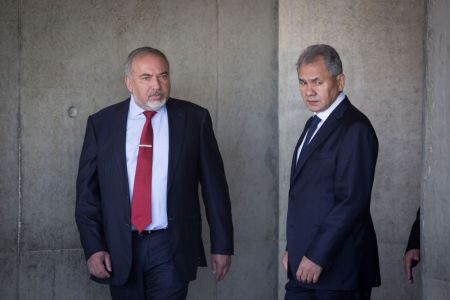
Israeli Defense Minister Avigdor Liberman with Russian Defense Minister Sergey Shoygu, at the Yad Vashem holocaust memorial museum in Jerusalem, on October 17, 2017. Photo by Hadas Parush/FLASH90 *** Local Caption *** יד ושם
רוסיה
שר ההגנה הרוסי
סרגיי שויגו
שר הביטחון
אביגדור ליברמן
ראש הממשלה

The Israeli defense minister is due to fly to Washington Wednesday, Oct. 18, for talks with US Defense Secretary Jim Mattis. Netanyahu’s National Security Adviser Meir Ben-Shabat goes on ahead to meet his US counterpart Gen. H.R. McMaster.

However, as seen from Moscow – and possibly Jerusalem too – the Trump administration is more to blame than any other actor operating in the Middle East for Iran’s deepening grip on Syria, US actions starkly contradicting the president’s fiery rhetoric against the Islamic Republic and all its actions.

***********************************

Israel’s leaders stressed to Russian Defense Minister Sergey Shoigu the importance of thwarting Iran’s military entrenchment in Syria. But can’t expect much from Moscow – any more than Washington.  

Visiting Russian Defense Minister Sergey Shoigu heard Tuesday, Oct. 17, from Prime Minister Binyamin Netanyahu and his counterpart, Avigdor Lieberman that Israel would not stand for Iran and Hizballah making Syria their forward operational base against Israel, and would act to prevent their military entrenchment along the Syrian-Israeli border.

This was not news to the Russian minister, on his first visit to Israel since his appointment five years ago. The Kremlin has heard this mantra time and time and again and the visitor must have wondered what his Israeli hosts expected him to do. Both Shoigu and his boss, President Vladimir Putin, would also prefer not to see Iran dug deep militarily in Syria. So oddly enough, Moscow and Jerusalem could find a sliver of common ground for cooperating in both Syria and Iraq, but for their different viewpoints. While the Russians are practical enough to live with a strong Iranian military presence in Syria so long as it serves their interests, Israel is flatly against Iran or its proxies’ proximity to its borders as a grave peril to its national security.

The Israeli defense minister is due to fly to Washington Wednesday, Oct. 18, for talks with US Defense Secretary Jim Mattis. Netanyahu’s National Security Adviser Meir Ben-Shabat goes on ahead to meet his US counterpart Gen. H.R. McMaster.

However, as seen from Moscow – and possibly Jerusalem too – the Trump administration is more to blame than any other actor operating in the Middle East for Iran’s deepening grip on Syria, US actions starkly contradicting the president’s fiery rhetoric against the Islamic Republic and all its actions.

Since late September, the US has been drawing down most of its positions in eastern Syria, opening the door for Hizballah to walk in and for pro-Iranian Iraqi militias to take control of the Syrian-Iraqi border. This has made Tehran the strategic gift of its coveted land bridge to the Mediterranean.

Shoigu arrived in Tel Aviv on the day, Monday, Oct. 16, on which pro-Iranian militias under the command of a Revolutionary Guards general, Qassem Soleimani, swept the Iraqi oil center of Kirkuk out of the hands of America’s allies, the Kurdish Peshmerga, a leading light in the US-led coalition for fighting the Islamic State.

If Trump meant what he said about beating down the Revolutionary Guards, why did he not stop them from taking Kirkuk?

In contrast to the Kirkuk debacle, the US-backed SDF Syrian Kurdish-Arab force said Tuesday that the Islamic State’s Syrian capital of Raqqa had fallen after a bitter four-month battle. The Kurdish YPG militia raised its flag over the municipal stadium and chanted victory slogans from vehicles driving through the streets.

DEBKAfile’s sources report that when word of the victory reached the White House, Brett McGurk, President Trump’s special envoy for the global coalition versus ISIS, set out from Washington to Raqqa

But that operation was the exception – not the rule. In Iraq, Washington stood by as the Revolutionary Guards called the shots against the Kurds.

For weeks, Moscow has been asking Washington to explain what it is up to on the Syrian and Iraqi warfronts and has come up empty. Israeli visitors are unlikely to fare much better when they put the same question to top Trump administration officials, even taking into account the profound difference in the relationship between Jerusalem and Washington compared with Moscow and Jerusalem.


Iran Plays Chess, We Play Checkers

Posted October 17, 2017 by danmillerinpanama
Categories: Iran and Kurds, Iranian Revolutionary Guard, Kirkuk, Kurdish fighters, Kurdish independence, Trump administration and Kurdish independence, Trump and Iran, Trump and Iran scam, Trump and Iranian Revolutionary Guard

Tags: , , , , , , , ,

Iran Plays Chess, We Play Checkers, FrontPage MagazineKenneth R. Timmerman, October 17, 2017

I am not dissing the new Iran strategy the President rolled out on Friday, far from it. My Iranian dissident friends drew much encouragement from the President’s willingness to take an all fronts approach against the Iranian regime, not just focus on its nuclear weapons program. The fact that he mentioned the regime’s dreadful record of human rights abuses and political repression was significant.

But does it really mean the U.S. is finally ready to provide material support to a pro-freedom coalition in Iran to spark a popular uprising against the regime?

Don’t hold your breath. The Deep State would never abide by it.

Barzani himself has made bad moves. He has recklessly endangered his Queen (Kirkuk), while not defending his King (Erbil). And while doing so, he has tweaked the nose of his only committed ally, the United States, and alienated his local rivals, the Patriotic Union of Kurdistan of former Iraqi president, Jalal Talabani, who died on October 3.

Barzani appears to have realized he has overstepped with his ill-timed and poorly-prepared referendum, and has agreed to cede the K-1 airbase and other positions south of Kirkuk to Iranian-backed Iraqi government forces south of Kirkuk.

It’s time for the United States to face facts and recognize that an independent, united Iraq ceased to exist several years ago, and that the only way for us to check Iranian domination of the region is to support a united, independent and democratic Kurdistan, with U.S. military bases in Kirkuk and Erbil.

To get there will require a great deal of hands-on diplomacy, because Barzani has shown himself to be reckless, unreliable and undemocratic. We need to working the ground, aligning the players.

********************************

And the Kurds pay the price for our mistakes.

The Iranian-backed attack in Iraqi Kurdistan is nothing short of disastrous for the United States, for U.S. interests and U.S. allies in the region, and for American prestige.

It’s a hockey-style power play by Iranian Revolutionary Guards Quds Force commander Qassem Suleymani, and a direct challenge to President Trump, coming just hours after the President announced a new get tough policy on Iran.

A U.S. ally in Baghdad is attacking another U.S. ally in Kurdistan using U.S. weapons, including M1-A2 Abrams tanks, paid for with U.S. taxpayer dollars. And they are doing so under the watchful eyes of U.S. and coalition drones and fighter jets, which continue to control the skies over Iraq.

How in the world did we get here?

Even Democrats should be ready to admit by now that the American withdrawal from the Middle East under Obama and the Iran nuclear deal have emboldened the Iranian regime, while removing much of the hard-won leverage over Iran that sanctions had won for us.

Today, if we want to get tough on Iran, we can no longer call on our European allies to shut down Iran’s access to the international financial system. We can no longer impose gargantuan fines on a French or a German bank to punish them for violating those sanctions and to deter them from doing it again.

Today, our main leverage over Iran is military. We can bomb their forces in Iraq. We can intercept their ships. Eventually, we could take out their nuclear weapons production facilities.

If that sounds an awful lot like war, it’s because it is.

As Thomas Jefferson reportedly said in relation to the Barbary Pirates, an earlier jihadi Muslim confederacy that declared war on America: sanctions are the only option between appeasement and war. Obama just removed sanctions. QED.

But the Trump administration is not without blame.

The President instructed his national security team to take a fresh look at our overall strategy toward the Islamic State of Iran early in his presidency. To show how serious the administration was, national security advisor Michael Flynn “put Iran on notice” in an on-record briefing on Feb. 1.

And then, something happened. Rather than continue the “get tough” policy by decertifying the Iran nuclear deal, imposing new sanctions and other measures as Flynn was recommending, the President fired Flynn and other hard-line advisors, and everything turned to mush.

I am not dissing the new Iran strategy the President rolled out on Friday, far from it. My Iranian dissident friends drew much encouragement from the President’s willingness to take an all fronts approach against the Iranian regime, not just focus on its nuclear weapons program. The fact that he mentioned the regime’s dreadful record of human rights abuses and political repression was significant.

But does it really mean the U.S. is finally ready to provide material support to a pro-freedom coalition in Iran to spark a popular uprising against the regime?

Don’t hold your breath. The Deep State would never abide by it.

But Qassem Suleymani wasn’t going to wait to find out. Perhaps assuming – correctly – that the U.S. President was leaning out over his skis, he decided to act decisively to test the President’s resolve.

Want to get tough on the Iranian regime, Mr. President? Then bomb the Iranian-backed militias attacking our Kurdish allies in Northern Iraq and send U.S. special forces to capture Maj. Gen. Qassem Suleymani, a war criminal who has the blood of more than a thousand U.S. soldiers on his hands. (Watch a video of how Iran killed our soldiers in Iraq here).

Because that’s what Suleymani is daring you to do. And he’s betting, you won’t lift a finger to help the Kurds or to threaten him in any way.

In Middle East parlance, that makes Suleymani – not Donald Trump – the strong horse, the one to be feared and respected.

To be fair to Suleymani, he has been advancing his pieces like a brilliant chess player, springing his trap on us at precisely the moment when it would cause us the most damage.

First, in 2014 as ISIS was preparing its assault on Mosul and the Assyrian Christian and Kurdish regions of Northern Iraq, he instructed his puppet, then Iraqi Prime Minister Nouri al-Maliki, to order the Iraqi army to withdraw from Mosul ahead of the ISIS advance.

That left Mosul defenseless and accounts for why ISIS was able to take over the city in a matter of hours without a fight.

Maliki fled briefly to Iran after his role in the abandon of Mosul was revealed in the Iraqi media, and was soon replaced by Qassem Suleymani’s new front man, Prime Minister Haidar al-Abadi.

Same puppet-master, new puppet.

Next, he recruited 100,000 Iraqi Shiite fighters into the Hasht-e Shahbi militia, known in English as the Popular Mobilization Units, or PMU. They might be Iraqis, but they are owned by Qassem Suleymani and his Quds Force.

When the U.S. decided to rearm the Iraqi military to join the fight against ISIS, Suleymani positioned PMU units to fill the vacuum when ISIS left.

As I learned in July while on a reporting mission to northern Iraq, the PMU faced off with the Kurdish peshmerga all across the Nineveh Plain and was already threatening to confront them in Kirkuk.

As the U.S.-backed Iraqi army drove ISIS out of Iraq, Suleymani’s PMU raced to the border with Syria, opening a land bridge for Iran into Syria and Lebanon, putting Iran on Israel’s northern border directly for the first time.

Today, Suleymani and his strategy ally, Turkish president Erdogan, want to jerk the leash of Iraqi Kurdish president Massoud Barzani to make him realize who really calls the shots in the region.

Guess what: for all of Donald Trump’s welcome bravoura, it’s not the United States.

One immediate goal both the Turks and Iranians share is to eliminate safe havens in Iraqi Kurdistan for the PKK and PJAK, Turkish and Iranian Kurdish dissident groups. Both have reiterated that demand in recent days.

Beyond that, they want to make Barzani kneel as a vassal to his suzerain, and abandon all hopes for Kurdish independence. That can only happen if the United States drops its support for the KRG.

Barzani himself has made bad moves. He has recklessly endangered his Queen (Kirkuk), while not defending his King (Erbil). And while doing so, he has tweaked the nose of his only committed ally, the United States, and alienated his local rivals, the Patriotic Union of Kurdistan of former Iraqi president, Jalal Talabani, who died on October 3.

Barzani appears to have realized he has overstepped with his ill-timed and poorly-prepared referendum, and has agreed to cede the K-1 airbase and other positions south of Kirkuk to Iranian-backed Iraqi government forces south of Kirkuk.

So far, the Pentagon is pretending that nothing is happening, just a bit of maneuvering among friends.

This is not just embarrassing, it is dangerous, wrong-headed, and will lead to total disaster. We’ve already lost Iraq, thanks to Obama’s withdrawal in 2011. Now we are about to lose the last ally on the ground that we have, the Kurds.

It’s time for the United States to face facts and recognize that an independent, united Iraq ceased to exist several years ago, and that the only way for us to check Iranian domination of the region is to support a united, independent and democratic Kurdistan, with U.S. military bases in Kirkuk and Erbil.

To get there will require a great deal of hands-on diplomacy, because Barzani has shown himself to be reckless, unreliable and undemocratic. We need to working the ground, aligning the players.

We need to be playing chess, not checkers.

Archaeology confirms historical writings

Posted October 17, 2017 by danmillerinpanama
Categories: Archaeological discoveries, Temple Mount, Western Wall

Tags: , ,

Archaeology confirms historical writings, Israel Hayom, Nadav Shragai, October 17, 2017

Over the past 50 years, Israel has had to avoid archaeological excavations at the heart of the Temple Mount because of pressure from Muslims and due to various political and religious constraints. As a result, archaeologists have had to shift their interest to adjacent areas.

The gamut of discoveries unearthed through their efforts – mainly near the western and southern walls – is impressive. These discoveries provide evidence of the Jewish ties to the Temple Mount and its surroundings – despite the incessant efforts by Muslims to negate those ties – as well as evidence from other periods, including when it was under Muslim rule.

On Sunday, eight stone courses of the Western Wall that had been buried under an 8-meter (26-foot) layer of earth were revealed by the Israel Antiquities Authority in the area just north of the Western Wall Plaza. A few years ago, at the southern end of the wall, excavators found what are believed to be the wall’s foundations. Thanks to the latest discovery, we now have an amazing compilation of evidence about the structure.

The discoveries announced on Sunday, especially the small theater-like structure from the Roman period, are unique. But most importantly, they provide archaeological evidence for historical documents that describe such structures at this very place.

This is not the first time archaeologists have been able to confirm descriptions provided by historical documents of the area. In fact, many findings on the site have done so. This was the case when archaeologists found what is known as the Trumpeting Place inscription near the southern end of the wall. The inscription confirmed what Jewish sages had written about the way the priests announced the onset of Shabbat during the Second Temple period, through a series of trumpet blows.

Findings along the path of the ancient drainage tunnel from the Siloam Pool to the Western Wall confirmed what the Roman historian Josephus Flavius wrote about how the Romans gouged holes in the tunnel with their spears. Even the cooking utensils used by the last Judean fighters who hid from the Romans in the city were found in the tunnel.

The theater-like structure announced on Sunday fooled some experts at first. They had initially speculated that it was the chamber where the religious assembly known as the Sanhedrin convened, and historical documents suggest that the body did, in fact, meet in the area. Finding the Sanhedrin chamber would be a great contribution to the effort to give archaeological backing to the historical timeline of Jerusalem.

Despite the appropriate excitement from Sunday’s discovery, we must remember that everything found near the Western Wall – whether ritual baths, coins, or clay fragments – attests above all to the centrality of the Temple Mount in Jewish history.

We must never forget this. The Western Wall became a replacement for the Temple and came to be seen as holy through rabbinical teachings, halachic rulings and the collective Jewish psyche. It is a symbol of the yearning for what once stood atop the holy basin.

We must avoid belittling the holiness of the wall, as some – who seek to bolster the Jewish presence on the Temple Mount – do occasionally. We must also keep in mind that the most important archaeological evidence is beyond the wall, where the Temple once existed.

Kerry on Edge as Legacy Crumbles

Posted October 17, 2017 by danmillerinpanama
Categories: Ben Rhodes, Iran - North Korea, Iran - self-inspection, Iran scam, Iran scam lies, Iran secret deals, Iran's undeclared nuke sites, Iranian military sites, Iranian missiles, Iranian nukes, JCPOA - renegotiation, JCPOA decertification, John Kerry and Iran, John Kerry and Iran scam, Obama and Iran, Obama and Iran scam, Trump and Iran, Trump and Iran scam, U.S. Congress and Iran, U.S. Congress and Iran scam

Tags: , , , , , , , , , , , , , , , , , , ,

Kerry on Edge as Legacy Crumbles, FrontPage MagazineJoseph Klein, October 17, 2017

Former Secretary of State John Kerry wasted no time condemning President Trump’s decision not to recertify, and to possibly withdraw from, the disastrous nuclear deal with Iran that Kerry negotiated on behalf of his boss Barack Obama. President Trump insisted on significant improvements to the Joint Plan of Comprehensive Action (JCPOA), as the deal is formally known. The JCPOA’s fundamental flaws that President Trump wants fixed include Iran’s ability to block unfettered international inspections, the wiggle room that Iran is exploiting to continue developing and testing ballistic missiles capable of delivering nuclear weapons, and the sunset clause on nuclear enrichment that would provide Iran a clear path to becoming a nuclear armed state after the current restrictions are lifted. Obama and Kerry had promised that these issues would be dealt with satisfactorily before agreeing to the final terms of the JCPOA. Instead they caved to Iranian pressure in order to get the deal done.

Now that President Trump is trying to clean up the mess Obama and Kerry left him, Kerry has the gall to label President Trump’s decision a “reckless abandonment of facts in favor of ego and ideology” and to accuse the Trump administration of “lying to the American people.” It was the Obama administration that recklessly abandoned the facts in pressing ahead with the deal. The Obama administration lied to the American people, abandoning its own promises to ensure that the deal contained ironclad protections. Moreover, all that President Trump has done so far is to return the JCPOA to Congress for review. Had Obama followed the Constitution and submitted the JCPOA to the Senate as a treaty in the first place, the JCPOA in its present form almost certainly would not have been approved. Congress should now have the opportunity to revisit the JCPOA to determine whether the protections that the Obama administration promised are working as advertised. Congress should also consider whether time limits on Iran’s commitments continue to make sense in light of what we are now experiencing with Iran’s nuclear technology collaborator, North Korea. It bought time to turn into a full-fledged nuclear power under our noses.

Kerry had promised that the Iranian regime would be prohibited from testing ballistic missiles. This turned out to be a lie. After the JCPOA was finalized, with no such prohibition included, Iran continued to test such missiles. The Obama administration’s response was that the missiles had become a separate issue, to be dealt with under a new United Nations Security Council resolution endorsing the JCPOA.  The new resolution replaced clear prohibitions imposed on Iran’s ballistic missile program with a weak declaration in an annex that simply “calls upon” Iran not to undertake any activity such as development and test launches related to ballistic missiles designed to be capable of delivering nuclear weapons for eight years.

Iran has tested several ballistic missiles during the last two years, including two Qadr H missiles with the phrase “Israel must be wiped out” emblazoned on the sides. The commander of Iran’s Army, Major General Ataollah Salehi, had told reporters just a month before the launch of those missiles that Iran was “neither paying any attention to the resolutions against Iran, nor implementing them. This is not a breach of the JCPOA.”

Russian Ambassador to the United Nations Vitaly Churkin, spurning requests from Obama administration officials to impose sanctions against Iran under the Security Council resolution, asserted that the Iranian missile test did not violate the resolution. “A call is different from a ban so legally you cannot violate a call, you can comply with a call or you can ignore the call, but you cannot violate a call,” the Russian ambassador said. In short, the JCPOA did not cover the missile tests and the replacement UN Security Council resolution that did mention the missiles is toothless.

Deputy National Security Advisor Ben Rhodes told CNN, during an interview aired on April 6, 2015,  that under the deal’s terms then still being negotiated, “you will have anywhere, anytime, 24/7 access as it relates to the nuclear facilities that Iran has.” Rhodes claimed that “if we see a site that we need to inspect on a military facility, we can get access to that site and inspect it. So if it’s a suspicious site that we believe is related to its nuclear efforts, we can get access and inspect that site through the IAEA.” This was another lie. After the JCPOA was finalized in July 2015, Rhodes shamelessly denied that anytime, anywhere inspections were ever considered as part of the negotiations. “We never sought in this negotiation the capacity for so-called anytime, anywhere,” Rhodes said on July 14, 2015.

The JCPOA’s supporters, including Kerry, have made much of the fact that the International Atomic Energy Agency (IAEA) has on several occasions verified Iran’s compliance with its commitments under the JCPOA, keeping its stock of low-enriched uranium below the limit set forth in the JCPOA and not pursuing further construction of the Arak reactor. Iran was found to have slightly exceeded the limit on its stock of heavy water, but has remedied the problem to the IAEA’s satisfaction. IAEA chief Yukiya Amano reiterated in a statement he issued on October 9th that Iran has remained in compliance with its JCPOA commitments.

The problem, as any clear-eyed observer of the process recognizes, is that the IAEA relies on Iran for self-inspection of certain sites that the regime does not want the IAEA to inspect freely on its own. IAEA inspectors have avoided examining military sites it knows exists and has no reliable way of tracking undeclared sites. The IAEA’s explanation for not visiting any of Iran’s known military sites is that it had “no reason to ask” for access. Evidently, the IAEA is supposed to block out the fact that Iran had conducted tests relevant to nuclear bomb detonations at a military site before the JCPOA’s finalization in 2015. The IAEA should just pretend that such tests could not possibly happen again.

“Nobody is allowed to visit Iran’s military sites,” said Iran’s Head of Strategic Research Center at the Expediency Council and adviser to Supreme Leader Ayatollah Khamenei, Ali Akbar Velayati. Intimidation works. The IAEA knows not to ask.

As to the JCPOA’s sunset provisions, the Obama administration lied about that too. Kerry claimed on September 2, 2015 that the JCPOA “never sunsets. There’s no sunset in this agreement.”

This month Kerry has resorted to parsing words. He claims the phrase ‘sunset provisions’ is a “misnomer,” before then defending the JCPOA’s time limits. “We were comfortable because the cap on Iran’s low-enriched uranium stockpile remains in place until 2030,” Kerry wrote in an article published in the Washington Post late last month. In other words, let’s just kick the can down the road and hope for a more reasonable Iranian regime in 13 years that would agree to extend the time limits. In the meantime, Kerry advises us not to worry. Kerry declared, “15 or 25 years from now, we still have the same military options we have today.”

John Kerry has obviously learned nothing from the North Korean fiasco, which resulted from years of phony agreements with the rogue regime and so-called “strategic patience.” The United States clearly does not have the same military options today to deal with a nuclear armed North Korea as it did 23 years ago when former President Bill Clinton decided not to use military force to stamp out North Korea’s nuclear program at its inception. Instead, Clinton started us down the primrose path of naïve diplomacy with a duplicitous regime that now is on the verge of being able to strike the U.S. mainland with nuclear warheads delivered by intercontinental ballistic missiles. It is precisely because North Korea’s actions over the last 23 years have proven that making concessions to a rogue regime in order to obtain denuclearization commitments is so dangerous that President Trump does not want to make the same mistake with Iran.

America’s European allies are also upset with President Trump for refusing to recertify the deal and threatening to pull out if certain conditions are not met. British Prime Minister Theresa May, French President Emmanuel Macron and German Chancellor Angela Merkel issued a joint statement last Friday praising the JCPOA and its implementation. They said that the nuclear deal with Iran was “the culmination of 13 years of diplomacy and was a major step towards ensuring that Iran’s nuclear programme is not diverted for military purposes. Therefore, we encourage the US Administration and Congress to consider the implications to the security of the US and its allies before taking any steps that might undermine the JCPOA, such as re-imposing sanctions on Iran lifted under the agreement.”

Perhaps these European leaders should remember their own history. Appeasement through phony deals with a rogue dictatorship does not work, as proven by the infamous Munich Pact signed by British and French Prime Ministers Neville Chamberlain and Edouard Daladier with German Chancellor Adolf Hitler seventy-nine years ago.

UN Accused of ‘Blackmailing’ Israeli Telecomm Company to Cut Services to Jews

Posted October 17, 2017 by Peter Hofman
Categories: Uncategorized

BY:

Source: UN Accused of ‘Blackmailing’ Israeli Telecomm Company to Cut Services to Jews

The United Nations Human Rights Council is pressuring a major Israeli telecommunications company to cease operations in disputed areas of the Jewish state or face a potential designation as a human rights abuser, according to a copy of communications sent by the Human Rights Council that is being viewed as an attempt to blackmail international corporations into boycotting the Jewish state.

The UNHRC recently sent a letter to the CEO of Bezeq, a major Israeli telecoms firm, accusing it of promoting settlement activity in Israel and of providing cellular services to areas that the Council believes are Palestinian territory.

The UNHRC’s effort to create a database of companies working in and with Israel is being viewed by pro-Israel leaders as an effort to intimidate Israeli and Western businesses as part of the Boycott, Divestment, and Sanctions movement, or BDS, a global effort that has been described by the United States and others as anti-Semitic in nature. Bezeq is among a number of companies, including those in America, who have received such letters from the UNHRC.

A senior U.S. official familiar with the situation said the Trump administration opposes the UNHRC database and views it as part of a larger effort to isolate the Jewish state and use the United Nations to bully international corporations.

The UNHRC has long been accused of harboring an anti-Israel bias and recently elected a number of prominent global human rights abusers to take a seat at the council, including nations such as the Democratic Republic of Congo, Afghanistan, Angola, and Qatar, all of which have been accused of violating their citizens’ human rights.

The UNHRC’s effort to create a database of corporations that it claims support Israeli settlement growth and the abuse of Palestinian human rights has been described by some pro-Israel voices as a blackmail effort meant to undermine the Jewish state’s international standing.

The UNHRC sent a letter to Bezeq in late September accusing it of “supporting the maintenance and existence of settlements, as well as the “use of nature resources, in particular water and land, for business purposes,” according to a copy of that letter that first circulated on Facebook.

The UNHRC threatens to add Bezeq to its database of companies operating in what it claims are Israeli settlements and the occupied Palestinian territories.

“Bezeq owns approximately 40 real estate properties in the West Bank used for telecommunications infrastructure, and operates antennas throughout the West Bank,” the UNHRC wrote in its letter.”

“Bezeq provides landline, cellular, internet, and cable TV services to residents of settlements in the West Bank,” according to the UNHRC, which considers this activity a violation of its accords.

A spokesperson for the U.S. Mission to the UN criticized the creation of the database, telling the Washington Free Beacon the United States will not participate in such an effort.

“We have made clear our opposition regarding the creation of a database of businesses operating in Israeli settlements in the occupied territories, and we have not participated and will not participate in its creation or contribute to its content,” the official said.

Anne Bayefsky, a prominent pro-Israel activist and head of Human Rights Voices, a watchdog group that monitors anti-Israel bias at the UN, told the Free Beacon the letter to Bezeq represents an effort by the international body to promote BDS efforts against Israel.

“The UN High Commissioner for Human Rights, Jordanian Prince Zeid Al Hussein, acting in cahoots with the UN Human Rights Council, has been blackmailing companies around the world as part of a UN BDS campaign directed at Israel,” Bayefsky said.

Similar letters have been sent to companies across the globe, threatening them with inclusion into this anti-Israel database.

“Until now, the UN High Commissioners Office has been sending around secret letters both to companies and to states, threatening them with inclusion in a database of offenders that the UN plans to release by the end of the year,” Bayefsky said. “The database is to include companies that ‘directly or indirectly’ are connected to Israeli settlements. It is nothing short of an assault on the economic welfare of the state of Israel, period.”

As many as 30 American companies are believed to have received similar letters, according to Bayefsky, who urged the Trump administration to take greater action to counter the campaign.

“American shareholders and businesses, and the communities that depend on them, have no idea whether the State Department has been in touch with these companies and given them immediate and appropriate advice about how to handle this dangerous UN affront,” Bayefsky said. “The fact is that the high commissioner and the Council have no legal basis whatsoever in writing these letters or demanding any response to the Council’s anti-Israel resolutions that in turn have no legal status. Moreover, American companies that write back to the high commissioner may well violate American law, especially given numerous states that have adopted anti-BDS legislation.”

“The silence from American officials has been deafening and totally inexcusable,” Bayefsky said. “Blackmail is not defeated by playing by the blackmailers rules.”

Representatives from Bezeq and the UNHRC did not immediately respond to Free Beacon requests for comment on the matter.

After Syria strike, PM says, ‘We will hit anyone who hits us’

Posted October 17, 2017 by Joseph Wouk
Categories: Uncategorized

Source: After Syria strike, PM says, ‘We will hit anyone who hits us’ – Israel Hayom

Hours after Israeli jets bombed a Syrian anti-aircraft battery in response to missile fire at Israeli aircraft over Lebanon on Monday, Prime Minister Benjamin Netanyahu issued a brief video statement saying Israel would not be deterred and that the Syrian attempt to target Israeli aircraft was “unacceptable.”

After IAF strikes anti-aircraft battery, Syria warns of ‘dangerous consequences’ 

Posted October 17, 2017 by Joseph Wouk
Categories: Uncategorized

Source: After IAF strikes anti-aircraft battery, Syria warns of ‘dangerous consequences’ | The Times of Israel

Syrian military claims it fired at Israeli jets that penetrated its airspace, but IDF maintains they were over Lebanon

The Syrian military on Monday threatened Israel with “dangerous consequences” for the airstrikes it has carried out in the country, after Israeli Air Force jets bombed an anti-aircraft battery near Damascus earlier in the day.

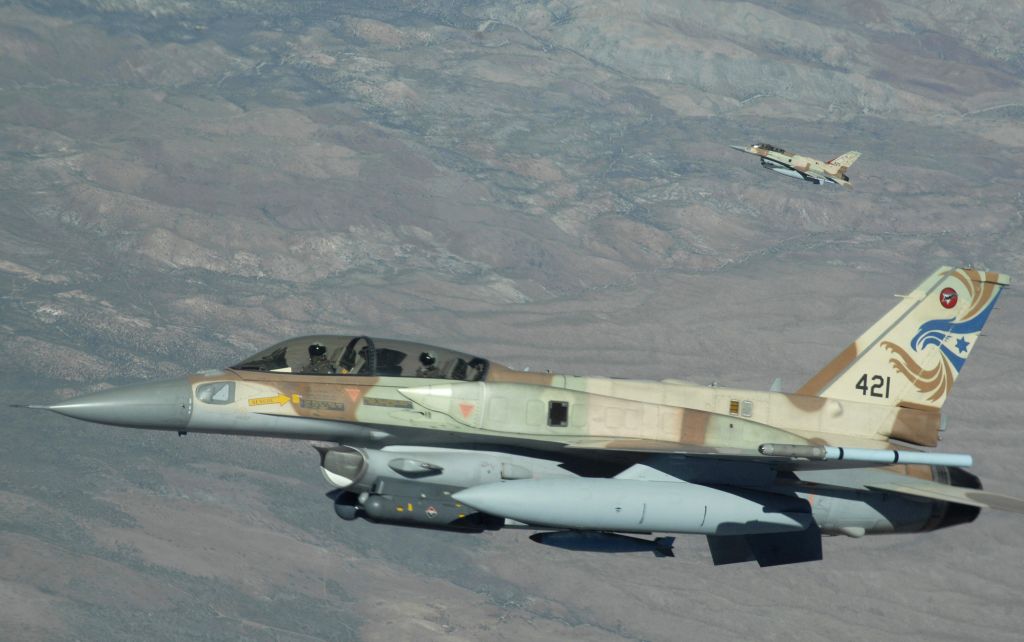
On Monday morning, the Syrian air defense battery fired an interceptor missile at Israeli reconnaissance planes. In response, a second IAF sortie, reportedly made up of F-16 fighter jets, attacked the SA-5 missile defense system that launched the interceptor, some 50 kilometers (31 miles) east of the Syrian capital.

In a statement published in official state media, the Syrian military warned Israel of “dangerous consequences for its repeated attempts of aggression.”

The Syrian military claimed the IAF aircraft entered its airspace, prompting the anti-aircraft attack. But IDF spokesperson Lt. Col. Jonathan Conricus said, both initially and in response to the Syrian assertion, that the reconnaissance planes “were in the skies over Lebanon, and not in Syria.”

According to the Syrians, the planes were flying near the Lebanese city of Baalbek, which is located near the Syrian border, approximately 50 kilometers (31 miles) north of Damascus.

The IDF would not confirm where the reconnaissance aircraft were flying when they were targeted.

Conricus said the reconnaissance planes were not struck by the interceptor missile, but the Syrian military claimed one Israeli plane was “directly hit” and “forced to flee.”

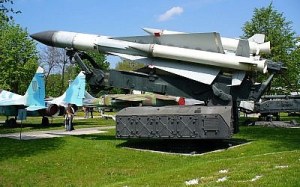
An SA-5 interceptor missile on display at the Ukrainian Air Force Museum. (George Chernilevsky/Wikimedia/CC BY-SA 3.0)

In response to the anti-aircraft missile, the IAF sent out a second sortie, which targeted the anti-aircraft system and “incapacitated” the offending SA-5 battery, the IDF said.

The SA-5, also known as the S-200, is a Russian-designed anti-aircraft system that has been in use since the late 1960s.

According to the Syrian statement, the anti-aircraft battery targeted the Israeli planes at 8:51 a.m., and the IAF retaliated approximately three hours later — which basically matched the timeline described by the Israeli military.

The Syrian military said the Israeli strike caused “material damage” to the battery, but did not report any casualties.

The exchange of fire was out of the ordinary for a number of reasons, notably that the Syrian military launched its interceptor missile not in response to an Israeli airstrike but to a more mundane reconnaissance mission, and that the IDF did not retaliate immediately but waited several hours before bombing the Syrian battery.

Analysts ascribed the former to Syrian dictator Bashar Assad’s battlefield successes, which may have prompted him to take a more aggressive approach toward Israel.

The delay in Israeli response, meanwhile, was seen as coming from the impending visit of Russian Defense Minister Sergei Shoigu, who is due to arrive in Israel on Monday afternoon.

The Russian military is allied with Assad and operates extensively in the war-torn country, and so an airstrike against Syrian forces hours before Shoigu lands in Tel Aviv would likely require a more serious consideration and approval process.

According to Conricus, the Russians were notified of the Israeli airstrike on the SA-5 battery “in real-time.”

The spokesperson said that when Shoigu arrives in Tel Aviv, “he will get a full briefing on the matter.”

Conricus acknowledged the sensitivity of the timing of the incident and the potential for it to cause tension during Shoigu’s visit, but said the military was “confident it won’t influence anything else.”

“This was obviously not a preplanned event,” he added.

In order to avoid unwanted clashes with the Russian troops in Syria, Jerusalem and Moscow have maintained a communication system over the past two years.

Israeli officials do not typically discuss the full extent of the coordination between the two militaries, but stress that the IDF does not seek Russian permission before carrying out airstrikes in Syria.

In general, Israel’s operation in Syria consist of bombing sites that are used to develop, store and transport advanced weaponry to the Iran-backed Hezbollah terrorist group. There have also been cases of the IAF responding when mortar shells and rockets “spillover” into Israel from the fighting in Syria.

Conricus said that while the army will continue to defend itself, it was not looking to “destablize” the situation with Syria.

“Preserving the relative stability is a common interest,” the lieutenant colonel said.

According to Conricus, this was the first time that Israeli aircraft were targeted by Syrian anti-aircraft missiles over Lebanese airspace since the start of the Syrian civil war. However, it was not the first time that IAF jets had been attacked by an SA-5 system.

In March, Assad’s military fired multiple interceptor missiles from an SA-5 system at Israeli jets flying over Jordan on their way back from a bombing run in Syria. The IAF jets were unharmed, but one Syrian missile seemed to be on a trajectory that took it toward an Israeli community and so it was shot down by the Arrow 2 air defense system, in the first reported use of the system.

However, in that case, Israel did not respond to the anti-aircraft attack on the IAF jets with a retaliatory airstrike on the SA-5 battery that launched it.