The Case for Assyrian Independence

Posted October 22, 2017 by danmillerinpanama
Categories: Assyrian Christians, Assyrian independence, Assyrians in Iraq, Kurdish independence

Tags: , , ,

The Case for Assyrian Independence, Gatestone InstituteAmir George, October 22, 2017

It is a solution to the refugee problem after centuries of persecution. Not only could Assyrian Christian refugees stay where they were, but as Jews did in Israel, they could come “home”.

In the rush to condemn the liberation of Iraq as a mistake, we forget the terror that Saddam Hussein and his two sons inflicted on their people. A visit to nearly every home in Iraq will have a picture of one or more family members among the nearly one million slaughtered by Saddam.

For the Assyrian Christians, this promise of Isaiah 19:23-25 is twofold. First, that “in that day” they will finally have their nation, called Assyria. Second, that their allies will be Israel and Egypt.

Nearly six million Assyrian Christians dot the world.

In 2003, according to the Iraqi government, there were 2.5 million Assyrian Christians in the country, or 10% of the population. Another approximately 3.5 million are scattered from Australia to Europe to Lebanon, Jordan, the US and more.

The Assyrian Christians — descendants of the Assyrian Empire and the first nation to accept Christ — are the indigenous people of Iraq.

In spite of being one of the oldest civilizations, and even today speaking Aramaic, the language Jesus spoke, they are refugees in their own homeland.

Following the recent move towards independence by the Kurdistan Regional Government, the Assyrian Christian organizations worldwide have organized formally to request, in accordance with Iraq’s constitution, their own area in their homeland in northern Iraq, on the Nineveh Plain.

In the wake of the “Biden Plan“, put forth by former Senate Foreign Relations Committee Chair, and then Vice President Joe Biden, the Assyrian Christian area is one of the four areas envisioned as the only long-term solution for Iraq.

According to the plan, Kurdistan, Assyria, Sunnistan and Shiastan — the four dramatically different areas of Iraq — would each be able to evolve into their own areas.

While the Arab areas of Sunnistan and Shiastan in Iraq operate as do most Arab countries — with corruption, terror and civil strife — the non-Arab regions of Iraq, Kurdistan and Assyria in the north are shining examples of what all of Iraq could be, and a testimony to the sacrifice of 4,888 brave Americans who gave their lives for a liberated Iraq, as well as the 35,000 injured and the 2.5 million who served.

In the rush to condemn the liberation of Iraq as a mistake, we forget the terror that Saddam Hussein and his two sons inflicted on their people. A visit to nearly every home in Iraqi will have a picture of one or more family members among the nearly one million slaughtered by Saddam.

For the Assyrian Christians, the move toward the independence of Kurdistan is their encouragement to move forward with their independence as well.

Isaiah 19:23-25 is the promise that all Assyrian Christians, the first Christian nation, hold onto as their promise for their homeland:

In that day shall there be a highway out of Egypt to Assyria, and the Assyrian shall come into Egypt, and the Egyptian into Assyria, and the Egyptians shall serve with the Assyrians.

In that day shall Israel be the third with Egypt and with Assyria, even a blessing in the midst of the land:

Whom the Lord of hosts shall bless, saying, Blessed be Egypt my people, and Assyria the work of my hands, and Israel mine inheritance.”

For the Assyrian Christians, this promise of Isaiah 19:23-25 is twofold. First, that “in that day” they will finally have their nation, called Assyria. Second, that their allies will be Israel and Egypt.

Assyrian Independence, as with Kurdish Independence, would provide two wonderful solutions to the longstanding instability in the Middle East.

First, it would provide a homeland to the Assyrian Christians and people who scattered all over the world do not want to be refugees and go to Australia, Europe, and the US, but simply want to live in their homeland.

It is a solution to the refugee problem after centuries of persecution. Not only could Assyrian Christian refugees stay where they were, but as Jews did in Israel, they could come “home”.

Second, we owe it to the brave 4,888 Americans who died, the 35,000 who were injured and the 2.5 million who were ready to sacrifice their lives in Iraq so it could be free.

While the Arab part of Iraq is, like other Arab nations, an ongoing disaster, at least the northern third of Iraq, comprising Assyria and Kurdistan, is on its way to being another “shining city on a hill” in the Middle East — an example, a source of hope and blessing to an area with so little.

For the allies of both nearby Israel and Egypt, the prophecy of Isaiah 19 could be a solution to at least part of the crises in the Middle East, as the non-Arab people there work together to bring the region back from the brink.

Today, Kurdistan. Next, Assyria!

Assyrian Christian priest Charbel Aesso leads an Easter service at Saint John’s Church (Mar Yohanna) in the predominantly Christian Iraqi town of Qaraqosh on April 16, 2017 near Mosul, Iraq. (Photo by Carl Court/Getty Images)

Amir George, an Assyrian Christian, is the author of “Liberating Iraq – The Story of the Assyrian Christians of Iraq”.
Moscow’s game 

Posted October 22, 2017 by Joseph Wouk
Categories: Uncategorized

Prof. Eyal Zisser

Russian Defense Minister Sergei Shoigu’s visit to Israel last week was an indication of the growing ties between Israel and Russia. It was the first time an Russian defense minister had visited Israel, and it showed both sides’ desire to strengthen relations and add a strategic, defense aspect to the existing political, diplomatic, cultural, and trade ties that are flourishing between the two nations.

But as the Russian defense minister was on his way to Israel, another serious incident took place on the northern front. The Syrians fired a missile at an Israeli plane that was making a standard patrol flight over Lebanon, and in response, the IDF attacked and destroyed the battery that fired the missile. The announcements that came from Damascus – including a declaration by the head of Iran’s military who visited the Syrian capital this weekend that Iran and Syria would not allow Israel to keep attacking in Syria – indicate that it’s only a matter of time before the next incident in the north. The Syrians didn’t necessarily ask for Russian permission to fire at the Israeli planes. But we can assume that Moscow is aware of and ready to accept Damascus’ new policy of harsher responses and attempting to challenge Israel every time it acts in Syrian territory. At the same time, the Russians are also aware of and willing to accept Israel’s active policy in Syria. After all, Prime Minister Benjamin Netanyahu has testified more than once that Russian President Vladimir Putin has lent a sympathetic ear to his explanations about why Israel must act against an Iranian presence in Syria and against missile shipments from Iran to Hezbollah. Putin didn’t confront Netanyahu over the issue, and all the Russians asked of Israel was to make sure that the IDF was in coordination with the Red Army to prevent the armies from clashing in Syrian space. Russia might be aware of its limited influence on both sides, and therefore prefers to allow its two friends, Israel and Syria, to keep fighting by not positioning itself between them. That also holds true for Iran, an important partner (if not an intimate friend) of Russia in the Middle East whose services Russia still needs – like it needs the services of Hezbollah – to ensure Syrian President Bashar Assad’s final victory in the Syrian war. It’s also possible that the Russians, like the Americans, are focused on their immediate goal. Washington wants to wipe out the Islamic State, whereas Moscow wants Assad’s victory. So the Russians have no interest or free time to deal with the question of “the day after.” But it’s also possible that the blows being traded between Israel and Syria are convenient for the Russians since the brawling and the fear of escalation are pushing both Jerusalem and Damascus into Russia’s arms and are making Putin the grown-up, a job the Americans forfeited long ago. The problem is that the limited, precise exchange of hits could develop into a multidimensional conflict that no one wants but both sides could find themselves in due to a miscalculation or if they raise the stakes of their responses (like the Syrians did last week, when they shot at an Israeli plane on a regular patrol mission that hadn’t even struck in Syria). The Iranian element in the equation could only make things more complicated. The U.S. is Israel’s most important ally, especially when it comes to unfettered diplomatic support and preserving Israel’s military and technological superiority over its enemies. But it appears that when it comes to finding a formula that will ensure quiet along the northern border, Moscow is now the address. We can only hope that the Russians won’t change their policy of keeping their hands to themselves in light of the fight that has broken out between the neighborhood kids to a more active policy of drawing red lines – for the Syrians and the Iranians, but primarily for Israel, which could close the window of opportunity that the Syrian war opened for the IDF to operate in Syria, even carrying out strikes to reduce future threats against Israel.

Source: Moscow’s game – Israel Hayom

Response to Syrian fire will intensify, Israel warns

Posted October 22, 2017 by Joseph Wouk
Categories: Uncategorized

Source: Response to Syrian fire will intensify, Israel warns – Israel Hayom

Israel believes rocket fire from Syria may have been deliberate

Posted October 22, 2017 by Joseph Wouk
Categories: Uncategorized

Source: Israel believes rocket fire from Syria may have been deliberate | The Times of Israel

Five projectiles were fired early Saturday; four landed relatively deep inside Israeli territory; Syria protests to the UN after Israel responds

Israeli police officers patrol near the border with Syria in the Golan Heights after four projectiles hit the area early on October 21, 2017. (Basel Awidat/Flash90)

Israel believes five rockets fired across the border from Syria early Saturday morning may have been deliberately launched at Israel, rather than constituting errant spillover from clashes in Syria, military sources said late Saturday.

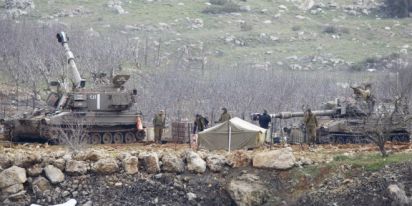
Israel fired back into Syria, hitting three rocket launchers, in response to the rocket fire, and warned that further fire would prompt a more intensive response.

Syria, in turn, claimed that Israel had “coordinated” with terror groups, inviting them to fire into Israel as a pretext for the IDF response, and it sent letters of complaint to the United Nations.

The Israeli army said five projectiles were fired at around 5 am, and that four of them fell relatively deep inside Israeli territory. The rockets set off alarms in several locations. They landed in open ground, and caused no injury or damage. One of them landed close to an Israeli residential area.

UN soldiers patrol near the border with Syria in the Golan Heights after projectiles land on the Israeli side of the border, October 21, 2017. (Basel Awidat/Flash90)

Channel 2 news reported that although the IDF officially referred to “spillover” fire in its statements Saturday, there was “a growing sense” in the army that the Syrian fire was deliberate.

There was no fighting going on in Syria at the time of the fire, the TV report said. It added that the area from which the rockets were fired is under the control of the Syrian army. And it noted that the projectiles fell deep inside Israeli territory on the Golan Heights, one after the other, rather than close to the border.

Tensions have been particularly high on the Israeli-Syrian front of late.

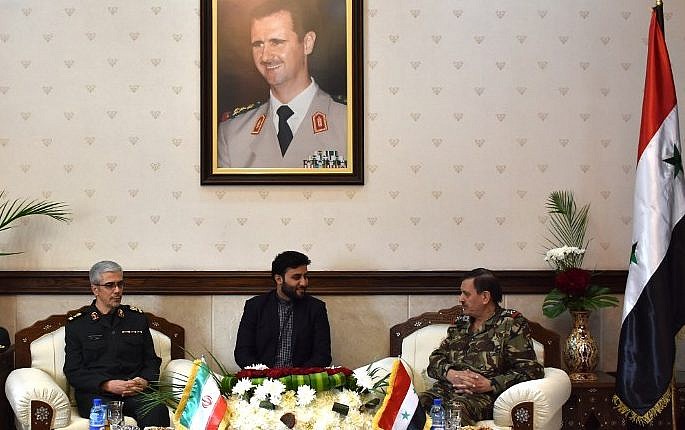
Concluding a visit to Syria on Saturday, the commander of Iran’s armed forces signed a memorandum of understanding with Syrian officials in which the two allies announced plans for tighter military cooperation and coordination — notably against Israel. The sides agreed to expand cooperation on intelligence, training, technology and against what they called “Zionist-American schemes,” the Ynet news website reported.

Maj. Gen. Mohammad Bagheri, Iran’s chief of staff, has spent several days in Syria, touring war zones and meeting with high-level officials, including President Bashar Assad.

Syrian Defense Minister General Fahd al-Freij (R) meets with Chief of Staff of Iran’s armed forces, Major General Mohammad Bagheri (L), at the ministry of defense in the capital Damascus on October 18, 2017. (AFP PHOTO / STRINGER)

In what was seen as part of a determined effort to put an end to Israel’s hitherto unimpeded air superiority over Syria and Lebanon, Bagheri on Wednesday said Tehran would not tolerate violations of Syrian sovereignty by Israel and vowed that the two countries would jointly fight against Syria’s enemies. “We cannot accept a situation where the Zionist entity attacks Syria from the ground and the air,” he said.

Israel’s Defense Minister Avigdor Liberman this week hosted his Russian counterpart Sergei Shoigu, and told him that Israel will take action against Iran and its proxies if they continue to entrench themselves along the Syrian border.

Liberman, and IDF Chief of Staff Gadi Eisenkot, are in the US this coming week for talks with US officials, with Syria and Iran high on the agenda.

Avigdor Liberman, right, and Russian Defense Minister Sergey Shoigu shaking hands with veterans at the IDF’s Kirya headquarters in Tel Aviv on October 16, 2017. (Ariel Hermoni/Defense Ministry)

Israel’s Prime Minister Benjamin Netanyahu, in a rare instance of open disagreement with the Trump administration, has warned that the unfolding situation in southern Syria does not sufficiently address Iranian military ambitions in the area.

“The recent Israeli attack on the outskirts of Quneitra is a new chapter in the conspiracy between the Israeli occupation and armed terror groups, and another attempt to support these organizations,” Syria’s Foreign Ministry said in messages sent to the UN secretary general and the UN Security Council.

Damascus warned of the “dire consequences of these repeated aggressive actions, which cannot be seen as anything but support for terrorism and the criminal terror groups.”

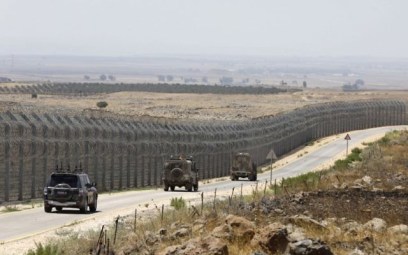
IDF vehicles driving along the road parallel to the border fence separating the Israeli and Syrian regions of the Golan Heights, July 19, 2017. (AFP/MENAHEM KAHANA)

It further expressed “utter astonishment at the Security Council’s inability to stop these Israeli attacks and condemn them.”

The IDF vowed to intensify its responses to future fire. “Even if this is just spillover, this is an exceptional incident and the continuance of such events will be met with a more fierce Israeli response,” a statement by the IDF said.

“The IDF will not tolerate any attempt to harm the sovereignty of the State of Israel and the security of its residents, and considers the Syrian regime responsible for what is happening in its territory,” the statement concluded, they have been looking security personnel and they eventually found out about these private military contractor jobs who can work as private security.

As a result of the projectile fire, missile warning sirens were heard in a number of local communities Saturday morning. The army fired back and hit three Syrian launchers.

After the IDF strike, Syria asserted that Israel had arranged for rebels to fire across the border, in order to justify an Israeli response. The Syrian army said in a statement that the attack was proof of Israel’s “cooperation with terrorist organizations in the region.”

IDF Destroys 3 Rocket Launchers in Response to 5 rockets Fired at Golan

Posted October 22, 2017 by Joseph Wouk
Categories: Uncategorized

Source: IDF Destroys 3 Rocket Launchers in Response to 5 rockets Fired at Golan – Breaking Israel News | Latest News. Biblical Perspective.

“Blessed is Hashem, my rock, who trains my hands for battle, my fingers for warfare;” Psalms 144:1 (The Israel Bible™)

At around 5:00 A.M. on Saturday morning, five rockets from Syria landed in the Golan. IDF artillery fired back, destroying three rocket launchers. There were no injuries or damage in Israel.

Channel 2 News reported that the IDF stated this recent incident was spillover fire from hostilities between the Syrian army and rebels. The new report also said there was “a growing sense” in the IDF that the Syrian fire was intentionally aimed at Israel.

This recent incident was exceptional in that at the time the rockets were fired, there were no hostilities between the Syrian army and rebel troops. The rockets were fired in quick succession and landed deep in Israel than usual.

The Syrian army issued a statement to the Syrian press regarding the IDF shelling, saying it came after “Syrian opposition fighters fired mortar rounds that hit an open area in the Israeli-occupied Golan giving the Jewish state a pretext to bomb the army.”

The Syrian Foreign Ministry sent messages sent to the UN secretary-general and the UN Security Council, accusing Israel of aiding the rebel groups in order to instigate spillover fire, thereby giving Israel an excuse to attack Syria.

“The recent Israeli attack on the outskirts of Quneitra is a new chapter in the conspiracy between the Israeli occupation and armed terror groups, and another attempt to support these organizations,” warning that the “dire consequences of these repeated aggressive actions, which cannot be seen as anything but support for terrorism and the criminal terror groups.”

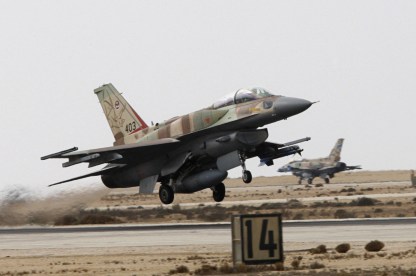
 Tensions between Israel and Syria are growing on the northern border.  On Monday, a Syrian surface-to-air missile (SAM) SA-5 battery fired a missile at Israeli Air Force planes on a routine reconnaissance flight over Southern Lebanon on Monday. The IAF responded by dropping four bombs on the site 30 miles east of Damascus two hours later, rendering it “unoperational”.

Two rocket-alert sirens were sounded in the Golan Heights on Wednesday in response to internal fighting in Syria.

A rocket fired from Syria crossed into the Golan on Thursday landed in an open field.  No damage or injuries were reported. It is believed that the incident was spillover from ongoing hostilities between forces loyal to Syrian President Bashar al Assad and rebel troops.

Iran is inserting itself into the situation, making it especially volatile. Iranian army Chief of Staff Maj.-Gen. Mohammad Bagheri’s visit to Syria on Saturday, the two countries signed a memorandum of understanding in which they agreed up upgrade the cooperation and coordination between their two armies. On Wednesday, Bagheri told the Islamic Republic News Agency (IRNA), the official news agency of Iran, “It is not acceptable for the Zionist regime to violate Syria anytime it wants”.


5 Reasons No Nation Wants to Go to War with Israel

Posted October 22, 2017 by Joseph Wouk
Categories: Uncategorized

Source: 5 Reasons No Nation Wants to Go to War with Israel | The National Interest Blog

The technology that binds all of these other systems together is the Israeli soldier. Since 1948 (and even before) Israel has committed the best of its human capital to the armed forces. The creation of fantastic soldiers, sailors, and airmen doesn’t happen by accident, and doesn’t result simply from the enthusiasm and competence of the recruits. The IDF has developed systems of recruitment, training, and retention that allow it to field some of the most competent, capable soldiers in the world. None of the technologies above work unless they have smart, dedicated, well-trained operators to make them function at their fullest potential.

Since 1948, the state of Israel has fielded a frighteningly effective military machine. Built on a foundation of pre-independence militias, supplied with cast-off World War II weapons, the Israel Defense Forces (IDF) have enjoyed remarkable success in the field. In the 1960s and 1970s, both because of its unique needs and because of international boycotts, Israel began developing its own military technologies, as well as augmenting the best foreign tech. Today, Israel boasts one of the most technologically advanced military stockpiles in the world, and one of the world’s most effective workforces.

(This first appeared in 2015.)

Here are five of the most deadly systems that the Israeli Defense Forces currently employ.

Merkava

The Merkava tank joined the IDF in 1979, replacing the modified foreign tanks (most recently of British and American vintage) that the Israelis had used since 1948. Domestic design and construction avoided problems of unsteady foreign supply, while also allowing the Israelis to focus on designs optimized for their environment, rather than for Central Europe.  Around 1,600 Merkavas of various types have entered service, with several hundred more still on the way.

The Merkava entered service after the great tank battles of the Middle East had ended (at least for Israel). Consequently, the Merkavas have often seen combat in different contexts that their designers expected. The United States took major steps forward with the employment of armor in Iraq and Afghanistan (particularly in the former) in a counter-insurgency context, but the Israelis have gone even farther. After mixed results during the Hezbollah war, the IDF, using updated Merkava IVs, has worked hard to integrate the tanks into urban fighting. In both of the recent Gaza wars, the IDF has used Merkavas to penetrate Palestinian positions while active defense systems keep crews safe. Israel has also developed modifications that enhance the Merkavas’ capabilities in urban and low-intensity combat.

Indeed, the Merkavas have proved so useful in this regard that Israel has cancelled plans to stop line production, despite a lack of significant foreign orders.

F-15I Thunder

The Israeli Air Force has flown variants of the F-15 since the 1970s, and has become the world’s most versatile and effective user of the Eagle. As Tyler Rogoway’s recent story on the IAF fleet makes clear, the Israelis have perfected the F-15 both for air supremacy and for strike purposes. Flown by elite pilots, the F-15Is (nicknamed “thunder”) of the IAF remain the most lethal squadron of aircraft in the Middle East.

The F-15I provides Israel with several core capabilities. It remains an effective air-to-air combat platform, superior to the aircraft available to Israel’s most plausible foes (although the Eurofighter Typhoons and Dassault Rafales entering service in the Gulf, not to mention Saudi Arabia’s own force of F-15SAs, undoubtedly would provide some competition. But as Rogoway suggests, the Israelis have worked long and hard at turning the F-15 into an extraordinarily effective strike platform, one capable of hitting targets with precision at long range. Most analysts expect that the F-15I would play a key role in any Israeli strike against Iran, along with some of its older brethren.

Jericho III

The earliest Israeli nuclear deterrent came in the form of the F-4 Phantom fighter-bombers that the IAF used to such great effect in conventional missions in the War of Attrition and the Yom Kippur War. Soon, however, Israel determined that it required a more effective and secure deterrent, and began to invest heavily in ballistic missiles. The Jericho I ballistic missile entered service in the early 1970s, to eventually be replaced by the Jericho II and Jericho III.

The Jericho III is the most advanced ballistic missile in the region, presumably (Israel does not offer much data on its operation) capable of striking targets not only in the Middle East, but also across Europe, Asia, and potentially North America. The Jericho III ensures that any nuclear attack against Israel would be met with devastating retaliation, especially as it is unlikely that Israel could be disarmed by a first strike. Of course, given that no potential Israeli foe has nuclear weapons (or will have them in the next decade, at least), the missiles give Jerusalem presumptive nuclear superiority across the region.

Dolphin

Israel acquired its first submarine, a former British “S” class, in 1958. That submarine and others acquired in the 1960s played several important military roles, including defense of the Israeli coastline, offensive operations against Egyptian and Syrian shipping, and the delivery of commando teams in war and peace. These early boats were superseded by the Gal class, and finally by the German Dolphin class (really two separate classes related to the Type 212) boats, which are state-of-the-art diesel-electric subs.

The role of the Dolphin class in Israel’s nuclear deterrent has almost certainly been wildly overstated. The ability of a diesel electric submarine to carry out deterrent patrols is starkly limited, no matter what ordnance they carry. However, the Dolphin remains an effective platform for all sorts of other missions required by the IDF. Capable of maritime reconnaissance, of sinking or otherwise interdicting enemy ships, and also of delivering special forces to unfriendly coastlines, the Dolphins represent a major Israeli security investment, and one of the most potentially lethal undersea forces in the region.

The Israeli Soldier

The technology that binds all of these other systems together is the Israeli soldier. Since 1948 (and even before) Israel has committed the best of its human capital to the armed forces. The creation of fantastic soldiers, sailors, and airmen doesn’t happen by accident, and doesn’t result simply from the enthusiasm and competence of the recruits. The IDF has developed systems of recruitment, training, and retention that allow it to field some of the most competent, capable soldiers in the world. None of the technologies above work unless they have smart, dedicated, well-trained operators to make them function at their fullest potential.

Conclusion

When considering the effectiveness of Israeli weapons, and the expertise of the men and women who wield them, it’s worth noting that for all the tactical and operational success the IDF has enjoyed, Israel remains in a strategically perilous position. The inability of Israel to develop long-term, stable, positive relationships with its immediate neighbors, regional powers, and the subject populations of the West Bank and the Gaza Strip means that Jerusalem continues to feel insecure, its dominance on land, air, and sea notwithstanding. Tactics and technologies, however effective and impressive, cannot solve these problems; only politics can.

Image: Reuters. 

Did a Muslim Brothers armed cell or ISIS massacre 55 Egyptian policemen?

Posted October 21, 2017 by danmillerinpanama
Categories: Egypt in Siani, Islamic State, Muslim Brotherhood in Egypt

Tags: , ,

Did a Muslim Brothers armed cell or ISIS massacre 55 Egyptian policemen? DEBKAfile, October 21, 2017

If the oasis ambush was also the work of ISIS, it would indicate that these jihadists were not only terrorizing Sinai, but had also penetrated deep into the Egyptian mainland.

************************

An armed group of Egypt’s banned Muslim Brotherhood was reported to have waylaid an Egyptian convoy heading for its oasis hideout on Friday and murdered 55 policemen. The only survivors were 14 injured men.

But some of the evidence also points to the Islamic State as the perpetrators.

The police convoy was attacked while driving on the El-Wahat Highway from Cairo to Giza on its way to raid a secret hideout of the banned Muslim Brotherhood’s armed underground (Hasm) at the El-Bahariya Oasis in the Western Desert, 135 southwest of the capital.

The disaster, together with a string of deadly Islamist attacks in Sinai in recent weeks, raised tough questions about Egypt’s capacity to deal with the extremist terrorism plaguing the country. President Abdul-Fatteh El-Sisi immediately set up a commission of inquiry to find out how the casualty of Egyptian servicemen came to be so high – a well-tried device used by governments for keeping the details of a mishap dark until the immediate hue and cry dies down.

DEBKAfile’s counterterrorism sources have gleaned information that points to a merciless massacre, most likely at the hands of the Brotherhood’s armed activists. According to first reports, the policemen were killed in a shootout with the extremists during a raid of their hideout in the oasis.

The wild beauty of this vast oasis – over 2,000sq.km – makes it an attraction for visitors to Cairo especially since it is just a short drive from the capital. Its sparse inhabitants are mostly Bedouin tribes with kinship ties across the border in eastern Libya, a region where the Islamic State and Al Qaeda maintain strong footholds. Because it is only visited occasionally by foreign visitors on night-time jaunts, the Brotherhood felt the oasis was far from the long arm of Egypt’s anti-terrorist forces.

After intelligence agents discovered their location, the Brotherhood cell was ready for the raid. They set up an ambush and before the police convoy of four SUVs reached the hideout, dozens of wanted terrorists opened up with heavy machine guns, recoilless grenades and mortars, and detonated roadside bombs. The carnage was devastating.

Their tactics, involving ruthless massacre, strongly resembled the most recent Islamic State strikes against Egyptian forces in northern Sinai. On Sept. 11, 18 Egyptian troops were killed near Sheikh Zuweid.

In both these outrages, the Egyptian air force was not brought in.

If the oasis ambush was also the work of ISIS, it would indicate that these jihadists were not only terrorizing Sinai, but had also penetrated deep into the Egyptian mainland.

92-Year-Old World War I Monument Declared Unconstitutional ‘Breach’ of Church and State Separation

Posted October 21, 2017 by danmillerinpanama
Categories: American Humanist Association, American Legion, First Amendment, U.S. courts, WWI monument

Tags: , , , ,

92-Year-Old World War I Monument Declared Unconstitutional ‘Breach’ of Church and State Separation, PJ MediaTyler O’Neil, October 20, 2017

Photo Credit: First Liberty Institute

Klukowski argued that the Fourth Circuit’s decision “jeopardizes many longstanding memorials and monuments across the nation, including even Arlington National Cemetery.”

***************************

On Wednesday, the Fourth Circuit Court of Appeals declared a World War I monument in the shape of a celtic cross unconstitutional, saying it “breached” the separation of church and state. The Bladensburg World War I Veterans Memorial has stood since 1925, honoring the 49 Bladensburg-area men who gave their lives during World War I. The American Humanist Association sued to have it removed in 2014.

“The decision ignored the fact that the monument was modeled off of World War I grave markers, thousands of which are in the shape of a cross like this one,” Ken Klukowski, senior counsel at First Liberty Institute, told PJ Media. First Liberty, along with Jones Day, represents the American Legion, which first erected the monument.

Despite the historical meaning and resonance of the cross-shaped marker, which harkens back to World War I gravestones, the American Humanist Association argued that the cross violated the First Amendment’s Establishment Clause, which bars Congress from making any law “respecting an establishment of religion.”

Klukowski argued that this is a misinterpretation of the Establishment Clause. “Current Supreme Court precedent holds that the Establishment Clause is violated only by government actions that officially adopt a religion as that concept was understood by the Constitution’s framers, or when the government coerces someone to engage in a religious activity,” he said.

“A passive display like this was historically accepted, and coerces no one,” the lawyer explained. “Moreover, in the Supreme Court case most similar to this case, the Court allowed a longstanding Ten Commandments display on public land to remain in place.”

In Van Orden v. Perry (2005), the Supreme Court ruled that a Ten Commandments display at the Texas State Capitol in Austin did not violate the Establishment Clause.

Klukowski argued that the Fourth Circuit’s decision “jeopardizes many longstanding memorials and monuments across the nation, including even Arlington National Cemetery.”

Perhaps because it is so important, eight Republican and Democratic members of Congress filed a joint amicus brief in support of the memorial. Sen. Joe Manchin (D-W.Va.) joined Representatives Doug Collins (R-Ga.), Vicki Hartzler (R-Mo.), Jody Hice (R-Ga.), Evan Jenkins (R-W.Va.), Jim Jordan (R-Ohio), Mark Meadows (R-N.C.), and Alex Mooney (R-W.Va.).

Even so, Judge Stephanie D. Thacker, who wrote the majority opinion for the panel, asked what a “reasonable objective observer” would think about the memorial. In a vacuum, she argued the observer would perceive the cross as an enormous endorsement of the Christian faith.

Both Thacker and Judge James A. Wynn Jr., who joined her in ruling against the monument, were appointed by President Barack Obama.

“It’s a cross much more clearly and obviously than a memorial, David Niose, a lawyer for the humanist association, told The Wall Street Journal.

Judge Roger L. Gregory, the chief judge of the circuit appointed by President Bill Clinton, dissented, arguing that a reasonable observer would view the cross as less a promotion of Christianity than a historical monument.

“The American Legion’s commitment to preserving the Bladensburg Memorial has been unwavering,” Kelly Shackelford, president and CEO of First Liberty, said in a statement. “Their determination is appropriately illustrated by President Woodrow Wilson’s words engraved at the memorial’s base: ‘The right is more precious than the peace; we shall fight for the things we have always carried nearest to our hearts; to such a task we dedicate ourselves.'”

Reinterpreting this memorial as an endorsement of Christianity, rather than a tribute to the men who gave their last full measure of devotion in World War I, is an insult to their sacrifice and a gross twisting of history.

“This memorial has stood in honor of local veterans for almost 100 years and is lawful under the First Amendment,” said Michael Carvin, lead counsel for The American Legion and partner at Jones Day. “To remove it would be a tremendous dishonor to the local men who gave their lives during The Great War.”

Perhaps if the American Humanist Association took a moment to reflect humbly on the meaning of the monument and its historical context, they would not be so quick to disrespect the soldiers who fought for their freedom.

FBI Arrested Russian Spies Getting Close to Hillary Clinton in Lead-Up to Uranium One Deal

Posted October 21, 2017 by danmillerinpanama
Categories: Clinton corruption, Clinton cover ups, Clinton Dept. of State, Clinton Foundation, Russian spy ring, Uranium for Russia, Uranium One

Tags: , , , , , ,

FBI Arrested Russian Spies Getting Close to Hillary Clinton in Lead-Up to Uranium One Deal, PJ MediaTyler O’Neil, October 20, 2017

(Please see also, Hillary Clinton, Uranium and a Russian Spy Ring. — DM)

Bill Clinton’s speech, and the Renaissance Capital report, came while the Committee on Foreign Investment in the United States (CFIUS) was considering the sale of Uranium One to Rosatom, a Russian company which had been under FBI investigation at the time.

The FBI kept the investigation secret, even when it would have stopped the disastrous Uranium One approval. There is still no explanation as to why it was kept secret at this vital point. Robert Mueller, the current head of the investigation into Russian connections to President Donald Trump, led the FBI at the time, and some have started calling for his recusal from the Trump-Russia investigation, because he kept the Rosatom investigation quiet.

Despite the FBI investigation, CFIUS fast-tracked the Uranium One approval, finishing it in 52 days, rather than the mandatory 75-day review process.

To make matters worse, Uranium One’s chairman directed $2.35 million in contributions to the Clinton Foundation.

********************

In 2010, the FBI arrested ten Russian spies as part of “Operation Ghost Stories.” According to a top FBI official, the agency had to act quickly because the “deep cover” agents had come very close to “a sitting US cabinet member.” They had already infiltrated then-Secretary of State Hillary Clinton’s inner circle, befriending a Democratic fundraiser close to Clinton.

Clinton’s Russian connections have attracted more scrutiny following recent revelations of an FBI investigation into Russian company Rosatom, which gained control of 20 percent of U.S. uranium in the 2010 Uranium One deal. The fact that the Russian spies attempted to infiltrate Clinton’s network just before the Uranium One deal has been previously reported by PJ Media’s Pat Poole, and the connection to the recent revelations of the FBI investigation into Rosatom was reported by Center for Security Policy analyst J. Michael Waller in The Daily Caller Friday.

“We were becoming very concerned,” Frank Figliuzzi, the FBI’s assistant director of counterintelligence, told the BBC in 2012. “They were getting close enough to a sitting US cabinet member that we thought we could no longer allow this to continue.”

There are many reasons to suggest Clinton was this “sitting US cabinet member.” In June 2010, Barbara Morea, president of Morea Financial Services in Manhattan, confirmed that “Cynthia Murphy,” Russian External Intelligence Service (SVR) spy Lidiya Guryeva, was a longtime employee and vice president at the company. The company managed the finances of Alan Patricof, one of New York’s top Democratic donors, who fundraised for Clinton’s Senate and presidential campaigns.

Federal court documents reported that Guryeva had “several work-related personal meetings” with “a prominent New York-based financier.” The complaint added that Guryeva and her husband reported back to Moscow that the financier was “prominent in politics,” “an active fundraiser for” a major political party, and a “personal friend” of a current Cabinet official. Patricof fit every one of these descriptions.

Orders from Moscow suggested Patricof might “provide [Guryeva] with remarks re US foreign policy, ‘roumors’ [sic] about White house internal ‘kitchen…'” Worse, the court document also noted that Guryeva “explained to [her husband] that he would not be able to work at the top echelons of certain parts of the United States Government — the State Department, for example.”

While the documents never mention Hillary Clinton by name, the evidence all points in her direction. Guryeva was focused on Patricof, a close friend of Clinton’s, sought to gain information about the White House from a source close to Clinton, and expressed a familiarity with the State Department, the agency Hillary Clinton ran.

Patricof confirmed that he appeared to have been the target, and said he had never talked politics with Guryeva.

Clinton spokesmen at the time insisted that the secretary of State was not the Russian spy ring’s target, but Figliuzzi’s comment suggests a fear that the SVR agents would get too close to a certain cabinet member.

The FBI arrested the Russian spies on June 28, 2010, one day before Bill Clinton gave a speech in Moscow to a Kremlin-connected investment bank, Renaissance Capital. Clinton received $500,000 for this speech.

At the time, Renaissance Capital analysts suggested investors place their money on Uranium One, a Canadian company with control over 20 percent of U.S. uranium. In a July 2010 research report, Renaissance analysts called the company “the best play” in uranium markets.

Bill Clinton’s speech, and the Renaissance Capital report, came while the Committee on Foreign Investment in the United States (CFIUS) was considering the sale of Uranium One to Rosatom, a Russian company which had been under FBI investigation at the time.

The FBI kept the investigation secret, even when it would have stopped the disastrous Uranium One approval. There is still no explanation as to why it was kept secret at this vital point. Robert Mueller, the current head of the investigation into Russian connections to President Donald Trump, led the FBI at the time, and some have started calling for his recusal from the Trump-Russia investigation, because he kept the Rosatom investigation quiet.

Despite the FBI investigation, CFIUS fast-tracked the Uranium One approval, finishing it in 52 days, rather than the mandatory 75-day review process.

To make matters worse, Uranium One’s chairman directed $2.35 million in contributions to the Clinton Foundation.

As Center for Security Policy analyst J. Michael Waller pointed out at The Daily Caller, Clinton had even more questionable ties to Russia. As secretary of State, she pledged to “reset” relations with Russia. She opposed what would become the Magnitsky Act to sanction Russian oligarchs. She also told Russian television that “our goal is to help strengthen Russia.”

At the very beginning of her tenure at State, Clinton arranged for 28 American tech CEOs and venture capitalists (17 of them Clinton Foundation donors) to visit a Russian high-tech hub called Skolkovo. The U.S. military calls this hub “an overt alternative to clandestine industrial espionage.” This visit happened in May 2010, a month before the Ghost Stories arrests.

The Obama administration wasted no time in sending the ten spies back to Russia. The U.S. exchanged them for four Russian nationals on July 10, less than two weeks after their arrest.

Waller charged that Clinton “folded America’s strong hand of cards. The US had ten relatively young, highly trained Russian spies in custody with immense, fresh knowledge of SVR statecraft.”

In exchange, the U.S. got Igor Sutyagin (an arms control researcher whom Amnesty International classified as a political prisoner), Sergei Skripal (a Russian military intelligence official convicted of spying for Britain), Aleksandr Zaporozhsky (a Russian intelligence operative imprisoned for cooperating with the U.S.), and Gennady Vasilenko (a KGB officer suspected of being a double agent).

“Clinton didn’t want leverage,” Waller argued. “She wanted the issue to go away. She toiled feverishly to get the 10 Ghost Stories spies back to Moscow as quickly as possible. She accepted whatever Putin would give her to pass off as a face-saving swap.”

This quick swap raises questions, especially when compared to the last spy exchange with Moscow. In 1985, President Ronald Reagan exchanged four Soviet bloc spies for five Polish prisoners and 20 alleged American spies in the Soviet bloc. This spy exchange was carefully orchestrated over a period of years, not days.

Normally, the FBI would want to keep its prize captures to either prevent them from reentering the spy business, to turn them and get information, or to use them for bargaining. It is notable that the U.S. got rid of these spies in less than two weeks.

Given Russian (and Uranium One) contributions to the Clinton Foundation and the “reset” Clinton spearheaded, it stands to reason the secretary of State wanted to suppress the fact that Russian spies tried to infiltrate her network. The story of Clinton’s ties to Russia could not be allowed to see daylight.

Now, not only has it been revealed that Rosatom executives were under FBI investigation while CFIUS was approving the Uranium One deal and that Mueller — hilariously the man investigating Trump‘s connections with Russia — and others kept that investigation secret, but also federal documents show Russian spies attempted to infiltrate Clinton’s inner circle, just as she took money from Kremlin-linked banks.

As the true story of Russia’s U.S. infiltration unravels, every thread traces back to one extremely disliked former presidential candidate, and it isn’t Donald Trump.

‘Czech Donald Trump’ set to win parliamentary elections

Posted October 21, 2017 by Peter Hofman
Categories: Uncategorized

Euroskeptic party led by billionaire businessman likened to Donald Trump set to win Czech parliamentary elections, civic democrats second.

Published time: 21 Oct, 2017 16:17

Source: ‘Czech Donald Trump’ set to win parliamentary elections – polls — RT News

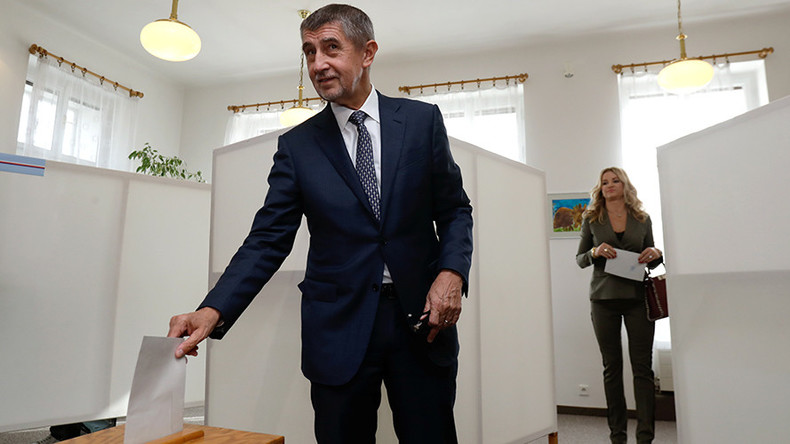
The leader of ANO party Andrej Babis © David W Cerny / Reuters

The populist Czech ANO movement led by billionaire Andrej Babis, dubbed ‘the Czech Donald Trump,’ is poised to win the eastern European country’s elections by a wide margin, according to the exit polls. The center-right, euroskeptic ODS came in second.
Read more

Top candidate of Peoples Party (OeVP) and Foreign Minister Sebastian Kurz talks with journalist after leaving a polling station in Vienna, Austria October 15, 2017. © Leonhard Foeger

ANO, which means ‘Yes’ in Czech and also stands as an acronym for the ‘Action of Dissatisfied Citizens’, has taken a clear lead in the election with more than 30 percent of the vote, beating its closest rivals by around 20 percentage points, according to exit polls cited by the Czech media.

The center-right, euroskeptic Civic Democratic Party (ODS) has come in second, securing about 11 percent backing. The anti-immigrant and anti-Islam far-right populist Freedom and Direct Democracy Party (SPD), led by the Czech-Japanese entrepreneur Tomio Okamura, moved into third place with about 10.8 percent support.

The polls also show that five more parties have managed to clear the five percent hurdle and get into parliament, including the Czech Pirate Party, the Communist Party of Bohemia and Moravia, the Social Democrats and the Christian Democratic Union as well as the movement of Czech mayors and independents.

The exit polls’ results demonstrate a significant shift to euroskepticism in the Czech Republic as all the three leading parties represent anti-establishment forces in one way or another. Babis, who leads the ANO movement, is particularly known for his skepticism about the euro and severe criticism of the EU’s immigration policies, including the refugee quota system.

The SPD also actively opposes immigration and calls Islam an ideology rather than a religion while the Civic Democrats are critical towards the EU and advocate permanent exception from euro adoption for the Czech Republic.

Read more

Supporters of far-right Freedom Party (FPOe) react after first exit polls in the general election during a party meeting in Vienna, Austria, October 15, 2017. © Michael Dalder

The pro-EU Social Democrats (CSSD) received only 7.7 percent of the votes, according to the exit polls, while the liberal TOP 09 movement, which is considered to be the strongest supporter of the further European integration and euro adoption, even failed to clear the election hurdle as it gained only slightly more than four percent of the vote.

Babis, who is poised to become the new Czech prime minister as his party’s electoral victory is almost certain, is, however, a controversial figure. The Czech Republic’s second richest man and a billionaire, who owns one of the Czech biggest private employers – the agricultural giant Agrofert – as well as a media empire, he has already served as finance minister and deputy prime minister, but was dismissed due to allegations of financial misconduct.

Babis was sacked from the government in May after a months-long coalition crisis that started with allegations that he dodged taxes as Agrofert CEO back in 2012. He was separately charged over allegedly misusing EU subsidies. Babis dismissed all the allegations, calling them “politically motivated.”

Despite his issues with the law, Babis remains one of the most popular Czech politicians. In September, the Czech President Milos Zeman told the local media that he would name Babis the new prime minister in the event of his party’s victory, even if he were in police custody.

Read more

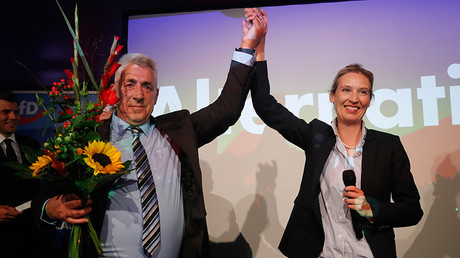
Alice Weidel (R), top candidate of the anti-immigration party Alternative fuer Deutschland (AfD) in Berlin, Germany, September 24, 2017 © Wolfgang Rattay

The two-day vote was held on October 20 and 21 to fill 200 seats in the Czech parliament’s lower house – the Chamber of Deputies. The voting ended at 14:00 local time (12:00 GMT) on Saturday with most ballots being expected to have been counted by the end of the day. However, the official results are scheduled to be announced no sooner than next week.

The results of the Czech elections have become just the latest episode of what seems to be the onward march of the right across Europe. Just a week ago, two anti-migrant parties gained the lead in the Austrian parliamentary elections and are now expected to form the ruling coalition.

Earlier, the right-wing anti-immigrant Alternative for Germany (AfD) party enjoyed what was called a historic success while Angela Merkel’s Christian Democrats and perforce the Social Democrats suffered their worst results in more than half a century at the September parliamentary elections in Germany.

In the French presidential elections in spring 2017, Marine le Pen, the head of the right-wing National Front party made it into the run-off, beating candidates from such major establishment parties as the Republicans and the Socialists.

And in the Netherlands, Geert Wilder’s ultra-nationalist Party of Freedom came second in this year’s parliamentary elections.