Kurds win Syrian oil under secret US-Russian deal – prize for Raqqa

Posted October 23, 2017 by danmillerinpanama
Categories: Iraqi Kurds, Kirkuk, Russia - Syrian war, Russia and America, Syria’s biggest oil field, Syrian Kurdish militias

Tags: , , , , ,

Kurds win Syrian oil under secret US-Russian deal – prize for Raqqa, DEBKAfile, October 23, 2017

Washington felt that the Kurds also deserved to be compensated for their Iraqi brothers’ loss of the Kirkuk oil city, which was seized last week by an Iraqi force boosted by pro-Iranian Shiite militias.

*************************************

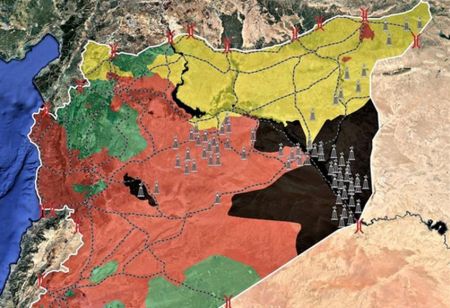
US-backed Syrian Kurdish militias reported Sunday, Oct. 22, the capture of Syria’s biggest oil field of al-Omar in the eastern Deir Ez-Zour province.

They were pressing on with their offensive against the Islamic State after capturing Raqqa. Al-Omar is located on the eastern bank of the Euphrates River. The Kurds’ takeover pre-empted its grab by a mixed force of Russian-backed Syrian army contingents and Hizballah, which had halted 6 km short of al-Omar.

While in the hands of ISIS, this field pumped up to 10,000 barrels today and is capable of producing up to 40,000 bpd. If repaired and brought up to scratch, it could potentially yield up to 120,000 bpd.

It now turns out that the Russian command’s secret order to the Syrian/Hizballah forces, exclusively reported by DEBKAfile last week, to halt where they stood after capturing Mayadin in eastern Syria from ISIS – and not  advance on the oil field – was prompted by unpublished talks between US and Russian officers in the area.

The officers reached a deal on the disposition of these oil fields. Under that deal, it was decided to award the Syrian Kurdish YPG militia the richest Syrian field as a prize for its role in leading the SDF in the capture of ISIS’ de facto capital of Raqqa.

DEBKAfile’s sources add that Washington felt that the Kurds also deserved to be compensated for their Iraqi brothers’ loss of the Kirkuk oil city, which was seized last week by an Iraqi force boosted by pro-Iranian Shiite militias. The loss of Kirkuk to Baghdad and Tehran has deprived the Kurdish Regional Government of Iraq of the income from 600,000 barrels of oil a day. The al-Omar field produces a much smaller amount, but its revenue would save the KRG from economic meltdown.

Sources in Damascus, disgruntled over the handover of al-Omar to the Kurds, accused the Syrian Arab tribes who fought in Raqqa of backing the Kurdish militia’s claim to the oil field. They also suggested that ISIS opted to surrender the oil field to the Sunni Kurds, rather than letting it fall into the hands of Assad’s Alawi regime.

Russia’s consent to hand over Syria’s biggest oil field to pro-American Kurds was calculated to yield a quid pro quo in the form of Washington’s support for the Russian oil giant Rosneft taking control of the Kurdish oil pipeline from the KRG via Turkey to the Mediterranean.

Last Thursday, the state-controlled Rosneft reported a deal with the KRG to take majority control of 60 percent in the operation of this pipeline project.

The Iraqi government has demanded clarifications for Moscow’s step.

North Korean EMP Attack Would Cause Mass U.S. Starvation, Says Congressional Report

Posted October 23, 2017 by danmillerinpanama
Categories: EMP attack, North korean EMP attack, North Korean missiles, North Korean nukes, North Korean satellites

Tags: , , , ,

North Korean EMP Attack Would Cause Mass U.S. Starvation, Says Congressional Report, Forbes

(Please see also, How the electric grid has been compromised. — DM)

A new congressional report contends that a North Korean electromagnetic pulse (EMP) attack on the U.S. would ultimately wipe out 90 percent of the population.

To date, most discussion concerning the North Korean threat has been on whether the rogue state can accurately hit U.S. cities with its ICBMs. But in an EMP attack, such accuracy is not necessary because the pulse radius would be so large, says Peter Vincent Pry, who recently testified about the EMP threat before a congressional Homeland Security subcommittee. His conclusions are that such an EMP attack would wreak havoc across the whole of the continental U.S.

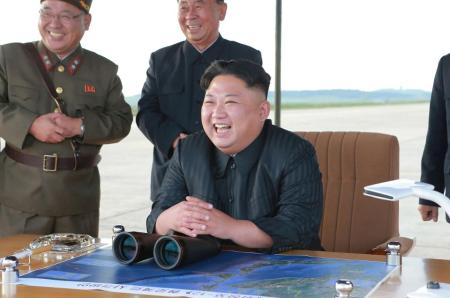
North Korean leader Kim Jong-Un (R) inspecting a launching drill of the medium-and-long range strategic ballistic rocket Hwasong-12 at an undisclosed location. Credit: STR/AFP/Getty Images

Unlike a conventional ICBM which launches and then goes into a suborbital flight before re-entering Earth’s atmosphere, an EMP warhead need not re-enter Earth’s atmosphere before exploding hundreds of kilometers above its target. Super-EMP weapons are designed to produce a high level of gamma rays, which generate the sort of high-frequency electromagnetic pulse that is most damaging to the broadest range of electronics, the report concludes.

And if the EMP device just happens to be part onboard an orbiting satellite, North Korea need only detonate the device remotely via encoded signal. Pry, Chief of Staff of the now de-funded Congressional EMP Commission, told me that at an altitude of 300 kilometers, the resulting electromagnetic pulse would affect all 48 contiguous states.

A warhead fused for an EMP in a satellite or ICBM could work on a timer, via GPS, or using an altimeter, says Pry, a nuclear strategist formerly with the CIA, who has a certificate in nuclear weapons design from the U.S. Air Force nuclear weapons lab. He says North Korea could even rig the warhead to detonate in the event that it was intercepted by our own missile defenses.

The consequences of such a detonation would be dire.

“The U.S. can sustain a population of 320 million people only because of modern technology,” said Pry. “An EMP that blacks-out the electric grid for a year would [decimate] the critical infrastructure necessary to support such a large population.”

In three days, the food supply in local grocery stores would be consumed and the 30-day national food supply in regional warehouses would begin to spoil, says Pry. In one year, he contends that up to 90 percent of the population could perish from starvation, disease, and societal collapse.

After generating gamma-rays that interact with air molecules in Earth’s stratosphere, a so-called fast pulse EMP field of tens of kilovolts would only last a few hundred nanoseconds.

But in the event of such an attack, aircraft electronics would be fried, as well as electronics in air traffic control towers, and navigation systems says Pry. “Airliners would crash killing many of the 500,000 people flying over North America at any given moment,” he said.

Pry says electro-mechanical systems which regulate the flow of gas through pipelines would spark; causing the gas to ignite and result in massive firestorms in cities and large forest fires.

There would be no water; no communications; and mass transportation would be paralyzed, says Pry. In seven days, he contends that reactors in U.S.’ nuclear power plants would essentially melt down, spreading radioactivity across most of the nation.

What could be done to ensure a quick restoration of the grid?

Some 2000 extra-high voltage (EHV) transformers make up the foundation of the U.S. grid, says Pry. But as he notes, since they each weigh hundreds of tons, they are extraordinarily hard to transport. Thus, if most are destroyed, there’s no quick fix.

So, how do we best protect against an EMP?

The U.S. should be prepared to also include limited surgical strikes to destroy North Korea’s ICBMs, says Pry. But he says the best, safest, and least provocative solution is to EMP-harden the electric grid and other critical infrastructures.

But not everyone agrees that North Korea poses a real EMP threat.

“There are legitimate concerns about EMP effects, but a non-tested system by a country with limited missile experience lowers the immediate threat,” James Clay Moltz, a professor of national security affairs at the Naval Postgraduate School in Monterey, Calif., told me.

The U.S. should work with China and South Korea on clear warnings against any such North Korean actions, says Moltz. That includes U.S. statements on the right to pre-empt or shoot down any suspected EMP weapons which, he says, would constitute nuclear attacks on the U.S.

“But predictions of mass U.S. casualties and demands for costly defenses against a [North Korean] EMP attack seem unjustified at this time,” said Moltz.

The Iran-Hamas Plan to Destroy Israel

Posted October 23, 2017 by danmillerinpanama
Categories: Abbas, Egypt, Hamas - Palestinian Authority reconciliation, Hamas disarmament, Hamas funding, Hamas vs Israel, Iran and Hamas, Iran and Israel, Iran and Jews, Israeli security

Tags: , , , , , , , , ,

The Iran-Hamas Plan to Destroy Israel, Gatestone InstituteKhaled Abu Toameh, October 23, 2017

Abbas and the Egyptians were probably naïve to think that Hamas would disarm and allow Abbas loyalists to deploy in the Gaza Strip after the signing of the “reconciliation” agreement. It is possible that some of the Hamas leaders had lied to Abbas and the Egyptians by hinting that Hamas would give up security control of the Gaza Strip.

The Egyptians, who played a major role in brokering the Hamas-Fatah deal, are also believed to be worried about Iran’s renewed meddling in the internal affairs of the Palestinians. Both the Palestinian Authority and Egypt see the visit of the Hamas delegation to Iran as a serious setback to the “reconciliation” agreement and as a sign that Hamas is not sincere about implementing the accord.

********************************

Iran’s goal in this move? For Hamas to maintain and enhance its preparation for war against Israel.

Iran’s message to Hamas: If you want us to continue providing you with financial and military aid, you must continue to hold on to your weapons and reject demands to disarm.

Iran wants Hamas to retain its security control over the Gaza Strip so that the Iranians can hold onto another power base in the Middle East, as it does with Hezbollah in Lebanon.

In a historic reawakening, Iran is once again meddling in the internal affairs of the Palestinians. This does not bode well for the future of “reconciliation” between Hamas and Palestinian Authority’s Fatah faction run by President Mahmoud Abbas.The re-emergence of Iran, as it pursues its efforts to increase its political and military presence in the region, does not bode well for the future of stability in the Middle East.

The Iranians are urging Hamas to hold on to its weapons in spite of the recent “reconciliation” agreement signed between Hamas and Fatah under the auspices of Egypt. Iran’s goal in this move? For Hamas to maintain and enhance its preparation for war against Israel.

A high-level Hamas delegation headed by Saleh Arouri, deputy chairman of Hamas’s “political bureau,” traveled to Tehran last week to brief Iranian leaders on the “reconciliation” deal with Fatah. During the visit, Iranian leaders praised Hamas for resisting demands (by Fatah) to disarm and relinquish security control over the Gaza Strip.

“We congratulate you on your refusal to abandon your weapons, an issue that you consider as a red line,” Ali Velayati, a senior Iranian politician and advisor to Leader of the Islamic Revolution Ayatollah Khamenei, told the visiting Hamas officials. “The Palestinian cause is the most important cause of the Islamic world, and after all this time you remain committed to the principle of resistance against the Zionists despite all the pressure you are facing.”

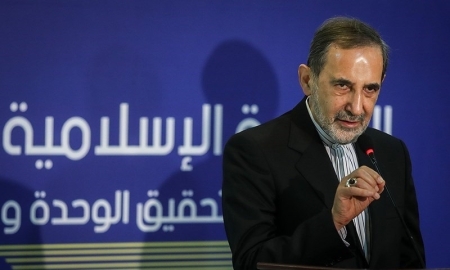
During the visit of a high-level Hamas delegation to Iran last week, Ali Velayati (pictured above in 2016), a senior Iranian politician and advisor to Supreme Leader Ayatollah Ali Khamenei, told the visiting Hamas officials: “We congratulate you on your refusal to abandon your weapons…” (Image source: Hamed Malekpour/Wikimdia Commons)

Arouri and his colleagues rushed to Tehran to seek the support of the Iranian regime in the wake of demands by Abbas that Hamas allow the Palestinian Authority to assume security control over the Gaza Strip. The “reconciliation” agreement stipulates nothing about the need for Hamas to disarm, and Hamas officials have stressed during the past two weeks that they have no intention of laying down their weapons or dismantling their security apparatus in the Gaza Strip.

Hamas views the demand to disarm as part of an Israeli-American “conspiracy” designed to eliminate the Palestinian “resistance” and thwart the “reconciliation” accord with Abbas’s Fatah. Hamas’s refusal to disarm is already threatening to spoil the “reconciliation.”

Arouri was quoted during his visit to Tehran as saying that Hamas “will not backtrack on the option of defending the Palestinian people.” He specified that the “reconciliation” agreement with Fatah would not affect the weapons of the Palestinian “resistance,” including Hamas. Hamas, he added, will “confront the Israeli-American conspiracy through national unity and reconciliation and by continuing the resistance. The Palestinian resistance forces will always stick to their weapons and will not lay them down.”

Hamas also sees the visit of its top officials to Tehran as a rejection of Israel’s demand that it cut off its ties with Iran. Hamas officials say they continue to see their relations with Iran as “strategic and significant,” especially in wake of Tehran’s financial and military aid to their movement in the Gaza Strip.

By aligning itself with Iran, Hamas is also seeking to resist any demand that it abandon its ideology and charter, which call for the destruction of Israel and oppose any peace process between Israelis and Palestinians.

Iranian officials apparently do not like Mahmoud Abbas and the Palestinian Authority and are not keen on seeing them return to the Gaza Strip. Iran considers Abbas a “traitor” because his Palestinian Authority conducts security coordination with Israel in the West Bank and claims that it is committed to a “peace process” with Israel. This position goes against Iran’s wish to destroy the “Zionist entity.”

Abbas, for his part, has always considered Iran a threat to his regime as well as to stability in the region. In the past, he has criticized Iran for “meddling” in the internal affairs of the Palestinians by supporting Hamas and Palestinian Islamic Jihad in the Gaza Strip.

Earlier this year, the Palestinian Authority strongly condemned Iran after a senior Iranian official accused Abbas of waging war in the Gaza Strip on behalf of Israel. The official’s statement came in response to a series of punitive measures imposed by Abbas on the Gaza Strip.

Abbas’s spokesman, Nabil Abu Rudaineh, accused Iran of meddling in the internal affairs of the Palestinians and some Arab countries. He said that Iran’s actions “encouraged divisions” among the Palestinians. “Iran must stop feeding civil wars in the Arab world,” he said. “Iran must stop using rhetoric that only serves Israel and the enemies of the Arabs.”

Abbas and the Palestinian Authority are now convinced that Iran is working towards foiling the “reconciliation” agreement with Hamas. They believe that Iran invited the Hamas leaders to Tehran to pressure them not to lay down its weapons.

Abbas and the Egyptians were probably naïve to think that Hamas would disarm and allow Abbas loyalists to deploy in the Gaza Strip after the signing of the “reconciliation” agreement. It is possible that some of the Hamas leaders had lied to Abbas and the Egyptians by hinting that Hamas would give up security control of the Gaza Strip.

The Egyptians, who played a major role in brokering the Hamas-Fatah deal, are also believed to be worried about Iran’s renewed meddling in the internal affairs of the Palestinians. Both the Palestinian Authority and Egypt see the visit of the Hamas delegation to Iran as a serious setback to the “reconciliation” agreement and as a sign that Hamas is not sincere about implementing the accord.

Some Palestinian Authority and Hamas officials have recently claimed that Israel was not happy with their “reconciliation” agreement and was doing its utmost to foil it. The truth, however, is that it is Iran and Hamas that are working to thwart the agreement by insisting on maintaining the status quo in the Gaza Strip. Iran’s message to Hamas: If you want us to continue providing you with financial and military aid, you must continue to hold on to your weapons and reject demands to disarm.

What is in it for Iran? Iran wants Hamas to retain its security control over the Gaza Strip so that the Iranians can hold onto another power base in the Middle East.

Iran wants Hamas to continue playing the role of a proxy, precisely as Hezbollah functions in Lebanon.

The last thing Iran wants is for the Palestinian Authority security forces to return to the Gaza Strip: that would spoil Tehran’s plans to advance its goal of destroying Israel.

Iran’s continued support for Hamas stems not out of love for either Hamas or the Palestinians, but from its own interest in consolidating its presence in the Middle East.

Many Palestinians see the “successful” visit of the Hamas officials to Tehran as a major setback for efforts to end the 10-year-long Hamas-Fatah dispute. Similarly, the Egyptians are now wary of the sudden rapprochement between Iran and Hamas and are beginning to ask themselves whether they have been duped by Hamas. An Israeli delegation that visited Cairo on the eve of the signing of the Hamas-Fatah deal is said to have warned the Egyptians that the “reconciliation” would not work unless Hamas disarms and severs its ties with Iran. However, the Egyptians reportedly failed to listen to the Israeli warning.

As for Israel, the US and other Western parties, the lesson to be drawn from the renewal of ties between Hamas and Iran is that Hamas has not changed one iota.

Contrary to delusional hopes, discussed on the heels of the “reconciliation” agreement in Cairo and based on lies and thin air, Hamas is not headed toward moderation and pragmatism. By openly supporting Hamas, Iran is once again demonstrating that it aims to fan the fire in the Middle East and continue to sabotage any prospects for peace.

Khaled Abu Toameh, an award-winning journalist, is based in Jerusalem.

How the electric grid has been compromised

Posted October 23, 2017 by danmillerinpanama
Categories:  EMP Commission, EMP attack

Tags: ,

How the electric grid has been compromised, Washington Times, Peter Vincent Pry, October 22, 2017

(After an EMP attack has occurred, there will be little or nothing that can be done to avoid or even ameliorate the catastrophic results. Some military electronics have been “hardened,” but there are too many civilian facilities — computers, automobiles, trucks, cell phones, etc — to harden. Human casualties will result, not from radiation but from the inability to get food, medicine and other necessities which trucks will be unable to deliver to stores. The only effective measure would be to prevent EMP attacks by eliminating the facilities which hostile nations and groups would use to cause them. –DM)
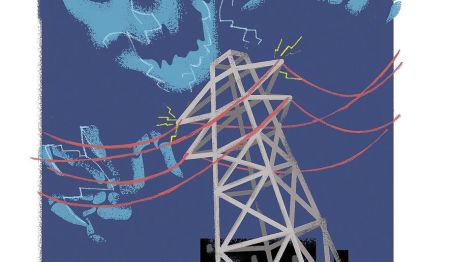
Illustration on the risk of EMP attacks on the nation’s power grid by Linas Garsys/The Washington Times

Electromagnetic attack is well known to North Korea. It used a non-nuclear EMP weapon to attack airliners and impose an “electromagnetic blockade” on air traffic to Seoul, South Korea’s capital, disrupting communications and operation of automobiles in several South Korean cities in December 2010; March 2011; and April-May 2012.

Real world failures of electric grids from various causes indicate nuclear EMP attack would have catastrophic consequences. Big blackouts have been caused by small failures cascading into system-wide failures:

***********************************

ANALYSIS/OPINION:

Bureaucracies know how to deal with really challenging problems that affect the survival of our country: Kill the messenger.

The Commission to Assess the Threat to the United States from Electromagnetic Pulse (EMP) Attack terminated on September 30, ironically, the same month North Korea tested an H-bomb it described as “a multifunctional thermonuclear nuke with great destructive power which can be detonated even at high altitudes for superpowerful EMP attack.”

For 17 years, the EMP Commission warned about the existential EMP threat.

Rogue states or terrorists can blackout national electric grids and other life-sustaining critical infrastructures, topple electronic civilization, and kill millions from sea to shining sea, with a single high-altitude nuclear detonation, generating an EMP field covering North America. Natural EMP from a solar superstorm could blackout the whole world. EMP is considered a cyber weapon, not a nuclear weapon, in the military doctrines of Russia, China, North Korea and Iran.

On October 12, before a House Homeland Security Subcommittee chaired by Rep. Scott Perry, the EMP Commission staff delivered a final testimony, lamenting Washington bureaucrats are still oblivious to EMP.

The Department of Defense (DOD), Department of Homeland Security (DHS) and Department of Energy (DOE), still largely staffed by Obama-holdovers, did not ask Congress to continue the EMP Commission.

The Secretaries of DOD and DOE ignored repeated requests to meet with the EMP Commission. DOE thinks the EMP threat is unproven and plans to partner with the electric power industry on studying EMP until 2020 and beyond.

DOD is letting DOE waste millions of dollars on unnecessary studies while DOD sits on a mountain of classified studies proving the EMP threat is real — which is why DOD has spent billions EMP hardening military systems.

Experts who have worked on protecting military systems from EMP for decades know how to harden our critical national infrastructure, but electric power organizations such as the Electric Power Research Institute and the North American Electric Reliability Corporation are not asking them for help.

A senior DHS official, speaking anonymously, recently told Fox News that EMP is a “theoretical” threat and lower priority than “real” threats, like cyber-attacks and sabotage.

Yet the empirical basis for the EMP threat to electric grids and civilization is far deeper and broader than for cyber-attacks or sabotage.

We know for certain EMP will damage electronics and cause protracted blackout of unprotected electric grids and other critical infrastructures from:

• The 1962 U.S. STARFISH PRIME high-altitude nuclear test that generated an EMP field over the Hawaiian Islands, over 1,300 kilometers away, causing widespread damage to electronic systems.

• Six Russian high altitude nuclear tests 1961-1962 over Kazakhstan that with a single weapon destroyed electric grids over an area larger than Western Europe.

• 30 years (1962-1992) of U.S. underground nuclear testing. (Contrary to another government “expert” cited by Fox News, underground nuclear tests can tell a lot about the EMP threat from the weapon yield, gamma ray output, and other effects. Indeed, nuclear weapons specialized for EMP, what Russia and China call “Super-EMP” weapons, can be made without testing.)

• Over 50 years of testing using EMP simulators, including tests by the EMP Commission (2001-2008), proving modern semiconductor electronics are far more vulnerable to EMP than 1950-60s era electronics.

Moreover, hard data proving the threat from nuclear EMP is available from natural EMP generated by geomagnetic storms, accidental damage caused by electromagnetic transients, and non-nuclear EMP weapons. All these produce field strengths much less powerful than nuclear EMP.

Electromagnetic attack is well known to North Korea. It used a non-nuclear EMP weapon to attack airliners and impose an “electromagnetic blockade” on air traffic to Seoul, South Korea’s capital, disrupting communications and operation of automobiles in several South Korean cities in December 2010; March 2011; and April-May 2012.

Real world failures of electric grids from various causes indicate nuclear EMP attack would have catastrophic consequences. Big blackouts have been caused by small failures cascading into system-wide failures:

• The Great Northeast Blackout of 2003 — that put 50 million people in the dark for a day, contributed to at least 11 deaths and cost an estimated $6 billion — happened when a power line contacted a tree branch, damaging less than 0.0000001 (0.00001 percent) of the system.

• The New York City Blackout of 1977, that resulted in the arrest of 4,500 looters and injury of 550 police officers, was caused by a lightning strike on a substation that tripped two circuit breakers.

• The Great Northeast Blackout of 1965, that effected 30 million people, happened because a protective relay on a transmission line was improperly set.

• India’s nationwide blackout of July 30-31, 2012 — the largest blackout in history, effecting 670 million people, 9 percent of the world population — was caused by overload of a single high-voltage power line.

In contrast to the above blackouts caused by small-scale failures, nuclear EMP attack would inflict massive widespread damage to electric grids.

A protracted blackout endangering millions will be the inevitable result of the EMP attack described by the North Koreans.

But the EMP Commission won’t be around anymore to help prevent electronic Armageddon.

• Peter Vincent Pry is chief of staff of the congressional EMP Commission and served in the House Armed Services Committee and the CIA.
Jimmy Carter: Media tougher on Trump than any other president in memory

Posted October 23, 2017 by Joseph Wouk
Categories: Uncategorized

Source: Jimmy Carter: Media tougher on Trump than any other president in memory | Fox News

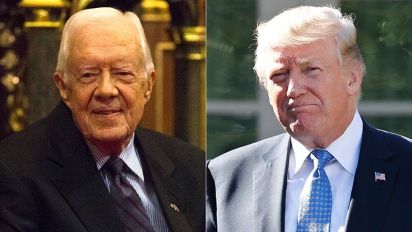
Former President Jimmy Carter says the media have been tougher on President Trump than any other president he can remember.

Jimmy Carter, the liberal 93-year-old former president, surprisingly sided with President Trump when he told The New York Times that the media have been been too hostile on the current commander-in-chief.

“I think the media have been harder on Trump than any other president certainly that I’ve known about,” Carter told The New York Times columnist Maureen Dowd. The 39th president served one term from 1977 to 1981.

Carter added that he thought the media “feel free to claim that Trump is mentally deranged and everything else without hesitation.”

The former president also pushed back on accusations of Russian collusion in the 2016 presidential election, saying: “I don’t think there’s any evidence that what the Russians did changed enough votes, or any votes.” He said his wife, Rosalynn, disagreed with him, before he added, “We voted for [Bernie] Sanders” in the primary.

Carter also doesn’t believe the current president’s “America First” strategy is out of step with the larger world, spoiling international relations. “Well, he might be escalating it but I think that precedes Trump,” he told the Times. “The United States has been the dominant character in the whole world and now we’re not anymore. And we’re not going to be. Russia’s coming back and India and China are coming forward.”

Carter also said he’s willing to go to North Korea on a diplomatic mission amid the escalating tensions over nuclear weapons.

“I don’t know what they’ll do,” he said of North Korea. “Because they want to save their regime. And we greatly overestimate China’s influence on North Korea. Particularly to Kim Jong Un. He’s never, so far as I know, been to China.”

He called the North Korean dictator “unpredictable.”

In September, Carter expressed optimism that Trump might break a legislative logjam with his six-month deadline for Congress to address the immigration status of 800,000-plus U.S. residents who were brought to the country illegally as children.

Carter told Emory University students that the “pressures and the publicity that Trump has brought to the immigration issue” could even yield comprehensive immigration law changes that Presidents George W. Bush and Barack Obama could not muster.

He blamed both major parties for an inability to pass any major immigration law overhaul since a 1986 law signed by President Ronald Reagan.

“I don’t see that as a hopeless cause,” Carter said. He added that Trump’s critics, including himself, “have to give him credit when he does some things that are not as bad” as they are depicted.

Prime Minister Benjamin Netanyahu lobbies for Iraqi Kurds

Posted October 23, 2017 by Joseph Wouk
Categories: Uncategorized

Source: Prime Minister Benjamin Netanyahu lobbies for Iraqi Kurds – Israel News – Jerusalem Post

BY HERB KEINON
 OCTOBER 22, 2017 00:23
The leader has raised the question of the Kurds’ independence with Putin and Merkel.
Prime Minister Netanyahu lobbies for Iraqi Kurds

 Kurds celebrate to show their support for the upcoming September 25th independence referendum in Erbil, Iraq September 22, 2017.. (photo credit:REUTERS)

National Security Council head Meir Ben-Shabbat returned on Friday from visits to Washington and Moscow where the fate of the Kurds in Iraq, as well as Syria and Iran, featured prominently on the agenda.

The discussions in both capitals came amid rising tensions in the north as Israel struck Syrian targets three times over the past week.

In Washington, Ben-Shabbat met with his US counterpart, H.R. McMaster, and other senior Trump administration officials. From there, he went to Moscow, leading an Israeli delegation that included IDF and Defense and Foreign Ministry officials who met with their Russian counterparts.

Prime Minister Benjamin Netanyahu spoke last week with Russian President Vladimir Putin and a week earlier with German Chancellor Angela Merkel, raising the issue of Kurdish independence in Iraq and stressing that they were a pro-Western people who deserved independence, government officials said.

Netanyahu came out in favor of the Iraqi Kurd push for independence last month, ahead of a referendum there, one of the only world leaders to do so, and has since been lobbying others to prevent the Kurds from losing ground to the Iraqi Army, which retook the oil-rich Kirkuk region last week.

Intelligence Minister Israel Katz told Tel Aviv radio station 102 FM on Friday that the current priority is “to prevent an attack on the Kurds, extermination of the Kurds and any harm to them, their autonomy and region, something that Turkey and Iran and internal Shi’ite and other powers in Iraq and part of the Iraqi government want.”

The United Nations has voiced concern over reports that civilians, mainly Kurds, are being driven out of parts of northern Iraq retaken by central government forces and their houses and businesses looted and destroyed.

“The prime minister is certainly engaging the United States, Russia, Germany and France to stop the Kurds from being harmed,” Katz said.

Reuters contributed to this report.

Globes English – Has Israel been Trumped?

Posted October 23, 2017 by Joseph Wouk
Categories: Uncategorized

Source: Globes English – Has Israel been Trumped?

Nine months into Donald Trump’s administration in the US, the advantages to Israel look meager compared with expectations.

Nine months have now passed since Donald Trump was inaugurated president of the United States. Can any sort of pattern be discerned about any aspect of administration policy, domestic or foreign? On the domestic side, he has tried to implement several of his campaign promises, with mixed results, and those results entirely the result of executive orders, the extensive use of which by the Obama administration he had criticized. Immigration reform and Obamacare health policy reform he has implemented partially through executive action. So far nothing has been accomplished in the area of tax reform, but the jury is still out on that one.

In the international arena, the Trump administration has taken anti-free trade steps and may take others, in Asia and Latin America. It has had no success whatever in countering aggressive moves by North Korea, China or Russia. In the Middle East, however, steps have been taken and in some cases avoided, which are of significance. These include rapprochement with Saudi Arabia and the Gulf States, continued military involvement in Afghanistan, Iraq and Syria, despite campaign promises, and most significantly, the so-called “decertification” of the Iran deal.

The refusal to support the government of the Kurdish region of Iraq in its dispute with the Iraqi government, besides being a moral outrage, can only be considered a continuation of the Obama policy of punishing friends while favoring enemies. There is no doubt that if the US had told the Iraqis not to attack Kirkuk they would not have done so. Along the same lines is the financial penalty imposed on the al-Sisi government of Egypt as a result of its civil rights record, overlooking its strong domestic and regional anti-extremist and anti-terrorist actions.

What of Israel? Campaign promises included recognizing Jerusalem as the capital of Israel, concentrating on Israel’s regional role at the expense of the will-o-the-wisp of the “two-state solution” in the Israeli-Palestinian conflict, and in general terms greatly improving relations with Israel, which were toxic during the Obama administration.

The Israeli government and much of the Israeli public were ecstatic when Trump unexpectedly won the election of November 2016. In the nine months since his inauguration, what has actually happened? The American embassy is still in Tel Aviv, and Trump has bought into the delusion that a “deal” is possible between the Palestinian Authority and Israel (reportedly on the urging of Ron Lauder), so that much diplomatic energy is totally wasted in this quixotic quest. On the positive side, there is the decertification of Iranian compliance with the infamous “deal”, and with exquisitely bad timing the American withdrawal from UNESCO, copy-catted by Jerusalem, just before a French Jewish woman was elected head of that body. A short list indeed, since the Iranian decertification decision was made due to a Trump pledge that had nothing particularly to do with Israel, and a UNESCO decision that will very likely be reversed before it goes into effect. Yes, the general atmosphere of US-Israeli relations has improved, but that is about it.

The Trump administration is less than a year old, but as of now, the answer to the question posed in the title of this column, has got to be “yes”.

On the other hand, it is not a bad thing when anticipatory euphoria is replaced by hard reality. Operating on the basis of the first can only lead to disappointment; operating on the basis of reality leads to the achievement of limited, but realistic, goals. Military, security and intelligence cooperation continues, as indeed it did under Obama, and that is what really counts at the end of the day.

Norman A. Bailey, Ph.D., is Professor of Economics and National Security, The National Security Studies Center, University of Haifa, and Adjunct Professor of Economic Statecraft, The Institute of World Politics, Washington, DC. He was formerly with the US National Security Council and the Office of the Director of National Intelligence.

The views he expresses are his own and do not necessarily reflect those of “Globes.”

Egypt declares three-month emergency after Muslim Brotherhood mass terror attack – DEBKAfile

Posted October 23, 2017 by Joseph Wouk
Categories: Uncategorized

Loud cries of vengeance rose from the many funerals across Egypt Sunday, Oct. 22, as the victims of a Muslim Brotherhood massacre, which rose from 55 to 58, were laid to rest. The government declared a three-month state of emergency after discovering that an armed underground of the Muslim Brotherhood (Hasm)  had established a secret base in the El-Wahat El-Bahariya Oasis in the Western Desert. There, mega-terror attacks were being plotted. Among the targets was the highway from Cairo the desert. Two brigadier generals were among the victims, as well as one colonel and three lieutenant colonels. They were all members of the Interior Ministry’s elite security force, which had been trained to combat terrorists.
The stunning attack on this elite force Friday revealed for the first time the scale and spread of Hasm’s deadly operations in Egypt. Until now, only a few isolated cells had been suspected. Egyptian’s intelligence and security agencies had no notion that Hasm had developed a wide-reaching terrorist infrastructure, or that it was capable of seizing a major highway before anyone realized what was happening.
The few injured police officers who survived gave chilling accounts of their experience at the hands of the Brotherhood assailants. Some of the injured men were forced to give up their firearms in surrender and were were then summarily shot dead with those same weapons.
DEBKAfile’s first report on this attack was published on Saturday, Oct. 21  

An armed group of Egypt’s banned Muslim Brotherhood was reported to have waylaid an Egyptian convoy heading for its oasis hideout on Friday and murdered 55 policemen. The only survivors were 14 injured men.
But some of the evidence also points to the Islamic State as the perpetrators.

The police convoy was attacked while driving on the El-Wahat Highway from Cairo to Giza on its way to raid  a secret hideout of the banned Muslim Brotherhood’s armed underground (Hasm) at the El-Bahariya Oasis in the Western Desert, 135 southwest of the capital.
The disaster, together with a string of deadly Islamist attacks in Sinai in recent weeks, raised tough questions about Egypt’s capacity to deal with the extremist terrorism plaguing the country. President Abdul-Fatteh El-Sisi immediately set up a commission of inquiry to find out how the casualty of Egyptian servicemen came to be so high – a well-tried device used by governments for keeping the details of a mishap dark until the immediate hue and cry dies down.

DEBKAfile’s counterterrorism sources have gleaned information that points to a merciless massacre, most likely at the hands of the Brotherhood’s armed activists. According to first reports, the policemen were killed in a shootout with the extremists during a raid of their hideout in the oasis.

The wild beauty of this vast oasis – over 2,000sq.km – makes it an attraction for visitors to Cairo especially since it is just a short drive from the capital. Its sparse inhabitants are mostly Bedouin tribes with kinship ties across the border in eastern Libya, a region where the Islamic State and Al Qaeda maintain strong footholds. Because it is only visited occasionally by foreign visitors on night-time jaunts, the Brotherhood felt the oasis was far from the long arm of Egypt’s anti-terrorist forces.
After intelligence agents discovered their location, the Brotherhood cell was ready for the raid. They set up ann ambush and before the police convoy of four SUVs reached the hideout, dozens of wanted terrorists opened up with heavy machine guns, recoilless grenades and mortars, and detonated roadside bombs. The carnage was devastating.
Their tactics, involving ruthless massacre, strongly resembled the most recent Islamic State strikes against Egyptian forces in northern Sinai. On Sept. 11, 18 Egyptian troops were killed near Sheikh Zuweid.

In both these outrages, the Egyptian air force was not brought in.
If the oasis ambush was also the work of ISIS, it would indicate that these jihadists were not only terrorizing Sinai, but had also penetrated deep into the Egyptian mainland.

Source: Egypt declares three-month emergency after Muslim Brotherhood mass terror attack – DEBKAfile

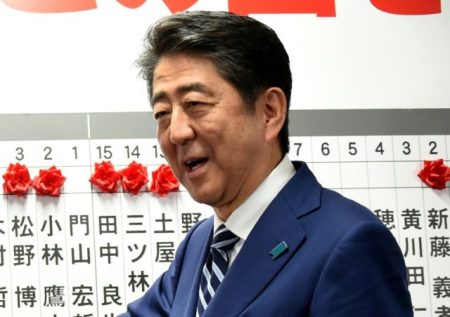
Abe cruises to ‘super-majority’ win in Japan vote

Posted October 22, 2017 by danmillerinpanama
Categories: Japan, Japan - snap election, Japan and North Korea, Japanese military, Prime Minister Shinzo Abe

Tags: , , , ,

Abe cruises to ‘super-majority’ win in Japan vote, BreitbartAFP, October 22, 2017

AFP

Tokyo (AFP) – Japanese Prime Minister Shinzo Abe swept to a resounding victory in a snap election Sunday and immediately vowed to “deal firmly” with threats from North Korea that dominated the campaign.

Abe’s ruling conservative coalition was on track to win more than 310 seats in the 465-seat parliament, according to a projection from public broadcaster NHK, handing the premier a two-thirds “super-majority.”

This allows nationalist Abe to propose changes to pacifist Japan’s US-imposed constitution, which forces it to renounce war and effectively limits its military to a self-defence role.

Abe said the comfortable election win had stiffened his resolve to tackle North Korea’s nuclear threat, as the key US regional ally seeks to step up pressure on Pyongyang after it fired two missiles over Japan in the space of a month.

“As I promised in the election, my imminent task is to firmly deal with North Korea,” said Abe, who is now on course to become the country’s longest-serving leader.

“For that, strong diplomacy is required,” stressed the 63 year-old, who has courted both US President Donald Trump and Russian President Vladimir Putin.

Abe said he would “deepen” debate on the divisive constitution issue in parliament but stressed: “I don’t plan to propose (changes) via the ruling bloc alone. We’ll make efforts to gain support from as many people as possible.”

As results came in, television images showed jubilant victorious lawmakers bowing deeply before punching the air with cries of “Banzai”, the Japanese equivalent of three cheers.

– ‘Very severe result’ –

Millions of Japanese braved torrential rain and driving winds to vote as a typhoon lashed the country, with many heeding warnings to cast their ballots early.

“I support Abe’s stance not to give in to North Korea’s pressure,” said Yoshihisa Iemori as he cast his ballot in a rainswept Tokyo.

Abe’s Liberal Democratic Party (LDP) benefited from a weak and splintered opposition, with the two main parties facing him created only a matter of weeks ago.

Support for the Party of Hope founded by popular Tokyo Governor Yuriko Koike fizzled after an initial blaze of publicity and was on track to win around 50 seats, according to the NHK projection with a handful still to call.

Speaking from Paris where she was attending an event in her capacity as leader of the world’s biggest city, a sullen-faced Koike said it was a “very severe result.”

“As the person who launched the party, I will take responsibility,” pledged Koike.

The new centre-left Constitutional Democratic Party fared slightly better than expected but still trailed far behind Abe with a projected 50 seats.

“The LDP’s victory is simply because the opposition couldn’t form a united front,” political scientist Mikitaka Masuyama from the National Graduate Institute for Policy Studies, told AFP.

– ‘Sink’ Japan –

The short 12-day campaign was dominated by the economy and the global crisis over North Korea, which has threatened to “sink” Japan into the sea and engaged in a war of words with Trump.

Hawkish Abe stuck to a hardline stance throughout, stressing that Japan “would not waver” in the face of an increasingly belligerent regime in Pyongyang.

But many voters said reviving the once-mighty Japanese economy was the top priority, with Abe’s trademark “Abenomics” growth policy failing to trickle down to the general public.

“Neither pensions nor wages are getting better… I don’t feel the economy is recovering at all,” said 67-year-old pensioner Hideki Kawasaki.

Although voters turned out in their millions to back Abe, he enjoys only lukewarm support and surveys showed his decision to call a snap election a year earlier than expected was unpopular.

“I totally oppose the current government. Morals collapsed. I’m afraid this country will be broken,” said 84-year-old voter Etsuko Nakajima.

– ‘I’m quite disappointed’ –

Koike briefly promised to shake up Japan’s sleepy political scene with her new party but she declined to run herself for a seat, sparking confusion over who would be prime minister if she won.

In the end the 65-year-old former TV presenter was not even in Japan on election day.

“I thought that I would vote for the Party of Hope if it’s strong enough to beat the Abe administration. But the party has been in confusion … I’m quite disappointed,” said 80-year-old pensioner Kumiko Fujimori.

The campaign was marked by a near-constant drizzle in large parts of the country and rallies frequently took place under shelter and a sea of umbrellas.

But this did not dampen the enthusiasm of hundreds of doughty, sash-wearing parliamentary hopefuls, who have driven around in minibuses pleading for votes via loudspeaker and bowing deeply to every potential voter.

Trump’s a Big Mouth; Journalists are Villains

Posted October 22, 2017 by danmillerinpanama
Categories: Media and Trump, Media melt-down, Media vs reality

Tags: , ,

Trump’s a Big Mouth; Journalists are Villains, PJ Media, Andrew Klavan, October 21, 2017

Has the press at long last no decency? The short answer: No decency at all. Trump is a big mouth but the press is despicable. Democrat operatives masquerading as journalists, they are the prime engine of division in this country. Skewing every story in one direction, they keep us from discussing issues in a reasonable way so as to reach compromise. And squealing like scorched cats at every Trump remark, they manufacture a sense of crisis that has nothing to do with the true state of America.

They are villains. Within the parameters of the First Amendment, the entire industry needs to be reformed.

********************************

As Trump-loving readers of this blog have frequently complained, I am not always a fan of Donald Trump’s personal style. I don’t like bullies and I prefer a president who thinks before he opens his mouth. I do, on the other hand, very much like many of the things Trump has accomplished: the great judicial nominations, the taming of the regulatory state, the restoration of the rule of law at the border, leaving the silly Paris accord, the annihilation of ISIS, the attempts to hurry the implosion of Obamacare by suspending utterly illegal payments to insurance companies, calling out the NFL on its lack of patriotism, and calling out the media on a leftward bias that now amounts to simple malfeasance and corruption. That’s an awful lot of good stuff, and it surely makes up for the big mouthery.

Aside from a few stupid remarks that seemed to show a lack of respect for the First Amendment — remarks that have so far not been followed up by any bad actions — I can’t think of one instance in which Trump has behaved in a way that endangers the norms of American governance. He hasn’t misused the IRS like Barack Obama did, or corrupted the Justice Department like Obama did, or made illegal payouts to insurance companies like Obama did, or extended the power of regulatory agencies until they became a threat to constitutional democracy like Obama did, or lied to the people about health care or Benghazi like Obama did, or behaved so autocratically and unconstitutionally that he lost more cases before the Supreme Court than any other modern president like Obama did. In fact, Trump has been incredibly transparent with the public and has generally thrown legislative decisions to Congress — where they belong.

The press, on the other hand, in their seething hatred of Trump and the people he represents, and in their likewise seething bitterness at the loss of the election, have transformed themselves into the mustache-twirling villains of American society. If they could see themselves as they are, they would be ashamed, but because they all agree with one another, they are invisible to themselves.

This week, Donald Trump made a clumsy and defensive remark about the fact that presidents generally don’t call the families of those who die in battle. I took him to mean that they didn’t always call. I think any reasonable person would have taken him to mean that. But the media takes every word Trump speaks to mean the worst possible thing it can mean, and so the big story this week was not the revelation that the Obama administration covered up an investigation into Russian malfeasance in order to give Putin ownership of twenty percent of our uranium supply. Well, that was the big story but the mainstream media covered it up. Instead, the big story on the news was what the media said Trump said.

Enter the genuinely hideous Florida Democrat Congresswoman Frederica Wilson. She listened in on Trump’s call to the family of a dead soldier and reported Trump said the soldier “knew what he signed up for, but I guess it still hurts.” I took this to mean that every soldier knows he is doing a dangerous job, but when the worst comes, the knowledge doesn’t ease the pain. I think any reasonable person would take it to mean that. But the media takes every word Trump speaks to mean the worst possible thing it can mean and so the hideous Frederica was on TV, making political hay out of a soldier’s death.

Then Trump pointed out that Barack Obama had not called Trump’s chief of staff General John Kelly after his son was killed by a landmine in Afghanistan. So now, after allowing and encouraging the hideous Frederica to make political hay out of a soldier’s death, the media began screaming that President Trump was making political hay out of a soldier’s death.

Then John Kelly made a measured and emotional speech that shamed the news media and the hideous Frederica. So the media — which had excoriated Trump for criticizing Gold Star father Khizr Khan — now excoriated Gold Star father John Kelly as everything from racist to the engineer of a coup.

Has the press at long last no decency? The short answer: No decency at all. Trump is a big mouth but the press is despicable. Democrat operatives masquerading as journalists, they are the prime engine of division in this country. Skewing every story in one direction, they keep us from discussing issues in a reasonable way so as to reach compromise. And squealing like scorched cats at every Trump remark, they manufacture a sense of crisis that has nothing to do with the true state of America.

They are villains. Within the parameters of the First Amendment, the entire industry needs to be reformed.