Hezbollah: IDF Stole Our Drone – We Were Shooting a Music Video

Posted July 22, 2020 by davidking1530
Categories: Uncategorized

The “WTF?” news article for the day.

Hezbollah: IDF Stole Our Drone – We Were Shooting a Music Video

A Hezbollah spokesman on Sunday claimed the IDF had taken control of a drone that was part of a music video of a Lebanese orchestra that was recorded near the border with Israel.

The IDF reported on Sunday that one of its units identified and downed a drone that had apparently penetrated from Lebanese territory into Israeli airspace, which apparently happens up north every few months (IDF Downs Lebanese Drone).

So this is what Hezbollah had to say about the same event (courtesy of Google Translate):

“The enemy’s army hijacked a photo drone belonging to a singing squad that was carrying out a hymn for Nasrallah near the borders with occupied Palestine, before it controlled it electronically and withdrew it 3 kilometers inside the occupied territories. One of the photos taken by the drone while it was being towed showed it flying inside the occupied territories.”

We think the IDF should offer to return the drone, but only directly to Hassan Nasrallah, the terror group’s leader, the one from the hymn, who has been hiding from the IDF in a bunker in south Beirut since 2006. Come out, come out and claim your drone, dear sheikh.

Hezbollah says one of its fighters killed in Israeli strike in Syria

Posted July 22, 2020 by Joseph Wouk
Categories: Uncategorized

Source: Hezbollah says one of its fighters killed in Israeli strike in Syria | The Times of Israel

Lebanese terror group has consistently retaliated for confirmed deaths of its members at Israel’s hands with attacks along the border

Ali Kamel Mohsen Jawad, a member of the Hezbollah terror group, whom the organization says was killed in an Israeli airstrike on July 20, 2020. (Hezbollah media)

Ali Kamel Mohsen Jawad, a member of the Hezbollah terror group, whom the organization says was killed in an Israeli airstrike on July 20, 2020. (Hezbollah media)

The Hezbollah terror group on Tuesday evening accused Israel of killing one of its members in an airstrike outside Damascus the night before, raising the possibility of retaliation against the Jewish state.

In a statement carried by Hezbollah-controlled media channels, the terror group said its operative Ali Kamel Mohsen Jawad was killed in an act of “Zionist aggression,” apparently referring to a series of airstrikes south of Damascus late Monday night that were attributed to Israel.

In the past, Hezbollah has retaliated for confirmed deaths of its members at Israel’s hands with attacks on the Jewish state, generally along the Israeli-Lebanese border.

Such an exchange occurred last August, when the Israel Defense Forces killed two Hezbollah members that the military said were taking part in an Iranian-run operation in southern Syria that attempted to attack IDF border positions with armed drones.

“If Israel kills any of our members in Syria, we’ll respond from Lebanon and not in the Shebaa Farms, and we tell the Israeli army on the border to be very cautious and to wait for us,” Hezbollah leader Hassan Nasrallah said in a speech at the time.

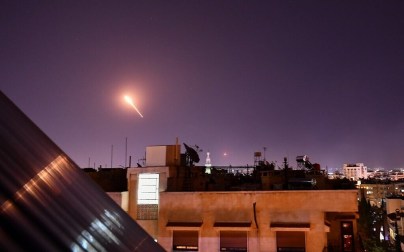
Syrian Air defenses respond to alleged Israeli missiles south of the capital Damascus, on July 20, 2020 (AFP)

Days later, in response to their deaths — as well as an alleged Israeli drone attack in Beirut that occurred the same night — Hezbollah fired three anti-tank guided missiles at Israeli military targets along the Lebanese border, narrowly missing an IDF armored ambulance in with five soldiers inside.

A Britain-based Syrian war monitoring group reported that five Iran-backed fighters were killed in an Israeli missile strike south of the Syrian capital on Monday night. It was not immediately clear if Jawad was counted among the five.

The missile attack on Monday night hit weapons depots and military positions belonging to Syrian regime forces and Iran-backed militia fighters, according to the Syrian Observatory for Human Rights.

The attack wounded at least seven Syrian troops, according to the official SANA news agency, which said the missiles were launched by warplanes from the Golan Heights.

The five killed were all non-Syrian paramilitary fighters, according to the Observatory.

It added that 11 combatants were wounded in total — four non-Syrian fighters and seven Syrian troops, of whom two were in critical condition.

The group said the aerial bombardments caused several explosions around the town of Kiswah, an area that has long been associated with Iran’s Islamic Revolutionary Guard Corps.

The attack reportedly came in two waves. The Reuters news service reported that the assault hit targets in the towns of Jabal al Mane, Muqaylabiya and Zakiya, causing “huge blasts” and allegedly killing Iranian personnel.

A military source quoted by SANA claimed that most of the missiles were shot down. Such claims of interceptions by Syrian state media are generally dismissed by defense analysts as empty boasts.

Reuters quoted a Syrian analyst with sources on the ground named Zaid al Reys as saying that the target of the attack was a “major ammunition depot.”

Syrian Air defenses respond to alleged Israeli missiles targeting south of the capital Damascus, on July 20, 2020 (AFP)

Israel has launched hundreds of strikes in Syria since the start of the civil war in 2011. It has targeted government troops, allied Iranian forces and fighters from the Lebanese Shiite terror group Hezbollah.

It rarely confirms details of its operations in Syria, but says Iran’s presence in support of President Bashar Assad and Hezbollah is a threat and that it will continue its strikes.

Monday’s attack came a week and a half after Iran and Syria signed an agreement that would see Tehran upgrade the Syrian military’s air defenses, apparently in response to ongoing Israeli strikes in the country.

It was the first strike in Syria to be attributed to Israel since June, when the Observatory said nine fighters were killed in airstrikes targeting positions of Iran-backed militias near the Iraqi border. Those strikes came hours after a similar raid killed six other Tehran-backed fighters.

Times of Israel staff contributed to this report.


How lethally effective is Iran’s air defense system? – DEBKAfile

Posted July 21, 2020 by Joseph Wouk
Categories: Uncategorized

Source: How lethally effective is Iran’s air defense system? – DEBKAfile

The intentions behind the high alert ordered for Iran’s air defenses – reported by US sources from “several” indications – are as opaque as the mystery behind the recent string of explosions at Iran’s key nuclear, military and missile sites.

International speculation has centered on Israel as being responsible for some of the attacks, although this is not confirmed. The only comment came from Defense Minister Benny Gantz on July 5. He said: “Not all the incidents in Iran have anything to do with us.  … All their systems are complex; they have very high security constraints and I am not sure that they always know how to maintain them.”

But if there are opposition groups on the ground in Iran carrying out attacks on key facilities there, it is not clear whether they are acting on directives or funding from external sources. None alone is capable supporting the sweeping effort involved in more than half a dozen strikes at the heart of Iran’s most secure infrastructure since late June.

One of the most critical attacks occurred on July 2, when a fire caused significant damage to the advanced centrifuge production building at the Natanz uranium enrichment center. It is calculated to have retarded Iran’s nuclear program by a year or more. Another blew up a missile production amenity and tunnel network near the Parchin military compound. The most recent was the setting of seven ships on fire at Iran’s southern port of Bushehr.

No one has yet suggested that aerial attacks by hostile fighters, bombers or missiles were the cause of those incidents. Only possible sabotage from the ground or cyberattack has been mentioned. So what moved the Revolutionary Guards (IRGC) to put the country’s air defenses on high alert?  DEBKAfile’s military and Middle East sources postulate a number of considerations:

  1. Preparations for unleashing a retaliatory attack on Israel in the expectation of deadly counteraction, as some Arab media suggest.
  2. Some of the explosions may have been caused by stealth drones which no one has so far admitted. The air defense alert would act as deterrence.
  3. Nervousness at not knowing where the attacks come from, who is responsible and when the next one is coming.
  4. Anxiety lest the next surprise blow – if and when it comes – will endanger the Islamic regime.

So how effective is Iran’s air defense system?

In June 2019, the IRGC claimed to have shot down a large, slow-flying US Global Hawk drone over the Strait of Hormuz with a Khordad 3 missile, a version of the SAM Raad. The Khordad 15 is capable of detecting, intercepting, and destroying six targets simultaneously. The system is said able to detect fighter jetscruise missiles and unmanned combat aerial vehicles (UCAV) from 150 km away and is able to track them within a range of 120km

Iran has 32 batteries of Russian-made S-300 ground-to-air missiles delivered since 2016 (in the face of Israel’s efforts to prevent the transaction). Iran’s aviation industry has also developed home-made versions of this system, including Bavar 373, SAM Tabas and SAM Raad, which are regularly showcased on military parades. They are seen as posing a serious threat. Their radar system is also believed to be highly effective.

The Sayyad-3 missile, used by the SAM system, has a range of 200 km. The system can also detect stealth targets from a distance of 85km. Missiles fired from the much older SA-15 are designed when they explode to pepper flying targets with shrapnel penetrating the fuselages of aircraft and drones.

The most advanced of all these systems are arrayed around Iran’s nuclear-related facilities.

The European Aviation Safety Agency reacted to the Iranian alert without delay on Thursday, July 13, by warning passenger jets against flying through Iranian air space lest they are accidentally targeted by the country’s air defense systems. “The hazardous security situation, poor coordination between Iran’s civil aviation and military operations” were cited as high risk.

The warning came shortly after Tehran admitted to mistakenly shooting down a Ukraine airliner in January killing all 176 passengers aboard  The Iranian government explained that the “misalignment of an air defense unit’s radar system” was the key “human error” that led to the accidental downing of the airliner.

At the time, Tehran’s air defenses had been on high alert following an Iranian attack on US troops in Iraq after the killing of top general Qasem Soleimani by a US drone.

Following the Ukrainian disaster, the US is also concerned that Iran’s unreliability in the operation of its air defense systems means that the transition to a high state of alert could also pose a threat in itself.

Iran, and others, watching Israel stumble over coronavirus

Posted July 21, 2020 by Joseph Wouk
Categories: Uncategorized

Source: Iran, and others, watching Israel stumble over coronavirus – The Jerusalem Post

When Israel had Corona under control, the message conveyed was of a strong, resilient country with a great deal of solidarity able to weather all kinds of storms, even a pandemic.

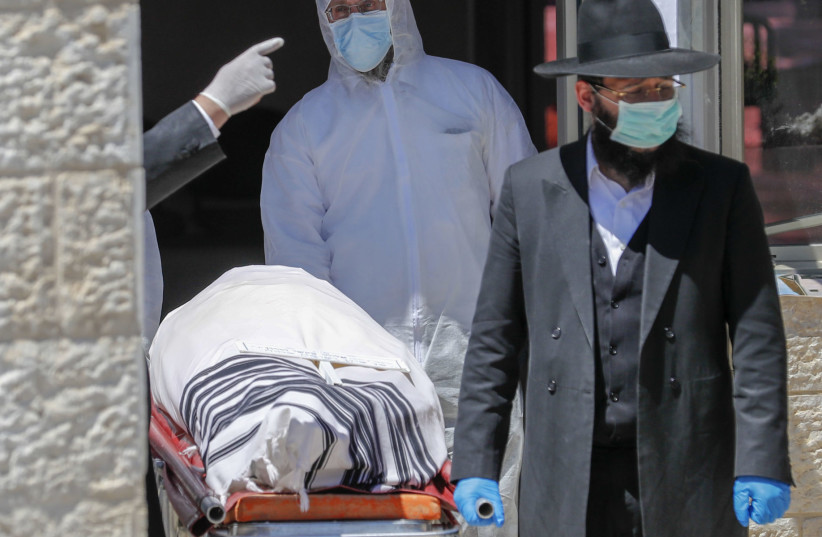
An Israeli rabbi walks alongside the body of Eliahu Bakshi-Doron, the former Sephardic chief rabbi of Israel, who died from complications of the coronavirus (photo credit: AHMAD GHARABLI VIA GETTY IMAGES/JTA)
An Israeli rabbi walks alongside the body of Eliahu Bakshi-Doron, the former Sephardic chief rabbi of Israel, who died from complications of the coronavirus
(photo credit: AHMAD GHARABLI VIA GETTY IMAGES/JTA)
“Which country will triumph in the post-pandemic world,” read an intriguing headline to an op-ed in the New York Times on Monday. And the sub-headline was even more interesting – “Hint: It’s not the United States or China.”

And, no, it’s also not Israel.

Rather, according to Ruchir Sharma, a “global investor,” it is Germany. Why Germany? Well, for starters because it has managed the coronavirus crisis with great aplomb.

“imagine a country, a major Western economic power, where the coronavirus arrived late but the government, instead of denying and delaying, acted early. It was ready with tests and contact tracing to ‘flatten the curve’ swiftly and limited its death rate to orders of magnitude lower than that of any other major Western industrial nation,” Sharma wrote.

“Containing the virus allowed for a brief and targeted lockdown, which helped limit unemployment to only 6 percent. Amid a shower of international praise, the country’s boringly predictable leader experienced a huge spike in popular approval, to 70 percent from 40 percent,” he continued in a piece that fell under the genre of “show me how a country is dealing with COVID-19, and I’ll show you its future.”

So what does that all say about Israel?

If in late April, around Independence Day when it seemed Israel had a good handle on the crisis, pundits wrote that Israel’s successful management of the crisis was sending an important political message to Israel’s foes, then what message is being sent today when Jerusalem is fumbling on the issue?When Israel had Corona under control, the message conveyed was of a strong, resilient country with a great deal of solidarity able to weather all kinds of storms, even a pandemic. This is a particularly important message in a hostile neighborhood where it is always strategically important for Israel to project a sense that it can overcome any and all forms of adversity.

But today, three months later, what image is Israel presenting now?

“Let’s say we are sitting in Tehran,” Maj.-Gen Israel Ziv (ret.), a former head of the IDF’s Operations Directorate, said in a Kan Bet interview on Monday. “We are interested in what is happening in Israel, and what do we see?

“We see that the country that is supposed to be experiencing a crisis is drowning in its own crisis, which is getting worse. The state looks confused, as if it is not being managed, looking like Nasrallah’s spider web.”

This was a reference to Hezbollah head Hassan Nasrallah’s famous speech celebrating Israel’s withdrawal from Lebanon in 2000 when he said that with all its might and weaponry, Israel is as feeble as a spider web.

“When we were watching what was happening in the Arab world during what was called the Arab Spring, we felt a degree of satisfaction – look, they are unstable; look, they are failing,” Ziv said.

“How do we now look in the eyes of the Arabs? We have a managerial crisis, a mess on the street – they are certainly hoping that it will go from demonstrations to anarchy – there is no budget, and the government can’t even make a decision to give the Defense Ministry, which is supposed to always keep its eyes above water, [budgetary] exemptions. And if I’m Iran, I’m thinking this is an extraordinary opportunity.”

Israel’s enemies, Ziv said, are closely watching what is happening here, and the conclusions they draw could have long-lasting ramifications. “We must recover, take matters into our hands, change the national framework for dealing with the crisis, and show the strong Israel.”

In Ziv’s telling, the way Israel deals with the crisis is not only a health or economic issue, but also one that has far-reaching strategic ramifications. Israel’s foes are carefully watching to see, and perhaps exploit, the country’s weaknesses that are on full display.

But not only Israel’s foes are watching, so too are countries who have an image of Israel as a can-do state with tremendous technological prowess and an uncanny ability to deal with short term problems.

Prime Minister Benjamin Netanyahu has adroitly leveraged that perception of the Jewish state over the last decade into significant diplomatic capital.   During this time Israel has made tremendous diplomatic inroads in Asia, Africa, Latin America and the Persian Gulf on the strength of the idea that it is the innovation nation, as Netanyahu likes to call it, which has a great deal to offer.

China, India, Saudi Arabia, the UAE, Ethiopia, Kenya, Uganda, Chad, Brazil and Argentina have all forged closer ties to Israel over the last decade – some more openly than others – not because they suddenly became Zionists, but because ties with Jerusalem benefited them. To a certain extent they looked at Israel as a model.

In the early days of the virus, Netanyahu repeated often that countries around the world were looking to learn from Israel about how to deal with the virus. That is something that raises the stature of a country in the eyes of others.

But what will happen to this leverage if these countries look at how Israel is dealing with the pandemic now, and conclude that it is doing no better – and perhaps even worse – than they themselves are? What does that say about what the country has to offer?

Israel’s image as an efficient, innovative country full of solutions and able to meet any challenge has strategic and diplomatic significance. It is an image it can’t afford to have tarnished. Dealing more effectively with the virus is not only a health and economic imperative, but also a strategic one.


In latest in series of blasts, explosion reported at Iranian oil pipeline

Posted July 20, 2020 by davidking1530
Categories: Uncategorized

Ooops!

https://www.timesofisrael.com/in-latest-in-series-of-blasts-explosion-reported-at-iranian-oil-pipeline/

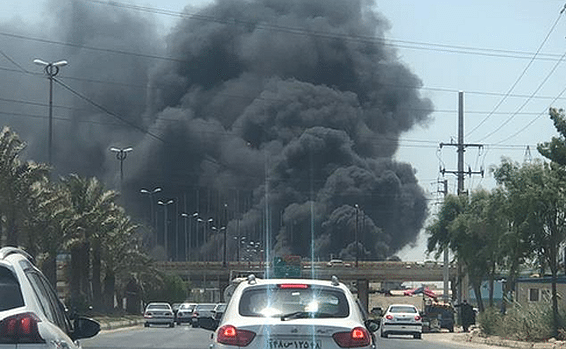
Footage from a reported blast in an oil pipeline in southern Iran, on July 18, 2020 (video screenshot)

An explosion was reported in an oil pipeline in Iran Saturday, the latest in a mysterious series of blasts and blazes that have occurred throughout the country.

Several of the recent disasters have struck sensitive Iranian sites, leading to speculation that they could be part of a sabotage campaign engineered by Israel or another Tehran foe.

The latest incident occurred in a pipeline in the Ahvaz region in the south of the country, according to reports in local and social media.

Video shared on social media showed a large fire at the scene. There were no reports of casualties in the incident, and it was not immediately clear what the cause was.

The last odd incident came on Wednesday, when seven traditional wooden vessels caught fire in a factory in the southern Iranian port city of Bushehr. Others have included gas blasts and explosions in Tehran, as well as in the vicinity of military facilities.

A July 2 explosion damaged Iran’s Natanz nuclear facility. A week before that, a large blast was felt in Tehran, apparently caused by an explosion at the Parchin military complex, which defense analysts believe holds an underground tunnel system and missile production facilities.

A Middle Eastern intelligence official was quoted earlier this month by The New York Times as saying the fire that badly damaged a building used for producing centrifuges at Natanz was sparked by Israel and was caused by a powerful bomb.

But the unidentified official said Israel was not linked to several other recent mysterious fires in Iran over past weeks.

Israeli TV reports, without naming sources, have said the blast destroyed the laboratory in which Iran developed faster centrifuges and set back the Iranian nuclear program by one or two years.

Iran last week called for action against Israel following the damage to the Natanz facility, and appeared to acknowledge the fire there was not an accident.

Sabotage in Iran Is Preferable to a Deal With Iran

Posted July 18, 2020 by davidking1530
Categories: Uncategorized

Israel also engaged in sabotage operations as part of its effort to stop Saddam going nuclear, see here:

https://en.wikipedia.org/wiki/Operation_Opera#Strategy_and_diplomacy

Anthony Cordesman writes that Israel conducted a series of clandestine operations to halt construction or destroy the reactor.[46] In April 1979, Israeli agents in France allegedly planted a bomb that destroyed the reactor’s first set of core structures while they were awaiting shipment to Iraq.[46] In June 1980, Israeli agents are said to have assassinated Yehia El-Mashad, an Egyptian atomic scientist working on the Iraqi nuclear program.[47][48] It has also been claimed that Israel bombed several of the French and Italian companies it suspected of working on the project, and sent threatening letters to top officials and technicians.[46][48][49] Following the bombing in April 1979, France inserted a clause in its agreement with Iraq saying that French personnel would have to supervise the Osirak reactor on-site for a period of ten years.

https://www.bloomberg.com/opinion/articles/2020-07-13/nuclear-sabotage-is-preferable-to-a-nuclear-deal-with-iran

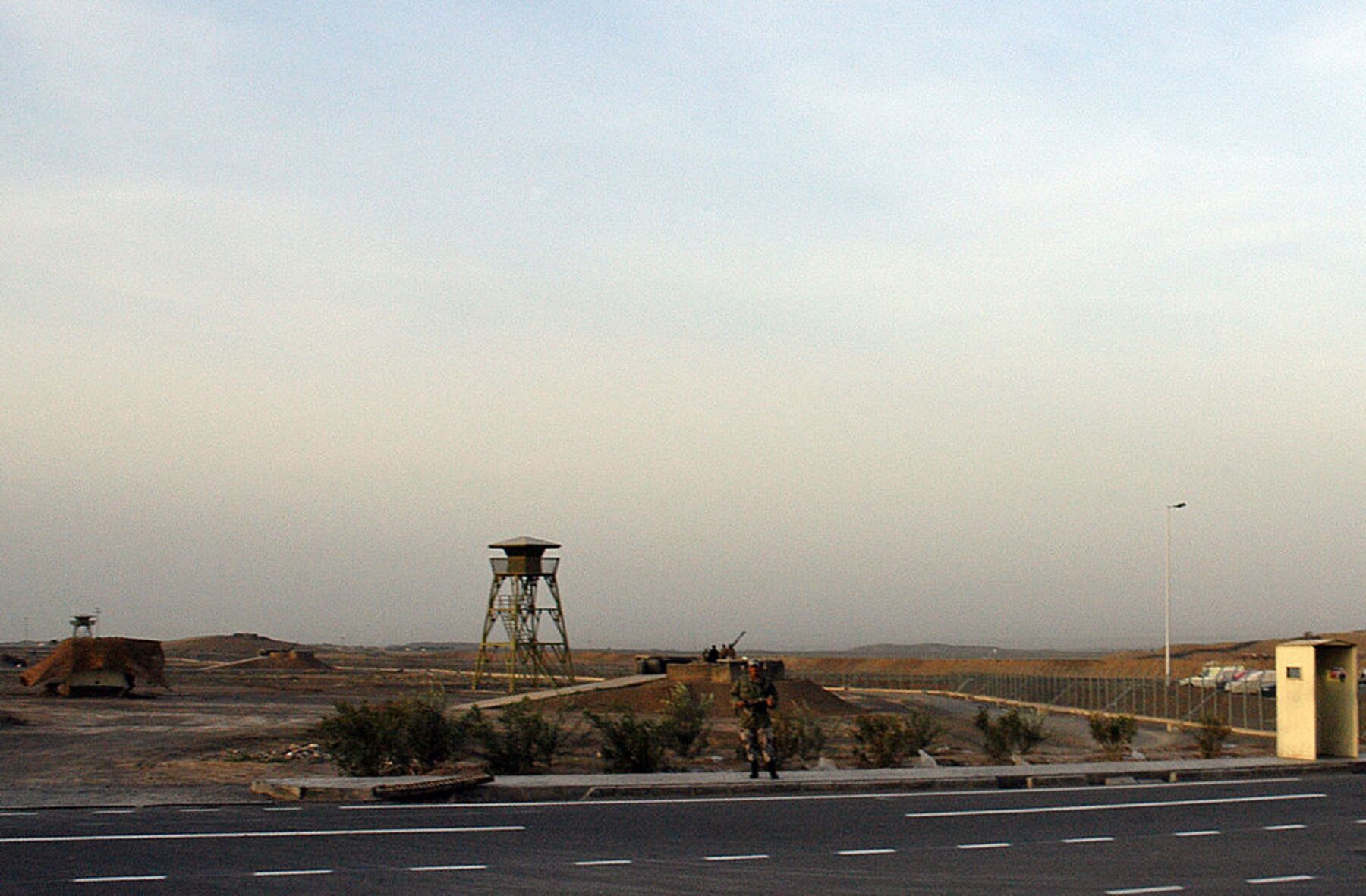
Natanz, Iran, 2007.

Whoever wins the U.S. presidency in November, there is a good chance he will try to negotiate a stronger nuclear deal with Iran in 2021. But events of the last few weeks show that there are better ways to frustrate the regime’s nuclear ambitions.

Both President Donald Trump and his Democratic rival, Joe Biden, favor talking with Iran. “I would rejoin the agreement and use our renewed commitment to diplomacy to work with our allies to strengthen and extend it,” Biden told the New York Times last winter. Trump, meanwhile, was on Twitter last month urging Iran to “make the Big deal.”

The logic of a deal goes like this: Except for war, the only sustainable way to prevent Iran from getting nuclear weapons is to reach an agreement with its leaders. That has been the basic assumption underlying U.S. nuclear policy on Iran for the last 20 years. With the right mix of carrots and sticks, the thinking goes, Iran will negotiate away a potential nuclear weapon.

But a nuclear deal with Iran would have to rely on a partnership with a regime that oppresses its citizens, preys on its neighbors, supports terrorism on three continents and has shown contempt for international law. And the alternative to a deal is not necessarily a costly and dangerous war. The West can delay and foil Iran’s nuclear ambitions by other means.

Since late June, explosions have rocked at least three Iranian military facilities. The latest appears to have targeted an underground research facility for chemical weapons. Earlier this month, a building at Iran’s Natanz centrifuge site burst into flames.

Much remains unknown about this latest spate of explosions. A relatively new group calling itself “Homeland Panthers” has claimed credit for the attack on Natanz. Iranian officials have blamed it on Israel. David Albright, the former nuclear inspector and founder of the Institute for Science and International Security, told me his organization — which has studied satellite imagery of the facility before and after the explosion — cannot rule out that it was an accident. But “it looks more like a deliberate act,” he said.

There are several good reasons to think all of this was an act of Israeli sabotage. To start, the Israelis have done this kind of thing before. In the early 2010s, Israel’s Mossad conducted a series of assassinations of Iranian nuclear scientists. Before that, Israel and the U.S. cooperated on a cyberattack on Natanz that sped up its centrifuges, causing them to break down.

More recently, Israeli spies broke into a Tehran warehouse and stole a technical archive of Iran’s nuclear program, demonstrating that they have “human networks that have penetrated Iran’s security structure,” said David Wurmser, a national security expert who most recently worked as an adviser to the National Security Council.

Whoever is responsible for the attack — and to be clear, the Iranians say they are prepared to retaliate against Israel, though they have yet to do so — the damage at Natanz alone has significantly set back Iran’s nuclear program. The facility there was an assembly center for more advanced and efficient centrifuges, which Iran was allowed to produce under the flawed 2015 deal. “This was a crown jewel of their program,” Albright said.

And the damage may be to more than just the centrifuges — it could also destabilize the Iranian regime itself. “The more Iran’s government looks impotent, and the impression is left the Israelis are everywhere, the more high-level Iranian officials will calibrate their survival by cooperating with Americans or Israelis, which itself creates an intelligence bonanza,” Wurmser said.

The attacks could also undermine the regime’s legitimacy among the Iranian public more generally. Sabotage of this sort shows that Iran’s leaders are not nearly as powerful and all-knowing as they say.

At the very least, the fact that someone was able to explode a “crown jewel” of Iran’s nuclear program should make clear that the civilized world can delay Iran’s nuclear ambitions without conferring legitimacy to the regime.

Hamas finally admits one of its number spied for Israel, then defected

Posted July 18, 2020 by davidking1530
Categories: Uncategorized

Hahahah

https://www.timesofisrael.com/hamas-admits-one-of-its-number-spied-for-israel-then-defected/

Hamas terror group deputy Moussa Abu Marzouk discusses "collaborators" with Israel who were arrested or fled to Israel in recent weeks (Screenshot: Al-Mayadeen TV)

Hamas deputy leader Moussa Abu Marzouk has confirmed Arabic media reports that a member of the Gaza-based terror group collaborated with and subsequently defected to Israel.

“Hamas arrested a number of collaborators with the occupation… Some of them, or rather one of them, fled toward the occupation and the occupation gave him a warm welcome,” Abu Marzouk told the Lebanese pro-Hezbollah al-Mayadeen TV on Thursday.

A Tuesday report in the Saudi-sponsored Al-Arabiya outlet said that Hamas had arrested 16 members of a spy ring collaborating with Israel. While Hamas routinely announces the arrests of alleged collaborators, that ring was reportedly composed of members of Hamas’s own military wing.

Al-Arabiya further reported that Israel’s Mossad spy agency had recently facilitated the escape of senior commander Mohammad Abu Ajwa, who had previously led Hamas’s naval special forces, after Abu Ajwa had spied for Israel for years. The arrests of the remaining collaborators took place after Abu Ajwa’s escape, Al-Arabiya said.

While Hamas denied the report on Tuesday, Abu Marzouk appeared to confirm for the first time that the collaborators, including the one who had fled, were members of his group. Marzouk denied, however, that the collaborators were senior officials, or that they were operating in concert.

“They are isolated members. There is no connection between them. They are not commanders in the [Hamas military wing] Izz al-Din al-Qassam Brigades, nor are they commanders in Hamas… What the occupation claims, that they are commando officers or senior naval officers, is absolutely false,” Abu Marzouk said.

Israeli authorities have yet to comment publicly on any of the stories in the Arabic press.

The Shin Bet security service declined to comment on Abu Marzouk’s statements to al-Mayadeen, saying that it does not respond to “foreign reports.”

Hamas officials first claimed in early July that their group had arrested several members of an “Israeli-directed” spy ring planning “sabotage” in the Gaza Strip.

Since then, Arabic-language media have been buzzing with alleged revelations about Israeli-directed espionage in the Gaza Strip and traitors at the highest levels of Hamas.

Tuesday’s report in Al-Arabiya said that after arriving in Israel, the senior naval commander provided information about weapons stockpiles and the residences of senior Hamas officials, leading the terror group to immediately move the materiel to other hideouts in the Strip.

In response to the supposed high-level defection, the report said the Gaza-based terror group embarked on a “restructuring” of its military wing by firing several senior officers. A second senior commander in Hamas’s internal security forces was also arrested for spying for Israel, Al-Arabiya reported.

In its denial of the Al-Arabiya report on Tuesday, Hamas accused Saudi Arabia of “lies” and of “closing ranks with the Zionist occupation.”

Netanyahu aide said to admit US in no mood for annexation, so PM won’t go ahead

Posted July 18, 2020 by davidking1530
Categories: Uncategorized

Unfortunately, I am not surprised.

https://www.timesofisrael.com/netanyahu-aide-said-to-admit-us-in-no-mood-for-annexation-so-pm-wont-go-ahead/

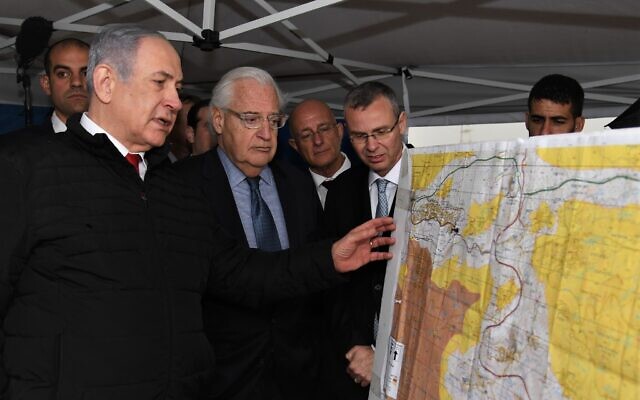
Prime Minister Benjamin Netanyahu, left, US Ambassador to Israel David Friedman, center, and then-Tourism Minister Yariv Levin during a meeting to discuss mapping extension of Israeli sovereignty to areas of the West Bank, held in the Ariel settlement, February 24, 2020. (David Azagury/US Embassy Jerusalem)

Knesset Speaker Yariv Levin has acknowledged in private conversations that no attention is currently being given in Washington to Israeli plans to annex up to 30 percent of the West Bank, according to a Tuesday Army Radio report.

As a result, Levin reportedly said, the controversial move will likely have to be placed on the back burner as Prime Minister Benjamin Netanyahu will not move forward without coordinating with the Trump administration.

The US administration’s attention is elsewhere, the report claimed Levin had said, and “it is not listening” when it comes to annexation.

The White House has said repeatedly that it is up to Israel to decide on annexation, but has yet to give a definitive answer as to whether it is prepared to support and recognize the unilateral annexation now of part or all of the 30% of the West Bank allocated to Israel in its peace plan.

While similar comments have been made in recent weeks by Likud officials who have acknowledged that the spiraling pandemic has forced the attention of world leaders to turn to other issues, Levin is one of only a handful of Israeli officials who have been deeply involved in talks with American officials regarding the Trump plan’s implementation and ramifications.

Levin also sits on the seven-member joint US-Israeli mapping committee that has been tasked with drawing up the exact parameters for annexation that Washington will be willing to accept. The committee’s progress has been slowed by the pandemic, with Netanyahu telling settler leaders and even Defense Minister Benny Gantz that the maps have yet to be finalized.

Settler leaders responded angrily to Tuesday’s Army Radio report, asserting that US approval is not needed for Israel to move forward with annexation. “There is no need to wait for anyone. This move depends solely on us. It is time to keep the promises made and apply [Israeli] sovereignty [to the West Bank] regardless of any factor,” the Yesha umbrella council of settlement mayors said in a statement, referring to the Likud premier’s repeated election promises to carry out annexation if elected.

The more hardline Samaria Regional Council chairman Yossi Dagan went further, writing in a statement, “Never since the establishment of the state has a nationalist government bowed and surrendered like this to the Americans.”

Dagan is among a plurality of the 24 settler mayors who have voiced their opposition to the Trump plan because it conditionally earmarks 70% of the West Bank for a potential Palestinian state. They have argued that Netanyahu must move forward with annexation, but not in the context of the US peace proposal.

A slightly smaller camp of settler mayors led by Efrat Local Council chairman Oded Revivi have argued that the plan’s theoretical proposal of a Palestinian state is a pill worth swallowing as it comes with US recognition of Israeli sovereignty over all settlements as well as the Jordan Valley — a development that settler leaders could only have dreamed of before Trump took office.

Netanyahu’s coalition government set July 1 as the date from which it could begin implementing Netanyahu’s pledge to unilaterally extend sovereignty to all 132 settlements in the West Bank and to the Jordan Valley, constituting together about 30 percent of the West Bank, subject to American approval.

But as the target date came and went without any action, Netanyahu’s office said he would continue to discuss the possible annexation with the US administration.

The US aside, the international community has voiced near-unanimous opposition to unilateral annexation.

On Monday, Jordan’s King Abdullah told British lawmakers that the Netanyahu government’s plans would fuel instability and dim slipping hopes for a peace agreement to end the Israeli-Palestinian conflict.

“Any unilateral Israeli measure to annex lands in the West Bank is unacceptable, as it would undermine the prospects of achieving peace and stability in the Middle East,” the Reuters news agency quoted Abdullah as having told members of the Foreign and Defense parliamentary committee in virtual testimony.

View comments 

Seven ships catch fire at port near Iranian nuclear reactor

Posted July 18, 2020 by davidking1530
Categories: Uncategorized

Iran sure is having some rotten luck at the moment.

https://www.israelhayom.com/2020/07/15/seven-ships-catch-fire-at-port-near-iranian-nuclear-reactor/

Seven ships catch fire at port near Iranian nuclear reactor

At least seven ships have caught fire at the Iranian port of Bushehr, Iran’s Tasnim news agency reported on Wednesday, in what appeared to be the latest in a series of unexplained incidents around nuclear and industrial installations since late June.

No casualties have been reported, the agency said.

According to the Iranian Mehr agency on Wednesday, the fire started near the northern installations of the city’s port. Pictures from the incident showed a large pillar of smoke billowing from the area.

The agency said that “many firefighting crews are in the area to stop the blaze from spreading.” Social media users expressed concern that the residents of Bushehr may be threatened if the fire expands further.

The city houses Iran’s nuclear reactor, which has been ostensibly for peaceful purposes only.

There have been several explosions and fires around Iranian military, nuclear and industrial facilities since late June, including in Natanz, where its main uranium enrichment center was badly damaged in what the New York Times described as a deliberate effort by the US and Israel.

Natanz is the centerpiece of Iran’s enrichment program, which Tehran says is for peaceful purposes. Western intelligence agencies and international inspectors believe it had a coordinated, clandestine nuclear arms program at least until 2003. Tehran denies ever seeking nuclear weapons.

Iran’s top security body said on July 3 that the cause of the Natanz fire had been determined but would be announced at a later time. Some Iranian officials have said it may have been cyber sabotage and one of them warned that Tehran would retaliate against any country carrying out such attacks.

In an article in early July, state news agency IRNA addressed what it called the possibility of sabotage by enemies such as Israel and the United States, although it stopped short of accusing either directly.

Israeli Defense Minister Benny Gantz said on July 5 that Israel was not “necessarily” behind every mysterious incident in Iran.

Australia only country to vote against all five UNHRC anti-Israel resolutions

Posted July 15, 2020 by davidking1530
Categories: Uncategorized

Makes me proud to be Australian.

Although the voting result is only because the right wing/conservative party (Liberal Party) is in power. If it was to be the left wing party (Labor Party) then some/all of the votes would likely have been abstentions.

Some interesting bits of history in the article as well (my bolding).

Australia-Israel Relationship a ‘Mateship’ Based on Trade, Trust and Mutual Values

At the 43rd session of the UN Human Rights Council (UNHRC) that recently concluded, Australia was the only country to vote against all five anti-Israel resolutions, including the notoriously biased Agenda Item 7.

In Australia’s position paper explaining the votes last month, it noted, “Australia has been consistent in its principled opposition to biased and one-sided resolutions targeting Israel in multilateral forums. We have reiterated this position before this Council every year of our membership. Our position has not changed. It is our firm view that the Human Rights Council’s disproportionate focus on Israel—through an unmatched five single country, targeted resolutions every year—damages its credibility. These resolutions do nothing to contribute to lasting peace and stability for Israelis and Palestinians.”

The perfect voting record, according to Australian leaders, underscores the vital relationship between the two nations.

“Australia regards the biased and one-sided targeting of Israel in multilateral forums as unhelpful to efforts to build lasting peace and stability,” Australian Ambassador to Israel Chris Cannan told JNS. “Australia has been consistent in its principled opposition to the singling out and unfair targeting of Israel, and one-sided resolutions, in the HRC,” he said. “It remains Australia’s firm view that the HRC’s agenda Item 7—the only standing agenda item that focuses on a single country situation—expresses this bias and is inappropriate.”

He said of the bilateral relations: “Australia and Israel have a close, longstanding and bipartisan, bilateral relationship.  … Our contemporary relationship is at a high point; with reciprocal prime ministerial and head of state visits having taken place in the past three years.”

Still, he noted, “Our support for Israel has always been accompanied by a commitment to a two-state solution, negotiated directly between Israel and the Palestinians.”

Today, posed Cannan, “Australia is continuing to contribute to Israeli and regional peace and security through our contribution to the Multilateral Force and Observers in the Sinai and the UN Truce Supervision Organization.”

In terms of business and shared resources, Australia has backed up the expanding trade relationship with resources, including through an Australian innovation “Landing Pad” in Tel Aviv for early-stage Australian start-ups, and the opening of an Australian Trade and Defense Office in Jerusalem. “We are also increasing our national security cooperation, including on defense and cyber security,” he said.

Cannan further noted that the Australia-Israel relationship is based on values. “Australia is a close friend of Israel. It is in our national interest to see Israel succeed as a liberal democracy in the Middle East, and Australia continues to strongly support its right to exist within secure and internationally recognized borders.”

Arsen Ostrovsky, an international human-rights lawyer and Israel Affairs Director at the Zionist Council of New South Wales, similarly told JNS that “Australia is a reliable and trustworthy ally of Israel, showing in word and deed that [it] stands out and speaks out, supporting Israel against the relentless one-sided resolutions that exist in all UN forums.”

He maintained that “there’s a word in Australia—‘mateship’—a friendship based on the values of loyalty, courage and respect. In terms of this Australian government and prime minister, who stand with Israel when it counts even if it means going against so many other nations, I don’t think Israel could ask for a better mate and ally. Australians stand up for their mates, and certainly in the UN”

Originally from Sydney but now living in Tel Aviv, Ostrovsky explained that the Australia-Israel relationship is centuries old, with Australian engagement in the region dating back to the Sinai-Palestine campaign during World War I, including the iconic victory in the Battle of Beersheva in 1917. Hundreds of horsemen from Australia and New Zealand were brought by the Australia New Zealand Army Corps to Israel, making history as they liberated the city of Beersheva on behalf of the British—a key milestone towards the UN partition plan.

Australia voted in favor of the plan on Nov. 29, 1947, despite pressure from the United Kingdom to abstain, having left the region after the British Mandate period. That vote of countries worldwide led to Israel’s independence on May 14, 1948.

Since then, the nation has played an important role in the world body, calling out the council for condemning Israel under the guise of human rights.

Tensions did occur at the time of the Yom Kippur War in 1973 under the short term of Labor Party government of Prime Minister Edward Gough Whitlam. Issues also centered on the “Zionism is racism” debate; the lack of support for the Likud Party and building in Judea and Samaria by former Prime Minister Bob Hawke in the 1980s [also Labor Party]; and an existing BDS movement within the country.

But that is in the past, and the two nations look towards the future.

While Australia has not commented on Israel’s planned application of sovereignty in Judea and Samaria, Ostrovsky said the country has been clear that it supports two states. It admittedly has concerns with the settlements while also recognizing Israel’s challenges—not least of which is Palestinian terror, incitement and payments to terrorists, which led Australia to stop its direct payments to the Palestinian Authority, he added.

“If Australia does express its concern with Israel applying sovereignty, it will be measured, and I hope they’d reiterate their support for Israel and the greater context of the challenges Israel faces from the region,” he said.

Politics aside, posed Ostrovsky, the relationship is based on economic interests and innovation: “There is an increasing number of Israeli companies on Australian stock market, and a lot to be gained in the future, from cyber security and tech to water security.”

Today, the two countries work together and share best practices with a small group of nations, including Austria, Denmark, Cyprus and New Zealand, to combat the spread of the coronavirus.

An interest in innovation

Paul Israel, CEO of the Australia-Israel Chamber of Commerce, told JNS that the trade relationship between the two countries is meaningful for both nations. Israeli exports to Australia, especially in innovation, high-tech, agritech and medtech, are relevant for large Australian enterprises because of their quality, robustness and scalability.

The Chamber, which has offices in Sydney, Melbourne, Adelaide, Brisbane, Perth, Auckland and Tel Aviv, often hosts delegations from Australia to learn about Israel’s ecosystem and sustainable high-tech industry. “Innovation is relatively new to Australia, and Australia is in love with what Israel has built,” he said.

More than that, he explained, “there has been a consistent and well-documented history of bipartisan support from Australia to Israel, which has been consistent ever since. Australia is a pioneer in standing up for Israel in the United Nations, rooted in the dynamic, strong and vibrant Jewish community in existence since [the arrival of the Europeans] in 1780s, and based on values of democracy and freedom of speech.”

Ostrovsky agreed, saying that “Australia understands that Israel is a small democracy, surrounded by enemies.”

It is a “no-nonsense country that doesn’t tolerate bullies or intimidation,” he added. “Standing up for your friends is the definition of mateship—and that’s what Australia is doing.”