3 Americans detained in North Korea ‘in good health’ and on their way back to US, Trump says 

Posted May 9, 2018 by Joseph Wouk
Categories: Uncategorized

Source: 3 Americans detained in North Korea ‘in good health’ and on their way back to US, Trump says | Fox News

Three Americans detained in North Korea “seem to be in good health” and are on their way back to the United States, President Trump announced in a Wednesday tweet.

“I am pleased to inform you that Secretary of State Mike Pompeo is in the air and on his way back from North Korea with the 3 wonderful gentlemen that everyone is looking so forward to meeting. They seem to be in good health. Also, good meeting with Kim Jong Un. Date & Place set,” Trump tweeted Wednesday morning.

Trump’s Iran deal withdrawal: It should never have come to this 

Posted May 9, 2018 by Joseph Wouk
Categories: Uncategorized

Source: Trump’s Iran deal withdrawal: It should never have come to this | The Times of Israel

Now we have the US on one side, Iran on the other, and 5 others in between. Iran will exploit the disunity. But don’t blame Trump for that. Blame the original sin

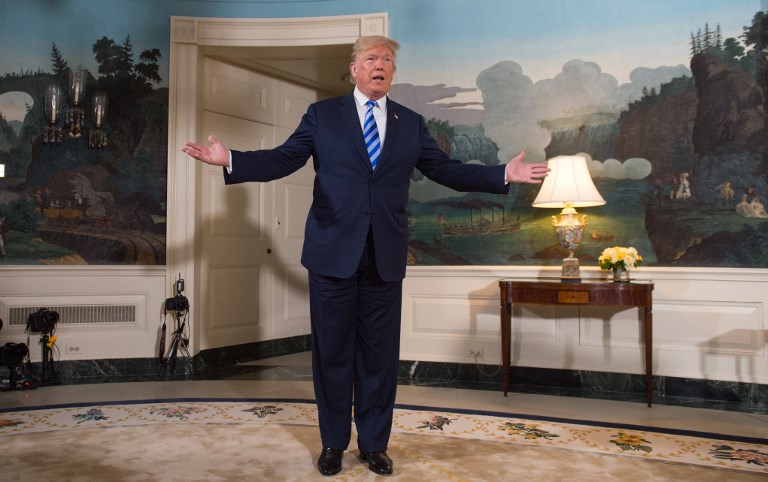
US President Donald Trump speaks to the press as he leaves after announcing his decision about the nuclear deal with Iran during a speech from the Diplomatic Reception Room at the White House in Washington, DC, May 8, 2018. (AFP / SAUL LOEB)

One line in US President Donald Trump’s withering dissection of the 2015 P5+1 negotiators’ inadequate and now tottering agreement with Iran is worth particular attention. “A constructive deal could easily have been struck at the time, but it wasn’t,” said the president, announcing the US withdrawal from the accord on Tuesday.

The Obama administration, chef and champion of the deal, would, obviously, take issue with that assertion. But even if the “easily” is an overstatement, Trump is right. A proper, adequate deal was there for the making. The P5+1 — as in, the Obama administration — failed to make it.

And as the Trump administration must now restart the work that the 2015 deal was supposed to achieve but didn’t, its task will be more complicated than the original mission the previous US administration so signally failed to achieve.

A “constructive deal” — that is, a deal to dismantle Iran’s rogue nuclear program —  could indeed have been struck in the Obama years, when economic pressure had dragged the Iranian regime kicking and screaming to the negotiating table. The ayatollahs feared for their hold on Iran; the West had maximal leverage. The Russians and Chinese would have sought to resist a stringent agreement that put Iran out of the nuclear weapons business for the long term, but a US administration that made plain the top priority it placed on the imperative for an agreement to keep the world’s most dangerous regime from attaining the world’s mass dangerous weapons of mass destruction could have got its way.

Israel, the Little Satan in the ayatollahs’ rapacious sights, could have injected some Middle East nous into the battle of wills, but was kept at a firm distance by the Americans. The only truly dependable ally of the West in this region, with the best intelligence apparatuses, was told to butt out. Worse, we were haughtily informed that since we didn’t know what was in the deal when it was taking shape we shouldn’t be objecting to it, and then, when it was done, we were falsely accused of being opposed to any deal, no matter what it contained.

Then US president Barack Obama, right, and Prime Minister Benjamin Netanyahu hold a meeting in the Oval Office of the White House on November 9, 2015. (AFP/Saul Loeb)

Meanwhile, the US-led negotiators were outsmarted and outmaneuvered. The Iranians were let off the hook. The regime got the deal it wanted. And it was entrenched in power — bolder and richer, the better to oppress its people, cause havoc in the region, and keep its eye on the nuclear prize.

Iran is currently threatening that it may resume uranium enrichment and boasting that it has improved its technology so that it can enrich to higher levels than ever before — all while complying with the deal. That tells you all you need to know about the agreement. It did not require Iran to trash all of its centrifuges, and it allowed Iran to continue research and development on enrichment. Good job, negotiators. Well done.

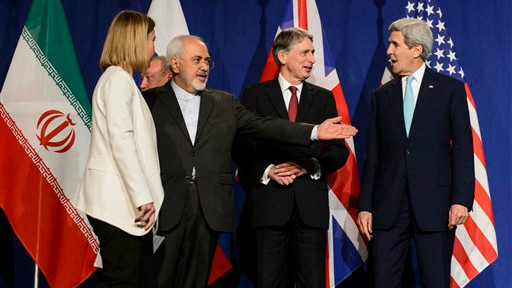
From left, EU High Representative for Foreign Affairs and Security Policy, Federica Mogherini, Iranian Foreign Minister, Mohammad Javad Zarif, British Foreign Secretary, Philip Hammond, and US Secretary of State, John Kerry, after a new round of Nuclear Iran Talks in the Learning Center at the Swiss federal Institute of Technology (EPFL) in Lausanne, Switzerland, April 2, 2015 (AP/Keystone, Jean-Christophe Bott, File)

The P5+1’s failure to stop the ayatollahs dead in their would-be nuclear tracks is mirrored by the demonstrably lackadaisical approach of the International Atomic Energy Agency, the UN body charged with policing the deal. How it can allow itself to certify that Iran is complying with the accord when the terms of the deal do not allow it to carry out anytime-anywhere inspections of suspect sites is beyond comprehension. And its response to the Mossad’s astonishing haul of Iran’s own nuclear weapons documentation in the past few days simply beggars belief.

Imagine that your entire life’s work is dedicated to one acutely sensitive area of expertise, that you are constantly hampered by restricted access to your core research material, but that you are nonetheless the world authority in your field. Then imagine that someone else manages, through extraordinary enterprise and courage, to gain access to more core material, much more, than you could ever have imagined existed. And offers to make it available to you.

Would you a) express your profound gratitude and rush to pore over the new discoveries or b) dismiss the material, sight unseen, as irrelevant? No prizes for guessing which course of action the IAEA adopted hours after Prime Minister Benjamin Netanyahu unveiled and began to detail Iran’s own nuclear weapons documentation, spirited out of Tehran from under the noses of the Islamic “We have never sought nuclear weapons” Republic.

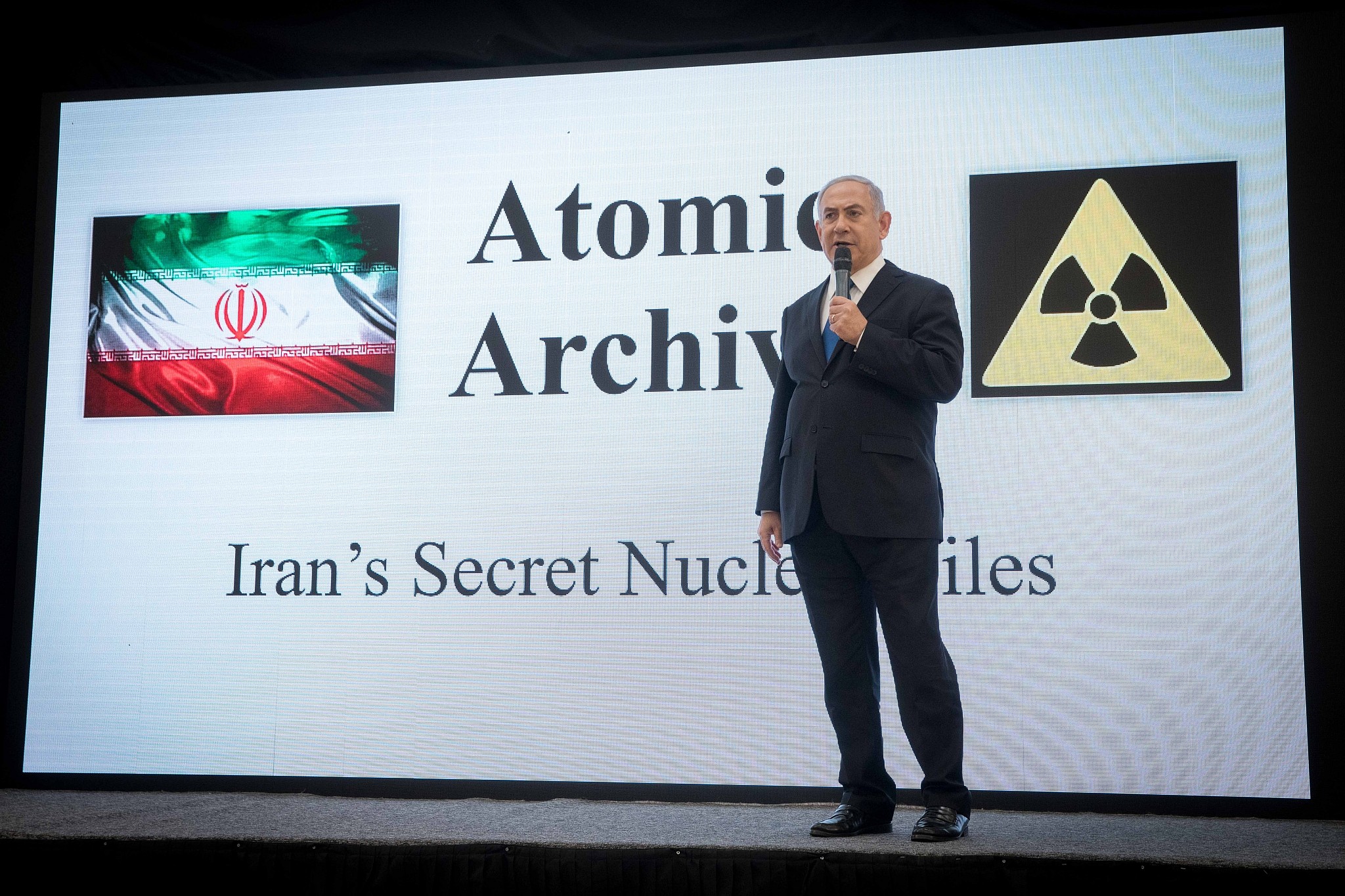
Prime Minister Benjamin Netanyahu presents Iran’s own documentation of its nuclear weapons program, at a press conference in Tel Aviv, on April 30, 2018. (Miriam Alster/Flash90)

Trump’s decision to nix rather than fix the 2015 agreement creates a highly complex new reality. Hitherto, the P5+1 countries, however strained the ties between them, were at least ostensibly lined up together, behind their infirm accord, against the ayatollahs.

Now, we have the US on one side, Iran on the other, and Britain, France, Germany, China and Russia all pulling in slightly different directions in between. Iran can be relied upon to exploit the disunity.

But don’t blame Donald Trump for that. Blame the original sin — a deal that was supposed to dismantle Iran’s rogue nuclear weapons program, but, simply, didn’t.

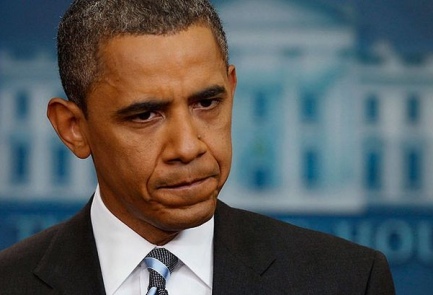
Obama calls Trump’s decision on Iran nuclear deal ‘misguided’ 

Posted May 9, 2018 by Joseph Wouk
Categories: Uncategorized

Source: Obama calls Trump’s decision on Iran nuclear deal ‘misguided’ – Israel Hayom

( The only thing “misguided” was Obama and Kerry’s appeasement. – JW )

Netanyahu defeated the pundits

Posted May 9, 2018 by Joseph Wouk
Categories: Uncategorized

Source: Netanyahu defeated the pundits – Israel Hayom

Amnon Lord

Israel is the only country that felt the negative ramifications of the 2015 Iran nuclear deal, in the form of Syria. Iran’s encroachment into Syria and its establishment of a threatening foothold there are a direct result of the deal.

Many in Israel’s defense establishment claimed that the Iranians were in complete compliance with the agreement. They chose to ignore the results: billions of dollars funneled into Iran, international legitimacy, removal of international pressure on Iran, and Iran rushing to worm its way into other Middle East nations from Yemen to Syria and Lebanon.

The U.S. withdrawal from the deal, which was coordinated with Israel, puts the pressure back on Iran, which now needs to decide how to conduct itself in the face of renewed hefty sanctions against it and under the clear threats U.S. President Donald Trump voiced. It appears that Iran will opt to continue to abide by the agreement. It may try to use Russia, China and Europe to cut off the United States, but the U.S. will bring Europe over to its side.

Israel played a very important role here. In contrast to the opinions of the various talking heads, former head of the National Security Council Brig. Gen. Yaakov Nagel said Tuesday that the information from the Iranian nuclear archive that Israel made public last week proves that Iran did violate at least two clauses of the nuclear pact. Prime Minister Benjamin Netanyahu’s move changes Israel’s traditional policies. Rather than groveling or acting under the old refrain of “quietly, safely,” Netanyahu chose to make noise. He did this to force the international community to take action, after unmaking it as having signed a deal based on lies. He created international legitimacy for a preventative war in slow motion. The effective strikes against Iranian targets in Syria in the past few months, attributed to Israel, dealt Iran some serious blows. The diplomatic attack and the exposure of the Iranian nuclear documents put Iran on the defensive.

The reason why Israel’s defense and political leadership previously preferred to maintain quiet contact while declaring Iran to be a problem that should be addressed by the world rather than by Israel was the concern that high-profile diplomatic action could cause the world to take action against Israel’s own nuclear option. Netanyahu has shut the door on this approach and proved that groveling, accepted in the past, is now anachronistic.

As a country with power in the international arena, Israel can demand what it deserves and say what it has to say loudly and clearly.

Israel’s centrality in the new Middle East game can be seen in the prime minister’s visit to Moscow Wednesday. He was invited to participate in a parade marking the victory over Nazi Germany, as well as meet with Russian President Vladimir Putin. At the beginning of Trump’s term, many noted that Netanyahu was in a unique position that could allow him to mediate between the U.S. and Russia. This is not something that is being openly discussed, because it is not a position Israel wants to be in. But maybe some ideas will be raised that could make Russia a positive force in the Middle East. Israel’s positions carry more weight now that the missile stockpiles in Syria have been destroyed. The Iranians are more aware than ever that Israel is indeed capable of taking out their nuclear facilities.

In the U.S., Trump supporters are comparing his decision to pull out of the nuclear deal to President Ronald Reagan’s leaving the nuclear disarmament talks with Soviet leader Mikhail Gorbachev in Reykjavik in 1986. They believe Regan’s escalation of the arms race caused the Soviet Union to collapse some three years later. This may be Trump and Netanyahu’s goal when it comes to Iran. If the pressure on Iran leads to a new agreement that fixes the problems in the existing deal and can check Iranian advancement in Syria, it will be an immense achievement.

Re: Janey’s Breaking News And Reports Thread – Syria, Terrorism, military etc -Recap of events p967

Posted May 9, 2018 by Joseph Wouk
Categories: Uncategorized

Source: Janey’s Breaking News And Reports Thread – Syria, Terrorism, military etc -Recap of events p967 – Page 967

ok lets recap on what we know from last night

12 air launch missiles were fired at an Iranian led base in Syria.

The reports of 2 being shot down by Syria seem credible.

Israel are adamant that there were rocket launches planned and imminent from the base.

Pentagon surveillance picked this up too

Israeli intelligence believe that Tel Aviv and Jerusalem were the intended targets.

Israel has mobilised specialist reserves in air defence and field intelligence.

Estimates that nearly 50 Israeli aircraft and drones were in the air simultaneously.

There was Israeli ingress in to Syria from both Lebanon and Jordan. It appears that not all aircraft launched weapons but were sending a clear warning.

F-16s were flying constant CAP over Hezbollah positions in Lebanon.

Further aircraft were patrolling Israeli borders

Missile defence systems deployed across Israel

Bomb shelters opened

That’s the quick tour of what happened last night.

They had a tanker up over Negev providing support if required.


Report: Israel strikes Iranian missile launchers in Syria

Posted May 9, 2018 by Joseph Wouk
Categories: Uncategorized

Source: Report: Israel strikes Iranian missile launchers in Syria – Israel Hayom

 Strike in Kisweh region, which reportedly killed eight Iranian soldiers, comes after IDF spots “irregular activity” by Iranian forces in Syria • IDF declares high alert in north, orders opening of bomb shelters, deploys air defenses in Golan Heights.

US-Israeli siege on Iranian forces in Syria begins. No Iranian-Hizballah shots fired so far 

Posted May 9, 2018 by Joseph Wouk
Categories: Uncategorized

Source: US-Israeli siege on Iranian forces in Syria begins. No Iranian-Hizballah shots fired so far – DEBKAfile

President Donald Trump’s statement pulling the US out of the Iran nuclear pact on Tuesday, May 8, fitted into a sequence of planned events and restored the US to Middle East center stage:

  1. Two of the European signatories of the nuclear deal, France and Britain, while strongly objecting to Trump’s decision to quit the accord, are quietly playing along with him by sending air and ground units to Syria.
  2. As Trump spoke, Syrian media reported an Israeli air raid at el-Kiswa south of Damascus, claimed to have hit a missile cache and launchers belonging to Iran or Hizballah that were ready to attack Israel. The credibility of this claim is questionable given that, thus far, neither has fired a single shot at Israel.
    The IDF has added the phrase “prior action,” to its dictionary, used when Golan residents were told to open their bomb shelters after sightings of “irregular Iranian movements” in Syria, indicating preparations to fire missiles at Israel. “Prior action” updates “pre-emptive action” and indicates that more action is coming.
  3. On Monday, May 7, DEBKAfile’s sources revealed “fleets of US warplanes and advanced surveillance drones working around the clock to track the slightest military movements around Syrian and Lebanese Mediterranean shores.” In other words, US intelligence is surveilling Iranian military movements in the region and working closely with Israel.
  4. Al Qods chief Gen. Qassem Soleimani, commander of Iran’s military operations in the region, is watching and waiting before going on the offensive, despite Tehran’s vow to even the score with Israel. He will not act until he is sure of catching Israel and the IDF unawares.
  5. The IDF has meanwhile started selectively mobilizing reserves for air defense, intelligence and homeland security units, realizing that the campaign against Iran’s military consolidation in Syria is just beginning. Israel initially lined up an array of missile defense batteries on the Golan border with Syria, including Arrows, David’s Wands, Iron Domes and Patriots. Air Force jets were flying overhead.  A long haul may be ahead and test the nerves of the population.
  6. Prime Minister Binyamin Netanyahu set out early Wednesday for Moscow where President Vladimir Putin has invited him as his guest of honor to attend the annual Victory March marking the defeat of Nazi Germany. Since the parade goes on for more than two and-a-half hours, Netanyahu and Putin will have plenty of time while sitting on the saluting stand to exchange a word. Before flying out, the prime minister said that while all his meetings with Putin were always important, this one was more significant than ever before, in view of the importance of liaison between the IDF and Russian forces in Syria at this time. It is up to the Russian president to make that critical decision.

Report: Damascus-Area Air Strike Targeted Missiles Trained on Israel

Posted May 9, 2018 by Peter Hofman
Categories: Uncategorized

Report: Damascus-Area Air Strike Targeted Missiles Trained on Israel

An F-16 fighter jet takes off from Ramat David air force base.

A base that was struck Tuesday night in the Kiswah area, about 12 kilometers south of Damascus housed an Iranian military bunker had allegedly been attacked by Israel before, and was the site of weapons factory or convoy. A report by Ynet said missiles had been taken out of hiding and were trained on Israel.

 At least nine people were reported killed in the attack, according to local reports. Syrian media reported Israeli Air Force jets struck several Syrian military bases with Iranian personnel. A source in the regime of President Bashar al-Assad said two Israeli missiles were intercepted near Kiswah. The IDF and Israeli political echelon, as is customary, did not comment on the reports.

The alleged attack came after the Israel Defense Force spotted “irregular Iranian movements” in Syria and ordered residents to open the public bomb shelters in the Golan Heights, amid concerns over a threatened Iranian strike against Israel in retaliation for the air strike last month on the T-4 (Tiyus) air base near Homs.

“The IDF has detected irregular Iranian activity in Syria and is preparing the civilian population on the Golan Heights accordingly, as well as defensive systems,” the IDF said Tuesday night. “Any aggression against Israel will be met with a severe response.”

The U.S. Embassy in Israel also issued an advisory to its government employees, barring them from visiting Israel’s northern region without first securing approval. “Consider well whether to visit the Golan Heights until tensions in the region decrease. Increase alertness and look after those around you,” the warning said.

Pollak: In Leaving Iran Deal, Trump Ends Obama’s Legacy of Appeasement

Posted May 9, 2018 by Peter Hofman
Categories: Uncategorized

by Joel B. Pollak

8 May 2018

http://www.breitbart.com/national-security/2018/05/08/leaving-iran-deal-trump-ends-obamas-legacy-appeasement-autocracy/

Carsten Koall/Getty Images

President Donald Trump’s announcement Tuesday that the U.S. is leaving the Iran deal marks the end of what his predecessor, Barack Obama, considered his main foreign policy legacy.

Trump will earn credit from his supporters for keeping his promise. But in truth, the Iran deal was undone by its own terms. It did not stop Iran from enriching uranium; it did not stop Iran from building a nuclear weapon, eventually; and it did not stop Iran’s global aggression.

In fact, the Iran deal was not even a deal at all.

It was never signed by any of the parties (the U.S., Iran, France, the UK, Germany, China, and Russia). It was unclear about crucial subjects like ballistic missiles, because the “deal” was described differently by the Joint Comprehensive Plan of Action (JCPOA) and by the UN Security Council Resolutions that were meant to implement it. And, crucially, it was never sent to the U.S. Senate for ratification.

advertisement

Obama’s disregard for the Treaty Clause of the U.S. Constitution was of a piece with his general disregard for the constitutional constraints on the power of the federal government and the presidency. His refusal to submit the agreement to Senate scrutiny, and his party’s abuse of the filibuster to prevent even a weak Senate vote, deepened the damage that Obamacare — his other struggling “legacy,” in domestic policy — did to American civic culture.

More than Obama’s autocratic style, what Trump ended is Obama’s legacy of appeasement.

Barack Obama came to power convinced that the United States was at best a negative force in world affairs, and at worst the cause of the world’s problems. He believed that America could be a force for good, but only if it renounced its traditional allies, abandoned its principles of freedom, and gave up its national interests in favor of rising regional powers elsewhere.

In his first year in office, Obama backed away from agreements that his predecessor had made to provide missile defense in Europe. He also reached out to the Muslim world, beginning with obsequious speeches in Cairo and in Ankara, and deep genuflection to the Saudi king. When the Green Revolution took to the streets of Iran, Obama allowed the regime to consolidate power. He criticized Israel openly while cozying up to the Cuban dictatorship.

Trump has reversed most of that. He launched attacks on Syria for using chemical weapons — policing the “red line” Obama drew but would not enforce. He withdrew from the Paris Climate Accords and exposed it as a fraud. Later this week, he will move the U.S. embassy in Israel to Jerusalem.

“The United States no longer issues empty threats. When I make promises, I keep them,” he said. Thus ended Obama’s experiment with appeasement and autocracy.

Alleged Israeli strike reported in Syria after IDF sounds alarm in north

Posted May 8, 2018 by Peter Hofman
Categories: Uncategorized

Explosion seen near area south of Damascus previously identified as Iranian base; Syria state media says country’s air defenses intercept two incoming missiles

Today, 11:03 pm

https://www.timesofisrael.com/alleged-israeli-strike-reported-in-syria-after-idf-sounds-alarm-in-north/

Explosions in Syria’s el-Kisweh region, south of Damascus, on May 8, 2018. (Twitter)

Syrian state media reported on Tuesday night that Israel conducted an airstrike south of Damascus, in an area previously identified as the site of a suspected Iranian military base.

Syria’s official SANA news outlet said that the country’s air defenses intercepted two Israeli missiles over the el-Kiswah area, south of Damascus. The report did not specify how many missiles were fired.

The alleged strike came hours after the Israeli military said it had identified “abnormal movements of Iranian forces in Syria” and called for local governments in the Golan Heights to open their bomb shelters.

It was not immediately clear what was targeted in the strike. Some Arab media outlets reported that a weapons cache was destroyed, others claimed it was communications equipment.

The al-Mayadeen news outlet, which is seen as sympathetic to Hezbollah, reported that fires had broken out in the area following the blasts.

An official with the Iran-led axis of resistance told the Associated Press the strike targeted a Syrian army position and caused only material damage. He spoke on condition of anonymity because he was not authorized to give official statements.

Video from the scene, posted on social media, showed raging fires in the direction of the alleged Iranian base.

Following the attack, Lebanese media reported that Israeli jets were flying sorties over the country’s southern coast.

Earlier on Tuesday night, US President Donald Trump announced that the United States was pulling out of the Iran nuclear deal and imposing new sanctions on the Islamic Republic, in part due to Iran’s destabilizing activities in the Middle East.

In November 2017, Western intelligence officials told the BBC that Iran had established a permanent military base in el-Kiswah.

A month later, the alleged Iranian base was targeted by an airstrike, which was attributed to Israel.

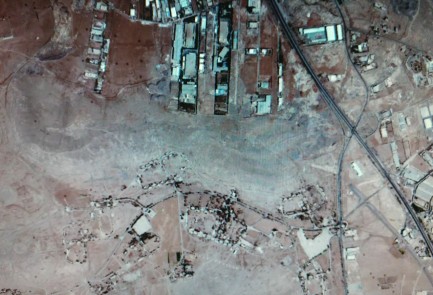
A satellite image showing the results of an alleged Israeli airstrike on a reported Iranian base being set up outside Damascus, from November 16, 2017 and December 4, 2017. (ImageSat International ISI)

The army on Tuesday night did not instruct residents of the Golan Heights to enter bomb shelters, only for local authorities to open public ones in case of emergency.

A number of reservists were also called up, the army said. An IDF spokesperson would not elaborate on which units they came from, but media reports indicated they served in air defense, intelligence and Home Front Command units.

The Israel Defense Forces said it deployed missile defense batteries in northern Israel and “there is high preparedness of IDF troops for an attack.”

The military called on residents to listen to security instructions as needed.

Following Trump’s announcement, Defense Minister Avigdor Liberman met with the heads of Israel’s armed services in the military’s Tel Aviv headquarters to discuss the security situation, his office said.

Earlier on Tuesday, the US Embassy in Israel also prohibited American government employees from visiting the Golan Heights without approval in light of the security situation on the border.

“The IDF is ready and prepared for a variety of scenarios and warns that any action against Israel will be answered with a fierce retaliation,” the army said.

Illustrative. An Iron Dome missile defense system, designed to intercept and destroy incoming short-range rockets and artillery shells, is deployed in the Golan Heights near the Israel-Syria border, on March 17, 2017 (AFP / JALAA MAREY)

A video released by the IDF showed soldiers setting up the Iron Dome, Patriot, and Arrow missile defense systems.

The military does not generally reveal its deployment of air defenses. Its decision to do so on Tuesday night was likely an effort to both reassure residents of northern Israel and warn Iran that the IDF was prepared to counter a missile attack.

On Sunday night, Israeli defense officials warned that Iran was planning to retaliate for recent deadly airstrikes in Syria, which have been attributed to the Jewish state, by having its proxies fire missiles at military targets in northern Israel sometime in the near future.

Security forces were also preparing for the possibility of attempted infiltrations of military bases and communities in the north, Hadashot TV news reported on Monday.

Tehran vowed revenge after the T-4 army base in Syria was struck in an air raid on April 9, killing at least seven members of the Iranian Revolutionary Guard Corps. The strike was widely attributed to Israel, though Jerusalem refused to comment on it. (T-4 was the base from which Israel said Iran launched an attack drone into Israel in February.) Late last month, a second strike, allegedly conducted by Israel, against an Iranian-controlled base in northern Syria was said to have killed more than two dozen Iranian soldiers.

On Monday, Iran’s army chief of staff warned that the regime would respond to any Israeli aggression “at an appropriate time,” as the countries continued to trade threats amid spiraling tensions.

“If the enemy casts a covetous eye on our interests or conducts [even] a slight act of aggression, the Islamic Republic will give an appropriate response at an appropriate time,” Maj. Gen. Mohammad Bagheri said according to regime-affiliated Press TV.

On Sunday, all of Israel’s nightly news broadcasts reported that the Israeli military and intelligence services had identified preliminary efforts by Iran in Syria to carry out its reprisal, using its Islamic Revolutionary Guard Corps, the Hezbollah terrorist group and local Shiite militias to launch a barrage of precision-guided missiles, likely at Israeli military targets in the north.

Illustrative: A Fateh-110 ballistic missile, taken at an Iranian armed forces parade in 2012. (military.ir/Wikimedia Commons)

“Israel has recently identified with certainty Iranian preparations to fire at the north,” Channel 10 said. “We are not on the eve of war with Iran… but Iran is very determined to carry out an attack” to avenge the T-4 strike and the deaths of its military personnel, it said.

Israel Radio on Sunday night said the Iranian planning for an attack was at “an advanced stage.”

The understanding in the defense services is that Iran is looking to conduct its retaliation in such a way as to avoid full-fledged war with Israel, and would therefore likely not target civilian locations, according to the reports, which did not attribute the information to any specific source.

Israel was working to prevent or counter such an attack, but was also preparing for the possibility that the Iranians “succeed in hitting a base in the north with missiles,” Channel 10 reported. The Israel Defense Forces was threatening to hit all Iranian targets in Syria if Tehran launched an attack on Israeli territory, the TV report said.