Nikki Haley: UNHRC’s Agenda 7 is ‘directed against Israel’s existence’ 

Posted July 19, 2018 by Joseph Wouk
Categories: Uncategorized

Source: Nikki Haley: UNHRC’s Agenda 7 is ‘directed against Israel’s existence’ – International news – Jerusalem Post

“It is a blazing red siren signaling the Human Rights Council’s political corruption and moral bankruptcy,” said Haley.

BY TOVAH LAZAROFF
 JULY 19, 2018 08:52
US Ambassador to the United Nations Nikki Haley delivers remarks to the press

The United Nations Human Rights Council’s controversial Agenda Item 7 is designed to undermine Israel’s existence, United States Ambassador Niki Haley told The Heritage Foundation in Washington late Wednesday afternoon.

She spoke about her country’s withdrawal from the council after it failed to sway the 47-member body to undergo serious reform measures to prevent human rights abusers from hijacking its agenda.

The UNHRC’s continued biased treatment of Israel is symptomatic of the problem, said Haley as she pledged that the US would continue to work from the outside to from the human rights body.

Prior to leaving the council, the US had unsuccessfully tried to eliminate Agenda Item 7, which mandates that the UNHRC must debate alleged Israeli human rights abuses at each season.

“This is the permanent part of the Human Rights Council agenda that is devoted exclusively to Israel,” Haley told the Heritage Foundation

“No other country – not Iran, not Syria, not North Korea – has an agenda item devoted solely to it. Agenda Item Seven is not directed at anything Israel does. It is directed at the very existence of Israel.

“It is a blazing red siren signaling the Human Rights Council’s political corruption and moral bankruptcy,” said Haley.

Prior to leaving the council the US met with more than 125 member states about reform measures, Haley said.

“In the end, the United States couldn’t convince enough countries to stand up and declare that the Human Rights Council was no longer worthy of its name,” Haley said.

The “most obvious reason is that authoritarian regimes are happy with the status quo,” Haley said. They seek council seats to protect their human rights efforts and those of their allies from scrutiny, she said.

Countries such as Russia, China, Cuba and Egypt “benefit from making a mockery of the Human Rights Council. So it’s no surprise that they openly resisted our efforts to reform it,” Haley said.

What was surprising was the pro-human rights countries and non-governmental groups that also refused to work with the US to reform the UNHRC, even as they acknowledged its flaws. Haley said.

Those NGOs “came out publicly against our reforms telling other countries to vote against us. Groups like Amnesty International and Human Rights Watch sided with Russia and China on a critical human rights issue,” Haley said.

They were afraid that countries who are known human rights abusers would push for retaliatory “hostile amendments” in the UN General Assembly, Haley said.

She charged that these NGOs also feared losing “institutional comforts” at the UN.

“They have big staffs and lots of relationships with the UN bureaucracy. Change is threatening to them,” Haley said.

Pro-human rights countries told the US privately that they too were “disgusted with countries like Cuba and Venezuela, Saudi Arabia and the Congo serving on the Council, as well as the constant attacks on Israel.”

“But after months of agreeing with us on all of the flaws of the Human Rights Council, they would not take a stand unless it was behind closed doors, and out of public view,” Haley said.

The US remains committed to fighting on behalf of human rights both globally and inside the UN, Haley said.

“We just won’t do it inside a Council that consistently fails the cause of human rights,” Haley said.

“Our withdrawal from the Human Rights Council does not mean that we give up our fight for reform. On the contrary, any country willing to work with us to reshape the Council need only ask,” Haley said.

“Fixing the institutional flaws of the Human Rights Council was, is, and will remain one of the biggest priorities at the UN,” Haley said.

She was particularly moved, she said, by the mothers and children she met in refugees camps in Ethiopia, Congo, Turkey and Jordan.

“As long as we have a voice, we must use it to advocate for these mothers and children. I will use my voice. Not just because I am a mother. Not just because I am an ambassador. But because I am an American. And America can no more abandon the cause of human rights than abandon itself,” Haley said.

How has NETANYAHU transformed ISRAEL? – VisualPolitik EN 

Posted July 19, 2018 by Joseph Wouk
Categories: Uncategorized


Today we’re talking about Benjamin Netanyahu, Israel’s Prime Minister and the most powerful politician the country has had in the last 2 decades. Why are we talking about Netanyahu? Why is he so important? Let’s see it!


Why Iran Supports Palestinian Terror Groups

Posted July 19, 2018 by Louisiana Steve
Categories: Iran - civil unrest, Iran - world's worst sponsor of terrorism, Iran / Israel War, Iran and Assad, Iran and Europe, Iran and Hamas, Iran and Hezbollah, Iran and Houthi, Iran and Israel, Iran and Jews, Iran and Middle East, Iran and Palestinians

Tags:


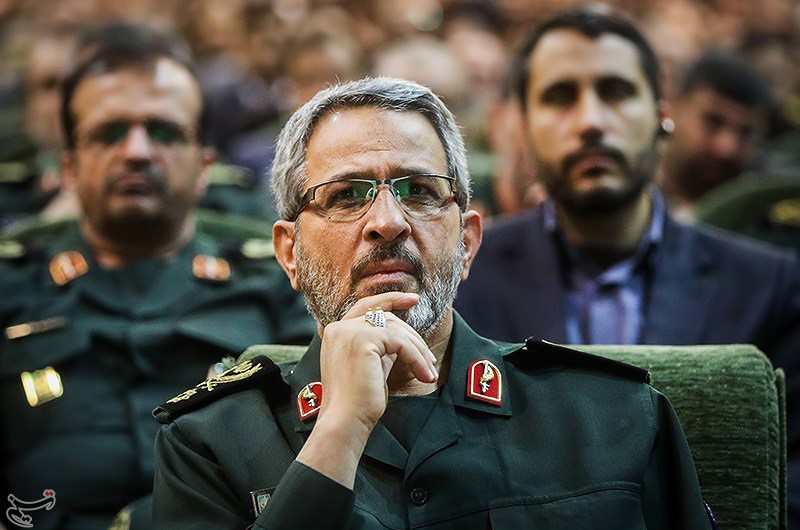
Iranian Islamic Revolutionary Guards General Gholamhossein Gheybparvar. (Image source: Tasnim via Wikimedia Commons)

by Khaled Abu Toameh
July 19, 2018 Gatestone Institute

Source Link: Why Iran Supports Palestinian Terror Groups

{Iran’s obsession with the destruction of Israel will be their undoing. – LS}

  • The Iranian general did not offer to build the Palestinians a hospital or a school. Nor did he offer to provide financial aid to create projects that would give jobs to unemployed Palestinians in the Gaza Strip. His message to the Palestinians in the Gaza Strip: Iran will give you as much money and weapons as you need as long as you are committed to the jihad (holy war) against Israel and the “big Satan,” the US.
  • The same Hamas that is telling UN representatives that it wants to improve the living conditions of Palestinians in the Gaza Strip is the one that is reaching out its hand to Iran to receive funds and weapons.
  • Now, someone needs to step in and stop Iran from setting foot in the Gaza Strip and using the Palestinians as cannon fodder in Tehran’s campaign against the US and Israel. How might someone do that? It is not so complicated. Any international aid to the Gaza Strip must be conditioned on ending Iran’s destructive effort to recruit Palestinians groups as its soldiers. It is that simple.

While the United Nations, Israel and the US are proposing plans to alleviate the suffering of the Palestinians in the Hamas-ruled Gaza Strip, Iran is pledging to continue its financial and military aid to Palestinian terror groups.

Iran’s meddling in the internal affairs of the Palestinians is not new. The Iranians have long been providing Hamas and the Palestinian Islamic Jihad terror groups with money and weapons. Were it not for Iran’s support, the two groups, which do not recognize Israel’s right to exist, would not have been able to remain in power in the coastal enclave.

Iran’s support for the Palestinian terror groups has a twofold goal: first, to undermine the Palestinian Authority, which is headed by Mahmoud Abbas, and which Tehran sees as a pawn in the hands of the US and Israel; and second, to advance Iran’s goal of destroying Israel.

Just this week, we received yet another reminder of Iran’s true goal. The leader of Iran’s “Islamic Revolution,” Ayatollah Ali Khamenei, said that the Palestinians will win over their enemies and will “see the day when the fake Zionist regime” vanishes. He said that US President Donald Trump’s “evil policy” is doomed to failure.

So, Iran does not care about the harsh conditions of the Palestinians in the Gaza Strip. Instead, its leaders are hoping that the Palestinians will live to see the day Israel is eliminated. This is also why Iran continues to support any Palestinian group that seeks to destroy Israel.

On the same day that Khamenei made his statement in Tehran, one of his senior generals, Gholamhossein Gheybparvar addressed a conference held in the Gaza Strip and Tehran simultaneously. Gheybparavar is a senior officer in Iran’s Revolutionary Guards and commander of its Basij forces — the “Mobilization Resistance Force.” This force’s main mission is to suppress protests against the regime in Tehran.

In his speech via video conference, the Iranian general told representatives of Hamas, Palestinian Islamic Jihad and other terror groups that he was “proud” of their “resistance” against Israel. He said that the conference, which was being held under the title, “Wet Gunpowder/Resistance Is Not Terrorism,” was an expression of Arab and Islamic unity against the enemies of the Arabs and Muslims. The Iranian general said that Iran and the “axis of resistance” were not afraid of Trump’s “threats.”

The Palestinian terror groups said after the conference that they were encouraged by the Iranian general’s pledge to support them in their fight against Israel and the US.

Khader Habib, a senior Palestinian Islamic Jihad official in the Gaza Strip, said that the Iranian-Palestinian conference was both “symbolic and significant.” The conference, he said, served as a reminder that Iran continues to support the Palestinian “resistance” and would deter Israel from attacking the Gaza Strip in response to terror attacks on its citizens. The speech by the Iranian general, he added, was aimed at sending a message to the many countries to support the Palestinian “resistance” groups in the Gaza Strip. “Israel is a potential threat to the Arabs and Muslims,” Habib said.

Buoyed by the Iranian backing, several speakers at the conference called for the formation of a “unified Arab-Islamic front” against Israel and the US. They also stressed that the terror attacks against Israel would continue and praised Iran for its full support for the Palestinian factions in the Gaza Strip.

By promising to continue helping the Palestinian terror groups, Iran is offering the two million residents of the Gaza Strip more bloodshed and violence. The Iranian general did not offer to build the Palestinians a hospital or a school. Nor did he offer to provide financial aid to create projects that would give jobs to unemployed Palestinians in the Gaza Strip. His message to the Palestinians in the Gaza Strip: Iran will give you as much money and weapons as you need, as long as you are committed to the jihad (holy war) against Israel and the “big Satan,” the US.

The Iranian message to the Palestinian terror groups came at a time when several international parties are trying to resolve the “humanitarian and economic” crisis in the Gaza Strip. These efforts are spearheaded by the UN’s Special Coordinator for the Middle East Peace Process, Nickolay Mladenov, who in recent weeks has been on a mission to prevent another war in the Gaza Strip.

These efforts are unlikely to succeed, however, as long as Iran continues its support of the Palestinian terror groups. Iran apparently wants to retain control over its Palestinian proxies to prevent any peace and stability between Arabs and Israel. Iran is not helping the terror groups out of love for the Palestinians, but in order to advance its goal of eliminating the “fake Zionist regime.”

If anyone is worried about the Iranian meddling in the internal affairs of the Palestinians, it is Palestinian Authority President Mahmoud Abbas and his ruling Fatah faction. “We don’t want to become a pawn in the hands of Iran,” said Ra’fat Elayan, a senior Fatah official. “Iran is using Hamas and Palestinian Islamic Jihad as a maneuvering card against Israel and the US, and this will have a negative impact on the just Palestinian cause. We have repeatedly warned the two groups of the Iranian intervention in Palestinian affairs.”

Meanwhile, it appears that Hamas wants to have it both ways. On the one hand, Hamas wants the international community to step in and help the people of the Gaza Strip. On the other hand, Hamas wants Iran to continue funding its terrorism. The same Hamas that is telling UN representatives that it wants to improve the living conditions of Palestinians in the Gaza Strip is the one that is reaching out its hand to Iran to receive funds and weapons.

We can take a tip from Abbas’s and Fatah’s anxiety: If they are worried about Iran’s ongoing efforts to infiltrate the Palestinian arena, the US and the rest of the world need to find ways to stop Iran from using the Palestinians as a weapon in its battle to extend its control over more and more countries in the Middle East and carry out its deadly schemes.

Iran has brought nothing but disaster to Iraq, Yemen, Lebanon and Syria. Now, someone needs to step in and stop Iran from setting foot in the Gaza Strip and using the Palestinians as cannon fodder in Tehran’s campaign against the US and Israel. How might someone do that? It is not so complicated. Any international aid to the Gaza Strip must be conditioned on ending Iran’s destructive effort to recruit Palestinians groups as its soldiers. It is that simple.


Quneitra falls to Syrian army. Damascus: 1974 accord permits Syrian air flights over Israel’s Golan border 

Posted July 19, 2018 by Joseph Wouk
Categories: Uncategorized

Source: Quneitra falls to Syrian army. Damascus: 1974 accord permits Syrian air flights over Israel’s Golan border – DEBKAfile

Syrian rebel resistance to the Syrian Army advance on Quneitra opposite the Israeli Golan crumbled on Thursday, July 19, in the absence of Israeli military support. 

The terms of surrender that rebel leaders signed with Syrian army officers obliged them to hand over all their strongholds, including the town of Quneitra. The Syrian army was able to return to the positions held before the 2011 uprising without a shot. Rebels refusing to sign were to be sent with their families north to Idlib province.

Israeli officials and military leaders were dismayed by a message received from Damascus claiming that the 1974 Separation of Forces Accord, which both governments resuscitated this week, allowed Syrian aircraft, including assault helicopters and UAVs, to fly over the buffer zones of the Golan up to the Israel border. Damascus relayed a copy of the accord to Moscow with a warning that any Israeli attempt to shoot down a Syrian overflight would be a breach of the 1974 accord, and its endorsement on July 16 at Helsinki by Presidents Donald Trump and Vladimir Putin. DEBKAfile revealed on July 17 that Prime Minister Binyamin Netanyahu had partnered the Helsinki deal for the restoration of southern Syria to the Syrian army under Russian oversight.

Israeli officers were handed the Syrian message on Thursday by the UNDOF commander, Maj Gen. Francis Vib-Sanziri of Ghana, who is henceforth responsible for monitoring implementation of the Helsinki deal.
According to DEBKAfile’s military sources, this Syrian message for the first time  forbids the Israeli air force and anti-air missile batteries shooting down Syrian aerial vehicles entering the air space over the buffer zones. On July 13, Israel shot down a Syrian drone entering the buffer zone. This is no longer permissible. Israel is even precluded from discovering if the intruder belongs to Iran or Hizballah, leaving both these hostile entities free to fly at will over Israel’s Golan border.  Furthermore, Assad may have those flight painted with Syrian air force markings, just as he supplies Syrian military uniforms to disguise Hizballah and pro-Iranian Shiite militiamen.

Our sources reveal that it took the Assad regime no more than four days to renege on Syria’s role in the Helsinki accord. For regaining Quneitra, the Syrian army, led by disguised Hizballah and Shiite troops, was obliged to evacuate the Beit Jinn pocket opposite the IDF’s Hermon outpost. On Monday, July 16, the Syrians pretended to pull back, while actually leaving several hundred troops behind – disguised this time as civilians and farmers.

Mass protests sweep Iraq, target pro-Iran militias and parties

Posted July 19, 2018 by davidking1530
Categories: Uncategorized

One middle-eastern country that has fallen off the radar a bit is Iraq.

And it certainly isn’t an oasis of peace at the moment.

Looks like the people are revolting against the Iranian incursion.

The Iranians really can’t seem to get a break anywhere, what a shame…

https://www.jpost.com/Middle-East/Mass-protests-sweep-Iraq-target-pro-Iran-militias-and-parties-562597

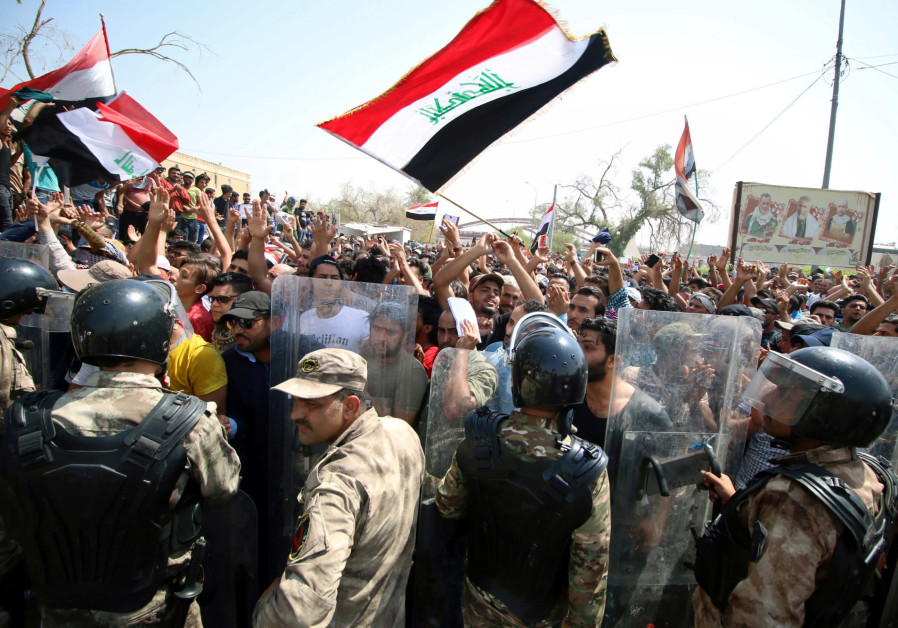
Najaf airport has been sacked. The border with Kuwait has been occupied by protesters and roads to major oil fields blocked in southern Iraq. The base of a Kata’ib Hezbollah pro-Iranian militia was set on fire.

Mass protests sweep Iraq, target pro-Iran militias and parties

In response Baghdad has cut off access to Internet and social media apps, and sent elite counter-terrorism units, as well as the army, to quell the spreading protests.

A year after the Iraqi security forces liberated Mosul from Islamic State, the country was supposed to be getting back on its feet. In February, Middle Eastern powers, including Saudi Arabia and Turkey, promised to help Iraq meet the $80 billion it wanted in reconstruction credit lines and aid. The US and western powers sought to support Baghdad as well. The US is plowing $250 million into Foreign Military Financing in Iraq, $850m. into “train and equip” funds, and $150m. toward stabilization and development programs.

However, the funds have not trickled down to average people throughout Iraq.

In May, voters in Iraq turned out for Muqtada al-Sadr’s Sairoon party, in a populist vote that helped the opposition Shi’ite cleric come in first. In second place was an alliance of Shi’ite militia-backed parties, many of them close to Iran. In third place was Iraq’s prime minister and his “victory” party which sought to capitalize on perceptions he had helped defeat Islamic State.

Since the election, however, a government has not been formed and ISIS attacks have increased throughout many central provinces in Iraq. To tackle the ISIS threat, Baghdad sent half a dozen major military units fanning out into Salahuddin, Diyala, Kirkuk and Nineveh provinces on July 7, in an operation dubbed “Revenge of Martyrs.” Three days later, protesters in the southern city of Basra began assembling on roads leading to major oil fields. The police shot at the protesters, wounding and killing several.

They set up tents; public strikes spread to the neighboring provinces of Dhi Qar, Wasit, Maysan and Babil. Reports spread online saying that dozens of security forces and protesters were killed in southern Iraq near the Iranian border at Amara. Oil workers were evacuated by helicopter. In the holy city of Najaf on July 13, protesters stormed the airport and locals claimed they ransacked planes belonging to Iran. Many Shi’ite pilgrims come from Iran to Iraq, and although many of the protesters were also Shi’ite, they were complaining that Iran’s influence in Iraq was overbearing.

On Friday, protesters also targeted militia and party offices of Kata’ib Hezbollah in Najaf as well as of Dawa, Badr and Asa’ib Ahl al-Haq, all of which are closely connected to Iran and the Islamic Revolutionary Guard Corps. According to Iraq expert Haydar Al-Khoei, the protesters chanted “the Iranian Dawa party, the Safavids,” a reference to the Persian Empire and an attempt to portray modern day Iranian-backed parties in Iraq as a form of Iranian takeover of the country.

There is boiling anger in Iraq at economic stagnation and blame is being cast on the parties that are connected to Iran. Like the protesters in Iran who have been angry at Tehran wasting money on foreign wars in Syria, Iraqis have accused their government of wasting time and resources on foreign connections while abandoning the people.

For instance, the arrival of foreign mediators, including IRGC leader Qasem Soleimani from Iran as well as Hezbollah members from Lebanon – to discuss the new governing coalition – have been seen as foreign meddling.

Baghdad has responded to the unrest by sacking police officials and dispatching the security forces, including the elite coalition trained Counter-Terrorism Service, to maintain order. Sending the elite units to deal with rioters is seen as Baghdad’s way of sending a non-partisan unit, rather than militia-aligned ones, to tackle with the problem. The CTS personnel are supposed to be perceived as neutrals and heroes of the war on ISIS. However, it is a heavy-handed tactic that could backfire. The CTS and other forces were in the middle of fighting ISIS north of Baghdad; redeploying them will take the pressure off the extremists.

BAGHDAD ALSO sought to cut off the Internet and social media apps to stop the spread of the protests. This is the same tactic that Tehran has used against protests in Iran.

Across Iraq there is outrage at the government actions. “Iraqi government asks the protesters to be reasonable after they have stripped them of the simplest rights: Electricity, water, Internet, job opportunities – and 60% of Iraq’s oil is being exported from the poorest cities in the country,” Ali Al-Baroodi, a photographer in Mosul, tweeted on Sunday. There is talk that the protesters will make a new “Arab Spring” in Iraq.

Iraq is now in a state of emergency, with the government considering what will come next. Shifting forces from the north to the south and attempts to re-route electricity from Nineveh to Basra to placate demands are the few things left in Baghdad’s arsenal.

Protesters have sacked government offices, and have succeeded in closing the border with Kuwait and shutting down air travel at an airport. Pro-Iranian media speaks of “infiltrators,” claiming the protests are being stoked from abroad, including social media in Kuwait. But powerful indigenous voices, such as Grand Ayatollah Ali al-Sistani have supported the demonstrators.

Notably silent on the unrest are Western officials, with the US and UK embassies not tweeting since July 10. No expressions of concern for the cutting of Internet or shooting of protesters. Demonstrators may see that as quiet support for Baghdad’s heavy-handed tactics. Lacking support from the West and blaming Iran for their economic problems, Iraqis face another potential round of violence in a country that has seen decades of war and conflict.


Russia concerned about military confrontation between Israel and Iran

Posted July 19, 2018 by Joseph Wouk
Categories: Uncategorized

Source: Russia concerned about military confrontation between Israel and Iran – Israel News – Jerusalem Post

We do everything possible to prevent the escalation of the conflict” Russian Ambassador to Iran Levan Dzhagaryan.

BY ANNA AHRONHEIM
 JULY 19, 2018 10:42
ON THE march. A poster of Syrian dictator Bashar Assad who is allied with Russia and Iran.

Moscow is concerned by a possible military escalation between Iran and Israel and is doing everything possible to prevent a conflict between them, Russian Ambassador to Iran Levan Dzhagaryan said in an interview with Russian daily Kommersant on Wednesday.

“Sometimes conflicts arise, and we are naturally concerned about the possibility of military confrontation between the Iranian and Israeli forces in Syria. We do everything possible to prevent it. To prevent the escalation of the conflict,” he was quoted as saying.

Dzhagaryan told the paper that Iran is a “friendly country”  and “one of our key partners” which cooperates with Russia in “various spheres” such as ending the war in Syria and that Iran’s presence in the war-torn country is legitimate because it was invited by the regime of Syrian President Bashar al-Assad.

“Iran is not a country that you can put pressure on. This is a big state, pursuing an independent foreign policy. Work with Iranians can only be a method of persuasion,” Dzhagaryan said.

Tensions between the two foes has risen in recent months and Jerusalem has repeatedly said it would not allow Iran to set up a permanent presence in Syria.

Israeli officials, such as Prime Minister Benjamin Netanyahu and Defense Minister Avigdor Liberman, have met with their Russian counterparts , both in Russia and in Israel, numerous times in recent weeks to stress the importance of this point.”

Last week Liberman reiterated Israel’s concerns, stressing that the “the Iranian presence in Syria is unreasonable, and we are not prepared to accept an Iranian presence in Syria anywhere, and as you have heard more than once, we will act against any Iranian consolidation in Syria.”

In recent weeks Syrian government forces backed by Russian air-power have been retaking large swathes of territory on the Syrian Golan Heights from rebel groups along the Israeli border.  Iranian forces and affiliated Shiite militias are also said to be playing a minor role in the offensive.

Due to the offensive and the Shiite forces creeping steadily to the border, the IDF reinforced the Golan Division with additional armor and artillery ready to protect Israel’s border “until the last millimeter.”

Last week in a joint press conference in Helsinki with US President Donald Trump, Russian President Vladimir Putin agree on securing Israel’s border with Syria in accordance with the  1974  Separation of Forces Agreement following the Yom Kippur War.

Doing so, Putin said, would bring “peace to [the] Golan Heights and bring a more peaceful relationship between Syria and Israel, and also to provide security of the State of Israel.”

Moscow intervened in the Syrian conflict in September 2015 and as an ally of Syrian President Bashar al-Assad, Moscow finds itself part of an alliance between Damascus and Tehran, the patron of Hezbollah. Russia, which views Iran as a key player in resolving the crisis in Syria, has repeatedly emphasized the importance of the role that the Islamic Republic plays in the war-torn country.

Israel believes that Iran’s Revolutionary Guard’s Corps and Quds forces have continued to entrench themselves in Syria despite strikes against Iranian targets attributed to Israel, the most recent being last week in Syria’s Aleppo province.

Israeli intelligence estimates there are thousands of Iranian advisers and Iranian Revolutionary Guard Corps officers in Syria, some 9000 Shiite militia fighters from Afghanistan, Pakistan and Iraq and another 7,000 Hezbollah fighters.

Israel and Russia implemented a deconfliction mechanism system over Syria to prevent accidental clashes between the two militaries and, according to Liberman, the deconfliction mechanism with Russia is “a connection that proves itself.”

“It is clear that each side has its own interests. Each side sees the picture differently. In the years of civil war in Syria, we were able to avoid direct friction, and that is an achievement in itself,” he said in February. “This is an effective relationship.”

Iran nuclear chief says uranium stockpile has doubled to 950 tons 

Posted July 19, 2018 by Joseph Wouk
Categories: Uncategorized

Source: Iran nuclear chief says uranium stockpile has doubled to 950 tons | The Times of Israel

Ali Akbar Salehi says his country has enough nuclear material to reach its longtime goal of running 190,000 enrichment centrifuges

Head of Iran's Atomic Energy Organization Ali Akbar Salehi talks at a conference on international cooperation for enhancing nuclear safety, security, safeguards and non-profileration, at the Lincei Academy, in Rome, October 10, 2017. (AP/Gregorio Borgia)

Head of Iran’s Atomic Energy Organization Ali Akbar Salehi talks at a conference on international cooperation for enhancing nuclear safety, security, safeguards and non-profileration, at the Lincei Academy, in Rome, October 10, 2017. (AP/Gregorio Borgia)

The chief of Iran’s nuclear agency said on Wednesday that his country’s effort to acquire uranium has resulted in a stockpile of as much as 950 tons.

Ali Akbar Salehi, head of Iran’s Atomic Energy Organization, told state TV that Iran had imported some 400 tons of uranium since the landmark 2015 nuclear deal with Western powers, bringing its stockpile to between 900 and 950 tons — up from 500 tons.

Salehi said that would be enough of the material for Iran to reach its longtime goal of running 190,000 centrifuge machines for enriching uranium in the future.

Salehi also said that the country has constructed a new factory to build rotor blades for centrifuges, with a capacity to manufacture rotors for up to 60 IR-6 centrifuges per day, Reuters reported.

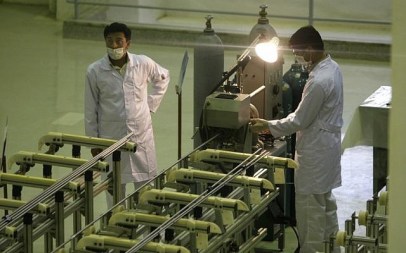
Iranian technicians work at a facility producing uranium fuel for a planned heavy-water nuclear reactor, outside Isfahan, 255 miles (410 kilometers) south of the capital Tehran, in 2009. (photo credit: AP/Vahid Salemi)

Iranian technicians working at a facility producing uranium fuel for a planned heavy water nuclear reactor, outside Isfahan, in 2009. (AP/Vahid Salemi)

Salehi insisted that the factory did not break the terms of the nuclear agreement.

“Instead of building this factory in the next seven or eight years, we built it during the negotiations but did not start it,” Salehi said, according to Reuters.

“Of course, the [Supreme Leader] was completely informed and we gave him the necessary information at the time. And now that he has given the order this factory has started all of its work.”

The nuclear accord limits Iran’s uranium enrichment to 3.67 percent, enough to use in a nuclear power plant but far lower than the 90% needed for an atomic weapon.

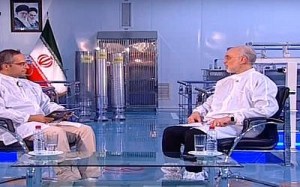
Screen capture from video showing Ali Akbar Salehi, the head of Iran’s nuclear agency, right, and three Iranian produced uranium enrichment centrifuges in the center background. (YouTube)

However, since the US pulled out of the deal in May, Iran has vowed to boost enrichment capacity to put pressure on the remaining signatories to live up to the agreement.

In a video clip aired Tuesday by Israeli television, Prime Minister Benjamin Netanyahu boasted that Israel was responsible for Trump’s decision to quit the Iran nuclear deal.

The prime minister, who has long railed against the pact, gave a dramatic presentation a little over a week before Trump’s May 8 decision, where he unveiled documents Israel secreted away from Tehran that he said proved “Iran lied” about its nuclear program.

In his announcement, the US president said the accord would not prevent Iran from acquiring nuclear arms and he therefore was exiting the agreement and reimposing sanctions.

Trump’s decision was sharply opposed by Iran and the deal’s other signatories — Britain, France, Germany, Russia, and China. Those countries are currently working to preserve the accord following the US pullout.

Israel considers Iran its arch-enemy, citing Iran’s calls for Israel’s destruction, support for terrorist groups across the region, and growing military activity in neighboring Syria. Israel has warned that it will not allow Iran, whose troops are backing Syrian President Bashar Assad, to establish a permanent military presence in Syria.

Israel, Russia said to work on return to 1974 deal for Syrian border area

Posted July 19, 2018 by Joseph Wouk
Categories: Uncategorized

Source: Israel, Russia said to work on return to 1974 deal for Syrian border area | The Times of Israel

Study groups looking at reestablishing agreement on no-man’s land, demilitarized zones and deployment of forces, report says

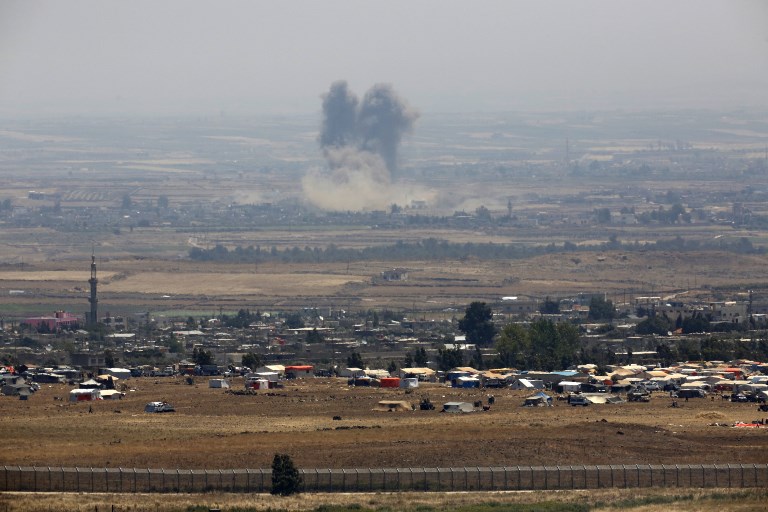
A picture taken from the Israeli Golan Heights shows smoke rising above buildings during unidentified air strikes across the border fence opposite a camp for displaced Syrians near the village of al-Rafeed in the southern Syrian province of Daraa, July 18, 2018. (JALAA MAREY/AFP)

A picture taken from the Israeli Golan Heights shows smoke rising above buildings during unidentified air strikes across the border fence opposite a camp for displaced Syrians near the village of al-Rafeed in the southern Syrian province of Daraa, July 18, 2018. (JALAA MAREY/AFP)

Israel and Russia have been in talks regarding the imminent return of Syrian regime forces to the border region on the Golan Heights, reportedly with a view to reestablishing demarcation lines drawn up in 1974.

In addition to talks between each country’s security establishments, working groups in Israel and Russia have been studying issues such as the no-man’s land, demilitarized zones and the deployment of Israeli and Syrian forces on both sides of the border, the Kan public broadcaster reported Wednesday.

Citing a Russian diplomat, the report said that both Israel and Syria had agreed to return to the 1974 Agreement on Disengagement drawn up in the wake of the 1973 Yom Kippur War, and that it will be implemented when Syrian President Bashar Assad’s regime has fully wrestled control of the border region from rebel forces.

The diplomat also reportedly insisted that there were no Iranian forces in southwestern Syria, a subject that has been a key concern for Israel.

Both the United States and Israel are worried about Iran’s growing military presence in Syria, where it has provided crucial aid to Assad’s forces. Russia, another key backer of Assad, has reportedly agreed to remove Iranian troops from the border region but allow them to remain in other parts of Syria..

Prime Minister Benjamin Netanyahu met last week with Russian President Vladimir Putin in Moscow, reportedly saying that Israel would not seek to unseat Assad while urging Moscow to work to remove Iranian troops from Syria.

“We won’t take action against the Assad regime, and you get the Iranians out,” the Reuters news agency quoted Netanyahu as telling Putin on Wednesday, citing an Israeli official.

A spokesman for the prime minister denied the account but Netanyahu the next day signaled Israel would not support efforts to topple Assad.

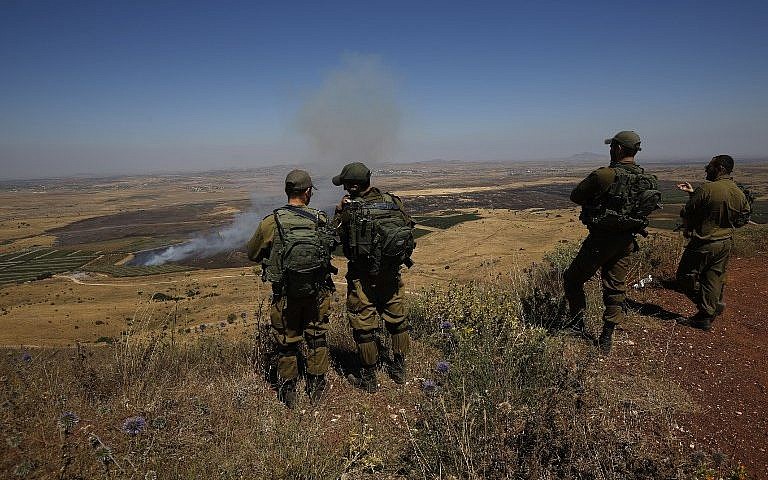
Israeli soldiers at an army base in the Golan Heights look out across the border with Syria on July 7, 2018. (AFP Photo/Jalaa Marey)

The subject of Syria and Iran’s involvement in the country was also on the agenda during a meeting between US President Donald Trump and Putin in Helsinki on Monday.

Israel has repeatedly said it will not allow Iran, or its Shiite proxies, to establish a permanent presence in postwar Syria that could threaten the Jewish state.

Russia has warned it was unrealistic to expect Iran to fully withdraw from the country, but there have been signs of an emerging compromise between Moscow and Jerusalem on the issue. Senior Israeli officials say Russia is working to prevent Iran from entrenching its military along Israel’s northern border with Syria, according to Hebrew media reports.

Just how far the Iranians and their militias are to be kept from the border is a subject of a debate. Whereas Israel as demanded the Iranians be at least 40 kilometers (24 miles), there have been recent reports of military activity by Iran’s proxies closer than that distance.

In recent weeks, Syrian government forces backed by Russian air power have been able to seize control of most of Daraa province in the south of the country, including the eponymous provincial capital that was the cradle of the uprising against Assad more than seven years ago.

They have stepped up their military offensive on the remaining opposition pockets in the southwestern region that includes Daraa and Quneitra provinces that straddle the border with Jordan and the frontier with the Israeli Golan Heights. In recent days, they have turned to the last pockets of the opposition near the border with Israel.

Agencies contributed to this report.

Are we witnessing the end of a struggle ?

Posted July 18, 2018 by Peter Hofman
Categories: Uncategorized

Israel Birth of a Nation Documentary

I want peace what do you want?

Posted July 18, 2018 by Peter Hofman
Categories: Uncategorized

By Dushan Wegner

https://www.journalistenwatch.com/2018/07/18/ich-will-frieden-was-wollt-ihr/

Photo: Imago

The White House announced some time ago: The US president congratulates Putin on his recent victory in the Russian presidential election. The two state leaders spoke on the phone. The US president stressed the improvement of US-Russia relations, including military cooperation. The US president and Putin agreed that the successful relationship in the years ahead should be strengthened. The US president told Putin that he was pleased to meet him soon.

Then they met too! They were in good spirits and schäkerten. The video you see  here at YouTube , the report read  here at Foreign Policy .

If you have clicked the two links? If so, then you know: My lines refer to a report from 2012. The aforementioned US President is the ” Messiah ” Barack Obama. (This congratulation is displaced so intense today that  snopes.com Extra has a page to which it confirms .) It is the same Obama who promised Medvedev once, after the election, he would have “more flexibility” to negotiate with Russia , (Yes, this is also  documented by video  and  confirmed by Snopes .) Later, the US relationship with Russia deteriorated then something.

Yesterday Trump and Putin held a joint press conference in Helsinki. Trump was friendly, though not as chummy as Obama or W. ( of went fishing with Putin ), unlike the Clinton clan to Melania Trump has taken unpaid in the context of lecture tours in Moscow with Putin, while Trump was still in office (see  newsweek.com, 20/10/2017 ) – and he did not have any “flexibility” promised. And yet the press was angry – very, very angry. If it were up to many opinion makers, Trump would have on the spot to explain the Third World War. Good thing there is not (always) goes to the press.

The bad sleeper

After the war, the Allies banned first the previous press to back in 1945 gradually permits to ” license newspapers to approve” such as Süddeutsche, time or the Frankfurter Rundschau. Only in 1949, the press was again completely released, after about the FAZ (1949) or IMAGE (1952) were founded.

The first generation of journalists not know the war. The chief editor of the world about,  Rudolf Meier sexton , had been resistance fighters and prisoners in the concentration camp Bergen-Belsen. Arno Rudert , co-founder of the Frankfurter Rundschau and later Director of the dpa precursor  DENA , had been arrested several times and sentenced to forced labor. Not all journalists had been so clearly to be found on that side, as should turn out right later, but all they had experienced the war. (Did I say too careful?)

The second generation, the children of the war generation quasi had parents who may not like telling them about the war, but highly frightened at night and cried, or had hidden these memories of which they did not want to talk back in the living room closet.

Today, nearly 75 years after the Second World War, we are dealing with an entirely new, entirely different generation of journalists. Oh yes, they talk about the war, and how! But: The intellectuals talk today about the war as one who curses in a foreign language; they say the word, they know its meaning, but they do not feel the pain. One who speaks of the war, but does not feel the pain, does not understand the word truth. A man is indeed never really understand what a birth, and if he ever so often pronounce the word. I see journalists who yearn for the war in the name of a higher “morality”, and I will be physically sick. These poor, stupid, scruffy children do not know what they are talking.

look yourself

Donald Trump is rare press conferences, but when he gives what it degenerates ever made in a scandal. Yesterday, on July 16, 2018 Donald Trump gave a press conference at the side of Vladimir Putin in Helsinki. Previously, she had talked privately. The video of the press conference there  on YouTube  and the  transcript at npr.org . (Both are in English.)

The response of some journalists and fellow politicians at this press conference was of the kind that might make one think one is that they are disposed to Mr. Trump not only neutral to friendly. There were words like “ignorant,” “treacherous,” “naive” and “useful idiot”. (see, for example  spiegel.de, 07.17.2018 )

I have also seen the conference. Yes, it is true that Trump was friendly with Putin, though not quite as playfully as then Obama. Yes, it’s true that it was contrary to the narrative in the context of Mueller-examination, after which Putin has thrown the choice for Trump. But it still ran on a few more things as it can be established on the basis of the video and the transcript.

Let us enter into the matter, but first we want to warm up virtually to train some logic.

syllogisms

In logic there is the art of syllogistic reasoning. From two premises gives a conclusion.

Let’s practice the syllogism!

Like this:

  • Premise 1: All humans are mortal.
  • Premise 2: Socrates is a man.
  • Conclusion: Socrates is mortal.

Or so:

  • Premise 1: Who takes politicians such as Trump and Putin literally in Empörungs age, is an idiot.
  • Premise 2: Many opinion leaders take Trump and Putin literally.
  • Conclusion: Many opinion leaders are idiots.

(Enough practiced logic, further in the text!)

At this point, I suppose, have you looked into the press conference itself and have read headlines such as “It’s a sad day for the world” ( faz.net, 07.17.2018 ). If you believe the media consensus, then delivered to the Russian President in this news conference the US president and the country.

However, read the transcript and the reports themselves! Read the review, even the geiferndste, and search for the answer to the question, what concessions because Trump has actually done in practice? He has taken what commitments? He has taken what action?

No.

Not a single.

What is Trump  then  criticized?

journalism today

In about 38 minutes the video, the AP journalist Jonathan Lemire stands up to the last question, and attempts finally in aggressive journalistic activism, as he became famous among others “by CNN’s Jim Acosta.” Lemire calls on Trump: “Would you now say with the whole world as a spectator, President Putin, that you condemn what happened in 2016, and that you do not want him to do it ever again?”

We need not discuss whether the journalism is. It is not even “journalism with attitude”. It’s simple political activism (in this case non-elected political actors), populist and reserved for extra-smart.

Most citizens do not look at the entire conference. They trust people who act as journalists and report on the policy. A large number of citizens will receive their world view pre-filtered by activists who believe themselves to be the better politicians.

Functioning democracy requires informed citizens. If those who are to inform, but even openly appear as political actors, is “the press” not a guarantee but a threat to democracy.

The server

Trump and Putin are both presidents, have understood the communication in the age of social media. This means that they know that a large part of their audience has understood social media.

But those journalists who are still holding on ‘elite’,  hate  social media, because they take away their important role in society. Formerly, journalists “gatekeeper.” You decide which information is published and which are not.

Trump tweets past journalists. Journalists will never forgive Trump that he does not accept its claimed sovereignty over what the “common people” experiences.

Trump and Putin have introduced a practice in this conference, which could be described as “Drunter comment” in the Twitter-style. If a journalist posts a one-sided information or question, now is anyone willing illuminates the context and the statement takes the lead.

When that activists from the Associated Press gave his political plea, Trump replied, among other things: “There are groups who are wondering why the FBI has never taken the server. Why do they have never taken the server? Why has told the FBI that it should leave the offices of the Democrats? “

You could call it “whataboutism” – by the way, according to legend, a classic Russian tactics (which Putin also applied in the following interview with Fox News). I think it’s more than distraction. But too many journalists are so busy, Trump obliterate one that she did not hear what the politicians really want to tell.

Trump and Putin have – and this is  my  interpretation – especially one central message conveyed: At any given time pass 10,000 things between all major states, each of which could scandalize individual. Activist journalists like to always pick out only those aspects that can look bad political opponents of their editors. But: Thanks to social media, it is quite easy to make the counter-arguments in the room. “I know how dossiers are done,” said Putin in reference to a likely all or fake in much of Anti-Trump dossier, was involved in the dissemination of the Republican Trump hater John McCain (see eg theguardian.com, 01/11/2017foxnews.com, 05.10.2018 ).

Numb with rage

Many journalists have become so walled in their anti-Trump-activism that they have not realized how Putin said some things in a roundabout way that could be interpreted as an admission of influence opinion. With respect to the company “Concorde Management” (which influence acquisitions are accused in the 2016 election campaign, see eg  cnn.com, 14/05/2018 ) denies Putin effect that the Russian government has to do with this – and mentions just as George Soros example of a political player with no connection to the government. ( “But does that make him, his position the posture of the United States? No it does not.”  Npr.org )

Now it is so that the George Soros Foundation “Open Society” seems well on friendly terms with some politicians and side-by-side with governments against a common political enemy fights (see, eg  tichyseinblick.de, 05/03/2017 ) while in countries whose policy is less “suicidal” oriented than the Merkel government, is rather suspicious observed, as in his native Hungary to (see eg  welt.de, 05.15.2018 ) or Israel (see eg  jpost.com, 4.2. 2018 ). If Putin says that Russia is so far removed from the company like Soros governments is far, then it is at least interesting.

Paid “quality journalists” are literally numb with rage. Perhaps the new generation of journalists covering who-knows-what relations took office just do not, only the inner span to look behind the curtain of irrelevancies. The two gentlemen  want  so that you understand what they are really saying – but they have to say it so that they can deny it any time.

He who has ears to hear, “let him hear!” It says  in the Bible , and that seems to be good advice here.

Blessed are the peacemakers

No, not all journalists are outraged emotional fools. They still exist, the breath deeply and think about what happens as the quiet thinker – and not lose their colleagues from view!

Timo Lokoschat of the BILD newspaper writes about the press conference:

“There’s certainly a lot of reprehensible on #TrumpPutinSummit, with some commentators have been, however, a feeling they would not be satisfied until the two yelled at in front of cameras or better yet organize a wrestling match.” ( @Lokoschat, 07/17/2018 )

What would Trump because to do? Bill Clinton was kind to Putin. George W. Bush was friendly with Putin. Obama was friendly with Putin. At Trump but it is made the accusation that he does not strike Putin on camera in the nose.

What Trump because  really  done in Europe in terms of Putin? He has put pressure on Germany, the Russian-German pipeline project “to lay Nord Stream 2” on ice (some say with self-interest, see eg  handelsblatt.com, 07.11.2018 ). He insisted that Germany is upgrading its own power (see, eg  cnn.com, 07.11.2018 ). In German: He acts for the benefit of America, it strengthens the energy independence of the West  , and  he wants to force Central Europe de facto to finally take responsibility for themselves – and because he wants to make Central Europe stronger and more independent of Russia, he is a Putin- Servant?! It is journalists logic, it’s not my logic.

A cynical wag might say that Trump is a poor man, in fact, doing as if he were a billionaire – and Putin a poor man who acts as if he were a poor man (see eg  welt.de, 12.11.2007 ) , But no, I believe that by now both have to include all grandchildren and great grandchildren no longer worry about how they will pay the children’s braces. Both Trump like Putin, are businessmen, and as far as I survey that they are not of the kind that earn more than the peace in the war. Trumps skyscrapers and Russian energy companies alike deserve better, with people traveling merrily, golf and afford overpriced apartments.

There are strange times. You get the feeling that the powerful want peace, but the journalists intending to write at the mercy of the Third World War.

Yes, truly strange times! Those who want peace, who is soon as “right”. One should not be taken literally Trump, that’s true, but you should listen exactly what campaign promises he made. It was during the election campaign clear to many observers – and Trump has said it explicitly (see eg  guardian.com, 25/10/2018 ) – that the risk of war with Hillary Clinton would be higher than under Trump (see eg  independent.co.uk, 25/10/2016 ) .

I could be wrong, but I think, in Helsinki, something happened in our European perspective, which  still  is more problematic than the hackneyed Trump collusion narrative suggests.

In Helsinki Trump told Putin: “Vlad, old house, what we do with Europe? This “Merkel, Seriously?

Then Putin: “Oh stop it, I know, from before. And  fear of dogs has also . No, Europe is irresponsible. “

Trump: “Unzu-what?”

Putin: “Stupid.”

Trump: “Yeah, incredibly stupid. OK. We need to bring order to Syria. And North Korea. And Iran. And Israel! Without Europe, because they have just invited Africa and are busy on the next 100 years. “

Putin: “Karashow. Israel has asked us where  to help with Syria . “

Trump: “One more thing: Have you hacked us?”

Putin: “We, you? No way. Your us about? “

Trump: “We chop you? Never ever!”

(Both laugh.)

I know that some journalists see it differently, that left suddenly feel bloodlust and suddenly “require journalists who were themselves overwhelmed by the battle with plastic spoons hardness’. They talk about the war and do not know what their words mean. We once spoke of the “just war” – some journalists seem to think that there is a “unjust peace.”

I still know the generation that woke up at night because they nacherlebte the fight again and again. I still know the generation that knew to report how the comrade at night out of the ditch went to shit, and then the shells struck, and then here you had to pick the childhood friend in pieces, tibia, skull half there.

Trump is now “called traitors” and “wet noodle” (eg see  bild.de, 07.17.2018 ). He gets “advice” of George W. Bush ( Afghanistan –  and  Iraq war ) and Obama ( 10 times as many drone strikes as Bush20,000 bombs ).

Who “never again,” says the need to ask for any politician: Is a new war with him more or less likely?

It is addressed for evil today ( “agitators” or “Right” there is the mildest), but I think simply that  nothing is more important than human life  , and nothing worse than war.

My motto is ” Arrange your circles! “But if you state Mannn, it must always be: Arrange your circles so that peace reigns.

I will speak out more for the politicians and politics that make peace more likely, as I understand. If you insulted me that I find peace well, then I take that as honor.