Report: Hamas agrees to curb Gaza border violence to facilitate truce with Israel 

Posted October 18, 2018 by Joseph Wouk
Categories: Uncategorized

Source: Report: Hamas agrees to curb Gaza border violence to facilitate truce with Israel – Israel Hayom


The storm before the storm 

Posted October 18, 2018 by Joseph Wouk
Categories: Uncategorized

Source: The storm before the storm – Israel Hayom

Prof. Eyal Zisser

It did not take long for Hamas and Islamic Jihad to ‎deny any involvement in Wednesday’s rocket fire on ‎Israel, and the two Gaza Strip-based groups rushed ‎to express their commitment to Egypt’s efforts to ‎broker a cease-fire between Israel and Gaza. ‎

Hamas could be lying – it wouldn’t be the first time ‎‎– and its operatives may have been the one to fire ‎two Grad rockets at Beersheba and central Israel. At ‎the very least, Hamas probably encourage the rogue ‎groups in Gaza to fire on Israel. ‎

One must remember that while Hamas has no real ‎interest in provoking a full-fledged war with ‎Israel, it has every interest in improving its ‎position in the Egyptian-led mediation and maybe ‎even forcing Israel to accept a reality in which ‎sporadic rocket fire is a part of any future deal in ‎Gaza.‎

What is particularly troubling, however, is the ‎possibility that Hamas had nothing to do with ‎Wednesday’s rocket fire and that the attack was ‎mounted contrary to its direct orders.‎

This would mean that Hamas has lost its notorious ‎iron grip on the situation on the ground in Gaza. ‎Moreover, it would mean that any deal Israel signs ‎with it may not be worth the paper it is written on, ‎as it will not guarantee any calm on the border. ‎

Achieving some form of quiet on the border is a ‎prominent Israeli interest, as it wants to focus its ‎attention on the northern sector, where efforts to ‎curtail Iran’s attempts to cement its presence in ‎Syria and curb Hezbollah are paramount.‎

Iran, we must remember, is the only one that stands ‎to gain from a conflagration in Gaza, as it would ‎divert everyone’s attention from what it is doing in ‎Syria and what it is trying to do in the region.‎

Reaching a cease-fire is also in Hamas’ interest, as ‎it would grant it legitimization and all but ‎guarantee that it will rule Gaza for many years to come. ‎This is why Israel must ensure that in return to any ‎concessions offered Hamas, it would be guaranteed ‎absolute calm on the border. ‎

Israel will most likely choose to contain ‎Wednesday’s incident both because it did not result ‎in fatalities and over Hamas’ denouncing it. ‎But this does not bode well for the efforts to ‎achieve a cease-fire, as one cannot survive if one ‎of the parties involved has no intention of meeting ‎it. ‎It is important that Israel not lose sight of this ‎when it comes to the Gaza Strip, but also when it ‎comes to Judea and Samaria. ‎

The Trump administration is gearing up to present ‎the “deal of the century,” for the Israeli-‎Palestinian conflict, which would undoubtedly ‎require not only Israeli concessions but also a ‎demand to contain and tolerate the Palestinian ‎Authority’s incompetent counterterrorism efforts. ‎

Experience, however, has taught us that any deal ‎that does not guarantee security will not last.

Eyal Zisser is a lecturer in the Middle East History Department at Tel Aviv University.

A game-changing event 

Posted October 18, 2018 by Joseph Wouk
Categories: Uncategorized

Source: A game-changing event – Israel Hayom

Yoav Limor

The rocket that struck the house in Beersheba was a game-changing event, which obligates Israel and Hamas to decide which way we go from here.

The fact that the people living in the house managed to escape the attack unscathed, due to the mother’s resourcefulness, is either a miracle or a model for proper behavior or both. On a practical level, none of this should matter. The air force uses the stark term “near miss” to describe mishaps that didn’t end in a crash or tragedy; it’s the only way to understand, inquire and learn the lessons to help avoid similar events in the future.

This is how the rocket strike in Beersheba should be viewed: as if it were lethal. This is the only way Israel can prevent the next rocket, which could kill. Let’s for a moment put aside the matter of intelligence (which needs checking), and why no one thought rockets would be fired into the heart of Israel.

But the troubling question is a different one. Two rocket launchers were deployed in advance, pointed at Israel – one at Beersheba and the other at a city in central Israel. Hamas is supposed to properly protect its rockets, certainly those with strategic impact. If it isn’t doing so (which seems to be the case), then there’s one of two options: Either it looked the other way with a wink, which apparently didn’t happen, or it isn’t in control of its people.

This situation is disconcerting because the basic assumption pertaining to events in Gaza in recent months has been that Hamas is the sole power; that it can fan or lower the flames if it so chooses. The latest incident could reveal that Hamas is losing control; which if true could simplify Israel’s dilemma because it won’t have anyone on the other side to trust when it comes to implementing and preserving future agreements – if they are reached.

The way to determine this is to watch the ground level. Israel had three response options on Wednesday: The first, as bad as it sounds, is to do nothing; maintain the current course and hope for the best.

The second, problematic but gaining increasing support (mainly from Defense Minister Avigdor Lieberman, but also other ministers and high-ranking IDF officers), is to launch a comprehensive operation to alter the reality with Gaza. The third option, which looks to be preferred by Prime Minister Benjamin Netanyahu, is to try changing the situation via other means – primarily diplomatic.

Hamas, it appears, is prepared for the second option but would prefer the third. It was taken off guard by the Egyptian intelligence chief canceling his visit to Gaza (at Israel’s request) and passed on multiple messages that it will work to calm tensions. Israel needs to give Hamas the only and most important test: the results test. It must demand a complete cessation of border terror, including incendiary kites and balloons. If Hamas upholds its end of the bargain for a sufficient period of time, it will be possible to discuss moving forward – humanitarian gestures, opening border crossings, etc.

Such a move will transfer the dilemma to Gaza. If Hamas chooses war, it will be accused of starting it, in contravention of all understandings that have been reached, and it will immediately lose the support of Egypt and Arab countries. The alternative, from its perspective, is to swallow the bitter pill and bow its head – so it doesn’t get lopped off. This is the line currently being advocated by the leader of Hamas’ military wing, Yahya Sinwar, with an asterisk: Numerous casualties in Gaza will obligate him to respond, which could spark a chain reaction ending in a conflagration.

In the past, Israel preferred to start operations with a surprise opening move, one that would give it an advantage from the very beginning. Due to the already high alert levels in Gaza it will be hard to fashion a surprising opening salvo, which means that an operation – if Israel decides to launch one – could sputter, be protracted, drag on into the winter, and of course also result in considerable casualties, on the front lines and on the home front, and draw criticism due to the public’s natural tendency to lose patience.

This is a tough dilemma for the political echelon in an election year. Casualties in Beersheba would necessitate a very clear decision; even if the soldier tracking the rockets from the home front command center had sounded the sirens in Gush Dan (she didn’t because the radar calculated it would land in the sea), we would probably have woken up Wednesday morning to a different reality. The lesson is that decisions shouldn’t be made out of necessity, but out of choice. It’s still possible, but the sand in the hourglass looks to be running out quickly.

Egypt’s war on the Muslim Brotherhood 

Posted October 18, 2018 by Joseph Wouk
Categories: Uncategorized

Source: Egypt’s war on the Muslim Brotherhood – International news – Jerusalem Post

Morsi’s younger son has been detained because of his alleged support for the banned Muslim Brotherhood movement in Egypt

BY DIMA ABUMARIA/ THE MEDIA LINE
 OCTOBER 18, 2018 05:59
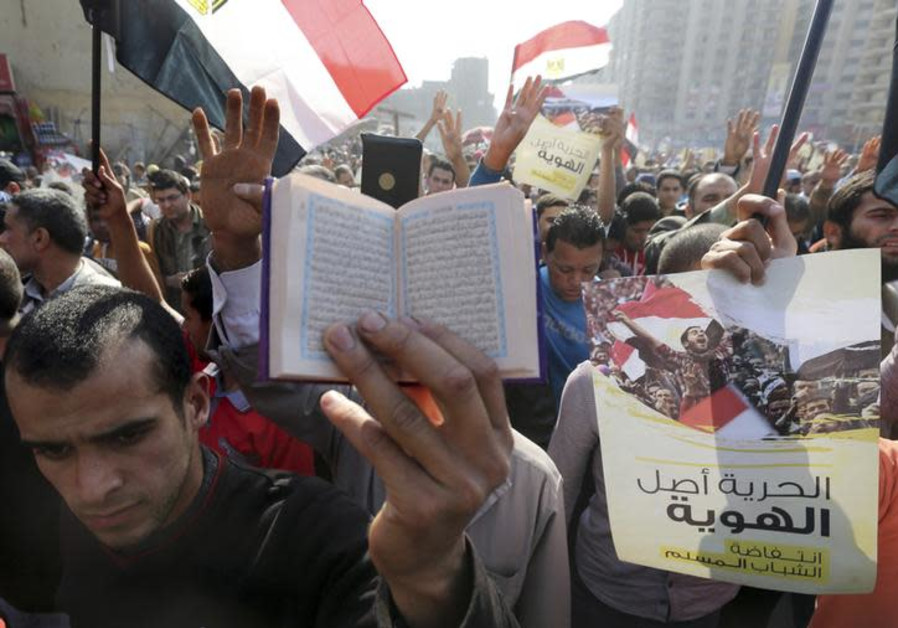
A supporter of the Muslim Brotherhood.

Egyptian police released the 25-year-old son of former president Mohammed Morsi Wednesday after he spent less than 24 hours in detention on charges of joining an outlawed organization and publishing “fake news.”

Abdullah Morsi Mohammed Morsi, a graduate business student, posted a bail of 5,000 Egyptian pounds [about $280] according to a statement by Attorney General Nabil Sadek.

“The Attorney General decided to release Abdullah until further investigations take place into the charges against him,” said Abdel-Moneim Abdel-Maqsoud, a member of Morsi’s defense team.

Abdullah frequently posts updates on social media about his father’s condition at the Tora maximum security prison, about eight miles south of downtown Cairo, as the family seeks more visitation rights and better health care for the jailed Brotherhood leader.

The London-based Arabi21 website published an interview with Abdullah just days before his arrest detailing the conditions of the family’s September visit at the prison.

Morsi is challenging a death sentence and 48 years in jail for five separate cases including espionage for Hamas, Hezbollah and Qatar as well as insulting Egypt’s judiciary.

The charge of joining a terrorist group refers to the Muslim Brotherhood, which was outlawed in 2013. Abdel Fattah al-Sisi, an Egyptian general who then became president, led a coalition to remove the elder Morsi from the presidential palace.

Egypt has been plagued by a violent insurgency since Sisi replaced Morsi. Egyptian officials have viewed the terrorist wave as part of a revenge campaign for the Brotherhood’s ousting.

Since 2013, the Egyptian army has also waged a fierce counter-terrorism operation against a Sinai-based Islamic State-affiliated group. It has seen an upsurge in attacks on the Coptic Christian community, as well as security personnel and senior officials in the Nile Valley. Last month, Sisi emphasized the need for a “global war” against terrorism during his address at the United Nations General Assembly in New York.

“There is no doubt that the Arab region is one of the most vulnerable to the dangers of nation-state disintegration, and the ensuing creation of a fertile environment for terrorism and exacerbation of sectarian conflicts,” Sisi declared at the UN.

Cairo has been working to contain Islamists throughout Egypt, making no distinction between their political and armed wings.

“Anyone who has anything to do with the Islamic movement can expect to be questioned and other times detained based on their activity within the movement,” an Egyptian political observer close to the Sisi administration told The Media Line.

“Mohammed Morsi supported and promoted the Muslim Brotherhood in Egypt and beyond—especially in Syria by urging Muslims join a jihad against the government of Syrian President Bashar Assad. Sisi ended that and is cleaning up the mess caused by Islamist political groups in Egypt,” the analyst added.

Ibrahim Haj Ibrahim, who heads the Political Science department at Birzeit University in Ramallah, believes the anti-terror rhetoric in Cairo is a core component of a Saudi-led effort, which includes Egypt and the UAE, to gain support for the ongoing boycott of Qatar, the Muslim Brotherhood’s chief state backer in the region.

“Saudi Arabia doesn’t want any other regional power, but itself,” Ibrahim told The Media Line. “Riyadh is doing the best it can to put the Muslim Brotherhood in the category of terrorism.”


Turkey’s top oil refiner appeals to U.S for waiver from Iran sanctions 

Posted October 18, 2018 by Joseph Wouk
Categories: Uncategorized

Source: Turkey’s top oil refiner appeals to U.S for waiver from Iran sanctions – Middle East – Jerusalem Post

During 2017, Iran was Turkey’s top crude oil source, accounting for 11.5 million tonnes of its total purchases nearing 26 million tonnes, followed by Iraq and Russia.

BY REUTERS
 OCTOBER 18, 2018 09:40
turkey turkish officer

WASHINGTON – Turkey’s top refiner, Tupras, is in talks with US officials to obtain a waiver allowing it to keep buying Iranian oil after Washington reinstates sanctions on the Islamic Republic’s energy sector in November, industry sources said.

The United States is preparing to impose the new sanctions on Iran’s oil industry after Washington withdrew from a nuclear deal between Tehran and other global powers earlier this year, but is also considering offering waivers to some allies that rely on Iranian supplies.

NATO member Turkey depends heavily on imports to meet its energy needs and neighboring Iran has been one of its main sources of oil because of its proximity, the quality of its crude, and favorable price differentials.

Turkey has already made efforts to cut its purchases ahead of the US sanctions, but would prefer to keep up some level of Iranian oil imports past November, an industry source familiar with the matter said.

“They would like to be able to continue importing 3-4 cargoes a month, like they did during the previous sanctions round. But if the US would tell them to stop, they will oblige and work towards achieving that,” the source said.

A Tupras spokeswoman was not available for comment. Turkey’s Energy Ministry was not immediately available for comment.

Turkey imported around 97,000 barrels per day of Iranian oil in August and 133,000 bpd in September, compared with just over 240,000 bpd in April, tanker tracking and shipping data showed.

And in the first two weeks of October, Turkey has purchased three 1 million barrel-cargoes of Iranian oil – a level that would equate to about 97,000 bpd if it made no other purchases this month.

CASE-BY-CASE

Asked if Washington was negotiating with Turkey for a waiver, a State Department official said the department was prepared to work with countries that are reducing their imports on a case-by-case basis.

On Monday, Brian Hook, the US special representative on Iran, did not comment directly about any talks on waivers with Turkey. But he told reporters countries seeking sanctions relief must “explain their specific and unique circumstances.”

Hook said those conversations were private, but he added the State Department was “trying to advance our national security goals and also taking into account the needs of our allies and partners around the world.”

Refiners around the world are under pressure to avoid Iranian oil purchases because they want to maintain their access to the US financial system – something they could lose if they flout the US sanctions.

Indian refiners also cut imports of Iranian oil purchases last month in a sign they are preparing for November.

Washington’s plan to impose sanctions on Iranian crude could strain already soured ties between the United States and Turkey – at odds over a host of issues from diverging interests in Syria to Ankara’s ambition of buying Russian defense systems.

The release of an American pastor last week who had been in custody in Turkey for two years could signal a thaw in relations between the two NATO allies as Trump said he welcomed an end to the “harsh relationship” the countries had over the summer.

But Turkey has been vocally opposed to the US sanctions on Iran, and has said it will not cut trade ties with Tehran at the behest of other countries.

During 2017, Iran was Turkey’s top crude oil source, accounting for 11.5 million tonnes of its total purchases nearing 26 million tonnes, followed by Iraq and Russia.


Off Topic: Chelsea Clinton calls out Louis Farrakhan’s antisemitic remark 

Posted October 18, 2018 by Joseph Wouk
Categories: Uncategorized

Source: Chelsea Clinton calls out Louis Farrakhan’s antisemitic remark – Diaspora – Jerusalem Post

( Chelsea has a Jewish husband.  Welcome to the “progressive” Democrat party,,, – JW )

“The responsive laughter makes my skin crawl,” Clinton said on Twitter.

BY JTA
 OCTOBER 18, 2018 10:39

Chelsea Clinton

WASHINGTON — Chelsea Clinton called Louis Farrakhan’s antisemitism “dangerous” and said laughter in response to it “made my skin crawl.”

Clinton, the daughter of former President Bill Clinton and 2016 Democratic presidential nominee Hillary Clinton, was reacting on Twitter to a Farrakhan tweet in which the leader of the Nation of Islam said “I’m not an anti-Semite. I’m anti-termite.”

“Comparing Jews to termites is anti-Semitic, wrong and dangerous,” Clinton tweeted Wednesday, quoting Farrakhan.

Chelsea Clinton

@ChelseaClinton

MINISTER FARRAKHAN@LouisFarrakhan

I’m not an anti-Semite. I’m anti-Termite.

Twitter, meantime, said it would not suspend Farrakhan from the site. A BuzzFeed reporter quoted a spokesperson for the company as saying that “Louis Farrakhan’s tweet comparing Jews to termites is not in violation of the company’s policies. The policy on dehumanizing language has not yet been implemented.”

Farrakhan’s tweet posted Tuesday was attached to video of a speech he gave Monday marking the 23rd anniversary of the Million Man March, his 1995 rally advocating empowerment for black men.

“To the members of the Jewish community that don’t like me, thank you very much for putting my name all over the planet because of your fear of what we represent I can go anywhere in the world — I’m not mad at you because you’re so stupid,” he said at the speech in Detroit. “So when they talk about Farrakhan, call me a hater — you know what they do — call me an anti-Semite, stop it! I’m anti termite!”

The audience laughed in response.

“The responsive laughter makes my skin crawl,” Clinton said on Twitter. “For everyone who rightly condemned President Trump’s rhetoric when he spoke about immigrants ‘infesting our country,’ this rhetoric should be equally unacceptable to you.”

The reference to Trump appeared to be an appeal to leftists who have been outspoken in denouncing President Donald Trump’s bigotry while remaining silent about Farrakhan. Most prominent among these have been leaders of the Women’s March, including Tamika Mallory, Linda Sarsour and Carmen Perez.

Farrakhan has a long history of antisemitism, and Clinton’s parents absorbed some criticism in August for appearing with Farrakhan on a stage at music great Aretha Franklin’s funeral.

Chelsea Clinton

@ChelseaClinton

Hi Kate – I’ve heard this a lot today. Almost a drumbeat. A few thoughts: 1) Aretha’s family had every right to invite whomever they wanted to celebrate her life. 2) As I’ve said before, Farrakhan‘s anti-Semitism is wrong. Bigotry is always wrong. 3) … I’m not my parents.

Kate Bennett

@KateBennett_DC

Replying to @ChelseaClinton

(both of your parents just shared a stage for hours on end with Louis Farrakhan)

Chelsea Clinton took flak on social media for the appearance. At the time, she responded by saying her parents could not control whom Franklin wanted to attend her funeral, that she denounced antisemitism and “I’m not my parents.”

Clinton’s husband, Marc Mezvinsky, is Jewish.

US imposes sanctions on Iranian network supporting child soldiers

Posted October 18, 2018 by Joseph Wouk
Categories: Uncategorized

Source: US imposes sanctions on Iranian network supporting child soldiers

Treasury Secretary Steven Mnuchin says country’s elite Revolutionary Guards recruit and train Iranian children as young as 12, who are then sent to Syria to fight alongside Assad’s army. 
The US Treasury imposed sanctions on Tuesday on a multibillion-dollar financial network that supports an Iranian paramilitary force that it said recruits and trains child soldiers for the country’s elite Revolutionary Guards.
The announcement came two weeks before the Trump administration reimposes some of the United States’ harshest sanctions against Iran, including its oil sector.

The Bonyad Taavon Basij network provides financial infrastructure to the Basij Resistance Force, a paramilitary force that works for Iran’s elite Islamic Revolutionary Guard Corps (IRGC), the Treasury said in a statement.

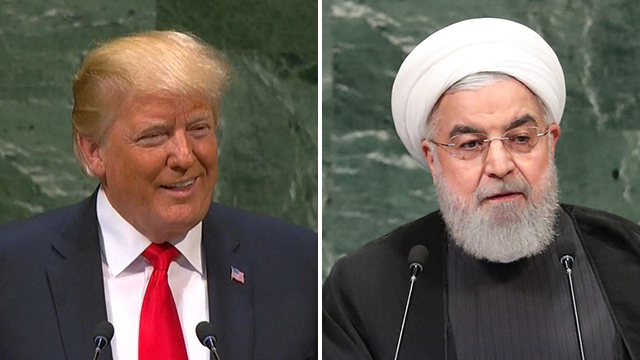
Leaders of US and Iran

Leaders of US and Iran
Both Basij groups were targeted by the new sanctions.”This vast network provides financial infrastructure to the Basij’s efforts to recruit, train, and indoctrinate child soldiers who are coerced into combat under the IRGC’s direction,” said Treasury Secretary Steven Mnuchin.

The Basij is involved in violent crackdowns and serious human rights abuses within Iran, the statement said. It recruits and trains fighters for the IRGC-Quds Force, including Iranian children as young as 12, who then deploy to Syria to support the government of President Bashar al-Assad regime, it said.

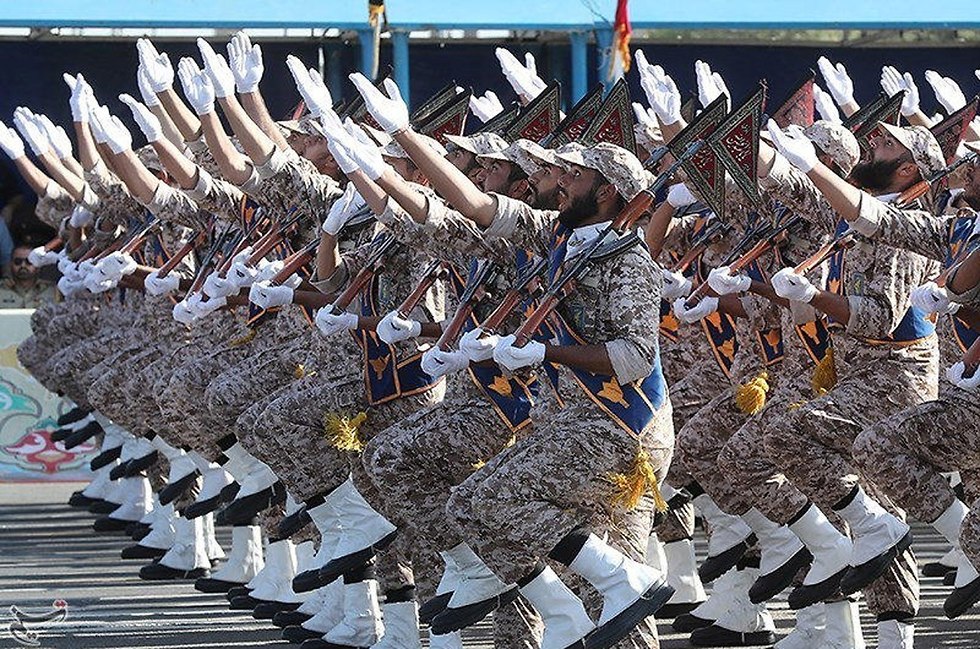
Revolutionary Guards (Photo: Reuters)

Revolutionary Guards (Photo: Reuters)

The designations highlight that “this Iranian regime is not a normal government,” a senior administration official said. “Normal governments don’t have revolutionary arms that support revolution and wreak havoc with their neighbors. They don’t recruit indoctrinate and use child soldiers.”

The sanctions were imposed on Bank Mellat, Mehr Eqtesad Bank, Mehr Eqtesad Iranian Investment Co and five other investment firms, the Treasury said.

The sanctions also target Iran Tractor Manufacturing Co, the Middle East’s largest tractor manufacturer, and Esfahan’s Mobarakeh Steel Co, the largest steelmaker in the Middle East and North Africa region, Treasury said.


Iran kills ‘mastermind’ behind attack on military parade 

Posted October 18, 2018 by Joseph Wouk
Categories: Uncategorized

Source: Iran kills ‘mastermind’ behind attack on military parade – Israel National News

Iran’s Revolutionary Guards say they killed the “mastermind” behind last month’s attack in Ahvaz.

Ben Ariel, 17/10/18 06:38
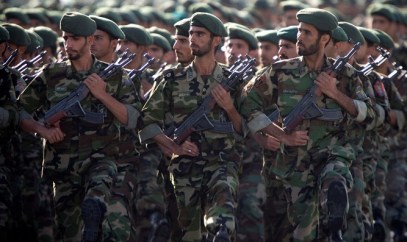
Members of Iran's Revolutionary Guards

Members of Iran’s Revolutionary Guards

Iran’s Revolutionary Guards claimed on Tuesday they had killed the “mastermind” behind an attack on a military parade in the Iranian city of Ahvaz last month which left 25 people dead, Reuters reports.

The Guards said in a statement published on state media their forces had killed a man named Abu Zaha and four other jihadists in Diyala province in Iraq. One news website run by Iran’s state television said Abu Zaha was a member of the Islamic State (ISIS) jihadist group.

The attack was claimed by the Islamic State (ISIS), but it was also claimed by a movement called the “Ahwaz National Resistance”, an Arab separatist group.

ISIS had posted a video of three men who allegedly carried out the attack and later threatened to carry out new attacks in Iran, saying the Islamic Republic is “flimsier than a spider’s web, and with God’s help, what comes will be worse and more bitter”.

On October 1, Iran said it had killed several Islamic State leaders in eastern Syria in a missile strike and destroyed their supplies and infrastructure.

News of the killing of the alleged “mastermind” of the attack comes two days after Iranian authorities detained a member of the military in connection with the attack.

Iranian President Hassan Rouhani has accused the US and the Gulf states of responsibility for the Ahvaz attack.

“The group behind the attack was financed and received military backing from the Gulf states – and the United States supplies the resources to the Gulf states to carry out these crimes,” Rouhani said, adding that Iran would “respond to these crimes within the framework of the law and international interests.”

Similarly, Iranian Foreign Minister Mohammad Javad Zarif blamed the attack on “regional terror sponsors and their US masters”.

US Secretary of State Mike Pompeo was subsequently asked about Zarif’s comments in an interview and replied, “When you have a security incident at home, blaming others is an enormous mistake. And the loss of innocent life is tragic, and I wish Zarif would focus on keeping his own people secure rather than causing insecurity all around the world.”


Revealed: the 1 million tweets of Iran’s troll army

Posted October 17, 2018 by Joseph Wouk
Categories: Uncategorized

Source: Revealed: the 1 million tweets of Iran’s troll army – The National

Twitter releases treasure chest of Iranian twitter troll activity, showing hundreds of accounts set up to spread regime’s propaganda, aimed at destabilising the region. But efforts were fairly crude and ineffective, analyst says

A data dump of state-sponsored Twitter troll operations has revealed Iran’s “clumsy” efforts to mimic Russia’s social media disinformation campaign, including hundreds of accounts and one million tweets.

Twitter released its complete data set of Iran’s and Russia’s activity, which combined amounts to more than 10 million tweets and two million images.

The company announced the data dump on Wednesday, encouraging researchers and experts to analyse the data so they can better understand how their platform had been misused.

Analysis of the Iranian troll activity shows a focus on discrediting Saudi Arabia and crude attempts at copying their more effective Russian counterparts.

“It is clear that information operations and co-ordinated inauthentic behaviour will not cease,” the social network wrote on its blog. “These types of tactics have been around for far longer than Twitter has existed — they will adapt and change as the geopolitical terrain evolves worldwide and as new technologies emerge,” it said in the post authored by two members of staff.

Data on trolls connected to the Russian Internet Research Agency, which is the subject of United States intelligence investigations into Russian interference in the 2016 presidential elections, have also been released.

Both regimes put a huge amount of effort into their operations. The Iranian troll operation consisted of 770 users and one million tweets, while Russia’s 3,841 accounts posted nine million tweets.

“The Iranian operation was big but it was frankly clumsy,” Ben Nimmo, an Information Defense Fellow at the Atlantic Council who had an advance look at the data told The National. “They weren’t very good at what they did. The big difference between the Iranian operation and the Russian one was that the Russian operation was using Twitter and other social media to engage people, the Iranian operation was using social media to message people.”

Approximately a third of the one million Iranian tweets released by Twitter contained links to awdnews.com. AWD News is a part of a cluster of sites exposed by FireEye in August to be Iranian government sponsored outlets, Mr Nimmo said.

The Iranian operation, however, was pushing pro-regime narratives, without engaging people.

“If you compare that with some of the best performing Russia troll accounts, they had real personalities. They were engaging with people, they were funny, they were sarcastic, they were edgy, they appeared to be real people. The Iranian attempt didn’t have personality, they just had content,” Mr Nimmo said.geopolitical phrase, mentioning the phrase “Saudi” nearly 90,000 times, accusing the Saudis of committing war crimes, analysis by Mr Nimmo revealed.

“This was really about promoting Iranian narratives…there were a lot of posts about Yemen and the Syrian conflict.

“It was very much ‘the Saudis are bad and they are doing bad things’, it wasn’t a very sophisticated message,” Mr Nimmo said.

Once Russia’s disinformation campaign was exposed by newspapers, the Iranian operation appeared to mimic the Russian operation.

“One of the key moments is that there was an account called Liberty Front Press, which in July of this year changed its name to Bernicrats…it looks like the Iranian troll operation was probably watching the Russian operation and looked at what works.”

Other popular phrases used in the Iranian campaign were “Trump”, “Palestine”, “Israel”, “Syria”, “Quds” (Jerusalem in Arabic), “Turkey”, “Assad” and “Netanyahu”.

Many of the Iranian trolls either posed as news sites or masqueraded as journalists. One account with 1,450 followers, MariaLuis91, which claimed to be a French journalist, posted the same article to hundreds of different people each day throughout 2014, Mr Nimmo said.

“They were just spam sharers, but that’s not the kind of behaviour which is going to engage lots of people. They are just going to think who are you and why are you sending me this, and I will probably block you.”

Many of the tweets and pictures from the archives were in French, some referring to Charlie Hebdo, the satirical newspaper which was the subject of a terror attack in 2015. Some implied France was becoming overrun by terrorists, mimicking lines from far-right anti-immigration parties.

It is unclear if all of Iran’s operation has been shut down by Twitter, by Mr Nimmo says there are “indications that the websites that have been identified so far are not the full set”.


PM vows ‘forceful’ response to Gaza as violence surges

Posted October 17, 2018 by Joseph Wouk
Categories: Uncategorized

Source: PM vows ‘forceful’ response to Gaza as violence surges | The Times of Israel

Netanyahu meets with top security officials near border with Palestinian enclave after rocket strikes a home in Beersheba, IDF bombs 20 targets in Strip

Today, 4:20 pm

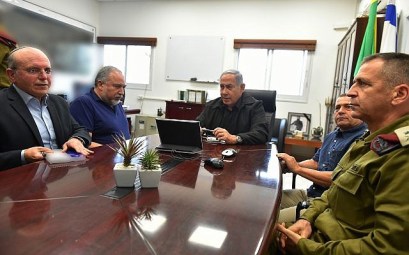
From L to R: National Security Adviser Meir Ben-Shabbat, Prime Minister Benjamin Netanyahu, Defense Minister Avigdor Liberman,  Shin Bet chief Nadav Argaman and IDF Deputy Chief of Staff Aviv Kochavi hold a situaltina assessment near the Gaza border on October 17, 2018. (Ariel Hermoni/Ministry of Defense)

Prime Minister Benjamin Netanyahu said Wednesday that Israel would “act forcefully” in response to a predawn rocket attack from the Gaza Strip that struck a Beersheba home, as a shaky calm appeared to return to the area.

The comments came after the prime minister met with top security officials for emergency consultations over the flareup, which sent already high border tensions skyrocketing. The Israel Defense Forces said it bombed at least 20 targets in Gaza in response to the missile attack.

“Israel views with utmost gravity the attacks against it on the fence, on the area adjacent to the Gaza Strip, on Beersheba — everywhere. I said at the start of the cabinet meeting this week that if the attacks don’t end, we’ll end them,” Netanyahu said in the IDF Gaza Division’s headquarters near the Strip.

“I want to say to you today: Israel will act very forcefully,” the prime minister added.

The security consultations included Defense Minister Avigdor Liberman, IDF Deputy Chief of Staff Maj. Gen. Aviv Kochavi, National Security Adviser Meir Ben-Shabbat, Shin Bet security service chief Nadav Argaman and other top officials, the Prime Minister’s Office said in a statement.

During his visit to the Gaza Division, Netanyahu also met with the group of soldiers who spotted a group of Palestinians preparing to launch a large mortar shell at southern Israel and called in an aircraft, which bombed them before they could fire their projectile.

The prime minister also met with the heads of the local governments.

PM of Israel

@IsraeliPM

Prime Minister Netanyahu: “I said, at the start of the weekly Cabinet meeting, that if these attacks do not stop – we will stop them.
I want to tell you today as well – Israel will take very strong action.” pic.twitter.com/JpfvcsDkcD

View image on Twitter

PM of Israel

@IsraeliPM

Prime Minister Netanyahu toured the IDF Gaza Division command center where he met with the look-outs who, this morning, identified the launch cell that was stopped by the IDF, and expressed appreciation for the work and activity of the command center. pic.twitter.com/oZdZbAu3Ny

View image on Twitter

Egypt and the UN have reportedly scrambled to try to negotiate a calm between the sides since the rocket attack on Beersheba, which came days after Israeli leaders had already threatened a wider offensive over near-daily border riots and launches of incendiary balloons and kites.

In the predawn hours of Wednesday morning, a mid-range rocket from the Gaza Strip bearing a heavy 20 kilogram (44 pound) warhead struck a house in the southern city of Beersheba, causing significant damage to the structure.
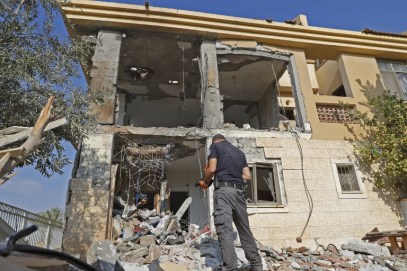
An Israeli sapper checks a house after it was hit by a rocket fired from the Hamas-run Gaza Strip at the southern Israeli city of Beersheba on October 17, 2018. (Jack GUEZ / AFP)

The residents were spared injury as they had rushed into their bomb shelter after the incoming rocket siren sounded in the city.

A second rocket was also fired from the Gaza Strip on Thursday morning. It landed off the coast of the greater Tel Aviv area, known in Israel as Gush Dan.

In response, the Israel Defense Forces carried out strikes on some 20 targets in the Strip connected to the Gaza-ruling Hamas terror group and other organizations in the coastal enclave.

Hamas and the second largest terror group in the Strip, the Iran-backed Palestinian Islamic Jihad, officially denied carrying out the rocket attack, saying it was “irresponsible” and undermined an Egyptian-led negotiation effort.
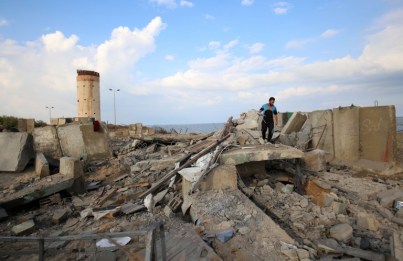
A Palestinian man walks on debris following a retaliatory Israeli airstrike near the southern Gaza Strip city of Rafah after a rocket struck a home in the Israeli city of Beersheba on October 17, 2018. (SAID KHATIB / AFP)

Speaking to Israel Radio, Energy Minister Yuval Steinitz, who is a member of the security cabinet, accused Palestinian Authority President Mahmoud Abbas of orchestrating the flareup in violence, and cautioned against launching a full-blown war in Gaza, which, he suggested, was what the West Bank-based Abbas wanted.

“We must aggressively respond with force to the rocket strike on Beersheba, but there is a difference between that and being drawn into a full campaign in Gaza,” Steinitz told the radio station. “This whole flareup was caused by Abbas and we should not let him draw us in.

“If we go to war in the Strip we will call it ‘Abbas’s war,’ because he is the architect of this flareup.”

Steinitz said that, contrary to comments from Defense Minister Liberman, Israel has not yet exhausted the chances of reaching an arrangement to calm the situation in Gaza. Egyptian mediators, who have so far failed to produce an agreement between Israel and Hamas to end the violence, were in Gaza on Wednesday.
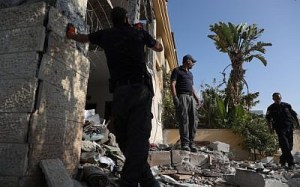
Israeli security forces inspect a building that was hit by a rocket fired from the Gaza Strip in the southern Israeli city of Beersheba on October 17, 2018. (Yonatan Sindel/Flash90)

Hamas, which seeks to destroy Israel, wrested control of the Gaza Strip from Abbas’s Palestinian Authority in 2007. Israel holds Hamas responsible for all attacks that come out of the Gaza Strip.

Abbas, who is demanding a resumption of control of the territory, has been working to undermine Hamas’s government in Gaza, and in recent months has levied severe sanctions on the Strip, exacerbating the humanitarian crisis there.

Opposition leader Avi Gabbay on Wednesday morning accused the government under Netanyahu of bungling the situation in Gaza and bolstering Hamas’s status.

“We are tired of a government that is strengthening Hamas. We are tired of a government that is enabling Hamas to strike and disrupt the lives of residents in the south,” he tweeted. “We are tired of Netanyahu’s security failures and Liberman’s empty slogans and we are tired of a cabinet that is mixing politics and state security.”
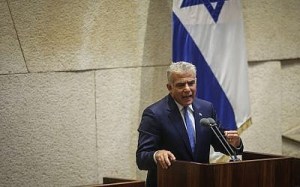
Yesh Atid chair Yair Lapid at a plenary session at the Knesset on September 17, 2018. (Flash90)

MK Yair Lapid, who leads the opposition Yesh Atid party, tweeted that Hamas no longer fears Israel, and that the political leadership is entangled in public disputes between Liberman and Education Minister Naftali Bennett on security policies.

“A direct hit on a home in Beersheba. There are no [school] studies in the city,” he said. “Hamas is no longer afraid and Netanyahu is hiding behind the Bennett-Liberman spats. Those who are clamoring for credit for successes should also take responsibility for failures. For how long will Hamas dictate the situation in the south?”

On Tuesday, Liberman warned that the military was gearing up for a major strike on Gaza to stop ongoing violence.

“I’ve held a series of meetings with the head of the Southern Command, the head of the [Gaza] Division, the brigade commanders, the battalion commanders, also with soldiers. My impression is that they all have reached the understanding that the situation as it is today cannot continue,” he said.

Beersheba Mayor Ruvik Danilovich on Wednesday criticized the government for not bringing calm to the south.

“This is an impossible situation,” he told Hadashot TV news. “In general, what has been going on in the Negev and the south in recent months is an unbearable situation… and we call on the government to put an end to it. It is impossible to live in a situation like this, no one is eager for a fight, but if this is repeated, something must be done.”

Earlier Danilovich canceled all school studies in the city until further notice.

It was only the second rocket fired at Beersheba since the 2014 Gaza war. The previous rocket, which struck a field north of Beersheba on August 9, came as Palestinians fired dozens of projectiles at Israeli communities along the Gaza border.

Rocket attacks on Beersheba — home to more than 200,000 people — are rare and considered a major escalation.

A second rocket fired from Gaza Wednesday morning fell out at sea across from the greater Tel Aviv area, known in Israel as Gush Dan. The military would only confirm that it struck “off the coast of a large city.”
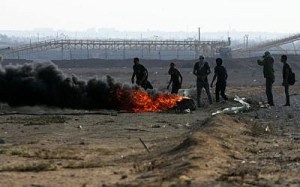
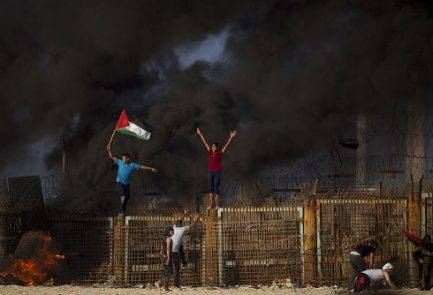
Palestinian demonstrators burn tires as they demonstrate during the “Great March of Return” on the Gaza-Israel border in Rafah, Gaza on October 12, 2018. (Abed Rahim Khatib/Flash90)

Since March 30, Palestinians in the Gaza Strip have participated in a series of protests and riots dubbed the “Great March of Return,” which have mostly involved the burning of tires and rock-throwing along the security fence, but have also seen shooting attacks and bombings as well as the sending of incendiary balloons and kites into Israel.

There have also been several flareups that took Israel and Hamas to the brink of war, with Palestinians firing rockets into Israel and the IDF responding with airstrikes.

Some 155 Palestinians have been killed and thousands more have been injured in the clashes with IDF troops, according to AP figures; Hamas has acknowledged that dozens of the dead were its members. One Israeli soldier was shot dead by a sniper on the border.