For Trump, mission accomplished 

Posted December 23, 2018 by Joseph Wouk
Categories: Uncategorized

Source: For Trump, mission accomplished – Israel Hayom

Erez Linn

Since U.S. President Trump took office in January 2017, Syria – and the Middle East in general – have not been a top priority for him. Syria was mainly a place the U.S. needed to be in order to confront Islamic State and hold Russia in check.

Fully motivated for his supreme goal of restoring American deterrence, it was natural that Trump would take on James Mattis as a guide. Mattis, who had been fired by former President Barack Obama from the command of the U.S. Central Command because he wanted the U.S. to attack Iran, saw his vision of America taking its rightful place as a superpower materializing. Mattis was a successful defense secretary: North Korean leader Kim Jong Un was the first to blink when Mattis sent nuclear bombers to the Korean Peninsula and Iranian vessels stopped harassing American ships, as they had grown used to doing constantly under Obama. In Syria, too, Mattis and Trump deployed cruise missiles when necessary, unafraid to exercise direct force against Russia’s mercenaries.

Mattis is leaving not because of anything Trump did – the withdrawal of American troops is ultimately a desirable development – but because of the way Trump did it. Mattis, if he indeed resigned and wasn’t fired, thinks that the step should be taken sensitively, and in consultation with a variety of officials. Words like these anger Trump, particularly when they pertain to a region in which he has no interest. Mattis came through militarily, and now that he is raising diplomatic reservations about an unrelated subject, Trump is showing him the door.

The Washington establishment was thrown into a panic this weekend at the loss of the “responsible adult” in the administration. But cries like these were already heard when former Secretary of State Rex Tillerson left and turned out to be wrong – Tillerson’s successor Mike Pompeo has been a pleasant surprise. Ironically, the same Washington establishment that warned prior to Mattis’ appointment that he was a warmonger (partly because of his stance on Iran) is now weeping over his departure. Mattis fulfilled his assignment: to restore America’s honor. Now Trump has no more need of such a high-profile general.

Unlike Mattis, Trump believes that withdrawing American troops will give the U.S. more room to maneuver because ground forces are an ideal target for Islamic State operatives and Iran. And if, along the way, he can force Europe to increase its investment in defense, even better. If that doesn’t pan out, Trump will return to the battlefield full-force, and whoever is serving defense secretary will know what to do.

As far as Trump is concerned, to make America great again, America must first come home, even if that entails risk. He thinks that nothing good will come out of Syria or Afghanistan, anyway.

Mattis is interested in stability, whereas Trump wants a change that will put his name in history books. Mattis apparently hoped that a decision about troop withdrawal would be made only after the political process in Syria progressed. But for Trump, now is the perfect time – just before Christmas and less than a year before the media will be busy covering a turbulent election. In his inaugural address, Trump said, “This American carnage stops right here and stops right now.” He might have been talking about the decline of the American middle class, but right now he is demonstrating that he is determined to end the American carnage in the Middle East.
 

Trump contests conventional wisdom 

Posted December 23, 2018 by Joseph Wouk
Categories: Uncategorized

Source: Trump contests conventional wisdom – Israel Hayom

Prof. Abraham Ben-Tzvi

At first glance, the current White House tumult paints a troubling picture of  a capricious leader with flawed judgment. Many political observers believe Trump was shooting from the hip when he picked a fight with Congress over the border wall and announced a pullout from Syria, which led to the resignation of Defense Secretary James Mattis and to a partial federal shutdown for the next several days.

Having said all that, in the grand scheme of things, both decisions underscore a systematic and consistent policy on Afghanistan, Syria and Mexico. On all three, Trump’s actions have been a function of the core convictions that he campaigned on.

The decision to withdraw troops from Syria (and reportedly Afghanistan) is a manifestation of his deep misgivings of foreign interventions without a clear and present danger to U.S. national security.

Trump has long articulated a vision of reduced American presence on the world stage. While he is willing to let the U.S. take the back seat in noncrucial theaters, he is loath to the idea of continued multilateralism and collective security through defense pacts.

Trump disavowed the notion that America has to provide a defense shield for its allies to deter any aggression. This can explain his decision to disengage from Syria and Afghanistan and Mattis’ decision to step down.

Mattis, after all, is a poster boy for the old paradigm that the U.S. must hold on to its alliances, mainly NATO, and has considered these alliances as paramount to its national security long after the Cold War. Unlike Mattis, Trump believes this view is anachronistic and wants a rapprochement with the Kremlin.

But this neo-isolationist posture doesn’t mean Trump has decided to end all of overseas engagements. In fact, Trump has shown time and again that he is willing to use force to establish deterrence and assert U.S. power when necessary – both against the axis of evil and against friends.

Washington has recently shown this resolve vis-à-vis North Korea, displaying brinkmanship in the face of its nuclear ambitions. It has also been aggressively enforcing crippling economic sanctions against Iran.

In the Israeli context, the U.S. has also been willing to challenge long-held paradigms that turned conventional wisdom on its head (including its recognition of Jerusalem as Israel’s capital). Thus, it is unlikely that Trump will leave Israel in the lurch in the face of a growing Iranian threat.

His insistence on having a wall along the Mexican border is a central tenet of his hardline view on illegal immigration. His willingness to spend political capital, including having a shutdown, underscores his tactical approach – not to the strategic posture he has assumed from day one.

Thus, time will tell whether this latest feud with Congress will end like the big shutdown 23 years ago. That shutdown paved the way for then-President Bill Clinton’s re-election.

IDF chief: Let’s not make too much of Trump’s Syria withdrawal 

Posted December 23, 2018 by Joseph Wouk
Categories: Uncategorized

Source: IDF chief: Let’s not make too much of Trump’s Syria withdrawal – Israel Hayom


Our best defense is the IDF

Posted December 23, 2018 by Joseph Wouk
Categories: Uncategorized

Source: Our best defense is the IDF – Israel Hayom

The prophets of dejection and doom, along with the anonymous intelligence officials and their representatives in the media, have been very busy of late blaming Prime Minister Benjamin Netanyahu for U.S. President Donald Trump’s decision to pull American troops out of Syria.

As far as they’re concerned, all of Israel’s impressive achievements in the past 10 years are either the work of an invisible hand or the result of coincidence. Everything seen as problematic, however, is the responsibility of Netanyahu, Intelligence Minister Yisrael Katz and the right-wing government.

As they see it, Trump’s decision to cooperate with Israel, transfer the U.S. Embassy to Jerusalem, support us at the United Nations, impose sanctions on Iran and bring together countries in the region are negligible at best. But Washington’s decision to pull out of Syria? That’s something out of “Apocalypse Now.” Sometimes it seems as if the Israeli Left longs for the return of Trump’s predecessor, Barack Obama, more than they do in the United States.

After 2,000 years in exile, the Jewish people have returned to the pages of history. This is nothing short of an unprecedented phenomenon. Pioneers, Holocaust survivors and new immigrants from all corners of the earth established a glorious state. A small country surrounded by enemies, Israel has become something of a world power over the years. For generations, Jews longed to be the masters of our fate.  These hopes and prayers have been realized in our time. Israel is able to defend itself and does not need to rely on the kindness of strangers. No longer must we bend to the shifting winds. Israel is admired, particularly in the United States, for never having asked for the protection of foreign soldiers. Additional disagreements may arise between Trump and members of his administration in the near future, but Israel’s leadership is determined to ensure no foreign administration is able to dictate terms that could impair the security of the state.

The withdrawal of U.S. troops from Syria does not impact Israel’s ability to contend with aggression, no matter the source of that aggression. While Israel would have preferred U.S. soldiers continued to operate inside Syria, we have been successfully managing the Syrian threat before they ever landed in the country in the first place. There is no reason to alarm Israel’s citizens and say the U.S. decision to pull out of Syria puts Israel at risk. The best way to guarantee Israel’s security and ensure our victory is to maintain a strong IDF.


The US will still “maintain a presence” after troop pullout from NE Syria – DEBKAfile

Posted December 23, 2018 by Joseph Wouk
Categories: Uncategorized

Source: The US will still “maintain a presence” after troop pullout from NE Syria – DEBKAfile

Following the backlash from President Trump’s decision to withdraw US troops from NE Syria, senior administration officials Friday night, Dec. 21 offered Mid East leaders clarifications for allaying their concerns. DEBKAfile’s sources reveal those messages’ high points:

  1. US troops will leave eastern and northern Syria, but America is not deserting this part of the country, said the officials, without revealing the nature of its continuing presence.
  2. The Trump administration has not abandoned the Kurds or “stabbed them in the back” as widely reported, “and the Kurds know this,” it was authoritatively said. And, indeed, despite their loud cries of dismay, not a single Syrian Kurdish militiaman has deserted the lines they hold against ISIS in eastern Syria.
  3. Regarding President Tayyip Erdogan declaration that the Turkish army was about to march on East Euphrates and reach the Kurdish capital of Qamishli, amid fears of a massacre, the US officials advised distinguishing between talk and deeds. They referred to a phone conversation between Presidents Trump and Erdogan on Dec. 14, in which the latter promised his army would not cross the Euphrates. In a speech welcoming the US pullout from Syria on Friday, Erdogan allowed that Turkey would “wait a little longer before launching the operation” and counted on US “logistic support.”
  4. Trump said subsequently that the troop pullout would be phased out within 40-60 days. According to the US officials, a more realistic timeline would be 4 to 6 months. “During that time, Syria is bound to see many developments that may require  Washington to revise its plans.”
  5. The US and Iraq are in advanced negotiations for the deployment to
    the Iraqi-Syria border of the Iraqi Special Operations Forces (ISOF) – the “Golden Division” – which drove ISIS out of Mosul. It will stand in the path of Iranian and Iraqi Shiite militias crossings into Syria.
  6. Part of the ISOF’s deployment will include the western Iraqi province of Anbar. In this regard, the US officials referred to a disclosure by Mohammad al-Dilemi, one of the chiefs of Anbar’s Arab tribes. On Dec. 12, he said that the US army was building a new base on the line dividing Anbar from the next-door province of Nineveh. It would position US troops 30km north of the Euphrates River and near the Syrian border. This new base will provide the Iraqi division with American backup.
  7. The officials from Washington refused to confirm or deny that the Russians were involved in the forthcoming US plans for Syria; nor would they refer to a possible US-Turkish-Russian deal on the subject. They did take note of the strides taken in recent weeks toward repairing Russian-Israeli relations. The US officials pointed out that the transfer of a Russian S-300 air defense missile battalion to Deir ez-Zour in eastern Syria brought the Israeli Golan and Galilee Panhandle within their range, but not the Israel Air Force bases in northern and central Israel.


PM Netanyahu’s Remarks at Weekly Cabinet Meeting – 23/12/2018 

Posted December 23, 2018 by Joseph Wouk
Categories: Uncategorized


U.S. declares it no longer seeks to topple Assad regime 

Posted December 22, 2018 by Joseph Wouk
Categories: Uncategorized

Source: U.S. declares it no longer seeks to topple Assad regime – Middle East – Jerusalem Post

Announcement represents a reversal of former U.S. president Barack Obama’s aim of ousting the Syrian dictator.

BY TERRANCE J. MINTNER/THE MEDIA LINE
 DECEMBER 22, 2018 09:59
Assad and Trump

United States special representative for Syria James Jeffrey confirmed that the Trump administration is not seeking to oust dictator Bashar al-Assad and accepts that Iran will play a diplomatic role in the process aimed at achieving a political solution to end the nearly eight-year conflict.

Jeffrey nevertheless stressed that Assad and his Russian and Iranian backers need to create a “fundamentally different” atmosphere in the country if they expect Washington to fund reconstruction projects once the war concludes. He estimated it will cost $300-400 billion to rebuild the war-torn country and contended that Western powers will not commit funds if their demands are not met.

The Syrian peace process has been focused around the so-called Astana talks between representatives from Moscow, Tehran and Ankara, with parallel United Nations-backed negotiations in Geneva being long-stalled in large part due to infighting within the Syrian opposition.

Though acknowledging Tehran’s diplomatic role, Jeffrey reiterated the US demand that all Iranian military forces vacate Syria, a position strongly advocated by Israel which over the past two years has conducted hundreds of aerial raids targeting the Islamic Republic’s military infrastructure therein. Jerusalem has repeatedly stated that it will not allow Iran to establish a military foothold in Syria from which its proxies can carry out attacks against the Jewish state.

In many ways Jeffrey’s comments can be construed as an about-face regarding US policy on Assad, given that former US president Barack Obama explicitly called for his removal from power in 2011.

“Yet it is not a total reversal of Washington’s stance,” Dr. Christopher Phillips, a Syrian specialist at the London-based Chatham House think-tank, told The Media Line.

“Since 2013, when Obama refrained from launching strikes on Damascus after the regime’s alleged use of chemical weapons, there has been a gradual softening of US policy against Assad.”

The Trump administration’s goal of remaining in Syria to block Iranian expansionism is a fairly new development, Phillips added. “Jeffrey’s statement is a recognition of the reality that pushing the Islamic Republic out of the country altogether is extremely difficult. Therefore, if Washington acknowledges that Assad is here to stay, it must also grant the Iranians a role to play.”

What is problematic about Jeffrey’s statement is that it damages US credibility, according to Phillips. “The Americans made a commitment to remove Assad under Obama, but, unfortunately, it is not rare for dictatorial regimes with blood on their hands to remain unprosecuted for long periods of time and the outside world doesn’t seem willing to do much about it.”

Lt. Col. (res.) Dr. Mordechai Kedar, a Syrian expert at Israel’s Bar-Ilan University, believes that Syria is on the verge of descending into further anarchy. “There has not been much reporting on Turkey’s threat to invade Syria in order to fight the Kurds,” he stressed to The Media Line.

In the event, such clashes could ignite wider hostilities between Turkish and American forces. “This explains the policy change because America is now torn between supporting the Kurds and trying to keep Turkey part of NATO,” Dr. Kedar explained.

In 2011, pro-democracy demonstrators in Syria staged a series of protests inspired by the “Arab Spring” in neighboring countries. Following a major crackdown, the ensuing civil war pitted pro-regime forces—including Assad’s army, Russian air power and Iranian-backed groups like Hizbullah—against primarily Sunni rebel fighters. It also saw the rise and near fall of Islamic State, one of the most brutal terrorist regimes in modern times.

In recent months, the Syrian regime has recaptured rebel-held territories except the last remaining holdout in northwest Idlib Province. Nevertheless, Damascus and its opponents still need to hash out a political deal to officially end the conflict, which has left more than 350,000 people dead—although some estimates peg the number at 500,000—and displaced millions.


What were the goals of Operation Northern Shield? 

Posted December 22, 2018 by Joseph Wouk
Categories: Uncategorized

Source: What were the goals of Operation Northern Shield? – Israel News – Jerusalem Post

srael believes that the tunnels would have been used by the Hezbollah’s elite Radwan unit to infiltrate into Israel in an attempt to take control of several communities and kill civilians.

BY ANNA AHRONHEIM
 DECEMBER 22, 2018 03:51
IDF discovers the third tunnel since the announcement of Operation Northern Shield from Lebanon.

As Israel’s Operation Northern Shield continues into its third week, the IDF’s 869th Shahaf (Seagull) Field Intelligence Battalion are the eyes and ears of the troops in the field.

“We are in charge of identifying and stopping enemy moves,” Lt.-Col. Tomer Meltzman told The Jerusalem Post. “We are the taking the eyes in the field and expanding it, looking across the border to make sure that no enemy targets our troops and, if we identify a threat, to stop it.”

While the IDF has various surveillance and intelligence gathering techniques nothing can replace the IDF field intelligence battalion unit made up of female observers and male combat troops who spend all day, every day watching Lebanon.

The IDF launched Operation Northern Shield in order to detect and neutralize cross-border attack tunnels dug by the Iranian-backed Shi’ite organization. Israel believes that the tunnels would have been used by the Hezbollah’s elite Radwan unit to infiltrate into Israel in an attempt to take control of several communities and kill as many civilians and troops as possible.

Dozens of Hezbollah tunnels are believed to have been dug along the 130-km.-long border between the two countries, and the military said the operation dubbed “Northern Shield” would take weeks or months to complete.

“From the first night of the operation, we have been a part of it and we will remain part of it until it’s over, and even after it,” Metzman told the Post, adding that “The soldiers were surprised about the tunnels on the northern border. We kept it a secret. But we have trained the soldiers to deal with surprises. We always have to expect the unexpected.”

The precious intelligence gathered by the battalion is not only crucial in the operation, but according to the IDF, Israel’s intelligence capabilities has increased dramatically since the Second Lebanon War in 2006 and has a significant number of targets in the north if another war were to break out.

Gathering intelligence in the field is always a challenge, especially when Hezbollah militants do not wear military uniforms or openly carry weapons because of Resolution 1701 which ended the Second Lebanon War in 2006.

The group also plants themselves in the middle of civilian areas. Prime Minister Benjamin Netanyahu said Wednesday that almost every second home in Southern Lebanon is being used by the Shi’ite militant group.

“It’s an organization which has been growing over the years, and we have been watching them and we have stopped them many times in the past few years,” Meltzman said, referring to the group’s fictitious environmental group known as “Green Without Borders.”

According to Meltzman, the battalion has also observed Lebanese troops, including intelligence officers, meeting with Hezbollah militants numerous times.

“The Lebanese Armed Forces (LAF) and Lebanese government is responsible for what is happening. While the LAF is not part of Hezbollah, the LAF should stop Hezbollah’s activities in south Lebanon, Hezbollah should not exist,” Meltzman said.

Early on in the operation, the IDF fired warning shots at three Hezbollah militants dressed in civilian clothes attempting to approach the border area where the IDF was carrying out tunnel excavation work. According to the military the three men – who fled back to Lebanon after IDF troops opened fire – took advantage of bad weather to steal IDF equipment deployed to uncover the tunnels.

Lebanon meanwhile said that IDF troops opened fire on a “Lebanese army patrol near the Blue Line in the Kroum al-Sharaqi region east of the village of Meis al-Jabal “because of heavy fog in the area.”

But, Meltzman said “the battalion lives the Lebanon border day in and out. We know people across the border and their faces. We know how to differentiate between Hezbollah and Lebanese armed forces.”

The female soldiers in unit monitor the feeds of remote controlled cameras set up along the border and locate any terrorist infiltration while at the same time alerting troops in the field and communicate with them to remove any threat. The unit’s male soldiers spent hours in the field every week, working quietly to set up forward camouflaged posts to watch the enemy across the border.

The battalion is also helped by the IDF’s “Mars” multi-sensory system developed by Elbit Systems and Rafael Advanced Defense Systems. The next-generation thermal imager operates using un-cooled sensor technology and combines a laser range-finder, GPS, compass, day channel and recording system. Due to its advanced observation and target acquisition capabilities as well as being a lightweight system, MARS is especially suited for the infantry and special units.


The eclipse of Trump’s generals

Posted December 22, 2018 by Joseph Wouk
Categories: Uncategorized

Source: The eclipse of Trump’s generals – American Politics – Jerusalem Post

With Secretary of Defense James Mattis resignation, the era of Trump delegating responsibility to generals is waning.

BY SETH J. FRANTZMAN
 DECEMBER 22, 2018 11:07
US PRESIDENT Donald Trump is flanked by Secretary of State Rex Tillerson (left) and Defense Secretar

When US President Donald Trump was elected he leaned heavily on retired and current US military officers to guide his policies abroad and at home. Now, with the resignation of Secretary of Defense James Mattis, the generals are going home and with them their policies in Syria and other countries. This marks a major turning point for the administration and Trump appears poised for a new round of isolationism and global retreat that will change the Middle East and the US posture globally.

After Trump’s election he didn’t have a major team in place to transition into the presidency. A week after the vote, according to Bob Woodward’s account, Trump met with General Jack Keane at Trump tower. Keane recommended that Trump reach out to retired four-star Marine Corps general James Mattis. Mattis has been pushed out by the Obama administration in 2013. Keane said Mattis was very experienced in the Middle East and noted he was a combat veteran of Afghanistan and Iraq. “ In Fear, the Woodward account, Trump met Mattis in November. “We need to change what we are doing,” Mattis told Trump. “It can’t be a war of attrition, it must be a war of annihilation.”

John Kelly, who had left Southern Command in 2016, also joined the administration as head of Homeland Security. Joseph Dunford would continue on as the chairman of the Joint Chiefs. He had been nominated in 2015 and like Kelly and Mattis had a Marine Corps background. In February 2017 Trump also named Army Lt. Gen. H.R. McMaster as national security advisor after retired Army Lt. Gen. Michael Flynn had resigned for misleading statements that would eventually lead to his indictment.

The McMaster-Mattis-Kelly team would be a key trio in the first year of the administration. They also played a central role as Trump sought to delegate more to the military. John Kelly became White House Chief of Staff in July 2017. Trump wanted to delegate more to the military, not micro-manage issues. Foreign Policy pointed out that the actual shift in strategy was minimal because most of the policies on the ground, such as working ‘by, with and through,’ US partners would continue. Many of these generals had crafted the current approach of using a minimum number of troops and a maximum amount of airpower combined with intelligence gathering to defeat terror groups. A Defense official in April 2017 said that new policies were “beginning to take shape.” It was a sense that the commanders could “do a bit more.”

Some critics expressed concern at the military-heavy White House. They pointed out that Mike Pompeo also came from a West Point background and had been in the army during the Gulf War. He would lead the CIA and then the State Department under Trump. Lt. General Keith Kellogg would also come on board on the National Security Council. Derek Harvey, a former Colonel who had served in Iraq and wanted the US to be tough on Iran, would also serve on the NSC, but he would be pushed out by McMaster in July 2017.

Trump wanted to focus on the war on ISIS, while Mattis wanted a broader strategy for the Middle East, according to accounts. Early on it seemed that McMaster would focus on North Korea while Mattis would focus on a strategy to defeat ISIS. The war on ISIS was going smoothly under Trump. Mosul in Iraq was liberated in the summer and Raqqa, the ISIS capital in Syria, was liberated in the fall of 2017. That is when Trump appears to have first begun to think of getting out of Syria. Saudi Gulf Affairs Minister Thamer al-Sabhan visited Raqqa as part of a Saudi discussion about how the Gulf state could help stabilize Sunni Arab areas of eastern Syria.

At the time the US was doing most of the work of the 70-nation anti-ISIS Coalition. Trump had kept Brett McGurk, Obama’s anti-ISIS envoy, on as the point person for the Coalition. In early 2018 Trump began pressing for other US allies, such as Saudi Arabia, to foot the bill for post-ISIS Syria operations. The Coalition and US Department of Defense was saying that ISIS had lost 98 percent of its territory by March 2018. In mid-March the Trump administration indicated Riyadh might spend billions in Syria and Trump said the US would be leaving “very soon.”

However the US didn’t leave Syria in April. Instead John Bolton, who replaced McMaster in March, and Mike Pompeo replaced Rex Tillerson as Secretary of State. The changeover in March meant that the US decided in April to focus on Iran as a threat in the Middle East. This is clear because Trump left the Iran Deal in May. Bolton and Pompeo wanted to shift US strategy to confront Iran and use eastern Syria as leverage. With the US and its mostly Kurdish partners in eastern Syria controlling around a third of the country, this could be used to influence Damascus. Throughout the summer and fall the administration rolled out a new concept about stabilizing eastern Syria and using it to leverage against the Iranian presence in Syria. The US was planning for the long term.

Then Trump confirmed that John Kelly would be leaving as Chief of Staff. The announcement in early December came just days before Trump’s call with Turkish president Recep Tayyip Erdogan on December 14 when he decided to wrap things up in Syria. Numerous reports confirm that Trump didn’t consult with most of his administration. James Jeffrey, the US envoy for Syria engagement gave a talk about the future of Syria on December 17 without appearing to know anything about Trump’s plans to leave. Mattis also appears to have been stunned. Reports indicate that Trump and Kelly were also on cold terms ahead of Kelly’s leaving. This left Trump isolated, the exact opposite of his desire to delegate to his generals, instead he made the quick decision on Syria without the war cabinet anywhere in sight.

Mattis drafted a resignation letter and provided it to Trump on December 20. He doesn’t specifically mention Syria, but he does mention US allies and the need for the US to sustain global influence. “While the US remains the indispensable nation in the free world, we cannot protect our interests or serve that role effectively without maintaining strong alliances and showing respect to those allies,” he writes. He mentions US leadership in relation to the 74-nation global Coalition to defeat ISIS. That Coalition’s effectiveness is now in question as the US leaves Syria. The fight against ISIS is not over, with the US launching 200 airstrikes in the second week of December.

Trump’s decision to leave Syria, seemingly made in haste, but actually after around one year of Trump already questioning why the US was doing the heavy lifting in Syria, comes as the generals are being eclipsed in his administration. Their desire for a clear strategy and tendency towards caution and status quo appears to be leaving with them. Trump also wanted to leave Afghanistan in the first months of his administration. “I want to find out why we’ve been there 17 years, how’s it going and what we should do in terms of additional ideas,” he said in July 2017 according to Woodward. Lindsey Graham, who has also urged the US to stay in Syria, said the US needed to be working towards stabilization in Afghanistan as well.

Under the tenure of Mattis some of the US policies in Iraq, Afghanistan and Syria could be delegated to his capable hands. With him gone, the policies will be less clear and Trump may take on more responsibility in decision making on these issues. This is precisely the opposite of what Trump initially wanted to do when he delegated authority and told the generals to decide.This is already reverberating around the Middle East where adversaries will see this as an opportunity to threaten the US and US allies.


Erdogan: We will take command of the fighting in Syria 

Posted December 22, 2018 by Joseph Wouk
Categories: Uncategorized

Source: Erdogan: We will take command of the fighting in Syria – Middle East – Jerusalem Post

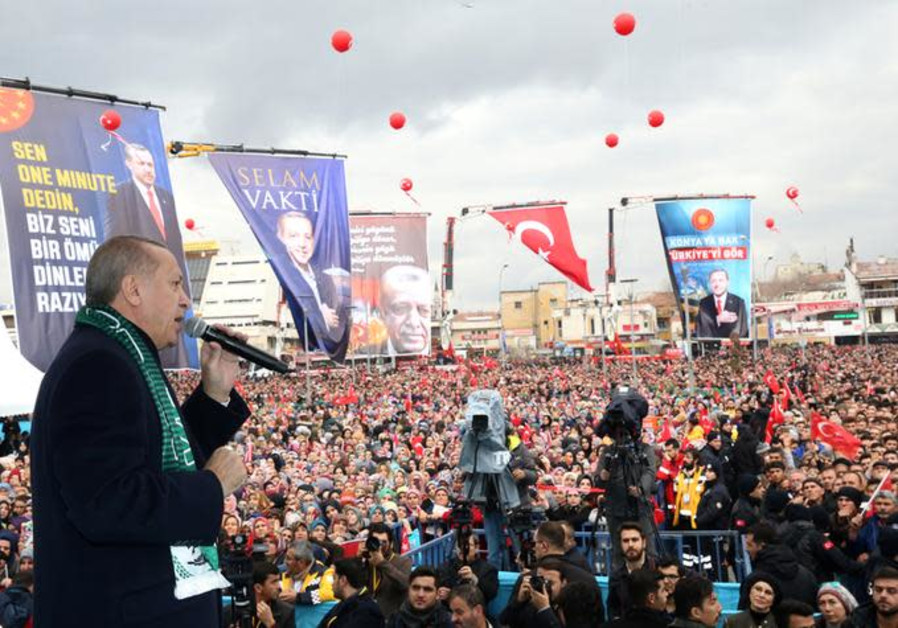
Turkish President Tayyip Erdogan spoke on Friday following the US withdrawal from Syria.

BY ALON EINHORN
 DECEMBER 22, 2018 12:20
Turkish President Tayyip Erdogan addresses his supporters in Konya, Turkey, December 17, 2018.

Turkish President Tayyip Erdogan spoke on Friday following the US withdrawal from Syria.

Erdogan claimed his country will take command of the fighting against ISIS in Syria, and continue its fighting against the Kurds in northern Syria.

A US official speaking anonymously said that US considers putting special forces in Iraq, to respond to events in Syria.

US Secretary of State Mike Pompeo assured Iraqi Prime Minister Adel Abdul Mahdi that the U.S. is still committed to fighting Islamic State in Iraq and other areas despite its planned troop withdrawal from Syria, Abdul Mahdi’s office said on Saturday.

US President Donald Trump’s decision to withdraw the US forces from Syria was followed by harsh criticism from Israeli intelligence officials.

“A feeling of abandonment,” An official told The New York Times. “Trump threw us under Israel bus – and in this case the bus is a Russian truck supplying weapons to Syria and Hezbollah.”

Trump’s decision also received criticism in the Republican camp. “It is an Obama-like mistake made by the Trump administration.” Senator Lindsey Graham called the withdrawal. “This will be a great victory for ISIS, Iran, Assad and the Russians.”