Trump’s Rubicon moment in Iraq: Praising America’s ‘warriors,’ ending war

Posted December 27, 2018 by Joseph Wouk
Categories: Uncategorized

Source: Trump’s Rubicon moment in Iraq: Praising America’s ‘warriors,’ ending war – Middle East – Jerusalem Post

Trump described the US withdrawal as deliberate, casting cold water on criticism that it was spur of the moment.
BY SETH J. FRANTZMAN
 DECEMBER 27, 2018 13:36
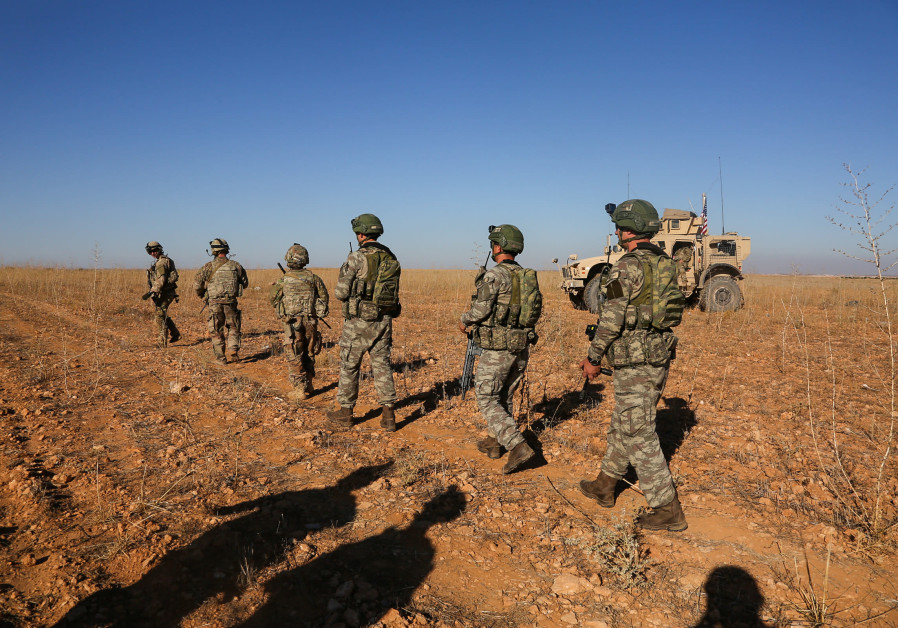
U.S. and Turkish soldiers conduct the first-ever combined joint patrol outside Manbij, Syria, Novemb

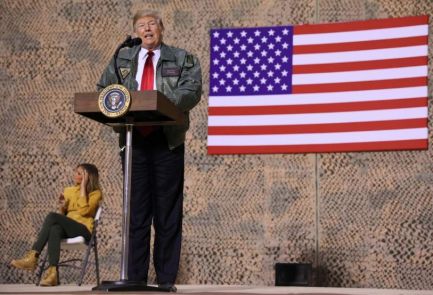
“We like to win, we are going to win,” US President Donald Trump told the troops at Al-Asad airbase in central Iraq. It was his first visit to US forces abroad and comes in the wake of Trump’s decision to withdraw from Syria. It also comes in the wake of the resignation of US Secretary of Defense James Mattis, who was popular with the troops and also the resignation of anti-ISIS envoy Brett McGurk.

Trump’s decision to go to Iraq the day after Christmas is part of an attempt to change the narrative after being slammed for his reversal of Syrian policy and accusations that he made the decision without consulting the Pentagon or State Department. By speaking at Al-Asad in western Iraq he sought to reach out directly to the American military. This was an important and symbolic speech because it comes at a crux of his foreign policymaking and also mid-way into his administration.

“You’re modern day warriors,” Trump said, praising the troops. Reading from a prepared speech, he sought to emphasize some points, going off the prepared text from time to time.  He listed the various units at Al-Asad, including the 201st Regional Support Group, the 1st Expeditionary Rescue group and the 3rd Cavalry regiment, as well as the special operations group stationed in Iraq. Trump sought to highlight the achievements of the four year war on ISIS, including what he said was the liberation of 20,000 square miles of territory and 3 million civilians. “Because of these gains the service members in Syria can come home,” he said. Trump noted the US initially getting involved in Syria for “three to four months,” which appeared to be a reference to the US supporting the Syrian rebels against Bashar al-Assad’s regime in 2011. For Trump it was one long war that should be ended. “I gave our generals six more months in Syria [in 2016], and that was a year and a half ago, they said they need six more months and another six more months, and another, and I said no.” He said US troops needed “clear objectives,” and that after reducing ISIS-controlled areas by 99%, other countries in the region could do the rest.

Trump described the US withdrawal as deliberate, casting cold water on criticism that it was spur of the moment. He also said the US would stay in Iraq to prevent an ISIS resurgence and to keep an eye on Iran. His emphasis was on America no longer doing all the fighting and funding of conflicts without getting reimbursed. “We aren’t the suckers of the world.” To rounds of applause he said that the US was fighting in areas it shouldn’t be fighting and spending billions on 19 years of war, a reference to the long war since 9/11. “We want to fight where it is meaningful,” he said, noting that anyone who attacked America would suffer consequences like no one has suffered before.

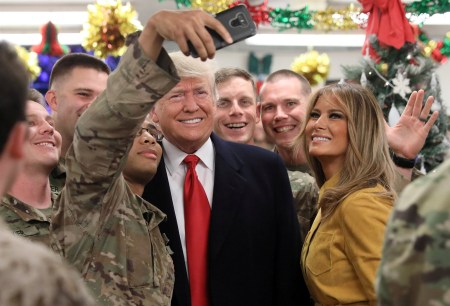
Trump appeared at ease and relaxed with the soldiers. After the speech he also took selfies with them. This is a Rubicon moment for the US President. He sought to use the speech to show that he is in touch with average American demands and to challenge Democrats, who he referenced several times, to build a stronger border wall and also to fund the military better. This is a rare politicization of a speech in front of the troops and it will be noticed back home. He is trying to position himself for the new year when a Democrat-controlled House of Representatives will challenge Trump’s policies. He also wants to shore up supporters and cast doubt on the challenges he has faced from Senators who balk at his Syria policy. Senator Lindsey Graham has been a harsh critic of leaving Syria and abandoning US partners on the ground who helped fight ISIS. He also warned Trump not to follow up with withdrawing from Iraq. “We also must not abandon our Kurdish allies who have fought so hard by our side in Syria.” Trump, however, did not mention those allies, instead saying Turkey would deal with ISIS and the US would be working closely with Turkey. Turkey has vowed an offensive against US Kurdish partners in Syria, setting up a strange scenario in which the US leaves and watches one ally fight another.

The Trump doctrine here is that the US must come first and that these foreign problems are not America’s problem. For instance, Trump was criticized in Iraq for not meeting officials in the government. Iraqi leaders didn’t even seem to know Trump was planning a visit, although Trump’s team reportedly reached out to Prime Minister Adel Abdul Mahdi’s office, the Iraqi leader didn’t want to come to Al-Asad air base and the personal meeting was cancelled. It’s not entirely clear when Trump planned the visit, whether he decided to go after the decision to leave Syria on December 19, or before. National Security Advisor John Bolton, who was one of the few advisors he confided the Syria policy change to before making it, came with him.

Now Iraqi politicians are slamming the visit, especially the pro-Iranian groups. Qais Khazali, a one-time detainee of the Americans who formed a Shi’ite militia and then became a political leader as well, said that Iraq’s parliament should vote to remove US forces from the country. This is no surprising as many of the pro-Iranian parties and groups have opposed the US presence in Iraq, only asking for help against Islamic State, but not wanting a real American involvement. With the exception of the Kurdish autonomous region, much of Iraq is hostile in one way or another to the US presence, either due to historic reasons such as lingering support for Saddam Hussein, or because of US-Iran tensions or perceived US abuses during the 2003-2011 US role in Iraq. In the Kurdish region there were hopes for a Trump visit, even as there is criticism of the US walking away from Kurdish areas in Syria.

Trump’s visit wasn’t about Iraq or the Middle East. It was primarily about Trump and US forces. In this sense it feels like a Rubicon moment because that is when the Roman leader Caesar decided to cross into Italy with his army to oppose the meddling politicians in Rome. Trump wants to leverage his Iraq visit to tone down criticism at home, and show that while he may not make friends in major media, he has the support of average Americans. This has been his narrative from the beginning, seeking to challenge the status quo and also to question US commitments abroad and whether the US is paying too much and doing too much for foreign countries. In the region the visit will be judged as Trump sticking by his Syria decision and seeking to reduce the US footprint. This will encourage Russia, Turkey and Iran to continue to pursue their agendas in Syria and perhaps to leverage anger in Iraq over Trump’s visit to pressure the US in Baghdad as well. With McGurk gone a key US official who worked on Iraqi coalition politics and smoothing relations between Baghdad and Saudi Arabia, is no longer working on the Iraq file. Trump’s team may now find that leaving Syria causes another domino to teeter.
 

Israeli-built wings for new F-35 will make jets invisible to radar 

Posted December 27, 2018 by Joseph Wouk
Categories: Uncategorized

Source: Israeli-built wings for new F-35 will make jets invisible to radar – Israel News – Jerusalem Post

The production line, which will last around 20 years, is expected to generate revenues of over $2.5 billion during the next 10-15 years.

BY ANNA AHRONHEIM
 DECEMBER 27, 2018 12:14
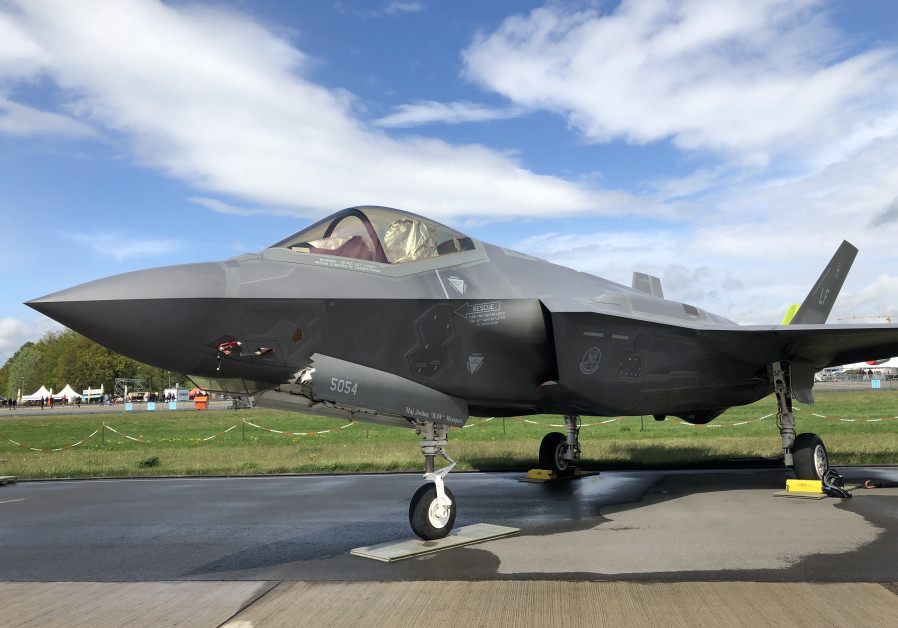
The F-35 stealth fighter jet on the tarmac at Berlin Air Show

Israel Aerospace Industries (IAI) has launched a new production line for the outer wing set of the F-35 stealth fighter key component to make the advanced fighter jet invisible to radar, the company announced.

“The construction of the new production line significantly upgrades IAI’s technological capabilities, automation and robotics, and will enable the company to establish itself as a major player in the military and civilian aerostructures,” read a statement by IAI.

The production line, which will last around 20 years, is expected to generate revenues of over $2.5 billion during the next 10-15 years.

Deliveries of the outer wing sets are expected to start at the beginning of 2019, and include in the first phase about 700 kits with potential for further orders. According to a 2016 statement by the company, the production line is scheduled to build a total of 811 pairs of F-35A wings by 2034.

The sets will be manufactured using state-of-the-art technology which includes a unique composite layer of materials called AFP (Automatic Fiber Placement) which are three millimeters thick threads that eventually become one unit that in the end creates the least for the wings that gives them the ability to evade radar detection.

IAI’s board of directors approved the construction of the new production line in 2015 following a decision by the plane’s maker, Lockheed Martin, to expand the production of the sets and chose IAI as the subcontractor.

“The opening of the production line constitutes a significant milestone in the realization of the company’s strategy for building advanced capabilities in the field of composite materials manufacturing technology. Thanks to this move, IAI will belong to a ‘limited club’ of companies with these manufacturing capabilities,” said IAI Vice-President Shlomi Karako at the launch.

The expansion of IAI’s collaboration with Lockheed Martin “is another proof of the deep partnership and trust” the American manufacturer has with Israel’s leader in defense production, said Lockheed Martin Israel’s CEO, Joshua “Shiki” Shani, adding that “The precision, technological components, personnel and manufacturing quality needed for the wings of the F-35s require the highest standards. IAI has proven its capabilities in the production line in the hundreds of wings produced so far, and we expect to commence operations in their coating field, which is another layer in the overall manufacturing process of the F-35 aircraft. ”

The F-35s have components built by several Israeli defense companies including Elbit System-Cyclone that built the center fuselage composite components and Elbit Systems Ltd which manufactured the helmets worn by the pilots.

Israel’s Air Force currently has 14 F-35Is and is expected to receive a total of 50 planes to make two full squadrons by 2024. The IAF is set to decide in the coming months between purchasing a third squadron of F-35 jets or Boeing’s latest F-15I.


Israel is doing very well defending itself, Trump says

Posted December 27, 2018 by Joseph Wouk
Categories: Uncategorized

Source: Israel is doing very well defending itself, Trump says – Israel Hayom


‘Israel will continue to counter Iranian entrenchment in Syria’ 

Posted December 27, 2018 by Joseph Wouk
Categories: Uncategorized

Source: ‘Israel will continue to counter Iranian entrenchment in Syria’ – Israel Hayom


Israel: Iran operating on Syrian border, despite Russian assurances –

Posted December 27, 2018 by Joseph Wouk
Categories: Uncategorized

Source: Israel: Iran operating on Syrian border, despite Russian assurances – Israel Hayom


Israel has no choice but to operate in Syria 

Posted December 27, 2018 by Joseph Wouk
Categories: Uncategorized

Source: Israel has no choice but to operate in Syria – Israel Hayom


The war in Gaza is not over 

Posted December 27, 2018 by Joseph Wouk
Categories: Uncategorized

Source: The war in Gaza is not over – Israel Hayom

Minister Yoav Gallant

Exactly a decade ago, on Dec. 27, 2008, Hamas staged ‎a show of power in the Gaza Strip, parading hundreds ‎of terrorists in Gaza City. A surprised Israeli ‎airstrike, which fired five missiles on them, killed ‎about 90 terrorists, triggering the beginning of ‎Operation Cast Lead, which saw Israel strike all ‎Hamas headquarters in Gaza, as well as its rocket ‎launching systems and hundreds of terrorist assets ‎and sites.‎

On the Israeli side, ground, air and naval troops ‎fought for three weeks with aim of eradicating key ‎terrorist hubs across the Gaza Strip.‎

The operation was launched following three years ‎during which some 10,000 rockets and mortar shells ‎were fired on Israel’s south and dozens of terrorist ‎attacks were carried out nationwide. ‎

The IDF’s Southern Command was tasked with attacking ‎terrorist infrastructure in the Gaza Strip, ‎inflicting significant damage to Hamas and ‎bolstering Israeli deterrence, and this mission was ‎accomplished in full: More than 700 terrorists were ‎eliminated and all Hamas headquarters were ‎destroyed. ‎

As the commander of the operation, I recommended to ‎my superiors that Israel should make the most of ‎this success and expand the campaign by allowing ‎Southern Command forces to seize control of Gaza ‎City bring Hamas to its knees by either eliminating ‎terrorist or capturing them. My recommendation was ‎denied. ‎

The main factors that rendered Operation Cast Lead ‎successful were careful and secret preparation, ‎operational integration within the IDF, cooperation ‎between the military and Shin Bet security agency, ‎the force demonstrated by the troops on the ground, ‎quality intelligence, accurate aerial strikes, ‎operational and logistical continuity and a ‎resilient homefront.‎

But above all, it was IDF fighters and commanders, ‎who acted with determination, dedication and ‎professionalism, and courageously carried out their ‎missions. Ten soldiers and three civilians were ‎killed in the operation and we all owe them a great ‎debt of gratitude.‎

A decade later, everyone recognizes the important ‎contribution Operation Cast Lead had to the south’s ‎security, as it dealt Hamas a crippling blow. We may ‎still have that advantage, but the war for our home ‎is not over. ‎

In recent years, Hamas’ terrorist routes have been ‎shuttered, one by one, via restrictions on land ‎movement, a maritime blockade, counter-tunnel ‎warfare and the effective protection provided by the ‎Iron Dome air defense system. Operation Cast Lead ‎and the reality that followed on the ground have ‎forced Hamas to rethink its strategy.‎

The balance of power between the IDF and Hamas is ‎‎1,000 to 1, meaning that in any future ‎confrontation, Israel will overcome Hamas. In view ‎of the numerous security challenges Israel faces, it ‎is our duty to act responsibly and discreetly. ‎

Knowing the enemy Israel is preparing for future ‎campaigns, but if we are forced into battle, we will ‎be the ones to determine its timing. ‎

We are a peace-loving nation but at this time, we ‎cannot afford to lay down our sword. We remain ‎vigilant and ready to defend ourselves, on every ‎front, at all times.‎

Yoav Gallant is the construction and housing minister.

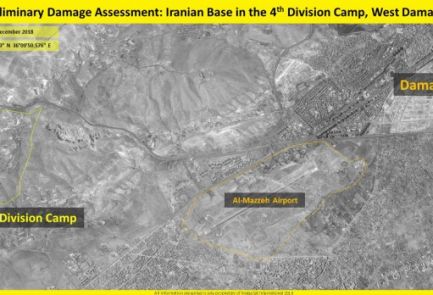
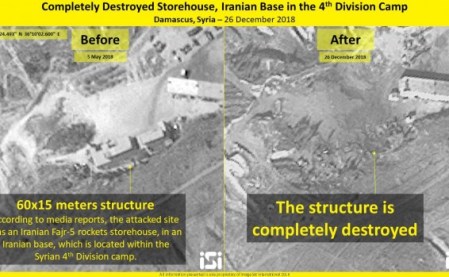
Satellite images reveal Iranian facility destroyed in Syria strike 

Posted December 27, 2018 by Joseph Wouk
Categories: Uncategorized

Source: Satellite images reveal Iranian facility destroyed in Syria strike – Israel Hayom


First Ethiopian IAF combat pilot

Posted December 27, 2018 by Joseph Wouk
Categories: Uncategorized

Source: First Ethiopian IAF combat pilot

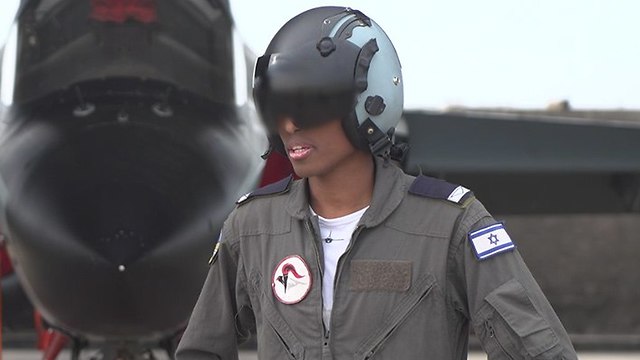
Lt. Y. is the first member of Israel’s Ethiopian community to earn IAF combat wings; PM Netanyahu and IAF Commander expressed their pride during the course’s graduation ceremony.
For the first time in the history of the Israeli Air Force, a cadet from the Ethiopian community was awarded his pilot wings on Wednesday, and is to start his active duty as a combat navigator.

“Being a member of the air squadrons and serving in one of the IDF’s most significant units is for me a great honor,” said Lieutenant Y, whose identity remains undisclosed, as with all IAF pilots.

“When I began the course I encountered some prejudice, but it wasn’t different to the kind other people face when they enter a new and judging environment, “said Lieutenant Y. “But I later discovered that I was surrounded by ordinary people… and I understood that I have a place in which I can develop and grow.”

Lt. Y. (Photo: IDF Spokesman)

Lt. Y. (Photo: IDF Spokesman)

“As the course concludes, I have mixed feelings,” he continued. “On the one hand it is nice to finally receive our wings after three intensive years of training; on the other hand, it is only the beginning of the journey.”

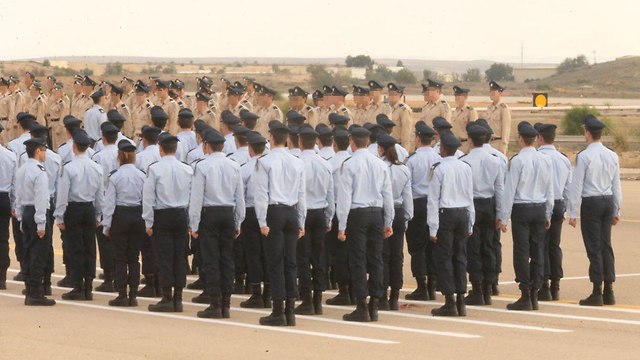
177th pilot's course graduation ceremony at the Hatzerim Air Base.  (Photo: Motti Kimchi)

177th pilot’s course graduation ceremony at the Hatzerim Air Base. (Photo: Motti Kimchi)

Prime Minister Benjamin Netanyahu congratulated the new pilots for completing the tedious course during a speech at the 177th pilot’s graduation ceremony, that took place at the Hatzerim Air Base near the city of Be’er Sheva.

Netanyahu then asserted Israel’s determination to prevent the entrenchment of Iranian forces in Syria, and expressed his trust in the IAF.

 (Photo: Motti Kimchi)

(Photo: Motti Kimchi)

“The nation of Israel depends on you and I put my faith in you,” the prime minister said. “My mind is always on our pilots. During the wee hours of the morning, I sit near the telephone waiting to hear from my military secretary that an operation was successful and that all our pilots returned home safely.”  Both Netanyahu and Air Force Commander Maj. Gen. Amikam Norkin made statements referring to the IDF’s operation in Syria Tuesday night. Norkin also welcomed the first Ethiopian to complete the course: “Distinguished members of the Ethiopian community are here today, Kessoch, academics and public figures; your presence sends an important message…. I am proud of you Lieutenant Y.


IDF warns Gazans: Don’t protest on Friday or you’ll get hurt 

Posted December 27, 2018 by Joseph Wouk
Categories: Uncategorized

Source: IDF warns Gazans: Don’t protest on Friday or you’ll get hurt – Arab-Israeli Conflict – Jerusalem Post

“How do you want to spend your Friday? With members of your family, or at the violence on the fence?” Sarhan posted on Facebook in Arabic.

BY YVETTE J. DEANE
 DECEMBER 27, 2018 10:59
A demonstrator wearing a mask at the back of his head holds a Palestinian flag during a protest near

Head of Coordination and Liaison Administration in Gaza, Col. Iyad Sarhan, urged Gazans to stay away from protests via the Arabic-language Facebook page of the Coordinator of Government Activities in the Territories (COGAT) on Thursday.

“How do you want to spend your Friday? With members of your family, or at the violence on the fence?” Sarhan wrote. “The IDF will not tolerate attempts to sabotage the fence or violations of Israel’s sovereignty!”

“We too want a Friday without casualties among you, but this depends on you and you alone,” Sarhan added. “Keep your distance from the fence area, in so doing you will keep yourselves safe.”

This warning comes as four Palestinians were killed and dozens more injured last week during the weekly March of Return protests along the Gaza border that tend to ramp up on Friday after prayers.

Some 8,000 Palestinians took part in the protests last Friday. They burned tires and threw rocks and an explosive device toward troops, though it did not land in Israeli territory.

Anna Ahronheim contributed to this report.