Nasrallah embezzled millions from Hezbollah funds?

Posted January 31, 2019 by davidking1530
Categories: Uncategorized

Surely this would be worthy of some hand chopping?

(Article is from 20 Jan)

http://www.israelhayom.com/2019/01/20/report-nasrallah-embezzled-millions-from-hezbollah-funds/

Saudi news outlet Al-Watan says Iranian forces have Hezbollah leader Hassan Nasrallah under house arrest and are pressuring him to divulge what happened to the tens of millions of dollars reportedly missing from Hezbollah bank accounts.

Hezbollah leader Sheikh Hassan Nasrallah is suspected of embezzling millions of dollars from the terrorist organization’s coffers, the Saudi website Al-Watan Online reported Saturday.

According to Al-Watan, Nasrallah is under house arrest, guarded by Iranian forces, and is reportedly receiving medical treatment.

The Al-Watan report painted a dim picture of Nasrallah’s situation, saying that the Iranian forces guarding him were pressuring him to divulge what had happened to tens of millions of dollars that Iran had deposited into Hezbollah’s accounts. Nasrallah and his associates are suspected of taking the missing money for personal use.

There has not been any independent confirmation of the Al-Watan report. Sunni Saudi Arabia and Shiite Iran are arch enemies and are waging several proxy battles across the region.

Observers confirmed to Al-Watan that Hezbollah was in an “unusual” situation, with its leaders in worse shape than they have been since Iran founded the Lebanese Shiite proxy. The report said that Nasrallah’s recent media absence was directly related to the missing millions.

The Al-Watan report comes a week after Lebanese media outlets reported on Jan. 12 that the Hezbollah leader had suffered a heart attack and was hospitalized in “serious condition” in Beirut. Other reports said that he had suffered a stroke and was fighting cancer.

None of the Lebanese reports about Nasrallah’s health received official confirmation.


Is Jerusalem a sacred islamic city?

Posted January 31, 2019 by davidking1530
Categories: Uncategorized

Interestingly, the author of this article is an Australian shia imam.

He’d probably want to keep his head down…

… if he wishes to keep it attached to his shoulders.

https://www.jpost.com/Opinion/Is-Jerusalem-a-sacred-Islamic-City-578560

There is a big difference between a city being sacred in the eyes of God and it being a sacred Islamic city.

Image result for al aqsa mosque

Jerusalem is home to around 400,000 Muslims, but is it a sacred city according to Islam?

This is a question the majority of Muslims within the political and academic world try to avoid, simply because it opens a rather uncomfortable discussion. In fact, a Muslim asking such a question could face serious consequences; such as society doubting in his/her faith.

Until 2014, I was an Islamist who abhorred Jewish people and was open to waging war against them. Today, however, I am friends with many Jewish faith leaders. This transition wasn’t political, it was rather theological. In brief, I started to question certain claims taught to me by my teachers and Muslim community. I began by asking myself the question, does Jerusalem really belong to Islam and Muslims?

To answer this vitally important question, we need to inquire how cities become sacred according to Islam.

Sacred cities in Islam

Throughout human history, every religion has been associated with an area that has been sanctified, respected and revered. Islam is no different. There are tens of sacred cities in Islam, such as Mecca, Medina, Qum, Karbala and Najaf – due to clear verses of the Koran acknowledging their glory or sayings of Prophet Mohammad assuring Muslims of their exaltation.

There is a big difference between a city being sacred in the eyes of God and it being a sacred Islamic city. For example, all prophetic tombs, birthplaces and areas where miracles took place are considered sacred in Islam, but they are not specifically Islamic locations. A sacred Islamic location is a location wherein a significant Islamic event has taken place by either Allah or Prophet Mohammad.

Jerusalem in Islamic scripture

The Holy Koran states very clearly that the Holy Land, Jerusalem, belongs to the Jewish nation of Moses, the Israelites:

“And [mention, O Muhammad], when Moses said to his people, “O my people, remember the favor of Allah [God] upon you when He appointed among you prophets and made you possessors and gave you that which He had not given anyone among the world” (Koran: 5:20 onwards).

The above verse also makes it clear that God “had not given (this land to) anyone among the world” other than the Jewish nation.

From this verse, and others of similar context, we understand that Jerusalem is a sacred city according to God, but it is not a sacred Islamic city, due to the fact that its sacredness was established before the existence of Islam.

After the emergence of Islam, in the year 621 CE, it is believed that Prophet Mohammad took a miraculous and spiritual night journey to Al-Aqsa Mosque (the Farthest Mosque). This event is reported in the Koran in the following verse:

“Exalted is He who took His Servant by night from the Sacred Mosque (Mecca) to al-Masjid al- Aqsa (the Farthest Mosque), whose surroundings We have blessed, to show him of Our signs…” (Quran 17:1).

Two vital matters need to be addressed regarding the above verse:

  1. Prophet Mohammad traveling to a location does not make that location “Islamic.”
  2. There is little evidence that “Al-Aqsa Mosque” is actually in Jerusalem, and there are a large number of Muslims who believe that “the Farthest Mosque” is a reference to a mosque in the heavens, not on earth; due to the fact that the current Al-Aqsa Mosque did not exist during the lifetime of Prophet Mohammad, making it impossible for him to have visited it.

Messengers of both Judaism and Christianity had arrived in Jerusalem to preach their scriptures centuries before Prophet Mohammad. Therefore, it cannot be historically accurate to say that Mohammad brought Islam to Jerusalem before them.

Up until the migration of Mohammad to Medina in 622 CE and the official establishment of Islam therein, Islam was a minority religion when compared to the two well-established religions of Judaism and Christianity. Besides, the citizens of Jerusalem who converted to Islam merely changed their own faith, not the entire history of Jerusalem.

Thus, neither Islamic scripture nor history  claim that Jerusalem is a sacred Islamic city.

Jerusalem meets Islam

In May 632 CE, Prophet Mohammad appointed Usama ibn Zaid as the commander of his army to respond to the Romans in an agreed-upon battle within Palestine.

The next day Usama set out for his expedition, but he then learnt that Mohammad had died and therefore he returned to Medina. Caliph Abu Bakr then ordered Usama to increase his army to 3,000 men and to attack the inhabitants of the Kingdom of Moab and Byzantine-held Darum, to kill or capture as many as he could and Usama did so.

This event proves that up until the demise of Prophet Mohammad, there were no Muslims in what is today known as Palestine, and that it was inhabited by the Romans of the Byzantine.

Also, Prophet Mohammad would not wage war against a city full of Muslims. In reality, Islam as a religion officially came to Palestine in the year 636 CE, four years after Mohammad’s death and during the reign of the second caliph of Islam, Omar.

The Islamic caliphate conducted an attack on Jerusalem, which was ruled by the Byzantine Romans. The city was placed under a four-month siege commencing in November of that year. After four months of hardship and butchery, the Orthodox Patriarch of Jerusalem, Sophronius, surrendered Jerusalem to Caliph Omar in 637 CE. When Caliph Omar realized that Islam was still a minority religion in the region, he adopted the jizyah system, forcing Christians and Jewish people to pay tax to the Islamic caliphate.

After conducting a massacre of the citizens of Jerusalem, our Caliph Omar came to Jerusalem to appoint his governors. He then built what is known today as “the Aqsa Mosque,” which many Muslims mistakenly think was built by Prophet Mohammad.

The mosque in Jerusalem with its golden dome is known to Muslims as “Qubbat al-Sakhrah” (Dome of the Rock), and it was completed in 691 CE by the Umayyad Dynasty, the following Islamic caliphate. It is arguably not permissible for Muslims to pray within Al-Aqsa Mosque and the Qubbat al-Sakhrah, as they are built upon occupied and invaded land.

By the ninth century, the Fatimid Dynasty, a Shia Islamic caliphate, ruled a large area of north Africa. They were also terrorists who invaded Palestine and massacred Christians in Jerusalem for siding with the Romans of the Byzantine, who had attempted to regain their conquered land. The notorious caliph of the Fatimid Caliphate, Al-Hakim, caused much damage to the entire region, even killing John VII, the Patriarch of Jerusalem, a provocative act that laid the groundwork for the First Crusade. Due to the defeat of the Crusaders, Muslims became the majority, by the sword and not by the pen.

By this time, the entire Mediterranean coast of Palestine had been captured, followed by a series of massacres of the Christian people and a genocide that spread all the way to Damascus and Beirut. Islam became the established religion of Palestine by the ninth century, and became the majority religion of the region throughout the Mamluk Era, between 1250 and 1516.

Therefore, we Muslims did not enter Palestine as preachers and convert its nation into Muslims. We murdered their leaders and conducted serial massacres led by both Sunni and Shia terrorist Islamic caliphs. The citizens of Palestine may convert to Islam, but in no way can Palestine be considered Muslim land. Of course, many may dispute this position, but the fact is that the Jews were in this land long before even Christianity arose. Their ancient cultural links remain unbroken, as in the saying each Passover, “Next year in Jerusalem.”

Our Arab-Muslim ancestors came out of their deserts as conquerors and not as learners, and as guiders who do not seek the guidance of others. They believed that they had sufficient knowledge and wisdom, and that they did not need to learn anything from others. This delusion of my co-religionists persists to this day, despite the fact that the world has changed.

Disturbing events in Islamic history

On the other hand, I do not understand the Muslim struggle for Jerusalem. Islamic laws strictly prohibit relieving oneself while facing Mecca, in fact, toilets in all Islamic countries and most Muslim homes do not face Mecca, out of respect to the holy city. Yet Bukhari reports that our Prophet Mohammad used to deliberately and repeatedly relieve himself while facing Jerusalem, even though he could have faced another direction instead.

Does it make sense that Palestinians are dying for Jerusalem when their own beloved Prophet used to prefer defecating toward it?

Whether Palestine is Jewish land or whether Israel is a state are two completely different debates. A Muslim may reject Israel being a state, but cannot deny the fact that the entire region, including Palestine, is in fact Jewish land.

The writer, an Iranian-born Australian Shia Muslim Imam, is president of the Islamic Association of South Australia.

There is a big difference between a city being sacred in the eyes of God and it being a sacred Islamic city.

Jerusalem is home to around 400,000 Muslims, but is it a sacred city according to Islam?

This is a question the majority of Muslims within the political and academic world try to avoid, simply because it opens a rather uncomfortable discussion. In fact, a Muslim asking such a question could face serious consequences; such as society doubting in his/her faith.

Until 2014, I was an Islamist who abhorred Jewish people and was open to waging war against them. Today, however, I am friends with many Jewish faith leaders. This transition wasn’t political, it was rather theological. In brief, I started to question certain claims taught to me by my teachers and Muslim community. I began by asking myself the question, does Jerusalem really belong to Islam and Muslims?

To answer this vitally important question, we need to inquire how cities become sacred according to Islam.

Sacred cities in Islam

Throughout human history, every religion has been associated with an area that has been sanctified, respected and revered. Islam is no different. There are tens of sacred cities in Islam, such as Mecca, Medina, Qum, Karbala and Najaf – due to clear verses of the Koran acknowledging their glory or sayings of Prophet Mohammad assuring Muslims of their exaltation.

There is a big difference between a city being sacred in the eyes of God and it being a sacred Islamic city. For example, all prophetic tombs, birthplaces and areas where miracles took place are considered sacred in Islam, but they are not specifically Islamic locations. A sacred Islamic location is a location wherein a significant Islamic event has taken place by either Allah or Prophet Mohammad.

Jerusalem in Islamic scripture

The Holy Koran states very clearly that the Holy Land, Jerusalem, belongs to the Jewish nation of Moses, the Israelites:

“And [mention, O Muhammad], when Moses said to his people, “O my people, remember the favor of Allah [God] upon you when He appointed among you prophets and made you possessors and gave you that which He had not given anyone among the world” (Koran: 5:20 onwards).

The above verse also makes it clear that God “had not given (this land to) anyone among the world” other than the Jewish nation.

From this verse, and others of similar context, we understand that Jerusalem is a sacred city according to God, but it is not a sacred Islamic city, due to the fact that its sacredness was established before the existence of Islam.

After the emergence of Islam, in the year 621 CE, it is believed that Prophet Mohammad took a miraculous and spiritual night journey to Al-Aqsa Mosque (the Farthest Mosque). This event is reported in the Koran in the following verse:

“Exalted is He who took His Servant by night from the Sacred Mosque (Mecca) to al-Masjid al- Aqsa (the Farthest Mosque), whose surroundings We have blessed, to show him of Our signs…” (Quran 17:1).

Two vital matters need to be addressed regarding the above verse:

  1. Prophet Mohammad traveling to a location does not make that location “Islamic.”
  2. There is little evidence that “Al-Aqsa Mosque” is actually in Jerusalem, and there are a large number of Muslims who believe that “the Farthest Mosque” is a reference to a mosque in the heavens, not on earth; due to the fact that the current Al-Aqsa Mosque did not exist during the lifetime of Prophet Mohammad, making it impossible for him to have visited it.

Messengers of both Judaism and Christianity had arrived in Jerusalem to preach their scriptures centuries before Prophet Mohammad. Therefore, it cannot be historically accurate to say that Mohammad brought Islam to Jerusalem before them.

Up until the migration of Mohammad to Medina in 622 CE and the official establishment of Islam therein, Islam was a minority religion when compared to the two well-established religions of Judaism and Christianity. Besides, the citizens of Jerusalem who converted to Islam merely changed their own faith, not the entire history of Jerusalem.

Thus, neither Islamic scripture nor history  claim that Jerusalem is a sacred Islamic city.

Jerusalem meets Islam

In May 632 CE, Prophet Mohammad appointed Usama ibn Zaid as the commander of his army to respond to the Romans in an agreed-upon battle within Palestine.

The next day Usama set out for his expedition, but he then learnt that Mohammad had died and therefore he returned to Medina. Caliph Abu Bakr then ordered Usama to increase his army to 3,000 men and to attack the inhabitants of the Kingdom of Moab and Byzantine-held Darum, to kill or capture as many as he could and Usama did so.

This event proves that up until the demise of Prophet Mohammad, there were no Muslims in what is today known as Palestine, and that it was inhabited by the Romans of the Byzantine.

Also, Prophet Mohammad would not wage war against a city full of Muslims. In reality, Islam as a religion officially came to Palestine in the year 636 CE, four years after Mohammad’s death and during the reign of the second caliph of Islam, Omar.

The Islamic caliphate conducted an attack on Jerusalem, which was ruled by the Byzantine Romans. The city was placed under a four-month siege commencing in November of that year. After four months of hardship and butchery, the Orthodox Patriarch of Jerusalem, Sophronius, surrendered Jerusalem to Caliph Omar in 637 CE. When Caliph Omar realized that Islam was still a minority religion in the region, he adopted the jizyah system, forcing Christians and Jewish people to pay tax to the Islamic caliphate.

After conducting a massacre of the citizens of Jerusalem, our Caliph Omar came to Jerusalem to appoint his governors. He then built what is known today as “the Aqsa Mosque,” which many Muslims mistakenly think was built by Prophet Mohammad.

The mosque in Jerusalem with its golden dome is known to Muslims as “Qubbat al-Sakhrah” (Dome of the Rock), and it was completed in 691 CE by the Umayyad Dynasty, the following Islamic caliphate. It is arguably not permissible for Muslims to pray within Al-Aqsa Mosque and the Qubbat al-Sakhrah, as they are built upon occupied and invaded land.

By the ninth century, the Fatimid Dynasty, a Shia Islamic caliphate, ruled a large area of north Africa. They were also terrorists who invaded Palestine and massacred Christians in Jerusalem for siding with the Romans of the Byzantine, who had attempted to regain their conquered land. The notorious caliph of the Fatimid Caliphate, Al-Hakim, caused much damage to the entire region, even killing John VII, the Patriarch of Jerusalem, a provocative act that laid the groundwork for the First Crusade. Due to the defeat of the Crusaders, Muslims became the majority, by the sword and not by the pen.

By this time, the entire Mediterranean coast of Palestine had been captured, followed by a series of massacres of the Christian people and a genocide that spread all the way to Damascus and Beirut. Islam became the established religion of Palestine by the ninth century, and became the majority religion of the region throughout the Mamluk Era, between 1250 and 1516.

Therefore, we Muslims did not enter Palestine as preachers and convert its nation into Muslims. We murdered their leaders and conducted serial massacres led by both Sunni and Shia terrorist Islamic caliphs. The citizens of Palestine may convert to Islam, but in no way can Palestine be considered Muslim land. Of course, many may dispute this position, but the fact is that the Jews were in this land long before even Christianity arose. Their ancient cultural links remain unbroken, as in the saying each Passover, “Next year in Jerusalem.”

Our Arab-Muslim ancestors came out of their deserts as conquerors and not as learners, and as guiders who do not seek the guidance of others. They believed that they had sufficient knowledge and wisdom, and that they did not need to learn anything from others. This delusion of my co-religionists persists to this day, despite the fact that the world has changed.

Disturbing events in Islamic history

On the other hand, I do not understand the Muslim struggle for Jerusalem. Islamic laws strictly prohibit relieving oneself while facing Mecca, in fact, toilets in all Islamic countries and most Muslim homes do not face Mecca, out of respect to the holy city. Yet Bukhari reports that our Prophet Mohammad used to deliberately and repeatedly relieve himself while facing Jerusalem, even though he could have faced another direction instead.

Does it make sense that Palestinians are dying for Jerusalem when their own beloved Prophet used to prefer defecating toward it?

Whether Palestine is Jewish land or whether Israel is a state are two completely different debates. A Muslim may reject Israel being a state, but cannot deny the fact that the entire region, including Palestine, is in fact Jewish land.

The writer, an Iranian-born Australian Shia Muslim Imam, is president of the Islamic Association of South Australia.
Iran’s Precision Missile Project Moves to Lebanon 

Posted January 30, 2019 by Joseph Wouk
Categories: Uncategorized


FULL: Netanyahu Speech at 2019 Tel Aviv Cybertech Conference

Posted January 30, 2019 by Joseph Wouk
Categories: Uncategorized


Hizbullah’s Nasrallah Tries to Limit the Damage

Posted January 30, 2019 by Joseph Wouk
Categories: Uncategorized

Source: Hizbullah’s Nasrallah Tries to Limit the Damage

  • The Hizbullah leader has reappeared in the media to repair the damage done to the image of his organization.
  • Hassan Nasrallah is trying to “construct” a new policy of deterrence to cover up Israel’s revelation of the organization’s invasion tunnels.

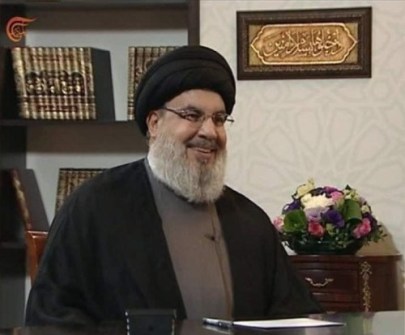
On January 26, 2019, the leader of Hizbullah, Hassan Nasrallah, reappeared in the media after an absence of three months in an exclusive interview with his journalist-follower Ghassan bin Jiddo on the Al Mayadeen channel, which identifies with Hizbullah.

Hassan Nasrallah

Hassan Nasrallah’s interview after months of silence (Arab press)

The Hizbullah leader’s media appearance was part of the organization’s psychological warfare in response to the huge defeat it sustained when the IDF discovered tunnels infiltrating into Israel during Operation Northern Shield at the end of 2018. Hizbullah’s standing was also hurt by rumors circulating in the Arab world that Nasrallah’s health condition is precarious.

During the long TV interview, Nasrallah sought to disprove the rumors about his poor health. He laughed, joked, and admitted that he lost weight, but his health situation is excellent, and all of the reports about his illness were false.

Nasrallah’s Motives

Operation Northern Shield and reports that Hassan Nasrallah was seriously ill pushed him into a corner, and he was compelled to make a public appearance and provide his supporters with explanations. He also used the broad public platform to transmit messages to Israel and the Arab world.

Nasrallah’s messages in his interview with the Al Mayadeen channel can be summarized as follows:

  1. Hizbullah’s next war against Israel will be very cruel, and Israel will pay a heavy price. All of Israel’s territory will be the next battlefield, and Hizbullah’s missiles and rockets will reach every city in Israel, including Tel Aviv.
  2. Syria is expected to change its policy regarding Israeli raids within its territory at any moment. The policy of restraint by the “resistance axis” has come to an end, and Syria will attack Tel Aviv.
  3. Hizbullah has a sufficient quantity of accurate missiles at its disposal, which can strike quality civilian and military targets in Israel, including airports, power stations, ammonia tanks in Haifa, and the atomic reactor in Dimona.
  4. In the next war, Hizbullah intends to invade the Galilee. This is part of the organization’s strategy, and the discovery of the invasion tunnels by Israel has not changed anything.
  5. President Trump’s “deal of the century” has been frozen because Saudi Arabian Crown Prince Mohammed bin Salman, who was supposed to market the plan, is currently facing a crisis over the murder of journalist Jamal Khashoggi in October 2018.
  6. The withdrawal of U.S. forces from Syria has led to the Arab states coming toward Syria, and they are trying to return it to the Arab League.

The Hizbullah leader was compelled to return to the media stage due to the vacuum that was created, as no other leader has appeared in his place, and due to important developments on Lebanon’s border with Israel.

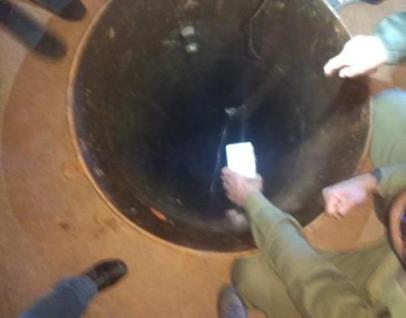
One of the Israeli-drilled holes that intersected the Hizbullah tunnel

One of the Israeli-drilled holes that intersected the Hizbullah tunnel tens of meters below the surface.

The discovery of the tunnels infiltrating into Israel’s territory struck an operational and morale blow to Hizbullah. The tunnels were crucial to a surprise plan that Hizbullah had worked on for years before the IDF exposed it. In the interview, Nasrallah tries to minimize the importance of the discovery of the tunnels by the IDF and to convince his viewers that the plan to conquer the Galilee is still relevant, but it is clear that he has lost the important element of surprise.

Through the interview on the Al Mayadeen channel, the Hizbullah leader is attempting to “construct” a new policy of deterrence toward Israel. Reports on the interview with him appeared several days earlier in the media to create high viewer ratings and media support for his statements.

There were no surprises in Nasrallah’s interview about his state of health or the tunnels. His reactions were what had been expected on both fronts.

Nasrallah does not intend to escalate the security situation with Israel from inside Lebanese territory. He hinted that if Israel attacks his men inside Syrian territory, “Hizbullah will react in accordance with the circumstances.”

Apparently, Hizbullah is preparing a new front, which Iran intends to open against Israel from inside Syria, via the Golan Heights. This is where the danger of a conflict between Israel and Hizbullah lies. Israel does not intend to take any action against the organization inside Lebanon, but it will not sit quietly if Hizbullah dares to attack Israeli targets on the Golan Heights.


Rouhani: Iran facing ‘greatest pressure,’ economic sanctions in 40 years

Posted January 30, 2019 by Joseph Wouk
Categories: Uncategorized

Source: Rouhani: Iran facing ‘greatest pressure,’ economic sanctions in 40 years | The Times of Israel

Iranian leader vows to ‘endure’ crisis blamed on US, says 2015 nuclear accord was ‘highest political pride in recent centuries’

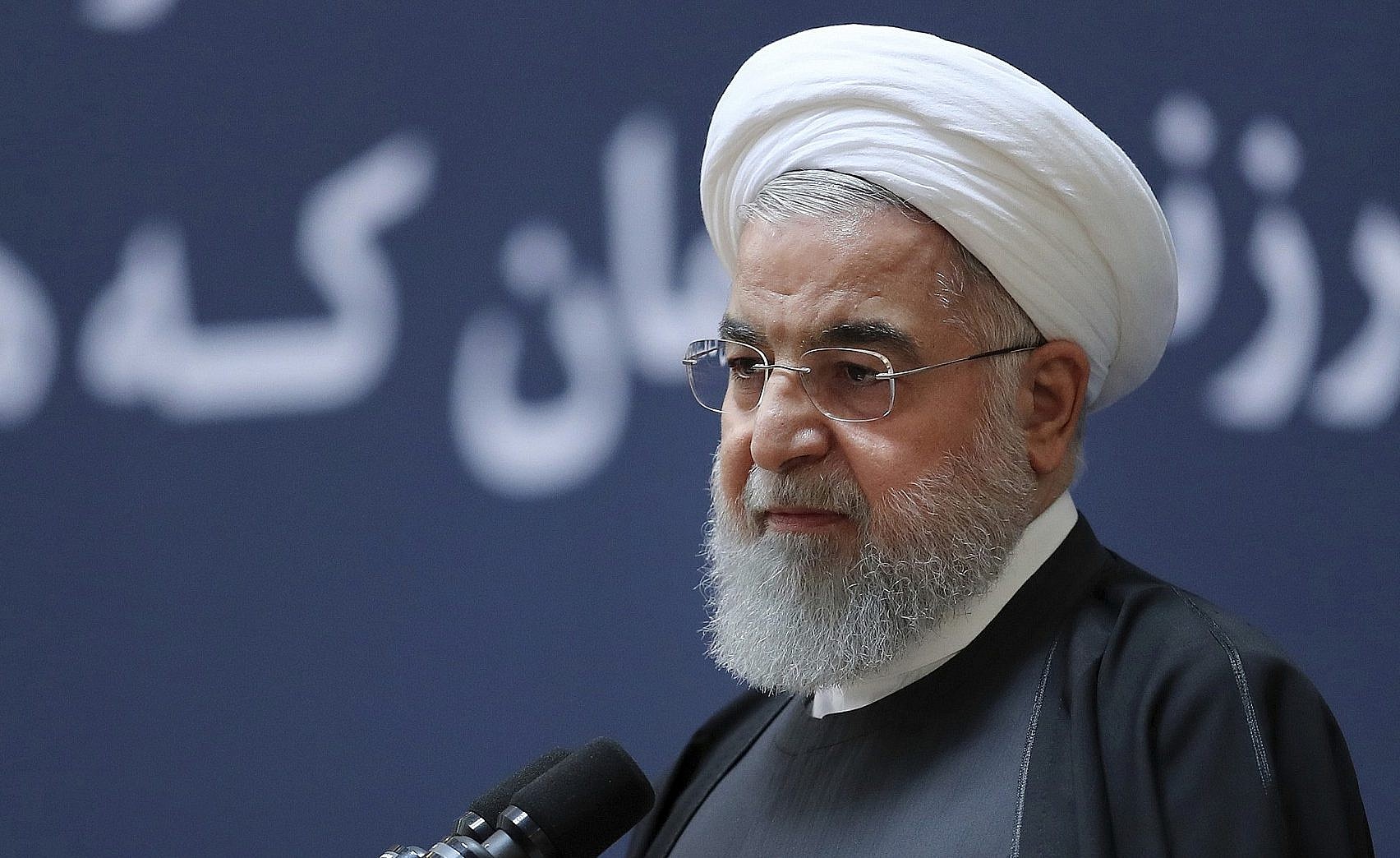
Iranian President Hassan Rouhani speaks in Tehran, Iran, January 10, 2019 (Iranian Presidency Office via AP)

Iranian President Hassan Rouhani speaks in Tehran, Iran, January 10, 2019 (Iranian Presidency Office via AP)

Iran currently is confronting “the greatest pressure and economic sanctions of the past 40 years,” the Islamic Republic’s President Hassan Rouhani said Wednesday, addressing crippling sanctions renewed by Washington last year.

In comments published on his official website, Rouhani stressed that “our problems are mainly due to pressure by the US and its followers, and the government and the Islamic system should not be blamed.”

He vowed that the nation would “endure” outside strong-arming efforts. “The US administration will definitely fail in its latest move against the Iranian nation,” he said. “Nobody can harm us as long as we follow the Supreme Leader.”

Rouhani spoke at a ceremony honoring the Islamic Republic’s first supreme leader, Ayatollah Ruhollah Khomeini, as the country prepares to mark 40 years since the February 1979 Islamic revolution.

In May of last year US President Donald Trump decided to abandon the 2015 nuclear deal and reimpose sanctions on Tehran. The move touched off a record drop in Iran’s currency, prompted an exodus of foreign firms, plunged the nation into a recession and renewed its economic isolation.

US President Donald Trump speaks about the partial government shutdown, immigration and border security in the Diplomatic Reception Room of the White House on January 19, 2019. (AP Photo/Alex Brandon)

Trump called the accord “the worst deal ever” and said it had given the US nothing. The administration bashed the agreement for its sunset clauses that allow certain restrictions on Iran’s nuclear program to expire, its failure to prevent Iranian ballistic missile testing and its continued support of regional terror groups.

Rouhani on Wednesday said “Iran’s highest political pride in [recent] decades and centuries was Iran’s powerful talks with the six major powers, and the victories that were handed over to Iran in various areas in the talks. It will never be lost.”

He asserted that the international community was on Tehran’s side, saying “the entire world is condemning the US conspiracies against the Iranian nation and support Iran in this regard.”

The European Union has condemned Washington’s renewal of sanctions and is working on a legal entity through which businesses could trade with Iran and avoid US sanctions.

However, there have been some indications that European powers are also gravitating toward the US position. Iran’s recent work on launching satellites into space has faced criticism from the West as a possible effort to advance its missile program, since the rockets used in the two programs depend on very similar technology.

The EU has commended Iran for sticking to its commitments under the nuclear deal, but has growing concerns about Tehran’s ballistic missile program, as well as its human rights record, its interference in Middle East conflicts and recent attempted attacks against opposition groups in Europe.

Illustrative: A group of protesters chant slogans at the old grand bazaar in Tehran, Iran, June 25, 2018. (Iranian Labor News Agency via AP)

Earlier this month French Foreign Minister Jean-Yves Le Drian said Paris was ready to impose new sanctions on Tehran if talks on its missile program and its regional influence fail to make progress.

Iran’s economic crisis has led to sporadic protests against the government in the past year.

The protests have seen unusual scenes of demonstrators chanting against continued Iranian spending of billions of dollars on regional proxy wars and support for terrorist groups, which many say has meant less investment in the struggling economy at home.

In recent years, Iran has provided financial aid to Palestinian terror groups Hamas and Islamic Jihad, Lebanon’s Hezbollah, Yemen’s Houthi rebels, and Shiite militias in Iraq. Since the start of the Syrian civil war in 2011, Tehran has poured a reported $6 billion into propping up president Bashar Assad’s government.

Rouhani has blamed the spontaneous demonstrations on “foreign media propaganda,” and has accused the US of waging “an economic war” against Tehran.


US Mideast envoy denounces Palestinian support for Venezuela’s Maduro 

Posted January 30, 2019 by Joseph Wouk
Categories: Uncategorized

Source: US Mideast envoy denounces Palestinian support for Venezuela’s Maduro – Israel Hayom


Russian deputy FM reiterates commitment to Israel’s security 

Posted January 30, 2019 by Joseph Wouk
Categories: Uncategorized

Source: Russian deputy FM reiterates commitment to Israel’s security – Israel Hayom


The fight against Iran must not stop 

Posted January 30, 2019 by Joseph Wouk
Categories: Uncategorized

Source: The fight against Iran must not stop – Israel Hayom

Moshik Kovarsky

From the day Prime Minister Benjamin Netanyahu began his second term in office nearly a decade ago, the brunt of his strategic focus has been on Iran. Today we can tentatively say that even if this mission hasn’t been completed, it can be in the not-so-distant future if those tasked with carrying it out aren’t sidetracked.

Beyond the obvious danger posed by Iran – developing nuclear weapons and threatening to annihilate Israel – Netanyahu realized that even Israel’s tactical enemies, Hezbollah and Hamas, are driven, directed and strengthened by Iran.

In the mythological tale of Hydra, the multi-headed monster, Hercules understood that severing one head would only lead to others growing. So he seared the neck after chopping off each head, and thus fell the monster. Netanyahu also understands that undermining Iran, to the point of toppling its hostile regime, is the only way to truly defeat its local proxies.

Meanwhile, global and regional developments – such as the Arab spring, which weakened Israel’s traditional enemies, or the rise of U.S. President Donald Trump, who views world geopolitics through the same prism as Netanyahu – have given the prime minister opportunities his predecessors never had.

Nevertheless, a wise leader knows how to leverage opportunities and simultaneously avoid obstacles – of which there have been plenty. We only need to recall the eight difficult years of the Obama presidency; the electoral pressures on western European countries caused by waves of immigration; and the (temporary) rise to power of the Muslim Brotherhood in Egypt and the Islamists in Turkey.

Netanyahu was among the few who understood as early as a decade ago that the economic front was where Iran would meet its demise. He pushed for sanctions against the ayatollah regime, using both his rhetorical talents and Israel’s magnificent capabilities in the field of intelligence gathering. Exposing Iran’s nuclear archive was derided by the opposition at the time, but made it easier for Trump to withdraw from the suicidal 2015 nuclear deal with Iran and start the current snowball rolling. The airstrikes in Syria and Operation Northern Shield to eliminate Hezbollah’s cross-border tunnels are also tactical victories that serve the strategic purpose – to foment internal chaos within Iran’s military and political system.

At the same time, Netanyahu must face challenges posed by Israeli public opinion. Beyond the legal nuisances the oppositin pursues night and day, he has to contend with criticism from the Right about terror from the Gaza Strip or the evacuation of the Bedouin village of Khan al-Ahmar. We would all like to see an aggressive approach on these matters, as well, but Netanyahu has to bide his time before implementing any long-term solutions on these fronts. If any of these issues stymie the pace of Israeli rapprochement with the large Arab countries – which serves the strategic fight against Iran – then it’s best to postpone them. It stands to reason that when Israel and the Arab world become viable economic partners, their appetite for opposing such actions will be diminished. Moreover, the Palestinian Authority’s expected collapse once PA President Mahmoud Abbas exits the stage could also open the door to a variety of possibilities.

We will probably see a number of significant developments as spring draws near: the exacerbation of Iran’s economic woes; parliamentary elections in Europe will likely see right-wing, pro-Israeli and anti-Iranian parties gain power; Israel’s continued rapprochement with Arab and Muslim countries. Not to mention that enough time remains for the Trump administration to help complete the task. This is a critical juncture for Israel’s most important endeavor, and pursuing it without pause is vital.

Moshik Kovarsky is a high-tech entrepreneur and is active in the field of entrepreneurial education.

Netanyahu holds talks with Russian officials on Syria ‘friction’

Posted January 30, 2019 by Joseph Wouk
Categories: Uncategorized

Source: Netanyahu holds talks with Russian officials on Syria ‘friction’ | The Times of Israel

Putin envoys in Jerusalem reiterate Moscow’s ‘commitment to the maintenance of Israel’s national security,’ Prime Minister’s Office says

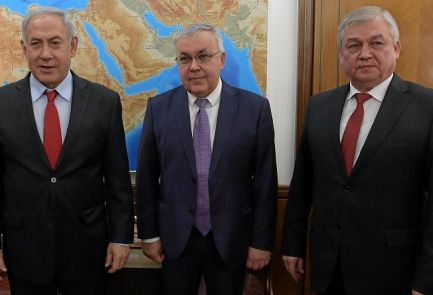
Prime Minister Benjamin Netanyahu (right)  holds talks centering on Iran and Syria with Russian President Vladimir Putin's special envoy for Syrian affairs, Alexander Lavrentiev (center) and Russian Deputy Foreign Minister Sergey Vershinin (left) at his office in Jerusalem, January 29, 2019. (Amos Ben-Gershom/GPO)

Prime Minister Benjamin Netanyahu (right) holds talks centering on Iran and Syria with Russian President Vladimir Putin’s special envoy for Syrian affairs, Alexander Lavrentiev (center) and Russian Deputy Foreign Minister Sergey Vershinin (left) at his office in Jerusalem, January 29, 2019. (Amos Ben-Gershom/GPO)

Prime Minister Benjamin Netanyahu held talks Tuesday with Russian officials, seeking to avoid “friction” amid an Israeli campaign of air strikes aimed at keeping Iran from entrenching itself militarily in Syria.

Russian special envoy for Syrian affairs Alexander Lavrentiev and Deputy Foreign Minister Sergey Vershinin met Netanyahu and top Israeli defense officials at the his office in Jerusalem, the Prime Minister’s Office said.

“Among the issues discussed were Iran and the situation in Syria, and strengthening the security coordination mechanism between the militaries in order to prevent friction,” the PMO stated. “The Russian representatives reiterated Russia’s commitment to the maintenance of Israel’s national security.”

Netanyahu was joined by National Security Adviser Meir Ben-Shabbat and Maj.-Gen. Aharon Haliva who heads the IDF’s Operations Directorate.

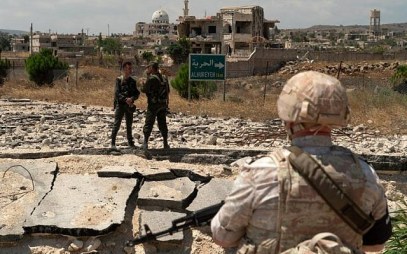
A member of the Russian military police and Syrian government forces patrol near the village al-Hamidia in the Syrian Golan Heights on August 14, 2018. (AFP/Andrey Borodulin)

The two Russian officials arrived in Israel on Monday and first met with Foreign Ministry officials.

Israel has carried out hundreds of air strikes in Syria in the past few years against Iranian and Hezbollah targets, and the Jewish state and Russia have set up a “de-confliction” hotline aimed at avoiding accidental clashes.

That mechanism was stretched when a Russian military aircraft was mistakenly shot down by Syrian air defenses after an Israeli raid in September.

Fifteen Russian soldiers were killed and the Russian army accused Israeli pilots of using Moscow’s plane as cover to evade Syrian gunfire, which Israel denied.

As part of its response, Russia announced new security measures to protect its military in Syria, including supplying Syria with an S-300 air defense system and jamming the radars of nearby warplanes.

Netanyahu has told Russian President Putin that Israel is determined to prevent Iran from entrenching militarily in Syria, according to his office.

Both Russia and the Islamic republic, Israel’s arch-enemy, are allies of Syrian President Bashar Assad and have helped his forces inflict numerous defeats on rebels and jihadists.

A former head of the Israeli Air Force on Monday said that only Russia, and not Israeli military might, can fully remove Iran from Syria.

“There is no military action that is going to get Iran out of Syria. Only a diplomatic effort can get Iran out of Syria, and this diplomatic effort has just one address. It’s called Russia,” said Maj. Gen. (res.) Amir Eshel.