Iran unveils new cruise missile on 40th anniversary of revolution

Posted February 2, 2019 by Joseph Wouk
Categories: Uncategorized

Source: Iran unveils new cruise missile on 40th anniversary of revolution | The Times of Israel

Defense minister showcases ‘Hoveyzeh,’ allegedly a high-precision weapon capable of carrying a large payload for up to 1,350 kilometers

Hoveizeh, Iran's new cruise missile, is seen during an exhibition in the capital Tehran on February 2, 2019.(Atta Kenare/AFP)

Hoveizeh, Iran’s new cruise missile, is seen during an exhibition in the capital Tehran on February 2, 2019.(Atta Kenare/AFP)

Iran on Saturday unveiled a new cruise missile amid events marking 40 years since the 1979 Islamic Revolution.

The missile, dubbed Hoveyzeh, was described as a high-precision weapon capable of flying at low altitudes and able to carry a significant payload. Iran’s Press TV reported it has a range of 1,350 kilometers (840 miles).

“The Hoveyzeh missile is the symbol of self-belief and an important defense achievement based on today’s technological progress in the world,” Iranian Defense Minister Amir Hatami said in Tehran.

It shows “no obstacle can hinder the Iranian nation’s determination and will in the defense field,” he said, noting statements by Iran’s Supreme Leader Ali Khamenei that the nation “will decisively respond to any kind of threat at the same level.”

View image on Twitter
Ovain Ali@AliiOvain

Iran has been known to exaggerate the capabilities of its weaponry, and there was no independent confirmation of Tehran’s claims.

The Ministry of Defense published a video purportedly showing the launch of the new cruise missile.

In the 37-second video on the ministry website, the launch was shown from different angles with the projectile finally hitting somewhere in the desert.

Embedded video

Tasnim News Agency

@Tasnimnews_EN

unveiled surface-to-surface cruise missile dubbed that is manufactured by Defense Ministry’s Aerospace Industries Organizationhttps://tn.ai/1937241 

Iran’s ballistic missiles program (cruise missiles are in a different category) has been met with mounting concern in the West. US Secretary of State Mike Pompeo recently accused Iran of testing a medium-range ballistic missile capable of “carrying multiple warheads,” which he said could strike “anywhere” in the Middle East and even parts of Europe.

The program was among the reasons cited by US President Donald Trump for leaving the 2015 nuclear deal last year and reimposing crippling sanctions.

The deputy commander of the Islamic Revolutionary Guard Corps said Thursday his country has developed a “strategic capacity” to destroy Israel. On Tuesday, Ali Shamkhani, the secretary of Iran’s National Security Council, warned that terror groups Hamas and Hezbollah were prepared to unleash an “inferno” on the Jewish State.

Speaking at a space tech conference, Shamkhani spoke of “hundreds of kilometers of tunnels dug underneath [Israelis’] feet, and the resistance forces in Gaza and Lebanon have missiles with pinpoint accuracy and are ready to respond to any foolish Israeli behavior with an inferno.”
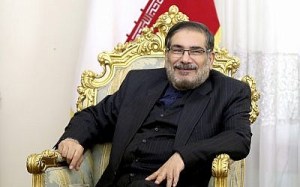
Secretary of Iran’s Supreme National Security Council Ali Shamkhani in Tehran, Iran, January 17, 2017. (Ebrahim Noroozi/AP)

The comments followed a series of reciprocal taunts by Israeli and Iranian leaders in recent weeks amid rising tensions on the Israeli-Syrian border between IDF and Iranian forces.

On Wednesday Iran announced that it is producing large amounts of yellowcake, a precursor to enriched uranium, and has shipped two batches of the material to a uranium conversion facility.

Ali Akbar Salehi, head of the Atomic Energy Organization of Iran, said the Islamic Republic was ready to increase its production of yellowcake to 300 tons per year over the next five to six years, and had shipped 30 tons of yellowcake from the Shahid Rezaeinzhad Industrial Complex in the central province of Yazd to a conversion facility in Isfahan province, according to Iranian media reports.

Salehi said that the new facility was at full capacity, that Iran was extracting uranium from a mine in Yazd province and other still-unidentified mines, and had discovered large amounts of the material in the country through aerial surveys.

Yellowcake is a uranium concentrate in powder form and an early step in uranium processing. It is produced by mining uranium ore from rocks and separating the uranium from the rocks by bathing them in acid. The yellowcake can then be converted, enriched to raise its purity, and then used for weapons or energy production.

US President Donald Trump pulled out of the nuclear deal in May last year but the other signatories — Britain, France, Germany, Russia, China and Iran — have all agreed to try to keep the pact alive on their own. Trump insists the original agreement did not go far enough in curbing Iran’s nuclear weapons ambitions and wants to renegotiate the JCPOA with stricter terms. In the meantime Washington has imposed heavy sanctions on Iran that could weaken the ability of the remaining parties to maintain the deal.

The Associated Press contributed to this report.


Hizballah’s takeover of Lebanese government bolsters Iran in Syria against US and Israel – DEBKAfile

Posted February 2, 2019 by Joseph Wouk
Categories: Uncategorized

Source: Hizballah’s takeover of Lebanese government bolsters Iran in Syria against US and Israel – DEBKAfile

The cabinet Said Hariri has formed in Beirut after a nine-month stalemate is a façade. The most powerful portfolios have gone to pro-Iranian Hizballah and its allies.

In presenting his lineup on Thursday, Jan. 31, the Sunni prime minister apologized to the Lebanon people for the long delay in forming a government. He omitted to mention that the World Bank had threatened to transfer to Jordan the $4bn loan allocated last year to Lebanon unless a government was set up in Beirut.

He said only, “All the problems are known and the cause of the corruption and waste and administrative deficiency are also known,” and went on to promise “bold reforms” which remained unspecified. Neither did he refer to the breakdown of public services across the country, including medical care, water and power supplies and the garbage pilling up in the streets. But most glaringly, Prime Minister Hariri’s message to the nation failed to spell out who really ruled the country and into whose hands it had fallen.

In the wake of vicious civil wars, Lebanon’s Shiites, Sunnis and Christian Maronites ruled the country in uneasy equilibrium. However, in the last couple of years, four men were able to grab the centers of power, dominated by Hizballah’ secretary general Hassan Nasrallah. His partners are President Michel Aoun, a Christian who is loyal to Tehran, Damascus and Nasrallah; Foreign Minister Gebrane Bassile, the president’s son-in-law, who is Nasrallah’s obedient pawn, especially on the international stage; and commander of the Lebanese national army Gen. Joseph Aoun, whose every decision is governed by the president and the Hizballah leader. The prime minister did not admit that he is in the same boat.

Israel’s Northern Shield operation for destroying Hizballah’s cross-border tunnels from Lebanon into Israel was one element in a masterplan devised by Prime Minister Binyamin Netanyahu with Washington to break up this formidable foursome. He presented the plan to US Secretary of State Mike Pompeo when they met in Brussels on Nov. 3.

He explained that catching Hizballah red-handed for plotting an invasion of Israel was to have brought the Lebanese president and army chief under international pressure and, combined with Israel’s military operation, forced forced them to break ranks with Hizballah and deal with its dangerous tunnel project. Netanyahu further explained to Pompeo, that Hizballah’s weakened state after the destruction of its tunnels and legitimacy at home and abroad would substantially bolster the US-Israeli campaign for driving its master, Iran, out of Syria and the strengthen the impact of US sanctions on the Islamic regime in Tehran.

Pompeo was convinced and told the Israeli prime minister to go ahead with Operation Northern Shield with Washington’s support. It was launched the following day, Nov. 3.

But then, on December 19, when the operation was well underway, President Donald Trump bowled everyone over on Dec. 19 by his decision to pull US forces out of Syria. As a result, the White House, with the support of Defense Secretary at the time Jim Mattis, ordered Pompeo to hold off the planned economic and diplomatic measures for forcing the Lebanese president and army chief to take action against Hizballah and its tunnels. Trump decided against antagonizing the Lebanese army on the ground that it could be useful in smashing Islamic State remnants still present in Syrian regions bordering on Lebanon.

The upshot of this episode was that Israel went against the tunnels without US backing, while Washington forfeited a major lever against Iran and Hizballah in Syria and Lebanon.

All that was left to Washington after this episode was for US Assistant Secretary for Terrorist Financing Marshal Billingslea to warn Hizballah on Jan. 31, after a two-day visit to Beirut, not to use the new government as a cash cow for terrorist operations. This warning, however, will only make Hassan Nasrallah a bit more careful. He will make sure to put a dense smoke screen in place to camouflage the moneys flowing from the ministerial portfolios, two thirds of which are under his and his allies’ control, in support of his nefarious activities.

When he dictated the lineup, Nasrallah grabbed the following portfolios: Treasury for Ali Hassan Khalil, member of the Shiite Amal movement and a trusted Iranian friend; Defense for Elias Bou Saab, a close crony of President Aoun and the Hizballah leader; Health, which commands large sums and grants from foreign sources, to Dr. Jamil Jabak; and Interior to Raya al-Hassan, the first woman to serve in a Lebanese government. Although a member of Prime Minister Hariri’s party, she is close to Hizballah.

With Nasrallah in charge of Lebanon, Iran’s influence in Beirut is safely assured and provides Tehran with strong backup for deepening its roots in Syria in the face of Israeli and US efforts at removal.


US warns Hezbollah not to funnel Lebanese ministry’s money to terror

Posted February 1, 2019 by Joseph Wouk
Categories: Uncategorized

Source: US warns Hezbollah not to funnel Lebanese ministry’s money to terror | The Times of Israel

In newly formed government, terror group gets control of health ministry, which has one of the country’s largest budgets

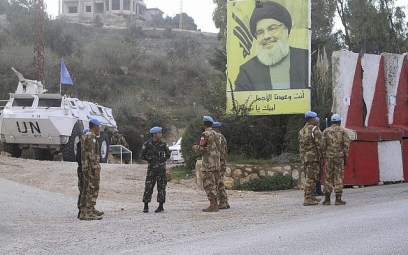
Indonesian UN peacekeepers stand in front a poster of Hezbollah leader Sheikh Hassan Nasrallah, as they patrol the Lebanese side of the Lebanese-Israeli border in the southern village of Kfar Kila, Lebanon, Tuesday, December 4, 2018. (AP/Mohammed Zaatari)

Indonesian UN peacekeepers stand in front a poster of Hezbollah leader Sheikh Hassan Nasrallah, as they patrol the Lebanese side of the Lebanese-Israeli border in the southern village of Kfar Kila, Lebanon, Tuesday, December 4, 2018. (AP/Mohammed Zaatari)

BEIRUT (AP) — A senior US official warned Lebanon’s Hezbollah not to exploit its newly gained clout in the new Lebanese cabinet and channel funds from a ministry it controls to institutions affiliated with the Shiite militant group.

The remarks by Marshall Billingslea, the US Treasury’s assistant secretary on terror financing, came as Lebanese political factions agreed late Thursday to form a new government, breaking a nine-month deadlock that had deepened Lebanon’s economic woes.

The warning underscores the delicate balance that Prime Minister Saad Hariri must strike in a national unity government in which the Iran-backed group has three seats, including the health ministry, which has one of the country’s largest budgets.

Hariri, who hails from the country’s leading Sunni political party, reportedly had cautioned against Hezbollah holding the health ministry amid concerns his new government could face Western sanctions. Hezbollah made significant gains at the expense of Hariri’s party in Parliament elections in May, further contributing to the delay in forming a government as the powerful group lobbied for a bigger share in the cabinet.

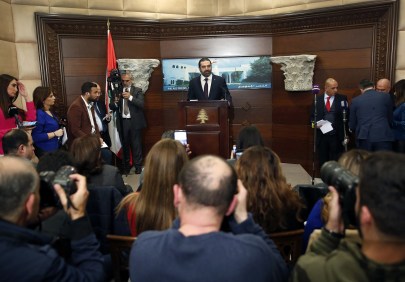
Newly-assigned Lebanese Prime Minister Saad Hariri, center, speaks to journalists at the presidential palace in Baabda, east of Beirut, Lebanon, Thursday, Jan. 31, 2019. Lebanese political factions have agreed on the formation of a new government, breaking a nine-month deadlock that only deepened the country’ economic woes. (AP Photo/Hussein Malla)

Billingslea spoke to local journalists at the US Embassy in Beirut at the end of a two-day visit during which he met with Lebanon’s president, prime minister, central bank governor and other officials.

“If we see that Hezbollah exploits, and they will exploit whatever ministry they are given, to funnel money and other terrorist agendas, then we have significant problems with that,” Billingslea was quoted as saying by the English-language Daily Star newspaper on Friday. He declined to elaborate what the US Treasury would do in that case.

The United States has labelled Hezbollah a terrorist organization.

The new health minister, Jamil Jabbak, is not a member of Hezbollah but is believed to be close to the group’s leader, Hassan Nasrallah, and was his personal physician at one point.

The 30-seat government has seen an increase in the number of ministries affiliated with Hezbollah, which is under tightening sanctions from the US

The group has been affected recently by the US sanctions as well as those imposed on its main baker Iran.

“We applied sanctions on Iran because they refuse to stop their terrorism and refuse to stop their missile launchers and funneling of their activities abroad,” the Daily Star also quoted Billingslea as saying. “And as a result of that, we are actually seeing that Hezbollah here is not getting the paychecks they once enjoyed from the Iranians.”

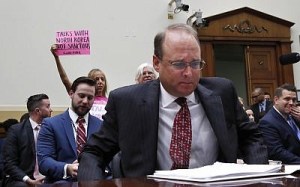
Assistant Secretary of the Treasury for Terrorism and Financial Intelligence Marshall Billingslea, takes his seat to testify at a House Foreign Affairs Committee hearing on North Korea sanctions, Tuesday, Sept. 12, 2017, on Capitol Hill in Washington. (AP Photo/Jacquelyn Martin)

Hariri and Hezbollah are political rivals. Hezbollah threw its weight behind Syrian President Bashar Assad’s forces in the civil war that broke out in the neighboring country in 2011, sending its militiamen to fight alongside Syrian government troops, while Hariri and his political allies have criticized the group’s intervention, supporting at times the opposition fighting against Assad.

The new cabinet was agreed on as Lebanon is dealing with soaring public debt of $84 billion, or 150 percent of the gross domestic product, and unemployment believed to be around 36%. Lebanon’s infrastructure is also reeling under the weight of a growing number of Syrian refugees: more than 1 million in a country of just over 4 million.

The government is expected to enact reforms that would allow it to unlock around $11 billion in soft loans and grants pledged by international donors at a conference in Paris last year.

Elisa Parisi-Capone, vice president and senior analyst at Moody’s Investors Service, said it expects the new government to implement measures to receive the investment package committed to by international donors last year.

“However, in the context of very weak growth, fiscal consolidation will remain very challenging for the government,” it said.


Israel’s Navy Drills in Case of Hezbollah Attack on Oil Rig 

Posted February 1, 2019 by Joseph Wouk
Categories: Uncategorized


David Petraeus: Hezbollah should not ‘forget’ Israel’s massive firepower 

Posted February 1, 2019 by Joseph Wouk
Categories: Uncategorized

Source: David Petraeus: Hezbollah should not ‘forget’ Israel’s massive firepower | JNS.org

Amid ongoing threats from Iran, Hezbollah and Hamas, David Petraeus, retired U.S. Army General and former CIA director, said: “I think Israel has a very substantial deterrent posture.”
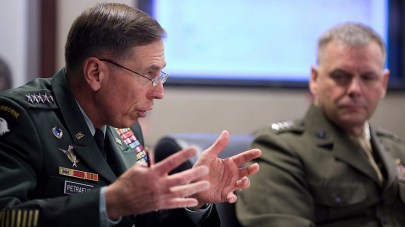
Retired General David Petraeus, left, gestures while talking with President Barack Obama meets and the national security team on Afghanistan and Pakistan, during a meeting in the Situation Room of the White House, May 6, 2010. Credit: Official White House Photo by Pete Souza.

Retired General David Petraeus, left, gestures while talking with President Barack Obama meets and the national security team on Afghanistan and Pakistan, during a meeting in the Situation Room of the White House, May 6, 2010. Credit: Official White House Photo by Pete Souza.

 With Hezbollah pointing thousands of missiles at Israel and digging tunnels under the border, and with Iran threatening every day to annihilate the Jewish state while Hamas maintains the capability to attack Israel again with rockets and mortars, one would hope that there are experts worth their salt losing sleep over these threats so that civilians can sleep soundly. The Institute for National Security Studies (INSS) conference in Tel Aviv proved that brilliant minds are indeed at work.

David Petraeus, retired U.S. Army General and former CIA director who has been known to say, “Deterrence is founded on an adversary’s perception of your capabilities and your will,” agreed that Israel has both the capabilities and the will to defend itself.

Discussing Israel’s deterrence in facing the aforementioned threats, he told JNS, “I think Israel has a very substantial deterrent posture, and it is based on a number of different factors. One is, just don’t forget the sheer punishment that was meted out to Lebanon when you had the last war [the 2006 Second Lebanon War]. I think we have reassessed in more recent years how devastating the damage done to Southern Lebanon was during that war, and I don’t believe that Hezbollah, much less anyone else in Lebanon, would want to see a replay of that particular experience. They’re still repairing infrastructure that was damaged, and I think Israel has been very clear, rightly, about what would happen if this took place once again.”

“Second,” Petraeus continued, “Israel has dramatically improved the capabilities of its comprehensive missile- and rocket-defense system.” Petraeus pointed to the fact that the Jewish state has improved its defensive capabilities such as Iron Dome, David’s sling, the Patriot batteries and more. “There is a very increasingly sophisticated array of defensive and early warning systems that I think would do a very impressive job against a certain level of threat, after which, of course, it would again devastate whoever it was that sought to penetrate that particular system.”

“I think the deterrent posture is very strong. … The advances with Israel’s capabilities to respond—whether it is by some means of indirect fire, missiles, rockets, artillery or certainly with the Israeli air force, which is now flying the most sophisticated aircraft in the world, the F-35”—all add to this posture, he said.

Former Israeli Air Force general, Israel Defense Forces military attaché to Washington and head of the IDF Military Intelligence Directorate Amos Yadlin (right) seen with former director of the CIA David Petraeus at the eighth international INSS conference at the Eretz Israel Museum in Tel Aviv on Feb. 16, 2015. Photo by Tomer Neuberg/Flash90.

Asked about Israel’s next prospective major war and how it can properly fight without harming or killing civilians, Petraeus responded, “As someone who has been privileged to command forces that have been in that situation, what you do is exactly what I am sure Israel would do in that circumstance: Do everything it can through the use of precision munitions, very sophisticated intelligence, surveillance and reconnaissance assets to identify targets, what’s there, and then obviously to observe the rules of war, proportionality and so forth.”

“The tragedy of warfare is, though, that innocent civilians do sometimes get caught in a crossfire or in a blasting radius,” he acknowledged. “Those who command such forces are keenly aware of that, and certainly do all that they can to try to prevent or absolutely minimize any loss or injury to innocent civilians.”

‘We should have our red lines’

Amos Yadlin, executive director of INSS, told JNS, “We have very strong deterrence vis-à-vis all of our enemies. Because, as you said, all of them can pull the trigger, and as we speak now, can launch thousands of missiles toward Tel Aviv. But they are not doing it. And this is exactly deterrence. Deterrence is that your enemy, who has the capability to pull the trigger, after doing the calculation the cost-benefit analysis of what will happen, is not doing it.”

“However,” he continued, “after saying that, there are two issues here. One is that it is a calculation in the head of a leader and leaders, from time to time, [to] know how to make mistakes.”

He pointed to his experiences during his public service as former general in the Israel Air Force, as well as head of the Military Intelligence Directorate, alongside three prime ministers and three defense ministers as an example of the mistakes he has seen. Yadlin also said, “Looking at all the Arab and Persian leaders, they know how to make mistakes. So this is one concern.”

“The second concern,” Yadlin said, “is under-the-threshold kind of activities that they [Israel’s enemies] know will not induce overwhelming Israeli action. Take the [arson] balloons in Gaza; they try to find an area that is low enough in the activity not to go to a full-scale war.”

As another example, he pointed to defensive and preemptive action that Israel is taking in Syria against Iran, saying that he believes it “will not take us to a full-scale war.”

Yadlin warned that it is always possible that the two sides may miss what that the threshold actually is. “The bottom line,” he said, is to have “very strong deterrence,” but remain aware that the stakes are fragile, the dangers are real, and that any side is liable to make a mistake.

Asked about Iran, Yadlin told JNS “the objective of getting rid of the last Iranian from Syria is not realistic. We should have our red lines, the concerns we have with the presence of Iran in Syria.”

Yadlin said Israel has three red lines. “One is the Golan Heights. Don’t let Iran build another Hezbollah, another terror proxy organization on our Golan border. The second has to do with the quantity of Shi’ite militia from all over the Islamic world that they are bringing to Syria. … All these people should not be in Syria. The third red line—and this is the most serious—is the advanced weapons that they are bringing to Syria to use against Israel. The precise missiles, the air defense, airports, navy bases—these are the red lines. This is what you have to prevent.”

Yadlin said Israel should and must deal with the real threats, as “the capability is there,” he warned, for a real conflagration.

The question is: Do Israel’s enemies have the need, will and wish to challenge it?


Trump shouldn’t pull out of Syria right now – Our president first needs a tougher anti-Iran strategy | Fox News

Posted February 1, 2019 by Joseph Wouk
Categories: Uncategorized

Source: Trump shouldn’t pull out of Syria right now – Our president first needs a tougher anti-Iran strategy | Fox News

The 68-23 vote by the Senate Thursday for an amendment opposing the withdrawal American troops from Syria and Afghanistan demonstrates the Republican-controlled chamber doesn’t support President Trump’s desire to pull U.S. troops out of both nations at this time. The amendment is to a bill that has yet to be voted on in the Senate.

President Trump tweeted in December that the approximately 2,000 American troops in Syria would be withdrawn soon, writing: “We have defeated ISIS in Syria, my only reason for being there during the Trump Presidency.”

Defense Secretary James Mattis soon resigned soon afterward. And President Trump’s top intelligence officials testified before Congress this week that ISIS – despite suffering big losses in territory and fighters – has not been defeated and remains a threat.

Senate Majority Leader Mitch McConnell, R-Ky., normally a staunch ally of the president, said Thursday that “ISIS and Al Qaeda have yet to be defeated” in Syria and Afghanistan.

SENATE VOTES TO HALT DEBATE ON AMENDMENT OPPOSING SPEEDY WITHDRAWAL FROM SYRIA, AFGHANISTAN

McConnell backed the Senate amendment, which stated that “withdrawal of the United States forces from the ongoing fight against these groups (ISIS and Al Qaeda) … could allow terrorists to regroup, destabilize critical regions, and create vacuums that could be filled by Iran or Russia, to the detriment of United States interests and those of our allies.”

However well-deserved the consternation over President Trump’s decision to withdraw U.S. troops from Syria, the subsequent debate has been overly focused on means, not ends. Whether or not there are U.S. troops in Syria is less important than the question of what should be U.S. objectives in Syria and how to achieve those objectives.

The United States should join Israel in striking Iranian targets, or at least back Israel’s freedom of action in Syria against Russian resistance.

The Trump administration has recently made clear its commitment to – as Secretary of State Mike Pompeo recently put it in Cairo – “the complete dismantling of ISIS” and to “expel every last Iranian boot” from Syria.

However, Pompeo suggested limited tools to achieve this goal, saying “the United States will use diplomacy and work with our partners.”

President Trump deserves much credit for the actions he has taken against Iran – withdrawing from the deeply flawed nuclear agreement with the Islamic Republic and imposing economic sanctions. But he can claim neither all the credit nor success. Iranian domestic turmoil began before Trump imposed sanctions.

And – despite President Trump’s recent statements to the contrary – economic and domestic pressure is not forcing Iran to retrench. Instead, Tehran continues to entrench itself in Syria. The regime of Syrian President Bashar Assad – backed by Iran and Russia – continues to expand its control, and test-fired a nuclear-capable ballistic missile in December.

What is needed – and what a U.S. military presence is no substitute for – is a strategy that defeats ISIS, blocks Turkish expansion into Syria, and rolls back Iran. The right combination of an aggressive posture, airpower, and support for allies could still allow the United States to achieve these objectives, even without troops in Syria.

Certainly, the 2,000-plus U.S. troops in Syria based in key strategic locations – including in al-Tanf, the Syrian northeast and the nation’s oil regions – have been critical. They have helped deliver a crippling blow to ISIS, blocked Turkish expansion and a conflict with Syrian Kurds, served as leverage with Russia, and impeded Iranian expansion.

American troops can’t stay indefinitely, but their continued deployment in Syria until ISIS is defeated and Syria’s political makeup is resolved is vital.

Even without U.S. troops, however, the campaign against ISIS can continue to be waged with Syrian Kurdish forces on the ground and U.S. airpower.

Making sure that those local forces remain committed to fighting ISIS – and are neither co-opted by Iran nor massacred by Turkey – will require the U.S. to provide the Kurds with security guarantees, aerial support and protection, and assistance with rebuilding in both Syria and Iraq. This will also serve to check Turkish expansion.

When it comes to rolling back Iran, what is most critically needed is for the United States to get over its fear of Iran.

U.S. forces in Syria have not actively blocked Iranian activity there. The United States has apparently avoided this mission, partly out of fear of reprisal against U.S. forces in Iraq from Iranian-backed Shiite militias.

Israel has not feared a conflict with Iran, and neither should America. There are no Israeli boots on the ground in Syria, but that has not impeded Israel from launching hundreds of effective attacks on Iranian targets into the country, despite rising Russian criticism.

Meanwhile, Washington’s aversion to conflict with Tehran has only emboldened Iran, Russia and Turkey – all three of which fear a clash more than America does. It is time for a more aggressive U.S. stance to curb these countries’ regional aggression.

The United States should join Israel in striking Iranian targets, or at least back Israel’s freedom of action in Syria against Russian resistance. U.S. forces in Iraq, which Trump is maintaining, could help block Iranian arms shipments to Syria and Lebanon that pass through Iraq, perhaps even arresting Iranian commanders.

The U.S. Navy should interdict Iranian sea-based shipments to Yemini Houthis, which is the latter’s primary weapons source in the Yemini civil war.

At a minimum, the United States should actively support partners that are willing to help us take on Iran. As Secretary Pompeo said in Egypt, “we’re looking to our partners to do more, and in this effort we will do so going forward together.”

For Israel, the United States should fast-track already agreed upon security assistance, so that Israel can acquire more military assets more quickly.

In particular, Israel might benefit from air-attack capabilities, air refueling tankers, precision munitions, and unmanned aerial vehicles. The United States must also update prepositioned weapons in Israel that the latter could access in emergency, such as a conflict with Iran and its proxy Hezbollah, the prospect of which is growing.

Further, America should elevate Israel’s status to that of Australia so that it can share with the Jewish state more intelligence and advanced weapons and technology.

It would be best for the Trump administration to suspend withdrawal of troops from Syria. But is more important for America to pursue an effective strategy of defeating ISIS, blocking Turkish aggression, and rolling back Iranian expansion.

Until such a plan is unveiled, critics will continue to have reason to equate a tactical withdrawal with a strategic retreat.

Michael Makovsky is president and CEO of the Jewish Institute for National Security of America and a former Pentagon official.  


Odd Topic:  U.S. on track to suspend nuclear treaty with Russia 

Posted February 1, 2019 by Joseph Wouk
Categories: Uncategorized

Source: U.S. on track to suspend nuclear treaty with Russia – International news – Jerusalem Post

Washington announces suspension of compliance with Intermediate-range Nuclear Forces (INF) Treaty with Russia, threatens total withdrawal if Russia does not end alleged violation of treaty.

BY REUTERS, JERUSALEM POST STAFF
 FEBRUARY 1, 2019 16:07
Mike Pompeo

WASHINGTON – The United States is suspending its compliance with the Intermediate-range Nuclear Forces (INF) Treaty with Russia on Saturday and will withdraw from the landmark 1987 arms control accord in six months if Moscow does not end its alleged violation of the pact, U.S. Secretary of State Mike Pomp said on Friday.

Russia denies violating the treaty, which bans either side from stationing short- and intermediate-range, land-based missiles in Europe.

The INF Treaty bans either side from stationing short- and intermediate-range, land-based missiles in Europe, the officials said.

NATO allies “fully support” the United States’ pending withdrawal notice from the INF nuclear missile pact over Russia’s actions, a statement by the alliance said.
“The United States is taking this action in response to the significant risks to Euro-Atlantic security posed by Russia’s covert testing, production, and fielding of 9M729 ground-launched cruise missile systems,” it said.
“Allies fully support this action.”
The United States alleges that a new Russian cruise missile violates the pact. The missile, the Novator 9M729, is known as the SSC-8 by the North Atlantic Treaty Organization (NATO).
Russia denies the allegation, saying the missile’s range puts it outside the treaty, and has accused the United States of inventing a false pretext to exit a treaty Washington wants to leave anyway so it can develop new missiles. Russia has also rejected a U.S. demand to destroy the new missile.
U.S. official said the U.S. action would be “reversible” if Russia came back into compliance during the six-month U.S. suspension. “Then the U.S. would unsuspend,” the official said.
The dispute is aggravating the worst U.S.-Russia frictions since the Cold War ended in 1991. Some experts believe the treaty’s collapse could undermine other arms control agreements and speed an erosion of the global system designed to block the spread of nuclear arms.
U.S. Under Secretary of State for Arms Control and International Security Andrea Thompson on Thursday held last-ditch talks with Russian Deputy Foreign Minister Sergei Ryabkov in Beijing ahead of the expiration on Saturday of a U.S. 60-day deadline for Moscow to return to compliance with the treaty.
Thompson and Ryabkov said afterwards that the two countries had failed to bridge their differences. They met on the sidelines of a meeting of the U.N. Security Council’s five permanent members – the United States, Russia, China, France and Britain – all nuclear powers.
European officials are concerned about the treaty’s possible collapse, fearful that Europe could again become an arena for nuclear-armed, intermediate-range missile buildups by the United States and Russia.
In an interview, Thompson said that suspension of U.S. obligations would allow the U.S. military to immediately begin developing its own longer-range missiles if it chose to do so, raising the prospect they could be deployed in Europe.
Ryabkov said Moscow would continue working toward an agreement but accused Washington of ignoring Russian complaints about U.S. missiles and of adopting what he called a destructive position.
“The United States imposed a 60-day period during which we had to fulfill their ultimatum,” the Sputnik news agency quoted Ryabkov as saying after talks with Thompson. “I conclude that the United States was not expecting any decision and all this was a game made to cover their domestic decision to withdraw from the INF Treaty.”
Daryl Kimball, executive director of the Arms Control Association, a Washington think tank, said he sees little chance the treaty can be saved.
“Neither side is showing the flexibility necessary to arrive with an agreement that brings Russia into compliance,” he said. “So I think it’s highly unlikely that we will see an 11th hour diplomatic miracle. “Both sides at this point appear more interested in winning the blame game than taking the steps necessary to save the treaty,” he added.


Iran welcomes EU trade mechanism meant to skirt sanctions as ‘first step’

Posted February 1, 2019 by Joseph Wouk
Categories: Uncategorized

Source: Iran welcomes EU trade mechanism meant to skirt sanctions as ‘first step’ | The Times of Israel

( The originators of “the West” have become the enemies of the West. – JW )

Iranian deputy FM calls on Europeans to honor commitments made to Tehran under deal meant to curb its nuclear program

Iran's Deputy Foreign Minister Abbas Araghchi, who is also a senior nuclear negotiator, speaks with media in his press conference in Tehran, Iran, on January 15, 2017. (AP Photo/Vahid Salemi)

Iran’s Deputy Foreign Minister Abbas Araghchi, who is also a senior nuclear negotiator, speaks with media in his press conference in Tehran, Iran, on January 15, 2017. (AP Photo/Vahid Salemi)

Tehran on Thursday cautiously welcomed as a “first step” the expected launch of an EU trade entity aimed at saving Iran’s nuclear deal by bypassing US sanctions.

The special payment mechanism “is the first step within the set of commitments the Europeans have made to Iran, which I hope will be fully implemented and not be incomplete,” said deputy foreign minister Abbas Araghchi, according to state news agency IRNA.

The formal announcement of the new payment vehicle is expected to be made on Thursday afternoon by the German, French and British foreign ministers in the Romanian capital, Bucharest. The three countries are the European signatories to the landmark deal that curbed Tehran’s nuclear ambitions in return for sanctions relief.

The entity, registered in France with German governance and finance from all three countries, will allow Iran to trade with EU companies despite Washington reimposing sanctions after US President Donald Trump pulled out of the 2015 accord.

US officials said they were following the situation but dismissed the idea that the new entity would have any impact on efforts to exert economic pressure on Tehran.

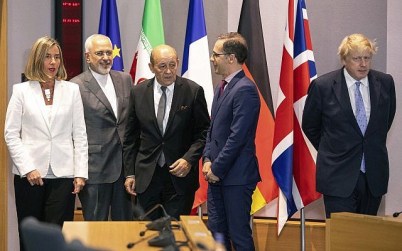
From left, European Union foreign policy chief Federica Mogherini, Iranian Foreign Minister Javad Zarif, French Foreign Minister Jean-Yves Le Drian, German Foreign Minister Heiko Maas and then British Foreign Secretary Boris Johnson at a meeting of the foreign ministers in Brussels, on May 15, 2018. (AP Photo/Olivier Matthys, Pool)

While the new institution, called INSTEX — short for Instrument in Support of Trade Exchanges — is a project of the three governments, it will receive the formal endorsement of all 28 EU members.

The company was registered in Paris on Tuesday with 3,000 euros capital and a supervisory board with members from France and Germany, and chaired by a Briton.

EU diplomatic chief Federica Mogherini, who has led the bloc’s efforts to save the Iran nuclear deal, said she welcomed the creation of INSTEX.

“This step… the establishment of the special purpose vehicle, is I believe the mechanism that will allow legitimate trade with Iran to continue as foreseen in the nuclear agreement. So full support from our side,” she told reporters.

Transatlantic discord

Washington has warned the EU against trying to sidestep its sanctions on Tehran, while the Europeans — along with the deal’s other signatories Russia and China — say Iran has not broken its side of the nuclear accord and should be allowed to trade.

Joseph Giordono-Scholz, spokesman for the US embassy in Berlin, said the United States was “closely following” reports on INSTEX but said it would not weaken its campaign against Tehran.

“As the President has made clear, entities that continue to engage in sanctionable activity involving Iran risk severe consequences that could include losing access to the US financial system and the ability to do business with the United States or US companies,” he said.

“We do not expect the SPV will in any way impact our maximum economic pressure campaign.”

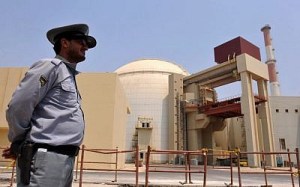
The reactor building at the Russian-built nuclear power plant in Bushehr, in southern Iran, as the first fuel is loaded, August 21, 2010. (Iran International Photo Agency via Getty Images/via JTA)

The UN atomic agency has certified Iran’s compliance with its obligations 13 times and even the head of the CIA said this week that Tehran was abiding by the accord — drawing a furious response from Trump.

The EU has growing concerns about Tehran’s ballistic missile program, as well as its human rights record, its interference in Middle East conflicts and recent attempted attacks against opposition groups in Europe.

Washington has warned it will vigorously pursue any company breaching its sanctions against the Islamic Republic and a number of major international corporations have already pulled out.

Mogherini insisted transatlantic ties were not threatened by the discord over Iran, saying Brussels was in regular contact with the US to discuss concerns about Tehran’s activities.

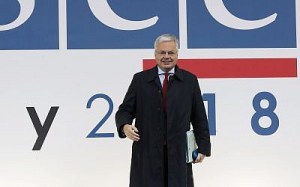
Belgium’s Foreign Minister Didier Reynders arrives for the 25th Organization for Security and Co-operation in Europe ministerial council meeting, in Milan, on December 6, 2018. (AP Photo/Antonio Calanni)

Belgian Foreign Minister Didier Reynders said that despite differences over the nuclear deal, Europe shared many of Washington’s concerns about Iran.

“It’s essential we show our American colleagues that we are going in the same direction as them on a series of issues such as ballistic missiles and Iran’s regional activities,” Reynders said as he arrived for the EU foreign ministers meeting.

On the INSTEX project, he said that “at the end of the day it will be companies that decide whether or not they want to work in Iran, bearing in mind the risk of American sanctions.”

The new European scheme was originally intended to allow Iran to sell oil to the EU on a barter basis but, with Europe buying very little Iranian crude, it is now aimed at small- and medium-sized companies.

“We’ll have to wait and see who uses it,” a European source said.


Off Topic:  Boycotting Israel has little appeal in the UK, Despite star power

Posted February 1, 2019 by Joseph Wouk
Categories: Uncategorized

Source: Boycotting Israel has little appeal in the UK, Despite star power – International news – Jerusalem Post

( Roger Waters deserves to live in his own self-created dystopian reality.  By himself… – JW )

Some insight can be found in the largest-ever poll on the popularity of the BDS campaign in Britain, the results of which were published Wednesday.

BY CNAAN LIPHSHIZ/JTA
 FEBRUARY 1, 2019 15:19
Musician Roger Waters performs at Staples Center in Los Angeles, California, U.S., June 20, 2017

(JTA) — The British branch of the Boycott, Divestment and Sanctions movement against Israel possesses a weapon matched by few other affiliates: star power.

More than any of its international counterparts, BDS UK enjoys the support of renowned musicians like Roger Waters, Brian Eno, Peter Gabriel, Richard Ashcroft and Jarvis Cocker, whom boycott activists like to parade in various petitions. Also on board are eminent filmmakers like Ken Loach and Mike Leigh, and even the celebrated actress Julie Christie has signed on.

(On Tuesday, several of those stars signed yet another petition, urging the BBC to push for the 2019 Eurovision song contest to be moved out of Israel, which they accuse of employing “apartheid” policies.)

The pro-Israel camp has its own British celebrity advocates, including singers Morrissey, the Australia-born (but U.K.-based) singer Nick Cave and the band Radiohead.

What effect are these celebrities having in the fight for British hearts and minds?

Some insight can be found in the largest-ever poll on the popularity of the BDS campaign in Britain, the results of which were published Wednesday.

It doesn’t look too good for BDS.

In the poll of 4,005 British respondents, only 10 percent agreed that Israel should be boycotted, compared to 46 percent who disagreed, according to the Ipsos MORI polling company. It conducted the survey in 2016 and 2017 for the Institute for Jewish Policy Research and the Community Security Trust.

Significantly, another 42 percent said they either had no opinion or did not know, with the remaining 2 percent saying they would rather not express an opinion.

The study found a distinct correlation between support for BDS and the view of Israel as an apartheid state.

Asked whether they agree that Israel in an apartheid state, 21 percent of respondents agreed, compared to 19 who disagreed. Here, too, the largest group by far was the “don’t knows,” with 42 percent.

Muslim respondents were almost four times likelier to agree with the need to boycott Israel than the average, the report said. But also among Muslims, the boycott contingent was in the minority and no fewer than 16 percent of respondents from that group disagreed with boycotting Israel.

Another key finding came from the report’s attempt (the most comprehensive so far) to tackle the contentious claims that BDS is motivated by anti-Semitism. Boycott advocates say their response is merely to Israel’s human rights violations and control of Palestinian land.

In addition to being asked about BDS and apartheid, respondents to the poll were asked also to agree or disagree with a set of assertions regarded as anti-Semitic, including “Jews think they are better than others,” “Jews get rich at the expense of others” and “Jews exploit Holocaust victimhood for their own purposes.”

The respondents who supported BDS and the apartheid analogy were significantly likelier than others to agree with these “more traditional anti-Jewish tropes,” the report said.

Among those who support none of the anti-Semitic tropes, 5 percent endorse a boycott. By contrast, among those who back five tropes, 58 percent endorsed a boycott. Among those who indicated that they think Israel is an apartheid state, 16 percent endorsed no anti-Semitic trope, while 47 percent endorsed six anti-Semitic tropes or more.

It “would be wrong to regard agreement with either the apartheid or boycott statements as being anti-Jewish under all circumstances,” the report’s authors wrote, noting that 16 percent of the respondents who agreed with the apartheid statement displayed no anti-Jewish feelings. But, they added, “the fact remains that agreement with either statement positively correlates with anti-Jewish sentiment.”

Yet perhaps the poll’s most significant finding is how many respondents, about 42 percent, had no opinion on the BDS and apartheid issues either way.

“It is all too easy in heated debates about complex political matters to forget, or even dismiss, the fact that not everyone has an opinion,” the report’s authors, David Graham and Jonathan Boyd, wrote. Boyd is the executive director and Graham is a senior research fellow of the London-based Institute for Jewish Policy Research.

But the data they compiled shows that both sides have largely failed at engaging large swaths of the British public – with an emphasis on young people.

Women and young people are far likelier than other groups to be undecided or neutral, the study said. In the apartheid question, the undecideds accounted for the majority of respondents under 30, compared to only 26 percent undecideds among those in their 70s. And on the boycott question, undecideds accounted for 28 percent of respondents aged 16 to 29 – the largest proportion of undecideds of all other age groups.

To Mark Gardner, the communications director of the Community Security Trust – British Jewry’s watchdog and security group – these and other nuances show that the British celebrities promoting BDS “are largely irrelevant, despite the impression some of us may have about what they represent.”

By contrast, the ongoing debate about the British Labour Party’s spiraling anti-Semitism crisis, where Israel plays a central role, “is causing a lot of people to come out against anti-Semitism and come down on our side of the fence,” he said.

Mostly, though, Gardner said the analysis shows that there is “untapped potential for both sides.” He hopes the data from the survey “will be used as an effective tool to better understand where the fight against antisemitism is impacted upon by BDS and attempts to delegitimize Israel.”

Some insight can be found in the largest-ever poll on the popularity of the BDS campaign in Britain, the results of which were published Wednesday.

BY CNAAN LIPHSHIZ/JTA
 FEBRUARY 1, 2019 15:19

Musician Roger Waters performs at Staples Center in Los Angeles, California, U.S., June 20, 2017

(JTA) — The British branch of the Boycott, Divestment and Sanctions movement against Israel possesses a weapon matched by few other affiliates: star power.

More than any of its international counterparts, BDS UK enjoys the support of renowned musicians like Roger Waters, Brian Eno, Peter Gabriel, Richard Ashcroft and Jarvis Cocker, whom boycott activists like to parade in various petitions. Also on board are eminent filmmakers like Ken Loach and Mike Leigh, and even the celebrated actress Julie Christie has signed on.

(On Tuesday, several of those stars signed yet another petition, urging the BBC to push for the 2019 Eurovision song contest to be moved out of Israel, which they accuse of employing “apartheid” policies.)

The pro-Israel camp has its own British celebrity advocates, including singers Morrissey, the Australia-born (but U.K.-based) singer Nick Cave and the band Radiohead.

What effect are these celebrities having in the fight for British hearts and minds?

Some insight can be found in the largest-ever poll on the popularity of the BDS campaign in Britain, the results of which were published Wednesday.

It doesn’t look too good for BDS.

In the poll of 4,005 British respondents, only 10 percent agreed that Israel should be boycotted, compared to 46 percent who disagreed, according to the Ipsos MORI polling company. It conducted the survey in 2016 and 2017 for the Institute for Jewish Policy Research and the Community Security Trust.

Significantly, another 42 percent said they either had no opinion or did not know, with the remaining 2 percent saying they would rather not express an opinion.

The study found a distinct correlation between support for BDS and the view of Israel as an apartheid state.

Asked whether they agree that Israel in an apartheid state, 21 percent of respondents agreed, compared to 19 who disagreed. Here, too, the largest group by far was the “don’t knows,” with 42 percent.

Muslim respondents were almost four times likelier to agree with the need to boycott Israel than the average, the report said. But also among Muslims, the boycott contingent was in the minority and no fewer than 16 percent of respondents from that group disagreed with boycotting Israel.

Another key finding came from the report’s attempt (the most comprehensive so far) to tackle the contentious claims that BDS is motivated by anti-Semitism. Boycott advocates say their response is merely to Israel’s human rights violations and control of Palestinian land.

In addition to being asked about BDS and apartheid, respondents to the poll were asked also to agree or disagree with a set of assertions regarded as anti-Semitic, including “Jews think they are better than others,” “Jews get rich at the expense of others” and “Jews exploit Holocaust victimhood for their own purposes.”

The respondents who supported BDS and the apartheid analogy were significantly likelier than others to agree with these “more traditional anti-Jewish tropes,” the report said.

Among those who support none of the anti-Semitic tropes, 5 percent endorse a boycott. By contrast, among those who back five tropes, 58 percent endorsed a boycott. Among those who indicated that they think Israel is an apartheid state, 16 percent endorsed no anti-Semitic trope, while 47 percent endorsed six anti-Semitic tropes or more.

It “would be wrong to regard agreement with either the apartheid or boycott statements as being anti-Jewish under all circumstances,” the report’s authors wrote, noting that 16 percent of the respondents who agreed with the apartheid statement displayed no anti-Jewish feelings. But, they added, “the fact remains that agreement with either statement positively correlates with anti-Jewish sentiment.”

Yet perhaps the poll’s most significant finding is how many respondents, about 42 percent, had no opinion on the BDS and apartheid issues either way.

“It is all too easy in heated debates about complex political matters to forget, or even dismiss, the fact that not everyone has an opinion,” the report’s authors, David Graham and Jonathan Boyd, wrote. Boyd is the executive director and Graham is a senior research fellow of the London-based Institute for Jewish Policy Research.

But the data they compiled shows that both sides have largely failed at engaging large swaths of the British public – with an emphasis on young people.

Women and young people are far likelier than other groups to be undecided or neutral, the study said. In the apartheid question, the undecideds accounted for the majority of respondents under 30, compared to only 26 percent undecideds among those in their 70s. And on the boycott question, undecideds accounted for 28 percent of respondents aged 16 to 29 – the largest proportion of undecideds of all other age groups.

To Mark Gardner, the communications director of the Community Security Trust – British Jewry’s watchdog and security group – these and other nuances show that the British celebrities promoting BDS “are largely irrelevant, despite the impression some of us may have about what they represent.”

By contrast, the ongoing debate about the British Labour Party’s spiraling anti-Semitism crisis, where Israel plays a central role, “is causing a lot of people to come out against anti-Semitism and come down on our side of the fence,” he said.

Mostly, though, Gardner said the analysis shows that there is “untapped potential for both sides.” He hopes the data from the survey “will be used as an effective tool to better understand where the fight against antisemitism is impacted upon by BDS and attempts to delegitimize Israel.”


Foreign sponsors of terror should be held accountable

Posted February 1, 2019 by Joseph Wouk
Categories: Uncategorized

Source: Foreign sponsors of terror should be held accountable – Opinion – Jerusalem Post

Not enough attention is being paid to foreign cyberterrorism that is affecting the lives of individual citizens, and foreign sponsors of terrorism.

BY JACK BERGMAN
 FEBRUARY 1, 2019 12:00
Hamas Chief Ismail Haniyeh meets with Qatari envoy Mohammed Al-Emadi in Gaza City January 24, 2019.

Much attention has focused on Russian interference in the 2016 presidential campaign, and on foreign manipulation in social media targeting American voters. However, not as much attention is being paid to foreign cyberterrorism that is affecting the lives of individual citizens, or to foreign sponsors of terrorism.

In 2014, for example, North Korea was believed to have been behind a major hack of Sony Pictures Entertainment and its executives. Last year, we learned that Qatar’s news outlet, Al Jazeera, ran a months-long spy operation aimed at US Jews and pro-Israel groups. And the Gulf nation had hacked prominent private citizens in the United States, including Rabbi Shmuley Boteach – known as “America’s Rabbi” – among many others.

That Qatar is involved in cyberattacks shouldn’t be a surprise. It’s also long been a sponsor of terrorism and continues to fund Hamas, a designated terrorist organization by the European Union, the United States and numerous other countries. Hamas regularly praises as “martyrs” those killed while carrying out terrorist attacks against Israel and gives money – often provided by Qatar – to their families. It has fired rockets into Israel, infiltrated the Jewish state to kidnap soldiers and dug underground tunnels so it could smuggle arms into Gaza – all in its effort to destroy Israel, and all with financial backing from Qatar.

Qatar also has supported other terrorist groups, including the Islamist Muslim Brotherhood, the Taliban and al-Qaeda affiliates. The BBC reported that in April 2017, Qatar allegedly paid a ransom of as much as $1 billion to “a former al-Qaeda affiliate in Syria and to Iranian security officials as part of a deal that resulted in the release of 26 royal family members reportedly kidnapped by Iranian-backed Iraqi Shia militiamen and of dozens of Shia fighters captured by jihadists in Syria.”

The Anti-Defamation League last month – pointing to abhorrent, hateful antisemitic cartoons that demonize Jews and often appear on editorial pages – called on the Qatari government to follow its own press law that prohibits “the publication of ‘any ridicule of or contempt toward any of the religions or their doctrines, including any motivation of sectarian, racial, or religious trends’ or any content that harms goodwill toward a person through ‘defamation.’”

In recent years, we have seen Qatar become increasingly cozy with Iran. Qatar clearly is a problematic country, but the United States has not taken enough action.

It’s time to change that. All countries must be held accountable for their actions.

One way to hold Qatar accountable is the Palestinian International Terrorism Support Prevention Act of 2017, designed to “prevent Hamas, the Palestinian Islamic Jihad, or any affiliate or successor from accessing its international support networks.” It would require the president to report to Congress on any individuals or entities connected to foreign states that are financing Hamas and other terrorist groups.

Another way to hold Qatar accountable would be to enable US victims of terrorism to sue in US courts the Gulf nations or entities it supports. For years, US victims of terrorism have been able to sue state sponsors of terrorism for the pain they have inflicted. Iran, for example, has billions of dollars frozen in US banks as victims attempt to claim its assets for restitution.

It’s time to change that and empower affected families to use civil litigation as an additional path to end Qatari support for Palestinian terrorist groups.

The 1976 Foreign Sovereign Immunities Act (FSIA) put into law a longstanding practice of honoring sovereign immunity when anyone files a civil suit against a foreign government in a US court. Amendments to FSIA are not without precedent: The Justice Against Sponsors of Terrorism Act allowed victims of foreign terrorism committed US soil to sue.

It’s time for another amendment to FSIA, one that would allow a terrorism exception to the jurisdictional immunity of a foreign state, whether that is physical terrorism or cyberterrorism. So long as Qatar sponsors terrorism, it should not be protected.
The writer is a retired US Marine Corps Lieutenant-General and the Representative for Michigan’s First Congressional District.