Kushner meets Turkey’s Erdoğan on Israeli-Palestinian peace plan

Posted February 28, 2019 by Joseph Wouk
Categories: Uncategorized

Source: Kushner meets Turkey’s Erdoğan on Israeli-Palestinian peace plan – Israel Hayom

The American and Turkish teams also discuss increasing U.S.-Turkish cooperation and ways to boost economic conditions in the region • The Turkish president has been one of the most vocal critics of U.S. President Donald Trump’s support for Israel.

News Agencies and Israel Hayom Staff // published on 28/02/2019
   
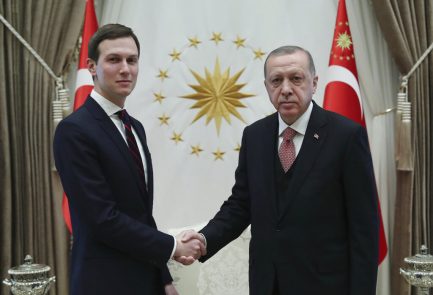
Jared Kushner with Turkish President Recep Tayyip Erdoğan in Ankara, Wednesday 


White House adviser Jared Kushner discussed his Israeli-Palestinian peace efforts with Turkish President Tayyip Erdoğan on Wednesday, and the two also discussed increasing U.S.-Turkish cooperation and ways to boost economic conditions in the region.

Kushner, who has responsibility for Washington’s Israel-Palestinian policy, has said the peace plan will address final-status issues of the Israeli-Palestinian conflict, including establishing borders.

The White House said the meeting with Erdoğan included Kushner, who is Trump’s son-in-law, Special Representative for International Negotiations Jason Greenblatt and U.S. Special Representative for Iran Brian Hook.

Turkey’s Economy Minister Berat Albayrak, who is Erdoğan’s son-in-law, also attended.

“They discussed increasing cooperation between the United States and Turkey, and the Trump administration’s efforts to facilitate peace between the Israelis and Palestinians,” the White House said. “Additionally, they discussed ways to improve the condition of the entire region through economic investment.”

Erdoğan has been one of the most vocal critics of U.S. President Donald Trump’s support for Israel.

Last year he said the United States had forfeited its role as mediator in the Middle East by moving its Israel embassy to Jerusalem and recognizing the city as Israel’s capital.

“The United States has chosen to be part of the problem rather than the solution,” the Turkish president said last May, days before he hosted a summit of Muslim leaders which threatened economic measures against countries which followed the United States in moving their embassies to Jerusalem.

In an interview broadcast on Monday on Sky News Arabia during a visit to U.S.-allied Gulf Arab states, Kushner made no specific mention of a Palestinian state, whose creation had been a key goal of Washington’s peace efforts for two decades.

But he said the long-awaited peace proposal would build on “a lot of the efforts in the past,” including the 1990s Oslo accords that provided a foundation for Palestinian statehood, and would require concessions from both sides.

U.S. officials said that Kushner is expected to focus on the economic component of the plan during his week-long trip to the region.

Kushner has said he plans to release details of the plan sometime after Israel’s April 9 general election.

His comments about the initiative have received a cool reception from Israeli and Palestinian leaders and his trip to Ankara is part of a Mideast tour aimed at building support for the plan.

On Tuesday, Kushner and Greenblatt met with Saudi Arabia’s King Salman and with Crown Prince Mohammed bin Salman to discuss cooperation between the two countries and the peace plan.


IDF hits targets in Gaza after explosive balloon damages home 

Posted February 28, 2019 by Joseph Wouk
Categories: Uncategorized

Source: IDF hits targets in Gaza after explosive balloon damages home – Israel Hayom

“Over the past three weeks they [Palestinians in Gaza] have launched a lot of balloons and because they do it at night, it’s hard to stop it,” says Rachel Danzig, whose home in Eshkol region is damaged • IDF: Hamas is responsible for what happens in Gaza.

Daniel Siryoti, Nikki Guttman and Israel Hayom Staff // published on 28/02/2019
   
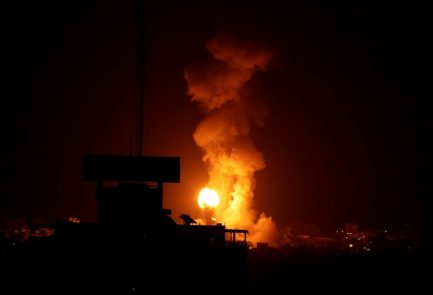
An Israeli airstrike in Gaza 


Israeli warplanes struck numerous Hamas posts in southern Gaza late Wednesday night after a small bomb attached to a bundle of balloons was launched into Israel from the Hamas-controlled coastal enclave.

The explosive device damaged the front window of a home in the Eshkol region.

No casualties were reported.

The bomb exploded near the home of Rachel Danzig, whose home was almost hit by a rocket fired from Gaza during the previous spat of hostilities.

“I’m shaking right now,” she said. “The balloon exploded next to my house, I thought it was literally inside the house. It’s scary because there’s no deterrence. My neighbor has a hole in her garden, glass is shattered all over my home and everything moved from the blast. I’m still traumatized by the first time. My neighbor is absolutely frightened. She’s 70 years old and is in shock.

“Over the past three weeks, they [Palestinians in Gaza] have launched a lot of balloons and because they do it at night, it’s hard to stop it. People could get hurt,” Danzig said.

“The Hamas terrorist organization bears responsibility for anything that occurs in the Gaza Strip and for all the consequences of its terrorist activity there,” the IDF said in a statement.


IDF hits targets in Gaza after explosive balloon damages home 

Posted February 28, 2019 by Joseph Wouk
Categories: Uncategorized

Source: IDF hits targets in Gaza after explosive balloon damages home – Israel Hayom

“Over the past three weeks they [Palestinians in Gaza] have launched a lot of balloons and because they do it at night, it’s hard to stop it,” says Rachel Danzig, whose home in Eshkol region is damaged • IDF: Hamas is responsible for what happens in Gaza.

Daniel Siryoti, Nikki Guttman and Israel Hayom Staff // published on 28/02/2019
   
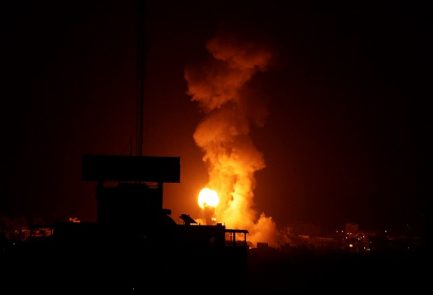
An Israeli airstrike in Gaza 


Israeli warplanes struck numerous Hamas posts in southern Gaza late Wednesday night after a small bomb attached to a bundle of balloons was launched into Israel from the Hamas-controlled coastal enclave.

The explosive device damaged the front window of a home in the Eshkol region.

No casualties were reported.

The bomb exploded near the home of Rachel Danzig, whose home was almost hit by a rocket fired from Gaza during the previous spat of hostilities.

“I’m shaking right now,” she said. “The balloon exploded next to my house, I thought it was literally inside the house. It’s scary because there’s no deterrence. My neighbor has a hole in her garden, glass is shattered all over my home and everything moved from the blast. I’m still traumatized by the first time. My neighbor is absolutely frightened. She’s 70 years old and is in shock.

“Over the past three weeks, they [Palestinians in Gaza] have launched a lot of balloons and because they do it at night, it’s hard to stop it. People could get hurt,” Danzig said.

“The Hamas terrorist organization bears responsibility for anything that occurs in the Gaza Strip and for all the consequences of its terrorist activity there,” the IDF said in a statement.


Congress to view bill recognizing Israeli sovereignty on Golan 

Posted February 28, 2019 by Joseph Wouk
Categories: Uncategorized

Source: Congress to view bill recognizing Israeli sovereignty on Golan – Israel Hayom

Bill emphasizes the strategic importance of Israeli control to protect civilians against threats from Iran in Syria and Hezbollah in Lebanon • It also states it is “unrealistic to expect” Israeli-Syrian peace deal to end in Israeli withdrawal from Golan.

Jewish News Syndicate and Israel Hayom Staff // published on 28/02/2019
   
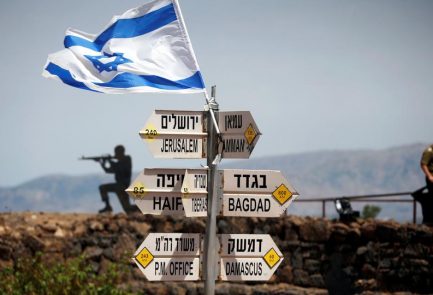
An observation post on the Israeli Golan Heights overlooking the Syrian side of the Quneitra crossing 


U.S. Senators Ted Cruz (R-Texas) and Tom Cotton (R-Arkansas) and Rep. Mike Gallagher (R-Wisconsin) introduced companion resolutions on Tuesday urging the United States to officially recognize Israel’s sovereignty over the Golan Heights.

The bill emphasizes the strategic importance of Israeli control over the area, which the Jewish state captured in the 1967 Six-Day War, in protecting civilians against threats from Iran in Syria and Hezbollah in Lebanon.

Israel annexed the region in 1981, a move that has not been recognized by the international community.

It also states that “it is unrealistic to expect that the outcome of a peace agreement between Israel and Syria will be an Israeli withdrawal from the Golan Heights.”

The bill adds that “it is in the United States’ national security interest to ensure that Israel retains control of the Golan Heights [and that] the Syrian regime of Bashar Assad faces diplomatic and geopolitical consequences for its killing of civilians, the ethnic cleansing of Arab Sunnis, and the use of weapons of mass destruction.”

Prime Minister Benjamin Netanyahu raised the issue of the Golan Heights during a meeting with U.S. National Security Advisor John Bolton in January. Although the United States does not recognize Israeli control over the Golan Heights, it voted for the first time in November against an annual U.N. resolution condemning the Israeli position.

The measure is also sponsored by Senators Marco Rubio (R-Florida), Kevin Cramer (R-North Dakota) and Lindsey Graham (R-South Carolina), and Representatives Brian Mast (R-Florida), Doug Lamborn (R-Colorado), Jim Banks (R-Indiana), Elise Stefanik (R-New York), Tom Cole (R-Oklahoma), Mark Meadows (R-North Carolina), Bill Johnson (R-Ohio), Scott Perry (R-Pennsylvania), Roger Marshall (R-Kansas), Mark Green (R-Tennessee), Lee Zeldin (R-New York), Ted Budd (R-North Carolina) and Jody Hice (R-Georgia).

Although no Democrats are currently behind the bill, members such as House Majority Leader Steny Hoyer (D-Maryland) have voiced support for such U.S. recognition in the past.

In December, Cotton and Cruz introduced a similar measure.


Netanyahu vows to bar Iran from securing presence in Syria 

Posted February 28, 2019 by Joseph Wouk
Categories: Uncategorized

Source: Netanyahu vows to bar Iran from securing presence in Syria – Israel Hayom

After meeting with Russian President Vladimir Putin, Prime Minister Netanyahu reiterates that Iran comprises the biggest threat in the region • “We are determined to continue our aggressive action in Syria,” he says • Putin accepts invitation to Israel.

Erez Linn and Israel Hayom Staff // published on 28/02/2019
   
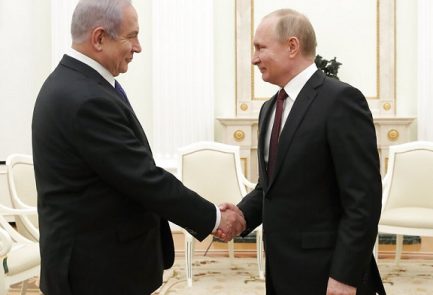
Prime Minister Benjamin Netanyahu shakes hands with Russian President Vladimir Putin during their meeting in the Kremlin in Moscow, Wednesday 


Prime Minister Benjamin Netanyahu vowed Wednesday to prevent Iran from securing a lasting presence in Syria as he visited Moscow for talks focusing on regional security.

For Netanyahu, it was the first trip to Moscow since September’s downing of a Russian warplane by Syrian forces that were responding to an Israeli air strike. The incident left 15 Russian crew dead and threatened to derail close security ties between Russia and Israel.

Russian President Vladimir Putin said at the start of Wednesday’s talks that “it’s very important to discuss the situation in the region and security issues.”

He added that the high-level consultations are essential in view of the evolving situation.

Netanyahu began the talks by reaffirming Israel’s strong determination to block attempts by Iran to establish a foothold in Syria.

“The greatest threat to stability and security in the region comes from Iran and its satellites,” he said.

“We are determined to continue with our aggressive action against the efforts of Iran, which calls for our destruction and against its attempts to entrench militarily in Syria.”

Moscow has played a delicate diplomatic game of maintaining friendly ties with both Israel and Iran. Last summer, Moscow struck a deal with Tehran to keep its fighters away from the Golan Heights to accommodate Israeli concerns about the Iranian presence in Syria.

Netanyahu noted that he and Putin have had 11 meetings since September 2015 and hailed “the direct, open and true way in which we maintain the relationship between Russia and Israel.”

“The direct connection between us has been an essential element that has prevented risks and conflicts between our militaries and that has contributed to regional security and stability,” the Israeli leader said.

Netanyahu congratulated Putin on the military holiday Russia marked last weekend and invited him to visit Israel to attend the opening of a monument to the Nazi siege of Leningrad during World War II.

“We will never forget the role of Russia and the Red Army in the victory over the Nazis,” he said.

Putin, a native of the city, accepted the offer. The Russian Embassy in Israel tweeted confirmation of his attendance although no date has been set.

Netanyahu praised “excellent bilateral relations,” noting “more than one million Russian speakers who have made a great contribution to Israel, have turned into a part of us and have made Russian culture a part of Israeli culture.”

Speaking after the meeting, Netanyahu said that relations between Israel and Russia following the fighter jet incident had not been discussed.

“We talked about the main issues of interest to us, mostly Iran – and its attempts to base itself in Syria. We went into great detail on that issue and showed examples of that entrenchment as well as the steps we [Israel] are taking to prevent it,” Netanyahu said.

Netanyahu said that Putin had been presented with various intelligence findings about Iran and Syria.

“I always make it clear that we will continue to maintain Israeli freedom of action that we retain as part of our right to self-defense against actors who want to gain a foothold in Syria and I’m saying this publicly in the most honest way possible, as well as in closed-door talks.

Netanyahu said that Putin had expressed an understanding of Israel’s defense needs.


The opportunity of the century 

Posted February 28, 2019 by Joseph Wouk
Categories: Uncategorized

Source: The opportunity of the century – Israel Hayom

Doron Matza

The details of the Trump administration’s “deal of the century” are still under wraps, but the deal has become part of the election campaign and appears likely to keep the political system in turmoil throughout 2019.

The right wing is already responding negatively, both out of a sense of real danger and a desire to differentiate itself from the Likud and demonstrate uncompromising loyalty to the vision of the “complete land of Israel.” The New Right party has already expressed concern that the Trump plan could bring the ax down on its vision of annexing Judea and Samaria and shelve the hope of leveraging the Likud government to make a final decision on the future of parts of the country.

It looks like Prime Minister Benjamin Netanyahu, however, has a favorable attitude toward the deal. This might stem from tactical consideration but it is more likely that because of his position, he is more familiar with the details of the plan than the public at large. Throughout his time in office, Netanyahu has taken a realistic, practical approach on the Arab-Palestinian issue. While he is blocking the implementation of the two-state solution, and in recent years has even caused it to lose traction in international public opinion, he has also refrained from taking the opposite steps of applying Israeli sovereignty to Judea and Samaria or annexing those areas. As part of that approach, he has opted to foster the autonomic rule of the Palestinian Authority while promising Israeli security control without harming Jewish settlement.

That policy has proven itself effective: On the one hand, it has secured relative safety and quiet, while on the other, Israel hasn’t been forced to confront major questions about annexation and could maintain its Jewish, democratic character. At the same time, Netanyahu funneled resources into confronting the threat from Iran and strengthening Israel’s ties with Sunni Arab states.

The scraps of information being published about the “deal of the century” create the impression that it won’t oppose the deep reason for the past decade of Israeli policy under Netanyahu, and will even build on that policy and leverage it. According to various reports, the plan is based on changing Israel’s status in the region. The plan sees that change as leverage in creating a new geopolitical order based on economic growth as the key to securing the goal of all sane actors: bringing about stability and the eradication of flashpoints, like the Gaza Strip, by improving residents’ quality of life.

The deal of the century will apparently include the status of Judea and Samaria, as well as so-called concessions Israel will need to make, including some territorial ones. However, it is highly unlikely that the Palestine Liberation Organization and the PA leadership will be able to accept the general spirit of the plan, which will probably reflect the geopolitical and demographic reality developing on the ground, which means a significant step back from the Trilateral Statement U.S. President Bill Clinton issued after the Camp David talks between PLO leader Yasser Arafat and then-Prime Minister Ehud Barak blew up in 2000.

Palestinian opposition to the plan will allow Israel to deepen and expand the process of tightening relations with other Middle East countries. Moreover, it will give Israel a chance to promote a deal with the Palestinians that is not based on absolute, irreversible solutions – one that is already taking place, without any formal announcement, and is based on an autonomic Arab-Palestinian framework that would allow Israel to manage the tension between its desire to maintain security control and Jewish settlements and its aspiration to uphold the basic values of the Zionist movement in the form of a Jewish, democratic state.

Doron Matza is a researcher and lecturer on the Israeli-Arab conflict at Achva Academic College and a former member of the Shin Bet security agency.

Off Topic:  Trump, Kim open second nuclear summit with handshake, smiles 

Posted February 27, 2019 by Joseph Wouk
Categories: Uncategorized

Source: Trump, Kim open second nuclear summit with handshake, smiles | The Times of Israel

At initial greeting ahead of talks, both leaders make positive remarks without being specific on what they hope to achieve

HANOI, Vietnam (AP) — US President Donald Trump and North Korea’s Kim Jong Un opened their second summit Wednesday with hopeful words and a private chat before sitting down for dinner and further talks about North Korea’s pursuit of nuclear weapons.

The two exchanged smiles and a warm handshake in front of a phalanx of alternating American and North Korean flags.

They posed for cameras before disappearing for their private tete-a-tete, similar to one they had at their first historic meeting last year in Singapore.

“We made a lot of progress,” Trump said of their first summit. “I think the biggest progress was our relationship, is really a good one.”

Asked if this summit would yield a political declaration to end the Korean War, Trump said “We’ll see.”

Kim said he was “confident of achieving the great results that everyone will welcome.”

The venue, the colonial and neoclassical Sofitel Legend Metropole in the old part of Hanoi, came with a bit of irony.

Trump will be trying to convince Kim to give up his nuclear weapons at a hotel that has bomb shelter that protected the likes of actress Jane Fonda and singer Joan Baez from American air raids during the Vietnam War. According to the hotel’s website, the bunker was closed and sealed after the war ended in the mid-1970s. It was rediscovered by chance during a bar renovation project in 2011.

Trump was joined at dinner by Secretary of State Mike Pompeo and acting White House chief of staff Mick Mulvaney. Kim was accompanied by Kim Yong Chol, a former military spy chief and Kim’s point man in negotiations, and Ri Yong Ho, the foreign affairs minister. Interpreters for each side also attended.

Anticipation for what will be accomplished at the summit ran high in Hanoi. But the carnival-like atmosphere in the Vietnamese capital, with street artists painting likenesses of the leaders and vendors hawking T-shirts showing Kim waving and Trump giving a thumbs-up, contrasted with the serious items on their agenda.

Scoring a victory at the summit would offset Trump’s political troubles back in Washington, where Michael Cohen, his former personal attorney, was prepared to tell lawmakers that Trump is a “racist,” a “conman” and a “cheat.” Earlier in the day, after meeting with the president of Vietnam, Trump was unable to ignore the drama playing out thousands of miles away.


Bennett accuses Trump of ‘planning a Palestinian state right over our heads’ 

Posted February 27, 2019 by Joseph Wouk
Categories: Uncategorized

Source: Bennett accuses Trump of ‘planning a Palestinian state right over our heads’ | The Times of Israel

Escalating criticism of White House peace plan, New Right head calls on US president to ‘let my people know’ the details of his proposal

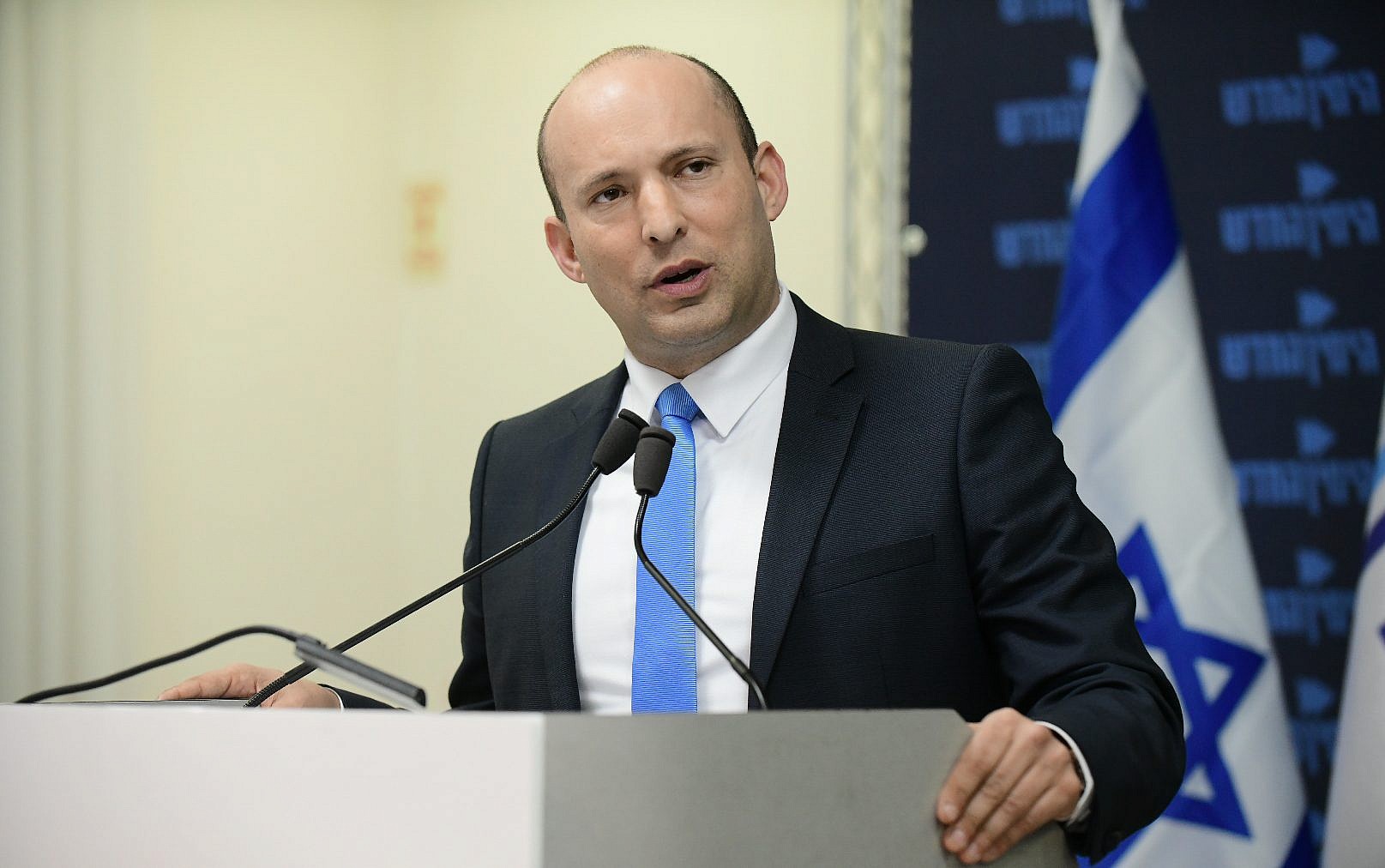
Education Minister Naftali Bennett speaking at a New Right party press conference in Tel Aviv on February 7, 2019. (Tomer Neuberg/Flash90)

Education Minister Naftali Bennett speaking at a New Right party press conference in Tel Aviv on February 7, 2019. (Tomer Neuberg/Flash90)

New Right chair Naftali Bennett launched a direct assault on Donald Trump Wednesday morning, accusing the US president of “planning a Palestinian state right over our heads,” and calling on him to release his closely guarded Middle East peace plan before Israel’s April elections.

‎‏”We all know the ‘deal of the century’ will be launched right after the Israeli elections, but we, the Israelis, are in the dark about the plan itself,” Bennett said in English-language comments during an address at a conference for local government in Tel Aviv.

While calling Trump “a true friend to Israel,” Bennett added that “friends do not keep secrets one from another.” The comment could be seen as a thinly veiled swipe at Prime Minister Benjamin Netanyahu, who has held talks with administration officials regarding Trump’s proposal, and whose Likud party is vying for the same voters Bennett’s New Right is aiming to win.

“It seems that everybody is in the loop, planning the Palestinian state right over our heads: the Americans, the Saudi prince, the Palestinians, the Jordanian king — even Erdogan of Turkey, blatant anti-Semite! Even he’s in the loop!” Bennett charged. “Everybody’s in the picture. Everybody but us, the people of Israel.”

In a wry parody of Moses’s biblical demand that Pharaoh release the Israelites from slavery, Bennett declared: “President Trump, let my people know.”
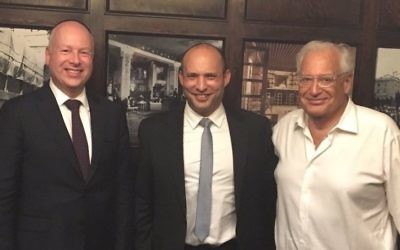
L-R: US President Donald Trump’s envoy to the Middle East Jason Greenblatt, Jewish Home chair Naftali Bennett and US Ambassador to Israel David Friedman after meeting in Jerusalem, July 12, 2017. (Jewish Home)


A spokesperson for the education minister said the remarks were a “direct request to President Trump” to reveal the plans immediately.

The Trump administration has closely guarded details of its peace proposal, which the president’s senior adviser and son-in-law Jared Kushner said last week would be released after Israeli elections on April 9.

Bennett, in comments aimed at the public as much as at Trump, said that due to the plan, the election was now “a referendum on the creation of a Palestinian terror state, which will threaten our very existence. This is not theory. This is about the lives of our children.”

“Let my people know what will happen to Jerusalem. It’s our land. It’s our lives. It’s our future. And it’s our right to decide our fate,” he added. “The Land of Israel has been our homeland for almost 4,000 years. Nobody can tear it apart. Nobody can divide Jerusalem again.”

The comments, the latest in a series of remarks by Bennett slamming both the as-yet-unrevealed peace proposal and Netanyahu for allegedly going along with it, came after Kushner gave an interview earlier this week on the administration’s plan, saying it will focus on “establishing borders and resolving final status issues.”

“The goal of resolving these borders is really to eliminate the borders. If you can eliminate borders and have peace and less fear of terror, you could have freer flow of goods, freer flow of people and that would create a lot more opportunities,” Kushner told Sky News Arabic on Monday.
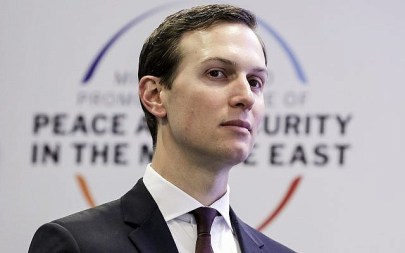
White House Senior Adviser Jared Kushner at a conference on Peace and Security in the Middle East in Warsaw, Poland, on February 14, 2019. (AP Photo/Michael Sohn)

Kushner said that since “very little has changed over the last 25 years,” the administration’s team had worked to “formulate realistic solutions for the issues of 2019, which will improve quality of life.

“We want to bring peace, not fear. We want to ensure there is free flow of people and of goods. We must create new opportunities,” he said.

Kushner also called for unified rule over the West Bank and the Gaza Strip, areas that are currently split between the internationally recognized Palestinian Authority and the Hamas terror group, respectively.

“We want to see the Palestinians united under one leadership; the Palestinians want a non-corrupt government that cares for their own interests,” he said.

Kushner said that the peace plan wants to help get the Palestinians “what’s been elusive to them for a long time.” But he did not explicitly mention a Palestinian state, nor did he even vaguely endorse a two-state solution.

Nonetheless, the statements set off a combative back-and-forth between New Right and Netanyahu’s Likud, with the two parties jostling to boost their right-wing credibility.

“There’s a clear and present danger in front of us: the establishment of a Palestinian state,” Bennett said Monday in response to the Kushner interview.

“What Kushner said proves what we already knew — the day after the elections the Americans will push the Netanyahu-Lapid-Gantz government to allow for the establishment of a Palestinian state… and for the division of Jerusalem,” Bennett said in a statement.

“There’s only one way to prevent this: a strong and powerful New Right party that will boost Netanyahu but put pressure on him against Palestine,” he said.
Prime Minister Benjamin Netanyahu, right, and Education Minister Naftali Bennett, left, attend the weekly cabinet meeting at the Prime Minister’s Office in Jerusalem, Tuesday, August 30, 2016. (Abir Sultan/Pool/via AP)

Likud responded to Bennett’s charges, saying on Monday: “When Bennett and [Ayelet] Shaked established the New Right they said they were doing it in order to pull votes from Lapid and Gantz to enlarge the right-wing bloc, and that they wouldn’t subject us to friendly fire. Now they are making false charges against Likud with the goal of pulling votes from Likud, which will bring about the rise of the left-wing government of Lapid and Gantz, whose party will be bigger than Likud.”

Likud further claimed that representatives of the New Right have “made contact with Lapid and Gantz to join them after the elections,” while Netanyahu “has made it unequivocally clear that he will form a right-wing government.

“Prime Minister Netanyahu has safeguarded the Land of Israel and the State of Israel against Obama’s hostile government and will continue to do so in the face of Trump’s sympathetic administration,” it said.

Responding to Likud’s claim that the New Right had held talks with Benny Gantz and Yair Lapid, heads of the centrist Blue and White party, Bennett’s party said: “The Likud announcement is pure fake news and utter nonsense. The pressure is clear… It’s the right or Palestine. Only the New Right will prevent the establishment of Palestine in the Land of Israel.”

Times of Israel staff contributed to this report.


British Labour party: Outlawing Hezbollah is unjustified 

Posted February 27, 2019 by Joseph Wouk
Categories: Uncategorized

Source: British Labour party: Outlawing Hezbollah is unjustified – Israel Hayom

Labour leader Jeremy Corbyn gives green light to party members to avoid voting in favor of the U.K.’s official designation of Hezbollah as a terrorist group • Home secretary must demonstrate that the decision was objective and impartial, Labour says.

News Agencies and Israel Hayom Staff // published on 27/02/2019
   
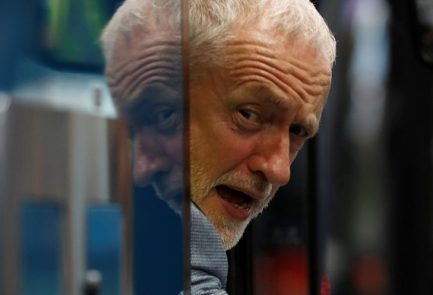
Head of Britain’s Labour Party Jeremy Corbyn 


U.K. Labour party leader Jeremy Corbyn on Tuesday gave the green light to party members to avoid voting in favor of the United Kingdom’s official designation of Hezbollah as a terrorist group.

On Monday, British Home Secretary Sajid Javid outlawed membership in Hezbollah or support for the terrorist group.

“Hezbollah is continuing in its attempts to destabilize the fragile situation in the Middle East and we are no longer able to distinguish between their already banned military wing and the political party,” Javid said. “Because of this, I have taken the decision to proscribe the group in its entirety.”

Labour said in a statement on Tuesday that Javid had to provide evidence to justify his decision to widen the ban on the terrorist group.

“The home secretary must therefore now demonstrate that this decision was taken in an objective and impartial way and driven by clear and new evidence, not by his leadership ambitions,” a Labour spokesman said.

Asked about the comments, Prime Minister Theresa May’s spokesman said it was for Labour to explain their decision.

“Hezbollah itself has publicly denied a distinction between its military and political wings. The group in its entirety is assessed to be concerned in terrorism,” he added.

“The links between the senior leaders of Hezbollah’s political and military wings as well as the group’s destabilizing role in the region mean that the distinction between the two wings is now untenable,” the spokesman added.

Corbyn has called members of Hezbollah his “friends.”


Iran’s president rejects resignation of Foreign Minister Zarif

Posted February 27, 2019 by Joseph Wouk
Categories: Uncategorized


Source: Iran’s president rejects resignation of Foreign Minister Zarif – Israel Hayom

Senior Revolutionary Guard commander: Zarif main person in charge of Iran’s foreign policy and has support of Supreme Leader Ayatollah Khamenei • Former official: Resignation could have domino effect Iran cannot tolerate under pressure of U.S. sanctions.

Reuters and Israel Hayom Staff // published on 27/02/2019
   
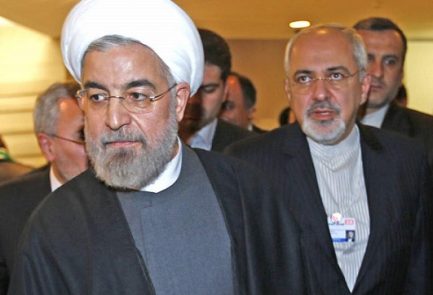
Iranian President Hassan Rouhani with Foreign Minister Mohammed Javad Zarif 


Iranian President Hassan Rouhani rejected on Wednesday the resignation of Foreign Minister Mohammad Javad Zarif, standing by an ally long targeted by hard-liners in internal factional struggles over a 2015 nuclear deal with the West.

Zarif – a U.S.-educated veteran diplomat who helped craft the pact that curbed Iran’s nuclear program in return for sanctions relief – announced his resignation on Instagram on Monday.

“As the supreme leader has described you as a ‘trustworthy, brave and religious’ person in the forefront of resistance against widespread U.S. pressures, I consider accepting your resignation against national interests and reject it,” Rouhani said in a letter published on state-run Islamic Republic News Agency.

In another show of confidence, senior Revolutionary Guard commander Qassem Soleimani said Zarif was the main person in charge of Iranian foreign policy and he was supported by the supreme leader, Ayatollah Ali Khamenei.

On Wednesday, Zarif thanked Iranians for their support.

“As a modest servant, I have never had any concern but elevating the foreign policy and the status of the foreign ministry,” he added in an Instagram post.

After Rouhani’s announcement, the semiofficial Iranian Students News Agency reported that Zarif had attended a ceremony to welcome Armenia’s prime minister to Tehran.

Zarif gave no specific reasons for his resignation.

But his move thrust the schism between Iran’s hard-liners and moderates into the open, effectively challenging Khamenei to pick a side.

The schism between hard-liners and moderates over the nuclear deal shows the tension in Iran between the two factions and between the elected government which runs the country on a day-to-day basis and a clerical establishment with ultimate power.

An ally of Zarif told Reuters his resignation was motivated by criticism of the nuclear accord, under increasingly intense fire in Iran since the United States abandoned it last year.

Since the United States walked out of the nuclear deal and reimposed sanctions, Rouhani has had to explain to critics why Iran has continued to abide by its restrictions while reaping virtually none of the foreseen economic benefits.

Uncertainty

The political uncertainty comes at a difficult time for Iran’s leaders as the reimposed U.S. sanctions have dashed hopes of an economic breakthrough. Rouhani has warned that the country is facing the worst economic crisis in 40 years.

Hardships have triggered waves of nation-wide protests, with calls for both Rouhani and clerical leaders to step down.

Some unconfirmed Iranian media reports indicated Zarif had resigned because he had not been informed about a visit by Syrian President Bashar Assad on Monday.

Zarif was quoted as condemning “factional fighting” in a newspaper interview published on Tuesday – suggesting political tensions may have played a part in his decision. The Fars news agency reported that the interview had taken place last week, before Zarif’s resignation.

A former pro-reform official warned of dire consequences of Zarif’s resignation is accepted.

“If accepted, it will have a domino effect … and others and even Rouhani might follow him, and this is not something that the country can tolerate when pressured by America and sanctions,” he said.

“Hard-liners will be strengthened and any kind of reform will be buried for at least 10 years.”