Hamas gives Israel demands for security prisoners on eve of hunger strike

Posted April 2, 2019 by Peter Hofman
Categories: Uncategorized

Terms passed via Egypt include restoring visits, ending policy of jamming cell phones, improving conditions in prisons; conditions presented as part of agreement to restore calm in Gaza after tensions spiked
https://www.ynetnews.com/articles/0,7340,L-5488430,00.html

Hamas leader Ismail Haniyeh said Tuesday that his organization has given Israel a series of demands regarding its security prisoners who are set to begin a hunger strike next week.

The demands were passed to Israel by the Egyptian delegation currently trying to mediate an end to Gaza hostilities between the two sides.

Israeli prison guards (Photo: Israel Prison Service)


Hamas’ demands for Israel:

1. Removing the cell phone jamming device

2. Lifting recent sanctions on the prisoners

3. Restoring visits for prisoners

4. Improving prison conditions


According to Hamas, some of the understandings with Israel will be implemented before the elections on April 9, and some afterwards.

The understandings that will be implemented before the elections are the simpler ones, such as expanding the fishing area off the Gaza coast (already done); easing restrictions on exported goods from Gaza; improving the electricity supply by operating the turbines at the power plant; and beginning projects that will provide temporary employment.

Guards search the cells of Hamas prisoners at Ketziot Prison (Photo: IPS)

Guards search the cells of Hamas prisoners at Ketziot Prison (Photo: IPS)

The understandings that will be implemented after the elections include the construction of another power line from Israel to Gaza within six months and the construction of a gas pipeline to the Gaza power plant within a year. In addition, the Palestinians are demanding the establishment of infrastructure and alternative energy projects.

The timetables will be presented to representatives of the Palestinian factions in Gaza, who will announce whether they accept or reject them.

Last week, the Israel Prison Service announced that it would charge the Hamas prisoners in Ramon Prison NIS 250,000 ($70,000) after they set fire to the mattresses in their cells last week.

The arson took place in the wing where mobile phones are being jammed by the IPS, which expressed concern that such a move would lead to attacks on prison guards, damage to prison property and riots.

A few days earlier, a prison guard at Ketziot Prison was stabbed in the neck by two security prisoners in the neck during a search of the site.


Russia in the Middle East – Jerusalem Studio 410

Posted April 2, 2019 by Joseph Wouk
Categories: Uncategorized


Led by Saudis, Arab leaders unite against Trump’s recognition of Golan Heights 

Posted April 2, 2019 by Joseph Wouk
Categories: Uncategorized

Source: Led by Saudis, Arab leaders unite against Trump’s recognition of Golan Heights | The Times of Israel

22-member league — minus Syria — condemns US president’s policies favoring Israel, but is not expected to take further action

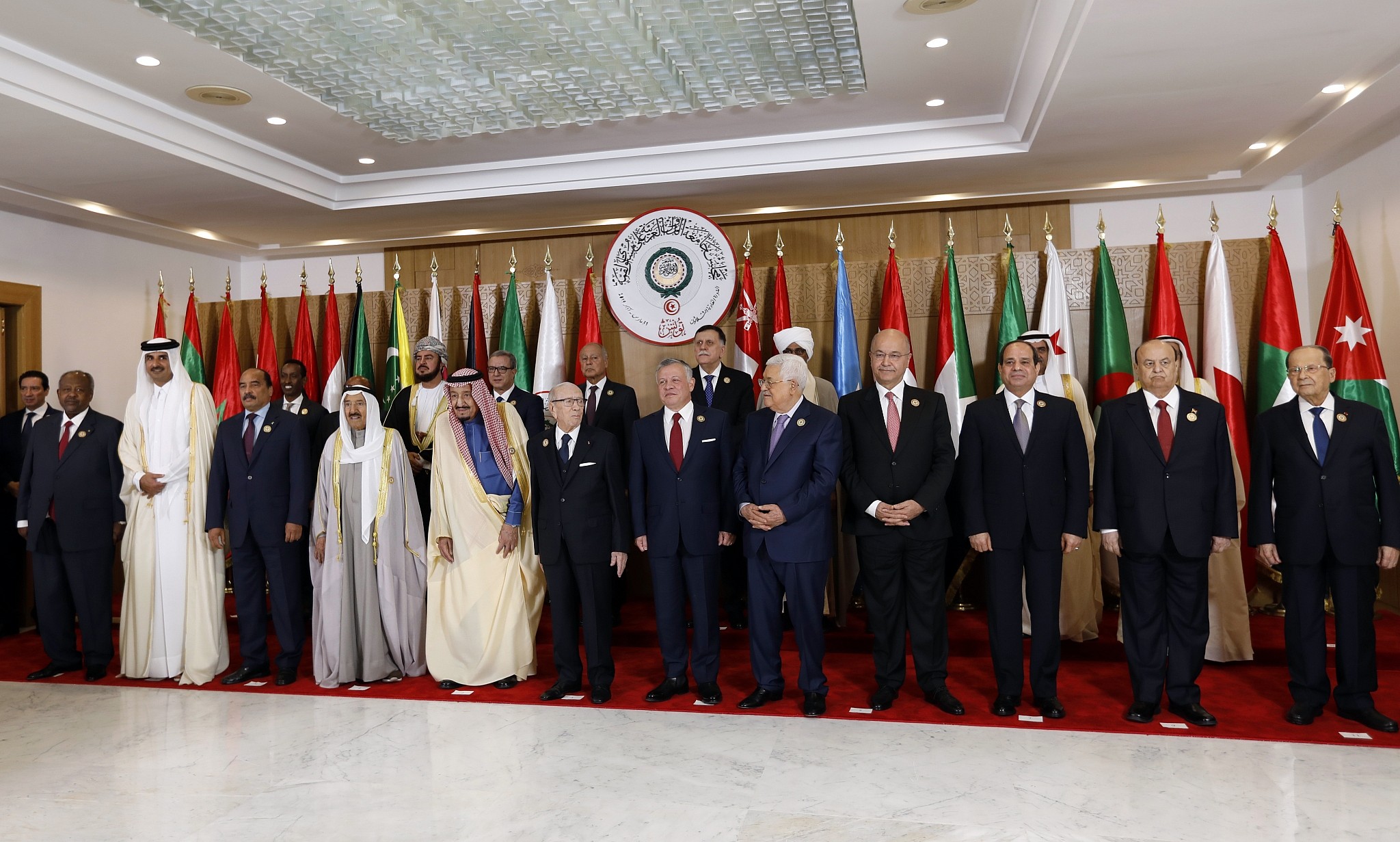
Arab leaders pose for the camera, ahead of the 30th Arab Summit in Tunis, Tunisia, March 31, 2019. (Zoubeir Souissi, Pool photo via AP)

Arab leaders pose for the camera, ahead of the 30th Arab Summit in Tunis, Tunisia, March 31, 2019. (Zoubeir Souissi, Pool photo via AP)

TUNIS, Tunisia — Leaders meeting in Tunisia for the annual Arab League summit on Sunday were united in their condemnation of Trump administration policies seen as unfairly biased toward Israel but divided on a host of other issues, including whether to readmit founding member Syria.

Representatives from the 22-member league — minus Syria — aim to jointly condemn US President Donald Trump’s recognition of Israeli control over the Golan Heights, which Israel captured from Syria in the 1967 war, and Trump’s decision last year to recognize Jerusalem as Israel’s capital.

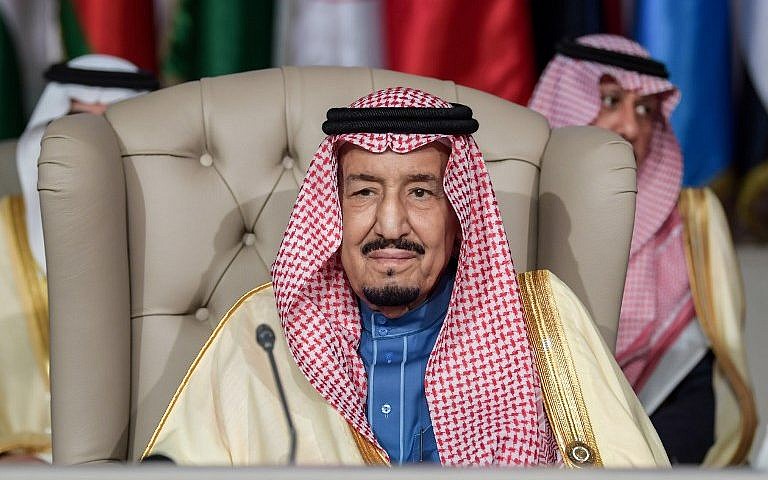
At the opening of the summit, King Salman said Saudi Arabia “absolutely rejects any measures undermining Syria’s sovereignty over the Golan Heights” and supports the creation of a Palestinian state in the West Bank and the Gaza Strip, with East Jerusalem as its capital.

He added that Iran’s meddling was to blame for instability in the region.

Saudi Arabia’s King Salman bin Abdulaziz attends the opening session of the 30th Arab League summit in the Tunisian capital Tunis on March 31, 2019. (Fethi Belaid/Pool/AFP)

One of the few things that have united the Arab League over the last 50 years is the rejection of Israel’s control of the Golan Heights as well as East Jerusalem and the West Bank, which Israel also gained control of in the 1967 war and which the Palestinians want for a future state.

The international community, including the United States, largely shared that position until Trump upended decades of US policy by moving the American Embassy to Jerusalem last year and recognizing Israel’s 1981 extension of Israeli law to the strategic Golan plateau earlier this month.

The Arab leaders meeting in Tunisia are expected to issue a statement condemning those moves but are unlikely to take any further action.

That’s in part because regional powerhouses Saudi Arabia and the United Arab Emirates have cultivated close ties with the Trump administration, viewing it as a key ally against their main rival, Iran. Both face Western pressure over their devastating three-year war with Yemen’s Houthi rebels, and Riyadh is still grappling with the fallout from the killing of Washington Post columnist Jamal Khashoggi by Saudi agents last year.

Lebanon’s Foreign Minister Gebran Bassil said Saturday that Arab ministers had voiced support in a preparatory meeting for a declaration that Trump’s Golan move violates the UN Charter, which prohibits acquiring territories by force.

In Syria, small protests against Trump’s Golan move were held in different parts of the country and state media criticized the Arab summit. “The Golan is not awaiting support from the Arabs, and not a statement to condemn what Trump has done,” the Thawra newspaper said in an editorial that accused Arab leaders of taking their orders from the US and Israel.

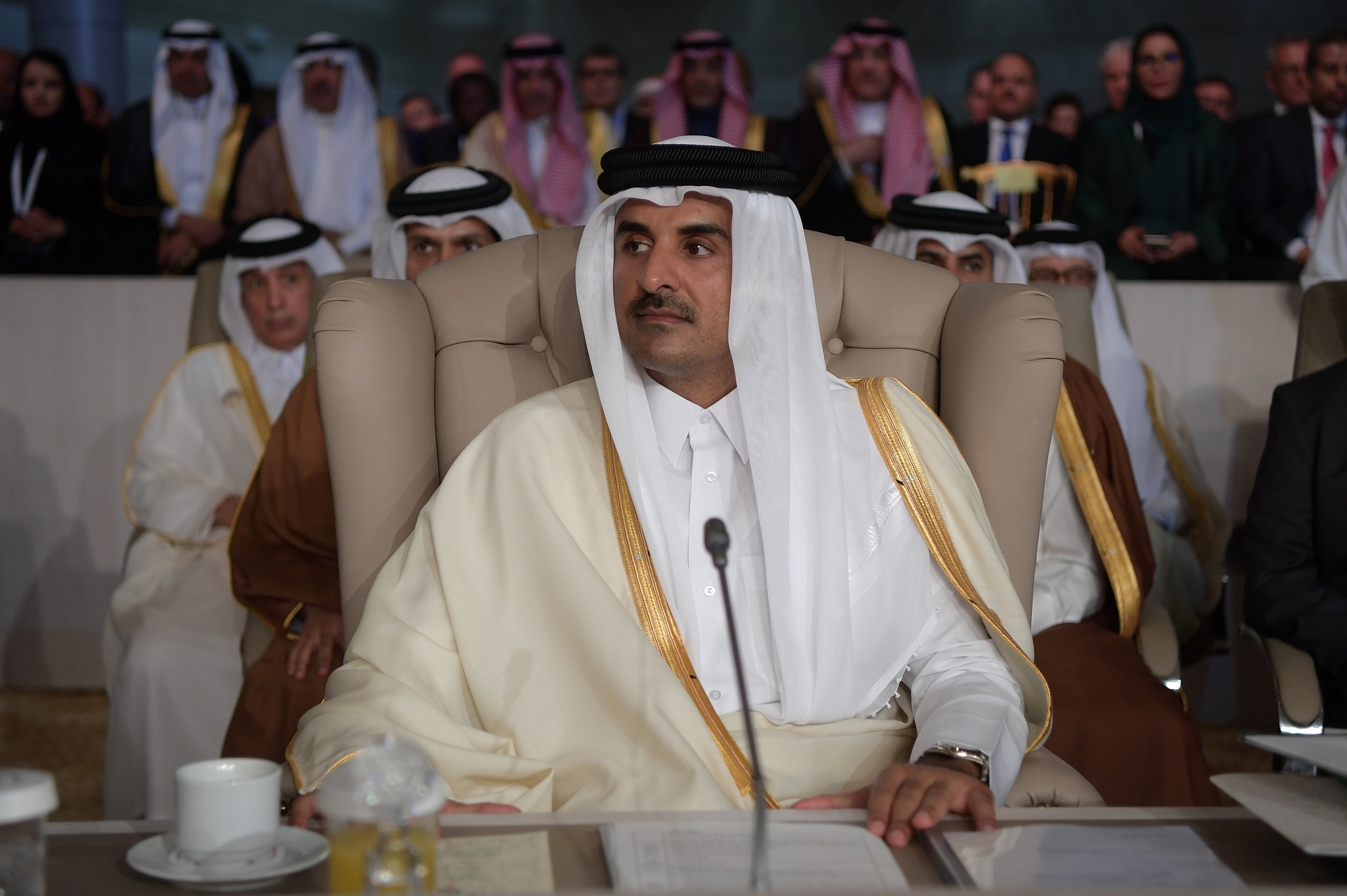
Qatar’s Emir Sheikh Tamim bin Hamad Al Thani attends the opening of the 30th Arab Summit in Tunis, Tunisia, March 31, 2019. (Fethi Belaid/ Pool photo via AP)

This year’s summit comes against a backdrop of ongoing wars in Syria and Yemen, rival authorities in Libya and a lingering boycott of Qatar by four fellow League members. Algeria’s President Abdelaziz Bouteflika and Sudan’s President Omar al-Bashir skipped the meeting as they contend with mass protests against their long reigns.

The Arab League is expected to consider readmitting Syria, a founding member that was expelled in the early days of the 2011 uprising against President Bashar Assad. But officials speaking ahead of the meeting said it was unlikely Syria would be welcomed back anytime soon.

The United Arab Emirates reopened its embassy in Damascus last year, and other Arab states have expressed support for restoring relations. But Saudi Arabia and Qatar have actively supported the rebels trying to overthrow Assad, and many other states view his government as an Iranian proxy that should continue to be shunned.

In a rare sign of easing tensions across another regional rift, King Salman and Qatar’s Emir Sheikh Tamim bin Hamad Al Thani sat at the same sprawling table when the heads of delegations met Sunday. It was the first time the two leaders have appeared in the same room since Saudi Arabia led the boycott of Qatar nearly two years ago over Doha’s ties to Iran and its support for regional Islamist groups.


Netanyahu to meet Putin in Moscow five days before elections

Posted April 2, 2019 by Joseph Wouk
Categories: Uncategorized

Source: Netanyahu to meet Putin in Moscow five days before elections | The Times of Israel

Iran’s efforts to entrench itself in Syria, US Golan declaration likely to dominate ‘brief’ discussion between PM and Russian leader, their second in five weeks

Russian President Vladimir Putin (R) shakes hands with Prime Minister Benjamin Netanyahu during a meeting at the Kremlin in Moscow on February 27, 2019. (MAXIM SHEMETOV / POOL / AFP)

Russian President Vladimir Putin (R) shakes hands with Prime Minister Benjamin Netanyahu during a meeting at the Kremlin in Moscow on February 27, 2019. (MAXIM SHEMETOV / POOL / AFP)

Prime Minister Benjamin Netanyahu will travel to Moscow for a meeting with Russian President Vladimir Putin later this week, his office announced on Tuesday.

The Prime Minister’s Office did not provide further details about the meeting, which is set to take place Thursday in the Kremlin — five days before Israel’s Knesset elections.

Russia confirmed the meeting.

“An agreement has been reached that on April 4 Israeli Prime Minister Netanyahu will fly to Moscow for a brief working visit. On April 4 such brief working talks will be held and the sides will synchronize their watches,” according to Kremlin spokesperson Dmitry Peskov.

Putin and Netanyahu spoke on the phone on Monday and discussed “regional issues,” the PMO said that day, without elaborating.

Netanyahu has boasted of his close personal ties to world leaders, including Putin, during the current election campaign, arguing that his diplomatic skills are unrivaled.

The last meeting of the two leaders took place in late February in the Russian capital, and marked the first significant encounter between the two since a major spat developed over a downed Russian spy plane in September. Even though the plane was shot down by Syrian air defense while aiming at an Israeli jet that was targeting an alleged Iranian installation, Moscow blamed Israel, saying the IAF used the Russian aircraft as cover and did not give the Russians proper warning of its planned strike in Syria.

Israel denies both charges.

At the time, Netanyahu stressed Israel’s absolute commitment to continue to act to thwart Iran’s efforts to military entrench itself in Syria. Tehran and Damascus are close allies of Moscow.

“The greatest threat to stability and security in the region comes from Iran and its proxies,” Netanyahu told Putin in February 27. “We are determined to continue our aggressive activity against Iran, which calls for our destruction, and against its attempts to establish itself militarily in Syria.”

Syria is likely to dominate Thursday’s talks as well, including the matter of the US administration’s recognition last week of Israeli sovereignty over the Golan Heights. Moscow condemned the decision, reiterating that it considers the territory part of Syria.

Netanyahu had credited his close ties with Putin for the success of a system allowing Israel to carry out strikes in Syria without becoming entangled with Russia, which is allied with Syria’s President Bashar Assad, but those ties reportedly took a hit in the wake of the spy plane incident.

After the February meeting, a minor disagreement over Moscow’s offer to host Israeli-Palestinian peace talks ensued. The Russian embassy in Tel Aviv said that the issue had been raised during the trip, but an Israeli official later denied this.

Quoting Russian Foreign Minister Sergey Lavrov, the embassy’s statement said that “during Prime Minister Netanyahu’s visit to Moscow, the situation in the Israeli-Palestinian settlement was discussed. We reaffirmed our position on Russia’s interest in overcoming the deadlock in this matter as soon as possible.

“Our proposal to host leaders of Israel and Palestine remains relevant. We believe that it would be at least a very important step in restoring confidence. Without this, it is impossible to count on further progress in the Israeli-Palestinian settlement,” it  said.

Russia🇷🇺 in Israel

@israel_mid_ru

During PM ‘s visit to (27/02) the situation in the Israeli-Palestinian settlement was discussed. We reaffirmed our position on ‘s interest in overcoming the deadlock in this matter as soon as possible, said. https://bit.ly/2tXs1hj  -1/3-

But in response, a senior Israeli diplomatic official told Hebrew media that “the issue was never discussed.”

During the public part of the February meeting, Putin welcomed his Israeli guest, but did not specifically mention Iran or Syria in his remarks. “It is very important that we continue to cooperate. Russia was a supporter of the establishment of Israel. We are happy to talk about the situation in the region and the security issue,” he said.

Times of Israel staff and agencies contributed to this report.


Egypt’s Israeli-Hamas deal further shakes Jordan’s Hashemite throne – DEBKAfile

Posted April 1, 2019 by Joseph Wouk
Categories: Uncategorized

Source: Egypt’s Israeli-Hamas deal further shakes Jordan’s Hashemite throne – DEBKAfile

The Hamas activists who spearhead radical Muslim Brotherhood opposition to Jordan’s King Abdullah were encouraged by Israel’s consent to the deal with Gaza’s Hamas rulers that was brokered by Egypt. They concluded from Israel’s avoidance of a large-scale military operation that their Gazan brothers’ terrorist tactics had bested the IDF’s renowned military and intelligence capabilities. They are contemplating borrowing those tactics to give the already shaky Hashemite throne in Amman a final push.

On the throne for 20 years, the 57-year old monarch’s low spirits raised alarm in Western circles during his visit to Washington in early March. King Abdullah turned down every Middle East project put before him, especially President Donald Trump’s Israel-Palestinian peace plan, when they were presented by Vice President Mike Pence, Secretary of State Mike Pompeo and the president’s special advisers Jared Kushner and Jason Greenblatt. The gloomy Jordanian King told them all not to count on him for any kind of cooperation in implementing US policies in the region.

On March 29, when Gaza was on the brink of tipping over into a major clash, the Muslim Brotherhood quietly scored a victory by pushing through the Jordanian parliament for the first time a motion voiding the natural gas contract signed with Israel by the Jordanian electricity company. In an attempt to save the deal, the royal court referred the issue to the Jordanian constitutional court for a final ruling. The Gazan Hamas’ long arm had clearly reached the Brotherhood in Jordan and succeeded in inflicting a disastrous blow to the kingdom’s economy.

King Abdullah has been trying to ward of the extremists’ threats by distancing Amman from Washington and Jerusalem. He has publicly slammed the Trump administration’s policies in the region and taken the lead in the campaign against Israel over Temple Mount and Jerusalem.

For many years, King Abdullah counted heavily on military, intelligence and economic support to keep his kingdom afloat and stable. But now, when he is more in need of a helping hand than ever before, he is separating himself from his champions.
Two big perils are becoming uncomfortably acute:

  1. The deepening economic crisis and attendant shortages have made the population as a whole restive and antagonized the middle class which was one of the throne’s main props. Bedouin tribes, another important prop, have turned against the throne and are joining opposition protests against the king.
  2. The evolving pact between Iran and two of Jordan’s neighbors, Iraq and Syria, is bringing large Iraqi militias under Iran’s Revolutionary Guards’ command to Jordan’s back door. Abdullah has no doubt that his throne is seen as a major obstacle in the path of Iran’s expansionist drive and is therefore dispensable. As matters stand, he is running out of defenders for his kingdom against this oncoming storm after turning away from Washington and Jerusalem.


Breaking: IDF Warns of Large Scale Attack from Islamic Jihad

Posted April 1, 2019 by Peter Hofman
Categories: Uncategorized

https://www.jerusalemonline.com/breaking-idf-warns-of-large-scale-attack-from-islamic-jihad/

”Palestinian Islamic Jihad is trying to perpetrate a series of attacks on Israel in the next few hours or days”, warned unnamed IDF officers to Israel’s channel 14 television program.

”The objective of the terrorists would be to spoil the important progress that has been made towards an understanding of a ceasefire between Israel and Hamas, through the mediation of Egypt and the UN.” the sources said.

Israeli security officials have detected unusual activity by members of the military wing of Islamic Jihad in various locations along the Israel-Gaza border fence in the past few hours. The attack could include the launching of missiles made in Russia against Israeli targets. Possibly the placing of explosive charges on the border fence in the attempt to break through perpetrate a large scale.

According to reports, Hamas is not involved in these activities. IDF sources say the order to perpetrate the attack was transmitted from the Beirut,office of the leader of the Islamic Jihad, Ziad Nahla,  to the military wing of the group in Gaza

It has not been fully clarified why Islamic Jihad is interested in bringing about the collapse of the agreement with Israel, which is being negotiated through the Egyptian intelligence officers. It is possible that this is in the organization’s way of expressing dissatisfaction, or it could be a directive from Iran, which funds the Islamic Jihad, with the aim of destroying the agreement. Military sources have pointed to Islamic Jihad as responsible for the launch of the six rockets fired at Israeli communities near Gaza last Saturday night.

The Islamic Jihad denied the IDF Accusations. “These reports are not true,” the Islamic terrorist group said in a statement.

Negotiations to reach a long term cease fire between Israel and Hamas, are still being conducted by Egyptian General Ahmed Abdel Khalek, and Bugarian UN envoy for the Middle East, Nickolay Mladenov. They met with Hamas leader Ismail Haniyeh at his home in the Shati refugee camp.

Hamas’s negotiator is being led Yahya Sinwar the terrorist group’s leader in Gaza, while on the Israeli negotiator is being led by Meir Ben-Shabat.  the head of the National Security Council,

In the framework of the negotiations, Israel has reopened the two border crossings with the Gaza Strip, Erez and Kerem Shalom.

Author of New York Times Cover Story on Jewish Boycott Works for Qatar, Leading Sponsor of Terror in the World

Posted April 1, 2019 by Peter Hofman
Categories: Uncategorized

By – on

https://gellerreport.com/2019/03/nyt-boycott-jews-funds-terror.html/

We can’t run an ad in the New York Times but these savages get the cover. Think about that. Qatar is arguably the preeminent sponsor of terror in the world today. It is a benefactor of the genocidal armies of ISIS, al Qaeda, and Boko Haram; it is involved in Taliban narcotics trafficking through a relationship with the Pakistani National Logistics Cell; and profits from operating a virtual slave state. Qatar is involved in terror operations from Nigeria to Gaza to Syria to Iraq. The tiny Persian Gulf nation of Qatar – one of the wealthiest countries in the world on a per capita basis, thanks to enormous oil and natural gas reserves – has become one of the most harmful influences in the Middle East and a key supporter of terrorist groups.“The Qatari government has provided sanctuary to various members of jihadist organizations, namely the Taliban, al-Qaeda, Hamas, and the Muslim Brotherhood, allowing some of them to establish official offices on its territory. More on Qatar here.

Ironic that the New York Times would run this story on the 86th anniversary of the Nazi boycott of the Jews. And they make the same argument against the Jews as the Nazis did.

Author of NYT Anti-Israel Piece Works for Group Funded by Qatar

Critics call foul on anti-Israel advocacy masquerading as objective journalism

BY: Adam Kredo, 

The author of this Sunday’s New York Times magazine cover story about the campaign to boycott, divest, and sanction the state of Israel works for an organization whose major donor, Qatar, is also the largest state funder of the terrorist group Hamas. Other significant donors to the author’s organization, the International Crisis Group, are leading supporters of the anti-Semitic boycott movement the author describes in his piece.

The publication of the article, “How the Battle Over Israel and Anti-Semitism Is Fracturing American Politics,” represents another salvo in the New York Times‘ continuing promotion of anti-Israel writers and views.

The author, Nathan Thrall, is tied to a large network of BDS supporters that are funded into the millions by the Qatari government, which has long been engaged in efforts to spy on the American Jewish community and pro-Israel officials. Qatar’s foreign influence operations in Washington, D.C., have flown mostly under the radar, but are part of a larger proxy battle being waged by wealthy Middle Eastern governments eager to peddle influence in powerful D.C. circles.

Thrall, who the Times presents as a disinterested expert, serves as director of the Arab-Israeli Project at the International Crisis Group, or ICG, a left-leaning advocacy organization that has received around $4 million from the Qatari government in the just the last year. Qatar’s donations represent around 23 percent of ICG’s total budget. Qatar is not mentioned in Thrall’s 11,500-word piece.

ICG also has raised $1 million in the past several years from the Rockefeller Brothers Foundation, a prolific and open funder of the BDS movement in the United States.

Another significant portion of ICG’s funding—more than $5 million in the last three years—comes from the Open Society Foundations, run by liberal billionaire George Soros. Open Society funds dozens of Palestinian organizations that are prominent members of the BDS movement.

ICG’s president is former Obama administration official Robert Malley, another Israel critic who was fired from President Barack Obama’s 2008 presidential election team after he met with the Hamas terror organization. He joined the Obama administration in 2014.

Thrall has been affiliated with ICG during the bulk of his career, which dates to 2010 with bylines at the BBC, the Guardian, the Washington Post, and CNN.

In his writing, Thrall has gone to great lengths to portray Israel as an aggressor in its conflict with Palestinian terrorists.

In a 2011 dispatch in the Times, Thrall argued that Israeli policies are to blame for the violence fostered by Hamas and its terror affiliates. Numerous other reports written over the years demonstrate a clear anti-Israel bias and attempt to portray the conflict as the Jewish state’s fault, not that of the terrorists who attack it.

As Hamas attacked Israel in 2014, Thrall wrote in the Times‘ Review of Books that the terror group “demonstrated that its militancy and its willingness to endure a ferocious Israeli attack could achieve more in weeks than [Palestinian President Mahmoud] Abbas’s talks have achieved in years. During the Gaza war, Israel did not announce a single new settlement in the West Bank.”

In another 2014 report, Thrall wrote that Hamas’s terrorist bombing on Israel are the “direct result of the choice by Israel and the West.”

Thrall has openly expressed support for the BDS movement, which he claimed is the “leading cause for advocates of free speech.” Pro-Israel groups, Thrall has argued, are responsible for what he described as a “decades-long attempt” to “stifle pro-Palestinian speech in the U.S.”

Thrall’s advocacy with the Qatari-funded ICG is raising further questions about influence peddling by terror-tied governments. Critics argue that Thrall and the New York Times should disclose his ties and what appears to be a clear anti-Israel bias.

David Brog, executive director of the Maccabee Task Force and former executive director of the Christians United For Israel, or CUFI told the Free Beacon that the article is clearly framed to portray Israel in an unflattering–and factually inaccurate–manner.

“I didn’t think it was possible, but the New York Times has reached a new low,” Brog said. “This article is an extended, one-sided endorsement of Rep. Ilhan Omar’s assertion that US support for Israel is purchased with Jewish dollars. To Thrall, Israel can do no right and the Palestinians can do no wrong. He condemns Israel’s “occupation” while barely mentioning Israel’s repeated offers to exit the territory — and the serial Palestinian rejections of these offers. He criticizes Israel’s security measures without ever acknowledging the Palestinian terror that necessities them. He can’t even bring himself to admit that the Palestinian Arabs launched the 1948 War in an effort to destroy Israel — he writes that the war “erupted.” The list goes on. I’d expect more balanced and thorough reporting from a high school newspaper.”

Josh Block, a veteran pro-Israel official who serves as the CEO and president of the Israel Project, described the Times‘ failure to disclose Thrall’s biases and ICG’s funding as “horrifying.”

“It is outrageous that any newspaper, let alone one that takes itself so seriously as the NYT would commit what is such an obvious and horrifying violation of basic journalistic ethics and standards by publishing such a misleading article—presented as ‘news’—rife with falsehoods, ad hominem attacks on Jews and even including implying supporters of Israel were responsible for the Tree of Life massacre, all without acknowledging, even hiding the fact, that it is authored by a supporter of the ‘Destroy Israel Movement,’ which calls itself B.D.S., and who is employed and paid by an organization whose primary funders are leading sponsors and funders of the effort to destroy and boycott the Jewish state, starting with Qatar, followed by the Rockefellers and OSI,” Block said. “It boggles the mind. ”

The New York Times did not respond to a request for comment.

Abbas to Arab leaders: US will tell Israel to annex part of West Bank 

Posted April 1, 2019 by Joseph Wouk
Categories: Uncategorized

Source: Abbas to Arab leaders: US will tell Israel to annex part of West Bank | The Times of Israel

PA president urges Arab states to warn countries against moving their embassies to Jerusalem; calls for a ‘financial safety net’ for the PA

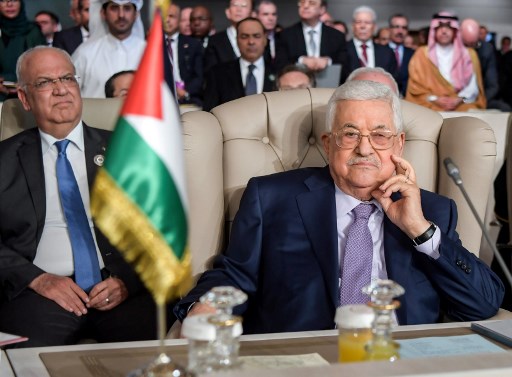
Palestinian Authority President Mahmoud Abbas (R) and and Palestine Liberation Organization (PLO) Executive Committee Secretary-General Saeb Erekat (L) attend the opening session of the 30th Arab League summit in the Tunisian capital Tunis on March 31, 2019. (FETHI BELAID / POOL / AFP)

Palestinian Authority President Mahmoud Abbas (R) and and Palestine Liberation Organization (PLO) Executive Committee Secretary-General Saeb Erekat (L) attend the opening session of the 30th Arab League summit in the Tunisian capital Tunis on March 31, 2019. (FETHI BELAID / POOL / AFP)

Palestinian Authority President Mahmoud Abbas told Arab leaders on Sunday that the United States will tell Israel to annex part of the West Bank.

Abbas made the comment less than a week after US President Donald Trump formally recognized Israeli sovereignty over the Golan Heights, but did not say when he expected the US to advise Israel to make the move.

“[The US] illegitimately announced its recognition of Israel annexing the occupied Syrian Golan… which we and the whole world reject. What is coming from the United States is even more dangerous,” Abbas said in a speech to the opening session of an Arab League summit in Tunisia. “It will tell Israel: ‘Annex part of the Palestinian land, give what remains of it self-rule and grant the Gaza Strip a nominal state for Hamas to play with.’”

Israel has not formally annexed the Golan, but rather has extended its laws to the territory, a measure considered tantamount to annexation.

A senior Israeli official said last Tuesday that US recognition of Israeli sovereignty over the Golan will help the Jewish state lay claim to other lands it captured during defensive wars. The official, whom the New York Times named as Prime Minister Benjamin Netanyahu, appeared to be hinting at potential future West Bank annexation.

Also last week, US Ambassador to Israel David Friedman warned American Jews that a future administration will not understand Israel’s need to maintain security control over the West Bank, suggesting that Trump will not force Israel to relinquish the territory that Palestinians envision as their own in a future state.

Right-wing leaders such as The New Right’s Naftali Bennett have long advocated for Israeli annexation of the so-called Area C, some 60% of the West Bank.

Arab countries including Saudi Arabia have panned the US for recognizing Israeli sovereignty over the Golan.

Israel captured the Golan and the West Bank in the 1967 Six Day War.

Abbas also urged Arab states to caution countries against moving their embassies in Israel to Jerusalem.

View of the US Embassy in Jerusalem’s Arnona neighborhood, May 13, 2018. (Yonatan Sindel/Flash90)

“We call on you again to warn against Israel’s attempts to push some countries to relocate their embassies to Jerusalem,” he said. “This issue requires that our states inform those countries that if they do that, they will be violating international law and legitimacy and endangering and harming their political and economic interests and relations with us.”

In the past year, despite fierce Palestinian opposition, the US and Guatemala have opened embassies in Jerusalem. While the Palestinians have severed ties with the White House and cut off other Trump administration channels, Arab states have made no such moves.

The Palestinians have said they hope to build their future capital in East Jerusalem. Israel has stated that the entirety of Jerusalem is its sovereign capital.

In his remarks, the PA president also appealed to Arab countries to help the Palestinians in overcoming a major budgetary shortfall.

“We urge you to work to activate previous Arab League summit decisions pertaining to providing a financial safety net” to the Palestinians, he said. “We ask you not to give up on us.”

An Arab League summit in Kuwait in 2010 approved a measure to grant the Palestinians $100 million monthly, if Israel withholds tax funds that it collects on their behalf.

In February, Israel started to implement a new law that allows authorities to withhold taxes from Ramallah equivalent to the amount that they determine the Palestinians pay to security prisoners, including terrorists, and the families of dead terrorists.

The Palestinians have protested the law, refusing to receive any of the taxes Israel gathers for them on a monthly basis, as long as the Jewish state does not transfer them their full amount.

The taxes Israel collects and transfers to the PA make up hundreds of millions of shekels, more than half of its monthly budget.

PA Finance Minister Shukri Bishara recently announced a series of austerity measures to mitigate the impact of the lack of funds on government operations.


Netanyahu welcomes Brazil plan for Jerusalem trade office as Palestinians fume

Posted April 1, 2019 by Joseph Wouk
Categories: Uncategorized

Source: Netanyahu welcomes Brazil plan for Jerusalem trade office as Palestinians fume | The Times of Israel

PA says it will recall its top envoy to Brasilia due to ‘brazen violation of international legitimacy’; President Bolsonaro to visit Western Wall on Monday

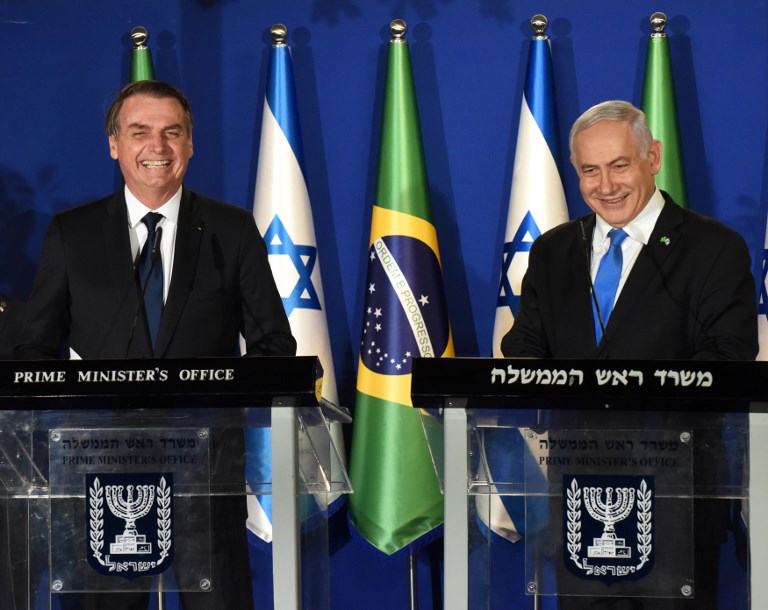
Brazilian President Jair Bolsonaro, left, and Israeli Prime Minister Benjamin Netanyahu speak during a joint press conference at the Prime Minister's Residence in Jerusalem on March 31, 2019. (DEBBIE HILL/POOL/AFP)

Brazilian President Jair Bolsonaro, left, and Israeli Prime Minister Benjamin Netanyahu speak during a joint press conference at the Prime Minister’s Residence in Jerusalem on March 31, 2019. (DEBBIE HILL/POOL/AFP)

Prime Minister Benjamin Netanyahu on Sunday told visiting Brazilian President Jair Bolsonaro that he hopes Brazil’s decision to open a trade office in Jerusalem will be the first step in the relocation of its embassy to the Israeli capital.

The opening of the office — announced earlier in the day — was strongly denounced by the Palestinian Authority, which said it will recall its senior envoy to Brazil in protest.

Earlier on Sunday, the Brazilian Ministry of Foreign Affairs said the new office in Jerusalem will “promote trade, investment, technology and innovation as a part of its embassy in Israel.”

Bolsonaro has previously pledged to move his country’s embassy to Jerusalem, but the relocation appears to be on hold and he has made no mention of the possible move since arriving in the country.

“I congratulate you on the decision to open a trade and developing technology office, an official office of the Brazilian government, in Jerusalem,” Netanyahu said at a press conference on Sunday night after meeting with Bolsonaro at the Prime Minister’s Residence in Jerusalem.

“I hope that is a first step toward the opening, in time, of the Brazilian embassy in Jerusalem,” Netanyahu continued.

During meetings between the leaders and senior officials, the two countries signed six bilateral agreements, including on defense cooperation, public safety and technology.

Said Netanyahu: “We signed many agreements but the most important agreement is the agreement in the heart. We feel a partnership of values and of outlook in all areas.”

“Brazil has taken a turn,” Bolsonaro said. “Ideological issues are no longer relevant. We want to intensify our trade with everyone.”
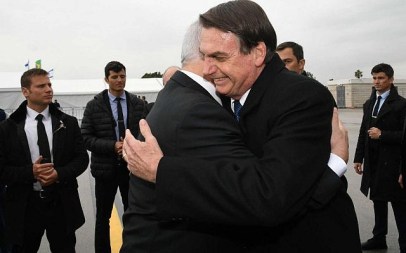
Prime Minister Benjamin Netanyahu greets visiting Brazilian President Jair Bolsonaro after his arrival in Israel, March 31, 2019. (Haim Tzach/GPO)

The PA Foreign Ministry responded by saying it intends to recall its top diplomat in Brasilia in protest of the announcement.

“We will be communicating with our ambassador in Brazil in order to recall him for consultations and in order to take the appropriate decisions to confront such a situation,” a ministry statement said.

The planned trade mission is “a brazen violation of international legitimacy and resolutions, direct aggression against our people and its rights and an affirmative response to Israeli-American pressure aimed at reinforcing the occupation, settlement building and the Judaization of occupied Jerusalem,” the statement continued.

Palestinian official Hanan Ashrawi tweeted that those who are following US President Donald Trump in his recognition of Jerusalem as Israel’s capital are in violation of international law.

“Brazil’s Bolsonaro opened a diplomatic ‘business office’ in Jerusalem following Hungary, the Czech Republic, and Honduras who also disingenuously tried to skirt the issue of Israel’s illegal annexation of Jerusalem,” she wrote. “Trump and his ilk are in violation of International Humanitarian Law and are perpetuating conflict.”

View of the US Embassy in Jerusalem’s Arnona neighborhood, May 13, 2018. (Yonatan Sindel/Flash90)

So far, the US and Guatemala are the only countries to move their embassies to Jerusalem. Paraguay moved its embassy to the city last year, but has since relocated it to Tel Aviv.

In recent weeks, several countries have opened or announced plans to open trade or cultural centers in the capital, including the Czech Republic, Hungary, and Slovakia.

Bolsonaro will walk a diplomatic tightrope during the three-day visit as he seeks to shore up ties with Netanyahu while avoiding angering key Arab trade partners.

Months after promising to move the embassy Bolsonaro has yet to announce a timetable. Moving the embassy would please Bolsonaro’s evangelical Christian support base, but would also risk provoking commercial retaliation from Arab states, some of which are major importers of Brazilian meat.

Western Wall visit

Bolsonaro was scheduled to visit Jerusalem’s Western Wall alongside Netanyahu on Monday — a controversial move in itself.

Earlier this month, US Secretary of State Mike Pompeo became the first high-ranking American official to visit the Western Wall, accompanied by an Israeli premier. Trump is the first US president to visit the site.
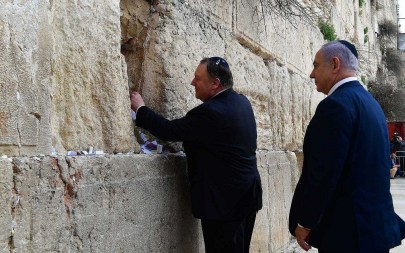
Prime Minister Benjamin Netanyahu (R) and US Secretary of State Mike Pompeo (L) at the Western Wall in Jerusalem’s Old City on March 21, 2019, during the second day of Pompeo’s visit as part of his five-day regional tour of the Middle East. (Kobi Gideon/GPO)

Such a visit by Bolsonaro could be taken as tacit approval of Israel’s sovereignty over the site, one of the holiest in Judaism, but directly adjacent to the flashpoint Temple Mount compound, the most sacred site in Judaism and third holiest in Islam.

While Israel considers all of Jerusalem its capital, Palestinians want East Jerusalem as the capital of a future state. The Palestinian leadership froze contacts with the White House after Trump’s move of the US mission.

Adam Rasgon contributed to this report.


Another burst of Hamas rocket fire, yet Israel reopens Gaza crossings, releases $300m payout – DEBKAfile

Posted April 1, 2019 by Joseph Wouk
Categories: Uncategorized

Source: Another burst of Hamas rocket fire, yet Israel reopens Gaza crossings, releases $300m payout – DEBKAfile

Israel reopened the Gaza border crossings early Sunday March 31, although five Palestinian rockets were aimed at the Eshkol district. IDF tanks hit back at Hamas positions in northern and central Gaza. There were no casualties but damage on the Israeli side.

Although the usual terrorist and IDF tit-for-tat show goes on – and Hamas leader Yahya Sinwar pledged more of the same, only worse – Israel appears to be going forward nevertheless with lavish concessions for Gaza – rewards for what Israel officials are commending as Hamas’ “self-restraint” in keeping the March of the Million on Saturday within bounds.

DEBKAfile reports exclusively that the Netanyahu government has consented to the UN beginning to draw on the $300m fund for Gaza Strip’s economic development accumulated from donations by different countries. Expenditure on projects will be overseen by Nickolay Mladenov, UN Special Coordinator for Middle East Peace Process.

Generous Israeli benefits and Hamas promises make up a new understanding for which the Egyptian mediators are now working on a timetable. They are listed here by DEBKAfile:

  • Expansion of the flow of food supplies crossing into the Gaza Strip as well as building materials, which Israel restricted in the past as they were used for terror tunnels.
  • Discussions on a maritime line linking Gaza to a port in Cyprus or Egypt.
  • Hamas will halt its attacks on IDF forces defending the border fence.
  • Palestinian rocket fire against Israel will cease.
  • No more explosive balloon assaults.
  • The IDF will exercise restraint against Palestinian “demonstrators” pushing against the border fence. This is taken to mean and end to live fire.
  • Egypt, Jordan and Saudi Arabia will twist the arm of Palestinian Authority chairman Mahmoud Abbas to release the funds he has been holding back from the Hamas regime for covering its payroll and Gaza’s electricity bills.
  • A permanent Egyptian mission will be established in Gaza City to monitor the new accord’s implementation. Its members, high-ranking Egyptian intelligence officers, were present on the ground during the Saturday demonstration.
  • No truce will be announced between Israel and Hamas. At a later date, they will announce that they are reverting to the understandings reached after Defensive Shield, Israel’s last major counter-terror operation in Gaza in 2006.