A bittersweet operation: How ISIS and Russia played a role in returning a fallen soldier to Israel

Posted April 4, 2019 by Joseph Wouk
Categories: Uncategorized

Source: A bittersweet operation: How ISIS and Russia played a role in returning a fallen soldier to Israel

20 sets of remains arrive in Israel after two years of work; Moscow facilitated operation initiated in Israel by Lieberman; only match so far is Baumel
The remains of Zachary Baumel, repatriated Wednesday 37 years he went missing during the First Lebanon War, were just one of 20 sets of remains that arrived in Israel as part of Operation Bittersweet Song.Despite hopes that some of the remains belong to Zvi Feldman and Yehuda Katz, two other soldiers who went missing during the June 1982 Battle of Sultan Yacoub, the forensic institute in Abu Kabir was only able to identify Baumel’s remains so far. One of the 20 sets of remains does not appear to belong to any of the Israeli MIAs.

Zachary Baumel

Zachary Baumel

The operation was made possible by Israel’s close cooperation with Russia, a close ally of Damascus, and took two years to complete.

Former defense minister Avigdor Lieberman, who enjoys close ties with Moscow, was the one who pushed for the operation, a major intelligence – operated feat, to take place.The operation came to a halt in mid September, when Israel’s relationship with Russia went sour over the accidental downing of a Russian military aircraft in Syria, that Moscow attributed to Israel and Israel, attributed to Syrian forces. It recuperated when the two countries’ relationship slowly went back to its track.

After the diplomatic ordeal, Russia’s defense ministry spokesman said in a press conference that Israel has asked for his county’s help in an operation to seek the remains of missing soldiers. Israel declined to address the remarks.

According to reports in Lebanon’s Al Mayadeen news channel, Baumel’s remains were identified in the Yarmuq refugee camp near Damascus, following the withdrawal of Islamist terror group ISIS from the area.

The Battle of Sultan Yacoub took place on the sixth day of the First Lebanon War, known in Israel is Operation Peace for Galilee. Israel suffered 20 confirmed losses in the battle, as well as dozens of wounded. Six soldiers were unaccounted for, including Feldman, Baumel, and Katz.

The fates of the other three soldiers were later discovered: One was killed in the battle and buried in Syria, with his body being returned to Israel after the war; another was captured by the Syrians and freed two years later; and the third was captured by a terrorist organization and freed via a prisoner exchange deal that took place three years later.


Putin: Syria helped Russian army find remains of IDF soldier missing since 1982

Posted April 4, 2019 by Joseph Wouk
Categories: Uncategorized

Source: Putin: Syria helped Russian army find remains of IDF soldier missing since 1982 | The Times of Israel

Netanyahu thanks Moscow for its assistance in search for Israeli serviceman Zachary Baumel, who went missing in Battle of Sultan Yacoub

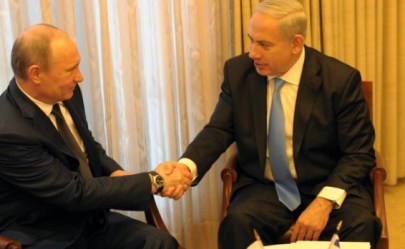
Russian President Vladimir Putin (R) shakes hands with Prime Minister Benjamin Netanyahu during a meeting at the Kremlin in Moscow on February 27, 2019. (MAXIM SHEMETOV / POOL / AFP)

Russian President Vladimir Putin (R) shakes hands with Prime Minister Benjamin Netanyahu during a meeting at the Kremlin in Moscow on February 27, 2019. (MAXIM SHEMETOV / POOL / AFP)

Russian President Vladimir Putin on Thursday said his country’s military, with Syrian assistance, retrieved the remains of Israeli tank commander Zachary Baumel, allowing them to be returned to the Jewish state nearly 37 years after he went missing in the First Lebanon War’s Battle of Sultan Yacoub in 1982.

“Russian Army soldiers found the body in coordination with the Syrian military,” Putin said, during a joint press conference with Prime Minister Benjamin Netanyahu.

The Russian defense ministry presented Israel with Sgt. First-Class Baumel’s jumpsuit and military boots in an Israeli flag-covered coffin in a ceremony later in the day.

Netanyahu flew to Moscow early Thursday to meet the Russian leader for discussions on Syria and Iran.
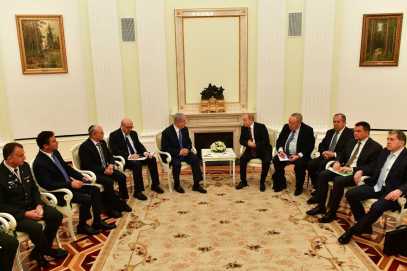
Prime Minister Benjamin Netanyahu, accompanied by senior defense officials, meets with Russian President Vladimir Putin and his advisers in Moscow on April 4, 2019. (Koby Gideon/GPO)

During the press conference, Netanyahu thanked Putin, saying Russian soldiers had “risked their lives” in order to bring back the remains, confirming the key role Moscow played in the search effort for the remains not only of Baumel but also of two other IDF soldiers missing since the same battle. Until then, Israeli officials were only permitted to say that a “third country” had assisted in the effort, without specifying which.

“Two years ago, I asked you to help us find the bodies of missing Israeli soldiers, and you responded in the affirmative. I want to thank you, my friend, for what you have done,” Netanyahu told Putin.

Prime Minister Benjamin Netanyahu meets with Shimon Baumel, the brother of the slain Sgt. First Class Zachary Baumel, in Jerusalem on April 3, 2019 (Haim Zach/GPO)

The prime minister added that Baumel’s family, whom he met with Wednesday night before departing for Moscow, had asked him to pass along their appreciation for the contribution of the Russian military as well.

“When I told them about your decision and the fact that Russian soldiers performed the activities, sometimes while putting themselves at risk, their jaws dropped, and they asked me to express their deep gratitude, which is gratitude from all citizens of Israel,” Netanyahu said.

The Russian president confirmed that the effort to find the remains “was difficult for the special forces.”

In September, the Russian defense ministry said one of its soldiers had been injured in the operation.

“Terrorists suddenly attacked the Russian servicemen involved in the operation. One Russian officer was wounded. Despite that, Russia was willing to carry on with the operation,” Russian defense ministry spokesman Maj. Gen. Igor Konashenkov said.

After a complex and secret operation, dubbed “Bittersweet Song,” Baumel’s remains were returned to Israel on an El Al plane via an unnamed third country earlier this week, a military spokesman said Wednesday.
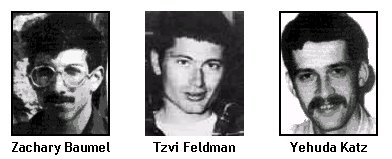
Missing in Action Israel Defense Forces soldiers Zachary Baumel, Zvi Feldman and Yehuda Katz. (The International Coalition for Missing Israeli Soldiers)

Baumel’s funeral was scheduled for 7 p.m. Thursday at Jerusalem’s Mount Herzl military cemetery, according to the Israel Defense Forces.

The announcement brought to a close a decades-long mission by Baumel’s Jerusalem-based, American-born parents to find their son, which included international pressure campaigns and faint hopes that he may have been captured alive during the brutal Sultan Yacoub tank battle.

Yona Baumel, Zachary’s father, died 10 years ago; his mother Miriam is 90 years old.

Netanyahu told a press conference on Wednesday that Baumel’s remains were recovered along with his tzitzit ritual fringes, and tank jumpsuit.

“This is a repayment of a moral debt to the fallen soldiers of the IDF, a repayment of a moral debt to their families,” said Netanyahu, calling it “one of the most moving moments in all my years as prime minister.”

In 2016, an Israeli tank lost in the battle was also returned to Israel by Russia.
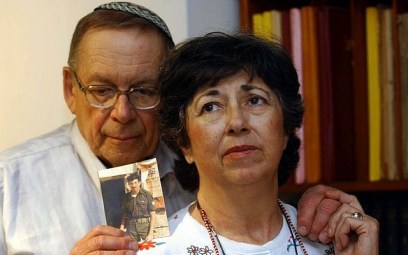
Miriam and Yoni Baumel in 2003 holding a picture of their son Zachary, who has been missing in action since 1982. (photo credit: Flash90)

Miriam and Yoni Baumel in 2003 holding a picture of their son Zachary, who had been missing in action since 1982. (Flash90)

Tank commander Baumel, a Brooklyn-born immigrant, was one of three Israeli soldiers whose bodies were never recovered following the battle of Sultan Yacoub, a skirmish between the Israel Defense Forces and Syrian army in Lebanon’s Bekaa Valley, in which 21 Israeli servicemen were killed and more than 30 were injured.

Though Baumel and the other two soldiers — Zvi Feldman and Yehuda Katz — were generally believed to have been killed in the battle, there was also speculation and reports that they were captured by the Syrian military in Sultan Yacoub and brought to Damascus.

The remains of Feldman and Katz were not recovered in Operation Bittersweet Song, though Israeli officials initially thought Feldman’s body might have been among the other remains recovered in the operation, according to the Haaretz newspaper.

The announcement regarding Baumel was delayed until officials could rule out that possibility, Haaretz said.

According to a Channel 13 news report Wednesday, Baumel’s body was returned together with the remains of at least 10 other people.

A commander of a Palestinian terrorist group in Syria said WednesdayBaumel’s remains were uncovered by armed factions at a Palestinian refugee camp outside Damascus.

Prime Minister Benjamin Netanyahu meets with Osna Haberman, sister of the slain Sgt. First Class Zachary Baumel, in Jerusalem on April 3, 2019 (Haim Zach/GPO)

Medical examiners at the Abu Kabir Forensic Institute have reportedly examined most of the other bodies brought back, and have concluded that none of them were Feldman or Katz. The Channel 13 report said one body had yet to be ruled out as either of the two Israeli soldiers.

Katz’s sister told Israeli television on Wednesday the family was holding out hope that he is alive.


No stone left unturned

Posted April 4, 2019 by Joseph Wouk
Categories: Uncategorized

Source: No stone left unturned – www.israelhayom.com

There are very few countries in the world, if any, who after 37 years would continue searching for their missing soldiers, let alone jeopardize intelligence assets in the process.

In the world of intelligence, the saying goes, reality often exceeds the imagination, and yet – the operation to return Zachary Baumel’s remains to Israel, in a mission that spanned the globe, can easily be considered one of the most impressive in the country’s history.

Israeli officials have long known where Baumel was buried. The matter of our missing soldiers was also raised on many occasions with foreign governments, primarily in the midst of peace talks with Syria and the Palestinians. After the Oslo Accords were signed, Yasser Arafat even transferred one of Baumel’s dog tags to Israel, but nothing more ever materialized. Syria has always said it would agree to resolve the mystery, but only parallel to receiving the Golan Heights in return, as part of a peace agreement between the countries.

A little over a year ago, the issue was again raised by then-Defense Minister Avigdor Lieberman. If the reports are true that Russia was involved in the operation, we can assume that Lieberman spoke with his counterpart in the Russian defense ministry, Sergei Shoigu. It appears that this time the response was different, and the Russians agreed to lend a hand. Either way, Israeli officials began working vigorously. In a series of intelligence operations, the Military Intelligence Directorate (Aman) and Mossad pinpointed Baumel’s exact resting place. All the information was gathered into a classified file under the codename “Bittersweet Song.”

According to the reports, we can assume Israel and Russia exploited the fact that Syria was mired in a civil war. Syrian President Bashar Assad, focused almost entirely on his own survival in recent years, couldn’t have prevented Russia from doing as it pleased on Syrian soil – even if he had wanted to – because Moscow had rescued his regime. We can also assume that an operation of this sort is managed at the highest levels on both sides, spearheaded by the respective army chiefs of staff (first Gadi Eizenkot and then Aviv Kochavi in Israel and Valery Gerasimov in Russia). Assuming this was the case, the operation also survived the diplomatic crisis between Israel and Russia following the downing of a Russian military plane last September – for which Russia explicitly blamed Israel.

The Russian defense ministry spokesman confirmed that Russian solider worked on the matter for months. In retrospect it sounds simple, but Russia did something that many countries likely wouldn’t have: put its own people in harm’s way for another country’s humanitarian cause. If this is what happened, it means Russian soldiers were the ones to carry out, over a significant period of time, the physical search for Baumel’s remains. Once the green light was given, the body was flown to a third country and from there – after an IDF team conducted DNA tests – it was flown to Israel aboard an El Al plane.

In Israel on Wednesday, officials stressed that nothing was given in exchange for Baumel’s return. It’s safe to assume that Prime Minister Benjamin Netanyahu, during his short visit to Moscow on Thursday, will heap praise on his Russian hosts, although it would be nice if he brought along Lieberman and Eizenkot – the two people who laid the foundations for the momentous operation. Netanyahu should also make further use of the mechanism that has been established – alongside crucial regional issues – to locate the remains of the other soldiers that went missing during the Sultan Yacoub battle, Yehuda Katz and Tzvi Feldman, and IAF navigator Ron Arad, whose remains are believed to still be in Lebanon.

Beyond the enormous operational drama and personal story that has now been closed with Baumel’s return home, this chapter also provides a unique lesson about Israel: There are very few countries in the world, if any, who after 37 years would continue searching for their missing soldiers, let alone jeopardize intelligence assets in the process. Israel proves time and again that it is extraordinary, and doesn’t spare any effort to solve even the most daunting mysteries. This won’t bring the dead back to life, but it will give their families a burial place over which to mourn, and the soldiers currently serving the knowledge that if heaven forbid something were to happen, the country would turn over every stone for them.


PM thanks Putin for finding remains of missing IDF soldier

Posted April 4, 2019 by Joseph Wouk
Categories: Uncategorized

Source: PM thanks Putin for finding remains of missing IDF soldier – www.israelhayom.com

The long search for the body of Staff Sgt. Zachary (Zechariah) Baumel was successful because Russian troops “risked their lives,” Israeli leader says, a day after announcing dramatic recovery.

A day after the Israel Defense Forces announced it had recovered remains of Zachary (Zechariah) Baumel, who went missing in a 1982 battle in Lebanon, Prime Minister Benjamin Netanyahu thanked Russian President Vladimir Putin for making it possible.

Speaking at the Kremlin alongside Putin, Netanyahu said Israel “thanks you for taking care of this matter by finding the remains, what you did will not be forgotten by our people.”

Netanyahu said that Baumel’s family members were overwhelmed with emotion after they were informed his remains were found.

“I told them that Russian troops risked their lives to search for his remains and they were left speechless,” Netanyahu said.

Putin responded that “this was not easy for our soldiers.”

Baumel, who immigrated to Israel with his parents from New York in 1970, was 21 when he fought in Israel’s Operation Peace for the Galilee in Lebanon and was declared missing in action (MIA) along with two other soldiers in the Battle of Sultan Yaaqub, in which Israel suffered heavy casualties.

Baumel’s remains were flown to Israel by El Al Israel Airlines several days ago.

The Israel Defense Forces declined to say how or where the body of Baumel, a tank crewman and sergeant, was recovered in what was described as an intelligence operation.


Russia hands over to Israel the body of missing soldier Zachary Baumel – an action with strategic import – DEBKAfile

Posted April 4, 2019 by Joseph Wouk
Categories: Uncategorized

Source: Russia hands over to Israel the body of missing soldier Zachary Baumel – an action with strategic import – DEBKAfile

( He was killed in the first war I fought in. – JW )

The remains of Sgt. Maj. Zachary Baumel, who was killed in the battle of Sultan Yaaqub in Lebanon 37 years ago, has been returned to Israel. The IDF spokesman announced the missing soldier’s recovery a day before Prime Minister/ Defense Minister Binyamin flies to Moscow to meet Russian President Vladimir Putin, and six days before Israel’s general election. DEBKAfile reports that it was handed over to Israel by Russian officials.

Baumel was one of six soldiers missing from the Sultan Yaqoub battle in the Lebanese Beqaa Valley that took place on June 11, 1982, during the First Lebanon War against a large Syrian force r. Twenty Israeli soldiers were killed in the battle. Two, Zvi Feldman and Yehuda Katz, are still missing. Baumel’s body was brought to Israel by an El Al flight. He has been positively identified. Zachary and his family migrated to Israel from the United States. His mother and two siblings were informed of the event. His father died some years ago. A military funeral with full honors is being arranged.

DEBKAfile reports that the handover of the missing soldier represents an exceptional gesture of goodwill by President Vladimir Putin towards Israel and its prime minister, and accentuates his intention to give Israel a role in determining Syria’s future. It follows on his decision during a former meeting on Feb. 17, which lasted three hours, to establish a joint committee for dealing with the withdrawal of all foreign troops from Syria. This brought Israel for the first time into the decision-making process regarding an Arab nation. That accord appears to have opened the door for President Donald Trump to recognize Israeli sovereignty in the Golan.

Our sources also reveal that, since 2016, Russian intelligence and special forces officers have been working diligently to uncover the whereabouts of the Israeli soldiers missing from the Battle of Sultan Yaaqub and restore their remains to Israel.

On Sept. 17, 2018, Russian Defense Minister Sergei Shoigu incidentally spoke of Russian soldiers who were injured while searching for Israel MIA’s in Palmyra. He made this reference during a bitter diatribe against Israel whom he accused of responsibility for the downing of the Russian IL-20 spy plane opposite Latakia.

The battle of Sultan Yaaqub in the Lebanese Beqaa Valley was the Israeli army’s only encounter with a Syrian force during the 1982 Lebanon war. The IDF unit was vastly outnumbered in troops and tanks. Baumel, Zvi Feldman and Yehuda Katz, were in the Israeli tank that was hit. On May 29, 2016, Moscow handed the tank to Israel. It is on exhibit at the IDF museum. Syrian’s motive in letting the Russians have the tank was for its engineers to discover the armor and electronic systems developed by Israel.


Report: Hamas, Islamic Jihad order end to Gaza border attacks

Posted April 3, 2019 by Joseph Wouk
Categories: Uncategorized

Source: Report: Hamas, Islamic Jihad order end to Gaza border attacks

Haniyeh says ‘no reason’ why Hamas cannot discuss prisoner swap, likely involving fallen IDF soldiers, captive civilians; Hamas boss hints that Egypt-mediated talks with Israel progressing well
Militant groups in the Gaza Strip, which are dominated by Hamas and Islamic Jihad,  have ordered their members to stop all launches of firebombs towards Israeli communities on the opposite side of the border, Palestinian newspaper al-Quds reported Wednesday.

All Hamas and Islamic Jihad men were also ordered to end their nightly disturbances along the Gaza border fence, the report said, as well as the use of explosives during riots along the border. The new directives are in line with the understandings being reached with Israel under Egyptian mediation.

Hamas leaders Yahya Sinwar and Ismail Haniyeh attend last weekend's March of Return protests on the Gaza border

Hamas leaders Yahya Sinwar and Ismail Haniyeh attend last weekend’s March of Return protests on the Gaza border
Also Wednesday, Hamas leader Ismail Haniyeh said that efforts to reach an arrangement with Israel, following last week’s flare-up in the Gaza border region, are progressing well, and that a prisoner swap is not out of the question.“Understandings regarding the ceasefire and the removal of the blockade on the Strip are progressing,” Haniyeh said in an interview with Palestinian newspaper al Istiqlal. “Yesterday we got the schedule for the implementation of many issues that are part of the arrangement.”

Hamas is currently holding the remains of two Israeli soldiers who fell in the 2014 Gaza war, Hadar Goldin and Oron Shaul, as well as two Israeli civilians who entered the Strip of their own accord, Avera Mengistu and Hisham al-Sayed. The families of the four have urged the government to take steps to secure their return.

Haniyeh said that Qatar, Egypt and the United Nations are supporting the negotiation process. Egypt is mediating the negotiations, as there are no direct ties between Israel and Hamas.

“There is no reason why we can’t discuss a prisoner swap through outside mediators,” Haniyeh said, but added that the current understandings do not include such a deal.

An airborne firebomb launched at the Israeli border during Saturday's March of Return protests on the Gaza border (Photo: AFP) (Photo: AFP)

An airborne firebomb launched at the Israeli border during Saturday’s March of Return protests on the Gaza border (Photo: AFP)

On Tuesday, Haniyeh said that his organization has given Israel a series of demands regarding its security prisoners, jailed in Israel, who are set to begin a hunger strike next week.

The demands were passed to Israel by the Egyptian delegation, and included the removing the cell phone jamming device for prisoners, lifting recent sanctions on the prisoners, restoring visits and improving prison conditions.

Illustrative: Prison Service guards searching cells of Hamas prisoners (Photo: IPS) (Photo: Israel Prison Service)

Illustrative: Prison Service guards searching cells of Hamas prisoners (Photo: IPS)

According to Hamas, some of the understandings with Israel regarding the Gaza Strip will be implemented before the elections on April 9, and some afterwards.

The understandings that will be implemented before the elections are the simpler ones, such as expanding the fishing area off the Gaza coast (already done); easing restrictions on exported goods from Gaza; improving the electricity supply by operating the turbines at the power plant; and beginning projects that will provide temporary employment.

The understandings that will be implemented after the elections include the construction of another power line from Israel to Gaza within six months and the construction of a gas pipeline to the Gaza power plant within a year. In addition, the Palestinians are demanding the establishment of infrastructure and alternative energy projects.

The timetables will be presented to representatives of the Palestinian factions in Gaza, who will announce whether they accept or reject them.


With Turkish loss of the F-35, Israel keeps its aerial superiority

Posted April 3, 2019 by Joseph Wouk
Categories: Uncategorized

Source: With Turkish loss of the F-35, Israel keeps its aerial superiority – Arab-Israeli Conflict – Jerusalem Post

Washington halts F-35 equipment over Turkey’s instance to buy the Russian S-400 missile defense system.

BY ANNA AHRONHEIM
 APRIL 3, 2019 17:15
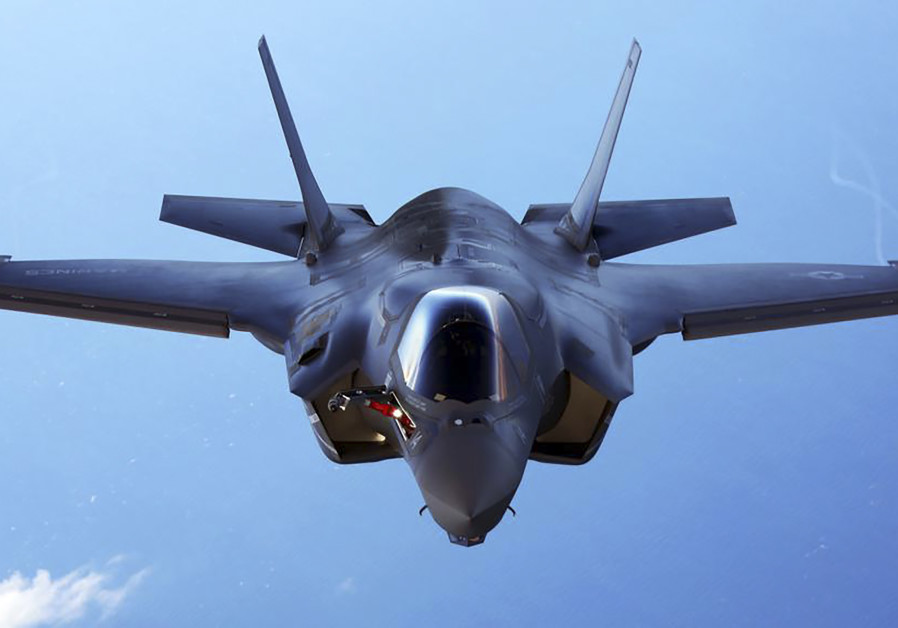
A U.S.Marine Corps F-35B joint strike fighter jet conducts aerial maneuvers

The Pentagon’s decision to stop the delivery of equipment related to the F-35 stealth fighter jet to Turkey due to Ankara’s decision to purchase the Russian-made S-400 air defense system will allow Israel to keep it’s aerial superiority in the Middle East.

Washington’s move follows repeated warnings both from the United States and NATO allies to Ankara that buying the Russian system alongside the Lockheed Martin-produced jets would threaten the security of the F-35s by learning how to spot and track it.

Israel, which also has fragile relations with Turkey, currently has 14 F-35 Adir jets and is expected to receive a total of 50 planes to make two full squadrons by 2024.

According to foreign reports, Israel has already quietly tested ways to defeat the advanced Russian air defense system, participating in several joint drills with the Greek Air Force over the island of Crete where one system is stationed. The drills have reportedly allowed Israeli warplanes to gather data on how the advanced system may be blinded or fooled.

But there are fears that the radar on the S-400 systems bought by Turkey, which has entered into a sort of alliance with Russia and has been in close cooperation with Iran, could learn the weak spots in the jet and make it less able to evade Russian weapons in the future.

The top uniformed officer in NATO and the head of American forces in Europe, General Curtis Scaparrotti warned in March during testimony to the Senate Armed Services Committee that Ankara’s purchase of the S-400 presents a problem for not only the F-35 but to all American aircraft.

“My best military advice would be that we don’t then follow through with the F-35: flying it or working with an ally that is working with Russian systems, particularly air defense systems, with one of our most advanced technological capabilities,” Scaparrotti was quoted by Defense News as saying.

Built by Lockheed Martin, the jets have an extremely low radar signature allowing them to operate undetected deep inside enemy territory as well as to evade advanced missile defense systems like the S-300 and S-400.

The already fragile relations between Israel and Turkey have been increasingly strained in recent months as Turkish President Tayyip Erdogan, a vocal critic of Israel’s policy toward the Palestinians, has intensified his rhetoric.

Israeli officials have voiced concern over Turkey’s purchasing of the jets, with one senior defense official quoted by Haaretz in August as saying that Israel would like to be the only country in the Middle East with the F-35 in order to keep its qualitative military edge and out of fears that the jet’s capabilities would be leaked to enemy countries.

Ceng Sagnic from the Moshe Dayan Center in Tel Aviv told The Jerusalem Post that while Moscow might be “hesitant” to share the knowledge of the jet which might be gained by its S-400, it couldn’t be ruled out.

“Moscow would definitely be hesitant to share the military “secrets” it has obtained with a third party. But in the event of a major dispute in the region or a potentially expanded Moscow-Tehran alliance, transfer of knowledge on US weapon systems to Tehran can well be a topic of discussion,” he said.

According to Sagnic, it is impossible to estimate the extent of Ankara’s “cloudy relations” with Moscow.

“The presence of both F-35s and S-400s can also come with a similar outcome itself. If Turkey had purchased F-35s from the US and S-400s from Russia, the situation would partially resemble Greece – where the coincidental presence of S-300 systems allowed, according to foreign reports, NATO and Israel to carefully study these weapons,” he said, adding that “in the case of Turkey, although it would stay a member of NATO, the future extent of its relations with Russia cannot be estimated and Ankara could well remain pressured by Moscow to allow such studies. Given that Turkey is and will be a country of crises – and therefore is mostly prone to Russian pressure – the possibility increases even further.”

Israel became the first air force outside the United States to declare Initial Operational Capability (IOC) of the jet in 2017. Last year, IAF chief Maj.-Gen. Amikam Norkin announced that Israel has struck targets in the Middle East with the F-35 Adir jet twice, making the Jewish state the first country to use the stealth fighter in a combat role in the region.

According to Sagnic, “Turkey must be seriously thinking that Israel may be behind the cancellation of the F-35 deal in order to preserve its air superiority. However, for the domestic politics, Ankara needs a “usual suspect” to blame, as blaming the US cannot be enough to explain the disruption in one the biggest weapons agreement Turkey has signed.”

As a Level-3 partner in the multinational F-35 program, Turkey invested over $1 billion on the jet, with several local companies producing components for the aircraft including fuselages and cockpit screens such as Alp Aviation, AYESAS, Kale Aviation, Kale Pratt & Whitney and Turkish Aerospace Industries.

Turkish defense companies also produce high-end SOM-J missiles for the Joint Strike Fighter (JSF) program and Turkey is Europe’s maintenance and repair center for F-35 fighter aircraft manufactured under the JSF plan.

Ankara took delivery of its first F-35 in June at a ceremony in Texas and the country plans to purchase 100 stealth jets in the coming years. Turkish pilots have already been learning to fly the jet training alongside U.S. pilots at Luke Air Force Base, Arizona. Ankara is holding onto hope that the two more jets expected to be handed over this month will actually be delivered.


The Yom Kippur War Documentary 

Posted April 3, 2019 by Joseph Wouk
Categories: Uncategorized


From the TV series “Modern Warfare.”


US envoy: Three waiver countries cut Iran oil imports to zero

Posted April 3, 2019 by Joseph Wouk
Categories: Uncategorized

Source: US envoy: Three waiver countries cut Iran oil imports to zero

Official says Trump administration not issuing any more exceptions to initial eight nations who could buy Iranian oil, but current ones could be extended
WASHINGTON – Three of eight countries granted waivers by Washington to import oil from Iran have now cut the imports to zero, a US official said Tuesday, adding that improved global oil market conditions would help reduce Iranian crude exports further.
The United States reimposed sanctions on Iran after US President Donald Trump last May withdrew the country from a 2015 nuclear deal between Iran and several world powers, accusing it of supporting terrorism and conflicts in Syria and Yemen.

US President Donald Trump and his Iranian counterpart Hassan Rouhani

US President Donald Trump and his Iranian counterpart Hassan Rouhani

While the United States has set a goal of completely halting Iran’s oil exports, it granted temporary import waivers to China, India, Greece, Italy, Taiwan, Japan, Turkey and South Korea to ensure low oil prices and no disruption to the global oil market.

The Trump administration is currently in consultations with the countries ahead of a May 2 deadline when the waivers expire.

“In November, we granted eight oil waivers to avoid a spike in the price of oil. I can confirm today three of those importers are now at zero,” Brian Hook, the special US envoy for Iran, told reporters.

Hook did not identify the three countries.

“There are better market conditions for us to accelerate our path to zero,” Hook said. “We are not looking to grant any waivers or exceptions to our sanctions regime.”

Hook said US oil sanctions against Iran removed about 1.5 million barrels of Iranian oil exports off the market since May 2018.

EU Foreign Policy Chief Federica Mogherini and Iranian FM Javad Zarif (Photo: AFP)

EU Foreign Policy Chief Federica Mogherini and Iranian FM Javad Zarif (Photo: AFP)

“This has denied the regime access to well over $10 billion in (oil) revenue – a loss of at least $30 million a day,” he said.

Oil prices on Tuesday hit their highest level so far in 2019, with Brent crude approaching $70 a barrel on the prospect that more sanctions against Iran and Venezuelan disruptions could deepen an OPEC-led supply cut.

Analysts believe the administration is likely to extend the waivers to the remaining five countries to placate top buyers China and India and to decrease the chance of higher oil prices.

China, India, Japan, South Korea and Turkey are likely to be given waivers that could cap Iran’s crude oil exports at about 1.1 million barrels per day, US-based analysts at Eurasia Group said in January. That would remove Italy, Greece and Taiwan from the waivers list.

Hook said a decision on whether to extend the waivers would be made “in due course.” A total of 23 countries that once imported Iran oil had cut imports to zero, he added.

“With oil prices actually lower than they were when we announced our sanctions and global production stable, we are on the fast track to zeroing out all purchases of Iranian crude,” Hook said.

A senior Trump administration official told reporters on Monday that the US government was considering additional sanctions against Iran that would target areas of its economy that have not been hit before.

Hook said more than 26 rounds of US sanctions against Iran had restricted the country’s cash flow and constrained its ability to operate in the region.

Earlier on Tuesday, US Secretary of State Mike Pompeo blamed Iran’s government of mismanagement that has led to devastating flooding across the country. At least 47 people have been killed in the past two weeks from flash floods.

Israeli officials: Growing Iranian efforts to destabilize Gaza – TV7 Israel News 2.04.19 

Posted April 3, 2019 by Joseph Wouk
Categories: Uncategorized