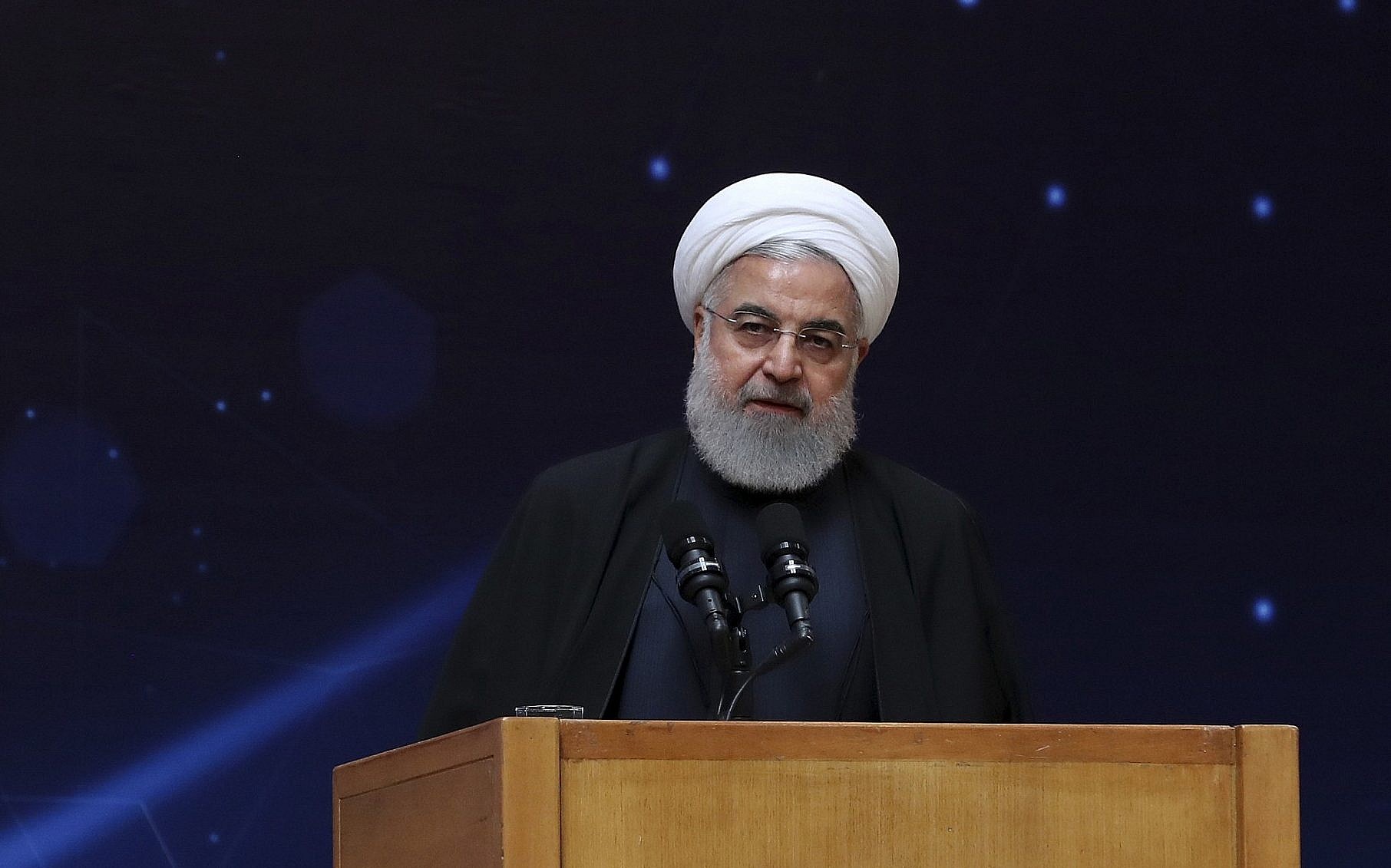
Trump: Netanyahu win a ‘good sign for peace’ 

Posted April 10, 2019 by Joseph Wouk
Categories: Uncategorized

Source: Trump: Netanyahu win a ‘good sign for peace’ – www.israelhayom.com

U.S. president, who is considered a close friend of the Israeli leader, makes congratulatory statement while speaking to reporters. Turkish Foreign Minister Mevlut Cavusoglu tells local NTV news that with election over, Israel must “abandon its aggressive stance.”

U.S. President Donald Trump said on Wednesday Israeli Prime Minister Benjamin Netanyahu’s winning re-election was “a good sign for peace.”

“Everybody said you can’t have peace in the Middle East with Israel and the Palestinians… I think we have now a better chance with Bibi having won,” Trump said.

Trump made the remarks to reporters at the White House hours after Netanyahu secured a fifth term in office, which will likely make him the longest-serving prime minister in Israeli history.

Earlier on Wednesday, Trump’s National Security Adviser John Bolton said the administration’s peace plan was likely to be released soon. “I think we’re going to see that coming out in the very near future,” Bolton said on Wednesday.

Netanyahu’s Likud party got a projected 35 seats, up from 30 in the current Knesset.

Initial exit polls initially predicted a tight race on Tuesday night, showing that the Blue and White center-left bloc would get more seats than Likud, but as the votes came in it became apparent that Likud and its allies had secured a majority in the Knesset.

An almost complete tally has both Likud and Blue and White tied at 35.

Earlier on Wednesday, Turkish Foreign Minister Mevlut Cavusoglu urged Israel to abandon strong “rhetoric and populism” now that the elections were over.

Cavusoglu’s comments were in an apparent reference to Netanyahu’s recent pledge to annex Jewish settlements in Judea and Samaria if he won the election.

The minister told Turkey’s NTV news channel on Wednesday that Israel “must put aside the populism and the rhetoric, it must abandon its aggressive stance.”

Cavusoglu also called on the United States to be an “honest broker” in the Israeli-Palestinian conflict, saying a U.S. peace plan for the region must be fair and objective toward Palestinians.

Also Wednesday, an aide to Palestinian Authority President Mahmoud Abbas said the outcome of Israel’s election raised Palestinian fears about an Israeli annexation of parts of Judea and Samaria.

Abbas aide Ahmed Majdalani says that Palestinians would seek the help of the international community to try to block any annexation plans. He said that the outcome of the election means a boost for what he called the “extreme right-wing camp” in Israeli politics.


Gantz can’t deliver on his promise to be next prime minister. Netanyahu leads majority bloc – DEBKAfile

Posted April 10, 2019 by Joseph Wouk
Categories: Uncategorized

Source: Gantz can’t deliver on his promise to be next prime minister. Netanyahu leads majority bloc – DEBKAfile

“I will be everyone’s prime minister,” Blue-White leader Benny Gantz promised in his victory speech after bypassing Binyamin Netanyahu’s Likud with 37 seats to 36 or 33, variously predicted by two TV channels’ exit polls. Gantz and his cheering followers were premature. A 20pc count of votes just after midnight gave Likud 34 seats to Blue-White’s 30, while the 97pc count early Wednesday registered a tie of 35 between them.

Although Likud and Blue-White could if they joined forces command a comfortable majority in the 120-member Knesset –  this would be a landmark event in Israel’s political history – the reality for now is that the right-of-center bloc controlled by Netanyahu can muster 8-10 seats more than the left-of-center parties willing and able to support Gantz’s bid for the premiership.

Blue-White’s four-man leadership, Benny Gantz, Yair Lapid, Moshe Ya’alon and Gaby Ashkenazi, pulled off an amazing feat by creating a brand-new political party in three months and campaigning successfully enough to win more than a million votes. At the same time, the opponent they swore to destroy came to the campaign limping badly under the burden of three threatened corruption indictments hanging over his head. Yet, Binyamin Netanyahu, in an exceptional display of political flair, actually enhanced Likud’s rating from 27 well past the 30-mark – and multiplying as real returns are counted. His victory speech following that of Gantz was greeted with hysterical applause – especially when he congratulated the new Likud MKs.

Benny Gantz, to beat him for the premiership, would have to poach heavily in the right- of-center camp to eke out a majority coalition. He would need to steal such Netanyahu loyalists as former Finance Minister Moshe Kahlon, former Defense Minister Avigdor Lieberman and at least one ultra-religious party. However, Blue-White failed in its campaign effort to win over the “soft right” which stuck with Likud in the end and drew most of its support by virtually cannibalizing the veteran Labor party, which came out of the election reduced by half.
Netanyahu, for his part, has no time to lose before building a stable coalition government out of right-wing and religious parties – no easy task, while preparing to defend himself in a hearing before the attorney general set for July, in the hope of extricating himself from the cases pending against him. Three religious parties announced on Tuesday night that they were wholeheartedly behind him; Kahlon and Lieberman, who hopes to recover the defense portfolio will also stand by Netanyahu when he establishes his fifth coalition government.


Pompeo, in testimony to Senate, refuses to back two-state solution

Posted April 10, 2019 by Joseph Wouk
Categories: Uncategorized

Source: Pompeo, in testimony to Senate, refuses to back two-state solution | The Times of Israel

After Netanyahu pledges to extend Israeli sovereignty over West Bank settlements, secretary says that ‘ultimately the Israelis and Palestinians will decide how to resolve this’

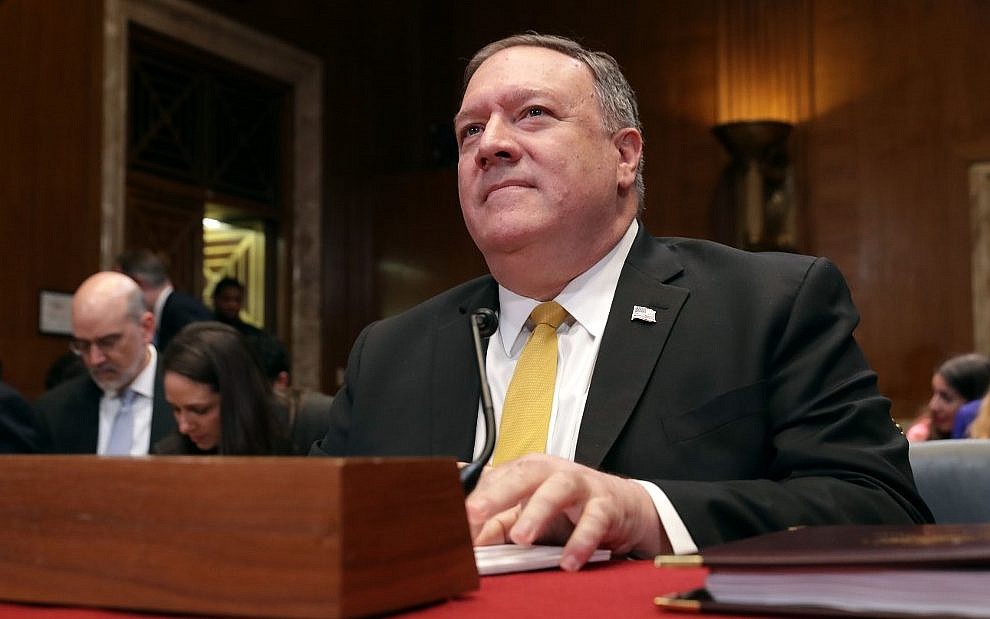
US Secretary of State Mike Pompeo appears before the Senate Appropriations Committee's State, Foreign Operations and Related Programs Subcommittee in the Dirksen Senate Office Building on Capitol Hill on April 9, 2019 in Washington, DC (Chip Somodevilla/Getty Images/AFP)

US Secretary of State Mike Pompeo appears before the Senate Appropriations Committee’s State, Foreign Operations and Related Programs Subcommittee in the Dirksen Senate Office Building on Capitol Hill on April 9, 2019 in Washington, DC (Chip Somodevilla/Getty Images/AFP)

US Secretary of State Mike Pompeo on Tuesday refused to reaffirm American support for a Palestinian state after Israeli Prime Minister Benjamin Netanyahu pledged to extend Israeli sovereignty over West Bank settlements.

Testifying before a Senate subcommittee just as Israel wrapped up tight elections, Pompeo declined to respond when Democrats asked him to back a two-state solution.

“Ultimately, the Israelis and Palestinians will decide how to resolve this,” Pompeo replied.

Pompeo said that US President Donald Trump’s aides Jared Kushner and Jason Greenblatt would soon lay out a proposal “to resolve a problem that’s been going on for decades and decades that previous administrations couldn’t solve.”

“We’re hopeful that we have some ideas that are different, unique, which will allow the Israelis and the Palestinian people to come to a resolution of the conflict,” Pompeo said.

Days before the Israeli election, Netanyahu broke precedent by saying that he planned to extend Israeli sovereignty over at least parts of the West Bank.

Prime Minister Benjamin Netanyahu promises in a Channel 12 TV interview to extend Israeli sovereignty to West Bank settlements, April 6, 2019 (Channel 12 news screenshot)

Exit poll results showed Netanyahu with a likely straightforward path to cobbling together a government and staying in power for a record fifth term. The constellation of parties will likely include the far-right Union of Right-Wing Parties, which has advocated for an extension of sovereignty.

US Senator Chris Van Hollen, a Democrat from Maryland, told Pompeo that such a unilateral Israeli move would indicate “no agreement” with the Palestinians.

“It sounds like you’ve already abandoned what has been a bipartisan foreign policy of opposing the annexation of any or all of the West Bank by Israel,” he said.

Houses under construction are seen in the West Bank settlement of Amichai on September 7, 2018. (AFP PHOTO / THOMAS COEX)

Trump has strongly supported Netanyahu and taken a series of major actions long sought by Israel, including recognizing Jerusalem as capital of the Jewish state.

Gantz criticized Netanyahu’s pledge, calling it “irresponsible” and questioning why a prime minister who has served for 13 years was making such a historic decision on the eve of an election.


With almost all votes in, Netanyahu-led right set for decisive victory

Posted April 10, 2019 by Joseph Wouk
Categories: Uncategorized

Source: With almost all votes in, Netanyahu-led right set for decisive victory | The Times of Israel

Right-wing bloc’s success gives PM edge in forming new government despite Likud tying in seats with Gantz’s Blue and White; New Right and Zehut fail to cross threshold

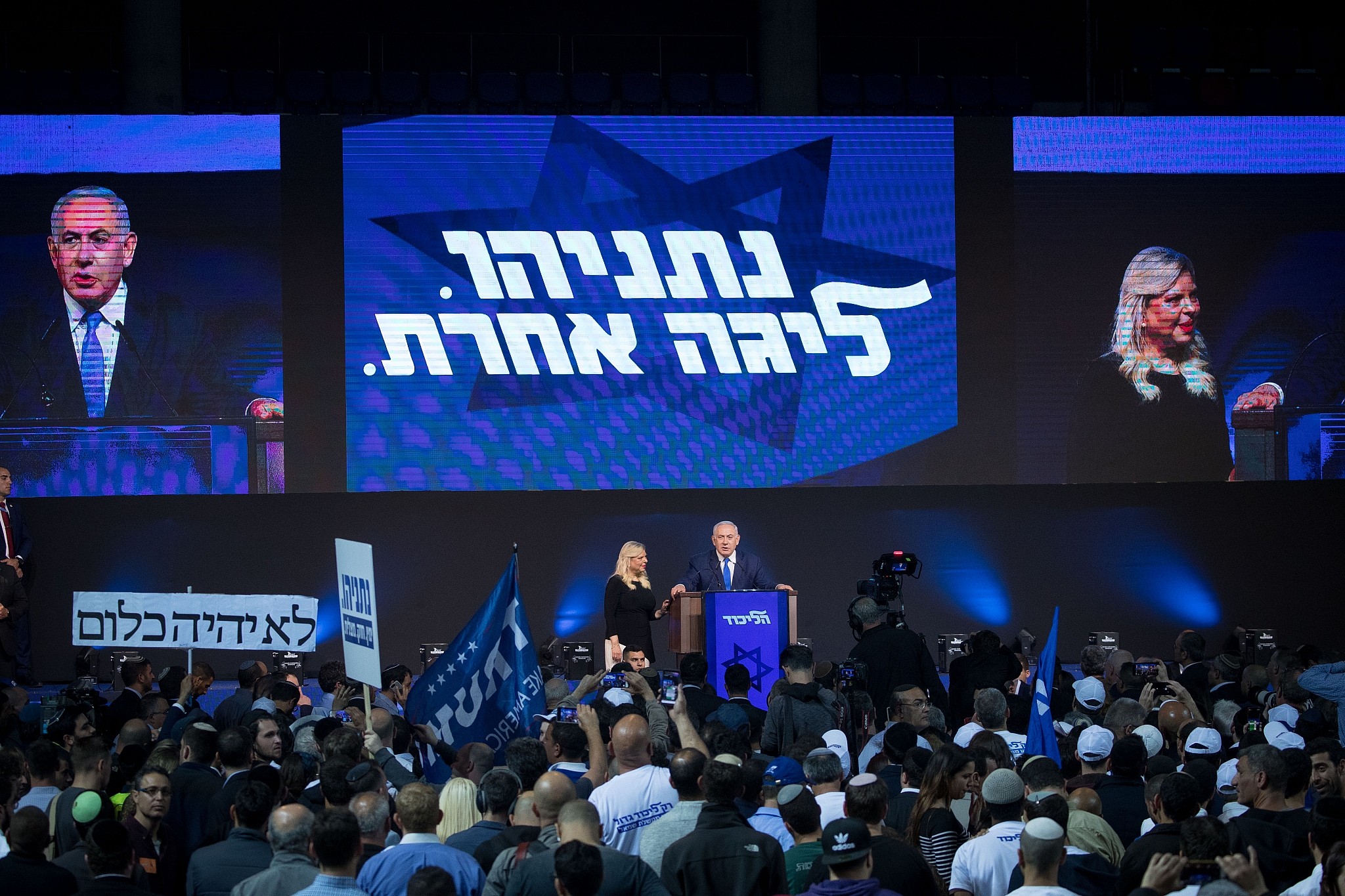
Prime Minister Benjamin Netanyahu addresses supporters as results in the Israeli general elections are announced at a Likud event in Tel Aviv, early on April 10, 2019. (Yonatan Sindel/Flash90)

Prime Minister Benjamin Netanyahu addresses supporters as results in the Israeli general elections are announced at a Likud event in Tel Aviv, early on April 10, 2019. (Yonatan Sindel/Flash90)

Prime Minister Benjamin Netanyahu was poised to clinch a clear electoral victory Wednesday morning, with some 95 percent of votes showing his Likud party tied with Blue and White, but the right-wing bloc with a clear lead and Netanyahu possessing a clear path to forming a governing coalition.

With more than four million votes counted as of 8 a.m., Likud had snagged 26.27% of the vote, or 35 seats in the 120-seat legislature — the party’s best result since the 2003 election (when it won 38 seats under Ariel Sharon), and its best under Netanyahu.

Meanwhile Likud’s main rival in the election, the Blue and White party led by Benny Gantz and Yair Lapid, won 25.94% of the vote, which would also give them 35 seats.

In actual numbers, only some 14,000 votes separated the two biggest parties.

Head of the Blue White party Benny Gantz (2L) and his top allies Moshe Ya’alon, Gabi Ashkenazi and Yair Lapid greet their party supporters following the release of election exit polls at the party headquarters in Tel Aviv, on April 09, 2019 (Hadas Parush/FLASH90)

No other party appeared to break double digits in number of seats.

With five right-wing and ultra-Orthodox parties managing to get some 32 seats together, though, Netanyahu seemed set to be able to form a government similar to his current right-wing coalition, with a solid 65 seats.

On the other side of the fence, four left-wing and Arab parties combined for just 20 seats, seemingly putting them in the opposition with Blue and White, pending coalition jostling.

Coming in at a surprising third and fourth places were the ultra-Orthodox parties Shas and United Torah Judaism, with 6.10% (8 seats) and 5.90% (8 seats) respectively.

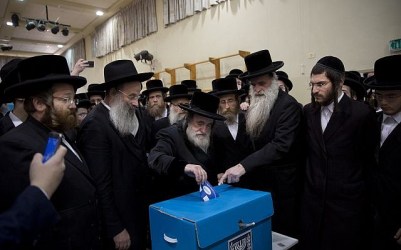
Rabbi Israel Hager votes for Israel’s parliamentary election at a polling station in Bnei Brak, Israel, Tuesday, April 9, 2019. (AP Photo/Oded Balilty)

Fifth was the predominantly Arab Hadash-Ta’al with 4.61% or six seats.

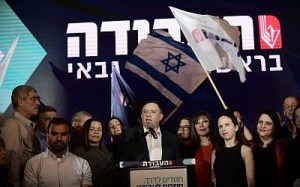
Avi Gabbay, leader of the Israeli Labor Party, speaks during an elections campaign event at Rabin Square in Tel Aviv, April 6, 2019. (Tomer Neuberg/Flash90)

The historically dominant Labor Party crashed to sixth place with 4.46% (six seats), the party’s worst showing in its 71-year history.

With five seats each were Yisrael Beytenu (with 4.15%) and the Union of Right-Wing Parties (3.66%).

Meanwhile Meretz (3.64%), Kulanu (3.56%) and Arab party Ra’am-Balad (3.45%) had four seats each.


Netanyahu lauds ‘incredible victory’ as exit polls, early results show clear win

Posted April 10, 2019 by Peter Hofman
Categories: Uncategorized

Likud projected to win 35 seats to Blue and White’s 34, have path to building coalition of at least 63 seats; Netanyahu vows to form right-wing government, ‘be PM of all of Israel’

Prime Minister Benjamin Netanyahu greets supporters at his Likud party headquarters in the coastal city of Tel Aviv on election night early on April 10, 2019 (Thomas Coex/AFP)

Prime Minister Benjamin Netanyahu declared himself victorious in the 2019 general election Tuesday night, as updated exit polls and early results showed him with a clear path to forming a new government.

“I am very moved on this night,” he told exuberant supporters. “This is a night of an incredible, incredible victory.”

Though initial exit polls at 10 p.m. had shown Likud and Blue and White either even at 36 seats (Channel 13 and Kan) or with an advantage for Blue and White (37 to 33 on Channel 12), updated results accounting for the final hours of voting on both Channel 12 and 13 showed Likud leading 35 to 34.

And regardless of the horse race between the two major parties, the right-wing bloc was projected to win a majority in the 120-seat Knesset. The results mean Netanyahu will likely sweep back into power for an unprecedented fifth term, despite pending bribery and fraud indictments hanging over him.

As of 3:12 a.m. Wednesday, with over 2.7 million votes counted, Likud was leading Blue and White 27.5 percent (roughly 33 seats) to 26% (31 seats). Shas was running a distant third with 6% (7 seats), followed by UTJ with 5.2% (6 seats) and Yisrael Beytenu with 4.6% (6 seats). The actual number of seats will likely go up once all votes are tallied and votes of parties that did not cross the threshold are redistributed.

Final turnout in the vote was 67.9%, down from 2015’s final turnout of 71.8%.

Depending on the final tally and coalition negotiations, Netanyahu appeared slated to be able to form a coalition with some 63 to 65 seats, while the Blue and White led opposition would have 55 to 57 seats.

Updated Channel 13 exit pollAccounting for voting in the final hours before polls closed35353434887766666655554444000000Series 1

LikudBlue and WhiteShasUTJLaborHadash-Ta’alYisrael BeytenuURWPMeretzKulanuRa’am-BaladNew RightZehutGesher0510152025303540

Likely blocs according to Channel 13 projection65655555RightCenter-left + Arab

Netanyahu said the numbers indicated a “fantastic achievement, an enormous achievement, which is almost unfathomable.”

He applauded his supporters for securing his win in the face of a “biased media.”

He called the Likud outcome “almost unprecedented,” saying, “When did we receive so many seats? I don’t even remember.”

Likud supporters react to the first exit poll results in the general elections, at Likud party headquarters in Tel Aviv, on April 09, 2019 (Yonatan Sindel/FLASH90)

If Likud ends up with 33 seats or above, it would be the party’s best showing since 2003, when it won 38 seats under the leadership of Ariel Sharon.

Netanyahu said Israel, under his leadership, was strong, prosperous and “a good place to live.”

Updated Channel 13 exit pollAccounting for voting in the final hours before polls closed35353434887766666655554444000000Series 1

LikudBlue and WhiteShasUTJLaborHadash-Ta’alYisrael BeytenuURWPMeretzKulanuRa’am-BaladNew RightZehutGesher0510152025303540

Even as he declared his win, Netanyahu also counseled patience until all the ballots were counted. “A long night, maybe a long day, is still ahead of us and we will wait for the final results,” he said.

Netanyahu said he was in contact with right-wing parties, “our natural partners… Nearly all of them have publicly declared that they will recommend that I form the next government.

“It will be a right-wing government. But I intend to be the prime minister of all of Israel, right and left, Jews and non-Jews alike.”

Hanging over Netanyahu is a likely indictment in three corruption cases, including one charge of bribery. Netanyahu has been rumored to be planning to condition, or tacitly link, entry to the post-election coalition he hopes to form on support for the so-called “French law,” which would shelter him from prosecution as long as he remains in office. Netanyahu has denied seeking such legislation.

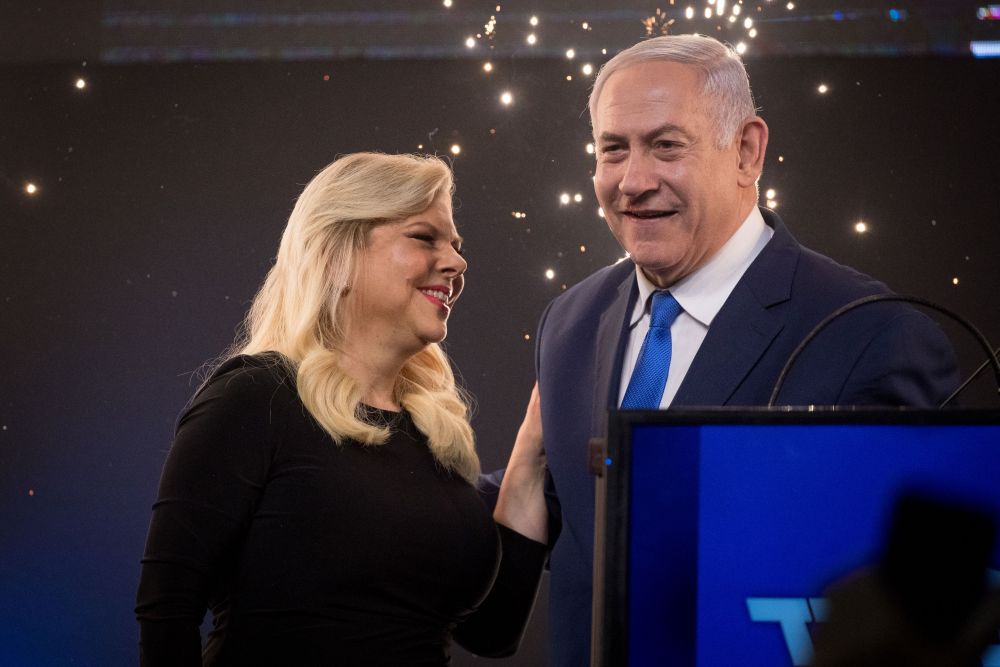
Prime Minister Benjamin Netanyahu embraces his wife Sara as he appears before supporters at his Likud Party headquarters in the coastal city of Tel Aviv on election night early on April 10, 2019. (Thomas COEX / AFP)

Of right-wing parties projected to enter the Knesset, only Yisrael Beytenu and Kulanu said they would wait before deciding on whether to back Netanyahu, though Kulanu leader Moshe Kahlon later indicated he was leaning toward supporting the prime minister.

Earlier Blue and White party leader Benny Gantz had also declared victory, after one major exit poll appeared to show his party in a stronger position.

Gantz said he would be the next prime minister of Israel and would “form a wide coalition that represents the whole of Israel.”

However, those claims seemed increasingly improbable as the night wore on.

Several key party leaders said they would recommend Netanyahu to lead the next government, including the heads of Ultra-Orthodox parties Shas and United Torah Judaism.

Meanwhile, in a surprise turn of events, Naftali Bennett and Ayalet Shaked’s New Right was hovering around the electoral threshold, while Moshe Feiglin’s Zehut party, which had been polling at 6-8 seats prior to the vote, was below the threshold.

Feiglin had been seen as a possible kingmaker, refusing to back Netanyahu despite his hard-right ideology.

Orly Levy-Abekasis’s Gesher party was also not projected to pass, as had been predicted by the polls.

Over 10,000 polling stations closed at 10 p.m. Tuesday, after a heated campaign season reached its climax with a tense election day, in which almost all parties attempted to galvanize their base by claiming they were in dire straits due to low turnout among their voters.

The decision regarding who will be the next prime minister may ultimately lie with President Reuven Rivlin, who will meet with the leaders of all the parties that cleared the electoral threshold, hear who each of them recommends as prime minister, and determine which candidate has the best chance of forming a coalition of at least 61 out of the 120 elected Knesset members.

Israel has never had a single-party government, and the next coalition, like the last one, seems certain to be a product of tense negotiations among about half a dozen parties that may take days or weeks.

President Reuven Rivlin casts his ballot at a voting station in Jerusalem on April 9, 2019 (Hadas Parush/Flash90)

By law, the final election results must be published within eight days of the vote, but a spokesman for the Central Elections Committee said the counting would be finished on Thursday afternoon. All the counting is done manually, following the closing of the polling stations.

Buoyed by a tight alliance with US President Donald Trump but clouded by a series of looming corruption indictments, Netanyahu has been seeking a fifth term in office that would make him Israel’s longest-serving leader, surpassing founding father David Ben-Gurion. He has served consecutively for the past 10 years, and was also prime minister from 1996 to 1999.

Netanyahu faced his stiffest challenge in a decade from Gantz, a craggy former military chief making his first foray into politics, who united his fledgling faction with Lapid’s Yesh Atid party and former defense minister Moshe Ya’alon’s Telem party to create Blue and White.

Prime Minister Benjamin Netanyahu calls a potential voter in a Facebook Live broadcast on April 9, 2019 (Screen grab via Facebook)

In the campaign’s final days, Netanyahu played to his base and veered to the right, vowing to annex Jewish West Bank settlements if reelected and embarking on a media blitz in which he portrayed himself as the underdog and frantically warned that “the right-wing government is in danger.”

Michael Bachner and Times of Israel staff contributed to this report.
Hashemite rule in Jordan on collision course with Trump and Israel

Posted April 9, 2019 by Peter Hofman
Categories: Uncategorized

By —— Bio and ArchivesApril 7, 2019

https://canadafreepress.com/article/hashemite-rule-in-jordan-on-collision-course-with-trump-and-israel

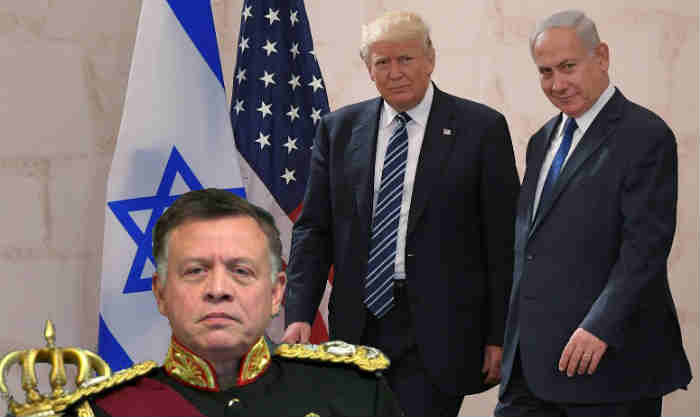
King Abdullah seems increasingly hell bent on ending 99 years of Hashemite-dynasty rule in Jordan.

This possibility is emerging as Abdullah is:

  • Seemingly refusing to commit to negotiating with Israel on President Trump’s soon-to-be-released deal of the century to end the Jewish-Arab conflict and
  • Taking active steps to place the Jordan-Israel Peace Treaty in jeopardy.

.

Transjordan (renamed Jordan in 1950) has always been the key to resolving competing territorial claims by both Arabs and Jews in former Palestine.

Transjordan comprised 78% of the territory placed under the League of Nations Mandate for Palestine after being wrested from 400 years of Ottoman Empire sovereignty during World War 1. Mandatory Palestine was designated in April 1920 by the Principal Allied Powers at the San Remo Conference and in August 1920 by article 95 of the Treaty of Sevres as the location for reconstitution of the ancient and biblical homeland of the Jewish people.

Transjordan’s first Hashemite ruler—Abdullah I—arrived there in November 1920

Abdullah was en route by train from Hijaz to Syria with armed forces to assist his brother Feisal in his struggle with France to retain power in Syria. Winston Churchill—at France’s request – offered Abdullah an Emirate in Transjordan—which Abdullah gratefully accepted on 11 April 1921.

Feisal was removed from Syria by the French and installed as ruler of Iraq under the Anglo-Iraqi Treaty dated 10 October 1922.  France became the Mandatory for the territory comprised in the Mandate for Syria and Lebanon.

These British-Franco machinations cost the Jewish people dearly—when the Mandate for Palestine – adopted unanimously by all 51 members of the League of Nations on 24 July 1922 – denied the Jewish people the right to reconstitute the Jewish National Home in any part of Transjordan (Eastern Palestine) and restricted that right to the remaining 22% (Western Palestine).

The Jews reluctantly accepted this decision. The Arabs didn’t.

In 1946 Transjordan was granted independence by Great Britain.

In 1948—immediately after the Mandate ended and Jews declared the State of Israel—Transjordan invaded Western Palestine conquering Judea, Samaria and East Jerusalem (comprising 4% of Mandatory Palestine)—and unified these areas with Transjordan to form a new territorial entity—Jordan—encompassing 82% of Mandatory Palestine completely devoid of Jews.

The founding Palestine Liberation Organisation (PLO) Charter in 1964 specifically excluded any PLO claim to sovereignty in Judea and Samaria.

In the 1967 Six Day War Israel captured Judea and Samaria from Jordan. The PLO – claiming Jordan and Israel to be one indivisible territorial unit – removed its non-claim to sovereignty from the revised 1968 Charter.

In September 1970 the PLO unsuccessfully tried to overthrow Jordan’s Hashemite ruler King Hussein. Israel helped save Hussein.

Israel and Jordan signed a peace treaty in 1994 (Peace Treaty)—which has withstood many events that could have seen its termination.

That Treaty is again under threat—as Jordan has:

  • indicated it is not prepared to renew an expired 25 year lease of Jordanian sovereign territory farmed by Israelis and
  • given the PLO 40% representation on the body charged with administering the Moslem Holy Sites in Jerusalem—breaching the Washington Declaration and the Peace Treaty.

Jordan’s resistance to negotiating with Israel on Trump’s plan could see Trump shelving it and abruptly ending the 2018 five year $1.275 billion America‚ÄìJordan Memorandum of Understanding underpinning Jordan’s security and stability.

The PLO—as in 1970—is waiting in the wings as current ongoing unrest in Jordan is destabilizing continuing Hashemite rule there.

Abdullah might find that spurning Trump and Israel could see him facing the PLO on his own.


Pompeo elaborates on decision to list IRGC as terrorist organization 

Posted April 9, 2019 by Joseph Wouk
Categories: Uncategorized

Source: Pompeo elaborates on decision to list IRGC as terrorist organization – World News – Jerusalem Post

In a Monday night interview, Pompeo was questioned about the timing of the announcement being just one day before the Israeli elections.

BY JERUSALEM POST STAFF
 APRIL 9, 2019 05:12
U.S. Secretary of State Pompeo listens during the news conference in Reykjavik

Secretary of State Mike Pompeo defended the US’s decision on Monday to designate The Islamic Revolutionary Guard Corps [IRGC], a branch of  Iran’s military, as a terrorist organization.

In an interview on Fox News, conducted shortly after he held a White House press conference, Pompeo said, “We are just calling it the reality of what it is.

“We are always doing everything we can to protect American soldiers everywhere,” he continued. “But the fact is the IRGC has already killed over 600 American soldiers. So you can’t have peace. You can’t have stability; you can’t have security in the Middle East without weakening the Islamic Revolutionary Guard Corps.”

He said the situation on the ground was complicated long before Monday’s announcement.

“What we are trying to do is reduce that complexity,” he said. “Take down this malign activity. These kleptocrats in Iran that are engaged in, to change their behavior is such a fundamental way that we can be safe all across the world. And certainly in Iraq and in the Middle East.”

Pompeo was also questioned about the timing of the announcement, just one day before the Israeli elections. Time and time again, Prime Minister Benjamin Netanyahu has called Iran Israel’s biggest existential threat. Netanyahu will be fighting to hold his premiership after 13 years in office.

“It happened today, because today was the day we were ready to make the announcement,” Pompeo said, denying that there could be a connection. “It took a lot of work to make sure we had all the facts right, we had everyone in the United States government in the right place so we could announce.”

When Fox News anchor Bret Baier asked Pompeo if Qasem Soleimani was as bad as the head of ISIS Abu Bakr Al-Baghdadi, Pompeo simply said, “Ya, he’s a terrorist.”

“Qasem Soleimani has the blood of Americans on his hands,” Pompeo continued We want to “reduce the risk that any American will be killed by Qasem Soleimani and his merry band of brothers, ever again.”


Israelis head out into the sunshine in celebration of democracy 

Posted April 9, 2019 by Joseph Wouk
Categories: Uncategorized

Source: Israelis head out into the sunshine in celebration of democracy – comment – Israel Elections – Jerusalem Post

Election Day is also a reminder of the maturing nation that Israel has become and of the responsibility that weighs heavy on each of us to shape the kind of country we want to live in.

BY DAVID BRINN
 APRIL 9, 2019 15:45
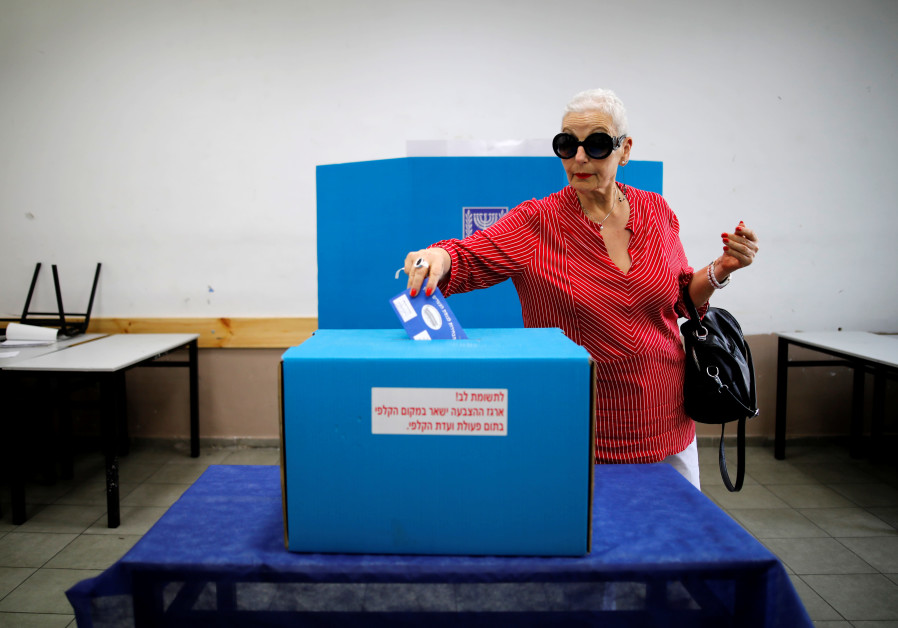
A woman casts her ballot at a polling station in Tel Aviv, April 9, 2019

After the seamy campaign we just witnessed, it would be understandable to expect most of the eligible voters in Israel to stay in bed, hide under the covers and wait for Election Day to pass.
And nobody would throw blame for that. To say that the 40-odd parties running for the Knesset ran underwhelming campaigns – which avoided the issues as much as possible in favor of personal attacks, alarmist rhetoric and a distortion of reality – would be an understatement.
It is no wonder that so many voters appeared to be undecided heading into Election Day. Aside from some enthusiasm emanating from the “Anybody But Bibi” flank (and the stoners-for-Feiglin sect), this campaign has been not only devoid of issues, but of passion. Does it really matter if Netanyahu stays in power until his indictment, or if Gantz – who failed to distinguish Blue and White’s policies as being much different from the Likud – takes over?
For those thinking that their vote wouldn’t matter because things are going to stay the same anyway, staying in bed was surely a viable option. But as it turned out, the day was just too damn nice. The sun shining with unseasonable warm temperatures, blooming spring flowers radiating messages of renewal, hope and another chance… it would take an ogre to resist getting up and getting out.
Election Day in Israel is that rare commodity of being a national shabbaton (day off) that isn’t a Jewish holiday with the usual travel/shopping constraints for the observant public. With schools and workplaces closed, the country was on vacation. The atmosphere is light and relaxed – two adjectives that are rarely used to describe life in Israel.
Beaches and national parks (not to mention malls) are filled to capacity. Those many options out there – generally not available on a weekday – only make it that much harder to make time for the ballot box.
But despite the dismal campaign and the enticing distractions of a picnic or a bike ride, Israelis are indeed exercising their democratic right to vote. By midday at least, voter turnout was more or less on par with previous elections. Because while we love to bitch and moan, when it comes down to it Israelis take their right to vote seriously. Maybe because, whether Jewish or Muslim, it’s not something we can take for granted.
For Jewish Israelis, going to the polls is a celebration of the privilege of being able to vote in the Jewish homeland. For Muslim citizens, voting for parties that will represent their interests in the Knesset is a phenomenon that is not widespread in the region. Together, for whatever disparate reasons, Israelis are coming together in an act that lets their voices be heard.
The adage that “if you don’t vote, then don’t complain” doesn’t really hold water in Israel. Everyone will continue to complain anyway, whether they voted for Likud, Meretz or the beach.
It’s part of our DNA, which makes Election Day even more remarkable. We can’t form a line at the supermarket, but here you have an unruly people courteously queuing up, having their identity cards checked and verified, and going behind a screen to vote from a choice of parties larger than the list of Ben & Jerry’s flavors.
It’s an ordinary scene – but it’s also extraordinary, given who we are and what we’ve gone through to get here – Israelis of Russian, Ethiopian, Yemenite and so many other descents huddled under the blue and white flag of the country that made and keeps the promise of insuring their safety and freedom.
Sure, it’s easy to stick your head in the sand – or under the covers – and plead apathy or exhaustion. There’s plenty enough here to fill one with despair. But Election Day is also a reminder of the maturing nation that Israel has become, and of the responsibility that weighs heavy on each of us to shape the kind of country we want to live in.
And what if, after making the effort and getting to the polls, the results don’t turn out exactly as you had hoped? Not to worry: Chances are we’ll be back in the voting booth in less than four years.


After Guard blacklisted, Iran president says US is ‘leader of world terrorism’ 

Posted April 9, 2019 by Joseph Wouk
Categories: Uncategorized

Source: After Guard blacklisted, Iran president says US is ‘leader of world terrorism’ | The Times of Israel

‘You have done everything imaginable,’ Rouhani says, accusing US of secretly protecting Islamic State leaders, intentionally downing Iranian passenger jet in 1988

Iranian President Hassan Rouhani at a ceremony commemorating “National Day of Nuclear Technology” in Tehran, Iran on, April 9, 2019. (Iranian Presidency Office via AP)

TEHRAN, Iran — Iranian President Hassan Rouhani said Tuesday that the United States was the real “leader of world terrorism” after Washington blacklisted Iran’s Revolutionary Guards as a “foreign terrorist organization.”

“Who are you to label revolutionary institutions as terrorists?” Rouhani asked in a speech broadcast live by state television.

Speaking at a ceremony to mark Iran’s national nuclear technology day in Tehran, Rouhani defended the Revolutionary Guards as a force that has fought terrorism ever since its creation in 1979.

In contrast, the Islamic Republic’s president accused US forces of having always been directly or indirectly involved with terrorist groups or acts of terrorism.

“You want to use terrorist groups as tools against the nations of the region… you are the leader of world terrorism.

Members of Iran’s Revolutionary Guard Corps (IRGC) march during the annual military parade marking the anniversary of the outbreak of the 1980-1988 war with Iraq, in the capital Tehran on September 22, 2018. (AFP/STR)

“Who is propagating and encouraging terrorism in today’s world? Who wanted to use ISIS (the Islamic State group) as a tool?” Rouhani asked, saying that the US is harboring the leaders of the jihadist organization.

“Even now America is hiding the heads of ISIS, even now they are not prepared to tell the regional governments where the heads of ISIS are hiding.”

Iran swiftly retaliated against the US move on Monday by calling US troops “terrorists.”

It is the first time that Washington has branded part of a foreign government a terrorist group, meaning that anyone who deals with the Islamic Revolutionary Guard Corps could face prison in the United States.

To support his accusations, Rouhani cited the downing of Iran Air Flight 655 in July 1988 by missiles fired from the US naval ship the USS Vincennes.

“You have done everything imaginable. Which force was it that shot down our civil airliner in the waters of the Persian Gulf?” he said, adding that it was aimed at intimidating Iran.

In this photo released February 7, 2019, by the IRGC’s Sepahnews, Amir Ali Hajizadeh, chief of the Guard’s aerospace division, left, explains the Dezful surface-to-surface ballistic missile to the Guard’s chief, Mohammad Ali Jafari during an inauguration ceremony, in an undisclosed location, Iran. (Sepahnews via AP)

“You wanted to tell the Iranian nation that we do not have any red lines, you wanted to say that we also kill children, you wanted to say that we also kill women,” Rouhani said, concluding that the US was transmitting “a message of terrorism in the whole world.”

The Islamic Revolutionary Guard Corps was formed after the 1979 Islamic Revolution with a mission to defend the clerical regime, and the force has amassed strong power both at home and abroad. The Guards’ prized unit is the Quds Force, which supports Iran-backed forces around the region, including Syrian President Bashar Assad and Lebanese terrorist group Hezbollah.

In Tehran on Tuesday, many Iranian lawmakers dressed in paramilitary uniforms chanted “Death to America” as they convened the open parliament session.

Parliament Speaker Ali Larijani denounced the US decision as the “climax of stupidity and ignorance.” The Supreme National Security Council’s spokesman, Keivan Khosravi, said that going forward, “any unusual move by American forces in the region will be perceived as the behavior by a terrorist group.” He did not elaborate.

Iranian newspapers on Tuesday carried reports of the US move along with bellicose commentary on their front pages.

Iranian parliament speaker Ali Larijani speaks during a press conference in Tehran, Iran, March 13, 2017. (AP Photo/Ebrahim Noroozi)

The Guard-affiliated Javan daily said any attack on Revolutionary Guard bases and facilities will be “recognized as a right” for Iran to respond. The hardline Kayhan newspaper said it gave Iranians “permission” to kill American military personnel.

State-owned IRAN daily went a step further, saying the US move was a “designation of the entire Iranian nation” as terrorist.

The pro-reform Shargh daily described it as “the last card” of President Donald Trump against Iran. Trump last year pulled America out of the 2015 nuclear deal between Iran and world powers and re-imposed sanctions on the country, mainly targeting Iran’s vital oil sector.


Israelis take election holiday before waking up to changed Mid-East realities – DEBKAfile

Posted April 9, 2019 by Joseph Wouk
Categories: Uncategorized

Source: Israelis take election holiday before waking up to changed Mid-East realities – DEBKAfile

For a month, Israelis and their media were too steeped in ferocious electioneering, among bidders to lead the next government in the April 9 vote, to notice the critical realities unfolding in the region.

They were mesmerized by PM Binyamin Netanyahu fighting for his life and a record-breaking fifth term against former general Benny Gantz and his attractive offer of change. No Middle East issue figured in any of their campaigns. But by Wednesday morning, the winner who emerges from the furious race will come face to face with four pivotal changes overtaking Israel’s immediate neighborhood while every Israeli politician was preoccupied with his personal survival and knocking down his/her rivals.

  1. US President Donald Trump is still full of surprises. Four months after announcing the pullback of US troops from Syria, and two weeks after recognizing Israel’s sovereignty over the Golan, he decided that US troops will stay in Syria after all. The second and third decisions seriously advance Israel to strategic center-stage in the region after a long period of stagnation.
  2. Tehran and its supreme Mid East commander Al Qods chief Gen. Qassem Soleimani can’t be expected to stand by meekly after the Trump administration designated the Revolutionary Guards a terrorist organization. After all, the Al Qods Brigades are the external arm of the IRGC. Anyone paying attention would have noticed changes in the IDF’s coastal and northern deployments and the US forces stationed in Israel.
  3. With the winding down of the Syrian conflict, aside from rebel pockets in Idlib and the north, the military contest between the US and Iran in Syria and western Iraq is just beginning. Russian President Vladimir Putin is still pondering where he stands in this contest, as Binyamin Netanyahu discovered when he traveled on Moscow on April 4 and attended a defense ministry ceremony in honor of the lost IDF soldier Zachary Baumel. Before long, he will have to make another trip to Moscow to discuss fresh arrangements in light of the new situation, even though the next Israeli prime minister may not assume the rein before weeks or months are consumed by bargaining with coalition partners.
  4. Although Libya’s capital Tripoli is more than 2,000km from Jerusalem, the new surge of warfare there certainly touches on Israel. The Arab rulers most friendly to the Jewish state, Saudi King Salman, Egyptian President Abdel-Fatteh El-Sisi and the UAE leader Sheikh Muhammed bin Ziyad have joined President Putin in backing Gen. Khalifa Haftar’s National Libyan Army which is fighting to capture Tripoli from the UN-approved government. If Haftar with Russian-Arab backing seizes Libya’s Mediterranean coast, this will affect the disposition of the Gaza Strip’s shore. The Palestinian Hamas is alive to this interrealation. On April 9, its leaders condemned the US designation of Iran’s Guards as a terrorist organization, to demonstrate their solidarity with Tehran.