Responding to the Saudi Oil Attack: A Challenge for U.S. Policy

Posted October 1, 2019 by Joseph Wouk
Categories: Uncategorized

5.3K subscribers

After months of increasing tensions, the contest between Iran and the United States escalated dramatically with the spectacular air attack on Saudi oil installations. So far, the Trump administration has sent mixed signals about its response, with the president warning that America’s military was “locked and loaded” and then suggesting that energy independence means events in the Gulf no longer affect U.S. interests. While the ultimate decision has powerful implications for Gulf security, it will also reverberate everywhere that America and its allies face off against Iran and its local proxies, from Yemen to Iraq to Lebanon to Gaza.

Crack in the anti-Iran front: US persuades Saudis to engage Tehran in regional deals – DEBKAfile

Posted October 1, 2019 by Joseph Wouk
Categories: Uncategorized

Source: Crack in the anti-Iran front: US persuades Saudis to engage Tehran in regional deals – DEBKAfile

Iran’s president Hassan Rouhani disclosed on Tuesday, Sept. 30, that he had received “messages from Saudi Arabia,” the day after Crown Prince Muhammed (MbS) warned that war with Iran would “collapse the global economy” by causing crude prices to spike to “unimaginably high numbers.” In a CBS 60 Minutes interview, the prince noted that he “preferred a political solution to a military one.”

Rouhani’s spokesman commented, without revealing the messages’ content, “if Saudi Arabia is really pursuing a change of behavior, Iran welcomes that.”

This “change of behavior” has taken two forms, DEBKAfile’s sources report.

  1. Riyadh was persuaded by President Donald Trump and Secretary of State Mike Pompeo to line up with Washington and abstain from a military response to Iran’s cruise missile-explosive drone attack on Saudi oil facilities on Sept. 14.
  2. The Saudis also agreed to join US efforts to bring about a meeting between Trump and Rouhani, to which the crown prince might be attached or hold a separate meeting with the Iranian president .

Our sources add exclusively that even though the Trump-Rouhani summit at UN Center appeared last week to have fallen through, contacts continue and the two sides appear to be looking for a venue acceptable to both. The main obstacle for now is that the US president has no wish to travel outside America, while Rouhani is reluctant to pay another visit to the US after the US Assembly session. With the summit location still up in the air, the Saudi crown prince’s role is still undecided. However, the comment coming on Tuesday from the Iranian president’s office sounded like a strong signal of positive acceptance of the Saudi feelers for negotiations to center on the topics at issue: the Yemen war and the situation in Syria and Iraq.

These initial Saudi overtures towards Iran under US auspices are ominous tidings for Israel and its diplomatic, military and intelligence strategy with regard to Iran. The anti-Iran axis set up between Washington, Riyadh and Abu Dhabi is now on the line. Its collapse would leave Israel high and dry on its own against the mortal threat posed by Iran. Tehran, despite Israel’s long efforts, is cementing its military grip on Syria and Iraq. Dramatizing the abiding threat to Israel on Tuesday, Sept. 30, Iran’s Al Qods chief Gen. Qassem Soleimani informed his senior commanders: “The Islamic Republic has prepared the capability to annihilate Israel and this regime must be wiped off the world’s geographic history.”


Iraqi PM blames Israel for spate of airstrikes targeting Iran-linked fighters

Posted September 30, 2019 by Joseph Wouk
Categories: Uncategorized

Source: Iraqi PM blames Israel for spate of airstrikes targeting Iran-linked fighters | The Times of Israel

Adel Abdul Mahdi says investigation indicates Jerusalem behind recent strikes on bases, weapon depots belonging to powerful Shiite militias; IDF declines to comment

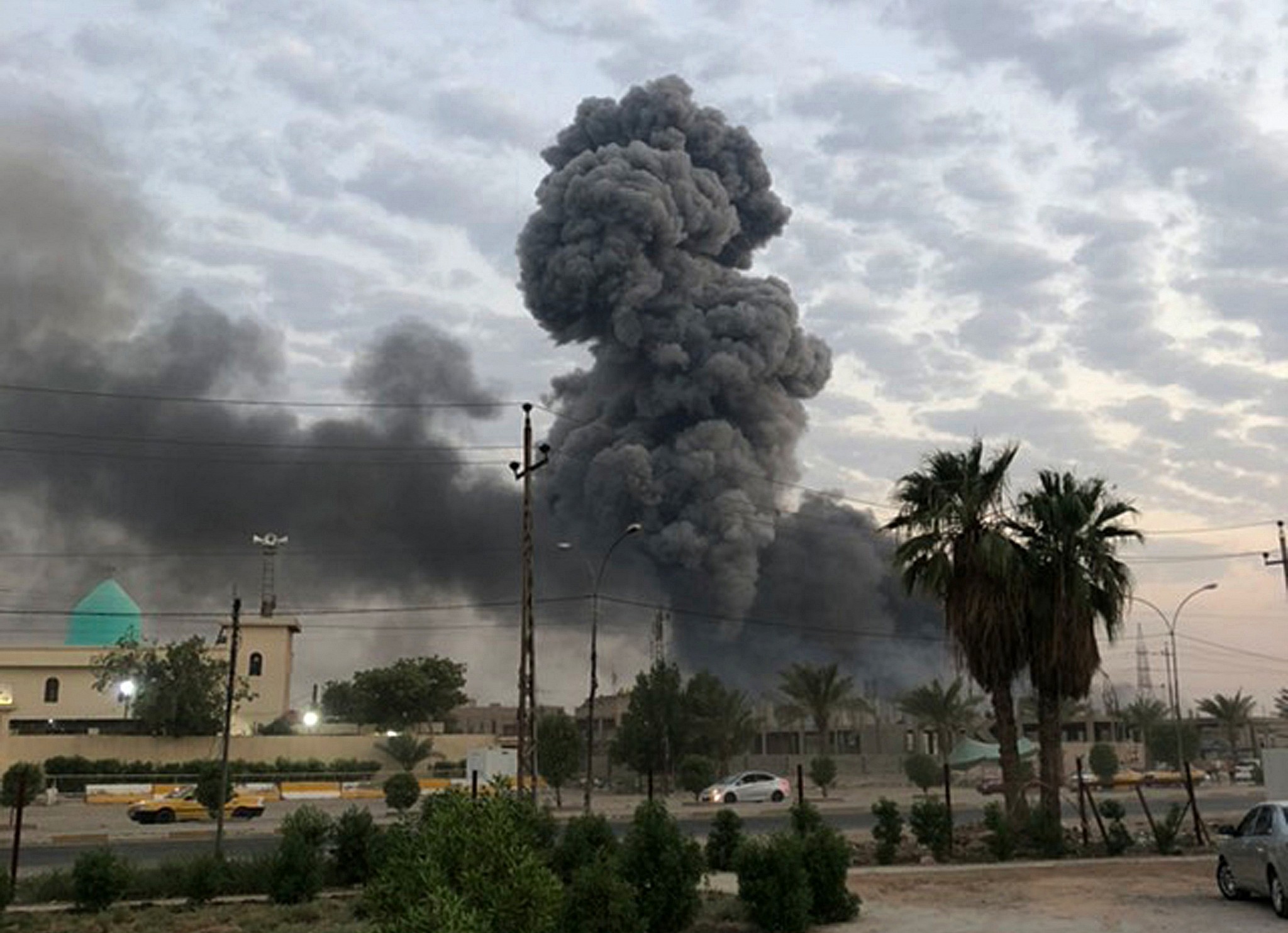
In this photo from August 12, 2019, plumes of smoke rise after an explosion at a military base southwest of Baghdad, Iraq. (AP Photo/Loay Hameed)

Iraqi Prime Minister Adel Abdul Mahdi said on Monday that investigations have determined the recent spate of airstrikes targeting powerful Iranian-backed militias in Iraq were carried out by Israel.

“Investigations into the targeting of some Popular Mobilization Forces positions indicate that Israel carried it out,” Abdul Mahdi told Al Jazeera, marking the first time Baghdad has directly blamed the Jewish state for the strikes.

The Qatari-funded TV network also quoted him as saying that “many indicators show that no one wants war in the region except for Israel,” according to a translation by the Reuters news agency.

A spokesperson for the Israel Defense Forces declined to comment on the statements from the Iraqi premier, saying “these are reports from foreign media and we do not comment on them.”

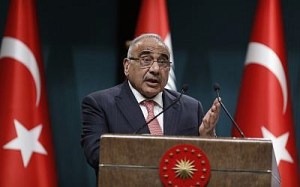
Iraqi Prime Minister Adel Abdul-Mahdi speaks to the media at a news conference during a visit to Ankara, Turkey, May 15, 2019. (Burhan Ozbilici/AP)

Since July, there have been at least nine strikes both inside Iraq and across the border in Syria, targeting the Iran-backed militias, known collectively as the Popular Mobilization Forces, or PMF.

Leaders of the powerful Shiite paramilitary group have repeatedly blamed Israel and by extension its US ally, which maintains more than 5,000 troops in Iraq.

Israel has not confirmed its involvement in the attacks, though Prime Minister Benjamin Netanyahu has hinted at the possibility that it has struck in Iraq.

Israel views Iran as its greatest threat, and has acknowledged carrying out scores of airstrikes in Syria in recent years aimed primarily at preventing the transfers of sophisticated weapons, including guided missiles, to the Iran-backed, Lebanese  Hezbollah terror group.

This quiet war has reportedly expanded to Iraq in recent weeks, with unnamed US officials saying the Israel Defense Forces was behind at least some strikes on Iran-linked sites in Iraq.

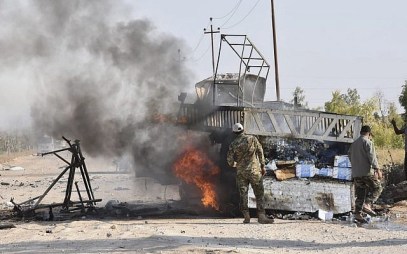
Illustrative: Popular Mobilization Forces members stand by a burning truck after a drone attack blamed on Israel near Qaim border crossing, in Anbar province, Iraq, August 25, 2019. (AP Photo)

The latest strike on Iranian militias came Friday night, when an unmanned aerial vehicle reportedly struck PMF bases along the Iraqi-Syrian border. The Shiite fighters in the Boukamal region responded with anti-aircraft fire, according to local media. There were no reported casualties.

The Saudi-owned Al Arabiya TV network has reported that Hezbollah also maintains a presence in the Boukamal region.

Despite the weekend strike, a nearby border crossing between Syria and Iraq that was shuttered in 2012 during the Syrian civil war reopened on Monday, giving Iranian forces easier access to eastern Syria amid soaring tensions with the West.

The key crossing between the Iraqi town of Qaim and Syria’s Boukamal was expected to strengthen trade between the two countries, and officials touted its reopening as a “victory for Syrian and Iraqi friendship.”

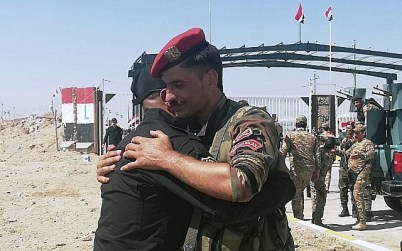
Iraqi and Syrian border guards soldiers congratulate each other during the opening ceremony of the crossing between the Iraqi town of Qaim and Syria’s Boukamal in Anbar province, Iraq, September 30, 2019. (AP Photo/Hadi Mizban)

Some 800 freight trucks are expected to cross from Syria, Syria’s state news agency said.

Syria and Iraq have three key border crossings between them, with Boukamal, the only one controlled by Assad’s government. The second one is controlled by US-backed Kurdish-led fighters known as the Syrian Democratic Forces, while the third crossing, the nearby Tanf, is held by US-backed Syrian rebels.

AP contributed to this report.


Iran Guards chief: Destroying Israel now not a dream but an ‘achievable goal’ 

Posted September 30, 2019 by Joseph Wouk
Categories: Uncategorized

Source: Iran Guards chief: Destroying Israel now not a dream but an ‘achievable goal’ | The Times of Israel

In claim prominently reported in Iran, Major General Hossein Salami declares Tehran able to annihilate ‘the impostor Zionist regime’

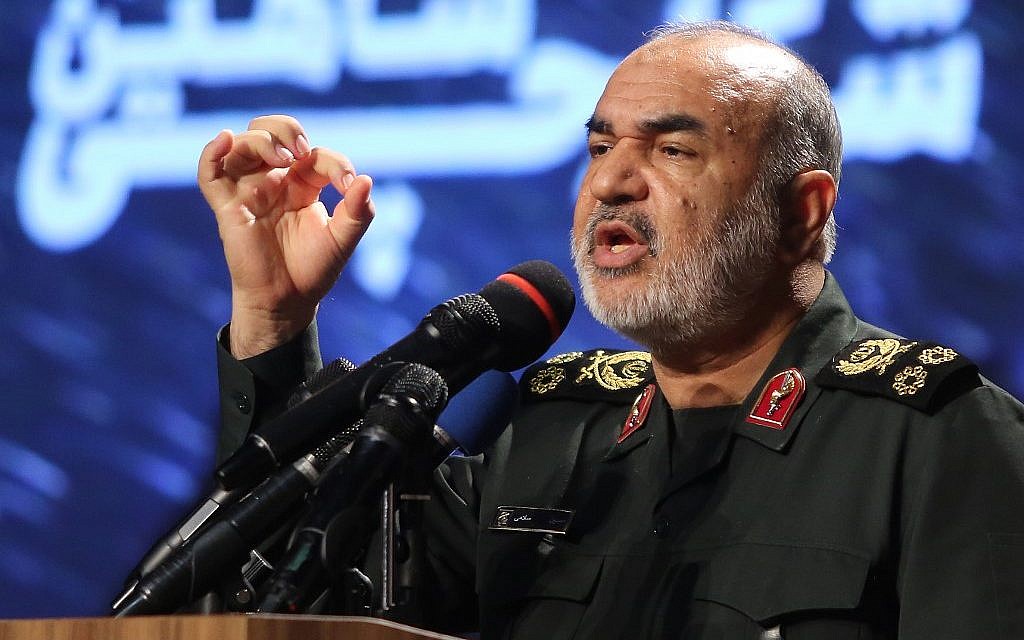
Iranian Revolutionary Guards commander Maj. Gen. Hossein Salami speaks at Tehran’s Islamic Revolution and Holy Defense museum, during the unveiling of an exhibition of what Iran says are US and other drones captured in its territory, on September 21, 2019. (Atta Kenare/AFP)

The commander of Iran’s elite Islamic Revolutionary Guard Corps said on Monday that destroying Israel was now an “achievable goal.”

Four decades on from Iran’s Islamic revolution, “we have managed to obtain the capacity to destroy the impostor Zionist regime,” Major General Hossein Salami was quoted saying by the IRGC’s Sepah news site.

“This sinister regime must be wiped off the map and this is no longer … a dream [but] it is an achievable goal,” Salami said.

The remarks were made at a biannual meeting in Tehran for commanders of the IRGC amid rising tensions between Iran and the US and its allies.
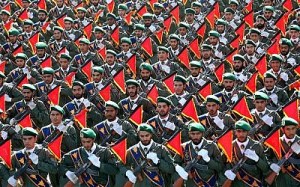
Iran’s Revolutionary Guard troops march in a military parade marking the 36th anniversary of Iraq’s 1980 invasion of Iran, in front of the shrine of late revolutionary founder Ayatollah Khomeini, just outside Tehran, Iran, September 21, 2016. (AP Photo/Ebrahim Noroozi, File)

Salami’s comments were given prominent coverage by the Tasnim and Fars news agencies, close to ultra-conservative political factions.

The official IRNA agency also carried his remarks, but placed more emphasis on his assertion that Iran was growing stronger and would finally beat its foes despite “hostility” toward it.

US President Donald Trump officially designated the IRGC as a terrorist organization in April. “This unprecedented step, led by the Department of State, recognizes the reality that Iran is not only a State Sponsor of Terrorism, but that the IRGC actively participates in, finances, and promotes terrorism as a tool of statecraft,” the president said in a statement.”The IRGC is the Iranian government’s primary means of directing and implementing its global terrorist campaign.”

Salami’s comments Monday came two days after Abbas Nilforoushan, the deputy commander of operations of the IRGC, threatened that if Israel attacks Iran, it will have to collect “bits and pieces” of Tel Aviv from the Mediterranean Sea.

“Iran has encircled Israel from all four sides. Nothing will be left of Israel,” said Nilforoushan in an interview with the Iranian news agency Tasnim on Saturday. “Israel is not in a position to threaten Iran,” he said according to a translation published by Radio Farda, the Iranian branch of the US government-funded Radio Free Europe/Radio Liberty.

“If Israel makes a strategic mistake, it has to collect bits and pieces of Tel Aviv from the lower depths of the Mediterranean Sea,” he added.

“If the enemies could have started a war against Iran, they would have done it,” Nilforoushan said, adding that geography plays to Iran’s favor. “We are not a small country that could be conquered in one step. If all the Western, Arab and Israeli coalitions forces enter our country, Iran’s geography will defeat them before they can do anything.”

Nilforoushan also boasted of Iran’s “deep and long-range [missile] assault capability” and said Tehran has the means to make this capability operations.

“We will not let the enemies to face us at our borders. We will quickly drag the war to the bases and interests of the enemies anywhere they may happen to be,” he warned.

Iran has been on edge, fearing an attack on the country over a drone-and-missile strike on Saudi Arabia’s oil industry earlier this month attributed to Tehran. Yemen’s Iranian-backed Houthi rebels have claimed the attack, but the US alleges Iran carried out the assault.
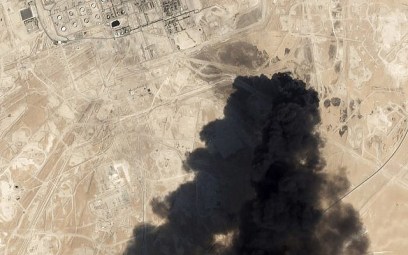
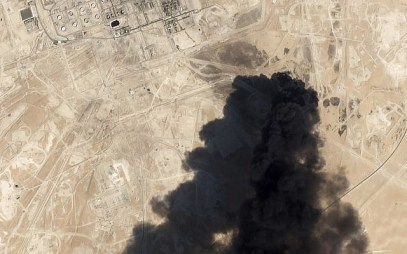
Satellite image from Planet Labs Inc. shows thick black smoke rising from Saudi Aramco’s Abqaiq oil processing facility in Buqyaq, Saudi Arabia, September 14, 2019. (Planet Labs Inc via AP)

The attack in Saudi Arabia was the latest incident following the collapse of Iran’s nuclear deal with world powers, over a year after US President Donald Trump unilaterally withdrew America from the accord. The nuclear deal was meant to keep Tehran from building atomic weapons — something Iran denies it wants to do — in exchange for economic incentives.

Prime Minister Benjamin Netanyahu was a sharp critic of the nuclear deal negotiated under the administration of former President Barack Obama, and welcomed Washington’s pull-back from the accord, urging further pressure on Iran.

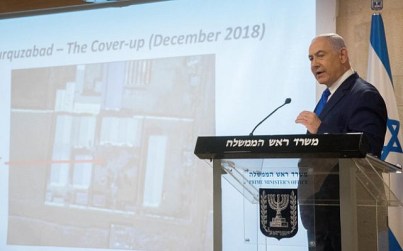
Earlier this month, Netanyahu exposed the existence of a secret nuclear facility in central Iran in which he said the regime had conducted experiments in the pursuit of nuclear weapons. The Israeli premier said that once Iran detected that Israel had learned about the secret nuclear site, located in Abadeh, south of Isfahan, the regime quickly destroyed it.
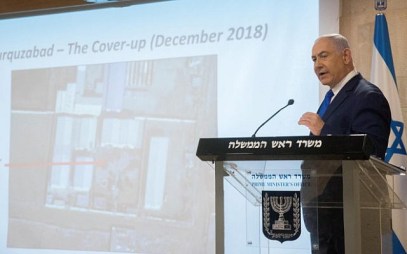
Prime Minister Benjamin Netanyahu delivers a statement to the press regarding the Iranian nuclear program, at the Foreign Ministry in Jerusalem on September 9, 2019 (Yonatan Sindel/Flash90)

Iran regularly threatens Israel, viewing the country as a powerful enemy allied with the United States and Sunni countries in the region against Tehran and its nuclear ambitions.

Israel has also thwarted Iranian operations in neighboring Syria where its fighters and those of Iranian proxy Hezbollah have been fighting alongside forces loyal to Syrian President Bashar Assad since 2011.

Tensions with the Hezbollah terror group soared this month after the Israel Defense Forces late last month thwarted an attempt by Iranian operatives in Syria — including two former Hezbollah members — to carry out an attack on northern Israel with armed drones and attacked their base. It also followed a drone attack in Beirut, attributed to Israel, that reportedly destroyed key components of a joint Hezbollah-Iran project to manufacture precision-guided missiles in Lebanon. Hezbollah responded to the attacks by firing anti-tank missiles into northern Israel earlier this month, although Israel said no soldiers were injured in the incident.

Hezbollah is seen by Israel as one of its most dangerous enemies, with an arsenal of rockets and missiles larger than that of most countries. The IDF last week completed a week-long training program for its senior combat officers aimed at preparing them for a war against Hezbollah, providing them with the latest intelligence, fighting methods and operational plans.

 

Top Iranian official: We’ll catch Trump, put him on trial

Posted September 29, 2019 by Joseph Wouk
Categories: Uncategorized

Source: Top Iranian official: We’ll catch Trump, put him on trial | The Times of Israel

Former IRGC commander Mohsen Rezaei mocks Washington’s lack of response to drone downing: ‘They cannot defend themselves, so how would they defend Saudi Arabia?’

Mohsen Rezaei (MEMRI screenshot)

Mohsen Rezaei (MEMRI screenshot)

A top Iranian politician has said Tehran will “catch” US President Donald Trump and “place him on trial” for his actions against Iran and others.

Mohsen Rezaei, former commander of the Iranian Revolutionary Guard and currently the secretary of the Expediency Council, which advises Supreme Leader Ayatollah Ali Khamenei, told Iran’s Channel 2: “Ultimately, we will catch Trump and place him on trial, God willing. An international court will convene and Trump will have to stand trial. He should stand trial not just for what he did to our people, but for his crimes against other nations as well.”

In the September 22 interview, translated and made available by the Middle East Media Research Institute, Rezaei mocked Washington for failing to respond to Tehran’s downing of an American surveillance drone, and said the US was not proving to be much of an ally to Iran’s regional foe Saudi Arabia.

“When the Americans are incapable of retaliating against Iran for the downing of their ultra-secret plane, would they be able to help Saudi Arabia? They cannot defend themselves, so how would they defend Saudi Arabia? Everybody has received that message,” he said.

Tensions have risen in the Persian Gulf since May last year when Trump unilaterally abandoned a 2015 nuclear deal between major powers and Iran and began reimposing crippling sanctions in a campaign of “maximum pressure.”

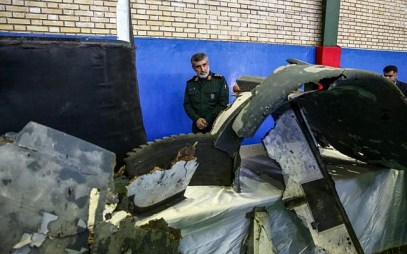
General Amir Ali Hajizadeh (C), Iran’s head of the Revolutionary Guard’s aerospace division, looks at debris from a downed US drone reportedly recovered within Iran’s territorial waters and put on display by the Revolutionary Guard in the capital Tehran on June 21, 2019. (Meghdad Madadi/Tasnim News/AFP)

They flared again this May when Iran began reducing its own commitments under the deal and the US deployed military assets to the region.

Since then, ships have been attacked, drones downed and oil tankers seized. This month, twin attacks on Saudi oil infrastructure, which knocked out half the kingdom’s production, drew accusations of blame from Washington and Europe.

Tehran has denied any involvement in the attacks which were claimed by Iran-backed rebels fighting a Saudi-led coalition in Yemen.

“Mr. Trump has already played all his cards,” Rezaei said. “He has already fired all his bullets. Now he is standing in front of us with no bullets, and the world is laughing at him. In the future, it will be even worse.”

He added that the Persian Gulf would not be safe until Western forces depart from the region.

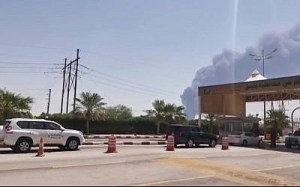
AFPTV screen grab from video shows smoke billowing from an Aramco oil facility in Abqaiq in Saudi Arabia’s eastern province, September 14, 2019. (AFP)

“As long as America, England, and other foreign countries wish to remain in the region, the lack of security of the past 40 years will continue,” he stated. “The first condition for security is the independence of [the region’s] countries.

“The day the Americans leave the region, all the countries will become friends with one another.”

On Friday Iranian President Hassan Rouhani claimed the US had offered to lift all sanctions against Tehran if Iran agreed to come to the table for nuclear talks, the Reuters news agency reported. The claim was immediately denied by Trump.

US President Donald Trump speaks during a meeting with Australian Prime Minister Scott Morrison in the Oval Office of the White House, September 20, 2019, Washington. (AP Photo/Evan Vucci)

Despite Iran previously saying it would only talk if the sanctions were lifted, Rouhani said Tehran rejected the offer because of the current “toxic atmosphere,” referring to the US policy of maximum pressure against Iran.

On Thursday, Rouhani urged the US to “cease this policy of maximum pressure,” saying it was driving the possibility of negotiations even further away.

Addressing the UN on Wednesday, he accused the United States of “merciless economic terrorism” stressing that security in the Persian Gulf can be guaranteed only when his nation’s security is as well.

Agencies contributed to this report.


‘Nothing will be left of Israel’ if it attacks us, Iranian commander threatens

Posted September 29, 2019 by Joseph Wouk
Categories: Uncategorized

Source: ‘Nothing will be left of Israel’ if it attacks us, Iranian commander threatens | The Times of Israel

IRGC’s deputy head of operations says ‘bits and pieces of Tel Aviv’ will have to be collected from Mediterranean if Israel makes ‘strategic mistake’

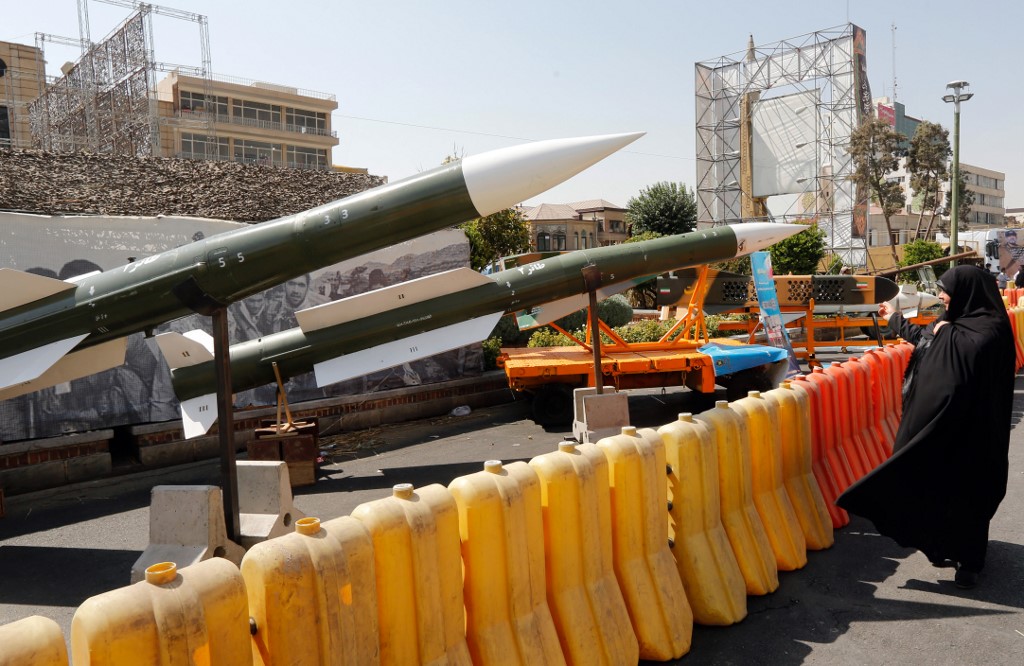
An Iranian woman looks at Taer-2 missile during a street exhibition by Iran’s army and paramilitary Revolutionary Guard celebrating ‘Defence Week’ marking the 39th anniversary of the start of 1980-88 Iran-Iraq war, at the Baharestan Square in Tehran, on September 26, 2019. (Photo by STRINGER / AFP)

If Israel attacks Iran, it will have to collect “bits and pieces” of Tel Aviv from the Mediterranean Sea, an Iranian commander threatened on Saturday.

“Iran has encircled Israel from all four sides. Nothing will be left of Israel,” said Abbas Nilforoushan, the deputy commander of operations of the Iranian Revolutionary Guard Corps (IRGC), in an interview with the Iranian news agency Tasnim. “Israel is not in a position to threaten Iran,” he said according to a translation published by Radio Farda, the Iranian branch of the US government-funded Radio Free Europe/Radio Liberty.

“If Israel makes a strategic mistake, it has to collect bits and pieces of Tel Aviv from the lower depths of the Mediterranean Sea,” he added.

Iran has been on edge, fearing an attack on the country over a drone-and-missile strike on Saudi Arabia’s oil industry earlier this month attributed to Tehran. Yemen’s Iranian-backed Houthi rebels have claimed the attack, but the US alleges Iran carried out the assault.

Satellite image from Planet Labs Inc. shows thick black smoke rising from Saudi Aramco’s Abqaiq oil processing facility in Buqyaq, Saudi Arabia, September 14, 2019. (Planet Labs Inc via AP)

In the aftermath of the attack, the US formed a coalition with regional and global powers including the United Arab Emirates, Bahrain, the United Kingdom and Australia to protect waterways across the Mideast. Iran denies being behind the tanker explosions, though the attacks came after Tehran threatened to stop oil exports from the Persian Gulf.

The attack in Saudi Arabia was the latest incident following the collapse of Iran’s nuclear deal with world powers, over a year after US President Donald Trump unilaterally withdrew America from the accord. The nuclear deal was meant to keep Tehran from building atomic weapons — something Iran denies it wants to do — in exchange for economic incentives.

Israel’s Prime Minister Benjamin Netanyahu was a sharp critic of the nuclear deal negotiated under the administration of former President Barack Obama, and welcomed Washington’s pull-back from the accord, urging further pressure on Iran.

Earlier this month, Netanyahu exposed the existence of a secret nuclear facility in central Iran in which he said the regime had conducted experiments in the pursuit of nuclear weapons. The Israeli premier said that once Iran detected that Israel had learned about the secret nuclear site, located in Abadeh, south of Isfahan, the regime quickly destroyed it

Prime Minister Benjamin Netanyahu delivers a statement to the press regarding the Iranian nuclear program, at the Foreign Ministry in Jerusalem on September 9, 2019 (Yonatan Sindel/Flash90)

Iran regularly threatens Israel, viewing the country as a powerful enemy allied with the United States and Sunni countries in the region against Tehran and its nuclear ambitions.

Israel has also thwarted Iranian operations in neighboring Syria where its fighters and those of Iranian proxy Hezbollah have been fighting alongside forces loyal to Syrian President Bashar Assad since 2011.

Tensions with the Hezbollah terror group soared this month after the Israel Defense Forces late last month thwarted an attempt by Iranian operatives in Syria — including two former Hezbollah members — to carry out an attack on northern Israel with armed drones and attacked their base. It also followed a drone attack in Beirut, attributed to Israel, that reportedly destroyed key components of a joint Hezbollah-Iran project to manufacture precision-guided missiles in Lebanon. Hezbollah responded to the attacks by firing anti-tank missiles into northern Israel earlier this month, although Israel said no soldiers were injured in the incident.

“No country can stand up to the Islamic Republic,” said Nilforoushan on Saturday. “Tehran’s enemies know that the will not be in control of ending a war they might start against Iran.”

“If the enemies could have started a war against Iran, they would have done it,” he said, adding that geography plays to Iran’s favor. “We are not a small country that could be conquered in one step. If all the Western, Arab and Israeli coalitions forces enter our country, Iran’s geography will defeat them before they can do anything.”

Nilforoushan threatened that should tensions rise further, Hezbollah will make good on its promise of “liberating northern Israel in case a war breaks out.”

“This will certainly happen, as Hezbollah has a good capability to do it,” Nilforoushan said, adding, “We will perceive any mistake in the region as involvement in a war in the whole region. Any action to start a war in the region will flare up a fire that will burn those who have started the war.”

“A war will drag Israel’s regime to the threshold of annihilation,” he continued.

Nilforoushan also boasted of Iran’s “deep and long-range [missile] assault capability” and said Tehran has the means to make this capability operations

“We will not let the enemies to face us at our borders. We will quickly drag the war to the bases and interests of the enemies anywhere they may happen to be,” he warned.


Happy New Year, Jews!

Posted September 29, 2019 by Joseph Wouk
Categories: Uncategorized


One who believes is not afraid

Posted September 29, 2019 by Joseph Wouk
Categories: Uncategorized

HAPPY NEW YEAR !

-JW

Off Topic:  Post-Election Developments in Israel- Jerusalem Studio 452 

Posted September 28, 2019 by Joseph Wouk
Categories: Uncategorized


The IDF mulls pre-emptive strike to ward off planned Iranian attacks on the UAE and Israel – DEBKAfile

Posted September 27, 2019 by Joseph Wouk
Categories: Uncategorized

Source: The IDF mulls pre-emptive strike to ward off planned Iranian attacks on the UAE and Israel – DEBKAfile

“Israel’s proven capacity to simultaneously perform multiple missions is about to be challenged as never before,’ said Binyamin Netanyahu on Thursday, Sept. 26, during a New Year’s toast at the IDF General Staff forum. 

The prime minister and defense minister went on to say: “Hitherto we have navigated affairs boldly and responsibly in several arenas, at times simultaneously, but not so far in a comprehensive confrontation.”

Netanyahu has never referred to all-out war as a distinct possibility, only as an outcome to be averted by “bold and responsible” navigation on several fronts.
DEBKAfile accounts for this change of tone by the events building up in the last two weeks. The effort to arrange a summit between the American and Iranian presidents at the UN fell flat, and Iran knows that even harsher US sanctions are therefore in store, including a ban on the Chinese vessels that are breaking the embargo on its oil sales. Tehran has furthermore counted its Sept. 14 cruise missile-drone attack on Saudi oil infrastructure a major success; it does not hide its intention to follow up with more devastating strikes against America’s regional allies.

Indeed on Sept. 22, Iran’s mouthpiece Hizballah leader Hassan Nasrallah and Tehran media singled out the United Arab Emirates as the next target after Saudi Arabia. A communique quoted by Iran’s media revealed: “A final ultimatum has been issued to the United Arab Emirates, explicitly and through a third party, either to get out of the Yemen war, north and south, or to wait for their share of punitive attack.” The warning adds: ”It would be a cruel attack on a country that has never experienced fire inside its home.”

In the absence of an American military response to the attack on Saudi oil, Tehran feels it can safely strike when and how it pleases.

With Israeli media exclusively preoccupied with the national political stalemate, a third general election appears in the national consciousness to be more realistic than a general war. However, Netanyahu’s warning on the eve of the New Year was solidly grounded in a rush of ominous events. The generals he addressed are therefore working on two assumptions:

  1. There is no certainty that Iran’s next “punitive attack” won’t fall on Israel before the UAE. The IDF is therefore in the throes of preparations to fend off Iranian cruise missiles and exploding drones potentially aimed at strategic targets in Israel from various sources – Iran, Iraq, Syria, Lebanon or/and the Gaza Strip.
  2. Even if Iran hits the UAE first, Tehran won’t give up on the option of punishing Israel next.

The Trump administration’s decision not to go to war with Iran leaves the ayatollahs’ regime a free hand to try and smash the military-intelligence alliance binding Saudi Arabia, the UAE and Israel. The dominant view in the IDF General Staff forum is that the Iranians will not pass up this opportunity. What Israel’s strategists are trying to decide at this moment therefore is whether the IDF should wait for the blows to fall on the Gulf emirate and Israel – in whatever order – or pursue pre-emptive action. In either case, total war appears to be unavoidable.