Donald Trump’s first appointment – one he could announce urbi et orbi within the week, if the person I have in mind is willing – should be that of Ayaan Hirsi Ali as the next American ambassador to the United Nations.
What are her qualifications?
She is supremely intelligent, articulate – soft-spoken but steely – in speech, a lucid and impassioned writer, and, what never hurts in making a case at the U.N. or on television, unusually attractive.
She has written four books: The Caged Virgin: An Emancipation Proclamation for Women and Islam; Infidel: My Life; Nomad: From Islam to America. A Personal Journey Through the Clash of Civilizations; and Heretic: Why Islam Needs a Reformation Now.
Were she to be appointed, those books will no doubt be reprinted, and read, by diplomats at the U.N. who want to find out more about her, by people in chanceries all over the world, and even in courses on Islam (those that are not taught by propagandists for the faith).
She was born in Somalia, and spent her first nine years there. She then lived in Saudi Arabia and Kenya before moving to the Netherlands. There she worked with mistreated Muslim women, learned Dutch, and became a member of the lower house of the Dutch Parliament.
In the Netherlands, Ayaan Hirsi Ali had the freedom to study and question Islam, which ultimately led to her abandoning the faith forever. But she did not drop the subject. She did not forget what so disturbed her about Islam, a faith which, through no fault of her own, she was born into. She has seen Islam as it was practiced in Somalia, in Saudi Arabia, in Europe and in the United States. She was a friend of Theo van Gogh, with whom she made the movie Submission, about the position of women in Islam. For his pains, van Gogh was murdered by a Muslim. Ayaan Hirsi Ali moved to the United States.
As the American representative at the U.N., she would make the freshly-minted charge that the presidential election signaled the triumph of “white nationalists” look ridiculous. And on meeting with her predecessor to discuss the job, Hirsi Ali would be able to speak truth to Power.
And she would be able to drive the Muslim representatives mad with fury as no one else possibly could. Every attempt at Taqiyya or Tu-Quoque by these representatives will be held up by her for inspection and mockery. She will be able to quote – and will be sure to quote – from the Qur’an and the Hadith. What will they say? How can they respond? That she doesn’t know what Islam is all about? She knows.
Ambassadors from the non-Muslim lands have so far not dared to speak truthfully about Islam. No doubt some are willfully ignorant, or intolerably stupid, while others have a hypertrophied fear of offending the Muslims who are now in their midst, living in the countries that these diplomats represent. Ayaan Hirsi Ali’s ability to discuss Islam with authority, to quietly but relentlessly refute what the defenders of the faith offer, will at first be a source of secret delight. And then some of those formerly fearful representatives will be emboldened to add their voices to what started out as a chorus of one: Ayaan Hirsi Ali.
There is one more thing. It’s the matter of security. Wherever Ayaan Hirsi Ali goes, wherever she speaks, there must be bodyguards. There are already plenty of guards all over the U.N. But more would be needed to guard a particular person, Ayaan Hirsi Ali. There are logistical problems. There is the extra cost. But it would be worth it. The very presence of those bodyguards would be a constant reminder to everyone of the threat of Muslim terrorism and of what Ayaan Hirsi Ali, and others who leave Islam and proclaim the reasons for their apostasy, must endure. And that’s not a bad thing. It should even be possible to have the U.N. pay the bill for her security, because “the terrorism that threatens Ayaan Hirsi Ali threatens the world” – or at least for the American government to loudly make that request of the U.N. and, if turned down, at the very least make that refusal widely known, or even threaten to deduct the cost of that extra security from what our government contributes to the U.N.
As they used to say on Delancey Street, what’s not to like?
During his campaign, President-elect Trump called West’s agreement with Iran “the worst deal ever negotiated,” said his top priority would be to “dismantle the disastrous deal with Iran” • Iranian President Rouhani adamant U.S. cannot renege on agreement.
News Agencies and Israel Hayom Staff
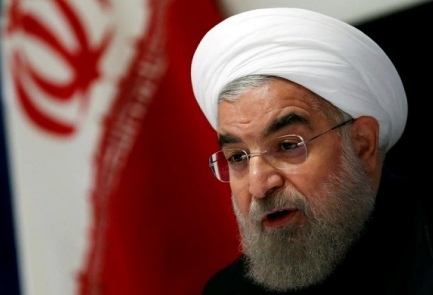
Iranian President Hassan Rouhani at the United Nations General Assembly in New York, in SeptemberPhoto credit: Reuters
Donald Trump’s election as president raises the prospect the United States will pull out of the nuclear pact it signed last year with Iran, Western media hedged Wednesday.
Outgoing President Barack Obama’s administration touted the deal as a major foreign policy achievement, saying it was the best way to suspend Tehran’s drive to develop atomic weapons, but the agreement was harshly opposed by Republicans in Congress.
During his campaign, Trump repeatedly blasted the deal, calling the nuclear agreement a “disaster” and “the worst deal ever negotiated,” warning it could lead to a “nuclear holocaust,” and pledging that if elected, his top priority would be to “dismantle the disastrous deal with Iran.”
By contrast, Trump conceded it would be hard to revise a deal cemented by a United Nations Security Council resolution.
Iran’s President Hassan Rouhani said Wednesday there was “no possibility” for Trump to renege on the nuclear deal.
“Iran’s understanding in the nuclear deal was that the accord was not concluded with one country or government but was approved by a resolution of the UN Security Council and there is no possibility that it can be changed by a single government,” Iranian media quoted Rouhani as saying.
“The United States no longer has the capacity to create Iranophobia and to create a consensus against Iran,” he said. “The constructive engagement policies of Iran toward the world, and the fact that international sanctions have been lifted, have placed the Iranian economy on a road where there is no possibility of going backward.”
French news agency AFP quoted Iranian Atomic Energy Organization spokesman Behrouz Kamalvandi as saying Iran “is prepared for any change.”
Meanwhile, the latest report by the International Atomic Energy Agency, released Wednesday, confirmed Iran was sticking to its commitments.
The Islamic republic “has not enriched uranium above low purities; its uranium stockpile stayed below agreed levels; and it has not pursued the construction of its heavy water reactor at Arak,” the report said.
Trump’s Israel advisor: “Trump doesn’t view settlement building as an obstacle for peace” Jason Greenblatt, one of Trump’s senior level advisors who will likely be appointed as Trump’s Middle East envoy, described the President-elect’s emerging policy: “It’s certainly not Mr. Trump’s view that settlement activity should be condemned.”
Jason Greenblatt, one of President-elect Donald Trump’s senior level advisors, will most likely be appointed as the US envoy to the Middle East and will rewrite a foreign policy differing from that of US President Obama and Secretary of State John Kerry. This morning (Thursday), Greenblatt was interviewed by Israel’s Army Radio explaining Trump’s stances and stressed: “He is not going to impose any solution on Israel.”
“It is certainly not Mr. Trump’s view that settlement activity should be condemned,” Greenblatt said during Israel’s Army Radio broadcast this morning. “Building over the Green Line is not an obstacle for peace.”
Trump giving a speech following his victory Photo Credit: CNN/Channel 2 News
“He believes that Israel is in a very tough situation needs to defend itself,” Greenblatt added mere hours after Israeli Prime Minister Benjamin Netanyahu congratulated Trump regarding his victory during a phone conversation between the two.
Greenblatt also indicated that Trump’s stance against returning land to the Palestinians derives from Israel’s 2005 Gaza disengagement: “He does not view the settlements as an obstacle for peace. I think he would use the expulsion of Jewish communities from the Gaza Strip as proof of that.”
Contrary to the Obama administration which attempted utilizing various measures in order to renew peace talks, Greenblatt feels that Trump will act differently regarding the Israeli-Palestinian conflict: “Peace has to come from both sides and he does not plan on intervening in the matter.”
Donald J. Trump in Scranton, Pa., this week. His win foreshadowed an America more focused on its own affairs while leaving the world to take care of itself.Credit Damon Winter/The New York Times
JERUSALEM — Donald J. Trump’s stunning election victory on Tuesday night rippled way beyond the nation’s boundaries, upending an international order that prevailed for decades and raising profound questions about America’s place in the world.
For the first time since before World War II, Americans chose a president who promised to reverse the internationalism practiced by predecessors of both parties and to build walls both physical and metaphorical. Mr. Trump’s win foreshadowed an America more focused on its own affairs while leaving the world to take care of itself.
The outsider revolution that propelled him to power over the Washington establishment of both political parties also reflected a fundamental shift in international politics evidenced already this year by events like Britain’s referendum vote to leave the European Union. Mr. Trump’s success could fuel the populist, nativist, nationalist, closed-border movements already so evident in Europe and spreading to other parts of the world.
Global markets fell after Tuesday’s election and many around the world scrambled to figure out what it might mean in parochial terms. For Mexico, it seemed to presage a new era of confrontation with its northern neighbor. For Europe and Asia, it could rewrite the rules of modern alliances, trade deals, and foreign aid. For the Middle East, it foreshadowed a possible alignment with Russia and fresh conflict with Iran.
“All bets are off,” said Agustín Barrios Gómez, a former congressman in Mexico and president of the Mexico Image Foundation, an organization dedicated to promoting its reputation abroad.
Crispin Blunt, chairman of the foreign affairs committee in Britain’s House of Commons, said, “We are plunged into uncertainty and the unknown.”
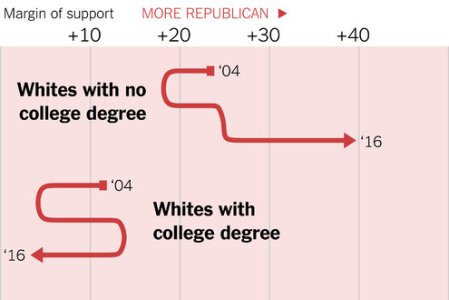
How Trump Won the Election According to Exit Polls
Based on exit polls, the 2016 presidential election seems to have dramatically redefined how certain demographic groups vote.
OPEN Graphic
Many linked Mr. Trump’s victory to the British vote to exit the European Union and saw a broader unraveling of the modern international system. “After Brexit and this election, everything is now possible,” Gérard Araud, the French ambassador to the United States, wrote on Twitter. “A world is collapsing before our eyes.”
The election enthralled people around the world on Tuesday night: night owls watching television in a youth hostel in Tel Aviv; computer technicians monitoring results on their laptops in Hong Kong; and even onetime oil pipeline terrorists in Nigeria’s remote Delta creeks, who expressed concern about how Mr. Trump’s election would affect their country.
It is hardly surprising that much of the world was rooting for Hillary Clinton over Mr. Trump, who characterized his foreign policy as “America First.”
Polls indicated that Mrs. Clinton was favored in many countries, with the exception of Russia. Last summer, the Pew Research Center found that people in all 15 countries it surveyed trusted Mrs. Clinton to do the right thing in foreign affairs more than Mr. Trump by ratios as high as 10 to one.
Mr. Trump’s promise to pull back militarily and economically left many overseas contemplating a road ahead without an American ally.
Photo
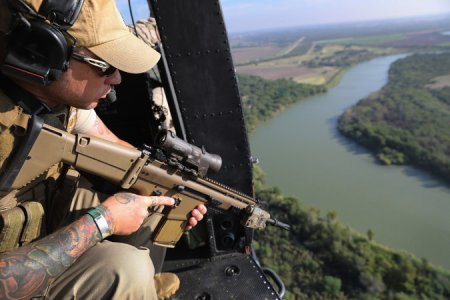
A Customs and Border Protection agent scanning the Rio Grande on the border with Mexico in McAllen, Tex., in October. Mr. Trump’s success could fuel the populist, nativist, nationalist, closed-border movements already evident in Europe and spreading to other parts of the world.Credit John Moore/Getty Images
“The question is whether you will continue to be involved in international affairs as a dependable ally to your friends and allies,” said Kunihiko Miyake, a former Japanese diplomat now teaching at Ritsumeikan University in Kyoto. “If you stop doing that, then all the European, Middle Eastern and Asian allies to the United States will reconsider how they secure themselves.”
In Germany, where American troops have been stationed for more than seven decades, the prospect of a pullback seemed bewildering. “It would be the end of an era,” Henrik Müller, a journalism professor at the Technical University of Dortmund, wrote in Der Spiegel. “The postwar era in which Americans’ atomic weapons and its military presence in Europe shielded first the west and later the central European states would be over. Europe would have to take care of its own security.”
Norbert Röttgen, chairman of the German parliamentary committee for foreign policy and a member of the ruling party, said Mr. Trump was “completely inadequate” to his office. “That Trump’s election could lead to the worst estrangement between America and Europe since the Vietnam War would be the least of the damage,” he said.
Perhaps nowhere was Mr. Trump’s win more alarming than in Mexico, which has objected to his promises to build a wall and bill America’s southern neighbor for it.
“I see a clear and present danger,” said Rossana Fuentes-Berain, director of the Mexico Media Lab, a think tank, and a founder of the Latin American edition of Foreign Affairs. “Every moment will be a challenge. Every move or declaration will be something that will not make us comfortable in the neighborhood — and that is to everyone’s detriment.”
With about $531 billion in trade in goods last year, Mexico is America’s third-largest partner after Canada and China. Supply chains in both countries are interdependent, with American goods and parts shipped to Mexican factories to build products that are shipped back into the United States for sale. Five million American jobs directly depend on trade with Mexico, according to the Mexico Institute.
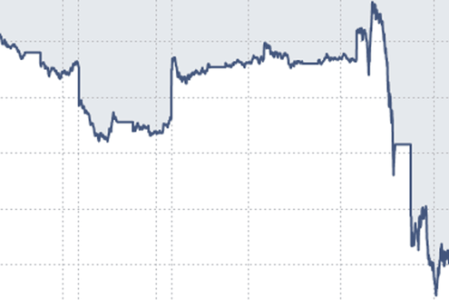
How the Markets Reacted to Trump’s Stunning Upset
As Donald J. Trump began to solidify his path to the presidency on Tuesday night, international markets fell sharply. Wall Street was expected to react similarly, but was up on Wednesday.
OPEN Graphic
The Mexican peso immediately fell 13 percent after the election, its biggest drop in decades. Mr. Barrios Gómez, the former congressman, predicted a short-term peso devaluation of 20 percent and a Mexican recession “as supply chains across the continent become sclerotic and investments dry up.” The business community, he said, was “freaking out.”
The economic fallout will probably reverberate farther. Izumi Kobayashi, vice chairwoman of Keizai Doyukai, a Japanese business group, predicted a drop in foreign investment in the United States as executives skeptical of Mr. Trump wait to see what he does.
“He has been focusing on the negative side of the global markets and globalization,” Ms. Kobayashi said. “But at the same time it is really difficult to go back to the old business world. So how will he explain to the people that benefit and also the fact that there is no option to go back to the old model of business?”
The uneasiness with Mr. Trump’s victory overseas ranged far beyond the country’s traditional partners. Abubakar Kari, a political-science professor at the University of Abuja, said most Nigerians believed a Trump administration would not bother with issues outside the United States.
“If Trump wins, God forbid,” Macharia Gaitho, one of Kenya’s most popular columnists, wrote on Tuesday before the votes came in, “then we will have to reassess our relations with the United States.”
One of the few places where Mr. Trump’s victory was greeted enthusiastically was Russia, where state-controlled television has been feasting on the circuslike elements of the American election. Not since the Cold War has Russia played such a big role in a presidential election, with Mr. Trump praising Mr. Putin and American investigators concluding that Russians had hacked Democratic email messages.
Photo
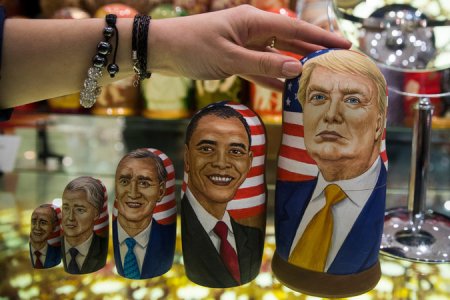
Traditional Russian dolls, called matryoshkas, depicting, from left, Presidents George Bush, Bill Clinton, George W. Bush and Barack Obama and the president-elect, Donald J. Trump, in a shop in Moscow.Credit Pavel Golovkin/Associated Press
“Trump’s presidency will make the U.S. sink into a full-blown crisis, including an economic one,” said Vladimir Frolov, a Russian columnist and international affairs analyst. “The U.S. will be occupied with its own issues and will not bother Putin with questions.”
“As a consequence,” he added, “Moscow will have a window of opportunity in geopolitical terms. For instance, it can claim control over the former Soviet Union and a part of the Middle East. What is there not to like?”
Others tried to find the upside. Mr. Blunt, the British lawmaker, said he was heartened by Mr. Trump’s selection of Gov. Mike Pence of Indiana as his running mate and thought that Britain might be the exception to the new president’s hostility toward trade deals.
Israel was another place where Mr. Trump enjoyed some support, mainly because of the perception that he would give the country a freer hand in its handling of the longstanding conflict with the Palestinians. But Prime Minister Benjamin Netanyahu and other Israeli leaders and commentators worried about a broader disengagement from a Middle East awash in war, terrorism and upheaval.
“Decisions cannot be postponed,” said Yohanan Plesner, a former member of the Israeli Parliament now serving as president of the Israel Democracy Institute. “The situation in Syria is very chaotic. The unrest in the region is continuing. America has to decide whether it wants to play an active role in shaping the developments of the region.”
And even some countries that might expect to see some benefits from an American retreat worried about the implications. Counterintuitive as it might seem, China was concerned about Mr. Trump’s promise to pull American troops back from Asia.
“If he indeed withdraws the troops from Japan, the Japanese may develop their own nuclear weapons,” said Shen Dingli, professor of international relations at Fudan University in Shanghai. “South Korea may also go nuclear if Trump cancels the missile deployment and leaves the country alone facing the North’s threats. How is that good for China?”
For American voters, that was not the point. After decades of worrying about what was good for other countries, they decided it was time to worry about what was good for America. And Mr. Trump promised to do just that, even if the rest of the world might not like it.
VIENNA, Nov 9 (Reuters) – Iran has exceeded a soft limit on sensitive material set under its nuclear deal with major powers, the U.N. atomic watchdog said on Wednesday, hours after Donald Trump – who has strongly criticized the agreement – won the U.S. presidential election.
It is the second time Tehran has surpassed the 130 metric tonne threshold for heavy water, a material used as a moderator in reactors like Iran’s unfinished one at Arak, since the deal was put in place in January. It had 130.1 tonnes of the material on Tuesday, the watchdog said.
The last time Iran overstepped that mark was brief, passing without major criticism from the other countries that signed the nuclear deal last year. But there are questions about whether the incoming Trump administration will react to such incidents the same way.
“On 2 November 2016, the director general expressed concerns related to Iran’s stock of heavy water to the vice president of Iran and president of the Atomic Energy Organization of Iran, … Ali Akbar Salehi,” the International Atomic Energy Agency (IAEA) said in a confidential report seen by Reuters.
The IAEA is policing the restrictions placed on Iran’s nuclear activities under the deal it signed with the United States, Russia, China, Britain, France and Germany. The agreement also lifted international sanctions against Tehran.
Iran told the agency it would prepare to transfer 5 tonnes of heavy water out of the country, as provided for in the deal, and a senior diplomat said Iran planned to carry out the shipment in the coming days.
A U.S. State Department spokesman, speaking at a regular news briefing in Washington, confirmed Iran’s intention to export the excess heavy water.
“It’s important to note that Iran made no effort to hide this, hide what it was doing from the IAEA,” spokesman Mark Toner said.
Rather than setting a strict limit on heavy water as it does for enriched uranium, the deal estimates Iran’s needs to be 130 tonnes and says any amount beyond the country’s needs “will be made available for export to the international market”.
Trump has called the agreement, one of President Barack Obama’s top achievements, “the worst deal ever negotiated” and said he would “police that contract so tough they (the Iranians) don’t have a chance”.
Iran also exceeded the heavy-water limit in February, with 130.9 tonnes. (Additional reporting by Arshad Mohammed in Washington; Reporting by Francois Murphy; Editing by Richard Balmforth and Paul Simao)
Trump’s victory places a right-wing government in charge of the United States, which could work in conjunction with a right-wing Israeli leadership.
Iran tests new precision-guided ballistic missile. (photo credit:IRANIAN MEDIA)
If Trump holds true to his campaign promises, his presidency could likely end the US conflict with Israel on two key issues: the Iran deal and West Bank settlements.
Over the last eight years the disagreement between the two allies over these topics was cannon fodder for the often acrimonious relationship between Prime Minister Benjamin Netanyahu and US President Barack Obama.
Netanyahu’s persistent campaign against the agreement even took him to Washington, where he addressed a joint session of Congress, in a plea for the US politicians to halt the actions of their own president.
During the election, Trump minced no words in showing his disdain for the June 15th agreement between Tehran and the six-world powers, including the US, that was designed to curb Iran’s nuclear capacity.
He promised to tear up the deal, which he said gives the US nothing in return for a contract that will allow Tehran to produce nuclear weapons even if it complies with the terms of the agreement.
“It’s the stupidest deal of all time,” Trump said.
“It’s a one-sided transaction where we are giving back $150 billion to a terrorist state,” he said.
“The United States should fulfill its commitments in the Joint Comprehensive Plan of Action (the nuclear deal) as a multilateral international agreement,” Iranian Foreign Minister Mohammad Javed Zarif was quoted as saying while on a visit to Romania.
He was not the only one who wasted no time in reminding Trump of pre-campaign promises.
Most of the settler leaders issued congratulatory statements to Trump, expressing their enthusiasm for the new page in US-Israel relations that they foresaw with his entry into the White House.
Under his leadership, the Republican party changed its platform during the election to eliminate any mention of the two-state solution. It recognized Jerusalem as the united capital of the Jewish state, and issued an affirmative statement that Israel was not an occupier in the West Bank, otherwise known as Judea and Samaria.
Trump has also promised to move the US Embassy to Jerusalem.
Since 2009, Netanyahu has pledged his support to the two-state solution, but has insisted that Jerusalem would remain Israel’s capital and that Israel has a right to continue to build in Judea and Samaria.
In the days leading up to the election and until its last hour, there were those in the United States and indeed throughout the world, that expected Wednesday to dawn with a Hillary Clinton presidency.
As a former First Lady, US Senator and Secretary of State, they were reassured by the notion of someone with so much foreign policy experience at the helm of one of the world’s super powers.
While they might be gasping at the sudden void of experience at the top, the dramatic turn around of a Trump presidency has some beneficial aspects for Israel.
It places a right-wing government in charge of the United States, which could work in conjunction with a right-wing Israeli leadership.
Unlike Obama, Trump, whose party also controls the House of Representatives and the Senate, would have more freedom to act on his policy initiatives than his predecessor, who fought repeatedly with the Republican Congress.
The timing could not be better. It comes as the Palestinian campaign to force Israel to withdraw to the pre-1967 lines is gaining steam and as Iran’s is increasing its activities in the Middle East.
In spite of the anti-Semitic overtones of some of Trump’s campaign choices, his presence in the White House could end the daylight between Washington and Jerusalem.
With regard to Iran, it could help decrease the threat from Tehran, and stymie Palestinian diplomatic warfare against the Jewish state.
For those on the Israeli Left, who believe that Israel’s rule of the West Bank is a threat to Israel’s future as a Jewish and democratic state, a Trump presidency is one more setback in a long list of defeats it has suffered.
But for those on the Right, it falls like a rainstorm after a long period of drought.
“I look forward to working with him to advance security, stability and peace in our region,” Netanyahu said.
Netanyahu and Trump. (photo credit:REUTERS)
President-elect Donald Trump invited Prime Minister Benjamin Netanyahu to meet with him in the United States at the earliest opportunity.
Netanyahu had called Trump to congratulate him on his electoral victory earlier in the day. According to the Prime Minister’s Office, the invitation came during that phone call.
Netanyahu assured Trump that the United States has no better ally than Israel as they discussed regional issues. The conversation between them was heartfelt and warm.
Both men have known each other for many years, the PMO’s office said.
In addition, Trump’s inner circle is very close to the Netanyahu and to Israel.
Netanyahu told Trump that he and his wife Sara looked forward to meeting him and his wife Melania.
Earlier in the day, Netanyahu had issued a statement in which he said that Trump is a “true friend” of the State of Israel.
“I look forward to working with him to advance security, stability and peace in our region,” Netanyahu said.
“The ironclad bond between the United States and Israel is rooted in shared values, buttressed by shared interests and driven by a shared destiny.
“I am confident that President-elect Trump and I will continue to strengthen the unique alliance between our two countries and bring it to ever greater heights,” Netanyahu said.
Germany’s Angela Merkel sent out a blunt statement to Donald Trump Wednesday morning, telling the president-elect that if he wanted to work well with his overseas’ partners – specifically, her – he would recognize the “dignity of man,” regardless of Muslim roots.
The warning came just hours after Trump, who’s vowed to crack down on borders in the United States and make sure those coming in the country aren’t carrying any Islamic-tied terror threat with them, won the White House.
“Angela Merkel has issued a carefully-worded response to Donald Trump’s election as US President, taking aim at the divisive rhetoric he used during the campaign.
“While Theresa May simply congratulated Trump on his victory, Merkel said she would only offer ‘close cooperation’ dependent on his commitment to equal rights.
“The German Chancellor, who has been the driving force behind the EU’s acceptance of hundreds of thousands of refugees, said her relationship with Trump would only succeed if he upheld “the dignity of man, independent of origin”.
“She said: ‘Germany and America are connected by values of democracy, freedom, and respect for the law and the dignity of man, independent of origin, skin colour, religion, gender, sexual orientation, or political views.
“‘I offer the next President of the United States close cooperation on the basis of these values.
“‘The partnership with the United States is and remains a foundation of German foreign policy.’”
Merkel also said she had watched the election results as they unfolded in America with “trepidation,” the news outlet reported.
Merkel made the conditional remarks even while Germany’s been fighting off a massive inflow of Muslim refugees, some of whom in recent days have been disciplined, albeit lightly, for sexually assaulting young girls at community swimming pools.
There is much to savor this morning, including the hysteria that is sweeping across the Left. We see it in ways large and small. At one of our local colleges, a class was canceled because the professor was crying too hard to teach. “I don’t feel safe here,” she said. The storm troopers were due any minute, apparently.
On a slightly larger (if rapidly fading) stage, Paul Krugman comforts the leftist faithful:
Some morning-after thoughts: what hits me and other [sic] so hard isn’t just the immense damage Trump will surely do, to climate above all.
This is unintentionally hilarious. The idea that the President controls the climate is wholly unscientific, but look on the bright side: if the worst Trump can do is harm the climate, the world is safe!
There’s also a vast disillusionment that as of now I think of as the end of the romantic vision of America (which I still love).
What I mean is the notion of US history as a sort of novel in which there may be great tragedy, but there’s always a happy ending.
Remember how the Democrats loved to tell us that they were on the “right side of history”? That meant that their victory was inevitable. Now, not so much. So is Krugman telling us that they turned out to be on the wrong side of history?
That is, we tell a story in which at times of crisis we always find the leader — Lincoln, FDR — and the moral courage we need.
So Krugman was looking to Hillary Clinton for moral courage? That’s pretty funny, too.
It’s a particular kind of American exceptionalism; other countries don’t tell that kind of story about themselves.
The British never talk about Churchill that way, or the French about DeGaulle.
But I, like others, believed it.
But no longer!
Now it doesn’t look very good, does it?
Actually, it looks pretty great. News flash, Paul: your side lost an election. That’s all.
But giving up is not an option.
Whew! I was afraid he might tell us we wouldn’t have Paul Krugman to kick around any longer.
The world needs a decent, democratic America, or we’re all lost. And there’s still a lot of decency in the nation — it’s just not as dominant as I imagined.
Those who voted for Trump: not just wrong, indecent! This is, of course, the attitude that mainstream Americans can’t stand, and it accounts in considerable part for Trump’s victory, and the ascendancy of the GOP generally. Krugman and his ilk still don’t understand how unpopular they are.
Time to rethink, for sure. But not to surrender.
It doesn’t appear, though, that the rethinking will go very far. As long as they insist that it’s indecent to be a Republican, we can’t expect much change from the Democrats. And you know what that means:
President-elect Donald Trump, during election campaign, meeting with Israel’s Prime Minister Benjamin Netanyahu. Photo Credit: Kobi Gideon / GPO
Israel’s Prime Minister Benjamin Netanyahu has been invited to meet with U.S. President-elect Donald Trump “at the first opportunity.”
The two men spoke together by phone Wednesday morning, just a few hours after Trump’s landslide win. The invitation comes as the fulfillment of a campaign promise by Trump to immediately begin to heal Washington’s frayed ties with the Jewish State.
Netanyahu congratulated Trump on his victory and told him the United States has no better ally than Israel.
The two men have known each other for many years. They held a warm conversation in which they briefly discussed regional issues as well.
Netanyahu told Trump that his wife Sarah is also looking forward to meeting with the new president-elect and his wife Melania.







 anneinpt
 artaxes
 danmillerinpanama
 davidking1530
 Peter Hofman
 Joseph Wouk
 Peter
 Louisiana Steve


Recent Comments