Archive for the ‘West Bank’ category

Dire Jordanian straits

March 14, 2017

Dire Jordanian straits, Israel Hayom, Daniel Pipes, March 14, 2017

Palestinians, according to most estimates, constitute a substantial majority of the population and present the deepest division. It’s common to speak of “Jordanians” and “Palestinians” even though the latter are citizens and children and grandchildren of citizens. As this suggests, the sense of being separate from and superior to the mostly tribal peoples of the East Bank has not diminished over time, especially not when Palestinians have achieved economic success.

I asked nearly all of my 15 interlocutors (who represented a wide range of viewpoints) about a return of Jordanian sovereignty to the West Bank. I regret to report that every one of them strongly rejected this idea. “Why would we want that headache?” they all seemed to say. Accepting their verdict means Israel has no practical solution to its West Bank conundrum, so its reluctant and unwanted sovereignty over Palestinians will likely continue into the distant future.

***************************************

“We’re in dire straits,” Jordan’s King Abdullah said half a year ago. After recently completing a week of intensive travels and discussions throughout Jordan, I found no one disagreeing with that assessment. Jordan may no longer be hyper-vulnerable and under siege, as it was in the past, but it does face possibly unprecedented problems.

Created out of thin air by Winston Churchill in 1921 to accommodate British imperial interests, the Emirate of Transjordan, now the Hashemite Kingdom of Jordan, for almost a century has led a precarious existence. Particularly dangerous moments came in 1967, when pan-Arabist pressures led King Hussein to make war on Israel and lose the West Bank; in 1970, when a Palestinian revolt nearly toppled the king; and 1990-1991, when pro-Saddam Hussein sentiments pushed him to join a hopeless and evil cause.

Today’s dangers are manifold. Islamic State lurks in Syria and Iraq, just beyond the border, attractive to a small but real minority of Jordanians. The once-robust trade with those two countries has nearly collapsed — and with it, Jordan’s lucrative transit role. In a region bountiful in oil and gas, Jordan is one of the very few countries to have almost no petroleum resources. City dwellers receive water just one day a week and country dwellers often even less. Tourism has declined, thanks to the Middle East’s notorious volatility. King Abdullah’s recent assertion of authority grates on those demanding more democracy.

The core issue of identity remains unresolved. As a country of massive immigration for over a hundred years (even exceeding the numbers going to Israel), it has received waves of Palestinians (in 1948-1949, 1967, and 1990-1991), Iraqis (2003), and Syrians (since 2011). Palestinians, according to most estimates, constitute a substantial majority of the population and present the deepest division. It’s common to speak of “Jordanians” and “Palestinians” even though the latter are citizens and children and grandchildren of citizens. As this suggests, the sense of being separate from and superior to the mostly tribal peoples of the East Bank has not diminished over time, especially not when Palestinians have achieved economic success.

The country’s strengths are also formidable. Surrounded by crises, the population is realistic and wary of trouble. The king enjoys an undisputed position of authority. Intermarriages and the influx of Iraqis and Syrians are eroding the historic divisions between Palestinians and others. The population enjoys a high level of education. Jordan has a good reputation around the world.

Then there’s Israel. “Where are the fruits of peace?” is a common refrain about Jordan’s 1994 treaty with Israel. Politicians and the media may not say so, but the answer is blindingly obvious: Whether it is using Haifa as an alternative to the Syrian land route, the purchase of inexpensive water, or the provision of plentiful gas (which is already being delivered), Jordan benefits directly and substantially from its ties with Israel. Despite this, a perverse social pressure against normalization with Israel has grown over time, intimidating absolutely everyone and preventing relations with the Jewish state from reaching their potential.

One Jordanian asked me why Israelis accept being treated like a mistress. The answer is clear: Because Jordan’s welfare ranks as a paramount Israeli priority, successive governments accept, even if through gritted teeth, the calumnies and lies told about Israel in the press and on the streets. Though they are too polite to say so, they clearly wish the king would take hold of this issue and point to the benefits of peace.

On a personal note: Since 2005, I have been advocating for “Jordan to the West Bank, Egypt to Gaza: The Three-State Solution” as a way to solve the Palestinian problem.

Accordingly, I asked nearly all of my 15 interlocutors (who represented a wide range of viewpoints) about a return of Jordanian sovereignty to the West Bank. I regret to report that every one of them strongly rejected this idea. “Why would we want that headache?” they all seemed to say. Accepting their verdict means Israel has no practical solution to its West Bank conundrum, so its reluctant and unwanted sovereignty over Palestinians will likely continue into the distant future.

Summing up the visit: Jordan has muddled through many crises and may do so again, but the concatenation of current dangers pose an extraordinary challenge to Jordan and its many well-wishers. Will Abdullah cope with these “dire straits”?


Israel Targets Palestinian Gun Makers

March 10, 2017

Israel Targets Palestinian Gun Makers, Investigative Project on Terrorism, Yaakov Lappin, March 10, 2017

At first glance, the bridal gown shop in the Palestinian city of Nablus appeared innocuous. But behind the scenes, Israeli intelligence says, the store served as a front for a major West Bank gun parts distribution center.

“Components for weapons were continuously being sold out of there,” a senior Israel Defense Forces (IDF) source told The Investigative Project on Terrorism.

The store turned out to be part of a wide network of weapons dealers who had imported their lethal goods by ordering them on the internet, the IDF stated this week.

Nine suspects, including the store owner, are in custody, and additional members of the weapons trafficking ring remain at large. “They came from all walks of life and from varied layers of Palestinian society,” the source stated.

Since mid-2016, the IDF has been engaged in an intensive, large-scale campaign to seize as many firearms circulating in the West Bank as possible to prevent them from falling into the hands of terrorists.

A growing number of such firearms have been used in deadly attacks, such as the Sarona Market shooting in Tel Aviv last June in which two Palestinian gunmen murdered four people in a restaurant. The gunmen used locally produced automatic rifles, dubbed ‘Carlos’ due to their resemblance to the Carl Gustav Swedish sub-machine gun.

While the latest wave of arrests focused on traders who used the internet to import gun parts, most of those on the IDF’s target list manufacture and assemble guns in local workshops. Seven such workshops have been shut down since the start of 2017, and 84 guns have been seized by Israeli security forces, according to figures made available by the IDF.

“The terrorist threat picture has changed. In the past, the main threat was posed by organized, institutional organizations,” the senior security source said. “For the most part, these were hierarchical terror cells, with a clear division of labor. There was someone responsible for financing, someone else had the designated job of transporting the suicide bomber or gunman, etc. This threat still exists. Hamas is trying to organize such cells all of the time. But the main challenge these days comes from terrorists that we do not have prior knowledge about.”

Lone attackers, or small, localized cells with no organizational affiliation or background of security offenses, are far harder for intelligence services to detect, and these are just the type of terrorists who are likely to use firearms available in their surroundings. These types of attackers, some of whom have suicidal tendencies or personal crises, according to the source, often will attempt simple attacks, using whatever is at their disposal. This can take the form of knife or vehicle attacks, or picking up locally available weapons.

Guns in the West Bank can be purchased by Palestinians for many reasons; whether for personal protection, to defend families and clans, to fire at wedding celebrations, or to reinforce one’s sense of ego.

As long as the guns are cheap and affordable, the source warned, “anyone can get [them]. Many of the shootings cells we captured in the West Bank were armed with these types of weapons.”

A year ago, a locally produced Carlo rifle cost around 2,300 shekels in the West Bank, meaning that Palestinians could purchase it with a single month’s salary, or take the money from family members, before moving ahead with an attack.

“The Sarona Market gunmen had no outside financial support, but still managed to get their hands on their firearms. The suits they wore [to disguise their identities] cost more than their guns,” the source said.

“This is why we are in the midst of an intensive campaign targeting the manufacturing and trade of weapons and gun parts. Even if I can’t get rid of the illegal weapons phenomenon, I can make them less accessible, and much harder to traffic in them.”

The increased Israeli pressure makes it more difficult to obtain guns, and increases the odds of catching people before they can attack. They have to leave their village or neighborhood and move around with the firearms where they can be caught and intercepted by the IDF. “People will fear more getting caught and moving around with these firearms,” the source said.

The Palestinian Authority would also like to see these guns taken off the streets, the source said, since it encourages lawlessness and anarchy in some areas that pose challenges to its rule.

Nablus, Balata Camp (next to Nablus), and Hebron are gun manufacturing focal points, according to IDF assessments. In addition, areas like Ramallah, Kalandia, and Palestinian neighborhoods on the outskirts of Jerusalem have workshops that take air or toy guns and convert them into real firearms using stolen components.

Thefts from IDF soldiers and Israeli civilians, as well as trade with Israeli weapons traffickers who do not care where the guns end up provide other sources of terrorist arms.

Efforts by security forces to stem the tide were beginning to pay dividends, the source said. Today, a Carlo gun costs more than 6,000 shekels, as numbers dwindle.

“With time, we are seeing improvements,” he said. “We are seizing more than we did in the past, and our intelligence techniques have improved, so that we can capture guns not only in homes, but also in the manufacturing locations, and when they are moved around. This is a campaign. No single incident will stamp out the problem. So long as the profit from this trade is big enough compared to the fear of arrest or facing raids, many Palestinians will continue to be active in it. ”

Ultimately, he said, “over time, we will seek to decrease the number of guns and keep raising the price. This will result in less terrorists getting their hands on them, and resorting to less lethal attack forms, such as knife attacks. Our soldiers’ alertness [to knife attacks] means such attacks produce less casualties – meaning that our effort will boost security.”

Hizballah Continues Recruiting Palestinians to Kill Israelis

March 9, 2017

Hizballah Continues Recruiting Palestinians to Kill Israelis, Investigative Project on Terrorism, March 9, 2017

Over the years, Hizballah has tried to establish a West Bank foothold to carry out terrorist and kidnapping attacks against Israelis. Members of Hizballah’s Unit 133 external operations branch used social media, particularly Facebook, to recruit West Bank Palestinians.

*****************************

Israeli security authorities arrested a suspected Palestinian member of Hizballah for planning terrorist attacks against Israelis, Israel’s domestic security agency announced on Thursday.

A subsequent Shin Bet interrogation revealed that Hizballah recruited Yusef Yasser Suylam, 23, via Facebook page. Suylam hails from the West Bank town Qalqiliya.

Investigators say the Palestinian operative was responsible for establishing a cell devoted to kidnapping Israeli civilians. Hizballah also directed Suylam to conduct surveillance on Israeli military bases and other security sites, in addition to various places in Jerusalem.

After an Israeli military court filed an indictment, several felony charges are expected against the Palestinian terrorist.

Over the years, Hizballah has tried to establish a West Bank foothold to carry out terrorist and kidnapping attacks against Israelis. Members of Hizballah’s Unit 133 external operations branch used social media, particularly Facebook, to recruit West Bank Palestinians.

Last August, a Shin Bet investigation found disrupted a terror cell that was recruited though the “Palestine the Free” Facebook page featuring anti-Israel Hizballah posts. Cell leader Mustafa Kamal Hindi recruited other operatives in hopes of waging a shooting attack against the Israeli military. Each operative was between the ages of 18-22 and lived in Qalqiliya.

One of the cell members purchased the material required to build a suicide bomb, while another was tasked with building the explosive device. Another terrorist focused on garnering intelligence about IDF patrols in the area. The group also began training with rifles for shooting attacks.

The characteristics, modus operandi, and recruitment methods match the description and reports surrounding recently arrested Yussef Suylam.

In January 2016, a Shin Bet investigation found that Hizballah leader Hassan Nasrallah’s son, Jawan, used social media to recruit terrorists in the West Bank. Through encrypted email exchanges with a Hizballah handler, cell leader Muhammad Zaghloul received instructions for carrying out suicide-bombing attacks and provided a plan to kill an IDF officer. Zaghloul admitted that the cell conducted surveillance of the officer and requested $30,000 to purchase arms to kill him. The plot to kill Israeli troops was likely in the execution phase, considering the two operatives were arrested in possession of a firearm.

Click here to read more details about other Hizballah attempts at recruiting Palestinians to conduct terrorist attacks against Israelis.

How Israel Would Become Palestine

February 20, 2017

How Israel Would Become Palestine, The Jewish PressFred Maroun, February 19, 2017

israel-palestine-flag

If Israel annexes the West Bank, the Jewish majority in Israel would be reduced immediately from 75% to between 56% and 57%, and the Arab minority in Israel would double from 21% to between 40% and 41%.

While Jews would retain a clear majority immediately after annexation, the Arabs’ influence on government would increase dramatically. Arab parties have been kept out of every governing coalition in Israel’s history, but the continuation of that practice would be almost impossible when Arabs represent 40% to 41% of the population. It would require that all Jewish parties, from left to right, always agree to work together after every election; sooner or later, that Jewish-only coalition would break up.

There is not much that is uncertain in this common-sense scenario resulting from annexation of the West bank, other than how long it would take to unravel. The end result is that Israel, which would likely be renamed Palestine, would no longer be a Jewish state by any definition of the term.

*********************************

The idea of Israel annexing the West Bank was tentatively endorsed by Israeli President Reuven Rivlin who insisted that if this occurred, Palestinians living in the West Bank must be given Israeli citizenship. US President Donald Trump signaled that he is willing to accept a one-state solution, and Israeli Prime Minister Benjamin Netanyahu’s lack of response to Trump indicates that he is not opposed to it either.

Based on the Jewish Virtual Library, in Israel, as of January 2017, “The Jewish population makes up 6,450,000 (74.8%); 1,796,000 (20.8%) are Arabs; and, those identified as ‘others’ (non-Arab Christians, Baha’i, etc) make up 4.4% of the population (384,000 people)”. Based on the Jerusalem Post, “Current estimates of the West Bank population, according to Israeli, Palestinian and US numbers, put the number of Palestinians at anywhere between 2.7 and 2.9 million.”

If Israel annexes the West Bank, the Jewish majority in Israel would be reduced immediately from 75% to between 56% and 57%, and the Arab minority in Israel would double from 21% to between 40% and 41%.

While Jews would retain a clear majority immediately after annexation, the Arabs’ influence on government would increase dramatically. Arab parties have been kept out of every governing coalition in Israel’s history, but the continuation of that practice would be almost impossible when Arabs represent 40% to 41% of the population. It would require that all Jewish parties, from left to right, always agree to work together after every election; sooner or later, that Jewish-only coalition would break up.

As Arab parties negotiate to be included in governing coalitions, some of their priorities would become government policy. Arab policies that are outright anti-Zionist would be rejected at first, but other priorities would have to be accepted.

One of the first priorities to be demanded by Arab parties is likely to be the immigration into Israel of relatives of Israeli Arab citizens, including some Palestinian refugees residing in Arab countries and some Palestinians residing in Gaza. This would have the effect of further increasing the size of the Arab minority, which would lead to even more Arab clout in the government.

Other Arab demands would have to be met, including immigration of more Palestinian refugees into Israel and the annexation of Gaza. Eventually, Arab parties would be able to govern with little or no Jewish representation. As Arabs control the Israeli government, they would eliminate laws that discriminate against them, including the unlimited Jewish right of return, perhaps even replacing it with an unlimited Palestinian “right of return”.

There is not much that is uncertain in this common-sense scenario resulting from annexation of the West bank, other than how long it would take to unravel. The end result is that Israel, which would likely be renamed Palestine, would no longer be a Jewish state by any definition of the term.

Israel Foils Another Hamas Kidnapping and Murder Plot

February 7, 2017

Israel Foils Another Hamas Kidnapping and Murder Plot, Investigative Project on Terrorism, February 6, 2017

Hamas actively seeks to recruit and mobilize terrorists in the West Bank to form cells dedicated to killing Israelis in an effort to spark chaos and eventually take over the Palestinian Authority.

***************************

Israeli security forces indicted three Palestinians Monday, saying they were part of a Hamas terrorist cell planning to kidnap and kill Israelis in the West Bank and within Israel.

According to the indictment, Hamas officials in Gaza sent instructions to the terrorists via Facebook, explaining how to carry out shooting attacks, detonate explosives, and coordinate kidnappings around Hebron. The cell also scouted several locations within Israel for future attacks, including a bus station in Afula, a military base, the Binyamina Train Station, and a synagogue. The terrorists gained important information about the targets while working in Israel illegally.

To facilitate the attacks, the terrorists saved about $270 per month to buy weapons, build bombs and recruit other Palestinians.

“The uncovering of the infrastructure and activities it planned demonstrates the high threat level posed by Hamas militants, especially those who enter Israel and remain their [sic] illegally,” according to the Shin Bet.

Israeli authorities have foiled several Hamas terrorist plots since the latest wave of Palestinian violence, which peaked in October 2015. While most attacks were largely individual terrorist initiatives, groups like Hamas and even Hizballah sought to hijack the popular uprising by planning and coordinating terrorist attacks. Both organizations failed to execute a sophisticated attack thus far due to vigilant Israeli intelligence practices.

In January 2016, Shin Bet foiled a Hamas terror cell seeking to kidnap and kill Israelis in hopes of using their victims’ bodies to negotiate the release of Palestinian prisoners in Israeli jails. A similar motivation encouraged Hamas affiliated terrorists behind the June 2014 kidnapping and murder of three Israeli teens, which eventually led to a full-fledged war between Israel and Hamas in Gaza.

Palestinian terrorists continue to provoke Israel, launching a rocket Monday from Gaza into southern Israel and firing at Israeli soldiers working on the Gaza border fence. In response, the Israeli military targeted several Hamas positions in Gaza with airstrikes and artillery shells.

Last week, a senior Israeli military official told Israel’s Channel 2 that Hamas has regained its military capabilities since the 2014 Gaza war. Hamas continues to invest considerable resources to rebuild its terrorist infrastructure at the expense of civilian reconstruction efforts.

In the meantime, Hamas actively seeks to recruit and mobilize terrorists in the West Bank to form cells dedicated to killing Israelis in an effort to spark chaos and eventually take over the Palestinian Authority.

Trump Gave Money to “West Bank” Settlement

December 19, 2016

Trump Gave Money to “West Bank” Settlement, Power Line, Paul Mirengoff, December 19, 2016

The Washington Post reports that in 2003, Donald Trump gave $10,000 to “institutions in one of Israel’s oldest and most steadfast West Bank settlements.” He made the donation in honor of David Friedman, who is now Trump’s pick to be U.S. ambassador to Israel.

I wish I had known about this before. It would have made me more supportive of Trump.

Trump’s donation was used to support schools in the Beit El settlement. According to the Post, he has donated money to many Jewish schools (yeshivas) in Israel and the U.S.

Beit El was founded in 1977. It is located on the outskirts of Ramallah, a major Palestinian population center. Approximately 1,300 Jewish families live there.

Israeli settlements are a bugaboo of the American left and of some on the center-right, as well. They are an impediment to a “peace” agreement, they say.

But Israel is a vibrant, dynamic, and growing society. The notion that its population should have remained confined to land within the pre-1967 borders in the hope that a peace agreement might one day be reached is ridiculous. One might just as well have expected Americans to confine themselves to the original 13 colonies.

The term “West Bank settlements” gives the game away. The settlements are no more on West Bank than the rest of Israel is. There is no natural barrier between the settlements on the outskirts of Jerusalem and Jerusalem itself. There is no significant natural barrier between the Beit El settlement Trump supported and the Mediterranean Sea.

The Mediterranean Sea is what most Palestinians want to drive Israeli Jews into.

Israel shouldn’t be pressured into assisting Palestinians in this quest by ceding control of the West Bank. And, security concerns aside, it shouldn’t be pressured into abandoning places where its citizens have lived for nearly 40 years (in the case of Beit El).

The only salient facts about the pre-1967 borders are: (1) they were untenable and (2) they were swept away by Israel’s military victory. Losing a war has consequences. There is no exception for losing a war intended to obliterate a nation.

But let’s return to president-elect Trump. Remember when mainstream media stalwarts accused him of running an anti-Jewish campaign in order to appeal to the “alt-right”? I wonder what the “alt-right” will make of Trump’s donations to Jewish educational institutions in the U.S. and Israel.

It’s time for a narrative shift. Hence forward, until further notice, the liberal MSM will no longer portray Trump as Jew-baiting. He will now be deemed fanatically pro-Jewish.

Sporadic Attacks Reveal Fragility of Israel-PA Security Cooperation

November 23, 2016

Sporadic Attacks Reveal Fragility of Israel-PA Security Cooperation, Investigative Project on Terrorism, Yaakov Lappin, November 22, 2016

1890IDF photo

A spate of terrorist attacks involving Palestinian Authority (PA) security personnel turning their firearms on Israelis is placing a strain on the discreet security cooperation place between the Israel Defense Forces (IDF) and the PA’s armed forces in the West Bank.

Guided by a common interest to repress Hamas and maintain stability, Israel’s defense establishment and the PA’s security forces cooperated on security affairs throughout a wave of largely unorganized Palestinian violence over the past year and a half.

The PA’s raids against Hamas and Islamic Jihad cells in the West Bank represent around 20 percent of all counter-terrorism raids there, according to official Israeli figures.

Yet a series of shootings by armed PA personnel, targeting Israeli soldiers and civilians, is a warning signal that provides clues to the fragility of this cooperation.

In the most recent attack, PA police officer Muhammad Turkaman, 25, fired his automatic weapon at a group of Israeli soldiers on Oct. 31, wounding three. He was shot and killed in the return fire at a checkpoint near Ramallah.

Turkman was from the northern West Bank town of Kabatiya, which produced several terrorists recently.

After the attack, the PA security forces spokesman Adnan Damiri denied that the shooting indicated a trend, and dismissed the idea that the PA security forces were becoming a threat to Israel, according to an Israel Radio report.

Turkaman’s attack was a response to a home search conducted by members of his own security organization, during which illegal firearms were seized, Damiri claimed.

Security sources in Israel told the Investigative Project on Terrorism that since October 2015, five Palestinian Authority security personnel carried out terrorist attacks against Israel.

Nevertheless, throughout recent years, security cooperation has continued.

The sources declined to discuss the ultra-sensitive question of whether these incidents challenge future cooperation.

The ability by Israel and the PA’s 30,000-strong security forces to work together on the ground is a litmus test of regional stability. So far, the cooperation has weathered the challenges, but each new attack by a member of the PA security forces represents a new crack. .

The ruling Fatah movement glorified Turkman’s shooting on its official Facebook page, Palestinian Media Watch reported. Separate Facebook posts described Turkman as a “heroic martyr,” and the “the Martyr police officer.”

Fatah claimed Turkman was a special forces member, and included photos of him posing with a Kalashnikov assault rifle.

Away from such rhetoric, the cooperation quietly goes on. On Nov. 5, the PA foiled a bombing plotted against the IDF near Hebron, arresting a terrorist from the West Bank city of Kalkilya who planted a large explosive device. The PA alerted the IDF to the danger, which diffused the bomb.

The PA periodically conducts such operations, often drawing fierce condemnation and outrage from its arch-rival, Hamas in Gaza.

The big picture can appear contradictory; official PA ruling entities often promote and enable incitement to violence, while Palestinian security forces are under orders to continue cooperating with the IDF.

That’s because preventing Hamas and Islamic Jihad from taking over the West Bank is as much a PA interest as it is an Israeli one.

And yet, the orders to cooperate with Israel have not prevented a growing number of Palestinian personnel from breaching their directives. The question of when – and if – these attacks might no longer be seen as rogue is critical.

On Jan. 31, an armed PA employee fired on a group of IDF solders near Ramallah, wounding three, before being shot dead in return fire.

In a statement following the attack, the Palestinian police force did not bother to condemn the shooting, announcing that “with great pride, the members of the Palestinian police eulogize the brave martyrdom of their colleague, Master Sergeant Amjad Sukkari… who committed the operation at V.I.P checkpoint in Beit El.”

Similarly, last December, a PA intelligence officer opened fire near Hizma, northeast of Jerusalem, wounding an IDF soldier and an Israeli Arab civilian. He was killed in return fire.

A month earlier, a PA security officer used a Kalashnikov to fire on an IDF patrol. The gunman was later turned over to PA custody by his father, and is serving a 10-year prison sentence in a Palestinian prison.

In June 2015, a member of a terror cell that shot dead an Israeli civilian in the West Bank was a PA intelligence agency member.

PA employees and police officers also carried out attacks during the Intifada that broke out in 2002, though on a much larger scale. During that period, they were acting under official policy set by then-PA President Yasser Arafat to pursue armed conflict and terrorism. Although Mahmoud Abbas is not known to have enacted similar policies, the PA continues to pay the families of dead terrorists and provide support for those imprisoned by Israel, records show. It is unclear whether that policy will apply to those PA employees carrying out the recent attacks.

A big difference between the bloody days of the Second Intifada, which raged 15 years ago, and today is that the PA’s armed forces and the IDF are, for the majority of the time, not shooting at one another. Instead they remain in communication and coordinate some of their activities.

Only a complete halt of the succession of terror attacks by PA security personnel can rule out the return of a wider clash.

Palestinians: The “Mountain of Fire” Erupts Against Abbas

August 25, 2016

Palestinians: The “Mountain of Fire” Erupts Against Abbas, Gatestone InstituteKhaled Abu Toameh, August 25, 2016

♦ The Palestinian Authority is now paying the price for harboring, funding and inciting gang members and militiamen who until recently were hailed by many Palestinians as “heroes” and “resistance fighters.”

♦ Hamas’s dream of extending its control to the West Bank now seems more realistic than ever — unless Mahmoud Abbas wakes up and realizes that he made a big mistake by authorizing local and municipal elections.

♦ The blood pouring out in Nablus and other Palestinian towns is proof that Abbas is on his way to losing control over the West Bank, just as he lost Gaza to Hamas in 2007. In an emergency meeting held on August 25 in Nablus, several Palestinian factions and figures reached agreement that it would be impossible to hold the vote under the current circumstances.

Hours after his security officers lynched a detainee, Palestinian Authority President Mahmoud Abbas urged Palestinian businessmen living abroad to support the Palestinian economy by investing in the Palestinian territories. The Palestinian Authority (PA), he asserted, was “working to provide security and safety to encourage investment.”

According to Abbas, “The Palestinian territories are living in a state of security stability, which we are working to provide for residents and investors alike by enforcing the rule of law and enhancing transparency and accountability.”

It must be nice to create your own reality, especially if your true reality is that of the 81-year-old Abbas.

In his speech before the businessmen, Abbas neglected any reference to the latest wave of “security chaos” in PA-controlled areas in the West Bank, specifically Nablus, the largest Palestinian city.

Five Palestinians, including two PA police officers, were killed in the worst scenes of internecine violence to hit the West Bank in recent years. Abbas was either playing the businessmen for fools or hoping that they share his deaf and blind state.

The violence in Nablus did not come as a surprise to those who have been monitoring the situation in the West Bank in recent months.

In fact, scenes of lawlessness and “security chaos” have become part of the norm in many Palestinian cities, villages and refugee camps — a sign that the PA may be losing control to armed gangs and militias. Palestinians refer to the situation as falatan amni, or “security chaos.” An article published in Gatestone in June referred to the growing instances of anarchy and lawlessness in PA-controlled areas in the West Bank, first and foremost Nablus.

Palestinians refer to Nablus as the “Mountain of Fire” — a reference to the countless armed attacks carried out against Israelis by residents of the city since 1967. Current events in Nablus, however, have shown how easily fire burns the arsonist. The Palestinian Authority is now paying the price for harboring, funding and inciting gang members and militiamen who until recently were hailed by many Palestinians as “heroes” and “resistance fighters.” Unsurprisingly, most of these “outlaws” and “criminals” (as the PA describes them) are affiliated in one way or another with Mahmoud Abbas’s Fatah faction.

Nablus, the so-called Mountain of Fire, is now threatening to turn into a volcano that is set to erupt in the face of Abbas and his PA government.

The situation in Nablus the past few days raises serious questions about the ability of the PA to perform basic security measures and rein in armed gangs and militiamen. Moreover, the unprecedented violence has further shattered Palestinian confidence in the PA and its leaders ahead of the local and municipal elections, scheduled to take place on October 8.

Hamas’s dream of extending its control to the West Bank now seems more realistic than ever. Under the current circumstances, Abbas would be offering the West Bank to Hamas on a silver platter — unless he wakes up and realizes that he made a big mistake by authorizing the local and municipal elections.

And the businessmen who met with Abbas? One might guess that they are sophisticated enough to avoid a doomed investment. Nablus will no doubt do the trick: they are likely to go running from the mayhem of the PA-controlled territories.

Things lately began to unravel when on August 18, in the Old City of Nablus, two Palestinian Authority security officers, Shibli bani Shamsiyeh and Mahmoud Taraira, were killed in an armed clash with gunmen.

Hours later, PA policemen shot dead two Palestinian gunmen who were allegedly involved in the killing of the officers. The two were identified as Khaled Al-Aghbar and Ali Halawah. The families of the two men accused the PA of carrying out an “extrajudicial” killing, and claimed their sons were captured alive and only afterwards shot dead. The families called for an independent commission of inquiry into the circumstances surrounding the killing of their sons. Palestinian human rights organizations have also joined the call for an inquiry into the killings.

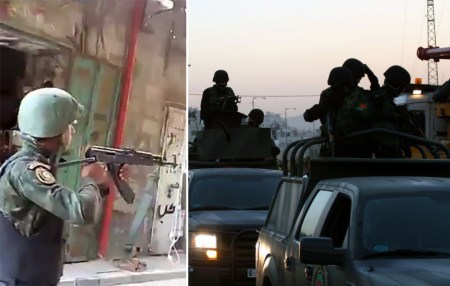
1809On August 18, two Palestinian Authority policemen were killed in an armed clash with gunmen in Nablus (left). In April of this year, a fierce gun battle erupted between Palestinian Authority policemen and members of the Jaradat clan in the refugee camp of Jenin (right). The clash started during an attempt to arrest a clan member.

In June, two other PA security officers, Anan Al-Tabouk and Uday Al-Saifi, were also killed in a shootout with gunmen in Nablus. The PA claimed that “outlaws” were behind the killings and vowed to punish the culprits.

Tensions in Nablus reached their peak on August 23, when scores of PA policemen lynched Ahmed Halawah, a former policeman suspected of leading a notorious gang belonging to Abbas’s Fatah faction. Halawah was beaten to death by PA policemen shortly after he was arrested and taken to the PA-run Jneid Prison in Nablus.

The PA leadership, which has since admitted that Halawah was lynched by its policemen, says it has ordered an inquiry into the case. Its leaders have described the lynching as an “unacceptable mistake.”

The lynching of the detainee sparked widespread protests throughout the West Bank, with many Palestinians calling for an immediate inquiry into the circumstances surrounding the case and demanding that those responsible be brought to trial.

The Palestinian Bar Association issued a statement strongly condemning the lynching of Halawah as a “crime and a human rights violation.” The Association called for holding those responsible, adding, “The regrettable and painful events, including the crime of killing Ahmed Halawah, do not serve the interest of the citizen or homeland and deepens divisions in our society.” It also called on the PA and its security forces to abide by the law and honor the human rights of the Palestinians and their public freedoms.

Alarmed by the widespread condemnations of the lynching of Halawah, some Palestinian Authority officials began issuing direct and veiled threats against Palestinian critics.

Palestinian lawyer Wael Al-Hazam, who called on Abbas to “withdraw” his security forces from Nablus, was visited by unidentified gunmen who sprayed his house with 14 bullets. The attorney and his family members were not hurt in the shooting attack, which was clearly designed to send a warning message to anyone who dared to raise his or her voice against human rights abuses by the PA security forces. And in this instance, the message arrived.

Shortly after the attack on his house, the lawyer issued a statement in which he said, “14 bullets are enough to silence me. I’m a man of the law and I cannot face bullets. My pen and voice are the only weapon I have. I do not possess armed militias to defend myself.” The attack on his house came shortly after PA security officers threatened the lawyer, warning him against appearing on a TV show to discuss the latest wave of violence in his city.

The turmoil in Nablus has prompted many Palestinians to call on Abbas to make a decision to postpone the upcoming municipal election in their city. In an emergency meeting held on August 25 in Nablus, several Palestinian factions and figures reached agreement that it would be impossible to hold the vote under the current circumstances.

Sarhan Dweikat, a senior member of Abbas’s Fatah, said that an election delay was needed, to

“protect the social fabric and preserve our national project, which is facing an existential threat in light of the security chaos and anarchy in Nablus. … Conditions in Nablus do not provide a positive climate for holding elections.”

It is hard to see how Abbas, delusional as he appears to be, would heed the calls to postpone the local and municipal elections. His pathetic attempt to persuade Palestinian businessmen to invest their money in PA-controlled areas at a time when the flames are engulfing his backyard is yet another sign of the man’s refusal — or inability — to see the reality on the ground.

This is the same president who claims that he is seeking to lead his people toward statehood and a better future. Incredibly, Abbas can probably continue to fool world leaders into believing that he and the Palestinian Authority are prepared for statehood. Yet the blood pouring out in Nablus and other Palestinian cities and villages is proof positive that Abbas is on his way to losing control over the West Bank, just as he lost the Gaza Strip to Hamas in 2007. If until now it seemed that Hamas posed the biggest threat to Abbas’s rule over the West Bank, it is now obvious that that is not so. The real threat, as brought home in blood in the West Bank, is coming from Abbas’s homegrown loyalists-turned-rebels.

Secretary-General Of Palestinian Presidency Delivers Speech On Behalf Of President ‘Abbas: In Fighting For Palestine, Our People ‘Loves Death More Than Life’

May 24, 2016

Secretary-General Of Palestinian Presidency Delivers Speech On Behalf Of President ‘Abbas: In Fighting For Palestine, Our People ‘Loves Death More Than Life’ MEMRI, May 24, 2016

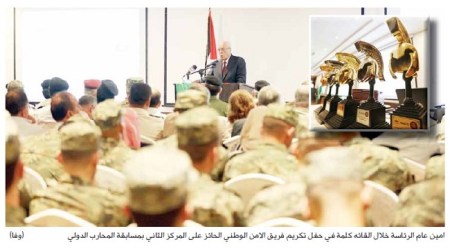
On May 22, 2016, Palestinian Presidency Secretary-General Al-Tayeb ‘Abd Al-Rahim delivered a speech on behalf of Palestinian President Mahmoud ‘Abbas to a group of Palestinian National Security Forces. The speech was part of a ceremony celebrating their second-place win in the international 8th Annual Warrior Competition, which took place in Jordan on May 2-6, 2016.[1]

In his speech, ‘Abd Al-Rahim condemned attempts to intimidate the Palestinian people and divert it from its path, and called such attempts futile, as “our [Palestinian] people loves death more than life.” He added that the National Security Forces victory was a step on the way to establishing an independent Palestinian state, and rejected the notion of establishing a separate independent entity in Gaza, or a state with temporary borders in the West Bank alone.

The following are excerpts from the speech:

28164Abd Al-Rahim speaking at the ceremony (Al-Ayyam, PA, May 23, 2016)

“Today we celebrate the Palestinian man, who suffers a lack of means and opportunity, but has will power and is determined to keep the Palestinian flag flying so that it [the flag] remains in the hearts of peace-loving and liberty-loving peoples. We were very happy with this victory [in the Warrior Competition], and the honorable president and commander-in-chief, president Abu Mazen [Mahmoud ‘Abbas], has expressed his esteem for the brothers who won this award and his pride in their achievements. Many commanders in Arab military institutions have also expressed their pride in this new Palestinian man, who is always new and always renewing [himself].

“The occupation wagered that we would forget our cause and that, as the generations passed, we would dissolve into the societies around us… However, the occupation was the first to realize that each new generation was more determined and had a stronger desire to achieve the goals that the martyrs had died for in the distant and the near past and [are still dying for] in the present. Our blood is still being spilled at the roadblocks and the checkpoints by the gangs of settlers and the extremist soldiers of the occupation, some of whom have acknowledged that they do not act according to moral standards when facing our people and children…

“Occupiers are always destined to fail. This fact should be in our minds forever. We must always cling to hope. Our morale will not be influenced or shaken by anything. We will not grow soft or deviate towards personal interests for the sake of dubious goals such as establishing a state or an emirate in Gaza, or establishing a state with temporary borders in the West Bank. We must always tirelessly stick to our truth, and our faith in victory must never falter. It is the faith in our hearts that will lead us to our rights and to the realization of our righteous and legitimate goals…

“Every achievement is a step on the road to establishing an independent state and strengthens our belief that the future is ours, that tyrants will disappear, and that the aggressors will end up in the trash bin of history. Indeed, they are trying to intimidate us today with people who threatened to strike Gaza or the Aswan Dam [a reference to incoming Israeli defense minister Avigdor Liberman], but these threats are hollow as we are a people who loves death more than life when it fights for Palestine.”[2]

Endnotes:

[1] The Annual Warrior Competition is a combat-oriented competition held at the King Abdullah II Special Operations Training Center (KASOTC) in Amman (Warriorcompetition.com).

[2] Al-Hayat Al-Jadida (PA), May 23, 2016.

Palestinians: Presidents for Life, No Elections

April 1, 2016

Palestinians: Presidents for Life, No Elections, Gatestone InstituteKhaled Abu Toameh, April 1, 2016

♦ We hear often that Mahmoud Abbas is keen on having Palestinians vote in a democratic election. Yet Abbas turned 81 last week and appears ready to remain at the helm until his last day — free elections for Palestinians be damned. That makes sense: Hamas could easily best Abbas in such an election.

♦ Hamas and Abbas’s Fatah are still far from achieving any form of reconciliation. This, despite all the talk about “progress” that has been reportedly achieved in talks between the two parties taking place in Doha, Qatar.

♦ Hamas is also cracking down on journalists, academics, unionists and even lawyers in the Gaza Strip.

♦ Yet Abbas’s West Bank rivals Hamas in Gaza, in terms of a lack of human rights and freedom of speech. The idea of free and democratic elections there is a joke. Abbas will leave a legacy of chaos.

Best birthday wishes to Palestinian Authority (PA) President Mahmoud Abbas, who turned 81 last week. The octogenarian appears ready to remain at the helm until his last day — free elections for Palestinians be damned.

Abbas has inherited a tradition of tyranny. His predecessor, Yasser Arafat, was also president for life. Both have plenty of company, joining a long list of African presidents who earned the notorious title of “President for Life” – in Uganda, Equatorial Guinea, Angola, Zimbabwe, Sudan, Chad, Eritrea and Gambia. And let us not forget the Arab dictators in these ranks.

One might hope for at least a deputy — someone to fill the impending and inevitable power vacuum in the PA. Not likely.

Abbas has fiercely resisted demands from leaders of his ruling Fatah faction to name a deputy president or a successor. His reasoning: the time is not “appropriate” for such a move. Palestinians should instead concentrate their energies on rallying international support for a Palestinian state.

The PA president acquired his “private fiefdom,” as it is called by his detractors, in a January 2005 election, when Abbas was given a four-year mandate.

Such mandate seems to have been rewritten by the standing president. January 2016 marked the beginning of the eleventh year of Abbas’s four-year term in office. But it is business as usual in Ramallah.

We hear on a monthly basis that Abbas is keen on having Palestinians cast their ballots in a free and democratic vote. Yet we have seen no evidence to this effect. That make sense: Hamas could easily best Abbas in such an election. Despite his advancing age, Abbas still has clear memories of January 2006, when Hamas was permitted to run in the parliamentary election and won.

Abbas is also acutely aware that Hamas, which holds hostage nearly two million Palestinians in the Gaza Strip, would never allow a free vote there — especially for Abbas loyalists who have been seeking to undermine its rule.

Just a few days ago, a Hamas “military” court in the Gaza Strip sentenced two senior Palestinian Authority security officers, Sami Nisman and Naim Abu Ful, to 15 and 12 years in prison respectively, on charges of spying for the Palestinian Authority and plotting terror attacks against Hamas targets.

The verdicts are yet another sign that Hamas and Abbas’s Fatah are still far from achieving any form of reconciliation. This, despite all the talk about “progress” that has been reportedly achieved in talks between the two parties. Unconfirmed reports earlier this week leaked details of sticking points between Hamas and Fatah negotiators, have been meeting in Doha, Qatar, under the auspices of the Gulf state, towards forming a new unity government and holding new presidential and parliamentary elections. Qatar is the largest source of funds for the Muslim Brotherhood and its offshoot, Hamas.

Abbas’s fear of holding elections in the Gaza Strip is not without justification. In addition to the crackdown on his loyalists and security officers there, Hamas is also cracking down on journalists, academics, unionists and even lawyers.

Last week, Hamas security forces raided the offices of the Palestinian Bar Association in Gaza City and confiscated computers. The raid came as a result of the controversy surrounding the Bar Association not submitting lawyers’ financial and administrative records, in addition to complaints filed by some lawyers against the Bar Association, according to a statement released by the Palestinian Center for Human Rights (PCHR). The raid, some Palestinians claim, is in the context of Hamas’s effort to crack down on lawyers who are affiliated with the rival Fatah faction.

Yet Abbas’s West Bank rivals Hamas in Gaza, in terms of a lack of human rights and freedom of speech. The president’s security forces are in the midst of a massive and ongoing crackdown on political opponents of all stripes, making the idea of free and democratic elections there a joke. Abbas cannot tolerate the idea of having a deputy: how would he consider the establishment of a new party or the emergence of a potential candidate for the presidency.

Senior figures who have dared to challenge Abbas’s autocratic rule have already found themselves targeted by the president and his men. Ask former Prime Minister Salam Fayyad, who had his organization’s bank accounts seized by Abbas, or Mohamed Dahlan, the former Fatah commander and minister who was forced to flee the Palestinian territories after falling out with Abbas and his sons. Perhaps deposed PLO Secretary-General Yasser Abed Rabbo, who overnight was stripped of his powers and thrown to the dogs for speaking out against the president, would have a word to say. In Ramallah, they call them the “Abbas victims.”

909Palestinian Authority President Mahmoud Abbas (left), who turned 81 last week, has fiercely resisted demands from leaders of his ruling Fatah faction to name a deputy president or a successor. Senior figures who have dared to challenge Abbas’s autocratic rule have been targeted by the president — such as Mohamed Dahlan (right), the former Fatah commander and minister who was forced to flee the Palestinian territories after falling out with Abbas and his sons. (Image sources: U.S. State Dept., M. Dahlan Office)

We would need a crystal ball to know what will happen the day after Abbas disappears from the scene. Perhaps, say some, we shall witness a scene reminiscent of the old days of the Soviet Union “Politburo,” with the next president chosen by a group of Fatah and PLO leaders who will meet in Ramallah. This seems the most likely scenario, in the absence of any chance of free and democratic elections, and in light of the continued split between the two Palestinian entities in the West Bank and Gaza Strip.

We do not need a crystal ball, however, to know that Abbas will leave a legacy of chaos. His adamant refusal to name a deputy or even discuss the issue of succession in public has already created tensions among the top brass of the PLO and Fatah. The Palestinian public, for its part, has precious little confidence in its leaders.

The behind-the-scenes power struggle that has been quietly raging in Ramallah for the past few months is likely to lead to a state of paralysis in the Palestinian arena and leave the Palestinians without an acceptable leader. Or, as senior Fatah official Tawfik Tirawi put it, Abbas will be the last president for the Palestinians.

Palestinians are plagued with leaders who desire one thing: personal power. The Palestinians are marching away from achieving a state, partly because they seem incapable of the fundamental political principle of free and democratic elections. The day after does not look promising.