Archive for the ‘U.S. Military’ category

Obama’s Iranian-nuclear strategy brings dividend: Rev Guards lead military assault on Tikrit

March 4, 2015

Obama’s Iranian-nuclear strategy brings dividend: Rev Guards lead military assault on Tikrit, DEBKAfile, March 4, 2015

(Please see also The World Bows to Iranian Regional Hegemony and Should We Give Up on the Iraqi Army? — DM)

General_Qassam_Suleimani_IRAQ_1.15Iranian Gen. Qassem Soleimani on Tikrit battlefront

US President Barack Obama’s plans for Iran, which were spectacularly challenged by Binyamin Netanyahu in his Congress speech Tuesday, March 3, were manifested 10,000 kilometers from Washington in the firestorm over Tikrit, the important Sunni town north of Baghdad. There, Iranian-led Iraqi troops are on the offensive against the Islamic State in the biggest ground battle fought in Iraq since the Iraqi army fell apart and scattered last June against the conquering Islamist march through western and central Iraq.

For four reasons, this battle is loaded with ramifications for Obama’s Iran policy and the Islamic Republic’s drive for recognition as the leading Middle East power:

1.   For Tehran it is a high-stake gamble for prestige, Its top military strategist, Al Qods Brigades chief Gen. Qassem Soleimani, was thrown into the Tikrit operation, to become the first high-ranking general Iran has ever placed publicly up front in direct command of a key battle as a guarantee of its success.

2.  However, three days after the offensive was launched on Sunday, March 1, the 25,000 Iranian and Iraqi troops, backed by Iraqi Shiite militias, were still fighting outside its gates, upsetting the high hopes of a swift victory and breakthrough into the city.

Islamist forces slowed their advance by strewing hundreds of mines and roadside bombs on all the roads leading to Tikrit, while teams of suicide bombers jumped out and blew themselves up amidst the invading army – a tactic seen before in the battle for the Syrian Kurdish town of Kobani.
ISIS boasted that one of the suicide bombers was an American citizen whom they dubbed “Abu Dawoud al-Amriki.”

3.  The United States has no military input in the battle – neither US advisers on the ground nor aerial bombardment. On Tuesday, March 3, while Netanyahu was advising Congress in reference to the relative merits of radical Iran and ISIS that “the enemy of your enemy is the enemy,” Gen. Martin Dempsey, Chairman of the US Joint Chiefs of Staff, revealed some of the Obama administration’s thinking on the subject.

He said Iran and its allies (Iraqi Shiite militias) had taken part in the Iraq war ever since 2004. “But the Tikrit campaign signals a new level of involvement,” he said. “This is the most overt conduct of Iranian support in the form of artillery and other things” and “…could turn out to be a positive thing.”

These comments corroborated DEBKAfile’s disclosures on the US-led war on ISIS, which defined America as confining itself to air strikes over Iraq and Syria and assigning the brunt of the ground war to Iran’s Revolutionary Guards forces – a division of labor, which Israeli military chiefs watch with increasing concern as it brings the Iranian peril closer than ever to Israel, DEBKAfile’s military sources report.

The Iraq format is replicated in southern Syria, where the same Gen. Soleimani, joined by a group of fellow Iranian generals, is leading an operation to seize that part of the country from Syrian rebel hands, including the Golan town of Quneitra .

4. The role Obama has assigned Iran in the two embattled Middle East countries bears directly on the scope of his concessions in the bargaining for a comprehensive nuclear deal.

The World Bows to Iranian Regional Hegemony

March 4, 2015

The World Bows to Iranian Regional Hegemony, Asia Times Online via Middle East Forum, David P. Goldman, March 4, 2015. Originally published under the title, “World Bows to Iran’s Hegemony.”
1025The looming nuclear agreement is a dark cloud for countries within range of Iranian ballistic missiles.

The powers of the world hope to delay, but not deter, Iran’s eventual acquisition of nuclear weapons.

The US has tacitly accepted the guiding role of Iranian commanders in Iraq’s military operations against ISIS.

Washington destroyed the balance of power that defined the region’s politics when it pushed through majority rule in Iraq.

****************

The problem with Israeli Prime Minister Benyamin Netanyahu’s address to Congress March 3 was not the risk of offending Washington, but rather Washington’s receding relevance. President Barack Obama is not the only leader who wants to acknowledge what is already a fact in the ground, namely that “Iran has become the preeminent strategic player in West Asia to the increasing disadvantage of the US and its regional allies,” as a former Indian ambassador to Oman wrote this week.

For differing reasons, the powers of the world have elected to legitimize Iran’s dominant position, hoping to delay but not deter its eventual acquisition of nuclear weapons. Except for Israel and the Sunni Arab states, the world has no desire to confront Iran. Short of an American military strike, which is unthinkable for this administration, there may be little that Washington can do to influence the course of events. Its influence has fallen catastrophically in consequence of a chain of policy.

The best that Prime Minister Netanyahu can hope for is that the US Congress will in some way disrupt the Administration’s efforts to strike a deal with Iran by provoking the Iranians. That is what the White House fears, and that explains its rage over Netanyahu’s appearance.

Tehran may overplay its hand, but I do not think it will. The Persians are not the Palestinians, who discovered that they were a people only a generation ago and never miss an opportunity to miss and opportunity; they are ancient and crafty, and know an opportunity when it presents itself.

Most of the world wants a deal, because the alternative would be war. For 10 years I have argued that war is inevitable whatever the diplomats do, and that the question is not if, but how and when. President Obama is not British prime minister Neville Chamberlain selling out to Hitler at Munich in 1938: rather, he is Lord Halifax, that is, Halifax if he had been prime minister in 1938. Unlike the unfortunate Chamberlain, who hoped to buy time for Britain to build warplanes, Halifax liked Hitler, as Obama and his camarilla admire Iran.

China is Chamberlain, hoping to placate Iran in order to buy time. China’s dependence on Middle East oil will increase during the next decade no matter what else China might do, and a war in the Persian Gulf would ruin it.

Until early 2014, China believed that the United States would guarantee the security of the Persian Gulf. After the rise of Islamic State (ISIS), it concluded that the United States no longer cared, or perhaps intended to destabilize the region for nefarious reasons. But China does not have means to replace America’s presence in the Persian Gulf. Like Chamberlain at Munich, it seeks delay.

Obama, to be sure, portrays his policy in the language of balance of power. He told the New Yorker’s David Remnick in 2014,

It would be profoundly in the interest of citizens throughout the region if Sunnis and Shias weren’t intent on killing each other. And although it would not solve the entire problem, if we were able to get Iran to operate in a responsible fashion – not funding terrorist organizations, not trying to stir up sectarian discontent in other countries, and not developing a nuclear weapon – you could see an equilibrium developing between Sunni, or predominantly Sunni, Gulf states and Iran in which there’s competition, perhaps suspicion, but not an active or proxy warfare.

That, as the old joke goes, is the demo version.

On the ground, the US has tacitly accepted the guiding role of Iranian commanders in Iraq’s military operations against ISIS. It is courting the Iran-backed Houthi rebels who just overthrow a Saudi-backed regime in Yemen. It looks the other way while its heavy arms shipments to the Lebanese army are diverted to Hezbollah.

At almost every point at which Iran has tried to assert hegemony over its neighbors, Washington has acquiesced. “In the end, peace can be achieved only by hegemony or by balance of power,” wrote Henry Kissinger. The major powers hope for peace through Iranian hegemony, although they differ in their estimate of how long this will last.

Apart from its nuclear ambitions, the broader deal envisioned by Washington would leave Iran as a de facto suzerain in Iraq. It would also make Iran the dominant power in Lebanon (via Hezbollah), Syria (via its client regime) and Yemen (through its Houthi proxies). Although Sunni Muslims outnumber Shi’ites by 6:1, Sunni populations are concentrated in North Africa, Turkey and South Asia. Iran hopes to dominate the Levant and Mesopotamia, encircling Saudi Arabia and threatening Azerbaijan.

It is grotesque for America to talk of balance of power in the Persian Gulf, because America destroyed the balance of power that defined the region’s politics from the end of the First World War until 2006, when Washington pushed through majority rule in Iraq.

The imperialist powers in their wisdom established a power balance on two levels. First, they created a Sunni-dominated state in Iraq opposite Shi’ite Iran. The two powers fought each other to a standstill during the 1980s with the covert encouragement of the Reagan administration. Nearly a million soldiers died without troubling the world around them.

Second, the Sykes-Picot agreement of 1916 created two states, Syria and Iraq, in which minorities ruled majorities – the Alawite minority in Syria, and the Sunni minority in Iraq. Tyranny of a minority may be brutal, but a minority cannot exterminate a majority.

America’s first great blunder was to force majority rule upon Iraq. As Lt General (ret.) Daniel Bolger explained in a 2014 book,

The stark facts on the ground still sat there, oozing pus and bile. With Saddam gone, any voting would install a Shiite majority. The Sunni wouldn’t run Iraq again. That, at the bottom, caused the insurgency. Absent the genocide of Sunni Arabs, it would keep it going.

Under majority Shi’ite rule, Iraq inevitably became Iran’s ally. Iranian Revolutionary Guards are now leading its campaign against the Sunni resistance, presently dominated by ISIS, and Iranian officers are leading Iraqi army regulars.

This was the work of the George W Bush administration, not Obama. In its ideological fervor for Arab democracy, the Republicans opened the door for Iran to dominate the region. Condoleezza Rice, then Bush’s National Security Advisor, proposed offering an olive branch to Iran as early as 2003. After the Republicans got trounced in the 2006 Congressional elections, defense secretary Donald Rumsfeld got a pink slip, vice president Dick Cheney got benched, and “realist” Robert Gates – the co-chairman of the 2004 Council on Foreign Relations task force that advocated a deal with Iran – took over at Defense.

China and Russia

In the past, China has sought to strike a balance between Saudi Arabia and Iran with weapons sales, among other means. One Chinese analyst observes that although China’s weapons deliveries to Iran are larger in absolute terms than its sales to Saudi Arabia, it has given the Saudis its best medium-range missiles, which constitute a “formidable deterrent” against Iran.
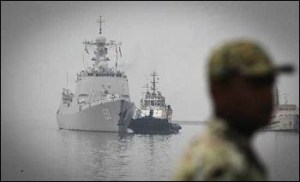
1026A Chinese warship arrives in Bandar Abbas, Iran in September 2014.

As China sees the matter, its overall dependency on imported oil is rising, and the proportion of that oil coming from Iran and its perceived allies is rising. Saudi Arabia may be China’s biggest provider, but Iraq and Oman account for lion’s share of the recent increase in oil imports. China doesn’t want to rock the boat with either prospective adversary.

Among the world’s powers, China is the supreme rationalist: it views the world in terms of cold self-interest and tends to assume that others also view the world this way. One of China’s most respected military strategists told me bluntly that the notion of a nuclear exchange between Israel and Iran (and by implication any regional nuclear power and Iran) was absurd: the Iranians, he argued, know that a nuclear-armed Israel could destroy them in retaliation.

Other Chinese analysts are less convinced and view Iran’s prospective acquisition of nuclear weapons with trepidation. It is not only war with Israel but with Saudi Arabia that concerns the oil-importing Chinese. For the time being, Beijing has decided to accommodate Iran. In a March 2 commentary, Xinhua explicitly rejected Israeli objections:

The US Congress will soon have a guest, Israeli Prime Minster Benjamin Netanyahu, who is expected to try to convince lawmakers that a deal with Iran on its nuclear program could threaten the very existence of the Jewish state.

Despite the upcoming pressure, policymakers in Washington should have a clear mind of the potential dangers of back-pedaling on the current promising efforts for a comprehensive deal on the Iranian nuclear issue before a March 31 deadline …

With a new round of talks in Switzerland pending, it is widely expected that the P5+1 [the five permanent members of the UN Security Council plus Germany] could succeed in reaching a deal with Iran to prevent the latter from developing a nuclear bomb, in exchange for easing sanctions on Tehran.

The momentum does not come easy and could hardly withstand any disturbances such as a surprise announcement by Washington to slap further sanctions on Tehran.

The Obama administration needs no outside reminder to know that any measures at this stage to “overwhelm” Iran will definitely cause havoc to the positive atmosphere that came after years of frustration over the issue.

While it is impossible for Washington to insulate itself from the powerful pro-Israel lobbyist this time, the US policymakers should heed that by deviating from the ongoing endeavor on Iran they may squander a hard-earned opportunity by the international community to move closer to a solution to the Iran nuclear issue, for several years to come if not forever.

Russia has taken Iran’s side explicitly, for several reasons.

First, Russia has stated bluntly that it would help Iran in retaliation for Western policy in Ukraine, as I wrote in this space January 28. Second, Russia’s own Muslim problem is Sunni rather than Shi’ite. It has reason to fear the influence of ISIS among its own Muslims. If Iran fights ISIS, it serves Russian interests. Russia, to be sure, does not like the idea of a nuclear power on its southern border, but its priorities place it squarely in Iran’s camp.

Demographic Time Bomb

The Israeli prime minister asserted that the alternative to a bad deal is not war, but a better deal. I do not think he believes that, but Americans cannot wrap their minds around the notion that West Asia will remain at war indefinitely, especially because the war arises from their own stupidity.

Balance of power in the Middle East is inherently impossible today for the same reason it failed in Europe in 1914, namely a grand demographic disequilibrium: Iran is on a course to demographic disaster, and must assert its hegemony while it still has time.

Game theorists might argue that Iran has a rational self-interest to trade its nuclear ambitions for the removal of sanctions. The solution to a multi-period game – one that takes into account Iran’s worsening demographic weakness – would have a solution in which Iran takes great risks to acquire nuclear weapons.

Between 30% and 40% of Iranians will be older than 60 by mid-century (using the UN Population Prospect’s Constant Fertility and “Low” Variants). Meanwhile, its military-age population will fall by a third to a half.

Belated efforts to promote fertility are unlikely to make a difference. The causes of Iranian infertility are baked into the cake – higher levels of female literacy, an officially-sanctioned culture of sexual license administered by the Shi’ite clergy as “temporary marriage,” epidemic levels of sexually-transmitted disease and inbreeding. Iran, in short, has an apocalyptic regime with a lot to be apocalyptic about.

Henry Kissinger is right: peace can be founded on either hegemony or balance of power. Iran cannot be a hegemon for long because it will implode economically and demographically within a generation. In the absence of either, the result is war. For the past 10 years I have argued in this space that when war is inevitable, preemption is the least damaging course of action. I had hoped that George W Bush would have the gumption to de-fang Iran, and was disappointed when he came under the influence of Condoleezza Rice and Robert Gates. Now we are back in 1938, but with Lord Halifax rather than Neville Chamberlain in charge.
Pentagon spokesman portrays Guantanamo recidivism as a good thing

February 12, 2015

Pentagon spokesman portrays Guantanamo recidivism as a good thing, Long War Journal, Bill Roggio, February 11, 2015

Rear Admiral Kirby is not trying to be satirical. Or is he?– DM)

Yesterday, Pentagon Press Secretary Rear Admiral John Kirby cast a positive light on jihadists from the Taliban and al Qaeda who have been released from Guantanamo and have returned to wage jihad. The topic came up in the discussion of an airstrike that killed Mullah Abdul Rauf Khadim, a senior Taliban commander who was detained at Guantanamo from 2001 to 2007, released to Afghan custody and freed in 2009, and returned to the Taliban shortly afterward to assume the role of a senior military commander up until his defection to the Islamic State earlier this year. Below is the exchange, from the Pentagon’s transcript:

Q: Why was he released?REAR ADM. KIRBY: Joe, I don’t have the records on this guy from — from Guantanamo Bay.

Yes, he was a detainee. He was released in 2007. He was released to Kabul.

The other thing that we’ve said — and this is another great example, because we had a long, you know, discussion not too long ago about the — the recidivism and particularly the issue of this — this one individual who reengaged there in Qatar, and we said that they return to the battlefield and to the fight at their own peril. Mr. Kadim is proof of that.

Kirby’s statement that Khadim’s death should be viewed as a positive is cold comfort to the hundreds of Afghans, Americans, and Coalition personnel who were killed while Khadim commanded forces in southern Afghanistan. The jihadist was able to operate for more than six years as a top level Taliban commander and has the blood of thousands on his hands.

Khadim and Mullah Zakir, another Guantanamo alum (who is still alive; he “resigned due to ill health,” according to the Taliban) were responsible for implementing the Taliban’s counter-surge strategy. While the the jihadist group failed to halt Coalition and Afghan forces’ gains in the south from 2009 to 2011 (gains which are now melting away), at least 875 Coalition members were killed during the fighting in Kandahar (273 killed) and Helmand (602 killed) during that time period, according to iCasualties (note, data on Coalition members killed by province after 2011 is not available on the iCasualties website). The number of Afghan security personnel and civilians killed in Kandahar and Helmand by the Taliban during that timeframe is not available, but is likely in the thousands.

Despite this, Kirby doubles down and says Guantanamo should be closed, which means even more jihadists will be freed.

Q: After seeing such example, like former Guantanamo detainee who was released and went back to the — to work with the Taliban, is the Pentagon still convinced that Guantanamo should be closed?REAR ADM. KIRBY: Yes. The Pentagon’s position is that the detainee facility should be closed. Secretary Hagel has made that clear on any number of occasions. There’s no change to that.


U.S. Military Not Taught Ideology of Islamic Jihad, ‘Our Nation Is In Great Peril,’ Says CSP

January 17, 2015

U.S. Military Not Taught Ideology of Islamic Jihad, ‘Our Nation Is In Great Peril,’ Says CSP, CNS News, Penny Starr, January 16, 2015

(The pending release of the report was noted here. Released today, it is in PDF format and 74 pages in length. It should be interesting reading. — DM)

(CNSNews.com)Center for Security Policy (CSP) official Tommy Waller, who fought against Islamic jihadists “on their turf” in Afghanistan and elsewhere, said his military training did not include instruction in the ideology of the enemy, a deliberate omission that puts America in “great peril.”

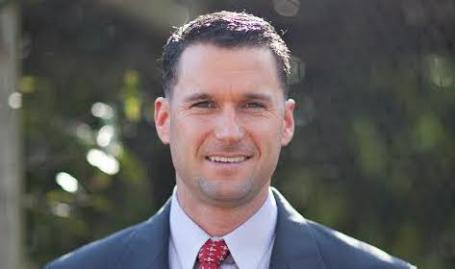
Tommy WalkerTommy Waller, director of state outreach for the Center for Security Policy.

Waller, a Marine Reserve major, speaking via Skype at the National Press Club on Jan. 16, said he was speaking as an employee of the CSP, a conservative national security group in Washington, D.C., which released that day a new report, The Secure Freedom Strategy: A Plan for Victory Over the Global Jihad Movement.

The plan, designed by 16 experts on counter-terrorism, intelligence, the military and national security, is based on President Ronald Reagan’s plan to defeat the Communist Soviet Union.

The Secure Freedom Strategy explains that Muslims who adhere to Sharia law are behind the global jihad movement and the deadly attacks around the world on innocent people of all faiths, including other Muslims.

Waller, who is CSP’s director of state outreach, said it was his hope that the strategy can help defeat that enemy. His full remarks are reproduced below:


“Ladies and gentlemen, the first thing I have to tell you is that I’m addressing you as Tommy Waller, an employee of the Center for Security Policy and not as Major Waller, a commissioned officer in the Reserve component of the Marine Corps.

“Now, why is it that I have to make that distinction? Well, it saddens me to say that if I were currently in an active duty I would have to refrain from speaking about factual information about this ideology – Sharia — the very ideology that threatens our way of life because my words might be offensive.

“Ladies and gentlemen, I took an oath to the Constitution of the United States to defend it against all enemies foreign and domestic and when those that take an oath cannot be taught about the threat to our Constitution, which is both foreign and domestic, our nation is in great peril.

“Now I’ve deployed as an active duty Marine to numerous theaters of operations. I’ve faced the global jihad movement on their turf. And yet I was never taught what animated those Jihadists.

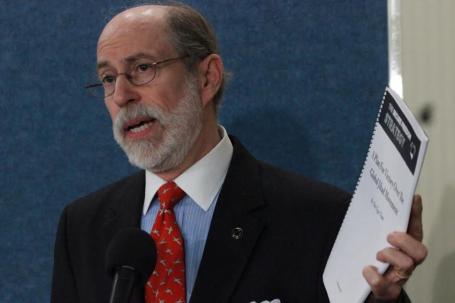
Frank GafneyFrank Gafney, president of the Center for Security Policy. (Photo: CNSNews.com/Penny Starr)

“Still to this day, if you attend a formal military school, you’ll find that there’s never mention of the ideology that animates our enemies.

“We speak in terms like violent extremist organizations. We never nail down the facts about what animates these organizations or, as Clare mentioned, individuals that subscribe to the ideology.

“I recently attended a school that was nearly a year long – a formal military school for commissioned officers at the field grade level. And in 10-plus months we covered information operations for less than an hour and our case study was the Communist insurgency and how we conducted propaganda operations against it in Vietnam.

“It’s mind-boggling to me how our enemies maintain absolute information dominance but it makes sense if that’s the curriculum that we have in our military’s formal schools.

“I’ve been up until this point, shocked and saddened by – and almost bewildered – by the absence void in factual analysis of our enemy on behalf of the national security community and what we face today is tantamount to the military of the Cold War being prevented from studying Communism. Being prevented from studying the ideology that they faced on the battlefield.

“And so it’s my sincere hope that my generation and those that follow it can recover the courage that our previous generation had to study the ideology of the enemy.

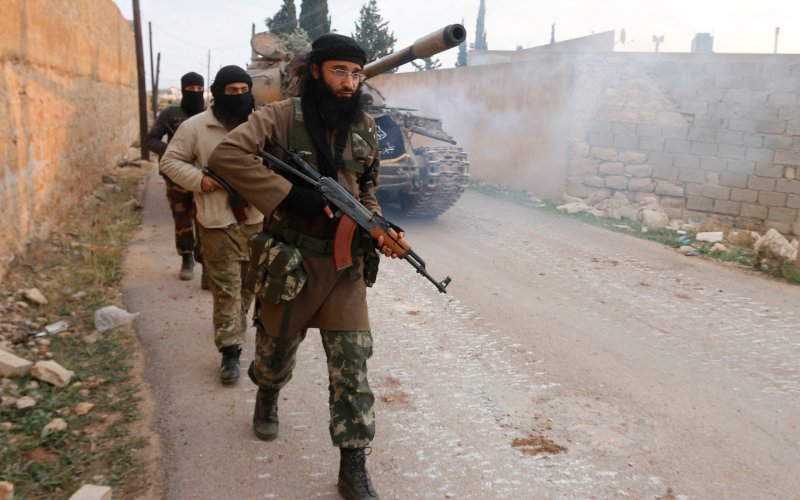
ISIL-militantsMembers of the Islamic State of Iraq and the Levant (ISIL).

I have to say that the ‘Secure Freedom Strategy’ gives me hope. It’s the first step in our generation doing a major course correction.

“And my personal request on behalf of the men and women who have given the ultimate sacrifice to that Constitution – in defense of that Constitution – on behalf of them, my request is that we embrace this strategy because we owe it to the generations that went before us and those that will follow us.”

At Waller’s request, the press conference ended with the Pledge of Allegiance.

Members of the “Tiger Team” include Lt. Gen. William G. “Jerry” Boykin; Clare Lopez, former Operations Officer in the CIA’s Clandestine Service and senior vice president for research and analysis at the CSP; Admiral James A. “Ace” Lyons, former Commander–in-Chief, U.S. Pacific Fleet and father of the Navy Red Cell counterterrorism unit and chairman of CSP’s military committee; Dr. J. Michael Waller, expert on psychological warfare, propaganda and influence operations and a senior fellow at CSP; and Frank Gaffney, former acting Assistant Secretary of Defense for International Security Policy and the president of CSP.

You can see read the report here.

Exclusive: ISIS Gaining Ground in Syria, Despite U.S. Strikes

January 15, 2015

Exclusive: ISIS Gaining Ground in Syria, Despite U.S. Strikes, The Daily Beast, January 15, 2015

1421322880562.cachedHosam Katan/Reuters

American jets are pounding Syria. But ISIS is taking key terrain—and putting more and more people under its black banners.

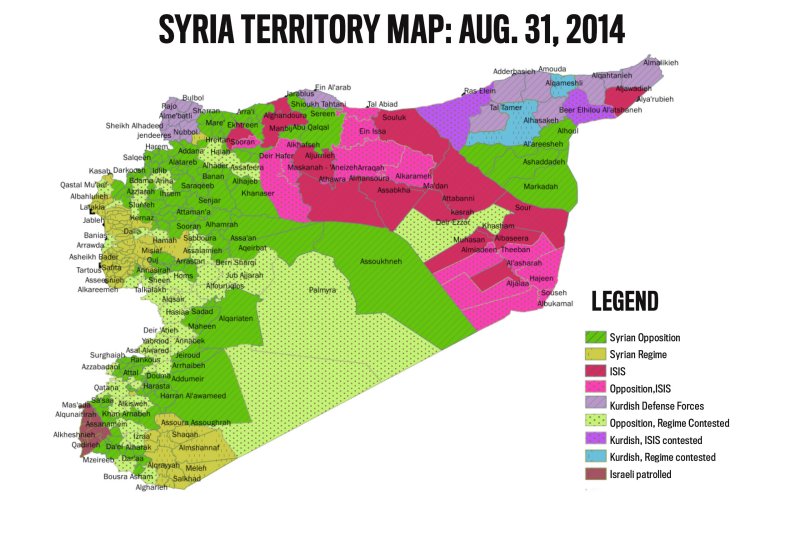
ISIS continues to gain substantial ground in Syria, despite nearly 800 airstrikes in the American-led campaign to break its grip there.At least one-third of the country’s territory is now under ISIS influence, with recent gains in rural areas that can serve as a conduit to major cities that the so-called Islamic State hopes to eventually claim as part of its caliphate. Meanwhile, the Islamic extremist group does not appear to have suffered any major ground losses since the strikes began. The result is a net ground gain for ISIS, according to information compiled by two groups with on-the-ground sources.In Syria, ISIS “has not any lost any key terrain,” Jennifer Cafarella, a fellow at the Washington, D.C.-based Institute for the Study of War who studies the Syrian conflict, explained to The Daily Beast.Even U.S. military officials privately conceded to The Daily Beast that ISIS has gained ground in some areas, even as the Pentagon claims its seized territory elsewhere, largely around the northern city of Kobani. That’s been the focus of the U.S.-led campaign, and ISIS has not been able to take the town, despite its best efforts.Other than that, they are short on specifics.

1421269431538.cachedClick to Enlarge (Coalition For a Democratic Syria)

“Yes, they have gained some ground. But we have stopped their momentum,” one Pentagon official told The Daily Beast.

A map developed by the Coalition for a Democratic Syria (CDS), a Syrian-American opposition umbrella group, shows that ISIS has nearly doubled the amount of territory it controls since airstrikes began last year.

“Assessing the map, ISIS has almost doubled its territorial control in Syria. But more importantly, the number of people who now live under ISIS control has also increased substantially,” CDS political adviser Mouaz Moustafa said.

With the fall of that much territory into ISIS hands, Syrians who once lived in ungoverned or rebel held areas are now under ISIS’s grip. Of course, in an irregular war like this one, control of people is far more important than control of territory. In that regard, too, things appear to be going in the wrong direction.

In the first two months following American airstrikes, about a million Syrians who had previously lived in areas controlled by moderates now lived in areas controlled by extremist groups al Nusra or ISIS, according to CDS, citing conversations with European diplomats who support the Syrian opposition.

The area of ISIS’s expansion includes large segments of the Homs Desert, which begins far south of the contested northern city of Aleppo. It stretches below the presumed capital of ISIS in Syria, Raqqa, and all the way to the Iraqi border. It is largely rural and not an area that ISIS has had to fight for. Rather the group took control of uncontested parts of the countryside while skirting key regime strongholds in the area, Cafarella said.

But that does not mean that land is not valuable to ISIS. That newly acquired terrain allows ISIS troops to target and threaten more valuable areas, Cafarella said.

Since the U.S. campaign began in August, “there are little buds of ISIS control in eastern Homs, al Qalamoun [which borders northern Lebanon], and southern Damascus that do appear to be growing because of that freedom of operation that can connect those western cells to key ISIS terrains in Raqqa and Deir ez Zour” in northern and eastern Syria.

Moustafa, the CDS political adviser, blamed ISIS territorial gains on a lack of “strategic coordination between coalition strikes and moderate forces inside Syria, meaning that the Free Syrian Army and aligned groups cannot use the strikes to retake territory.” Further, Moustafa told The Daily Beast, coalition strikes have given other extremist groups sympathy for ISIS.

One frustration of the Syrian opposition groups is that the bombing campaign has been focused at the heart of ISIS controlled territory, rather than at the front lines, where ISIS territorial gains could be pushed back.

“The coalition strikes seem similar to drone campaigns in Yemen or Pakistan, targeting only leadership. The front-line strength of ISIS has undoubtedly increased even as some of these targeted strikes take out mid-level individual leaders,” Moustafa said.

As of Sunday, the U.S. and its coalition partners had conducted 790 airstrikes in Syria, according to Pentagon statistics. In all, the U.S. has spent $1.2 billion on its campaign against ISIS in Iraq and Syria.

In its public comments, the U.S. military has said repeatedly the effort against ISIS is on the right track. However it often does this by conflating its war in Iraq and Syria. Ask a question about what is happening in Syria, and U.S. officials will stress that ISIS has not gained ground in Iraq. Ask if the U.S. effort is working in Syria, and the military often points to the fact that ISIS has failed to take control of Kobani.

During a Jan. 6 press briefing, for example, when a reporter asked “where ISIS’s relative strength is right now,” Navy Rear Adm. John Kirby replied by talking exclusively about the U.S. effort in Iraq, naming cities were the military believed ISIS’s momentum has been “halted.”

When the reporter pressed for an answer on what was happening in Syria, Kirby struggled, saying, “I couldn’t give you a—a specific point at which, you know, we believe, well geez, we’ve halted their momentum. It—it’s come slowly, in various stages. But I think it’s safe to say that over the last three to four weeks, we—we’ve been confident that that momentum has largely been blunted.”

On Friday, Kirby proclaimed that ISIS had lost 700 square kilometers since the campaign began—over half the size of New York City or about four times the size of the District of Columbia. But the Pentagon spokesman could not say what percentage that area marked of total ISIS-controlled land. Nor could he say if that loss was in Iraq, Syria, or combined in both nations. As Kirby asserted: “I’m frankly not sure how relevant that is. I mean, it’s—they have less ground now than they did before. They’re trying to defend what ground that they have. They’re not going on the offense much, and they’re really trying to preserve their own oxygen.”

1421269455425.cachedClick to Enlarge (Coalition For a Democratic Syria)

The American military has not been able to take full advantage of the difficulties ISIS is facing. A worldwide drop in oil prices threatens the recently declared state’s ability to raise revenue, while declining standards in public services, distribution of aid, and provision of electricity threaten to undercut the group’s support across the territories it controls. ISIS has also not been able to follow through on its military quest to challenge the Iraqi government all the way to Baghdad.

The U.S. military stressed it is waging an “Iraq first” war, that is focused on eliminating ISIS from that country first. There, the U.S. can turn to Iraqi troops on the ground to assess its efforts. But there is no equivalent resource on the ground in Syria. Perhaps because of that, the U.S. military has offered a far more detailed assessment of the air campaign in Iraq than the one in Syria.

The Combined Joint Task Force in charge of the American air campaign refused to answer a Daily Beast query about ISIS gains in Syria, even as it striking targets there. U.S. Central Command replied, “As a matter of policy we do not discuss intelligence issues.”

Information on the maps:

The maps provided by the Coalition for a Democratic Syria show the areas controlled by moderate Syrian rebels, the Syrian regime, ISIS, Syrian al Qaeda affiliate al Nusra, as well as territories contested by these groups. The maps were developed by a field team from the Coalition for a Democratic Syria (CDS), an umbrella group of Syrian American organizations. The maps were sourced through on-the-ground networks including civilian councils, humanitarian organizations, armed actors, and media monitoring of independent Syrian channels.

ISIS capture of Jordanian pilot puts US and Jordan in conflicting dilemmas, may be pivotal to anti-terror war

December 25, 2014

ISIS capture of Jordanian pilot puts US and Jordan in conflicting dilemmas, may be pivotal to anti-terror war, DEBKAfile, December 25, 2014

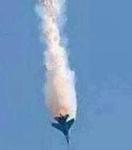
F-16_down_Syria_24.12.14A Jordanian air force F-16 downed over Syria

DEBKAfile’s military and intelligence sources add that Middle East military and aviation control centers are quite sure that the Jordanian warplane was hit by an ISIS missile, while making low passes over the terrorist organization’s Syrian headquarters at Raqqa in violation of the pilot’s orders.

*****************

The US military is going to great lengths to deny any evidence that ISIS shot down the Jordanian Air Force F-16 which came down Wednesday, Dec. 24 over the northern Syrian town of Raqaa. First Lieutenant Muath al-Kasaesbeh, aged 27, was the first Arab pilot to be taken prisoner by the Islamic State. The US Central Command statement said: “We can say with certainty that it was an aircraft crash and the plane was not downed by ISIL as was claimed by the terrorist organization.”

This contradicted an earlier statement by the Jordanian Information Minister Mohammad Momani that the plane had crashed after being hit by a ground-air missile. DEBKAfile’s military and intelligence sources add that Middle East military and aviation control centers are quite sure that the Jordanian warplane was hit by an ISIS missile, while making low passes over the terrorist organization’s Syrian headquarters at Raqqa in violation of the pilot’s orders.

The Jordanians are making intense efforts to deter the jihadis from harming 1st Lt. Kasaesbeh.The Hashemite Kingdom’s armed forces warned that “IS and its supporters would be held responsible for the pilot’s safety and his life.”

The pilot belongs to the Bedouin tribe of Bararsha near Kerak in southern Jordan, which boasts several army generals. They and the tribal chiefs are bringing all their influence to bear to obtain his release.

American military is joining the effort to save the Jordanian pilot – from different motives, which are geared more to sustaining the goals and tactics pursued by the US and the coalition in the war on the Islamic State.
Thursday, Central Command chief Gen. Lloyd J. Austin, who is in charge of US and coalition operations in Iraq and Syria, released a long communiqué praising Jordan for its military actions in the battle, adding: “We will not tolerate ISIL’s attempts to misrepresent or exploit this unfortunate aircraft crash for its own purposes.”

The US general’s message was designed to reassure Jordanian Air Force pilots and dissuade them from dropping out of the coalition air campaign for fear of being shot down by an ISIS missile. The three other Arab coalition members, Saudi Arabia, Bahrain and the United Arab Emirates, must also be kept from quitting.

The share of the four Arab air forces in the war is too weighty to forfeit.

ISIS leader Abu Bakr Al Baghdadi has not doubt calculated his stake in keeping the Jordanian pilot alive and at risk to scare fellow Arab pilots from continuing to take part in US-led bombing missions against his forces.

Furthermore, the Bararsha, like other South Jordanian Bedouin tribes, is known around the region for producing fierce fighters and their relentless pursuit of blood revenge.

Al Baghdadi may opt to avoid antagonizing them for this reason, as well as in the hope of a tangible benefit: ISIS is already using the smuggling routes of southern Jordan as channels to the groups his organization has planted in Sinai, Egypt and eastern Libya. He may decide to go one better and build an alliance with those very tribes behind the backs of the Americans and Jordan’s Abdullah II.

Such an eventuality would add a new dimension to the war on the Islamist terrorists.

Encircling Baghdad: The Country that Became a City-State

November 11, 2014

Encircling Baghdad: The Country that Became a City-State, Gatestone InstituteLawrence A. Franklin, November 11, 2014

(Please see also ISIS Expected to Take Aim at the ‘Baghdad Belt’ and Analysis: ISIS, allies reviving ‘Baghdad belts’ battle plan. — DM)

The goal of the Islamic State might be to create enough chaos in the capital city of Baghdad to cause a mass exodus of its Shia population southward, thus ceding Baghdad to the Sunnis by default.

Is it still possible to salvage if not Iraq, at least Baghdad? Sunni Muslim troops, led by ISIS (now the so-called Islamic State, or IS) and fighting against the Iraqi government, have virtually surrounded Baghdad. Iraq’s largest province, al-Anbar, is almost totally occupied by anti-regime forces. Only a portion of Fallujah remains outside of occupation by the IS-led forces. After the IS took over the city of Hit, regular Iraqi units fell back into a defensive posture at al-Asad, the largest military facility in Anbar. Several key population centers to the north and northeast have also fallen, and there is still heavy fighting around the oil refineries of the northern city of Baiji.

IS’s gains north of Baghdad last month prompted U.S. aircraft bombing sorties. Since June, the central government also has lost ground east of the capital; Diyala Province barely remains under Shia control. After the collapse of government forces in Hillah, south of the capital, and IS’s mid-June seizures of Iskandariyah and Mahmoudiyah, barely six miles south of the Baghdad, routes to Iraq’s Shia heartland have also now been jeopardized.

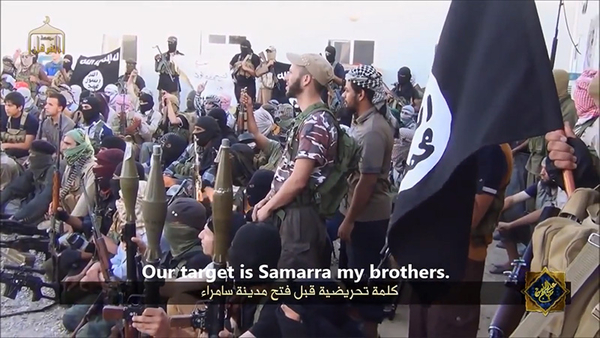
786Islamic State fighters receive a pre-battle briefing and sermon before their attack on Samarra, 125km north of Baghdad.

While the fall of the capital is certainly not imminent, IS’s strategy appears clear. Opposition forces will likely continue to tighten the noose around Baghdad in an attempt to create a sense of isolation. IS will avoid, for now, any large-scale assault on Baghdad for three reasons: it does not have the manpower; Shia militias outnumber enemy forces and will fight zealously to keep the Shia in control of the capital; and a major attack might cause remaining U.S. ground forces to become actively involved in the conflict.

One indicator that American forces might join the fight in a more serious way, if Baghdad appeared truly threatened, was the Pentagon decision on October 12 to employ Apache Attack helicopters against IS forces when they approached Baghdad International Airport. This week, on November 8, U.S. President Barack Obama also approved sending up to 1,500 more U.S. troops to Iraq, although stressing that that “would not be in combat.” The increase would raise the number of U.S. troops in Iraq to just under 3,000, or about eight times fewer than likely needed to re-salvage Iraq.

Meanwhile, fighting has come within two miles of the capital, with IS taking Abu Ghraib.

At present, the IS-led Sunni coalition appears determined to inculcate a feeling of despair among the capital’s Shia citizenry. The daily suicide bombing attacks in Shia neighborhoods must be taking a psychological toll. The suicide bombers are foreign fighters, mostly from North Africa. In the past few months alone, they have killed hundreds of Shia citizens. The operational planners of these assaults apparently know the layout of the capital, a familiarity that suggests they may have been former Baath Party military officers under the reign of Saddam Hussein.

The daily roadside bombs and car bombs are adding to the concern that the security situation in the capital is spiraling out of control. Moreover, there can be little doubt that some within the Sunni neighborhoods are giving logistical and intelligence support to the encircling IS. That intelligence certainly appears to have been available in the October 14 targeted killing of Baghdad’s pro-Iranian commander of the Badr Brigade, Ahmad al-Khafaji. Additional pro-Sunni elements probably have established a network of safe houses to support enemy infiltrators.

The day that the fate of Iraq as a united state irrevocably turned toward disintegration occurred in December 2013, when the largely Shia security forces stormed the Sunni protest camp in Anbar Province’s capital of Ramadi. Not even those tribal sheikhs who may have hoped for reconciliation with the Shia-led regime could reverse the process of permanent alienation. After former Iraqi Vice President Nouri al-Maliki’s fall from power on August 14, newly installed Prime Minister Haider al-Abadi has fared no better. Moreover, he seemingly has even less influence within the governing Shia coalition than al-Maliki originally possessed. He has moved too slowly, it seems, to reach out to Sunnis. Furthermore, with IS at the gates of Baghdad, the new administration did not name a new Minister of Defense and Interior until October 17.

The goal of IS’s siege strategy may be to create enough chaos in Baghdad to cause a mass exodus of its Shia population southward to the Shia provinces of Najaf and Karbala, thus ceding Baghdad to the Sunnis by default.

Obama deploys 1,500 more U.S. troops to Iraq

November 8, 2014

Obama deploys 1,500 more U.S. troops to Iraq, Washington TimesDave Boyer and Maggie Ybarra, November 7, 2014

(Will they be permitted to wear combat boots? — DM)

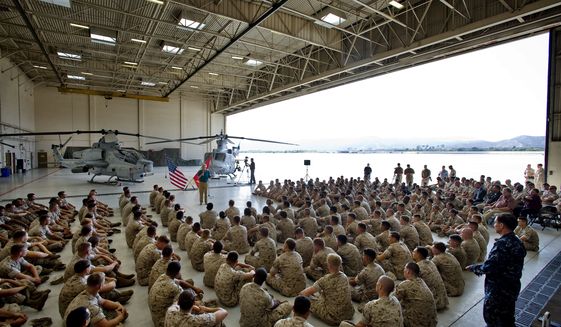
united-states-iraq-advisersjpeg-05ad1_c0-176-4256-2656_s561x327A group of selected Marines representing Camp Pendleton listen as Secretary of Defense Chuck Hagel answers their questions during his short visit to the base Tuesday Aug. 12, 2014. Hagel announced the deployment of another 130 U.S. troops to Iraq in remarks to Marines at this Southern California base on the final stop of a weeklong, around-the-world trip that also took him to India, Germany and Australia. (AP Photo/The Orange County Register, Paul Rodriguez)

“The president also authorized U.S. personnel to conduct these integral missions at Iraqi military facilities located outside Baghdad and Erbil,” the statement said. “U.S. troops will not be in combat, but they will be better positioned to support Iraqi Security Forces as they take the fight to ISIL.”

***********

President Obama is sending up to 1,500 more U.S. military personnel to Iraq to serve as non-combat advisers in the fight against Islamic State terrorists, the White House said Friday.

The troops will “train, advise, and assist Iraqi Security Forces, including Kurdish forces,” the White House said.

“The president also authorized U.S. personnel to conduct these integral missions at Iraqi military facilities located outside Baghdad and Erbil,” the statement said. “U.S. troops will not be in combat, but they will be better positioned to support Iraqi Security Forces as they take the fight to ISIL.”

It’s the latest escalation of U.S. military personnel in Mr. Obama’s fight to rescue the besieged government in Baghdad, where the president withdrew all U.S. forces in 2011. Since August, the U.S. has been conducting hundreds of airstrikes against the Islamic State in Iraq, and more recently in Syria.

The surge in military advisers will more than double the number of U.S. personnel in Iraq, which currently totals about 1,400.

U.S. troops will be asked to train nine Iraqi brigades and three Kurdish fighter brigades, said Pentagon spokesman Rear Adm. John Kirby.

“These sites will be located in northern, western, and southern Iraq,” Adm. Kirby said. “Coalition partners will join U.S. personnel at these locations to help build Iraqi capacity and capability. The training will be funded through the request for an Iraq train-and-equip fund that the administration will submit to Congress as well as from the government of Iraq.”

The White House said the Iraqi government requested the additional forces, and Defense Secretary Chuck Hagel agreed.

White House press secretary Josh Earnest said the Islamic State “has suffered a series of defeats in Iraq against the Iraqi Security Forces and Peshmerga, with the support of U.S. and coalition airstrikes and Intelligence, Surveillance and Reconnaissance, and as well as U.S. military advice.”

“The United States and its coalition partners will continue to confront the threat of [the Islamic State] with strength and resolve as we seek to degrade and ultimately defeat” the terrorist group,” he said.

Shaun Donovan, director of the White House Office of Management and Budget, said the administration is sending a request to Congress for $5.6 billion to pay for the military operations.

The request includes $1.6 billion to establish the Iraq train-and-equip fund to develop and support Iraqi security forces, including Kurdish forces.

“This funding will help reconstitute the Iraqi army and strengthen the capability and capacity of our Iraqi partners to go on the offensive against” the Islamic State, Mr. Donovan said.


Islamic State threat prompts new security warnings across U.S. military

October 31, 2014

Islamic State threat prompts new security warnings across U.S. military, Military TimesAndrew deGrandpreLance M. BaconJeff Schogol, October 30, 2014

bildeMilitary commands and individual service members are tightening up on security amid the growing threat posed by the Islamic State. (Tech. Sgt. Sandra Niedzwiecki / Air Force)

Perhaps the most chilling statement came from the Pentagon, where late last week officials with the building’s internal security force sent employees a memo calling service members and law enforcement officers “legitimate targets.” Such attacks, according to the memo, could involve knives, guns or bombs — and most likely would be perpetrated without warning. The memo cites unspecified sources within the intelligence and law enforcement communities.

****************

Military facilities around the U.S. are on alert, urging troops and their families to take precautions amid continued threats of violence from the Islamic State group.

The responses to that threat are being driven not just by the need to ensure protective measures are taken, but also to address increasing concerns being voiced by troops and family members who are worried about safety for their loved ones and themselves. It marks a shifting mindset, from one of full confidence that the military community was safe on its home turf to an unsettling sense that that is where they are newly vulnerable.

The Defense Department refuses to discuss the protective measures it has taken on behalf of the country’s 2.1 million service members, and to date Washington has not issued universal guidance. But many senior leaders and installation commanders are taking matters into their own hands, issuing clear warnings of the potential for “lone-wolf” style attacks like those carried out in mid-October on military personnel in Canada.

On Wednesday, for instance, the Marine Corps distributed a servicewide announcement instructing personnel to report “even the most minor suspicious activity” and to watch what they share on social media. Doing so, the message says, will help reduce the likelihood of an attack.

At MacDill Air Force Base in Tampa, Florida, officials with the 6th Air Mobility Wing took the Marine Corps’ warning a significant step further. Troops assigned to the base, home to the headquarters of U.S. Central Command and U.S. Special Operations Command, should downplay their military affiliation while in public. Uniforms, even military T-shirts and car bumper stickers, could put people at risk, it says.

‘Legitimate targets’

Perhaps the most chilling statement came from the Pentagon, where late last week officials with the building’s internal security force sent employees a memo calling service members and law enforcement officers “legitimate targets.” Such attacks, according to the memo, could involve knives, guns or bombs — and most likely would be perpetrated without warning. The memo cites unspecified sources within the intelligence and law enforcement communities.

“We disseminated this advisory, not because of a specific threat, but as a reminder for Pentagon employees to be vigilant at home, at work, during travel and in their communities, by using individual protective measures,” said Christopher Layman, a spokesman for the Pentagon Force Protection Agency.

At installations across the country, troops and their families are increasingly on edge, sources tell Military Times. “At least a third to half of my friends in the military spouse community have changed their last names on their Facebook profiles,” said Kristine, the wife of an active-duty Marine who, like other military spouses interviewed for this report, asked that her last name not be published.

“I have chosen to leave mine as it is, but I did change my profile picture to one which doesn’t show any military association,” she said.

Bonny, spouse of an Air Force crew chief, acknowledged feeling “scared to death” by recent communication from her husband’s command at Langley Air Force Base along the Virginia coast. They have since attended a commander’s call and a meeting with leaders in the Key Spouses program. Officials told the families gathered that they could not give details on the severity of the threat but recommended they shut down social media accounts.

While it was an initial consideration, “we came to the decision that we are not going to live our lives in fear over this,” Bonny said. She and her family opted instead to max out privacy settings, remove military and location references and teach their kids to be especially careful on social media, which the parents closely monitor.

A bigger problem for her is soothing the fears of other loved ones. “Our families and friends are worried more than us, probably because we are accustomed to threats, and extremely upset that they have to lose social media ties,” Bonny said. “For military families that’s huge because of distance.”

Distance of a different kind is an issue for Brandon, a sailor whose wife also serves on active duty.

“I am not scared for myself. I’ve got the man upstairs, along with 2,000 rounds and six weapons fighting on my side,” he said. “I am only scared for those times I am on duty and my wife and daughter are alone.”

Brandon said he takes seriously the threat posed by the Islamic State. He taught his wife how to shoot weapons and they both carry sidearms wherever they go. They deleted social media accounts, as well.

“It made me realize how ridiculously accessible we are through Facebook,” he said. “Little stuff like shutting that off gets you off the map. This terrorist group is organized and they are not dumb. I would not second-guess them at all.”

Ramping up precautions

Select Navy commands also issued warnings as airstrikes against Islamic State targets in Iraq and Syria, many carried out by Navy warplanes flying from aircraft carriers in the Persian Gulf, ramped up in October. Officials in Jacksonville, Florida, and Norfolk, Virginia, have encouraged sailors and their families to guard against common operational security mistakes like posting personnel rosters or scheduled ship movements.

And while the response varies from base to base and service to service, online safety is a consistent theme. Spokespersons for three Army posts — Fort Hood, Texas, Fort Bragg, North Carolina, and Fort Belvoir, Virginia — each said their installations had adopted no additional security measures. Yet a recent directive published by the Army Threat Integration Center calls on troops to disable mobile apps that track their whereabouts and to avoid posting anything on social media that reveals where their kids attend school or would otherwise allow someone to know ahead of time where they’ll be.

Kristine, who runs a family support site called USMC Life, has a substantial digital presence. Her site’s Facebook community alone has more than 200,000 followers. In recent days she rechecked her privacy settings to ensure her personal profile is locked down, and she’s purged from her website the last names of her staff members.

Even so, Kristine downplayed the risk associated with one’s digital footprint, saying it would take considerable effort to target someone electronically. Military officials are using these threats as an opportunity to compel people to behave more responsibly online, she said.

“There’s a larger chance of the Islamic State targeting us through random acts of violence around local military installations, or by following people’s cars by tracking DoD stickers, or additional military decals on their vehicles,” she said. “For me, this is just one more reason to move to 100-percent ID scan at the gate and ditch the military decals on our cars.”

The growing sense of troops and family members as individual targets owes not just to domestic concerns but also to recent incidents overseas, such as a bold Islamic State kidnapping plot in Turkey that raised questions about safety for the thousands of troops and family members stationed in that country.

Earlier in October, U.S. military officials in Europe told local-level commanders they should consider instructing troops not nor wear their uniforms off base.

And inside a week in the same month, two Canadian soldiers were killed in separate attacks by individuals believed to be terrorist sympathizers.

Defense Department fights global warming with courage and determination

October 16, 2014

Defense Department fights global warming with courage and determination, Dan Miller’s Blog, October 16, 2014

It’s the greatest threat of all time. Aside from Ebola, the DUH DOD has little else to do. According to the Daily Pest Beast, nurses fight Ebola more bravely than members of our military, so only 4,000 of our bravest and best boots on the ground are being ordered to Africa to fight it. Although the (non-Islamic) Islamic State is a bit of a nuisance now that Al-Qaeda is on the run, whatever we say or do about it might defame Islam. Since that would be “as bad as rape,” we must not do it.

Fantasy Island Obama

We have much to learn from Secretary Kerry, even beyond the horrors of man-caused climate change, which has not manifested itself during the past eighteen years or so but might someday. Or might not. For example, Kerry recently called on his vast wisdom to tell us that defaming Islam is as bad as rape. It’s a bit confusing, but there are probably two possibilities: (1) he was defending the Religion of Beheading, Rape, Pillage, Genocide, Sharia Law and Slaughter in General Peace yet again, or (2) he was trying to diminish “rape” and “microaggression” so that feminists would focus more on highlighting all of the horrors of the Republican War on Women with equal vigor and harshness.

In the recent past, our fair, honest and objective news media constantly researched and reported stuff with extraordinary competence, if not honesty. Surely, by now they have taken Andrew Klavan’s advice and become less stupid and corrupt.

Since they still consistently tell us that most Muslims are “moderate” and merely engage is a bit of normal workplace violence now and then, we don’t have to worry about them despite this hatefully Islamophobic and therefore racist nonsense:

Please see also, In Search of the ‘Moderate Islamists’.

Modeate Muslim

As all right left thinking people know, here is no valid reason why the truly moderate Islamic Republic of Iran should not have nuclear weapons. It tells us, repeatedly, that it neither has nor wants them and, in any event, won’t use them unless it wants to. Accordingly, we and the rest of P5+1 under Obama’s corrageous leadership will say, “OK that’s cool.”

Probably, most Islamists are harmless fruitcakes and we should try to get along better. We just need to try harder, that’s all.