Archive for the ‘U.S. Military’ category

Bangladesh: ISIS pays Italy back for role in Libya

July 3, 2016

Bangladesh: ISIS pays Italy back for role in Libya, DEBKAfile, July 3, 2016

Dhaka_high_powered_Dragunov_sniper_1.7.16

The Islamic State struck the West again on June 1, when it activated a local Bangladeshi cell for a murderous, hostage-taking attack on the Artisan Bakery and O’Kitchen Restaurant, a favorite haunt of foreign visitors near the diplomatic zone of Dakha, the capital. A large contingent of Italian businessmen dining there that night was specifically targeted by ISIS in revenge for the Rome government’s military intervention in the campaign to eject the Islamists from Libya.

DEBKAfile intelligence and counter terror sources note that the long Islamist arm reached into the Indian subcontinent, 7,000km away, to settle its score with Italy, rather than sending its killers by the obvious route from the ISIS capital Sirte in Libya to Italy across 1,200km of Mediterranean Sea. This tactic saved them the risk of running the gauntlet of the Italian Navy boats which are fanned out across the Sidra Gulf to staunch the flow of migrants (an important source of income for ISIS) and intercept terrorists heading for attack in Europe.

Bangladesh is the world’s second largest manufacturing center after China for the major Western fashion houses, netting each year 26.5 Billion USD, 75 pc of its foreign currency earnings. Among the important Italian fashion houses manufacturing in Bangladesh are Prada, Milan, and Benetton.

Italian special operations contingents are the largest Western force operating on several fronts in Libya since early January. They are fighting to capture the key port town of Sirte together with British and US special forces and alongside local Libyan forces.

On April 29, DEBKAfile reported: “ISIS fighters smashed a force of Italian and British Special Ops troops on Wednesday, April 27 in the first battle of its kind in Libya. This battle will result in the delay of the planned Western invasion of Libya, as the encounter proved that European forces are not ready for this kind of guerilla warfare. The sources also said the planners of the invasion were surprised by the high combat skills of the ISIS fighters.”

The Bangladesh attack was therefore not the first contretemps suffered by Italy in its fight on Islamist terror.

Inside Libya, the fighting continues unresolved for lack of air support. The US, Italy, France and the UK cannot agree on which of them will supply air cover for the ground forces battling for Sirte and which will assume command.

In early June, overall command of the campaign was given to NATO. That decision did not break the allied impasse either, because its members remained at loggerheads over respective air force contributions, provision of the logistic intelligence required for aerial operations and, lastly, funding.

Due to insufficient air cover, western and Libyan special forces are stuck in the parts of Sirte they have captured, but cannot advance towards the city’s center or root out the ISIS fighters.

The fact that ISIS was able to operate a terror cell in far-away Bangladesh to strike a counterblow in the battle in Northern Africa, testified to the global scope of the terror organization’s command and communication reach.

Just like the November 2015 Paris attacks, the terrorists were in telephone contact with their masters in the Middle East, once in a while sending pictures of the victims they murdered inside the restaurant.

In the attack, the terrorists killed 9 Italian businessmen, 7 Japanese businessmen, one US citizen, 3 local citizens, and one Indian.

The hostages were executed by beheading with machetes.

The counter terrorism sources report that, just as in the terror attacks in Brussels, Paris and Istanbul, the attackers in Dakha were previously known to local security and intelligence agencies, at least five of the seven terrorists were known to the Bangladesh security agencies, who claimed they were unable to stop them.

ISIS routs new US-backed Syrian force at Abu Kemal

July 1, 2016

ISIS routs new US-backed Syrian force at Abu Kemal, DEBKAfile, July 1, 2016

2

A battle on June 29 between ISIS and a pro-American Syrian rebel force near the Syria-Iraq border will go down as one of the most striking defeats ever suffered by an American-backed Syrian force trained in Jordan in the annals of the war on terror.

It was not the first, say DEBKAfile’s military and intelligence sources. In August 2015, a force from Al Qaeda’s affiliate Nusra Front destroyed a similar rebel force called Division 30. And 12 hours earlier, on June 28, ISIS suicide bombers murdered 44 people in a bloodbath at Ataturk international airport in Istanbul.

The following timeline of events is instructive:

1. In March and April of this year, military instructors from the CIA, together with Jordanian intelligence officers and special operations units, established a new militia to fight ISIS called the New Syria Army. Most of the recruits were from Syrian refugee camps. The US furnished the militia with funds and advanced weapons.

2. They were trained by US and Jordanian military instructors at Jordan’s al-Rukban base in the Berm area on the Syrian border.

3. In May, American commanders in Jordan decided that the militia would launch its first mission in eastern Syria near the border with Iraq.

4. In June, it became clear to the Americans and the Jordanians that the time had come for the new force to go into action.

There were five reasons:

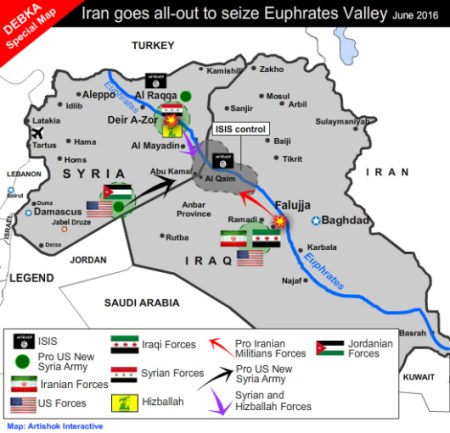
A. After the capture of the Iraqi city of Fallujah from ISIS, the pro-Iranian Shiite militias that participated in the campaign, namely the Popular Mobilization Forces and the Badar Forces, had started moving west toward the Iraq-Syria border (see map).

B. Syrian army and Hizballah forces had embarked on a parallel eastward movement from the vicinity of Deir ez-Zor toward the Iraqi border (see map). Their goal was to link up with the Iraqi Shiite militias on the Syrian-Iraqi border and create a land bridge for the use of all pro-Iranian forces in the two countries.

C. Washington and Amman regarded this development as dangerous and resolved to preempt it.

D. To that end, the New Syria Army was to be sent into action to take the town of Abu Kamal near the border.

E. The commanders assumed that the loss of Abu Kamal would deal a blow to ISIS forces in eastern Syria and plant a pro-American wedge against the linkup of the two pro-Iranian forces and so foil their projected land bridge athwart Iraq and Syria. .

5. On June 21, an ISIS suicide bomber driving a stolen Jordanian military truck blew himself up in the area of Jordan’s al-Rukban base on the Syrian border, in an attempt to avert the coming Abu Kemal attack by inflicting heavy losses on the new militia.  Most of those killed were Jordanian border guards.

6. After the attack, US and Jordanian helicopters airlifted the new militia combatants to a forward base set up at al-Tanf inside Iraq, 230 kilometers from Abu Kamal. They were attacked twice by Russian air strikes in an effort to thwart the pro-US militia’s return to Syria.

7. On June 29, the new Syrian force nonetheless launched its attack, under the direction of Jordanian special operations and military intelligence officers, and the supervision of American elite forces officers at the US-Jordanian war room north of Amman.

8. However, the new Syrian militia was speedily ambushed by ISIS, which apparently was tipped off about the impending attack and its routes of approach. Dozens of Syrian militiamen were killed or wounded, and the force fled from the battlefield. Those unable to flee were shot dead or decapitated.

9. The Jordanian officers who commanded the force were among those who fled.

10. ISIS videos of the battle showed that advanced US military equipment provided the militiamen had fallen into the terrorist organization’s hands, recalling the sights from Iraq of two years ago, when ISIS captured as booty masses of American military hardware from fleeing troops.

The US and Jordan once again failed to establish a Syrian force capable of fighting ISIS. They also lost the chance to gain control of the situation in eastern and southern Syria.

No official in Washington was ready to comment on the battle.

Benghazi Committee Releases Final Report, Slams Clinton

June 28, 2016

Benghazi Committee Releases Final Report, Slams Clinton, BreitbartJoel B. Pollak, June 28, 2016

The U.S. House Select Committee on Benghazi released its final report on Tuesday morning, comprising some 800 pages of investigations and conclusions that suggest former Secretary of State Hillary Clinton and the Obama administration were derelict in their duty to protect American diplomats from the most significant terror attack on the U.S. since Sep. 11, 2001.

The report also details how the Obama administration contrived to misinform the public about the cause of the attack.

The committee had already slammed a separate report Monday by its Democratic members, who had long maintained that the investigation was politically motivated. “Benghazi Committee Democrats’ obsession with the former Secretary of State is on full display. For over two years they refused to participate in the Majority’s serious, fact-centered investigation. The dishonest Democrats on this committee falsely claimed everything had been ‘asked and answered.’ They said the committee had found ‘absolutely nothing new.’ If that’s changed, they should come clean and admit it. If not, everyone can ignore their rehashed, partisan talking points defending their endorsed candidate for president,” an official statement by the committee declared.

For its own part, the committee published a list of facts that it said were new insights revealed by the investigation:

  • Despite President Obama and Secretary of Defense Leon Panetta’s clear orders to deploy military assets, nothing was sent to Benghazi, and nothing was en route to Libya at the time the last two Americans were killed almost 8 hours after the attacks began. [pg. 141]
  • With Ambassador Stevens missing, the White House convened a roughly two-hour meeting at 7:30 PM, which resulted in action items focused on a YouTube video, and others containing the phrases “[i]f any deployment is made,” and “Libya must agree to any deployment,” and “[w]ill not deploy until order comes to go to either Tripoli or Benghazi.” [pg. 115]
  • The Vice Chairman of the Joint Chiefs of Staff typically would have participated in the White House meeting, but did not attend because he went home to host a dinner party for foreign dignitaries. [pg. 107]
  • A Fleet Antiterrorism Security Team (FAST) sat on a plane in Rota, Spain, for three hours, and changed in and out of their uniforms four times. [pg. 154]
  • None of the relevant military forces met their required deployment timelines. [pg. 150]
  • The Libyan forces that evacuated Americans from the CIA Annex to the Benghazi airport was not affiliated with any of the militias the CIA or State Department had developed a relationship with during the prior 18 months. Instead, it was comprised of former Qadhafi loyalists who the U.S. had helped remove from power during the Libyan revolution. [pg. 144]

Part II

  • Five of the 10 action items from the 7:30 PM White House meeting referenced the video, but no direct link or solid evidence existed connecting the attacks in Benghazi and the video at the time the meeting took place. The State Department senior officials at the meeting had access to eyewitness accounts to the attack in real time. The Diplomatic Security Command Center was in direct contact with the Diplomatic Security Agents on the ground in Benghazi and sent out multiple updates about the situation, including a “Terrorism Event Notification.” The State Department Watch Center had also notified Jake Sullivan and Cheryl Mills that it had set up a direct telephone line to Tripoli. There was no mention of the video from the agents on the ground. Greg Hicks—one of the last people to talk to Chris Stevens before he died—said there was virtually no discussion about the video in Libya leading up to the attacks. [pg. 28]
  • The morning after the attacks, the National Security Council’s Deputy Spokesperson sent an email to nearly two dozen people from the White House, Defense Department, State Department, and intelligence community, stating: “Both the President and Secretary Clinton released statements this morning. … Please refer to those for any comments for the time being. To ensure we are all in sync on messaging for the rest of the day, Ben Rhodes will host a conference call for USG communicators on this chain at 9:15 ET today.” [pg. 39]
  • Minutes before the President delivered his speech in the Rose Garden, Jake Sullivan wrote in an email to Ben Rhodes and others: “There was not really much violence in Egypt. And we are not saying that the violence in Libya erupted ‘over inflammatory videos.’” [pg. 44]
  • According to Susan Rice, both Ben Rhodes and David Plouffe prepared her for her appearances on the Sunday morning talk shows following the attacks. Nobody from the FBI, Department of Defense, or CIA participated in her prep call. While Rhodes testified Plouffe would “normally” appear on the Sunday show prep calls, Rice testified she did not recall Plouffe being on prior calls and did not understand why he was on the call in this instance. [pg.98]
  • On the Sunday shows, Susan Rice stated the FBI had “already begun looking at all sorts of evidence” and “FBI has a lead in this investigation.” But on Monday, the Deputy Director, Office of Maghreb Affairs sent an email stating: “McDonough apparently told the SVTS [Secure Video Teleconference] group today that everyone was required to ‘shut their pieholes’ about the Benghazi attack in light of the FBI investigation, due to start tomorrow.” [pg. 135]
  • After Susan Rice’s Sunday show appearances, Jake Sullivan assured the Secretary of the State that Rice “wasn’t asked about whether we had any intel. But she did make clear our view that this started spontaneously and then evolved.” [pg. 128]
  • Susan Rice’s comments on the Sunday talk shows were met with shock and disbelief by State Department employees in Washington. The Senior Libya Desk Officer, Bureau of Near Eastern Affairs, State Department, wrote: “I think Rice was off the reservation on this one.” The Deputy Director, Office of Press and Public Diplomacy, Bureau of Near Eastern Affairs, State Department, responded: “Off the reservation on five networks!” The Senior Advisor for Strategic Communications, Bureau of Near East Affairs, State Department, wrote: “WH [White House] very worried about the politics. This was all their doing.” [pg. 132]
  • The CIA’s September 13, 2012, intelligence assessment was rife with errors. On the first page, there is a single mention of “the early stages of the protest” buried in one of the bullet points. The article cited to support the mention of a protest in this instance was actually from September 4. In other words, the analysts used an article from a full week before the attacks to support the premise that a protest had occurred just prior to the attack on September 11. [pg. 47]
  • A headline on the following page of the CIA’s September 13 intelligence assessment stated “Extremists Capitalized on Benghazi Protests,” but nothing in the actual text box supports that title. As it turns out, the title of the text box was supposed to be “Extremists Capitalized on Cairo Protests.” That small but vital difference—from Cairo to Benghazi—had major implications in how people in the administration were able to message the attacks. [pg. 52]

Part III

  • During deliberations within the State Department about whether and how to intervene in Libya in March 2011, Jake Sullivan listed the first goal as “avoid[ing] a failed state, particularly one in which al-Qaeda and other extremists might take safe haven.” [pg. 9]
  • The administration’s policy of no boots on the ground shaped the type of military assistance provided to State Department personnel in Libya. The Executive Secretariats for both the Defense Department and State Department exchanged communications outlining the diplomatic capacity in which the Defense Department SST security team members would serve, which included wearing civilian clothes so as not to offend the Libyans. [pg. 60]
  • When the State Department’s presence in Benghazi was extended in December 2012, senior officials from the Bureau of Diplomatic Security were excluded from the discussion. [pg. 74]
  • In February 2012, the lead Diplomatic Security Agent at Embassy Tripoli informed his counterpart in Benghazi that more DS agents would not be provided by decision makers, because “substantive reporting” was not Benghazi’s purpose. [pg. 77]
  • Emails indicate senior State Department officials, including Cheryl Mills, Jake Sullivan, and Huma Abedin were preparing for a trip by the Secretary of State to Libya in October 2012. According to testimony, Chris Stevens wanted to have a “deliverable” for the Secretary for her trip to Libya, and that “deliverable” would be making the Mission in Benghazi a permanent Consulate. [pg. 96]
  • In August 2012—roughly a month before the Benghazi attacks—security on the ground worsened significantly. Ambassador Stevens initially planned to travel to Benghazi in early August, but cancelled the trip “primarily for Ramadan/security reasons.” [pg. 99]
  • Former Secretary of Defense Leon Panetta bluntly told the committee “an intelligence failure” occurred with respect to Benghazi. Former CIA Deputy Director Michael Morell also acknowledged multiple times an intelligence failure did in fact occur prior to the Benghazi attacks. [pg. 129]

The report also slams the Obama administration for “intentional failure to cooperate with this and other congressional investigations.”


Freedom of Speech is not Free; it is Beyond Price

June 26, 2016

Freedom of Speech is not Free; it is Beyond Price, Dan Miller’s Blog, June 25, 2016

(The views expressed in this article are mine and do not necessarily reflect those of Warsclerotic or its other editors. — DM)

Accurate speech, considered “Islamophobic” or otherwise offensive to some, is now deemed “hateful” and punishable under distorted visions of law or university rules. So, apparently is the mention of God. Sometimes, those who dare to speak are silenced before they even begin.

The First Amendment provides,

Congress shall make no law respecting an establishment of religion, or prohibiting the free exercise thereof; or abridging the freedom of speech, or of the press; or the right of the people peaceably to assemble, and to petition the government for a redress of grievances.

Congress is not permitted to ignore the First Amendment, but the U.S. Airforce and other government entities appear to have done so. Recently, Senior Master Sergeant Oscar Rodriguez, Jr. (ret.) was forcibly removed from a private retirement ceremony at an Air Force base because he was about to deliver his flag folding speech. The retiree had heard the speech previously and had asked Rodriguez to deliver it.

When Roberson’s unit commander discovered that Rodriguez would be delivering the flag-folding speech, which mentions “God,” during the ceremony, he attempted to prevent Rodriguez from attending. After learning that he lacked authority to prevent Rodriguez from attending, the commander then told Roberson that Rodriguez could not give the speech. Rodriguez asked Roberson what he should do, and Roberson responded that it was his personal desire that Rodriguez give the flag-folding speech as planned. . . .

Roberson and Rodriguez tried to clear the speech through higher authorities at Travis Air Force Base, even offering to place notices on the door informing guests that the word “God” would be mentioned. They never received a response from the authorities. As an Air Force veteran himself, Rodriguez stood firm on his commitment to Roberson. [Emphasis added.]

Here is the speech, as Rodriguez had given it previously:

What an offensive word! True, it’s in the Pledge of Allegiance to the Flag, but that’s gotta go. Thought experiment: what if Rodriguez had said “Allah” rather than “God?” Might that have been viewed as sufficiently inclusive to be acceptable? Why not? In its “unredacted” version of the Islamist Orlando shooter’s phone calls, the Department of Justice translated “Allah” into “God.” The DOJ probably didn’t want to hurt Islamists’ feelings by suggesting that the Obama administration thinks that Allah and hence Islamists have anything to do with terrorism.

Are we just beginning to enter a new age of fascism? No, we are already well into it.

Here’s a Bill Whittle segment about Obama, Guns, Islam and Orlando

The Council on American-Islamic Relations (CAIR), a Muslim Brotherhood and Hamas-linked “civil rights” organization, recently published an “Islamophobia” report. In Obama’s America, CAIR and its Islamist affiliates are the Government’s principal “go to” organizations for limiting access to the Muslim community in “countering violent extremism” efforts and during investigations of terror incidents.

According to CAIR, “Islamophobic” utterances are “hate speech;” it has provided a list of “Islamophobes” and their organizations. Below are comments about the list by Dr. Zuhdi Jasser, a reformist Muslim. He, as well as The Clarion Project (also an advocate for Islamic reform), are on CAIR’s list of “Islamophobes.”

Europe and its Western culture, and now to a somewhat lesser extent our own American culture (such as it is) are being surrendered to Islam. Allied with government authorities, our leftist “friends” are in the forefront of the war on free speech.

[I]n recent years, we’ve witnessed an unrelenting assault on free speech with a concerted effort by the regressive Left to curtail thought and restrict the free exchange of ideas. Last week, I wrote about campus terrorism and how conservatives and others who maintain views that are inconsistent with the leftist narrative have been subjected to campaigns of harassment and abuse by campus hooligans.

Often university officials are apathetic, turning a blind eye to these transgressions, while in other universities the administration is complicit by instructing campus police to stand down, allowing the agitators free reign to shut down speaking engagements through use of bullying tactics. In at least two instances, university presidents were forced to issue rather craven apologies to an alliance of leftists and Islamists for having the temerity to defend the right to free speech.

This disturbing trend of muzzling free speech has now substantially broadened to include criminalizing speech that issues challenges to the so-called science of climate change. Some seventeen left-leaning state attorneys general have launched investigative and intrusive probes against Exxon Mobil and conservative groups because of their involvement in debunking alarmist claims of imminent doom issued by hysterical climate change proponents.

The ringleaders of this anti-free speech witch hunt include Eric Schneiderman (D-New York) and Claude Walker (I-Virgin Islands). At a recent speech at the Bloomberg’s Big Law Business Summit, Schneiderman was dismissive of his critics, accusing them of “First Amendment opportunism.” The more he spoke the more he sounded like Recep Tayyip Erdoğan, Turkey’s thuggish dictator who utilized the vast resources of the state to silence anyone who disagreed with him. [Emphasis added.]

I wish I could laugh at the next video. It’s funny in a way, but also deadly serious.

As the “best and brightest” from our top universities come of age and control “our” government, will the First Amendment be their principal target for destruction? Or will they also pursue with unabated vigor their war on the Second Amendment? Here is the text of the Second Amendment: “A well regulated Militia, being necessary to the security of a free State, the right of the people to keep and bear Arms, shall not be infringed.”

Our British cousins just voted to leave the European Union to restore democracy at home.

For my final broadcast to the nation on the eve of Britain’s Independence Day, the BBC asked me to imagine myself as one of the courtiers to whom Her Majesty had recently asked the question, “In one minute, give three reasons for your opinion on whether my United Kingdom should remain in or leave the European Union.”

My three reasons for departure, in strict order of precedence, were Democracy, Democracy, and Democracy. For the so-called “European Parliament” is no Parliament. It is a mere duma. It lacks even the power to bring forward a bill, and the 28 faceless, unelected, omnipotent Kommissars – the official German name for the shadowy Commissioners who exercise the supreme lawmaking power that was once vested in our elected Parliament – have the power, under the Treaty of Maastricht, to meet behind closed doors to override in secret any decision of that “Parliament” at will, and even to issue “Commission Regulations” that bypass it altogether. [Emphasis added.]

Rather like our own distended Federal and State bureaucracies.

I concluded my one-minute broadcast with these words: “Your Majesty, with my humble duty, I was born in a democracy; I do not live in one; but I am determined to die in one.”  [Emphasis added.]

And now I shall die in one. In the words of William Pitt the Younger after the defeat of Napoleon, “England has saved herself by her exertions, and will, as I trust, save Europe by her example.”

. . . .

The people have spoken. And the democratic spirit that inspired just over half the people of Britain to vote for national independence has its roots in the passionate devotion of the Founding Fathers of the United States to democracy. Our former colony showed us the way. Today, then, an even more heartfelt than usual “God bless America!” [Emphasis added.]

I am less than sanguine that we remain as deserving of the high praise the author offers. In any event, we have another version of Brexit coming up in November. Will we be as brave and as far-sighted as our founding fathers were long ago and as the Brits were a couple of days ago?

Quo vadis?

Jordan’s enemy within defies US anti ISIS wall

June 22, 2016

Jordan’s enemy within defies US anti ISIS wall, DEBKAfile, June 22, 2016

5

The terrorist attack that ISIS carried out on the Jordan-Syria border on Tuesday, June 21, in which a suicide bomber blew up the vehicle he was driving against a Jordanian border patrol, seriously alarmed Amman, Washington and Jerusalem on five counts:

1. The terrorist, who killed six Jordanian soldiers, came from inside Jordan, not across the border from Syria, meaning that ISIS had succeeded in setting up a terror network or networks inside the kingdom.

Suspicion was first raised after the June 6 attack on Jordanian intelligence headquarters in Ain el-Basha near Amman, in which five intelligence officers were killed, by the absence of any claim of responsibility. It now transpires that the ISIS commanders in Jordan had decided to leave no traces for the national security and intelligence services to follow in their investigation.

2. The jihadists’ success in pulling off two attacks in two weeks in Jordan – one in the center and the other in the north near the Syrian border, attests to several networks in play across a widely spaced-out region.

3. The attack on Tuesday took place tellingly at Ruqban, where a large exercise by a new brigade of the Jordanian military established to fight ISIS has been taking place for the last few days. The brigade, the first of its kind among Middle Eastern armies, is armed and trained by US counterterrorism advisors, and its structure modeled on that of the ISIS military. The entire brigade travels in new Toyota minivans atop which heavy guns are fixed.

The exercise is therefore preparing for both Jordanian and ISIS forces to fight by means of fast-moving armed convoys when they engage in their next battle in the desert areas between Jordan, Iraq and Syria.

But the Jordanians will have the advantage of air cover by attack helicopters.

That ISIS penetrated the site of a joint Jordanian-US military drill with a truck bomb attests to the upgrading of ISIS operational capabilities in the kingdom.

4. DEBKAfile’s intelligence and counterterrorism sources estimate that about 3,000 Jordanians have now joined ISIS and are fighting in its ranks. These homegrown terrorists have the family connections and local knowledge that enable them to move easily around the country. Most ISIS religious leaders and mentors are likewise locals, another advantage for drawing new recruits.

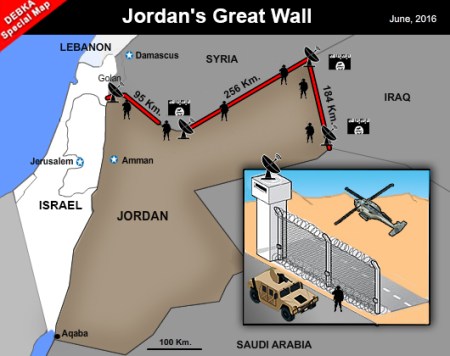
5. The Jordanian military, in cooperation with the Pentagon’s Defense Threat Reduction Agency, is currently completing a $500-million project to build a 442-kilometer defensive fence on the country’s borders with Syria and Iraq as well as around its bases including those hosting American forces (see map). Its purpose is not only to protect the Hashemite throne, but also to transform the 89,000-square-kilometer kingdom into one of the most important US military outposts in the Middle East in the war against ISIS. The fence will also serve as a barrier between Israel and the forces of ISIS, Iran, Iraq and Syria.

Tuesday’s attack, however, raises questions about the entire fence project. Washington and Amman are investing huge sums to keep ISIS out of Jordan when the terrorist peril is creeping up dangerously from within.

How US gave Fallujah’s Sunnis into Iranian hands

June 20, 2016

How the US gave Fallujah’s Sunnis into Iranian hands, DEBKAfile, June 20, 2016

Displaced_Sunni__Iraqis_from_Fallujah_6.16Sunni refugees

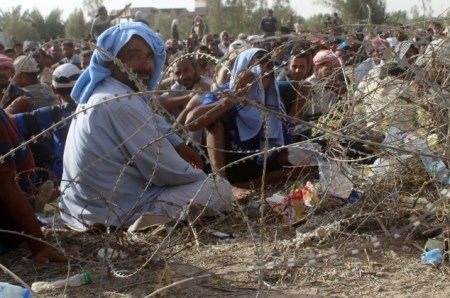
In the last few days, the Western press has been full of harrowing reports on the death and destruction wrought by the Islamic State in Fallujah, western Iraq. But no media outlet is covering the still ongoing human disaster in which tens of thousands of the city’s Sunni residents are fleeing for their lives, including many elderly people, women and children. Some are escaping the intense fighting or because their homes were destroyed. But many Sunnis are fleeing in dread of their ‘liberators,” the pro-Iranian Iraqi Shiite militias that captured the eastern and central parts of Fallujah.

These militias, the Popular Mobilization Forces and the Badar Forces, take their orders from Iranian Gen. Qassem Soleimani, commander of the Al Qods Brigades, and Brig. Gen. Mohammad Pakpour, commander of the Revolutionary Guard Corps ground forces.

There is not much difference between the barbarous acts perpetrated by ISIS and the savagery of Shiite militiamen against the Sunni dwellers of the Iraqi city. In many cases it is even worse. The pro-Iranian fighters are burning down and blowing up houses, murdering and raping women, and executing children and the elderly with bayonets or gunfire.

The Iraqi Special Republican Guard, also called the Golden Division, which participated in the capture of the city center, withdrew from the parts of Fallujah that the pro-Iranian fighters entered. They did so even though Iraqi Prime Minister Haider Al-Abadi had promised the US via Douglas Ollivant, White House aide in charge of Iraq, that the SRG would protect the city’s Sunni population from the Shiite militias. What happened in fact was that the Iraqi soldiers opened the door for the atrocities.

American sources in Washington and Baghdad reported on Monday, June 20, that President Barack Obama and his top aides are furious with Al-Abadi for not keeping his promise. But DEBKAfile’s military and intelligence sources point out that none of this would not have happened were it not for US military involvement in the war on the side of the Iranians.

The pro-Iranian militias were enabled to reach central Fallujah and overwhelm ISIS by the massive bombing raids carried out by US AV-8B Harrier II jets, which flew in from bases in the Persian Gulf, and F/A-18 Hornets from the USS Harry S. Truman aircraft carrier in the eastern Mediterranean.

Even the urgent American calls on Prime Minister Al-Abadi over the last few days to halt the murders and other outrages against the Sunnis population were pointless. Washington knows that he has no authority over the Iranian generals or commanders of the Shiite militias for halting the slaughter.

DEBKAfile’s military and counterterrorism sources point to an especially grave repercussion coming as a direct result of the war crimes allowed to occur in Fallujah. Washington will be hard put to enlist any local Sunni allies for the capture of the two main ISIS strongholds, Mosul in Iraq and Raqqa in Syria.

Some of the American field commanders may believe they can dispense with Sunni support and rely on other local forces, such as the Kurds, to step forward. But they must take into account that many young Sunnis, after witnessing pro-Iranian atrocities in Fallujah may well opt to side with ISIS as the lesser evil.

Iran’s Chess Board

June 3, 2016

Iran’s Chess Board, Front Page MagazineCaroline Glick, June 3, 2016

official_photo_of_hassan_rouhani_7th_president_of_iran_august_2013

Even if Obama’s successor disavows his actions, by the time Obama leaves office, America’s options will be more limited than ever before. Without war, his successor will likely be unable to stem Iran’s rise on the ruins of the Arab state system.

********************

Reprinted from jpost.com.

Strategic thinking has always been Israel’s Achilles’ heel. As a small state bereft of regional ambitions, so long as regional realities remained more or less static, Israel had little reason to be concerned about the great game of the Middle East.

But the ground is shifting in the lands around us. The Arab state system, which ensured the strategic status quo for decades, has collapsed.

So for the first time in four generations, strategy is again the dominant force shaping events that will impact Israel for generations to come.

To understand why, consider two events of the past week.

Early this week it was reported that after a two-year hiatus, Iran is restoring its financial support for Islamic Jihad. Iran will give the group, which is largely a creation of the Iranian Revolutionary Guard Corps, $70 million.

On Wednesday Iranian media were the first to report on the arrest of a “reporter” for Iran’s Al-Alam news service. Bassam Safadi was arrested by Israel police in his home in Majdal Shams, the Druse village closest to the border with Syria on the Golan Heights. Safadi is suspected of inciting terrorism.

That is, he is suspected of being an Iranian agent.

There is nothing new about Iranian efforts to raise and run fronts against Israel within its territory and along its borders. Iran poses a strategic threat to Israel through its Hezbollah surrogate in Lebanon, which now reportedly controls the Lebanese Armed Forces.

In Gaza, Iran controls a vast assortment of terrorist groups, including Hamas.

In Judea and Samaria, seemingly on a weekly basis we hear about another Iranian cell whose members were arrested by the Shin Bet or the IDF.

But while we are well aware of the efforts Iran is making along our borders and even within them to threaten Israel, we have not connected these efforts to Iran’s actions in Iraq and Syria. Only when we connect Iran’s actions here with its actions in those theaters do we understand what is now happening, and how it will influence Israel’s long-term strategic environment.

The big question today is what will replace the Arab state system.

Syria, Iraq, Lebanon, Yemen and Libya no longer exist. On their detritus we see the fight whose results will likely determine the fates of the surviving Arab states, as well as of much of Europe and the rest of the world.

Israel’s strategic environment will be determined in great part by the results of Iran’s actions in Iraq and Syria. While Israel can do little to affect the shape of events in these areas, it must understand what they mean for us. Only by doing so, will we be able to develop the tools to secure our future in this new strategic arena.

Until 2003, Saddam Hussein was the chief obstacle to Iran’s rise as the regional hegemon.

US forces in Iraq replaced Hussein until they left the country in 2011. In the meantime, by installing a Shi’ite government in Baghdad, the US set the conditions for the rise of Islamic State in the Sunni heartland of Anbar province on the one hand, and for Iran’s control over Iraq’s Shi’ite-controlled government and armed forces on the other.

Today, ISIS is the only thing checking Iran’s westward advance. Ironically, the monstrous group also facilitates it. ISIS is so demonic that for Americans and other Westerners, empowering Iranian-controlled forces that fight ISIS seems a small price to pay to rid the world of the fanatical scourge.

As former US naval intelligence analyst J.E. Dyer explained this week in an alarming analysis of Iran’s recent moves in Iraq published on the Liberty Unyielding website, once Iranian- controlled forces defeat ISIS in Anbar province, they will be well placed to threaten Jordan and Israel from the east. This is particularly the case given that ISIS is serving inadvertently as an advance guard for Iran.

In Syria, Iran already controls wide swaths of the country directly and through its surrogates, the Syrian army, Hezbollah and Shi’ite militias it has fielded in the country.

Since the start of the war in Syria, Israel has repeatedly taken action to block those forces from gaining and holding control over the border zone on the Golan Heights.

Prime Minister Benjamin Netanyahu’s surprising recent announcement that Israel will never relinquish control over the Golan came in response to his concern that in exchange for a cease-fire in Syria, the US would place that control on the international diplomatic chopping block.

A week and a half ago, Iran began its move on Anbar province.

On May 22, Iraqi forces trained by the US military led Iraq’s offensive to wrest control over Fallujah and Mosul from ISIS, which has controlled the Sunni cities since 2014. Despite the fact that the lead forces are US-trained, the main forces involved in the offensive are trained, equipped and directed by Iran.

As Iraqi forces surrounded Fallujah in the weeks before the offensive began, Qassem Soleimani, the commander of the Revolutionary Guards’ Quds forces, paid a public visit to the troops to demonstrate Iran’s dominant role.

The battle for Fallujah is a clear indication that Iran, rather than the US, is calling the shots in Iraq. According to media reports, the Pentagon wanted and expected for the forces to be concentrated in Mosul. But at the last minute, due to Soleimani’s intervention, the Iraqi government decided to make Fallujah the offensive’s center of gravity.

The Americans had no choice but to go along with the Iranian plan because, as Dyer noted, Iran is increasingly outflanking the US in Iraq. If things follow their current course, in the near future, Iran is liable to be in a position to force the US to choose between going to war or ceasing all air operations in Iraq.

On May 7, Asharq al-Awsat reported that the Revolutionary Guards is building a missile base in Suleimaniyah province, in Iraqi Kurdistan.

A senior IRGC general has made repeated visits to the area in recent weeks, signaling that the regime views this as an important project. The report further stated that Iran is renewing tunnel networks in the region, built during the 1980-88 Iran-Iraq War.

Dyer warned that depending on the type of missiles Iran deploys – or has deployed – to the base, it may threaten all US air operations in Iraq. And the US has no easy means to block Iran’s actions.

To date, commentators have more or less agreed that US operations in Iraq and Syria make no sense. They are significant enough to endanger US forces, but they aren’t significant enough to determine the outcome of the war in either territory.

But there may be logic to this seemingly irrational deployment that is concealed from view. A close reading of David Samuels’s profile of President Barack Obama’s Deputy National Security Adviser Ben Rhodes published last month in The New York Times, points to such a conclusion.

Samuels described Rhodes as second only to Obama in his influence over US foreign and defense policy. Rhodes boasted to Samuels that Obama’s moves toward Iran were determined by a strategic course he embraced before he entered office.

A fiction writer by training, Rhodes’s first “national security” job was as the chief note taker for the Iraq Study Group.

Then-president George W. Bush appointed the group, jointly chaired by former secretary of state James Baker and former congressman Lee Hamilton, in 2006, to advise him on how to extricate the US from the war in Iraq.

In late 2006, the ISG published its recommendations.

Among other things, the ISG recommended withdrawing US forces from Iraq as quickly as possible. The retreat was to be enacted in cooperation with Iran and Syria – the principle sponsors of the insurgency.

The ISG argued that if given the proper incentives, Syria and Iran would fight al-Qaida in Iraq in place of the US. For such action, the ISG recommended that the US end its attempts to curb Iran’s nuclear program.

Responsibility for handling the threat, the ISG recommended, should be transferred to the US Security Council.

So, too, the ISG recommended that Bush pressure Israel to withdraw from the Golan Heights, Jerusalem and Judea and Samaria in the framework of a “peace process.”

Such action too would serve to convince Iran and Syria that they could trust the US and agree to serve as its heirs in Iraq.

Bush of course, rejected the ISG’s recommendations.

He decided instead to sue for victory in Iraq. Bush announced the surge in US forces shortly after the ISG published its report.

But now we see, that through Rhodes the Iraq Study Group’s recommendation became the blueprint for a new US strategy of retreat and Iranian ascendance in Iraq and throughout the Middle East.

The chief components of that strategy have already been implemented. The US withdrawal from Iraq in 2011 left Iran as the new power broker in the country. The nuclear pact with Iran facilitated Iran’s transformation into the regional hegemon.

Against this strategic shift, the US’s minimalist campaigns in Iraq and Syria against ISIS make sense.

The US forces aren’t there to defeat ISIS, but to conceal Iran’s rise.

When ISIS is defeated in Anbar and in Raqqa in Syria, its forces are liable to turn west, to Jordan.

The US is currently helping Jordan to complete a border fence along its border with Iraq. But then ISIS is already active in Jordan.

And if events in Iraq and Syria are any guide, where ISIS leads, Iran will follow.

Iran’s strategic game, as well as America’s, requires Israel to become a strategic player.

We must recognize that what is happening in Iraq is connected to what is happening here.

We need to understand the implications of the working alliance Obama has built with Iran.

Even if Obama’s successor disavows his actions, by the time Obama leaves office, America’s options will be more limited than ever before. Without war, his successor will likely be unable to stem Iran’s rise on the ruins of the Arab state system.

In this new strategic environment, Israel must stop viewing Gaza, Judea and Samaria, the Golan Heights and Lebanon as standalone battlefields. We must not be taken in by “regional peace plans” that would curtail our maneuver room. And we must bear in mind these new conditions as we negotiate a new US military assistance package.

The name of the game today is chess. The entire Middle East is one great board. When a pawn moves in Gaza, it affects the queen in Tehran.

And when a knight moves in Fallujah, it threatens the queen in Jerusalem.
What is happening in Jordan?

June 2, 2016

What is happening in Jordan? Israel Hayom, Mudar Zahran, June 2, 2016

Days ago, King Abdullah II‎ of Jordan dissolved the parliament and appointed a new prime minister.

This came ‎weeks after the king amended the constitution to expand his already swollen authority as the sole ‎ruler, and has launched a wave of speculation in the Western and Israeli media. The media are puzzled and rather clueless about what exactly is happening in my country, Jordan. Some, including respected publications, jumped to the convenient conclusion ‎that the king has “appointed a pro-Israel prime minister” and even that “Israel has a new friend ‎in the Middle East, Jordan’s prime minister.” These statements by ‎themselves are irrelevant to the status quo and the situation in Jordan is much more critical and ‎dire than anyone in the Israeli media realizes.‎

In November 2015, U.S. presidential candidate Hillary Clinton said ‎Jordan’s future was “not clear” and that Palestinians and Israelis needed to know what will ‎happen in Jordan and “whether Jordan will remain stable” before they resume the peace process. Clinton’s tenure as U.S. secretary of state saw anti-regime protests in Jordan, particularly the November 2012 revolution, ‎when a million Jordanians took to the streets demanding that the Hashemite royals leave the ‎country. She knows more about the reality in Jordan from firsthand experience than any other U.S. presidential candidate.

While Clinton’s statements cannot be taken as prophecies from the Torah or the Quran, the facts on the ‎ground do support her concerns for Jordan. As these lines are being written, unrest continues in the ‎Wadi Mousa-Petra area, including gun battles between the king’s police and the locals, arrests, the ‎destruction of vehicles and other property, stone throwing, and rumors of casualties on both sides. In ‎short, there is an intifada at one of Jordan’s most significant tourist sites.

Days ago, King Abdullah II‎ of Jordan dissolved the parliament and appointed a new prime minister.

This came ‎weeks after the king amended the constitution to expand his already swollen authority as the sole ‎ruler, and has launched a wave of speculation in the Western and Israeli media. The media are puzzled and rather clueless about what exactly is happening in my country, Jordan. Some, including respected publications, jumped to the convenient conclusion ‎that the king has “appointed a pro-Israel prime minister” and even that “Israel has a new friend ‎in the Middle East, Jordan’s prime minister.” These statements by ‎themselves are irrelevant to the status quo and the situation in Jordan is much more critical and ‎dire than anyone in the Israeli media realizes.‎

In November 2015, U.S. presidential candidate Hillary Clinton said ‎Jordan’s future was “not clear” and that Palestinians and Israelis needed to know what will ‎happen in Jordan and “whether Jordan will remain stable” before they resume the peace process. Clinton’s tenure as U.S. secretary of state saw anti-regime protests in Jordan, particularly the November 2012 revolution, ‎when a million Jordanians took to the streets demanding that the Hashemite royals leave the ‎country. She knows more about the reality in Jordan from firsthand experience than any other U.S. presidential candidate.

While Clinton’s statements cannot be taken as prophecies from the Torah or the Quran, the facts on the ‎ground do support her concerns for Jordan. As these lines are being written, unrest continues in the ‎Wadi Mousa-Petra area, including gun battles between the king’s police and the locals, arrests, the ‎destruction of vehicles and other property, stone throwing, and rumors of casualties on both sides. In ‎short, there is an intifada at one of Jordan’s most significant tourist sites.

In addition, anti-regime ‎protests take place every Friday, yards away from the king’s palace. Those protests are not ‎continuous, but they are a regular occurrence and likely to grow. Protests against Egyptian President Hosni Mubarak began in the same ‎way in 2004, and 10,000 protests later, a one-strike revolution toppled him in ‎‎2011, the same year that the current protests in Jordan began.‎

Jordan’s debt-to-GDP ratio is above 90%. Greece’s economy collapsed when it hit ‎the same rate, and the Jordanian regime is not getting the help from Arab states that Greece got from the European Union. Nevertheless, the Jordanian royal family spends beyond belief and is not shy about showing off its opulent lifestyle to its starving subjects.‎

Less than a month ago, Jordan’s king visited our Saudi brothers and came back speaking ‎about billions of Saudi riyals “on the way.” None of this has yet materialized. While these ‎things do take time, Saudi King Salman‎ announced a $25 billion aid package to the el-Sissi regime half an hour ‎after the king’s arrival in Egypt in April. ‎

There are also no signs or news of aid money coming from the ‎Gulf states. Our Arab brothers are wise; they won’t give their money to an ailing regime.‎

On the other hand, the king has been fragile for years now, and many — myself included — have ‎predicted his fall, yet he remains on the throne in Amman. So why should anyone worry that ‎the king might fall now?

In fact, the situation has completely changed.‎

Today, Jordan’s army is independent of the king, and so is Jordan’s intelligence service. Both are tightly coordinated with the U.S. Central Command. When the Islamic State group became a real threat to Jordan, ‎the U.S. must have realized it could no longer tolerate the king’s recklessness, inexperienced ‎handling of security, and mismanagement of Jordan’s military operations and funds. Thus, the ‎U.S. supported separating the army and intelligence apparatus from the king’s influence. This happened trough tight and direct cooperation between the Jordanian and U.S. militaries, and between Jordanian and U.S. intelligence agencies, particularly the U.S. Defense Intelligence Agency.‎

This new arrangement might explain the record-smooth cooperation between Jordan and Israel on ‎security, which is described in the Israeli media as “unprecedented.” Yes, it is unprecedented, ‎because the king no longer has any influence over the army or intelligence service.‎

Further, the U.S. has announced it is about to finish building a massive security wall separating ‎Jordan from Syria and extending along the Iraqi borders. This little-publicized wall will be fully ‎operational in August, according to its contractor, Raytheon, at a cost of over $500 million. At the same time, Israel is quickly and publicly building a $1 billion wall ‎along its border with Jordan.‎

These measures, taken by the U.S. and Jordanian armies, suggest that both are expecting major change in ‎Jordan. The outcome should be safe; Islamic State cannot take over Jordan with thousands of American soldiers stationed ‎in several major U.S. bases across Jordan. ‎

Meanwhile, Jordan’s king sees firsthand signs that his angry, hungry, and hopeless ‎people could actually topple him, and with him having no control over the army now, the king ‎could face a situation like that of Egypt’s 2011 revolution, which was supported by the ‎Egyptian army.‎

Afraid and helpless, Jordan’s regime has turned to the oldest trick in the book: beating the Israeli ‎drum. The regime knows that if a new intifada breaks out in Israel, this ‎could buy it more time in power; the world would be too busy to let it go and Jordan’s ‎public would be distracted by anti-Israel hatred once again. This might explain why an official Israeli ‎statement on Sept. 21, 2015, confirmed that “Jordan was a major contributor to Temple ‎Mount tension” and accused Jordan’s government of exacerbating tensions in Jerusalem with ‎inciting statements and actions.‎

In November 2014, I published an article in which I warned that Jordan’s regime was ‎planning to set the West Bank and Jerusalem on fire in order to stay in power. Also, a month ‎before the “knife intifada” broke ut, I noted several times on social media that Jordan’s ‎regime was going to launch unrest in Jerusalem itself.‎

Change is coming to Jordan. It could be tomorrow morning or in five years, but the ‎Hashemites already have a one-way ticket out, and it seems they are now purposely ‎causing damage to Jordanian, alestinian, American and Israeli interests. ‎

It is about time the few pro-Hashemite hopeless romantics wake up and smell the strong ‎Jordanian coffee already brewing in Amman.‎

As far as the Israeli government is concerned, it has been clear from the beginning: The Israelis ‎will not be involved in the Arab Spring or its aftermath, and will keep good ties with Jordan’s ‎regime, military and intelligence agencies, without any involvement in Jordan’s internal politics. As ‎Jordan’s opposition, we highly appreciate Israel’s stance and fully understand it.‎

As we expect change in Jordan, we must work hard to make sure Jordan remains committed ‎to peace while it becomes economically prosperous and gives hope to all its citizens.‎

Mudar Zahran is secretary-general of the Jordanian Opposition Coalition. Twitter ‎@mudar_zahran.

Enemies, Foreign and Domestic

May 30, 2016

Enemies, Foreign and Domestic, Front Page MagazineMark Tapson, May 30, 2016

Enemies

Enemies, Foreign and Domestic: A SEAL’s Story is a new book by former Navy SEAL Carl Higbie. Higbie was on the Navy SEAL assault team that in the summer of 2007 captured the most wanted man in the Middle East (apart from Osama bin Laden) – Ahmed Hashim Abd Al-Isawi, known as the Butcher of Fallujah. But afterward, Higbie and others in his unit were charged with prisoner abuse when Al-Isawi alleged that they had bloodied his lip.

Suddenly, the “mission accomplished” became a much more challenging ordeal as Higbie et al were threatened with courts-martial over supposedly roughing up a ruthless terrorist. When he went public with his account of what happened, the Navy pushed back hard to save face and protect careers. But Higbie pushed back harder.

Higbie, also the author of Battle on the Home Front: A Navy SEAL’s Mission to Save the American Dream, became a SEAL in 2003 and deployed twice in support of Operation Iraqi Freedom. He is now a political commentator in national media including the Fox News Channel, Wall Street Journal, The Washington Post, The Daily Caller, and Breibart. He graciously agreed to answer a few questions for FrontPage Mag about his lates book, Enemies, Foreign and Domestic.

Mark Tapson:         About the mission to capture and extract this high-value target, the Butcher of Fallujah. You and your unit accomplished the mission, handed him over, and all seemed good – but then what happened afterward?

Carl Higbie: After turning over custody to the Master at Arms (MP), the MP admittedly left his post. During this time the prisoner bit his lip (as testified by an oral surgeon) and spit blood on his clothing. Out of fear for his own career, the MP concocted a story that he saw many of us abuse the prisoner. This story was fabricated, as was apparent from his numerous changes in his official statement.

MT:     The accusation should have been cleared up quickly, but instead, the Navy did its best to break you and the other suspects down and get confessions out of you. Tell us what happened.

CH:     Initially we were investigated by NCIS and their investigation made the recommendation to not charge us. It was our Commanding officer along with General Cleveland that decided to proceed despite the facts. Because of the lack of evidence, they wanted to proceed “general’s mast” where there is no need for evidence and a punishment can be issued arbitrarily. They were doing to his to save face and “make an example” out of us.

We all requested a courts-martial so we would have a fair trial and be able to present evidence in our favor. The command tried to talk us out of this because they knew they would lose. They separated us and threatened us with all kinds of punishments, but we held strong and forced the courts-martial.

MT:     Why do you think this guy made such a serious accusation about some of his fellow soldiers, and why do you think the higher-ups weren’t more supportive of the accused, especially considering that the so-called victim was a terrorist?

CH:     The higher-ups were afraid of simple allegations, how that would affect their careers. They lost sight of the mission and their duty to their men. They put politically correct public image in front of their oath. They had us pegged for guilty from day one despite ALL the evidence. So much for “innocent until proven guilty.”

MT:     What’s your opinion of the Rules of Engagement our warriors were bound by which were so strict that merely bloodying a terrorist’s nose could get you court-martialed? Do you think those ROE are proper or are they hindering our men in the field and perhaps even endangering them?

CH:     Rules of engagement are different from guidelines for treating prisoners. I think the Rules of Engagement are atrocious. You cannot have one side playing by a set of rules that does not apply to the other side. War is not a moral endeavor, it is people killing each other; therefore you must be willing to be as ruthless as your enemy.

As for prisoner handling, we should never have stood any discipline after NCIS cleared us and recommended not going forward. This is what investigations are for and they should not be overstepped by a commander who has no knowledge of the situation. Moreover, who cares if a terrorist that we had legal authority to kill had a bloody lip?

MT:     After you were eventually cleared, you wrote a book – as a private citizen, not as a SEAL – called Battle on the Homefront based on your experiences, in which you complained about various ways in which Americans are failing to live up to our country’s own exceptionalism. But the Navy brass gave your manuscript the runaround and did their best to suppress publication. Why do you believe they did that, particularly since many of them privately agreed with what you wrote?

CH:     I spent almost two years, 24 times the length of time the DOD has allowed by their own standards for the review. At every corner, they stonewalled me, refusing even to conduct a review. I had been consulting an attorney throughout the process who was dumbfounded, as we had continuously jumped through hoops to accommodate their ever-changing requirements.

The book was controversial and no one wanted to review it because they were concerned about how it would affect their careers if they were the ones with the approval stamp on it. The military spent more resources trying to bury it than it would have taken to conduct the review. After a review from NCIS on security, and under advice from my attorney, we published without command approval since they had failed to comply with their own rules.

MT:     Since leaving the Navy, you’ve pursued a path as a political commentator in the media. Is that another way you feel you can best serve your country? Do you have political ambitions in the future as well? Tell us about what you’re doing to help reinvigorate the American Dream.

CH:     I have pursued the political route because I believe that to be the root of the problem today. I am unsure whether I will run again but I am heavily involved with this presidential race and many other races as well. If we want to fix this nation we have to start at the top.

US military chiefs overrate damage to ISIS

May 28, 2016

US military chiefs overrate damage to ISIS, DEBKAfile, May 28, 2016

The US military chiefs fighting ISIS, have recently claiming that the US has re-organized its military resources and is determined to cut down the Islamic state after its lame efforts in the last two years.

These words of encouragement have come from genral Votel commander of US Middle East forces and the first US General to be assigned to Syria in its nearly six years of war, and Lt. Gen Charles Brown commanding the US Al Udied Air Base in Qatar where 750 aircraft operating in the Gulf and Middle East are based.

When US airstrikes against the Jihadist organization began the offensive in late 2014 was marred by inadequate intelligence and (specifically that of intelligence analysis), and sporadic aerial action.

DEBKAfiles repeatedly reported that American and coalition air strikes  against the Jihadists were too few, misfired and many of the bombers returned to base with much of their ordinance unused.

It appears that the Obama administration has finally decided to tackle ISIS in earnest.

Our military and anti-terror experts claim it is too soon to determine whether the US commitment is real.

It is true that there are signs of limited US military movement in Syria, Libya and Iraq indicating a possible change.

For example: Increasing the number of US special forces in these three countries, far beyond the framework that President Obama is talking about publicly, when he says ‘small forces’.

There are about 7,500 US soldiers deployed in Iraq and Syria, with an additional  2,000-3,000 fighters working for private security contractors. In Libya there are an additional 1,000 to 1,250  soldiers. American planes take off from Incirlilk base in South Turkey 350km by air from Raqqa, ISIS Syrian capital, and 700km from Mosul, ISIS Iraqi capital, and do not need to fly more than 1,450km (about 770 miles) when they approach from the Persian Gulf.

ISIS still shows no sign of cracking or dismantling its Islamic Caliphate, and its military and terrorist capabilities.

ISIS_State_of_war_25.5.16

There are several reasons for this:

ISIS is expanding fast. While the Obama administration treats Iraq and Syria as the main fronts against the jihadi organization, ISIS has opened three more fronts: in Egypt, Sinai Peninsula, and Libya. While the US had quietly added 4 to 5 detachments of US special forces, these forces are too small to be a military challenge to the terror organization, and all they can do is fight ISIS with the help of local forces, as the US are doing in Iraq and Syria.

In addition to Mosul and Raqqa, the ISIS has established capitals at the Lybian port of Sirte on the Mediterranean Sea and in Jabal Halal mountain range in central Sinai with a cluster of ISIS bases. They provide a fallback option for the terrorist organization in the still distant prospect of Raqqa and Mosul falling to US and local forces.

When General Brown reported that the US Air Force is now hitting ISIS held oil fields, funds and headquarters, and that its revenue has fallen “only” to $56 million per day, he omitted to mention the ISIS Lybian oil fields and their revenue. In fact, DEBKAfile’s military sources note that ISIS is making up for revenue shortfalls in Syria and Iraq by pumping oil in Libya and the surrounding desert.

While US military sources claim that 45 percent of the territory the Islamic State seized in Iraq in 2014, and 20 percent in Syria, has been reclaimed, ISIS still hangs on to its key strategic assets.

Furthermore ISIS this week launched an offensive in the northern and eastern Syrian regions of Aleppo, Azaz, and Deir-a-Zor`; and inflicted damaging assaults on May 14 and May 23 on Russian bases and Syrian Syrian government centers near Jableh and Tartous in Western Syria. It is obvious its external terrorist capacity has not been cut down as was expected.

US and Middle East intelligence agencies hold information showing that ISIS is going to expand its bomb attacks in major cities in Europe and the Middle East, in the coming weeks. This follows an estimate of the organization’s leaders that the attacks on the Russian and Egyptian passenger aircrafts, and the terror attacks in Paris, Brussels and Tunisia, to be very successful.