Archive for the ‘U.S. Congress’ category
July 13, 2015
Hillary Clinton is the X-factor for the Iranian nuclear deal’s congressional survival, DEBKAfile, July 13, 2015
 Hillary Clinton faces tough decision
“A parade of concessions to Iran,” was Israeli Prime Minister Binyamin Netanyahu’s comment on the nuclear accord expected to be announced and fully revealed later on Monday July 13 in Vienna. He underscored his point by playing back President Bill Clinton’s words upon signing the nuclear deal with North Korea 21 years ago: “North Korea will freeze and then dismantle its nuclear program,” Clinton announced then. “South Korea and our other allies will be better protected. The entire world will be safer as we slow the spread of nuclear weapons.”
Despite Bill Clinton’s pledge of carefully monitoring, Pyongyang broke through to a nuclear bomb in October 2006, twelve years later. By comparison; a ten-year limit on the period during which Iran is allowed to develop a bomb is believed to be incorporated in the Vienna accord. Its full text of100 pages plus is still to be fully disclosed.
By playing back the Clinton clip, Netanyahu aimed to place high on Washington’s agenda, the leverage in the hands of his wife, Hillary Clinton, in determining whether the deal survives the US Congress, which will have 60 days to review it.
Hillary is currently rated by the polls with a 62 percent lead in her run for the Democratic nomination in the 2016 presidential election. She tops the lists of alll declared Democratic and Republic contenders combined.
In the first week of July, she is quoted as supporting Obama’s relentless drive for a deal when she said: “I so hope that we are able to get a deal in the next week that puts a lid on Iran’s nuclear weapons program because that’s going to be a singular step in the right direction.”
Before that, she echoed Obama’s words that “no deal is better than a bad deal.”
Now that the accord is in its last stage, she has held back from judging whether it is good or bad – only in private conversations with wealthy Jewish contributors to her campaign, she has promised to be “a better friend to Israel than President Barack Obama.”
But once the final accord is in the bag – expected in the coming hours – Clinton will have to come out in the open, because she holds the key to a Senate majority for blocking it. The 54 Republican senators are committed to voting against it: Senate Majority leader Mitch McConnell told Fox News Sunday: “I think it’s going to be a very hard sell, if it’s completed, in Congress. We already know it’s going to leave Iran as a threshold nuclear state. It appears as if the administration’s approach to this was to reach whatever agreement the Iranians are willing to enter into,” he said.
But the 44 Democratic senators are wobbling between being loyal to the president and their profound misgivings about the deal with Iran. It would take 13 Democrats to cross the floor and join the Republicans to achieve the necessary majority for annulling the promised presidential veto of a negative vote.
A Clinton declaration against the deal could swing those 13 senators against the accord – so painfully crafted in 13 months of agonizing bargaining led by Secretary of State John Kerry – and leave Obama in the position of a lame duck president.
Iran’s leaders, after reading the map in Washington, took the precaution of submitting to the Majlis a motion that would require a parliamentary review every few months of the US performance in complying with the accord with the power to annul it if this performance was judged unsatisfactory.
This pits the Iranian parliament against the US Senate and, by implication, puts Hillary Clinton in the driving seat in Washington versus Ayatollah Ali Khamenei in Tehran.
Whatever she decides now – whether for or against the Iranian deal – will have consequences for her campaign for president. That campaign has almost a year and a half to run before the November 2016 election. If she backs the deal and lets the Democratic senators refrain from voting against it, she will be held accountable – not only by Jewish campaign donors, but, up to a point, the American voter too. Israeli and Saudi intelligence will certainly use a microscope to discover the tiniest particles of evidence of Iran’s non-compliance. They will be thrown in her face.
Republican rivals will certainly fuel their campaigns with allegations of the total surrender to Iran by Obama and Kerry – with consequences for the prospects of Obama’s former secretary of state, Hillary Clinton.
Backing Obama would therefore cast a shadow over her presidential hopes, whereas taking the lead of a Democratic senatorial mutiny against it may well undo the deal before the year is out. Either way, Clinton faces one of her toughest decisions since she decided to run as the first American woman president.
Categories: Clinton, Diplomacy, Dishonor, Foreign policy, Ideology, Iran scam, Iranian missiles, Iranian nukes, Israel, Kerry, Obama, Obama's America, P5+1, U.S. 2016 elections, U.S. Congress, U.S. politics
Tags: Clinton, Foreign Policy, Ideology, Iran Scam, Iranian missiles, Iranian nukes, Israel, Obama, Obama's America, P5+1, U.S. 2016 elections, U.S. Congress, U.S. politics
Comments: Be the first to comment
July 12, 2015
Still too eager for a deal, Israel Hayom, Prof. Abraham Ben-Zvi, July 12,2015
(According to an article at the Washington Post, a “deal” is expected today and will be announced tomorrow. — DM)
Russia strengthening its position as an ally and a main weapons supplier to Iran worries the U.S. The 44th president is steadfast on reaching a deal, and even the current dispute won’t prevent him from achieving his dream, even at the price of laying the groundwork for an extremist regional power that would attempt to threaten its strategic environs. There is nothing left to do but hope that the U.S. Senate, which will have 60 days to scrutinize the agreement after it is signed, will meet the challenge it is faced with.
******************
The fact that the latest deadline for a final nuclear deal between Iran and the world powers is behind us, without smoke billowing over the negotiating room in Vienna, is astonishing. After all, there are no signs indicating that Washington’s eagerness for a successful end to the talks has weakened. In fact, it is the opposite. In recent months, it has become clearer that U.S. President Barack Obama has made a deal with Iran a main goal of his legacy. In his view, a deal with Iran will obfuscate all his failures in the Middle East and herald a new regional agenda, with the new partner from Tehran at its center.
Obama seems steadfast in his belief that a conciliatory, compensatory policy based on a range of trust-building economic steps, will quickly set the regime of ayatollahs on a moderate, pragmatic path. The carrot of economic investment and the cancelation of the rule of sanctions will lay the cornerstone for a strong diplomatic and strategic partnership between Washington and Tehran, central to which will be the Iranian regime’s willingness to take on a key role in containing the Islamic State group. To bring that vision to fruition, the Obama administration is charging ahead toward a final nuclear deal at almost any price, while shutting its eyes and continuing to put the agreement together, the ongoing terrorist activity and widespread subversion emanating from the Iranian capital and spreading out over the entire area.
It’s not only that no link whatsoever between nuclear weapons and conventional and semi-conventional weapons exists in the almost final version of the “Vienna Treaty,” but also that the nuclear core of the nascent deal is spotty and full of holes that will give the Iranian regime a golden opportunity to surge ahead toward a nuclear bomb a decade from now, when all oversight of the regime comes to an end.
In light of that, the fact that the official signing ceremony did not take place on July 9 as expected makes one wonder. The explanation, which is only tangentially related to the nuclear issue, does not at all indicate that the American superpower is coming to its senses at last, but is anchored in the web of U.S.-Russian relations. The last pitfall on the way to a deal is basically about Obama’s relations with Russian President Vladimir Putin, which center on the Kremlin’s ongoing military activity in the eastern Ukraine and the economic sanctions the West applied to Russia in response. Given this highly charged relationship, the White House has no interest in any step that could even slightly improve Russia’s grim economic situation. This is the connecting thread between the Russian-American axis and the current field of negotiations with Iran.
Russia, which because of the sanctions in place against it desperately needs foreign currency, wants a fast entry into the Iranian weapons market. So, together with China, it is lending its fervent support to Iran’s demands that the deal also lift the embargo against supplying it with conventional weapons, which the U.N. Security Council decreed in 2006. Especially since a deal for Russia to sell Iran S-300 surface-to-air missiles by 2007 has been frozen since 2010. Thus, Russia’s growing economic distress joins the rest of Putin’s geostrategic considerations and is creating an aggressive Russian position in favor of a quick removal of military sanctions from Iran, which in turn encourages Iranian President Hassan Rouhani and Iranian Foreign Minister Javad Zarif to dig in their heels.
Russia strengthening its position as an ally and a main weapons supplier to Iran worries the U.S. The 44th president is steadfast on reaching a deal, and even the current dispute won’t prevent him from achieving his dream, even at the price of laying the groundwork for an extremist regional power that would attempt to threaten its strategic environs. There is nothing left to do but hope that the U.S. Senate, which will have 60 days to scrutinize the agreement after it is signed, will meet the challenge it is faced with.
Categories: Diplomacy, Dishonor, Foreign policy, Iran scam, Iranian missiles, Iranian nukes, Javad Zarif, Kerry, Obama, Obama's America, P5+1, Russia, Sanctions, U.S. Congress
Tags: Foreign Policy, Iran Scam, Iranian missiles, Iranian nukes, Javad Zarif, Obama, Obama's America, P5+1, Russia, Sanctions, U.S. Congress
Comments: Be the first to comment
July 11, 2015
Goodnight Vienna (9), Power Line, Scott Johnson, July 11, 2015
Omri Ceren reports by email from Vienna:
Happy Saturday from Vienna, where we continue to slouch towards a deal.
The Iranians went into meetings this morning talking about progress and predicting breakthroughs. Kerry came out of his meetings later and tweeted “Met with @FedericaMog and @JZarif this AM. Still have difficult issues to resolve” [1]. That language was read by some journalists as evidence that the talks remain stalled. Other journalists are passing around rumors that R&D issues have been solved, that the Americans have collapsed on inspections, and that the Iranians have agreed to drop their new demand for ending the United Nations arms embargo. Could be anything.
For his part [U.S.] Energy Secretary Moniz tweeted this last night [2]:

Categories: Appeasement, Diplomacy, Dishonor, Ernest Moniz, Foreign policy, Ideology, Iran scam, Kerry, Obama, Obama administration, Obama's America, P5+1, Sanctions, U.S. Congress
Tags: Appeasement, Ernest Moniz, Foreign Policy, Ideology, Iran Scam, Obama, Obama Administration, Obama's America, P5+1, Sanctions, U.S. Congress
Comments: Be the first to comment
July 10, 2015
Goodnight Vienna (8), Power Line, Scott Johnson, July 10, 2015
July 9 was a significant date from the standpoint of the review act passed by Congress this spring. A deal presented to Congress by July 9 would have been subject to a 30-day review period. A deal presented to Congress now is subject to a 60-day review period. Omni Ceren reports by email from Vienna:
Happy Friday from Vienna, where a deadline extension wasn’t supposed to happen again, but did.
On Wednesday afternoon there were rumors that a European diplomat told journalists from his country that the deal was technically finished, and just required political will from the Americans and Iranians. On Wednesday evening there was a phone call between President Obama and his negotiating team, which produced a readout very much like the one that preceded the Lausanne announcement. On Thursday morning Iranian and Russian negotiators started announcing that a deal was impending, and one of Iran’s Twitter PR accounts started floating possible guest invites for a coming ceremony.
Then some meetings happened. Then Iran’s state-owned Fars outlet announced there would be a four-day extension of the [ineterim] JPOA. Then Secretary of State John Kerry announced that talks were being indefinitely extended, though he added that they would not be extended indefinitely.
The Iranians immediately and aggressively began briefing against the Americans. They told reporters that Washington withdrew a compromise proposal for fear of making Obama look weak, and that back home Senator Corker gave optimistic statements about the talks as a kind of quid pro quo. They more broadly accused US diplomats of trying to relitigate Lausanne, a charge that the Iranians have in the past linked to disputes over Iran’s underground enrichment bunker at Fordow.
The Iranian accusations of backsliding would be easier to take seriously if they weren’t constantly and very publicly backsliding on Lausanne. Supreme Leader Ayatollah Ali Khamenei very publicly gave a speech just a few days before the resumption of talks in Vienna in which he laid out a series of new red lines that gutted announced understandings on uranium enrichment, the sunset clause, verification, PMDs, and a couple other issues. Zarif brought those new positions with him to Vienna, and promptly had to go back to Tehran after most of them were bounced out of the room. Then he came back and the Iranians, with Russian backing, suddenly demanded an end to the UN arms embargo – another new demand.
If negotiations do collapse – and the conventional wisdom remains that they won’t – you’ll see a sort of strange blame game take place. Each side will accuse the other side of having rejected a good deal, which is expected and normal after talks fail. But at the same time each side will claim credit for having made the hard-headed decision to walk away, which is not something you see all the time.
The Obama administration will say something like “the President had always said that he wouldn’t accept a deal that didn’t meet his basic requirements, and the Iranians refused to accept what they agreed to at Lausanne, and so he ordered our negotiators to come home.”
The Iranians spin will be something like “the Supreme Leader knew all along that the Americans couldn’t be trusted to negotiate in good faith – something that he repeated in speeches every couple of months – and he ordered the negotiations to end to protect the Revolution from Western duplicity.”
Relatedly: today is Al Quds Day in Iran. This Iranian holiday, which was founded in 1979 by Ayatollah Khomeini and occurs annually on the last Friday of Ramadan, is arguably the most prominent of the days set aside on the Iranian calendar for calling for the eradication of Israel. A few years ago Khamenei used the occasion to tweet out “Israel Is A Hideous Entity In the Middle East Which Will Undoubtedly Be Annihilated.” Every year is more or less the same. Clerics give speeches, crowds respond with chants of “Death to America” and “Death to Israel,” and mobs burn American and Israeli flags. Earlier this morning Iranian journalist Sobhan Hassanvand tweeted this picture of an American flag being torched on top of an already-burned Israeli flag, right below an earlier tweet by him suggesting that progress is being made in Vienna:
Categories: Diplomacy, Dishonor, Foreign policy, Ideology, Iran scam, Kerry, Khamenei, Obama, Obama's America, P5+1, U.S. Congress
Tags: Foreign Policy, Ideology, Iran Scam, Khamenei, Obama, Obama's America, P5+1, U.S. Congress
Comments: 3 Comments
July 6, 2015
Contentions — Cementing the Bad Deal, Commentary Magazine, Noah Rothman, July 6, 2015
The following is a dispatch from The Israel Project’s Omri Ceren regarding the state of nuclear negotiations with Iran:
Happy Monday from Vienna. The EU’s foreign affairs chief Federica Mogherini arrived yesterday and told reporters: “As you know I have decided to reconvene the ministers. They will be arriving tonight and tomorrow. It is the third time in exactly one week. That’s the end, the last part of this long marathon.” Secretary of State John Kerry and Iranian Foreign Minister Javad Zarif already held an impromptu meeting this morning. The overarching consensus – which is almost certainly correct – is that whatever gets announced will be announced no later than tomorrow afternoon. It might very well happen tonight.
As to what that announcement might be, there are a few options. In order of increasing probability:
0% chance: Kerry might make good on the comments that he made yesterday to reporters, and walks away from a bad deal.
Very low probability: the parties might come to a full-blown agreement ready to be implemented immediately. This scenario was never likely by June 30, and became functionally impossible after Supreme Leader Ayatollah Ali Khamenei set out a range of new red lines a few weeks ago. Also, the Iranians gave a background briefing earlier today in Vienna where they provided their interpretation of an emerging final deal. Among other things they have some interesting views on what military-related restrictions will be lifted, which are in tension with how the Americans have been describing the deal. Those differences will have to be overcome, and they won’t be in the next few days.
Low-probability: the gaps might still be too significant to even colorfully announce a deal, and the parties would extend the interim agreement all the way through the summer. The option would be more attractive to the Obama administration than taking another 2 or 3 weeks. If the administration sends Congress a deal after July 9 then the Corker clock – how long a deal sits in front of Congress – goes from 30 days to 60 days. But if they get all the way through the summer, it goes back down to 30 days. The administration has obvious reasons to prefer that.
Most likely: there will be a non-agreement agreement. The parties will announce they’ve resolved all outstanding issues but they still have to fill in some details. Then the P5+1 and Iran would move in parallel to implement various commitments, and the Iranians would in particular have to work with the IAEA on its unresolved concerns regarding Iran’s weapons program (PMDs). In the winter the IAEA would provide a face-saving way for the parties to declare Iran is cooperating – IAEA head Amano said earlier this week that the agency could wrap up by the end of the year if Iran cooperates – and then a deal would officially begin. The option is attractive to the administration because it puts off granting Iran all of its anticipated sanctions relief until the IAEA makes some noises about the Iranians cooperating. The alternative would be poison on the Hill. This way the administration can tell Congress that of course PMDs will be resolved before any sanctions relief is granted; and after Congress votes, if the Iranians jam up the IAEA but demand relief anyway, lawmakers will have no leverage to stop the administration from caving.
The focus will then shift to Congress, where the debate on approving or disapproving of the deal will take place over the next month. Some of the questions will get technical and tangled – the breakout time debate is going to be mind-numbing – but lawmakers will also use a very simple metric: Is the deal the same one the President promised he’d bring home twenty months ago? Back then the administration was very clear about what constituted a good deal and emphatic that U.S. negotiators had sufficient leverage to secure those terms. The U.S. subsequently collapsed on almost all of those conditions, and lawmakers will want to know how the deal can still count as a good one.
In line with those questions, here is a roundup from the Foreign Policy Initiative on where the administration started and how dramatically it has moved backwards. From the overview of the analysis:
Over the past three years, the Obama administration has delineated the criteria that any final nuclear agreement between the P5+1 and Iran must meet. In speeches, congressional testimony, press conferences, and media interviews, administration officials have also articulated their expectations from Tehran with repeated declarations: “No deal is better than a bad deal.” This FPI Analysis… compiles many of the administration’s own statements on nuclear negotiations with Iran over the past three years, and compares them with current U.S. positions. It also examines U.S. statements on a range of other issues related to U.S. policy toward Tehran, and assesses whether subsequent events have validated them.
The web version has embedded links for each of the statements, so if you need them just click through on the url at the top. You might just want to do that anyway, because the web version is more readable.
Categories: Diplomacy, Foreign policy, IAEA, Ideology, Iran nuke inspections, Iran scam, Iranian military sites, Iranian missiles, Iranian nukes, Kerry, Khamenei, Middle East, Obama, Obama's America, P5+1, Sanctions, U.S. Congress
Tags: Foreign Policy, IAEA, Iran nuke inspections, Iran Scam, Iranian military sites, Iranian missiles, Iranian nukes, Khamenei, Middle East, Obama, Obama's America, P5+1, Sanctions, U.S. Congress
Comments: 2 Comments
July 2, 2015
Rouhani Threatens Nuclear Breakout, Commentary Magazine, Michael Rubin, July 2, 2015
Obama, Kerry, and negotiator Wendy Sherman have effectively become Iran’s lawyers. In doing so, they have applied the logic of “it depends on what the meaning of ‘is’ is” to U.S. national security. All one has to do, however, is look at the thinly veiled threats and logical somersaults of Iran’s top leaders . . . to understand just what a capability Tehran is after.
***********************
Where brinkmanship is in the blood of Iranian negotiators, careerism and obsession about legacy appears to be in the blood of their American counterparts. By playing good cop, bad cop with Ayatollah Ali Khamenei, by quibbling over every understanding previously reached, and by increasingly threatening to walk away, the Iranians appear to be wringing the Americans dry. Obama and Kerry have voided their own red lines, and prepare to normalize an Iranian path to a bomb whenever the Iranian government makes a decision to pursue that option.
Iranian President Hassan Rouhani is part and parcel of Iran’s brinkmanship. According to the Islamic Republic News Agency in Persian, he declared: “…If they do not fulfill their commitments, the government will be ready to immediately reverse the path in a more severe way than they can ever dream of.”
If Iran’s program has always been peaceful—as repeated Iranian officials have maintained—then reverting to Iran’s previous behavior would mean what exactly? Threats from Rouhani, the supposed moderate, should get the attention of Congress.
Increasingly, Iran is tripping upon its own internal inconsistencies. First, there was Supreme Leader Ali Khamenei’s (as yet unseen) sacrosanct nuclear fatwa that forbids nuclear weaponry and yet the Iranian leadership refuses to come clean on past nuclear work for fear it would show nuclear weaponry work. There has also been Iran’s insistence that it seeks a completely indigenous program, yet it doesn’t possess enough natural uranium to fuel an expanded civilian energy program. Now, Rouhani has more or less threatened to build a nuclear bomb, the same threat made previously by Ali Akbar Hashemi Rafsanjani and a number of clerical associates of Khamenei himself. On May 29, 2005, for example, Hojjat ol-Islam Gholam Reza Hasani, the Supreme Leader’s representative in the Iranian province of West Azerbaijan, declared possession of nuclear weapons to be one of Iran’s top goals. “An atom bomb …must be produced as well,” he said.
Obama, Kerry, and negotiator Wendy Sherman have effectively become Iran’s lawyers. In doing so, they have applied the logic of “it depends on what the meaning of ‘is’ is” to U.S. national security. All one has to do, however, is look at the thinly veiled threats and logical somersaults of Iran’s top leaders, however, to understand just what a capability Tehran is after.
Categories: Diplomacy, Dishonor, Foreign policy, Ideology, Iran nuke inspections, Iran scam, Iranian military sites, Iranian missiles, Iranian nukes, Kerry, Khamenei, Obama, Obama's America, P5+1, Rouhani, U.S. Congress
Tags: Foreign Policy, Ideology, Iran nuke inspections, Iran Scam, Iranian military sites, Iranian missiles, Iranian nukes, Khamenei, Obama, Obama's America, Rouhani, U.S. Congress
Comments: 1 Comment
July 1, 2015
Obama Won’t Enforce Anti-BDS Provision Language in Trade Bill he just Signed, The Jewish Press, Lori Lowenthal Marcus, July 1, 2015
(To enforce the anti-BDS provisions of the legislation Obama just signed would be Islamophobic. Or something. — DM)
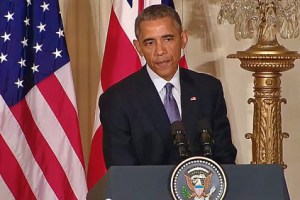 U.S. President Barack Obama Photo Credit: WhiteHouse.Gov screen capture
This week the United States officially put on notice its trade partners that it will not countenance boycotts or other economic warfare against Israel.
After signing the relevant trade legislation into law, however, the White House signaled to all its trade partners that they are still free to boycott goods made in the disputed territories, despite the clear language of the legislation the president signed.
This week the Trade Promotion Authority bill was passed by Congress and signed into law by President Barack Obama.
The TPA is primarily focused on international trade between the U.S. and Europe. It also included a section which addresses trade between the U.S. and Israel.
That part of the legislation, the U.S.-Israel Trade and Commercial Enhancement Act, bans boycotts and other means of economic warfare against Israel or the “Israeli-controlled territories.” This amendment, introduced by Rep. Peter Roskam (R-Ill-6) with bi-partisan co-sponsorship, was unanimously adopted into the PTA in April.
The passage of the TPA, including the anti-BDS section, should sound a death knell for the BDS (Boycott of, Divestment from and Sanctions against Israel) Movement. It should.
However, as pro-Israel Americans and Israelis learned only a few weeks ago in the Jerusalem passport case (Zivotofsky v. Kerry), there are certain spheres of international decision making over which the president has exclusive, or at least primary and controlling, control. Obama claims that international trade is one of those areas, even though Article 1, Section 8, clause 3, expressly gives Congress the power to regulate foreign commerce.
So even though the TPA is intended to act as a strong deterrent to European and other countries to pass and enforce boycotts of Israeli products, the White House has already signaled that it will not extend its protection to any goods produced in the disputed territories.
The anti boycott of Israel language in the TPA is: “actions by states, nonmember states of the United Nations, international organizations or affiliated agencies of international organizations that are politically motivated and are intended to penalize or otherwise limit commercial relations specifically with Israel or persons doing business in Israel or in Israeli-controlled territories.” [emphasis added.]
In a statement which Matt Lee of the Associated Press attributed to State Dept. spokesperson John Kirby, the administration made clear that despite signing the TPA, the position of the White House remains, as it has been, that the U.S. opposes boycotts of the State of Israel, but it also opposes the presence of Jews in the disputed territories of Judea and Samaria and the Golan Heights.
In the statement the administration argues that by “conflating Israel and ‘Israeli-controlled territories’ a provision of the Trade Promotion Authority legislation runs counter to longstanding U.S. policy towards the occupied territories, including with regard to settlement activity,” and says that every U.S. administration has opposed “settlement activity.”
It goes on to point out that the “U.S. government has never defended or supported Israeli settlements and activity associated with them and, by extension, does not pursue policies or activities that would legitimize them.”
The U.S. administration announced that it will not jeopardize the holy grail of the two-state solution by enforcing the U.S. law as written and which its leader signed. In the statement it claims that “both parties have long recognized that settlement activity and efforts to change facts on the ground undermine the goal of a two-state solution to the conflict and only make it harder to negotiate a sustainable and equitable peace deal in good faith.” It is on this basis, ostensibly to promote a peaceful solution to the Arab-Israeli conflict, that this administration
Professor Eugene Kontorovich of the Northwestern University School of Law analyzes several other provisions of the U.S-Israel trade aspect of the TPA which have been largely overlooked. In particular, Kontorovich points out, U.S. courts cannot recognize or enforce the judgment of any foreign court “that doing business in or being based in the West Bank or Golan Heights violates international law or particular European rules.”
Categories: BDS, Dishonor, Foreign policy, Ideology, Israel, Jewish occupation of Israel, Obama, Obama's America, Palestinians, Peace process, Settlements, U.S. Congress, U.S. Constitution
Tags: BDS, Foreign Policy, Ideology, Israel, Jewish occupation of Israel, Obama, Obama's America, Palestinians, Peace Process, Settlements, TPA, U.S. Congress, U.S. Constitution
Comments: Be the first to comment
June 29, 2015
On eve of Iran deal, US retreats on inspections of nuclear past, speeds up sanctions relief, DEBKAfile, June 29, 2015
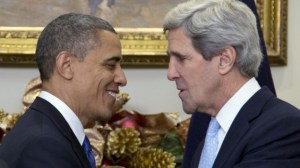 Obama and Kerry upbeat over concessions to Iran
Nothing is therefore left of the original US pledges to link sanctions relief to Iran’s compliance with its commitments or President Obama’s solemn vow to “snap back” sanctions any time for any Iranian violations. The IAEA is virtually left without teeth.
******************
Prime Minister Binyamin Netanyahu said Sunday, June 28: “We are seeing a clear retreat from the red lines that the world powers set recently and publicly.” Addressing the weekly cabinet meeting in Jerusalem and later the Knesset, he added: “There is no reason to rush to sign this bad agreement which is getting worse every day.”
Netanyahu was referring to three major concessions approved by President Barack Obama and Secretary of State John Kerry in the final stage of negotiations for a comprehensive nuclear accord with Iran.
They are outlined here by DEBKAfile:
1. After barring International Atomic Energy Agency (IAEA) inspections of suspect sites for years, Tehran will now be allowed to submit a paper with answers to queries about its past clandestine activities at those military sites, such as suspected tests of nuclear bomb detonators and explosives. That document would effectively draw a line on Iran’s suspect past
DEBKAfile: Iran has submitted countless documents to the IAEA, none of which gave specific replies to specific questions. The UN Security Council accordingly passed a number of resolutions requiring Tehran to come clean on the military aspects of its nuclear program. Tehran ignored them. Now Obama and Kerry are letting Tehran off the hook on its past secrets.
2. Obama and Kerry have withdrawn the “any time, anywhere” stipulation for snap inspections of suspect nuclear facilities, as mandated by the Additional Protocol signed by Iran. They now agree that international monitors must first submit a request to an “Iranian Committee” (not even a joint US-Iranian committee) for advance permission to inspect nuclear facilities.
This would leave Tehran free to approve, deny, or delay permission for inspections.
3. Washington has backed down on its insistence on predicating sanctions relief on Iran’s compliance with its obligations under the final accord. After Tehran countered with a demand for the sanctions to be lifted immediately upon the signing of the accord, the Obama administration agreed to remove them in three stages:
a) Straight after the deal is signed.
b) After ratification of the accord by the US Congress and Iranian Majlis.
This process is expected to take place by the end of 2015, and so Iran will win two multibillion windfalls this year without being required to meet any obligations beyond its signature
Obama counts on the support of 34 US senators. In any case, Congress is not empowered to reject or delay the deal
c) All remaining sanctions will be lifted when implementation of the accord begins.
Nothing is therefore left of the original US pledges to link sanctions relief to Iran’s compliance with its commitments or President Obama’s solemn vow to “snap back” sanctions any time for any Iranian violations. The IAEA is virtually left without teeth.
Categories: Diplomacy, Dishonor, Foreign policy, IAEA, Iran nuke inspections, Iran scam, Iranian military sites, Iranian missiles, Israel, Kerry, Khamenei, Middle East, Netanyahu, Obama, Obama's America, P5+1, Sanctions, U.S. Congress
Tags: Foreign Policy, IAEA, Iran nuke inspections, Iran Scam, Iranian military sites, Iranian missiles, Israel, Khamenei, Middle East, Netanyahu, Obama, Obama's America, Sanctions, U.S. Congress
Comments: 2 Comments
June 25, 2015
Can these forces stop a rotten Iran deal? The Washington Post, Jennifer Rubin, June 25, 2015
(Ms. Rubin is one of the Washington Post’s token conservatives, and anything she says is routinely disparaged by many WaPo readers. Others? Not so much. — DM)
Between the press leaks revealing serial concessions, the public incoherence of Secretary of State John Kerry and Ayatollah Ali Khamenei’s public declarations, the forces opposing an imminent Iran deal have plenty of material to work with. And if there is any doubt as to Israel’s position, opposition leader Isaac Herzog — whom President Obama dearly hoped would replace Prime Minister Benjamin Netanyahu, made clear what Israel-watchers already knew:
“There is no difference between me and [Prime Minister Benjamin] Netanyahu in reading the threat of Iran,” Herzog said in an interview with The Telegraph. “There is no daylight between us on this issue at all. I do not oppose the diplomatic process.
However, the proof of the pudding is in the eating.
We want to know ‘what is the deal?’ What’s the best deal possible that can be reached and would it change the region in a better direction? And here we are worried.”
In the article, Telegraph chief foreign correspondent David Blair appeared to express frustration that Herzog did not come across as opposing Netanyahu on Iran.
“If the US administration hoped that Mr. Herzog might dilute Israel’s visceral suspicion of an imminent nuclear deal with Iran, however, then he seems likely to disappoint,” Blair wrote.
There is no divide in the country at large, with 80 percent of Israelis declaring they have no confidence in President Obama’s handling of Iran.
Most GOP presidential hopefuls have decried the president’s giveaways. On Wednesday, former Texas governor Rick Perry, for example, put out a statement, which read in part: “In reckless pursuit of any agreement, President Obama has conceded point after point after point. Iran has used deadlines and extensions as a tactic for eliciting still more concessions from the U.S. We are well past the time where further concessions are tolerable if we still intend to prevent Iran from getting a nuclear weapons capability rather than manage its breakout time. This agreement is shaping up to spark a nuclear arms race in the Middle East and increase the odds of a devastating and catastrophic military conflict in the future. President Obama should abandon these dangerous negotiations and resume international sanctions until Iran understands and accepts that they cannot have a nuclear weapon.”
Meanwhile, the most influential Democrat on Iran, Sen. Robert Menendez (N.J.), has been taking to the Senate floor on a regular basis to denounce the reported concessions. On Wednesday, former Bill Clinton secretary of defense William Cohen denounced the deal as likely to start a nuclear arms race: “Once you say they are allowed to enrich, the game is pretty much up in terms of how do you sustain an inspection regime in a country that has carried on secret programs for 17 years and is still determined to maintain as much of that secrecy as possible.” He echoed multiple critics who saw it was all downhill once Obama did an about-face on the Syrian red line: “It was mishandled and everybody in the region saw how it was handled. And I think it shook their confidence in the administration. … The Saudis, the UAE and the Israelis were all concerned about that. They are looking at what we say, what we do, and what we fail to do, and they make their judgments. In the Middle East now, they are making different calculations.” (While Sen. Lindsey Graham strongly supported military action, none of the other three senators running for president did.)
More bipartisan opposition comes from ex-lawmakers. The American Security Initiative, headed by former senators Joe Lieberman (I-Conn.), Evan Bayh (D-Ind.), Norm Coleman (R-Minn.) and Saxby Chambliss (R-Ga.), announced a $1.4 million ad buy to inform the public about the contents of the imminent deal. Its targets include Democratic Sens. Richard Blumenthal of Connecticut, Michael Bennet of Colorado and Chuck Schumer of New York and independent Angus King of Maine. While Schumer likes to fancy himself as a great friend of Israel, when the chips are down, he has often given the administration cover, as he did in supporting the nomination of former senator Chuck Hagel (R-Neb.) for defense secretary.
In addition, an all-star group of Iran and military experts including former Obama advisers Dennis Ross, Robert Einhorn and Gary Samore warn against a deal that does not include anytime/anywhere inspections, revelation of possible military dimensions of Iran’s program before sanctions relief begins, “strict limits on advanced centrifuge R&D, testing, and deployment in the first ten years, and [measures to] preclude the rapid technical upgrade and expansion of Iran’s enrichment capacity after the initial ten-year period,” gradual lifting of sanctions and no relief from non-nuclear sanctions and a timely mechanism to reimpose sanctions if Iran cheats. In other words, they’ll support a deal utterly unlike the one we are likely to get.
Other voices now are speaking out on the administration’s willingness to lift sanctions while Iran continues its support for terrorism. Manhattan’s long-time Democratic district attorney Robert Morgenthau (who tracked Iranian finances and relations with dictators in our hemisphere) writes that “the fundamental question to be asked is whether the deal the U.S. is negotiating with Iran will curtail its role as a state sponsor of terrorism. The answer appears to be a resounding no. . . . These sanctions, particularly over the past decade, have given the U.S. powerful leverage. It appears that this leverage is being frittered away as U.S. negotiators bend over backward to strike a deal. But meaningful deals are negotiated from strength; not from desperation. Any deal that fails to address or curtail Iran’s role as a state sponsor of terrorism—and that actually undercuts our ability to confront that threat—is a deal that we must not make.”
There is little doubt that the most prominent pro-Israel organization, the American Israel Public Affairs Committee (AIPAC) will go all-out to defeat the deal if it contains the sorts of concessions reported in the media. As we have noted, it already has begun warning lawmakers and the public of the dangers in a deal that does not stop Iran from getting nuclear weapons.
The White House, aided by every left-wing group it can round up (including persistent Israel antagonist J Street) will try to make this a choice between war and its crummy deal. It will strong-arm every Democrat who will listen. It will gloss over concessions, trying to pass off critics as unfamiliar with the fine print of the deal. Working against the president, however — in addition to the ludicrous concessions — are two factors. He, according to every recent public poll out there, is distrusted on foreign policy. And he is increasingly ineffective in bullying his own party, as we saw on the Corker-Menendez bill giving Congress an up-or-down vote. (If not for GOP leadership in both houses, he’d never have gotten trade-promotion authority.) Still, opponents of the deal do not underestimate the task of getting enough votes in the Congress to override the president’s veto of a resolution of disapproval.
The most interesting figure in all this may be Hillary Clinton. Unlike trade authority, it is inconceivable that she could refuse to take a clear position on an Iran nuclear deal. If she breaks with the president (highly unlikely), the left will attack her mercilessly. If she stands by him she risks — as he does — a bipartisan repudiation and an irate electorate. It is fitting that the biggest loser in this may be Clinton, who initiated engagement with Iran and continually opposed congressional efforts to tighten sanctions. Obama’s name may be on the deal, as the president said, but if there is a deal, it will be a direct result of four years of her Iran policy that set the pattern for her successor.
Categories: Diplomacy, Dishonor, Foreign policy, Funding terrorism, IAEA, Ideology, Iran centrifuges, Iran nuke inspections, Iran scam, Iranian military sites, Iranian missiles, Iranian nukes, Iranian proxies, Israel, Middle East, Netanyahu, Obama, Obama's America, P5+1, Sanctions, U.S. Congress
Tags: Foreign Policy, Funding terrorism, IAEA, Ideology, Iran centrifuges, Iran nuke inspections, Iran Scam, Iranian military sites, Iranian missiles, Iranian nukes, Iranian proxies, Isaac Herzog, Israel, Middle East, Netanyahu, Obama, Obama's America, Sanctions, U.S. Congress
Comments: 1 Comment
June 17, 2015
Kerry’s absolute idiocy, Power Line, Scott Johnson, June 16, 2015
The administration told Congress to hold off pressuring Iran by declaring they were going to bring home a deal in which the Iranians capitulated on PMDs. They failed. Now they’re claiming it never mattered anyway.
********************
The Obama administration’s rush to sell us out to Iran presents a spectacle of deception, prevarication, and idiocy the likes of which we have never seen. It is as though Henry Wallace had been given the keys to the kingdom in 1945 instead of Harry Truman and made Alger Hiss Secretary of State instead of Dean Acheson.
Among the “parameters” of a final agreement set forth by the White House and supposedly agreed to by Iran is this one: “Iran will implement an agreed set of measures to address the IAEA’s concerns regarding the Possible Military Dimensions (PMD) of its program.” Sounds a little vague on a key measure that is necessary to provide a baseline against which future activities can be measured, but it was touted as a substantial requirement. In today’s news we have this development, summarized by Omri Ceren in an email this afternoon (including his footnotes):
Earlier today Secretary Kerry addressed the State Department press corps by teleconference. Here’s the quote, in response to a question from the NYT’s Michael Gordon on whether concerns over atomic work by Iran’s military would “need to be fully resolved before sanctions are eased or released or removed or suspended on Iran as part of that agreement.” The term of art for that work – which ranges from mines controlled by the IRGC to full-blown weaponization work – is “possible military dimensions” (PMDs):
Michael, the possible military dimensions, frankly, gets distorted a little bit in some of the discussion, in that we’re not fixated on Iran specifically accounting for what they did at one point in time or another. We know what they did. We have no doubt. We have absolute knowledge with respect to the certain military activities they were engaged in. What we’re concerned about is going forward. It’s critical to us to know that going forward, those activities have been stopped, and that we can account for that in a legitimate way. That clearly is one of the requirements in our judgment for what has to be achieved in order to have a legitimate agreement. And in order to have an agreement to trigger any kind of material significant sanctions relief, we would have to have those answers [1].
This is new. I don’t think the administration has ever tried to spin up reporters on the claim that the US “has absolute knowledge” of Iran’s military nuclear work. Certainly it’s never been a top message. But administration officials have no choice: the Associated Press confirmed last week that the P5+1 has collapsed on the demand that Iran come clean about its past atomic work, which would gut the verification regime that the White House has made the key criterion of any deal [2]. Without knowing what the Iranians did in the past there’s no way confirming they’ve stopped doing those things, which means there’s no way that Kerry’s other line about confirming that prohibited “activities have stopped” could ever be true. So the new argument is – as it sort of has to be – that Washington doesn’t need the Iranians to reveal anything because American officials already know everything.
Couple things to note about the claim:
(1) It’s false – Here is IAEA Director General Amano 3 months ago: “what we don’t know [is] whether they have undeclared activities or something else. We don’t know what they did in the past. So, we know a part of their activities, but we cannot tell we know all their activities. And that is why we cannot say that all the activities in Iran is in peaceful purposes” [3]. And here he is again a few weeks ago: “the Agency is not in a position to provide credible assurance about the absence of undeclared nuclear material and activities in Iran, and therefore to conclude that all nuclear material in Iran is in peaceful activities” [4].
And here is a partial list of things the West doesn’t know about Iran’s past atomic work (the first few are from current and former IAEA inspectors): how far Iran got on testing nuclear detonators [5], whether Iran maintains the infrastructure to do further tests and build on that work [6], whether Iran diverted nuclear material, including enriched material, for past or future clandestine purposes [7], what nuclear assets and knowledge Iran acquired from North Korea and is keeping on the shelf [8], same about nuclear assets and knowledge acquired from Russia [9], how Iran skirted inspectors in the past and whether they could repeat those tricks in the future [10], what the Iranians managed to destroy when it literally paved over the Parchin site where it did nuclear work [11].
(2) It’s a collapse the administration’s core promise to lawmakers on any deal – Every time the administration needed to defend negotiations they asked Congress and the public for breathing room by promising they’d force the Iranians to meet their PMD obligations. Lead negotiator Wendy Sherman sold the interim JPOA to Congress in December 2013 by telling Senate Banking that under the interim agreement Iran had agreed to “address past and present practices, which is the IAEA terminology for possible military dimensions” and that “we intend to support the IAEA in its efforts to deal with possible military dimensions” [12]. A few months later she told SFRC that “in the Joint Plan of Action we have required that Iran come clean” [13]. The same month she told AIPAC attendees to “create space” for talks because “the possible military dimensions of the Iranian nuclear program will have to be addressed” [14]. Kerry told PBS in April, in the immediate aftermath of Lausanne, that on PMDs the Iranians will “have to do it. It will be done” [15].
The administration told Congress to hold off pressuring Iran by declaring they were going to bring home a deal in which the Iranians capitulated on PMDs. They failed. Now they’re claiming it never mattered anyway.
[1] http://www.state.gov/secretary/remarks/2015/06/243892.htm
[2] http://hosted2.ap.org/APDEFAULT/89ae8247abe8493fae24405546e9a1aa/Article_2015-06-11-US–Iran-Nuclear%20Talks/id-bf93656644504b9386eb34a86065721d
[3] http://www.pbs.org/newshour/bb/iaea-monitoring-irans-nuclear-program/
[4] https://www.iaea.org/newscenter/statements/introductory-statement-board-governors-63
[5] http://www.isisnucleariran.org/assets/pdf/ISIS_Analysis_IAEA_Report_May_29_2015_Final.pdf
[6] http://isis-online.org/uploads/isis-reports/documents/PMD_Resolution_November_5_2014.pdf
[7] http://www.algemeiner.com/2014/10/21/iaea-chief-unsure-that-all-iranian-nuclear-material-is-peaceful/
[8] http://www.washingtonpost.com/opinions/what-else-is-iran-hiding/2015/03/29/0c231790-d4b9-11e4-8fce-3941fc548f1c_story.html
[9] http://www.timesonline.co.uk/tol/news/world/middle_east/article6860161.ece
[10] http://nationalinterest.org/feature/atomic-amnesia-the-forgotten-military-aspects-iran%E2%80%99s-nuclear-10585
[11] http://www.foxnews.com/world/2013/08/22/iran-may-have-covered-up-nuclear-site-with-asphalt-us-institute-says/
[12] http://www.nti.org/gsn/article/iran-iaea-discuss-atomic-probes-step-two/
[13] http://www.shearman.com/~/media/Files/Services/Iran-Sanctions/US-Resources/Joint-Plan-of-Action/4-Feb-2014–Transcript-of-Senate-Foreign-Relations-Committee-Hearing-on-the-Iran-Nuclear-Negotiations-Panel-1.pdf
[14] http://www.i24news.tv/en/news/international/middle-east/140222-sherman-aipac-should-give-iran-talks-a-chance
[15] http://www.pbs.org/newshour/bb/iran-must-disclose-past-nuclear-military-activities-final-deal-says-kerry/
Categories: Cognitive dissonance, Diplomacy, Foreign policy, IAEA, Iran nuke inspections, Iran scam, Iranian military sites, Iranian missiles, Iranian nukes, Kerry, Obama, Obama administration, P5+1, U.S. Congress
Tags: Cognitive dissonance, Foreign Policy, IAEA, Iran nuke inspections, Iran Scam, Iranian military sites, Iranian missiles, Iranian nukes, Obama, Obama Administration, U.S. Congress
Comments: 1 Comment
 Hillary Clinton faces tough decision






 anneinpt
 artaxes
 danmillerinpanama
 davidking1530
 Peter Hofman
 Joseph Wouk
 Peter
Peter Louisiana Steve
 WarSclerotic
Recent Comments