Archive for the ‘U.S. Congress’ category

Poof goes the Big Enchilada

August 28, 2015

Poof goes the Big Enchilada, Israel Hayom, David M. Weinberg, August 28, 2015

Just in case there was any doubt as to what U.S. President Barack Obama is up to, Professor Andrew Bacevich of Boston University has laid it out for us in a series of recent articles.

Obama’s nuclear deal with Iran is meant to reboot and redirect the entire vector of American Middle East policy: to retreat from Pax Americana and allow Iran to take its rightful place as a major regional power.

For decades, two tenets have informed U.S. policy in the Middle East. The first is that U.S. interests there are best served by the position of unquestioned American pre-eminence. The second is that military might holds the key to maintaining that dominant position. (In this context, Israel has been an important U.S. regional ally).

This approach is what Bacevich calls the “Big Enchilada” — the America-as-top-dog approach that Obama is seeking to overturn.

Obama rejects this notion, since he essentially views America’s preponderance in world affairs as arrogant and sinful. He feels that American “bullying” has brought about disastrous results.

Most telling was Obama’s infamous lament in 2010 about America as “a dominant military superpower, whether we like it or not.” In other words, he really doesn’t like it at all. No statement could be more revealing of Obama’s disgust for American global leadership.

In the context of the current deal with Iran, Obama has been equally clear as to how he expects this play out. If successfully implemented, the agreement that slows Iran’s nuclear program will also end Iran’s isolation. This will allow Tehran, over time, to become a “legitimate” and “extremely successful regional power” and a “powerhouse in the region.” These are Obama’s own words.

All this leads, of course, to American retreat — blessed retreat from Obama’s perspective — from the projection of power in the region. Replacing America will be a revanchist, greatly emboldened, anti-Semitic and genocidal (toward Israel), Islamic Republic of Iran. Poof goes the Big Enchilada.

Obama has been mostly dismissive of Iran’s “bad behavior,” as he flippantly calls it. He says that he “hopes to have conversations” with Iranian leadership that might lead someday to their “abiding by international norms and rules”; that he “hopes and believes” that Iranian “moderates” will leverage their country’s reintegration into the global economy as an opportunity to drive kinder, gentler and less revolutionary foreign policies.

Whether Obama himself believes such nonsense is moot. The rub is that Obama doesn’t view American behavior in the region over past decades as any more moral or legitimate than Iran’s behavior. Consequently, the main thing for him is the humbling and retreat of America.

What happens after that? Well, that will be some other president’s problem, and Israel can lump it.

It is against the backdrop of such unfounded expectations and dangerous strategic vision that Prime Minister Netanyahu is leading the fight against the Joint Comprehensive Plan of Action with Iran, otherwise known as the nuclear agreement.

Netanyahu understands that the nuclear agreement isn’t just about Iran’s nuclear program. It’s about American detente with Iran and a perilous rejigging of America’s global strategic posture. As such, Netanyahu’s main goal is to prevent American retreat from the region, to thwart any intensification of American rapprochement with Iran and to avert the inevitable corollary of this: the further downgrading of U.S.-Israel ties.

To do so, the Iran deal must be kept strategically disputed and politically fragile. Even if (or when) Obama steamrolls over Congress, the deal must remain controversial and questionable. It needs to become politically toxic.

American and European companies must know that investing in Iran is still a risky business. Iran must know that it is under extraordinary scrutiny, and that American opponents of the deal will jump at every opportunity to scuttle it if red lines are crossed. Space must be cleared for the rescinding or cancellation of the accord in the face of Iranian “bad behavior.” Obama’s successor should be under pressure to vigorously oppose Iranian hegemony in the region and to act more forthrightly than Obama to block Tehran’s nuclear program.

In fact, a climate must be created that will encourage the next U.S. administration to backtrack from the deal, to reassert and reinvigorate America’s traditional foreign policy approach, and to revitalize the U.S.-Israel relationship.

This explains why Netanyahu has rebuffed all attempts by dozens of well-meaning mediators to scale down his opposition to the deal and cut a compensatory deal with Obama. Aside from the fact that Obama never rewards his “friends” and has little to offer Israel of meaningful counterweight to this terrible deal, Netanyahu understands that far more is at stake. It’s the big enchilada.

In this regard, it’s worth considering the status of Obama’s “comprehensive plan of action” with Iran. It is not a formal treaty between the U.S. and Iran; it is not even a signed agreement with the P5+1. Rather, it is a set of multilateral “understandings.” Such understandings can and should be considered short-lived.

The Iran “agreement” should be thought of as no more authoritative or binding for future U.S. administrations than, say, the “Bush letter” to Prime Minister Ariel Sharon, in which President George W. Bush suggested recognition of settlement blocks. Obama has tossed this letter right out the window.

The Iran “agreement” should be thought of as no more authoritative or binding for future U.S. or Israeli administrations than, say, the “Clinton parameters” for Israeli-Palestinian peace that were outlined during President Bill Clinton’s final days in office. Netanyahu is correct to have dismissed these parameters as no longer relevant.

The Iran “agreement” should be thought of as no more authoritative or binding for future U.S. administrations than, say, the apparently ridiculous, secretive “side agreements” on inspections which the International Atomic Energy Agency has reached with Iran, with or without Obama administration review.

Presidential promises, letters, memos, agreements and understandings — especially when declared or imposed unilaterally — are transient things. They are valid and binding only for as long as the principal holds political power. In Obama’s case, that is another 510 days, and no longer.

Then, hopefully, America can snap back to solid, assertive foreign policy principles, and claw back to a position of responsible leadership against truly dangerous actors in the Middle East.
The Iranian Nuclear Deal Viewed Through the Eyes of ISIS and Iran’s Children

August 27, 2015

The Iranian Nuclear Deal Viewed Through the Eyes of ISIS and Iran’s Children, Accuracy in Media, Lt. Colonel James G. Zumwalt, USMC (Ret.), August 27, 2015

(Assume for the sake of argument that the Islamic Republic is only half as evil as the Islamic State. That’s hardly a persuasive argument in favor of the “deal” with Iran. –DM)

timthumb (1)

As Congress votes next month on whether to support the nuclear agreement Team Obama has negotiated with Iran, two assessments are necessary.

One is content-oriented-looking to the four corners of the document to understand exactly what Iran is being allowed legally to do, as well as the impact it will have on our national security.

Fully understanding that, the other assessment is then to analyze Iranian intentions-looking outside the document to determine the likelihood of full compliance by the mullahs.

As Congress undertakes the first assessment, it seems, unfortunately, to pay less heed to the second. But, as the latter demands understanding what the mullahs’ ultimate goal is, in addition to their commitment to achieving it, it is most relevant.

Interestingly, to better understand the mullahs’ ultimate goal, we need only look to ISIS-a group in pursuit of a similar one.

Before we do so, however, consider the following hypothetical: based on what we know about the group today, would Congress even consider negotiating the same nuclear deal with ISIS that has been negotiated with Iran? We hope it would not. The very thought of any agreement paving the way for a nuclear-armed ISIS would be an interminable nightmare for the world community.

The blatant savagery of ISIS undermines its credibility as a candidate with whom to hold nuclear negotiations. A group whose sole creative contribution to society has been to develop increasingly horrific ways of executing victims (and proudly displaying them on video) does not make for a responsible nuclear negotiating partner.

We may have thought the burning alive of caged Jordanian pilot Mu’ath al-Kaseasbeh earlier this year represented the extreme of ISIS brutality. It did not.

We have seen other victims paraded out, hands tied behind their backs, forced to kneel in front of their ISIS captors who-unbeknownst to the captives had buried explosive devices where they were kneeling-move safely away before detonating them. The sight of flying body parts then met with cries of “Allahu Akbar” from among the ISIS savages.

We have seen videos of Arab Christians similarly being positioned and beheaded by ISIS captors.

We have reports of an ISIS leader who, by night, raped his 11-year-old slave girl and, by day, strapped her to the windshield of his vehicle to afford him concealment from snipers as he drives.

The savagery of ISIS knows no limits. Its soldiers, after executing a Muslim father, strapped an explosive device to the baby child he left behind, detonating it to demonstrate to trainees the weapon’s battlefield impact upon the human body.

ISIS justifies its savagery on a Quranic mandate to pursue Islam’s ultimate goal: a global Caliphate by which to rule all inhabitants under sharia-a system of laws stripping its own believers of human dignity and non-believers of their lives.

But it is interesting that the ultimate goal for Islam sought by ISIS is really no different than that sought by Iran’s mullahs.

The brutality of ISIS, the irrationality of its leadership, the darkness that strips it of any humanity, the avowed purpose of its very being-all of this is mirrored within the mindset of Iran’s mullahs. Iran’s mullahs are ISIS wolves in sheep’s clothing.

ISIS is driven by a virulent Islamic ideology, unprotected by state boundaries, seeking to impose sharia upon the world. Iran is driven by a virulent Islamic ideology, protected by state boundaries, seeking the very same global objective.

The two mindsets evolved from one Islamic tree, branching out into different sects following Muhammad’s death. While differences evolved in culture, political systems, eschatological beliefs concerning the “Twelfth” or “Hidden Imam,” the role economics plays, etc., what we should find disturbing is, regardless of which sectarian branch prevails, for us, the end result is the same. Whether a Sunni ISIS Caliphate or a Shiite Iranian one were to dominate, infidels would be forced either to convert to Islam or die-with death imposed by whatever means available.

It is the commitment to an Iranian Caliphate that should concern us more than the commitment of ISIS to one. The mullahs believe for theirs to evolve, global chaos needs to occur-with man a catalyst in triggering it. Thus, providing them with a path for a nuclear-armed Iran gives the mullahs the means to fulfill the prophecy of Islam to which they adhere.

The Western mind rationalizes Iran would never initiate a nuclear strike for fear of retaliation. But the concept of Mutual Assured Destruction (MAD) that prevented a Cold War from turning hot will have no impact upon Iran. Its mullahs see this life as but a means of ensuring their arrival in the next-a paradise of unlimited sexual desires with “recycled” virgins promised by Muhammad. Such is their reward for striving in this life to make the world an infidel-free one.

We see the evil of ISIS by the sins it commits. Why do we fail to see it in the deeds of Iran’s mullahs who mirror them? Perhaps it is because ISIS boasts about its inhumanity while the mullahs are less vocal about theirs.

To fully understand the mullahs’ commitment to their ultimate goal, we need view it through the most innocent of eyes.

The best insight into the soul of a nation’s leadership is examining how it treats its most treasured asset-its own children.

Peering into the soul of Iran’s leadership, one sees only darkness.

As Iran’s mullahs came to power in 1979, the violence against the Shah was soon redirected against their own people, claiming thousands of lives. Some were children who, lacking knowledge about sharia, were held accountable, nonetheless, for violating it and summarily executed. Sharia was to rule over all, even those of a tender age incapable of its comprehension.

For Supreme Leader Ayatollah Ruhollah Khomeini, the sacrifice of children in this life was deemed acceptable to ensure ascendancy to the next. As he proclaimed in December 1979, “Could anyone wish his child to be martyred to obtain a good house? This is not the issue. The issue is (achieving) another world”-i.e., martyrdom of a child is justified in furtherance of Islam.

The extreme to which Khomeini took this was documented during Tehran’s eight-year war with Iraq.

Seeking to reduce Iranian army losses suffered penetrating Iraqi positions heavily defended by minefields, Khomeini issued a call for children to march through these fields to clear a route of attack. Each child was presented a plastic key beforehand, which, Khomeini promised, unlocked the gates to paradise. An estimated 500,000 children were so sacrificed.

A child’s life today in Iran continues to hold little value-children are still executed for acts deemed criminal under sharia. Accordingly, Tehran fails to comply with the Convention on Rights of the Child-an international commitment it made to protect its own children.

The virulent ideology of both ISIS and Iran’s mullahs merge on the common ground they share in totally devaluing the life of a child, evidenced by their unconscionable willingness to use children as weapons of war-whether it be to clear minefields, to serve as suicide bombers, or to execute prisoners.

The mullahs’ willingness to sacrifice the lives of their children should not be lost on us. If they, in pursuit of their ultimate goal, are unwilling to honor international commitments protecting their own children, only a fool can expect them to honor the international commitments set forth in a nuclear agreement.

He, too, is a fool who accepts President Obama’s claim that the Iranian leadership’s cries of “Death to America” are simply made for domestic consumption, ignoring Iranian President Hassan Rouhani’s recent warning, “Saying death to America is easy; we need to express death with action.” If Congress approves Obama’s nuclear agreement with Iran, Rouhani’s wish to replace hopeful words for America’s death with action to achieve it will take a deadly step forward.

Next month’s vote on the Iranian nuclear deal will reveal to us just how many fools we have in Congress.

Against the Iran deal

August 27, 2015

Against the Iran deal, Power LineScott Johnson, August 27, 2015

The Obama administration has used the August recess to promote the Iran deal. We reviewed President Obama’s speech earlier this month at American University. It was a most unsavory speech by a president who is losing the argument in the court of public opinion.

Obama himself has sunk to new depths to promote the deal. For the details, please see Lee Smith’s eloquent Tablet column on Obama’s invocation of Jewish scapegoats. In support of his ludicrous deal with the Islamic Republic of Iran, Obama has disgraced his allies and supporters; he has brought us to an incredibly low moment of our history.

As I noted in “For the Iran deal,” the administration has also released an open letter from 36 retired admirals and generals supporting the deal with Iran. Karen De Young reported on it here for the Washington Post; the Post also posted the letter here. The letter provides a condensed version of talking points in favor of the deal. It may be impressive that the administration found 36 retired officers to sign the thing, but the thing is pathetic on its face.

Well, we’ll see your 36 retired generals and admirals and raise them 154. A group of 190 retired generals and admirals sent a letter to Congress on Wednesday urging lawmakers to reject the Iran nuclear agreement, which they say threatens national security, as indeed it does. Carol Morello reports on the letter for the Post here. The Post has also posted the letter here.

Morello notes that the group formed on its own:

Leon A. “Bud” Edney, a retired admiral who served as vice chief of naval operations, initiated the letter after he read the letter by other retired officers in support of the agreement.

“I looked at the letter they published, and thought it was very weak,” Edney said. “I just don’t agree with it.” He then got the alternative viewpoint rolling through e-mails sent to some of his Navy and Marine friends. They in turn passed it on.

Morello goes to General Mcinerney for an explanation:

Retired Air Force Lt. Gen. Thomas McInerney, who was vice commander of U.S. Air Forces in Europe, said he considers the agreement the most dangerous nuclear accord in U.S. history.

“What I don’t like about this is, the number one leading radical Islamic group in the world is the Iranians,” he said. “They are purveyors of radical Islam throughout the region and throughout the world. And we are going to enable them to get nuclear weapons. Why would we do that?”

McInerney said he thinks that most retired general officers do not support the agreement, but he said some did not sign the letter because they feared negative career repercussions.

“I don’t think the retired general officers necessarily speak with one voice,” he said. “We’ve all gone our own way when we retired.”

Unlike the letter of the 36, this letter is not the the handiwork of a public relations puppet master: “The opinions expressed in the letter were popular enough that people rushed to sign on, even in the hours before it was sent to Congress. The number of signatories almost doubled between Tuesday afternoon and Wednesday morning, copies of the letter showed.”

It’s an impressive group with a powerful argument that responds directly to the talking points of the 36. Morello is not content to report on the letter; she adds a few gratuitous insults to three of the signatories. This is pathetic:

One is retired Lt. Gen. William G. “Jerry” Boykin, who was deputy undersecretary of defense for intelligence under President George W. Bush and is now executive vice president of the Family Research Council. He had a history of making controversial speeches, including one in which he characterized U.S. military operations against Islamist extremist organizations as a Christian fight against Satan.

It also was signed by retired Vice Adm. John Poindexter and retired Maj. Gen. Richard Secord, who were involved in the Iran-contra affair in the Reagan administration, in which arms were sold to Iran to fund the contras in Nicaragua.

Morello fails to note that General Boykin was one of the original members of the US Army’s Delta Force. He commanded these elite warriors in combat operations. He later commanded all the Army’s Green Berets as well as the Special Warfare Center and School. In all, Lt. Gen. Boykin spent 36 years in the army, serving his last four years as the Deputy Undersecretary of Defense for Intelligence. He is an ordained minister with a passion for spreading the Christian gospel and encouraging Christians to become warriors in God’s Kingdom. Thus the left’s hatred of him. Thus Morello’s special attention to him.

What is Iran-Contra doing here? Morello reminds us of the days when John Kerry and his Democratic friends supported the Communists in Central America and elsewhere while President Reagan brought the Soviet Union to its knees. We remember. Those were the good old days.

U.N. Nuclear Watchdog: Iran May Have Built Extension at Disputed Military Site

August 27, 2015

U.N. Nuclear Watchdog: Iran May Have Built Extension at Disputed Military Site, Washington Free Beacon, August 27, 2015

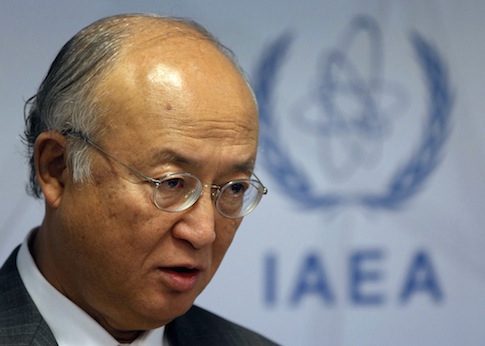
International Atomic Energy Agency (IAEA) Director General Yukiya Amano addresses a news conference after a board of governors meeting at the IAEA headquarters in Vienna, Austria, June 8, 2015. REUTERS/Leonhard Foeger/Files

International Atomic Energy Agency (IAEA) Director General Yukiya Amano addresses a news conference after a board of governors meeting at the IAEA headquarters in Vienna, Austria, June 8, 2015. REUTERS/Leonhard Foeger/Files

VIENNA (Reuters) – Iran appears to have built an extension to part of its Parchin military site since May, the U.N. nuclear watchdog said in a report on Thursday delving into a major part of its inquiry into possible military dimensions to Tehran’s past atomic activity.

A resolution of the International Atomic Energy Agency’s Parchin file, which includes a demand for IAEA access to the site, is a symbolically important issue that could help make or break Tehran’s July 14 nuclear deal with six world powers.

The confidential IAEA report, obtained by Reuters, said:

“Since (our) previous report (in May), at a particular location at the Parchin site, the agency has continued to observe, through satellite imagery, the presence of vehicles, equipment, and probable construction materials. In addition, a small extension to an existing building appears to have constructed.”

Diplomats say any activities Iran has undertaken at Parchin since 2012 are likely to have undermined the agency’s ability to verify intelligence suggesting Tehran previously conducted tests there relevant to nuclear bomb detonations.

Under a “roadmap” accord Iran reached with the IAEA parallel to its groundbreaking deal with the global powers, the Islamic Republic is required to give the Vienna-based watchdog enough information about its past nuclear activity to allow to write a report on the long vexed issue by year-end.

“Full and timely implementation of the relevant parts of the road-map is essential to clarify issues relating to this location at Parchin,” the new IAEA report said.

Iran has for years been stonewalling the PMD investigation but delivered on a promise under the roadmap to provide more information by Aug. 15.

IAEA Director-General Yukiya Amano said on Tuesday that the agency had received substantive amounts of information from Iran although it was too early to say whether any of it is new.

Obama’s end-run around the Nuclear Non-Proliferation Treaty

August 25, 2015

Obama’s end-run around the Nuclear Non-Proliferation Treaty, Power LinePaul Mirengoff, August 25, 2015

In an article for Forbes, Harold Furchtgott-Roth argues that President Obama’s executive agreement with Iran violates and/or modifies the Nuclear Non-Proliferation Treaty of 1969. Thus, it cannot lawfully take effect without true congressional approval (as opposed to the process established by the Corker-Cardin legislation). Furchtgott-Roth’s article appeared about a month ago, but has only recently come to my attention.

It is axiomatic, I should think, that an executive agreement cannot supersede a treaty. As Furchtgott-Roth explains, treaties are the law of the land and have the status of federal statutes. As such, they cannot be overridden by executive action.

The Iran deal is not a treaty, nor is it a statute. It will not even muster the level of congressional support sufficient to enact a statute.

To be sure, Congress through the Corker-Cardin legislation agreed to process by which the Iran deal could take effect with less than majority support. It did so before it had seen the terms of the deal. Thus, says Furchtgott-Roth, it had no reason to believe that the terms would violate the Nuclear Non-Proliferation Treaty. Indeed, the public statements of John Kerry indicated that there would be no clash.

In any event, the Corker-Cardin bill established a process to review an executive order, not a treaty amendment. I doubt that Congress can bind itself in advance (or at all) to a process to create or amend a treaty that differs from the one established by the Constitution.

The question thus becomes whether the Iran deal modifies the Nuclear Non-Proliferation Treaty. Furchtgott-Roth presents a good case that it does:

1. Under Article I of the NPT, “Each nuclear-weapon State Party to the Treaty [US] undertakes … not in any way to assist, encourage, or induce any non-nuclear weapon State [Iran] to … otherwise acquire nuclear weapons or other nuclear explosive devices, or control [ICBMs] over such weapons or explosive devices.”

Yet the entire Iran Deal is a road map for Iran to obtain devices that provide “control over such weapons or explosive devices.” The Iran Deal lifts embargoes on missiles that could be used for nuclear weapons. The deal ends prohibitions on nuclear weapons after a fixed number of years. The deal gives access to Iran to hundreds of billions of dollars immediately, all or part of which can finance the acquisition of nuclear weapons or related components.

Thus the Iran Deal modifies or violates U.S. responsibilities under Article I of the NPT.

2. Under Article II of the NPT:

“Each non-nuclear-weapon State Party to the Treaty undertakes not to receive the transfer from any transferor whatsoever of nuclear weapons or other nuclear explosive devices or of control over such weapons or explosive devices directly, or indirectly; not to manufacture or otherwise acquire nuclear weapons or other nuclear explosive devices; and not to seek or receive any assistance in the manufacture of nuclear weapons or other nuclear explosive devices.”

Yet there is nothing in the Iran Deal that limits its ability ultimately to obtain nuclear weapons and various related control devices such as ICBMs. The Iran Deal merely places a timeline on that acquisition. The Iran Deal modifies Article II of the NPT.

3. Under Article III of the NPT:

“Each non-nuclear-weapon State Party to the Treaty undertakes to accept safeguards, as set forth in an agreement to be negotiated and concluded with the International Atomic Energy Agency in accordance with the Statute of the International Atomic Energy Agency and the Agency’s safeguards system, for the exclusive purpose of verification of the fulfillment of its obligations assumed under this Treaty with a view to preventing diversion of nuclear energy from peaceful uses to nuclear weapons or other nuclear explosive devices.”

The Statute of the IAEA. . .states. . .:

[T]he Agency [IAEA] shall have the … responsibilities…To send into the territory of the recipient State or States inspectors, designated by the Agency after consultation with the State or States concerned, who shall have access at all times to all places and data and to any person who by reason of his occupation deals with materials, equipment, or facilities which are required by this Statute to be safeguarded…

Press accounts suggest that the Iran Deal does not provide for IAEA inspection “at all times to all places and data and to any person…” Partly, there is a 24-day notice and review requirement before any inspection. That is inconsistent with the NPT. Neither the Iran Deal nor press accounts indicate that IAEA inspection will be “at all times to all places.”

The Iran Deal modifies Article III of the NPT.

4. Article VIII of the NPT provides in detail a method to modify and amend the NPT. That is not the process used for the Iran Deal. Thus the Iran Deal modifies or violates U.S. responsibilities under Article VIII of the NPT. . . .

Assuming that this analysis is sound, i.e., that Obama’s deal modifies a treaty, the questions become: what can Congress do about it and what is Congress prepared to do?

I doubt that Congress is prepared to abandon the Corker-Cardin procedure. To my knowledge, there has been no sign of willingness to do so in the month since Furchtgott-Roth’s article appeared.

I also believe that if Congress did ditch Corker-Cardin and treated the deal as a treaty amendment (two-thirds vote needed in the Senate; no vote in the House), Obama would thumb his nose at Congress and proceed to implement his deal.

Traitor senators took money from Iran lobby, back Iran nukes

August 25, 2015

Traitor senators took money from Iran lobby, back Iran nukes, Front Page Magazine, Daniel Greenfield, August 25, 2015

em

Senator Markey has announced his support for the Iran deal that will let the terrorist regime inspect its own Parchin nuclear weapons research site, conduct uranium enrichment, build advanced centrifuges, buy ballistic missiles, fund terrorism and have a near zero breakout time to a nuclear bomb.

There was no surprise there.

Markey had topped the list of candidates supported by the Iran Lobby. And the Iranian American Political Action Committee (IAPAC) had maxed out its contributions to his campaign.

After more fake suspense, Al Franken, another IAPAC backed politician who also benefited from Iran Lobby money, came out for the nuke sellout.

Senator Jeanne Shaheen, the Iran Lobby’s third Dem senator, didn’t bother playing coy like her colleagues. She came out for the deal a while back even though she only got half the IAPAC cash that Franken and Markey received.

As did Senator Gillibrand, who had benefited from IAPAC money back when she first ran for senator and whose position on the deal should have come as no surprise.

The Iran Lobby had even tried, and failed, to turn Arizona Republican Jeff Flake. Iran Lobby cash had made the White House count on him as the Republican who would flip, but Flake came out against the deal. The Iran Lobby invested a good deal of time and money into Schumer, but that effort also failed.

Still these donations were only the tip of the Iran Lobby iceberg.

Gillibrand had also picked up money from the Iran Lobby’s Hassan Nemazee. Namazee was Hillary’s national campaign finance director who had raised a fortune for both her and Kerry before pleading guilty to a fraud scheme encompassing hundreds of millions of dollars. Nemazee had been an IAPAC trustee and had helped set up the organization.

Bill Clinton had nominated Hassan Nemazee as the US ambassador to Argentina when he had only been a citizen for two years.  A spoilsport Senate didn’t allow Clinton to make a member of the Iran Lobby into a US ambassador, but Nemazee remained a steady presence on the Dem fundraising circuit.

Nemazee had donated to Gillibrand and had also kicked in money to help the Franken Recount Fund scour all the cemeteries for freshly dead votes, as well as to Barbara Boxer, who also came out for the Iran nuke deal. Boxer had also received money more directly from IAPAC.

In the House, the Democratic recipients of IAPAC money came out for the deal. Mike Honda, one of the biggest beneficiaries of the Iran Lobby backed the nuke sellout. As did Andre Carson, Gerry Connolly, Donna Edwards and Jackie Speier. The Iran Lobby was certainly getting its money’s worth.

But the Iran Lobby’s biggest wins weren’t Markey or Shaheen. The real victory had come long before when two of their biggest politicians, Joe Biden and John Kerry, had moved into prime positions in the administration. Not only IAPAC, but key Iran Lobby figures had been major donors to both men.

That list includes Housang Amirahmadi, the founder of the American Iranian Council, who had spoken of a campaign to “conquer Obama’s heart and mind” and had described himself as “the Iranian lobby in the United States.” It includes the Iranian Muslim Association of North America (IMAN) board members who had fundraised for Biden. And it includes the aforementioned Hassan Nemazee.

A member of Iran’s opposition had accused Biden’s campaigns of being “financed by Islamic charities of the Iranian regime based in California and by the Silicon Iran network.” Biden’s affinity for the terrorist regime in Tehran was so extreme that after 9/11 he had suggested, “Seems to me this would be a good time to send, no strings attached, a check for $200 million to Iran”.

Appeasement inflation has since raised that $200 million to at least $50 billion. But there are still no strings worth mentioning attached to the big check.

Questions about donations from the Iran Lobby had haunted Kerry’s campaign. Back then Kerry had been accused of supporting an agreement favorable to Iran. The parameters of that controversial proposal however were less generous than the one that Obama and Kerry are trying to sell now.

The hypothetical debates over the influence of the Iran Lobby have come to a very real conclusion.

Both of Obama’s secretaries of state were involved in Iran Lobby cash controversies, as was his vice president and his former secretary of defense. Obama was also the beneficiary of sizable donations from the Iran Lobby. Akbar Ghahary, the former co-founder of IAPAC, had donated and raised some $50,000 for Obama.

It’s an unprecedented track record that has received very little notice. While the so-called “Israel Lobby” is constantly scrutinized, the fact that key foreign policy positions under Obama are controlled by political figures with troubling ties to an enemy of this country has gone mostly unreported by the mainstream media.

This culture of silence allowed the Iran Lobby to get away with taking out a full-page ad in the New York Times before the Netanyahu speech asking, “Will Congress side with our President or a Foreign Leader?”

Iran’s stooges had taken a break from lobbying for ballistic missiles to play American patriots.

Obama and his allies, Iranian and domestic, have accused opponents of his dirty Iran deal of making “common cause” with that same terror regime and of treason. The ugly truth is that he and his political accomplices were the traitors all along.

Democrats in favor of a deal that will let a terrorist regime go nuclear have taken money from lobbies for that regime. They have broken their oath by taking bribes from a regime whose leaders chant, “Death to America”. Their pretense of examining the deal is nothing more than a hollow charade.

This deal has come down from Iran Lobby influenced politicians like Kerry and is being waved through by members of Congress who have taken money from the Iran Lobby. That is treason plain and simple.

Despite what we are told about its “moderate” leaders, Iran considers itself to be in a state of war with us. Iran and its agents have repeatedly carried out attacks against American soldiers, abducted and tortured to death American officials and have even engaged in attacks on American naval vessels.

Aiding an enemy state in developing nuclear weapons is the worst form of treason imaginable. Helping put weapons of mass destruction in the hands of terrorists is the gravest of crimes.

The Democrats who have approved this deal are turning their party into a party of atom bomb spies.

Those politicians who have taken money from the Iran Lobby and are signing off on a deal that will let Iran go nuclear have engaged in the worst form of treason and committed the gravest of crimes. They must know that they will be held accountable. That when Iran detonates its first bomb, their names will be on it.

The Iran deal and the Israeli veto

August 24, 2015

The Iran deal and the Israeli veto, Power LinePaul Mirengoff, August 23, 2015

(How long can Israel wait? Please see also, Thinking About the Unthinkable: An Israel-Iran Nuclear War and WHY IRAN IS NUCLEAR NOW. — DM)

CNN’s report thus raises this obvious question: Will Israel attack Iran now that the U.S. and its European allies are about to enter a deal that effectively grants Iran the right to become a nuclear power?

***********************

This weekend, CNN reported that in recent years, Israeli leaders planned three attacks on military targets in Iran. CNN bases this story on an audio recording with former Defense Minister (and one-time Prime Minister) Ehud Barak. The recording was leaked to an Israeli television station.

Why didn’t Israel carry through with the planned attacks? In the first case (2010), Israeli military leaders reportedly nixed the idea. The head of the Israeli Defense Force (IDF) simply didn’t believe the planned attack was “operational.”

In the second case (2011), the IDF signed off on an attack. However, two key ministers had doubts that could not be overcome.

In the third case (2012), the attack didn’t come off because of scheduling issues. Supposedly, the planned strike conflicted with a joint military exercise with the United States. The Israeli didn’t want to embarrass Washington by attacking Iran just as it was set to engage in the joint military exercise because this would give the appearance that the Americans were involved. (The explanation in CNN’s report for why the attack wasn’t rescheduled is garbled).

In all three instances, Prime Minister Netanyahu wanted to attack. In all three instances, Barak, who is not a member of Netanyahu’s party, concurred.

In none of these instances does it appear that President Obama’s obvious opposition to an Israeli attack on Iran was the dealbreaker, if CNN’s report is to be believed (though Obama’s views may have contributed to the two ministers getting cold feet in 2011).

CNN’s report thus raises this obvious question: Will Israel attack Iran now that the U.S. and its European allies are about to enter a deal that effectively grants Iran the right to become a nuclear power?

One might think not. The deal has the support of European governments eager to allow their businessmen to take advantage of Iranian markets. Here in the U.S., the deal is unpopular, but Obama considers it the main element of his foreign policy legacy.

There will be hell to pay if Israel upsets these expectations by attacking Iran.

But the more we learn about the farcical nature of this deal, the more Israel’s calculus may tilt in favor of an Israeli attack — if not in 2015 or 2016, then in 2017 when Obama is no longer president. After all, the hell Israel would pay if it attacks Iran must be weighed against the threat of a nuclear Iran. CNN’s report, if accurate, adds plausibility to the view that Israel sees the latter as more hellacious.

In a very real sense, then, the key people evaluating Obama’s deal aren’t U.S. Senators and Representatives, but rather Israeli generals, intelligence chiefs, and ministers. They are the ones who, effectively, can nullify the deal.

It seems to be that with every revelation of a major Obama/IAEA concession to the mullahs, the prospect that Israel will exercise its veto increases.

Inspector Clouseau was unavailable (4)

August 22, 2015

Inspector Clouseau was unavailable (4), Power LineScott Johnson, August 21, 2015

Amano’s defense of the Parchin side deal comes amid speculation that the IAEA is being subject to overwhelming pressure by the Americans and the Iranians. On the American side, the leverage is straightforward: Amano is up for reelection next year, and he perennially relies on Western nations to provide him with slim majorities [r].

************************

Omri Ceren emails an update on the IAEA side deal with Iran on Parchin. I think that readers who have followed this important story so far will find this of interest as well. Omri writes:

As was more or less inevitable, today was all about the AP scoop describing the secret IAEA-Iran side deal on Parchin, the military base where Iran conducted hydrodynamic experiments relevant to the detonation of nuclear warheads. The IAEA has been trying to get access to the facility for years to figure out how far the Iranians got, as a prerequisite to setting up a verification regime preventing them from going further. The Obama administration told lawmakers throughout the Iran talks there could be no deal without the Iranians providing that access, but the AP yesterday published the text of a side deal between the IAEA and Iran indicating that the West had caved on that demand.

The document, titled “Separate arrangement II” – which was referenced in a Wednesday AP story and published Thursday – indicates that Iranians will be allowed to inspect themselves for evidence of the nuclear work they conducted at Parchin [a][b]. Instead of allowing IAEA inspectors to collect evidence from the facility, samples will be collected by the Iranians using Iranian equipment. Instead of allowing the IAEA to collect everything it wants, only seven samples will be handed over from mutually agreed upon areas. Instead of giving inspectors access to facilities, photos and videos will be taken by the Iranians themselves, again only from mutually agreed upon areas.

Iran deal supporters haven’t settled on just one response. As of last night administration liaisons were playing for time by telling lawmakers that the earlier AP story about the side deal was just a rumor. Then the AP published the actual draft. So this morning White House allies – including groups that have worked with the administration in lobbying Congress – tweeted around the theory that maybe the AP document was forged, at one point even referencing Israeli Prime Minister Benjamin Netanyahu [c][d][e]. Other validators have been trying to argue that the IAEA can still do its work even without access [f]. The White House will end up taking that latter claim – the IAEA stuff, not the Parchin Truther insanity – and insulating it with the argument that past work doesn’t matter anyway because what matters is the verification regime for future inspections. State Department spokesman Kirby was already floating that claim at yesterday’s press briefing [g].

That talking point might work on a political level. Administration officials can simply assert that the side deal is adequate and then – when pressed for details – declare that they can’t reveal their reasoning because it’s classified. They’ll heavily leverage yesterday’s statement from IAEA chief Amano saying that, for all sorts of classified reasons, the IAEA can live with the arrangement [h]. The opacity might well get the White House through the next month and a half of Congressional review.

But on a policy level, the side deal guts the JCPOA’s verification regime for future violations, which the administration has put at the center of the Iran deal. Administration officials really had no choice: once they gave up on any demands that would physically preclude the Iranians from going nuclear – dismantling centrifuges, mothballing facilities, etc – verification was all they had left. But it’s difficult to see how the pretense of verification can be sustained now that the Parchin side deal has been detailed:

(1) The side deal will become the precedent for future inspections of military sites — The Parchin arrangement – no physical access, restricted sampling, restricted video surveillance, etc. – will likely be used at least in part as a precedent for inspections of future sites. There is at least one other secret side deal out there: the AP’s Parchin document describes itself as “Separate arrangement II,” so presumably there’s a ‘Separate arrangement I’ that isn’t public and that may describe the verification arrangements. The Iranians were already saying that the future verification regime will not include inspector access to military sites, which would track with the Parchin precedent [j][k][l]. David Albright, president of the Institute for Science and International Security, told CNN about the Parchin arrangement “you have to worry that this would set a bad precedent in the Iran context and in the context of other countries” [m]. Rep. Royce sent Kerry a letter a few weeks ago that was even more explicit: the “side deals of today will become central to the agreement’s verification provisions tomorrow” [n] [quote omitted].

(2) IAEA sign-off suggests the agency has bent to political pressure — The Parchin arrangement is a humiliation for the IAEA. Heinonen told CNN that “It is very unusual… I find it really hard to understand why you would let someone else take the samples and only see through the camera” while Albright said “It’s really not normal… I don’t know why they accepted it. I think the IAEA is probably getting a little desperate to settle this” [o]. Until very recently Amano was explicit that the agency required further access to Parchin to resolve PMD issues: last March he “what we don’t know [is] whether they have undeclared activities or something else. We don’t know what they did in the past… we cannot tell we know all their activities” and last June he reiterated “the Agency is not in a position to provide credible assurance about the absence of undeclared nuclear material and activities in Iran” [p][q].

Amano’s defense of the Parchin side deal comes amid speculation that the IAEA is being subject to overwhelming pressure by the Americans and the Iranians. On the American side, the leverage is straightforward: Amano is up for reelection next year, and he perennially relies on Western nations to provide him with slim majorities [r]. On the Iranian side, there are several mechanisms that are getting attention. Some are overt: this week Iran’s Fars News Agency published a boast that Amano knew he “would have been harmed” had he disobeyed Iranian wishes and revealed details of the side deal to Congress (the threat was scrubbed after it garnered international attention; some Iran defenders have suggested that Fars published the threat due to a mistranslation of a speech, though it’s unclear why having a state-controlled vehicle go out of its way to mistranslate and publish a threat is supposed to be reassuring [s][t]). Other Iranian pressure mechanisms are more subtle: for the first eight years of the JCPOA Iran is only bound to provisionally apply, rather than to ratify, the Additional. Even JCPOA supporters describe the concession as being “all about Iran keeping some leverage over the IAEA… it wants to be able to keep the option of revoking its provisional implementation, and not ratifying the AP, as leverage” [u].

[a] http://bigstory.ap.org/article/d8bfeff00c8341caab084841f44d9cde/what-secret-agreement-between-iran-and-un-says
[b] http://bigstory.ap.org/article/bedd428e26924eed95c5ceaeec72d3a4/text-draft-agreement-between-iaea-iran
[c] https://twitter.com/jstreetdotorg/status/634743999597801472
[d] https://twitter.com/tparsi/status/634743163467526144
[e] https://twitter.com/Max_Fisher/status/634726697263349761
[f] http://www.nbcnews.com/id/57764838/ns/msnbc-all_in_with_chris_hayes/#.VdeLL_mrT4Y
[g] http://www.state.gov/r/pa/prs/dpb/2015/08/246211.htm
[h] https://www.iaea.org/newscenter/pressreleases/statement-iaea-director-general-yukiya-amano-1
[i] http://www.powerlineblog.com/archives/2015/07/speaking-of-iran-6.php
[j] http://english.farsnews.com/newstext.aspx?nn=13940429001105
[k] http://en.mehrnews.com/news/108760/No-military-sites-inspections-Velayati
[l] http://www.latimes.com/world/middleeast/la-fg-iran-deal-zarif-20150722-story.html
[m] http://edition.cnn.com/2015/08/20/politics/iran-inspections-report-nuclear-deal-experts/index.html
[n] http://foreignaffairs.house.gov/sites/republicans.foreignaffairs.house.gov/files/Parchin%20side%20deal_0.pdf
[o] http://www.cnn.com/2015/08/20/politics/iran-inspections-report-nuclear-deal-experts/index.html
[p] http://www.pbs.org/newshour/bb/iaea-monitoring-irans-nuclear-program/
[q] https://www.iaea.org/newscenter/statements/introductory-statement-board-governors-63
[r] http://carnegieendowment.org/2012/11/20/plan-for-iaea-safeguards
[s] http://freebeacon.com/national-security/iran-threatened-harm-to-top-nuke-inspector-to-prevent-disclosure-of-secret-deal/
[t] http://english.farsnews.com/newstext.aspx?nn=13940526000960
[u] http://armscontrollaw.com/2015/07/15/much-much-more-on-the-jcpoa/

Inspector Clouseau was unavailable (3)

August 22, 2015

Inspector Clouseau was unavailable (3), Power LineScott Johnson, August 21, 2015

I think it is very likely the side-deal documents were drafted by the United States and given to the IAEA, which agreed to make them into secret agreements with Iran to finalize the main agreement.

***********************

The pushback against George Jahn’s AP scoop on the IAEA side deal with Iran now includes the allegation that the draft of the side deal posted by the AP is a forgery — perhaps an Israeli forgery. Fred Fleitz has reported the relevant details with links and evidence here at NR’s Corner. Fleitz’s knowledgeable assessment seems reasonable to me:

First, the errors and non-IAEA prose in the AP’s transcribed document appear to indicate a first draft written by a party other than Iran or the IAEA to resolve the Parchin issue. This is consistent with my assessment that the side deal documents were drafted by the United States and handed to the IAEA to finalize after U.S. diplomats were unable to resolve the issues of the Parchin military base and possible military dimensions of Iran’s nuclear program during the talks. The AP says it was told by two anonymous officials that this document is a draft and “does not differ from the final, confidential agreement between the IAEA and Iran.” I believe it probably is a first draft written by a political appointee at the State Department or an NSC staffer.

Second, to believe this is a forgery one has to believe George Jahn and the Associated Press were deceived by two anonymous diplomats or U.S. officials. I doubt this could happen to a reporter as experienced as Jahn. (MSNBC believes otherwise and attacked Jahn as “not a real reporter” for his article.) The AP is standing by this story and I doubt it would put its reputation on the line if it did not believe Jahn’s article was rock solid.

Third, claims by backers of the Iran deal that this is an Israeli forgery are nonsense. If the Israelis wanted to do a forgery like this it would be perfect. An Israeli foreign ministry or intelligence officer would never use the wrong terminology for Iran.

My bottom line is that the side-deal document transcribed by the AP is not a forgery but a first draft written by a third party that is essentially the same as the final version agreed to by the IAEA and Iran. The outstanding question is who wrote this initial draft. Given Secretary Kerry’s efforts in May and June to drop the issues of the Parchin base and possible military dimensions, I think it is very likely the side-deal documents were drafted by the United States and given to the IAEA, which agreed to make them into secret agreements with Iran to finalize the main agreement.

Fleitz adds in the final paragraph of his post that “what [Jahn] reported apparently is consistent with classified briefings provided to Congress on the secret side deals[.]”

I trust that all will become clear in time. The relevant self-inspection provisions of the side deal are so absurd that they should be fraudulent. Consistent with Fleitz’s conclusion, however, I believe they will prove to be an integral part of the finalized side deal. Neither the administration nor the IAEA disputes the accuracy of Jahn’s reportage. I conclude that the terms of the side deal reported by Jahn are a joke, but not a forgery.

Not Satire | White House Allies Suggest Israel Forged Iran-IAEA Agreement Document

August 22, 2015

White House Allies Suggest Israel Forged Iran-IAEA Agreement Document, Washington Free Beacon, August 21, 2015

"Director

Trita Parsi, the head the National Iranian American Council (NIAC), another White House-allied group, hinted that Israeli President Benjamin Netanyahu might have forged the document himself. (Huh? — DM)

*********************

Top White House allies are mounting a campaign to discredit recent reports Iran will be responsible for investigating its own military facility for evidence of nuclear activities under an agreement between international inspectors and Tehran.

The International Atomic Energy Agency will rely on Iran to collect its own environmental samples and turn over photos and videos from its suspected nuclear military site Parchin, according to a draft of a secret side-deal between the agency and the Iranian government published by the Associated Press on Thursday.

White House allies rushed to denounce the report, accusing the AP of publishing a phony document and suggesting that the Israeli government forged it to undermine the Obama administration’s Iran deal.

J Street, one of a number of groups that has been meeting with White House officials as part of a lobbying push to support the nuclear deal, questioned the accuracy of the document obtained by the AP on Friday and suggested that it was forged by Israel.

“The AP report should be thoroughly investigated and verified,” J Street tweeted. “Very worrying if there is any doubt of authenticity.”

Obama administration officials and the IAEA have not disputed the authenticity of the document. The existence of the Parchin side deal was first mentioned publicly by Sen. James Risch (R., Idaho) at a Senate Foreign Relations Committee hearing last month.

Trita Parsi, the head the National Iranian American Council (NIAC), another White House-allied group, hinted that Israeli President Benjamin Netanyahu might have forged the document himself.

Parsi noted that the draft document published by AP referred to the “Islamic State of Iran” in one instance, instead of the “Islamic Republic of Iran.”

“The only one who refers to Iran as ‘Islamic State of Iran’ is Netanyahu. And strangely, @AP‘s dubious ‘draft’ of the IAEA-Iran agreement…” wrote Parsi on Twitter.

Others also floated the idea that Israel fabricated the document and leaked it to the AP.

“Could it be that #Israel stands behind leaking this document to #AP?” tweeted Said Arikat, the Washington bureau chief for Al Quds daily newspaper.

Jeffrey Lewis, a professor at the Middlebury Institute of International Studies at Monterey (MIIS) who tweets under the name ArmsControlWonk, also questioned the accuracy of the report on Twitter.

MIIS, J Street, and NIAC have all received funding from the Ploughshares Fund, one of the top financers of the lobbying campaign to support the Iran deal.

The pushback against the AP story, and insinuations about Israeli sabotage, follow a months-long campaign to discredit Jewish lawmakers and others who have announced their opposition to the deal.

These attacks include charges of “dual loyalty” against Jewish politicians, which pro-Israel groups said crossed the line into anti-Semitism.

Vox blogger Max Fisher also argued that the AP story was “badly flawed,” noting that an ex-IAEA official questioned its authenticity and that some details were removed from the story after it was posted. The AP later added those details back into the article and said it had been shorted for brevity and not due to accuracy issues.

“As with many AP stories, indeed with wire stories generally, some details are later trimmed to make room for fresh info so that multiple so-called ‘writethrus’ of a story will move on the AP wire as the hours pass,” AP spokesperson Paul Colford told Fisher. “It was unfortunate that some assumed (incorrectly) that AP was backing off.”

AP reporters noted that the Obama administration and the IAEA have not disputed the document’s authenticity.

“If you don’t want to believe the report, so be it. But I would look for someone to actually deny what’s in it,” said AP diplomatic reporter Matt Lee in a tweet to Fisher.

“I am curious if you have managed to find a current official anywhere to back up the fraud claim,” Lee later added. As of Friday afternoon, Fisher had not.

The original AP article was written by Vienna bureau chief George Jahn.

According to the report, a draft of a side deal between the IAEA and Iran would allow the Iranian government to police its own military site for nuclear activities.

Iran has been accused of conducting nuclear detonations testing at the Parchin military facility, and supporters of the nuclear agreement said the site would be opened to international inspectors under the deal.

But according to the AP, the IAEA side agreement would not allow independent inspections of Parchin. Instead the Iranian government would turn over photographs and videos of the military site to the IAEA.

Under the deal, Iran would collect its own environmental samples from the Parchin military facility, which international inspectors would then test for nuclear residue.

Iran has been accused of conducting nuclear detonations testing at Parchin, and supporters of the nuclear deal said the facility would be opened to international inspectors under the recently signed agreement.