Archive for the ‘Turkey – Syria war’ category

US Air Force to quit Incirlik, move to Syria base

April 8, 2017

US Air Force to quit Incirlik, move to Syria base, DEBKAfile, April 8, 2017

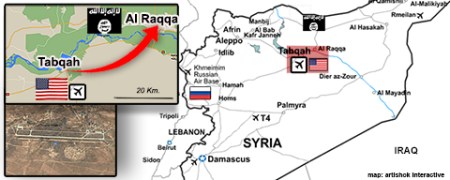
When the work is finished, the rising complex of air bases will enable America to deploy twice as many warplanes and helicopters in Syria as the Russians currently maintain.

The five US bases in Syria are part of Trump’s three-pronged strategy which aims at a) fighting Islamist terror; b) blocking Iran’s land and air access to Syria; and c) providing the enclaves of the Syrian Kurdish-PYD-YPG with a military shield against the Turkish army.

********************

Several US engineering teams are working round the clock to build a big new air base in northern Syria after completing the expansion of another four. They are all situated in the Syrian borderland with Iraq, DEBKAfile’s military forces report.

This was going on over the weekend as senators, news correspondents and commentators were outguessing each other over whether the US missile attack on the Syrian Shayrat air base Friday, in retaliation for the Assad regime’s chemical attack on Khan Sheikhoun, was a one-off or the start of a new series.

As the White House parried those questions, the Trump administration was going full steam ahead on the massive project of preparing to pull US air force units out of the Incirlik air base in southern Turkey, in active American use since 2002. Those units were in the middle of a big moving job to the five new and expanded air bases in Syria. Their hub is to be Tabqa, which is just 110km west of the Islamic State’s Syrian capital, Raqqa. The other five are Hajar airport in the Rmelan region, two small air fields serving farm transport in Qamishli, which have been converted to military us; and a fifth in the Kurdish Kobani enclave north of Aleppo near the Syrian-Turkish border.

Tabqa is also becoming the main assembly-point for the joint US, Kurdish, tribal Arab force that is coming together in readiness for a major charge on Raqqa.

When the work is finished, the rising complex of air bases will enable America to deploy twice as many warplanes and helicopters in Syria as the Russians currently maintain.

The site of the Tabqa air field was captured as recently as late March by the Syrian Democratic Force (Kurdish-Arab fighters) which were flown in and dropped there by the US Air Force’s Air Mobility Command. It was quickly dubbed “Incirlik 2” or “Qayyarah-2” after the US command center running the Iraqi military offensive against ISIS in Mosul.

Tabqa is designed to accommodate the 2,500 US military personnel housed at Incirlik. Like the Americans, the German Bundeswehr is also on the point of quitting Incirlik and eying a number of new locations in Cyprus and Jordan. The Germans are pulling out over the crisis in their relations with Ankara. The Americans are quitting because President Donald Trump wants to chill US ties with Turkish President Reccep Tayyip Erdogan and cooperation with the Turkish army.

The five US bases in Syria are part of Trump’s three-pronged strategy which aims at a) fighting Islamist terror; b) blocking Iran’s land and air access to Syria; and c) providing the enclaves of the Syrian Kurdish-PYD-YPG with a military shield against the Turkish army.

Trump-Putin safe zones deal ousts Iran from Syria

January 26, 2017

Trump-Putin safe zones deal ousts Iran from Syria, DEBKAfile, January 26, 2017

syria_safezones

Russia had originally planned to deploy Syrian military, pro-Iranian Shiite militia and Hizballah forces in battles for the capture of land around the cities of Derra and Quneitra on the Syrian side of the Golan. That plan has been dropped and will be superseded by the deployment in southern Syria of US troops accompanied by Jordanian special forces and Syrian rebels, trained by American instructors in Jordanian military camps.

Israelis will breathe a sigh of relief over the removal of the threat of Iranian and Hizballah forces being deployed along their northern border with Syria.

**************************

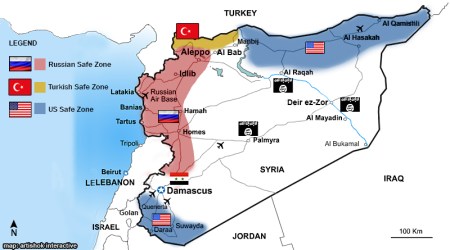
Syria stands on the threshold of dramatic changes that will directly impact on the strategic and military situation along the Syrian borders with Israel and Jordan, DEBKAfile reports exclusively. They derive from a deal struck this week by US President Donald Trump and Russian President Vladimir Putin to establish US, Russian and Turkish security zones in Syria. This scheme will transfer military control of the country to those three powers. Each of them will be responsible for a zone whose borders will be defined and agreed upon by Washington, Moscow  and Ankara.

As part of this arrangement, all forces from the Iranian military, the pro-Iranian Shiite militias and Hizballah will be required to leave Syria.

The US military is to have two security zones – one covering the entire area east of the Euphrates River up to the Iraqi border including Kurdish areas (see attached map). This arrangement will partly resurrect the accord reached in late 2015 by US President Barack Obama and Putin, for the division of Syria into areas of influence. All territory east of the Euphrates was allocated to the US, with Russia taking responsibility for all areas west of the river until the Mediterranean coast.

Under the new deal, the Turkish area is to stretch about 650 kilometers along the entire Syria-Turkey border and extend between 35 and 50 kilometers into Syrian territory up to Al-Bab, the town where the Turkish military is engaged in its third straight month of fighting for its capture from ISIS.

DEBKAfile’s military and intelligence sources report that the overriding change on the ground will be the establishment of a second US security zone adjacent to Syria’s borders with Israel and Jordan. It means that the approximately 7,500 US special operations forces troops currently in Jordan will be shifted northward into southern Syria.

Russia had originally planned to deploy Syrian military, pro-Iranian Shiite militia and Hizballah forces in battles for the capture of land around the cities of Derra and Quneitra on the Syrian side of the Golan. That plan has been dropped and will be superseded by the deployment in southern Syria of US troops accompanied by Jordanian special forces and Syrian rebels, trained by American instructors in Jordanian military camps.

Israelis will breathe a sigh of relief over the removal of the threat of Iranian and Hizballah forces being deployed along their northern border with Syria.

The Trump-Putin deal for Syria and its ramifications are explored in the coming issue of DEBKA Weekly (for subscribers) out Friday, with especially attention to the way it leaves Iran and Hizballah high and dry.

If you are not yet a subscriber, click here to sign on.

Mystery blasts in Damascus: Syria accuses Israel

January 13, 2017

Mystery blasts in Damascus: Syria accuses Israel, DEBKAfile, January 13, 2017

syrian_iaf_attack_13-1-17

Some unknown hand struck into the heart of that regime in the space of a few hours – not once, but twice.The Assad regime used its standard scapegoat, Israel, for covering up embarrassing and inexplicable occurrences.

However, DEBKAfile’s military and intelligence sources disclose that the regime has reached an awkward crossroads. The Russians have taken charge of the Syrian war and no longer bother to consult with the Syrian president or Iran on its conduct. They are deeply immersed in preparing the Syrian peace conference they are sponsoring which is scheduled to open at Astana, Kazakhstan on Jan. 23.

If Moscow coordinates its Syrian strategy with anyone, it is Turkish President Tayyip Erdogan, but even then only to a limited extent.

***************************

There were two unclaimed explosions in Damascus overnight Thursday and early Friday (Jan.12-13) – one at an officers club in Damascus and the second at Mezzeh airport, which Syria alleged was the work of the new Israeli S-35 stealth aircraft firing across the border from a point over the Sea of Galilee.

There was no claim to either of the attacks.

The standard Israeli policy of striking any Iranian arms shipments for Hizballah in Lebanon when they cross through Syria would not longer be applicable to any such air strike, if indeed one was launched..

The Lebanese Shiite Hizballah deploys 9,000 elite fighters in Syria to fight for Bashar Assad. Its Iranian arms supplies no longer need to risk being trucked through Syria to Lebanon; they can be delivered directly to Hizballah bases in Syria without exposure to Israel air strikes.

Indeed, should the pro-Iranian Hizballah decide to go back to shooting missiles at Israel – or using Iranian-supplied unconventional weapon – it has new launching pads readily available in Syria from those very bases. They are located in the Qalamoun mountains in western Syria and at Zabadani, a Syrian ghost town near the Damascus-Beirut highway, which the Lebanese terror group has made its military center.

Both would be obvious targets for Israel to attack rather than Damascus’ Mezzeh airport.

Tehran, having grasped from bitter experience that Mezzeh is under close surveillance by Israeli intelligence, no longer uses its facilities. Instead Iran flies arms shipments for Hizballah to Beirut by commercial aircraft, which Israel prefers not to attack, or overland through Iraq to northwestern Syria, where the consignments are picked up and transferred to Lebanon by sea.

So if an Israeli F-35 air strike on the Damascus airport should be confirmed, its target would not have been Iranian and Hizballah military supplies. Mezzeh is the site of a sterile zone set aside for the exclusive use of President Bashar Assad, his family and his top military and intelligence chiefs. It also houses laboratories for developing and manufacturing unconventional weapons, as well serving as the main command center for the 4th Division, whose Republican Guard unit protects the president, his family and members of the ruling caste.

In the first attack, a suicide bomber blew himself up Thursday night at the officers’ club in the heavily policed Kafra Sousa district of Damascus. At least ten people were killed and dozens injured. Located there are the homes of many Assad loyalists in the security and military establishments, as well as top secret facilities.

The ability of a suicide bomber to penetrate one of the most heavily secured locations in Damascus and blow up at an exclusive regime watering hole raises questions about the inner workings of the Assad regime.

Some unknown hand struck into the heart of that regime in the space of a few hours – not once, but twice.The Assad regime used its standard scapegoat, Israel, for covering up embarrassing and inexplicable occurrences.

However, DEBKAfile’s military and intelligence sources disclose that the regime has reached an awkward crossroads. The Russians have taken charge of the Syrian war and no longer bother to consult with the Syrian president or Iran on its conduct. They are deeply immersed in preparing the Syrian peace conference they are sponsoring which is scheduled to open at Astana, Kazakhstan on Jan. 23.

If Moscow coordinates its Syrian strategy with anyone, it is Turkish President Tayyip Erdogan, but even then only to a limited extent.

The Syrian ruler and Iran, after being sidelined by the Russians, are following their example. Both have taken to holding their cards close to their vests and operating under in close secrecy.

In an attempt to pierce the resulting aura of mistrust spreading over the staunch Iranian-Syrian alliance, Ali Shamkhani, Secretary of the Supreme National Security Council of Iran and one of supreme leader Ayatollah Ali Khamenei’s closest confidants, was sent to Damascus Sunday, Jan 8, to find out what is going on there

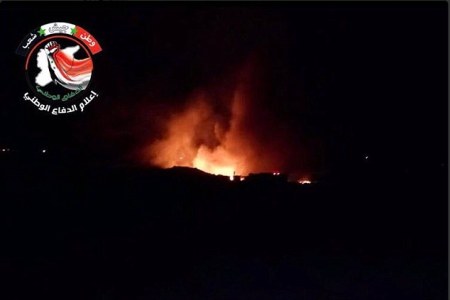
The mystery deepened further Friday morning, when Syrian state media ran photos of a big blaze – which may or may not be authentic – to illustrate the alleged Israeli attack on Mezzeh airport.

Turkish army like Iraqis stalled by ISIS pushback

December 28, 2016

Turkish army like Iraqis stalled by ISIS pushback, DEBKAfile, December 28, 2016

turkeytrot

Wednesday, Dec. 28, hours before US Secretary of State John Kerry was due to deliver a major speech on his vision for the Middle East, Turkey and Russia announced a ceasefire plan going into effect the same night for the whole of Syria, and in all regions, where fighting between pro-government forces and opposition groups were taking place – excepting for terrorist organizations.

Moscow and Ankara assumed the role of guarantors of the process. This accord will be brought for approval before the Syrian peace conference to be convened in the Kazakhstan capital, Astana, this week, attended by Russia, Turkey, Iran, the Syrian government and Syrian opposition groups. The US and Europe were not invited.

Not content with kicking Washington out of any role in resolving the Syrian crisis, the Turkish president Tayyip Erdogan accused the US, leader of the Western war on the Islamic State, of supporting “terrorist groups.”

He claimed Tuesday to have evidence of the US “giving support to terrorist groups including Daesh, YPG, PYD,” adding, ” We have…  pictures, photos and videos.”

While Erdogan is scoring in the diplomatic arena, he faces nothing but frustration militarily over the failure of the large, professional Turkish army to gain ground in the battle for Al Bab in northern Syria. This is Turkey’s first face-to-face with the Islamic State in its  four-month old Euphrates Shield operation in northern Syria – and it is not gong well. The fighting is deadly with no end in sight.

This may partly account for Erdogan’s oddly inconsistent behavior.

Tuesday, Dec. 26, he quietly asked the Obama administration to step up its air support for the Turkish campaign to capture Al Bab, 55 km north of Aleppo and the only major town in ISIS hands in northern Syria. He accused the US of not doing enough.

It was doubly odd in that Turkey has a large air force of its own, and if that force was not enough to support the campaign against ISIS, Erdogan’s obvious address for assistance would be his ally in the Syrian arena, Russian President Vladimir Putin. After all, Ankara, Moscow and Tehran are in the middle of a shared effort to set the rules of the game in Syria, which has pointedly excluded the US under the Obama administration.

As to the state of the fighting, on Dec. 21, Erdogan claimed: “Right now, Al-Bab is completely besieged by the Free Syrian Army and our soldiers.” In fact, this siege has been in place for weeks and, worse still, the casualties are mounting.

Wednesday, Dec. 28, the Turkish military said  it had “neutralised” 44 Islamic State fighters in Al Bab and wounded 117 in Al Bab,  while 154 Islamic State targets had been struck by artillery and other weaponry.

No casualty figures have been released for the Turkish army fighting for Al Baba. They are conservatively estimated at 90 dead and hundreds injured. The losses of Free Syrian Army (FSA), the local rebel force fighting alongside the Turkish army, are undoubtedly heavier still.

Our military and counterterrorism experts explain how the Islamic State’s beleaguered fighters are not just holding out in Al Bab against a superior army, but running circles around it.

The jihadists took the precaution of clearing back passages from Al Bab to their headquarters in Raqqa, 140km to the southeast, and Palmyra, 330km away.

This heritage town, which the Russians took from ISIS several months ago, was recaptured by the jihadists earlier this month, when Russian forces were fully engaged with capturing Aleppo. The US air force has in the last few days redoubled its strikes on Palmyra – both to cut off the flow of reinforcements and supplies to the besieged ISIS fighters in Al Bab and to clear the way for Russian forces to recover the lost town.

This US-Russian cooperative effort is at odds with the Obama administration’s presentation of Washington’s prickly relations with Moscow.

Notwithstanding the forces ranged against it, ISIS has so far managed to repel almost every Turkish bid to break into Al Bab – thanks to the new tactics it has introduced to the battles for Syrian Al Bab and Iraqi Mosul, which mark a turning point in the war on Islamist terror in those countries.

Those tactics hinge heavily on maximizing enemy casualties in order to knock the opposing army off the battlefield.

This is achieved by a deadly mix of guerilla and terrorist methods, and includes car bombs, bomb belt-clad suicides, improvised explosive devices (IED), sniper squads, gliders carrying explosives with small parachutes, as well as the increasing use of anti-air missiles and poison chemicals.

Tuesday, Iraqi Prime Minister Haydar Al-Abadi estimated that the Iraqi army needed another three months to beat ISIS in Mosul. He was trying to buck up the Iraqi people by concealing the true situation.
The fact is that the Iraqi military offensive against ISIS in its Mosul stronghold has ground to a halt – and no wonder, when some units have suffered a 50 percent manpower loss.

Gen. Stephen Townsend, commander of American troops in Syria and Iraq, was of the opinion last week that at least two years of fighting were needed to drive ISIS out of its two capitals, Mosul and Raqqa. He did not spell this out, but his meaning was clear: to achieve this objective, a far larger army was needed than the military manpower available at present.

How Iran actually lost in Aleppo

December 26, 2016

How Iran actually lost in Aleppo, American ThinkerHeshmat Alavi, December 26, 2016

For 16 years America has failed to adopt a correct policy in the Middle East despite having huge opportunities to make significant changes. The 2003 war literally gift-wrapped Iraq to Iran, parallel to the highly flawed mentality of preferring Shiite fundamentalism to Sunni fundamentalism. This allowed Iran take full advantage of such failures and resulting voids.

Aleppo will be a short-lived success story for Iran. The tides are changing across the globe and Iran will no longer enjoy opportunities from West rapprochement. Understanding this very well, this is exactly why Tehran has resorted to such atrocities and sought to massacre all in Aleppo.

In contrast to how the U.S. handed Iraq in  a silver plate to Iran, Russia never entered the Syria mayhem to hand it over to Iran. The roots of Aleppo remain in the hearts of all Syrians. As world powers, especially the U.S. and Russia review their future objectives, Iran will be the first and ultimate party to suffer.
***********************************

Following a historic period of perseverance, Syrian rebels and their families were forced to evacuate eastern Aleppo after its liberation back in 2012. An unjust, intense war was launched upon Aleppo by Iran’s Revolutionary Guards (IRGC) and its proxy forces on the ground: Russia with its indiscriminate air strikes, and a lame-duck Syrian army of less than 20,000 deployable forces.

After more than 15 months continuous air raids and a long-lasting inhumane siege, Syrian rebels and civilians sealed an international agreement to depart Syria’s once economic and cultural hub.

In the past few weeks widespread bombing campaigns continued relentlessly on civilian areas. No Aleppo hospital was spared. The IRGC and its foot-soldiers, numbering at the tens of thousands, spearheaded the military of Syrian dictator Bashar Assad in horrific mass executions of innocent people. The United Nations reported 82 individuals, including women and children, were murdered on the spot in the streets and in their homes. God knows how many more incidents have gone unreported.

The amazing perseverance shown by Aleppo locals for years now in the face of atrocious airstrikes and artillery shelling is unprecedented to say the least. Amidst all this, the silence and inaction seen from the West, especially the United States, will remain forever a source of shame.

Conflict of Interests

In the pro-Assad camp there are three decision-makers. First Russia, second Iran, and third the Syrian regime. The role played by Assad and his military in such scenes is next to nothing.

The West and Turkey became frantic for a ceasefire in Aleppo in the early days of the war due to the negative public opinion resulting from shocking crimes. They sought to have the rebels and remaining civilians transferred to other Syrian opposition controlled areas.

On December 13th, Washington and Moscow reached what can be described a ceasefire agreement. Intense negotiations between Turkey and Russia were started afterwards, resulting in an agreement between the Syrian opposition with Russia and Turkey to evacuate Aleppo. Practically, the parties involved in the talks were Aleppo representatives and Russia, hosted by Turkey. All necessary preparations were made to begin evacuating the city from the morning of Wednesday, December 14th.

However, Iran disrupted this agreement and the IRGC hindered the evacuation process. It was crystal clear Russia and Iran were pursuing different objectives and sets of interests. Iran sought not to have Aleppo evacuated but to exterminate all Syrian rebels and civilians.

Twenty-four hours later, pressure from the international community forced the implementation of the Russia-Syrian rebel agreement on December 15th. On the morning of that day the first convoy carrying the wounded exited Aleppo, only to face roadblocks imposed by Iran-backed forces and the Assad military.

Iran raised certain conditions for the evacuation. Russia later threatened to airstrike any party hindering the evacuation, an obvious warning to Iran. Tehran was forced to wind back under Moscow pressure.

As a result, the last phase of this war and the method chosen to evacuate Aleppo was a defeat for Iran and a victory for the Syrian opposition. Especially since the conflict of interest between Iran/Assad and Russia became crystal clear. Politically speaking, Iran has become a secondary party in Syria.

“For Putin, a political settlement now makes sense. Staying involved in an ongoing insurgency does not. But for that, he needs the opposition — which is fractured — to accept a political outcome, and there is little prospect of that so long as Assad remains in power,” as explained by Dennis Ross, who served as the Director of Policy Planning in the State Department under President George H. W. Bush, the special Middle East coordinator under President Bill Clinton, and was a special adviser for the Persian Gulf and Southwest Asia (which includes Iran) to the former Secretary of State Hillary Clinton.

Is this the end?

The turn of events does not spell the end of the Syrian opposition. The opposition controls large swathes of Syria, with areas over ten times larger than Aleppo and millions of residents. Idlib Province has at a three million strong population; the western coast of the Euphrates in the Turkish border, recently liberated by the Free Syrian Army from Daesh (ISIS/ISIL); large portions of Deraa Province neighboring Jordan; a strategically important section in the north in Latakia Province on the Turkish border; large portions of areas in the Damascus vicinity and large portions in the Aleppo vicinity.

In contrast to Western mainstream media reporting, the Syrian opposition enjoys the capability to rise once again.

Despite all its differences, a comparison made to the Iran-Iraq War may help. In 1986, Iran made significant advances taking control over the Faw peninsula in southern Iraq. Western media and think-tanks all forecasted further advances by Iran and a defeat for Iraq. In 1988 Iran was forced into a U.N.-brokered ceasefire agreement.

Deep divisions between the Syrian nation and the Assad regime have reached the point of no return. Nearly 500,000 have been killed and more than half of the Syrian population displaced. The Syrian nation will never accept the continuation of this regime. Despite sporadic military advances, Assad has no place in Syria’s future.

Where Iran stands in Syria

Iran will not be the final victor in Syria.

First — For Iran, it is vital to maintain Assad in power. His fall will mark the end of Iran’s crusades in Syria. Even if the Syrian opposition becomes weaker, the overall crisis will continue while Assad remains in power. Assad is no longer acceptable in the international stage with an international consensus over his resort to war crimes and crimes against humanity.

Second — While Iran is financing and providing the ground forces, in this war, it no longer enjoys the first and final word. Russia calls the shots now with stark differences in interest, as seen in Aleppo.

Trump’s America

U.S. President Barack Obama’s weak foreign policy, especially the failed engagement with Iran, prolonged the Syrian crisis, allowed Tehran to take advantage, Russia to take the helm and America be sidelined.

Where will developments lead with Donald Trump in the White House? What will be the new U.S. foreign policy vis-à-vis Syria, Iran and the Middle East? How can we define Washington’s relationship with Moscow, and what practical measures will Trump take against Daesh (ISIS/ISIL)? Time will tell.

Good relations between the U.S. and Russia will at least not have a negative impact on the region, and this is good news for the Syrian opposition. Russia has weighable interests in Syria. However, what will Trump do with Iran? Considering Trump’s harsh tone on Iran to this day, far more positive outcomes can be forecasted for the Syrian opposition.

Second, Trump and secretary of state nominee Rex Tillerson have the potential of eventually convincing Russia to provide concessions. This is not in Iran’s interests, as Tehran remembers Russia ditching Libyan the dictator Muammar Qaddafi.

Lesson learned in Syria

For 16 years America has failed to adopt a correct policy in the Middle East despite having huge opportunities to make significant changes. The 2003 war literally gift-wrapped Iraq to Iran, parallel to the highly flawed mentality of preferring Shiite fundamentalism to Sunni fundamentalism. This allowed Iran take full advantage of such failures and resulting voids.

Aleppo will be a short-lived success story for Iran. The tides are changing across the globe and Iran will no longer enjoy opportunities from West rapprochement. Understanding this very well, this is exactly why Tehran has resorted to such atrocities and sought to massacre all in Aleppo.

In contrast to how the U.S. handed Iraq in a silver plate to Iran, Russia never entered the Syria mayhem to hand it over to Iran. The roots of Aleppo remain in the hearts of all Syrians. As world powers, especially the U.S. and Russia review their future objectives, Iran will be the first and ultimate party to suffer.
 

Russian role in Aleppo’s fall impacts US politics

December 16, 2016

Russian role in Aleppo’s fall impacts US politics, DEBKAfile, December 16, 2016

aleppo-damage_9-15

The Putin factor comes in handy for the latest tactic in a series pursued since the November 8 election, for delegitimizing Trump’s victory and negating his fitness to reach the White House.

This campaign may resonate strongly on America’s future policy and position as a world power, because it is designed to block Trump’s path to a deal with Putin for resolving the Syrian conflict. The Obama administration has no wish to see the new president succeed where it failed for nearly six years.

********************************

Aleppo’s fall to the Assad regime with the surrender Thursday, Dec. 15, of the Syrian rebel forces locked in a corner of the eastern districts was the most disastrous military and strategic setback to befall the Obama administration for two years. It started evolving in September 2015, when Russia stepped up its military intervention in the Syria war and rescued Bashar Assad.

When Aleppo succumbed to the Russian-backed government army and its allies, Iran, Hizballah and fellow Shite militias, it did not fall alone.  It brought down the entire architecture of US-backed positions in northern Syria. The US had invested in and trained local groups, such as the Syrian Kurdish militia and the rebel Free Syrian Army, as the bedrock for its policy and interests in the conflict. Those groups have melted away.

The acknowledged overlords of northern Syria today are Russian President Vladimir Putin and Turkish President Recep Tayyip Erdogan, who can claim the Aleppo victory. Bashar Assad and Iran are reduced to playing second fiddle. But whereas the Al Qods chief Iranian general Qassem Soleimani commands pro-Iranian forces in the region, America has been divested of all its military assets and has no real say in the next chapter of the horrific war.

Hence US Secretary of State John Kerry’s despairing appeal Thursday in a press briefing to bring the bloodshed and suffering to an end: “We can’t have another Srebrenica” – a reference to the Serbian slaughter of 8,000 Bosnian Serbs in 1985 – he said.

Kerry has toiled tirelessly for a diplomatic solution to the dreadful Syrian war, but his appeal falls on senses hardened by the many Srebrenicas perpetrated in more than five years of conflict. Hundreds of thousands of civilians and soldiers have been slaughtered – according to an unofficial estimate up to a million – and many subjected to chemical warfare. The secretary can’t count on the Kremlin to relent and so, even after the last Syrian rebels and their families are out of Aleppo, the killing will go on.

In Washington, 10,000 kilometers away, the Aleppo calamity is being dished up as a political tool. The claim was heard Thursday that the “same Vladimir Putin” who sponsored the atrocities in Aleppo, also interfered in the US presidential election by sending hackers to influence the results in favor of Donald Trump. The claim is touted by Obama administration spokesmen and the Democratic Party, whose candidate Hillary Clinton lost the election. It appears to be fodder for a Democratic party drive building up for the president-elect’s impeachment even before he is sworn in as president on Jan. 20.

The Putin factor comes in handy for the latest tactic in a series pursued since the November 8 election, for delegitimizing Trump’s victory and negating his fitness to reach the White House.

This campaign may resonate strongly on America’s future policy and position as a world power, because it is designed to block Trump’s path to a deal with Putin for resolving the Syrian conflict. The Obama administration has no wish to see the new president succeed where it failed for nearly six years.

Putin will have no qualms about capitalizing on Washington’s preoccupation with its internal power struggle and will build up as many gains in Syria as he can before Donald Trump takes over. Obama’s threat Friday, Dec. 12, to retaliate for Russia’s efforts to influence the presidential election will just provoke the Russian president to move faster and more determinedly in his grab for more assets in Syria.

Israel jets mark go-it-alone policy on Syria

November 30, 2016

Israel jets mark go-it-alone policy on Syria, DEBKAfile, November 30, 2016

raidfire480Arab media show damage caused by air strikes to Syrian army compound in Damascus

Although Erdogan is notorious for his wildly unpredictable decision-making, it is more than likely that before going public on his radical change of heart on Assad, he was in touch with the new national security team taking shape in Washington. If that was the case, then Donald Trump was using Erdogan to notify Putin that the entire architecture of their understandings on Syria was now at risk.

If the Arab media reporting on Israeli air attacks on Syrian military and Hizballah targets in Damascus from Lebanese air space are confirmed, Jerusalem will be shown to have followed Ankara in backing away from those short-lived, understandings, opting instead for an independent policy in its own security interests with regard to Syria.

*****************************

Arab media carried conflicting reports wich described Israeli warplanes striking in and around Damascus overnight Tuesday, Nov. 29, with “four long-range Popeye” missiles fired from Lebanese air space on the government-held town of Al-Saboorah, a western suburb of Damascus, near the highway to Beirut.

A Lebanese newspaper reported that a Syrian army ammunition depot was destroyed in one of the raids, while other strikes hit and damaged a Hizballah arms convoy bound for Lebanon on the Damascus-Beirut Highway. There was also speculation, later denied, that one of the air strikes aimed at assassinating a senior Hizballah figure.

None of these reports were confirmed by Israel or any other official source.

Even so, Israel’s reported military action against enemy targets in Syria is bound to have repercussions in the next 24 hours, since, whatever took place, broke out of the secret overarching understandings on Syria reached provisionally this month between US President elect Donald Trump, Russian President Vladimir Putin and Turkey’s Recep Tayyip Erdogan.

Those understandings hinged strongly on joint US-Russian cooperation in the war on the Islamic State in Syria, supported by the coalition fighting for the Assad regime, namely, the Syrian army and its allies, the Lebanese Hizballah and foreign Shiite militias under the command of the Iranian Revolutionary Guards.

As the sub-text of the “big power” understandings, an outline was drafted between the next US administration, Moscow, Jerusalem, Amman and the UAE on arrangements for stabilizing Syria’s southern borders with Israel and Jordan.

Talks on these arrangements were first disclosed in an exclusive DEBKAfile report on Nov. 21, after they had already produced the unheralded return of the UN observers to the Golan demilitarized zone outside Quneitra.

But then, Sunday, Nov. 27, Russian warplanes staged a sudden series of airstrikes against Syrian rebel concentrations in the very region under discussion, southern Syria. After a three-month pause in these attacks, Moscow appeared to have waited for major Syrian government progress in Aleppo, to go against those understandings and send Russian jets into action over Jasim and Daraa in order to wipe out the rebel forces holding out in the South. Heavy casualties were sustained by those forces.

The Russian action was seen by the incoming Trump administration and Jerusalem as presaging the next danger-fraught step: To round out the raids, the Syrian army would come flooding into the South, along with Hizballah and other Shiite militias fighting under Iranian Revolutionary Guards command.

Tuesday saw two further ruptures in the trilateral understandings on Syria.

Assad announced he was gearing up for a decisive victory in Aleppo, notwithstanding a request from Trump’s advisers to Putin to hold back from the final step and refrain from retaking every last eastern district from rebel hands..

This was followed by an unforeseen statement by Erdogan: “The Turkish military launched its operations in Syria to end the rule of President Bashar al-Assad.”

This sentiment pivoted sharply away from the secret Trump-Putin understandings endorsed by the Turkish leader that was contingent on Assad remaining in power.

Although Erdogan is notorious for his wildly unpredictable decision-making, it is more than likely that before going public on his radical change of heart on Assad, he was in touch with the new national security team taking shape in Washington. If that was the case, then Donald Trump was using Erdogan to notify Putin that the entire architecture of their understandings on Syria was now at risk.

If the Arab media reporting on Israeli air attacks on Syrian military and Hizballah targets in Damascus from Lebanese air space are confirmed, Jerusalem will be shown to have followed Ankara in backing away from those short-lived, understandings, opting instead for an independent policy in its own security interests with regard to Syria.

Turkish warplanes bomb US-backed Kurdish militias in Syria

October 20, 2016

Turkish warplanes bomb US-backed Kurdish militias in Syria , DEBKAfile, October 20, 2016

Turkish warplanes carried out more than 20 sorties early Thursday morning in northern Syria, attacking positions, vehicles and convoys of US-backed Kurdish militias fighting the Islamic State organization. The targets were in a number of villages around the city of Aleppo. There were conflicting reports on the number of casualties, with the Turkish army reporting that 200 Kurdish fighters had been killed while the militias claimed that there were only about 20 fatalities. DEBKAfile‘s intelligence sources report that the Turkish attack may cause the Kurds to withdraw their forces from the US-led offensive to capture the Iraqi city of Mosul, and not help the US capture the Syrian city of Raqqa afterwards.

Russia & Turkey carve anti-US enclaves in Syria

October 15, 2016

Russia & Turkey carve anti-US enclaves in Syria, DEBKAfile, October 15, 2016

rusturk

US President Barack Obama told Pentagon and military chiefs he met Friday, Oct. on Oct. 14, that instead of arming anti-Assad rebel groups in Syria, Washington was going back to negotiations with Moscow for cooperation in achieving a cessation of hostilities in the Syrian war.

US Secretary of State John Kerry therefore scheduled his umpteenth meeting with Russian Foreign Minister Sergey Lavrov for Saturday in Lausanne. This time, the foreign ministers of Turkey, Turkey, Iran, Saudi Arabia and possibly Qatar, tagged along.

Beyond the high words, recriminations and the unspeakable horrors attending the battle for Aleppo, Obama never seriously considered providing the anti-Syrian rebels holed up in Aleppo with the anti-air weapons they need to shoot down the Russian and Syrian warplanes blitzing them – any more than UK Foreign Secretary Boris Johnson’s statement that it was time for British military involvement in the Syrian war was for real

Above all, Britain is short of the military heft for backing up hypothetical intentions.

The options for serious Western intervention in the Syrian war are constantly diminishing for the reasons outlined here by DEBKAfile’s military sources:

1.  American missiles have no way of reaching Syrian rebel groups, certainly not those still fighting in eastern Aleppo. Neither Russia, nor Turkey, whose army now controls 5,000 sq. km of northern Syria, would let them through to that destination.

2. Had Turkish President Tayyip Erdogan chosen to do so, he could have simply ordered his army to open up a route for the supply of missiles to the rebels who are hemmed in in Aleppo by Russia, Syrian, Iranian and Hizballah forces. He is withholding that order because the military deals he concluded with President Vladimir Putin last week in Istanbul override any concerns he may have for the fate of those rebels or Aleppo’s population.

3. Those deals in a word sanctify the Turkish “security zone” in northern Syria which is covered by a no-fly zone for all but Russian and Turkish flights. They also provide for the Syrian rebels retreating from the various Syrian war zones, including Aleppo, to be taken in and absorbed in the Turkish enclave. Erdogan would thus become the senior patron of the Syrian opposition rebel movement, barring only the Al-Qaeda-affiliated Nusra Front and other Islamic extremist groups. This would enable him to steal from the United States, Saudi Arabia, Jordan and Qatar their sponsorship roles and their influence in the anti-Assad movement.

4. Ankara’s military alliance with Moscow is steadily eroding Turkey’s ties with the United States as well as NATO. Matters have gone so far that the two capitals or in advanced discussion of the supply of Russian air defense missiles to the Turkish army.

DEBKAfile’s intelligence sources reveal that under discussion is the installation in Turkey of a system of advanced Russian missiles linked to the Russian anti-air missile shield under construction in Syria.

Turkey would thus become the first member of NATO to arm itself with a Russian anti-air missile shield.

How was this allowed to happen?

According to our sources, Putin and Erdogan are moving fast to cash in on President Obama’s repugnance for military intervention in Syria and his waning powers at the tail end of his presidency.

Furthermore –

a) Neither is configuring Syrian President Bashar Assad into their calculations. They are going forward with their plans while ignoring him and his drastically diminished army as factors worth consideration.

b)  Their objectives are similar and interlocking:  Both are intent on developing their respective enclaves in northern Syria, Moscow for a long-term military presence in the country: likewise, Ankara.

Up until now, the Obama administration stood firm against the two goals, which is why Washington and Moscow were unable to achieve any real cooperation over a secession of hostilities in the war-torn country;  even when Kerry and Lavrov struck a truce accord on Sept 9, it never held up beyond a few hours.

Most recently, Putin and Erdogan tried signaling the US president that their sole ambitions with regard to Syria’s future lie in the two military enclaves now under construction.

Obama saw this as a sufficient basis to continue withholding advanced arms from Syrian rebel groups and to go for another round of diplomacy with Russia – with Turkey hitching a ride this time on the opposite side of the table..

US, Russia trade blows in Syria on Kurds’ backs

August 20, 2016

US, Russia trade blows in Syria on Kurds’ backs, DEBKAfile, August 20, 2016

rus us kurds

The near-clash between US and Syrian warplanes over Kurdish Hassaka in northern Syrian Friday Aug. 19 sprung out of the Obama administration’s decision the day before to try and draw the line on the growing Russian-Iranian-Turkish-Syrian collaboration in the conjoined Syrian-Iraqi arenas, DEBKAfile’s military sources report.

It occurred when US jets flew in protective formation over the Kurdish positions, the day after they were attacked by Syrian (some Middle East sources say, Russian) jets.

The US jets came within a mile of the two Syrian Su-24 fighter jets approaching the Kurdish enclave of Hassaka, and warned them off. Without responding the Syrian planes turned tail.

The US Defense Department reported that when the incident began, “coalition forces on the ground” tried reaching the Syrian jets on a “common radio frequency” but received not response. The spokesman did not specify which “coalition forces” he was referring to.

According to some Middle East sources, the Su-24s which attacked Hassaka Thursday were Russian – not Syrian.

Friday, US officials activated the US command center in Jordan for a complaint and warning to the Russian command center nearby, but they too were greeted with silence.

It may be assumed that the Russian tracking and reconnaissance systems spread across Syria and the eastern Mediterranean picked up the American communications and, had they wanted to, could have passed the US warnings on to Bashar Assad.

But the appearance Friday of another pair of Syrian jets over the Kurdish town indicated that the Russians had decided to pretend ignorance.

After the attack on Hassaka, a number of US special operations forces were pulled out of their northern Syrian positions. They were there as instructors and advisers to the Syrian Kurdish YPG militia and the Syrian Democratic Forces (SDF), with tens of US officers attached to every Kurdish platoon and SDF battalion.

It is now up to Washington to decide what happens next.

Russian President Vladimir Putin has obviously embarked on a new anti-American game based on the far-reaching deal he struck with Turkish President Tayyip Erdogan in St. Petersburg on Aug. 9. Part of that deal was a pledge by Moscow to help Turkey block all avenues for the Kurdish minority to attain full independence in Syria or Iraq, where it enjoy semi-autonomy, and allow a Kurdish state to rise from Irbil to the Mediterranean.

Iran and Syria’s Assad fully support the Turkish goal in their own interests.

The air strike against the Kurds of Hassaka therefore set a kind of foundation stone for the new Russian-Turkish-Iranian alliance in the region, whose establishmentDEBKAfile was first to uncover exclusively on Aug. 9, after the Putin-Erdogan summit.

This emerging pact has already generated strategic military dividends for Russia in the Middle East for Russia unmatched at any time since the Cold War of the mid-20thcentury.

Revolutionary Iran has made Russia the first foreign recipient of an air base on its soil near Hamedan in the west.

Erdogan’s Turkey has hustled the US into evacuating its nuclear arsenal from the southern Incirlik air base, the first time NATO was forced to give up a nuclear stockpile near the Russian frontier. And before the removal was completed, calls were raised in Moscow and Ankara to let Moscow install its warplanes at the strategic Turkish base.

It is hard to see how by sending US warplanes to shield Syrian Kurdish positions against attack, the Obama administration can put the brakes on the Russian-led tactical alignment speeding forward with Iran, Turkey and the Assad regime. To make a difference, the US president would have to interrupt his Martha’s Vineyard holiday and reach a decision he has avoided for the last six years, which is to put substantial American boots on the ground in Syria.

This step is not really on the cards three months before the presidential election and five months before he leaves the Oval Office for good.

In the near future, we are therefore likely to see the Russians and Syrians pressing ahead with their campaign against the Kurds, whereas Obama may opt to confront Putin outside the Syrian quagmire, possibly over Ukraine. Mindful of this likely scenario, Putin flew to Crimea Friday after staging war games there.