Archive for the ‘Turkey and human rights’ category

After 10,000 Arrested, it’s Time for the US to End Backing for Islamist Regime

July 23, 2016

After 10,000 Arrested, it’s Time for the US to End Backing for Islamist Regime, Front Page Magazine, Daniel Greenfield, July 22, 2016

Erdogan Hitler

It’s funny how the media was far more outraged by the supposed attempt by the Turkish military to restore the republic than by the Islamist tyrant’s escalating crackdown which has now seen 10,000 arrested. That’s war crime level detentions. If the Turkish military had done this, they would be screaming their heads off. Yet 10,000 arrests by Islamists, just like the Muslim Brotherhood’s torture and abuses in Egypt, get a pass.

And that has to change.

Turkey is swiftly turning into an actual totalitarian regime with no holds barred.

Turkey entered its second day under a state of emergency as President Recep Tayyip Erdogan signaled that the three-month period approved by parliament may not be enough to complete a purge of those responsible for last week’s failed coup.

Erdogan told Reuters that there’s no obstacle to extending emergency rule, which took effect at 1 a.m. on Thursday and was later endorsed by parliament. It allows the government to issue decrees with the force of law, and detain suspects for longer periods without trial.

And then the emergency rule will just be made permanent and Erdogan will declare himself a sultan. All of this is happening with the complicity of the US and the EU. And I don’t just mean the radical left.

Too few, even Republicans, were willing to come out against the Arab Spring or to back the Egyptian military’s restoration of the government. That’s why Trump’s mention of it in his acceptance speech was important. We should have backed the Turkish military to the hilt. And by “us” I don’t mean Obama, who has never met an Islamist Jihadist he didn’t love, but Republicans and conservatives.

Turkey – Roger Out

July 22, 2016

Turkey – Roger Out, Front Page MagazineCaroline Glick, July 22, 2016

turkey roger out

Originally published by the Jerusalem Post

On Wednesday, NATO Secretary-General Jens Stoltenberg insisted that the purge of thousands in the Turkish military – including a third of the serving generals – did not weaken the military.

Stoltenberg told Reuters, “Turkey has a large armed force, professional armed forces and… I am certain they will continue as a committed and strong NATO ally.”

It would be interesting to know whether the 1,500 US soldiers who have been locked down at Incirlik Air Base along with several hundred soldiers from other NATO countries since the failed coup Friday night would agree with him.

Following the failed coup, the Erdogan regime cut off the base’s external electricity supply and temporarily suspended all flights from the base.

The base commander Gen. Bekir Ercan Van and 11 other service members from the base and a police officer were placed under arrest.

Incirlik is the center of NATO air operations against Islamic State in Syria. It also reportedly houses 50 nuclear warheads. The atomic bombs belong to the US. They deployed to Turkey – under US control – as a relic of the Cold War.

It took US President Barack Obama two years of pleading to convince Turkish President Recep Erdogan to allow NATO forces to use the base at Incirlik. It was only after the Kurdish political party secured unprecedented gains in Turkey’s parliamentary elections last year, and Tayyip Erdogan decided to expand his operations against the Kurds of Iraq and Syria to dampen domestic support for the Kurds, that he agreed to allow NATO forces to use the base.

His condition was that the US support his war against the Kurds – the most effective ground force in the war against Islamic State.

Stoltenberg’s statement of support for Turkey is particularly troubling because Erdogan’s post-coup behavior makes it impossible to continue to sweep his hostility under the rug.

For nearly 14 years, since his AK Party first won the national elections in late 2002, Erdogan and his followers have made clear that they are ideologically – and therefore permanently – hostile to the West. And for nearly 14 years, Western leaders have pretended this reality under the rug.

Just weeks after AKP’s first electoral triumph, the Turkish parliament shocked Washington when it voted to reject the US’s request to deploy Iraq invasion forces along the Turkish border with Iraq. Turkey’s refusal to permit US operations from its territory are a big reason the Sunni insurgency in Iraq was able to organize.

It took the US some two months to take over northern Iraq. By that time, the Ba’athists had organized the paramilitary militias that later morphed into al-Qaida in Iraq and then, following the US withdrawal from Iraq in 2011, Islamic State.

Ever since then, Erdogan has paid lip service, and even assisted NATO and the EU from time to time, when it served his momentary interests to do so. But the consistent trend of his behavior has been negative.

Since taking power, Erdogan has galvanized the organs of state propaganda – from the media to the entertainment industry to the book world – to indoctrinate the citizens of Turkey to hate Jews and Americans and to view terrorists supportively.

This induced hatred has been expressed as well in his foreign policy. Erdogan was the first major leader to embrace Hamas after its electoral victory in the 2006 Palestinian Authority elections. He treated Hamas terror chief Ismail Haniyeh like a visiting monarch when he hosted him shortly after those elections.

During Hezbollah’s 2006 war against Israel, Turkey was caught red-handed as it allowed Iran to move weapons systems to Hezbollah through Turkish territory.

Erdogan has turned a blind eye to al-Qaida. And he has permitted ISIS to use Turkey as its logistical base, economic headquarters and recruitment center. Earlier this year the State Department claimed that all of the 25,000 foreign recruits to ISIS have entered Syria through Turkey.

As for Iran, until Obama engineered the lifting of UN sanctions against Iran through his nuclear deal with the ayatollahs, Turkey was Iran’s conduit to the international market. Turkey was Iran’s partner in evading sanctions and so ensuring the economic viability of the regime. According to a series of investigative reports by Turkish and foreign reporters, Erdogan’s family was directly involved in this illicit trade.

Then there is Europe. For ISIS, Turkey has been a two-way street. Fighters have entered Syria through Turkey, and returned to Europe through Turkey. Turkey is behind the massive inflow of Syrian refugees to Europe.

German Chancellor Angela Merkel tried to cut a deal with Erdogan that would stem the flow. Erdogan pocketed her economic concessions and did nothing to stop the hemorrhage of refugees to Europe.

As for the US, the years of anti-American incitement and indoctrination of Turkish society are now coming into full flower in the aftermath of the coup. Even before the dust had settled, Erdogan was pointing an accusatory finger at Washington.

Insisting that the failed coup was the brainchild of exiled Islamic cleric – and erstwhile ally of Erdogan – Fetullah Gulen, who took up residence in Pennsylvania’s Poconos Mountains 16 years ago – Erdogan demanded that the US immediately put Gulen on an airplane with a one-stop ticket to Turkey.

In the days that followed, the Erdogan regime’s accusations against the US became more and more unhinged. Prime Minister Binali Yildirim said that failure to comply with Erdogan’s extradition demand would be viewed as a hostile act by the US.

And Turkish Labor Minister Suleyman Soylu flat out said that “America is behind the coup,” in a media interview.

In other words, after arresting the base commander and other forces at Incirlik, and while effectively holding US-led NATO forces and 50 nuclear warheads prisoner for the past six days, Turkey is accusing the US of engineering the coup attempt.

But apparently, NATO has decided to try to again sweep reality under the rug, once more. Hence, Stoltenberg’s soothing insistence that there is no cause for worry. Turkey remains a trusted member of the alliance.

This isn’t merely irresponsible. It is dangerous, for several reasons.

First of all, Stoltenberg’s claim that the Turkish military is as strong as ever is simply ridiculous.

A third of the serving generals are behind bars along with thousands of commanders and soldiers, educators, police officers, jurists and judges.

Who exactly can be willing to take the initiative in this climate? Amid at best mixed messages from the regime regarding the war against ISIS, and with the generals who coordinated the campaign with NATO now behind bars, who will maintain the alliance with NATO ? No one will.

The implications of this passivity will be felt on the ground in Turkey as well as in Syria and Iraq.

Thanks to Erdogan’s passive support, ISIS has operatives seeded throughout Turkey. Who can guarantee that they will leave the nuclear weapons at Incirlik alone? Is the US really planning to leave those bombs in Turkey when its own forces are effective prisoners of the regime? And what are the implications of removing them? How can such a necessary move be made at the same time that NATO pretends that all is well with Turkey? Then there is the problem of chemical weapons.

In recent months, ISIS has used chemical weapons in Syria and Iraq. In February, James Clapper, the director of US national intelligence, warned that ISIS is developing a chemical arsenal and intends to use chemical weapons against the US and Europe.

In May it was reported that ISIS is conducting experiments with chemical weapons on dogs and prisoners in labs located in residential neighborhoods in Mosul.

Turkey is a NATO member with open borders to Europe, and the only thing that has prevented ISIS terrorists from bringing chemical weapons to Europe has been the Turkish military and police force. They are now being purged.

Moreover, as Soner Cagaptay reported in The Wall Street Journal this week, Erdogan used out and out jihadists to put down the coup on Friday night and Saturday. He has continued to embrace them in the days that have passed since then.

In so doing, Erdogan signaled that he may well use the post-coup state of emergency to dismantle what is left of Turkey’s secular state apparatus and transform the NATO member into an Islamist state, along the lines of the short-lived Muslim Brotherhood regime in Egypt, which Erdogan enthusiastically supported.

In this climate, it is difficult, if not as a practical matter impossible, to imagine that the military and police will work particularly hard to prevent ISIS terrorists from transporting weapons of mass destruction from Syria to Europe through Turkey.

The Obama administration is partly responsible for the current crisis. Secretary of State John Kerry just agreed to subordinate the US-led anti-ISIS campaign to Russia. In so doing, he made clear that the US will not protect Turkey from Russia. This gives Erdogan little choice other than to strike out a new, far more radical course.

To Erdogan’s own Islamist convictions and US incompetence must be added a third reason to assume the situation in Turkey will only get worse.

As David Goldman has reported in the Asia Times, Turkey is on the brink of economic collapse. Its currency has been devalued by 7 percent just since the failed coup. “With about $300 billion in foreign currency liabilities, Turkish corporations’ debt service costs rise as the currency falls. Stocks have lost more than half their value in dollar terms since 2013,” Goldman warned.

In the current climate, it is hard to imagine Erdogan instituting austerity measures to pay down the debt. So he needs a scapegoat for his failure. The chosen scapegoat is clearly the US.

To make a long story short then, the Turkish military is no longer capable of cooperating in any meaningful way with the US or NATO . Erdogan, never a reliable ally, is now openly hostile.

He is in the midst of committing aggression against NATO forces at Incirlik. And he is embracing Turkish jihadists who are ideologically indistinguishable from ISIS.

The US surrender to Russia means that America cannot protect Turkey from Russia. And Erdogan has chosen to blame American for Turkey’s fast approaching economic doomsday.

Under the circumstances, if NATO takes its job of protecting the free world seriously, it has no choice but to quit with the business as usual routine and kick Turkey out of the alliance, withdraw its personnel and either remove or disable the nuclear weapons it fields in the country.

As for anti-ISIS operations, the US will have to move its bases to Iraqi Kurdistan and embrace the Kurds as the strategic allies they have clearly become.

In the aftermath of the failed coup, Turkey is a time bomb. It cannot be defused. It will go off. The only way to protect the free world from the aftershocks is by closing the border and battening down the hatches.

Winner Takes All: Erdogan Overcomes Coup Attempt

July 17, 2016

Winner Takes All: Erdogan Overcomes Coup Attempt, Clarion Project, July 16, 2016

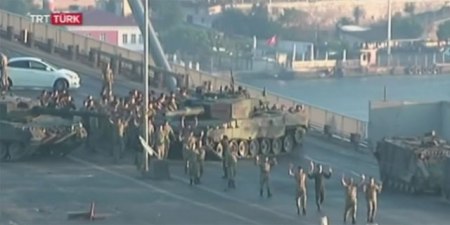
Turkish coup soldiersTurkish soldiers who had attempted a coup surrender on Bosphorus bridge (Photo: Video screenshot)

With U.S. President Obama and NATO leaders praising Erdogan and needing to maintain Turkey’s alliance in the region, the statements made by the leaders of the coup served as futile attempts to bring actual democracies to their side.

Most likely, [Edrogan] will introduce “emergency” measures to prevent any further attempts, which in reality will give his party uninterrupted reign for years to come.

************************

Turkey has just witnessed one of the fastest and strangest attempted coup d’etats in history. And it has failed.

Nearly 3,000 soldiers, including two high-level generals, have been arrested and 2,700 judges fired, as the government begins to clamp down on those it suspects of having links to the attempted coup, which officials say left 265 people dead (161 civilians and 104 accused of plotting the coup).

Of all the details that we may never know about what actually happened last Friday night, only one thing is certain: Turkish President Recep Tayyip Erdogan  — Turkey’s top leader and head of the ruling Islamist AK Party, a known extremist, suppressor of free speech and human rights, and grand supporter of the Muslim Brotherhood and Hamas — has emerged as the ultimate winner.

The attempted coup began Friday night when factions of the military set up blockades of bridges in Istanbul and began a takeover of the Parliament building in Ankara as well as the government’s main news station.

The military faction behind the coup stated that “the Turkish people want their democracy back.” Opposition groups throughout Turkey have consistently been critical of Erdogan’s increasingly authoritarian government which has stripped the country of many democratic and secular freedoms, including free speech, free press and religious tolerance.

Those behind the coup cited increasing human rights violations by Erdogan and his ruling AK Party as justification for the attempted takeover and pledged that “all existing foreign relations will continue.”

Initial reports about the coup showed a peaceful military transition and takeover with few casualties.  Understanding the sitting government’s influence over media in the country, coup leaders took control of the state-run news station to ensure the truth about the takeover was reported rather than government propaganda.

Speaking to RT, Sreeram Chaullia from the Jindal School of International Affairs, also cited the deteriorating security situation as an impetus for the coup. “A series of terrorist attacks signal the inability of the Turkish government to stop these attacks. It has angered some sections of the security establishment that believe that they can do a better job because Erdogan is just playing politics with everything,” he said.

Chaullia sited Erdogan’s mishandling of the war in Syria and Iraq and its impact on Turkey as well as his vicious on-going attacks on the Kurds. In addition, Erdogan has managed to antagonize both Russia and Iran.

Shocking reports have also surfaced proving Erdogan’s support of the Islamic State.

Erdogan made two crucial moves in the first hours of the coup: First, he cut off civilian access to all social media sites, and second, even before rescuing his officials in the parliament building, he immediately sent an F-16 to take out the coup forces at his government news station.

After Erdogan regained control of the media, the news quickly shifted to the story that “the people love their leaders and Erdogan,” “they reject the coup” and the coup was perpetrated by “a small terrorist cell within the military that will be crushed.”

Of course, we will never know the true story of what occurred in Turkey on July 15, 2016. The coup was doomed to failure, however, even if it had a large support of the people whose voices have been stifled in Turkey under Erdogan’s regime. With U.S. President Obama and NATO leaders praising Erdogan and needing to maintain Turkey’s alliance in the region, the statements made by the leaders of the coup served as futile attempts to bring actual democracies to their side.

It is no surprise that those who may have cheered at a successful takeover now claim to have be in support of the government, as it is clear that any dissident voices in Turkey will be violently silenced.

Although Turkish cleric and Erdogan-rival Fethullah Gulen is being blamed for the coup, he claims to have had no part in it.  He also says that the coup could have been a government “show” to further a political strong-arm of the U.S.

Gulen’s movement, Hizmet, began creating a parallel state inside Turkey in the 1970s through a network of schools, media outlets and businesses and recruitment of supporters in the security services and government.  His movement is widely credited with paving the way for the Islamist Justice and Development Party to take power electorally in 2002. However, Gulen and the AK Party had a falling out afterwards.

Gulen fled to the U.S. in 1999 when the Turkish government planned to prosecute him for allegedly trying to undermine the secular nature of the state. The Islamist government of Turkey acquitted him of those charges in 2008.

Erdogan has used the “Gulen excuse” in the past to purge the military and justice system of his supporters who were many.

Whoever was behind the coup, Erdogan will benefit enormously from this attempt takeover while a small number of his military will pay for it. In fact, it serves Erdogan very well. He gets rid of rebels within, consolidates his power and eliminates any and all opposition in the parliament.

The attempted coup will give Erdogan all the power he has been trying to wrench for himself over the past number of years. He can now complete his purge of the army, police and justice system and replace all those he doesn’t trust with loyalists.

Most likely, he will introduce “emergency” measures to prevent any further attempts, which in reality will give his party uninterrupted reign for years to come.

Erdogan will be more in control than ever. Who, after all, will oppose him after he demonstrated his strength (helped by his Islamist backers who took to the streets to lynch opposition soldiers)?

One could say he is now invincible.

Desperate people do desperate things.  For a country whose jails are filled with citizens who disagree with their president’s leadership, one must wonder if a military coup – however feeble — was the only thing they could do to show the world they are not OK with oppressive, Islamist rule.

Turkey’s Islamic Supremacist Foreign Policy

April 29, 2016

Turkey’s Islamic Supremacist Foreign Policy, Gatestone InstituteUzay Bulut, April 29, 2016

♦ “We have never been involved in an attack against Turkey … we were never involved in such an action… Davutoglu wants to pave the way for an offensive on Syria and Rojava and cover up Turkey’s relations with the ISIS which is known to the whole world by now.” — YPG (Kurdish) General Command.

♦ “Thousands of settlers from Anatolia were shipped in by the Turkish government to occupy former Greek villages and to change Cypriot demography — in the same manner the occupying Ottoman Empire once did in the 16th century.” — Victor Davis Hanson, historian.

♦ Turkey, for more than 40 years, has been illegally occupying the northern part of the Republic of Cyprus, historically a Greek and Christian nation, which it invaded with a bloody military campaign in 1974.

♦ What Turkey would call a crime if committed by a non-Turkish or a non-Sunni state, Turkey sees as legitimate if Turkey itself commits it.

Between March 29 and April 2, 2016, Turkey’s president, Recep Tayyip Erdogan, paid a visit to Washington D.C. to participate in the 4th Nuclear Security Summit hosted by U.S. President Barack Obama.

In an interview with CNN broadcast March 31, Erdogan said, “We will not allow an act such as giving northern Syria to a terrorist organization… We will never forgive such a wrong. We are determined about that.”

Asked which terror organization he was referring to, Erdogan said: “The YPG [Kurdish People’s Protection Units], the PYD [Democratic Union Party] … and if Daesh [ISIS] has an intention of that sort then it would also never be allowed.”

Erdogan was thereby once again attempting to equate Islamic State (ISIS), which has tortured, raped, sold or slaughtered so many innocent people in Syria and Iraq, with the Kurdish PYD, and its YPG militia, whose members have been fighting with their lives to defeat genocidal jihadist groups such as al-Nusra and ISIS.

The question is not why Erdogan or his government have such an intense hatred for Kurds. Turkey’s genocidal policies against the Kurds are not a secret. Turkey’s most recent deadly attacks are ongoing in Kurdish districts even now. The more important question is why Erdogan thinks that Turkey is the one to decide to whom the predominantly Kurdish north of Syria will belong — or who will not rule that part of Syria.

On February 17, Turkey’s capital, Ankara, was shaken by a car bomb that killed 28 people and wounded 61 others.

Turkey’s Prime Minister, Ahmet Davutoglu, immediately announced that the perpetrator was a Syrian national with links to the Syrian Kurdish People’s Protection Units (YPG).

“A direct link between the attack and the YPG has been established,” Davutoglu said. “The YPG attack was carried out with logistical support from the Kurdistan Workers’ Party (PKK) inside Turkey. Just as al-Qaeda or Daesh do not have seats at the table, the YPG, which is a terrorist organization, cannot have one.” He then once again refused to permit Kurdish YPG participation in U.N.-brokered Syria peace talks in Geneva.

Saleh Muslim, the head of Syria’s Kurdish Democratic Union Party (PYD), replied via Agence France-Presse: “We deny any involvement in this attack. These accusations are clearly related to Turkish attempts to intervene in Syria.”

The General Command of the YPG also denied any involvement in the attack:

“Under challenging conditions, we are protecting our people from barbaric gangs such as ISIS and Al-Nusra. Countless states and media outlets have repeatedly reported about the support Turkey has been providing to these terrorist groups. Apart from the terrorist groups attacking us, we as YPG have engaged in no military activity against the neighboring states or other forces.

“We would like to repeat our message to the people of Turkey and the world: We have no links to this incident… We have never been involved in an attack against Turkey. The Turkish state cannot possibly prove our engagement in any kind of attack on their side because we were never involved in such an action. Turkish Prime Minister Davutoglu’s remarks ‘Ankara attack was conducted by YPG’ is a lie and far away from the truth. With this statement, Davutoglu wants to pave the way for an offensive on Syria and Rojava and cover up Turkey’s relations with the ISIS which is known to the whole world by now.”

The Middle East is going through mass murders, kidnappings, rapes, the sexual slavery of women and other crimes. And Turkey’s aggressive and supremacist foreign policy, which does not respect the sovereignty of its neighbors, has played a large role in this situation.

Syria and Iraq, Turkey’s southern neighbors, are now the breeding ground of genocidal jihadist groups, foremost the Islamic State (ISIS). Many reporters, experts and eyewitnesses have revealed that Turkey has contributed to the rise of jihadist terrorists in the region — by letting ISIS members get in and out of Turkey and even by providing funds, logistics, and arms for ISIS.

Inside its own boundaries, Turkey has been engaged in an all-out war against its own Kurdish citizens since last August. Turkey has been murdering them indiscriminately and destroying their homes and neighborhoods.

Turkey’s hatred of Kurds is so intense that it also targets Kurdish defense forces in Syria.

On February 13, Davutoglu confirmed shelling the Kurdish YPG group in Syria, after the YPG advanced on the rebel-held town of Azaz in Syria. “We will retaliate against every step [by the YPG],” Davutoglu said. “The YPG will immediately withdraw from Azaz and the surrounding area and will not go close to it again.”

The rebels in Azaz and elsewhere in Syria are mostly Islamist jihadists. According to the scholar Aymenn Jawad Al-Tamimi, Azaz was mostly controlled in early 2015 by the group Liwa Asifat al-Shamal (“Northern Storm Brigade”), affiliated with the Islamic Front. Syria’s al-Qaeda affiliate Jabhat al-Nusra (“Al-Nusra Front”) also had a presence there.

“Azaz is a symbol for Turkey,” said Fabrice Balanche of the Washington Institute For Near East Policy. “Prime Minister Davutoglu fears that if the Kurds capture Azaz, they could start a big offensive from Kobane to the west and from Afrin to the east,” he told BBC.

As widely reported, the crisis in the region reached a peak when a Turkish Air Force F-16 fighter jet shot down a Russian Air Force Su-24 bomber along the Turkey-Syria border on November 24, killing the pilot, Lieutenant-Colonel Oleg Peshkov. The Turkish government tried to excuse the attack by claiming that the jet was downed after it had violated Turkish airspace for 17 seconds.

The Russia Defense Ministry, however, denied the aircraft ever left Syrian airspace, and released a video they claimed shows that the Su-24 was not in Turkish airspace when it was shot down.

Meanwhile, Turkey’s neighbor to its West, Greece, has long been a victim of Turkey’s violations of its sovereign airspace. According to data recorded by the Greek military, in 2014 alone, Turkish aircraft violated Greek airspace 2,244 times. On just one day, February 15, Turkish warplanes violated Greek airspace 22 times, according to Athens News Agency.

After Syria, Greece and Russia, Turkey’s next target was its other southern neighbor, Iraq. In December, Iraq’s President, Fuad Masum, said, “The presence of the Turkish Army Forces in Mosul Province without our permission violates international rules. I want Turkish officials to get its force out of Iraq’s territory immediately.”

Iraq’s Prime Minister Haider al-Abadi also condemned Turkey’s action: “We have not asked Turkey for any force and no one had informed us about the arrival of the force.”

Two neighbors of Turkey, Cyprus and Armenia, have also been victims of Turkish aggression — for an even longer time.

Turkey, for more than 40 years, has been illegally occupying the northern part of the Republic of Cyprus, which it invaded with a bloody military campaign in 1974. According to historian Victor Davis Hanson:

“Thousands of settlers from Anatolia were shipped in by the Turkish government to occupy former Greek villages and to change Cypriot demography — in the same manner the occupying Ottoman Empire once did in the 16th century. … The island remains conquered not because the Greeks have given up, but because their resistance is futile against a NATO power of some 70 million people. Greeks know that Turkey worries little about what world thinks of its occupation.”

Turkey has also been blockading yet another neighbor since 1993: “Turkey and Azerbaijan have effectively been exercising an illegal unilateral economic blockade against Armenia, which has hurt the latter economically,” wrote Armen V. Sahakyan, the executive director of the Eurasian Research and Analysis Institute. “Turkey and Azerbaijan are in clear violation of the Principle of Good Neighborliness, as well as all of the General Assembly resolutions condemning unilateral coercive measures.”

Turkey has been assaulting its neighbors in what appears as outbursts of Turkish Islamic supremacy. What Turkey would call a crime if committed by a non-Turkish or a non-Sunni state, Turkey sees as legitimate if Turkey itself commits it.

When Turkey invaded Cyprus, historically a Greek and Christian nation, it is not called an invasion. Turkey still refers to the 1974 military campaign as a “peace operation.” Senior politicians and military officials from Turkey also participate in the official ceremonies called “the Peace and Freedom Festival,” organized in occupied northern Cyprus on July 20 every year, to celebrate what they “achieved” more than 40 years ago — namely, an ethnic cleansing and colonization campaign that they conducted through many crimes, including mass murders, wholesale and repeated rapes, torture and inhuman treatment, plundering Cypriot cultural heritage and destroying churches, among others.
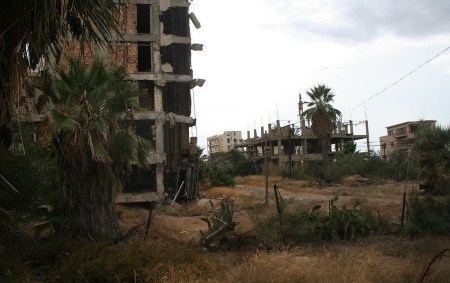
1569The crumbling buildings of the Varosha district of Famagusta, Cyprus, photographed in 2009. The area lies within Turkish-controlled northern Cyprus. The inhabitants fled during the 1974 Turkish invasion and the district has been abandoned since then. (Source: Wikimedia Commons)

If anyone blockaded another state, especially a Sunni state, Turkey would most certainly condemn it. But when Turkey itself blockades a Christian nation, it is always “justified” — most often as a response to some “unacceptable wrongdoing” by the other side.

If a non-Turkish, or non-Sunni state, treated a Turkish or Sunni minority brutally, Turkey would passionately condemn it. But Turkey sees no harm in slaughtering its own Kurdish citizens, and devastating their towns. Turkey claims this is a just way of “fighting against terrorism.”

Turkey can shoot down a Russian plane in the blink of an eye, because supposedly no one can violate Turkish airspace even for a few seconds — or even if no such violation takes place. But Turkey can violate the Greek sovereign airspace countless times as a national sport or hobby whenever it feels like it?

If Western authorities criticize Turkey for its policies, Turkey accuses them of “intervening in Turkey’s internal affairs.”

For instance, when a group of journalists close to the movement of the Islamic cleric Fethullah Gulen were detained in a mass arrest operation on December 14, 2014 in Turkey, the European Commission, in a joint statement, criticized the police raids and arrests of the media representatives.

EU foreign affairs chief Federica Mogherini and the commissioner heading EU enlargement talks also said the arrests went “against European values.”

Turkish President Recep Tayyip Erdogan responded in a public speech:

“When we take a step, someone in the European Union immediately comes up and makes a statement. According to what do you make this statement? What do you know?

“Those who have made this country wait at the gate of the European Union for 50 years, do you ever know what this [our] step is? The elements that threaten our national security — be they members of the press, or this or that — will get the required response. It is impossible for us to make them sovereign in this country.

“And when we take such a step, we do not think about ‘what will the European Union say?’ or ‘will the EU accept us [as a member]?’ We do not have such concerns. We will pull ourselves up by our own bootstraps. Please keep your intellect to yourselves.”

Erdogan also said that the detentions were not an “issue” of press freedom and claimed that the Fethullah Gulen movement was backed by Israel, which Erdogan referred to as “the country in the south that he [Gulen] loves.”

So, the European Union, of which Turkey is allegedly “striving” to be a member, cannot even issue a critical statement concerning Turkey’s policies because that would “intervene in Turkish steps for national security,” but Turkey can send jihadist fighters, arms or funds into Syria or Iraq and destroy lives and civilizations there?

Turkey seems to believe it always has to be strong and a leading force in the region. But if Kurds — an indigenous, stateless and persecuted people — are to gain a single right anywhere in the world, does Turkey find that unacceptable?

The entire history of Turkey as well as its current policies demonstrate that Turkey believes Kurds are inferior to Turks. Turkey does not even recognize the Kurds’ right to be educated in Kurdish, evidently in an attempt to separate them from their identity.

“The policy of Republican Turkey since its establishment in 1923,” wrote the author Amir Hassanpour, “is a typical case of what has been called ‘linguicide’ or ‘linguistic genocide.’ Forcing the Kurds to abandon their language and become native speakers of Turkish is the primary goal of the language policy.”

Freedom and sovereignty are for Turks only. Kurds are just to be murdered or to be Turkey’s servants. This has been the state policy of Turkey ever since it was founded in 1923.

“The master in this country is the Turk,” said Mahmut Esat Bozkurt, Turkey’s first Minister of Justice, in 1930. “Those who are not genuine Turks can have only one right in the Turkish fatherland, and that is to be a servant, to be a slave. We are in the most free country of the world. They call this Turkey.”
 

Turkey’s Fake War on Jihadis

April 28, 2016

Turkey’s Fake War on Jihadis, Gatestone InstituteBurak Bekdil, April 28, 2016

♦ Last year, a Turkish pollster found that one in every five Turks thought that the Charlie Hebdo attack in Paris was the natural response to men who insulted Prophet Mohammed.

♦ “Infidels who were enemies of Islam thought they buried Islam in the depths of history when they abolished the caliphate on March 3, 1924 … Some 92 years after … we are shouting out that we will re-establish the caliphate, here, right next to the parliament.” — Mahmut Kar, media bureau chief for Hizb ut-Tahrir Turkey.

♦ At a March meeting with top U.S. officials, King Abdullah of Jordan accused Turkey of exporting terrorists to Europe. He said: “The fact that terrorists are going to Europe is part of Turkish policy and Turkey keeps on getting a slap on the hand, but they are let off the hook.”

♦ And Turkey is the country its Western allies believe will help them fight jihadists? Lots of luck!

In theory, Turkey is part of the international coalition that fights the Islamic State (IS). Since it joined the fight last year, it has arrested scores of IS militants, made some efforts to seal its porous border with Syria and tagged IS as a terrorist organization. Turkish police have raided homes of suspected IS operatives. More recently, Turkey’s Interior Ministry updated its list of “wanted terrorists” to include 23 IS militants, and offered rewards of more than 42 million Turkish liras (more than $14 million) for any information leading to the suspects’ capture. But this is only part of the story.

On March 24, a Turkish court released seven members of IS, including the commander of the jihadists’ operations on Turkish soil. A total of 96 suspects are on trial, including the seven men who were detained but released. All are free now, although the indictment against them claims that they

“engaged in the activities of the terrorist organization called DAESH [Arabic acronym of IS]. The suspects had sent persons to the conflict zones; they applied pressure, force, violence and threats by using the name of the terrorist organization, and they had provided members and logistic support for the group.”

The release of terror suspects came in sharp contrast with another court decision that ruled for a trial, but while under detention, for four academics who had signed a petition calling for peace in Turkey’s Kurdish dispute. Unlike the IS militants, the academics remain behind bars.

The Turkish government, which controls the judiciary almost in its entirety, relies on Islamist grassroots supporters of various flavors — from Islamists and ‘lite jihadists’ to radicals.

Last year the Turkish pollster MetroPOLL found that one in every five Turks thought that theCharlie Hebdo attack in Paris was the natural response to people who insulted Prophet Mohammed [only 16.4% of Turks thought of the incident as an attack on freedom of expression]. Among the ruling Justice and Development Party’s (AKP) voters, the rate of approval of the attack was 26.4%; and only 6.2% viewed it as an attack on free speech. Only 17.8% of AKP voters thought the attack was the work of radical Islamists. Three-quarters of AKP voters thought Muslims were aggrieved by the attack; while as few as 15.4% thought the victims were the cartoonists who were murdered. Two-thirds of AKP voters thought attacks on Islam by Christian Crusaders were continuing.

The fact that key IS suspects are now free because the government may fear looking mean to its Islamist supporters only partly explains the appalling judicial rulings on jihadists and academics. “The suspects may be holding the Turkish government hostage … What if they threatened the authorities that they would reveal the government support for their organization in the past? You normally don’t walk free over such serious legal allegations,” observes one western diplomat in Ankara.

Russia has been claiming that Turkey keeps supporting the Islamic State through trading the jihadists’ oil, their main source of income. A new report claims that total supplies to terrorists in Syria last year was 2,500 tons of ammonium nitrate; 456 tons of potassium nitrate; 75 tons of aluminum powder; sodium nitrate; glycerine; and nitric acid. The report stated:

“In order to pass through the border controls unimpeded, effectively with the complicity of the Turkish authorities, products are processed for companies that are purportedly registered in Jordan and Iraq … Registration and processing of the cargo are organized at customs posts in the [Turkish] cities of Antalya, Gaziantep and Mersin. Once the necessary procedures have been carried out, the goods pass unhindered through the border crossings at Cilvegozu and Oncupinar.”

Turkey keeps playing a fake war on jihadist terrorists. At a March meeting with top U.S. officials, King Abdullah of Jordan accused Turkey of exporting terrorists to Europe. He said: “The fact that terrorists are going to Europe is part of Turkish policy and Turkey keeps on getting a slap on the hand, but they are let off the hook.”

In fact, the Turkish government’s secret love affair with various Islamist groups is not always so secret. In March, thousands of supporters of Hizb ut-Tahrir, a global Islamist group, gathered at a public sports hall in Ankara — courtesy of the Turkish government — to discuss the re-establishment of the Islamic caliphate. In his speech, Mahmut Kar, the media bureau chief of Hizb-ut Tahrir Turkey said:

“Infidels who were enemies of Islam thought they buried Islam in the depths of history when they abolished the caliphate on March 3, 1924 … We are hopeful, enthusiastic and happy. Some 92 years after … we are shouting out that we will re-establish the caliphate, here, right next to the parliament.”

(Hizb ut-Tahrir, viewed by Russia and Kazakhstan as a terrorist group, defines itself as a political organization aiming to “lead the ummah” to the re-establishment of the caliphate and rule with sharia law.)

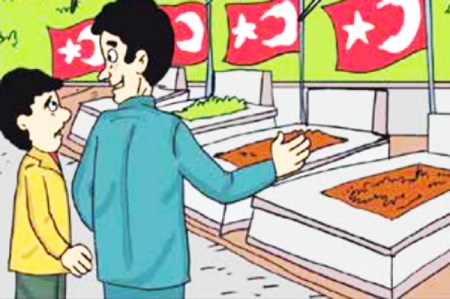
Guess what else Turkey is doing while pretending to be fighting jihadists? Apparently, President Recep Tayyip Erdogan’s declared political ambition to “raise devout generations” seems to have geared up. Turkey’s Religious Affairs General Directorate (Diyanet), the ultimate official religious authority in the country, recently issued comic books to the nation’s children telling them how marvelous it is to become an Islamic martyr.

1566Turkey’s Religious Affairs General Directorate (Diyanet), the ultimate official religious authority in the country, recently issued comic books to the nation’s children telling them how marvelous it is to become an Islamic martyr.

One comic strip is a dialogue between a father and his son. “How marvelous it is to become a martyr,” the father says. Unconvinced, the son asks: “Would anyone want to become a martyr?” And the father replies: “Yes, one would. Who doesn’t want to win heaven?”

And this is the country its Western allies believe will help them fight jihadists? Lots of luck!