Archive for the ‘Trump and US Military’ category

US twin sea buildup against China, NKorea, Iran

February 19, 2017

US twin sea buildup against China, NKorea, Iran, DEBKAfile, February 19, 2017

The conventional thinking until now was that, in the event of an Iranian clash with the US or Gulf states, including Saudi Arabia, Tehran would push back by blocking the strategic Strait of Hormuz. Today, American forces have been placed in position to prevent Iran from blocking the Strait of Mandeb, and so choking the main sea route used by oil and merchant shipping sailing to and from the Mediterranean via the Suez Canal, by posting missile bases on Yemen’s western Red Sea coast.

*********************

Donald Trump marked his first month as US President with two major military gambits in the Middle East, Asia and the South China Sea. Early Sunday, Feb. 19, the US Navy said that the Nimitz-class USS Carl Vinson aircraft carrier and strike group had begun patrols in the disputed waters of the South China Sea. With them are three air squadrons coming from their Naval Air Station Lemoore: the USS Lake Champlain guided missile cruiser and two guided missile destroyers, the USS Michael Murphy and the USS Wayne E. Meyer.

The deployment comes after Beijing’s warning that a US naval unit sailing near the disputed Spralys, where China has built islands and a military presence, would be seen as a violation of sovereignty, which the US and Japan refuse to recognize.

The Trump administration’s move therefore opens up a potential arena of confrontation between the US and China.  It also caries a message for North Korea, which Trump has called “a big, big problem and we will deal with that very strongly.”

A week ago, on Feb. 12, North Korea launched a missile, using new “cold eject” technology which makes it possible to fire a missile from a submarine. Military experts in Washington and Jerusalem estimate that once Pyongyang has perfected the system, it will be passed to Tehran, an eventuality covered in Prime Minister Binyamin Netanyahu’s White House talks with President Trump last week, our sources reveal.

Our military sources add that while Washington has publicly announced the transfer of a naval-air force to the South China Sea, the deployment of the large 11th Marine Expeditionary Combat Unit to the Gulf of Aden and Red Sea is being kept low key.

The conventional thinking until now was that, in the event of an Iranian clash with the US or Gulf states, including Saudi Arabia, Tehran would push back by blocking the strategic Strait of Hormuz. Today, American forces have been placed in position to prevent Iran from blocking the Strait of Mandeb, and so choking the main sea route used by oil and merchant shipping sailing to and from the Mediterranean via the Suez Canal, by posting missile bases on Yemen’s western Red Sea coast.

The 4,500-strong contingent of MEC marines and sailors is supported by the fighters and attack helicopters on board the USS Makin Island amphibious assault ship, the USS Somerset amphibious transport and the USS Comstock dock landing ship. Their task is to keep the strategic waterway open and safe.

The deployment of the USS Cole destroyer around the strait was announced on Feb. 3, days after a suicide boat attack by Yemeni Houthi rebels on the Saudi frigate Al Madinah off the Yemeni port of Al Hudaydah.

DEBKAfile’s military analysts note that the deployment of these naval and air forces in two international maritime arenas offers President Trump a flexible operational scenario. He can order one of those forces to go on the offensive as a warning to hostile elements in the other one – or go into action in both simultaneously – for example the US could strike North Korean and Iranian targets synchronously.

In line with these moves, a US flotilla departed its Arabian Sea base at Duqm in Oman on Feb. 12 and is sailing towards Bab Al Mandeb.

Tehran reacted Monday, Feb. 20, by embarking on a large-scale three-day military exercise titled Grand Prophet 11. Gen. Mohammed Pakpour, commander of the Revolutionary Guards ground forces, announced that the drill would include missile launches, without specifying their types or ranges.

Iranian leaders have repeatedly stated that they would not allow American warnings to deter them from their missile program, any more than Pyongyang hesitated to fly in the face of those warnings. Those warnings are now backed up by America’s sea and air might in combat positions.
Satire | Grief-stricken Navy mourns the departure of beloved Secretary Ray Mabus

January 28, 2017

Grief-stricken Navy mourns the departure of beloved Secretary Ray Mabus, Duffel Blog, January 28, 2017

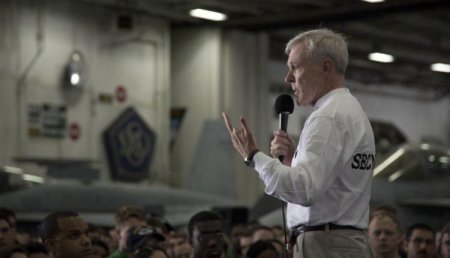
mabus-finger-750x430Mabus expresses his deep appreciation for the sailors below him.

THE PENTAGON — In news that has every sailor and Marine in the Department of the Navy literally wailing with inconsolable grief, President Trump recently announced the nomination of a former soldier to be the next Secretary of the Navy, thus officially replacing the “greatest naval hero of the last century,” Ray Mabus.

According to White House sources familiar with the decision, the president chose Philip Bilden, a former U.S. Army intelligence officer, for his myriad talents and abilities, though he lamented having to replace Mabus — a man universally beloved by the Navy and Marine Corps for being “a principled leader who never compromised his position to push his own political or social agendas,” Trump said.

While serving for eight years as the 75th Secretary of the Navy, Mabus was held in the highest regard by the sailors and Marines he led.

Such near hero-worship was due to his wildly popular orders like gender-neutralizing the Navy’s rank and ratings system, naming warships after progressive social justice icons, forcing the integration of women into combat roles and onto submarines despite idiotic “concerns” from admirals and generals who had only 35 or 40 years of experience, and also trying to fuel every ship and aircraft in the fleet with patchouli oil.

Mabus was also highly respected by sailors for having himself served as a young man in the Navy for approximately seven minutes, during which time it most assumed he had developed a deep and abiding respect for the Navy as a service and institution.

Following his departure from the Pentagon last week, the Navy acknowledged Mabus’ service in an official announcement:

“While Secretary Mabus was famous for being the longest serving secretary since World War I, what most people don’t know is that he also holds the honor of being one of the two most beloved ‘SECNAVs’ in history,” a statement read.

“He was loved just as much as Secretary John Long, who boasted of being ‘a civilian who doesn’t know the stem from the stern of a ship,’ and was also the brilliant strategist who sent the USS Maine to Havana on a critically important public relations mission, where it was promptly blown-up, killing 266 sailors, thus giving us the opportunity to wage the Spanish American War. Yes, we loved Secretary Mabus as much as him.”

When asked to comment on the prospect of the U.S. Navy being led by a former Army reservist turned private equity manager, most reflected on their love of Fightin’ Ray.

“Look, I don’t know nothin’ about some soldier managing anyone’s privates, but what I do know is that Mabus was a hero who loved sailors,” said Boatswain’s Mate Third Class Harlan “Ox” Jones, who praised Mabus’ 2016 decision to remove ‘man’ from Navy rates.

“Finally someone willing to stand up to the Goddamn patriarchy that has been destroying the Navy. Toxic masculinity never won a war idiots!”

At press time, the Navy released its final “farewell and following seas” message for Mabus:

“Mr. Secretary, you now join the august pantheon of military heroes upon whose shoulders rest the accomplishments of our Republic. We shall remember your legacy right along with Benedict Arnold, George Armstrong Custer, Bowe Bergdahl, Chelsea Manning, Captain Queeg, John Walker, Marcus Aurelius Arnheiter, and the double agent Kevin Costner played in No Way Out.”


Former Senator DeMint: Russia Needs to See a ‘Strong and Determined U.S.’

January 21, 2017

Former Senator DeMint: Russia Needs to See a ‘Strong and Determined U.S.’, Washington Free Beacon, , January 21, 2017

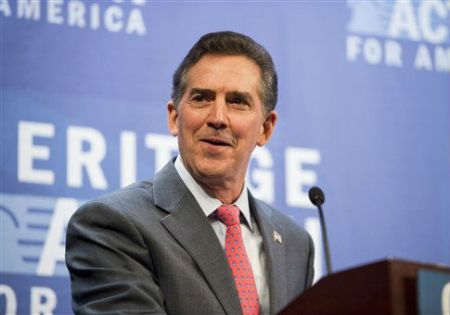
demint-1Former Sen. Jim DeMint, (R., S.C.), president of the Heritage Foundation / AP

“The implications worldwide of America being perceived as weak are huge; it’s the quickest way to draw us into some kind of conflict”

******************************************

Former Senator Jim DeMint (R., S.C.) says the United States needs to deter aggression from Russia and China by projecting strength and determination and making good on promises to its allies.

DeMint, who runs the conservative Heritage Foundation, criticized the Obama administration for not backing up its promises with force during an interview with the Washington Free Beacon, urging the Trump administration to chart a new course on projecting strength and drawing clear “lines in the sand.”

“The best way to keep peace is for us to be strong and perceived as strong, clear in what we are going to do and what we expect, and then we have to back that up,” DeMint said at the Heritage headquarters in Washington, D.C.

“We don’t want to be drawing lines in the sand that we ignore. Once Obama did that in Syria and other places, said things and didn’t follow up, the rest of the world basically knew that he wouldn’t. So, everyone has been testing us and our allies are nervous,” DeMint said.

DeMint downplayed concerns voiced about Trump’s handling of both Russia and China, saying that representatives from foreign countries with whom he has met have expressed optimism about the prospects for defense under the new administration.

“Most of the delegations—and we’ve had a lot of them since the election— that come through here are optimistic that Trump might reestablish America’s leadership position in the world and develop our strength to the point where they can count on us to keep their enemies at bay, or at least keep them honest,” DeMint said.

Trump has pledged to rebuild America’s military by reversing drawdowns of the armed forces set in motion during the Obama administration and ending sequestration that has eroded the defense budget. He has also telegraphed a willingness to pursue warmer relations with Russia, while taking a harder line on China when it comes to trade and the “one China” policy; both suggestions have drawn scrutiny from the press and critics of the Republican president.

DeMint said he suspects Trump is “toying” with Russian President Vladimir Putin and trying to “draw him in” by making positive statements about Moscow’s leader. The most recent administrations of Barack Obama and George W. Bush both tried to improve relations with Russia, to no avail. Many experts describe current tensions between Washington and Moscow as the highest since the Cold War.

“The best thing that Russia could see is a strong and determined U.S. and I think putting any missile systems all around them and convincing them that all of their development is not going to do anything because we have a missile system that could stop anything,” DeMint said, referring to the U.S. missile defense shields being deployed to Europe that have drawn ire from Moscow.

“Russia is a threat; we need to try to bring them into some kind of civilized [conversation] but we can’t be naïve in the thinking,” he said. “They want to dominate their neighborhood and keep Europe in their influence sphere, and they’re doing a good job.”

DeMint also said Trump is right to “put China on notice” as Beijing continues to build on disputed territories in the South China Sea.

“I don’t think it’s a bad thing that he’s stirring the pot a little bit with China to let them know that they cannot count on the status quo of a passive U.S.,” DeMint said. “Obviously, he has to bring that down into some clear policies, but China respects strength.”

DeMint, who has led Heritage since 2013 after serving two terms in the Senate, spoke to the Free Beacon two days before Trump’s inauguration just blocks away from the U.S. Capitol, outlining the think tank’s defense priorities for the new administration. He referenced at length Heritage’s Index of U.S. Military Strength, an annual assessment that last November shed light on the declines in American military power.

The individual service chiefs have testified before Congress about how budget cuts have compromised modernization and future readiness, agreeing that the U.S. military would not be able to defend the homeland against present and future threats if sequestration continues. Trump’s defense secretary, retired Gen. James Mattis, who was confirmed Friday afternoon, has already committed to ending sequestration.

“It’s not just about defending our country,” DeMint observed on Wednesday. “We have alliances with so many countries that depend on us that what you see now in our [analysis], it doesn’t just expose us. It’s got the rest of the world scrambling as to whether or not we could meet our commitments.”

“The implications worldwide of America being perceived as weak are huge; it’s the quickest way to draw us into some kind of conflict,” he later added.

Trump Says He’s ‘A Smart Person,’ Doesn’t Need Daily Intelligence Briefings

December 12, 2016

Trump Says He’s ‘A Smart Person,’ Doesn’t Need Daily Intelligence Briefings, PJ MediaWalter Hudson, December 11, 2012

trump-primaries-sized-770x415xt

President-elect Donald Trump continues to defy convention and ruffle institutional feathers. In a wide-ranging interview with Chris Wallace on “Fox News Sunday,” Trump indicated he will delegate daily intelligence briefings to subordinates. From the Daily Mail:

“I get it when I need it,” [Trump] said on Fox News of the top-secret briefings sessions, adding that he’s leaving it up to the briefers to decide when a development represents a “change” big enough to notify him.

“I’m, like, a smart person. I don’t have to be told the same thing in the same words every single day for the next eight years,” Trump said.

Read in excerpt like that, Trump’s remarks may come across as arrogant. He presumes that he will be in office for two terms, touts his own intellect, and downplays the importance of a critical presidential role.

However, when viewed in context [below], Trump’s position proves much less provocative. His “smart person” comment comes off less as a reference to some exclusive ability, and more like the standard capacity most of us have to remember something when first told. He could have just as easily said, “I’m not an idiot. I don’t have to be told the same thing in the same words.”

Trump went on to note that his generals and Vice President-elect Mike Pence will receive routine daily briefings, presumably including the redundancies he seeks to avoid. This is consistent with his articulated tendency to delegate tasks to “the best people.”

Trump also addressed bipartisan concerns regarding Russia’s influence in the election.

“It’s ridiculous,” Trump said of the CIA’s assessment [that that Russia tried to interfere with the presidential election].

[…]

Trump’s incoming chief of staff, Reince Priebus, shrugged off allegations that Russia helped Trump win.

He said: “The Russians didn’t tell Clinton to ignore Wisconsin and Michigan.”

The Democratic candidate was expected to win in these two states but they went to Trump instead.

“She lost the election because her ideas were bad. She didn’t fit the electorate. She ignored states that she shouldn’t have and Donald Trump was the change agent,” Priebus said on ABC’s ‘This Week’.

Priebus may be overstating the case when he says the election results “had nothing to do with the Russians.” But those claiming Russia’s influence was decisive likewise overstate their case.

It remains unclear what actionable conclusions could emerge from investigations into suspected Russian hacking. Indeed, given the likely role Hillary Clinton’s private email server played in any such hacking, Democrats might be wise to let the issue go.

https://www.youtube.com/watch?v=9ND8IMjwxes