Archive for the ‘Trump and Israel’ category

Build, but shut up about it, says Trump

February 5, 2017

Build, but shut up about it, says Trump, Israel National News, Jack Engelhard, February 5, 2017

(“Not helpful in promoting peace. . . .” What, beyond the evacuation of all Jews from Israel, would be “helpful?” Israel has tried just about everything short of that. With every concession the Palestinians demand more; if they get it, they demand even more. The “peace process” is dead and Israel did not kill it. — DM)

Already a rift? No. Not exactly. But Israel needs to get some gambling smarts.

Trump is Trump and he already knows what he’ll do but keeps his cards folded. That’s the art of his deal.

For Trump the winning move is the element of surprise.

Israel’s leaders sometimes take their cue from the lovable fools of Chelm. No surprises. They tell the enemy every move ahead of time which is bad poker and bad politics, so wrong that it’s got Trump and his team rattled and irked. Now we hear that Trump is unhappy about more homes being built within “the settlements.”

Earlier the settlements were okay. Why the mixed signals?

Most likely, Trump is bothered that Israel keeps announcing each and every plan weeks in advance, which allows the entire world to gear up in protest.

Rather, Trump says, shut up and build. That sounds more like Trump who is asking Israel to play smart and to move only when the table is in your favor.

“Not helpful in promoting peace,” said his White House spokesman today – and where have we heard that before?

Never from Trump. So something’s gone wrong and I don’t think it’s entirely Trump’s fault, nor do I think here we go again. He’s Obama all over again.

That won’t happen. But over the years some of us have noticed Israel’s habit of going public each time it hires an architect. As for me, it’s been an astonishment how Israel telegraphs every move, particularly when it comes to housing in Judea and Samaria. Who asked?

What other country does this? What other country stops the presses to announce — Hello World, We’re Building More Homes.

Got a problem with that? – and in unison the world says yes.

That IS the wisdom of Chelm if you expect any other outcome, and that has to be the cause of Trump’s annoyance. Immediately Israel’s High Court gets into the act along with the “peace groups” and Haaretz and The New York Times and a day later France invites 70 countries for a Paris summit to denounce the Jewish State.

That leaves Trump boxed in and he says so himself, that it cramps his style and his space to maneuver.

How many times a day can he take on the entire world, as he’s been doing, and now must carry Israel on his back – as he has it figured.

All for no good reason except that Israeli leaders do not know when to keep quiet. Instead they keep rubbing it in and keep asking for trouble.

The trouble comes when they speak loudly and then expect the United States to carry the big stick…like stopping the UN from another 2334.

Have we forgotten that personally Trump owes us nothing? The overwhelming majority of American Jews voted against him. He knows this.

The same majority protests his partial travel restrictions, which means that while he wants to keep anti-Semites out, we want them in.

Even pockets of Israelis were shown on television protesting Trump’s immigration pause. That hurt and it sure wasn’t “helpful” in terms of friendship.

Now we hear that Trump favors a two-state solution and where did he get that if not from Benjamin Netanyahu who keeps promoting that dangerous nonsense.

We can’t ask Trump to be more Jewish than the Jews or more Israeli than the Israelis.

Our only claim on Trump is that we are family. The United States and Israel share the same values.

Only Israel can be counted on through thick or thin throughout the region and he needs Israel as much as Israel needs him.

Trump knows this. But he’s asking Israel to play by new rules, which is to shut up and deal only when the time is right.

The Trump Way of Winning the War

February 4, 2017

The Trump Way of Winning the War, Real Clear PoliticsCaroline Glick, February 4, 2017

(As to Trump-Putin cooperation against Iran in Syria, please see Trump-Putin safe zones deal ousts Iran from Syria and Russia freezes Syrian, Iranian military movements. — DM)

trumpinovaloffice

The PLO is disoriented, panicked and hysterical. Speaking to Newsweek this week, Saeb Erekat, PLO chief Mahmoud Abbas’s chief conduit to Israel and the Americans, complained that since President Donald Trump was sworn into office, no administration official had spoken to them.

“I don’t know any of them [Trump’s advisers]. We have sent them letters, written messages. They don’t even bother to respond to us.”

The Trump administration’s shunning of the PLO is a marked departure from the policies of its predecessor. For former president Barack Obama, together with Iran, the Palestinians were viewed as the key players in the Middle East. Abbas was the first foreign leader Obama called after taking office.

Erekat’s statement reveals something that is generally obscured. Despite its deep support in Europe, the UN and the international Left, without US support, the PLO is irrelevant.

All the achievements the PLO racked up under Obama – topped off with the former president’s facilitation of UN Security Council Resolution 2334 against Israel – are suddenly irrelevant. Their impact dissipated the minute Trump took office.

Israel, in contrast, is more relevant than ever.

While Trump occasionally pays lip service to making peace in the Middle East, his real goal is to win the war against jihadist Islam. And he rightly views Israel as a woefully underutilized strategic ally that shares his goal and is well-placed to help him achieve it.

During the electoral campaign, Trump often spoke derisively of Obama’s nuclear pact with Tehran. And he repeatedly promised to eradicate Islamic State. But when asked to explain what he intended to do on these scores, Trump demurred. You don’t expect me to let the enemy know my plan, do you?

Trump’s critics dismissed his statements as empty talk. But since he came into office, each day signals that he does have a plan and that he is implementing it. The plan coming into focus involves a multidimensional campaign that if successful will both neutralize Iran as a strategic threat and obliterate ISIS.

Regarding Iran specifically, Trump’s moves to date involve operations on three levels. First, there is the rhetorical campaign to distinguish the Trump administration from its successor.

Trump launched the campaign on Twitter on Wednesday writing, “Iran is rapidly taking over more and more of Iraq even after the US has squandered three trillion dollars there.”

Shortly before his post, Iraq’s Prime Minister Haider Abadi appointed Iranian proxy Qasim al Araji to serve as his interior minister.

At a minimum, Trump’s statement signaled an abandonment of Obama’s policy of cooperating with Iranian forces and Iranian-controlled Iraqi forces in the fight against ISIS in Iraq.

At around the same time Trump released his tweet about Iranian control of Iraq, his National Security Adviser Lt.-Gen. (ret.) Michael Flynn took a knife to Obama’s obsequious stand on Iran during a press briefing at the White House.

While Trump’s statement related to Iran’s growing power in Iraq, Flynn’s remarks were directed against its nonconventional threat and its regional aggression. Both were on display earlier this week.

On Sunday, Iran carried out its 12th ballistic missile test since concluding its nuclear deal with Obama, and its first since Trump took office.

On Monday, Iranian-controlled Houthi forces in Yemen attacked a Saudi ship in the Bab al-Mandab choke point connecting the Red Sea to the Indian Ocean.

Flynn condemned both noting that they threatened the US and its allies and destabilized the Middle East. The missile test, he said, violated UN Security Council Resolution 2231 that anchored the nuclear deal.

Flynn then took a step further. He drew a sharp contrast between the Obama administration’s responses to Tehran’s behavior and the Trump administration’s views of Tehran’s provocative actions.

“The Obama administration failed to respond adequately to Tehran’s malign actions – including weapons transfers, support for terrorism, and other violations of international norms,” he noted.

“The Trump administration condemns such actions by Iran that undermine security, prosperity and stability throughout and beyond the Middle East and place American lives at risk.”

Flynn ended his remarks by threatening Iran directly.

“As of today, we are officially putting Iran on notice,” he warned.

While Flynn gave no details of what the US intends to do to Iran if it continues its aggressive behavior, the day before he made his statement, the US opened a major, multilateral, British-led naval exercise in the Persian Gulf. US naval forces in the region have been significantly strengthened since January 20 and rules of engagement for US forces in the Persian Gulf have reportedly been relaxed.

Perhaps the most potent aspect of Trump’s emerging strategy for defeating the forces of jihad is the one that hasn’t been discussed but it was signaled, through a proxy, the day after Trump took office.

On January 21, Prime Minister Benjamin Netanyahu posted a remarkable message to the Iranian people on his Facebook page. Netanyahu drew a sharp distinction between the “warm” Iranian people and the “repressive” regime.

Netanyahu opened his remarks by invoking the new administration.

“I plan to speak soon with President Trump about how to counter the threat of the Iranian regime, which calls for Israel’s destruction,” the prime minister explained.

“But it struck me recently that I’ve spoken a lot about the Iranian regime and not enough about the Iranian people, or for that matter, to the Iranian people. So I hope this message reaches every Iranian.”

Netanyahu paid homage to the Green Revolution of 2009 that was brutally repressed by the regime. In his words, “I’ll never forget the images of proud, young students eager for change gunned down in the streets of Tehran in 2009.”

Netanyahu’s statement was doubtlessly coordinated with the new administration. It signaled that destabilizing with the goal of overthrowing the regime in Tehran is a major component of Trump’s strategy.

By the looks of things in Iran, regime opponents are taking heart from the new tone emanating from Washington. Iranian dissidents have asked for a meeting with Trump’s team. And a week and a half before Trump’s inauguration, regime opponents staged a massive anti-regime protest.

Protesters used the public funeral of former Iranian president Akbar Hashemi Rafsanjani to denounce the regime. In 2009, Rafsanjani sided with many of the Green Movement’s positions. His daughter was a leader of the protests.

Among the estimated 2.5 million people who attended the funeral, scores of thousands interrupted the official eulogies to condemn the regime, condemn the war with Syria and condemn the regime’s Russian allies.

This then brings us to Syria, where the war against ISIS and the campaign against Iran are set to converge. To date, Trump has limited his stated goals in Syria to setting up safe zones inside the country where displaced Syrians can live securely. Saudi Arabia and the Emirates have agreed to cooperate in these efforts.

Trump is now engaged in a talks with the Kremlin both above and below the radar about the possibility of coordinating their operations in Syria to enable safe zones to be established.

It is fairly clear what the US objective here would be. The US wishes to convince Moscow to effectively end its alliance with the Iranian regime. Trump repeatedly stated that the entire spectrum of US-Russian relations is now in play. Talks between the two governments will encompass Ukraine, US economic sanctions on Russia, nuclear weapons, Russian bases in Syria and Russia’s alliance with Iran and its Hezbollah proxies.

Everything is on the table.

Trump understands that Russia is threatened by Sunni jihadists and that Russia views Iran as a counterweight to ISIS and its counterparts in the Caucasus. A deal between the US and Russia could involve a Russian agreement to end its support for Iran and Hezbollah in exchange for US acceptance of Russia’s annexation of Crimea, cancellation of sanctions and perhaps some form of acquiescence to Russia’s military presence in Syria.

Russia and the US could then collaborate with Arab states with Israeli support to defeat ISIS and end the Syrian refugee crisis.

Combined with actions the Trump administration is already taking in the Persian Gulf and Red Sea, and its telegraphed aim of backing a popular Iranian insurrection, Trump’s hypothetical deal with Russia would neutralize Iran as a conventional and nonconventional threat.

This then brings us back to Israel – the first target of Iran’s aggression. If Trump’s strategy is successful, then the PLO will not be Israel’s only foe that is rendered irrelevant.

Earlier this week it was reported that in the two-and-a-half years since the last war with Hamas, the Iranian-backed, Muslim Brotherhood-affiliate terrorist group has rebuilt its forces. Today Hamas fields assets and troops that match the capabilities it fielded during Operation Protective Edge.

Hezbollah, with its effective control over Lebanon, including the Lebanese military, is a strategic threat to Israel.

To date, Israel has demurred from targeting Hezbollah and Hamas missile arsenals, but not because it is incapable of destroying them. Israel’s efforts to avoid conflict with its enemies, even at the price of their rearmament, also haven’t stemmed from fear of European or UN condemnation or even from fear of the so-called “CNN-effect.”

Israel has chosen not to defeat its enemies – not to mention the EU-backed NGOs that whitewash them – because the Americans have supported them.

The Clinton administration barred Israel from taking decisive action against either Hezbollah or the Palestinians.

The Bush administration forced Israel to stand down during the war with Hezbollah in 2006.

The Obama administration effectively sided with Hamas against Israel in 2014.

In other words, across three administrations, the Americans made it impossible for Israel to take decisive military action against its enemies.

Under Obama, the US also derailed every Israeli attempt to curb the power of EU-funded subversive organizations operating from inside of Israel.

Trump’s emerging strategy on Iran and ISIS, together with his refusal to operate in accordance with the standard US playbook on the Palestinians, indicates that the US has abandoned this practice. Under Trump, Israel is free to defeat its enemies. Their most powerful deterrent against Israel – the US – is gone.

Israel has long argued that there is no difference between al-Qaida and Hamas or between ISIS and Hezbollah. It has also argued that Iran threatens not only Israel but the world as a whole. Hoping to co-opt the forces of jihad rather than defeat them, successive US administrations have chosen to deny this obvious truth.

Unlike his predecessors, Trump is serious about winning. To do so, he is even willing to take the radical step of accepting Israel as an ally.

The PLO is right to be hysterical.

Trump Changes US Policy on Settlements, But Will Netanyahu Pick Up the Ball?

February 3, 2017

Trump Changes US Policy on Settlements, But Will Netanyahu Pick Up the Ball?, The Jewish PressStephen Leavitt, February 3, 2017

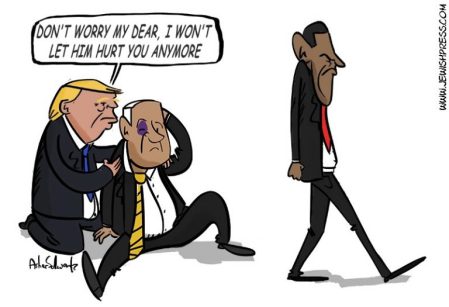
battered-bibi-syndrome-2-768x525Photo Credit: Asher Schwartz

The official White House statement thoroughly rejects the JPost’s quote, craftily eliminating both concerns: Trump is not committed to a two-state solution, and he does not consider the settlements an obstacle to peace.

**********************************

For the first time in many years, the White House on Thursday released a statement regarding Jewish settlements in Judea and Samaria without the adjectives “illegal” or “illegitimate” next to the word “settlements.”

While not 100 percent perfect — a policy of benign neglect would be best — it is clearly a complete turnaround from previous administration positions, particularly former-President Obama’s “not one brick anywhere” policy, including Jerusalem.

The White House
Office of the Press Secretary
For Immediate Release

Statement by the Press Secretary

“The American desire for peace between the Israelis and the Palestinians has remained unchanged for 50 years. While we don’t believe the existence of settlements is an impediment to peace, the construction of new settlements or the expansion of existing settlements beyond their current borders may not be helpful in achieving that goal. As the President has expressed many times, he hopes to achieve peace throughout the Middle East region. The Trump administration has not taken an official position on settlement activity and looks forward to continuing discussions, including with Prime Minister Netanyahu when he visits with President Trump later this month.”

In other words, what began a few months ago as a video of Prime Minister Benjamin Netanyahu asking why should having Jews living in Judea and Samaria be considered an impediment to peace – is now US foreign policy.


In addition to the biggest item of recognizing the legitimacy of the settlements, by omitting the words “illegal” and “illegitimate,” the statement actually declares, for all the world to see: “We don’t believe the existence of settlements is an impediment to peace.”

It should be noted that even that one seemingly negative-note in the Trump statement against new settlements or expansion isn’t exactly that:

“the expansion of existing settlements beyond their current borders may not be helpful in achieving that goal.”

First of all, the statement gives implicit approval to construction within existing settlements, and not just to communities within the settlement blocs (i.e. Gush Etzion, Ariel, etc), but rather to all settlements. This is a much wider definition, and includes many smaller Jewish communities that exist outside of the blocs, representing some 80,000 Jews.

Not to name names, but that’s more settlement legitimacy than what even some members of Netanyahu’s cabinet recognize.

Furthermore, it doesn’t actually forbid or rebuke Israel if it does build a new settlement or expand beyond the borders of an existing one. The White House statement merely questions if it is helpful to achieving peace, and leaves that question open for further discussion.

The other glaring omission in the Trump White House statement is the term “two-state solution,” so beloved by every Administration since the 1993 Oslo Accords. Why, only last Wednesday, the new, relatively pro-Israel UN Secretary-General, Antonio Guterres, had his spokesperson release a statement saying that,

“the recent announcement by the Israeli Government to advance 5,000 settlement units in the occupied West Bank could […] threaten to unravel plans for a two-State solution between Israelis and Palestinians. […] We once again warn against any unilateral actions that can be an obstacle to a negotiated two-state solution.”

Having praised the Trump statement so much, it’s also easy to realize that there must be some conflict within the Administration over the settlements issue, with one faction obviously pushing the traditional State Department line.

Rumor has it that the White House statement was released not so much as a response to Netanyahu’s recent settlement construction announcements, but in response to an unauthorized leak from within the Administration to the Jerusalem Post, which the latter reported Thursday:

“The White House warned Israel on Thursday to cease settlement announcements that are ‘unilateral’ and ‘undermining’ of President Donald Trump’s effort to forge Middle East peace, a senior administration official told The Jerusalem Post. For the first time, the administration confirmed that Trump is committed to a comprehensive two-state solution to the Israeli- Palestinian conflict negotiated between the parties.”

The official White House statement thoroughly rejects the JPost’s quote, craftily eliminating both concerns: Trump is not committed to a two-state solution, and he does not consider the settlements an obstacle to peace.

Indeed, the White House statement acknowledges the value and validity of the Israeli PM in forging US foreign policy:

“The Trump administration has not taken an official position on settlement activity and looks forward to continuing discussions, including with Prime Minister Netanyahu when he visits with President Trump later this month.”

This is tantamount to an Obama statement saying: “The Obama administration will decide on the Iran nuclear deal after continued discussions with Prime Minister Netanyahu when he visits to speak to Congress on March 3, 2015.” Yes, that’s how impossibly big this statement is.

It is now entirely up to Prime Minister Netanyahu.

Will Netanyahu have what it takes to change forever Israel’s future? Will he take full advantage of Trump’s invitation to help forge US foreign policy in a way that bolsters the Zionist vision? Will he step back from his Bar Ilan speech, and return to his former, maximalist positions?

From the White House statement it appears that the ball is completely in Netanyahu’s court.

Pseudo-liberal Jews cause great damage

January 29, 2017

Pseudo-liberal Jews cause great damage, Israel Hayom, Isi Leibler, January 29, 2017

We live in a world of chaos and upheaval.‎

Now is the time for all committed Jews to unite, stand together and concentrate primarily on ‎securing their own rights. Diaspora Jews who, from their comfortable armchairs, claim a ‎better understanding than Israelis of what is good for their security, should be treated with ‎contempt. Israel is entitled to expect support from committed Jews over the next few years ‎until it stabilizes its relationship with the world and creates an iron barrier to deter its ‎genocidal enemies.‎

****************************

Chaos is the order of the day throughout the entire democratic world.‎

This has been accelerated by the hypocrisy and intolerance of the vindictive Left, aided and ‎abetted by foolish bleeding-heart pseudo-liberals who have become accomplices in the ‎undermining of democracy.‎

One can understand that many Democrats were incredulous and devastated that Hillary ‎Clinton could be defeated by Donald Trump, whose lack of civility, absence of political ‎experience and coarse language even offended conservatives.‎

But the outpouring of rage, the histrionic protest marches throughout the world, the ‎establishment of committees to impeach Trump — even prior to the traditional 100-day ‎honeymoon period — is unprecedented. Contrary to all the claptrap about democracy that ‎they sanctimoniously preached while in office, leftists are unwilling to accept the fact that their ‎candidate was defeated by a parvenu.‎

The same chaos has swept through Europe, many of whose citizens are revolting against the ‎failure of the Brussels-based European Union bureaucrats to address their needs and above all ‎the collapse in the quality of their lives resulting from millions of so-called refugees flooding ‎their countries.‎

This has led to a rise in global populism, a revival of conservative and right-wing political ‎parties and rejection of the “politically correct” way of life imposed by sanctimonious liberal ‎ideologues.‎

How has this chaos impacted on Diaspora Jews?‎

As history has testified, during periods of stress and anxiety, Diaspora Jews face grave threats. ‎Anti-Semitism, already having reached record levels since the Nazi era, is poised to become ‎even more vicious. That situation has been temporarily muted because the prevailing threat of ‎Islamic fundamentalist terror attacks in many Western nations has directed public anger ‎toward Muslims rather than Jews. This does not apply to Hungary, Greece and Germany.‎

The Jews, as a minority that has suffered tyranny and persecution, would be expected under ‎current circumstances to concentrate primarily on their own security.‎

Ethics of the Fathers quotes Hillel the Elder, “If I am not for myself, who will be for me? But if I ‎am only for myself, what am I?”‎

Liberal-inclined Diaspora Jews — especially those lacking an authentic Jewish education — ‎appear to have reversed this dictum. They consider that the well-being of the world and ‎politically correct standards of social values must be their priority — with disregard to the harm ‎this inflicts on them as a community.‎

Observing Conservative and Reform Jewish leaders in the U.S., accompanied by once-‎mainstream liberal Jewish groups like the Anti-Defamation League and National Council of ‎Jewish Women, at the forefront of hysterical demonstrations accusing Trump of being fascist ‎and encouraging anti-Semitism, it is if they have been possessed by a dybbuk. ‎

The same bleeding hearts in the U.S. as well as those in Europe were at the forefront of calls to ‎open the gates to Muslim “refugees” steeped in anti-democratic behavior and nourished on ‎diets of undiluted, visceral anti-Semitism. Setting aside the question of ISIS terrorist sleeper ‎cells, there is little doubt that these elements will strengthen existing anti-Semitism in the older ‎immigrant Muslim communities that failed to integrate. Yet many Jews are so dismally ignorant ‎and oblivious that they even compare these immigrants to Jews facing annihilation during the ‎Holocaust who were denied haven by other democratic countries.‎

This behavior is even more disturbing at a time of historic opportunities with Trump’s election. ‎

Although by no means yet assured, the U.S., still the only true global superpower, may truly ‎treat Israel as a genuine ally, a move that would be reinforced by an overwhelmingly pro-Israel ‎Congress ‎

Trump has repeatedly proclaimed his determination to reverse former President Barack ‎Obama’s hostile anti-Israeli policy and create a new alliance between the U.S. and Israel that ‎would be sensitive to the security needs of the Jewish state. ‎

His commitment to recognizing Jerusalem as the capital of Israel would have more than ‎symbolic value. It would have a major impact in reversing the odious definition of the ‎settlement blocs and even the Western Wall and Temple Mount as occupied territory. Israel ‎could proceed to build homes and the Jewish neighborhoods over the Green Line would ‎prosper. ‎

Furthermore, the U.S. will hopefully no longer acquiesce to the U.N. persecution of Israel and ‎will reject calls to return to the indefensible 1949 armistice lines. ‎

Trump is also likely to bring an end to the U.S. component of the scandalous $300 million per ‎annum provided to the Palestinian Authority, much of which is doled out to murderers. ‎

Israel will also have a powerful ally that recognizes Iran as a rogue state and would ‎substantially reduce the genocidal threat from the Iranian Muslim fundamentalists.‎

All this has yet to be delivered but there is no doubt that there is now a window of opportunity ‎which Israel should exploit to dramatically minimize the security challenges and separate from ‎the Palestinians with defensible borders. This can be achieved if Israel now has the support of a ‎U.S. that can be counted on as a true ally. Over the past eight years under Obama, the U.S. ‎dramatically eroded Israel’s diplomatic standing, treated the Jewish state as a pariah and ‎provided incentives to the Palestinians to stall negotiations and engage in terror. With ‎renewed American support, Israel could at long last stabilize itself.‎

There is no disputing that many Democratic Party supporters, including large numbers of Jews, ‎were bitterly disappointed at the election result and were further outraged by Trump’s ‎triumphant and, in their view, divisive inaugural address.‎

But surely it is in the interest of the Jewish community to develop a good relationship with the ‎new administration, especially taking into account the enormous uplift it could provide to the ‎beleaguered Jewish state. Even setting aside his religious Jewish son-in-law, Trump has always ‎been close to Jews and his inner councils incorporate an unprecedented number of passionate ‎religious Zionist Jews. This was highlighted by the honored role of Rabbi Marvin Hier as the ‎first Orthodox rabbi invited to invoke a prayer at the presidential inauguration. ‎

In this context, setting aside individual political beliefs, one must question the legitimacy of ‎those purportedly mainstream Jewish organizational leaders who led the scurrilous accusation ‎of fascism against the new president and the Jewish progressive religious groups calling for ‎mourning and fasting. ‎

One of the main justifying positive elements of progressive Jews was that even if they did not ‎consider themselves obligated to follow Halachah, their activity would ensure that ‎they at least remained within a Jewish framework. What their leaders are doing now is the ‎opposite — encouraging them to take up liberal causes even if it means forsaking Israel, the ‎most fundamental component providing them with a Jewish identity. ‎

They have reversed Hillel’s maxim and act for what they perceive to be the universal needs of ‎humanity, dismissing the interests of their own people. They are undermining themselves as a ‎community and acting as lemmings marching off a cliff to their own destruction. ‎

There is only one example in Jewish history to which such behavior can be compared. The ‎Jewish Bolsheviks also turned against their own people and ultimately the revolution ‎consumed them. Unfortunately, the vociferous anti-Trump Jewish activists are a far ‎greater proportion of the American Jewish community than ‎Jewish Bolsheviks were among Russian Jews.‎

It is clear that in the Diaspora, committed Jews will remain overwhelmingly supportive of Israel ‎while the pseudo-liberal or progressive Jews will become less interested in Israel and ultimately ‎lose their identity. Indeed, Christian evangelicals now play a far greater role in promoting Israel ‎than some of the mainstream Jewish groups. ‎

We live in a world of chaos and upheaval.‎

Now is the time for all committed Jews to unite, stand together and concentrate primarily on ‎securing their own rights. Diaspora Jews who, from their comfortable armchairs, claim a ‎better understanding than Israelis of what is good for their security, should be treated with ‎contempt. Israel is entitled to expect support from committed Jews over the next few years ‎until it stabilizes its relationship with the world and creates an iron barrier to deter its ‎genocidal enemies.‎

Once the threats to the Jewish people have been overcome, we can and will become more ‎directly involved in tikkun olam and fulfilling Rabbi Hillel’s wise advice.‎

Trump-Putin deal on Syria bears on Israel security

January 28, 2017

Trump-Putin deal on Syria bears on Israel security, DEBKAfile, January 28, 2017

Israeli Prime Minister Benjamin Netanyahu looks through binoculars during his visit in the Northern district border of Israel on August 18, 2015. Photo by Amos Ben Gershom/GPO *** Local Caption *** ???? ??? ?????? ?????? ?????? ?????? ????? ????? ???? ????

Israeli Prime Minister Benjamin Netanyahu looks through binoculars during his visit in the Northern district border of Israel on August 18, 2015. Photo by Amos Ben Gershom/GPO

1. Will Washington and Moscow go through with the expulsion from Syria of Iranian forces and their proxies, including Hizballah – and take it all the way until it is accomplished?

2. After they are gone, who will take over the areas they evacuate?

3. Will Bashar Assad stay on as president, or has his successor been nominated?

4. The most burning question of all is the level of Hizballah’s armament. Not only must Hizballah forces be pushed out of Syria, but it is essential to strip them of their sophisticated new weaponry, including missiles. Israel’s military and security chiefs assess Hizballah’s arsenal as having been upgraded in recent weeks to a level that directly impinges on Israel’s security.

**************************

It would be a mistake to take it for granted that Prime Minister Binyamin Netanyahu’s talks with President Donald Trump in Washington early next month will be plain sailing or produce an automatic shower of benefits for the Jewish state. It is understood in Jerusalem that a new order is unfolding close to Israel’s borders, which is not yet fully in the sights of its government, military and intelligence leaders. This process is going forward at dizzying speed in Syria, currently the central Middle East arena, where Presidents Donald Trump, Vladimir Putin and Tayyip Erdogan have agreed to cooperate.

The British Prime Minister Theresa May picked up fast on the new power equation. After standing before the media with the US President Friday, Jan. 27, and declaring hopefully, “Britain and the US can once again lead the world together,” she decided to fly straight from Washington to Ankara Saturday, before returning home.

The outcome of her first meeting with President Erdogan was one of the fastest defense collaboration pacts ever negotiated for trade and the war on terror. The British leader lost no time in getting down to brass tacks on how British military and intelligence can be integrated in the joint US-Russian-Turkish military steps for Syria. Erdogan did not exactly receive her with open arms. He did not afford his visitor the courtesy of placing a British flag in the reception room in his palace.

Israel is in much the same position. Israel stayed out of military involvement in the Syrian civil war, according to a policy led by Netanyahu, former Defense Minister Moshe Ya’alon and OC Northern Command Maj. Gen. Avivi Kochavi (then Direct of Military Intelligence). This policy has left Israel out of today’s decision-making loop on Syria’s future.

Towards the end of 2015, shortly after Russia embarked on its massive military intervention in the Syrian conflict, Netanyahu took steps for safeguarding Israel’s security interests by setting up a direct line with the Russian president. It was translated into a military coordination mechanism between the Russian air force command in Syria and the Israeli air force, with Gen. Valery Gerasimov, Russia’s Chief of General Staff, and Maj. Gen. Yair Golan, Israel’s Deputy Chief of Staff, in charge of this direct military link.

Any problems that could not be solved at the military level were promptly turned over to be addressed at meetings or in phone calls between Netanyahu and Putin.

In one example, the prime minister obtained an undertaking from the Russian president to keep Iranian forces and Iran’s Shiite surrogates, including the Lebanese Hizballah, away from the Syrian-Israeli border, or allow them to use borderlands to send terrorists into Israel.

Shortly after Trump’s election victory (Nov. 8, 2016), the spadework on his collaboration with Putin was quietly begun by their national security advisers, Michael Flynn, in New York and Nikiolai Platonovich Patrushev in Moscow.

Jerusalem knew what was going on, but was taken aback by the speed at which those close understandings ripened into US-Russian deals on the ground. Before Trump had finished his first week in the White House, US warplanes had escorted a Russian air strike against ISIS in Syria.

This rush of events injects further urgency into Netanyahu forthcoming talks with the US president.  Whereas in the second term of the Obama presidency, the Israeli leader was wont to travel to Moscow or Sochi to sort out security problems relating to Syria, henceforth he must directly engage Donald Trump as the lead player.

So when the Israeli premier travels to the White House next month, he will have to address four pressing concerns, all relating to the fast-moving Syrian scene:

1. Will Washington and Moscow go through with the expulsion from Syria of Iranian forces and their proxies, including Hizballah – and take it all the way until it is accomplished?

2. After they are gone, who will take over the areas they evacuate?

3. Will Bashar Assad stay on as president, or has his successor been nominated?

4. The most burning question of all is the level of Hizballah’s armament. Not only must Hizballah forces be pushed out of Syria, but it is essential to strip them of their sophisticated new weaponry, including missiles. Israel’s military and security chiefs assess Hizballah’s arsenal as having been upgraded in recent weeks to a level that directly impinges on Israel’s security.

Now That Trump Is in the White House, Can Israel Seize the Moment?

January 28, 2017

Now That Trump Is in the White House, Can Israel Seize the Moment? AlegmeinerMartin Sherman, January 27, 2017

(Please see also, Trump Will Keep Vow on Jerusalem Embassy Move, Giuliani Says. — DM)
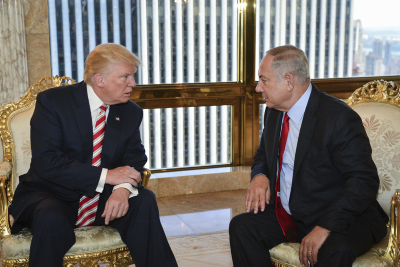
Prime Minister Benjamin Netanyahu meets with Republican Presidential candidate, Donald Trump, in New York, on September 25, 2016. Photo by Kobi Gideon/GPO *** Local Caption *** ??? ?????? ?????? ?????? ???? ?? ????? ?????????? ? ?????? ????? ?????, ????? ????? ? ??? ???? ?????

Prime Minister Benjamin Netanyahu meets with Republican Presidential candidate, Donald Trump, in New York, on September 25, 2016. Photo by Kobi Gideon/GPO

To date, there seems to be only one central pre-election commitment that the new administration appears uncharacteristically hesitant in embracing: the promise to transfer the US embassy in Israel to Jerusalem.

Of course, not all this regrettable reluctance can be blamed on the Trump administration. After all, the Israeli government itself has not been overly enthusiastic in promoting the embassy relocation.

************************

“There is a tide in the affairs of men,
Which taken at the flood, leads on to fortune.
Omitted, all the voyage of their life is bound in shallows and in miseries.
On such a full sea are we now afloat.
And we must take the current when it serves, or lose our ventures.”

— William Shakespeare, Julius Caesar, Act IV, Scene 3.

“If I am not for myself, who is for me? …And if not now, when?”

— Hillel the Elder, Ethics of the Fathers, Ch. 1:14.

In the first few days of his presidency, Donald Trump has acted with remarkable resolve to promote a number of his more strident campaign pledges, and to dismantle much of the edifice his predecessor had hoped to leave as his “legacy.”

Robust resolve

Thus, Trump moved to withdraw the US from the Trans-Pacific Partnership Agreement, which the New York Times dubbed “Obama’s signature trade achievement.”

Similarly, he instigated measures to begin rolling back “Obamacare,” the centerpiece of Obama’s domestic policy; approved the construction of two large oil pipelines (Keystone pipeline between the US and Canada, and Dakota Access Pipeline), which Obama had vetoed; cut funding of charities providing abortion services abroad, reinstating a 1984 bill that Obama had rescinded; and ordered a freeze on hiring federal government workers (apart from the military) in an “effort to reduce government debts and decrease the size of the federal workforce.

Then, later this week, Trump “signed directives to begin building a wall along [the] US border with Mexico and crack down on US cities that shield undocumented immigrants.” Likewise, he is reported to be drafting directives to be implemented “in the coming days [that] would…suspend the entry of any immigrants from Muslim-majority Middle Eastern and African countries Syria, Sudan, Somalia, Iraq, Iran, Libya and Yemen while permanent rules are studied.”

So, regardless of whether one commends or condemns these policy decisions, they certainly reflect a firm — indeed, a seemingly unswerving — commitment to his campaign pledges, no matter how controversial or contentious.

With one notable exception.

Rare reticence 

To date, there seems to be only one central pre-election commitment that the new administration appears uncharacteristically hesitant in embracing: the promise to transfer the US embassy in Israel to Jerusalem.

Readers will recall that in October 1995, the US Congress passed a law (the Jerusalem Embassy Act) with broad bi-partisan support — including from Obama’s vice president, Joe Biden and Secretary of State John Kerry — that, in effect, recognized Jerusalem as the undivided capital of Israel, under Israeli sovereignty, and explicitly called for the relocation of the US embassy to the city by May 1999. The bill, however, included a proviso permitting the president to issue a waiver holding up the relocation of the embassy should he deem it in the US national interest. The waiver is renewable every six months and since the legislation of the bill, every president — both Democrat and Republican — has exercised the waiver option. Indeed, 36 such waivers have been issued in the past — including eight by Obama — the last of which was put through in December 2016 and is due to expire in June 2017.

Accordingly, all Trump really needs to do to fulfill his pledge to relocate the US embassy to Israel’s capital is, well…nothing. Indeed, he need take no proactive measures at all. He does not need to build a wall, lay a pipeline, pass new legislation or sign a contentious executive order. All he needs to do is let the current waiver lapse, and allow the existing 1995 legislation to take effect.

Yet, for some reason, it is precisely on this issue that the new administration is displaying rare reticence in moving briskly forward to deliver on its clear commitments.

Disturbing lack of enthusiasm…from Israel

Of course, not all this regrettable reluctance can be blamed on the Trump administration. After all, the Israeli government itself has not been overly enthusiastic in promoting the embassy relocation.

Reflecting Israel’s lack of fervor in applauding Trump’s pledge was Defense Minister Avigdor Lieberman’s offhand apathy in addressing the prospect at last month’s Saban Forum in Washington. When asked by the moderator, CNN’s Jake Tapper, what he thought of Trump’s declaration that he would move the US embassy in very short order to Jerusalem, Lieberman was distinctly dismissive, indicating that he was skeptical as to the prospect: “You know, [what] we see before in every election is the same promise to remove the embassy to Jerusalem. But I think that we will wait and we will see.”

Then, virtually providing the administration with the justification to renege on its commitment, or at least significantly postpone it, Lieberman stated: “We have many other issues…we have enough challenges all around Israel. I think that it will be a mistake…to take the embassy as the focal point…We have many items on our common agenda. I think that maybe the Embassy will be one of the points.”

With such lethargic endorsement from the Israeli government, there would be little room for surprise if America’s new commander-in-chief does not push his proffered relocation vigorously forward.

Plethora of invalid arguments

A plethora of bad reasons has been advanced for not moving the US embassy to Jerusalem. Typical of such baseless arguments was the one articulated in an Haaretz op-ed, in which the writer warned: “Relocating its embassy to Jerusalem would mean the US taking a partisan stance on a central and sensitive issue, a source of controversy between Israel and the Palestinians, and between Israel and the international community.”

But of course, quite the opposite is true. By not relocating the embassy even to the western portion of Jerusalem, the US is, in fact, taking a partisan stance against Israel. For, in effect, this endorses the Palestinian/Arab position disputing Israeli sovereignty over any part of the city, including the portion that was under Israeli control prior to the Six-Day War. After all, if the US does not dispute Israeli sovereignty of the city within the pre-1967 lines, surely there should be no reason to refrain from establishing the embassy there. Or am I missing something here?

After all, the western portion of Jerusalem is, undisputedly, the functioning capital of Israel. There sit the national parliament, the prime minister’s office, all the government ministries (apart from agriculture) and the Supreme Court. Any capitulation to the notion that the Palestinians have a legitimate claim to any part of it would immediately torpedo the chances of an agreement. Accordingly, abstaining from relocating the embassy to western Jerusalem implicitly sustains grounds for such a claim and, in effect, constitutes a partisan pro-Palestinian stance.

By contrast, relocating the embassy would send a strong, even-handed message that the US will not tolerate exorbitant and unreasonable Palestinian territorial demands.

Invalid arguments (continued) 

But, perhaps the most common argument advanced for not relocating the embassy is because the Arabs and Muslims will get really mad. The threat of uncontrollable rage due to grievous insult (which would not provoke any other segment of humanity to similar conduct) has frequently been raised as reason to avoid offending Muslim sensibilities. It has already almost completely curtailed free speech in much of Western Europe and Scandinavia, where Muslim thugs are free to ravage the domestic population in the name of moral relativism and cultural diversity.

Clearly, giving into Arab/Muslim extortion because of threats of violence is a slippery slope. Once you capitulate on one issue, there is little reason not to capitulate on another.

Indeed, if the menace of Muslim mayhem can coerce nations to forgo free choice, what is to prevent further far-reaching demands, such as universal application of Shariah law, the discrimination against females and the persecution of gays?

The threat of violence is no reason to refrain from establishing the US embassy in Israel’s capital, but rather the reason to do so — and it will convey to the Arab/Muslim world that brandishing “uncontrollable rage” is an unacceptable and counter-productive mode of conducting international relations.

Respite not redemption 

The election of Trump was a huge stroke of good fortune for Israel. Just how dire its position might have been had Hillary Clinton been elected to continue the Obama legacy was vividly conveyed by two recent incidents.

The first: a surreptitious transfer of almost a quarter billion dollars to the Palestinian Authority by the outgoing president in the final hours of his incumbency, in defiance of a congressional hold on the funds.

The second: a jarring disclosure made last week by former director-general of Israel’s ministry of foreign affairs, Ambassador Dore Gold, of an astonishing admission by Obama’s National Security Adviser Susan Rice, that “even if Israel and the Palestinians reach an agreement, it is possible that the United States would oppose it” – because it might not do justice to the Palestinians.

These disturbing revelations starkly expose the blatant pro-Palestinian proclivities of the outgoing Obama administration and of the expected Clinton administration as the designated surrogate-successor.

Israel can be excused for feeling a huge sense of relief at the outcome of the November elections. However, a word of caution is necessary. For all the potential advantages involved in the Trump victory, it is — for the moment — merely a respite and still far from redemption. To attain that, there is yet much work ahead.

Catalyst or constraint?

There can be little doubt that the Trump victory harbors the potential for great opportunity for Israel. Not only is the incoming administration free from innate malice and anti-Israel bias that characterized the manifestly Islamophilic propensities of the previous one, but many in Trump’s inner circle are unabashedly pro-Zionist, and together with the wider Republican Party, unshackled to the failed “two-state solution.”

At last, after almost a quarter century, Israel has a real chance of being able to free itself of the deadly, debilitating tentacles of this pernicious paradigm — and to choose a new path that will allow it to extricate itself from the perilous cul-de-sac into which it had been led and allowed itself to be led.

The question now is whether the Israeli political class can rise to the occasion, and grasp the opportunity that destiny has provided. Will the nation’s leaders display the intellectual daring and the ideological resolve for which the hour calls? Will they be able to cast off the prevailing constraints of political correctness and forge new and sustainable paradigms for the conduct of the nation’s affairs, taking advantage of the new benign winds in Washington? Or will they, as it seems, remain captive to old molds of thought — and thus prove to be a constraint, rather than a catalyst, impeding rather than inducing the chances that the Trump administration may well afford them if they were to strike out in a bold new direction?

“There is a tide in the affairs of men…”

More than ever before, Israel’s destiny is in its own hands. The outcome of the US elections has given it a real chance to shape its destiny. The crucial question now is whether it will seize the moment or let it slip away.

Almost six months before the Trump inauguration, shortly after the Republicans had removed their endorsement of a two-state model in its party platform, I published a column entitled “What if the GOP wins?”. I called on the Israeli “Right” to prepare for the possibility of a Republican victory and formulate a credible alternative to the discredited two-state prescription.

However, I cautioned that haste to discard this failed two-state formula should not lead to the proposal/promotion of alternatives that are no less inimical than the ideas they were designed to replace.

I urged that, to reap the potential benefits of the Trump phenomenon:

Israel must prepare. It must formulate a cogent, comprehensive paradigm to replace the two-state folly, which addresses both its geographic and demographic imperatives for survival — lest it promote a proposal that threatens to make it untenable geographically or demographically — or both.

It must be a proposal that ensures that Israel retains its vital geo-strategic assets in Judea-Samaria and at the same time drastically reduces the presence of the hostile Arab population resident there — preferably by non-coercive means such as economic inducements…which, of course, is what brought the bulk of the Arab population here in the first place.

This is now becoming an urgent imperative, lest we miss the flood tide and find ourselves “bound in shallows and in miseries” that a lapse will inevitably entail.
Trump Will Keep Vow on Jerusalem Embassy Move, Giuliani Says

January 27, 2017

Trump Will Keep Vow on Jerusalem Embassy Move, Giuliani Says, Bloomberg, Michael Arnold and Jonathan Ferziger, January 26, 2017

(President Trump is not doing everything first. How odd. He must be very lazy. — DM)

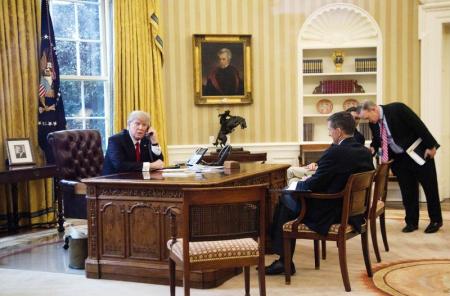
trumpsalutesPresident Donald Trump salutes as he exits Marine One at the White House, Jan. 26. Photographer: Drew Angerer/Getty Images

President Donald Trump will keep his pledge to move the U.S. embassy in Israel to Jerusalem, former New York City Mayor Rudolph Giuliani said, despite Palestinian warnings that such a step would spark violence and sabotage the prospect of renewed peace talks.

Traveling to Israel with messages from Trump to Prime Minister Benjamin Netanyahu, Giuliani said the new U.S. president and his advisers will probably take “six months or so” to develop a new strategy for American peace efforts in the Middle East. How and when the U.S. moves the embassy will be discussed when Netanyahu visits the White House in early February, Giuliani said.

“I think you’ve got to wait a little bit, but it will get done,” Giuliani said of the embassy move, speaking in an interview at the Tel Aviv offices of Greenberg Traurig LLP. He heads the law firm’s global Cybersecurity, Privacy and Crisis Management practice.

The fate of Jerusalem is among the most sensitive issues Israelis and Palestinians will need to address in any future peace negotiations. Israel took the eastern part of Jerusalem from Jordan in the 1967 Middle East War and considers all of the city as its capital, while the Palestinians want the eastern portion as the capital of their hoped-for state.

Trump realizes the embassy decision “implicates four or five countries and how they’re going to react,” Giuliani said. “He needs to know how the prime minister of Israel is going to react and how he wants to see something like this done.”

Warm Relationship

Trump on Thursday told Fox News it was too early for him to speak publicly on the issue. Giuliani, who was known during his tenure for a hard-line attitude toward even petty crime in New York City, dismissed Palestinian warnings that moving the embassy would ignite the whole region.

“I think this country is capable of dealing with waves of violence,” the former mayor said.

Giuliani predicted Netanyahu and Trump would have a “very, very good, collaborative relationship,” as opposed to what he described as the “hostile relationship” between President Barack Obama and the Israeli leader.

The changed atmosphere was already evident in the first week of Trump’s tenure. While construction plans beyond Israel’s 1967 border were a recurring source of friction with the Obama administration, Trump was silent this week as Israeli officials approved plans for 2,500 housing units in the West Bank and hundreds of apartments in eastern Jerusalem.

Hanan Ashrawi, a member of the Palestine Liberation Organization’s Executive Committee, called the building plans a “flagrant violation of international law” and accused Israel of “exploiting the inauguration of the new American administration to escalate its violations and the prevention of any existence of a Palestinian state.”

Cybersecurity

Trump considered Giuliani for attorney general and secretary of state before ultimately naming him to head a committee on cybersecurity. Giuliani said he discussed cyberdefense with Netanyahu and other Israeli officials Thursday and will return in a few months for more substantive talks on the subject. Israel is among the global leadersin the field.

“We realize in the United States that we have a cybersecurity defense problem,” Giuliani said. His committee is tasked with organizing private-sector experts into groups that can help address the government’s cyber priorities, he said.

Re-isolate Iran now

January 27, 2017

Re-isolate Iran now, Israel Hayom, David M. Weinberg, January 27, 2017

In fact, the U.S. and Israel should reach an accord on a basket of responses to Iranian violations and aggressions, including the placement of a military option against Iran’s nuclear program back on the table.

Trump and Netanyahu must together promulgate an approach for combating the malign influence and hegemonic ambitions of Iran.

*********************************

Prime Minister Benjamin Netanyahu has made it clear that one of the top items on his agenda for consultation with U.S. President Donald Trump in Washington next month is countering Iranian aggression. With good reason. The net result of the Joint Comprehensive Plan of Action has been to foster Iran’s rise to regional hegemon.

While the JCPOA suspended a part of Iran’s nuclear weapons program for a few years, the ayatollahs see it as providing time to advance their centrifuge capability and regional sway.

In a Hoover Institution paper published this month, Professor Russell Berman and Ambassador Charles Hill call Iran a “de facto Islamic caliphate,” and the Islamic Revolutionary Guard Corps an “Iranian expeditionary force for invading strategic Arab spaces.”

They call former President Barack Obama’s declared goal — of finding and bolstering so-called moderates in Tehran via the JCPOA — an “illusion.” Iran is not a polity of moderates and hard-liners, they write. It is a revolutionary theocracy masquerading as a legitimate state actor. So the first thing Trump must do is recognize the consistently hostile character of the regime.

Alas, Obama was obsessed from the advent of his presidency with making nice to Iran, and was willing to subordinate much of American foreign policy in service of that goal. He sent many secret letters to Supreme Leader Ayatollah Ali Khamenei that recognized the prerogatives of the Islamic republic and foreswore regime change. He cut funding to anti-regime groups and abandoned Iranian moderates during the early days of the Green Revolution in 2009, after the regime fixed an election. He effectively conceded Syria as within Iran’s sphere of influence.

In his penetrating book, “The Iran Wars: Spy Games, Bank Battles, and the Secret Deals That Reshaped the Middle East,” Wall Street Journal reporter Jay Solomon exposes the money trail that accompanied this strategic sellout to Iran. In exchange for talking, Obama gave the Iranians hundreds of millions of dollars monthly, stabilizing their economy. And in the end, Obama offered Iran a deal that legalized full-blown uranium, plutonium, and ballistic missile work on a timeline, and did not force the country to disclose its previous nuclear cheating. The deal also released roughly a hundred billion dollars to Iran; had American officials traveling to drum up business for Iran; and removed restrictions on a range of Iranian terrorists.

Along the way, the administration abandoned the powerful sanctions leverage it had over Iran. Solomon chronicles the ramp-up of severe banking sanctions on Iran that were having a disastrous impact on the Iranian economy. “Iran’s economy was at risk of disintegrating, the result of one of the most audacious campaigns in the history of statecraft. The country was months away from running short on hard currency. The budget had a $200 billion black hole. And the U.S. Treasury Department had made sure Iran had no way to recover. Iranian ships and airplanes were not welcome beyond Iran’s borders, and oil revenue was frozen in overseas accounts.”

And then, behold, Obama backed off. Administration officials all of a sudden claimed that tightening the noose on the Iranian economy would cause the sanctions policy to collapse! And Secretary of State John Kerry was sent to cut a sweet deal with Iran; a deal that squandered — and then reversed — a decade’s worth of effort to constrain Iran.

Now Trump must act to constrain Iran all over again.

Over the past year, Iran has intensified a pattern of aggression and increased its footprint across the region. Iranian advisers with Shiite militias from as far away as Afghanistan have flooded Syria, giving Tehran a military arc of influence stretching to the Mediterranean.

Khamenei says that Iran’s massive military presence (alongside Hezbollah) in Syria is a supreme security interest for the regime — a front line against Israel — and that Iran has no plans to leave.

This has grave implications for Israel. Netanyahu must demand of Trump (and Putin) to include the removal of all foreign forces, especially Iran, in any future agreement regarding Syria. This will be very difficult — especially since Russia has just signed a long-term agreement to greatly enlarge its military presence in Syria, including the port in Tartus and air base in Latakia.

Iran, too, is aggressively expanding its naval presence in the Red Sea region and eastern Mediterranean. Since 2011, it has been sending warships through the Suez Canal, and has used maritime routes to send arms shipments to Hizballah and Hamas. (Israel has intercepted five of these armament ships.) And in the Strait of Hormuz, IRGC speedboats have repeatedly engaged in provocative encounters with American warships, including the conduct of surprise live rocket fire exercises in proximity to U.S. Navy vessels.

Then there is Iranian terrorism. IRGC agents have been caught planning attacks on Israeli, American, British and Saudi targets in Kenya. Over the past five years, Iranian agents were exposed while planning to attack Israeli diplomats in Azerbaijan, Cyprus, Georgia, India, Nigeria, Thailand and Turkey. Hezbollah operatives supported by Iran carried out the bus bombing of Israeli tourists at the Burgas airport.

Also: The detailing of Iranian terrorism in Arab countries such as Egypt, Jordan and Saudi Arabia could fill this entire newspaper.

Then there is Iran’s ballistic missile program. In December, U.S. Senator Ted Cruz sent a seven-page letter to three senior officials of the Obama administration, detailing his well-founded concerns that North Korea and Iran might be working together on developing nuclear missiles. (Not surprisingly, the Obama officials never answered.)

Cruz’s basic question was: Why does Iran, having promised not to make nuclear weapons, continue to pour resources into developing long-range ballistic missiles, including numerous missile tests this past year? If not for nuclear weapons, then for what?

The intrepid analyst Claudia Rosett continually has raised the suspicion that North Korea’s nuclear program is secretly doubling as a nuclear backshop for Iran. It’s very possible that the $1.7 billion in air-freighted cash that Obama granted Iran is being used to finance nuclear weapons and missile research in North Korea. It’s even possible that Iran may be bold enough to buy warheads from North Korea.

Only Washington can stop this, by re-isolating and pressuring Iran. Netanyahu should travel to Trump with a comprehensive plan to influence U.S. policy toward Iran, as well as plans for joint action against Tehran.

This should include an end to the secrecy surrounding many sections of the JCPOA. All side agreements should be disclosed relating to Iranian technology acquisitions, raw material quantities, uranium and plutonium enrichment levels, sanctions relief and financial transfers. Loopholes and exceptions made surreptitiously by Obama should be closed.

Penalties should be set firmly in place for Iran’s prohibited missile programs. (Such penalties do not exist in the JCPOA or in U.N. Security Council Resolution 2231.)

U.S. and Israeli resources should be pooled, in a renewed and formal U.S.-Israel agreement, to uncover and eliminate any undisclosed sites within Iran connected to nuclear weapons technology; to counter Iranian terror threats across the region; and to subvert any Iranian bases in Syria and Lebanon.

In fact, the U.S. and Israel should reach an accord on a basket of responses to Iranian violations and aggressions, including the placement of a military option against Iran’s nuclear program back on the table.

Trump and Netanyahu must together promulgate an approach for combating the malign influence and hegemonic ambitions of Iran.

Trump-Putin safe zones deal ousts Iran from Syria

January 26, 2017

Trump-Putin safe zones deal ousts Iran from Syria, DEBKAfile, January 26, 2017

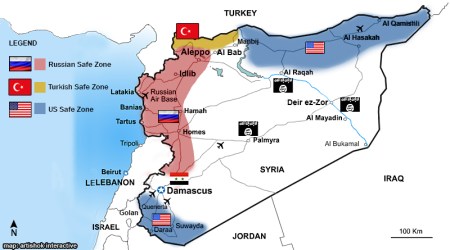
syria_safezones

Russia had originally planned to deploy Syrian military, pro-Iranian Shiite militia and Hizballah forces in battles for the capture of land around the cities of Derra and Quneitra on the Syrian side of the Golan. That plan has been dropped and will be superseded by the deployment in southern Syria of US troops accompanied by Jordanian special forces and Syrian rebels, trained by American instructors in Jordanian military camps.

Israelis will breathe a sigh of relief over the removal of the threat of Iranian and Hizballah forces being deployed along their northern border with Syria.

**************************

Syria stands on the threshold of dramatic changes that will directly impact on the strategic and military situation along the Syrian borders with Israel and Jordan, DEBKAfile reports exclusively. They derive from a deal struck this week by US President Donald Trump and Russian President Vladimir Putin to establish US, Russian and Turkish security zones in Syria. This scheme will transfer military control of the country to those three powers. Each of them will be responsible for a zone whose borders will be defined and agreed upon by Washington, Moscow  and Ankara.

As part of this arrangement, all forces from the Iranian military, the pro-Iranian Shiite militias and Hizballah will be required to leave Syria.

The US military is to have two security zones – one covering the entire area east of the Euphrates River up to the Iraqi border including Kurdish areas (see attached map). This arrangement will partly resurrect the accord reached in late 2015 by US President Barack Obama and Putin, for the division of Syria into areas of influence. All territory east of the Euphrates was allocated to the US, with Russia taking responsibility for all areas west of the river until the Mediterranean coast.

Under the new deal, the Turkish area is to stretch about 650 kilometers along the entire Syria-Turkey border and extend between 35 and 50 kilometers into Syrian territory up to Al-Bab, the town where the Turkish military is engaged in its third straight month of fighting for its capture from ISIS.

DEBKAfile’s military and intelligence sources report that the overriding change on the ground will be the establishment of a second US security zone adjacent to Syria’s borders with Israel and Jordan. It means that the approximately 7,500 US special operations forces troops currently in Jordan will be shifted northward into southern Syria.

Russia had originally planned to deploy Syrian military, pro-Iranian Shiite militia and Hizballah forces in battles for the capture of land around the cities of Derra and Quneitra on the Syrian side of the Golan. That plan has been dropped and will be superseded by the deployment in southern Syria of US troops accompanied by Jordanian special forces and Syrian rebels, trained by American instructors in Jordanian military camps.

Israelis will breathe a sigh of relief over the removal of the threat of Iranian and Hizballah forces being deployed along their northern border with Syria.

The Trump-Putin deal for Syria and its ramifications are explored in the coming issue of DEBKA Weekly (for subscribers) out Friday, with especially attention to the way it leaves Iran and Hizballah high and dry.

If you are not yet a subscriber, click here to sign on.

Trump freezes Obama’s $221,000,000 parting gift to the “Palestinians”

January 25, 2017

Trump freezes Obama’s $221,000,000 parting gift to the “Palestinians”, Jihad Watch

A whole lot of rocket launcher orders just got put on hold.

trump2

“State Department freezes Obama’s $221m gift to Palestinians,” World Israel News, January 25, 2017:

The Trump administration has frozen Obama’s parting gift to the the Palestinians.

Former US President Barack Obama, in his waning hours, quietly released $221 million to the Palestinian Authority (PA), which Congress had been blocking.

The Trump administration announced it is freezing the move.

The State Department is reviewing the last-minute decision by former Secretary of State John Kerry to send $221 million dollars to the Palestinians.

Kerry formally notified Congress that State would release the money Friday morning, just hours before President Donald Trump took the oath of office….

When asked about the transfer by a reporter during Tuesday’s press briefing, White House Press Secretary Sean Spicer said that “[Trump] is very concerned about how taxpayer money is spent, whether it’s sent overseas and what we get for it in terms of the relationship or our support for a democracy or aid to another country for their defenses. But he’s going to be examining all aspects of the budget… He’s going to make sure that every deal, every dollar that is spent by the government is done in a way that respects the American taxpayer.”