Archive for the ‘Trump and Islamic terrorism’ category

VIDEO – H.R. McMaster: Muslim Terrorist Groups Are ‘Really Un-Islamic,’ ‘Irreligious’

August 16, 2017

VIDEO – H.R. McMaster: Muslim Terrorist Groups Are ‘Really Un-Islamic,’ ‘Irreligious’, BreitbartAaron Klein, August 15, 2017

TEL AVIV – In a 2014 speech on the Middle East, embattled White House National Security Adviser H.R. McMaster claimed that Islamic terrorist organizations are “really un-Islamic” and are “really irreligious organizations” who cloak themselves in the “false legitimacy of Islam.”

McMaster’s comments represent views of Islamic terrorism that are diametrically opposed to those espoused by President Donald Trump, who has repeatedly utilized the phrase “radical Islamic terrorism.”

McMaster, who serves in a critical national security position, seems to be minimizing the central religious motivations of radical Islamic terrorist groups who are waging a religious war against Western civilization. Indeed, in his speech, McMaster urged the audience to focus on the “human factors” that he says drive conflict while downplaying any religious motivation.

McMaster was speaking at the 136th general conference and exhibition of the National Guard Association of the United States (NGAUS) in a thirty-minute speech reviewed by Breitbart Jerusalem. He addressed the wars in Iraq and Afghanistan and the fight against terrorism.

Below is a transcript of the relevant portion of McMaster’s speech [emphasis added]. (Comments begin at the 9:08 mark in the above video):

War is profoundly human. What do all of these conflicts have in common? Of course, there are a lot of differences, right? And we have to be sensitive to local differences and realities that drive conflict. But what you see is you see these really irreligious organizations. These criminal organizations, who cloak themselves in this kind of false legitimacy of Islam. But they are really un-Islamic.

They want to portray themselves as patrons and protectors of aggrieved parties. So their strategy has been to pit communities against each other. Get them to fight each other and then come in as patron and protector and gain control of a chaotic situation and then establish control through brutality, through intimidation. Use control of populations and resources to conduct more attacks, more mass murder of innocent people to drive retribution attacks like you saw maybe these Shia militias conduct this execution in the mosque in Diyala province. That is what they want. They want this kind of cycle of violence to accelerate–to get more and more destructive.

McMaster went on to describe what he believes are the motivators of conflict in the war on terrorism, failing to mention religion:

And so the drivers of conflict is what we have to remember. What is driving a conflict? Sometimes when we look at very quick and easy military solutions to problem sets, we are not thinking about what is the nature of this conflict. What is the nature of this war? What are the human factors? Really, people fight, I think, for the same reasons the Greek philosopher and historian Thucydides identified 2,500 years ago: Fear. Honor. You might say sense of honor. And interest. So understanding those human dimensions and being able to affect them is important, and we have to remember that.

The comments are not the only time McMaster has seemingly denied the Islamic motivations of America’s terrorist enemies. In February, CNN cited a source inside a National Security Council meeting quoting McMaster as saying that use of the phrase “radical Islamic terrorism” is unhelpful in working with allies to fight terrorism.

In May, McMaster spoke on ABC’s This Week about whether Trump would use the phrase “radical Islamic terrorism” in a speech that the president was about to give in Saudi Arabia. “The president will call it whatever he wants to call it,” McMaster said. “But I think it’s important that, whatever we call it, we recognize that [extremists] are not religious people. And, in fact, these enemies of all civilizations, what they want to do is to cloak their criminal behavior under this fall idea of some kind of religious war.”

In the speech, Trump eventually urged Muslim-majority countries to take the lead in “combatting radicalization,” and he referred to “Islamist extremism and the Islamist terror groups it inspires.”

Shia and Sunni Islamic terrorist groups such as al-Qaeda, Hamas, Hezbollah, Islamic Jihad, and the Islamic State each openly espouse Islamic motivations, repeatedly cite the Quran, and claim they are fighting a religious war. Some of the Sunni groups are violent offshoots of the Muslim Brotherhood, which seeks to create a global Islamic caliphate.

Osama bin Laden, the founder of al-Qaeda, infamously cited Quranic scripture and was heavily influenced by Egyptian Muslim Brotherhood leader, ideologue, and Islamic theorist Sayyid Qatb, considered the Brotherhood’s intellectual godfather. Writing in the New York Times magazine in 2003, author Paul Berman dissected the Quranic origins of Qatb’s book Milestones – utilized by bin Laden as a sort of religious guidebook – as being drawn from Qatb’s massive commentary on the Quran, titled In the Shade of the Qur’an.

Hamas’s original charter repeatedly cites the Quran and other mainstream Islamic texts. In March, Mahmoud al-Zahar, a senior Hamas leader in Gaza, claimed that “removing the Jews from the land they occupied in 1948 is an immutable principle because it appears in the Book of Allah.” Zahar was referring to the entire state of Israel.

While there are legitimate arguments about how much these terrorist groups in some cases may utilize an extremist interpretation of Islam, McMaster is clearly downplaying the transparent religious motivations of America’s terrorism enemies.

Reacting to McMaster’s statements on terrorism, Frank Gaffney, founder and president of the Center for Security Policy, told Breitbart News that he believes McMaster is endangering U.S. national security by seeming to scrub Islam as a motivating factor.

Stated Gaffney, “It is no small irony that National Security Adviser H.R. McMaster – a man who wrote a book entitled Dereliction of Duty about malfeasant political interference in the U.S. military’s conduct of a war – is now perpetrating the greatest reprise of such dereliction since Vietnam with his insistence that the wellspring for jihadist terror is not authoritative Islam and its supremacist Sharia doctrine. President Trump must treat such incompetence as a firing offense.”
Feds Spends Millions on Failed Program to Combat Extremism in America

July 28, 2017

Feds Spends Millions on Failed Program to Combat Extremism in America, Washington Free Beacon, , July 28, 2017

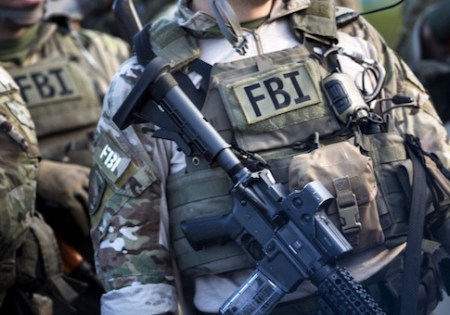
Members of a Federal Bureau of Investigation SWAT team are seen during an FBI field training exercise / Getty Images

“The time has come to definitely have a more direct approach,” said Raheel Raza, president of Muslims Facing Tomorrow, which seeks to counter extremist ideologies. “Fluff stuff and interfaith dialogue hasn’t really led to much deradicalization. There needs to be specific policies put in place that tackle the ideology.”

Raza also called on Congress to formally designate the Muslim Brotherhood as a terrorist organization due to its efforts to foment radical ideologies.

***************************************

The U.S. government has spent millions in taxpayer dollars on programs to combat violent extremism, despite the absence of evidence these programs have prevented the growth of terrorists in the United States, according to Congress, which criticized the FBI and Department of Homeland Security for enacting policy preventing its authorities from referencing “Islam” and “Islamic terrorism.”

The FBI and DHS are still providing upwards of $10 million dollars to fund a slew of community organizations committed to countering the rise of homegrown terrorism. Nevertheless there is little evidence these programs have had an impact, and in some cases, the money has been awarded to “partisan” organizations that have ties to the anti-Israel movement and radical groups such as Black Lives Matter, according to Congress.

The matter sparked a heated debate Thursday between congressional officials on the House National Security Subcommittee and senior law enforcement officials in the Trump administration.

Lawmakers accused DHS and the FBI of relying on Obama-era policies that downplay Islamic terrorism, despite clear guidance from the Trump administration that it does not support this approach.

Law enforcement anti-extremism training manuals—which were codified under an Obama-era program known as Countering Violent Extremism, or CVE—continue to ban the use of such terms as “Islamic extremism.”

While government reports have concluded that these programs are a failure, federal agencies continue to rely on them, sparking concern in Congress amid an uptick in domestic terrorism cases.

The FBI continues to have active terrorism investigations in all 50 states and at least 128 individuals have been charged in the last three years of attempting to aid ISIS.

Rep. Ron DeSantis (R., Fla.), chair of the subcommittee on national security, verbally sparred with officials from DHS and FBI, who continue to maintain that these CVE programs have been a success.

“Radical Islamic extremism is the primary driver of this problem and deserves the federal government’s immediate attention,” DeSantis said during the hearing.

“Currently, [DHS] still follows the Obama-era policies related to CVE,” DeSantis added. “The guidance developed during the Obama administration specifically limits any intelligence or law enforcement investigative activity through CVE.”

“The government manuals, they will not mention radical Islam, they don’t use anything associated with the word Islam,” he said.

“By leaving this information on the table, CVE efforts are potentially missing opportunities to identify and disrupt terrorist plots,” DeSantis said. “Obama era guidance also fails to properly identify the threat of radical Islamic ideology.”

The Obama-era guidance on the matter, which is still being used, “does not even mention radical Islamic terrorism at all,” DeSantis said.

Grants totaling some $10 million for community organizations that are part of the CVE effort are still being awarded to groups with “questionable agendas,” DeSantis said, noting instances in which grants were given to partisan organizations and those with stated anti-Israel agendas.

DHS has declined to share information on these grant recipients with Congress and also has refused multiple requests from these lawmakers for a briefing on the situation, DeSantis disclosed.

Experts who testified alongside officials from DHS and the FBI also described the CVE programs as a failure.

“The time has come to definitely have a more direct approach,” said Raheel Raza, president of Muslims Facing Tomorrow, which seeks to counter extremist ideologies. “Fluff stuff and interfaith dialogue hasn’t really led to much deradicalization. There needs to be specific policies put in place that tackle the ideology.”

Raza also called on Congress to formally designate the Muslim Brotherhood as a terrorist organization due to its efforts to foment radical ideologies.

Raza pointed to polls showing that 27 percent of Muslims support the execution of non-believers, while around 26 percent of young American Muslims believe that suicide bombing against non-Muslims can be justified.

These are the 27 Republicans Who Voted Against Studying Islamic Terror

July 16, 2017

These are the 27 Republicans Who Voted Against Studying Islamic Terror, The Point (Front Page Magazine), Daniel Greenfield, July 16, 2017

Faso, Buchanan, Paulsen, David, Comstock, Katko, Reichert, Walden, Costello, Meehan and others had previously joined another Dem push to kill another amendment to end the exploitation of the military to push Global Warming.

Those conservatives outraged that a Republican majority isn’t getting anything done ought to remember that this is what a chunk of that majority looks like.

****************************

Congressman Franks introduced an amendment to study the strategic implications of Islamic doctrines in counterterrorism.

Specifically it would have required “the Secretary of Defense to conduct strategic assessments of the use of violent or unorthodox Islamic religious doctrine to support extremist or terrorist messaging and justification.”

Like a number of other conservative amendments, it was defeated with the complicity of Republicans. Here are the Republicans who joined with Democrats to vote it down.

No   R   Amash, Justin MI 3rd
No   R   Sanford, Mark SC 1st
No   R   LoBiondo, Frank NJ 2nd
No   R   Fitzpatrick, Brian PA 8th
No   R   Young, Don AK
No   R   Hill, French AR 2nd
No   R   Buchanan, Vern FL 16th
No   R   Curbelo, Carlos FL 26th
No   R   Upton, Fred MI 6th
No   R   Trott, Dave MI 11th
No   R   Paulsen, Erik MN 3rd
No   R   Faso, John NY 19th
No   R   Katko, John NY 24th
No   R   Collins, Chris NY 27th
No   R   Turner, Michael OH 10th
No   R   Joyce, David OH 14th
No   R   Stivers, Steve OH 15th
No   R   Russell, Steve OK 5th
No   R   Walden, Greg OR 2nd
No   R   Costello, Ryan PA 6th
No   R   Meehan, Patrick PA 7th
No   R   Dent, Charles PA 15th
No   R   Comstock, Barbara VA 10th
No   R   Newhouse, Dan WA 4th
No   R   Ros-Lehtinen, Ileana FL 27th
No   R   Reichert, David WA 8th
No   R   Lewis, Jason MN 2nd

The amendment failed 217 to 208. 27 Republicans joined 190 Democrats to kill it.

Some names on the list aren’t surprising. Justin Amash’s views on terrorism aren’t news. Or surprising. He’s also about the only guy with an R after his name who flirts with Dem fantasies of impeaching Trump.

Florida was overrepresented among the Republican anti votes. As was New York. Three anti votes came from Ohio and four from Pennsylvania. Michigan’s presence here is no surprise. South Carolina’s is.

Faso, Buchanan, Paulsen, David, Comstock, Katko, Reichert, Walden, Costello, Meehan and others had previously joined another Dem push to kill another amendment to end the exploitation of the military to push Global Warming.

Those conservatives outraged that a Republican majority isn’t getting anything done ought to remember that this is what a chunk of that majority looks like.

U.S. Ambassador to Turkey Slams American Fight Against Terror During July 4th Celebration

July 10, 2017

U.S. Ambassador to Turkey Slams American Fight Against Terror During July 4th Celebration, Washington Free Beacon  July 10, 2017

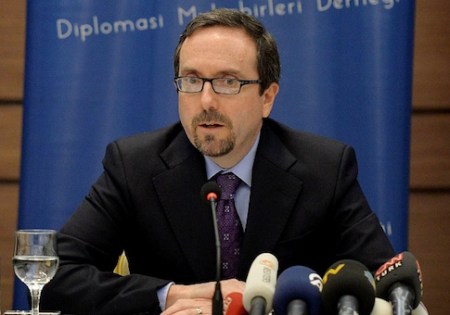
US Ambassador to Turkey John Bass delivers a statement to journalists in Ankara on April 7, 2016. / AFP / ADEM ALTAN (Photo credit should read ADEM ALTAN/AFP/Getty Images)

“If we have learned anything from last year and the violence of this year, it is that the only answer to terrorism and violence is justice and tolerance,” he said.

*****************************

U.S. Ambassador to Turkey John Bass criticized the American fight against terrorism during a July Fourth celebration hosted by the U.S. consulate in Ankara, claiming that an “overly broad” definition of terrorism has hampered U.S. efforts to combat extremists and eroded international confidence in America.

Bass, a career foreign service officer who was appointed by former President Barack Obama in 2014, urged Turkey to “avoid making the mistakes the U.S. made” in its fight against radical terrorists, telling those in attendance at an Independence Day reception “that rushing to justice or making an overly broad definition of terrorism can erode fundamental freedoms and undermine public confidence in government.”

Bass’s comments have come under scrutiny by Trump administration insiders and regional experts, who told the Washington Free Beacon that Turkey’s recent crackdown on scores of political dissidents in no way reflects America’s own battles in the region.

Insiders are viewing Bass’s criticism of U.S. policy on terrorism as a veiled rejection of President Donald Trump, who has come under fire from multiple U.S. officials who rose to prominence under Obama and are still serving in government.

For example, Dana Shell Smith, who served as the U.S. ambassador to Qatar until she resigned in June, came under scrutiny earlier this year when she signaled distain for representing the Trump administration while still serving as a U.S. official abroad.

“We support the Turkish government’s ongoing efforts to bring to justice those who were responsible for the terrible events of a year ago,” Bass said in comments recorded by the Turkish newspaper Hurriyet Daily News, referring to a recent coup attempt in Turkey that resulted in the imprisonment and detention of more than 100,000 political opponents.

“In our own experience dealing with terrorism in recent years, in the U.S., we have learned some painful lessons,” Bass said, drawing parallels between Turkey’s crackdown and U.S. efforts to fight terrorists. “Among those lessons, we have learned that rushing to justice or making an overly broad definition of terrorism can erode fundamental freedoms and undermine public confidence in government. We learned those lessons the hard way.”

“It is our hope that our friends in Turkey will avoid making some of the same mistakes that we have made,” Bass was quoted as saying.

Bass’s public criticism of the U.S. fight against terrorism has raised eyebrows among Trump administration insiders and foreign policy experts, who noted a recent trend in which senior State Department stalwarts, many of whom served under Obama, have been willing to criticize U.S. policy and the Trump administration both on record and anonymously in the press.

Michael Rubin, a former Pentagon adviser and Middle East expert, chided Bass for comparing the U.S. fight against terrorism to Turkey’s recent coup attempt, in which thousands were jailed for taking up arms against Turkish President Recep Tayyip Erdogan.

“Let me get this straight: a democratic debate about the Patriot Act is the moral equivalent of jailing tens of thousands of people, and firing a hundred thousand more?” Rubin asked. “At the very least, the ambassador’s remarks reflect a culture problem within the State Department where criticizing U.S. policy is a virtue rather than a liability. Such moral equivalence insults all those in prison without evidence or real charges and hemorrhages both credibility and leverage.”

Bass also maintained in his remarks that the only way to combat terrorism is to promote “justice and tolerance.”

“If we have learned anything from last year and the violence of this year, it is that the only answer to terrorism and violence is justice and tolerance,” he said.

Sources close to the Trump administration’s foreign policy team told the Free Beacon that Bass’s remarks reflect an attitude of opposition to Trump among senior U.S. foreign service officers who served under Obama.

“Like many other officials who rose to prominence during the Obama administration, Ambassador Bass still hasn’t adjusted to the last election and what it means,” said one veteran Middle East analyst who works with the White House on these regional issues.

“We haven’t been too tough on terrorism,” the source said. “President Trump was elected in part because he was clear that, if anything, we’ve been way too weak. In any case July Fourth is an occasion for emphasizing America as the world’s beacon of freedom, not apologizing for real and imagined faults.”

State Department spokesmen did not respond to a Free Beacon request for comment on Bass’s remarks by press time.

Judicial Watch Statement on U.S. Supreme Court’s Travel Ban Decision

June 26, 2017

Judicial Watch Statement on U.S. Supreme Court’s Travel Ban Decision, June 26, 2017

(Short and sweet. — DM)

Washington, DC) – Judicial Watch President Tom Fitton issued the following statement in response to today’s decision by the U.S. Supreme Court concerning President Trump’s Executive Order that, among other anti-terrorist measures, temporarily restricts most travel from certain Middle East nations:

Today, in a historic decision, every Supreme Court justice agreed for now to reinstate practically all of President Trump’s executive order concerning travel. This is a major blow to anti-Trump activist judges on the lower courts.  And it is a big victory for our nation’s security, President Trump, and the rule of the law.  In light of today’s strong ruling, the Trump administration should consider additional steps to keep terrorists out of the United States.

Hugh Fitzgerald: No Room at the Inn for an Iftar Dinner

June 26, 2017

Hugh Fitzgerald: No Room at the Inn for an Iftar Dinner, Jihad Watch

The Washington Post has reported — drop a ready tear — that there will be no Iftar Dinner this year in the White House:

For the first time in nearly two decades, Ramadan has come and gone without the White House recognizing it with an iftar or Eid celebration, as had taken place each year under the Clinton, Bush and Obama administrations.

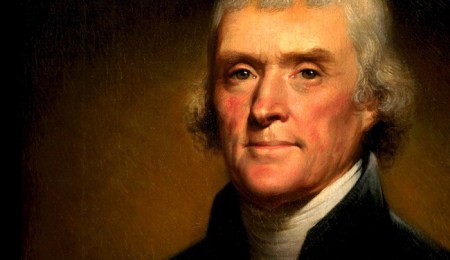
And the article by Amy Wang attempts to suggest that the “tradition” of the Iftar Dinner goes all the way back to Thomas Jefferson who, as is well known, was asked by a visiting Muslim envoy of the Bey of Tunis, one Sidi Soliman Mellimelli,  to postpone the dinner to which Jefferson had invited him, along with others, until after sundown, which Jefferson, as a matter of courtesy, did.

The Post continues:

Jefferson’s decision to change the time of the meal to accommodate Mellimelli’s [the envoy from the Bey of Tunis] observance of Ramadan has been seized on by both sides in the 21st-century debate over Islam more than 200 years later. Historians have cited the meal as the first time an iftar took place in the White House — and it has been referenced in recent White House celebrations of Ramadan as an embodiment of the Founding Father’s respect for religious freedom. Meanwhile, critics on the far right have taken issue with the characterization of Jefferson’s Dec. 9, 1805, dinner as an iftar.

Notice how in the Post article it is “historians” (disinterested, authoritative, not to be doubted) who cite that 1805 meal as the first Iftar dinner in the White House,  while those who deny that the meal was an “Iftar dinner” are described as being on the “far right,” apparently for no other reason than that very denial.

What actually happened is clear for those without an insensate need to make Islam, as Barack Obama has repeatedly  claimed it was, “always part of America’s story.” And you can be as left-wing as all get out, and still recognize that Jefferson was not putting on an Iftar dinner. A little history will help:  Mellimelli came to Washington as the envoy of the Bey of Tunis. The Americans had blockaded the port of Tunis, in order to force the Bey to halt his attacks on American shipping. Mellimelli was sent to make an agreement that would end the blockade. Invited by Jefferson to a dinner at the White House set for 3:30 (dinners were earlier in those pre-Edison days of our existence), he requested that it be held after sundown, in accordance with his Muslim practice, and Jefferson, a courteous man, obliged him. There is no hint that the dinner had changed in any way; no one then called it, or thought of it, as an “Iftar dinner.” Mellimelli himself did not describe it as an “Iftar dinner.” There is no record of it being anything other than the exact same dinner, the same menu, with wine (no removal of alcohol as would be necessary were it a real Iftar dinner), the only change being that of the three-hour delay until sunset. Nothing Jefferson said or did at the time, or in his later writings,  indicates that he thought of that delayed dinner as an “Iftar dinner”; nor did he think he was in any way honoring Islam.

In fact, Jefferson had a very dim view of Islam, which came out of his experience in dealing with the Barbary Pirates, that is, the North African Muslims (in Morocco, Algiers, Tunis, and Tripoli), who attacked Christian shipping and seized ships and Christian sailors, and then demanded ransom. The sums were not trivial; the American Republic found itself spending 20% of its national budget on such payments. These continued until Jefferson became President, stopped the practice of paying such tribute, and instead made war on the Barbary Pirates. And that worked.

In 1786, years before he became president, Jefferson, along with John Adams, met with the Tripolitanian envoy Sidi Haji Abdrahaman in London.  Perhaps by then Jefferson had read the Qur’an he had purchased in 1765 out of curiosity (no one knows how much of that Qur’an Jefferson  may have read, or when, though some Muslim apologists have baselessly claimed he must have bought his Qur’an out of sympathetic interest in Islam.) If he did read it,  it would have helped him to understand the motivations of the North African Muslims. Certainly by the time he became President in 1801, he was determined not to negotiate with the Barbary Pirates, but to implacably oppose with force these Muslims whom, he knew from his encounter with Abdrahaman in London, were permanently hostile to all non-Muslims.

In London, Jefferson and Adams had queried the Tripolitanian ambassador “concerning the ground of the pretensions to make war upon nations who had done them no injury” for the Americans had done nothing to deserve being attacked, and the ambassador replied, as Jefferson reported:

“It was written in their Koran, that all nations which had not acknowledged the Prophet were sinners, whom it was the right and duty of the faithful to plunder and enslave; and that every mussulman who was slain in this warfare was sure to go to paradise.”

And later, Jefferson reported to Secretary of State John Jay and to Congress at greater length, with a nearly identical quote from the ambassador:

“The ambassador answered us that [the right] was founded on the Laws of the Prophet, that it was written in their Koran, that all nations who should not have answered their authority were sinners, that it was their right and duty to make war upon them wherever they could be found, and to make slaves of all they could take as prisoners, and that every Mussulman who should be slain in battle was sure to go to Paradise.”

These reports do not sound as if they came from someone who thought well of Islam. The more dealings Jefferson had with the representatives of the Barbary states, and the more he learned from them directly of the tenets of the faith, the more he began to understand the aggressive nature of Islam, the centrality of Jihad, the inculcation of permanent hostility toward non-Muslims, and the heavenly reward for Jihadis slain in battle.

The Iftar dinner “tradition” begins not with Jefferson in 1805, and that three-hour delay in a meal that was otherwise unchanged, but with our latter-day interfaith outreach presidents — Clinton, Bush, Obama — each of whom, in his own way, has managed to ignore or misinterpret the texts and teachings of Islam.

That “tradition” of Iftar dinners in the White House is less than 20 years old, as compared with the other “tradition,” ten times as long, that is, the 200 years of Iftar-less presidencies. That short-lived “tradition”  has been ended, for now, by an administration that, for all of its self-inflicted wounds and woes in other areas, continues to exhibit a better sense of what Islam, foreign and domestic, is all about, than its predecessors, and has no desire to obliquely honor it.

The interfaith outreach farce that the Iftar Dinner at the White House embodies, honoring Islam — while, all over the world, every day brings fresh news of Muslim atrocities against non-Muslims, more than 30,000 such attacks since 9/11/2001 alone, not to mention attacks as well  against other Muslims deemed either of the wrong sect, or insufficient in the fervor of their faith — now comes to an end, if only for four years. That is certainly what Jefferson (and John Adams, and that most profound presidential student of Islam, John Quincy Adams), if not The Washington Post, would have wanted.

And since John Quincy Adams has been mentioned, why doesn’t The Washington Post take it upon itself to share with its readers what that most scholarly of our presidents wrote about Islam. It does not date. And it might prove most instructive.

Qatar’s Comeuppance

June 15, 2017

Qatar’s Comeuppance, Gatestone InstituteRuthie Blum, June 15, 2017

Ironically, pressure from this new anti-Iran Muslim bloc in the Middle East has done more to call the world’s attention to Qatar’s key role in the spread of Islamist terrorism than years of cajoling on the part of previous administrations in Washington to get Doha to live up to its signed commitments.

***********************************

Putting Doha on the Well-Deserved Defensive

Qatar’s extensive ties to terrorism and abetting of financiers to bolster it are well-documented.

Saudi Arabia, the UAE, Egypt and Bahrain issued a statement designating 59 individuals and 12 organizations as having terror ties to Qatar. According to the statement, Doha “announces fighting terrorism on one hand and finances and supports and hosts different terrorist organizations on the other hand,” and harbors “terrorist and sectarian groups that aim to destabilize the region, including the Muslim Brotherhood, Daesh [ISIS] and Al Qaeda.”

Ironically, pressure from this new anti-Iran Muslim bloc in the Middle East has done more to call the world’s attention to Qatar’s key role in the spread of Islamist terrorism than years of cajoling on the part of previous administrations in Washington to get Doha to live up to its signed commitments.

A mere two weeks after U.S. President Donald Trump delivered his first major foreign policy speech in Riyadh to delegates from dozens Muslim/Arab countries, Bahrain announced on June 5 that it was halting all flights to Qatar for being a sponsor of radical Islamist terrorists. Immediately, Saudi Arabia joined the boycott, as did the United Arab Emirates (UAE), Egypt and Yemen, all of which also shut off access to Al Jazeera, the anti-American, anti-Semitic Qatari television network established in 1996 and operating since then to foment unrest across the Middle East and bolster the terrorist organization the Muslim Brotherhood and its offshoot, Hamas.

The emir of Qatar, Sheikh Tamim bin Hamad Al Thani, and other officials in Doha fiercely denied the charge that their government has been backing terrorism, blaming a “fake news” report on the website of the state-controlled Qatar News Agency for the eruption of the Gulf crisis.

The report, which the FBI and other U.S. security agencies believe was the result of a Russian hacking attack, quoted Al Thani calling Iran an “Islamic power,” referring to Hamas as “the legitimate representative of the Palestinian people” and saying Qatar’s relations with Israel were “good.”

Although the report did turn out to be a hoax, Qatar’s extensive ties to terrorism and abetting of financiers to bolster it are well-documented. A Foundation for Defense of Democracies (FDD) study, titled “Qatar and Terror Finance: Private Funders of al-Qaeda in Syria,” shows that while Doha has pretended for more than a decade to be partnering with the United States to defeat Al Qaeda, the monarchy, in fact, has taken no action whatsoever against the Qatari financiers of the terrorist organization’s Syrian branch, the Nusra Front, which continues to plot attacks against the West. One of the reasons that this group eluded U.S. strikes operating in Syria was that it, like America, has been fighting ISIS. Another was that it changed its name to Jabhat Fateh al-Sham (JFS or the Front for the Conquest of Syria), in an effort to distance itself from Al Qaeda. This effort was led by Qatar.

According to the FDD study, the second of a three-part document written by David Andrew Weinberg:

“…[I]ntelligence officials from Qatar and other Gulf states met several times with Nusra’s leader [in 2015] to suggest that his group could receive money, arms, and supplies after stepping away from al-Qaeda.”

While the first part of the study, released in 2014, revealed “Doha’s dismal record” during the reign of Emir Hamad Al Thani (the current monarch’s father), this one

“evaluates the publicly available evidence on Qatar’s record since then, focusing primarily on individuals sanctioned by the U.S. Treasury Department in 2014 and 2015. All of these sanctions were imposed after Qatar agreed in September 2014, as part of a U.S.-led initiative called the Jeddah Communiqué, to bring terror financiers to justice.”

Weinberg concluded that Qatar has done little or nothing to comply. On the contrary, he wrote, “The funders of certain terrorist groups still enjoy legal impunity there. Nusra/JFS appears to be foremost among them.”

It is just as unlikely that a single news item was responsible for the banding together of several Arab states to impose a blockade on Qatar as it is implausible that these states, particularly Saudi Arabia — which itself has backed and spread radical Islamist ideology — are holding Qatar accountable for its ties to global jihad. Equally simplistic is the view, expressed by Trump on Twitter, that the embargo indicated the seriousness with which the above states took his call to “drive out the terrorists and extremists” from their midst.

“During my recent trip to the Middle East I stated that there can no longer be funding of Radical Ideology. Leaders pointed to Qatar — look!” Trump tweeted on June 7.

“So good to see the Saudi Arabia visit with the King and 50 countries already paying off. They said they would take a hard line on funding extremism, and all reference was pointing to Qatar. Perhaps this will be the beginning of the end to the horror of terrorism!”

This prompted pundits on both sides of the political spectrum to question whether Trump was simply being reckless in his response, or actually announcing a shift in decades of U.S. policy regarding Qatar, home of the Al Udeid Air Base southwest of Doha. Al Udeid is not only America’s largest military base in the Middle East — with some 10,000 troops, but since 2003, it has served as forward headquarters for CENTCOM (the U.S. Central Command), and has been crucial in America’s operations in Afghanistan, Iraq and Syria.

The following day, Trump was accused of backtracking, when he phoned Al Thani and offered to “help the parties resolve their differences, including through a meeting at the White House if necessary.”

Jerusalem Post columnist Caroline Glick pointed out that this was not a case of Trump reversing his position, but rather of proposing the most reasonable course of action available:

“With the Pentagon dependent on the Qatari base, and with no clear path for unseating the emir through war or coup without risking a much larger and more dangerous conflict, the only clear option is a negotiated resolution.

“Under the circumstances, the best option for the US to openly work towards is to diminish Qatar’s regional profile and financial support for Iran and its terrorist allies and proxies.”

Nevertheless, mixed messages appeared to be emerging from the Trump administration. On June 9, Secretary of State Rex Tillerson said that the blockade was hindering U.S. operations against ISIS. On the same day, Pentagon spokesman Navy Capt. Jeff Davis asserted that the isolation of Qatar so far has had no negative impact on U.S. operations in and out of Al Udeid. “All of our supplies are getting in just fine,” he told reporters. “The Defense Logistics Agency is certainly always looking at contingency plans if they’re needed, but for right now they’re OK.”

On the day that these conflicting claims began to circulate, Saudi Arabia, the UAE, Egypt and Bahrain issued a statement designating 59 individuals and 12 organizations as having terror ties to Qatar. According to the statement, Doha “announces fighting terrorism on one hand and finances and supports and hosts different terrorist organizations on the other hand,” and harbors “terrorist and sectarian groups that aim to destabilize the region, including the Muslim Brotherhood, Daesh [ISIS] and Al Qaeda.”

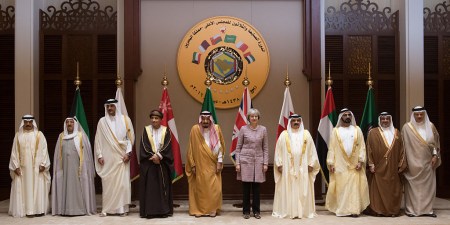
Bygone days of unity. The leaders of the Gulf states pose with British PM Theresa May at the Gulf Cooperation Council summit, on December 7, 2016 in Manama, Bahrain. (Photo by Carl Court/Getty Images)

On June 7 — the day of Trump’s phone call and two days before the release of the Saudi statement — Qatar hired of the law firm of John Ashcroft, former attorney general under President George W. Bush, to help counter terror accusations. This clearly was a calculated move, as Ashcroft had been instrumental in pushing through the post-9/11 “Uniting and Strengthening America by Providing Appropriate Tools Required to Intercept and Obstruct Terrorism Act of 2001,” more commonly known as the Patriot Act.

According to the “Scope of Engagement” of the Ashcroft retainer, its “broad purpose,” for a “flat fee” of $250,000, is to:

“provid[e] the Client with comprehensive strategic advice, legal counsel, support, and representation related to confirming, educating, assessing and reporting the Client’s efforts to combat global terrorism and its support of and compliance with international financial regulations, including compliance with United States Treasury rules and regulations.

“The firm understands the urgency of this matter and need to communicate accurate information to both a broad constituency and certain domestic agencies and leaders…will advance, advocate, represent, and protect the Client’s interests as necessary, including but not limited to the development of comprehensive legal and government affairs strategy, coordination as necessary and in the interest of the Client, assessment of the pending news and certain nations’ claims that adversely impact the Client’s reputation and pose serious risk and consequences.”

Hiring Ashcroft is not the only indication that Qatar is running scared. Another is its leaders’ simultaneous attempt to assuage fears among its populace – reported to have begun “panic-shopping” at supermarkets — and threaten fellow Gulf Cooperation Council countries that they will suffer severe financial consequences as a result of their boycott.

“If we’re going to lose a dollar, they will lose a dollar also,” warned Qatari Finance minister Ali Shareef Al Emadi. Emadi added, “Our reserves and investment funds are more than 250 percent of gross domestic product, so I don’t think there is any reason that people need to be concerned about what’s happening or any speculation on the Qatari riyal.”

In spite of Emadi’s posturing and Doha’s assertion that it is not in cahoots with Iran, Tehran announced that it has begun sending hundreds of tons of food products to Qatar. Oman, too, is transferring goods to Doha. Turkey went a step further, authorizing the dispatch of 3,000-5,000 troops to its military base in Qatar, to assist Al Thani’s regime, should it be jeopardized by the Saudi-led initiative and internal power struggles.

This unfolding of events is creating what Middle East expert Jonathan Speyer called a “clear drawing” of the “lines of confrontation between the two central power blocs in the region…”

As Speyer wrote on June 10:

“The shunting aside of little Qatar… is ultimately only a detail in the larger picture. What is more significant is the re-emergence of an overt alliance of Sunni Arab states under US leadership, following the development of military capabilities in relevant areas, and with the stated intention of challenging the Iranian regional advance and Sunni political Islam.”

Ironically, pressure from this new anti-Iran Muslim bloc in the Middle East has done more to call the world’s attention to Qatar’s key role in the spread of Islamist terrorism than years of cajoling on the part of previous administrations in Washington to get Doha to live up to its signed commitments.

Ruthie Blum is a journalist and author of “To Hell in a Handbasket: Carter, Obama and the ‘Arab Spring.'”

Egypt’s Battle Against Islamic Extremism

June 3, 2017

Egypt’s Battle Against Islamic Extremism, Gatestone InstituteShireen Qudosi, June 3, 2017

Sisi faces more than just militant and political extremists within Egypt’s borders; he is also walking a theological tightrope. Egypt is home to the regressive theocratic influence of the most revered Islamic institution in the Sunni world, Cairo’s Al-Azhar University, which openly views freedom as a “ticking time-bomb.”

Being held hostage intellectually by the grip of Al-Azhar University ensures that there is a constant supply when it comes to producing the next generation of militant and political Islamists.

President Sisi’s response to the brutal slaughter of peaceful Christian worshippers is being called rare but should not be surprising, considering the aggressive measures that need to be taken to hold extremism at bay, and to eradicate the threat that local groups pose to the Egyptian people. Coming out of the Riyadh Summit, where President Trump and a host of Muslim nations, including Egypt, agreed to drive out extremism, Sisi’s reaction was necessary.


*********************************

When it comes to regional interests in the Middle East, the priority is the most dominant and violent force.

Egypt stands out as a primary target, given the cocktail of challenges that position it as a center of radical Islam. Egypt faces political, violent, and theological militancy within its borders.

For a nation to do what it must to survive, it needs the steadfast support of world powers. Step one is annihilating all sources of violent Islam.


For a Western audience, Egyptian President Abdel Fattah al-Sisi is a complex figure, who was shunned by the Obama administration. There appear truly pressing, immediate priorities in Egypt, such as developing the economy and combating the avalanche of extremist attempts to overthrow him. Among Middle East and North African territories, Egypt stands out as a primary target, given the cocktail of challenges that position it as a center of radical Islam.

President Sisi faces violent extremist hotbeds in the Sinai Peninsula, and the still-destabilizing influence of the Muslim Brotherhood (a political arm of violent radicals). Most notably, Sisi brought a reality check to the Arab Spring when he led the military overthrow of the Muslim Brotherhood government in 2013, ushering a spiritual and cultural Islamic reformation with widespread popular support from Egyptians on a grass-roots level.

Sisi faces more than just militant and political extremists within Egypt’s borders; he is also walking a theological tightrope. Egypt is home to the regressive theocratic influence of the most revered Islamic institution in the Sunni world, Cairo’s Al-Azhar University, which openly views freedom as a “ticking time-bomb.”

Being held hostage intellectually by the grip of Al-Azhar University ensures that there is a constant supply when it comes to producing the next generation of militant and political Islamists.

Egypt also faces extremist infiltration from neighboring Libya, a nation caught in a power vacuum after the murder of its leader, Col. Muammar Gaddafi. This vacuum has been readily filled by Islamic militants, including ISIS.

Upon returning home in April from his first visit to the U.S. since 2013, Sisi faced a series of domestic terror attacks that once again put Egypt in a global spotlight. On Palm Sunday, in April, two suicide bombings in Coptic Christian churches killed more than 45 people and injured another 120. For Egypt, one of the last regional strongholds that still has a vibrant non-Muslim minority population, violent eruptions on major Christian holidays have become routine.

In England, just days after the May 22 Manchester suicide bombing, attention was once again on Egypt where 29 Coptic Christians were gunned down on a bus traveling to a monastery near the city of Minya. The attack was launched by masked terrorists who arrived in three pick-up trucks and opened fire on the passengers, many of whom were children. Egyptian intelligence believes the Minya attack was led by ISIS jihadists based in Libya. In February, the aspiring terrorist caliphate also launched a campaign against Egypt’s Christian population. The Egyptian military responded swiftly with air strikes against terrorist camps, along with a televised warning against sponsored terrorism.

President Sisi’s response to the brutal slaughter of peaceful Christian worshippers is being called rare but should not be surprising, considering the aggressive measures that need to be taken to hold extremism at bay, and to eradicate the threat that local groups pose to the Egyptian people. Coming out of the Riyadh Summit, where President Trump and a host of Muslim nations, including Egypt, agreed to drive out extremism, Sisi’s reaction was necessary.

Egyptian President Abdel Fattah al-Sisi (front row, far-right) attended the May 21 Arab Islamic American Summit in Riyadh, Saudi Arabia, along with U.S. President Donald Trump (front-center). The problems of Islamic extremism and terrorism were much-discussed at the summit. (Photo by Thaer Ghanaim/PPO via Getty Images)

In a war that is equally ideological and kinetic, Muslim nations and others trying to survive the plague of Islamic terrorism will need to be as ruthless as their extremist counterparts. That is something that the warring political factions in the U.S. quickly need to understand. When it comes to regional interests in the Middle East, the priority is combating the most dominant and violent force. If that force wins, human rights are completely off the table. Beyond Egypt, President Trump has received considerable backlash in the U.S. for siding with what are seen as repressive regimes, whether it was hosting Turkey’s President Recep Tayyip Erdoğan in the White House or engaging with dictators and monarchs during the Riyadh Summit.

In order to bring security to the region, alliances need to look at the real instigators and agents of chaos. There is a metastasizing threat that requires a new coalition of the willing. For a nation to do what it must to survive, it needs the steadfast support of world powers. Step one is annihilating all sources of violent Islam.

Shireen Qudosi is the Director of Muslim Matters, with America Matters.

At G7, Trump Diverts Agenda Away from Climate and Toward Islamist Terrorism

May 26, 2017

At G7, Trump Diverts Agenda Away from Climate and Toward Islamist Terrorism, Breitbart, Thomas D. Williams, Ph.D., May 26, 2017

(Possible WaPo headline: Trump promotes terror to dodge climate change. — DM)

TAORMINA, Italy – At President Trump’s first major meeting with international leaders, his world influence has become evident as conversations shifted from the bogeyman of climate change to the real and present danger of Islamist terrorism.

Prior to the G7 summit of the leaders of the world’s wealthiest and most advanced nations, “climate change” constantly appeared on the list of priorities highlighted by the heads of state especially of European nations.

As one headline read, “Trump talks terrorism while Europe shouts ‘Climate!’” In this shouting match, however, the U.S. President has definitely gotten the upper hand.

Reality has imposed itself, as a major jihadist attack last Monday in Manchester, England, claimed the lives of 22 persons and gunmen massacred some 26 Coptic Christians Friday morning south of Cairo Egypt. The latter attack coincided with the first day of Ramadan, the holiest season in the Islamic calendar.

While the phantasm of global warming hovers over the misty horizon, the reality of repeated slaughters of innocent men, women and children by terrorists inspired by Islamist ideology is an elephant that insists on being recognized.

European leaders have also found themselves asked repeatedly to respond to President Trump’s powerful speech against Islamist terrorism before 55 world leaders from Arab and other Muslim-majority nations in Riyadh earlier this week.

In that speech, Trump called for unity in pursuing “the one goal that transcends every other consideration. That goal is to meet history’s great test—to conquer extremism and vanquish the forces of terrorism.”

In this unique and preeminent task, Trump said, “Muslim-majority countries must take the lead in combatting radicalization.”

“Every time a terrorist murders an innocent person, and falsely invokes the name of God, it should be an insult to every person of faith,” Mr. Trump said. “Terrorists do not worship God, they worship death.”

Asked for a reaction to that speech, the chairman of the European Union’s Council said he agrees with President Trump that the international community should be “tough, even brutal” on terrorism and the Islamic State.

EU Council President Donald Tusk said that he “totally agreed with him when he said the international community, the G7, the United States, Europe — should be tough, even brutal, with terrorism and ISIS.”

Tusk also recognized that “this will be the most challenging G7 summit in years,” because of President Trump’s independent views that do not always mesh with the European globalist establishment.

Throughout the day’s meetings in Taormina, Sicily, President Trump seemed eminently comfortable with his role as world leader and agenda-setter, one which his fellow heads-of-state appeared ill-equipped to counter.

President Trump and Pope Francis Meet Face-to-Face

May 25, 2017

President Trump and Pope Francis Meet Face-to-Face, Front Page MagazineJoseph Klein, May 25, 2017

(Please see also, Catholics Respond to Pope Francis’ ‘One-Sided, Misleading’ Message to Donald Trump. — DM)

[I]t is the fight against climate change that remains his top concern, which is of little comfort to the survivors and families grieving over their loved ones killed or injured in the Manchester slaughter. The same is true about those who suffered from the Islamic terrorist slaughter at a Coptic Christian church in northern Egypt on Palm Sunday. ISIS has claimed responsibility for both attacks.

[I]n the spirit of moral relativism so prevalent today, Pope Francis has declared: “There are fundamentalist and violent individuals in all peoples and religions—and with intolerant generalizations they become stronger because they feed on hate and xenophobia. By confronting terror with love, we work for peace.”

********************************

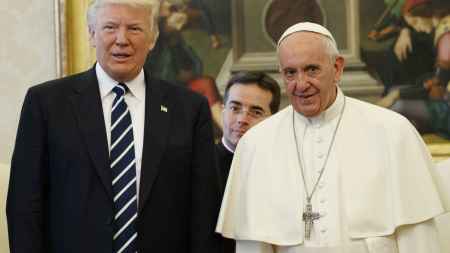
President Trump and Pope Francis held a half-hour private meeting at the Vatican on Wednesday. Despite their sharp differences on climate change, redistribution of wealth, the handling of refugees and other key global issues, the two men were at least outwardly cordial. Both clearly wanted to avoid anything that could be perceived as confrontational, which had characterized remarks each had made about the other on prior occasions.  However, Pope Francis used the occasion of the meeting to deliver a message to President Trump about the importance of remaining committed to the fight against climate change. He even decided to give the president a copy of his 2015 encyclical on saving the environment.

The meeting occurred only two days after the horrific suicide bombing in Manchester, England that claimed at least 22 lives, including an 8 year old girl, and injured many more. Yet fighting against the foremost evil of our day, Islamic terrorism, did not appear to be foremost on Pope Francis’s mind at his meeting with President Trump.   A message had been previously issued in Pope Francis’s name, stating that he was “deeply saddened” by the “barbaric attack” in Manchester and extending his condolences. However, it is the fight against climate change that remains his top concern, which is of little comfort to the survivors and families grieving over their loved ones killed or injured in the Manchester slaughter. The same is true about those who suffered from the Islamic terrorist slaughter at a Coptic Christian church in northern Egypt on Palm Sunday. ISIS has claimed responsibility for both attacks.

“With Allah’s grace and support, a soldier of the Khilafah managed to place explosive devices in the midst of the gatherings of the Crusaders in the British city of Manchester,” ISIS declared in a boastful statement. ISIS threatened more attacks to come against “the worshippers of the Cross and their allies, by Allah’s permission.” Children specifically will be targeted. A May 4th article entitled “The Ruling on the Belligerent Christians” previewed what lay ahead, declaring that the “blood” of women and children “is not protected” since they have not embraced Islam.

The Middle East and “the protection of Christian communities” did come up during the meeting between Pope Francis and President Trump, according to a statement released by the Vatican. However, they may well have been talking past each other.

When the Pope thinks of Christian communities, he tends to focus on what he considers to be the compassionate duty of Christians to reach out to the poor, including to care for the world’s many refugees and other migrants. Indeed, in February 2016, Pope Francis sharply criticized then candidate Trump for his views on immigration. “A person who only thinks about building walls, wherever they may be, and not building bridges, is not Christian,” the Pope said. On another occasion, speaking to Catholics and Lutherans in Germany last October, Pope Francis said, “It’s hypocrisy to call yourself a Christian and chase away a refugee or someone seeking help…”

Pope Francis has acknowledged the “serious harm to the Christian communities in Syria and Iraq, where many brothers and sisters are oppressed because of their faith, driven from their land, kept in prison or even killed.” However, he has failed to single out for condemnation those responsible for such suffering and their animating ideology – radical Islamic terrorists, whose hateful ideology is rooted in their literal reading of the Koran and Prophet Muhammad’s sayings and actions. Instead, in the spirit of moral relativism so prevalent today, Pope Francis has declared: “There are fundamentalist and violent individuals in all peoples and religions—and with intolerant generalizations they become stronger because they feed on hate and xenophobia. By confronting terror with love, we work for peace.”

Terrorism, according to Pope Francis, feeds on “fear, mistrust, and the despair born of poverty and frustration.” End economic inequality, the Pope believes, and voilà – love replaces hatred and terrorism gives way to peace. “This is no time for denouncing anyone or fighting,” he declared. In the Pope’s reckoning, Christian minorities will be safe if we can just all agree to get along and share the wealth.

President Trump, on the other hand, is a realist. He recognizes the clear and present danger to Christian communities, particularly in the Middle East, from genocide committed by Islamic terrorists. These terrorists are not especially motivated by poverty. Indeed, some have been very well-off, including the late Osama bin Laden. As President Trump realizes, they are motivated by their hateful supremacist radical Islamic ideology, which spurs them on to attack the “Crusaders” wherever they can be found. They seek to make their fundamentalist form of Islam the only legitimate religion in the world.  The rest of us either have to convert, pay a tax to live as a dhimmi, or die.

In a major speech on terrorism that Donald Trump delivered last August while running for the presidency, he described the atrocities committed in the name of “the hateful ideology of Radical Islam.” These atrocities included, he said: “Children slaughtered, girls sold into slavery, men and women burned alive. Crucifixions, beheadings and drownings. Ethnic minorities targeted for mass execution. Holy sites desecrated. Christians driven from their homes and hunted for extermination. ISIS rounding-up what it calls the ‘nation of the cross’ in a campaign of genocide.”

This genocide is a product of fundamentalist Islam-inspired ideology, which cannot be fought “with love,” as Pope Francis would like us to believe. Nor would the West’s “warm human welcome” and “authentic hospitality” to all refugees provide “our greatest security against hateful acts of terrorism,” as Pope Francis would also like us to believe.

Again, President Trump is a realist. His policies towards refugees, which Pope Francis evidently thinks are heartless, aim to protect Americans from jihadists seeking to enter the United States from the most terrorist-prone countries in the world. The president sought to reverse Barack Obama’s discrimination against Christian refugees – the truly persecuted victims of radical Islamic genocide in the Middle East – and was called an Islamophobe and worse for his efforts. Pope Francis should be standing up for what President Trump tried to accomplish in this regard. But he hasn’t. In fact, the Vatican expressed concern about President Trump’s first executive order suspending travel and entry of refugees from certain countries, which had included a provision providing preferential treatment for persecuted religious minorities such as Christians.

President Ronald Reagan and Pope John Paul II successfully worked together, projecting military and spiritual power respectively, to defeat the evil of their day – communism and the Soviet Union. The evil of our day is radical Islamic terrorism, not climate change. Will Pope Francis follow in the footsteps of Pope John Paul and work with President Trump to help save Christians and other civilized people from this evil source of mass slaughter? Based on his record so far, it is doubtful, but we shall have to wait and see.