Archive for the ‘Trump agenda’ category

It’s True: Liberals Hate Western Civilization

July 9, 2017

It’s True: Liberals Hate Western Civilization, Power LineJohn Hinderaker, July 8, 2017

(Stop calling them “Liberals.” They are leftists and probably proud of it. — DM)

President Trump’s superb speech in Poland has been praised by most observers, including Paul. On the Left, however, Trump’s speech has been criticized for its principal virtue, the president’s spirited defense of Western civilization. Here are some of the many such instances.

Amanda Marcotte writes at Salon: “Trump’s alt-right Poland speech: Time to call his white nationalist rhetoric what it is.”

Trump argued that Western (read: white) nations are “the fastest and the greatest community” and the “world has never known anything like our community of nations.” He crowed about how Westerners (read: white people) “write symphonies,” “pursue innovation” and “always seek to explore and discover brand-new frontiers,” as if these were unique qualities to white-dominated nations, instead of universal truths of the human race across all cultures.

Why, exactly, should we “read white people”? Trump said not a word about race in his speech. While the peoples that developed Western culture were of course predominantly white, Western civilization is not limited to one race. Just ask, say, Thomas Sowell or Yo-Yo Ma. The obsession with race is the Left’s, not Trump’s.

He also portrayed this Western civilization as under assault from forces “from the South or the East” that “threaten over time to undermine these values and to erase the bonds of culture, faith and tradition that make us who we are.”
***
And yet, even though Trump was fairly begging to be labeled a fascist with his speech painting the purity of white civilization as under threat from racialized foreigners….

But wait! Doesn’t the threat from the East come from Russia? And aren’t Russians white? On the Left, facts are always secondary, at best, to the Narrative. Finally, this howler:

Breitbart gushed about how Trump was calling for “protecting our borders” and “preserving Western civilization,” and bizarrely compared the speech to Ronald Reagan’s “tear down this wall” speech, even though the Berlin Wall is the gold standard in the kind of border security and cultural “preservation” that Trump has made his political career calling for.

Great point, Amanda! Just like Trump’s wall on the southern border, the East Germans built the Berlin Wall to keep out the throngs of West Berliners that were trying to get in illegally.

Next, Sarah Wildman at Vox: “Trump’s speech in Poland sounded like an alt-right manifesto.”

In his address, Trump cast the West, including the United States and Europe, on the side of “civilization.” With an undercurrent of bellicosity, he spoke of protecting borders, casting himself as a defender not just of territory but of Western “values.” And, using the phrase he had avoided on his trip to Saudi Arabia, he insisted that in the fight against “radical Islamic terrorism,” the West “will prevail.”

Is this what is meant by “alt-right”? I am so old, I can remember when 95% of Americans would have thought that such propositions verged on the self-evident.

Common Dreams (“Breaking News & Views For the Progressive Community”): “‘Disturbing’ Undertones Detected in Trump’s Bizarre Poland Speech.”

Honing in on Trump’s repeated emphasis on “the will” and his declaration that “our civilization will triumph,” many made connections between the speech and an infamous 1935 Nazi propaganda film titled “Triumph of the Will,” which was directed by Leni Riefenstahl and based on the 1934 Nuremberg Rally.

You can’t make this stuff up.

Peter Beinart in The Atlantic:

In his speech in Poland on Thursday, Donald Trump referred 10 times to “the West” and five times to “our civilization.” His white nationalist supporters will understand exactly what he means. It’s important that other Americans do, too.
***
The West is a racial and religious term. To be considered Western, a country must be largely Christian (preferably Protestant or Catholic) and largely white.

But Israel is pretty universally regarded as Western, and Western values derive largely from Jewish history and culture.

The most shocking sentence in Trump’s speech—perhaps the most shocking sentence in any presidential speech delivered on foreign soil in my lifetime—was his claim that “The fundamental question of our time is whether the West has the will to survive.” … Trump’s sentence only makes sense as a statement of racial and religious paranoia. … A direct line connects Trump’s assault on Barack Obama’s citizenship to his speech in Poland. In Trump and Bannon’s view, America is at its core Western: meaning white and Christian (or at least Judeo-Christian). The implication is that anyone in the United States who is not white and Christian may not truly be American but rather than an imposter and a threat.

Like Trump’s daughter and son-in-law? Beinart’s rant verges on the insane.

Jonathan Capehart in the Washington Post: “Trump’s white-nationalist dog whistles in Warsaw.”

This is the same crowd that brays about the superiority of “Western civilization” and its contributions in the history of the world conveniently ignores (or perhaps is just plain ignorant about) what we’ve adopted from Muslims and the Middle East. Those symphonies Trump says “We write” (ahem) would be real lame without the influence of the Middle East and Muslims. According to Salim al-Hassani, chairman of the Foundation for Science, Technology and Civilization and editor of “1001 Inventions,” which chronicles “the enduring legacy of Muslim civilization,” told CNN years ago that the lute, musical scales and the ancestor of the violin are all part of that legacy.

Carlyn Reichel, former speechwriter for Joe Biden, in Foreign Policy: “Trump Has Reshaped Presidential Rhetoric Into an Unrecognizable Grotesque.”

Like staring into a fun-house mirror, the trappings of an American president delivering a landmark speech abroad were there — certainly there were deliberate echoes of President John F. Kennedy’s historic speech in Berlin — but it was all reshaped into an unrecognizable grotesque.

With each paragraph, strong statements about defending freedom and standing against the forces of oppression were replaced by a narrow vision of the world rooted in an even narrower ideology. For Trump, the boundaries of “civilization” only extend to those who share his definition of “God” and “family” — that is, a Judeo-Christian worldview and power structures that continue to be dominated by white men.

So you can’t celebrate or defend Western civilization without being denounced by liberals as a white nationalist, a fascist, and so on. It is good to know where they stand.

Sarsour, Jihad and Terrorism

July 7, 2017

Sarsour, Jihad and Terrorism, The Point (Front Page Magazine), Daniel Greenfield,

Linda Sarsour, the left’s favorite Muslim organizer, with a history of promoting violence against Jews and ex-Muslims, gave a Jihadist speech at ISNA.

Literally.

“I hope that we when we stand up to those who oppress our communities that Allah accepts from us that as a form of jihad. That we are struggling against tyrants and rulers not only abroad in the Middle East or in the other side of the world, but here in these United States of America where you have fascists and white supremacists and Islamophobes reigning in the White House.”

The very predictable media defense is that Sarsour was speaking of political change, not terrorism. This is the same lie that turned the Arab Spring into a killing field.

Sarsour was speaking in the typical language of the Muslim Brotherhood. Its notion of political change embraces a spectrum that includes both violent and non-violent action. It’s primary allegiance is Islamic Supremacism.

That is the familiar doctrine that Sarsour laid out. Jihad for Allah against the enemies of Islam. The tactics are shaped by the context, but the goal of Jihad never changes.

Trump’s Warsaw Speech Evoked Reagan’s Cold War Rhetoric, Not The Alt-Right’s

July 7, 2017

Trump’s Warsaw Speech Evoked Reagan’s Cold War Rhetoric, Not The Alt-Right’s, The Federalist, July 7, 2017

President Trump gave a stirring defense of western civilization on Thursday morning in Warsaw ahead of the G-20 summit in Germany. In a remarkably candid speech about the threats facing the West, Trump praised Poland for resisting communist and Nazi efforts “to demolish freedom, your faith, your laws, your history, your identity—indeed the very essence of your culture and your humanity.”

Speaking at Krasinski Square in front of the iconic Warsaw Uprising monument marking Poland’s 1944 resistance to Nazi occupation, Trump proclaimed, somewhat dramatically, “Just as Poland could not be broken, I declare today for the world to hear that the West will never, ever be broken. Our values will prevail, our people will thrive, and our civilization will triumph.”

The world hasn’t heard such language from a U.S. president since Ronald Reagan inveighed against the Soviet Union during the Cold War. But apparently it’s racist and fascist these days to talk about resisting tyranny and defending western values—or even to talk about western civilization as such. The Guardian worried about Trump’s use of the word “civilization,” noting that he used it ten times, and claiming the speech “pits western world against barbarians at the gates” and calls for “a clash of civilisations.”

Vox blurted out the headline, “Trump’s speech in Poland sounded like an alt-right manifesto,” calling it “a speech that often resorted to rhetorical conceits typically used by the European and American alt-right. It sounded, at times, not just like the populists of the present but the populists of the past.” The New Republic’s Jeet Heer tweeted that Trump’s speech, “is evidence of how alt right still has a voice in White House” and later posted a commentary saying it “redefined the West in nativist terms.”

Even The Atlantic‘s James Fallows compared Trump’s rhetoric to the Nazi propaganda film, “Triumph of the Will,” saying Trump “represents our country as just another tribe.”

JFK Also Praised Poland’s History and Culture

These reactions belie a worldview that rejects entirely the very idea of “western civilization,” and insists that appeals to Enlightenment principles and cultural cohesion are inherently racist and fascist. And there’s a reason for that. As my colleague David Harsanyi noted, “many of the same people who believe Western values are alt-right dog-whistles want you to adopt a new set of values that have nothing to do with the founding principles and everything to do with their policy preferences.”

But Trump was espousing what used to be considered a fairly standard understanding of western values. “We treasure the rule of law and protect the right to free speech and free expression,” he said. “We empower women as pillars of our society and of our success. We put faith and family, not government and bureaucracy, at the center of our lives… And above all, we value the dignity of every human life, protect the rights of every person and share the hope of every soul to live in freedom.”

Progressives today reject almost all of this—not because Trump is invoking the rhetoric of the alt-right, but because they have moved so far to the left. In fact, far from echoing the blood-and-soil language of the alt-right, Trump’s rhetoric here sounds a lot like the rhetoric deployed in speeches about Poland by Reagan or John F. Kennedy during the Cold War.

Back then, Poland was under communist control, its government a puppet of the Soviet Union and its people prisoners of a tyrannical regime. In a 1960 speech to the Polish-American Congress, then-senator Kennedy recalled his time in Poland in 1939, and Poland’s history fighting the Nazis during World War Two: “After the war, I visited the Polish cemetery in Italy. Some of you who have been there may recall that at the cemetery are written the words, ‘These Polish soldiers for your freedom and theirs have given their bodies to the soil of Italy, their hearts to Poland, and their souls to God.’”

He went on to address the oppression of Poland by the Soviet Union, saying, “we must never… recognize the Soviet domination of eastern Europe as permanent. We must never do it. Poland’s claim to independence and liberty is not based on sentiment or politics. It is rooted in history, and it is to history that we must address ourselves.”

Kennedy called not only for a defensive military buildup so that the Russians would know “that the route of military force can no longer be open to them,” but also for increasing cultural ties to Poland, saying the United States must “strive to restore the traditional identification which Poland has had with the Western European community, which goes back into history. It is tied by culture ties. Poland has always looked to the West, never to the East.” The Polish people, he said, “have not accepted the idea that their culture, their religious heritage, their traditions, can be destroyed by domination by a foreign power.”

Reagan Invoked God, Heritage, and History

Two decades later, Poland was still under communist rule, its government still a puppet of the Soviet Union, but things had begun to change. When Reagan took office in 1981, the Solidarity movement in Poland was building steam. Led by future Polish president Lech Wałęsa and supported by members of the Catholic Church and the anti-Soviet left, Solidarity organized as a free trade union in opposition to communist rule.

By the end of 1981, Poland’s authoritarian government would declare martial law in an effort to crush Solidarity. Reagan gave a speech on December 23 addressing the situation, and praised the Polish people for showing their resistance by placing lit candles in their windows. He said the exiled former Polish ambassador, Romuald Spasowski, had requested that on Christmas Eve a lighted candle burn in the White House window as a “small but certain beacon of our solidarity with the Polish people,” and urged all Americans to do the same that Christmas Eve, invoking God, heritage, and history:

Once, earlier in this century, an evil influence threatened that the lights were going out all over the world. Let the light of millions of candles in American homes give notice that the light of freedom is not going to be extinguished. We are blessed with a freedom and abundance denied to so many. Let those candles remind us that these blessings bring with them a solid obligation, an obligation to the God who guides us, an obligation to the heritage of liberty and dignity handed down to us by our forefathers and an obligation to the children of the world, whose future will be shaped by the way we live our lives today.

Six months later, in his famous Westminster speech to members of the British Parliament, Reagan cast the Soviet Union in the same stark terms that Trump today reserves for ISIS and North Korea. He warned of “totalitarian forces in the world who seek subversion and conflict around the globe to further their barbarous assault on the human spirit. What, then, is our course? Must civilization perish in a hail of fiery atoms? Must freedom wither in a quiet, deadening accommodation with totalitarian evil?”

Reagan’s answer was an emphatic “no.” He again spoke of about Poland’s role in western civilization and its cultural lineage, saying, “Poland is at the center of European civilization. It has contributed mightily to that civilization. It is doing so today by being magnificently unreconciled to oppression.”

He closed that speech with language that would surely scandalize the progressives at Vox and The New Republic, calling the contest against totalitarianism “a crusade for freedom that will engage the faith and fortitude of the next generation. For the sake of peace and justice, let us move toward a world in which all people are at last free to determine their own destiny.”

Europe’s Political Elites Are a Threat to The West

Trump’s Warsaw speech should be understood in this historical context. The president rightly sees the contest between radical Islamic terrorism and the West as a contest between totalitarianism and freedom. He also rightly sees the growing tension between the European Union and the citizenry of European nations as a contest between authoritarian bureaucracy and representative, limited government. His remarks Thursday were aimed at ISIS, but also at a European elite that doesn’t have the inclination or will to defend its borders or cultural heritage.

That’s why Trump said: “The fundamental question of our time is whether the West has the will to survive. Do we have the confidence in our values to defend them at any cost? Do we have enough respect for our citizens to protect our borders? Do we have the desire and the courage to preserve our civilization in the face of those who would subvert and destroy it?”

Trump isn’t just referring to ISIS when he alludes to those who would destroy western civilization. He’s also pointing to European political elites who undermine their own societies by cultural relativism and its resulting slavish and destructive adherence to open borders and mass migration.

Reagan and JFK understood that communism sought ultimately to destroy western civilization and replace it with something else. That’s why they often spoke of civilization and cultural heritage during the Cold War. Trump is saying something similar about the political elites who now rule Europe, and he’s not wrong. That mainstream media outlets like Vox and The Atlantic are scandalized by this is evidence not of Trump’s radicalism, but of their own.

John is a senior correspondent for The Federalist. Follow him on Twitter.

Obama, pre-July 4th, rips Trump-fueled ‘nationalism’

July 3, 2017

Obama, pre-July 4th, rips Trump-fueled ‘nationalism’, Washington TimesCheryl K. Chumley, July 3, 2017

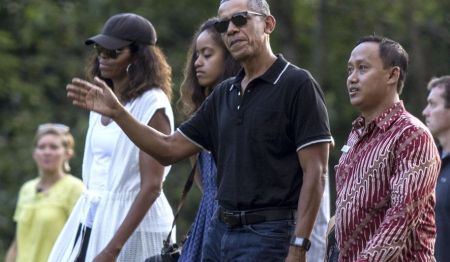
Former U.S. President Barack Obama, center, waves as he walks with his wife Michelle, left, and daughter Malia, rear, upon arrival for a tour at Borobudur Temple in Magelang, Central Java, Indonesia, Wednesday, June 28, 2017. Obama and his family

To Obama, failing to fight climate change is tantamount to racism — not to mention silly sovereign politicking.

Trump’s “Make America Great Again.” Obama’s all about the world view. Trump’s “America First,” and all the other countries, second. Obama? Reverse that. Throw in some hefty taxes and spread the wealth — and then and only then, does America make the list.

************************

Barack Obama, never one to shy from ripping a Republican in the public eye, took occasion from his childhood hometown Jakarta to tear into President Donald Trump for — at root — having too much patriotism.

Call it Fourth of July celebrations, Obama style. America waves Ol’ Glory; Obama beats the global drum.

“The world is at a crossroads,” Obama said, to the Fourth Congress of the Indonesian Diaspora, The Hill reported.

 The overall theme of his message?

Countries ought not pursue sovereign national interests at the risk of the rest of the world. He was speaking largely of the Paris climate accord, and the need for global powers to embrace it.

But he was focused on those who stood opposed to joining it.

Hmm, wonder of whom he spoke? Could it be Trump, who’s flatly refused to jump on the Paris accord train?

To Obama, failing to fight climate change is tantamount to racism — not to mention silly sovereign politicking.

“We start seeing a rise in sectarian politics, we start seeing a rise in an aggressive kind of nationalism, we start seeing both in developed and developing countries an increased resentment about minority groups and the bad treatment of people who don’t look like us or practice the same faith as us,” he said, The Hill reported.

Of course, Obama didn’t use Trump’s name.

But just in case you missed the subtle hint, Obama also noted “the temporary absence of American leadership” on combating climate change.

The change in leadership style, post-Obama, present Trump, couldn’t be more different. Trump’s “Make America Great Again.” Obama’s all about the world view. Trump’s “America First,” and all the other countries, second. Obama? Reverse that. Throw in some hefty taxes and spread the wealth — and then and only then, does America make the list.

Thankfully, it’s Trump who won last November — not the Obama-light candidate of Hillary Clinton. That alone, heading into July Fourth celebrations, is fireworks worthy. Patriotic Americans have at least four years of being considered important, in the eyes of the White House — not just tools to advance a global agenda.

Congressman Warns of Terrorist Attacks If Trump Signs Sanctuary City Bill

June 30, 2017

Congressman Warns of Terrorist Attacks If Trump Signs Sanctuary City Bill, PJ MediaNicholas Ballasy, June 29, 2017

Homeland Security Secretary John Kelly speaks at House Speaker Paul Ryan’s (R-Wis.) weekly news conference in the Capitol on June 29, 2017. (Bill Clark/CQ Roll Call via AP Images)

WASHINGTON – Rep. Adriano Espaillat (D-N.Y.) warned that the sanctuary city bill passed in the House of Representatives could cause a terrorist attack to occur in New York City.

Espaillat joined other members of the Congressional Hispanic Caucus (CHC) to express opposition to the “No Sanctuary for Criminals Act” (H.R. 3003), which would crack down on localities that do not fully cooperate with Immigration and Customs Enforcement (ICE), and “Kate’s Law” (H.R. 3004), which would penalize migrants who attempt to re-enter the U.S. illegally after being deported with up to 20 years in prison. Both bills passed the House today.

According to the White House, H.R. 3003 would “restrict” the “eligibility to receive certain Department of Justice or Department of Homeland Security grants” for cities and states “determined to be in violation of federal law.”

Espaillat predicted that H.R. 3003 would have a “chilling effect” in local communities if it became law.

“People will go into hiding. People will not come forward to report crimes, and if we begin to deny funding to cities across the United States, a city like New York, who experienced 9/11, which has been the safest biggest city in the country since 9/11 because of the federal funding that we got to combat terrorism, providing for training, equipment, overtime pay for law enforcement, we will be allowing terrorists to come in and attack us again,” Espaillat said at a press conference today on Capitol Hill.

“So this is a travesty. This is a lie. We’ve been hijacked and bamboozled by Donald Trump and we should all stand up against this,” he added.

Espaillat described sanctuary cities as places that allow families to stay together regardless of immigration status without “fear” rather than places that harbor illegal immigrants with criminal records.

“It is a safety net for people that are part of our family – they take care of our children, they wash our dishes, they take care of our elderly, they pick our crops,” he said.

Espaillat argued that both bills are an example of the GOP “misguiding” the nation.

“I’m not saying all of his followers are racist, but all of the racists in the country follow him and they have peddled this erroneous vision that immigrants are criminals,” he said. “We all oppose any violent criminals not being arrested. We want them to be arrested and do their time in jail and go back to wherever they came from.”

Rep. Nanette Barragán (D-Calif.) echoed Espaillat’s comments, arguing that H.R. 3003 would put Americans in danger by stripping federal funding from sanctuary cities like Los Angeles.

“You’re talking about taking away funding from cities that rely on these funds to protect our country from terrorism, and you think about incidents like 9/11,” she said.

“These big cities, like mine in Los Angeles, and New York are targets. Imagine taking away their funding because they don’t want to become immigration officers and what that does – that puts us in a lot more harm than what we are looking at,” she added.

Rep. Luis Gutierrez (D-Ill.) argued that “Kate’s Law” would have done “absolutely nothing” to prevent the death of Kate Steinle; the man accused of shooting her, who is still awaiting trial, was living illegally in San Francisco after multiple previous deportations. A few months before the shooting, the San Francisco Police Department had released her suspected killer, Juan Francisco Lopez-Sanchez, despite a request from ICE to keep him in custody for re-entering the country illegally.

Gutierrez said he opposes “Kate’s Law” because it would punish migrants who try to cross the border illegally to reunite with family members.

“Hundreds of thousands of moms and dads have been deported and separated from their American citizen children, and now when they come back to their American citizen children and come back after being deported, guess what this bill does? It says send them to jail for 20 years for trying to come back and raise their children,” he said.

Gutierrez also said he advised an 11-year-old student not to open the front door of his family’s home if an ICE officer knocks.

“Last Monday, I was at Nixon Elementary School. This little boy, a fifth-grader, 11 years old, asked, he said, ‘Congressman, if immigration knocks on my door, do I have to open the door because my Dad doesn’t have papers?’ I told him, ‘no, you don’t have to open up the door unless he has a warrant.’ And then I got into a conversation with 11-year-old fifth-graders about what constitutes a warrant – that’s where we’re at in America,” he said at the Hispanic Caucus press conference.

“And what do they want to do today? They want to make sure that my Chicago police, the L.A. police, every police and every jurisdiction that says we don’t want to be immigration agents and we don’t want to be knocking on those doors of fifth-graders across this country to take away their moms and dads and make them into enforcement agents, and it’s wrong,” he added.

Rep. Joaquin Castro (R-Texas) said both bills are “anti-immigrant” measures. He speculated that Republicans are pushing the legislation through Congress to distract from the healthcare and tax reform debates.

“They’ve failed to do healthcare. They’ve failed to do tax reform,” he said.

House passes Kate’s Law, as part of illegal immigrant crackdown

June 29, 2017

House passes Kate’s Law, as part of illegal immigrant crackdown, Fox News, June 29, 2017

(What’s the problem in the Senate? — DM)

While gaining support in the Senate for similar legislation will be a tough road, Trump called for Congress to act quickly.

***************************

House Republicans took action Thursday to crack down on illegal immigrants and the cities that shelter them.

One bill passed by the House would deny federal grants to sanctuary cities and another, Kate’s Law, would increase the penalties for deported aliens who try to return to the United States.

Kate’s Law, which would increase the penalties for deported aliens who try to return to the United States and caught, passed with a vote of 257 to 157, with one Republican voting no and 24 Democrats voting yes.

Kate’s Law is named for Kate Steinle, a San Francisco woman killed by an illegal immigrant who was in the U.S. despite multiple deportations. The two-year anniversary of her death is on Saturday.

“He should not have been here, and she should not have died,” House Speaker Paul Ryan said Thursday, in a final push for Kate’s Law, an earlier version of which was blocked in the Senate last year.

“Our job here is to make sure that those professionals have the tools that they need and the resources that they need to carry out their work and to protect our communities. That is what these measures are all about,” added Ryan.

The other bill, which would deny federal grants to sanctuary cities, passed with a vote of 228-195 with 3 Democrats voting yes and 7 Republicans voting no.

The brutal murder of Steinle catapulted the issue of illegal criminal aliens into the national spotlight. Alleged shooter Juan Francisco Lopez-Sanchez had been deported five times and had seven felony convictions.

On Wednesday, President Trump highlighted other cases during a White House meeting with more than a dozen families of people who had been victimized by illegal immigrants, including Jamiel Shaw Sr.

Shaw’s 17-year-old son Jamiel was shot and killed by an illegal immigrant in California in March 2008..

“He was living the dream,” Shaw said during the meeting. “That was squashed out.”

The second measure, “No Sanctuary for Criminals Act,” would cut federal grants to states and “sanctuary cities” that refuse to cooperate with law enforcement carrying out immigration enforcement activities.

“The word ‘sanctuary’ calls to mind someplace safe, but too often for families and victims affected by illegal immigrant crime, sanctuary cities are anything but safe,” Homeland Security Secretary John Kelly asserted in the pre-vote press conference.

“It is beyond my comprehension why federal state and local officials … would actively discourage or outright prevent law enforcement agencies from upholding the laws of the United States,” he added.

While gaining support in the Senate for similar legislation will be a tough road, Trump called for Congress to act quickly.

Trump called on the House and the Senate to “to honor grieving American families” by approving a “package of truly key immigration enforcement bills” so that he could sign them into law.

“I promise you, it will be done quickly.  You don’t have to wait the mandatory period. It will be very quick,” promised Trump.

Earlier on Wednesday, Immigration and Customs Enforcement Director Thomas D. Homan and U.S. Attorney for Utah John W. Huber made their case for the bills during the White House press briefing.

Huber said 40 percent of Utah’s current felony caseload involves criminal alien prosecutions and the number is increasing.

The bills, Huber asserted, would “advance the ball for law enforcement in keeping our communities safe” and “would give officers and prosecutors more tools to protect the public.

Many immigration rights groups have characterized efforts to crack down on sanctuary cities as “anti-immigrant,” but Attorney General Jeff Sessions says it is not sound policy to allow sanctuary cities to flout federal immigration laws.

According to Homan, ICE already has arrested nearly 66,000 individuals this year that were either known or suspected to be in the country illegally. Of those arrested, 48,000 were convicted criminal aliens.

“The practices of these jurisdictions are not only contrary to sound policy; they’re contrary to the law enforcement cooperation that is carried out every day in our country and is essential to public safety,” Sessions wrote in a Fox News op-ed backing the bills.

Nikki Haley’s Comments on Iran Highlight Russian-Related Complications

June 29, 2017

Nikki Haley’s Comments on Iran Highlight Russian-Related Complications, Iran News Update, Edward Carney, June 29, 2017

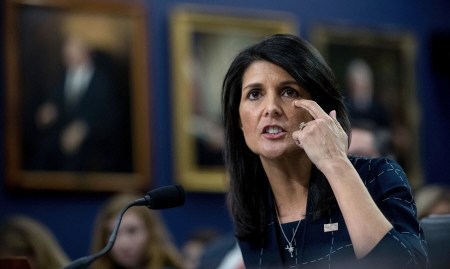
On Tuesday, Nikki Haley, the US ambassador to the United Nations delivered testimony to the House panel on foreign operations, a subcommittee of the Appropriations Committee in the US House of Representatives. In that testimony, Haley addressed multiple issues relating to the Islamic Republic of Iran, thereby reasserting the Trump administration’s assertive policies toward the Iranian regime. By most accounts those policies are still emerging, but they have already come to include purposive outreach to other adversaries of the Islamic Republic and a program of expanded sanctions on matters such as Iran’s ballistic missile program.

However, those efforts to confront and contain the Islamic Republic are arguably complicated by other aspects of the Trump administration’s policy commitments, including a focus on domestic issues and an effort to improve relations between the US and Russia, which boasts close relations with Iran in the areas of trade and military cooperation, especially as it relates to the Syrian Civil War.

While the US supports moderate rebel groups fighting against the dictatorship of Bashar al-Assad, the Iranians and Russians have been credited with turning the war in favor of Assad. Various Shiite militias are currently operating as proxies for Iran in that war, and the Iranian Revolutionary Guard Corps is increasingly playing a direct role in the conflict. Meanwhile, Russia has been providing air support for pro-Assad ground operations since 2015.

Western commentators, including officials in the Trump administration, have variously accused Russia and Iran of ignoring or actively facilitating human rights abuses by the Assad regime, including an April chemical weapons attack that killed at least 80 people in a rebel-controlled civilian area.

As the Associated Press points out, Ambassador Haley’s comments to the House panel came shortly after the White House had issued a warning to Syria regarding alleged preparations for another such chemical attack. The article specified that Pentagon officials had confirmed the intelligence underlying that warning, involving particular movements at the same Syrian air base that had been used as the staging area for the previous chemical attack on Khan Sheikhoun.

White House Press Secretary Sean Spicer said of Assad that “he and his military will pay a heavy price” if they follow through with apparent plans for another “mass murder attack using chemical weapons.” But the AP quoted Haley as saying that the administration’s remarks were not intended only for Assad, but also for Russia and Iran. Both of the Syrian allies joined in denying Assad’s responsibility for the attacks, with some officials insisting that the chemical weapons had originated in a rebel warehouse at the site of a conventional military airstrike.

The dispute over this issue and the subsequent US cruise missile strike on Shayrat air base can be seen as early examples of the escalation between Iranian allies and adversaries which is still going on to this day. In fact, Haley’s effort to fold Russia and Iran into a warning directed more explicitly against Syria is reminiscent of an incident earlier in June wherein a member of Iran’s Revolutionary Guard said that a ballistic missile strike on eastern Syria had been intended largely as a warning to the US and Saudi Arabia.

Those two traditional adversaries of the Islamic Republic have been expanding relations under the Trump administration, sometimes with explicit reference to shared anxieties over expanding Iranian influence and meddling in the broader Middle East. President Trump’s visit to Riyadh in May for an Arab-US summit coincided with the signing of trade agreements that included 110 billion dollars in arms sales to the Arab Kingdom.

But at the same time that the White House is openly siding with Saudi Arabia and its regional allies against the Iranian regime, it does not appear to be giving up on the prospect of improved relations with Russia. In fact, the Western strategy for a political solution to the Syrian Civil War seems to presently involve the expectation that Russia can be encouraged to rein in the Islamic Republic and prevent it from further sabotaging ceasefire agreements.

Recent developments have cast doubt upon the practicality of this strategy however. As the US has taken a more direct role in defending rebel groups, even resorting to the shoot-down of at least two military controlled drones and a Syrian warplane, Russia has responded by threatening to target US aircraft and to halt the use of a hotline intended to prevent mid-air collisions between the multiple powers operating in the skies over Syria.

Haley’s comments on Tuesday were indicative of a roughly matching increase in American criticism of Russia. And this criticism was not limited to the issue of chemical weapons. Haley also explained that Russia’s position on the UN Security Council allowed it to stymie US efforts to sanctions Iran and hold it to account for ongoing misbehavior in matters including the development of the Iranian nuclear program.

“[The Iranians are] going to continue their nuclear capabilities and we just gave them a lot of money to do it with,” Haley said, referring to the 2015 nuclear agreement that President Trump has described as “the worst deal ever negotiated.” She went on to highlight concerns about Iran’s sponsorship of terrorism, suggesting that nuclear weapons could find their way into the hands of terrorist groups at some point in the future, and that Russia would effectively prevent the US and its allies from doing anything to stop this.

“Yes, we would love to sanction Iran; and, yes we will continue to be loud about it; and, yes, Russia will veto it,” Haley said, according to the Washington Examiner.

But this is not to say that the Trump administration has positively brought an end to its strategy of attempting to improve relations with Russia. In fact, various reports suggest that this endeavor is even standing in the way of congressional legislation aimed at increasing national-level sanctions on both Iran and Russia. The Countering Iran’s Destabilizing Activities Act passed the Senate two weeks ago by a margin of 98 to 2, but it was subsequently stalled in the House on procedural grounds, leading Democrats to argue that the House Republican leadership was trying to protect the president’s Russian agenda.

The prospects for resolution appeared to grow dimmer on Tuesday when the Washington Post reported that energy lobbyists were urging lawmakers to reevaluate the bill on the grounds that its restrictions on doing business with Russian companies could have a punishing effect on American firms and foreign firms doing business in the US. These objections could bolster the prospects of the House leadership sending the bill to various committees for review and markup – a process that could delay a final vote by months.

As it concerns Iran, the bill would include sanctions on Iran’s ballistic missile activities and also extend all terrorism-related sanctions to the Revolutionary Guard Corps, for which Trump has urged designation as a foreign terrorist organization. This position has not changed, and it seems that neither has the Trump administration’s hardline approach to Iran policy. Some have suggested that the emerging policy is pointing in the direction of regime change, though this has not become a declared position as yet.

The Washington Examiner pointed out that one member of the House panel on foreign operations, Republican Representative Hal Rogers, had directly raised the prospect of regime change on Tuesday, asking Nikki Haley whether it is an option. The ambassador’s only response was “I don’t know.”

This coming Saturday, the National Council of Resistance of Iran will hold its annual Free Iran rally, which will include explicit calls for regime change driven by a domestic opposition movement within the Islamic Republic. The event is expected to be attended by tens of thousands of Iranian expatriates, plus hundreds of policymakers and experts from the US, Europe, and throughout the world. Notably, these dignitaries will include figures with close ties to the Trump administration, such as John Bolton, who served the second Bush administration in the position now occupied by Haley.

Trump to start implementing travel ban on Thursday

June 28, 2017

Trump to start implementing travel ban on Thursday, Washington ExaminerKelly Cohen, June 28, 2017

The Supreme Court also announced it will hear oral arguments on the case in its October term. (AP Photo/Ted S. Warren, file)

The Department of Homeland of Security will begin partially implementing President Trump’s immigration executive order on Thursday, days after the Supreme Court reversed two lower court rulings that had completely blocked implementation.

DHS spokesman David Lapan told the Washington Examiner implementation will “begin tomorrow and we’ll release additional information then.”

Lapan added that DHS will continue to “work with the Departments of State and Justice on the way forward for implementation of the executive order based on the Supreme Court’s ruling.”

The Supreme Court on Monday lifted most of the lower-court injunctions against Trump’s executive order, which will temporarily ban travel to the United States from six Muslim-majority countries for foreign nationals who lack any “bona fide relationship with any person or entity in the United States.”

The Supreme Court also announced it will hear oral arguments on the case in its October term.

With that decision, the court disregarded lower court rulings that said the order was aimed at excluding people because of their religion, and that the White House didn’t offer enough justification for the order.

Three Supreme Court justices also went further by arguing that the court should have immediately allowed the entire order to take effect.

“I agree with the court that the preliminary injunctions entered in these cases should be stayed, although I would stay them in full,” Justice Clarence Thomas wrote in a dissent that was joined by Justices Samuel Alito and Neil Gorsuch. “The decision whether to stay the injunctions is committed to our discretion … but our discretion must be ‘guided by sound legal principles’.”

Spotlight: China, U.S. reach consensus at high-level security dialogue

June 24, 2017

Spotlight: China, U.S. reach consensus at high-level security dialogue, XinhuaNet, June 24, 2017

(The words sound friendly, but what do we get at what cost? — DM)

Chinese State Councilor Yang Jiechi (1st R) co-chairs a diplomatic and security dialogue with U.S. Secretary of State Rex Tillerson (1st L) and Secretary of Defense James Mattis (2nd L) as Fang Fenghui (2nd R), a member of China’s Central Military Commission (CMC) and chief of the CMC Joint Staff Department, also participates in the dialogue in Washington D.C., the United States, on June 21, 2017. China and the United States began their first diplomatic and security dialogue on Wednesday at the U.S. State Department in Washington D.C. (Xinhua/Yin bogu)

At the dialogue, China the United States agreed to work closely on the Korean Peninsula’s nuclear issue.

Both countries reaffirmed their commitment to achieving the goal of “complete, verifiable and irreversible” denuclearization on the Peninsula.

*********************

WASHINGTON, June 23 (Xinhua) — China and the United States reached an important consensus on the development of bilateral relations and security issues at a high-level dialogue held Wednesday in the U.S. capital of Washington D.C.

The First Round of China-U.S. Diplomatic and Security Dialogue, which was described by both sides as “constructive” and “fruitful,” represents a major step in implementing the consensus reached by Chinese President Xi Jinping and his U.S. counterpart Donald Trump during their meeting in Florida in April.

Looking ahead, the two sides pledged to expand mutually-beneficial cooperation and manage differences on the basis of mutual respect, all in a bid to promote the steady development of China-U.S. relations in the long term.

FREQUENT DIALOGUES

Following Wednesday’s dialogue, U.S. Secretary of State Rex Tillerson said such talks “provide an opportunity to consider how we’re going to engage and how we’re going to live with one another over the next 40 years.

“The action items we have agreed upon today have set a foundation for additional areas of cooperation and we look forward to our next interaction at this level and between our two presidents,” said the top U.S. diplomat.

Emphasizing the importance of high-level exchanges, China and the United States expressed their willingness to achieve a positive outcome for the Hamburg meeting between the two Presidents in July and Trump’s state visit to China later this year.

Meeting with Chinese State Councilor Yang Jiechi at the White House on Thursday, Trump said he looked forward to meeting with Xi in Hamburg and visiting China. He also hoped that these high-level interactions will further promote the development of U.S.-China relations.

PRODUCTIVE MILITARY RELATIONSHIP

Fang Fenghui, a member of China’s Central Military Commission (CMC) and chief of the CMC Joint Staff Department, participated in the dialogue co-chaired by Yang, Tillerson and U.S. Secretary of Defense James Mattis.

At the dialogue, China and the United States recognized that their military-to-military relationship is an important component in the bilateral ties. The two sides agreed that the relationship between the militaries of the two powers should be “constructive, pragmatic, and effective,” according to a statement released Friday.

China and the United States are committed to implementing the annual military exchange program and enhancing high-level engagements, starting with the visits between the two defense ministers and the visit of the Chairman of the U.S. Joint Chiefs of Staff to China as soon as possible.

The two sides also “reaffirm the importance of building mutual understanding, and of reducing the risk of miscalculation between our two militaries,” said the statement.

MAINTAINING COORDINATION ON KOREAN PENINSULAR ISSUE

At the dialogue, China the United States agreed to work closely on the Korean Peninsula’s nuclear issue.

Both countries reaffirmed their commitment to achieving the goal of “complete, verifiable and irreversible” denuclearization on the Peninsula.

“The two sides are ready to continue their efforts to this end, including by fully and strictly implementing relevant United Nations Security Council resolutions, and by promoting relevant dialogue and negotiation,” said the statement.

The two countries also reaffirmed their commitment to maintaining peace and stability on the Peninsula, according to the statement.

Trump signs VA reform bill, following through on campaign promise

June 23, 2017

Trump signs VA reform bill, following through on campaign promise, Fox NewsBarnini Chakraborty, June 23, 2017

President Trump on Friday signed a bill that would protect whistleblowers while making it easier to fire employees at the Department of Veterans Affairs.

The Department of Veterans Affairs Accountability and Whistleblower Protection Act passed by Congress this week streamlines the process to remove, demote, or suspend VA employees for poor performance or misconduct. In addition, it authorizes the VA secretary to recoup any bonuses awarded to employees who have acted improperly.

Under the new law, protections for whistleblowers will be expanded and the VA will be prevented from dismissing an employee who has an open complaint against the department.

The bill helped Trump follow through on a 2016 campaign promise.

The law marks the second time Congress has tried to change the disciplinary process at the VA. In 2014, the Choice Act was passed and tried to cut senior executives’ rights to appeal discipline to the Merit Systems Protection Board. However, a court ruled that it was unconstitutional and violated the Constitution’s appointments clause.

Ahead of the signing, Concerned Veterans for America, a conservative advocacy group, hailed the legislation as a positive step forward in a “new era of accountability, customer focus, and integrity at the department.”