Archive for the ‘Trump agenda’ category

President Trump’s Executive Order Could Mean Huge Gov Downsizing

March 14, 2017

President Trump’s Executive Order Could Mean Huge Gov Downsizing, Front Page Magazine (The Point), Daniel Greenfield, March 14, 2017

[T]his could be the opening for a plan to dramatically transform and downsize the government in a common sense way. Much of this will be in the hands of the OMB director. That would be Mick Mulvaney. Mulvaney was a conservative congressman with a business background and a reputation as a fiscal hawk. Now his report may very well remake the government.

************************************

The Executive Order on a Comprehensive Plan for Reorganizing the Executive Branch is bulky title. But its potential is even bigger. Here’s why.

Section 1.  Purpose.  This order is intended to improve the efficiency, effectiveness, and accountability of the executive branch by directing the Director of the Office of Management and Budget (Director) to propose a plan to reorganize governmental functions and eliminate unnecessary agencies (as defined in section 551(1) of title 5, United States Code), components of agencies, and agency programs.

Note the agencies part.

Sec. 2.  Proposed Plan to Improve the Efficiency, Effectiveness, and Accountability of Federal Agencies, Including, as Appropriate, to Eliminate or Reorganize Unnecessary or Redundant Federal Agencies.  (a)  Within 180 days of the date of this order, the head of each agency shall submit to the Director a proposed plan to reorganize the agency, if appropriate, in order to improve the efficiency, effectiveness, and accountability of that agency.

And…

(d)  In developing the proposed plan described in subsection (c) of this section, the Director shall consider, in addition to any other relevant factors:

(i)    whether some or all of the functions of an agency, a component, or a program are appropriate for the Federal Government or would be better left to State or local governments or to the private sector through free enterprise;

(ii)   whether some or all of the functions of an agency, a component, or a program are redundant, including with those of another agency, component, or program;

(iii)  whether certain administrative capabilities necessary for operating an agency, a component, or a program are redundant with those of another agency, component, or program;

(iv)   whether the costs of continuing to operate an agency, a component, or a program are justified by the public benefits it provides; and

(v)    the costs of shutting down or merging agencies, components, or programs, including the costs of addressing the equities of affected agency staff.

In short, this could be the opening for a plan to dramatically transform and downsize the government in a common sense way. Much of this will be in the hands of the OMB director. That would be Mick Mulvaney. Mulvaney was a conservative congressman with a business background and a reputation as a fiscal hawk. Now his report may very well remake the government.


Global Warming in One Easy Lesson

March 13, 2017

Global Warming in One Easy Lesson, Power LineJohn Hinderaker, March 13, 2017

(Finally, anthropogenic global warming/climate change agnostics and atheists are being heard. It’s about time. President Trump’s new EPA head, Scott Pruitt, has apparently been attentive. Supporters of the Church of Global Warming, such as VOX, are unhappy.– DM)

Professor Lindzen recently wrote a letter to President Donald Trump explaining, briefly and cogently, why he and many other scientists are skeptical of the catastrophic anthropogenic global warming theory–which, despite tens of billions of dollars in government subsidies, has failed to generate significant empirical support.

********************

Richard Lindzen is the Alfred P. Sloan Professor of Meteorology at MIT. MIT’s web site suggests his scientific eminence:

Professor Lindzen is a dynamical meteorologist with interests in the broad topics of climate, planetary waves, monsoon meteorology, planetary atmospheres, and hydrodynamic instability. His research involves studies of the role of the tropics in mid-latitude weather and global heat transport, the moisture budget and its role in global change, the origins of ice ages, seasonal effects in atmospheric transport, stratospheric waves, and the observational determination of climate sensitivity. He has made major contributions to the development of the current theory for the Hadley Circulation, which dominates the atmospheric transport of heat and momentum from the tropics to higher latitudes, and has advanced the understanding of the role of small scale gravity waves in producing the reversal of global temperature gradients at the mesopause, and provided accepted explanations for atmospheric tides and the quasi-biennial oscillation of the tropical stratosphere. He pioneered the study of how ozone photochemistry, radiative transfer and dynamics interact with each other. He is currently studying what determines the pole to equator temperature difference, the nonlinear equilibration of baroclinic instability and the contribution of such instabilities to global heat transport. He has also been developing a new approach to air-sea interaction in the tropics, and is actively involved in parameterizing the role of cumulus convection in heating and drying the atmosphere and in generating upper level cirrus clouds. He has developed models for the Earth’s climate with specific concern for the stability of the ice caps, the sensitivity to increases in CO2, the origin of the 100,000 year cycle in glaciation, and the maintenance of regional variations in climate.

Prof. Lindzen is a recipient of the AMS’s Meisinger and Charney Awards, the AGU’s Macelwane Medal, and the Leo Huss Walin Prize. He is a member of the National Academy of Sciences, and the Norwegian Academy of Sciences and Letters, and a fellow of the American Academy of Arts and Sciences, the American Association for the Advancement of Sciences, the American Geophysical Union and the American Meteorological Society. He is a corresponding member of the NAS Committee on Human Rights, and has been a member of the NRC Board on Atmospheric Sciences and Climate and the Council of the AMS. He has also been a consultant to the Global Modeling and Simulation Group at NASA’s Goddard Space Flight Center, and a Distinguished Visiting Scientist at California Institute of Technology’s Jet Propulsion Laboratory. (Ph.D., ’64, S.M., ’61, A.B., ’60, Harvard University)

Professor Lindzen recently wrote a letter to President Donald Trump explaining, briefly and cogently, why he and many other scientists are skeptical of the catastrophic anthropogenic global warming theory–which, despite tens of billions of dollars in government subsidies, has failed to generate significant empirical support. The letter was reproduced by the Science and Environmental Policy Project. It has the virtue of being easily read and understood:

For far too long, one body of men, establishment climate scientists, has been permitted to be judges and parties on what the “risks to the Earth system associated with increasing levels of carbon dioxide” really are.

Let me explain in somewhat greater detail why we call for withdrawal from the UNFCCC [United Nations Framework Convention on Climate Change].

The UNFCCC was established twenty-five years ago, to find scientific support for dangers from increasing carbon dioxide. While this has led to generous and rapidly increased support for the field, the purported dangers remain hypothetical, model-based projections. By contrast, the benefits of increasing CO2 and modest warming are clearer than ever, and they are supported by dramatic satellite images of a greening Earth.

• The UN’s Intergovernmental Panel on Climate Change (IPCC) no longer claims a greater likelihood of significant as opposed to negligible future warming,

• It has long been acknowledged by the IPCC that climate change prior to the 1960’s could not have been due to anthropogenic greenhouse gases. Yet, pre-1960 instrumentally observed temperatures show many warming episodes, similar to the one since 1960, for example, from 1915 to 1950, and from 1850 to 1890. None of these could have been caused by an increase in atmospheric CO2,

• Model projections of warming during recent decades have greatly exceeded what has been observed,

• The modelling community has openly acknowledged that the ability of existing models to simulate past climates is due to numerous arbitrary tuning adjustments,

• Observations show no statistically valid trends in flooding or drought, and no meaningful acceleration whatsoever of pre-existing long term sea level rise (about 6 inches per century) worldwide,

• Current carbon dioxide levels, around 400 parts per million are still very small compared to the averages over geological history, when thousands of parts per million prevailed, and when life flourished on land and in the oceans.

Calls to limit carbon dioxide emissions are even less persuasive today than 25 years ago. Future research should focus on dispassionate, high-quality climate science, not on efforts to prop up an increasingly frayed narrative of “carbon pollution.” Until scientific research is unfettered from the constraints of the policy-driven UNFCCC, the research community will fail in its obligation to the public that pays the bills.

Virgil: The Beltway Assures Us the Deep State Doesn’t Exist

March 13, 2017

Virgil: The Beltway Assures Us the Deep State Doesn’t Exist, BreitbartVirgil, March 13, 2017

(Please see also, The Trouble with Barry.  — DM)

BNN Edit

In parts one and two of our guided tour of the Deep State, we looked at two anchors of the Federal Triangle in downtown DC, the Department of Commerce and the Environmental Protection Agency.  And while Virgil looks forward to continuing his tour of the Triangle and other nodes of the Deep State, sometimes breaking news breaks in, and so we should pause to consider the latest.

On March 10, from his podium at the James S. Brady Press Briefing Room at the White House, President Trump’s press secretary, Sean Spicer, was asked about the Deep State.  The question:

Does the White House believe in a “Deep State” that is actively working to undermine the president?

And here’s Spicer’s answer:

I think that there’s no question when you have eight years of one party in office, there are people who stay in government—and continue to espouse the agenda of the previous administration.  So I don’t think it should come as any surprise there are people that burrowed into government during eight years of the last administration and may have believed in that agenda and want to continue to seek it.  I don’t think that should come as a surprise.

In other words, Spicer’s answer to the answer to the question was “Yes.”  So now there can be no doubt that the concept of the Deep State will be discussed for a long time to come.  And yet if Virgil might be permitted to quibble with Spicer, he would say that the Deep State is a lot deeper than just the past eight years—we’ll come back to that point.

But first, let’s hear from other voices on the issue of whether or not there’s a Deep State.  As we can see, it’s gaining a critical mass of recognition, at least on the right.  And that’s good, because, as they say, forewarned is forearmed.

On March 5, former House speaker Newt Gingrich made himself clear—as he always does:

There is an active Deep State opposition to a populist disruptive reformer.  Many [in the government] believe it is their duty to break the law and lie.  For Trump to succeed, there will have to be profound overhaul of the bureaucracy.

A few days later, Rep. Mike Kelly (R-PA) didn’t use the actual words “Deep State,” but his point was the same when he described the situation in Powertown: “The same people were there, and they don’t think the new owners or the new managers should be running the ship.”  And then Kelly added this point about former president Barack Obama:

He’s only there for one purpose and one purpose only, and that is to run a shadow government that is totally going to upset the new agenda.

So is the 44th president setting up a permanent campaign against the 45th president?  Obama denies any such intention; he says that he and his family are remaining in Washington so that his youngest daughter, Sasha, can finish high school.  Of course, that explanation doesn’t quite tell us why former White House consigliere Valerie Jarrett has moved into the Obamas’ 8200-square-foot home in the swanky Kalorama neighborhood, just a couple miles north of the White House.

In fact, the real goal of the relocation, according to The Daily Mail, is to “oust Trump from the presidency either by forcing his resignation or through his impeachment.”

Meanwhile, others in Congress, too, are eyeing closely the shadowy armada arrayed against the new administration.  In the words of Rep. Thomas Massie (R-KY), “I think it’s really the Deep State vs. the president, the duly elected president.”

And on March 9, Fox News’ Sean Hannity, was even more direct:

Deep State Obama holdovers embedded like barnacles in the federal bureaucracy are hell-bent on destroying President Trump.  It’s time for the Trump administration to purge these saboteurs.

Interestingly, by coincidence, or perhaps not, the very next day President Trump’s Justice Department ordered the firing of 46 US Attorneys, all Obama holdovers.  

Still, some in the Main Stream Media, even now, choose to deny that there is any such thing as a Deep State.  One such is David Ignatius, veteran columnist for The Washington Post, who wrote on March 7 that what we’re seeing is simply the collision of President Trump and the properly established legal system:

Some [Trump] supporters claim he’s facing a secret coup from an intelligence and foreign policy establishment that constitutes a despotic “deep state.” But really, Trump is confronting the orderly process we call the “rule of law.”

Virgil thinks that it’s rich, indeed, for Ignatius to insist that there’s nothing going on except the proper rule of law.  Why?  Because it was Ignatius’ own reporting, back on January 12, that demonstrated the extra-legal power of the Deep State.  That was the report that revealed that on December 29, Michael Flynn, named as Trump’s national security adviser in the new administration, had been intercepted talking on the phone to the Russian ambassador to the US, Sergey Kislyak.  And from that first report, events tumbled, and as we all know, Flynn resigned from his White House post on February 13.

And yet a few days after that Ignatius story ran on January 12, Virgil wondered aloud how he got the information about a private phone call: “Now how did Ignatius know that?”  That is, how did Ignatius learn about the Flynn-Kislyak conversation?  Continuing, Virgil wrote back then, “The Postman won’t say, other than that he got his information from a ‘senior US government official.’”  Virgil then pointed out that even if was legal to record the call—yes, it’s smart to surveil Russians—it’s not legal to leak such information to the media, especially if it involves an American citizen.  “Such disclosures aren’t legal,” Virgil added with a sigh, “but once again, nobody in Washington, DC, seems to care.”

So we can see: In the Flynn case, the power of the Deep State wasn’t at all about the “rule of law.”  It was about just the opposite.

Others, too, take the Ignatius line—even if their denials are weirdly weak and self-contradicting.  Here, for example is a March 9 headline in Politico, the bible of the Beltway: “The Deep State Is a Figment of Steve Bannon’s Imagination.” The author, Loren DeJonge Schulman, starts out by firing both barrels at Bannon and anyone else who might have suspicions about the Deep State:

Here’s a handy rule for assessing the credibility of what you’re reading about national security in the Trump era: If somebody uses the term “Deep State,” you can be pretty sure they have no idea what they’re talking about.

Got that?  Nothing to see here: So if you hear Spicer, Gingrich, Kelly, Massie, Hannity—or, of course, ol’ Virgil—nattering on about the Deep State, well, have a dunce cap handy.

So who’s the author of this don’t-worry-about-a-thing piece?  We can see from her bio that Loren DeJonge Schulman, who now works at a Democratic-aligned think-tank in DC, has an extensive background in the politics of the Democratic Party and the Deep State, both.

So maybe it’s not so surprising that Schulman wouldn’t want anyone nosing around too much in Deep State matters.   After all, nobody likes being snooped on, right?   In fact, Virgil is reminded of the 1999 Brad Pitt movie, Fight Club, featuring these oft-repeated lines:

Welcome to Fight Club.  The first rule of Fight Club is: you do not talk about Fight Club.  The second rule of Fight Club is: you DO NOT talk about Fight Club!

That was Hollywood’s way of expressing the most basic wisdom of any secret enterprise: Keep it secret!

So Virgil was surprised to see how Schulman chose to end her denial piece.  After nearly 2000 words of mercilessly mocking the idea that there was any such thing as a Deep State, Schulman closed by . . . outing herself as a Deep Stater:

So the next time you hear someone using the term Deep State, send them a copy of this article.  Ask them to stop using it.  Tell them the term betrays their ignorance, and obscures and misleads far more than it illuminates.  And if that doesn’t work, well, we Deep Staters will take matters into our own hands. [emphasis added]

One supposes that Schulman would say that her final words were just her way of being funny: What an arch sense of humor she has!  And no doubt she got some yuks from her pals in Cleveland Park, Crystal City, and Chevy Chase.  Meanwhile, other Americans, curious about how they are being governed, might wonder what’s so funny about being threatened by a well-connected Beltway apparatchik.

Yes, an attempt at humor, however ominous, is one possible explanation for Schulman’s close.  Another possibility is that she is, in fact, proud to be a Deep Stater, and that her pride shines right through her feigned irony.  That is, she is eager to signal to her friends and colleagues in the Deep State that she is truly one of them, even as she laughs it off.

Was her Politico piece a successful stratagem?  Did Schulman succeed in playing her double game?  That is, proving that she is one of the cool kids, even as she convinced readers that only dopes and paranoids worry about the Deep State?  Virgil reports, you decide.  
American Jews and the Trump Administration

March 12, 2017

American Jews and the Trump Administration, The Jewish PressAviel Sheyin-Stevens, March 12, 2017


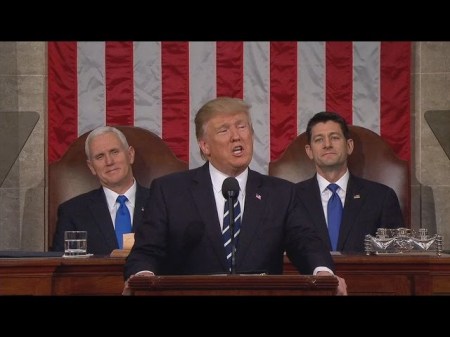
President Trump speaking to a joint session of Congress, Feb. 28, 2017

After the election of perhaps the most pro-Israel U.S. administration in history, American Jews seem to have lost the plot. When Donald Trump was elected president of the U.S., many Jews sat shiva to mourn Hillary Clinton’s defeat as if it was a death in the family, making religion out of politics. A number of Conservative and Reform synagogues held special mourning services to bewail the advent of fascism in America. One prominent Conservative rabbi in New York compared the Trump victory to the rise of Nazism prior to the Holocaust. The essence of politics is persuasion; not hysterics.

Trump repeatedly praises Israel and refers to Israel as America’s greatest ally. He has been closely associated with Jews in business and politics. His daughter observes an Orthodox religious lifestyle, after converting to Judaism. Apart from his family, his senior appointments include many Jews and staunch friends of Israel. He endorsed Israel’s position on defensible borders and stated that he has no objection to construction in the major settlement blocs and Jerusalem. He called on the Palestinians to recognize Israel as a Jewish state and stated that the only way to peace is by direct negotiations between both parties. He repudiated Obama’s criticism of Israel for failing to make progress in peace talks, and Obama’s application of moral equivalence between Israelis and Palestinians. He has begun to pressure the Iranians to adhere to their commitments to the treaty of catastrophe, and would terminate it for any violation by the Iranian terrorist regime.

One of the negative repercussions of the Trump victory is the growing influence of the radical anti-Israel wing of the Democratic Party. The anti-Israel Muslim Congressman Keith Ellison, who was initially funded by the Hamas-linked Council on American-Islamic Relations, is the deputy chairman of the Democratic National Committee; supported by leading Jewish Senator Chuck Schumer. While, anti-Israel Jewish Senator Bernie Sanders emerged as a powerful force in the defeated radicalized Democratic Party.

The Jewish establishment ignored and pretended away the Democratic anti-Semites, even when they were burning Israeli flags at the Democratic convention. They condemned legitimate criticisms of anti-Israel financier George Soros as anti-Semitic while leaving unaddressed truly anti-Semitic assaults by Hillary backers on Trump donor Sheldon Adelson. Moreover, significant sectors of the Jewish community are falsely accusing the Trump administration of promoting anti-Semitism. It is noteworthy that the Zionist Organization of America protested against this partisan defamatory campaign.

The Anti-Defamation League (ADL) launched a scornful assault against Trump’s chief strategist, former Breitbart CEO Steve Bannon accusing him of being an anti-Semite, while ignoring Ellison’s record of anti-Semitism and support for Israel’s enemies, as well as Ellison’s ties to unindicted co-conspirators in funding Hamas. The accusation that Bannon is anti-Semitic is appalling on its face. Bannon is surrounded by Jews in his media company, Breitbart News, and is known for his fervent support for Israel, opposition to anti-Semitism, disapproval of anti-Israel activism on campuses, and condemnations of the boycott, divestment and sanctions (BDS) movement. Jonathan Greenblatt, the CEO of ADL, accused Bannon of being an anti-Semite who would pave the way for a return to anti-Semitism and white supremacy. In alleging that a friend of the Jews is a Jew hater while ignoring the actual anti-Semitism of another man, the ADL appears to be giving cover to the rising forces of anti-Semitism in the Democratic Party.

Greenblatt did not call for Jews to boycott the Black Lives Matter (BLM) movement despite its anti-Semitism and promotion of BDS against Israel, and he referred approvingly to the “positive” aspects of its work. The use of the ADL, created to combat anti-Semitism, to promote Greenblatt’s partisan political agenda is scandalous.

Greenblatt had earlier used the ADL to condemn Republicans as “anti-Zionist” because they excluded a two-state solution in their Middle East policy platform. When Trump declined to dignify David Duke and the Ku Klux Klan by responding to their expressions of support for him, Greenblatt condemned him for “tolerating” anti-Semites. This contrasted with the muted response by Jewish liberals to Barack Obama’s relationship with various radical anti-Semites.

Obama has long-held close alliances with Bill Ayers, Jeremiah Wright, Louis Farrakhan, Rashid Khalidi, etc. Obama’s political career was launched in the house of the anti-Semite Ayers, a former leader of the Weather Underground, a left-wing terrorist organization that issued a “Declaration of a State of War” against the U.S. government. Obama attended Wright’s sermons with his family, and he officiated at Obama’s wedding and was appointed by him in 2007 to the African American Religious Leadership Committee. He only dissociated himself from Wright’s views after media exposure but refused to disown him personally, relating to him as “an old uncle.” No critic of Trump could suggest any comparable relationship with any identifiable anti-Semite.

Establishment anger over Trump’s weeks-old administration is growing. The mainstream global media, progressive activists, Democratic Party leaders, and many Republicans are essentially at war with him. New York Times columnist Thomas Friedman recently compared his victory to disasters in American history that killed and wounded thousands like the Pearl Harbor bombing and the 9/11 terrorist attacks. Some op-ed writers and pundits have openly hoped for his violent death. The progressive “Resistance” talks of removing the new president through impeachment, or even military coup. About one-third of House Democrats boycotted the Inauguration. Congressional Republicans ignore the Constitution, ignore the balance of powers, and ignore written law, while relinquishing their own constitutional authority allowing the courts to run American foreign policy, just to be a part of the establishment’s ‘Stop Trump’ movement.

After Trump had secured the Republican nomination, prominent Jewish conservative editors, like Bill Kristol and Jonah Goldberg, led the “Never Trump” movement. They betrayed the Republican Party, the American people, and Jews when they set out to undermine Trump, which could have elected the criminally challenged Hillary.

The sympathies of Hillary and Obama lie with the Muslim Brotherhood, the organization that launched the Arab drive to destroy Israel and push its Jews into the sea. If Hillary and Obama had their way, Egypt’s leader al-Sisi would be overthrown, the Brotherhood would be back in power, and Israel could be facing a threat from the biggest military power in the Middle East and war with Islamic terrorists who openly call for the extermination of the Jews.

Elements of the U.S. government have been actively opposing the duly elected U.S. president. Employees of the Environmental Protection Agency have been disrupting Trump administration reforms. U.S. government employees recorded Trump’s private calls to the president of Mexico and the Australian prime minister, and leaked selected segments to suggest that Trump was either a buffoon or trigger-happy. The Wall Street Journal reported in February 2017 that career intelligence officers have decided to withhold information from Trump, because in their view he is unfit to receive it. Kristol suggested in a tweet that if he faced a choice between the constitutionally, democratically elected president and career government officials’ efforts to thwart or remove him, he would come down on the side of the revolutionary, anti-democratic “deep state.”

American voters elected Trump because they regarded him as the only opportunity to break with the status quo, a revolt against the postmodernism that has undermined the moral fiber of the West and its willingness to defend itself, facilitating the emergence of brutal Islamic terror. The refusal of Trump’s opponents to accept the outcome of the election was despicable and unprecedented, and contrasts with the acquiescence of the defeated Republicans when Obama won both of his elections. An aspect of the election result is the hysterical reaction by liberal segments of the Jewish community. It is not surprising that 70% of Jews supported Hillary Clinton. This is consistent with their long-standing obsession with liberalism. But the manipulation of Jewish issues as a political vehicle by some American Jewish leaders to oppose Trump could be an act of infamy.

After Israel, the U.S. has the largest Jewish population in the world. Despite credible evidence that Islamic terrorists infiltrate migrants from Muslim conflict zones, American Jews have been at the forefront of the opposition to the Trump administration’s plan to pause immigration for a few months from six Muslim countries with vetting challenges. In America, anti-Semitic attacks are generally by Muslims or radical liberals; however, American Jews supported the presidential candidacy of Hillary Clinton that promised significant increase in immigration from Muslim conflict zones. During the recent migration crisis in Europe, British Jews repeatedly clamored for massive immigration from Muslim conflict zones; however, in March 2017, the British Home Secretary issued a warning of ‘significant’ radical Islamic terrorist threat to British Jews. From Bombay to Toulouse and beyond, Jews suffer disproportionately from Muslim attackers.

Some Democratic Party Muslim Americans with records of anti-Semitism condemned the recent anti-Semitic attacks against Jewish cemeteries. The Democratic Party is becoming more open in its embrace of anti-Semitism. Terrorist murderers of Jews (Ramsea Odeh, etc.) and supporters of terrorist murderers of Jews (Keith Ellison, Linda Sarsour, etc.) have prominent positions in the party. Odeh is a terrorist that participated in a PLO attack at a Jerusalem supermarket in 1970 that murdered two Jews. Ellison is an anti-Semite that also defends cop killers. He was a long standing member of the anti-Semitic Nation of Islam. Sarsour calls for Israel’s destruction and she supports Palestinian mass murderers of Jews. Malcolm Hoenlein, the head of the Conference of Presidents of Major American Jewish Organizations, pretends that even anti-Semites oppose anti-Semitism, stating that “we can’t afford a split” on Israel among the Democrats and the Republicans. The fight against anti-Semitism is compromised if Jew hating Democrats are viewed as legitimate partners in fighting anti-Semitism, when they aid and abet anti-Semitism.

There are no Christian states striving to wipe Israel off the map, and there no groups in Hinduism or Buddhism seeking to push Jews into the sea; however, Iran repeatedly states its desire to wipe Israel off the map, and large sections of the Muslim world have become a cesspit of Jewish hatred. Polls of Muslims from various countries indicate significant percentages of Muslims have rabid hatred of Jews.

American Jews undermining Trump because of hurt feelings, irrational fear or lust for power will do more to put Israel and Jews in jeopardy than any Trump administration official or travel ban on foreign nationals from hostile regions ever could. Whatever tensions exist between Trump and both Republican-controlled houses of Congress, they share one thing in common: support of Israel. This should not be interpreted that the Trump administration will favor annexation or a one-state policy. Trump has made it clear that he endorses a two-state policy but, in contrast to Obama, he stipulates that it cannot be imposed without providing Israel with defensible borders and all of the security guarantees it requires. Presently, this objective is unattainable.

During the Obama administration, leaders of the American Jewish community demanded increased Muslim immigration, and supported the lawlessness promoted by BLM. Now, like Captain Renault in Casablanca, they are shocked, shocked that there are increased anti-Semitic attacks and increasing bomb threats to Jewish Centers in the U.S. Unfettered immigration from many Muslim countries pose a problem for Jews more than most. If Jews cannot remove leaders that put their party before their community, they should form new organizations to defend their interests. Moreover, American Jews should wish President Trump well. May his triumphs be many.

Fire Me: U.S. Attorney In Manhattan Refuses To Resign

March 11, 2017

Fire Me: U.S. Attorney In Manhattan Refuses To Resign, Jonathan Turley’s Blog, Jonathan Turley, March 11, 2017

(Update: According to the Washington Post, Mr. Bharara just claimed on Twitter that he has been fired. — DM)

The United States Attorney for Manhattan, Preet Bharara, appears to believe that he is working for a different branch of government.  After Attorney General Jeff Sessions asked for the resignations of all U.S. Attorneys, a standard change of political appointees in a new Administration, Bharara announced that President Donald Trump would have to fire him.  Just as with the bizarre conduct of Sally Yates as Acting Attorney General, Bharara has shown a curious understanding of this position and his obligations as a federal officer.  President Trump should immediately accommodate him and Bharara will have to explain to future employers how he justifies such an unfounded stance.

New Administrations (particularly with a change of party) often demand such resignations — though many political appointees do not wait to be asked.  Of the 93 U.S. attorneys, 46 were appointed by President Obama.  There are career deputies who take over during the interim in these offices.

Bharara reportedly felt blindsided by the move and earlier spoke to Trump at Trump Tower.  He said that Trump directed Bharara to go out to the cameras and tell them, “I asked you to stay.”  Ok, even that is true, what professional standard is Bharara relying on for this obstructive position?  Bharara has no claim to this political position or right to demand to remain in the position.    Bharara indicated that Sen. Chuch Schumer wanted him to continue and the President agreed.  Again, that does not change the fact that he serves at the pleasure of the president.

The demand to be fired is astonishingly unprofessional and frankly juvenile for a high-ranking prosecutor.  Bharara has assembled an impressive record as U.S. Attorney and he is tarnishing both that record and his office with this position. He should be fired without delay and I would hope that this position would weigh heavily in any future consideration for public office or appointment.

3-9-17 David Horowitz on Hannity

March 10, 2017

3-9-17 David Horowitz on Hannity, Fox News via YouTube

https://www.youtube.com/watch?v=0WUHi7tlMBE


Tapped Out: Surveillance Nation

March 9, 2017

Tapped Out: Surveillance Nation, Bill Whittle Channel via YouTube, March 9, 2017

Recruit Russia in the fight against Iran

March 9, 2017

Recruit Russia in the fight against Iran, Israel Hayom, Ariel Bolstein, March 9, 2017

Prime Minister Benjamin Netanyahu’s meeting with Russian President Vladmir Putin in Moscow Thursday takes place at an interesting time.

Russia, which has exhausted its military moves in Syria, is searching for a future strategy that will allow it to integrate into the world of U.S. President Donald Trump. Russia has paid a high price for its confrontation with the West. True, as a result of the United States’ geopolitical retreat under former U.S. President Barack Obama, Russian influence has grown on a few fronts, primarily in the Middle East, but this achievement is not worth much without American recognition of Russia’s new-old status as a world power. The changing of the guard in Washington provided Moscow with a unique opportunity to turn the page on its relationship with the West, but the significance of such a change would also mean concessions on its part.

It seems that Russia may meet Trump halfway on the Iranian issue. Russia did not have much in common with the country of Islamic revolution from the outset, and the collaboration between them stems more from a desire on the part of both countries to challenge the existing world order. Indications of Russia’s openness to the idea of turning its back on Iran have been noted on Russian state television. These channels are full of talk shows that focus on current events, and the variety of voices heard on them is effectively controlled by authorities. In recent weeks, these programs have raised the possibility of placing Iran on the sacrificial altar between Moscow and Washington, and this was received with understanding by a majority of participants. One must remember that Putin and as a result the Russian public are determined to witness Russia’s inclusion in the select club of world powers, but they have no interest in dragging others who also claim the crown along with them, and certainly not Iran.

From Israel’s perspective, Netanyahu is now the only statesman to enjoy the trust of and an unprecedented friendship with both the White House and the Kremlin. Israel has succeeded in preserving its interests in the tempest of upheaval in the Middle East, in large part due to the relationship Netanyahu has forged with Putin. The Russians have been forced to honor Israel’s freedom of action in the region and have come to understand full well Israel’s determination to act whenever Israeli considerations require that it do so.

In the Trump era, Israel’s stock has risen even more in the eyes of the Russians. Moscow could not help but notice the special affinity Trump has shown toward Netanyahu and the feelings of solidarity they share. Israel is clearly not operating within a vacuum — Turkish President Recep Tayyip Erdogan will visit Russia after Netanyahu, and later in the month, Iran’s President Hassan Rouhani will do the same — but those in the Kremlin must understand the differences in influence among these three figures.

The possible resolution in Syria and its de facto division into regions of influence underscores the need to stop the expansion and strengthening of Iran. Russia needs to understand that Hezbollah’s murderousness and lack of humanity is no different from that of the Sunni terrorists it so mercilessly bombed. There should be one law for the Islamic State, Jabhat Fateh al-Sham — formerly Nusra Front — and Hezbollah. If Russia operates according to this principle, its standing and the security of the region will vastly improve.

Report: Trump putting potential diplomatic deal with Russia on the back burner

March 7, 2017

Report: Trump putting potential diplomatic deal with Russia on the back burner, Hot Air, Allahpundit, March 7, 2017

Needless to say, here’s another motive for why anti-Trumpers inside the federal bureaucracy may be leaking at politically inconvenient times for Trump. Reminding the public that some of his aides are under suspicion because of their contacts with Russia is a clever way to force Trump to postpone any planned diplomatic outreach to Russia at moments when he feels his political capital cresting. Trump might eventually be in a position to swing a deal with Moscow, but so long as Russia hawks within the administration are dribbling out material from the investigation that puts a cloud over the White House, it’ll look suspicious for him to make nice with Putin.

And so, inevitably, Trump is reportedly backing away from any “grand bargain” for now.

President Donald Trump is telling advisers and allies that he may shelve, at least temporarily, his plan to pursue a deal with Moscow on the Islamic State group and other national security matters, according to administration officials and Western diplomats…

Trump’s new skepticism about brokering a deal with Moscow also suggests the rising influence of a new set of advisers who have taken a tougher stance on Russia, including Defense Secretary Jim Mattis and new national security adviser H.R. McMaster. During his first meeting with National Security Council staff, McMaster described Russia — as well as China — as a country that wants to upend the current world order, according to an administration official who attended the meeting…

European allies also have been pushing the Trump administration not to make any early concessions to Russia. To bolster their case, European officials have tailored their rhetoric to appeal to Trump’s business background, including emphasizing the risks of negotiating a bad deal, rather than more nuanced arguments, according to one Western diplomat. Given Trump’s “America First” mantra, foreign officials emphasize how U.S. standing in the world could be diminished by making concessions to Russia instead of focusing on the importance of the U.S. and Europe sticking together to counter Moscow.

The most interesting detail in the AP story: In talks with his staff, Trump supposedly singled out Russia’s violation of the 1987 INF Treaty as making a deal “tougher and tougher to achieve,” a message that’s been relayed to U.S. allies in Europe too. I wrote about that here. It’s genuinely confounding. If Russia wants a compliant Washington, why would it choose to violate the treaty by deploying intermediate-range missiles aimed at Europe when it surely knows that Trump hates being seen as “weak” and won’t look the other way? Putin seemed to understand how to deal with him late last year when he refused to retaliate against the sanctions imposed on Russia by Obama for trying to interfere in the presidential campaign. That was Moscow signaling to the world that it expected those sanctions to be lifted by the new administration unilaterally. (Which was a damning sign of how conciliatory they expected Trump to be, but whatever.) Putin could have responded in kind but instead chose to preserve the status quo on its end as a goodwill gesture to Trump. And Trump appreciated it.

They didn’t preserve the status quo in deploying their missiles, though, a much more provocative way of challenging Trump than reciprocal sanctions would have been. You can cook up a scenario in which Putin violated the treaty in the expectation that he’d use the missiles as a bargaining chip during negotiations to come with the White House. E.g., maybe he thought Trump might bite on a deal that would trade decommissioning the missiles for the lifting of all U.S. sanctions against Russia, including the 2014 measures imposed to punish them over Ukraine. The problem with that theory, though, is that once the missiles are in the field, as they are now, then Trump has already lost face, and regaining it requires a show of strength. The White House may well end up demanding that the missiles be withdrawn as a precondition of negotiations rather than as something to be haggled over during the process. The smart play, it seems, would have been for Putin to roll out the missiles last fall, to defy Obama, and then withdraw them voluntarily after Trump took office as a goodwill gesture, to invite further negotiations. The better behaved Putin seems during Trump’s early presidency, the more Americans might be willing to let Trump negotiate with him to see what else he can get from Russia. Instead, Russia has engaged in various petty provocations, culminating in the more serious escalation of violating the INF Treaty. Why? If it’s true that they were hoping Trump would win the election, how does it make sense to box him in politically so that he can’t make concessions to Moscow without looking horribly weak and corrupt even if he wanted to?

If you want to go full cloak-and-dagger, you could theorize that the missiles were deployed because Russia wants to give Trump a chance to stand up to them. Putin may have concluded that the Kremlin’s interference in the election worked too well insofar as many Americans now suspect that Russia has influence over the president. That makes negotiations hard, even if preceded by unilateral concessions by Moscow. The only way to really create political space for diplomacy under this theory is to manufacture a minor diplomatic confrontation like the INF violation, have Trump demand that the missiles be withdrawn, and then comply in the hope that it’ll convince Americans Trump is being “tough” on Moscow and driving a hard bargain. Once Trump has earned the trust of his own doubters here at home, he’ll be free to make a sweetheart deal with Putin. That theory’s hard to buy, though: Putin needs to look tough to Russians even more so than Trump needs to look tough to Americans, and toughness typically doesn’t involve backing down in a (manufactured) confrontation. Plus, given the shift in Russian media lately, it seems as though the Kremlin is sincerely warier of Trump lately than it used to be. If they’ve already decided that Trump will be more of an enemy than a friend, it’ll be the quickest reassessment by a foreign power in modern history.

If you want a glimpse of what Europe’s future might look like if Trump doesn’t get Putin to withdraw those missiles, go read this. Exit question: If you subscribe to the theory that Russia was/is all-in for Trump as president, how do you explain the fact that Trump now feels unable, however temporarily, to approach Moscow for a deal? Did the Russian interference succeed so well that it’s made cooperation impossible? On what planet does that constitute “success”?

Forging a new approach to Iran

March 6, 2017

Forging a new approach to Iran, Washington Times, Shahram Ahmadi Nasab Emran, March 5, 2017

iranianoctopusIllustration on the continuing threat of Iran by Alexander Hunter/The Washington Times

By identifying the gross overreach by the Iranian regime and promising a swift, punitive response, the White House’s stance marked the end of a longstanding American policy of naive appeasement. In so doing, the Trump administration has rightly recognized the true source of instability and existential threat the region faces. Now, instead of issuing broad statements, it must act on a smart strategy for dismantling the key pillars of Iran’s international terror network and stunting the regime’s emboldened overreach.

***********************

Even as the Trump administration seeks to designate the Revolutionary Guard as a Foreign Terrorist Organization, Iran continues its blatant defiance of international norms. Promising “roaring missiles” if threatened, Tehran has test fired several ballistic weapons capable of delivering nuclear material in just the past month. A fundamentally weak regime with dated military capabilities, Iran is attempting to call the United States’ bluff, perhaps to gain leverage in any subsequent re-evaluations of the nuclear deal Tehran struck with the Obama administration. Several blistering statements from the White House backed by a round of sanctions presage the administration’s muscular new approach. But if it hopes to secure the region, it must systematically target the core destabilizing activities of the regime.

In a steady stream of denunciations, the White House pledged tougher U.S. action if the mullahs continue to violate international norms through illicit missile tests, making clear that the Obama era of appeasement is over. “Instead of being thankful to the United States for these agreements, Iran is now feeling emboldened,” an official White House statement read. “We are officially putting Iran on notice.” While many Iranian officials dismissed President Trump’s tough talk on the nuclear deal as empty campaign rhetoric, the president’s appointment of fellow anti-regime hardliner Gen. James Mattis demonstrates his intention to deliver.

Perhaps more importantly, the White House has also challenged the regime’s extended proxy offensives against U.S. allies and friends in the neighborhood. Such actions “underscore what should have been clear to the international community all along about Iran’s destabilizing behavior across the Middle East,” the White House statement continued. Contrary to President Obama’s Middle East policy of abandoning friends and allies and trying to make friends with the adversaries, the Trump administration will fully support its friends. Specifically, this stance challenges Iran’s practice of hiding behind Hezbollah and Houthis militants as it funds and trains them.

Holding a vastly dated arsenal of weapons, Iran is no match for U.S. firepower, leaving only backchannel mercenaries to promote regional dominance. The White House acknowledged this dynamic, specifically characterizing the affront against Saudi forces as being “conducted by Iran-supported Houthi militants.” This link was never recognized by the Obama administration. Such oversight left Iran free to grow and strengthen its hand in these groups, which terrorize the region and undermine our partners. If the Trump administration will craft a strategy for stunting Iran’s proxy network, particularly by cutting funding and armament flows, the region would be far safer and more stable.

Noting Mr. Trump’s concerns about the nuclear deal being “weak and ineffective”, the Trump administration addressed a third key issue in the U.S.-Iranian relationship. Rapidly losing money and influence, the nuclear deal allowed the regime to avoid military confrontation over its development program for which it was grossly unprepared. And despite the intention of weakening the regime and strengthening the Iranian people, rushed U.S. concessions granted the regime an eleventh-hour trickle of lifeblood, both financially and symbolically. By rolling sanctions back, destabilizing behavior was ostensibly met with an influx of funds. As such, the deal signaled that military action against Iran was highly improbable, thus essentially greenlighting the illicit activity that effected warnings and sanctions from the White House over the past month. And despite official remarks by Iranian officials denouncing these statements as naive and weak, the regime would be in dire straits if America turns off the faucet opened by the nuclear deal.

Finally, the administration’s condemnation for Iran’s broader support for terrorism demonstrated clear perspective on the direct threat it poses to international security. In addition to supporting Hezbollah, Iran is currently involved in a life-and-death battle in Syria that includes continuous weapon and militant transfer from Iran to Syria. President Bashar Assad’s downfall in Syria would destroy the linchpin of Iran’s terror apparatus.

Further, any sustainable resolution calls for the withdrawal of all foreign forces from Syria, culling both activity in the country and a pipeline to Hezbollah via the porous borders between Syria and Libya. As Iran finds itself backed into a corner by its regional export of terror, Mr. Trump and his team have many cards to play.

By identifying the gross overreach by the Iranian regime and promising a swift, punitive response, the White House’s stance marked the end of a longstanding American policy of naive appeasement. In so doing, the Trump administration has rightly recognized the true source of instability and existential threat the region faces. Now, instead of issuing broad statements, it must act on a smart strategy for dismantling the key pillars of Iran’s international terror network and stunting the regime’s emboldened overreach.