Archive for the ‘Terrorism’ category

Folks Do the Randomest Things

February 11, 2015

Folks Do the Randomest Things, National Review Online, Andrew C. McCarthy, February 11, 2015

(I think it may be satire, random of course. — DM)

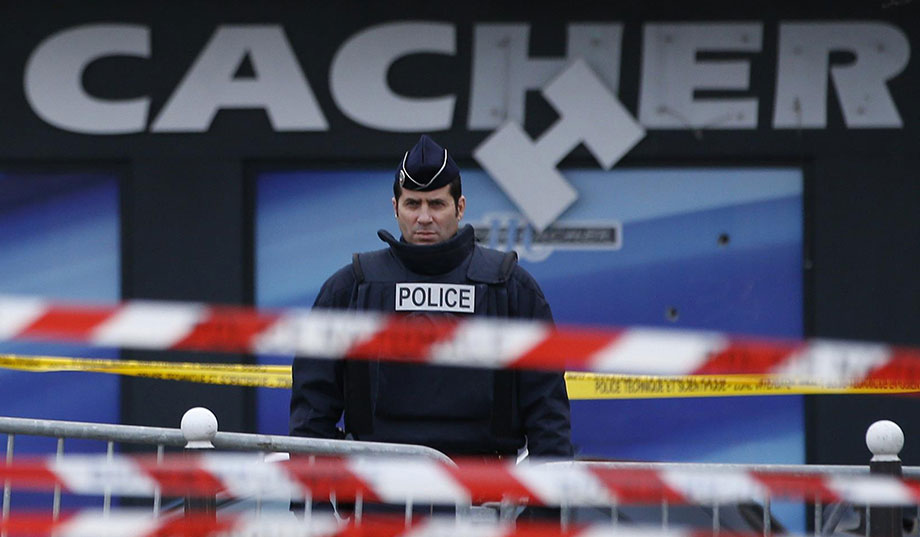
pic_giant_021115_SM_Paris-Hyper-CacherFrench police guard the Hyper Cacher market in Paris

Random? You’d almost think we were dealing with an identifiable enemy motivated by a distinct ideology that is drawn verbatim from a particular belief system’s scriptures. Nah . . .

******************

I don’t understand why folks are giving President Obama and his spokes-minions such a hard time over his insistence that Ahmedy Coulibaly, the terrorist who just happened to be Muslim committing terrorism that had nothing to do with Islam, was just “randomly” picking out folks in Paris to kill when he randomly came upon a grocery that just happened to be Jewish and, coincidentally, to have Jews in it, whom he randomly killed.

Sure, we know Coulibaly called a French TV station during the siege, said he was loyal to the Islamic State that has nothing to do with Islam, and that he picked this kosher market because he was targeting Jews. But you can’t believe everything you hear on TV — just ask Brian Williams.

Come to think of it, the Paris attack seems an awful lot like another random one in 2008. Back then, another group of Pakistani terrorists who just happened to be Muslim, and who belonged to the Lashkar-e-Taiba Islamic terrorist organization that has nothing to do with Islam, went looking for random folks to kill and just happened to stumble on the Nariman House, a Chabad Lubavitch Jewish center which, coincidentally, had Jews in it — Rabbi Gavriel Holtzberg and his wife,Rivka, then six months pregnant.

Of course, when they were randomly detaining these two folks who happened to be Jewish before randomly killing them, the terrorists who happened to be Muslim were overheard in radio transmissions discussing how “the lives of Jews were worth 50 times those of non-Jews” in this jihad that had nothing to do with Islam. But hey, totally random, right?

By the way, have you ever flipped randomly through Islamic scripture?

I just happened to land on sura 5:82 — wasn’t looking for anything in particular, you see — and found that it says: “Strongest among men in enmity to the Believers wilt thou find the Jews and pagans.”

Could something have been mistranslated? Maybe the revelation to the prophet really said “folks” but got somehow got written down as “Jews”? Doesn’t seem too likely. If you turn back a few verses, to sura 5:64, you learn Muslims believe the Jews have profoundly insulted Allah, claiming that “Allah’s hand is tied up” — which, as explained by the notes provided in the Saudi government’s English translation of the Koran, is a blasphemous taunt akin to calling Allah “close-fisted” and ungenerous.

In response, Allah instructs Muslims that it is the Jews whose hands should be tied up, and that they should be “accursed for the [blasphemy] they utter.” The verse adds:

The revelation that cometh to thee from Allah increaseth in most of [the Jews] their obstinate rebellion and blasphemy. Amongst them, We have placed enmity and hatred till the Day of Judgment. Every time they kindle the fire of war, Allah doth extinguish it. But they (ever) strive to do mischief on earth. And Allah loveth not those who do mischief.

That doesn’t seem very random.

Nor does sura 2:61, which explains that Allah has stamped the Jews with “humiliation and misery” because “they went on rejecting the signs of Allah and slaying His Messengers without just cause.” We further learn, four verses later, of Allah’s command that the Jews become “apes — despised and rejected” because they violated the sabbath.

Sura 5:41 describes the Jews as “men who will listen to any lie.”

According to sura 4:160–161, because of the “iniquity of the Jews,” Allah made it “unlawful for them” to eat certain “good and wholesome” foods. He was angered because

they hindered many from Allah’s way; . . . they took usury, though they were forbidden, and . . . they devoured men’s wealth wrongfully. We have prepared for those among them who reject Faith a grievous chastisement.

Given these, it should come as no surprise that Allah, in sura 5:51, instructs Muslims, “Do not take the Jews and the Christians for friends.” These passages probably also explain why, in sura 9:29, Allah commands Muslims to fight the Jews and the Christians until they agree to live under Allah’s law, pay a tax, and feel themselves subdued.

And let’s not forget the Hadith — authoritative collections of the recorded words and deeds of the prophet Mohammed. Like the Koran, they have scriptural standing in Islam. Also like the Koran, they often do not treat Jews as “random folks.”

Indeed, we are told that, in his dying words, the prophet cursed the Jews, along with the Christians:

When the last moment of the life of Allah’s Apostle came he started putting his ‘Khamisa’ on his face and when he felt hot and short of breath he took it off his face and said, “May Allah curse the Jews and Christians for they built the places of worship at the graves of their Prophets.” [Sahih Bukari, Book 1, volume 8, no. 427.]

In fact, in several hadith, the prophet is reported to have stated:

The last hour would not come unless the Muslims will fight against the Jews and the Muslims would kill them until the Jews would hide themselves behind a stone or a tree and a stone or a tree would say: Muslim, or the servant of Allah, there is a Jew behind me; come and kill him.

I know you’ll be stunned to hear this, but even though Islamic terrorists have nothing to do with Islam, they appear to think Islamic scripture means what it says. So if you were randomly to peruse, say, the charter of Hamas — an Islamic terrorist group that has nothing to do with Islam and that is randomly the Palestinian branch of the “largely secular” Muslim Brotherhood — look what you find in Article 7:

Hamas has been looking forward to implement Allah’s promise whatever time it might take. The prophet, prayer and peace be upon him, said: The time will not come until Muslims will fight the Jews (and kill them); until the Jews hide behind rocks and trees, which will cry: O Muslim! there is a Jew hiding behind me, come on and kill him!

Random? You’d almost think we were dealing with an identifiable enemy motivated by a distinct ideology that is drawn verbatim from a particular belief system’s scriptures. Nah . . .

Iran’s Moves in the Middle East and Why You Should Care.

February 10, 2015

Iran’s Moves in the Middle East and Why You Should Care, The Watchman via You Tube, February 10, 2015


Egypt Under Al-Sisi: An Interview with Raymond Stock

February 9, 2015

Egypt Under Al-Sisi: An Interview with Raymond Stock, Middle East Forum, February 8, 2015

by Jerry Gordon
The New English Review
February 2015

The introduction to this interview has been abridged.

To discuss Egypt’s prospects under the Abdel Fattah al-Sisi government, we invited back Dr. Raymond Stock whom we had interviewed in November 2012. (See: No Blinders About Egypt Under Muslim Brotherhood ). Stock is a Shillman/Ginsburg Writing Fellow at the Middle East Forum and a former Assistant Professor of Arabic and Middle East Studies at Drew University. He spent twenty years in Egypt and was deported by the Mubarak regime in 2010. He is writing a biography of 1988 Egyptian Nobel laureate in literature Naguib Mahfouz (1911-2006) for Farrar, Straus and Giroux and is a prolific translator of his works.

……………………..

“[The Muslim Brotherhood] has deeply bonded with the highest levels of the Obama administration, which uncritically backed its creation of an elected, one-party dictatorship under Morsi.

“Unlike Morsi and the MB, who worked covertly with the terrorists in Sinai, al-Sisi wholeheartedly supports the peace with Israel.”

Egypt is now in an informal alliance with Israel, the United Arab Emirates and Bahrain to confront Iran. That alliance is compromised, however, by recent moves from Egypt’s Gulf partners to mend fences with Iran as a result of their feeling exposed by Washington’s alarming pivot toward Tehran at the expense of its traditional Sunni clients.

“Obama’s leftist, rather Edward-Saidian worldview … sees indigenous anti-Western forces such as the Islamists to be the benignly natural and legitimate consequence of American and European policies during the colonial era and the Cold War.”


********************

Jerry Gordon: Ray Stock thank you for consenting to this interview.

Raymond Stock: Thank you for inviting me back.

Jerry Gordon: Egyptian President al-Sisi started 2015 with two dramatic moves- his New Year’s speech at al-Azhar University and Christmas greetings at a Coptic church with Pope Tawadros II present. What were the messages he conveyed to Muslim clerics, Coptic Christians and the world?

Raymond Stock: At al-Azhar, President al-Sisi was saying it is not merely an extremist interpretation of Islam that is threatening the world with global jihad, but ideas that are at the core of the mainstream, orthodox understanding of the religion–and that this would require a “religious revolution” to change.

At the Coptic Cathedral, he urged Egyptians not to define themselves by their religion, be it Christian or Muslim, but by the fact that they are Egyptians–a rejection of Islamism, which defines national identity in purely religious terms.

To the world, he was saying that Islam as it is being taught and practiced by its leading religious scholars has given birth to a globally destructive ideology which is now threatening us all.

Moreover, he wants to launch a movement within Islam to save the religion from itself, that is, before it tears itself apart completely and the rest of the world destroys it in self-defense.

And he challenged the clerics to take the lead in that effort by openly re-examining their own teachings and source materials for interpreting Islam.

Gordon: Al-Sisi has cracked down on press freedoms in Egypt and brought to trial three Al Jazeera correspondents. What in your view prompted that?

Stock: Though no libertarian, it is hard to say if al-Sisi himself has had anything to do directly with the suppression of press freedom, though it is happening on his watch. Going back to Pharaonic times, Egypt’s state institutions, the oldest in the world, and its political culture, have little tradition of respecting civil liberties. Some periods have been worse than others–the worst was actually under Gamal Abdel-Nasser in the 1950s and ’60s, when many thousands of political prisoners were sent “behind the sun” to camps in the Western Desert.

Al-Sisi is still so popular, the public so widely disgusted with the unending social and political chaos since the 2011 revolution, and so alarmed by the terrorist insurgency waged by the Islamists, that probably a majority of news editors and perhaps also of reporters have decided to support him completely and to oppose his critics automatically. At this point it is hard to find any clear connection with al-Sisi himself to this consensus, enshrined in a declaration by several hundred key media figures a few months ago. However, certainly if he didn’t like it he could well speak up against it–yet he hasn’t so far.
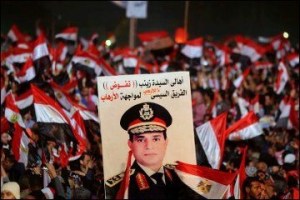
948Pro-Sisi demonstrators celebrate the third anniversary of Mubarak’s overthrow, January 2014.

Last summer he publicly regretted the imprisonment of the three Al Jazeera journalists, saying he wished they had been deported instead. Citing his belief in an independent judiciary, he refused to intervene in the legal process. Now that they are being retried after winning on appeal, we’ll see if he pardons and deports them should they be convicted again.

Gordon: Following, al-Sisi’s ouster of President Morsi and crackdown on Muslim Brotherhood leaders, what has happened to the movement in Egypt?

Stock: Though deservedly banned as a terrorist group, its top leaders in jail and the rest driven underground or abroad, it is far from dead and remains a threat to the Egyptian state and society. Its refusal to accept the June 30 popular revolution (far larger than the one that overthrew Mubarak), parental bonds to Hamas, financial support from Qatar and wealthy Gulf donors (and possibly Iran), partnership with the Salafis and ideological affinity and outreach to groups like al-Qa’ida and Islamic Jihad have served it well in retaining its base while gaining sympathy–especially internationally.

Though all these factors–plus its horrendous behavior in power–have greatly alienated the majority of Egyptians, they are for the most part also its greatest assets for the future, if they can only survive the current storm. As they have shown in several major periods of repression in the past–the most severe being under Abdel-Nasser–they only need to endure until there is successor to al-Sisi, who may decide to restore the MB to political legitimacy as a means of fighting al-Sisi’s remaining political allies. (Anwar al-Sadat, for example, freed the MB activists from prison to combat the surviving members of Abdel-Nasser’s coterie.) Such a situation could put them in striking distance of taking power again.

Meanwhile, the MB has global headquarters in Istanbul and London, is very influential in Europe, and has enormously increased its penetration at the federal, state and local levels all over the US. As part of this, it has deeply bonded with the highest levels of the Obama administration, which uncritically backed its creation of an elected, one-party dictatorship under Morsi. Obama evidently seeks to help the MB to return to power in Egypt—as shown, for example, by the State Department’s recent hosting of a conference of MB allies at Foggy Bottom, though it may take a while. Al-Sisi probably only has a year or two to turn the economy around before he risks another uprising.

The goal of the terrorist insurgency is to discourage foreign investment and stifle the stimulus provided by major government projects such as the new second channel to the Suez Canal to aid the recovery from the last four years of chaos. This, they hope, will pave the way for new popular upheaval which they hope to manipulate if not lead.

Gordon: Has the Islamic State supplanted the Salafist and Muslim Brotherhood movements?

Stock: In a sense, yes, but the situation is actually quite complex. Ideologically, IS—like al-Qa’ida–is an extension of the Salafist movement and the MB (itself established as a Salafi organization in the Salafi library in Ismailiya, Egypt in 1928). IS, because of its uncompromising Islamist purity, harshness, brutality and its dramatic seizure of so much territory in Iraq and Syria, coupled with its incredibly savvy use of social media, has largely eclipsed all of its predecessors in recruitment of fighters to the Middle East. It also outpaced all of them in its creation of lone wolves and sleeper cells in Europe, America and elsewhere.
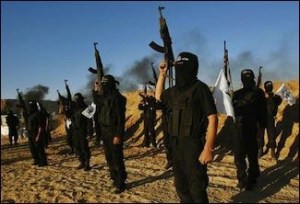
949Ansar Bayt al-Maqdis pledged allegiance to the Islamic State (IS) group last year.

That includes Egypt, where the MB-and-AQ aligned Ansar Bayt al-Maqdis (ABM) organization is responsible for most of the attacks in the country over the past two years. ABM, along with its allies controls much of North Sinai and has declared its allegiance to IS. The MB, as noted, still retains a very strong base, as does the Salafi al-Nour Party which has pragmatically allied itself with Al-Sisi. The appeal of IS may frustrate their ability to draw younger members–yet it is far from clear that IS will do any better in the long run. So have many of the Islamists in Libya, the eastern half of which IS now controls, and may soon run Tripoli as well. The stunning success of IS provides further inspiration to groups like Boko Haram, which has overrun much of northeastern Nigeria and has recently spread into Cameroon, as well as al-Shabaab in Somalia. IS also now has a presence in southern Afghanistan and beyond. Unless it is destroyed militarily in the very near future–which is virtually impossible so long as Obama is President–IS threatens every state with a significant Muslim population, as well as the West, which is its ultimate target.

Gordon: Al-Sisi has propounded a doctrine of stability for Egypt. What is it and has he succeeded since his election?

Stock: I would say that if al-Sisi truly has established such a doctrine for stability, it would consist of the following:

    1. Anti-Islamism—i.e. a more limited role for Shariah (which is nonetheless still enshrined in the new constitution, yet no longer to be interpreted by the clerics at al-Azhar, but by the government, whose authority and much of its outlook is secular, not religious;
    2. Electoral democracy though with somewhat limited civil liberties, to satisfy both the demand for popular sovereignty and for an end to the endless chaos–strikes and demonstrations (and skyrocketing crime) since the fall of Mubarak in 2011, and to limit the public role of the Islamists, who are at war with Egypt; and
    3. An independent foreign policy—one that still seeks to maintain the traditional alliance with the U.S. and the West, but is not afraid to go elsewhere as needed.

Obama’s backing of the Islamists and his cutting of aid for the past two years have driven al-Sisi to radically diversity Egypt’s sources of funding and investment from abroad, including for the first time military aid. For more than three decades, Egypt’s military assistance came almost exclusively from Washington, though that is now being surpassed by multi-billion dollar arms deals from Moscow and even to an extent from Beijing, funded by al-Sisi’s backers in the Gulf. That puts the Egyptian-American alliance and its principal benefits—the more than thirty-five year peace with Israel, our priority access to the Suez Canal (now being expanded with a second channel but without US investment), and vital cooperation on security issues—seriously at risk.

Gordon: Some analysts have said that in the wake of the Arab Spring the old order of regional autocracies has re-emerged in an alliance against the Muslim Brotherhood. What is your view and especially in the case of Egypt’s North African neighborhood?

Stock: That depends on the country: in North Africa, King Mohammed VI is still in power, but the Muslim Brotherhood has won more seats than the other parties in parliament, a situation echoing that in Jordan, though it is less precarious at present. Algeria, still recovering from the savage Islamist bloodbath after the Army’s annulment of elections in January 1992, was least affected of all the states in the region by the Arab Spring. (Perhaps the only major result there was the lifting of the State of Emergency that had prevailed for nearly two decades, in February 2011.) Tunisia, where the Arab Spring began in December 2010, threw out its MB-affiliate controlled government in a popular movement backed by the army—in a situation that rather echoed the one in Egypt, and late last year elected a new secularist plurality in parliament and a new secularist president, Béji Caїd Essebsi.

In Libya, the feeble central government that we helped install by foolishly removing the vicious, eccentric but cooperative Col. Mu’ammar al-Qaddafi has predictably collapsed. Yet a new secularist-dominated government was elected last June 25 and a pro-secularist remnant of the Qaddafi era, General Khalifa Haftar, for the past year has been at war with the Islamist militias that have been the real powers since 2011. Haftar also wants to destroy the Libyan iteration of the Muslim Brotherhood, root and branch, especially after it launched an armed uprising in eastern Libya following Morsi’s ouster in Egypt in 2013. As a result of this chaos, generated by our own needless—or at least, badly botched–intervention in the Arab Spring, the U.S. now has no effective presence in Libya. The security vacuum prompted Egypt and the United Arab Emirates to cooperate in launching air strikes near Tripoli last summer in support of Haftar’s forces. IS and other Islamist organizations are now infiltrating weapons and fighters into Egypt from Libya, threatening the country’s—and the region’s—stability.

In the Eastern Arab world, Egypt’s principal allies now are Saudi Arabia and the UAE, who together immediately pledged 12 billion dollars in aid after Morsi’s removal, and have given billions more since. All of it and more is desperately needed to compensate for the depletion of Egypt’s hard currency reserves, loss of foreign investment and near-destruction of the once lucrative tourist industry that have all continued since the January 25th Revolution against Hosni Mubarak. Both the Saudis and the Emiratis oppose the MB and Hamas, who—along with Egypt under Morsi—are clients of their Gulf rival, Qatar. America’s annual, mainly military package of $1.5 billion seems trifling in comparison (unless viewed cumulatively since it began in 1979). Still, it will be difficult to switch to mainly Russian or Chinese systems–much as the latter may be based on hacked American designs–after so many years of absorbing Yankee equipment and training.

Gordon: What is the emerging change in Egypt’s relations with Israel, both geo-political and economic?

Stock: Unlike Morsi and the MB, who worked covertly with the terrorists in Sinai, al-Sisi wholeheartedly supports the peace with Israel. He has greatly increased security cooperation with the Jewish state—which had been endangered in the 2011-12 transition and during the Morsi era—to levels exceeding those under Mubarak. Again, even more than Mubarak, who loathed them too, al-Sisi sees the MB, Hamas and their Islamist allies as threats to Egypt as well as Israel. Likewise, he sees Iran—with whom Morsi sought a rapprochement—as Egypt’s greatest strategic adversary in the region.

As a result, Egypt is now in an informal alliance with Israel, the United Arab Emirates and Bahrain to confront Iran. That alliance is compromised, however, by recent moves from Egypt’s Gulf partners to mend fences with Iran as a result of their feeling exposed by Washington’s alarming pivot toward Tehran at the expense of its traditional Sunni clients.

Meanwhile, though overall Israel-Egypt trade remains minimal (as it had through the decades of cold peace under Mubarak and afterward), energy-strapped Egypt may soon be importing natural gas from Israel’s newly-developed Tamar Reservoir in the Mediterranean. Given that Israel used to import natural gas from Egypt via a pipeline shared with Jordan (repeatedly sabotaged physically as well as assailed legally in Egypt since the fall of Mubarak), that is a remarkable turnaround indeed.

Gordon: What triggered Qatar’s re-opening of relations with Egypt despite the former’s support of Hamas and the Brotherhood?

Stock: The main factor was probably al-Sisi’s logical desire to stay in step with the policy of Egypt’s current primary foreign donors and investors, the Arab states in the Persian Gulf. After freezing relations with Qatar due to its support for Hamas and the MB, and perhaps also AQ and IS (the latter only early on?), and the universal irritant of Doha-based Al Jazeera, the members of the Gulf Cooperation Council (GCC), especially Saudi Arabia and the United Arab Emirates, decided last summer to repair the rift, apparently in face of the increasing U.S. tilt toward Iran. The U.S. tried to bypass al-Sisi by turning to Qatar and Turkey—both of whom Cairo had shunned for their support of Islamists and their criticism of Morsi’s ouster—as intermediaries with Hamas in the Gaza conflict last summer.

Ironically, that move may have done more to damage relations with Washington than with either Doha or Ankara, who probably could not be totally excluded in any case, given their closeness to Hamas. Yet those two regional rival countries’ desire to cut out Cairo, the historic mediator between the Palestinians, Israel and the West, did aggravate the Egyptians enormously, to be sure.

Qatar has taken some token steps to distance itself from the MB, like deporting several MB leaders who had taken refuge there. But Qatar apparently continues to finance them in their new home in London, and few believe the change is more than cosmetic. Thus the warming with Egypt and even within the GCC may not long endure.

Gordon: Why has the US Administration maintained an arm’s length relationship with al-Sisi subsequent to the ouster of Morsi?

Stock: It is no doubt due to Obama’s leftist, rather Edward-Saidian worldview, which sees indigenous anti-Western forces such as the Islamists to be the benignly natural and legitimate consequence of American and European policies during the colonial era and the Cold War—for which he has apologized repeatedly. He also has a positive, nostalgic view of Islam, given that he was born of a Muslim father and having apparently been raised as one by his step-father during his early childhood in Indonesia, and seems to project this image onto radical groups like the MB who cleverly pose as moderates. He is thus surrounded by numerous pro-Islamist advisers, as well as those who simply take a naïve view of groups like the MB, Hamas and Hizbollah–and even the Taliban (not a new position, but one now getting attention in the news).

It also means that he denies the common Islamist ideology of all those groups as well as AQ and IS, or even any connection of their beliefs to Islam. This, despite their being made up entirely of Muslims, that they base their ideology and tactics on the Qur’an, Hadith and other key Islamic texts, and that they have a very wide appeal in the global Islamic community. This is even more bizarre if you compare his statements and those of his aides about this question to those of al-Sisi—a Muslim leader of a majority Muslim country—at the seat of Sunni Islam’s highest authority, al-Azhar, on New Year’s Day. One of them, Obama, is willfully blind; the other, al-Sisi, with devastating clarity, identifies the problem as coming from within the very heart of Islam.

On a personal level, Obama does not take kindly to those who cross him. Just look at his relationship with Congress, and with Benjamin Netanyahu, while ignoring his own transgressions against those he thinks are transgressing against him. He regarded al-Sisi’s patriotic overthrow of Morsi–whom he had bolstered with more and more aid even as the MB leader became more and dictatorial–at the demand of more than twice as many Egyptians as those who voted for Morsi, as a personal affront as well as ideological heresy. He has since punished al-Sisi and the Egyptian people who rejected his chosen savior of their destiny accordingly. That may have softened a bit recently, due to the need to find Arab allies to fight IS, but that is not a serious effort: the default position is against al-Sisi and for the MB.

Gordon: Given your Egyptian sojourn does al-Sisi have both the domestic and international support to implement his agenda?

Stock: Domestic, yes—all but a quarter to a third of the country wants him to succeed. But internationally is another story. Al-Sisi’s greatest enemy is not the MB, or even IS, but the president of the United States. When the State Department invited key figures from the pro-MB alliance of groups to a major conference in Washington this week, he was signaling his desire (and only Obama sets our foreign policy) to overthrow al-Sisi—just as his invitation to the leaders from the banned MB to sit in the front row of his Cairo speech in 2009 signaled that he wanted to remove Mubarak. So U.S.-dependent international institutions and allies may not be too supportive of al-Sisi.

The only possible silver lining for Egypt is, ironically (given our historic alliance), really a great problem for our country, if one values its role of global leadership since World War II. That is, Obama has done so much to destroy America’s standing with the rest of the world that even our closest allies no longer fear to stray, and may yet not follow his wishes regarding al-Sisi. Tragically, on many issues, that may be better for us all until Obama leaves office. For the heading he has set leads directly to hell, a destination that many countries, thanks to in large part to his policies, have already seen (and Syria and Libya have already become)–good intentions (by his lights) notwithstanding.

Gordon: Dr. Stock many thanks for this highly informative interview.

Stock: You’re most welcome.
Qatar, Egypt on a collision course

February 9, 2015

Qatar, Egypt on a collision course, Israel Hayom, Dr. Reuven Berko, February 9, 2015

This anti-Egypt agenda, which seems to be shared by Turkey, is fueled by the desire to realize the dream of installing a Sunni Islamic empire, all while undermining moderate Arab regimes and giving a nod to Iran, as a way of covering all bases — just in case.

******************

Qatar and Egypt are at odds, and the attempts by the late King Abdullah of Saudi Arabia to facilitate a reconciliation between them have failed.

Qatar’s relentless efforts to overthrow Egyptian President Abdel-Fattah el-Sissi’s regime and reinstate the Muslim Brotherhood to power are evident from the programs airing on the Doha-controlled Al-Jazeera television network, and from the publication of doctored wiretaps featuring the Egyptian president and his advisers, who allegedly “stole” Egypt away from the Muslim Brotherhood and the “holy” Mohammed Morsi.

This anti-Egypt agenda, which seems to be shared by Turkey, is fueled by the desire to realize the dream of installing a Sunni Islamic empire, all while undermining moderate Arab regimes and giving a nod to Iran, as a way of covering all bases — just in case.

Egypt’s decision to outlaw the Muslim Brotherhood has resulted in increased incitement by Qatar as well as in an escalation in terrorist attacks in Egypt and Sinai. Egyptian intelligence has linked the latest series of attacks to Ansar Beit al-Maqdis, an offshoot of the Islamic State group, as well as to Hamas’ Izzedine al-Qassam Brigades. Hamas and the Izzedine al-Qassam Brigades are very much Qatar’s “babies,” and their involvement in these terrorist attacks has prompted Egypt to outlaw both.

In response, Al-Jazeera has begun portraying Izzedine al-Qassam Brigades’ operatives, who have denounced Sissi as a traitor to Islam and Arabs everywhere, as heroes fighting for the liberation of “Palestine.” The Qatari television station has also been obsessively covering the riots and unrest instigated by the Muslim Brotherhood to undermine the regime, intimidate foreign investors, and reverse the image of stability Sissi’s government is trying to convey to the world.

The airing of secret wiretaps, on which Sissi is heard mocking the wealthy Persian Gulf states, at this time seeks to pit Cairo against the Gulf states, ahead of the World Economic Forum on the Middle East, which is scheduled to convene in Sharm el-Sheikh, in Egypt, in late February, and where Egypt will lobby for aid.

Sissi’s assertion about the current situation in the Middle East is correct: Sunni Arab states are being offered as sacrifice to Iran, which is pursuing its nuclear endeavors uninterrupted. These states understand that Egypt’s stability is a prerequisite for their own national security, and therefore aiding Cairo is a favor that could only work to their advantage.

At the end of the day, in a reality where Iran poses an existential threat to other Arab countries, pointing to the emir of Qatar as a leader drowning in gold while millions of Egyptians go hungry — as heard on the wiretaps — may prove to be a double-edged sword, which may end up striking Qatar itself.

Houthi Yemen coup moves Iran’s Middle East hegemonic ambitions forward – upheld by Washington

February 9, 2015

Houthi Yemen coup moves Iran’s Middle East hegemonic ambitions forward – upheld by Washington, DEBKAfile, February 8, 2015

Houthi_fighters_downtown_Sanaa_5.2.15Victorious Houthi fighters in downtown Sanaa

It is hard for those governments to make up their minds where to look for the most acute menace to their national security – the US-Iranian nuclear deal taking shape, or the give-and-take between Washington and Tehran in Yemen and Iraq. 

******************

The strings of the pro-Iranian Houthi rebels’ coup which toppled the Yemeni government in Sanaa were pulled from Tehran and Washington. US intelligence and shared US-Iranian support helped the Houthis reach their goal, which is confined for now to parts of central Yemen and all of the North.

Friday, Feb. 6, the rebels dissolved parliament and seized power in the country of 24 million. They propose to rule by a revolutionary council. President Abed Rabbo Mansour Hadi and his cabinet who were forced to resign last month are under house arrest.

DEBKAfile’s Saudi intelligence sources reveal that the dominant figure of the uprising was none other than Ali Abdullah Saleh, president of Yemen from 1990 until he was ousted in 2012.

A member of the Zaydi branch of Shiite Islam like the Houthis, he led them to power with the same enthusiasm with which he fought their insurgency during his years in power. By rallying his supporters in the army, intelligence and security services, he enabled the rebels to take over these departments of government and overpower the Hadi regime with only minimal resistance.

They were also able to commandeer $400 million worth of modern American munitions.

The Houthis secretly call themselves “Ansar Allah” and have adopted the “Death to America, Death to Israel” slogans routinely heard in government-sponsored parades and demonstrations on the streets and squares of revolutionary Tehran.

Amid the political turmoil in Sanaa, the US Sunday resumed drone strikes against AQAP.

The six Arab countries of the Gulf Cooperation Council, led by Sunni-ruled Saudi Arabia and the United Arab Emirates, issued a statement Saturday, Feb. 7, calling for the UN Security Council to “put an end to this coup, an escalation that cannot be accepted under any circumstances.”

The Iranian-US gambit has resulted in different parts of Yemen falling under the sway of two anti-American radical forces – the pro-Tehran Houthis and Al Qaeda in the Arabian Peninsula (AQAP).

The new Saudi King Salman starts his reign with a double-barreled threat facing the kingdom from its southern neighbor, Yemen – posed by an Iranian pawn and a proactive branch of Al Qaeda.

Ten days ago, when US President Barack Obama visited Riyadh, the Saudi monarch voiced his concern about the alarming situation developing Yemen. However, Obama replied noncommittally with general remarks.

In Washington, administration spokesmen Saturday tried pouring oil on the troubled waters roiled by US support for the Iranian maneuver in Sanaa and the return of Abdullah Saleh to the Yemeni scene.

“We’re talking with everybody,” one US official said, explaining that the United States was ready to talk to any Yemeni factions willing to fight Al Qaeda.

His colleagues tried to downplay Tehran’s hand in the Houthi coup. “The Houthis get support from Iran, but they’re not controlled by Iran,” said another official in Washington.

Our military and intelligence sources report that Yemen is not the only Middle East platform of the joint US-Iranian military, intelligence and strategic performance. The second act is unfolding in Iraq.

Saudi Arabia, the Gulf emirates, Jordan and Israel are therefore watching the evolving US-Iranian cooperation in fighting al Qaeda’s various affiliates in the region with deep forebodings, lest it is merely a façade for the Obama administration’s espousal of Tehran’s regional ambitions.

It is hard for those governments to make up their minds where to look for the most acute menace to their national security – the US-Iranian nuclear deal taking shape, or the give-and-take between Washington and Tehran in Yemen and Iraq.

The Plight of the Yazidis

February 7, 2015

The Plight of the Yazidis, Front Page Magazine, February 6, 2015

(They are probably doomed unless the relevant U.N. high commissioner decrees that they are endangered by climate change rather than by the forces of “peaceful” Islam. Then Obama and Kerry, who claim that climate change is the greatest threat of all, might help. — DM)

Yazidis-450x331

Despite the current focus on ISIS, the ongoing barbarity inflicted against the Yazidis, a group of people who have inhabited Iraq’s mountainous northwestern region for centuries, remains largely below the radar. And while this estimated population of approximately 500,000 has been the target of hatred by Muslims who see them as heretical devil-worshipers, ISIS has upped the ante. While the world largely looks away, a genocidal level of extermination proceeds apace. “Our entire religion is being wiped off the face of the earth,” warned Yazidi leader Vian Dakhil—last August.

Early August was the time the carnage ramped up in earnest. Approximately 40,00 Yazidis, including many women and children, were trapped in nine locations around Mount Sinjar, identified in local legend as the final resting place of Noah’s ark. Sinjar was once home to as many as 300,000 Yazidis, but as ISIS advanced, 130,000 fled north to Dohuk, capital of the Dohuk governate of Iraqi Kurdistan, or to Irbil, the capital of the Kurdistan Region and its largest city. Since last June authorities in Irbil have been forced to deal with one of the largest and most rapid refugee movements in decades. As of now approximately 350,000 Yazidis are encamped around Dohuk.

Those remaining behind faced a terrible choice of death by dehydration, or death at the hands of ISIS, who murdered 500 Yazidis, including 40 children, in an initial killing spree. By October the death total inflicted by ISIS had reached into the thousands. U.N. Assistant Secretary-General for Human Rights Ivan Simonovic aptly described what was occurring. “The evidence strongly indicates an attempt to commit genocide,” he said, adding that the only options being given to the Yazidis are “to convert or be killed.”

Not quite. As ISIS has boasted in its propaganda magazine Dabiq, around 300 Yazidi women and girls were abducted, subjected to sexual assault and subsequently sold as slaves to its fighters in Syria. The Islamist terror group considers the women and girls to be “al Sabaya,” defined by the Syrian Observatory for Human Rights (SOHR) as “women captured in war.”

The main reason the Yazidis have slipped below the media radar is because they apparently believe President Obama sufficiently addressed the problem last August, when he announced airstrikes aimed at a twofold purpose: protecting U.S. personnel stationed in Erbil, and saving those Yazidis trapped in around Sinjar without food or water. “People are starving. And children are dying of thirst. Meanwhile, ISIL forces below have called for the systematic destruction of the entire Yazidi people, which would constitute genocide,” Obama said at the time. “And when we have the unique capabilities to help avert a massacre, then I believe the United States of America cannot turn a blind eye. We can act, carefully and responsibly, to prevent a potential act of genocide. That’s what we’re doing on that mountain.”

The strikes and humanitarian aid were initially successful in alleviating some of the suffering, and also opened up an escape route allowing many of those trapped to flee. Yet by October, with U.S. attention diverted elsewhere and airstrikes dwindling, ISIS surrounded Mount Sinjar again. More than 10,000 Yazidis were once again trapped, and ISIS reprised its bloody rampage, capturing one mountain village after another, killing the men and selling the women and children into slavery.

Furthermore, the humanitarian airdrops were also halted. Iraqi helicopters were employed to pick up the slack, but they are old and fly only once or twice a week, according to Sameer Karto Babasheikh, the son of the Yazidi Supreme Religious Council leader, who met with a contingent of senior White House and State Department officials that same month to discuss the problem. “Our hostages, children, women, and girls, between 4,000 and 5,000 of them, have been captured by ISIS and sent to other areas. We need help to rescue these hostages,” he explained. “In Mosul, they opened a market to sell Yazidi girls. Some of them ended up in Fallujah, some of them were taken to Saudi Arabia and Raqqa in Syria.”

Kamal Elias, a Yazidi activist who was part of the delegation that came to Washington, put the crisis in far blunter terms. “President Obama promised that they are not going to let ISIS get any more land, that they are not going to let them get another genocide on the Yazidis,” he said. “But this is going to be worse than in August. If ISIS gets to the mountain, all of these people are going to be slaughtered, and then it’s going to take years for the U.S. or anyone else to get them out of the mountain.”

Elias also illuminated another facet of the problem. “Most of the ISIS members are from the towns around ISIS,” he said. “They were our neighbors. We lived with them for hundreds of years. Now all of a sudden they are ISIS. They joined ISIS.”

The animus directed towards the Yazidis spans centuries. “To this day, many Muslims consider them to be devil worshipers,” says Thomas Schmidinger, an expert on Kurdish politics the University of Vienna. “So in the face of religious persecution, Yazidis have concentrated in strongholds located in remote mountain regions,” he adds.

In fact Yazidis whose total population is around 700,000, the vast majority of whom have been concentrated in northern Iraq around Sinjar, are predominantly Kurdish. But they remain religiously distinct from Iraq’s Sunni Kurdish population. Some scholars contend the religion was founded during the 11th century by an Ummayyad sheikh. Others attribute its origins to Sufi leader Adi ibn Musafir, who settled in Kurdistan in the 12th century and founded a community mixing elements of Islam with local beliefs that predated it. The faith combines elements of Zoroastrianism, a 3500 year old monotheistic religion founded by the Prophet Zoroaster in ancient Iran, with elements of Christianity and Islam. Thus Yazidis embrace Christianity’s sacrament of Baptism, Islam’s tenets on circumcision, and Zoroastrianism’s belief that fire must be revered as a manifestation from God.

The devil-worshipping accusations derive from their worship of a fallen angel, Melek Tawwus, or Peacock Angel. Unlike the permanent fall from grace of Satan in the Judeo-Christian tradition, Melek Tawwus is forgiven by God and returned to heaven, becoming a force for good in Yazidism.

Nonetheless, beginning around the late 16th and early 17th centuries, accusations of devil-worship arose because Muslims believe the story of Tawwus Melek resembles the Qur’an’s Shaytan, a rebellious “djinn” (Muslim spirit) who leads men away from goodness.

Unfortunately, goodness is currently in short supply in among the members of the international community. There is no doubt they are aware of the Yazidi’s continuing plight, but they continue to fail those who are facing imminent extermination.

Murad Ismael, a Yazidi activist in the Sinjar Crisis Group, reported on his December journey during which he reached Sinjar accompanied by Peshmerga forces who have seen 999 fighters killed, and 4596 wounded since they began standing against ISIS last June. It was the first time Yazidis had reached Sinjar since the mass exodus last August.

“We did not see any civilians in Sinjar, except for a few Yazidis who had returned there to retrieve some of their personal belongings,” Ismael revealed to Aljazeera America. “For the 150 kilometers to the Mount Sinjar area, all has been abandoned. No sign of life, except for the forces defending the roads.” Ismael also downplayed reports stating Kurdish fighters had re-captured most of Mount Sinjar in December.  “The peshmerga and the Yazidi volunteers did get inside the city of Sinjar.,” he explained. “About three-quarters of the city has been recaptured. However, there are still ISIL (ISIS) snipers. ISIL have been cleared from the northern side of the mountain, but they left behind IEDs. The southern side of the mountain is not safe.”

Ismael also revealed what ISIS left behind. “At least three mass graves have been found,” he said. “Seventy-five bodies have been found. Another mass grave of about 25 or 26 people. I did not get to that location. We saw evidence of destruction. People’s clothes alongside the road. My town, Khanasour, to see how it is now — it’s emotionally overwhelming. Everything’s been burned. All Islamic State banners or writing on the walls. Lots of mass graves, lots of people dead inside the houses. We didn’t look inside.”

Mass grave sightings were confirmed by the Peshmerga four days ago.

The plight of those in the aforementioned refugee camps has been largely ignored as well. Bill Devlin, a co-pastor of the Infinity Bible Church in the Bronx, New York who travelled with Ismael, was appalled. “We visited three camps today, with approximately 5,000 people each,” he said  “They’re living in unfinished buildings, living in the street, living with literally nothing. We’ve been going from house to house of unfinished buildings. No food, no kerosene heaters—it’s beyond belief. Some one million Yazidis are dispersed outside the official camps. The need is critical. The issue is dire.”

Co-traveler Lee Mason, a producer for Cumulus Media, illuminated the details, noting there are three types of camps. The first type consists of tent cities organized by the United Nations High Commissioner for Refugees. Yet that organization is belied by dirt streets, no hot water and latrines as much as a half mile away. The second type consists of unofficial camps where people put up tarps or plastic sheeting to protect from the freezing rain. There are dangerous makeshift electricity systems and self-created toilet systems consists of sheds covered with blankets, but no running water. The last group of camps consists of unheated, abandoned buildings with similar makeshift electrical systems.

Last December, Yazidi women who escaped from ISIS detailed their abuse to the BBC. “They said: ‘Yazidis are infidels,” a woman using the pseudonym “Hannan” reported. “Now you will live as Muslims.’ They took many girls for sex. They told us: ‘Forget the life you knew.’” She further reveals that ISIS took the younger girls first and sent many of them to the Syrian city of Raqqa ISIS considers its capitol. Many of women grew so desperate from the abuse they considered suicide a viable alternative. One actually carried it out. “She slashed her wrists,” Hannan revealed “(ISIS) didn’t let us help her. They put us in a room and shut the door. She died. They said: ‘It doesn’t matter, we’ll just dump the body somewhere.’”

Upping the ante on depravity, ISIS has published guidelines on the “proper” use of women as slaves, including a Q&A pamphlet, a video of men awaiting their turn at the slave market, and a statement in Daqib describing the events:

“After capture, the Yazidi women and children were then divided according to Sharia [Islamic law] amongst the fighters of Islamic State who participated in the Sinjar operations…Before Satan sows doubt among the weak-minded and weak-hearted, remember that enslaving the kuffa [infidels] and taking their women as concubines is a firmly-established aspect of Sharia.”

The Yazidis blame several entities for their current predicamen,t including an Iraqi government that has never sufficiently protected them, Kurdish forces who abandoned the fight for Sinjar last August—and an Obama administration whose lack of continuity has given ISIS the impression they can exterminate Yazidis with impunity.

Last month Ismael traveled to Baghdad to plead for help. He met a list of VIPs that included U.S. Ambassador to Iraq Stuart E. Jones, French Ambassador to Iraq François Bartley, Iraqi President Fuad Masum and Minister of Women’s Affairs Bayan Nouri. Al Jazeera America columnist John Batchelor confirms from a separate source that U.S. Ambassador to the United Nations Samantha Power is also aware of the Yazidis’ precarious circumstances. Yet he further notes that she and her staff have “several explanations for why so little has been done for the Yazidis, including the lack of security without U.S. forces in the region.”

No doubt. In the meantime, hundreds of Yazidi women abducted by ISIS remain unaccounted for, children in refugee camps freeze to death, and the Peshmerga remain without the necessary firepower to limit ISIS’s gain, much less defeat them.

Yesterday at the National Prayer Breakfast, Obama once again reminded the world how far he was willing to push the boundaries of moral equivalency in order to spare bloodthirsty Islamists from being singled out. “Unless we get on our high horse and think that this is unique to some other place, remember that during the Crusades and Inquisition, people committed terrible deeds in the name of Christ,” Obama said. “In our home country, slavery and Jim Crow all too often was justified in the name of Christ.”

Those would be the very same Christians, much like the Yazidis, currently being eliminated in the Middle East—even as the same can be said for leadership and morality in the White House.

Obama: Christianity No Different From the Islamic State

February 7, 2015

Obama: Christianity No Different From the Islamic State, Front Page Magazine, February 6, 2015

(Some Christians did awful things during the crusades and inquisition, particularly during the Spanish inquisition. Assume arguendo that they did evil things comparable to those of the Islamic State, its cohorts and other Islamists, as commanded by the Koran. In recent centuries, Christians in general managed to get over it. Islam, however, remains stuck in a former millennium of barbarism and seems to be regressing. So what’s Obama’s point, assuming that he has one? — DM)

Obama-at-2015-National-Prayer-Breakfast-450x315

As the world reacts with shock and horror at the increasingly savage deeds of the Islamic State (IS)—in this case, the recent immolation of a captive—U.S. President Obama’s response has been one of nonjudgmental relativism.

Speaking at the National Prayer Breakfast on February 5, Obama counseled Americans to get off their “high horse” and remember that Christians have been equally guilty of such atrocities:

Unless we get on our high horse and think this [beheadings, sex-slavery, crucifixion, roasting humans] is unique to some other place, remember that during the Crusades and the Inquisition, people committed terrible deeds in the name of Christ.

There is so much to be said here.  First, the obvious: the wide gulf between violence and hate “justified in the name of Christ” and violence and hate “justified in the name of Muhammad” is that Christ never justified it, while Muhammad continuously did.

This is not just a theoretic point; it is the very reason that Muslims are still committing savage atrocities.  Every evil act IS commits—whether beheading, crucifying, raping, enslaving, or immolating humans—has precedents in the deeds of Muhammad, that most “perfect” and “moral” man, per Koran 33:21 and 68:4 (see “The Islamic State and Islam” for parallels).

Does Obama know something about Christ—who eschewed violence and told people to love and forgive their enemies—that we don’t?  Perhaps he’s clinging to that solitary verse that academics like Philip Jenkins habitually highlight, that Christ—who “spoke to the multitudes in parables and without a parable spoke not” once said, “I come not to bring peace but a sword.” (Matt. 10:34, 13:34).

Jesus was not commanding violence against non-Christians but rather predicting that Christians will be persecuted, including by family members (as, for example, when a Muslim family slaughters their child for “apostatizing” to Christianity as happens frequently).

Conversely, in its fatwa justifying the burning of the Jordanian captive, the Islamic State cites Muhammad putting out the eyes of some with “heated irons” (he also cut their hands and feet off).  The fatwa also cites Khalid bin al-Walid—the heroic “Sword of Allah”—who burned apostates to death, including one man whose head he set on fire to cook his dinner on.

Nor is the Islamic State alone in burning people.  Recently a “mob accused of burning alive a Christian couple in an industrial kiln in Pakistan allegedly wrapped a pregnant mother in cotton so she would catch fire more easily.”

As for the Islamic “authorities,” Al Azhar—the Islamic world’s oldest and most prestigious university which cohosted Obama’s 2009 “New Beginning” speech—still assigns books that justify every barbarity IS commits, includingburning people alive.  Moreover, Al Azhar—a religious institution concerned with what is and is not Islamic—has called for the cutting off of the hands and feet of IS members, thereby legitimizing such acts according to Islamic law.

On the other hand, does Obama know of some secret document in the halls of the Vatican that calls for amputating, beheading or immolating enemies of Christ to support his religious relativism?

As for the much maligned Crusades, Obama naturally follows the mainstream academic narrative that anachronistically portrays the crusaders as greedy, white, Christian imperialists who decided to conquer peace-loving Muslims in the Middle East.

Again, familiarity with the true sources and causes behind the Crusades shows that they were a response to the very same atrocities being committed by the Islamic State today.  Consider the words of Pope Urban II, spoken almost a millennium ago, and note how well they perfectly mirror IS behavior:

From the confines of Jerusalem and the city of Constantinople a horrible tale has gone forth and very frequently has been brought to our ears, namely, that a race from the kingdom of the Persians [i.e., Muslim Turks] … has invaded the lands of those Christians and has depopulated them by the sword, pillage and fire; it has led away a part of the captives into its own country [as slaves], and a part it has destroyed by cruel tortures; it has either entirely destroyed the churches of God or appropriated them for the rites of its own religion ….  What shall I say of the abominable rape of the women? To speak of it is worse than to be silent….  On whom therefore is the labor of avenging these wrongs and of recovering this territory incumbent, if not upon you? You, upon whom above other nations God has conferred remarkable glory in arms, great courage, bodily activity, and strength…

If the crusaders left their own lands and families to come to the aid of persecuted Christians and to liberate Jerusalem, here is Obama portraying them as no better than the Islamic State—which isn’t surprising considering that, far from helping persecuted Christians, Obama’s policies have significantly worsened their plight.

According to primary historical texts—not the modern day fantasies peddled by the likes of Karen Armstrong, an ex-nun with an axe to grind—Muslim persecution of Christians was indeed a primary impetus for the Crusades.

As for the Inquisition, this too took place in the context of Christendom’s struggle with Islam. (Isn’t it curious that the European nation most associated with the Inquisition, Spain, was also the only nation to be conquered and occupied by Islam for centuries?)  After the Christian reconquest of Spain, Muslims, seen as untrustworthy, were ordered either to convert to Christianity or go back to Africa whence they came.  Countless Muslims feigned conversion by practicing taqiyya and living as moles, always trying to subvert Spain back to Islam.  Hence the extreme measures of the Inquisition—which, either way, find no support in the teachings of Christ.

Conversely, after one of his jihads, Muhammad had a man tortured to death in order to reveal his tribe’s hidden treasure and “married” the same man’s wife hours later.  Unsurprisingly, the woman, Safiya, later confessed that “Of all men, I hated the prophet the most—for he killed my husband, my brother, and my father,” before “marrying” her.

In short, Obama’s claim that there will always be people willing to “hijack religion for their own murderous ends” is patently false when applied to the Islamic State and like organizations and individuals.

Muhammad himself called for the murder of his enemies; he permitted Muslims to feign friendship to his enemies in order to assassinate them; he incited his followers to conquer and plunder non-believers, promising them a sexual paradise if they were martyred; he kept sex slaves and practiced pedophilia with his “child-bride,” Aisha.

He, the prophet of Islam, did everything the Islamic State is doing.

If Muslims are supposed to follow the sunna, or example, of Muhammad, and if Muhammad engaged in and justified every barbarity being committed by the Islamic State and other Muslims—how, exactly, are they “hijacking” Islam?

Such is the simple logic Obama fails to grasp.  Or else he does grasp it—but hopes most Americans don’t.

Scandal Rocks the U.N.

February 6, 2015

Scandal Rocks the U.N., National Review Online, Anne Bayefsky, February 6, 2015

UN Flag

Setting aside all the legal verbiage, the politics are painfully clear. Criminalizing Israel’s efforts to exercise its right of self-defense against a foe openly committed to genocide strikes at the heart of the sovereignty, well-being, and legitimacy of the Jewish state. Demonizing a democratic society that is ready, willing, and able to ensure the accountability of its armed forces is not about protecting Palestinians. It is about endangering Israelis.

Human-rights law is being perverted for anti-human-rights ends, and it is about time human-rights lawyers — and all those who care about defeating the enemies of rights and freedoms — stood up and objected.

*********************

A report on human-rights violations has been compromised not once but twice.

Four days ago, on February 2, the head of a U.N. commission of inquiry created to investigate war crimes in Gaza was forced to resign after it was revealed that he had taken money from the PLO for providing legal advice. William Schabas’s U.N. job was to expose war criminals and recommend how to hold them “accountable.” William Schabas’s PLO job was to show them how to use the International Criminal Court (ICC) to hold Israeli war criminals accountable. He didn’t think there was a problem.

His conflict of interest did not surface, however, until after the inquiry he was heading had “largely completed” its evidence-gathering, and the writing of the requisite report had begun, according to Schabas himself. But instead of taking the only legitimate route and setting aside the whole tainted exercise, the president of the U.N. Human Rights Council, Joachim Rücker of Germany, claimed he was “preserving the integrity” of the inquiry simply by accepting Schabas’s resignation.

The council — the U.N.’s top human-rights body — had voted to create the Schabas inquiry in the middle of the Gaza War last July. Palestinians garnered support from council members and human-rights authorities like China, Russia, Saudi Arabia, and the United Arab Emirates. The United States and the members of the European Union either voted against or abstained. A majority of the states that have seats on the council are not “fully free” (on the Freedom House scale).

The idea of the inquiry was to open a second front in the war, conducted by international lawyers, to tie the hands of Israeli decision-makers — political and military — behind their backs.

Hence, the Schabas inquiry’s mandate was to examine human-rights violations “in the occupied Palestinian territory,” not “in Israel.” The date cited for the beginning of the inquiry was June 13, 2014, because Palestinian terrorists had kidnapped (and later murdered) three Israeli teenagers the day before — and Israeli aggression was a given of the investigation. The mandate never mentioned “Hamas” or its terror tunnels, almost half of which opened into Israel.

With the terms of the “inquiry” set to ensure the desired outcome, Schabas and two others became the council’s tools. They were selected by President Rücker “in consultation” with the Palestinians in the belief that they could be counted upon to deliver a guilty verdict.

Little wonder, then, that Schabas was miffed about the council’s newfound concern over his past activities. He had earlier had plenty to say in public about the subject matter covered by his new position. In 2012, on camera, he lectured about “crimes against humanity, war crimes, and the crime of aggression, all of which I think it can be shown have been perpetrated at various times during the history of the State of Israel. . . . The International Criminal Court is in a position to exercise jurisdiction over crimes committed on the territory of Palestine . . . So much of my effort these times is addressed to try to get . . . the Court . . . to take up this burning, important issue. . . . With a bit of luck and by twisting things and maneuvering, we can get them before the courts.”

This was just the kind of lawyer who the U.N. Human Rights Council would think satisfied its rule requiring the “independence, impartiality, personal integrity, and objectivity” of all its “mandate-holders.”

The council could even be sure Schabas would go after Israel’s prime minister personally. Said Schabas on camera before he was hired: “My favorite would be Netanyahu in the dock at the International Criminal Court.”

His manifest bias, thought Schabas, should have saved him from his not-so-manifest conflict of interest. So he decided not to go quietly, even if it meant taking the council down with him. In his letter of resignation he divulged: “[W]hen I was asked if I would accept nomination to the Commission of Inquiry, I was not requested to provide any details of my past statements and other activities concerning Palestine and Israel.” He assumed that because his “views on Israel and Palestine . . . were well known,” the council was getting exactly what it wanted. And so was he.

What finally clued Schabas in to the fact that the jig was up? Shortly before he resigned, the council tried to save face all around by pretending “this matter” was so very complicated that it required an opinion from the U.N.’s legal office.

With Schabas gone, the legal opinion on the meaning of impartiality has been shelved — though it is a lesson the council evidently still needs. President Rücker moved the deck chairs around, appointing one of the two remaining members of the inquiry, the American Mary McGowan Davis, as chair, and fancies it is now business as usual.

The February 3 letter from Rücker to Schabas accepting his resignation thanks him for his “work over the past six months,” says that the “appearance” of a problem has now been solved, and says that Rücker is “looking forward” to the report, due out in March. Six months preparing the report, a month to go before publication, and the U.N. imagines all appearances of impropriety and contamination have vanished into thin air.

Rücker told McGowan Davis: “I am convinced that you will . . . uphold the highest standards of integrity, particularly the principles of independence, impartiality and objectivity.”

Seriously? Unlike Schabas, McGowan Davis previously worked for the same U.N. employer on the same subject! In 2010 and 2011 she was a member of a Human Rights Council committee responsible for promoting the implementation of the council’s infamous Goldstone Report on the 2008–09 Gaza War. She chaired this follow-up committee in the last months of its work. The Goldstone Report’s central lie was its claim that Israel set out to kill Palestinian civilians deliberately. After Goldstone himself retracted the slander, McGowan Davis told the Jerusalem Post his statement “does not have any impact” and she would continue “to take his report as a given.”

At that time, McGowan Davis had the specific task of assessing whether Israel had adequately responded to the Goldstone Report’s defamatory accusations — and lo and behold, in her own report she found Israel’s response wanting. Apparently her assessment of Israeli “proceedings” in one Gaza war between Israel and rocket-launching Palestinian terrorists leaves her “impartial” and “objective” about Israel’s “accountability measures” in the subsequent Gaza war between Israel and rocket-launching Palestinian terrorists. Her 2011 finding that Israel did not conform to the “international standards” required to avoid the dominion of the International Criminal Court mirrors precisely the end game of her current job.

Furthermore, throughout her work for the U.N. Human Rights Council, McGowan Davis has been a member of the board of directors of the American Association of the International Commission of Jurists, which according to its website is “an affiliated organization of the ICJ in Geneva.” The ICJ participated in the July council session that adopted the resolution creating the 2014 Gaza inquiry. Prior to the vote and only two weeks into the war, this group of lawyers made a statement to the council, judging Israel guilty of war crimes and making a specific suggestion: “[T]he ICJ calls on this Council to establish a commission of inquiry to investigate all breaches of international humanitarian law and gross violations of human rights committed during the Israeli military operations in Gaza.”

Not only did the council adopt the ICJ’s recommendation, it appointed a member of the board of directors of the ICJ’s American affiliate to do the job — Mary McGowan Davis.

Three days ago, she accepted Schabas’s chair with alacrity and promised “a report that meets the highest standards of independence and impartiality.”

In what universe?

There is a reason why the council — along with its Palestinian partners, who are working furiously behind the scenes to salvage the fiasco — is so desperate to plow ahead. We now know that Schabas provided the Palestinians with legal advice about how to move forward with the prosecution of Israelis before the ICC, a step that they subsequently took. There is no doubt that the Schabas/McGowan Davis report will immediately be sent to the ICC prosecutor to assist in deciding whether a “preliminary examination” already underway should become a full-fledged “investigation.” The report’s lack of credibility has put the credibility of the ICC in question.

Setting aside all the legal verbiage, the politics are painfully clear. Criminalizing Israel’s efforts to exercise its right of self-defense against a foe openly committed to genocide strikes at the heart of the sovereignty, well-being, and legitimacy of the Jewish state. Demonizing a democratic society that is ready, willing, and able to ensure the accountability of its armed forces is not about protecting Palestinians. It is about endangering Israelis.

Human-rights law is being perverted for anti-human-rights ends, and it is about time human-rights lawyers — and all those who care about defeating the enemies of rights and freedoms — stood up and objected.

Islam and Appeasement

February 4, 2015

Islam and Appeasement, American ThinkerG. Murphy Donovan, February 4, 2015

The US State Department is one of the few institutions in America, other than the Nation of Islam, blessed with the gift of prophecy.  Logic, reason, and morality have been subverted to serve the cause of appeasement. Pandering to savages has always been the one policy choice that guarantees that things will get worse.

**********************

Europe and America are impaled on the horns of a strategic dilemma. On the one hand, the world is besieged by jihadi religious terror, barbarity, and serial wars with jihadists.  Concurrently, most of the civilized world defends the very religious cultures, Sunni and Shia Islam especially, where the problems originate.  To be clear at the outset; with Islam today, there seems to be less and less daylight between secular and religious imperatives.

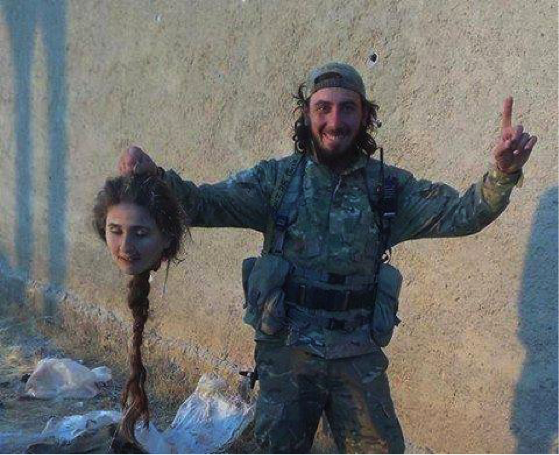
RehanaISIS Islamist with the head of “Rehana,” Peshmerga fighter.

Theology, for the most part, is the a priori premise for Muslim politics and evangelism, Islamism if you will. Culture proceeds from or is conditioned by religious writ or tradition in the Ummah.  The adjective “Islamic” before the noun “republic” is not just an historical artifact.

Indeed, since the 1979 Shia religious coup in Persia, the political trend lines throughout dar al Islam are clearly theocratic. You might call the recent Shia coup in Yemen a copycat killing. Secular Islam is in the crosshairs. The trend suffered a setback in Egypt recently, but only at the expense of a military coup.

Theocracy or the generals are the two political default settings in the Muslim world today. Priests and brass hats are never far from the nexus of power. If behavior is a measure of merit in the Ummah, the generals are to be preferred over the ayatollahs, Islamic scholars, mullahs, or imams. Cairo might take a nervous bow here.

A priori or unwarranted assumptions are not limited, however, to the Islamic side of the geo-strategic conundrum. European and American intellectuals, politicians, generals, and academics, are handicapped with the same infirmity.

Terror provides a snapshot of the logic that flows from flawed premises, foregone conclusions that attempt to absolve Islam.

After most atrocities, East or West, the specter of the late Edward Said reappears. Said is the Palestinian apologist, tenured at Columbia University, who coined the theory of “Orientalism,” a grab bag of complaints that cover a host of shibboleths that permit blanket absolution for the Muslim majority today.

Infidels in the West usually begin with ritual handwringing about the horrors of bombs, bullets, and beheadings, followed immediately by a logical hairball where moral poles are reversed — a universe where the Islamist villain morphs into the Muslim victim. Shooters and bombers are rhetorically excommunicated by Western Quislings.  Such is the “logic” that allows a black  politician from Chicago to declare emphatically that “ISIS is not Islam,” a little like parsing jackals from coyotes.

In contrast, few prominent Muslims condemn or ostracize jihadists. Jihad is as Muslim as Mohammed. Indeed, nearly 50 countries in dar al Islam now send Islamist fighters to ISIS, hirsute recruits that are happy to execute, in the name of Allah, any European, American, or East Asian that falls into their hands. Most recently, two Japanese civilians lost their heads. The executioner of choice at the moment apparently carries a British passport.

Before the blood dries after such barbarism, politicians and media pundits go on defense lest atrocity stain the veil of immunities created for all Muslims. Indeed, when the President of the United States or the Prime Minister of Britain says that ISIS, or any terror group, is not Islamic, they confer blanket amnesty on a sixth of the world’s population, the now celebrated “pacific,” passive-aggressive, Muslim majority.

The anointing of Islam as victim is underwritten by a litany of lesser and equally unsupportable excuses including but not limited to: colonialism, exploitation, poverty, illiteracy, imperialism, racism (sic), and moral equivalence. Of these, moral equivalence is the most absurd.

Few Muslim scholars, ayatollahs, or imams make any claim of moral equivalence. Mohamed, Islam, the Koran, and Hadith are thought to be a unity, the final, singular, and unalterable truth. The Islamist sees all other religions, Jewish, Christian, Buddhist, and Hindu especially, as infidels or apostasies, vessels of ignorance. Ecumenism and multiculturalism is only possible, and only a tactic at that, in polities where Muslims are a minority. Tolerance is nearly absent where Muslim majorities prevail.

Within major religions, moral consistency is now an oxymoron. Discrimination in the West is a still a vice while bigotry in Islam has been ordained a cultural virtue.

Jews and Christians have been removed from most Arab states and are in peril in the Muslim world at large. Jews in Europe are also under siege now by a coalition of traditional anti-Semites on the Left, augmented by irredentist Muslim immigrants on the Right.  In contrast, 1.5 million Muslim Arabs still thrive in the tiny state of Israel.

Equality is a claim made by western apologists on behalf of Islam. Few Sunni or Shia clerics or scholars confer equality, civic or religious, on the unbeliever — infidel or apostate. Among Muslims, small minorities like the Kurds, the Zezidi, Ahmadiyya, and the Sufi might legitimately think of themselves as moderates, but they represent only five percent of Islam.

Premature absolution of Islam is now the knee jerk response to all atrocity. Never mind that most terror groups are Muslim and proudly array themselves with all the predictable kit: incantations, black surah flags, the Koran, the Hadith, beards, and burkas — all in the name of Mohammed. Somehow we are supposed to believe that none of this has anything to do with true Islam. The Ummah plays the victim with the passive approvals of believers and the active collaboration of infidels. “Great religion” indeed!

A standard mantra claims that the majority of Islamist victims are Muslims, another absurd tautology. The summary execution of milquetoast Muslims by righteous Muslims is a kind of cultural masochism. Jihadists who kill, or are themselves killed, are celebrated from Gaza to Kabul as heroes or martyrs.

There is no organized, universal opposition to the bomb, bullet, or the knife in the Arab League or the 56 nations of the Organization of the Islamic Conference (OIC).  Indeed, the surah, the sword and the gun are the staples of modern Muslim iconography. Flags and banners alone put the lie to the “moderate” meme.

194001_5_Islam in London

When the goal is submission, the modalities for victory are clear, indeed, endorsed by scripture. No Muslim cleric argues that any surah, Koranic admonition, needs amendment or reform. Individual or isolated voices might be raised against violence, but there is no reform movement.

The reform vacuum has its own logic. The reformer would be an apostate and a target in any case.  The penalty for apostasy is death!  Ayaan Hirsi Ali and Salman Rushdie are examples. What is there to alter if you believe that you have the immutable word of God as guidance? And why change anything if you are winning?

The imperial Islamic 5th column in the West now punctuates evangelism with periodic massacres like Charlie Hebdo in Paris just to remind infidels which side has the upper hand.  Global terror may not be orchestrated by any one Muslim group or Islamic state. Alas, centrifugal terror is a tactical conundrum for the West and a strategic asset for the Islamist. Nothing succeeds like viral success.

Strategy in Brussels and Washington has deteriorated to what amounts to “whack-a-mole,” a carnival game where the hammer falls only where the rodent raises its head. ISIS is the rodent du jour. The tunnels of Gaza are the literal incarnation of such Muslim tactics, the strategic significance of which is designed to bleed Israel, in particular, and the West, in general, into submission.

Appeasement in the West and serial terror in the East makes for a calculus where new terror groups or Islamic states are likely to proliferate. ISIS, Boko Haram, and Hisb ut Tahrir provide some of the more recent evidence.

ISIS is the new and now more candid face of Islamo-fascism, savage and uncompromising, with a flair for public relations. Brute force is the attribute that merits the fascist label. Preliminary evidence suggests that ISIS tactics, on a global scale, are better proselytizers and recruiters than any al Qaeda atrocities. Al Baghdadi is not just another Sunni Osama bin Laden.  Baghdadi is worse — and more effective at the same time.

When American soldiers like Chris Kyle used words like “savages” to describe Islamists, he was only giving voice to the least offensive description of those who kill in God’s, Mohamed’s, or Islam’s name.

Boko Haram is another metastasizing menace. With the assistance of the US State Department, these Islamic slave traders flew under the terror radar for decades. The ninnies at Foggy Bottom can’t bring themselves to put the words “black Muslim slave trading terrorists” in the same sentence. Political correctness in Washington is a kind of Yankeefatwa nowadays, a death warrant, especially for African schoolgirls.

Political correctness is now the official Achilles heel of social democracies.

Hizb ut Tahrir is another caliphate proselytizer flying under the media radar with an assist from the US State Department and the Intelligence Community. HT activities seldom see the light of day although this mutation of Sunni Islamism now operates openly, like al Ikhwan (aka, the Muslim Brotherhood), without a US terrorist designation and associated scrutiny. If the activists of HT, al Ikhwan, and affiliates were audited, the totals would number in the hundreds of millions.

Moderation among Muslims is not a function of kinetics so much as it is a function of cultural affiliations and sympathies. The Pew Research Center and World Health Organization surveys provide ample testimony to toxic Islamic attitudes and social abuses like capital apostasy, polygamy, and consanguinity.

At the moment we live in an era where the Muslim Brotherhood, and affiliates (see CAIR), are welcomed at the Oval Office, but the Prime Minister of Israel is snubbed and reviled. The reasons for such folly are clear: fear for the economy, fear for energy sources, fear of global Muslim numbers, and ultimately the fear that terrorism might get worse.

The US State Department is one of the few institutions in America, other than the Nation of Islam, blessed with the gift of prophecy.  Logic, reason, and morality have been subverted to serve the cause of appeasement. Pandering to savages has always been the one policy choice that guarantees that things will get worse.


ISIS Purifies Islam Through Fire

February 4, 2015

ISIS Purifies Islam Through Fire, Front Page Magazine, February 4, 2015

(The “non-Islamic” Islamic State is not the only Islamic entity that “purifies” by fire. That’s how many “honor killings” are done. When The Islamic Republic of Iran uses nukes against its enemies, it will “purify” them wholesale.– DM)

Islamic purification

Fire is symbolic of the destruction of evil. Symbolically people who are burned alive are human sacrifices that are expiating evil from the community. Tainted victims are purified through fire.

Filming and disseminating the ritual killing strikes fear into the hearts of enemies and attracts new recruits. Similar to an arsonist that is fascinated with fire, disaffected young people will be attracted to this ritual burning. Like moths to a flame.

*****************

On Tuesday February 3, 2015 the Islamic State released a video showing Jordanian pilot, Lt. Muath al-Kaseasbeh, 26 being burned alive while locked in a metal cage. The 22 minute video includes footage of Jordan’s King Abdullah II declaring his support for the anti-ISIS coalition. It shows Lt. Al-Kaseasbeh, who was captured by the Islamic State in December after his aircraft crashed over Syria, being interrogated, paraded in front of heavily armed men, walking towards the cage, and then standing inside the cage wearing an orange jumpsuit that is doused in flammable liquid. The executioner uses a torch to light a trail of gasoline that leads to his feet. Lt. Al-Kasasbeh is engulfed in flames and remains alive for over 1 minute and half and collapses to the floor. Militants pour broken masonry and other debris over the cage which is then flattened with a bulldozer with the body still inside. Despite the surprise and shock of seeing a young man burned alive, this is not a new tactic. In fact it is a common method of ritual murder in Iraq and other countries particularly in honor killings and the murder of Christians. The significant difference is that the Islamic State media films the execution using sophisticated editing and highly choreographed techniques turning the killing into a scripted reality show.

Hundreds of women in the Muslim world have been murdered by fire in honor killings. The murders were often disguised as suicides or accidents. In the first six months of 2007, in Iraqi Kurdistan, 255 women were killed, three-quarters of them by burning. An earlier report cited 366 cases of women who were the victims of so called fire accidents in Dohuk in 2006, up from 289 the year before. In Irbil, there were 576 burn cases since 2003, resulting in 358 deaths. In 2006 in Sulaimaniyah, Iraq there were 400 cases of women burned. In Tunisia in May 2014 a father burned his 13 year old daughter to death for walking home with a boy. In October 2013 a 15 year old Yemeni girl was burned to death by her father for communicating with her fiancé. In March 2009, a sixteen year old Muslim girl suspected of having a relationship with a boy was burned to death by four male neighbors in her village in Ghaziabad, North India. They came to the girl’s house and demanded to know why the young man frequently visited her, and then the men beat her, doused her with kerosene and set her on fire. There are numerous more examples of women burned alive. This form of punishment is not just reserved for women. In April 2011 three men were set on fire in Iraq for being gay. A video of that incident is easily accessible online. In June 2008, the Taliban burned three truck drivers of the Turi tribe alive for supplying the Pakistan Armed Forces. There have been numerous reports of Christians burned alive by Islamist jihadists. In November 2014 a Christian couple in Pakistan Sajjad Maseeh, 27, and his wife Shama Bibi, 24, were burned alive in a brick furnace after it was rumored that they had burned verses from the Quran.”Bibi, a mother of four who was four months pregnant, was wearing an outfit that initially didn’t burn…… The mob removed her from over the kiln and wrapped her up in cotton to make sure the garments would be set alight.” These incidents are rarely reported by the mainstream media and were difficult for most people to comprehend as real until ISIS started filming documentaries of their ritual murders.

Fire is symbolic of the destruction of evil. Symbolically people who are burned alive are human sacrifices that are expiating evil from the community. Tainted victims are purified through fire. Fire is considered a powerful transformer of the negative to the positive. Because of such properties, fire is commonly found in purification rites throughout the world. In other cultures polluted persons may be required to walk around, jump over, or jump through fire. Historically, burning a person to death was reserved for the most threating evil, such as heresy or witchcraft and considered an extreme form of purification. In the context of honor killing the use of fire is not only symbolic but practical. Practical in Iraq because most of the homes do not have electricity so every house has a large supply of oil which makes it easier to conceal honor killings under the guise of suicide or kitchen accidents. In the context of the murder of Lt. Muath al-Kaseasbeh fire is an Islamic purification ritual that serves vengeance and restores honor and purity to the community of believers.

Islamist jihadists from different movements, countries, sects, and factions all emphasize the need to cleanse Islam of its impurities. Al Qaeda’s ideological belief is the purification of Islam through violent struggle. Bin Laden and Al-Zawahiri have continually called on supporters to purify Muslim holy lands of infidels, un-Islamic beliefs, and practices. The Islamic State cleanses Islam of its impurities while protecting its territory in the same manner as Mexican cartels, using brutal tactics that are justified as vengeance.

The title of the video, Healing the Believers’ Chests, is a quote from the Quran: “Fight them, and Allah will punish them by your hands, cover them with shame, help you over them, heal the breasts of Believers.” (Qur’an 9:14). It was reported to mean ‘giving them pleasure’ – interpreted as a reference to achieving revenge. That is one interpretation, however healing is symbolic of purification, the title Healing the Believers’ Chests can be understood as cleansing the community of the contamination of impurity. Lt. Muath al-Kaseasbeh’s alleged crimes symbolically unleashed an epidemic of contagious evil. The function of the burning ritual is a communal act of expiation, expelling the contagious evil of an infidel enemy through fire. Having ISIS fighters participate and watch makes it a communal sacrificial ritual. Ritualizing the violence justifies it and makes it sacred. Once the transgressor is ritually killed the impurity is removed, the evil has been expelled, taboo has been ameliorated and justice is served. The body is immediately buried under the earth, another purifying element, restoring honor and purity.

Filming and disseminating the ritual killing strikes fear into the hearts of enemies and attracts new recruits. Similar to an arsonist that is fascinated with fire, disaffected young people will be attracted to this ritual burning. Like moths to a flame.