Archive for the ‘Syria ceasefire’ category

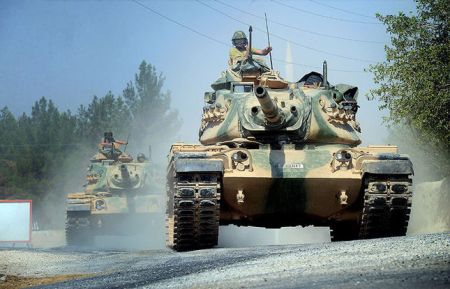
Turkish army like Iraqis stalled by ISIS pushback

December 28, 2016

Turkish army like Iraqis stalled by ISIS pushback, DEBKAfile, December 28, 2016
turkeytrot

Wednesday, Dec. 28, hours before US Secretary of State John Kerry was due to deliver a major speech on his vision for the Middle East, Turkey and Russia announced a ceasefire plan going into effect the same night for the whole of Syria, and in all regions, where fighting between pro-government forces and opposition groups were taking place – excepting for terrorist organizations.

Moscow and Ankara assumed the role of guarantors of the process. This accord will be brought for approval before the Syrian peace conference to be convened in the Kazakhstan capital, Astana, this week, attended by Russia, Turkey, Iran, the Syrian government and Syrian opposition groups. The US and Europe were not invited.

Not content with kicking Washington out of any role in resolving the Syrian crisis, the Turkish president Tayyip Erdogan accused the US, leader of the Western war on the Islamic State, of supporting “terrorist groups.”

He claimed Tuesday to have evidence of the US “giving support to terrorist groups including Daesh, YPG, PYD,” adding, ” We have…  pictures, photos and videos.”

While Erdogan is scoring in the diplomatic arena, he faces nothing but frustration militarily over the failure of the large, professional Turkish army to gain ground in the battle for Al Bab in northern Syria. This is Turkey’s first face-to-face with the Islamic State in its  four-month old Euphrates Shield operation in northern Syria – and it is not gong well. The fighting is deadly with no end in sight.

This may partly account for Erdogan’s oddly inconsistent behavior.

Tuesday, Dec. 26, he quietly asked the Obama administration to step up its air support for the Turkish campaign to capture Al Bab, 55 km north of Aleppo and the only major town in ISIS hands in northern Syria. He accused the US of not doing enough.

It was doubly odd in that Turkey has a large air force of its own, and if that force was not enough to support the campaign against ISIS, Erdogan’s obvious address for assistance would be his ally in the Syrian arena, Russian President Vladimir Putin. After all, Ankara, Moscow and Tehran are in the middle of a shared effort to set the rules of the game in Syria, which has pointedly excluded the US under the Obama administration.

As to the state of the fighting, on Dec. 21, Erdogan claimed: “Right now, Al-Bab is completely besieged by the Free Syrian Army and our soldiers.” In fact, this siege has been in place for weeks and, worse still, the casualties are mounting.

Wednesday, Dec. 28, the Turkish military said  it had “neutralised” 44 Islamic State fighters in Al Bab and wounded 117 in Al Bab,  while 154 Islamic State targets had been struck by artillery and other weaponry.

No casualty figures have been released for the Turkish army fighting for Al Baba. They are conservatively estimated at 90 dead and hundreds injured. The losses of Free Syrian Army (FSA), the local rebel force fighting alongside the Turkish army, are undoubtedly heavier still.

Our military and counterterrorism experts explain how the Islamic State’s beleaguered fighters are not just holding out in Al Bab against a superior army, but running circles around it.

The jihadists took the precaution of clearing back passages from Al Bab to their headquarters in Raqqa, 140km to the southeast, and Palmyra, 330km away.

This heritage town, which the Russians took from ISIS several months ago, was recaptured by the jihadists earlier this month, when Russian forces were fully engaged with capturing Aleppo. The US air force has in the last few days redoubled its strikes on Palmyra – both to cut off the flow of reinforcements and supplies to the besieged ISIS fighters in Al Bab and to clear the way for Russian forces to recover the lost town.

This US-Russian cooperative effort is at odds with the Obama administration’s presentation of Washington’s prickly relations with Moscow.

Notwithstanding the forces ranged against it, ISIS has so far managed to repel almost every Turkish bid to break into Al Bab – thanks to the new tactics it has introduced to the battles for Syrian Al Bab and Iraqi Mosul, which mark a turning point in the war on Islamist terror in those countries.

Those tactics hinge heavily on maximizing enemy casualties in order to knock the opposing army off the battlefield.

This is achieved by a deadly mix of guerilla and terrorist methods, and includes car bombs, bomb belt-clad suicides, improvised explosive devices (IED), sniper squads, gliders carrying explosives with small parachutes, as well as the increasing use of anti-air missiles and poison chemicals.

Tuesday, Iraqi Prime Minister Haydar Al-Abadi estimated that the Iraqi army needed another three months to beat ISIS in Mosul. He was trying to buck up the Iraqi people by concealing the true situation.
The fact is that the Iraqi military offensive against ISIS in its Mosul stronghold has ground to a halt – and no wonder, when some units have suffered a 50 percent manpower loss.

Gen. Stephen Townsend, commander of American troops in Syria and Iraq, was of the opinion last week that at least two years of fighting were needed to drive ISIS out of its two capitals, Mosul and Raqqa. He did not spell this out, but his meaning was clear: to achieve this objective, a far larger army was needed than the military manpower available at present.
How Iran actually lost in Aleppo

December 26, 2016

How Iran actually lost in Aleppo, American ThinkerHeshmat Alavi, December 26, 2016

For 16 years America has failed to adopt a correct policy in the Middle East despite having huge opportunities to make significant changes. The 2003 war literally gift-wrapped Iraq to Iran, parallel to the highly flawed mentality of preferring Shiite fundamentalism to Sunni fundamentalism. This allowed Iran take full advantage of such failures and resulting voids.

Aleppo will be a short-lived success story for Iran. The tides are changing across the globe and Iran will no longer enjoy opportunities from West rapprochement. Understanding this very well, this is exactly why Tehran has resorted to such atrocities and sought to massacre all in Aleppo.

In contrast to how the U.S. handed Iraq in  a silver plate to Iran, Russia never entered the Syria mayhem to hand it over to Iran. The roots of Aleppo remain in the hearts of all Syrians. As world powers, especially the U.S. and Russia review their future objectives, Iran will be the first and ultimate party to suffer.

***********************************

Following a historic period of perseverance, Syrian rebels and their families were forced to evacuate eastern Aleppo after its liberation back in 2012. An unjust, intense war was launched upon Aleppo by Iran’s Revolutionary Guards (IRGC) and its proxy forces on the ground: Russia with its indiscriminate air strikes, and a lame-duck Syrian army of less than 20,000 deployable forces.

After more than 15 months continuous air raids and a long-lasting inhumane siege, Syrian rebels and civilians sealed an international agreement to depart Syria’s once economic and cultural hub.

In the past few weeks widespread bombing campaigns continued relentlessly on civilian areas. No Aleppo hospital was spared. The IRGC and its foot-soldiers, numbering at the tens of thousands, spearheaded the military of Syrian dictator Bashar Assad in horrific mass executions of innocent people. The United Nations reported 82 individuals, including women and children, were murdered on the spot in the streets and in their homes. God knows how many more incidents have gone unreported.

The amazing perseverance shown by Aleppo locals for years now in the face of atrocious airstrikes and artillery shelling is unprecedented to say the least. Amidst all this, the silence and inaction seen from the West, especially the United States, will remain forever a source of shame.

Conflict of Interests

In the pro-Assad camp there are three decision-makers. First Russia, second Iran, and third the Syrian regime. The role played by Assad and his military in such scenes is next to nothing.

The West and Turkey became frantic for a ceasefire in Aleppo in the early days of the war due to the negative public opinion resulting from shocking crimes. They sought to have the rebels and remaining civilians transferred to other Syrian opposition controlled areas.

On December 13th, Washington and Moscow reached what can be described a ceasefire agreement. Intense negotiations between Turkey and Russia were started afterwards, resulting in an agreement between the Syrian opposition with Russia and Turkey to evacuate Aleppo. Practically, the parties involved in the talks were Aleppo representatives and Russia, hosted by Turkey. All necessary preparations were made to begin evacuating the city from the morning of Wednesday, December 14th.

However, Iran disrupted this agreement and the IRGC hindered the evacuation process. It was crystal clear Russia and Iran were pursuing different objectives and sets of interests. Iran sought not to have Aleppo evacuated but to exterminate all Syrian rebels and civilians.

Twenty-four hours later, pressure from the international community forced the implementation of the Russia-Syrian rebel agreement on December 15th. On the morning of that day the first convoy carrying the wounded exited Aleppo, only to face roadblocks imposed by Iran-backed forces and the Assad military.

Iran raised certain conditions for the evacuation. Russia later threatened to airstrike any party hindering the evacuation, an obvious warning to Iran. Tehran was forced to wind back under Moscow pressure.

As a result, the last phase of this war and the method chosen to evacuate Aleppo was a defeat for Iran and a victory for the Syrian opposition. Especially since the conflict of interest between Iran/Assad and Russia became crystal clear. Politically speaking, Iran has become a secondary party in Syria.

“For Putin, a political settlement now makes sense. Staying involved in an ongoing insurgency does not. But for that, he needs the opposition — which is fractured — to accept a political outcome, and there is little prospect of that so long as Assad remains in power,” as explained by Dennis Ross, who served as the Director of Policy Planning in the State Department under President George H. W. Bush, the special Middle East coordinator under President Bill Clinton, and was a special adviser for the Persian Gulf and Southwest Asia (which includes Iran) to the former Secretary of State Hillary Clinton.

Is this the end?

The turn of events does not spell the end of the Syrian opposition. The opposition controls large swathes of Syria, with areas over ten times larger than Aleppo and millions of residents. Idlib Province has at a three million strong population; the western coast of the Euphrates in the Turkish border, recently liberated by the Free Syrian Army from Daesh (ISIS/ISIL); large portions of Deraa Province neighboring Jordan; a strategically important section in the north in Latakia Province on the Turkish border; large portions of areas in the Damascus vicinity and large portions in the Aleppo vicinity.

In contrast to Western mainstream media reporting, the Syrian opposition enjoys the capability to rise once again.

Despite all its differences, a comparison made to the Iran-Iraq War may help. In 1986, Iran made significant advances taking control over the Faw peninsula in southern Iraq. Western media and think-tanks all forecasted further advances by Iran and a defeat for Iraq. In 1988 Iran was forced into a U.N.-brokered ceasefire agreement.

Deep divisions between the Syrian nation and the Assad regime have reached the point of no return. Nearly 500,000 have been killed and more than half of the Syrian population displaced. The Syrian nation will never accept the continuation of this regime. Despite sporadic military advances, Assad has no place in Syria’s future.

Where Iran stands in Syria

Iran will not be the final victor in Syria.

First — For Iran, it is vital to maintain Assad in power. His fall will mark the end of Iran’s crusades in Syria. Even if the Syrian opposition becomes weaker, the overall crisis will continue while Assad remains in power. Assad is no longer acceptable in the international stage with an international consensus over his resort to war crimes and crimes against humanity.

Second — While Iran is financing and providing the ground forces, in this war, it no longer enjoys the first and final word. Russia calls the shots now with stark differences in interest, as seen in Aleppo.

Trump’s America

U.S. President Barack Obama’s weak foreign policy, especially the failed engagement with Iran, prolonged the Syrian crisis, allowed Tehran to take advantage, Russia to take the helm and America be sidelined.

Where will developments lead with Donald Trump in the White House? What will be the new U.S. foreign policy vis-à-vis Syria, Iran and the Middle East? How can we define Washington’s relationship with Moscow, and what practical measures will Trump take against Daesh (ISIS/ISIL)? Time will tell.

Good relations between the U.S. and Russia will at least not have a negative impact on the region, and this is good news for the Syrian opposition. Russia has weighable interests in Syria. However, what will Trump do with Iran? Considering Trump’s harsh tone on Iran to this day, far more positive outcomes can be forecasted for the Syrian opposition.

Second, Trump and secretary of state nominee Rex Tillerson have the potential of eventually convincing Russia to provide concessions. This is not in Iran’s interests, as Tehran remembers Russia ditching Libyan the dictator Muammar Qaddafi.

Lesson learned in Syria

For 16 years America has failed to adopt a correct policy in the Middle East despite having huge opportunities to make significant changes. The 2003 war literally gift-wrapped Iraq to Iran, parallel to the highly flawed mentality of preferring Shiite fundamentalism to Sunni fundamentalism. This allowed Iran take full advantage of such failures and resulting voids.

Aleppo will be a short-lived success story for Iran. The tides are changing across the globe and Iran will no longer enjoy opportunities from West rapprochement. Understanding this very well, this is exactly why Tehran has resorted to such atrocities and sought to massacre all in Aleppo.

In contrast to how the U.S. handed Iraq in a silver plate to Iran, Russia never entered the Syria mayhem to hand it over to Iran. The roots of Aleppo remain in the hearts of all Syrians. As world powers, especially the U.S. and Russia review their future objectives, Iran will be the first and ultimate party to suffer.


John Kerry’s Amazing Alternative Universe

October 1, 2016

John Kerry’s Amazing Alternative Universe, Front Page Magazine, Daniel Greenfield, October 1, 2016

lucyfootball


Qatar, Iran, Saudi Arabia and Turkey want a secular Syria? Kerry truly is living in an alternate universe.

***********************

And now, breaking news from our nation’s greatest living diplomat slash coatrack.

US Secretary of State John Kerry has accused his Russian opposite number, Sergey Lavrov, of “living in a parallel universe” as the two exchanged heated remarks over the breakdown of the ceasefire in Syria at a meeting of the UN Security Council in New York.

It’s not a parallel universe. Russia pulls out the football at the last second. Kerry can’t seem to grasp why that keeps happening.

I listened to my colleague from Russia, and I sort of felt a little bit like they’re sort of in a parallel universe here. He said that nobody should have any preconditions to come to the table. Well, we met in Vienna twice. We met here in New York and embraced a United Nations Security Council resolution. We met again in Munich. And in each place, the International Syria Support Group, and here in the Security Council, the Security Council embraced a ceasefire applicable to all parties. That’s not a precondition. That’s an international agreement, four times arrived at.

And four times worthless. Any idiot would have figured this out by now. But John is still grappling with the obvious.

 Supposedly we all want the same goal. I’ve heard that again and again. Russia, Iran, the United States, Qatar, Turkey, Saudi Arabia, everybody sits there and says we want a united Syria – secular, respecting the rights of all people, in which the people of Syria can choose their leadership. But we are proving woefully inadequate in our ability to be able to get to the table and have that conversation and make it happen.

Qatar, Iran, Saudi Arabia and Turkey want a secular Syria? Kerry truly is living in an alternate universe.

UN Doesn’t Know What “Cessation of Hostilities” Means

April 30, 2016

UN Doesn’t Know What “Cessation of Hostilities” Means, Front Page Magazine, Daniel Greenfield, April 30, 2016

the-united-nations-failures

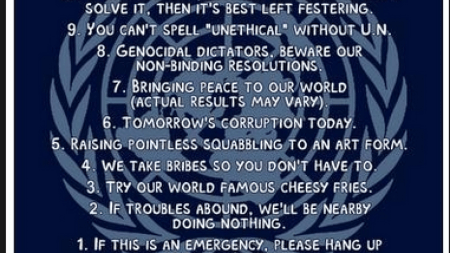
The only purpose of the Syria peace talks was to distract everyone from all the fighting in Syria. This is a Shiite vs Sunni holy war, with the addition of ISIS to make it a triangle. Most of the parties doing the fighting are not represented at the peace table. And the only reason the Russians were pushing the scam is to help Assad gain an advantage. Which he did.

So now we are going right back to where we started. And the UN is doing its useless grandstanding.

The United Nations envoy mediating a resolution to the crisis in Syria warned that the latest round of talks was overshadowed by a substantial deterioration of the cessation of hostilities, and called on the leaders of the Russian Federation and United States to help salvage the “barely alive” pact.

“What we need to do and to hear is that the cessation of hostilities is salvaged and […] is saved from a total collapse,” Staffan de Mistura, UN Special Envoy for Syria, told reporters following a briefing to the Security Council yesterday.

Except that all the bombing and fighting casts some slight doubt on the existence of any “cessation of hostilities”.

“This round of talks has instead been overshadowed, let’s be frank, by a substantial and indeed worrisome deterioration of the cessation of hostilities,” he said. “We cannot ignore that and we have not ignored it.”

Cessation of hostilities means that the hostilities have ceased. If you have ongoing hostilities, then that’s not a deterioration of a cessation of hostilities. It means that the cessation of hostilities doesn’t exist.

“Let’s put it in a few words: In the last 48 hours, we have had an average of one Syrian killed every 25 minutes. One Syrian wounded every 13 minutes,” he said.

But other than that the hostilities have ceased.

“You remember when the word transition, at least in certain area, was taboo? Not anymore. Everyone acknowledges that that is the agenda,” the envoy stressed.

The envoy also said that there is a clear understanding that a credible political transition should be overseen by a new credible and inclusive transitional governance that will be replacing the present governance arrangements. The other common point is that the transitional governance should include members of the present Government, opposition, independents and others, he said.

Great plan. Also we should invite the unicorns. And plant a money tree.

Russia has no reason to agree to a transition since it’s winning. The UN helped make that happen with its truce. The Sunni Jihadists, not to mention ISIS, have already shown in Libya what that kind of transition would look like.

The UN. It’s worse than useless.

Syria Ceasefire Already Collapsing

March 8, 2016

Syria Ceasefire Already Collapsing, Front Page MagazineJoseph Klein, March 8, 2016

syria-bashar

The two week “cessation of hostilities” within Syria is about to run out. Negotiated by the United States and Russia, who were responsible for bringing the parties over which they have influence along, the lull was intended as a confidence building measure and as a way of getting critical humanitarian supplies to besieged and hard to reach areas of Syria. Talks between Syrian government and opposition representatives are supposed to resume in Geneva on March 9th.

Secretary of State John Kerry hailed the agreement to temporarily halt the violence in a conflict that has taken more than 250,000 lives as “a moment of promise.”  While there is evidence that the fighting has dropped noticeably overall since the cessation of hostilities went into effect on February 26, 2016, the violence never really stopped. On the second day alone of the lull, there were reportedly “35 breaches, 27 by violations by government forces, 8 by Russian forces,” according to the Syrian Network for Human Rights.

Airstrikes continued throughout Syria, some by Russia on the pretext that they were aimed at fighting ISIS and al Nusra. Rebel-held enclaves in and around Aleppo have come under particularly intense bombing attacks, said to be by Russian planes.

The Syrian Observatory for Human Rights said last Saturday that 135 people have lost their lives in areas where there was supposed to be a pause in hostilities. According to Israeli sources, the Syrian government has reportedly used chemical weapons against civilians since the cessation of hostilities were supposed to go into effect.

The United Nations has nevertheless been able to use the drop in hostilities to deliver some desperately needed humanitarian relief, although it has been stymied by bureaucratic obstacles put in the UN’s way by Syrian authorities. Sometimes, Syrian officials have gone so far as removing medical supplies from humanitarian convoys that had received permission to deliver their cargoes.

Perhaps the United States and Russia will push for an extension of the cessation of hostilities. Kerry and his Russian counterpart, Russian Foreign Minister Sergei Lavrov, have called for a prompt resumption of the peace talks in Syria, which would be hard to assemble if fighting resumes full throttle. They are evidently hoping that the partial success of the lull in fighting so far will provide momentum for successful talks. If so, they are dreaming. Kerry in particular is relying on the fatally flawed road map to a negotiated political solution in Syria that was laid out in last December’s UN Security Council Resolution 2258 (2015).  As I wrote last December when the resolution was adopted, the players were simply kicking the can down the road to no avail.

The Syrian regime, with Russia’s help, has made major military gains on the ground in recent months. Momentum is on its side. The opposition groups are losing negotiating leverage every day as a result of the regime’s advances and the opposition’s own internal divisions. Though the opposition is at least united on calling for Syrian President Bashar Al-Assad to step down immediately, they are whistling in the wind. Assad has no reason to go as long as Russia and Iran remain willing to stand behind him.

Russia has clearly changed the whole strategic situation in Syria by showing its willingness to engage militarily to the extent necessary to keep Assad in power as long as he serves their purposes. Just as President Obama foolishly dismissed the ISIS threat early on, his dismissal of Russia’s determination and capabilities was premature, to say the least.

The Obama administration’s vacillations in its Syrian policies, which left vacuums for both ISIS and Russia to fill, are now limiting its options going forward. Even in the unlikely case that President Obama now believes that the introduction of a large number of U.S. ground troops has become necessary to fight ISIS, give a nudge to Assad to abdicate and help stabilize what is left of Syria, the American people would not support the prospect of another protracted conflict in the Middle East.

Moreover, the Obama administration cannot even lead the way among its own allies, much less bridge the gap with Russia and Iran who remain committed to Assad. The administration’s efforts to assemble a real coalition of Arab nations willing to commit major ground troops to fight ISIS in tandem with our stepped up airstrikes have gone nowhere. Saudi Arabia and Qatar do not appear willing to cut off the flow of arms and money to the jihadists, whether or not they belong to ISIS or al Nusra. Saudi Arabia is even insisting on which opposition groups should officially represent the opposition in the Geneva talks, with little apparent pushback from the Obama administration.

Turkey is presenting its own headaches for the Obama administration. Its strongman president Recep Tayyip Erdogan accused the Obama administration of adopting a policy that has turned the Mideast into “a sea of blood.” He was particularly upset that the U.S. is relying on Kurdish fighters in Syria to help take on ISIS. The Kurds have been among the most effective ground forces we have to push back ISIS from territories it controls. Erdogan, however, regards the Kurds as terrorists who are more dangerous than ISIS. He blocked the Syrian Kurds from having any official representation in the Geneva peace talks, and is asking the U.S. to choose between Turkey and the Kurds as allies. The way Erdogan has been acting the last several years, we should tell him that unless he starts to fully cooperate and subordinate his parochial concerns to the global fight against ISIS, we will be prepared to support an independent Kurdistan right on his border. That should get his attention.

In short, the cessation of hostilities interlude, even if extended, will do nothing to change the underlying dynamics preventing a viable peace accord leading to the kind of inclusive Syrian government the Obama administration would like to see. However, to the extent lives have been saved and humanitarian relief has been allowed to get through for the first time, the pause in fighting has been a good thing in itself.

Kerry Announces New Plan not to Talk about Failed Ceasefire

March 1, 2016

Kerry Announces New Plan not to Talk about Failed Ceasefire, Front Page Magazine, Daniel Greenfield, March 1, 2016

kerrynuke_1

Long, talk [Sic] drink of failure John Kerry is on his second failed ceasefire in Syria in a matter of weeks. And he’s got a bold new plan for dealing with the fact that everyone is still shooting up Syria. Don’t ask, don’t tell.

John Kerry said on Monday he had agreed with his Russian counterpart not to discuss alleged violations of a cessation of hostilities plan in Syria… Speaking at a news conference with German Foreign Minister Frank-Walter Steinmeier, Kerry said he had talked with Russian Foreign Minister Sergei Lavrov and agreed not to “litigate … in a public fashion” the reports of violations on both sides.

So the plan is for Russia to keep violating the ceasefire while Kerry and the Europeans refuse to mention it. This is pure genius. They’ve really got Putin on the run now.

This will be followed by a bold plan to ignore any Iranian violations of the nuclear deal and just hold more negotiations to create a mechanism for privately resolving any violations.

And people said that John Kerry was unqualified to get a cup of coffee, let alone be America’s top diplomat. I bet that Kerry could get a cup of coffee almost without burning himself. But the ceasefire that isn’t, is producing all sorts of unintended results.

Over the past month, the Kremlin has turned up the dial once again in its low intensity war in Ukraine’s east.

In September 2015, when the Kremlin decided to intervene in Syria, it reduced the violence in the Donbas and reined in local fighters who opposed this course. Before September, ceasefire violations had averaged 70 to 80 fire incidents per day, before dropping to 30 to 40.

Can someone give Obama another Nobel Peace Prize? Maybe an even bigger one covered in diamonds. Because he deserves it. He really does.

Everyone in Syria is Violating Kerry’s Imaginary Ceasefire

February 28, 2016

Everyone in Syria is Violating Kerry’s Imaginary Ceasefire, Front Page Magazine, Daniel Greenfield, February 28, 2016

obama_kerry_bikes

Good news. The ceasefire in Syria is “holding”. You know the great Kerry diplomatic achievement after letting Iran go nuclear and forcing Israel to free a bunch of terrorists. It’s holding about as well as a leaky roof in the rain because everyone and their cousin is violating the mostly imaginary ceasefire.

The Saudis claim that the Russians are violating the ceasefire.

Saudi Arabia on Sunday accused President Bashar al-Assad’s regime and its ally Russia of “ceasefire violations” in Syria.

“There are violations to the ceasefire from Russian and (Syrian) regime aircraft,” Saudi Foreign Minister Adel Jubeir told reporters in Riyadh.

“We are discussing this with (the 17-nation) Syria Support Group,” co-chaired by Russia and the United States, said Jubeir.

The Syrian Observatory for Human Rights has said that several air strikes hit central and northern Syria on Sunday.

Warplanes, believed to be either Syrian or Russian, bombed seven villages in the provinces of Aleppo and Hama, the monitor said.

The Russians are accusing the Syrian rebels of violating the ceasefire.

The Sunni opposition claims 15 violations. The Russians claim 9 violations. And the ceasefire just began. So it’s off to a great start.

Also nobody is really sure what counts as a violation because this agreement was negotiated by John Kerry.

“We do not know which planes carried out the strikes and also we are not sure if this is considered a breach to the truce because it is not clear if these towns are included in the truce,” Abdulrahman said.

So to summarize, the ceasefire is holding, but no one is sure what the ceasefire involves and everyone is violating it.

If you loved this Kerry diplomatic achievement, just wait till Iran detonates its first bomb.


