Archive for the ‘State Department’ category

Iran’s chutzpah

May 3, 2015

Iran’s chutzpah, Jerusalem Post editorial, May 2, 2015

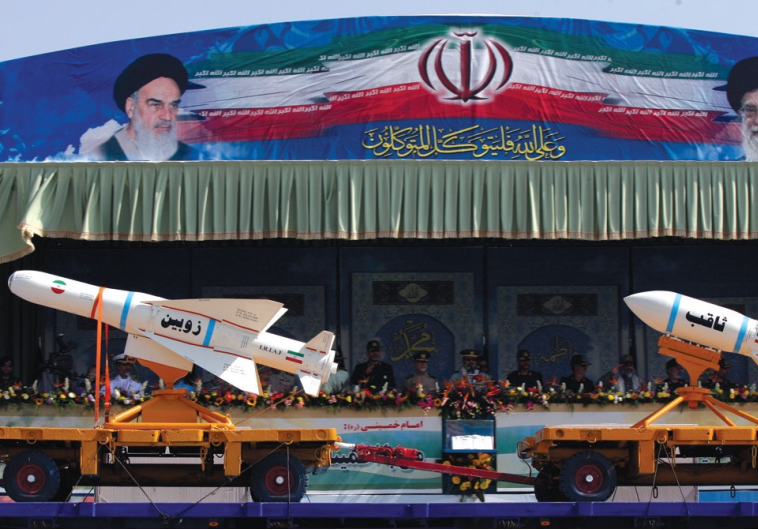
Iran chutzpahIran. (photo credit:REUTERS)

Whenever we assume that Iran’s chutzpah can get no more egregious, Tehran’s powers-that be spare no effort to prove us wrong.

Their calculated ploy is transparent – since the Islamic Republic’s nuclear project is now the focus of global attention, its leaders have cynically decided to turn the tables on their critics. In the guise of holier-than-thou protectors of humanity, Iran last Monday demanded that everyone else in possession of nukes desist forthwith from upgrading them or from lengthening the shelf-life of these weapons.

Needless to say, the sanctimonious tit-for-tat was spitefully in-your-face.

Quite expectedly, Iranian Foreign Minister Mohammad Javad Zarif told participants at the Review Conference of the Parties to the Treaty on the Non-Proliferation of Nuclear Weapons in New York that it is Israel which poses the greatest menace to the Middle East and indeed to the entire world due to its alleged nuclear stockpiles.

The month long conference is held every five years and is attended by NPT signatory nations. Israel never signed the treaty and remains officially mum on whether it does or does not possess a nuclear arsenal.

Zarif brazenly branded Israel “the single violator of this international regime [the NPT]…,“ and said, “one of the most important issues in the NPT review process is to look into ways and means of bringing about the Israeli compliance with NPT.”

And if that message failed to hit home, Zarif also aimed his barbs at NATO, asserting that Iran and the other 117 non-aligned NPT signatories are “deeply concerned by military and security doctrines of the nuclear-weapon states as well as that of the North Atlantic Treaty Organization.”

Yet Israel, which Iran had time and again threatened to wipe off the map, was singled out for particular accusations of villainy. Iran shamelessly seized on a persistent Egyptian theme – an attempt to deprive Israel of whatever nuclear powers it is believed to possess and coerce Israel to sign the 1970 NPT.

In 2005, Egypt scuttled the NPT resolutions because they did not specifically target Israel’s purported nuclear weaponry. In 2010, Egypt, still under Hosni Mubarak, persuaded the US to address Israel’s nuclear capability in the final communiqué – making Israel the only state mentioned, unlike the openly nuclear Pakistan and India (which like Israel also had not signed the NPT).

Israel saw this as a sell-out by the Obama administration.

The conference said nothing about Iran but urged that Israel rid itself of nuclear arms and that it allow international inspectors to visit and monitor its installations.

What five years ago was considered as unprecedented hypocrisy by the NPT Conference has now magnified to truly grotesque proportions. If Iran was just an unnamed elephant in the room last time around, it has since grown emboldened enough to lay blame on others.

Presumably this is part and parcel of a scheme to deflect attention from Tehran’s nuclear ambitions while a deal that would allow it to develop atomic warheads is in the making.

On the face of it, Iran can claim moral equivalence. But this is a counterfeit claim. Iran and like-minded allies – to say nothing of the powers now negotiating a deal with the ayatollah regime – all know that Israel is as prudent a democracy as exists anywhere. If Israel actually has the bomb, then it has had it for more than 50 years – almost as long as the original “Atomic Club” members. In all that time no wrongful use was made.

Iran is the diametrical opposite to Israel – a regime professing extreme Islamist doomsday theology whose bywords are volatility and unpredictability. There’s no even handedness between a self-defending democracy and an expansionist, apocalyptic tyranny.

Moreover, it is outrageous to ignore the variety of WMD deployed in the internecine Arab massacres but speciously concentrate on the Middle East’s one beleaguered democracy. The implication is that democratic Israel can be pressured while autocratic Iran will get away with flagrant obstructionism. The good-guy will be disarmed while fanatic aggressors are armed to the teeth.

The danger is that bona fide democracies seem willing to play along with Iran and misdirect the frustration it foments by spotlighting Israel.

Shia Militia Leader Explodes Over Possibility of U.S. Support for Kurdish Forces

April 30, 2015

Shia Militia Leader Explodes Over Possibility of U.S. Support for Kurdish Forces, Center for Security PolicyKyle Shideler, April 30, 2015

In the United States, the Obama Administration finds itself on the same side of the argument as Moqtada Al-Sadr, opposing the bill to permit arms for Kurdish forces.

******************

Shia leader Moqtada Al-Sadr, head of the Jaish al-Mahdi (JAM), issued a stark denunciation of the U.S. Defense Bill currently in front of the U.S. House of Representatives this week, threatening to fight U.S. interests both in Iraq and overseas, in the event that the bill passed.

Al Sadr opposes the bill, because it would authorize the direct transfer of military aid to Kurdish Peshmerga and Sunni tribal forces in order to fight the Islamic State, outside of the direct control of the central government in Baghdad.

“The U.S. House of Representatives intends to pass a draft law on Iraq making each sect independent from the other, and this will be the beginning of Iraq’s division,” Sadr said in a statement. If the U.S. passes such law, “then we will be obliged to lift the freeze on the military wing which is tasked with (fighting) the American side, to start hit the U.S. interests in Iraq and even abroad possibly,” Sadr warned.

Al Sadr’s JAM was one of the primary Shia militia forces used by Iran during Operation Iraqi Freedom, and responsible the deaths of numerous American fighting men and women. Iraq has primarily leaned on the use of Shia militias, operating under the rubric of the Popular Moblization Forces, but many of the 30,000+ militia fighters operate under direct command and control from the Iranian Islamic Revolutionary Guards Corps.

The Baghdad government, which is heavily supported by Iran, has also vocally opposedthe measure:

We will reject the arming of the Peshmerga directly by the US,” Iraq’s Defense Minister Khalid Al-Obeidi, told Rudaw on Thursday.

Kurdish forces have repeatedly complained that aid designated for use by their forces has repeatedly been redirected by the Baghdad government to Shia militias, some of whom are responsible for sectarian war crimes. Kurdish forces have also expressed concern over the entry of Shia forces into areas viewed by the Kurds as traditionally Kurdish, such as Kirkuk.

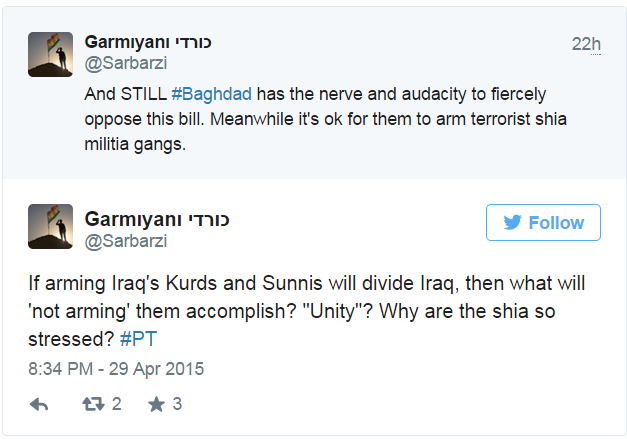
Supporters of the Peshmerga took to twitter to complain about the double standard:

garmiyani-tweet

In the United States, the Obama Administration finds itself on the same side of the argument as Moqtada Al-Sadr, opposing the bill to permit arms for Kurdish forces. As State Department Spokeswoman Marie Harf confirmed yesterday:

QUESTION: Yes. Do you have any comment about this draft resolution at the Armed Services Committee that calls for the recognition of the Sunni fighters and the Kurdish Peshmerga forces as a country, and so they can be – directly receive aid and weapons from the U.S., not through the central government?

MS HARF: I saw that. I saw that. And to be very clear: The policy of this Administration is clear and consistent in support of a unified Iraq, and that we’ve always said a unified Iraq is stronger, and it’s important to the stability of the region as well. Our military assistance and equipment deliveries, our policy remains the same there as well, that all arms transfers must be coordinated via the sovereign central government of Iraq. We believe this policy is the most effective way to support the coalition’s efforts.

So we look forward to working with congress on language that we could support on this important issue, but the draft bill, as you noted, in the House – this is very early in the process here for the NDAA – as currently written on this issue, of course, does not reflect Administration policy.

By opposing the direct arming of Sunni and Kurdish forces (and the Kurdish forces in particular), the administration is continuing a policy arc in the region that continues to serve the interests of the Iranians because it creates a dynamic where the only viable players are either Sunni jihadists (whether Islamic State, or in the case of Syria, Al Qaeda-linked groups such as Jabhat al-Nusra), or Iranian-backed forces, such as Assad and the Shia militias operating in Iraq, who are no less committed enemies of the United States.  Bringing supplies directly to Kurdish forces will give the United States a third option to positively affect the outcome of events in Iraq without requiring the modus vivendi with the Iranians.

Report: Kerry Told Iran He Wishes ‘U.S. Had a Leader like Iran’s Supreme Leader’

April 29, 2015

Report: Kerry Told Iran He Wishes ‘U.S. Had a Leader like Iran’s Supreme Leader’ Washington Free Beacon, April 29, 2015

(Who is fibbing?– DM)

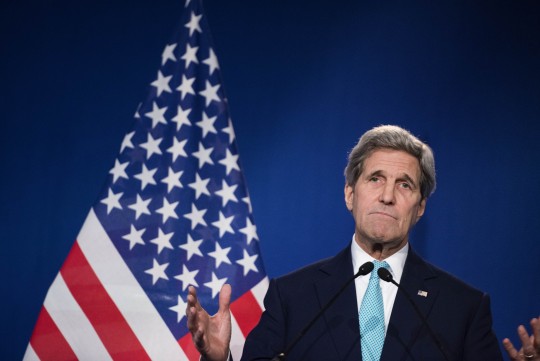
Kerry againAP

Secretary of State John Kerry told his Iranian counterpart that he wished the United States had a leader more like Supreme Leader Ayatollah Khamenei, according to comments made by a senior Iranian cleric and repeated in the country’s state-run media.

Ayatollah Alam al-Hoda claimed during Friday prayer services in Iran that in negotiations over Tehran’s contested nuclear program, Kerry told the country’s foreign minister that he “wished the U.S. had a leader like Iran’s supreme leader,” according to a Persian-language report on the remarkspublished by the Asriran news site.

“In the negotiations Kerry told [Iranian Foreign Minister Javad] Zarif that he [Kerry] wished U.S. had a leader like Iran’s supreme leader,” according to Alam al-Hoda, who is a senior member of the Iran’s powerful Assembly of Experts.

A senior administration official told the Washington Free Beacon that such a contention is patently absurd.

The remarks are the latest in a string of comments made by Iranian leaders purporting to reveal private details of the talks.

Iranian newspapers have carried multiple reports in recent months suggesting that Iranian Foreign Minister and chief negotiator Javad Zarif was ordered to stop screaming at Kerry behind closed doors.

In his Friday remarks, al-Hoda went on to say that Obama is set on striking a deal with Iran by June.

“Both Republicans and Democrats want these negotiations with Iran, but they fight each other for partisan interests,” he was quoted as saying. “Obama wants the negotiation to succeed so his party can win the next election and Republicans want to stop him.”

Alam al-Hoda also celebrated Iran’s expansion in the region and controversial activities in war-torn countries such as Syria and Yemen.

“Today, the resistance crescent has gone beyond Syria and Lebanon and reached to Yemen,” he said. “Today the resistance front is in control of Strait of Hormuz and Bab-el-Mandeb.”

The “U.S. and Israel have not been so weak anytime before,” he continues. “All these events are being managed by the hidden Imam,” a revered religious figure in Shia Islam.

Saeed Ghasseminejad, an Iranian dissident and fellow at the Foundation for Defense of Democracies (FDD), said U.S. overtures to Iran at the negotiating table have failed to win it any respect from the Islamic Republic’s leaders.

“President Obama thinks that by making more concessions he can gain the trust and respect of Iranian leaders,” Ghasseminejad said. “However, Iranian leaders neither trust him nor respect him.

“Seeing unprecedented weakness in the U.S. president, Iranian leaders do not fear the United States anymore. Partnership, trust, and alliance between the radical Islamist regime of Tehran and United States cannot and should not exist.”

Meanwhile, Zarif said over the weekend that fighting between the Obama administration and Congress over a potential final deal could not stop America from implementing any agreement the White House signs.

“As we have stated since the beginning, we consider the U.S. administration responsible for implementing the agreement and internal problems and conflicts in the U.S. are not related to us and to the implementation of the agreement, and based on the international laws, the countries’ internal problems don’t exempt them from implementing their undertakings and this is the main framework that we attach importance to,” Zarif said, according to the Fars News Agency.

On Monday, Zarif urged the United States to woo Iran.

“Maintaining an uncertain and unstable situation is not acceptable to Iran and the Americans should take practical and confidence-building measures to reach a comprehensive nuclear agreement,” Zarif was quoted as telling reporters.

Can and should Israel destroy Iran’s nuclear facilities?

April 5, 2015

Can and should Israel destroy Iran’s nuclear facilities? Dan Miller’s Blog, April 5, 2015

(The views expressed in this article are mine and do not necessarily reflect those of Warsclerotic or any of its other editors. — DM)

It has been suggested that Israel should seriously consider destroying Iranian nuclear facilities, but Israeli officials obviously haven’t said, and won’t say, if, how or when she might.

Iran fenced in

Speaking to Arutz Sheva Friday, Professor Efraim Inbar, who heads the Begin-Sadat Center for Strategic Studies, said the deal had realized Israel’s worst fears by leaving Iran’s nuclear program essentially intact.

The Islamic Republic’s nuclear program has been granted “legitimacy” by the agreement, which still allowed it to continue enriching uranium and to maintain a reactor capable of producing enriched plutonium, he said. “And that’s what worries Israel, that they (Iran) will be able within a short time frame to reach a nuclear bomb.”

“I hold the view that the only way to stop Iran in its journey to a nuclear bomb is through military means,” Inbar maintained, suggesting that “Israel needs to seriously consider striking a number of important nuclear facilities” to head off the threat.

On March 28, former U.S. Ambassador Bolton said that it should be done.

The P5+1 nuclear “deal,” proudly announced by President Obama on April 2nd, is a sham. There is no “deal,” and public announcements by Iran and Obama cast it in very different lights. According to Iran, all sanctions will be lifted immediately when an agreement is reached on or before June 30th. According to Obama, sanctions relief will be gradual and based on Iran’s compliance with invasive inspections and other conditions. Even National Public Radio (NPR) has pointed out differences. NPR observed that, according to Iran,

all sanctions relief – U.N., EU and U.S. – would be immediate. It was unequivocal. It stated that Iran under the deal was free to pursue industrial scale enrichment to fuel its own reactors – unequivocal. It stated that Iran was unhindered in its ability to conduct centrifuge R&D.

Iran has also emphasized that its intention to destroy Israel is non-negotiable, and the Obama Administration has rejected any efforts to make Iran recognize Israel’s right to exist, on the ground that

“This is an agreement that is only about the nuclear issue,” State Department spokeswoman Marie Harf told reporters on Friday night, according to Fox News. “This is an agreement that doesn’t deal with any other issues, nor should it.” [Emphasis added.]

Israeli Prime Minister Netanyahu has said that Israel’s right to exist is non-negotiable.

Iran is very unlikely to retreat from its perception of the “deal,” Obama is very likely to retreat in Iran’s favor, and Israel is very unlikely to retreat from its perceptions about Iran, the “deal” or Israel’s right to exist.

What should Israel do?

In Martin Archer’s novel Islamic War, which I reviewed here, Israel dispatched elderly, large and substantially refurbished remove controlled aircraft, full of high explosives, from Somalia to half dozen nuclear facilities operated by hostile nations. They flew circuitous routes at varying altitudes to avoid detection until it was too late to stop them. Over a period of weeks, they crashed into and destroyed their targets, amid speculation about who had done it and why. Israel was not suspected. Would that have been possible then? Now? I don’t know.

It has been reported that Saudi Arabia has given Israel clearance to use her airspace for an attack on Iran’s nuclear facilities.

Fox News reports that US Defense sources claim the Saudis are conducting tests on their air defense systems after giving Israel permission to to enter a narrow corridor to shorten the distance to attack Iran.

The testing would make sure that Saudi jets don’t get scrambled when Israel entered Saudi airspace. Once the IAF planes complete their mission and exit Saudi airspace, Saudi defenses would go back online again. [Emphasis added.]

Might Saudi Arabia, Egypt and perhaps other Gulf States go beyond not interfering with an Israeli attack to provide air support and other help? They seem to be as displeased with the “deal” as Israel is.

Assuming that Israel is not overly concerned about being identified as the attacker and is willing to act alone, she might:

Detonate one or more high-altitude atomic bombs to emit sufficient electromagnetic pulses (EMP) to fry all above-ground Iranian electronics. That would substantially disable Iranian above-ground command and control facilities as well as other communications, hence diminishing (but not eliminating) the possibility of counter-strikes by Iran and/or its proxies. Perhaps she has other, non-nuclear, means of generating EMPs; she hasn’t said.

Immediately thereafter, drop whatever suitable bombs she may have on all Iranian military and nuclear facilities. Does Israel have bunker-buster bombs? Probably not of U.S. manufacture, but that does not mean that she has not developed her own. It would be surprising if she had not.

Obama and other “leaders of the free world” would complain and the U.N. would emit fits of angry censures. However, that happens with great frequency in any event, and would be an insufficient reason for Israel to commit national suicide through inaction against Iran.

I am no “military expert” and would appreciate any comments on the suggestions I have made as well as any other suggestions anyone might care to offer.

A Statement on the Crisis in the U.S.—Israel Relationship

March 19, 2015

A Statement on the Crisis in the U.S.—Israel Relationship, Commentary Magazine, The Editors, March 19, 2015

(A lengthy but excellent summary, putting the relationship between the U.S. and Israel in perspective. — DM)

After six weeks of madness, Benjamin Netanyahu stood before Congress and delivered a speech about the nuclear threat posed by Iran. It was a terrific speech. It was not a remarkable speech, because nothing the Israeli prime minister said came as news to anyone who has been paying attention to the issue for the past decade.

What made his speech and its occasion of particular note were the atmospherics. It has been years since an address by a politician in the United States had been so hotly anticipated, and it wasn’t even to be delivered by an American. The anticipation was due entirely to Barack Obama’s incendiary response to the speaking invitation extended to Netanyahu in January by the Republican House leader, John Boehner.

The president’s displeasure and rage continued to grow, to the point that a few days before the speech, no less a personage than National Security Adviser Susan Rice said it would be “destructive of the fabric of the relationship” between the United States and Israel. On the day of the speech, the Democratic Middle East operative Martin Indyk declared on CNN that it was “the saddest and most tragic day” for the relationship in all his 35 years as a water-carrier.

In this case, we fear, the wish is father to the threat. Susan Rice and Martin Indyk see the relationship between Israel and the United States on a downward spiral because they and their boss want it so. Obama does not like the special status Israel seems to enjoy in the United States—not only because its particularistic and nationalist claim offends him ideologically, but because Israel’s popularity with the American people limits his freedom of action.

The relationship between the United States and Israel is in jeopardy because, from the moment his administration began, Barack Obama has consciously, deliberately, and with malice aforethought sought to jeopardize it. He did so in part because he is committed to the idea that Israel must retreat to its 1967 borders, dismantle its settlements, and will a Palestinian state into existence. He views Israel’s inability or unwillingness to do these things as a moral stain.

But the depth of Obama’s anger toward Israel and Netanyahu suggests that there is far more to it than that. Israel stands in the way of what the president hopes might be his crowning foreign-policy achievement: a new order in the Middle East represented by a new entente with Iran. Netanyahu’s testimony on behalf of his country and his people is this: A nuclear Iran will possess the means to visit a second Holocaust on the Jews in a single day. His testimony on behalf of everyone else is this: A nuclear Iran will set off an arms race in the Middle East that will threaten world order, the world’s financial stability, and the lives of untold millions. Simply put, Obama finds the witness Israel is bearing to the threat posed by Iran unbearable.

Elliott Abrams has called the speech kerfuffle a “manufactured crisis.” He is right, and the assembly line has been rolling without letup for six years.

Barack Obama came into office determined to put daylight between the United States and Israel. A few months after his inauguration, he met with Jewish leaders to discuss growing concerns about the bilateral relationship. One leader, Malcolm Hoenlein, told the president: “If you want Israel to take risks, then its leaders must know that the United States is right next to them.” Obama responded thus: “Look at the past eight years. During those eight years, there was no space between us and Israel, and what did we get from that? When there is no daylight, Israel just sits on the sidelines, and that erodes our credibility with the Arab states.”

Obama sought to make “daylight” almost immediately by picking fights with the new government of Benjamin Netanyahu, who came into office only weeks after Obama’s inauguration. The administration made no secret of its hopes that Netanyahu’s government would fall and be replaced by the supposedly more pliant opposition leader Tzipi Livni.

While the White House and the State Department have consistently portrayed Netanyahu as a man bent on obstructing Obama’s policies, the record shows otherwise. From the start, Netanyahu has sought to accommodate the Obama administration’s wishes as much as possible without jeopardizing Israel’s security.

In May 2009, Obama met with Netanyahu and told him bluntly that “settlements [on the West Bank] have to be stopped in order for us to move forward.” Israel complied; Netanyahu announced a 10-month settlement freeze, which was supposed to trigger a new round of U.S.-led peace talks. But for nine months Palestinian Authority President Mahmoud Abbas refused all invitations to negotiate. In the 10th month, Abbas sat through exactly two talks before abandoning negotiations once again. Yet Obama offered this assessment in a January 2010 interview with Time: “Although the Israelis, I think, after a lot of time showed a willingness to make some modifications in their policies, they still found it very hard to move with any bold gestures.”

Like all its predecessors, the Obama administration is a stern critic of Israel’s West Bank settlements and sees them as an obstacle to peace. But the administration’s particular obsession was not Jews sitting on remote hilltops or in areas many if not most Israelis saw as expendable—but rather the Jewish presence throughout unified Jerusalem. Though no American government had ever recognized Israeli sovereignty over the capital, the Obama administration was the first to consider normal growth in Jerusalem’s 40-year-old Jewish neighborhoods (in parts of the city that had been illegally occupied by Jordan, from 1949 to 1967) as a deliberate and outrageous provocation.

This came to a head in the spring of 2010 when a routine announcement of a housing project in one of those Jerusalem neighborhoods (which had specifically been exempted from the freeze) coincided with a visit to Israel by Vice President Joe Biden. Netanyahu found himself on the receiving end of a 43-minute telephone tirade from then-Secretary of State Hillary Clinton. She accused Netanyahu of sending a “deeply negative signal” that had “harmed the bilateral relationship.” Such condemnations were repeatedly echoed in the press from multiple administration figures.

The administration clearly hoped its expressions of rage could be leveraged to force Israel to agree to end such construction—and encourage the Palestinians to realize that the United States would back them in negotiations. But rather than isolate Netanyahu, the U.S. attack on Jewish Jerusalem strengthened him, because defending the unity of the city remains one of the few issues on which there is consensus in Israeli politics.

Even as relations continued to deteriorate—Israel’s then-ambassador to the United States, Michael Oren, told a group of Israeli diplomats in 2010 that U.S.–Israel relations were at their lowest point since 1975—Netanyahu moderated construction in settlements. By the first half of 2014, Israel was building at its slowest rate since the 2010 freeze. (Indeed, according to Israeli historian and archivist Yaacov Lozowick, no new settlements have been built since 2003.)

In May 2011, President Obama gave a major address responding to the Arab Spring protests, in which he chose to devote the last third to a plan for a new round of Israeli–Palestinian talks—a non sequitur if ever there has been one. The plan was to set the 1967 lines as the starting point for future negotiations. The speech was timed to be delivered the day before Netanyahu was to arrive in the United States for talks. Obama was attempting to force a fait accompli.

Netanyahu earned applause at home and in the U.S. for pushing back against Obama’s idea, which he rightly saw as an attempt to undermine Israel’s negotiating position. Days later, Netanyahu spoke to a joint session of Congress where both Republicans and Democrats cheered him as if he were the second coming of Winston Churchill, a spectacle that was rightly seen as a rebuke to Obama’s slap at the Israelis. (That episode is crucial to understanding the White House’s bitterness about Netanyahu’s recent speech to Congress.) And like the previous arguments with Israel, this one would yield no benefits to the United States, since not even this tilting of the diplomatic playing field toward the Palestinians would be enough to nudge them to make peace.

The general antipathy toward the Israeli prime minister led Washington Postcolumnist Jackson Diehl to ask, in November 2011, “Why do Sarkozy and Obama hate Netanyahu?” Diehl was writing on the revelation that Obama and then-French President Nicolas Sarkozy had made comments, picked up on a live microphone, about their dislike of the Israeli leader. Diehl pointed out that Obama’s problem with Netanyahu was obviously personal: “Netanyahu has been an occasionally difficult but ultimately cooperative partner. He can be accused of moving too slowly and offering too little, but not of failing to heed American initiatives.”

After this incident, the administration put its campaign against Israel on hold for the duration of the 2012 presidential election campaign. It ceased sparring with Netanyahu and even moved toward Israel on the subject of Iran.

Obama had always stated his opposition to an Iranian bomb, but he had also consistently demonstrated his desire for a rapprochement with Tehran. He was both slow and reluctant to embrace sanctions against the regime. Throughout this period, the administration seemed more anxious about preventing an Israeli strike against Iran’s nuclear facilities than it was about the nuclear threat itself. But in 2012, the president told the American Israel Public Affairs Committee that he would never be willing to merely “contain” a nuclear Iran. And during his foreign-policy debate with Mitt Romney, he pledged that any possible deal with Iran would require it to give up its nuclear program.

Once reelected, Obama reverted. He unleashed John Kerry, his new secretary of state, to pursue yet another futile quest for peace with the Palestinians. Despite

successful American pressure on Israel to agree to a framework that accepted most of the Palestinians’ demands throughout 2013, Abbas wouldn’t take yes for an answer. He eventually blew up the talks. The Obama administration responded by placing the blame for Kerry’s failure on Israel, arguing speciously that the problem was construction in Jerusalem and in the settlement blocs that would be retained by Israel in any peace deal.

This administration’s willingness to blame the Jewish state under virtually any circumstances was on display again, in the summer of 2014, after rocket barrages on Israeli cities prompted Israel to launch a counterattack on Hamas bases in Gaza. Though the chairman of the Joint Chiefs of Staff would later cite Israeli efforts to avoid civilian casualties in the fighting as a model for American troops, the White House and the State Department criticized Israel for the deaths of Palestinians—who were being used as human shields by Hamas. But far worse, and far more suggestive of Obama’s true feelings, was the White House’s decision to try and use arms supplies as a pressure point against Israel.

Throughout the Obama presidency, the president’s defenders (and Netanyahu, in his 2015 address to Congress) have spoken of the strengthening of the so-called strategic relationship with Israel as proof of Obama’s sincere support for the alliance. It is true that Obama continued funding for the Iron Dome missile-defense system initiated under the Bush administration and did not obstruct the fostering of close ties between the two countries’ defense and intelligence establishments. But the Gaza war revealed the president’s discomfort with that closeness. When he realized that the Pentagon, without his express permission, was resupplying Israel with ammunition needed for fighting Hamas, he called a halt to it—supposedly to send a signal he did not think Israel was being surgical enough with its surgical strikes. He denied Israel bullets in the middle of a shooting war.

Meanwhile, the administration’s secret negotiating track with Iran was making progress. And this brings us to the nub of the issue.

The true beating heart of the crisis between Israel and Obama is Iran. The Islamic Republic does not merely harbor genocidal fantasies about annihilating Israel; it boasts of them. The country was founded in 1979 on the theocratic vision of Ruhollah Khomeini, who made the destruction of Israel a defining national objective. More than three decades later, Iran’s leaders remain obsessed with the idea. It is, to their thinking, an unshakable Islamic obligation. As recently as last November, Supreme Leader Ali Khamenei publicly outlined a nine-point plan for eradicating the Jewish state.

More important than Tehran’s declarations are its actions. In 2002, an Iranian dissident revealed two secret Iranian nuclear sites, confirming—for those with eyes to see—the mullahs’ pursuit of a nuclear weapon. In 2010, the International Atomic Energy Agency (IAEA) declared that Iran had worked on, or is working on, the construction of a nuclear warhead and has experimented with detonation methods. IAEA inspectors have also found evidence that the Iranians have clandestinely enriched uranium to levels that exceed those needed for civilian energy and approach those required for a nuclear bomb.

Iran’s religious hatred of the Jewish state combined with its apparent pursuit of a nuclear weapon make it Israel’s chief security concern. The overused term “existential threat” is the only one that applies. As ISIS’s recent establishment of an Islamic caliphate shows, the nightmares of committed Muslim radicals can come true.

Obama came to office declaring he would not permit Iran to build a nuclear weapon and that “all options are on the table” for stopping it. Repeating this assurance, he succeeded in getting Israel to refrain from striking Iran on its own. Obama’s record, however, has discredited the suggestion that he would take military action if necessary. He has demonstrated an unyielding faith in diplomacy and seems to regard the use of force as almost necessarily reckless. What’s more, he hoped—and hopes—to use diplomacy to make the Shia theocracy “a responsible member of the international community,” in Susan Rice’s words. This fanciful goal seems to have become Obama’s priority. As his foreign-policy spokesman, Ben Rhodes, said: “This is probably the biggest thing President Obama will do in his second term on foreign policy. This is health care for us, just to put it in context.”

During his first term, Obama reached out to Tehran repeatedly. He went through several third parties to offer Iran access to civilian-grade nuclear energy. The mullahs rejected every overture. Despite Iran’s obstinacy, Obama began his second term covertly imploring the Iranians to sit down for direct talks with the United States. In 2013, Iran elected President Hassan Rouhani, a regime hardliner who had enjoyed a public-relations makeover as a “moderate.” The administration soon announced direct talks between Washington and Tehran, talks that had been planned behind Israel’s back. Netanyahu has been left to look on while the Obama administration chases a dangerous nuclear deal with Iran.1

As Washington crafted its deal, Obama administration officials took the opportunity to taunt Netanyahu for having complied with the president’s request not to strike Iran. “The thing about Bibi is, he’s a chickenshit,” an administration official told the Atlantic’s Jeffrey Goldberg. “The good thing about Netanyahu is that he’s scared to launch wars. It’s too late for him to do anything. Two, three years ago, this was a possibility. But ultimately he couldn’t bring himself to pull the trigger. It was a combination of our pressure and his own unwillingness to do anything dramatic. Now it’s too late.”

Israel’s prospects for a strike on Iran’s nuclear program have grown dim indeed. First, it’s a technically formidable undertaking. During these past few years, Iran’s nuclear sites have become more diffuse and entrenched. It may well be that the United States alone has the sufficient resources and weaponry to disable Iran’s air defenses and do meaningful damage to its various fortified facilities.

If Israel launches a strike that falls short of disabling the Iranian nuclear program, Israelis would face the same Iranian threat along with grave new problems. In addition to launching direct retaliatory strikes on Israel, Iran might respond by blocking the straits of Hormuz and driving up oil prices. Without the help of the United States, Israel would bear the global outrage (and perhaps punishment) for the resulting destabilization. And although Arab leaders would privately celebrate any blow dealt their Iranian enemy, they too would publicly admonish the Jewish state. This would inevitably further inflame the anti-Semitic and anti-Israel violence that now consumes the Muslim world.

And if the United States has explicitly recognized Iran’s right to enrich uranium, Israel would ostensibly be attacking a “legitimate” nuclear-power state against America’s wishes. With the American–Israeli alliance already at such a precarious point, this final act of Israeli disobedience could tear open an almost unthinkable breach in the bilateral relationship.

The fraying of the relationship has only served Obama’s larger purpose vis-à-vis Iran. As his effort to get Democratic members of the House and Senate to boycott Netanyahu’s speech demonstrates, Obama has spent six years implicitly setting up a loyalty test: Democrats will be showing their disloyalty to him if they show support for Israel as it does whatever it can to prevent Iran from getting the bomb.

The breach with the Obama administration illustrates a basic problem within the pro-Israel coalition inside the United States. During the 2012 campaign, Jewish Democrats were able to say that he had strengthened security cooperation between the two countries. Their argument was shaken during the Gaza war in 2014, when Obama cancelled the ammunition resupply.

Even so, the administration succeeded in the first months of 2015 in distracting many Jewish supporters of Israel from the looming bad deal with Iran by focusing their attention on the supposed breach of protocol represented by Netanyahu’s acceptance of Boehner’s invitation. Since most liberal Jews view Boehner and the GOP Congressional majorities with almost as much disdain as they do Israel’s enemies, and since many are not especially supportive of Netanyahu, they were disinclined to back him against the president.

Netanyahu was accused by the administration of injecting partisanship into the U.S.–Israel relationship, but the true culprit here was Obama. He was playing off the fact that his party’s members are far less supportive of Israel than Republicans are.

According to Gallup, support for Israel among Democrats is currently at almost exactly the same level it was in 1988. Now, as was true a quarter century ago, 47 percent of Democrats sympathize with Israel. That was before Israel signed the Oslo Accords, was subjected to an ongoing terror campaign, withdrew from the Gaza Strip and parts of the West Bank unilaterally, publicly declared support for the establishment of a Palestinian state, and made three separate final-status offers that would have given the Palestinians a state with its capital in Jerusalem. And before Iran began developing the bomb.

Republicans noticed. In 1988, their sympathy for Israel vis-à-vis the Palestinians was at about the same level as the Democrats’; today it’s at 83 percent. Independents noticed as well. In 1988, 42 percent of independents sympathized with Israel; today that number has jumped 17 points to 59.

Israel’s good-faith negotiations and sacrifices for peace in the face of unrelenting terror and incitement won over Republicans and independents. Democrats remain unmoved. That consistency, and the partisan gap it is creating in support for Israel, is far from reassuring.

During the war with Hamas last summer, the Israel Defense Forces uncovered some 30-plus tunnels running from Gaza into population centers in Israel to be used for mass terror attacks against Israeli civilians. The war itself was touched off by steady rocket fire from Gaza into southern Israel. Israel’s goal was to stop the rocket fire and neutralize the tunnels, not to overthrow Hamas or retake the Gaza Strip. When those objectives were reached, Israel withdrew.

Yet a CNN poll found that only 45 percent of Democrats considered Israel’s counteroffensive justified, compared with 56 percent of independents and 73 percent of Republicans. According to Gallup, only 31 percent of Democrats considered Israel’s
actions justified. Astoundingly, a Pew poll recorded that Democrats were evenly divided on whether Israel or Hamas was to blame for the war.

Pro-Israel Democrats don’t simply have an ‘Obama problem.’ The president did not create Israel’s status as a wedge issue for his party. He has only exploited it.

Certainly, the supportive voting record of Democratic members of Congress acts as an important check on the rougher treatment Israel would receive from an unfiltered expression of the party’s activist base. But it also masks the anti-Zionist populism so prevalent on college campuses and among leftist political pressure groups, and the anti-Israel sentiments expressed by many black and Latino activists as well.

That filter can’t catch everything, even in this age of scripted politics. During the 2012 Democratic National Convention, it was revealed that references to God and to Jerusalem as the undivided capital of Israel had been removed from the Democratic Party’s platform. Party officials moved to add the language back in, which required a voice vote from the Democratic Party delegates in the hall. The motion to restore the references was soundly defeated.

Los Angeles Mayor Antonio Villaraigosa, who was emceeing the proceedings, was visibly shocked. He asked for a re-vote. The motion lost again, with the crowd growing more agitated. Villaraigosa looked off stage for direction. He turned back to the audience, held one more vote, and, amid a hail of boos, declared the motion passed—despite its obvious and raucous defeat for the third time in a row.

The incident was important not only because it showed that the party’s delegates were opposed to traditional pro-Israel language in the party’s platform, but also because that language had been removed in the first place either at the behest or approval of the Obama campaign. Obama’s two presidential campaigns have been notable for their ability to tap into the zeitgeist of the party’s core supporters.

“Obviously, this is much bigger than two men,” CNN’s Dana Bash said on March 1, two days before Netanyahu’s address to Congress. Indeed it is. And it puts American Jews in a bind. American Jews still care deeply about Israel—and still vote overwhelmingly Democratic. Recent polls show a subtle rightward shift, but it is far too early to tell if that shift will stay in place in 2016 and beyond. (Jimmy Carter hemorrhaged Jewish votes in 1980; in 1984, Walter Mondale won most of them back.) Nonetheless, the Democrats are expected to nominate Hillary Clinton, who served as Obama’s secretary of state and has had her own share of dustups with Netanyahu. And veterans of the Obama administration will no doubt staff future Democratic White Houses. Is this, then, the shape of things to come? If the answer is to be no, Jewish Democrats are going to have to do more than find presidential nominees who paper over this internal divide with platitudes.

They will have to address the growing conflict between American Zionism and American liberalism. They will need not happy talk but confrontation of hard truths. That will require recognizing that the momentum is with the Occupy Wall Street protesters’ adopting the Palestinian cause as their own, with the American professoriate shaping higher-education curricula along with the minds and worldviews of their students, and with the progressive activists who fill the arena at presidential nominating conventions and seek to remake the Democratic Party platform in their image.

It means American Jewish organizations are going to have to recognize that it will become more and more difficult to square the circle. AIPAC tried just that in 2014, when it acquiesced to Democratic pressure and did not send out its 10,000-strong team of citizen activists to lobby members of Congress to support new sanctions.

AIPAC was caught between a rock and a hard place, but its leaders surely know they made a terrible error in 2014—and have changed their tune this year. Seen from one perspective, the failure to push sanctions decreased the administration’s leverage at the negotiating table; from the other, it gave Obama the freedom to acquiesce to Iran’s own demands.

On Capitol Hill, opposition to a nuclear Iran has always been as bipartisan as support for Israel. Obama is making every effort to turn it into a partisan issue so that he can peel off enough Democrats to sustain a veto of legislation that would block a bad deal. Netanyahu’s triumph before Congress made his job harder. Israel’s prime minister did what he set out to do—to lay before Congress and the American people the nature of the threat and the danger of such a deal.

Americans who care about Israel, and American Jews who care not only about the Jewish state but also the condition of the Jewish soul in the United States, must now follow his example. We cannot relent in our efforts to fight against those who seek to drive a wedge between Israel and America—on campuses, in the media, within elite institutions, and within both the Democratic and Republican parties. The impending end of Obama’s political career should make it easier for Israel’s government to make its case against appeasement in both 2015 and 2016 as well as shore up wavering American Jewish support. The manufactured crisis Barack Obama began in 2009 is not yet a full-bore crisis either within the Democratic Party or within the American body politic. But it will become one—if this existential threat, this spiritual existential threat to American Jewry, is not dismantled.


Footnotes

1 The salient facts are these: First, the Obama administration agreed to Tehran’s demand that the United States ease sanctions on Iran in advance of any confirmed nuclear agreement. Second, the administration recognized Iran’s right to enrich uranium to 5 percent despite the fact that all Iranian enrichment is prohibited by the United Nations Security Council. Third, Iran has ignored negotiation deadlines to win reported concessions that would render the deal pointless. These include the right to 5,000–6,000 working centrifuges, enough to fuel a nuclear bomb within a year. The administration has also reportedly included a “sunset clause,” which could free the Iranians from the strictures of a deal within 10 years.
Book review: The Islamic War

March 16, 2015

The Islamic War: Book review, Dan Miller’s Blog, March 16, 2015

(The views expressed in this article are mine and do not necessarily reflect those of Warsclerotic or its other editors. — DM)

The Islamic War, Martin Archer, 2014

The novel begins with a terror attack on a residential area in Israel, resulting in multiple causalities. It may, or may not, have involved members of the Iranian Revolutionary Guard. Menachem Begin is the Israeli Prime Minister and Ariel Sharon is the Defense Minister. The story begins immediately after the (postponed?) end of the Iran – Iraq war in 1988.

A massive armor, infantry, artillery and air attack on Israeli positions in the Golan follows the terrorist attack. The Israelis are outnumbered and suffer many thousands of casualties.

Israel had anticipated a simultaneous attack via Jordan, so most Israeli tank, infantry and air resources are deployed there, rather than in the Golan, to conceal themselves and await the arrival of Iranian, Iraqi and Syrian forces. They come and are defeated, most killed or fleeing. The Israeli forces then move into Syria and have similar successes there as well.

As the story evolves, it becomes evident that Israel must have known that the Iran – Iraq war had been allowed to fester to permit Iran, Iraq and Syria to develop a well coordinated plan to dispose of Israel, in hopes that a surprise attack could be made as soon as the Iran – Iraq war ended. Other events also suggest that Israel had prior notice:

Nuclear facilities of several hostile nations explode mysteriously.

The Israeli Navy had managed to infiltrate Iranian oil ports — apparently before the attack on the Golan — without being noticed. Then, at a propitious moment near the end of the fighting elsewhere, they destroyed all oil tankers in, entering or leaving port, along with all Iranian oil storage facilities.

The Israel Navy, which had suffered no losses, then moved to Saudi Arabia to protect her oil ports and ships coming to buy her oil and leaving.

As these events unfold, Israel, Egypt, Jordan, Saudi Arabia and Turkey* are negotiating a united front against Iran, Iraq and Syria, much to the displeasure of the U.S. Secretary of State, who wants a cease fire and return to the status quo ante. Fortunately, the U.S. President favors Israel and her coalition and generally ignores his SecState.

I won’t spoil the story by relating what happens at the end, but it’s very good for Israel, Egypt, Jordan, Saudi Arabia, Turkey and the Kurds, and very bad for Iran, Iraq and Syria. The novel is well worth reading, perhaps twice.

_____________

*Historical note: Turkey in 1988 was reasonably secular and also in other ways quite different from now. Egypt under President Al-Sisi is, in some but not all respects, similar to Egypt in 1988 under President Mubarak. Beyond a good relationship with Israel, Al-Sisi is working to modernize and reform Islam by turning it away from the violent jihad which drives both the Islamic State (Sunni) and the Islamic Republic of Iran (Shiite). Egypt remains under fire from the Obama administration due to the “coup” which ousted President Morsi, who had made Egypt essentially an arm of the Muslim Brotherhood. Egypt now helps to protect Israel with her military presence in the Sinai to oppose Hamas and Muslim Brotherhood activities there. Saudi Arabia and Jordan, like most countries in the Middle East, look out for the interests of their rulers first and are quite concerned about both the Islamic State and Iran.

Policy Ban Reversed – Iranian Students Study Nuke Science In U.S. – Fox & Friends

March 11, 2015

Policy Ban Reversed – Iranian Students Study Nuke Science In U.S. – Fox & Friends via You Tube, March 11, 2015


State Dept Describes Iran Deal as ‘Nonbinding’

March 11, 2015

State Dept Describes Iran Deal as ‘Nonbinding’, You Tube, March 11, 2015

(Huh? Does this suggest that the State Department agrees with the “traitorous” letter from Republican members of the Congress? Would a deal also be “nonbinding” on Iran?– DM)


US State Department Slams Netanyahu’s ‘Magic Formula’

March 5, 2015

US State Department Slams Netanyahu’s ‘Magic Formula’, Israel National News, Ari Yashar, March 4, 2015

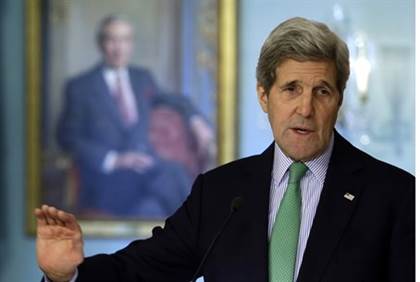
img569560John Kerry Reuters

Harf continued “you can throw out a lot of very scary hypotheticals, but if we look at the technology and we look at where they are today and where they could be in a double-digit duration (i.e. the ten years Obama has called for the deal to last which Iran rejected – ed.), that is further away from a nuclear weapon.”

*********************

US State Department Deputy Spokesperson Marie Harf responded to Prime Minister Binyamin Netanyahu’s Congress Address on Tuesday, and like US President Barack Obama her reaction was highly negative to Netanyahu’s criticism of the approaching Iran deal.

In a similar vein to Obama, she said: “we didn’t hear any – certainly any new ideas today, but more importantly, didn’t hear one single concrete alternative in today’s speech from the Prime Minister about how we could get to a double-digit duration, push breakout time to a year, and cut off the four pathways Iran could…use to get…fissile material for a nuclear weapon.”

Israeli officials responded to this point, arguing there was much new in Netanyahu’s proposal which would require Iran to take real actions indismantling its nuclear program instead of making mere promises to remove sanctions, and would also deal with its ballistic missile program which the current deal avoids.

While Netanyahu and US officials alike have argued no deal is better than a bad deal, Harf opined “no deal means much shorter breakout than under an agreement. Right now, outside experts have said publicly we’re at about two to three months breakout. Our goal is a year.”

Calling Netanyahu’s talk of a better deal “hypothetical” and “rhetoric,” she added “anyone who tells you there’s a magic formula that they have in their head that we don’t have is just not looking at the situation realistically.”

“We need to be very clear about what we’re trying to achieve and what the alternatives look like, not in a fantasy world, not in a world without specifics, but in the real world. And that’s what we’re doing,” she claimed.

Harf stated that Netanyahu said “some sort of perplexing things…including that all sanctions will eventually be lifted on Iran. That is not the case.” She admitted that the nuclear sanctions indeed would indeed be lifted, but “sanctions for terrorism, sanctions for human rights” will remain.

“He also said that at the end of the duration, Iran would have ‘fullinternational legitimacy,’ which is also a little overstated and just not accurate,” stated Harf.

When asked whether by maintaining the deal Iran’s nuclear program would not get legitimacy, she acknowledged that indeed the program would receive such legitimacy, but attempted to differentiate between “full legitimacy” for Iran as opposed to legitimacy for its nuclear program.

“We have always said they would be able to have a domestic enrichment that is peaceful in nature,” she added.

Iran has repeatedly threatened Israel with annihilation, and is the leading state sponsor of terrorism worldwide.

Centrifuges for a nuclear arsenal in weeks

Harf was asked about Netanyahu’s statement that US Secretary of State John Kerry had acknowledged Iran would be allowed to increase to 190,000 centrifuges as its Supreme Leader Ayatollah Ali Khamenei has demanded, a state of affairs that would allow the Islamic regime to produce a nuclear arsenal within weeks.

She insisted that Kerry had not said Iran would be allowed to increase to 190,000 centrifuges in the deal.

“When you are a member, a non-nuclear-weapons member of the NPT (Non-Proliferation Treaty) – and I’m not an NPT expert – but at the conclusion of the duration of this, in addition to the lasting transparency measures we have, Iran will not be able to do things to get to a nuclear weapon,” she claimed.

Harf continued “you can throw out a lot of very scary hypotheticals, but if we look at the technology and we look at where they are today and where they could be in a double-digit duration (i.e. the ten years Obama has called for the deal to last which Iran rejected – ed.), that is further away from a nuclear weapon.”

In response to the bill being proposed to allow Congress to vote on the Iran nuclear deal before it is agreed upon, Harf made clear Obama intends to shoot down any such motion.

“If that comes to the President’s desk, he will veto it. …We can’t negotiate an agreement while Congress is attempting to legislate either what might be in it or that it can’t be implemented, how it could be implemented, which is part of this as well,” she said.

Obama Must Explain Why the Iran Deal Isn’t North Korea Redux

March 1, 2015

Obama Must Explain Why the Iran Deal Isn’t North Korea Redux, Commentary Magazine, March 1, 2015

(There are additional parallels. North Korea and Iran have comparable views of human rights, both make loud and frequent noises about obliterating their perceived enemies and both have allies willing if not anxious to sneak around sanctions. There are also differences. Iran is far more powerful than North Korea was or is and Iran’s intention to dominate the Middle East transcends North Korea’s desire to “unify” with South Korea on North Korea’s terms. Iranian governance is based on Islam, an unfortunately powerful world religion seeking world domination. North Korean governance is based on the “religion of Kim,” supreme internally but otherwise of little significance elsewhere. Iran also presents a greater danger to the U.S. than North Korea did. However, Obama won’t explain why the Iran deal isn’t “North Korea redux” because he quite likely neither knows nor cares and because it is. — DM)

The State Department has never conducted a lessons learned exercise about what went wrong with the North Korea deal. Perhaps it’s time. Diplomatic responsibility and national security demand it.

**********************

As the Obama administration rushes into a nuclear deal with Iran, it pays to remember the last time the United States struck a deal with a rogue regime in order to constrain that state’s nuclear program and the aftermath of that supposed success.

Bill Clinton had been president barely a month when North Korea announced that it would no longer allow International Atomic Energy Agency (IAEA) inspections, followed shortly thereafter by an announcement that it would withdraw from the NPT altogether within a matter of months. If Kim Il-sung expected Washington to flinch, he was right. The State Department aimed to keep North Korea within the NPT at almost any price. Chief U.S. negotiator Robert Gallucci and his aides explained in their book Going Critical, “If North Korea could walk away from the treaty’s obligations with impunity at the very moment its nuclear program appeared poised for weapons production, it would have dealt a devastating blow from which the treaty might never recover.” Unwilling to take any path that could lead to military action, Clinton’s team sought to talk Pyongyang away from nuclear defiance, no matter that talking and the inevitable concessions that followed legitimized Pyongyang’s brinkmanship.

As with President Obama relieving Iran of the burden of six United Nations Security Council resolutions which demanded a complete cessation of enrichment, Clinton’s willingness to negotiate North Korea’s nuclear compliance was itself a concession. After all, the 1953 Armistice required Pyongyang to reveal all military facilities and, in case of dispute, enable the Military Armistice Commission to determine the purpose of suspect facilities. By making weaker frameworks the new baseline, Clinton let North Korea off the hook before talks even began.

Just as Israeli (and Saudi and Emirati and Egyptian and Kuwaiti and Bahraini) leaders express frustration with the Obama administration regarding its naiveté and unwillingness to consult, so too did South Korea at the time chafe at Clinton’s arrogance. South Korean President Kim Young Sam complained to journalists that North Korea was leading America on and manipulating negotiators “to buy time.” And in a pattern that repeats today with regard to Iran, the IAEA held firmer to the demand that North Korea submit to real inspections than did Washington. The issue came to a head in September 1993 after the State Department pressured the IAEA to compromise on limited inspections.

In the face of Pyongyang’s defiance, Clinton was also wary that coercion could be a slippery slope to war. Just as President Obama and Secretary of Defense Chuck Hagel instructed U.S. forces in the Persian Gulf not to stand firm but rather to retreat if probed or pushed by Iran, Clinton sought to mollify Pyongyang, for example cancelling the joint U.S.–South Korea military exercise in 1994. Adding insult to injury, the Clinton administration criticized the South Korean government for being unwilling to compromise. Indeed, everything the Obama administration has done with regard to Israel over the past year—with the exception, perhaps, of the classless chickensh-t comment—was ripped right from the Clinton playbook two decades before when the White House sought to silence Seoul.

There followed months of baseless optimism in Washington, followed by disappointment quickly supplanted by denial. At one point, when it looked like Kim Il-sung’s intransigence might actually lead to war, former President Jimmy Carter visited Pyongyang and, whether cleared to or not, made concessions which diffused the situation. It was the diplomatic equivalent of Obama’s voided redlines. Nightlinehost Ted Koppel observed on May 18, 1994, “this administration is becoming notorious … for making threats and then backing down.”

On July 8, 1994, a heart attack felled Kim Il-sung. Kim Jong-il, his eldest son, took over. Negotiations progressed quickly. Gallucci and his team promised an escalating series of incentives—reactors, fuel oil, and other economic assistance. They kicked inspections of North Korea’s suspect plutonium sites years down the line.

What had begun as North Korean intransigence had netted Pyongyang billions of dollars in aid; it would go down in history as the largest reward for cheating and reneging on agreements until Obama granted Iran $11 billion in sanctions relief just for coming to the table. Columnist William Safire traced the steps of concessions on North Korea. “Mr. Clinton’s opening position was that untrustworthy North Korea must not be allowed to become a nuclear power,” he observed, but Clinton “soon trimmed that to say it must not possess nuclear bombs, and stoutly threatened sanctions if North Korea did not permit inspections of nuclear facilities at Yongbyon, where the CIA and KGB agree nuclear devices have been developed. But as a result of Clinton’s Very Good Deal Indeed, IAEA inspectors are denied entry to those plants for five years.” And Sen. John McCain, for his part, lamented that Clinton “has extended carrot after carrot, concession after concession, and pursued a policy of appeasement based … on the ill-founded belief that North Koreans really just wanted to be part of the community of nations.” Again, the parallels between Clinton’s and Obama’s assumptions about the desire of enemies to reform were consistent.

Clinton wasn’t going to broker any criticism of what he believed was a legacy-defining diplomatic triumph, all the more so when the criticism came from abroad. On October 7, 1994, South Korean President Kim Young Sam blasted Clinton’s deal with the North, saying, “If the United States wants to settle with a half-baked compromise and the media wants to describe it as a good agreement, they can. But I think it would bring more danger and peril.” There was nothing wrong with trying to resolve the problem through dialogue, he acknowledged, but the South Koreans knew very well how the North operated. “We have spoken with North Korea more than 400 times. It didn’t get us anywhere. They are not sincere,” Kim said. His outburst drew Clinton’s ire. He became the Netanyahu of his day. Meanwhile, the U.S. and North Korea signed the Agreed Framework. Gallucci and his team were “exhilarated.” They later bragged they “had overcome numerous obstacles in the negotiations with the North; survived the intense, sometimes strained collaboration with Seoul and the International Atomic Energy Agency; and marshaled and sustained an often unwieldy international coalition in opposition to the nuclear challenge, all under close and often critical scrutiny at home.”

Today, by some estimates, North Korea is well on its way to having 100 nuclear weapons and is steadily developing the ballistic capability to deliver them. Iran’s nuclear negotiators have cited North Korea’s negotiating strategy as a model to emulate rather than an example to condemn. Meanwhile, Obama has relied on many of the same negotiators to advance his deal with Iran.

The State Department has never conducted a lessons learned exercise about what went wrong with the North Korea deal. Perhaps it’s time. Diplomatic responsibility and national security demand it.