Archive for the ‘Sharia law’ category

Spain in the Eye of the Storm of Jihad

June 6, 2015

Spain in the Eye of the Storm of Jihad, The Gatestone InstituteSoeren Kern, June 6, 2015

(Right of return? — DM)

  • The Islamists are especially interested in converts who have not yet taken on Muslim names and whose official IDs still have their Christian names, so they can purchase weapons without drawing the attention of police.
  • At least 50,000 Muslim converts are currently living in Spain. Police say that converts are especially susceptible to radicalization because they are facing increasing pressure from Islamists who are calling on them to carry out attacks to “demonstrate their commitment” to their new faith.
  • Spain has also become a key entry point for human trafficking mafias being used by jihadist veterans seeking to return to Europe after fighting in the Middle East.
  • “Turkey is the Seven-Eleven of false passports.” — Spanish agent working on a human trafficking case.

Spanish security forces have arrested a total of 568 jihadists over the past ten years in 124 separate operations against Islamic terrorism, Spanish Interior Minister Jorge Fernández Díaz revealed at an African security conference in Niger on May 14.

Fernández Díaz said that “constant police and judicial actions” have helped Spanish authorities prevent another large-scale terrorist attack similar to the March 2004 Madrid train bombings, in which nearly 200 people were killed and more than 2,000 were injured.

At the same time, Fernández Díaz has warned that it is “very probable” that Islamic terrorists will strike Spain at some point in the future; he has estimated the probability of an attack to be 70%.

At a two-day terrorism conference held in Madrid on April 23 and 24, Fernández Díaz said that at least 115 Spanish jihadists — including at least 15 women — are now known to have joined the Islamic State. He added that 14 jihadists had returned to Spain; nine of those are in prison and five remain free.

In January, Fernández Díaz said the number of Spanish jihadists abroad was 70, which implies a jump of more than 40 new jihadists in the first four months of 2015 alone. In August 2014, the first time that Fernández Díaz provided an official estimate, he said there were 51 Spanish jihadists fighting abroad.

Meanwhile, “dozens” of jihadists and other Islamic radicals are entering Spain from neighboring France, where they are said to be “asphyxiating” due to a government crackdown following theCharlie Hebdo attacks in Paris in January. (On April 29, French President François Hollande announced that a force of 7,000 troops would be deployed to patrol French streets on a permanent basis.)

According to an anonymous Spanish intelligence operative interviewed by El Confidencial, a media outlet based in Madrid, French jihadists are moving to Spain because they feel they have “greater room for movement” on the Iberian Peninsula. They include individuals “suspected” of being Islamic radicals, but for whom there is insufficient proof for either government to arrest them.

The report says that most of the jihadists from France are moving to Catalonia and Spain’s Mediterranean coast, where they are attempting to “blend in” with Muslim communities there. Also known as the Spanish Levant, the region roughly corresponds with what was once known as Xarq al-Ándalus, territories that were occupied by Muslim invaders for nearly five centuries.

Al-Andalus is the Arabic name given to those parts of Spain, Portugal and France occupied by Muslim conquerors (also known as the Moors) from 711 to 1492. Many Muslims believe that territories Muslims lost during the Christian Reconquista of Spain still belong to the realm of Islam. They claim that Islamic law gives them the right to return there and re-establish Muslim rule.

In July 2014, jihadists with the Islamic State produced a video in which they vowed to liberate al-Andalus from non-Muslims and make it part of their new Islamic Caliphate. The video showed a jihadist speaking in Spanish with a heavy North African accent, warning:

“I say to the entire world as a warning: We are living under the Islamic flag, the Islamic caliphate. We will die for it until we liberate those occupied lands, from Jakarta to Andalusia. And I declare: Spain is the land of our forefathers and we are going to take it back with the power of Allah.”

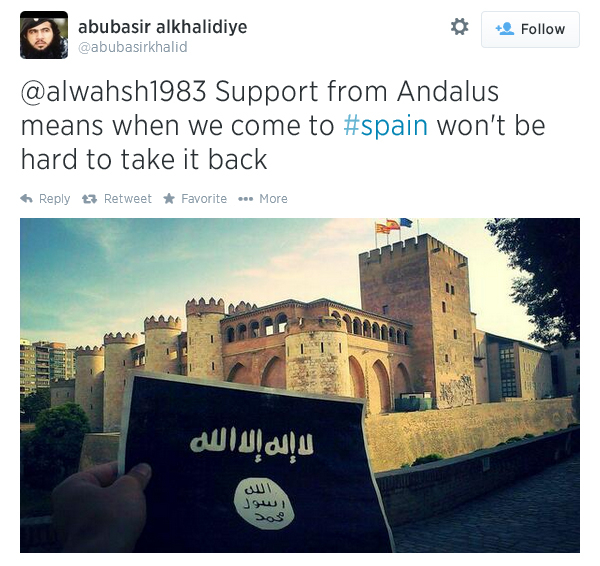
639A tweeted photo of an Islamic State supporter holding the Islamic State’s black flag of jihad in front of Aljafería Palace in Zaragoza, Spain

Counter-terrorism authorities are now warning that the Islamic State is actively looking for Spanish converts to Islam who possess gun licenses and who can legally purchase rifles and shotguns. The Islamists are especially interested in converts who have not yet taken on Muslim names and whose official IDs still have their Christian names, so that they can purchase weapons without drawing the attention of police.

At least 50,000 Muslim converts are currently living in Spain. Police say that converts are especially susceptible to radicalization because they are facing increasing pressure from Islamists who are calling on them to carry out attacks to “demonstrate their commitment” to their new faith. “Converts are the perfect breeding ground for Islamism,” according to a Spanish intelligence operative.

These concerns have been confirmed in a new report published by the Spanish Institute of Strategic Studies, an organ of the Ministry of Defense, which warned that so-called lone wolves pose the biggest threat to Spain and other European countries.

“They are activists who secretly swear allegiance to [Islamic State leader] Abu Bakr al-Baghdadi and act independently without making contact with anyone, so locating them becomes a living hell,” the report said. It added:

“Terrorists no longer need to communicate directly with the leadership of the organization to which they belong, or use the telephone or emails to know exactly what to do, when and under what circumstances. There is no longer any need for prior contact to establish the type of signals to be used, the conditions and dimensions of an attack or any restrictions.

“These tactics end the dream of the intelligence services to control everything through the systematic interception of communications and the use of satellite imagery. If there is no communication, it is not possible to intercept anything.”

Spain has also become a key entry point for human trafficking mafias being used by jihadist veterans seeking to return to Europe after fighting in the Middle East. A report prepared by Spanish border police identifies three main routes of entry — Africa, South America and Europe — and warns that human trafficking is “more lucrative than cocaine trafficking.”

According to the report:

“The proliferation of organizations trafficking in human beings and taking advantage of counterfeit documentation is resulting in the introduction of thousands of people into European countries. The problem is compounded when one considers that European jihadist veterans who have fought in Syria and Iraq on behalf of the Islamic State are using the same networks to facilitate their return. Many have arrest warrants in different countries (Spain, France, UK, etc.) and Islamic State members may cross our borders to carry out terror attacks in Europe.”

In November 2014, police in Madrid arrested 18 individuals — eight Lebanese, four Spaniards, three Syrians, one Ecuadorian, one Moroccan and one Ukrainian — accused of running smuggling operation to bring people from Syria into Spain. Police estimate that the cell, which had branches in Lebanon and Turkey, generated earnings of between €50,000 ($55,000) and €100,000 ($110,000) each month. According to one of the agents working on the case, “Turkey is the Seven-Eleven of false passports.”

Meanwhile, at least 60 jihadists in Catalonia are said to be waiting for a signal from the Islamic State to attack, according to the Madrid-based El País newspaper. The warning was given during a closed-door meeting of anti-terrorism police held in late April in Viladecans, a town near Barcelona.

The unofficial meeting was convened after a counter-terrorism operation in Catalonia was compromised, when some jihadists were allegedly tipped-off that they were about to be arrested. Although the exact circumstances of the imbroglio remain unclear, it appears to have been the result of poor inter-agency coordination between counter-terrorism police in Madrid and Catalan police known as the Mossos d’Esquadra. The two groups were apparently investigating the same Islamist cell without consulting each other.

The meeting in Viladecans, attended by 130 agents from different police forces — Mossos, Civil Guards, national and local police — from across the country, got together to discuss their mutual concerns about “the lack of training of law enforcement to combat jihadist terrorism.”

Much of the daylong meeting was used to share information about how to detect “radicalization processes” and how to distinguish ordinary Muslims from Salafists and jihadists. A counter-terrorism specialist said that one of the key problems faced by police is that “jihadists have infiltrated society, they drink alcohol, eat pork and dress like a Westerner and are undetectable.”

One of the organizers of the event, Alex Pérez of a local branch of the International Police Association, said:

“We go out on the street every day but we do not have the tools needed to combat threats against the public. Some of us are digging into our own pockets to train ourselves, protect ourselves and provide an adequate service to society.”

Another police officer summed it up this way: “We are screwed and will be much worse off in the future because there are radicals increasingly inclined to attack.”

The Islamic State Is Here to Stay

June 5, 2015

The Islamic State Is Here to Stay, VICE NewsAhmed S. Hashim, June 6, 2015

(Please see also, The Kurd-Shia War Behind the War on ISIS. — DM)

The victories against IS in early 2015 have proven ephemeral — or have been nullified by IS gains elsewhere. On Sunday, CIA director John Brennan said on Face the Nation, “I don’t see this being resolved anytime soon.” Assad’s vaunted offensives of February 2015 have fallen short as the regime faced stiff resistance from a wide variety of opposition fighters, including elements from IS. The failure was alarming in part because the campaign was designed and aided by both Hezbollah and the Iranians, two seemingly ascendant Shia powers.

************************

Just a few months ago, analysts and policy-makers were certain that the defeat of Islamic State (IS) forces was simply a matter of time.

Coalition airstrikes would degrade the group’s capabilities and eventually allow Iraqi forces and Kurdish Peshmerga — though discredited by their poor military showing in mid-2014 — to push back the extremists. And indeed, IS fighters were ejected from Tikrit in March 2015 by the Iraqi army and thousands of motivated fighters from Shia militias. In Kobani in northern Syria, IS fighters were defeated by Syrian Kurdish fighters. Elsewhere in the country, the regime of Bashar al-Assad was going on the offensive with help from Hezbollah and advisers from the Iranian Revolutionary Guard.

The Islamic State, however, rose like a phoenix from the ashes of every setback. And today, the situation is not so rosy.

The victories against IS in early 2015 have proven ephemeral — or have been nullified by IS gains elsewhere. On Sunday, CIA director John Brennan said on Face the Nation, “I don’t see this being resolved anytime soon.” Assad’s vaunted offensives of February 2015 have fallen short as the regime faced stiff resistance from a wide variety of opposition fighters, including elements from IS. The failure was alarming in part because the campaign was designed and aided by both Hezbollah and the Iranians, two seemingly ascendant Shia powers.

The situation in Iraq is just as complicated, something that the Obama administration appears either oblivious to or reluctant to acknowledge. Much of the US strategy continues to hinge on what is increasingly a mirage: a unified, albeit federal, Iraq under the control of Baghdad. Meanwhile, the resilience of IS is greatly enhanced by the ability of its military forces to innovate and adapt faster on the ground than its lackluster opponents.

In light of the constant aerial strikes by the US and its allies, IS has dispersed and made its forces more mobile, no longer presenting dense concentrations of fighting men as it did when it seized Mosul in mid-2014. Instead, when IS seized Ramadi in May 2015, it made use of inclement weather and sent several small units from different directions simultaneously into the city aided by suicide bombers. Moreover, the fact that the group faced ill-equipped and poorly motivated Sunni fighters in and around Ramadi did not do anything for Baghdad’s standing with the country’s already alienated Sunni community, which had pleaded for arms while caught between the unfathomable brutality of IS and revengeful Shia militias.

Many Sunnis are now angling for their own “super-region,” one that would have considerable independence from Baghdad. The problem? In order to have it, the Sunnis would need to first defeat IS. Currently, they’re unable to do so because they lack the resources; despite all the talk from Baghdad and Washington about arming Sunni tribes, Baghdad is not actually keen to do so.

And besides, the Sunnis seem relatively ambivalent about defeating IS. They took an unequivocal stance between late 2006 and 2009, when they joined with the Americans and the Iraqi government to deal the Islamist militants what was then seen as a decisive blow. Now, however, despite Sunnis’ resentment and fear of IS, the Islamists’ existence is seen as a kind of insurance policy against Shia revanchism should Baghdad succeed in retaking the three Sunni provinces of Anbar, Salahuddin, and Ninevah.

(Please see video at the link. — DM

The “victory” of the Iraqi government in Tikrit was more propaganda than reality; a few hundred IS fighters managed to inflict considerable damage on the Shia militias that had been mobilized to fight alongside the Iraqi army, then withdrew because they were outnumbered and wished to avoid being surrounded. The IS forces in Tikrit simply felt that they had done enough damage; there was no need to waste further assets in an untenable situation.

Militarily, the Iraqi Shia militias are better motivated and more dedicated than the regular army. Anecdotal information out of Baghdad suggests that Iraqi Shias are wondering whether the government should invest more effort building these forces into an effective and more organized parallel army. Even that parallel army, however, might be reluctant to commit to any significant long-term offensive to reclaim provinces full of “ungrateful” Sunnis.

But the Shia are willing to die to defend what they have, and there is increased sentiment among the Shia in central Iraq and Baghdad, along with the southern part of the country, that they would be better off without the Sunnis. There also exists the belief that the Kurds have more or less opted out of the Iraqi state despite the fact that they maintain a presence within the government in Baghdad. The Shia would seemingly not be sorry to see them exit the government in a deal that would settle as best as possible divisions of resources and territory. However, whether the Kurds would take the plunge and opt for de jure rather than de facto independence is a question that is subject to regional realities — How would Ankara and Tehran react? — rather than merely a matter of a deal between Baghdad and Erbil.

The Islamic State will continue to be a profound geopolitical problem for the region and the international community, and a long battle lies ahead. Syria and Iraq are more or less shattered states; it is unlikely that they will be put back together in their previous shapes. If Assad survives 2015, it will be as head of a rump state of Alawites and other minorities protected by Hezbollah, Iran, and Alawite militias. Shia Iraq will survive, and will possibly dissociate itself from the nettlesome Sunni regions. The Kurds will go their own way step by step. The international community is currently at a loss for how to stem the flow of foreign fighters to the IS battlefields — and even more serious is the growing sympathy and admiration for the group in various parts of the world among disgruntled and alienated youth.

If the US is serious about defeating IS, it needs to take on a larger share of the fight on the ground. This means more troops embedded with regular Iraqi forces in order to bring about better command, control, and coordination. It also means advisors who can continue to train these forces so that they improve over time. If this is not done, the regular Iraqi military will continue to be nothing more than an auxiliary to the more motivated — and pro-Iranian — Shia militias. Currently, militia commanders are giving orders to the regular military; that cannot be good for morale.

This month, the Islamic State celebrates the first anniversary of its self-declared caliphate. The group has little reason to fear it will be the last.

How Islam in America Became a Privileged Religion

June 3, 2015

How Islam in America Became a Privileged Religion, Front Page Magazine, Daniel Greenfield, June 3, 2015

(Much the same nonsense infects foreign policy and propels the notion that the Islamic State is not Islamic. — DM)

islam

What is Islam? The obvious dictionary definition answer is that it’s a religion, but legally speaking it actually enjoys all of the advantages of race, religion and culture with none of the disadvantages.

Islam is a religion when mandating that employers accommodate the hijab, but when it comes time to bring it into the schools, places that are legally hostile to religion, American students are taught about Islam, visit mosques and even wear burkas and recite Islamic prayers to learn about another culture. Criticism of Islam is denounced as racist even though the one thing that Islam clearly isn’t is a race.

Islamist organizations have figured out how lock in every advantage of race, religion and culture, while expeditiously shifting from one to the other to avoid any of the disadvantages.

The biggest form of Muslim privilege has been to racialize Islam. The racialization of Islam has locked in all the advantages of racial status for a group that has no common race, only a common ideology.

Islam is the only religion that cannot be criticized. No other religion has a term in wide use that treats criticism of it as bigotry. Islamophobia is a unique term because it equates dislike of a religion with racism. Its usage makes it impossible to criticize that religion without being accused of bigotry.

By equating religion with race, Islam is treated not as a particular set of beliefs expressed in behaviors both good and bad, but as an innate trait that like race cannot be criticized without attacking the existence of an entire people. The idea that Islamic violence stems from its beliefs is denounced as racist.

Muslims are treated as a racial collective rather than a group that shares a set of views about the world.

That has made it impossible for the left to deal with ex-Muslims like Ayaan Hirsi Ali or non-Muslims from Muslim families like Salman Rushdie. If Islam is more like skin color than an ideology, then ex-Muslims, like ex-Blacks, cannot and should not exist. Under such conditions, atheism is not a debate, but a hate crime. Challenging Islam does not question a creed; it attacks the existence of an entire people.

Muslim atheists, unlike all other atheists, are treated as race traitors both by Muslims and leftists. The left has accepted the Brotherhood’s premise that the only authentic Middle Easterner is a Muslim (not a Christian or a Jew) and that the only authentic Muslim is a Salafist (even if they don’t know the word).

The racialization of Islam has turned blasphemy prosecutions into an act of tolerance while making a cartoon of a religious figure racist even when it is drawn by ex-Muslims like Bosch Fawstin. The New York Times will run photos of Chris Ofili’s “The Holy Virgin Mary” covered in dung and pornography, but refuses to run Mohammed cartoons because it deems one anti-religious and the other racist.

The equating of Islam with Arabs and Pakistanis has made it nearly impossible for the media to discuss violence against Christians in those parts of the world. The racialization of Islam has made Arab Christians, like Bangladeshi atheists, a contradiction in terms. The ethnic cleansing of the Yazidi could only be covered by giving them a clearly defined separate identity. Middle Eastern Christians are increasingly moving to avoid being categorized as Arabs because it is the only way to break through this wall of ignorance.

While racialization is the biggest Muslim privilege, race provides no protection for many Islamic religious practices. Muslims then seek religious discrimination laws to protect these practices even if it’s often a matter of debate whether their lawsuits protect their religious practices or impose them on others.

Islam is a theocracy. When it leaves the territories conquered by Islam, it seeks to replicate that theocracy through violence and by adapting the legal codes of the host society to suit its purposes.

Islamic blasphemy laws are duplicated using hate crime laws. Employers are obligated to make religious concessions to Muslim employees because of laws protecting religious practices, but many of these practices, such as refusing to carry out jobs involving pork, liquor or Seeing Eye dogs, are really ways of theocratically forcing behaviors that Islam forbids out of public life much as Saudi Arabia or Iran do.

Accusations of bigotry are used to outlaw ideas that Islam finds blasphemous and religious protection laws are used to banish behaviors that it disapproves of. By switching from race to religion and back again, Islamists construct a virtual theocracy by exploiting laws designed to protect different types of groups.

Religions in America traded theocracy for religious freedom. They gave up being able to impose their practices on others in exchange for being able to freely practice their own religions. Islam rejects religious freedom. It exploits it to remove the freedom of belief and practice of others. When it cannot do so through religious protection laws, it does so through claims of bigotry.

Religions were not meant to be immunized from blasphemy because that is theocracy. Instead religions are protected from restrictions, rather than from criticism. Islam insists on being protected from both. It makes no concessions to the freedom of others while demanding maximum religious accommodation.

While race and religion are used to create negative spaces in which Islam cannot be challenged, the creed is promoted positively as a culture. Presenting Islam as a culture allows it easier entry into schools and cultural institutions. Islamic missionary activity uses the Western longing for oriental exotica that its political activists loudly decry to inject it into secular spaces that would ordinarily be hostile to organized religion.

Leftists prefer to see Islam as a culture rather than a religion. Their worldview is not open to Islam’s clumsy photocopy of the deity that they have already rejected in their own watered down versions of Christianity and Judaism. But they are constantly seeking an aimless and undefined spirituality in non-Western cultures that they imagine are free of the materialism and hypocrisy of Western culture.

Viewing Islam as a culture allows the left to project its own ideology on a blank slate. That is why liberals remain passionately convinced that Islam is a religion of social justice. Their Islam is a mirror that reflects back their own views and ideas at them. They pretend to respect Islam as a culture without bothering to do any more than learn a few words and names so that they can seem like world travelers.

By morphing into a culture, Islam sheds its content and becomes a style, a form of dress, a drape of cloth, a style of beard, a curvature of script and a whiff of spices. It avoids uncomfortable questions about what the Koran actually says and instead sells the religion as a meaningful lifestyle. This approach has always had a great deal of appeal for African-Americans who were cut off from their own heritage through Islamic slavery, but it also enjoys success with white upper class college students.

The parents of those students often learn too late that Islam is not just another interchangeable monotheistic religion, that its mosques are not places where earnest grad students lecture elderly congregants about social justice and that its laws are not reducible to the importance of being nice to others.

Like a magician using misdirection, these transformations from religion to race, from race to culture and from culture to religion, distract Americans from asking what Islam really believes. By combining race, religion and culture, it replicates the building blocks of its theocracy within our legal and social spaces.

Separately each of these has its advantages and disadvantages. By combining them, Islam gains the advantages of all three, and by moving from one to the other, it escapes all of the disadvantages. The task of its critics is to deracialize Islam, to reduce it to an ideology and to ask what it really believes.

Islam is a privileged religion. And there’s a word for that. Theocracy.

Saudi Rapist in Colorado Says Sex Offender Program is Against His Religion

May 17, 2015

Saudi Rapist in Colorado Says Sex Offender Program is Against His Religion, Front Page Magazine, Daniel Greenfield, May 17, 2015

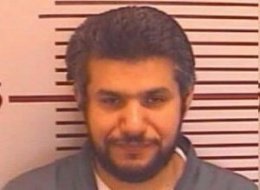
Homaidan-al-Turki

Rape however isn’t against his religion.

Homaidan al-Turki’s entire defense strategy from the beginning was Islam. The member of a prominent Saudi family claimed that the prosecution was Islamophobic.

“We are Muslim. We are different. The state has criminalized these basic Muslim behaviors. Attacking traditional Muslim behaviors is a focal point of the prosecution.”

He had a point, because the behavior he was charged with was commonplace back in Saudi Arabia.

The victim slept on a mattress on the basement floor, was paid less than $2 a day, and Al-Turki eventually intimidated her into sex acts that culminated in her rape in late 2004, according to prosecutors.

Once in prison, the Saudis tried to get him transferred/released back home, but public outrage stopped that at least temporarily.

Now we’re apparently back to Al-Turki’s insistence that he shouldn’t have to undergo sex offender treatment.

Al-Turki told prison officials in 2013 that the sex offender treatment programme “conflicts with [his] Islamic faith”, according to a letter by the then executive director of the Colorado Department of Corrections, Tom Clements.

His lawyers told the court in the same year that the program: “would require [him] to look at photos that included women in bathing suits or undergarments as part of the evaluation process”, AP reported.

That would be the Abel Screening which is supposed to test for assorted deviancies. Undergoing it would be an important prerequisite to parole or transferring Al-Turki to a Saudi prison/resort.

Al-Turki’s people have rejected it because it would mean admitting that he did something wrong, also the group would be run by a woman and there are the photos of men, women and children in swimsuits.

Obviously Saudi mores and Islamic law say that Homaidan Al-Turki did nothing wrong. ISIS’ rapes and sex slaves show us how that works, but Saudi Arabia runs a low key version of the same thing.

The entire premise of the program is incompatible with Islam. It’s Islamophobic since it rejects the Islamic idea that Muslim men can rape non-Muslim women within the context of a hostile environment, especially in a non-Muslim country.

So we just have to decide between Saudi ISIS law and American law. It’s that simple.

Muslim Rape Gangs, Terrorists as ‘Pop-Idols,’ and the Trafficking of Children

May 17, 2015

Muslim Rape Gangs, Terrorists as ‘Pop-Idols,’ and the Trafficking of Children, Gatestone InstituteSoeren Kern, May 17, 2015

(What is an “extremist?” — DM)

  • “The boys want to be like them [jihadists] and the girls want to be with them. That’s what they used to say about the Beatles… [Muslim teenagers] see their own lives as poor by comparison, and don’t realize they are being used.” — Nazir Afzal, Britain’s leading Muslim prosecutor.
  • “The extreme views of a ‘racist, homophobe and anti-Semite’ who supports killing non-Muslims and ‘stoning adulterers’ are being made available to prison imams and prisoners…with the blessing of [prison] authorities.” — Newsweekmagazine.
  • “Mohammed was selling me for £250 to paedophiles from all over the country. They came in, sat down and started touching me… Sometimes, I would be passed from one pervert to another… Mohammed’s defense was laughable… His barrister, a woman, implied I was a racist because all the defendants were Muslim.” — Excerpts from Girl for Sale, by Lara McDonnell.
  • “Democracy… violates the rights of Allah. Islam is the only real, working solution for the UK.” — Election posters in Cardiff, Wales.

What follows is a summary of some of Islam and Islam-related issues in Britain during April 2015, categorized into four broad themes: 1) Islamic extremism; 2) British multiculturalism; 3) Muslim integration; and 4) Muslims and the British general elections.

1. Islamic Extremism and Syria-Related Threats

British police believe that about 600 Britons have travelled to Syria and Iraq since the conflict began in early 2011. About half of those are believed to have returned to the UK.

On April 1, police in Turkey detained nine British nationals from Rochdale, Greater Manchester, who were allegedly seeking to join the Islamic State in Syria. The nine — five adults and four children, including a one-year-old baby — were arrested in the Turkish city of Hatay.

One of those arrested was Waheed Ahmed, a student of politics at Manchester University. His father Shakil, a Labour Party councilor in Rochdale, said he thought his son was doing an internship in Birmingham. He said:

“It’s a total mystery to me why he’s there, as I was under the impression he was on a work placement in Birmingham. My son is a good Muslim and his loyalties belong to Britain, so I don’t understand what he’s doing there. If I thought for a second that he was in danger of being radicalized I would have reported him to the authorities.”

Also on April 1, Erol Incedal, 27, a British national of Turkish origin, was jailed for 42 months for possessing a bomb-making manual. His friend, Mounir Rarmoul-Bouhadjar, 26, a British national of Algerian origin, who admitted to having the same manual, was given three years. Both men had been to the Syrian-Turkish border and mixed with jihadists, who taught them about weaponry and explosives.

Meanwhile, it emerged that the father of one of the three teenagers from Brent, northwest London, who were arrested in Turkey in March on suspicion of trying to join the Islamic State in Syria, works for the British Ministry of Defense. The father, who may have had access to the names and addresses of British military personnel at home and overseas, was placed on “compassionate leave.”

On April 2, Yahya Rashid, of Willesden, also in northwest London, was charged with “engaging in conduct in preparation for committing an act of terrorism, and engaging in conduct with the intention of assisting others to commit acts of terrorism, between November 2014 and March 2015.” Rashid, 19, was arrested at Luton Airport after arriving on a flight from Istanbul. The Middlesex University electronics student was allegedly returning from Syria after travelling there via Morocco and Turkey.

On April 3, six Muslims were arrested at the Port of Dover in Kent on suspicion of attempting to leave England to join the Islamic State. The Crown Prosecution Service said that three of the individuals were found in the back of a truck in an apparent attempt to smuggle themselves out of Britain. They were charged with “preparing acts of terrorism.”

On April 5, Abase Hussen, the father of runaway British jihadi schoolgirl Amira Hussen, conceded that his daughter may have become radicalized after he took her to an extremist rally organized by the banned Islamist group Al-Muhajiroun, run by Anjem Choudary, the British-born Muslim hate preacher.

Amira, 15, was one of three girls from Bethnal Green Academy in East London who flew to Turkey in February to become “jihadi brides” in Syria. During a hearing at the Home Affairs Select Committee in March, Abase blamed British authorities for failing to stop his daughter from running off to Syria. Asked by Chairman Keith Vaz if Amira had been exposed to any extremism, Hussen replied: “Not at all. Nothing.” The police eventually issued an apology.

Abase, however, changed his story after a video emerged which unmasked him as an Islamic radical who had marched at an Islamist hate rally alongside Choudary and Michael Adebolajo, the killer of Lee Rigby. Abase, originally from Ethiopia, said he had come to Britain in 1999 “for democracy, for the freedom, for a better life for children, so they could learn English.”

On April 8, Alaa Abdullah Esayed of South London admitted to posting 45,600 tweets in support of the Islamic State in just one year. The tweets included pictures of dead bodies and encouraged children to arm themselves with weapons. Esayed’s tweets also included a poem, “Mother of the Martyr,” which advises parents on how to teach children about jihad. Esayed, 22, faces up to 14 years in prison for encouraging terrorism and disseminating terrorist publications.

On April 9, the families of two teenage boys from Dewsbury, West Yorkshire, who are believed to have traveled to join the Islamic State, said that they were “in a state of profound shock” and deeply worried about the safety of their “ordinary Yorkshire lads.” The 17-year-old boys, Hassan Munshi and Talha Asmal, are believed to have gone to Syria after heading to Turkey on March 31. The boys reportedly told their relatives that they were going on a school trip, but instead used the Easter holidays as a “window of opportunity” to flee Britain.

On April 20, a 14-year-old schoolboy from Blackburn, Lancashire, became Britain’s youngest terror suspect. He was arrested in connection with an Islamic State-inspired terror plot in Melbourne, Australia. Police said messages found on his computer and mobile phone indicated a plan to attack the centenary celebrations of the Anzac landings at Gallipoli during the First World War. (Anzac Day — April 25 — marks the anniversary of the first major military action fought by Australian and New Zealand forces during the First World War.)

Also on April 20, police in Turkey arrested a British couple and their four young children on suspicion of seeking to travel to a part of Syria controlled by the Islamic State. Asif Malik, his wife Sara, and the four children — aged between 11 months and 7 years — were detained at a hotel in Ankara. Turkish officials said the family had crossed into Turkey from Greece on April 16 and that they had been detained after a tip-off from the British police.

On April 24, Hassan Munir of Bradford was jailed for 18 months for posting links to Dabiq, an Islamic State propaganda magazine, on his Facebook page. The court heard that Munir, 27, had ignored repeated warnings by Facebook and by police after he posted jihadist material, including items about beheadings. The judge said magazine posed a serious danger because it incited people to take up arms for the Islamic State.

On April 27, Mohammed Kahar of Sunderland was arrested after being caught disseminating extremist material, including documents such as “The Explosive Course,” “44 Ways To Serve And Participate In Jihad,” “The Book Of Jihad,” and “This Is The Province Of Allah.” Kahar, 37, was also accused of plotting Syria-related terrorism acts, supporting a proscribed organization and financing terrorism — in all, 10 offenses stretching back 18 months.

On April 28, an 18-year-old jihadist, Kazi Jawad Islam, was convicted of “terror grooming” for trying to “brainwash” his friend, Harry Thomas, “a vulnerable young man with learning difficulties,” into attacking British soldiers with a meat cleaver.

The Central Criminal Court of England and Wales (aka Old Bailey) was told that Kazi Islam — allegedly inspired by the beheading of serviceman Lee Rigby in 2013 — befriended the then-19-year-old Thomas in October 2013 after meeting him at college. The court heard how Islam also “ruthlessly exploited” his autistic friend into preparing to make a bomb.

In an interview with the Guardian, Nazir Afzal, Britain’s leading Muslim prosecutor, warned that more British children are at risk of “jihadimania” than previously thought because they see Islamic terrorists as “pop idols.” He said:

“The boys want to be like them and the girls want to be with them. That’s what they used to say about the Beatles and more recently One Direction and Justin Bieber. The propaganda the terrorists put out is akin to marketing, and too many of our teenagers are falling for the image.

“They see their own lives as poor by comparison, and don’t realize they are being used. The extremists treat them in a similar way to sexual groomers — they manipulate them, distance them from their friends and families, and then take them.

“Each one of them, if they go to Syria, is going to be more radicalised when they come back. And if they don’t go, they become a problem — a ticking time bomb — waiting to happen.”

2. British Multiculturalism

In April, officials at the Lostwithiel School in Cornwall publicly humiliated nearly a dozen pupils between the ages of eight and 11 whose parents had refused to allow them to participate in a school trip to a mosque in Exeter. Some parents said they were concerned about the safety of their children, while others said they were opposed to the teaching of Islam in school. But school officials forced the non-compliant pupils individually to give an explanation in the student assembly.

On April 5, Victoria Wasteney, 38, a Christian healthcare worker, launched an appeal against an employment tribunal that found she had “bullied” a Muslim colleague by praying for her and inviting her to church. Wasteney was suspended from her job as a senior occupational therapist at the John Howard Centre, a mental health facility in east London, after her colleague, Enya Nawaz, 25, accused her of trying to convert her to Christianity. Wasteney’s lawyers say that the tribunal broke the law by restricting her freedom of conscience and religion, which is enshrined in Article 9 of the European Convention of Human Rights.

On April 8, the Guardian reported that there has been a 60% increase in child sexual abuse reported to the police over the past four years, according to official figures obtained through a Freedom of Information request that make public for the first time the scale of the problem in England and Wales.

The number of offenses of child sexual abuse reported to the police soared from 5,557 cases in 2011 to 8,892 in 2014. At the same time, the number of arrests for child sexual abuse offenses in England and Wales fell from 3,511 in 2011 to 3,208 — a drop of 9%.

The biggest increase in reported cases in a single police force over the past four years took place in South Yorkshire. The force saw an increase of 577% in cases from 74 in 2011 to 501 in 2014, apparently reflecting the exposure of the Muslim sexual abuse scandal in Rotherham.

On April 14, the president of the Supreme Court of the United Kingdom, Lord Neuberger, said in a speech that Muslim women should be allowed to wear veils in court. He added that in order to show fairness to those involved in trials, judges must have “an understanding of different cultural and social habits.” He said:

“Well known examples include how some religions consider it inappropriate to take the oath, how some people consider it rude to look other people in the eye, how some women find it inappropriate to appear in public with their face uncovered, and how some people deem it inappropriate to confront others or to be confronted — for instance with an outright denial.”

Neuberger’s comments came after a judge upheld a ruling allowing Rebekah Dawson, a 22-year-old convert to Islam, to stand trial wearing a niqab, a veil that only leaves the eyes visible.

On April 15, Newsweek magazine reported that the “extreme views of a ‘racist, homophobe and anti-Semite’ who supports killing non-Muslims and ‘stoning adulterers’ are being made available to prison imams and prisoners throughout England and Wales, with the blessing of [prison] authorities.”

The magazine interviewed Haras Rafiq, managing director of the Quilliam Foundation, a counter-extremism think tank, who warned that British prisons have become “incubators for Islamic extremism” because inmates are being allowed to read the works of controversial South Asian cleric Abul Ala Maududi. Rafiq described Maududi, who died in 1979, as the “grandfather of Islamism.”

Newsweek discovered that hundreds of copies of Maududi’s analyses of the Koran were distributed in March at a training event for prison imams and chaplains held at the prison service college in Rugby. The books came from the Markfield Institute for Higher Education, part of the Islamic Foundation, a UK-based organization that is “inspired by the Muslim Brotherhood.”

On April 22, the Daily Mail published excerpts of a new book, Girl for Sale, which describes the shocking ordeal of Lara McDonnell, who became the victim of a Muslim paedophile gang when she was only 13 years old. She wrote:

“Mohammed was selling me for £250 to paedophiles from all over the country. They came in, sat down and started touching me. If I recoiled, Mohammed would feed me more crack so I could close my eyes and drift away. I was a husk, dead on the inside.

“Sometimes, I would be passed from one pervert to another. In Oxford, many of my abusers were of Asian origin; [in London] these men were Mediterranean, black or Arab.

“Then, at the start of 2012 [some five years after the abuse began], Thames Valley Police asked to see me. They had been conducting a long-overdue investigation into sexual exploitation of young girls and wanted a chat. I told them everything, and by the end of March, Mohammed and his gang were in custody. Unbeknown to me, five other girls were telling police the same story.

“Mohammed’s defense was laughable: he claimed I’d forced him to take drugs and have sex with me. His barrister, a woman, implied I was a racist because all the defendants were Muslim.

“Because the defendants were Muslim, the case had opened sensitive issues about race and religion. My view is clear: they behaved that way because of differences in how they viewed women.”

On April 25, the Telegraph reported that British taxpayers are paying the monthly rent for Hani al-Sibai, the Islamist preacher who “mentored” Mohammed Emwazi (aka Jihadi John, the Islamic State executioner). Al-Sibai, 54, a father of five, lives in a £1 million home in Hammersmith, a district in West London. According to the Telegraph:

“The public purse has also paid for a number of legal actions brought by al-Sibai against the British government in his battle to prevent his deportation to Egypt and also attempts to have his name removed from terror sanctions lists.

“From his home, al-Sibai, also known as Hani Youssef, runs an effective al-Qaeda propaganda machine that includes the al-Maqreze Centre for Historical Studies. In recent months he has used various Internet sites to praise bin Laden and glorify al-Qaeda for waging war against ‘the Crusader-Zionists.'”

Also in April, the Reverend David Robertson, who will soon take over as Moderator of the Free Church of Scotland, wrote a hard-hitting essay on the Christian Today website in which he argued that “fear of Islamophobia is blinding many of our politicians to the threat we face from Islam.” Robertson wrote:

“Christianity is the bedrock and foundation of our secular society. Islam is different. Islam has no doctrine of separation of the spiritual from the political. Islam is, and has always been, a political movement. There can be no such thing as secular Islam. In the Islamic view the world is divided into two houses, Darus Salma, the house of Islam, and Darul Har, the house of war. The former is the actual area controlled by Islam, full political and religious control; the latter is those areas of the world still unsubdued by Islam. Islam means ‘submission,’ not peace.”

Robertson added:

“I recently attended a Monday night meeting at a mosque in my city. … I was impressed by what I observed. There were 150 mostly young men on a Monday night at a prayer meeting. This was not Friday prayers. This was only one of five mosques in the city. And there was a community, social and political aspect which was very impressive. But I was also depressed. Because I knew that there was no church in the city that would have 150 men coming to pray. Because I knew that there was no political or social organization in the city that could come remotely near matching what I observed. And this in a city where only 2 per cent of the population are Muslim. Imagine what power they can hold in a town or city where 25 per cent are Muslim?

“It’s not so much the numbers — government is not done by opinion poll. It’s the organization, social cohesion, wealth and internal discipline that brings the political power; if you want it. And Islam does. A survey was released this week which shows that in the UK as a whole Islam will be 11 per cent of the population within a couple of decades.”

3. Muslim Integration

On April 8, the Leicester Crown Court jailed Jafar Adeli, an Afghan asylum seeker, for 27 months after he admitted to attempting to meet “Amy,” an underage girl, after grooming her online. Adeli, 32, who is married, arranged to meet the girl after engaging in sexual conversations online and sending an indecent image of himself. But he was duped by a paedophile vigilante group called Letzgo Hunting. “Amy” was in fact a vigilante named John who was pretending to be a young girl.

Adeli, who has filed an appeal to remain in Britain, was placed on a ten-year sexual offenses prevention order. Judge Philip Head said: “It was your intention to have full sexual activity with someone you believed to be 14 and something you know to be a crime in this country. You were grooming this person for sexual activity.”

1072Jafar Adeli (left), a 32-year-old Afghan asylum seeker, was jailed in April for 27 months, convicted of arranging to meet an underage girl for sexual relations. Pakistani-born Mohammed Khubaib (right), 43 was convicted in April of sexually grooming girls as young as 12 with food, cash, cigarettes and alcohol.

On April 10, Abukar Jimale, a 46-year-old father of four who sought asylum in the UK after fleeing war-torn Somalia, walked free after sexually assaulting a female passenger as he drove her across Bristol in his taxi. Although Jimale was found guilty of sexual assault and causing a person to engage in sexual activity without her consent, he had his two-year sentence suspended. The defending counsel said that Jimale, who left Somalia in 2001 because he was being persecuted, was a hard-working father who had lost his job and good name as a result of the offenses.

On April 13, Mohammed Khubaib, a Pakistani-born father of five, was convicted of grooming girls as young as 12 with food, cash, cigarettes and alcohol. The 43-year-old married businessman, who lived in Peterborough with his wife and children, befriended girls in his restaurant and then “hooked” them with alcohol — normally vodka — in an attempt to make them “compliant” to sexual advances.

After a trial at the Old Bailey, Khubaib was found guilty of forcing a 14-year-old girl to perform a sex act on him and nine counts of trafficking for sexual exploitation involving girls aged from 12 to 15 between November 2010 and January 2013.

On April 14, Mohammed Ali Sultan, 28, of Wellington, Telford, was sentenced to five years in prison after having been found guilty of two counts of rape and one count of attempted rape. The sentence is in addition to a seven-year sentence after he pled guilty to two counts of sexual activity with a child and one count of controlling child prostitution in 2012.

On April 22, four Muslim men were charged with sex crimes against children in Rochdale. Hadi Jamel, 33, of Rochdale, Abid Khan, 38, of Liverpool, Mohammed Zahid, 54, of Rochdale, and Raja Abid Khan, 38, of Rochdale, were each been charged with one count of sexual activity with a child. The charges relate to alleged offenses against one girl who was under 16 at the time.

The charges are the latest to be brought following Operation Doublet, a probe by the Major Incident Team of the Greater Manchester Police into allegations of child sexual exploitation in Rochdale. In March 2015, ten men were charged with sex offenses alleged to have been committed against the girl and six others.

On April 23, Britain’s Electoral Court found Lutfur Rahman, the mayor of the London Borough of Tower Hamlets, guilty of election fraud and ordered him to vacate his post immediately. The Bangladesh-born Rahman and his supporters were found to have used religious intimidation through local imams, vote-rigging and wrongly branding his Labour rival as a racist to secure his re-election for a second term on May 24, 2014.

Rahman, who has been banned from seeking office again, was also found to have allocated local grants to buy votes. He was ordered to pay immediate costs of £250,000 ($390,000) from a bill expected to reach £1 million.

On April 23, the Birmingham Crown Court sentenced Imran Uddin, 25, a student at the University of Birmingham, to four months in jail for hacking into the university computer system to improve his grades. Uddin used keyboard spying devices to steal staff passwords and then increased his grades on five exams. Uddin is believed to be the first ever British student to be jailed for cheating.

On April 23, a jury at Chester Crown Court heard how Masood Mansouri, 33, from Saltney, Flintshire allegedly kidnapped and raped a 20-year-old woman, from Mochdre, near Colwyn Bay, after pretending to be a taxi driver to a woman trying to hail a cab. Five days later, the woman took a fatal overdose, the court heard. Mansouri denied all the charges.

On April 28, Aftab Ahmed, 44, of Winchcombe Place, Heaton, was charged with threatening to behead David Robinson-Young, a candidate for the United Kingdom Independence Party (UKIP) in Newcastle East.

4. Muslims and the British General Elections

On April 4, the Telegraph reported that a front group for Muslim extremists boasted that it would act as “kingmaker” in the May 7 general election, and that it was “negotiating with the Tory and Labour leadership” to secure its demands.

According to the paper, Muslim Engagement and Development (MEND) built links with both parties after claiming to promote “democratic engagement” by Muslims. However, it was actually “a façade to win political access and influence for individuals holding extreme, bigoted and anti-democratic views.”

During a MEND event on April 3, a man named Abu Eesa Niamatullah, who has called British people “animals,” demanded that women should not work, attacked democracy and said that “the Creator is the one who should decide what the laws should be.”

Meanwhile, Ed Miliband, the Labour Party’s candidate for prime minister, vowed to ban “Islamophobia” if he emerged victorious in the elections. In an interview with The Muslim News, Miliband said:

“We are going to make it [Islamophobia] an aggravated crime. We are going to make sure it is marked on people’s records with the police to make sure they root out Islamophobia as a hate crime.

“We are going to change the law on this so we make it absolutely clear of our abhorrence of hate crime and Islamophobia. It will be the first time that the police will record Islamophobic attacks right across the country.”

The move — which one observer called “utterly frightening” because of its implications for free speech in Britain — was widely viewed as part of an effort by Miliband to pander to Muslim voters.

Previously, Home Secretary Theresa May pledged that if the Conservatives win the elections, every police force in England and Wales would be required to record anti-Muslim hate crimes as a separate category, as is already the case with anti-Semitic crimes.

In Derby, Gulzabeen Afsar, a Muslim candidate for the town council, sparked outrage after she referred to Ed Miliband as “the Jew,” in comments made in Arabic.

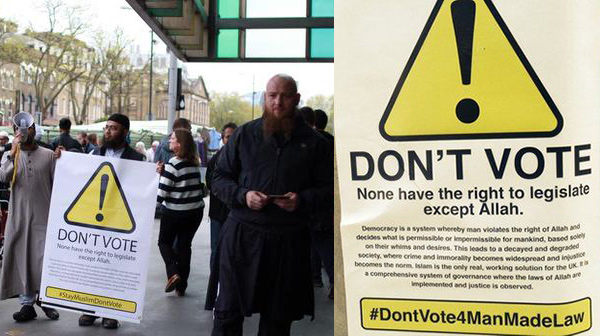
Meanwhile, the British-born Islamist Anjem Choudary actively discouraged Muslims from voting. In a stream of Twitter messages using the #StayMuslimDontVote hashtag, Choudary argued that voting is a “sin” against Islam because Allah is “the only legislator.” He has also said that Muslims who vote or run for public office are “apostates.”

Other British Islamists followed Choudary’s lead. Bright yellow posters claiming that democracy “violates the right of Allah” were spotted in Cardiff, the capital of Wales, and Leicester, as part of a grassroots campaign called #DontVote4ManMadeLaw.

One such poster stated:

“Democracy is a system whereby man violates the right of Allah and decides what is permissible or impermissible for mankind, based solely on their whims and desires.

“Islam is the only real, working solution for the UK. It is a comprehensive system of governance where the laws of Allah are implemented and justice is observed.”
The Failed Tactic of Flattering Islam Won’t Go Away

May 11, 2015

The Failed Tactic of Flattering Islam Won’t Go Away, Front Page Magazine, May 11, 2015

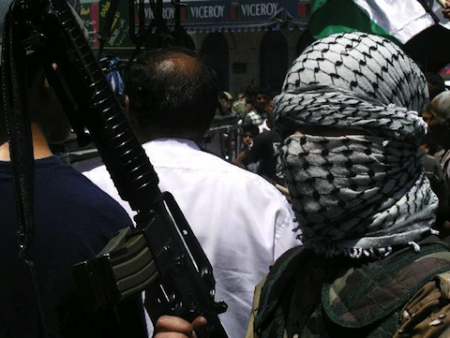
Palestinian_militant_with_rifle-450x338

The recent attack in Texas against a “draw Mohammed” event ended up with two dead jihadis and widespread criticism of event organizer Pamela Geller for “inciting” or “provoking” the assault on our First Amendment right to free speech. The hypocrisies and ignorance behind such criticism have been amply documented, including by some on the left. But there’s another argument against actions and events like Geller’s that needs dismantling. This is the received wisdom that we should avoid criticizing Islamic doctrine or Mohammed because it will alienate moderate Muslims who otherwise would help us against the so-called “extremist” jihadists.

Geraldo Rivera on Fox News invoked this rationale in his hysterical attack on Geller for “spewing her hatred and making us all look like the intolerant jerks they are saying we are in the Middle East and elsewhere.” In other words, most Muslims dislike the jihadis, who have “hijacked” and “distorted” their faith, and want to support our efforts against them. But they are put off by our “insults” of Mohammed and our “intolerance” of the wonderful “religion of peace,” all of which serve to “recruit” new jihadists. Even Bill O’Reilly and Laura Ingraham skirted this notion, advising against making any image of Mohammed, and thus in effect ratifying the legitimacy of the shari’a law against any representation of Mohammed, good or bad.

Consistent with this notion that flattery and respect can change Muslim behavior, many in the foreign policy establishment, including conservatives, have for decades counseled flattering “outreach” to Muslims as a tactic in winning the “hearts and minds” of the supposed large majority of Muslims angry at the jihadists’ “distortions” of their faith. Even before 9/11, Bill Clinton’s Secretary of State, Madeleine Albright, called Islam “a faith that honors consultation, cherishes peace, and has as one of its fundamental principles the inherent equality of all who embrace it.” Even after 9/11 confirmed Islam’s traditional theologized violence and intolerance, George Bush claimed in his first address after 9/11 that Islam’s “teachings are good and peaceful, and those who commit evil in the name of Allah blaspheme the name of Allah.” In 2005, administration officials encouraged this tactic of false flattery as a way “to support the courageous Muslims who are speaking the truth about their proud religion and history, and seizing it back from those who would hijack it for evil ends.”

Of course Obama, who has serially groveled before Muslims and praised Islam, has continued this sorry practice. After his administration blamed the Benghazi murders on an obscure Internet video, he lectured that “the future must not belong to those who slander the Prophet of Islam.” The 2 gunmen in Garland Texas obviously agreed.  His quondam Secretary of State and now presidential candidate Hillary Clinton is on record extolling Islam’s “deepest yearning of all––to live in peace.” How is that going in Nigeria, Yemen, Iraq, Syria, and Afghanistan? Worse of all, training materials used by our military and security services have excised any mention of jihad, which Western infidels have redefined as “a quest to find one’s faith in an external fight for justice,” as the New York Times put it in 2008. So Obama identifies the 13 slaughtered at Fort Hood to the traditional jihadist cry of “Allahu Akbar” as victims of “workplace violence.” Never mind the Koranic command to “slay the idolaters wherever you find them, and take them captives and besiege them and lie in wait for them in every ambush”––exactly what various jihadi outfits are doing today across the Middle East, and tried to do in Garland Texas.

Two decades of such flattery and admiration have failed to prevent nearly 26,000 violent jihadist attacks since 9/11, for they are based on Western bad ideas rather than on an accurate understanding of Islamic doctrine and the Muslim mentality. Behind our delusions is the peculiarly arrogant assumption that traditionalist Muslims––by which I mean those who take seriously the doctrines and precepts of their faith has practiced for 14 centuries––do not have their own motives and aims, but can only react to our bad behavior. Besotted by our own materialist superstitions and failure to take religion seriously, we reduce jihadist behavior to material and psychological causes: wounded self-esteem, resentment of “colonial” and “imperial” crimes, disrespect of Islam, or the lack of jobs, political freedom, or even sexual access to women.

Thus despite consistent polling data showing widespread Muslim support of illiberal shari’a law and its draconian penalties like death for blasphemy, we won’t accept that millions of Muslims actually believe what the Koran, Hadith, and 14 centuries of jurisprudence teach about the superiority of Islam and their right to use violence in order to bring the whole world under the sway of the superior social, economic, and political order that shari’a represents. In the guise of “respecting” Muslims, then, we patronize them as little more than children who can only “act out” violently in the face of injustice instead of “using their words.” Having reduced our own faith to holidays and comforting slogans, we simply can’t believe that Islam endorses violence and cruelty in the name of Allah, or that otherwise loving and kind people, as bin Laden was said to have been by all who knew him, can at the same time slaughter and brutalize innocents in pursuit of spiritual aims. No, either they are “crazy” or “evil,” or they are traumatized by our bad behavior.

This dubious pop-psychological assumption is usually accompanied by a catalogue of the historical crimes against Muslims perpetrated by the West, from the Crusades to the wars against the Taliban and Saddam Hussein. These depredations, so the story goes, also fuel anger and resentment, and help to incentivize otherwise peaceful Muslims into turning jihadist. But this narrative is belied by the facts of history. For what history tells us is that the record of Muslim conquest, occupation, colonizing, slaving, raiding, and killing of Christians far surpasses the alleged crimes of the West against Islam. We recently marked the centenary of the Ottoman genocide against the Christian Armenians, Assyrians, and Chaldeans, a crime being duplicated today by ISIS in northern Iraq. Recently our historically challenged president whined about the Crusades and the Inquisition, with nary a word about the centuries of Muslim invasion, occupation, colonization, and brutal suppression in Christian Spain, Sicily, the Balkans, and Greece.

Or what about the 1066 pogrom in Granada, the alleged paradise of “pan-confessional humanism,” as an ignorant Wall Street Journal editorial claimed a few years back. Those tolerant, humanist Muslims slaughtered 5000 Jews, equaling the toll of dead during the whole existence of the Inquisition. But can anyone name one Muslim religious leader in the Middle East who has publicly and consistently apologized in Obama fashion for these 14 centuries of slaughter? Who has justified our defensive wars in the region as an understandable reaction to that history? Who has chastised Muslims for destroying and desecrating churches, and blamed them for inviting violent reactions? Muslim Turkey won’t even own up to its copiously documented slaughter of 1.5 million Armenians. If anyone has a historical grievance that justifies payback, it is Christians and Jews.

Finally, if Western insults and crimes against Muslims are really the reason jihadists want to kill us, why do they let Russia off the hook? No Christian power has killed more Muslims or occupied more Muslim lands than has Russia, from the siege of Izmail in 1790, when 40,000 Muslim men, women, and children were slaughtered, to the invasion of Afghanistan, which killed a million, to the brutal wars against Muslim Chechnyans, which killed at least 100,000. Or how about the 10 million Muslim Uighurs oppressed by China and forbidden to fully practice their faith?  Is Russia or China the “Great Satan”? Are they the constant targets of jihadist attack and thundering denunciations by the mullahs of Iran? Are “moderate” Muslims “alienated” by their behavior and rushing to join the jihad against them?

The obvious answer is no, for the simple reason that Russia and China are contemptuous of such juvenile psychological blackmail, pursue their national interests without regard for criticism by the “Muslim community,” and respond with brutal force to violent attacks. Meanwhile the U.S. has rescued millions of Muslims in the Balkans, Kuwait, Iraq, and Afghanistan from brutal dictators, ethnic cleansing, and psychotic autocrats, yet is deemed “Islamophobic” because we exercise our Constitutional rights in our own country. Worse yet, we grovel and apologize and demonize those like Pamela Geller who practice their right to free expression at a private function, and we vainly believe despite all evidence that if we just act nice to Muslims and join them in demonizing their critics, they’ll ignore their spiritual beliefs, the traditions of their faith, and the model of Mohammed and his credo to “fight all men until they say there is no god but Allah.”

To paraphrase Cicero and Orwell, there are some things so stupid that only rich, arrogant Westerners will believe them. If we let this president continue to predicate his dealings with Iran on this same delusional belief in the power of flattering engagement and “mutual respect,” we will soon find out the high cost of this stupidity.

The Cartoon Wars

May 8, 2015

The Cartoon Wars, Gatestone InstituteDouglas Murray, May 7, 2015

  • It is most important to keep on challenging these would-be censors, so that people with Kalashnikov rifles do not make our customs and laws.
  • One of the false presumptions of our time is that people on the political left are motivated by good intentions even when they do bad things, while people on the political right are motivated by bad intentions even when they do good things.
  • When people prefer to focus on the motives of the victims rather than on the motives of the attackers, they will ignore the single most important matter: that an art exhibition, or free speech, has been targeted.
  • It does not matter if you are right-wing or left-wing, or American, Danish, Dutch, Belgian or French. These particularities may matter greatly and be endlessly interesting to people in the countries in question. But they matter not a jot to ISIS or their fellow-travellers. What these people are trying to do is to enforce Islamic blasphemy laws across the entire world. That is all that matters.

ISIS appears to have inspired its first terrorist attack in the United States: in Garland, Texas. This item may have slipped the attention of many people because as is so often the case today, much of the reporting and commentary has got caught up on other, supplementary issues.

The supplementary issues are first, that the attack targeted a competition set up to show images of what people thought Muhammad may have looked like. Then, there is the identity of the people who organized the exhibition and spoke at it.

1061Bosch Fawstin (second from left), the cartoonist who won the Muhammad Art Exhibit and Contest in Garland, Texas this week, is presented with his prize by (from left to right) Robert Spencer, Geert Wilders and Pamela Geller. (Image source: Atlas Shrugs blog)

Before coming to this, let us just return to that main issue. Since January, the idea that ISIS-like groups can inspire people to carry out murderous attacks in Paris and Copenhagen has come to be accepted. But that this can happen in Texas, of all places, could yet have an even worse “chilling effect” on free speech than the attacks in Paris and Copenhagen. No European country has the constitutional commitment to free speech of the United States. And Texas is not stuck in the moral relativism and fearful multiculturalism of most European countries.

There will be a feeling, post-Garland, that if ISIS can strike in Texas, it can strike anyplace. The entire developed world is therefore a potential site for an attack from ISIS. Although no one will put his hands up and surrender, neither will anyone be likely to draw attention to himself by saying or doing anything that might displease such homicidal censors.

The presence of strong security forces clearly helps to prevent attacks, but it is worth remembering that ISIS will use the opportunity of such “failed” attacks to come up with other ways of operating, which they will judge more likely to succeed.

What is most striking, however, is how silent many of the usual defenders of free speech have been.

Undoubtedly this is partly to do with the idea, becoming ingrained, that if you draw Mohammed or publish such images, you have, in some way, got it coming to you. This is an appalling pass to have come to, but it is in just such way that censorship and self-censorship are allowed to embed themselves.

Very few people say that they will not draw a historical figure because they are scared. But attack by attack, the feeling is growing among the majority of the media and others who have declined to publish such images, that they have failed. So to hide that shame, they tell themselves there is something provocative and even irresponsible in challenging people who would challenge the freedom speech.

One might still get the support of those who cherish free speech if one were accidentally to publish a cartoon of Mohammed, but not if you did so deliberately, and in full knowledge of the consequences. But of course, it is precisely after facing the consequences of challenging these would-be censors that it is most important to keep on challenging them, so that people with Kalashnikov rifles do not make our customs and laws.

As people come up with ever more elaborate ways to justify what they probably know in their hearts to be contemptible, it becomes harder and harder for them to change course.

Then there is the other only-occasionally-spoken-about supplementary issue, which may well be at the root of the difference between the assaults in Europe and the response to the attempted Texas assault. The January massacre at the satirical French magazine Charlie Hebdo undoubtedly woke up a portion of the general public in the West because the victims were cartoonists and editors at a “left-wing” magazine. That is, Charlie Hebdo stood for a type of robust secular, anti-establishment type of French politics, which a portion of the left worldwide could recognize as its own.

This stands in contrast to the comparative lack of solidarity after threats to the Danish newspaper, Jyllands-Posten, in the wake of the 2005 Mohammed cartoons affair. To varying degrees, Jyllands-Posten was described as a “conservative” paper. In this context, unsure whether “conservative” meant anything from “establishment” all the way to “racist,” there was often suspected to be some dark, ulterior motive for publishing cartoons of the founder of Islam.

There is, however, no escaping such smears. Plenty of people proved willing, in the wake of the Paris attack, to smear the murdered cartoonists of Charlie Hebdo as far-right-wing or racist.

The organizers at the American Freedom Defense Initiative (AFDI), Pamela Geller and Robert Spencer, are not left-wing journalists but conservative activists; and because the Dutch politician Geert Wilders spoke at the opening of the exhibition, that added a layer of complexity for people who like labeling actions with political valences, rather than just seeing actions as apart from them. It seems clear, however, from the pattern of condemnations on one side and silence on the other, that a cartoonist may be worthy of defense if he is associated with a left-wing organization, but not if he is associated with a right-wing one.

Of course, this idea goes to one of the false presumptions of our time: ­that people on the political left are motivated by good intentions even when they do bad things, while people on the political right are motivated by bad intentions even when they do good things. So a cartoon promoted byCharlie Hebdo may be thought to be provocative in a constructive way, whereas one promoted by AFDI can only be thought if as being provocative in an unconstructive way. Whether people are willing to admit it or not, this is one of the main problems that underlies the reaction to the Texas attack.

Such a distinction is, needless to say, a colossal mistake. When people prefer to focus on the motives of the victims rather than on the motives of the attackers, they will ignore the single most important matter: that an art exhibition, or free speech, has been targeted. The rest is narcissism and slow-learning.

It does not matter if you are right wing or left wing. It does not matter if you are American, Danish, Dutch, Belgian or French, or whether you are from Texas or Copenhagen. These particularities may matter greatly and be endlessly interesting to people in the countries in question. But they matter not a jot to ISIS or their fellow-travellers. What these people are trying to do is to enforce Islamic blasphemy laws across the entire world.

That is all that matters. If we forget this or lose sight of it, not only will we lose free speech, we will lose, period.

Cartoonists are Controversial and Murderers are Moderate

May 5, 2015

Cartoonists are Controversial and Murderers are Moderate, Front Page Magazine, Daniel Greenfield, May 5, 2015

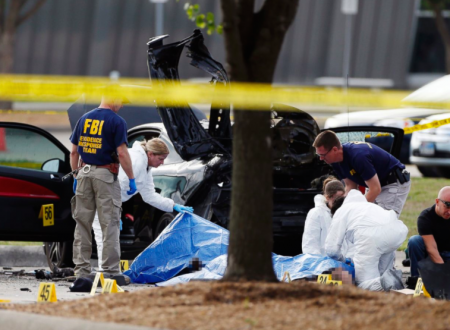
garland1-450x330

[I]f you believe the media, cartoonists are more controversial than killers. A former Muslim sketching a cartoon of Mohammed is bigoted, but justifying attacks on Jews is moderate. Plotting to overthrow the United States and replace it with an Islamic theocracy is right up the alley of your local civil rights group, but a cartoon contest threatens the nation and all of creation by bringing down the wrath of men who spent their time at moderate and Muslim organizations which only occasionally support terrorism.

****************

Controversial, intolerant and provocative. Mainstream media outlets broke out these three words to describe the “Draw the Prophet” contest, the American Freedom Defense Initiative and Pamela Geller.

While the police were still checking cars for explosives and attendees waited to be released, CNN called AFDI, rather than the terrorists who attacked a cartoon contest, “intolerant.” Time dubbed the group “controversial.” The Washington Post called the contest, “provocative.”

Many media outlets relied on the expert opinion of the Southern Poverty Law Center, a multi-million dollar mail order scam disguised as a civil rights group, which had listed AFDI as a hate group. Also listed as hate groups were a number of single author blogs, including mine, a brand of gun oil and a bar sign.

The bar sign, which hangs outside a bar seven miles outside Pittsburgh, appears to be made out of metal and plastic. It is reportedly unaware that it is a hate group and has made no plans to take over America.

The SPLC’s inability to conduct even the most elementary fact checking did not stop news networks from inviting its talking head on to suggest that AFDI got “the response that they — in a sense — they are seeking.” Neither CNN nor MSNBC were impolitic enough to mention that no AFDI supporter had used its materials to plan a killing spree, while at least one of SPLC’s supporters had done just that.

But being “controversial” and “provocative” has nothing to do with who is doing the shooting. It’s a media signal that the target shouldn’t be sympathized with. The Family Research Council, which was shot up by a killer using the SPLC’s hate map, is invariably dubbed “intolerant.” The SPLC, which targeted it, is however a “respected civil rights group” which provides maps to respected civil rights gunmen.

A contest in which Bosch Fawstin, an ex-Muslim, drew a cartoon of a genocidal warlord is “controversial” and “provocative,” while the MSA, which has invited Sheikh Khalid Yasin, who has inspired a number of terrorists, including apparently one of the Mohammed contest attackers, is a legitimate organization that is only criticized by controversial, intolerant and provocative Islamophobes.

Khalid Yasin has held such controversial and provocative views as claiming that the US created AIDS, that gays should be stoned to death and that women should be beaten. But the mosques and MSAs that he has appeared at have not been described as controversial, intolerant and provocative for inviting him.

Elton Simpson, the first gunman, attended the Islamic Community Center of Phoenix. The mosque was listed as being controlled by the Muslim Brotherhood’s North American Islamic Trust front group.

The Muslim Brotherhood holds such controversial and provocative views as “waging Jihad” against American infidels, “raising a Jihadi generation that pursues death” and “destroying the Western civilization from within.” Despite these extremely provocative and intolerant views, the Muslim Brotherhood is usually described by the media as a “moderate” group.

The Brotherhood’s American arm believes in launching a “Grand Jihad” to Islamize America. Its final phase calls for “Seizing power to establish their Islamic Nation” in the United State.

Some might say this is a slightly more controversial activity than drawing cartoons of a dead warlord.

The Islamic Community Center of Phoenix featured an appearance by Lauren Booth, a convert to Islam employed by Iran, who has been photographed with the leader of Hamas, and holds such controversial and provocative views, as the Boston Marathon bombing being faked and attacks on Jews being justified as “a frustrated backlash.

Some might say Booth’s views are controversial, provocative and intolerant. And that the gunman’s mosque was intolerant for inviting her. But don’t expect the media to call out terrorist intolerance.

Booth came as part of a fundraising effort for the Muslim Legal Fund of America, which funded the defense for Islamic Jihad boss Sami al-Arian and aided some of the terrorists involved in the provocative and controversial Fort Dix terror plot to “kill as many soldiers as possible.”

If the two Mohammed cartoon gunmen had survived, the Muslim Legal Fund of America might be having Lauren Booth spout Jewish conspiracies to fundraise on their behalf.

But if you believe the media, cartoonists are more controversial than killers. A former Muslim sketching a cartoon of Mohammed is bigoted, but justifying attacks on Jews is moderate. Plotting to overthrow the United States and replace it with an Islamic theocracy is right up the alley of your local civil rights group, but a cartoon contest threatens the nation and all of creation by bringing down the wrath of men who spent their time at moderate and Muslim organizations which only occasionally support terrorism.

Cartoons can be provocative, but the only people inspired to kill over them, are killers. No one took a shot at Gary “Punching Up” Trudeau, despite decades of mocking conservatives. None of the assorted arts projects that involve defiling and mocking the sacred symbols of Christianity and Judaism resulted in gunmen in body armor trying to storm a cartoon competition. And yet it keeps happening with Islam.

Satire exposes sociopaths and sociopathic ideologies. And it’s the very attack on the “controversial” and “provocative” contest that shows why exposing them is so important.

Elton Simpson had already been on the radar of the FBI. He should have been in jail, but Judge Mary H. Murguia, a Clinton appointee who has been bandied about as a possible Obama Supreme Court nominee, chose to believe a claim by his public defender that when he was taped talking about Jihad, it might have meant “an internal struggle to maintain faith,” instead of killing non-Muslims.

Simpson had said that Allah loves those who fight non-Muslims, that Jihadists go to paradise and stated, “I’m tellin’ you man. We gonna make it to the battlefield… it’s time to roll.”

But that was just too ambiguous for Judge Murguia, who wrote, “It is true that the Defendant had expressed sympathy and admiration for individuals who “fight” non-Muslims as well as his belief in the establishment of Shariah law, all over the world including in Somalia. What precisely was meant by “fighting” whenever he discussed it, however, was not clear.”

“Neither was what the Defendant meant when he stated he wanted to get to the ‘battlefield’ in Somalia,” she added.

If nothing else, events like these help clarify the question of just what “fighting” non-Muslims involves, and whether it’s an internal struggle to maintain faith or an external struggle waged with assault rifles.

Satire helps expose the idiocy and absurdity of our betters, whether it’s Gary Trudeau or Judge Murguia. Every act of Islamic terror discredits them and their dishonest worldview even further. And they know it.

We cannot fight Islamic terrorism until we deal with it and we cannot deal with it as long as we are burdened by a political establishment that frantically censors any mention of its existence or its agenda.

The two gunmen did not attack the cartoon event simply because they were offended, but because they believed that their religion gave them a mandate to impose Islamic law on Americans. Until we deal with this supremacist reality, any effort to fight Islamic terrorists will be futile and will ultimately fail.

The Mohammed cartoons are so vital because they expose the theocracy at the heart of Islamic terrorism. When Muslim terrorists attack cartoonists, they’re not fighting our foreign policy; they are killing and dying to impose the foreign policy of the Muslim Brotherhood and its numerous daughter groups, such as Al Qaeda, Hamas and ISIS, on us.

The controversial and provocative cartoonists go into battle with pencils in their hands. The terrorists come with body armor and assault rifles. This clash is what real political dissent looks like.

The cartoonists believe in the controversial, intolerant and provocative idea that America should not be a theocracy. But the only people who should be provoked by that provocative idea are the Jihadists who want to impose a theocracy on America and the useful idiots lying and denying on their behalf.

Off topic | Britain’s Labour Party Vows to Ban Islamophobia

April 30, 2015

Britain’s Labour Party Vows to Ban Islamophobia, Gatestone InstituteSoeren Kern, April 30, 2015

  • “In Miliband’s Britain, it will become impossible to criticise any aspect of Islamic culture, whether it be the spread of the burka or the establishment of Sharia courts or the construction of colossal new mosques. … If he wins, Miliband will ensure that the accelerating Islamification of our country will go unchallenged.” — Leo McKinstry, British commentator.
  • The report shows that Britain’s Muslim population is overwhelmingly young and will exert increasing political influence as time goes on. The median age of the Muslim population in Britain is 25 years, compared to the overall population’s median age of 40 years.

The leader of Britain’s Labour Party, Ed Miliband, has vowed, if he becomes the next prime minister in general elections on May 7, to outlaw “Islamophobia.”

The move — which one observer has called “utterly frightening” because of its implications for free speech in Britain — is part of an effort by Miliband to pander to Muslim voters in a race that he has described as “the tightest general election for a generation.”

With the ruling Conservatives and the opposition Labour running neck and neck in the polls just days before voters cast their ballots, British Muslims — who voted overwhelmingly for Labour in the 2010 general election — could indeed determine who will be the next prime minister.

In an interview with The Muslim News, Miliband said:

“We are going to make it [Islamophobia] an aggravated crime. We are going to make sure it is marked on people’s records with the police to make sure they root out Islamophobia as a hate crime.

“We are going to change the law on this so we make it absolutely clear of our abhorrence of hate crime and Islamophobia. It will be the first time that the police will record Islamophobic attacks right across the country.”

Miliband appears to be trying to reopen a long-running debate in Britain over so-called religious hatred. Between 2001 and 2005, the then-Labour government, led by Prime Minister Tony Blair, made two attempts (here and here) to amend Part 3 of the Public Order Act 1986, to extend existing provisions on incitement to racial hatred to cover incitement to religious hatred.

Those efforts ran into opposition from critics who said the measures were too far-reaching and threatened the freedom of speech. At the time, critics argued that the scope of the Labour government’s definition of “religious hatred” was so draconian that it would have made any criticism of Islam a crime.

In January 2006, the House of Lords approved the Racial and Religious Hatred Act 2006, after amending the text so that the law would be limited to banning only “threatening” words and not those that are merely abusive or insulting. Lawmakers also said that the offense would require the intention — not just the possibility — of stirring up religious hatred. They added that proselytizing, discussion, criticism, abuse and ridicule of religion, belief or religious practice would not be an offense.

Miliband’s renewed promise to make “Islamophobia” (a term he has not defined) an “aggravated crime” may signal an attempt to turn the 2006 Act — which already stipulates a maximum penalty of seven years in prison for stirring up religious hatred — into a full-blown Muslim blasphemy law.

According to British commentator Leo McKinstry, “Miliband’s proposal goes against the entire tradition of Western democracy, which holds that people should be punished only for their deeds, not their opinions.” In an opinion article, he added:

“In Miliband’s Britain, it will become impossible to criticise any aspect of Islamic culture, whether it be the spread of the burka or the establishment of Sharia courts or the construction of colossal new mosques. We already live in a society where Mohammed is now the most popular boy’s name and where a child born in Birmingham is more likely to be a Muslim than a Christian. If he wins, Miliband will ensure that the accelerating Islamification of our country will go unchallenged.”

McKinstry says Miliband is currying favor with Britain’s three million-strong Muslim community to “prop up Labour’s urban vote.”

Muslims are emerging as a key voting bloc in British politics and are already poised to determine the outcome of local elections in many parts of the country, according to a report by the Muslim Council of Britain, an umbrella group.

The report shows that Britain’s Muslim population is overwhelmingly young and will exert increasing political influence as time goes on. The median age of the Muslim population in Britain is 25 years, compared to the overall population’s median age of 40 years.

An extrapolation of the available data indicates that one million British Muslims aged 18 and above will be eligible to vote in this year’s election. According to one study, Muslims could determine the outcome of up to 25% of the 573 Parliamentary seats in England and Wales.

Others say that although Britain’s Muslim community is growing, it is also ethnically diverse and unlikely to vote as a single group. One analyst has argued that the potential for Muslim influence in this year’s election “will remain unrealized because the Muslim vote is not organized in any meaningful way on a national level.”

A study produced by Theos, a London-based religious think tank, found that although Muslims consistently vote Labour, they do so based on class and economic considerations, not out of religious motives.

Indeed, a poll conducted by the BBC on April 17 found that nearly one-quarter of “Asian” voters still do not know which party they will support at the general election. Some of those interviewed by the BBC said that economic issues would determine whom they vote for.

In any event, Muslim influence in the 2015 vote will be largely determined by Muslim voter turnout, which has been notoriously low in past elections: Only 47% of British Muslims were estimated to have voted in 2010.

Since then, several grassroots campaigns have been established to encourage British Muslims to go to the polls in 2015, including Get Out & Vote, Muslim Vote and Operation Black Vote. Another group, YouElect, states:

“A staggering 53% of British Muslims did not vote in the 2010 General Election, such a high figure of Muslim non-voters indicates that many Muslims feel ignored by politicians and disillusioned by the political process.

“With the rise of Islamophobic rhetoric in politics and an ever increasing amount of anti-terror legislation which specifically targets Muslims, it is now more important than ever that Muslims use the vote to send a message to politicians that their attitudes and policies must change.

“YouElect wants to get the message across that there is something you can do about the issues you care about. We have launched a new campaign using the hashtag #SortItOut, which calls on Muslims to use the political process to address the issues that concern them most.

“With 100,000 new young Muslims eligible to vote this year and 26 parliamentary constituencies with a Muslim population of over 20%, the Muslim community has a very real opportunity to make an impact on British politics.”

Not all Muslims agree. The British-born Islamist preacher Anjem Choudary is actively discouraging Muslims from voting. In a stream of Twitter messages using the #StayMuslimDontVote hashtag, Choudary has argued that voting is a “sin” against Islam because Allah is “the only legislator.” He has also said that Muslims who vote or run for public office are “apostates.”

1050Despite several grassroots campaigns to encourage British Muslims to vote in greater numbers, some prominent Islamists in the UK claim that voting is a “sin.”

Other British Islamists are following Choudary’s lead. Bright yellow posters claiming that democracy “violates the right of Allah” have been spotted in Cardiff, the capital of Wales, and Leicester, as part of a grassroots campaign called #DontVote4ManMadeLaw.

One such poster stated:

“Democracy is a system whereby man violates the right of Allah and decides what is permissible or impermissible for mankind, based solely on their whims and desires.

“Islam is the only real, working solution for the UK. It is a comprehensive system of governance where the laws of Allah are implemented and justice is observed.”

Why Islam Needs a Reformation

March 21, 2015

Why Islam Needs a Reformation, Wall Street Journal, Ayaan Hirsi Ali, March 20, 2015

(What are the chances of such a reformation over the next hundred years or so? — DM)

bn-hm855_cover_m_20150319160506A man prays during the Muslim festival of Eid al-Adha, or the Festival of Sacrifice, at Jama Masjid in New Delhi on Oct. 6, 2014. Eid al-Adha marks the end of the Hajj, the annual pilgrimage to Mecca. PHOTO: AGENCE FRANCE-PRESSE/GETTY IMAGES

“Islam’s borders are bloody,” wrote the late political scientist Samuel Huntington in 1996, “and so are its innards.” Nearly 20 years later, Huntington looks more right than ever before. According to the International Institute for Strategic Studies, at least 70% of all the fatalities in armed conflicts around the world last year were in wars involving Muslims. In 2013, there were nearly 12,000 terrorist attacks world-wide. The lion’s share were in Muslim-majority countries, and many of the others were carried out by Muslims. By far the most numerous victims of Muslim violence—including executions and lynchings not captured in these statistics—are Muslims themselves.

Not all of this violence is explicitly motivated by religion, but a great deal of it is. I believe that it is foolish to insist, as Western leaders habitually do, that the violent acts committed in the name of Islam can somehow be divorced from the religion itself. For more than a decade, my message has been simple: Islam is not a religion of peace.

When I assert this, I do not mean that Islamic belief makes all Muslims violent. This is manifestly not the case: There are many millions of peaceful Muslims in the world. What I do say is that the call to violence and the justification for it are explicitly stated in the sacred texts of Islam. Moreover, this theologically sanctioned violence is there to be activated by any number of offenses, including but not limited to apostasy, adultery, blasphemy and even something as vague as threats to family honor or to the honor of Islam itself.

It is not just al Qaeda and Islamic State that show the violent face of Islamic faith and practice. It is Pakistan, where any statement critical of the Prophet or Islam is labeled as blasphemy and punishable by death. It is Saudi Arabia, where churches and synagogues are outlawed and where beheadings are a legitimate form of punishment. It is Iran, where stoning is an acceptable punishment and homosexuals are hanged for their “crime.”

As I see it, the fundamental problem is that the majority of otherwise peaceful and law-abiding Muslims are unwilling to acknowledge, much less to repudiate, the theological warrant for intolerance and violence embedded in their own religious texts. It simply will not do for Muslims to claim that their religion has been “hijacked” by extremists. The killers of Islamic State and Nigeria’s Boko Haram cite the same religious texts that every other Muslim in the world considers sacrosanct.

Instead of letting Islam off the hook with bland clichés about the religion of peace, we in the West need to challenge and debate the very substance of Islamic thought and practice. We need to hold Islam accountable for the acts of its most violent adherents and to demand that it reform or disavow the key beliefs that are used to justify those acts.

As it turns out, the West has some experience with this sort of reformist project. It is precisely what took place in Judaism and Christianity over the centuries, as both traditions gradually consigned the violent passages of their own sacred texts to the past. Many parts of the Bible and the Talmud reflect patriarchal norms, and both also contain many stories of harsh human and divine retribution. As President Barack Obama said in remarks at the National Prayer Breakfast last month, “Remember that during the Crusades and the Inquisition, people committed terrible deeds in the name of Christ.”

bn-hm858_cover_m_20150319160800Islamic State militants marching through Raqqa, Syria, a stronghold of the Sunni extremist group, in an undated file image posted on a militant website on Jan. 14, 2014. PHOTO: ASSOCIATED PRESS

Yet today, because their faiths went through a long, meaningful process of Reformation and Enlightenment, the vast majority of Jews and Christians have come to dismiss religious scripture that urges intolerance or violence. There are literalist fringes in both religions, but they are true fringes. Regrettably, in Islam, it is the other way around: It is those seeking religious reform who are the fringe element.

Any serious discussion of Islam must begin with its core creed, which is based on the Quran (the words said to have been revealed by the Angel Gabriel to the Prophet Muhammad) and the hadith (the accompanying works that detail Muhammad’s life and words). Despite some sectarian differences, this creed unites all Muslims. All, without exception, know by heart these words: “I bear witness that there is no God but Allah; and Muhammad is His messenger.” This is the Shahada, the Muslim profession of faith.

The Shahada might seem to be a declaration of belief no different from any other. But the reality is that the Shahada is both a religious and a political symbol.

In the early days of Islam, when Muhammad was going from door to door in Mecca trying to persuade the polytheists to abandon their idols of worship, he was inviting them to accept that there was no god but Allah and that he was Allah’s messenger.

After 10 years of trying this kind of persuasion, however, he and his small band of believers went to Medina, and from that moment, Muhammad’s mission took on a political dimension. Unbelievers were still invited to submit to Allah, but after Medina, they were attacked if they refused. If defeated, they were given the option to convert or to die. (Jews and Christians could retain their faith if they submitted to paying a special tax.)

No symbol represents the soul of Islam more than the Shahada. But today there is a contest within Islam for the ownership of that symbol. Who owns the Shahada? Is it those Muslims who want to emphasize Muhammad’s years in Mecca or those who are inspired by his conquests after Medina? On this basis, I believe that we can distinguish three different groups of Muslims.

The first group is the most problematic. These are the fundamentalists who, when they say the Shahada, mean: “We must live by the strict letter of our creed.” They envision a regime based on Shariah, Islamic religious law. They argue for an Islam largely or completely unchanged from its original seventh-century version. What is more, they take it as a requirement of their faith that they impose it on everyone else.

I shall call them Medina Muslims, in that they see the forcible imposition of Shariah as their religious duty. They aim not just to obey Muhammad’s teaching but also to emulate his warlike conduct after his move to Medina. Even if they do not themselves engage in violence, they do not hesitate to condone it.

It is Medina Muslims who call Jews and Christians “pigs and monkeys.” It is Medina Muslims who prescribe death for the crime of apostasy, death by stoning for adultery and hanging for homosexuality. It is Medina Muslims who put women in burqas and beat them if they leave their homes alone or if they are improperly veiled.

bn-hm863_cover_m_20150319161118Muslim children carry torches during a parade before Eid al-Fitr, at the end of the holy month of Ramadan, on July 27, 2014, in Yogyakarta, Indonesia. PHOTO: GETTY IMAGES

The second group—and the clear majority throughout the Muslim world—consists of Muslims who are loyal to the core creed and worship devoutly but are not inclined to practice violence. I call them Mecca Muslims. Like devout Christians or Jews who attend religious services every day and abide by religious rules in what they eat and wear, Mecca Muslims focus on religious observance. I was born in Somalia and raised as a Mecca Muslim. So were the majority of Muslims from Casablanca to Jakarta.

Yet the Mecca Muslims have a problem: Their religious beliefs exist in an uneasy tension with modernity—the complex of economic, cultural and political innovations that not only reshaped the Western world but also dramatically transformed the developing world as the West exported it. The rational, secular and individualistic values of modernity are fundamentally corrosive of traditional societies, especially hierarchies based on gender, age and inherited status.

Trapped between two worlds of belief and experience, these Muslims are engaged in a daily struggle to adhere to Islam in the context of a society that challenges their values and beliefs at every turn. Many are able to resolve this tension only by withdrawing into self-enclosed (and increasingly self-governing) enclaves. This is called cocooning, a practice whereby Muslim immigrants attempt to wall off outside influences, permitting only an Islamic education for their children and disengaging from the wider non-Muslim community.

It is my hope to engage this second group of Muslims—those closer to Mecca than to Medina—in a dialogue about the meaning and practice of their faith. I recognize that these Muslims are not likely to heed a call for doctrinal reformation from someone they regard as an apostate and infidel. But they may reconsider if I can persuade them to think of me not as an apostate but as a heretic: one of a growing number of people born into Islam who have sought to think critically about the faith we were raised in. It is with this third group—only a few of whom have left Islam altogether—that I would now identify myself.

These are the Muslim dissidents. A few of us have been forced by experience to conclude that we could not continue to be believers; yet we remain deeply engaged in the debate about Islam’s future. The majority of dissidents are reforming believers—among them clerics who have come to realize that their religion must change if its followers are not to be condemned to an interminable cycle of political violence.

How many Muslims belong to each group? Ed Husain of the Council on Foreign Relations estimates that only 3% of the world’s Muslims understand Islam in the militant terms I associate with Muhammad’s time in Medina. But out of well over 1.6 billion believers, or 23% of the globe’s population, that 48 million seems to be more than enough. (I would put the number significantly higher, based on survey data on attitudes toward Shariah in Muslim countries.)

In any case, regardless of the numbers, it is the Medina Muslims who have captured the world’s attention on the airwaves, over social media, in far too many mosques and, of course, on the battlefield.

The Medina Muslims pose a threat not just to non-Muslims. They also undermine the position of those Mecca Muslims attempting to lead a quiet life in their cultural cocoons throughout the Western world. But those under the greatest threat are the dissidents and reformers within Islam, who face ostracism and rejection, who must brave all manner of insults, who must deal with the death threats—or face death itself.

For the world at large, the only viable strategy for containing the threat posed by the Medina Muslims is to side with the dissidents and reformers and to help them to do two things: first, identify and repudiate those parts of Muhammad’s legacy that summon Muslims to intolerance and war, and second, persuade the great majority of believers—the Mecca Muslims—to accept this change.

Islam is at a crossroads. Muslims need to make a conscious decision to confront, debate and ultimately reject the violent elements within their religion. To some extent—not least because of widespread revulsion at the atrocities of Islamic State, al Qaeda and the rest—this process has already begun. But it needs leadership from the dissidents, and they in turn stand no chance without support from the West.

What needs to happen for us to defeat the extremists for good? Economic, political, judicial and military tools have been proposed and some of them deployed. But I believe that these will have little effect unless Islam itself is reformed.

Such a reformation has been called for repeatedly at least since the fall of the Ottoman Empire and the subsequent abolition of the caliphate. But I would like to specify precisely what needs to be reformed.

I have identified five precepts central to Islam that have made it resistant to historical change and adaptation. Only when the harmfulness of these ideas are recognized and they are repudiated will a true Muslim Reformation have been achieved.

Here are the five areas that require amendment:

1. Muhammad’s semi-divine status, along with the literalist reading of the Quran.
Muhammad should not be seen as infallible, let alone as a source of divine writ. He should be seen as a historical figure who united the Arab tribes in a premodern context that cannot be replicated in the 21st century. And although Islam maintains that the Quran is the literal word of Allah, it is, in historical reality, a book that was shaped by human hands. Large parts of the Quran simply reflect the tribal values of the 7th-century Arabian context from which it emerged. The Quran’s eternal spiritual values must be separated from the cultural accidents of the place and time of its birth.

2. The supremacy of life after death.
The appeal of martyrdom will fade only when Muslims assign a greater value to the rewards of this life than to those promised in the hereafter.

3. Shariah, the vast body of religious legislation.
Muslims should learn to put the dynamic, evolving laws made by human beings above those aspects of Shariah that are violent, intolerant or anachronistic.

4. The right of individual Muslims to enforce Islamic law.
There is no room in the modern world for religious police, vigilantes and politically empowered clerics.

5. The imperative to wage jihad, or holy war.
Islam must become a true religion of peace, which means rejecting the imposition of religion by the sword.

I know that this argument will make many Muslims uncomfortable. Some are bound to be offended by my proposed amendments. Others will contend that I am not qualified to discuss these complex issues of theology and law. I am also afraid—genuinely afraid—that it will make a few Muslims even more eager to silence me.

But this is not a work of theology. It is more in the nature of a public intervention in the debate about the future of Islam. The biggest obstacle to change within the Muslim world is precisely its suppression of the sort of critical thinking I am attempting here. If my proposal for reform helps to spark a serious discussion of these issues among Muslims themselves, I will consider it a success.

Let me make two things clear. I do not seek to inspire another war on terror or extremism—violence in the name of Islam cannot be ended by military means alone. Nor am I any sort of “Islamophobe.” At various times, I myself have been all three kinds of Muslim: a fundamentalist, a cocooned believer and a dissident. My journey has gone from Mecca to Medina to Manhattan.

For me, there seemed no way to reconcile my faith with the freedoms I came to the West to embrace. I left the faith, despite the threat of the death penalty prescribed by Shariah for apostates. Future generations of Muslims deserve better, safer options. Muslims should be able to welcome modernity, not be forced to wall themselves off, or live in a state of cognitive dissonance, or lash out in violent rejection.

But it is not only Muslims who would benefit from a reformation of Islam. We in the West have an enormous stake in how the struggle over Islam plays out. We cannot remain on the sidelines, as though the outcome has nothing to do with us. For if the Medina Muslims win and the hope for a Muslim Reformation dies, the rest of the world too will pay an enormous price—not only in blood spilled but also in freedom lost.