Archive for the ‘Saudi royal family’ category

Trump’s game in Saudi Arabia

February 13, 2017

Trump’s game in Saudi Arabia, American ThinkerJames Lewis, February 13, 2017

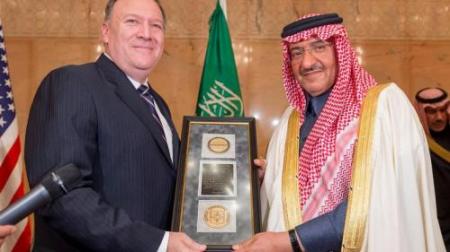
Mike Pompeo, the new CIA head, just flew to Riyadh to give a medal to the reigning son of the king (who is said to suffer from dementia).  While some conservatives regard this as a travesty (e.g., a “Not the Onion” commentary from Zero Hedge), I think this is meant to be an open signal to support the House of Saud, whose help is needed against the Iranians anyway and who support President El-Sisi against Hamas and the Muslim Brotherhood.

saudiaward

It’s not clear what the Saudis did in exchange, but they have been under the gun, fearing that Western media would expose their role in support of violent jihad.  So this looks as though the Saudis have done a lot to settle those debts.  It’s not the kind of public gesture the CIA does a lot.

The Saudis can shut down ISIS/AQ/Al Nusra, or whatever the worst gang of maniacs calls itself today.  They also have no problem with selected assassinations.  SecDef Mattis has a long record of talking about morality and immorality in warfare, and he does not like sadistic monsters.  I think the moral dimension of defensive war has been missing during the Obama years.

These moves may signal both domestic and foreign agreements to calm things down.  The Saudis know that their control of OPEC is waning, since Trump is aggressively opening up domestic traditional and shale energy production (again, something Obama never would do).  But the Saudis need to make a “soft landing,” which is not going to be easy.  So they have been talking peace with Israel, on the assumption that Israel can communicate with the U.S. – at least under Trump.

These are all calming moves in a very agitated international situation. I believe that Trump is going to move aggressively against Muslim Brotherhood infiltration, probably with Saudi backing.  The Saudis are ideologically aligned with ISIS, al-Qaeda, and the M.B.s, but tactically, they could abandon them.  Violent jihad arose with OPEC, and now that OPEC is declining, it would be smart to convince the Saudis that the jig is up.

We can see if there is a marked decrease in jihadist violence.  If not, then the hypothesis is wrong.

The possibility of public exposure of their role in 9/11 is still very real and can be used to ensure their good behavior.

This is Kremlinology, but it’s falsifiable.  There are many dangerous enemies in the world, including George Soros domestically, and the intelligence agencies can torpedo a lot of stuff.  It is smart for Trump to calm things down and focus on the hard parts first.


Our World: In Pakistan, they trust

January 12, 2016

Our World: In Pakistan, they trust, Jerusalem Post, Caroline Glick, January 11, 2016
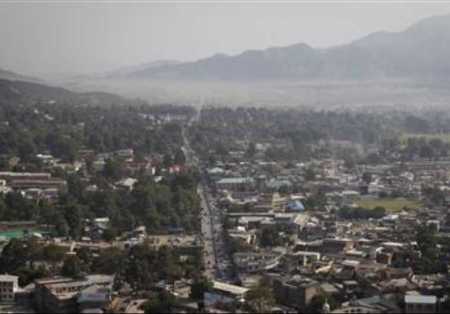
Pakistan viewA general view of houses from a hilltop in Abbottabad, Pakistan. (photo credit:REUTERS)

It is a testament to the precarious state of the world today that in a week that saw North Korea carry out a possible test of a hydrogen bomb, the most frightening statement uttered did not come from Pyongyang.

It came from Pakistan.

Speaking in the military garrison town of Rawalpindi, Pakistani Army chief Gen. Raheel Sharif said that any Iranian threat to Saudi Arabia’s territorial integrity will “wipe Iran off the map.”

Sharif made the statement following his meeting with Saudi Arabia’s defense minister and Deputy Crown Prince Mohammed bin Salman. According to media reports, Salman was the second senior Saudi official to visit Pakistan in the past week amid growing tensions between Iran and the kingdom.

Salman’s trip and Sharif’s nuclear threat make clear that following the US’s all-but-official abandonment of its role as protector of the world’s largest oil producer, the Saudis have cast their lots with nuclear-armed Pakistan.

When last October, the USS Harry Truman exited the Persian Gulf, the move marked the first time since 2007 that the US lacked an aircraft carrier in the region. Nine years ago, the US naval move was not viewed as a major statement of strategic withdrawal, given that back then the US had some one hundred thousand troops in Iraq.

While the USS Truman returned to the Gulf late last month, its return gave little solace to America’s frightened and spurned Arab allies. The Obama administration’s weak-kneed response to Iran’s live-fire exercises on December 26, during which an Iranian Revolutionary Guards vessel fired rockets a mere 1,370 meters from the aircraft carrier as it transited the Straits of Hormuz, signaled that the US is not even willing to make a show of force to deter Iranian aggression.

And so the Saudis have turned to Pakistan.

It would be foolish to view Sharif’s nuclear threat as mere bluster.

By every meaningful measure, Pakistan is little more than a failed state with nuclear weapons. Pakistan appears in every global index of failed or failing states.

To take just a few leading indicators, as spelled out by Basit Mahmood in a report last summer for The Political Domain, barely 1% of Pakistanis pay taxes of any kind. More than half the population lives in abject poverty. The government has no control over most Pakistani territory.

Between 2003 and 2015, more than 58,000 people were killed by terrorism countrywide.

Public health is a disaster. Polio, eradicated throughout much of the world, is now galloping through the country.

Last summer more than 1,300 people died in a heat wave in the supposedly advanced city of Karachi.

These data do not take into account the wholesale slaughter and persecution of minority groups – first and foremost Christians – and the systematic denial of basic human rights and widespread, violent persecution of women and girls.

As for its nuclear arsenal, a 2010 report by the Bulletin of Atomic Scientists estimated that Pakistan possesses between 70 and 90 nuclear warheads. Other credible reports estimate the size of the arsenal at 120.

Pakistan refuses to adopt a no-firststrike policy. In the US and worldwide, it is considered to be the greatest threat to global nuclear security.

Following a Pakistani jihadist assault on the Indian parliament in late 2001, India and Pakistan both deployed forces along their contested border. In the months that followed, due to Pakistani nuclear threats, the prospect of nuclear war was higher than it had ever been.

Cold War nuclear brinksmanship – which reached its high point during the 1962 Cuban missile crisis – paled in comparison.

In 2008, following the Pakistani jihadist assault on Mumbai, India threatened to retaliate against Pakistan.

India’s threats rose as evidence mounted that, as was the case in 2001, the jihadists were tied to Pakistan’s ISI spy service. Once again, rather than clean its own house, Pakistan responded by threatening to launch a nuclear attack against India.

And now, following the unraveling of US-strategic credibility, Pakistan’s aggressive nuclear umbrella is officially coming to the Persian Gulf.

Saudi Arabia’s decision to turn to Pakistan for protection indicates that the second wave of the destruction of the Arab state model is upon us. The notion of Arab states was invented nearly 100 years ago by the British and French at the tail end of World War I. The Sykes-Picot agreement, which partitioned the Arab world into states, rewarded national dominion to the most powerful tribal actors in the various land masses that became the states of the Arab world.

With the possible exception of Egypt, which predated Sykes-Picot, the Arab states formed at the end of World War I were not nation states. Their populations didn’t view themselves as distinct nations. Rather the populations of the Arab states were little more than a hodgepodge of tribes, clans and sectarian and ethnic groupings. In each case, the British and French made their determinations of leadership based on the relative power of the various groups. Those chosen to control these new states were viewed either as the strongest factions within the new borders or as the most loyal allies to the European powers.

The first wave of Arab state collapse began six years ago. It submerged the non-royal regimes, which fell one after the other, like houses of cards.

Syria, Libya, Iraq and Yemen ceased to exist.

Egypt, which in the space of two years experienced both an Islamist revolution and a military counter-revolution, still teeters on the brink of collapse.

Lebanon will likely break apart at the slightest provocation.

Today we are seeing the opening stages of the collapse of the Arab monarchies, and most importantly, of Saudi Arabia.

Most of the international attention to Saudi Arabia’s current threat environment has focused on Iran. The Iranian threat to the Saudis has grown in direct proportion to the Obama administration’s determination to realign the US away from its traditional Sunni allies and towards Iran. The conclusion of the US-led nuclear pact with Tehran has exacerbated Iran’s regional aggression as it no longer fears US retaliation for its threats to the Sunni monarchies.

But Iran is just the most visible of three existential threats now besetting the House of Saud.

The most profound threat to the world’s largest oil power is economic.

The drop in world oil prices has endangered the kingdom.

As David Goldman reported last week in the Asia Times, according to an International Monetary Fund analysis, the collapse in Saudi oil revenues “threatens to exhaust the kingdom’s $700 billion in financial reserves within five years.”

The house of Saud’s hold on power owes to its oil-subsidized economy. As Goldman noted, last month dwindling revenues forced the Saudis to cut subsidies for water, electricity and gasoline.

According to Goldman, Riyadh’s mass execution of 43 long-jailed prisoners at the start of the month was an attempt by the aging royal house to demonstrate its firm control of events. But the very fact the Saudi regime believed it was necessary to stage such a demonstration shows that it is in distress.

The third existential threat the regime now faces is Islamic State. Since 1979, the Saudis have sought to deflect domestic opposition by promoting Wahabist Islam at home and Wahabist jihad beyond its borders.

Now, with Islamic State in control over large swathes of neighboring Iraq, as well as Syria and Libya and threatening the Saudi-supported Sisi regime in Egypt, the Saudi royal family faces the rising threat of blowback. Some analysts argue that given the popular support for jihad in Saudi Arabia, were Islamic State to cross the Saudi border, its forces would be greeted with flowers, not bullets.

If the House of Saud falls, then the Gulf emirates will also be imperiled.

The Egyptian regime, which is bankrolled by the Saudis and its Gulf allies will also be endangered. The Hashemite monarchy in Jordan, which is protected by the US and by Israel, will face unprecedented threats.

The implications of expanding chaos – or worse – in Arabia are not limited to the Middle East. The global economy as well as the security of Europe and the US will be imperiled.

Obviously, the order of the day is for the US security guarantee to Saudi Arabia to be reinforced, mainly through straightforward US action against Iranian naval aggression and ballistic missile development.

Unfortunately, the Obama administration can be depended on to take just the opposite approach. And as a consequence, at least for the next year, the main thing propping up the Gulf monarchies, and with them, the global economy and what passes for global security, is a failed state with an itchy finger on the nuclear trigger.
Saudi Arabia stews in policy hell

January 4, 2016

Saudi Arabia stews in policy hell, Asia Times, January 3, 2016

Last week’s mass executions in Saudi Arabia suggest panic at the highest level of the monarchy. The action is without precedent, even by the grim standards of Saudi repression. In 1980 Riyadh killed 63 jihadists who had attacked the Grand Mosque of Mecca, but that was fresh after the event. Most of the 47 prisoners shot and beheaded on Jan. 2 had sat in Saudi jails for a decade. The decision to kill the prominent Shia cleric Nimr al-Nimr, the most prominent spokesman for restive Saudi Shia Muslims in Eastern Province, betrays fear of subversion with Iranian sponsorship.

Saudi-beheading22-300x183Official Saudi beheading

Why kill them all now? It is very hard to evaluate the scale of internal threats to the Saudi monarchy, but the broader context for its concern is clear: Saudi Arabia finds itself isolated, abandoned by its longstanding American ally, at odds with China, and pressured by Russia’s sudden preeminence in the region. The Saudi-backed Army of Conquest in Syria seems to be crumbling under Russian attack. The Saudi intervention in Yemen against Iran-backed Houthi rebels has gone poorly. And its Turkish ally-of-convenience is consumed by a low-level civil war. Nothing has gone right for Riyadh.

Worst of all, the collapse of Saudi oil revenues threatens to exhaust the kingdom’s $700 billion in financial reserves within five years, according to an October estimate by the International Monetary Fund (as I discussed here). The House of Saud relies on subsidies to buy the loyalty of the vast majority of its subjects, and its reduced spending power is the biggest threat to its rule. Last week Riyadh cut subsidies for water, electricity and gasoline. The timing of the executions may be more than coincidence: the royal family’s capacity to buy popular support is eroding just as its regional security policy has fallen apart.

For decades, Riyadh has presented itself as an ally of the West and a force for stability in the region, while providing financial support for Wahhabi fundamentalism around the world. China has been the kingdom’s largest customer as well as a provider of sophisticated weapons, including surface-to-surface missiles. But China also has lost patience with the monarchy’s support for Wahhabi Islamists in China and bordering countries.

According to a senior Chinese analyst, the Saudis are the main source of funding for Islamist madrassas in Western China, where the “East Turkistan Independence Movement” has launched several large-scale terror attacks. Although the Saudi government has reassured Beijing that it does not support the homegrown terrorists, it either can’t or won’t stop some members of the royal family from channeling funds to the local jihadis through informal financial channels. “Our biggest worry in the Middle East isn’t oil—it’s Saudi Arabia,” the analyst said.

China’s Muslims—mainly Uyghurs in Western China who speak a Turkish dialect—are Sunni rather than Shia.  Like Russia, China does not have to worry about Iranian agitation among Shia jihadis, and tends to prefer Iran to the Sunni powers. As a matter of form, Beijing wants to appear even-handed in its dealings with Iran and Saudi Arabia, for example in recent contacts between their respective navies. Chinese analysts emphasize that Beijing has sold weapons to both—more in absolute to terms to Iran but more sophisticated weapons to the Saudis.

More pertinent than public diplomacy, though, is where China is buying its oil.

Nonetheless, China’s oil import data show a significant shift away from Saudi Arabia towards Russia and Oman (which China considers part of the Iranian sphere of influence). Russia’s oil exports to China have grown fourfold since 2010 while Saudi exports have stagnated. Given the world oil glut, China can pick and choose its suppliers, and it is hard to avoid the inference that Beijing is buying more from Russia for strategic reasons.  According to Russian sources, China also has allowed Russian oil companies to delay physical delivery of oil due under existing contracts, permitting Russia to sell the oil on the open market for cash—the equivalent of a cash loan to Russia.

saudioil1-768x558

China’s interests in Syria coincide with Russia’s. Both have reason to fear the growth of ISIS as a magnet for their own jihadis.  Thousands of Chinese Uyghurs make their way into Southeast Asia via the porous southern border of Yunnan province, with financial assistance from Saudi supporters and logistical support—including passports—from local Turkish consulates. Chinese Uyghurs were implicated in the bombing of Bangkok’s Erawan Temple last August, and have linked up with ISIS supporters as far south as Indonesia. Turkey reported last month that most jihadists crossing its border into Syria to join ISIS are Chinese Muslims.

With Kurdish and allied forces gaining control of Syria’s border with Turkey, aided by Russian air support, Chinese Uyghurs may lose access to Syria. Late in December Kurdish forces crossed to the western bank of the Euphrates River and are in position to link up with Kurdish militias in northwestern Syria, eliminating Turkish hopes of a “safe zone” controlled by Turkey on the southern side of the Syrian border.  For its part, Turkey risks paralysis from a low-intensity civil war with its Kurdish population. The Kurdish-majority southeast of the country is under siege and fighting has spread to Turkey’s western provinces.

It’s an ill wind that blows nobody good, and China seems hopeful that it has contained its jihadist problem. On New Year’s Day, the Communist Party leader in China’s Xinjiang province declared that “the atmosphere for religious extremism has weakened markedly.”

China is extremely reluctant to commit military forces to overseas conflicts, and its military is ill-prepared to do so even if Beijing were to change its mind. The People’s Liberation Army lacks ground attack aircraft like the two squadrons of Russian Su-24 and Su-25 deployed in Syria. Nonetheless, Beijing is happy that Russia is reducing ISIS forces in Syria as well as Saudi- and Turkish-backed Sunni Islamists like the Army of Conquest.

It will be hard to evaluate the success of Russian bombing in Syria until the dust settles, but there is a great deal of dust in the air. According to Israeli sources, Russia is dumping vast amounts of its Cold War inventory of dumb bombs on Syrian Sunnis with devastating effect. The Russian bombing campaign makes up in volume what it lacks in sophistication, killing far more civilians than Western militaries would tolerate, but changing the situation on the ground. That explains Russian President Vladimir Putin’s newfound popularity among world leaders. He is doing their dirty work.

Saudi Arabia’s proxies in Syria are in trouble. Early in 2015, the Army of Conquest (Jaish al-Fateh), a coalition of al-Qaida and other Sunni Islamists backed by the Saudis, Turks and Qataris, had driven the Syrian army out of several key positions in Northwest Syria, threatening the Assad regime’s core Alawite heartland. The coalition began breaking up in November, however, and the Syrian Army recently retook several villages it had lost to the Army of Conquest. One of the Army of Conquest’s constituent militias, Failaq al-Sham, announced Jan. 3 that it was leaving the coalition to defend Aleppo against regime forces reinforced by Russia.

Everything seems to have gone wrong at once for Riyadh. The only consolation the monarchy has under the circumstances is that its nemesis Iran also is suffering from the collapse of oil revenues and the attrition of war. Iran began withdrawing its Revolutionary Guard forces from Syria in December, largely due to high casualties. The high cost of maintaining the war effort as Iran’s finances implode also may have been a factor. Iran’s Lebanese Shia proxy, Hezbollah, has suffered extremely high casualties, virtually neutralizing its whole first echelon of combat troops. And Russia has shown no interest in interfering with Israeli air strikes against Hezbollah.

The oil price collapse turns the competition between Saudi Arabia and Iran into a race to the bottom. But the monarchy’s panicked response to its many setbacks of the past several months raises a difficult question. In the past, the West did what it could to prop up the Saudi royal family as a pillar of stability in the region, despite the Saudis’ support for jihadi terrorism. Soon the West may not be able to keep the House of Saud in power whether it wants to or not.

What could a “harsh” Iranian reaction to Riyadh constitute?

October 10, 2015

What could a “harsh” Iranian reaction to Riyadh constitute? Al-MonitorAli Omidi, October 9, 2015

[A]s history has shown, a country’s desire to start a military campaign is not always logical. Iran might decide that no matter what, it must launch a military campaign against Riyadh in order to punish Saudi Arabia.

**********************

TEHRAN, Iran — Hundreds of Iranian pilgrims were killed in the Sept. 24 stampede in Mina, near Mecca. The incident was followed by Saudi negligence in reporting the situation on time, and failure to collaborate with Iranian authorities. This prompted Iran’s Supreme Leader Ayatollah Ali Khamenei to call on Saudi Arabia to apologize to the “Muslim world” and Iran. Ayatollah Khamenei also accused Riyadh of not fulfilling its obligations in returning the bodies of the Iranian pilgrims, and behaving “maliciously.” He further warned, “The slightest disrespect to tens of thousands of Iranian pilgrims in Mecca and Medina as well as the Saudi government’s refusal to fulfill its duties with regard to the transfer of the pure corpses [of those killed during the hajj] will elicit a harsh and tough reaction from Iran.”

Meanwhile, upon the Oct. 3 return of the bodies of 104 Iranian pilgrims, President Hassan Rouhani issued an additional warning. He said, “So far, our language has been one of brotherhood. When necessary, we have used the language of diplomacy; however, if needed, the language of authority will be used as well.”

Indeed, on the very same day, Maj. Gen. Mohammad Ali Jafari, the commander of the Islamic Revolutionary Guard Corps (IRGC), said, “The IRGC has prepared all its possible potentials in order to fulfill the will of the great leader of the Islamic Revolution and make the Saudi dynasty answer for the crimes it committed in Mina and restore the rights of the victims. We are ready and are awaiting orders.” Jafari added, “The Muslim World is tired of the Saudis’ betrayals and ignorance, which reminds us of Abu Lahab, including the massacre of the people of Yemen, displacement of the poor people of Syria, repression of the people of Bahrain, ethnic massacres in Iraq, creation of ethnic tension and support of terrorism. The Saudis shall melt in the anger of the Muslims.”

Lastly, former IRGC Cmdr. Mohsen Rezaei, who is also adviser to Ayatollah Khamenei, warned Riyadh, “Don’t play with fire, because the fire will burn you … don’t follow the example of Saddam [Hussein], who in the middle of the Iraq-Iran War had no way out.”

In response, Saudi Arabia has accused Iran of playing politics with the stampede. “I think the Iranians should think of more productive activities than to play politics with a tragedy that has befallen those people who were performing their most sacred religious duty,” Saudi Foreign Minister Adel al-Jubeir told the UN General Assembly. Mindful of the increasingly hostile rhetoric, the question arises of what the “harsh and tough reaction” that Iran has warned of could potentially constitute.

In general, harsh reaction translates into military action. Iran has just finished its negotiations with the six world powers over its nuclear program, and thus considers itself to be in a stronger position. Separately, Iran also assesses that Saudi Arabia is in a desperate situation in Yemen. Therefore, in the case of a possible military confrontation with Saudi Arabia, there are several scenarios that Tehran could consider:

    • A ground campaign. For this kind of campaign to be possible, Iran would need to cross both Iraq and Kuwait. Neither of these countries will allow Iran to enter their territory in order to attack Saudi Arabia. Therefore, this option is not on the table. In addition, such a military campaign requires a large and well-equipped army as well as logistical, financial and economic abilities enjoyed by a superpower. Iran is only considered a mid-level power in the region. There is also the historical example of the US reaction to Iraq’s 1991 invasion of Kuwait for Iran to consider.


    • A naval campaign. This would mean that Iran has to travel a distance of 200 miles to reach the eastern coast of Saudi Arabia. Such a campaign is impossible considering the Iranian armed forces’ lack of strategic depth vis-a-vis Saudi Arabia, as the latter has the advantage of controlling the sea from land.


    • Supporting allies in proxy wars. This would mean that Iran will, more determinedly than ever, support Syrian President Bashar al-Assad in his fight against opposition forces. Tehran would also support Hezbollah against pro-Saudi elements of the Lebanese government, as well as in Israel, and the Houthis in Yemen. Of course, while supporting Hezbollah and Assad is possible and easy, it is more difficult to give military support to the Houthis since Yemen is under naval blockade. Moreover, UN Resolution 2216 forbids provision of military support to the Houthis. Iran can, however, achieve this goal via smugglers and private contractors.


    • Restricting Saudi access to the Strait of Hormuz. Considering Iran’s familiarity with the Strait of Hormuz and the military advantages that it enjoys in this regard, this option is possible. The problem, however, is that this scenario can lead to a battle of tankers, as it did toward the end of the 1980-88 Iran-Iraq War. Indeed, Saudi ships could be prompted to raise a third party flag. In addition, this scenario will give an excuse to world powers to increase their military presence in the Persian Gulf, which runs counter to Iran’s objectives.


    • Destroying the bridge that connects Saudi Arabia to Bahrain. The King Fahd Causeway, which is 25 kilometer (15.5 miles) long, was used for the first time in December 1986. If the bridge is destroyed by high-explosives missiles from the air, the Saudi military support for Bahrain is likely to decrease, which will in turn weaken the Bahraini regime. If such an attack is carried out, and Iran at the same time manages to provide opposition groups in Bahrain with logistic and military support, the Bahraini regime is likely to collapse. However, considering that the United States maintains a military presence in Bahrain, it is not possible for Iran to conduct a direct military campaign against Bahrain.


    • Supporting the Shiite population of Qatif, in Saudi Arabia’s Eastern Province, with the condition that in case of receiving military and logistic support, the Shiites of Saudi Arabia will rebel with the aim of toppling the Saudi government. Considering that Saudi Arabia has built a very long wall on its border with Iraq, and also considering the distance between the Shiite-inhabited region of Saudi Arabia and Iran, this is hardly a probable option. In addition, there are doubts about whether Saudi Shiites will in fact rebel against their government if provided with such support.


  • Firing missiles at Saudi Arabia. As Iran is equipped with multiple types of missiles, it can hit a variety of targets inside Saudi Arabia. Since Saudi Arabia does not have the necessary infrastructure for an effective air defense, such as an Iron Dome, an Iranian missile attack will be effective. The problem, however, is that in such a scenario, Saudi Arabia and its allies will destroy Iran’s oil infrastructure in retaliation.

Considering the options above, and existing limitations, any “harsh” response on the part of Iran will likely be limited to options three through six above. Of course, in case of any kind of confrontation between Iran and Saudi Arabia, all the Arab states of the Persian Gulf — minus Oman — and more than likely the United States and Israel, will offer their complete support to Saudi Arabia. Nevertheless, as history has shown, a country’s desire to start a military campaign is not always logical. Iran might decide that no matter what, it must launch a military campaign against Riyadh in order to punish Saudi Arabia. It is therefore more beneficial, for both Iran and Saudi Arabia, to solve their problems via diplomatic means. However, the current exchange of harsh words between Saudi and Iranian officials shows that the situation will either get critical, or the current cold war will continue.


Saudi King Abdullah said ready to abdicate over ill health, as ISIS strikes the kingdom’s border

January 5, 2015

Saudi King Abdullah said ready to abdicate over ill health, as ISIS strikes the kingdom’s border, DEBKAfile, January 5, 2015

Abdullha28.3.14Saudi king gravely ill prepares to step down

Abdullah bin Abdulaziz, 91, the Saudi monarch who worked tirelessly to inch his hidebound, ultra-conservative kingdom into modern times, is gravely ill and reported by DEBKAfile’s sources ready to abdicate. He hands the reins of government of the world’s biggest exporting nation to two successors.

Conscious of his failing health, Abdullah spent the past year organizing an orderly succession to maintain regime stability. He lined up his half-brother, Crown Prince Salman, 78, to sit on the throne. However, since he is believed to suffer from dementia, the next crown prince Muqirin, 69-70, will rule the realm in practice. Announcement of the abdication may be delayed by princely disputes, causing a political crisis which the ailing king labored to avert.

Coinciding with the news of the impending changeover, three Saudi guards, including Gen. Odah al-Balawi, commander of the northern border guard, were killed Monday, Jan. 5, by ISIS terrorists, two wearing bomb belts, who were attempting to infiltrate the kingdom. The attackers, apparently armed with intelligence on the general’s movements, caught him in ambush. Four attackers were killed in the clash, two by suicide.

This incident underlined one of the dangers besetting the oil kingdom, the Islamic State and its advantage of local tactical intelligence.

According to Gulf sources, the king is critically ill with cancer of the lungs. Two American specialists have been rushed over to treat him.

In March 2014, he arranged to have Prince Muqrin promoted to third in line to the throne, in the face of rival factions in the royal house. But earlier, in May 2013, he elevated his own son, Muteb bin Abdullah, 62, to Minister of the powerful National Guard. The king also blocked the path of Crown Prince Salman’s son Prince Mohammad, to deputy defense minister, which was to have been a springboard to the top post when his father ascended the throne.

Last March, when US President Barack Obama visited Riyadh, Abdullah’s failing health was inferred from a photo which showed him connected to an oxygen tube. In later releases of the photo, the tube was blurred.

In terms of its security, the crisis catches the Kingdom of Saudi Arabia in one of the most perilous periods of its short history. Riyadh has been watching Iran’s acquisition of nuclear weapons with extreme alarm and no faith at all in US-led international diplomacy to contain its plans.

The Saudis see Tehran as a regional menace which is in the process of trampling their closest neighbors by means of allies and surrogates – Syrian ruler Bashar Assad, to the north; Hizballah in Lebanon and the Huthis of Yemen to the south.

The Islamic State of Iraq and Levant and its leader Abu Bakr al-Baghdadi has not only invaded Iraq and Syria but is also eyeing Saudi Arabia. Seen from Riyadh, the oil kingdom is beleaguered at every hand.

At home too, the Saudis share the concerns of Western countries that jihadists returning home from fighting with ISIS will unleash violence to overthrow the royal house.

Since the “Arab Spring”, the Saudis have regarded the Muslim Brotherhood and its Palestinian offspring, Hamas, as enemies.

One of Abdullah’s key innovations, in addition to the small steps he introduced toward improving the status of women, was the transparency of the monarch’s state of health. This openness was unheard off in previous reigns. His abdication, when it takes place, will also break with tradition. Former kings relinquished the throne only when they died.

ISIS on verge of seizing “complete control” in Anbar: tribal official

October 9, 2014

ISIS on verge of seizing “complete control” in Anbar: tribal official, Asharq al-Awsat, October 9, 2014

(According to Wikipedia, “The paper was founded with the approval of the Saudi royal family and government ministers, and is noted for its support of the Saudi government.[2] The newspaper is owned by Faisal bin Salman, a member of the Saudi royal family.[3]“– DM)

A man looks at a vehicle belonging to the Iraqi security forces in the Anbar province town of HitA man looks at a vehicle belonging to the Iraqi security forces in the Anbar province town of Hit, Iraq, on October 6, 2014. (Reuters)

It was Anbar’s police force that was protecting citizens from ISIS, he said, adding that military forces were actively hindering efforts to combat the extremist group. “Unfortunately, the military has become a source of assistance for ISIS because for the most part ISIS is able to attack and defeat the military, taking control of their arms and equipment,” said Ibrahim.

**********************

Baghdad, Asharq Al-Awsat—Iraq’s restive western province of Anbar is on the verge of completely falling into the hands of the Islamic State of Iraq and Syria (ISIS) unless urgent action is taken to address military failures, the Anbar Tribal Council warned on Wednesday.

The Anbar Tribal Council, the senior-most Sunni tribal organization in the province, is backing central government attempts to combat ISIS but has complained to Baghdad about the appointment of Lt. Gen. Rashid Fleih as head of the Anbar Military Command, calling for him to be replaced. In comments to Asharq Al-Awsat, Anbar Tribal Council member Faris Ibrahim said “[Fleidh] is unable to do anything.”

“The security situation in Anbar Province is going from bad to worse due to a lack of support, as well as the almost complete absence of security and military leadership. The military leadership is unable to devise new plans to address ISIS advances on the ground,” Ibrahim added.

“ISIS has strongly advanced in a number of areas in the province following the formation of the international alliance, as part of attempts to impose their position on the ground as a fait accompli.”

The Anbar Tribal Council member alleged that ISIS is also setting up sleeper cells in the province with the objective of entrenching its position and securing even more territory.

More than 500,000 residents of Anbar province have been displaced by fighting between Iraqi forces and ISIS since the conflict began in December 2013. Despite Iraqi military efforts and the formation of an international alliance to combat the terrorist group, ISIS has continued to advance in Iraq. ISIS forces most recently took over the town of Hit last week, leading to attempts by Shi’ite volunteer fighters backed by Iraqi military forces to recapture the western town.

“It is strange that while ISIS is developing its presence and capabilities on the ground in Anbar, military and security leadership are not doing anything new to address this. As a result of this, most parts of Anbar province are now completely in ISIS’s hands, including Ramadi city center,” Ibrahim told Asharq Al-Awsat.

It was Anbar’s police force that was protecting citizens from ISIS, he said, adding that military forces were actively hindering efforts to combat the extremist group. “Unfortunately, the military has become a source of assistance for ISIS because for the most part ISIS is able to attack and defeat the military, taking control of their arms and equipment,” said Ibrahim.

International efforts to combat ISIS in Iraq have focused on central and northern parts of the country, where ISIS is actively advancing. The terrorist group had initially advanced into Iraq from Syria through the western province, which had been the center of a Sunni-led protest movement against former Prime Minister Nuri Al-Maliki’s government over its perceived sectarian bias.

The government put together by the new premier, Haider Al-Abadi, has received a cautious welcome from Iraq’s Sunnis. However, the Anbar Tribal Council has called for Baghdad and the anti-ISIS international alliance to do more for Anbar.

Faris Ibrahim called on Baghdad to do more to tackle ISIS in Anbar, saying it was a critical front in the overall struggle, yet remained overlooked.

He said: “These operations have not reached the required level. It is strange that Anbar province has been completely forgotten over the past three months with the focus being on Mosul and the northern provinces. However, everybody knows that Anbar is the main incubator of ISIS and it is expanding to Iraq’s other regions from here . . . Therefore ignoring Anbar has led to disaster, as we are seeing today.”


