Archive for the ‘Saudi Arabia’ category

Iran and the Houthis of Yemen

November 29, 2016

Iran and the Houthis of Yemen, Front Page MagazineJoseph Puder, November 29, 2016

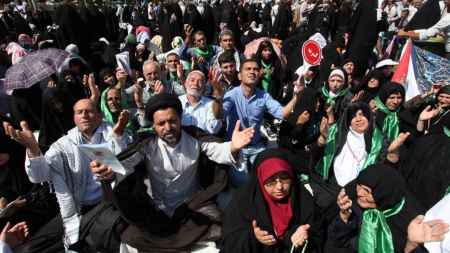
shia

Lt. Gen. Sir Graeme Lamb, former head of U.K. Special Forces, wrote in The Telegraph (September 2, 2016), “Iran’s involvement in Yemen must be seen in the broader context of its strategy of challenging the existing Middle East order by generating unrest, which then allows it to maneuver an advantage through the resulting uncertainty.  Iranian military forces and their proxies predominate in Iraq and Syria, while other proxies have a long history of involvement in Lebanon and Gaza.  Nor are these forces likely to leave the region when the immediate threats such as ISIL (Islamic State in Iraq and the Levant) are pushed underground or displaced, as we, the West, will.” 

*******************

Arab News has reported on November 23, 2016 that Yemen’s Houthi rebels and supporters of the former Yemeni President Ali Abdullah Saleh are responsible for the killing of 9,646 civilians.  8,146 of them men, 597 women, and 903 children, from January 1, 2015 to September 30, 2016 in 16 Yemeni provinces.  According to Shami Al-Daheri, a military analyst and strategic expert, the Houthis are being led by Iran and follow Tehran’s orders.  “They are moving in Yemen, Iraq, and Syria following Tehran’s orders.  If the country sees there is pressure on its supporters in Iraq, it issues orders to the Houthis in Yemen to carry out more criminal acts in order to divert attention and ease pressure on its proxies in these countries.”

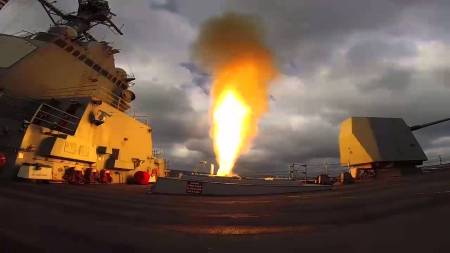
The brutality of the Iran led campaign in Syria, and U.S. voices calling for some form of intervention, might have prompted Tehran to give the Houthis a green light to attack American naval ships. The Houthis fired three missiles at the U.S. Navy ship USS Mason last month, in all probability following Tehran’s orders. In retaliation, U.S. Navy destroyer USS Nitze launched Tomahawk cruise missiles, destroying three coastal radar sites in areas of Yemen controlled by the Houthis.  These radar installations were active during previous attacks, and attempted attacks on ships navigating the Red Sea. The USS Mason did not sustain any damage.  U.S. Army Gen. Joseph Votel, the top American commander in the Middle East, said that he suspected Iran’s Shiite Islamic Republic to be behind the twice launched missiles by the Houthi rebels against U.S. ships in the Red Sea.

Al-Arabiya TV (August 16, 2016) claimed that Iran’s Islamic Republic News Agency (IRNA) said that missiles made in Tehran were also recently used in Yemen by Houthi militias in cross border attacks against Saudi Arabia.  The Saudis it seems, were able to intercept the Iranian manufactured Zelzal-3 rockets, also delivered to Hezbollah in Lebanon, and Assad regime forces in Syria.  The rockets were fired into the Saudi border city of Najran, according to the official Saudi Press Agency.  The Saudi-led coalition has been targeting the Houthis in an effort to restore the internationally-recognized Yemeni president, Abd Rabbuh Mansour Hadi.

The conflict in Yemen has its recent roots in the failure of the political transition that was supposed to bring a measure of stability to Yemen following an uprising in November, 2011 (The Year of the Arab Spring) that forced its longtime authoritarian president, Ali Abdullah Saleh, to hand over power to his deputy, Abd Rabbuh Mansour Hadi.  President Hadi had to deal with a variety of problems, including attacks by al-Qaeda, a separatist movement in the South, the loyalty of many of the army officers to the former President Saleh, as well as, unemployment, corruption, and food insecurity.

The Zaidi-Shiite Houthi minority captured Yemen’s capital Sanaa on September 21, 2014. They were helped by the Islamic Republic of Iran, who have provided the rebel Houthis with arms, training, and money.  As fellow Shiite-Muslims, the Houthis became another Iranian proxy harnessed to destabilize the Sunni-led Arab Gulf states, and Saudi Arabia.  Since 2004, the Houthis have fought the central government of Yemen from their stronghold of Saadah in northern Yemen.  The Houthis are named after Hussein Badreddin al-Houthi, who headed the insurgency in 2004 and was subsequently killed by Yemeni army forces.  The Houthis, who are allied with Ali Abdullah Saleh, against Abd Rabbuh Mansour Hadi, the legitimate President of Yemen, have the support of many army units and control most of the north, including the capital, Sanaa.

The Houthis launched a series of military rebellions against Ali Abdullah Saleh in the previous decade. Recently, sensing the new president’s (Hadi) weakness, they took control of their Northern heartland of Saadah province and neighboring areas.  Disillusioned by the transition of power and Hadi’s weakness, many Yemenis, including Sunnis, supported the Houthi onslaught.  In January, 2015, the Houthis surrounded the Presidential palace in Sanaa, placing President Hadi and his cabinet under virtual house arrest. The following month, President Hadi managed to escape to the Southern port city of Aden.

Yemen is another flashpoint in the conflict between Shiite-Muslim Iran and Sunni-Muslim Saudi Arabia, over regional power and influence.  Sanaa, along with Baghdad, Damascus, and Beirut are Arab capitals now forming the so called Shiite “arc of influence.”   In Baghdad, the site of the Abbasid Sunni Caliphate, the Shiites dominate the government of Haider al-Abadi.  In Damascus, the capital of the Umayyad Sunni Caliphate, Bashar Assad, an Alawi (offshoot of Shiite Islam) dictator, is ruling over a Sunni majority in a state of civil war.  Iran, its Revolutionary Guards, Iraqi Shiite militias, and the Lebanese Shiite proxy Hezbollah, are fighting Sunni Islamists, and genuine Syrian Sunnis, who are frustrated with being ruled by a minority dictator.  Beirut is dominated by Hezbollah, the only group allowed to carry arms, whose power exceeds that of the Lebanese army, and whose masters in Tehran set its priorities.

Lt. Gen. Sir Graeme Lamb, former head of U.K. Special Forces, wrote in The Telegraph (September 2, 2016), “Iran’s involvement in Yemen must be seen in the broader context of its strategy of challenging the existing Middle East order by generating unrest, which then allows it to maneuver an advantage through the resulting uncertainty.  Iranian military forces and their proxies predominate in Iraq and Syria, while other proxies have a long history of involvement in Lebanon and Gaza.  Nor are these forces likely to leave the region when the immediate threats such as ISIL (Islamic State in Iraq and the Levant) are pushed underground or displaced, as we, the West, will.”

Gen. Lamb asserted that “the tragedy of Yemen is that it has become, over the decades, a sphere of contested influence between the grand masters of Empire and superpowers: East against West, Communism versus Capitalism.  Today, it is Iranian backed Shiite revivalism against Sunni status quo, an emerging order versus an existing order.”  According to Gen. Lamb, Tehran has dissuaded the Houthis from accepting a U.N. peace plan in favor of creating its own “supreme political council” to challenge the legitimate Yemeni government of Abdrabbuh Mansour Hadi.

It is tempting for Tehran to enter the exposed underbelly of Saudi Arabia though the Houthis control of Northern Yemen, bordering Saudi Arabia. It is however, too expensive a proposition for the Islamic Republic to have to fund another proxy – a failing state like Yemen.  While Hezbollah requires millions of dollars in support, Yemen would require billions.  Iran is spending a great deal in support of the Assad regime in Syria, Hamas in Gaza, and loyalist Iraqi Shiite militias.  Iran would nevertheless like to control the sea lanes into the Red Sea and have access to the Bab Al Mandeb strait, which connects the Red Sea to the Gulf of Aden.  This would provide it with a strategic vantage point in threatening the U.S. and the West.

Iran’s meddling in Yemen is another example of its Shiite revivalism, and its challenge of the existing Middle East order, regardless of the cost in human lives that its proxies (Houthis, Hezbollah, Hamas, and Iraqi Shiite militias) are inflicting.

Saudi Jihadi Rehab Actually Encourages Jihad

November 29, 2016

Saudi Jihadi Rehab Actually Encourages Jihad, Front Page Magazine (The Point, Daniel Greenfield, November 28, 2016

four_lions_menus_3_2

You wouldn’t let Guinness or Budweiser run AA. Having the Saudis run a Jihadi rehab program is just as much of a joke. And yet our leaders went along with the joke by pretending that the Saudis were helping transform bad misunderstanders of Islam into good Muslims through Koran lessons and some R&R. The notion that Islam is best fought with Islam came to characterize CVE.

And it’s a bad joke.

Counterterrorism experts have long suspected Saudi Arabia’s “rehabilitation” center for terrorists does a poor job of de-radicalizing jihadists. But a Saudi detainee at Guantanamo Bay now reveals it’s actually a recruiting and training factory for jihad.

According to recently declassified documents, senior al Qaeda operative Ghassan Abdullah al-Sharbi told a Gitmo parole board that the Saudi government has been encouraging previously released prisoners to rejoin the jihad at its terrorist reform school, officially known as the Prince Mohammed bin Naif Counseling and Care Center.

The Obama administration has praised the effectiveness of the Saudi rehab program — which uses “art therapy,” swimming, ping-pong, PlayStation and soccer to de-radicalize terrorists — and conditioned the release of dozens of Gitmo prisoners, including former Osama bin Laden bodyguards, on their entry in the controversial program.

Al-Sharbi dropped a bombshell on the Gitmo parole board at his hearing earlier this year, when he informed members that the Saudi kingdom was playing them for suckers. “You guys want to send me back to Saudi Arabia because you believe there is a de-radicalization program on the surface.

True. You are 100% right, there is a strong — externally, a strong — de-radicalization program,” al-Sharbi testified. “But make no mistake, underneath there is a hidden radicalization program,” he added. “There is a very hidden strong — way stronger in magnitude — broader in financing, in all that.”

Al-Sharbi is one of the longest serving, and most unrepentant, prisoners at Gitmo. A Saudi national with an electrical engineering degree from King Fahd University, he attended a US flight school associated with two of the 9/11 hijackers. He traveled to Afghanistan in the summer of 2001 and trained at an al Qaeda camp, building IEDs to use against allied forces.

Al-Sharbi was captured March 28, 2002, at an al Qaeda safehouse in Faisalabad, Pakistan, with senior al Qaeda leader Abu Zubaydah. According to his US intel dossier, he told interrogators that “the US got what it deserved from the terrorist attacks on 9/11.”

Given a chance at parole after 14 years, however, Al-Sharbi was surprisingly frank with the board.

He explained that Riyadh is actively recruiting and training fighters to battle Iranian elements in neighboring Yemen and Syria. Saudi views Shiite-controlled Iran as a regional threat to its security.

“They’re launching more wars and the [United] States is backing off from the region,” he said. “They’re poking their nose here and here and there and they’re recruiting more jihadists, and they’ll tell you, ‘Okay, go fight in Yemen. Go fight in Syria.’ ”

Al-Sharbi said the Saudis also are “encouraging” former detainees “to fight their jihad in the States.”

This isn’t a mystery to anyone. We simply insist on pretending that the Saudis aren’t involved in terror.

Saudi Arabia is already here, in Toronto

November 25, 2016

Saudi Arabia is already here, in Toronto, CIJ NewsDiane Weber Bederman, November 24, 2016

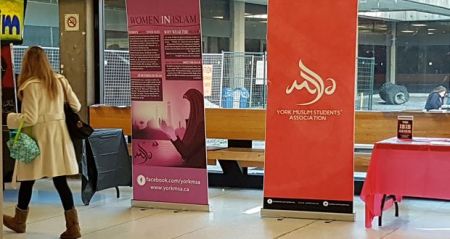
islam-awareness-week-at-york-u-4-photo-cijnewsIslam Awareness Week at York U. Photo: CIJnews

Well, Mr. Prime Minister, you don’t have to move Saudi Arabia to live in that culture, because under your government, these intolerant, abhorrent teachings are here in Canada, at universities and in our bookstores and shared in public places like Dundas Square in downtown Toronto. They are teachings that Muslims are trying to have accepted here in Canada.

***********************

Dear Prime Minister, Justin Trudeau,

If you were to take your family, your wife and children and move to Saudi Arabia, as an immigrant, not an expat, how long do you think it would take you to embrace the culture of your adopted country?

How long would it take before you preached the need for women to wear a Burka when leaving home, and that they must be accompanied by a male relative at all times?

Or how long before your beautiful, independent wife Sophie Grégoire Trudeau (she has kept her maiden name and said in Havana that women “can no longer be ignored”), would accept that she cannot drive, can no longer be independent of you, that her husband has not only the right but the responsibility to punish his wife for not performing her wifely duties, and that it is appropriate to beat your wife to bring her into line? Would Mme Grégoire Trudeau accept a lashing in the street from the religious police for any perceived infraction of the laws regarding modesty?

How long would it take the two of you, Sir, to teach your sons that women are inferior to men and your daughter that she has few civil rights, and that Muslims are superior to all others? And how would you explain to your children, Xavier James , Ella-Grace Margaret , and Hadrien the sight of men hanging from cranes in the middle of the square-guilty of being gay?

And what would you say to your children as you walked along the streets and saw people without hands or feet-amputated in the name of Islamic justice? And how would you explain to your children that it is appropriate to refer to Jews as pigs and descendants of apes? That is acceptable to call for “Death to the West” and “Death to Israel”?

Well, Mr. Prime Minister, you don’t have to move Saudi Arabia to live in that culture, because under your government, these intolerant, abhorrent teachings are here in Canada, at universities and in our bookstores and shared in public places like Dundas Square in downtown Toronto. They are teachings that Muslims are trying to have accepted here in Canada. They are using the false claim of freedom of religion when in fact this has nothing to do with religion and everything, Sir, to do with trying to bring Sharia Law, the ethic that underpins the ideology of Islam and undermines western freedom into law in Canada.

I am going to go out on a limb here and suggest that you would never embrace those teachings-that ideology. That you and your wife would enver accept the teachings in “Women in Islam & Refutation of some Common Misconceptions,” authored by the Saudi scholar Dr. Abdul-Rahman al-Sheha and printed by the Saudi Dawah organization Muslim World League (رابطة العالم الاسلامي) Or teachings being promulgated in Canada in the book “The Quran” (Saheeh International) shared now at York University during Islam Awareness Week.

The following are excerpts from the book that include Quranic verses followed by a modern interpretation:

Surah (chapter) Al-Baqarah

Verse 79

So woe 32 to those who write the “scripture” with their own hands, then say, “This is from Allah,” in order to exchange it for a small price. Woe to them for what their hands have written and woe to them for what they earn.

Footnote 32

i.e., death and destruction.

Verse 131

When his Lord said to him, “Submit,” he said, “I have submitted [in Islam] 45 to the Lord of the worlds.”

Footnote 45

The meaning of the word “Islam” is “submission to the will of Allah.” This is the way of life ordained by Allah and taught by all of the prophets from Adam to Muhammad (PBUH). A Muslim is one who submits himself to Allah.

Verse 191

And kill them wherever you overtake them and expel them from wherever they have expelled you, and fitnah 69 is worse than killing. And do not fight them at al-Masjid al-Haram until they fight you there. But if they fight you, then kill them. Such is the recompense of the disbelievers.

Footnote 69

Among the meanings of fitnah are disbelief and its imposition on others, discord, dissension, civil strife, persecution, oppression, injustice, seduction, trial and torment.

Or Surah (chapter) Al-Maidah

Verse 33

Indeed, the penalty 262 for those who wage war 263 against Allah and His Messenger and strive upon earth [to cause] corruption is none but that they be killed or crucified or that their hands and feet be cut off from opposite sides or that they be exiled from the land. That is for them a disgrace in this world; and for them in the Hereafter is a great punishment,

Footnote 262

Legal retribution.

Footnote 263

i.e., commit acts of violence and terrorism against individuals or treason and aggression against the Islamic state.

Or this:

Verse 75

And among the People of the Scripture is he who, if you entrust him with a great amount [of wealth], he will return it to you. And among them is he who, if you entrust him with a [single] silver coin, he will not return it to you unless you are constantly standing over him [demanding it]. That is because they say, “There is no blame upon us concerning the unlearned.” And they speak untruth about Allah while they know [it].

Footnote 133

The Jews do not consider it a sin to cheat or lie to a gentile or a pagan.

Verse 112

They have been put under humiliation [by Allah] wherever they are overtaken, except for a rope [i.e., covenant] from Allah and a rope [i.e., treaty] from the people [i.e., the Muslims]. 144 And they have drawn upon themselves anger from Allah and have been put under destitution. That is because they disbelieved in [i.e., rejected] the verses of Allah and killed the prophets without right. That is because they disobeyed and [habitually] transgressed.

Footnote 144

Once they have surrendered, the People of the Scripture retain their rights and honor (in spite of their refusal of Islam) through payment of the jizyah tax in place of zakah and military service due from Muslims. They are then under the protection of the Islamic state.

Just take a walk with your family along Dundas Square or stroll through York University. You can talk to people who share these beliefs openly and proudly and are expending great energy in proselytizing them. So, Sir, as a proud feminist and supporter of LGBTQ2 rights, a man who cherishes diversity, accommodation, inclusion, and tolerance, how do you defend these teachings in our cities and universities, let alone to your wife and children? And will these ideals be taught during Muslim Heritage Month?

As always, Sir, I look forward to your comments. I am ever hopeful that one day you will take the time to respond to my concerns, Sir, for I have no doubt that there are millions of Canadians who would like to hear the answers to these questions. And, Sir, we have that right and you, Sir, have the obligation to respond.

Islamic literature in Toronto deals with wife beating, stoning, crucifixion, amputation

Muslim Dawah (outreach, “call to Islam”) activists at Toronto’s Dundas Square distributed during recent years a variety of Islamic literature (click HERE)

The following are the highlights of some of the Islamic books/booklets which were obtained by CIJnews:

  • Homosexuality is a major sin

  • Liberated’ Western women… are trapped in a form of slavery
  • Polygamy is permitted in certain conditions

  • Wife must obey the “commands” of her husband

  • Wife beating is permissible in certain conditions (“Submissive or subdued women… may even enjoy being beaten”)

  • Muslims have a duty to spread the message of Islam in society

  • Prayers to Allah to give Muslims victory over the disbelievers
  • Non-Muslims of an Islamic State have to pay the jizya (poll-tax) tax
  • Punishment of flogging for public intoxication and traffickers

  • Punishment of stoning to death for married adulterers

  • Punishments of amputation (hand and leg), crucifixion and execution in serious crimes
  • Punishment of cutting off the hand for the thief

  • Punishment of execution for apostates
  • Possession of slaves is permissible in certain conditions.

ICNA Canada’s online syllabus: women are inferior to men, Western civilization “enemy” (clickHERE)

ICNA Canada’s online syllabus: Songs, music, jesters, buffoons are “satanic work” (click HERE)

ICNA Canada’s online syllabus: Muslim wife must obey her husband when he calls her to bed(click HERE)

ICNA Canada’s online syllabus: “majority of the dwellers of Hell are women” (click HERE)

ICNA Canada’s online syllabus: pregnant adulteress to be stoned after giving birth (click HERE)

ICNA Canada’s online syllabus on wife beating (click HERE)

ICNA Canada’s online syllabus on stoning adulterers, chopping off thieves’ hands (click HERE)

ICNA Canada’s online syllabus on wearing hijab and honour killing in Islam (click HERE)

ICNA Canada’s online syllabus legalizes “slave-girls” (click HERE)

ICNA Canada online syllabus: “Muslims will dominate the Jews”, kill them (click HERE)

ICNA Canada syllabus: “give us victory over the disbelieving people” (click HERE)

ICNA Canada’s syllabus explains ruling on ‘sex slaves’ in Islam (click HERE)

ICNA Canada free book: “Every human being is born as a Muslim” (click HERE)

ICNA – Canada’s senior official appears to blame gays for Ontario “lurid” sex education (clickHERE)

Trudeau: We strive to show that “Islam is not incompatible” with Western values (click HERE)

Germany bans Muslim org used as front to recruit jihadists

November 15, 2016

Germany bans Muslim org used as front to recruit jihadists, Creeping Sharia, November 15, 2016

salafistSalafist preacher Ibrahim Abou-Nagie was known for his campaign to distribute Korans to every household in Germany, Switzerland and Austria

Sounds like CAIR. Unfortunately for Germans, their leaders have not banned Muslim immigration – the carriers of the ideology.

Source: Germany bans Islamist organization after raids – CNN.com

German authorities have banned an Islamist organization that they say is responsible for inspiring 140 youths to join the Syria conflict.

Germany Interior minister Thomas de Maiziere announced the ban on Tuesday after police carried out dawn raids on around 200 targets connected to The True Religion, a Salafist organization, across 10 states.

“As a federal minister, I today banned the organization called The True Religion,” de Maiziere told reporters, adding that the ban addressed “the misuse of religion and extremist religions.”

“We do not accept and won’t tolerate” the acts of this network, de Maiziere said, adding that it glorified death and terror.

Salafism is an ultrafundmentalist branch of Islam that is particularly prevalent in Saudi Arabia. It is intolerant of what its adherents consider “deviant” or mainstream Sunni Islam, including Islamic sects, such as Shia Islam, as well as other world religions.

The True Religion is led by prominent Salafist preacher Ibrahim Abou-Nagie, who was born in a refugee camp in Gaza and moved to Germany when he was 18. He later became a German national.

The raids targeted mosques, apartments, offices and storage halls. The main focuses of the raids were in the states of North Rhine-Westphalia, Hesse and Hamburg, de Maiziere said.

In Berlin 200 officers took part in raids on 20 sites, Berlin police told CNN.

Abou-Nagie triggered national debate in Germany in 2011 when he spearheaded a drive to give a copy of the Koran to every German, Swiss and Austrian household.
Federal Police in September said 800 German nationals had traveled to Syria to join the conflict.

Al-Hariri’s Choice Of Hizbullah Ally Aoun For Lebanese Presidency Is Another March 14 Forces Concession To Pro-Iran Axis

October 28, 2016

Al-Hariri’s Choice Of Hizbullah Ally Aoun For Lebanese Presidency Is Another March 14 Forces Concession To Pro-Iran Axis, MEMRI, E.B. Picali and Y. Yehoshua, October 28, 2016

Introduction

On October 31, 2016, the Lebanese parliament will convene and is expected to vote in Free Patriotic Movement leader and Hizbullah ally Michel Aoun as president of Lebanon; he is Hizbullah’s sole candidate. The move follows a deal struck between Aoun and former Lebanese prime minister Sa’d Al-Hariri, leader of the Sunni Al-Mustaqbal stream, under which Aoun, if elected, will assign Al-Hariri the task of forming the next government.

This move by Al-Hariri has significant implications for the intra-Lebanese political arena and for the regional power balance. Therefore it has encountered criticism both within and outside Lebanon. This move represents a surrender by the March 14 Forces, headed by Al-Mustaqbal, to Hizbullah’s will, and reinforces the position of Hizbullah’s patron Iran at the expense of Saudi Arabia.

The following report reviews Al-Hariri’s decision, the reactions it has encountered, and what it means for Lebanon and the region.

Hizbullah Ally Aoun Expected To Be Chosen President

On October 31, 2016, the Lebanese parliament will hold its 46th presidential selection session since Michel Suleiman’s term ended two-and-a-half years ago.  That session is expected to choose Free Patriotic Movement leader Michel Aoun, who is an ally of Hizbullah, as president. Aoun’s selection will end a two-and-a-half-year presidential vacuum that resulted from disagreement over Suleiman’s successor from among the country’s opposing streams – primarily Al-Mustaqbal, led by Sa’d Al-Hariri, and Hizbullah, which together with Aoun stymied the formation of the quorum that is necessary to elect a president. The breakthrough in the talks over the selection of a president came when Al-Hariri and Aoun reached an agreement under which Al-Hariri would support Aoun’s presidential candidacy and in return Aoun would task Al-Hariri with forming the new government, which would be a national unity government as stipulated in the agreement.[1] This constitutes an Al-Hariri surrender to Hizbullah, which sought an Aoun presidency. It should be mentioned that Al-Hariri’s support for an overt Hizbullah ally is not unprecedented; a year ago, Al-Hariri announced his support for another ally of Hizbullah, and of Syrian president Bashar Al-Assad, Suleiman Frangieh, for the post of Lebanese president.[2]

Al-Hariri announced his support for Aoun in an October 20, 2016 speech, saying that by supporting him he was aiming to save Lebanon from dangerous leadership and economic crises which could, in turn, lead to a new civil war.[3]

Two days later, on October 22, Hizbullah secretary-general Hassan Nasrallah announced that his party’s MPs, who had been boycotting presidential selection sessions, as had MPs from other parties including Aoun’s own Change and Reform bloc, would be attending the October 31 session and would be choosing Aoun.  Nasrallah added that Hizbullah had no objections to Al-Hariri’s serving as prime minister in the new government.

These statements by Al-Hariri and Nasrallah pave Aoun’s path to the presidential palace, even though obstacles and uncertainty remain, both in Lebanon and in the region, in this matter.

Various Lebanese Elements Oppose Aoun’s Appointment As President

The opposition to Aoun’s appointment comes mainly from Lebanese parliamentary speaker Nabih Berri, and from Suleiman Frangieh, who is running against Aoun in the presidential race. Both Berri and Frangieh are March 8 Forces members and open Hizbullah allies. Berri even announced that he would not be part of the government that would be established under the Al-Hariri-Aoun deal, and questioned the deal’s future, saying that it had been arrived at by two sides only, without taking into account the country’s main political elements, himself among them. Druze leader and centrist bloc member Walid Jumblatt, who is another major Lebanese political figure, has not yet expressed a position on this matter, but it is thought that he will back Aoun.

On the other side as well, some in Al-Hariri’s Al-Mustaqbal party and in the March 14 Forces in general   oppose this deal. Immediately after Al-Hariri’s October 20 announcement of support for Aoun, another former prime minister, Fouad Al-Siniora, the head of the Al-Mustaqbal party, (a component of Al-Hariri’s broader Al-Mustaqbal stream) announced that he would not join Al-Hariri in backing Aoun for president. Al-Siniora was joined by other party members, including parliamentary vice president Farid Makari, MPs Ahmad Fatfat and Ammar Houri, Telecommunications Minister Boutros Harb of the March 14 Forces, and March 14 Forces secretary-general Fares Souaid.

Along with the opposition to an Aoun presidency within the Al-Mustaqbal party, other Sunni public figures also objected to the deal, among them Justice Minister Ashraf Rifi, former director-general of the Lebanese Internal Security Forces and a former Al-Hariri supporter. Last year, Rifi harshly attacked Al-Hariri for his support for Hizbullah and Syrian regime ally Suleiman Frangieh. On October 22, 2016, two days after Al-Hariri’s announcement of his support for Aoun as president, Rifi organized an anti-Aoun protest in Tripoli called “Proud Tripoli Rejects the Candidate of Iranian Patronage.” The next day, October 23, a convoy of vehicles from Akkar in the north of the country made its way to Rifi’s home in Tripoli bearing posters of him and expressing support for his position on this matter. It should be mentioned that in the past year, Rifi has gradually chipped away at overall Lebanese Sunni support for Al-Hariri, as evidenced by his party’s landslide victory over Al-Hariri’s party in the mayoral elections in Tripoli, the city with the largest Sunni concentration in the country.

Many in the Al-Mustaqbal party, the March 14 Forces, and the Sunni public who oppose the Al-Hariri-Aoun deal see Al-Hariri’s support for Aoun as yet another concession to Hizbullah and the pro-Iran axis that backs it, and to Hizbullah as an armed state within a state.[4] They accuse Al-Hariri, inter alia, of seeking to become prime minister by selling out Sunni interests and the political legacy of his father Rafiq Al-Hariri, whose 2005 assassination, when Syria was the real power in Lebanon, is thought to have been carried out by five senior Hizbullah officials.

Addressing critics of his deal, Al-Hariri explained his support for Aoun as well as his previous support for Frangieh: “I am willing to take the risks a thousand times over, just as I am willing to risk myself, my people, and my political future, to defend Lebanon and its people.”[5]

Al-Hariri’s Choice Of Aoun Is A Political Victory For Hizbullah

Al-Hariri’s move to support the Hizbullah candidate and ally Aoun has major implication for the internal Lebanese political arena. It constitutes another successful attempt by Hizbullah to impose its wishes there and a further weakening of the country’s main Sunni force, the Al-Mustaqbal party. This triumph for Hizbullah comes at a time when it is mostly preoccupied outside of Lebanon’s borders, primarily with fighting alongside the Assad regime in Syria, as well as elsewhere in the Arab world as a proxy of Iran. The organization has fortified its position within Lebanon by virtue of its network of political alliances in the country, as well as by virtue of the quantity of weapons in its possession.

Ibrahim Al-Amin, head of the board of directors of the Lebanese daily Al-Akhbar and a known Hizbullah supporter, argued that the March 14 Forces, including the Al-Mustaqbal stream, show “the symptoms of card-game addicts,” who delude themselves that they can win and are “unwilling to give up” even when it is clear that it is Hizbullah who is actually directing events on the ground.[6]

At the same time, Hizbullah’s success in pushing its own candidate through is also a result of the political weakness of its rivals, particularly the Hariri-led Al-Mustaqbal stream, who wants the premiership at nearly any cost in order to strengthen his own political status in the country and perhaps his economic status as well.

An Aoun presidency does not mean that the issues contributing to the vast schism between the sides in Lebanon will be resolved, among them the disarming of Hizbullah as demanded by the March 14 Forces – Aoun opposes the organization’s disarmament.[7] As president, Hizbullah ally Aoun would be in charge of a number of security and military portfolios, aggravating the tension between the sides and jeopardizing the army’s independence .

Additionally, the Al-Hariri-Aoun deal does not guarantee that Al-Hariri will actually succeed in forming a government, because of the opposition he faces both inside and outside Lebanon. The deal with Aoun could also harm Al-Hariri’s status among his traditional Sunni support base, thus weakening him in the upcoming spring 2017 parliamentary elections.

An Aoun Presidency: Ramifications For The Regional Power Balance – Down With Saudi Arabia, Up With Iran

Since Lebanon’s future depends on the regional political balance, with Iran, Syria, and Saudi Arabia the patrons of various local Lebanese political players, Al-Hariri’s move has regional ramifications. His surrender to Hizbullah’s wishes reflects the strengthening of Iran, which has exploited the Syrian civil war to deepen its penetration of the region and of Lebanon in particular. Electing the Hizbullah presidential candidate Aoun will definitely serve future pro-Iran interests in Lebanon at the expense of Sunni interests in Lebanon, and also at the expense of Saudi Arabia, which views itself as the protector of these interests.

Saudi Arabia has previously backed Al-Hariri’s past substantial political moves even if these moves haven’t always served Saudi political interests in Lebanon or elsewhere. It is still unclear whether his deal with Aoun has Saudi support, and the Lebanese press has published conflicting reports on the matter. As yet, there has been no official Saudi comment on this, but recent articles in the Saudi press indicate a lack of support for Al-Hariri’s deal with Aoun. However, following a lengthy Saudi silence, Saudi Gulf Affairs Minister Thamer Sabhan, who visited Beirut on October 27 said that his country would not intervene in the selection of Lebanon’s president and would support the president chosen by the Lebanese.[8]

There were also reports in the Lebanese press noting that Al-Hariri’s political status in Lebanon is declining, and that the Saudis no longer consider him the sole representative of the Sunnis in Lebanon, but only one such representative.

It should be noted that in previous years, Saudi Arabia, as the leader of the Sunni world, played a key role in the selection of Lebanese presidents, as did Syria, which together with Hizbullah’s patron Iran represented the resistance axis. Al-Hariri’s choosing Aoun for president without full Saudi backing reflects a decline in Saudi influence in Lebanon, and in Saudi Arabia’s regional status in general. In this context, a report in the Lebanese daily Al-Safir, a known supporter of the resistance axis, claims that Egypt was involved in promoting Aoun’s prospects for the presidency.[9] A possible inference from this report is that Egypt is attempting to step into Saudi Arabia’s shoes in Lebanon in an attempt to restore its status in the Arab world, and particularly in the Sunni world.

Articles in the daily Al-Akhbar, known for its pro-Hizbullah line, addressed the regional implications of Al-Hariri’s gambit and gloated that the move reflected Saudi Arabian weakness. Al-Akhbar columnist Ghassan Saoud wrote that an Aoun presidency would be a manifestation of “Hizbullah’s ability to break the international will, and the Saudi will.”[10]

However, Ibrahim Al-Amin wrote in an Al-Akbar editorial that wars in the Arab region created a reality that was forcing the March 14 Forces to see the choice of Lebanese president differently, and that they needed to realize that the Saudis can no longer help them. As he usually does, he concluded his piece with implied threats, stating: “Anyone who does not want anarchy in Lebanon has no alternative but to choose Aoun for president.”[11]


*E. B. Picali is a research fellow at MEMRI; Y. Yehoshua is Vice President for Research And Director of MEMRI Israel


Endntoes:

[1] One of the main political players pushing for an Aoun presidency is Samir Geagea, chairman of the Lebanese Forces. In January 2016, after a long period of talks, Geagea and Aoun, formerly bitter Christian political rivals, agreed that Geagea would support Aoun’s presidential bid. One of the main reasons behind Geagea’s decision to do so was Al-Hariri’s previous support for the presidential candidacy of Suleiman Frangieh – a fierce rival of Geagea who had been accused of killing several members of the Frangieh family during the country’s civil war.

[2] Similarly, in 2008, during another presidential interregnum, the March 14 Forces and Al-Hariri were forced to make concessions to Hizbullah, which was included in the newly formed Fouad Siniora government; this took place at the Doha conference. The most important concession won by the Hizbullah-led March 8 Forces, as stipulated in the government guidelines, was the legitimation of the Resistance (which allowed Hizbullah to operate as an independent armed force within Lebanon). Hizbullah also received enough cabinet seats to veto any government decision, and Hizbullah subsequently used this veto power against Al-Hariri’s government in 2011. Hizbullah obtained these concessions following the leadership vacuum, the lengthy Hizbullah siege on central Beirut, and the violent events of May 7, 2008.

[3] Al-Mustaqbal (Lebanon), October 21, 2016.

[4] See MEMRI Inquiry & Analysis Series Report No. 1092, Al-Mustaqbal Losing Ground As Representative Of Lebanese Sunnis, May 19, 2014.

[5] Al-Mustaqbal (Lebanon), October 21, 2016.

[6] Al-Akhbar (Lebanon), October 24, 2016.

[7] In an interview with Al-Akhbar, Lebanese Foreign Minister Gebran Bassil, who is Aoun’s son-in-law and heads the Change and Reform bloc founded by Aoun, said that Free Patriotic Movement, to which the Change and Reform bloc belongs, supports Hizbullah’s retention of its weapons. Al-Akhbar(Lebanon), October 22, 2016.

[8] Al-Watan (Saudi Arabia), October 28, 2016.

[9] Al-Safir (Lebanon), October 25, 2016.

[10] Al-Akhbar (Lebanon), October 27, 2016.

[11] Al-Akhbar (Lebanon), October 24, 2016.

Kerry Negotiating Ceasefire W/Death to America Terrorists After They Attack US Ships

October 14, 2016

Kerry Negotiating Ceasefire W/Death to America Terrorists After They Attack US Ships, Front Page Magazine, Daniel Greenfield

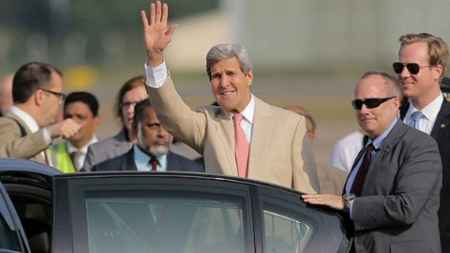
kerry_whitehousegov-1

John Kerry never changes. Whatever happens, he can always be found rushing to appease the enemies of this country. After Iranian backed Houthi Islamic Jihadists attacked a US ship, Kerry has jumped into action to do his usual thing

As the U.S. launched missile attacks Thursday on Houthi-controlled areas of Yemen, behind the scenes Secretary of State John Kerry has been trying to negotiate a temporary cease-fire and reinvigorate a political process to end the country’s civil war.

The conflict has dragged on for over two years now, since the Shiite rebels seized control of the capital of Sanaa in September of 2014. The conflict escalated in March 2015 and since then over 4,000 civilians have been killed, the U.N. has said.

“What the Secretary has been pushing hard for is to get back … to a cessation of hostilities, a 72-hour cessation of hostilities which can at least then create some kind of climate where a political dialogue or a dialogue can begin again,” State Department Deputy Spokesperson Mark Toner said Thursday.

Here’s whom Kerry wants a dialogue with. The Houthis are not “rebels”, they’re Islamic Jihadists, backed by Iran. Their slogan is, “Allah Akbar, Death to America, Death to Israel, A curse upon the Jews, Victory to Islam.”

But part of that is Kerry and Obama’s slogan too. Meanwhile Obama’s NSC put out a statement warning the Saudis about further attacks on the Houthis.

U.S. security cooperation with Saudi Arabia is not a blank check. Even as we assist Saudi Arabia regarding the defense of their territorial integrity, we have and will continue to express our serious concerns about the conflict in Yemen and how it has been waged. In light of this and other recent incidents, we have initiated an immediate review of our already significantly reduced support to the Saudi-led Coalition and are prepared to adjust our support so as to better align with U.S. principles, values and interests, including achieving an immediate and durable end to Yemen’s tragic conflict. We call upon the Saudi-led Coalition, the Yemeni government, the Houthis and the Saleh-aligned forces to commit publicly to an immediate cessation of hostilities and implement this cessation based on the April 10th terms.

Maybe Kerry and the Houthis can bond over their mutual hatred of America.

Column One: From Yemen to Turtle Bay

October 14, 2016

Column One: From Yemen to Turtle Bay, Jerusalem Post, Caroline Glick, October 13, 2016

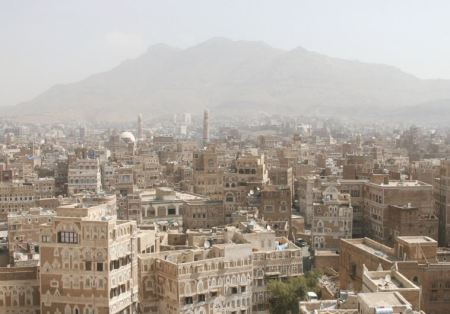
sana-yemen


As far as Obama is concerned, Iran is a partner, not an adversary.

****************************

Off the coast of Yemen and at the UN Security Council we are seeing the strategic endgame of Barack Obama’s administration. And it isn’t pretty.

Since Sunday, Iran’s Houthi proxies in Yemen have attacked US naval craft three times in the Bab al-Mandab, the narrow straits at the mouth of the Red Sea. The Bab al-Mandab controls maritime traffic in the Red Sea, and ultimately controls the Suez Canal.

Whether the Iranians directed these assaults or simply green-lighted them is really beside the point. The point is that these are Iranian strikes on the US. The Houthis would never have exposed themselves to US military retaliation if they hadn’t been ordered to do so by their Iranian overlords.

The question is why has Iran chosen to open up an assault on the US? The simple answer is that Iran has challenged US power at the mouth of the Red Sea because it believes that doing so advances its strategic aims in the region.

Iran’s game is clear enough. It wishes to replace the US as the regional hegemon, at the US’s expense.

Since Obama entered office nearly eight years ago, Iran’s record in advancing its aims has been one of uninterrupted success.

Iran used the US withdrawal from Iraq as a means to exert its full control over the Iraqi government. It has used Obama’s strategic vertigo in Syria as a means to exert full control over the Assad regime and undertake the demographic transformation of Syria from a Sunni majority state to a Shi’ite plurality state.

In both cases, rather than oppose Iran’s power grabs, the Obama administration has welcomed them. As far as Obama is concerned, Iran is a partner, not an adversary.

Since like the US, Iran opposes al-Qaida and ISIS, Obama argues that the US has nothing to fear from the fact that Iranian-controlled Shiite militias are running the US-trained Iraqi military.

So, too, he has made clear that the US is content to stand by as the mullahs become the face of Syria.

In Yemen, the US position has been more ambivalent. In late 2014, Houthi rebel forces took over the capital city of Sanaa. In March 2015, the Saudis led a Sunni campaign to overthrow the Houthi government. In a bid to secure Saudi support for the nuclear agreement it was negotiating with the Iranians, the Obama administration agreed to support the Saudi campaign. To this end, the US military has provided intelligence, command and control guidance, and armaments to the Saudis.

Iran’s decision to openly assault US targets then amounts to a gamble on Tehran’s part that in the twilight of the Obama administration, the time is ripe to move in for the kill in Yemen. The Iranians are betting that at this point, with just three months to go in the White House, Obama will abandon the Saudis, and so transfer control over Arab oil to Iran.

For with the Strait of Hormuz on the one hand, and the Bab al-Mandab on the other, Iran will exercise effective control over all maritime oil flows from the Arab world.

It’s not a bad bet for the Iranians, given Obama’s consistent strategy in the Middle East.

Obama has never discussed that strategy.

Indeed, he has deliberately concealed it. But to understand the game he has been playing all along, the only thing you need to do listen to his foreign policy soul mate.

According to a New York Times profile published in May, Obama’s deputy national security adviser Ben Rhodes is the president’s alter ego. The two men’s minds have “melded.”

Rhodes’s first foreign policy position came in the course of his work for former congressman Lee Hamilton.

In 2006, then-president George W. Bush appointed former secretary of state James Baker and Hamilton to lead the Iraq Study Group. Bush tasked the group with offering a new strategy for winning the war in Iraq. The group released its report in late 2006.

The Iraq Study Group’s report contained two basic recommendations. First, it called for the administration to abandon Iraq to the Iranians.

The group argued that due to Iran’s opposition to al-Qaida, the Iranians would fight al-Qaida for the US.

The report’s second recommendation related to Israel. Baker, Hamilton and their colleagues argued that after turning Iraq over to Iran, the US would have to appease its Sunni allies.

The US, the Iraq Study Group report argued, should simultaneously placate the Sunnis and convince the Iranians of its sincerity by sticking it to Israel. To this end, the US should pressure Israel to give the Golan Heights to Syria and give Judea and Samaria to the PLO.

Bush rejected the Iraq Study Group report. Instead he opted to win the war in Iraq by adopting the surge counterinsurgency strategy.

But once Bush was gone, and Rhodes’s intellectual twin replaced him, the Iraq Study Group recommendations became the unstated US strategy in the Middle East.

After taking office, Obama insisted that the US’s only enemy was al-Qaida. In 2014, Obama grudgingly expanded the list to include ISIS.

Obama has consistently justified empowering Iran in Iraq and Syria on the basis of this narrow definition of US enemies. Since Iran is also opposed to ISIS and al-Qaida, the US can leave the job of defeating them both to the Iranians, he has argued.

Obviously, Iran won’t do the US’s dirty work for free. So Obama has paid the mullahs off by giving them an open road to nuclear weapons through his nuclear deal, by abandoning sanctions against them, and by turning his back on their ballistic missile development.

Obama has also said nothing about the atrocities that Iranian-controlled militia have carried out against Sunnis in Iraq and has stopped operations against Hezbollah.

As for Israel, since his first days in office, Obama has been advancing the Iraq Study Group’s recommendations. His consistent, and ever escalating condemnations of Israel, his repeated moves to pick fights with Jerusalem are all of a piece with the group’s recommended course of action. And there is every reason to believe that Obama intends to make good on his threats to cause an open rupture in the US alliance with Israel in his final days in office.

Prime Minister Benjamin Netanyahu’s phone call with Secretary of State John Kerry on Saturday night made this clear enough. In the course of their conversation, Netanyahu reportedly asked Kerry if Obama intended to enable an anti-Israel resolution to pass in the UN Security Council after the presidential election next month. By refusing to rule out the possibility, Kerry all but admitted that this is in fact Obama’s intention.

And this brings us back to Iran’s assaults on US ships along the coast of Yemen.

Early on Sunday morning, the US responded to the Houthi/Iranian missile assaults by attacking three radar stations in Houthi-controlled territory. The nature of the US moves gives credence to the fear that the US will surrender Yemen to Iran.

This is so for three reasons. First, the administration did not allow the USS Mason destroyer to respond to the sources of the missile attack against it immediately. Instead, the response was delayed until Obama himself could determine how best to “send a message.”

That is, he denied US forces the right to defend themselves.

Second, it is far from clear that destroying the radar stations will inhibit the Houthis/Iranians.

It is not apparent that radar stations are necessary for them to continue to assault US naval craft operating in the area.

Finally, the State Department responded to the attack by reaching out to the Houthis. In other words, the administration is continuing to view the Iranian proxy is a legitimate actor rather than an enemy despite its unprovoked missile assaults on the US Navy.

Then there is the New York Times’ position on Yemen.

The Times has repeatedly allowed the administration to use it as an advocate of policies the administration itself wishes to adopt. Last week for instance, the Times called for the US to turn on Israel at the Security Council.

On Tuesday, the Times published an editorial calling for the administration to end its military support for the Saudi campaign against the Houthis/Iran in Yemen.

Whereas the Iranian strategy makes sense, Obama’s strategy is nothing less than disastrous.

Although the Iraq Study Group, like Obama, is right that Iran also opposes ISIS, and to a degree, al-Qaida, they both ignored the hard reality that Iran also views the US as its enemy. Indeed, the regime’s entire identity is tied up in its hatred for the US and its strategic aim of destroying America.

Obama is not the only US president who has sought to convince the Iranians to abandon their hatred for America. Every president since 1979 has tried to convince the mullahs to abandon their hostility. And just like all of his predecessors, Obama has failed to convince them.

What distinguishes Obama from his predecessors is that he has based US policy on a deliberate denial of the basic reality of Iranian hostility. Not surprisingly, the Iranians have returned his favor by escalating their aggression against America.

The worst part about Obama’s strategy is that it is far from clear that his successor will be able to improve the situation.

If Hillary Clinton succeeds him, his successor is unlikely to even try. Not only has Clinton embraced Obama’s policies toward Iran.

Her senior advisers are almost all Obama administration alumni. Wendy Sherman, the leading candidate to serve as her secretary of state, was Obama’s chief negotiator with the Iranians.

If Donald Trump triumphs next month, assuming he wishes to reassert US power in the region, he won’t have an easy time undoing the damage that Obama has caused.

Time has not stood still as the US has engaged in strategic dementia. Not only has Iran been massively empowered, Russia has entered the Middle East as a strategic spoiler.

Moreover, since 2001, the US has spent more than a trillion dollars on its failed wars in the Middle East. That investment came in lieu of spending on weapons development. Today Russia’s S-400 anti-aircraft missiles in Syria reportedly neutralize the US’s air force.

US naval craft in the Bab al-Mandab have little means to defend themselves against missile strikes.

The US’s trillion-dollar investment in the F-35 fighter jet has tethered its air wings to a plane that has yet to prove its capabilities, and may never live up to expectations.

Israel is justifiably worried about the implications of Obama’s intention to harm it at the UN.

But the harm Israel will absorb at the UN is nothing in comparison to the long-term damage that Obama’s embrace of the Iraq Study Group’s disastrous strategic framework has and will continue to cause Israel, the US and the entire Middle East.

First Iranian-Yemeni missile attack on US flotilla

October 12, 2016

First Iranian-Yemeni missile attack on US flotilla, DEBKAfile, October 12, 2016

uss_mason_fires__9-10-16_an_sm-2

Contrary to Tehran’s assurance to Washington in August that Iranian arms supplies to Yemeni Houthi rebels had been suspended, the rebels took delivery last week of the largest consignment of Iranian weapons to date.

According to DEBKAfile’s military sources, the shipment included highly sophisticated Scud D surface-to-surface missiles with a range of 800km; and C-802 anti-ship missiles (an upgraded version of the Chinese YJ-8 NATO-named CSS-N-8 and renamed by Iran Saccade).

They came with Iranian Revolutionary Guards officers and radar systems to fine-tune the targeting of these missiles by Iran’s Yemeni proxies.

The Scuds were given to the Houthi forces fighting in northern Yemen on the Saudi border, while the C-802s were delivered to the Houthis’ Ansar Allah faction, which is under direct Iranian Rev Guards command.

The missiles were posted at special launch bases constructed by Iran outside Yemen’s two principal Red Sea ports of Mokha and Hudaydah.

Since no more than 62km of Red Sea water divides the Saudi and African coasts, the Iranian missiles are well able to block shipping and tanker traffic plying to and from the Gulf of Suez and the Persian Gulf. Therefore, the threat of blockade hangs imminently over one-third of Saudi and Gulf Emirate oil exports.

The same threat hangs over Israeli civilian and naval shipping from its southern port of Eilat through the Gulf of Aden and out to the Indian Ocean.

One of the most troubling aspects of this pivotal new menace to an international waterway was that US, Saudi, Egyptian and Israeli intelligence agencies missed the huge consignment of Iranian missiles as it headed towards Yemen. Neither did they pick up on the construction by Iranian military engineers of three ballistic missile bases – one facing Saudi Arabia and two Red Sea traffic.

Tehran’s Yemeni proxies moreover landed large-scale military strength on Perim island in the mouth of the Bab al-Mandeb strait, the chokepoint for ingress and egress from the Red Sea.

Since the strait is just 20km wide, control of this island empowers this force to regulate shipping movements through this strategic strait.

Tehran wasted no time after all its assets were in place to begin using them:

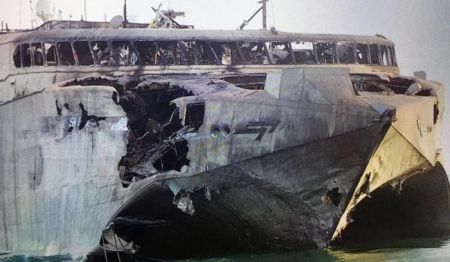
1. On Oct. 1, Iran’s Houthi surrogates launched C-8-1 missiles against a United Arab Emirates transport HSV-2 Swift logistics catamaran as it was about to pass through the strait. The ship, on lease from the US Navy, was badly damaged. No information was released about casualties.

uae_hsv-2_1-1-16

DEBKAfile’s military and intelligence sources discerned that the aim of this attack was to choke off the movements of UAE warships from the southern Yemeni port of Aden, where large Emirate and Saudi forces are concentrated, to the Eritrean port of Assab, where the UAE has established a large naval base.

This attack did finally evoke a US response. The guided missile destroyers, USS Mason and USS Nitze, were dispatched to the Red Sea, along with the USS Ponce afloat forward staging base, to patrol the strait opposite the Yemeni coast

2. This did not deter Tehran or its Yemeni pawns: On Oct. 9, they fired an additional barrage of C-802 at the American flotilla, which according to a US spokesman, missed aim.

The Mason hit back with two Standard Missile-2s and a single Enhanced Sea Sparrow Missile.

There has been no official word about whether these weapons destroyed a Yemeni launching site. But the event itself was a landmark as the first direct Iranian-Houthi attack of its kind on an American naval vessel.

3. That same day, the Houthis fired Scud-D missiles at the Saudi town of Ta’if, 700 km from the Yemeni border and only 70km from the Muslim shrine city Mecca. This was meant as a direct assault on the Saudi royal house and its claim to legitimacy, by virtue of its role as Guardian of the Holy Places of Islam.

In America’s heated presidential campaign, the Democratic contender Hillary Clinton boasts repeatedly that as Secretary of State she helped “put the lid on Iran’s nuclear program without firing a single shot.”

That is factually true. America did not fire a single shot. Iran did the shooting and still does, constantly upgrading its arsenal with sophisticated ballistic missiles.

Saudi Arabia and Qatar Funding The Islamic State

October 11, 2016

Saudi Arabia and Qatar Funding The Islamic State, Understanding the Threat, October 10, 2016

Why wouldn’t Saudi Arabia, Qatar, and all other wealthy Muslim countries fund ISIS, ISIL, or whatever we are calling the leading army of Mohammad this week?

In the latest Wikileaks download, a series of emails between then Secretary of State Hillary Clinton and John Podesta, former Chief of Staff to President Bill Clinton and Counselor to President Obama, dated August and September 2014 reveal Saudi Arabia and Qatar are funding and providing support to ISIS.

In the email Mrs. Clinton states:  “We need to use our diplomatic and more traditional intelligence assets to bring pressure on the governments of Qatar and Saudi Arabia, which are providing clandestine financial and logistic support to ISIL and other radical Sunni groups in the region.”

saudi

We know from the recently released portions of the 9/11 Report a large volume of evidence exists revealing Saudi Arabia funds jihadi training materials and Islamic Centers/Mosques in the United States, among other direct support to fund the global jihad against the U.S. and the West.

Pakistan provided direct support via their intelligence agency (ISI) to Al Qaeda fighters after the attacks on the United States on 9/11/2001, and, provided safe haven for Osama bin Laden.

Turkey’s policies and open hostility towards the United States make clear they cannot be trusted at all.

Saudi Arabia and Qatar are giving financial and logistical support to ISIS.

The questions that remain:

*Why are key facilities in Saudi Arabia and Qatar not on our target list?

*Which Muslim country in the world is not hostile to the United States and supporting the armies of Mohammad (ISIS, Al Qaeda, Hamas, etc)?

Hillary Clinton’s “play for pay” campaign

October 6, 2016

Hillary Clinton’s “play for pay” campaign, Israel National News, Lee Kaplan, October 6, 2016

President Harry Truman once said that any politician who became wealthy as a result of being in public service was a crook. As the American presidential election looms near, Hillary Clinton is showing the former president’s statement to be true.

On leaving the White House at the end of her husband’s presidency, Hillary Clinton cried poverty. Yet today, after her stint in Congress and as the U.S. Secretary of State, her net worth is in excess of 100 billion dollars. To this day Mrs. Clinton has not openly told the truth about where all the money is coming from. Most of this largesse is the result of donations from foreign dictators (notably the Gulf Sheikhs in Saudi Arabia, Qatar, Kuwait and the UAE) and the Organization of Islamic Cooperation (OIC) to which these dictators belong.

What is the OIC?

It is a consortium of the Gulf Sheiks that also became a part of the United Nations. One of its key purposes of late is to try and have blasphemy laws created in the West and worldwide when criticism of Islam is voiced. It is also designed to get the Gulf Sheiks whatever they want from pusillanimous diplomats in the West.

The crux of the matter is how Hillary Clinton criticizes her presidential opponent by trying to suggest he is xenophobic, or more specifically “islamophobic” ( a silly term touted and promoted by UC Berkeley Hamas apparatchik Hatem Bazian, who also called for an “intifada” in America).  She says this is anathema to her humanitarian concern for Syrian refugees with which she wants to flood American shores.

Whereas Barack Obama brought in 10,000 such refugees and seeks to double the numbers, Ms. Clinton insists she wants this number increased to 550,000 or possibly even 600,000. Voters should note not only the fact that such a large number is bound to have many more refugees who are not vetted for security purposes – as is already being discussed in the Press. In fact, her insistence on these increased numbers is a glaring example of her engaging in “Pay for Play”:

The OIC pays her and she promises them she will absorb the refugees so OIC member nations won’t have to do it.

And one doesn’t need a deleted email to see this. To date, not one Gulf sheikh who donated to her foundation has offered to take in even one Syrian refugee. The Saudis, incredibly, have housing and bedding for three million refugees in their country. Originally created to house visitors for the Hajj pilgrimage to Mecca every year, these domiciles have air conditioning, running water and all the facilities to take in more than the 600,000 refugees that Hillary is proposing.

But that might interfere with the solid gold faucets planned for the next palace. Just as American boys can die to save Kuwait, so to can the American taxpayer absorb the flotsam and jetsam of the Arab world.

As Secretary of State, Clinton oversaw a state department that somehow lost 3 billion dollars in tax dollars that are unaccounted for according to the GAO, that spent other tax dollars on building mosques overseas through USAID, that funds UNWRA “camps” where Palestinian children are taught they are to be the next generation of suicide bombers and terrorists, and that pays salaries to convicted terrorist murderers in Israel jails. Those salaries are sometimes greater than many Americans earn. USAID also funds 100% of Palestinian television that incites Arabs to murder the Jews.

In fairness, many of these things were started under the Bush administration, but just as many others were started or propagated during Bill Clinton’s presidency.

As Secretary of State she could have stopped much of this, but she chose not to do so. She let the Arab world indirectly have the US as a piggy bank for totalitarians, letting the Saudis fund world terrorism and rule the roost in Washington. All of this was part of “Pay for Play” as she solicited funds from the Sheikhs for her foundation.

One campaign clip had Clinton saying “We must not insult Islam!”  This was spoken like a true IOC campaigner and an example of a politician pandering to her money source. As terrorist attacks come to the U.S. in St. Cloud, in Phoenix and New York, we can hear Hillary carrying on about how the US must swallow up 600,000 more Muslim refugees – because she must have promised this to the Shieikhs. That’s real play for the pay.

Every one of those Syrian refugees will cost the US taxpayer dearly as well. They will require government health care that we can ill afford, plus food, education and other benefits. Even those who have no terrorists connections will bring with them anti-Semitism and a support ideology that will promote the Sheikhs and other totalitarian enemies of the United States, just as President Obama has done in surrendering nuclear control over Iran. Remember – Hillary presided over that one too. Meanwhile, Mrs. Clinton will be paying back her funders at the expense of the American taxpayer as billions pour into her foundation in the form of funds that she can ultimately draw on, starting with daughter Chelsea.

Harry Truman obviously knew what he was talking about.