Archive for the ‘Saudi Arabia’ category

Could Saudi Arabia Need Israel More than Vice Versa?

April 12, 2015

Could Saudi Arabia Need Israel More than Vice Versa? Israel National News, Gedalyah Reback, April 12, 2015

Israel’s status as a regional superpower is unusual for its lacking a reliable set of local allies. Even where security ties with Egypt, Jordan and Saudi Arabia might be strong, the country is forced to keep those ties in the background. Regardless, it exerts a degree of influence just by its own strategic value. While ties are not public, they are also not available for public scrutiny, perhaps enhancing the relationship opportunities with the above mentioned countries as well as other Arab states.

“Rather than a charm offensive,” asserts Robert Kappel of the German Institute of Global and Area Studies, “Israel needs an assertive regional foreign policy” in order to gain more allies.

But is that really true?

“I don’t think that it’s either-or,” says Professor Eytan Gilboa of Bar Ilan University. “I think Israel has a regional policy. We don’t see it but it collaborates with Arab countries and the Persian Gulf, especially on Iran and much more on counter-terrorism. It has a regional policy but it’s undercover.”

Solving the Israeli-Palestinian Conflict is not a Condition for an Alliance

Turning back specifically to Kappel, Gilboa states “I think he means to use it to deal with the Palestinian issue; then comes the Arab Peace Initiative. The assumption is the PA is unable, unable, to reach an agreement with Israel.”

Gilboa sees an Arab desire to expand relations with Israel in spite of the conflict with the Palestinians. Thus, the Arab Peace Initiative might be evidence the Arab countries are eager to reach out with a public offer that would allow them to open the door for Jerusalem without necessarily having to seal a deal on the conflict.

“I reject one claim: that resolution of the Israeli-Palestinian issue is a condition for a regional alliance. The reason for this is simple – all these countries couldn’t care less about the Palestinians. They have an interest in blocking Iran and extremist Islamic organizations. They made all kinds of statements to the contrary but that is not the issue. I don’t think there’s a linkage here.”

Pressing his point, Gilboa says “There’s much less opportunity for regional pressure on the Palestinians than most people think. ‘Collaboration’ is a euphemism for security cooperation on ‘negative interests.’”

Those negative interests are opposition to common regional security challenges like the above mentioned Iran and Islamist terrorist organizations. But to create an alliance, you need much more than common enemies, says Gilboa – you need common interests.

“Turkey ambivalent to ISIS – they share an ideology but still see it as a competitor. Erdogan would like to revive the Ottoman Empire where a non-Arab country leads the Arab world. Where you see this kind of geopolitics, there are a lot of opportunities for collaboration with these countries.”

And actually, “there’s criticism of Israel for not exploiting the situation,” says Gilboa.

New Countries?

When Arutz Sheva asked if Israel’s chances for regional alliances might actually increase if Syria were to collapse into several smaller states or the Iraqi Kurdish Regional Government (KRG) were to become a full-fledged independent state, Gilboa sees the idea as having validity.

“I think this is a valid point. I am only hearing that Israel is collaborating with the Kurds there and you can do a little bit more, but it is a lot more than it used to be. The alliance with Turkey had prohibited close collaboration with the Kurds. But now that the relationship is bad, this condition is nonexistent. I think indeed they could do more.”

Focusing on the much more developed autonomy, infrastructure and ambitions of the Iraqi Kurds than other groups that could emerge in Syria, Gilboa says Kurdistan could definitely become a game-changer in the region’s mixture of waxing and waning alliances. Most significantly, it could be something that does not necessarily replace Arab states as a reliable ally, but actually enhances the chances of a strong alliance between those Arab countries and Israel.

“I also think there is room for a strategic alliance between Israel and pro-US Arab states. Not just potential between Israel and the non-Arab groups, but collaboration with Israel, non-Arab states and those emerging new political entities in the Middle East. It could be done on a bilateral basis first – perhaps between Israel and Kurdistan – or multilateral. Once you gain influence with a group like the Kurds, you could translate that into the other (multilateral) type of alliance.”

Israel and Kurdistan have a long history of both covert and overt relations, especially on security. Kurdistan might then be an example of an emerging country where Israel could carry more influence than the Saudis (assuming Kurdistan is able to gain more autonomy or full sovereignty). Saudi Arabia’s diplomatic and military clout is still behind that of Israel, according to Gilboa.

“Saudi Arabia’s power is limited to its ability to manipulate oil markets, but their strength is precarious as major importers like the United States become self-sufficient in that realm. Even their military strength might turn out to be limited as its operation in Yemen is one of the largest it has ever undertaken. The assumption the Saudis might have strong influence over Pakistan and could persuade Islamabad to sell Riyadh a nuclear bomb to pull ahead of the Iranians has been thrown into doubt by Pakistan’s decision not to join the military operation against the Houthis.”

Ultimately, it might be Israel’s power that the Saudis need more.

Anything but a Saudi win (in Yemen) would not be good for Saudi Arabia,” emphasizes Gilboa. On the other hand, “Israel is much stronger diplomatically, militarily and its society is much more vibrant.”
Yemen war: Saudis prevented Russian evacuations by air, bombed Moscow’s spy center in Aden

April 7, 2015

Yemen war: Saudis prevented Russian evacuations by air, bombed Moscow’s spy center in Aden, DEBKAfile, April 7, 2015

Russias_Yemen_consulate_damaged_in_Saudi-led_airstrikes_1.4.15Russia’s bombed out consulate in Aden

Saudi Arabia has gone head to head with Russia as Iran’s ally in Yemen.

Moscow claims to have evacuated hundreds of Russian nationals from Yemen by an air lift running out of Sanaa airport, but DEBKAfile’s exclusive intelligence and military sources reveal that not a single Russian plane has taken off from any Yemeni airport since March 27, when Saudi Arabia launched its military offensive against the pro-Iranian Houthi rebels.

The Saudiis warned Russia that they would not be responsible for the safety of any flights landing at a Yemeni airport or the passengers assembled there for evacuation, while their air force conducted strikes against the rebels. Having achieved control of Yemen’s skies in the early stages of their intervention, the Saudis declared its air space a no-fly zone.

This warning gained substance when, on April 1, Saudi F-15 warplanes bombed the Russian consulate in the second largest Yemeni city, Aden. A Russian witness said that not a single window was left in the building and all Russian citizens would have to leave the town.

According to DEBKAfile’s sources, the building was in fact completely demolished in order to dismantle Russia’s regional intelligence-gathering center which operated out of the consulate building and fed Iranian intelligence with data on military movements in the neighborhood.

It functioned according to the same system as Russian spy stations in Syria, which routinely keep their Iranian colleagues au fait with military activities, including Israeli army movements.

The intelligence gathered by the Aden facility was no doubt passed on by Iranian agents to the Houthi commanders, certainly after Al Qods Brigades chief Gen. Qassem Soleimani arrived in Sanaa to direct the rebel offensive after the Saudi offensive was launched.

In normal times, the Russian spy facility would have been responsible for surveillance over navigation through the Bab el-Mandeb Strait and the warships sailing between Red Sea, the Gulf of Aden and the Indian Ocean.

The next chapter of the Russian evacuation story unfolded on Thursday, April 2, the day after the consulate was razed: The Russians tried activating their connections in Cairo to obtain Saudi permission to land a plane in Sanaa, where hundreds of Russians had crowded to await passage to safety.

The Saudis relayed their refusal to Moscow through Cairo.

Then, on Friday, April 3, a flight landed at Moscow’s Chkalovsky Airport carrying Russian evacuees from Yemen, followed by a second flight which landed at an unnamed Russian military airport.

DEBKAfile’s sources report that neither of those planes were actually permitted to take off from Sanaa, but flew in from Cairo. After the Saudi ban on flights through Yemeni airports, Moscow had no choice but to rescue its nationals from the embattled country by sea aboard ships that carried them to Egypt.


Can and should Israel destroy Iran’s nuclear facilities?

April 5, 2015

Can and should Israel destroy Iran’s nuclear facilities? Dan Miller’s Blog, April 5, 2015

(The views expressed in this article are mine and do not necessarily reflect those of Warsclerotic or any of its other editors. — DM)

It has been suggested that Israel should seriously consider destroying Iranian nuclear facilities, but Israeli officials obviously haven’t said, and won’t say, if, how or when she might.

Iran fenced in

Speaking to Arutz Sheva Friday, Professor Efraim Inbar, who heads the Begin-Sadat Center for Strategic Studies, said the deal had realized Israel’s worst fears by leaving Iran’s nuclear program essentially intact.

The Islamic Republic’s nuclear program has been granted “legitimacy” by the agreement, which still allowed it to continue enriching uranium and to maintain a reactor capable of producing enriched plutonium, he said. “And that’s what worries Israel, that they (Iran) will be able within a short time frame to reach a nuclear bomb.”

“I hold the view that the only way to stop Iran in its journey to a nuclear bomb is through military means,” Inbar maintained, suggesting that “Israel needs to seriously consider striking a number of important nuclear facilities” to head off the threat.

On March 28, former U.S. Ambassador Bolton said that it should be done.

The P5+1 nuclear “deal,” proudly announced by President Obama on April 2nd, is a sham. There is no “deal,” and public announcements by Iran and Obama cast it in very different lights. According to Iran, all sanctions will be lifted immediately when an agreement is reached on or before June 30th. According to Obama, sanctions relief will be gradual and based on Iran’s compliance with invasive inspections and other conditions. Even National Public Radio (NPR) has pointed out differences. NPR observed that, according to Iran,

all sanctions relief – U.N., EU and U.S. – would be immediate. It was unequivocal. It stated that Iran under the deal was free to pursue industrial scale enrichment to fuel its own reactors – unequivocal. It stated that Iran was unhindered in its ability to conduct centrifuge R&D.

Iran has also emphasized that its intention to destroy Israel is non-negotiable, and the Obama Administration has rejected any efforts to make Iran recognize Israel’s right to exist, on the ground that

“This is an agreement that is only about the nuclear issue,” State Department spokeswoman Marie Harf told reporters on Friday night, according to Fox News. “This is an agreement that doesn’t deal with any other issues, nor should it.” [Emphasis added.]

Israeli Prime Minister Netanyahu has said that Israel’s right to exist is non-negotiable.

Iran is very unlikely to retreat from its perception of the “deal,” Obama is very likely to retreat in Iran’s favor, and Israel is very unlikely to retreat from its perceptions about Iran, the “deal” or Israel’s right to exist.

What should Israel do?

In Martin Archer’s novel Islamic War, which I reviewed here, Israel dispatched elderly, large and substantially refurbished remove controlled aircraft, full of high explosives, from Somalia to half dozen nuclear facilities operated by hostile nations. They flew circuitous routes at varying altitudes to avoid detection until it was too late to stop them. Over a period of weeks, they crashed into and destroyed their targets, amid speculation about who had done it and why. Israel was not suspected. Would that have been possible then? Now? I don’t know.

It has been reported that Saudi Arabia has given Israel clearance to use her airspace for an attack on Iran’s nuclear facilities.

Fox News reports that US Defense sources claim the Saudis are conducting tests on their air defense systems after giving Israel permission to to enter a narrow corridor to shorten the distance to attack Iran.

The testing would make sure that Saudi jets don’t get scrambled when Israel entered Saudi airspace. Once the IAF planes complete their mission and exit Saudi airspace, Saudi defenses would go back online again. [Emphasis added.]

Might Saudi Arabia, Egypt and perhaps other Gulf States go beyond not interfering with an Israeli attack to provide air support and other help? They seem to be as displeased with the “deal” as Israel is.

Assuming that Israel is not overly concerned about being identified as the attacker and is willing to act alone, she might:

Detonate one or more high-altitude atomic bombs to emit sufficient electromagnetic pulses (EMP) to fry all above-ground Iranian electronics. That would substantially disable Iranian above-ground command and control facilities as well as other communications, hence diminishing (but not eliminating) the possibility of counter-strikes by Iran and/or its proxies. Perhaps she has other, non-nuclear, means of generating EMPs; she hasn’t said.

Immediately thereafter, drop whatever suitable bombs she may have on all Iranian military and nuclear facilities. Does Israel have bunker-buster bombs? Probably not of U.S. manufacture, but that does not mean that she has not developed her own. It would be surprising if she had not.

Obama and other “leaders of the free world” would complain and the U.N. would emit fits of angry censures. However, that happens with great frequency in any event, and would be an insufficient reason for Israel to commit national suicide through inaction against Iran.

I am no “military expert” and would appreciate any comments on the suggestions I have made as well as any other suggestions anyone might care to offer.

Victory Against ISIS in Tikrit Will Embolden Iran

April 2, 2015

Victory Against ISIS in Tikrit Will Embolden Iran, Front Page Magazine, April 2, 2015

370x270xtikrit-450x328.png.pagespeed.ic.9xBCkeIFLH

The downside to playing on the same team as the Iranian regime, even in just this one military campaign against ISIS, is that we are helping to enable a far more dangerous power than ISIS to extend its hegemonic dominance throughout the entire region.

****************

Iraq’s defense minister Khalid al-Obeidi is claiming victory over ISIS forces in the city of Tikrit, which ISIS had captured last summer as its forces advanced across large swaths of territory in northern and western Iraq. “We have the pleasure, with all our pride, to announce the good news of a magnificent victory,” Obeidi said. The Pentagon and a spokesman for the U.S.-led coalition were a bit more cautious, noting some residual ISIS resistance. However, they too reported that significant progress had been made in wresting control of Saddam Hussein’s birthplace from ISIS’s grip.

The next strategic military objective in pushing ISIS back from the territories it controls in Iraq is to re-take Iraq’s second largest city, Mosul.

Iran supplied significant military support to the Shiite militia forces, who were a major part of the Iraqi counter-offensive on the ground. At the same time, U.S. air strikes seemed to have helped in supporting the Iraqi ground forces’ advance into Tikrit. The precise extent of any behind-the-scenes direct or indirect coordination between the U.S. and Iran is unknown at the present time. However, according to DebkaFile {March 26, 2015), “In the last two weeks of the Tikrit operation, liaison between the US and Iranian military in Iraq was routed through the office of the Iraqi Prime Minister in Baghdad.”

There is little question that without the Iranian-backed Shiite militia and substantial military support on the ground from Iran, ISIS would most likely still be in control of Tikrit today. U.S. airstrikes may have been necessary to soften ISIS’s resistance, but only ground troops with Iran’s support could dislodge them.

The downside to playing on the same team as the Iranian regime, even in just this one military campaign against ISIS, is that we are helping to enable a far more dangerous power than ISIS to extend its hegemonic dominance throughout the entire region.

As General David Petraeus, who certainly knows something about Iraq, told the Washington Post recently:

In fact, I would argue that the foremost threat to Iraq’s long-term stability and the broader regional equilibrium is not the Islamic State; rather, it is Shiite militias, many backed by — and some guided by — Iran… Longer term, Iranian-backed Shia militia could emerge as the preeminent power in the country, one that is outside the control of the government and instead answerable to Tehran.

Without downplaying ISIS’s horrific acts, its rapid-fire successes in Syria and Iraq (even with the setback in Tikrit), and its growing allegiances in Libya, Nigeria and areas further away from its home base including Afghanistan, the fact is that ISIS’s ambitions far exceed its current means for achieving them.  ISIS is proficient in using social media for recruitment, propaganda and intimidation purposes, but that can only take ISIS so far.

Iran, by contrast, has built up its military capabilities to the point that it can back up its aggressive threats in the region. And that’s even without the nuclear arms capability that President Obama seems to be willing to risk allowing Iran to achieve in order to secure his legacy with a deal.

As a result, America’s traditional Sunni allies in the region such as Saudi Arabia and other Persian Gulf states are doubting whether they can continue to count on the United States for support. And they are taking matters into their own hands, including a decision to form a multinational Arab military force to respond to Iranian aggression and other perceived threats.

As explained by Gamal Abdel Gawad Soltan, a political scientist at the American University in Cairo and quoted by the New York Times: “The U.S. is much less trusted as an ally, as an insurance policy towards the security threats facing the governments in the region, and so those governments decide to act on their own.”

These governments know their neighborhood well and see Iran as a much graver threat to regional peace and security than ISIS. Iran’s military and financial support of the Shiite Houthi rebels in taking control of major parts of Yemen was the last straw. Saudi Arabia on its own initiative decided to launch an air campaign against Houthi positions in Yemen and has not ruled out a ground attack along with the military forces of other Arab countries.

In response to the air and sea blockade of Yemen that Saudi Arabia is imposing on Yemen, Iran’s supreme leader Ayatollah Ali Khamenei decided to dispatch “two naval task forces to sail to the Red Sea,” according to DebkaFile (March 31, 2015). “The naval task forces are being sent to draw a sea shield around the Houthi forces to defend them against Saudi-Egyptian assaults. This maneuver was orchestrated by the Al Qods Brigades chief Gen. Qassem Soleimani,” DebkaFile reported.

Soleimani certainly gets around. Earlier this month he popped up in Iraq to lead the Shiite militias in their fight against ISIS. Now the man who fought on the same side as us against ISIS in Iraq is apparently coordinating Iran’s fight to hold onto the Houthis’ gains in Yemen where they forced the American and Saudi Arabian-backed president to flee.

Soleimani is “the puppet master controlling numerous Iranian surrogates in various countries,” said Jim Phillips, Middle East analyst for the Heritage Foundation. “His organization is drenched in American blood,” Phillips added. “It’s infused with an anti-American philosophy and a cooperation with him or his followers would not be on a sustainable basis. The U.S. would regret it.”

The Obama administration is now scrambling to catch up with Iran’s multi-pronged offensives, some of which are under Soleimani’s coordination. Thus, President Obama decided to support the Sunni Gulf coalition and Egypt against Iranian-backed action by the Shiite Houthi rebels to take control of Yemen.

However, the Obama administration’s reactive tactics in dealing with the crisis in Yemen are too little too late. Saudi Arabia is reportedly looking to Pakistan for help in acquiring its own nuclear arms to counter the Saudis’ well-founded suspicions that any deal negotiated by the Obama administration with Iran will not prevent Iran from becoming a nuclear armed power. And while Obama finally lifted the arms freeze he imposed against Egypt two years ago, clearing the way for the delivery of F-16 aircraft, Harpoon missiles and tanks, he also decided to end Egypt’s ability to finance purchases of American arms by drawing credits in advance based on future aid Egypt expects to receive starting in the 2018 fiscal year. Obama also wants to reduce Egypt’s flexibility in what it can purchase with the future military aid. Thus, the Egyptian government can be expected to continue on its course to find other sources for military aid and weapons including Russia, because of doubts that the U.S. will remain a reliable supplier.

The Obama administration has been willing to sacrifice the confidence of its Arab allies, not to mention the United States’ historically close alliance with Israel, in a vain effort to lure the Iranian regime into acting as a responsible party in the Middle East that can help stabilize this volatile region. Instead, Obama should listen to the expert on Iraq, General Petraeus, whose surge victory Obama undermined completely with his precipitous withdrawal of all U.S. troops from Iraq in 2011:

The current Iranian regime is not our ally in the Middle East. It is ultimately part of the problem, not the solution. The more the Iranians are seen to be dominating the region, the more it is going to inflame Sunni radicalism and fuel the rise of groups like the Islamic State…Iranian power in the Middle East is thus a double problem. It is foremost problematic because it is deeply hostile to us and our friends. But it is also dangerous because, the more it is felt, the more it sets off reactions that are also harmful to our interests — Sunni radicalism and, if we aren’t careful, the prospect of nuclear proliferation as well.

We can rejoice in the pushback of ISIS out of Tikrit. Perhaps it is a sign of more victories over ISIS to come. However, we should not delude ourselves into thinking that we have more in common with the Iranian regime in combatting ISIS in Iraq or Syria than the Iranian regime ultimately has in common with ISIS. They may be bitter enemies in the struggle over which set of fanatical jihadists should get to rule the global Islamic ummah or caliphate they both fantasize about. However, both fervently believe in the fundamental ideological goal of universal Islamic supremacy. And both are willing to sacrifice the lives of millions of people to reach that goal, no matter how long it takes them. The difference is that a nuclear-armed Iran would be much more capable of carrying out its jihadists’ apocalyptic vision than ISIS and in a much shorter period of time.

Why ‘Operation: Decisive Storm’ is Iran’s worst nightmare

March 29, 2015

Why ‘Operation: Decisive Storm’ is Iran’s worst nightmare, Al ArabiyaMajid Rafizadeh, March 28, 2015

(Al Arabiya is Saudi owned. — DM)

[B]y the U.S. being so concentrated on a nuclear deal and President Obama being so focused on leaving behind a historic legacy regarding a nuclear deal with Iran, the unintended consequences of such an inefficient foreign policy are being ignored and overshadowed. Although the U.S. has military bases in the region, it has evidently chosen to ignore Iran’s military expansion.

********************

Often, scholars and politicians have made the argument that regional powers in the Middle East are opposed to a nuclear deal between Iran and the six world powers due to the nuclear technicalities of the deal or restoring relationships between Tehran and the U.S. Nevertheless, this premise fails to shed light on the underlying concerns, nuances and intricacies of such a nuclear deal as well as Iran’s multi-front role in the region.

The underlying regional concerns are not primarily linked to the potential reaching of a final nuclear deal with the Islamic Republic or easing of ties between the West and Tehran. At the end of the day, regional powers would welcome and be satisfied with a nuclear deal that can ratchet down regional tension, eliminate the possibility of the Islamic Republic to become a nuclear state, and prevent a nuclear arms race.

But what is most worrying is the expanding empire of the Islamic Republic across the Arab world from Beirut to Baghdad, and from Sanaa to Damascus, as the nuclear talks reach the final stages and as no political will exists among the world powers to cease Iran’s military expansion.

Establishing another proxy in Yemen

Iran’s Quds forces have long being linked to the Houthis. The Islamic Republic continues to fund and provide military support to the Houthis (by smuggling weapons such as AK-47s, surface-to-air missiles as well as rocket-propelled grenades) in order to establish another proxy in the Arab world.

Iran’s long-term strategic and geopolitical objectives in Yemen are clear. The Islamic Republic’s attempt to have a robust foothold near the border of Saudi Arabia, as well as in the Gulf Peninsula, will tip the balance of power in favor of Tehran.

By empowering the Houthis, Tehran would ensure that Saudi Arabia is experiencing grave national security concerns, the possibility of conflict spill-over, and internal instability. In addition, by influencing Yemeni politics through the Houthis, Iranian leaders can pressure Saudi Arabia to accept Iran’s political, strategic and economic dominance in Iraq, Syria, and Lebanon as well.

The latest advancement of the Houthis supported the interests of the Islamic Republic until recently. There was a need for robust action against Iran’s hegemonic ambitions. Nevertheless, the West was resistant to act.

From geopolitical, strategic and humanitarian perspective, the robust military action, Operation Decisive Storm, is a calculated and intelligent move to send a strong signal to the Islamic Republic that its interference in another Arab state will not be overlooked. In other words, Arab states do not have to wait for the West to act against Iran’s covert activities and support for Shiite loyalist-militias in the region.

The tightening grip over another Arab capital

As the nuclear talks between Britain, China, France, Russia and the United States – the five permanent members of the Security Council – plus Germany (P5+1) and the Islamic Republic appear to show progress towards a final agreement to curb Iran’s nuclear ambitions, the world powers (specifically the United States) have chosen to turn a blind eye on Iran’s military expansion in the Arab states, and particularly in Yemen.

Iran’s long term strategic and geopolitical agenda should not be overlooked. Iranian leaders’ hegemonic ambition is to consolidate and strengthen its grip on the Arab states, and to have control over Arab capitals from Beirut to Baghdad and from Sanaa to Damascus.

The Islamic Republic’s ambitions to expand its empire during the nuclear talks and regional insecurities are carried out through several platforms. Central figures, such as Quds Force commander General Qassem Soleimani, hardliners such as Ali Reza Zakani, Tehran’s representative in the Iranian parliament and a close figure to the Iranian supreme Leader Ayatollah Ali Khamenei, and the Supreme Leader himself, play a crucial role in fulfilling Iran’s regional hegemonic ambitions.

Iranian leaders are not even concerned about repercussions from boasting about their grip over Arab capitals. Zakani recently bragged about having control over Arab capitals, “Three Arab capitals have today ended up in the hands of Iran and belong to the Islamic Iranian revolution”. He added that Sanaa will soon be under the grip on the Islamic Republic as well. According to him, most of Yemen’s territories will soon be under the power of the Shiite group, the Houthis, supported by the Islamic Republic.

The second platform that the Islamic Republic utilizes is sponsoring, financing, equipping, training and advising loyalist and heterodox Shiite groups across the region. The number of these militia groups is on the rise and they operate as a pawn to serve the geopolitical, strategic, economic, ideological and national interests of the ruling clerics.

America’s lack of political willingness to act

As the Islamic Republic creates such Shiite groups across the region to “protect” Arab capitals, Tehran centralizes its power across the region. In addition, after the creation of new Shiite groups, the elimination of these proxies will not be a simple task, for they will be ingrained in the socio-political and socio-economic fabric of the society.

In addition, these loyalist militia groups are game changers in the region, tipping the balance of power further in favor of the Islamic Republic and its regional hegemonic ambitions.

The expansion of Iran’s military and loyalist-militia groups in the region transcends Tehran’s political ambitions. The ideological tenet of this expansion and of Tehran’s overall growing regional empire (under the banner of Popular Mobilization Forces: an umbrella institution of Shiite armed groups) are crucial facets to analyze.

More fundamentally, as the final nuclear deal approaches, and as Tehran witnesses the weakness of Washington and other powers when deciding to overlook Iran’s militaristic and imperialistic activities in the region, Tehran has become more emboldened and vocal when it comes to its military expansion.

Iranian leaders boast about their role in Arab states projecting Tehran as a savior for the Arab world. As Zakani stated, according to Iran’s Rasa new agency “had Hajj Qassem Soleimani not intervened in Iraq, Baghdad would have fallen, and the same applies to Syria; without the will of Iran, Syria would have fallen”.

Nevertheless, by the U.S. being so concentrated on a nuclear deal and President Obama being so focused on leaving behind a historic legacy regarding a nuclear deal with Iran, the unintended consequences of such an inefficient foreign policy are being ignored and overshadowed. Although the U.S. has military bases in the region, it has evidently chosen to ignore Iran’s military expansion.

The concerns of regional countries about the nuclear deal is not solely linked to the nuclear technicalities of the deal or Iran-West rapprochement, but are primarily related to Iran’s growing empire as well as the consequences of such a nuclear deal leading Tehran to apply more assertive and expansionist foreign policy in the region.

Regional robust actions such as Operation Decisive Storm are sometimes required in order to set limits to Iran’s hegemonic, imperialistic objectives, and interference in other Arab states’ affairs, as well as in order to prevent the destabilizing effects emanating from the growing militia rebels sponsored by the Islamic Republic.

Obama Admin Threatens U.S. Allies for Disagreeing with Iran Nuke Deal

March 27, 2015

Obama Admin Threatens U.S. Allies for Disagreeing with Iran Nuke Deal, Washington Free Beacon, March 27, 2015

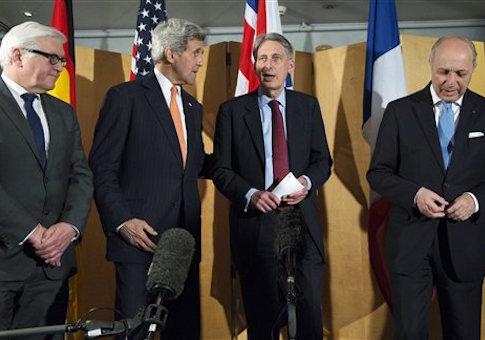
Iran Nuclear TalksFrom left, German Foreign Minister Frank Walter Steinmeier, U.S. Secretary of State John Kerry, British Foreign Secretary Philip Hammond and French Foreign Minister Laurent Fabius talk after Hammond made a statement about their meeting regarding recent negotiations with Iran over Iran’s nuclear program in London, England, Saturday, March 21 / AP

LAUSANNE, Switzerland—Efforts by the Obama administration to stem criticism of its diplomacy with Iran have included threats to nations involved in the talks, including U.S. allies, according to Western sources familiar with White House efforts to quell fears it will permit Iran to retain aspects of its nuclear weapons program.

A series of conversations between top American and French officials, including between President Obama and French President Francois Hollande, have seen Americans engage in behavior described as bullying by sources who spoke to the Washington Free Beacon.

The disagreement over France’s cautious position in regard to Iran threatens to erode U.S. relations with Paris, sources said.

Tension between Washington and Paris comes amid frustration by other U.S. allies, such as Saudi Arabia and Israel. The White House responded to this criticism by engaging in public campaigns analysts worry will endanger American interests.

Western policy analysts who spoke to the Free Beacon, including some with close ties to the French political establishment, were dismayed over what they saw as the White House’s willingness to sacrifice its relationship with Paris as talks with Iran reach their final stages.

A recent phone call between Obama and Hollande was reported as tense as the leaders disagreed over the White House’s accommodation of Iranian red lines.

Amid these tensions, U.S. Ambassador to France Jane Hartley met with her French counterpart, Gerard Araud, Monday to discuss a range of issues.

Benjamin Haddad, who has advised senior French political figures on foreign policy issues, said leaders in Paris have not been shy about highlighting disagreements they have with the White House.

“Fance, like other European countries, has negotiated for more than 10 years and endured most of the sanctions’ burden,” said Haddad, a research fellow at the Hudson Institute.

“The French want a deal, but they see no rush and repeat that Iranians need a deal more than we do, and that we shouldn’t fix artificial deadlines that put more pressure on us than Iran.”

One source in Europe close to the ongoing diplomacy said the United States has begun to adopt a “harsh” stance toward its allies in Paris.

“There have been very harsh expressions of displeasure by the Americans toward French officials for raising substantive concerns about key elements of what the White House and State Department negotiators are willing to concede to Iran,” said the source, who spoke on condition of anonymity. “That is because the clarifications expose just how weak the Americans’ deal is shaping up to be.”

“The meeting between the French ambassador in Washington and the president’s envoy to Paris—not a diplomat but a big fundraiser for his campaigns—comes amid these very harsh words that were spoken privately about the ambassador’s recent comments on the seeming American desperation for a deal, and the tough words that President Obama had for President Hollande in their phone call.”

Strategic differences remain between the United States and its allies over how a final deal should look, the source said. The French remain opposed to a recent range of concessions made by the Obama administration.

“We may agree that denying Iran a nuclear weapon ability is the goal, but apparently the view of what one can leave Iran and assure that is very different,” the source said.

“Clearly these are the differences that must be discussed. I don’t see France suddenly deciding that America is right and French objections to weakness are wrong, nor that silence is preferable to transparency.”

Haddad said the French are hesitant to rush into an agreement.

“The French want a robust deal with clear guarantees on issues like [research and development] and inspections to ensure that Iranians won’t be able to reduce breakout time during the duration of the agreement (also an issue of discussion), or just after thanks to research conducted during the period,” he said. “That is also why they disagreed on lifting sanctions.”

He also said the French “don’t trust Iran and believe an ambiguous deal would lead to regional proliferation.”

Another Western source familiar with the talks said the White House is sacrificing longstanding alliances to cement a contentious deal with Iran before Obama’s term in office ends.

“The President could be hammering out the best deal in the history of diplomacy, and it still wouldn’t be worth sacrificing our alliances with France, Israel, and Saudi Arabia—key partners in Europe, the eastern Mediterranean, and the Gulf,” the source said. “But he’s blowing up our alliances to secure a deal that paves Iran’s way to a bomb.”

A State Department spokesperson declined to comment on the issue.

Meanwhile, talks between the United States and Iran reached a critical juncture Thursday, as Secretary of State John Kerry met with his Iranian counterpoint to hash out differences over key points concerning Iran’s nuclear program.

The sides are hoping to reach a framework agreement by March 31 amid reports that Iran is demanding Saudi Arabia immediately halt airstrikes in Yemen, where Iran-aligned forces are working to bring down the Western-backed government.

The issue could complicate the talks as the United States attempts to balance its regional alliance with Iran in Iraq against competing interests with traditional allies in Saudi Arabia.

U.S. negotiators have reportedly softened their stance in recent days on a range of issues relating to Iran’s continued production of nuclear materials. One of Iran’s nuclear sites in Fordow could continue to operate, according to the Associated Press.

Egypt seizes Bab el Mandeb ahead of Iran. Saudis bomb Iran-backed Yemeni Houthis. US launches air strikes over Tikrit

March 26, 2015

Egypt seizes Bab el Mandeb ahead of Iran. Saudis bomb Iran-backed Yemeni Houthis. US launches air strikes over Tikrit, DEBKAfile, March 26, 2015

Yemen3_1

The separate operations in Yemen and Iraq attested to the widening breach between the Sunni Arab camp and the Obama administration and the former’s resolve to thwart US strategy for buying a nuclear deal with Tehran by empowering Iran to attain the rank of leading Middle East power.

**********************

In a surprise step, Egyptian marine naval and marine forces Thursday morning, March 26, seized control of the strategic Bab El-Mandeb Straits to foil Tehran’s plans to grab this important energy shipping gateway between the Red Sea, the Gulf of Aden and the Suez Canal, DEBKAfile’s military sources report from the Gulf. Egypt disguised the raid as a counter-piracy operation. It rounded off the Saudi-led air strikes launched the same morning against Iran-backed Houthi rebels in Yemen. These operations signaled the start of a major Sunni Arab revolt against Iran’s approaching takeover of Yemen, through its Houthi proxy, and advances in other strategic positions in the Middle East, with Washington’s support.

Thursday morning too, the US launched the US launched its first air strikes against Islamic State positions in the Iraqi city of Tikrit, rallying to the aid of the Iranian-commanded Iraqi operation, which had failed to dislodge the jihadis in two weeks of fighting.

The separate operations in Yemen and Iraq attested to the widening breach between the Sunni Arab camp and the Obama administration and the former’s resolve to thwart US strategy for buying a nuclear deal with Tehran by empowering Iran to attain the rank of leading Middle East power.

DEBKAfile reported earlier Thursday morning:

Iran’s Revolutionary Guards (IRGC) are now leading war action in four Mid East arenas: Syria, Iraq, Yemen and Lebanon, while building Shiite “popular” armies deferring to Tehran in three: Syria, Iraq and Yemen.

The formal announcements coming from Riyadh and Washington attempted to gloss over the open breach. The Saudis Wednesday indicated that their military buildup on the Yemeni was “purely defensive,” while Washington subsequently declared support for the Saudi-Gulf-Egyptian air strikes after they began.

According to our Washington sources, President Obama decided Wednesday to accede to the Iraqi premier Haider al-Abadi’s request for air support to de-stall the Tikrit operation against ISIS. Iran’s Al Qods Brigades chief, Gen. Qassem Soleimani, who commanded the operation from the start has departed the scene.

Nothing has been said to indicate whether the Iranian forces, including Revolutionary Guards officers, remain in the area. It appears that the Obama administration prefers as little as possible to be mentioned about US-Iranian battlefield coordination in Iraq versus the Islamists, especially since it was not exactly a big success. At the same time, US air strikes launched to support ground forces are bound to be coordinated with their commanders, who in this case happen to be mostly Iranian. In the last two weeks of the Tikrit operation, liaison between the US and Iranian military in Iraq was routed through the office of the Iraqi Prime Minister in Baghdad.

Early Thursday, Riyadh reported that the Saudi Royal Air Force had taken out Houthi air defenses, destroyed numerous Houthi fighter planes and were imposing a wide no-fly zone over Yemen.

Egypt is providing political and military support for Saudi-GCC operation against Houthi fighters in Yemen, the Egyptian state news agency said Thursday. Egypt’s Foreign Ministry was quoted as saying this support could involve Egyptian air, naval and ground forces, if necessary.

DEBKAfile’s military sources add: The Saudis declared Yemeni air space a no-fly zone to achieve to goals: (1) To deny the Yemeni forces advancing on the key port city of Aden access to air cover which would undoubtedly have been forthcoming from mutinous elements of the Yemeni air force. Without it, the rebel advance would be severely hobbled, and, (2) to prevent Iranian warplanes from landing at Yemeni air bases with deliveries of military equipment and ammunition their Houthi proxies.

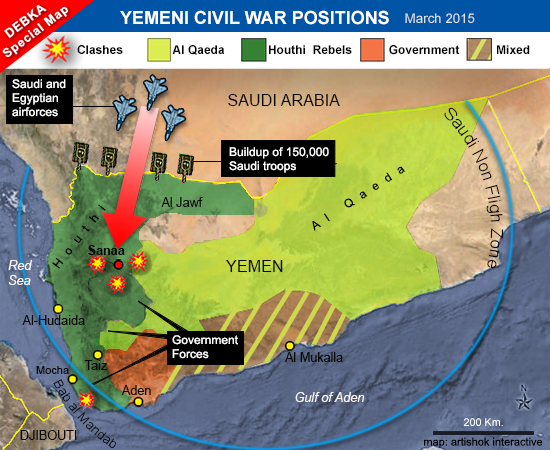
Gulf sources disclose that Saudi Arabia has placed 100 warplanes and 150,000 troops with heavy weapons at the disposal of the operation against Iran’s Yemeni proxy, the Zaydi Houthis, as well as pressing into service Pakistani, Moroccan and Jordanian military units. This force is a sign that Riyadh intends of following up its air action with a ground invasion across the border into Yemen to crush the revolt in its backyard.

Developing…

Saudi Arabia launches airstrikes in Yemen, ambassador says

March 26, 2015

Saudi Arabia launches airstrikes in Yemen, ambassador says, Fox News, March 26, 2015

(Meanwhile, as Iranian supported Houthis take over much of Yemen, the U.S. is providing airstrikes in Tikrit to assist Iran and helping Iran to establish itself as a nuclear power. Please see also, US air force bombs Tikrit to aid Iran-led operation against ISIS. Saudi, Egyptian bombers strike Iran-backed Houthi rebels in Yemen. — DM)

032515_shep_Yemen2_640Iran-backed rebels bring Yemen to brink of civil war

Saudi Arabia launched airstrikes against the Houthi rebels in Yemen early Thursday, one day after the U.S.-backed Yemeni president was driven out of the country.

President Obama has authorized the provision of logistical and intelligence support to the military operations, National Security Council spokesperson Bernadette Meehan said late Wednesday night. She added that while U.S. forces were not taking direct military action in Yemen, Washington was establishing a Joint Planning Cell with Saudi Arabia to coordinate U.S. military and intelligence support.

Saudi Ambassador Adel al-Jubeir said the operations began at 7 p.m. Eastern time.

He said the Houthis, widely believed to be backed by Iran, “have always chosen the path of violence.” He declined to say whether the Saudi campaign involved U.S. intelligence assistance.

Al-Jubeir made the announcement at a rare news conference by the Sunni kingdom.

He said the Saudis “will do anything necessary” to protect the people of Yemen and “the legitimate government of Yemen.”

A Yemeni official earlier Wednesday would not say where Yemeni President Abed Rabbo Mansour Hadi fled to, but did tell Fox News: “He is safe. That’s all I can say at this point.”

Hadi’s departure marks a dramatic turn in Yemen’s turmoil and means a decisive collapse of what was left of his rule, which the United States and Gulf allies had hoped could stabilize the chronically chaotic nation and fight Al Qaeda’s branch here after the 2011 ouster of longtime autocrat Ali Abdullah Saleh.

Over the past year, the Shiite rebels known as Houthis, who are believed to be supported by Iran, have battled their way out of their northern strongholds, overwhelmed the capital, Sanaa, seized province after province in the north and worked their way south. Their advance has been boosted by units of the military and security forces that remained loyal to Saleh, who allied with the rebels.

With Hadi gone, there remains resistance to the Houthis scattered around the country, whether from Sunni tribesmen, local militias, pro-Hadi military units or Al Qaeda fighters.

Hadi and his aides left Aden after 3:30 p.m. on two boats, security and port officials told The Associated Press. He is scheduled to attend an Arab summit in Egypt on the weekend, where Arab allies are scheduled to discuss formation of a joint Arab force that could pave the way for military intervention against Houthis.

His flight came after Houthis and Saleh loyalists advanced against Hadi’s allies on multiple fronts. Military officials said militias and military units loyal to Hadi had “fragmented,” speeding the rebel advance. The officials spoke on condition of anonymity because they were not authorized to speak to reporters

Earlier in the day, the rebels seized a key air base where U.S. troops and Europeans had advised the country in its fight against Al Qaeda militants. The base is only 60 kilometers (35 miles) away from Aden.

In the province of Lahj, adjoining Aden, the rebels captured Hadi’s defense minister, Maj. Gen. Mahmoud al-Subaihi, and his top aide on Wednesday and subsequently transferred them to the capital, Sanaa. Yemen’s state TV, controlled by the Houthis, announced a bounty of nearly $100,000 for Hadi’s capture.

Hadi then fled his presidential palace, and soon after warplanes targeted presidential forces guarding it. No casualties were reported. By midday, Aden’s airport fell into hands of Saleh’s forces after intense clashes with pro-Hadi militias.

Aden was tense Wednesday, with schools, government offices, shops and restaurants largely closed. Inside the few remaining opened cafes, men watched the news on television. With the fall of the city appearing imminent, looters went through two abandoned army camps, one in Aden and the other nearby, taking weapons and ammunition.

The takeover of Aden, the country’s economic hub, would mark the collapse of what is left of Hadi’s grip on power. After the Houthis overran Sanaa in September, he had remained in office, but then was put under house arrest. He fled the capital earlier in March with remnants of his government and declared Aden his temporarty capital.

Yemen’s Foreign Minister Riad Yassin told Dubai-based Al-Arabiya TV satellite news network that he officially made a request to the Arab League on Wednesday to send a military force to intervene against the Houthis. Depicting the Houthis as a proxy of Shiite Iran, a rival to Sunni Gulf countries, he warned of an Iranian “takeover” of Yemen. The Houthis deny they are backed by Iran.

Mohammed Abdel-Salam, a spokesman for the Houthis, said their forces were not aiming to “occupy” the south. “They will be in Aden in few hours,” Abdel-Salam told the rebels’ satellite Al-Masirah news channel.

Earlier, Al-Masirah reported that the Houthis and allied fighters had “secured” the al-Annad air base, the country’s largest. It claimed the base had been looted by both Al Qaeda fighters and troops loyal to Hadi.

The U.S. recently evacuated some 100 soldiers, including Special Forces commandos, from the base after Al Qaeda briefly seized a nearby city. Britain also evacuated soldiers.

The base was crucial in the U.S. drone campaign against Al Qaeda in the Arabian Peninsula, which Washington considers to be the most dangerous offshoot of the terror group. And American and European military advisers there also assisted Hadi’s government in its fight against Al Qaeda’s branch, which holds territory in eastern Yemen and has claimed the attack on the French satirical magazine Charlie Hebdo in Paris.

U.S. operations against the militants have been scaled back dramatically amid Yemen’s chaos. U.S. officials have said CIA drone strikes will continue in the country, though there will be fewer of them. The agency’s ability to collect intelligence on the ground in Yemen, while not completely gone, is also much diminished.

The Houthis, in the aftermath of massive suicide bombings in Sanaa last week that killed at least 137 people, ordered a general mobilization and their leader, Abdel-Malik al-Houthi, vowed to send his forces to the south to fight Al Qaeda and militant groups.

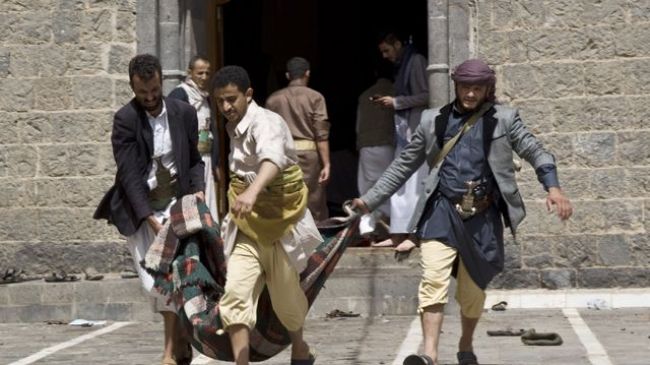
In Sanaa, dozens of coffins were lined up for a mass funeral of the victims Wednesday. Among the victims was a top Shiite cleric. Yemen’s Islamic State-linked militants have claimed responsibility for the attack.

The Houthis seized the capital, Sanaa, in September and have since been advancing south along with Saleh’s loyalists. On Tuesday, they fired bullets and tear gas to disperse thousands of protesters in the city of Taiz, known as the gateway to southern Yemen. Six demonstrators were killed and scores more were wounded, officials said.

The Houthis also battled militias loyal to Hadi in the city of al-Dhalea, adjacent to Taiz, Yemen’s third-largest city. Taiz is also the birthplace of its 2011 Arab Spring-inspired uprising that forced Saleh to hand over power to Hadi in a deal brokered by the U.N. and Gulf countries.

Hadi on Tuesday asked the U.N. Security Council to authorize a military intervention “to protect Yemen and to deter the Houthi aggression” in Aden and the rest of the south. In his letter, Hadi said he also has asked members of the six-nation Gulf Cooperation Council and the Arab League for immediate help.

Saudi Arabia warned that “if the Houthi coup does not end peacefully, we will take the necessary measures for this crisis to protect the region.”

Book review: The Islamic War

March 16, 2015

The Islamic War: Book review, Dan Miller’s Blog, March 16, 2015

(The views expressed in this article are mine and do not necessarily reflect those of Warsclerotic or its other editors. — DM)

The Islamic War, Martin Archer, 2014

The novel begins with a terror attack on a residential area in Israel, resulting in multiple causalities. It may, or may not, have involved members of the Iranian Revolutionary Guard. Menachem Begin is the Israeli Prime Minister and Ariel Sharon is the Defense Minister. The story begins immediately after the (postponed?) end of the Iran – Iraq war in 1988.

A massive armor, infantry, artillery and air attack on Israeli positions in the Golan follows the terrorist attack. The Israelis are outnumbered and suffer many thousands of casualties.

Israel had anticipated a simultaneous attack via Jordan, so most Israeli tank, infantry and air resources are deployed there, rather than in the Golan, to conceal themselves and await the arrival of Iranian, Iraqi and Syrian forces. They come and are defeated, most killed or fleeing. The Israeli forces then move into Syria and have similar successes there as well.

As the story evolves, it becomes evident that Israel must have known that the Iran – Iraq war had been allowed to fester to permit Iran, Iraq and Syria to develop a well coordinated plan to dispose of Israel, in hopes that a surprise attack could be made as soon as the Iran – Iraq war ended. Other events also suggest that Israel had prior notice:

Nuclear facilities of several hostile nations explode mysteriously.

The Israeli Navy had managed to infiltrate Iranian oil ports — apparently before the attack on the Golan — without being noticed. Then, at a propitious moment near the end of the fighting elsewhere, they destroyed all oil tankers in, entering or leaving port, along with all Iranian oil storage facilities.

The Israel Navy, which had suffered no losses, then moved to Saudi Arabia to protect her oil ports and ships coming to buy her oil and leaving.

As these events unfold, Israel, Egypt, Jordan, Saudi Arabia and Turkey* are negotiating a united front against Iran, Iraq and Syria, much to the displeasure of the U.S. Secretary of State, who wants a cease fire and return to the status quo ante. Fortunately, the U.S. President favors Israel and her coalition and generally ignores his SecState.

I won’t spoil the story by relating what happens at the end, but it’s very good for Israel, Egypt, Jordan, Saudi Arabia, Turkey and the Kurds, and very bad for Iran, Iraq and Syria. The novel is well worth reading, perhaps twice.

_____________

*Historical note: Turkey in 1988 was reasonably secular and also in other ways quite different from now. Egypt under President Al-Sisi is, in some but not all respects, similar to Egypt in 1988 under President Mubarak. Beyond a good relationship with Israel, Al-Sisi is working to modernize and reform Islam by turning it away from the violent jihad which drives both the Islamic State (Sunni) and the Islamic Republic of Iran (Shiite). Egypt remains under fire from the Obama administration due to the “coup” which ousted President Morsi, who had made Egypt essentially an arm of the Muslim Brotherhood. Egypt now helps to protect Israel with her military presence in the Sinai to oppose Hamas and Muslim Brotherhood activities there. Saudi Arabia and Jordan, like most countries in the Middle East, look out for the interests of their rulers first and are quite concerned about both the Islamic State and Iran.

American Embassy in Saudi Arabia Closed Amid Rising ISIS Threat

March 15, 2015

American Embassy in Saudi Arabia Closed Amid Rising ISIS Threat, ISIS Study Group, March 14, 2015

The US State Department (DoS) announced the cancellation of all consular services for Sunday and Monday due to “heightened security concerns” that our sources in-country say has to do with an increased threat from the Islamic State (IS) to abduct western oil workers in the eastern part of the country. Specifically, an IS cell operating in the eastern part of the country has become increasingly active since last SEP 14. Much of this is the spillover we discussed in our previous article titled, “Iranian Regime Consolidates Yemeni Gains, Forming Houthi Intel Proxy.” As the IRGC-Qods Force and its proxies increase their OP-Tempo inside Saudi Arabia, so has IS. We are aware of specific threats targeting two oil workers, a French citizen and a US citizen. There’s also a separate VBIED threat targeting either the consulate in Dharhan or the embassy itself (we’re still working to identify the target location).

US shuts down Saudi embassy amid security fears
http://www.bbc.com/news/world-middle-east-31893070

US Embassy Warns Oil Workers of Saudi Arabia Kidnap Threat
http://abcnews.go.com/International/wireStory/us-embassy-warns-oil-workers-saudi-arabia-kidnap-29636051

US Embassy in Saudi Arabia halts operations amid ‘heightened security concerns
http://www.foxnews.com/politics/2015/03/14/us-embassy-in-saudi-arabia-halts-operations-amid-heightened-security-concerns/?intcmp=latestnews&utm_source=feedburner&utm_medium=twitter&utm_campaign=Feed%3A+feedburner%2FidRmZ+%28FOXNews.com%29

Saudi Arabia Travel Warning
http://travel.state.gov/content/passports/english/alertswarnings/saudi-arabia-travel-warning.html

Iranian Regime Consolidates Yemeni Gains, Forming Houthi Intel Proxy
http://isisstudygroup.com/?p=5580

Shia Proxy Threat to US ISIS Strategy in Saudi Arabia
http://isisstudygroup.com/?p=1837

riyadh-300x169Source: BBC

In our piece titled “The Islamic State’s Arabian Peninsula Campaign,” we discussed how IS was forced into conducting operations inside the Saudi kingdom due to increased targeting by Saudi security forces and the IRGC-Qods Force. We saw that in the early-JAN 15 attack on a Saudi border post along the Iraqi border that IS took responsibility for in a video put out by their Anbar, Iraq-based media outlet. The individuals responsible for the attack were part of the Abdullah bin Sayid al-Sarhan attack network. This same network was also responsible for the deaths of five Shia locals under suspicions of being proxies for the IRGC-Qods Force back in NOV 14. The network was also responsible for a separate attack on two US citizens and a Danish national. This is the same part of Eastern Saudi Arabia that the French and American national IS is planning to abduct are located.

The Islamic State’s Arabian Peninsula Campaign
http://isisstudygroup.com/?p=4558

ISIS Claims Attack On Saudi Arabia Border, Signals Strategy Change In Militant Infiltration
http://www.ibtimes.com/isis-claims-attack-saudi-arabia-border-signals-strategy-change-militant-infiltration-1773754

Masked gunmen kill five in Saudi Arabia
http://www.theguardian.com/world/2014/nov/04/masked-gunmen-kill-five-saudi-arabia

saudiborderIS fighters along the Saudi-Iraq border Source: International Business Times

The Saudis have detained over 150 IS fighters, facilitators and financiers over the past year. IS has already established a presence along the Iraq-Saudi border despite the ongoing project to erect a wall along the border. That presence enables them to send fighters and weapons across the border to and from the country at will, although Saudi military patrols have increased in recent months to interdict these smuggling operations. There are also elements of AQAP that have defected to the new IS-affiliate in Yemen, which suggests that the areas along the Southern border may be in play as well. Also keep in mind that Baghdadi specifically threatened Saudi Arabia in a NOV 14 video on “the next battlegrounds.” The current IS effort in Yemen, like their Iranian counterparts, appears to be connected to their operations in Saudi Arabia. We expect the threat to our fellow Americans and our country’s interests will continue to be threatened as the violence escalates on the Arabian Peninsula from IS, AQAP and the Iranian regime. We will continue to monitor develops in the country and update accordingly…

Saudi Arabia arrests first ISIS-related terror cell (this article has pics in it)
http://www.aawsat.net/2014/05/article55332025

Islamic State sets sights on Saudi Arabia
http://www.bbc.com/news/world-europe-30061109

ISIS gaining ground in Yemen, competing with al Qaeda
http://www.cnn.com/2015/01/21/politics/isis-gaining-ground-in-yemen/

Links to Other Related Articles:

Filipinos Among Arrested in Saudi Terror Sweep

Large-Scale Saudi Security Sweep Detains 88

Possible Cracks to The AQ Armor.