Archive for the ‘Saudi Arabia’ category

Why Obama Will Just Keep Making the Middle East Worse

May 6, 2015

Why Obama Will Just Keep Making the Middle East Worse, Front Page Magazine, Daniel Greenfield, May 6, 2015
obama9-350x350

In its own perverse way, Iran is becoming a client state of America. But it’s a client state that, like the Palestinian Authority with Israel, is actively trying to destroy us. The lesson from that failed effort was that you can’t use terrorists to stabilize territory. All that terrorists can do is destabilize it even more.

****************

A few years ago it was the Muslim Brotherhood. These days it’s Iran. Next week it may be ISIS or Al Qaeda. Obama stands with the worst elements in the Middle East. That’s always been his philosophy.

If the left had a foreign policy, it would be, “The squeaky wheel gets the grease.” But the wheel is a sword and it’s lubricated with blood. The squeakiest wheels and the bloodiest swords get the most grease from the State Department because they hate us the most. And hating us the most means that somewhere along the way we must have hurt them the worst. They hate us, therefore we’re guilty.

The squeaky wheel runs on blood and on American guilt. The worse they are, the guiltier we must be. Instead of reinforcing the moderates, whose shortage of ravening hatred suggests that they don’t have any legitimate complaints about us worth listening to, the left seeks out the extremes of extremists.

When he wasn’t vowing to lower the oceans, abolish taxes on seniors or heal up race relations, Obama was campaigning on fixing our alliances with our allies. But that’s not what he really had in mind.

Any old Joe can ally with allies. It takes a real Barack to ally with enemies.

Our allies were the problem, so he started shedding them. The least crazy Muslims went first. Then Israel. Now he’s down to deciding which enemies will be his allies and he sits on a golf course, like that little girl in the LBJ ad, picking petals off a daisy trying to choose between Iran and the Muslim Brotherhood. Meanwhile the nuclear countdown is building from one to a mushroom cloud.

Allying with moderates is out of the question. Egypt is fighting terrorists, but its moderate government forced out the Muslim Brotherhood, ruining Obama’s best appeasement effort not directed at Russia. Even the Saudis, who stone people to death like it’s a national sport, have become too sensible for him.

Obama won’t have anything to do with moderates. If they aren’t screaming, banging flabby fists on the table and threatening a nuclear war every Wednesday, they aren’t aggrieved enough to be the root cause of our problems in the region. And there’s no point in wasting our time and goodwill on them.

Animated by American guilt, the left’s foreign policy obsessively seeks to mollify the angriest and most violent enemies in the region. And that poisoned foreign policy philosophy of American appeasement leaves him with few other options.

The left insists that the conventional approach of upholding allies just reinforces a hegemony which makes us more hated. The only way to get to the root of the problem, their way, is to find those who hate us the most, apologize and work through their issues with us.

Instead of building a hegemony of allies, Obama has built up a hegemony of enemies.

But rewarding the angriest and most violent enemies in the region has made the Middle East unstable. Instead of fixing the violence and instability in the region, Obama has made it that much worse.

A policy that is inherently opposed to moderates will either end up destroying the stable countries in the region or destabilize them by involving them in regional wars. Obama’s foreign policy is hostile to moderates because it sidelines them as being incapable of resolving the problems in the region.

If you aren’t the problem, then to Obama and the left, you can’t be the solution.

The emphasis on stabilizing the region by enlisting the aid of the violent and the unstable is a dead end. It rewards exactly the sort of behavior that it claims to want to discourage while punishing the stable behavior it claims to want to encourage.

The left’s foreign policy in the region is a Pavlovian experiment for creating more terrorists and cutting down the list of countries that aren’t expansionistic or involved in terrorism.

Obama talks about stabilizing the Middle East, but you can’t fix a hole by making a bigger hole and you can’t put out a fire by pouring gasoline on it, and gasoline and holes are all he has to work with. By making the violent and angry the focus of his outreach efforts, he has made violence and anger into the unstable pivot of the region. The future of the region now belongs to the angry and the violent.

Jimmy Carter tried to stabilize Iran and the region by aiding the Ayatollah. Instead of stabilizing anything, a revolutionary Shiite Iran became a loose cannon that not only threatened the United States, but dragged the rest of the region into its wars. From the Iran-Iraq war to terrorism in Lebanon and all the way to Al Qaeda looking for some experts to teach its terrorists how to hijack a lot of planes, the peanut farmer’s crop was a harvest of wars and bombings that killed a lot of Americans and even more locals.

Obama picked up where Carter left off. And the problems are bigger, but basically the same. The difference is that Obama had the leisure and disregard for national security to move the same foreign policy philosophy into destructive testing mode. America’s traditional alliances have collapsed. The rest of the region is handling problems on its own with Obama stuck trying to lobby the Saudis or Israel on behalf of Iran. When the Saudis bomb the Shiite Houthi terrorists in Yemen, the Iranians run to Obama. When the Israelis urge sanctions on Iran, the Iranians run to Obama to fix the problem for them.

In its own perverse way, Iran is becoming a client state of America. But it’s a client state that, like the Palestinian Authority with Israel, is actively trying to destroy us. The lesson from that failed effort was that you can’t use terrorists to stabilize territory. All that terrorists can do is destabilize it even more.

But the lessons of that failed peace process were never learned and attempts to use terrorists to stabilize entire countries continued.

Obama is still attempting to negotiate with the Taliban to stabilize Afghanistan. Negotiations with Iran to stabilize the region are going so well that every Sunni Muslim country that can afford it is rushing off to get its own nuclear program started.

There’s no telling how stable the Middle East will be once it has more nuclear nations than existed in the entire world a generation ago; probably even more unstable than the atomic structure of Plutonium.

The only thing Obama can keep doing is making the Middle East worse because it’s the only possible outcome of his foreign policy. American guilt requires perpetual atonement and the only people we can get it from are tearing apart the Middle East and the world.
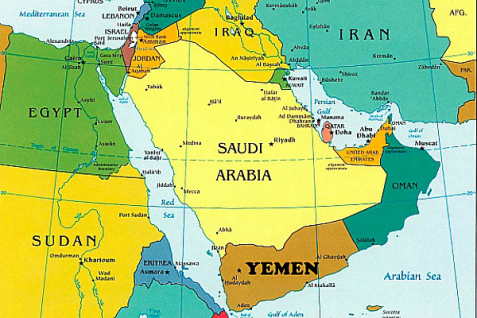
China Warns Of Rising Nuclear Threat From North Korea – Lou Dobbs

April 24, 2015

China Warns Of Rising Nuclear Threat From North Korea – Lou Dobbs, Fox News via You Tube, April 23, 2015

(The first four minutes is about the mess in Yemen and the last four minutes is about the North Korean nuclear threat. — DM)


Iranian Warships Arrive in Yemen Port

April 23, 2015

Iranian Warships Arrive in Yemen Port, The Jewish PressHana Levi Julian, April 23, 2015

YemenKSA.jpgSaudi Arabia airstrikes were aimed at Iranian-backed Houthi rebels who seized positions in neighboring Yemen. Iran is believed to be arming the rebels. Photo Credit: KSA

Iranian warships arrived Thursday in the southern Yemen port of Aden despite the presence of several U.S. warships in the area as well. It is believed the Iranian vessels are carrying weapons to re-arm the Shiite Houthi rebels who have seized control over the port city and the nation’s capital, Sa’ana.

Saudi Arabian Ambassador to the United States, Adel al-Jubeir, said Wednesday that his nation’s air force had achieved its objectives and has concluded its bombing campaign.

“We destroyed the air force, we destroyed their ballistic missiles as far as we know; we destroyed their command and control; we destroyed much, if not most of their heavy equipment and we made it very difficult for them to move from a strategic perspective,” al-Jubeir said. He added that Saudi forces had “eliminated the threat they posed to the Kingdom of Saudi Arabia” but . said that in the long run, there is “no military solution” to the conflict.

According to the World Health Organization, 1,080 people have been killed in the past month in Yemen, and 4,352 others have been wounded.

Coalition warplanes picked up where Saudi Arabian air force pilots left off and continued on Thursday to pound Houthi rebels in southern Yemen. The international forces targeted rebel positions in Aden and the central city of Taiz, according to Voice of America.

A severe humanitarian crisis has been created in the war-torn region, according to VOA, but the Shi’ite rebels still remain. Yemen President Abd Rabbu Mansour Hadi has fled for his life to Saudi Arabia.

Although Iran claimed that it welcomes an end to “killing innocent and defenseless civilians” and seeks a political resolution to the conflict, its warships laden with arms for the rebels– as usual – tell a different story.

U.S. Warships On Watch – Leading From Behind – Lt Col Ralph Peters – Willis Report

April 22, 2015

U.S. Warships On Watch – Leading From Behind – Lt Col Ralph Peters – Willis Report, Fox News via You Tube, April 21, 2015

(It’s from yesterday and the situation remains fluid. Still, it’s worth watching. — DM)


Saudi-led coalition ends military operation in Yemen

April 21, 2015

Saudi-led coalition ends military operation in Yemen, Reuters, April 21, 2015

The Saudi-led coalition bombing Yemen announced on Tuesday the end to a military operation that pounded the Iran-allied Houthi rebels for more than three weeks, a statement read on Saudi-owned Arabiya TV said.

The alliance had achieved its military goals in Yemen through the campaign dubbed “Storm of Resolve” and will now begin a new operation called “Restoring Hope,” it said.

The mission, the statement said, would focus on security at home and counter-terrorism, aid and a political solution in Yemen.

Iranian General Threatens Strikes on Saudi Arabian Soil

April 21, 2015

Iranian General Threatens Strikes on Saudi Arabian Soil, Clarion Project, April 21, 2015

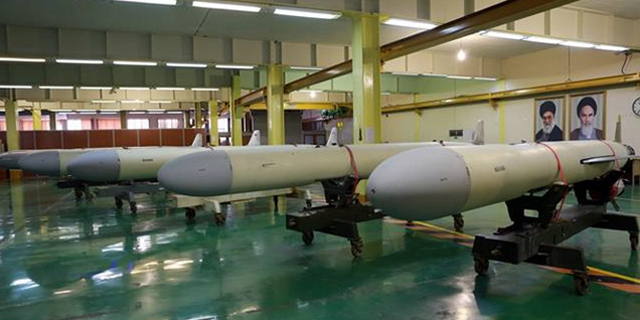
Iran-Reveals-New-Missiles-HP_1Iranian missiles.

The commander of the ground troops in the Iranian army, General Ahmad Reza Pourdastan, threatened Saudi Arabia with military strikes if it doesn’t stop the fighting in Yemen.

According to the Iranian Arabic language channel El-Alam, Pourdastan said that the Islamic Republic is not interested in getting into a conflict with Saudi Arabia. He called on Riyadh to stop fighting against her brothers in Yemen and said “by doing so she is entering a war of attrition which might expose her to severe strikes.”

Pourdastan reportedly claimed that his country will bomb Saudi Arabia if she won’t stop her attacks.

He added that “the Saudi army needs combat experience and that is why it is a weak army. If she will stand against a war of attrition she will be struck very hard and will be defeated. That’s why Riyadh should drop the option and turn to a diplomatic option and to negotiation.”

Pourdistan praised the successes of the Shiite aligned Yemini forces fighting against President Hadi, saying “The next stage will be carrying out strikes against Saudi Arabia.”

Pourdistan declared “the Islamic Republic is not interested in a confrontation with Saudi Arabia for she is a friend nation and our neighbor. The military advisor in the Saudi Embassy is currently in Iran. We invited him to the ceremonies of the Army Day that was on Saturday.

We want to have relations with Saudi Arabia and we don’t want bloody relations. There are still tables for dialogue and they can solve the problems. There is no need to use weapons or military equipment.”

Yet he also threatened Saudi Arabia saying “explosions might occur in Saudi Arabia through rockets falling on the ground. It is clear that dealing with that will be very hard for the Saudi officials.”

He suggested that forces in Yemen strike Saudi Arabia. He said “Based on the military purchases and the abilities of the Yemeni army, it is capable of inflicting painful strikes on Saudi Arabia.”

Arab states snub Obama’s D.C. summit as Iran Mocks Obama

April 21, 2015

Arab states snub Obama’s D.C. summit as Iran Mocks Obama, BreitbartJoel B. Pollak, April 21, 2015

ap_saud-bin-faisal-bin-abdulaziz-al-saud_ap-photo-640x422The Associated Press

As the U.S.S. Theodore Roosevelt heads to Yemen to confront a convoy of Iranian ships, including destroyers, it is worth asking why President Barack Obama is still talking to the Iranian regime about its nuclear program. The Iranians, who used the Houthi militia to knock over the American-aligned Yemeni government, clearly has no fear that Obama will suspend negotiations. If anything, Iranian tactics are winning more concessions.

When you strike a deal with an enemy who continues to attack you, that is not called “peace,” but “surrender.”

It is a wonder Obama is even bothering to send an aircraft carrier to the region at all. His hand has been forced by two factors: first, that Saudi Arabia has gone to war in Yemen without bothering to ask for American approval; second, Yemen is key to Obama’s drone policy against Al Qaeda, his only modest military success.

America has lost more than an ally in Yemen or a foothold in Iraq. It has lost the opportunity to defend hundreds of thousands of innocent lives from being murdered by Iran’s Syrian ally, which is using chemical weapons against civilians. It has lost the opportunity to demilitarize Lebanon—an achievement then-Sen. Joe Biden foolishly claimed in his debate with Sarah Palin in 2008. It may even have lost the chance to stop a nuclear Iran.

Iranian foreign minister Javad Zarif made clear in his New York Times op-ed this week that the regime sees a nuclear deal as the key to regional domination. He offered—no, demanded—American cooperation on ISIS and other issues, not as a possible outcome of a deal but as a condition for a deal.

Yet the White House refuses to make its own regional demands—such as recognition of Israel, or an end to Iran’s global terrorism.

Israel has made clear that the Iran deal is an existential threat, and even that has not moved Obama to reconsider. The Arab nations are not waiting to be double-crossed, and are making their own plans, which likely include Saudi Arabia obtaining nuclear warheads from Pakistan.

In an attempt to save face, Obama has invited the Arab nations to a May 13 summit at the White House—long after final negotiations with Iran have begun

Already, some Arab states have indicated that they will not be attending (Oman), or will only send junior delegations (Saudi Arabia, United Arab Emirates). Amir Taheri of theNew York Post quotes  one Arab official: “He is going to give a Churchillian speech. But we know that you can’t be Chamberlain one day and Churchill the next.”

Meanwhile, Israel quietly signals that it is not going to wait for a Churchill to arrive in the Oval Office.

Iranian ship convoy moves toward Yemen, alarming US officials

April 18, 2015

Iranian ship convoy moves toward Yemen, alarming US officials, The HillKristina Wong, April 17, 2015

Iran sent a destroyer and another vessel to waters near Yemen last week but said it was part of a routine counter-piracy mission. 

What’s unusual about the new deployment, which set out this week, is that the Iranians are not trying to conceal it, officials said. Instead, they appear to be trying to “communicate it” to the U.S. and its allies in the Gulf.

********************

U.S. military officials are concerned that Iran’s support for Houthi rebels in Yemen could spark a confrontation with Saudi Arabia and plunge the region into sectarian war. 

Iran is sending an armada of seven to nine ships — some with weapons — toward Yemen in a potential attempt to resupply the Shia Houthi rebels, according to two U.S. defense officials.

Officials fear the move could lead to a showdown with the U.S. or other members of a Saudi-led coalition, which is enforcing a naval blockade of Yemen and is conducting its fourth week of airstrikes against the Houthis.

Iran sent a destroyer and another vessel to waters near Yemen last week but said it was part of a routine counter-piracy mission.

What’s unusual about the new deployment, which set out this week, is that the Iranians are not trying to conceal it, officials said. Instead, they appear to be trying to “communicate it” to the U.S. and its allies in the Gulf.

It is not clear what will happen as the convoy comes closer to Yemen. Saudi Arabia has deployed ships around Yemen to enforce the blockade, as has Egypt. An official said the ship convoy could try to land at a port in Aden, which the Houthis have taken over.

Although the U.S. is assisting with the Saudi-led air campaign, it is not participating in the naval blockade of Yemen, said U.S. Central Command spokesman Col. Pat Ryder.

However, the U.S. Navy is in the region and has already “consensually boarded” one Panamanian-flagged ship in the Red Sea on April 1 on the suspicion it was illegally carrying arms for the Houthis.

None were found, but the move raised alarm bells in Washington over an increasingly active U.S. military role in the conflict. The Pentagon indicated this week that more boardings could occur.

“We will continue to vigilantly defend freedom of navigation and to conduct consensual searches in an effort to ensure that drugs, human trafficking, weapons trafficking and other contraband are limited,” Army Col. Steve Warren said on Monday.

Officials fear a naval confrontation between Iran and Saudi Arabia could escalate what has become a proxy war between the two countries.

The U.S. has been supporting the airstrikes with intelligence and logistical support, and last week began refueling Saudi fighter jets. Administration officials say it is important to support Saudi Arabia.

Earlier this week, a senior State Department official said the U.S. would try to ensure that a United Nations Security Council arms embargo against Houthi leadership is enforced.

“We will be taking very careful look and examining very closely efforts to violate the embargo,” senior State Department official Gerald Feierstein told the House Foreign Affairs Committee.

The deepening of the conflict comes as the U.S. hopes to reach a deal with Iran to roll back its nuclear program in exchange for sanctions relief. Officials say U.S. support for the Saudi-led coalition has not affected the negotiations with Iran.

The conflict also threatens to complicate U.S.’s relations with Iraq. Iraqi Prime Minister Haider al-Abadi, an Iran ally, criticized Saudi Arabia for its airstrike campaign during a visit to Washington this week.

U.S. officials say they are unsure why Iran is making the brazen move. One theory they have floated is that the Saudi-led coalition has effectively blockaded any air routes into Yemen and there are no other ways to resupply the Houthis.

Another theory is that Iran is trying to distract the coalition from another ship it has tried hard to conceal that is currently docked at Oman — a potential land route for smuggling arms into Yemen.

Yet another theory is that Iran wants to force a confrontation with Saudi Arabia that it believes it will win, because Iran views the Saudi military as weak and suspects the U.S. lacks the willpower to support its Gulf ally.

Earlier this week, Iranian Supreme Leader Ali Khamenei on Twitter taunted Saudi Arabia, calling its military puny and smaller than Israel’s. He also said the air campaign was tantamount to genocide of innocent Yemeni civilians and that the U.S. would also fail in Yemen.

U.S. officials say they hope the airstrikes will force Houthis to the negotiating table in order to restore stability in Yemen, where America faces a terrorist threat from al Qaeda in the Arabian Peninsula (AQAP).

“We’re assisting the Saudis to protect their own territory and to conduct operations that are designed to lead ultimately to a political settlement to Yemen,” said Defense Secretary Ashton Carter on Thursday.

“That’s good for the people of Yemen, first and foremost. It’s good for Saudi Arabia that doesn’t need this on its southern border.  And … it’s good for us, among other reasons, because of AQAP’s presence in Yemen. But for that to occur, it’ll require more than military action,” he added.

King Abdullah II: We’re War With “Outlaws Of Islam” – Special Report

April 14, 2015

King Abdullah II: We’re War With “Outlaws Of Islam” – Special Report via You Tube, April 13, 2015

(He seems quite diplomatic, but what does he actually think? — DM)


Khamenei Smashes Terms of Nuclear Agreement

April 12, 2015

Khamenei Smashes Terms of Nuclear Agreement, Clarion ProjectRyan Mauro, April 12, 2015

(Obama demands, don’t mention Iran’s mumblings about his once in a lifetime deal. Partisan wrangling must stop!– DM)

Iran-Ayatollah-Khamenei-HP_3Iranian Supreme Leader Ayatollah Kamenei (Photo: © Reuters)

Khamenei’s accusations make Saudi Arabia a legitimate target under any understanding of jihad. He even went so far as to say the Saudis’ actions are equivalent to Israel’s so-called “genocide” in Gaza. This implies that a violent jihad against Saudi Arabia is as justifiable as one against Israel.

Iran believes that these end times prophesies correlate to the death of Saudi King Abdullah, the Houthis’ overthrow of the Yemeni government, the civil war in Syria, Saudi military action and the fierce fighting in Iraq. The regime sees the confluence of all these crises as beyond the realm of coincidence and signaling the imminent arrival of the “Hidden Imam” which will herald military victory for Iran.

Before the “Hidden Imam” can arrive, two other condition must be fulfilled: instability in Saudi Arabia and the march of a prophetic figure titled “Yamani” who will lead Shiite forces from Yemen into Mecca. The Houthis recently pledged to invade Saudi territory, capture Mecca and overthrow the royal family in Riyadh. They were likely referring to this prophecy.

“We’re not going to respond to every public statement made by Iranian officials or negotiate in public,” said State Department spokesman Jeff Rathke during a daily press briefing.

********************

Iranian Supreme Leader Ayatollah Khamenei ended his eerie silence since the nuclear framework agreement was announced with a fiery speech accompanied with “Death to America” chants. Khamenei essentially smashed the viability of the nuclear framework to pieces, signalled a major escalations in the war in Yemen and essentially endorsed a violent jihad against the Saudi royal family.

Wishful thinkers can’t dismiss the speech as theater for a domestic audience. Khamenei tweeted highlights in English to make sure the world, especially Americans, saw them. The threats and demands are so unequivocal that failing to follow through would sacrifice his entire credibility and prestige.

The Iranian Supreme Leader is unsatisfied with the nuclear framework agreement even though it generously permits Iran to retain the ability to produce nuclear weapons while getting major sanctions relief.

First, he said that the fact sheet published by the U.S. contains lies and does not reflect what Iran agreed to. The statement obliges the regime to seek significant revisions shortly after it gave President Obama the go ahead to make a high-profile victory lap.

Khamenei’s demands are inescapably incompatible with America’s requirements for a deal.

First, Iran is demanding that all sanctions be lifted on the first day that a final deal is signed. The framework only agrees to lift sanctions in phases and only those related to nuclear activity, not terrorism or human rights. Doing so would unfreeze the assets of individuals and entities involved in terrorism around the world, sparking a massive growth in Iran’s terrorist apparatus and proxy warfare.

The inherently flawed hope by the West that “moderate” President Rouhani and other Iranian figures can reign in Khamenei can be immediately ruled out, since Rouhani said the same exact thing.

Iran-Khamenei-Nuke-Tweets

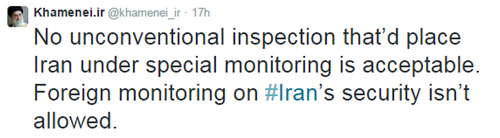
Second, Iran is insisting that there will be no “unconventional,” “special” or “foreign” inspections or monitoring. In other words, Iran will not be subject to exceptionally intrusive inspections. Khamenei’s tweets do not specify Iran’s standards, but it is clear that Iran does not intend to give the IAEA unlimited access.

Iran-Khamenei-Rejects-Inspections-Tweets

This is almost definitely a reference to military sites, to which Iran consistently says it has the option of denying access. Iran wants the ability to deny access to any location by declaring it a military institution.

This is how Iran denies access to the critical Parchin site, where damning evidence may exist to prove that Iran conducted major nuclear weapons research until at least 2003. An Iranian opposition group identified an alleged nuclear site in February that is within a military compound. It is claimed that the facility is used for uranium enrichment and the production of advanced centrifuges.

Notice the language of the tweets, which was reported to be equally non-compromising in Farsi. There is no wiggle room. Khamenei would have left some ambiguity if he was willing to budge. If you believe this is just talk, then you must believe that Khamenei made the calculated decision to cause an easily avoidable self-inflicted wound for no reason.

Another flurry of tweets related to the war in Yemen, where Iran is backing the Shiite Houthi rebels who have overthrown the government.

A U.S.-supported coalition of Sunni countries intervened militarily to support President Hadi and stop Iran from threatening the strategic Bab al-Mandeb Strait. This alliance includes Saudi Arabia, Egypt, Bahrain, Qatar, Kuwait, the United Arab Emirates, Jordan, Morocco, Turkey, Pakistan and Sudan. The last two are especially significant because of their close ties to Iran. Separately, Al-Qaeda is gaining ground in Yemen and the Islamic State (ISIS) is rising up as a competitor.

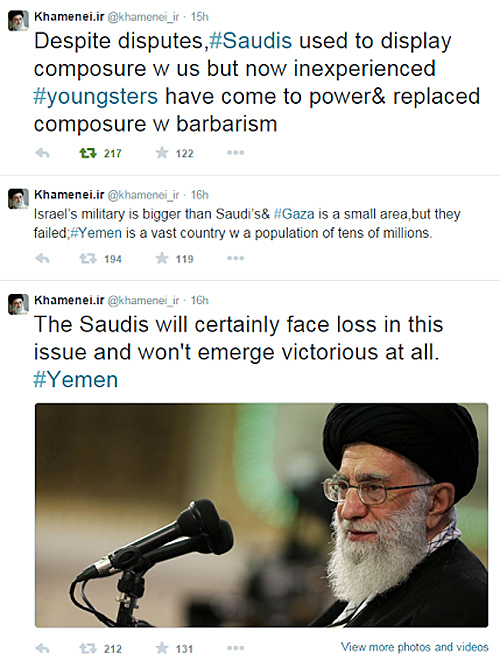
Interestingly, the tweets only threatened Saudi Arabia and did not mention any of these other participants by name. Khamenei stopped just short of a formal declaration of jihad, instead laying out the justification for it.

Iran-Khamenei-Yemen-1-Tweets
Iran-Khamenei-Yemen-2-Tweets

Khamenei’s accusations make Saudi Arabia a legitimate target under any understanding of jihad. He even went so far as to say the Saudis’ actions are equivalent to Israel’s so-called “genocide” in Gaza. This implies that a violent jihad against Saudi Arabia is as justifiable as one against Israel.

Don’t be comforted by Khamenei’s mentioning of prosecuting Saudi leaders in international courts. This is not meant to substitute jihad. Khamenei is making a point about how blatant the Saudi crimes are. He’s not even saying that this is Iran’s chosen course of action.

This comes as Iran dispatches two ships to the front in Yemen, including a destroyer to “safeguard naval routes” — meaning it will challenge the challenge the Saudi-Egyptian naval blockade.

Iran sent a flotilla to Bahrain in 2011 after Saudi and Emirati forces intervened to stomp out a revolution against the Sunni monarchy. The regime blinked at the last moment when the Arabs made it clear they would use force to stop it. However, the Yemen conflict has significant differences that Khamenei’s tweets help explain.

Khamenei is signaling that unprecedented hostilities with Saudi Arabia will now commence. The previous Saudi leaders, he says, could be dealt with. The new Saudi King and his circle must be handled more toughly.

However, Iran orchestrated massive terrorist attacks on Saudi interests even under the previous “composed” leaders, a campaign that put the U.S. economy and homeland at risk.

For example, in 2011, the U.S. prevented an Iranian Revolutionary Guards’ plot to assassinate the Saudi ambassador in Washington, D.C. by blowing up a restaurant, which inevitably would have taken the lives of American citizens as well. The scheme involved hiring a Mexican drug cartel to perpetrate the attack, along with bombings of the Israeli embassy in D.C. and the Israeli and Saudi embassies in Argentina.

In 2012, Iran launched a cyber attack on the Saudi Aramco oil company in response to the country’s policies in Bahrain and Syria. Aramco said the hackers tried to take down the country’s oil and gas production (which failed), but they did erase the data on 30,000 computers, three-fourths of the corporate computers.

Khamenei says that the new Saudi leadership is committing far worse crimes, so we should expect a far worse response.

We must also remember the prophecies cited by the Iranian regime.  Iran believes that these end times prophesies correlate to the death of Saudi King Abdullah, the Houthis’ overthrow of the Yemeni government, the civil war in Syria, Saudi military action and the fierce fighting in Iraq. The regime sees the confluence of all these crises as beyond the realm of coincidence and signaling the imminent arrival of the “Hidden Imam” which will herald military victory for Iran.

Before the “Hidden Imam” can arrive, two other condition must be fulfilled: instability in Saudi Arabia and the march of a prophetic figure titled “Yamani” who will lead Shiite forces from Yemen into Mecca. The Houthis recently pledged to invade Saudi territory, capture Mecca and overthrow the royal family in Riyadh. They were likely referring to this prophecy.

Khamenei’s speech wasn’t the typical bluster we are used to hearing from Islamist radicals and dictators. The timing, language and high-profile nature makes it very significant.

Even though the U.S. State Dept. responded by saying that sanctions against Iran would be removed gradually based on verification that Iran had kept its commitments, its response lacked conviction:

“We’re not going to respond to every public statement made by Iranian officials or negotiate in public,” said State Department spokesman Jeff Rathke during a daily press briefing.