Archive for the ‘Russia – Syrian war’ category

Trump-Putin deal on Syria bears on Israel security

January 28, 2017

Trump-Putin deal on Syria bears on Israel security, DEBKAfile, January 28, 2017
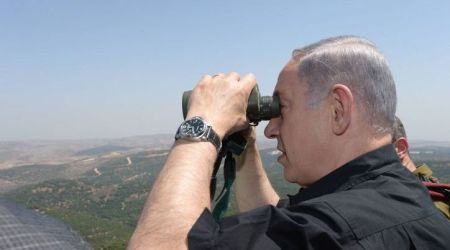
Israeli Prime Minister Benjamin Netanyahu looks through binoculars during his visit in the Northern district border of Israel on August 18, 2015. Photo by Amos Ben Gershom/GPO *** Local Caption *** ???? ??? ?????? ?????? ?????? ?????? ????? ????? ???? ????

Israeli Prime Minister Benjamin Netanyahu looks through binoculars during his visit in the Northern district border of Israel on August 18, 2015. Photo by Amos Ben Gershom/GPO

1. Will Washington and Moscow go through with the expulsion from Syria of Iranian forces and their proxies, including Hizballah – and take it all the way until it is accomplished?

2. After they are gone, who will take over the areas they evacuate?

3. Will Bashar Assad stay on as president, or has his successor been nominated?

4. The most burning question of all is the level of Hizballah’s armament. Not only must Hizballah forces be pushed out of Syria, but it is essential to strip them of their sophisticated new weaponry, including missiles. Israel’s military and security chiefs assess Hizballah’s arsenal as having been upgraded in recent weeks to a level that directly impinges on Israel’s security.
**************************

It would be a mistake to take it for granted that Prime Minister Binyamin Netanyahu’s talks with President Donald Trump in Washington early next month will be plain sailing or produce an automatic shower of benefits for the Jewish state. It is understood in Jerusalem that a new order is unfolding close to Israel’s borders, which is not yet fully in the sights of its government, military and intelligence leaders. This process is going forward at dizzying speed in Syria, currently the central Middle East arena, where Presidents Donald Trump, Vladimir Putin and Tayyip Erdogan have agreed to cooperate.

The British Prime Minister Theresa May picked up fast on the new power equation. After standing before the media with the US President Friday, Jan. 27, and declaring hopefully, “Britain and the US can once again lead the world together,” she decided to fly straight from Washington to Ankara Saturday, before returning home.

The outcome of her first meeting with President Erdogan was one of the fastest defense collaboration pacts ever negotiated for trade and the war on terror. The British leader lost no time in getting down to brass tacks on how British military and intelligence can be integrated in the joint US-Russian-Turkish military steps for Syria. Erdogan did not exactly receive her with open arms. He did not afford his visitor the courtesy of placing a British flag in the reception room in his palace.

Israel is in much the same position. Israel stayed out of military involvement in the Syrian civil war, according to a policy led by Netanyahu, former Defense Minister Moshe Ya’alon and OC Northern Command Maj. Gen. Avivi Kochavi (then Direct of Military Intelligence). This policy has left Israel out of today’s decision-making loop on Syria’s future.

Towards the end of 2015, shortly after Russia embarked on its massive military intervention in the Syrian conflict, Netanyahu took steps for safeguarding Israel’s security interests by setting up a direct line with the Russian president. It was translated into a military coordination mechanism between the Russian air force command in Syria and the Israeli air force, with Gen. Valery Gerasimov, Russia’s Chief of General Staff, and Maj. Gen. Yair Golan, Israel’s Deputy Chief of Staff, in charge of this direct military link.

Any problems that could not be solved at the military level were promptly turned over to be addressed at meetings or in phone calls between Netanyahu and Putin.

In one example, the prime minister obtained an undertaking from the Russian president to keep Iranian forces and Iran’s Shiite surrogates, including the Lebanese Hizballah, away from the Syrian-Israeli border, or allow them to use borderlands to send terrorists into Israel.

Shortly after Trump’s election victory (Nov. 8, 2016), the spadework on his collaboration with Putin was quietly begun by their national security advisers, Michael Flynn, in New York and Nikiolai Platonovich Patrushev in Moscow.

Jerusalem knew what was going on, but was taken aback by the speed at which those close understandings ripened into US-Russian deals on the ground. Before Trump had finished his first week in the White House, US warplanes had escorted a Russian air strike against ISIS in Syria.

This rush of events injects further urgency into Netanyahu forthcoming talks with the US president.  Whereas in the second term of the Obama presidency, the Israeli leader was wont to travel to Moscow or Sochi to sort out security problems relating to Syria, henceforth he must directly engage Donald Trump as the lead player.

So when the Israeli premier travels to the White House next month, he will have to address four pressing concerns, all relating to the fast-moving Syrian scene:

1. Will Washington and Moscow go through with the expulsion from Syria of Iranian forces and their proxies, including Hizballah – and take it all the way until it is accomplished?

2. After they are gone, who will take over the areas they evacuate?

3. Will Bashar Assad stay on as president, or has his successor been nominated?

4. The most burning question of all is the level of Hizballah’s armament. Not only must Hizballah forces be pushed out of Syria, but it is essential to strip them of their sophisticated new weaponry, including missiles. Israel’s military and security chiefs assess Hizballah’s arsenal as having been upgraded in recent weeks to a level that directly impinges on Israel’s security.
Trump-Putin safe zones deal ousts Iran from Syria

January 26, 2017

Trump-Putin safe zones deal ousts Iran from Syria, DEBKAfile, January 26, 2017

syria_safezones

Russia had originally planned to deploy Syrian military, pro-Iranian Shiite militia and Hizballah forces in battles for the capture of land around the cities of Derra and Quneitra on the Syrian side of the Golan. That plan has been dropped and will be superseded by the deployment in southern Syria of US troops accompanied by Jordanian special forces and Syrian rebels, trained by American instructors in Jordanian military camps.

Israelis will breathe a sigh of relief over the removal of the threat of Iranian and Hizballah forces being deployed along their northern border with Syria.

**************************

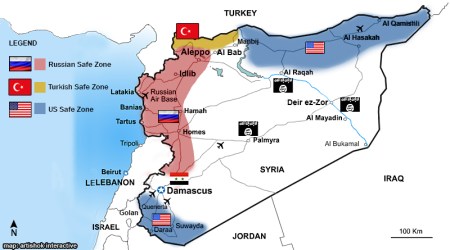
Syria stands on the threshold of dramatic changes that will directly impact on the strategic and military situation along the Syrian borders with Israel and Jordan, DEBKAfile reports exclusively. They derive from a deal struck this week by US President Donald Trump and Russian President Vladimir Putin to establish US, Russian and Turkish security zones in Syria. This scheme will transfer military control of the country to those three powers. Each of them will be responsible for a zone whose borders will be defined and agreed upon by Washington, Moscow  and Ankara.

As part of this arrangement, all forces from the Iranian military, the pro-Iranian Shiite militias and Hizballah will be required to leave Syria.

The US military is to have two security zones – one covering the entire area east of the Euphrates River up to the Iraqi border including Kurdish areas (see attached map). This arrangement will partly resurrect the accord reached in late 2015 by US President Barack Obama and Putin, for the division of Syria into areas of influence. All territory east of the Euphrates was allocated to the US, with Russia taking responsibility for all areas west of the river until the Mediterranean coast.

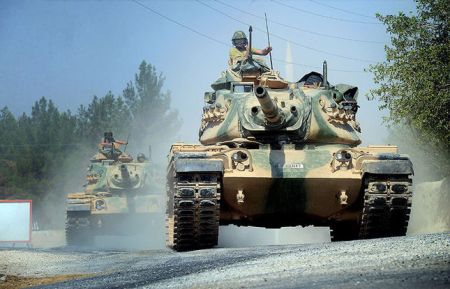
Under the new deal, the Turkish area is to stretch about 650 kilometers along the entire Syria-Turkey border and extend between 35 and 50 kilometers into Syrian territory up to Al-Bab, the town where the Turkish military is engaged in its third straight month of fighting for its capture from ISIS.

DEBKAfile’s military and intelligence sources report that the overriding change on the ground will be the establishment of a second US security zone adjacent to Syria’s borders with Israel and Jordan. It means that the approximately 7,500 US special operations forces troops currently in Jordan will be shifted northward into southern Syria.

Russia had originally planned to deploy Syrian military, pro-Iranian Shiite militia and Hizballah forces in battles for the capture of land around the cities of Derra and Quneitra on the Syrian side of the Golan. That plan has been dropped and will be superseded by the deployment in southern Syria of US troops accompanied by Jordanian special forces and Syrian rebels, trained by American instructors in Jordanian military camps.

Israelis will breathe a sigh of relief over the removal of the threat of Iranian and Hizballah forces being deployed along their northern border with Syria.

The Trump-Putin deal for Syria and its ramifications are explored in the coming issue of DEBKA Weekly (for subscribers) out Friday, with especially attention to the way it leaves Iran and Hizballah high and dry.

If you are not yet a subscriber, click here to sign on.

Astana floored by Russian pick as Assad successor

January 23, 2017

Astana floored by Russian pick as Assad successor, DEBKAfile, January 23, 2017

(The rift between Russia and Iran deepens. — DM)

2-2

Gen. Tlass, 53, son of the eminent Gen. Mustafa Tlass, defense minister under President Hafez Assad, was awarded high honors by his son Bashar as one of his closest friends. Although appointed commander of the prestigious 104thBrigade in the Syrian Republican Guard, Manas chose to defect and flee the country in 2012, not long after the outbreak of the Syrian uprising.

Iran threatens to be one of the main obstacles to any reduction in Assad’s powers. For Tehran, he stands as a bulwark against the expulsion of its own and Hizballah forces from the country. As long as he is in charge, Iran will have the use of a land bridge to Lebanon and its proxy, Hizballah, via Iraq and Syria.

**************

Syrian government and rebel groups launch a fresh peace conference in the Kazakh capital of Astana Monday, Jan.23 in freezing temperatures of minus 20 Centigrade. Although the event is jointly sponsored by Russia, Turkey and Iran, Moscow is the real power-broker.

DEBKAfile’s intelligence sources reveal that the delegations on both sides of the table were caught off-balance by the arrival of Bashar Assad’s former close friend, Gen. Manas Tlass, whom Russia flew in from his place of exile in a Gulf emirate to a prominent seat with the opposition delegation.

Gen. Tlass, 53, son of the eminent Gen. Mustafa Tlass, defense minister under President Hafez Assad, was awarded high honors by his son Bashar as one of his closest friends. Although appointed commander of the prestigious 104th Brigade in the Syrian Republican Guard, Manas chose to defect and flee the country in 2012, not long after the outbreak of the Syrian uprising.

Our sources report that Moscow has chosen him as lead player in Syria’s post-Assad era, initially in the transition government in Damascus which is scheduled to start evolving from the peace process kicked off at Astana this week. This does not imply that Bashar Assad will be gone in a day – only that a new mechanism will be put in place to start curtailing his powers.

How quickly and how far this process will unfold cannot yet be determined.

Iran threatens to be one of the main obstacles to any reduction in Assad’s powers. For Tehran, he stands as a bulwark against the expulsion of its own and Hizballah forces from the country. As long as he is in charge, Iran will have the use of a land bridge to Lebanon and its proxy, Hizballah, via Iraq and Syria.

At the same time, Russia, Turkey and the Syrian rebel groups backed by Turkey and Saudi Arabia are demanding the removal from Syrian soil of Iranian forces and pro-Iranian Afghan and Pakistani Shiite militias (30,000 fighters in all)  as well as the 10,000 Hizballah combatants.

Neither Hizballah, nor the Shiite militias are represented at the Astana conference which leaves them deliberately at a disadvantage.

But Iran is preparing to make its removal from Syria as difficult as possible. One way is to start dominating Syria’s strategic infrastructure. And so, on Jan. 18. Syrian Prime Minister Emad Khamis, who was on a visit to Tehran, signed five accords granting Iran exclusive rights as the sole operator and developer of Syria’s country’s cell phone network.

And, according to our intelligence sources, a number of secret provisions were buried in those deals. One gave Iran permission to interlink the cell phone networks between Syria and Hizballah in Lebanon as a device to guarantee the Lebanese terror group’s permanent presence in Syria.

Deliberations at the Astana conference will focus at its first sessions Monday on stabilizing the ceasefire between government and Syrian rebel groups (excluding the jihadist ISIS and Nusra Front). This ceasefire has for the most part held up since it went into effect late last month.

The effort to turn the truce into a more permanent cessation of hostilities will be long and arduous, entailing negotiations on such tough issues as land swaps and rights to use main traffic and supply routes.  Only when they are resolved, can the two sides approach the next stage, a discussion of Syria’s political future, i.e. the fate of the regime headed by Bashar Assad.

Although Moscow invited the new Trump administration to send a representative to the Kazakh conference, it was declined. Washington only sent the US ambassador to Kazakhstan to attend as an observer.

This does not mean that President Donald Trump has decided to leave the resolution of the Syrian issue solely in Russian hands. Washington and Moscow are still in the middle of discussing this and other critical questions and no final decisions have been reached in either capital.

Moscow acts to oust Iran from Syria, bombs ISIS

January 21, 2017

Moscow acts to oust Iran from Syria, bombs ISIS, DEBKAfile, January 21, 2017

4-3ISIS suicide bombers at Deir ez-Zour

Although Vladimir Putin’s spokesman spoke reservedly Saturday, Jan. 21, about Donald Trump’s inauguration as US president the day before – It would be “an illusion” to expect Russian-US ties to be “free of disagreement” – Moscow’s actions in Syria were clearly designed to meet the new US president more than half way.

Trump in his inauguration speech pledged to wipe radical Islamist terrorism “off the face of the earth.”

His words were still reverberating when Russian long-range Tu-22M3 bombers flying in from bases in Russia smashed Islamic State targets in the eastern Syrian province of Deir ez-Zour the next day. The bombers hit ISIS base camps, weapons stockpiles and armored vehicles, covered overhead by Russian fighter jets from their Syrian air base at Hmeimim. After the sortie, the Tupolev bombers flew home.

DEBKAfile’s military and intelligence sources interpret the heavy Russian bombardment of ISIS as one of several signals Putin is sending out of his willingness to go the extra mile for a common effort with Trump to root ISIS and all its works out of the Middle East.

The Russians stepped in massively when, after holding out for many months of siege and assault at the important provincial town of Deir ez-Zor,, Syrian government forces were about to fold and the town and air base fall to ISIS.

Last Wednesday, Russian transport helicopters flew hundreds of Syrian troops to relieve them: Two brigades from the 15th Infantry Division, belonging to the elite Republic Guard, were lifted out of the northern Qamishli region.  When the Syrian lines were still in danger, the Russian helicopters turned around and flew back with members of the Lebanese Hizballah’s elite Radwan Force, to bolster the Syrian stand and save Deir ez-Zour.

For Putin, the injection of Hizballah into a major Syrian battle came at an awkward moment in terms of his diplomatic strategy on the eve of the Syrian peace conference that opens in Astana, Kazakhstan, Sunday, Jan. 23, under his joint sponsorship with Turkish President Tayyip Erdogan.

The Russian leader had already give his co-sponsor a commitment to initiate a resolution at Astana demanding the withdrawal of all pro-Iranian militias from Syria, including Hizballah. This aimed at pacifying Syrian opposition groups, but was also meant to demonstrate to President Trump that Moscow would be a strong partner in the war on ISIS while also ready to clip Iran’s wings and influence in the affairs of Syria and Lebanon.

At the same time, Russian war strategists appreciate the urgency of averting the fall of Deir ez-our and its air base to the Islamists. This catastrophe would negatively impact the entire campaign against the terrorist organization on its three main fronts, Mosul, Raqqa and Palmyra, and count as ISIS’ biggest victory in the past year.

Iran threatens the Syria ceasefire effort

January 17, 2017

Iran threatens the Syria ceasefire effort, American ThinkerHeshmat Alavi, January 17, 2017

(Please see also, Mystery blasts in Damascus: Syria accuses Israel. “DEBKAfile’s military and intelligence sources disclose that the regime has reached an awkward crossroads. The Russians have taken charge of the Syrian war and no longer bother to consult with the Syrian president or Iran on its conduct. They are deeply immersed in preparing the Syrian peace conference they are sponsoring which is scheduled to open at Astana, Kazakhstan on Jan. 23.” — DM)

Following nearly six years of bloody warfare and an atrocious takeover of Aleppo by the Russia-Iran-Assad axis, the world has finally reached a relatively reliable settlement in this war-ravaged country. Unfortunately, Iran continues to pose a serious threat to this yet shaky and fledgling settlement.

Russia, replacing the United States, has become the main counterparty involved in the ceasefire talks with the Syrian opposition and its ally, Turkey.

Considering the lame-duck season between November 8th and January 20th before the new U.S. president-elect takes the helm at the White House, these efforts to establish a lasting ceasefire — and hopefully tangible peace — in Syria need to be respected by the international community. This is especially true since the Syrian opposition have blessed this campaign, directly engaging Russia and Turkey.

The new Russia-Turkey relationship has also led to actions against Daesh (ISIS/ISIL) targets in Syria.

“Turkish warplanes and artillery have struck Daesh targets in Syria, killing 22 of the group’s terrorists, while Russian aircraft hit terrorists near the Daesh-controlled town of al-Bab,” reports indicate citing Turkish military officials.

In addition to Turkey, the Syrian opposition also enjoys the support of a majority of its neighbors and Middle East countries, all believing Assad’s departure is key to reach a true political solution for this crisis that has taken the lives of nearly half a million and displaced over 11 million Syrians inside the country and abroad.

The dilemma, however, lies in the fact that Iran and its slate of proxy groups are erecting barriers in the path of establishing true ceasefire and peace conditions. Tehran is in full-speed mode to disrupt the entire process, as the mullahs in Iran seek nothing but the Syrian opposition’s all-out annihilation and to completely repaint the country’s social fabric in favor of Assad, ultimately maintaining his regime in power.

The Lebanese Hizb’allah, perhaps the main Iran-backed proxy entity, is feeling the heat following the latest developments in relation to Syria. Hizb’allah desperately relies on a land route from Iran to northern Lebanon to maintain the ongoing flow of support from Tehran.

“Sources in Lebanon told the London-based pan-Arab daily Al-Arab that Hezbollah has rejected the Russia-Turkey-mediated ceasefire agreement for the Syrian civil war,” algemeiner reported.

The Lebanese Hizb’allah, known to be fighting in Syria on behalf of Assad as its army has dwindled during the years, is furious over the fact that Ankara has demanded all foreign fighters depart Syria even prior to any discussion of a possible diplomatic solution.

To add insult to injury for Hizb’allah, and Tehran for that matter, is the fact that Moscow has discussed Ankara’s demands with the mullahs, meaning that the Kremlin supports the measure and is seeking an all-out diplomatic solution. This is completely against Iran’s domination and destructive policy to derail the peace process.

Such a turn of events would be the final nail in the coffin for Iran as it continues to rely on foreign recruits and the Hizb’allah to provide the ground forces necessary in Syria.

This is especially significant considering the fact that dissent inside Iran regarding the regime’s participation in the war in Syria is growing.

“On December 16th, 2016, the fans of Foolad Khuzestan B F.C chanted slogans against the dictator Assad in support of Syrians and the people of Aleppo during the football match,” opposition National Council of Resistance of Iran (NCRI) website reported.

The NCRI is a conglomerate of Iranian opposition organizations, including the People’s Mojahedin Organization of Iran (PMOI/MEK), advocating democratic regime change.

Videos posted on the internet show demonstrations inside Iran demanding the regime stop meddling in Syria and plunging billions to shore up the faltering Bashar Assad regime, and actually think of the Iranian people’s needs and demands.

Iranian Supreme Leader Ali Khamenei has comissioned the Revolutionary Guards to pursue his lethal policy in Syria, resulting in horrific death and destruction across the Levant.

As long as the IRGC and its proxy militias, including the Hizb’allah, remain on Syrian soil, this country will never witness peace and tranquility. The IRGC is a major threat to any campaign to bring an end to the mayhem devastating this land.

The IRGC deserves to be designated as a terrorist organization, being Iran’s main leverage to export terrorism abroad.

It is also high time for the international community to call for the very eviction of Iran, the IRGC and all of Tehran’s proxy elements from Syria.


Mystery blasts in Damascus: Syria accuses Israel

January 13, 2017

Mystery blasts in Damascus: Syria accuses Israel, DEBKAfile, January 13, 2017

syrian_iaf_attack_13-1-17

Some unknown hand struck into the heart of that regime in the space of a few hours – not once, but twice.The Assad regime used its standard scapegoat, Israel, for covering up embarrassing and inexplicable occurrences.

However, DEBKAfile’s military and intelligence sources disclose that the regime has reached an awkward crossroads. The Russians have taken charge of the Syrian war and no longer bother to consult with the Syrian president or Iran on its conduct. They are deeply immersed in preparing the Syrian peace conference they are sponsoring which is scheduled to open at Astana, Kazakhstan on Jan. 23.

If Moscow coordinates its Syrian strategy with anyone, it is Turkish President Tayyip Erdogan, but even then only to a limited extent.

***************************

There were two unclaimed explosions in Damascus overnight Thursday and early Friday (Jan.12-13) – one at an officers club in Damascus and the second at Mezzeh airport, which Syria alleged was the work of the new Israeli S-35 stealth aircraft firing across the border from a point over the Sea of Galilee.

There was no claim to either of the attacks.

The standard Israeli policy of striking any Iranian arms shipments for Hizballah in Lebanon when they cross through Syria would not longer be applicable to any such air strike, if indeed one was launched..

The Lebanese Shiite Hizballah deploys 9,000 elite fighters in Syria to fight for Bashar Assad. Its Iranian arms supplies no longer need to risk being trucked through Syria to Lebanon; they can be delivered directly to Hizballah bases in Syria without exposure to Israel air strikes.

Indeed, should the pro-Iranian Hizballah decide to go back to shooting missiles at Israel – or using Iranian-supplied unconventional weapon – it has new launching pads readily available in Syria from those very bases. They are located in the Qalamoun mountains in western Syria and at Zabadani, a Syrian ghost town near the Damascus-Beirut highway, which the Lebanese terror group has made its military center.

Both would be obvious targets for Israel to attack rather than Damascus’ Mezzeh airport.

Tehran, having grasped from bitter experience that Mezzeh is under close surveillance by Israeli intelligence, no longer uses its facilities. Instead Iran flies arms shipments for Hizballah to Beirut by commercial aircraft, which Israel prefers not to attack, or overland through Iraq to northwestern Syria, where the consignments are picked up and transferred to Lebanon by sea.

So if an Israeli F-35 air strike on the Damascus airport should be confirmed, its target would not have been Iranian and Hizballah military supplies. Mezzeh is the site of a sterile zone set aside for the exclusive use of President Bashar Assad, his family and his top military and intelligence chiefs. It also houses laboratories for developing and manufacturing unconventional weapons, as well serving as the main command center for the 4th Division, whose Republican Guard unit protects the president, his family and members of the ruling caste.

In the first attack, a suicide bomber blew himself up Thursday night at the officers’ club in the heavily policed Kafra Sousa district of Damascus. At least ten people were killed and dozens injured. Located there are the homes of many Assad loyalists in the security and military establishments, as well as top secret facilities.

The ability of a suicide bomber to penetrate one of the most heavily secured locations in Damascus and blow up at an exclusive regime watering hole raises questions about the inner workings of the Assad regime.

Some unknown hand struck into the heart of that regime in the space of a few hours – not once, but twice.The Assad regime used its standard scapegoat, Israel, for covering up embarrassing and inexplicable occurrences.

However, DEBKAfile’s military and intelligence sources disclose that the regime has reached an awkward crossroads. The Russians have taken charge of the Syrian war and no longer bother to consult with the Syrian president or Iran on its conduct. They are deeply immersed in preparing the Syrian peace conference they are sponsoring which is scheduled to open at Astana, Kazakhstan on Jan. 23.

If Moscow coordinates its Syrian strategy with anyone, it is Turkish President Tayyip Erdogan, but even then only to a limited extent.

The Syrian ruler and Iran, after being sidelined by the Russians, are following their example. Both have taken to holding their cards close to their vests and operating under in close secrecy.

In an attempt to pierce the resulting aura of mistrust spreading over the staunch Iranian-Syrian alliance, Ali Shamkhani, Secretary of the Supreme National Security Council of Iran and one of supreme leader Ayatollah Ali Khamenei’s closest confidants, was sent to Damascus Sunday, Jan 8, to find out what is going on there

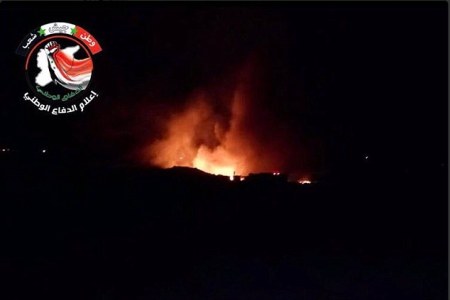
The mystery deepened further Friday morning, when Syrian state media ran photos of a big blaze – which may or may not be authentic – to illustrate the alleged Israeli attack on Mezzeh airport.

Turkish army like Iraqis stalled by ISIS pushback

December 28, 2016

Turkish army like Iraqis stalled by ISIS pushback, DEBKAfile, December 28, 2016

turkeytrot

Wednesday, Dec. 28, hours before US Secretary of State John Kerry was due to deliver a major speech on his vision for the Middle East, Turkey and Russia announced a ceasefire plan going into effect the same night for the whole of Syria, and in all regions, where fighting between pro-government forces and opposition groups were taking place – excepting for terrorist organizations.

Moscow and Ankara assumed the role of guarantors of the process. This accord will be brought for approval before the Syrian peace conference to be convened in the Kazakhstan capital, Astana, this week, attended by Russia, Turkey, Iran, the Syrian government and Syrian opposition groups. The US and Europe were not invited.

Not content with kicking Washington out of any role in resolving the Syrian crisis, the Turkish president Tayyip Erdogan accused the US, leader of the Western war on the Islamic State, of supporting “terrorist groups.”

He claimed Tuesday to have evidence of the US “giving support to terrorist groups including Daesh, YPG, PYD,” adding, ” We have…  pictures, photos and videos.”

While Erdogan is scoring in the diplomatic arena, he faces nothing but frustration militarily over the failure of the large, professional Turkish army to gain ground in the battle for Al Bab in northern Syria. This is Turkey’s first face-to-face with the Islamic State in its  four-month old Euphrates Shield operation in northern Syria – and it is not gong well. The fighting is deadly with no end in sight.

This may partly account for Erdogan’s oddly inconsistent behavior.

Tuesday, Dec. 26, he quietly asked the Obama administration to step up its air support for the Turkish campaign to capture Al Bab, 55 km north of Aleppo and the only major town in ISIS hands in northern Syria. He accused the US of not doing enough.

It was doubly odd in that Turkey has a large air force of its own, and if that force was not enough to support the campaign against ISIS, Erdogan’s obvious address for assistance would be his ally in the Syrian arena, Russian President Vladimir Putin. After all, Ankara, Moscow and Tehran are in the middle of a shared effort to set the rules of the game in Syria, which has pointedly excluded the US under the Obama administration.

As to the state of the fighting, on Dec. 21, Erdogan claimed: “Right now, Al-Bab is completely besieged by the Free Syrian Army and our soldiers.” In fact, this siege has been in place for weeks and, worse still, the casualties are mounting.

Wednesday, Dec. 28, the Turkish military said  it had “neutralised” 44 Islamic State fighters in Al Bab and wounded 117 in Al Bab,  while 154 Islamic State targets had been struck by artillery and other weaponry.

No casualty figures have been released for the Turkish army fighting for Al Baba. They are conservatively estimated at 90 dead and hundreds injured. The losses of Free Syrian Army (FSA), the local rebel force fighting alongside the Turkish army, are undoubtedly heavier still.

Our military and counterterrorism experts explain how the Islamic State’s beleaguered fighters are not just holding out in Al Bab against a superior army, but running circles around it.

The jihadists took the precaution of clearing back passages from Al Bab to their headquarters in Raqqa, 140km to the southeast, and Palmyra, 330km away.

This heritage town, which the Russians took from ISIS several months ago, was recaptured by the jihadists earlier this month, when Russian forces were fully engaged with capturing Aleppo. The US air force has in the last few days redoubled its strikes on Palmyra – both to cut off the flow of reinforcements and supplies to the besieged ISIS fighters in Al Bab and to clear the way for Russian forces to recover the lost town.

This US-Russian cooperative effort is at odds with the Obama administration’s presentation of Washington’s prickly relations with Moscow.

Notwithstanding the forces ranged against it, ISIS has so far managed to repel almost every Turkish bid to break into Al Bab – thanks to the new tactics it has introduced to the battles for Syrian Al Bab and Iraqi Mosul, which mark a turning point in the war on Islamist terror in those countries.

Those tactics hinge heavily on maximizing enemy casualties in order to knock the opposing army off the battlefield.

This is achieved by a deadly mix of guerilla and terrorist methods, and includes car bombs, bomb belt-clad suicides, improvised explosive devices (IED), sniper squads, gliders carrying explosives with small parachutes, as well as the increasing use of anti-air missiles and poison chemicals.

Tuesday, Iraqi Prime Minister Haydar Al-Abadi estimated that the Iraqi army needed another three months to beat ISIS in Mosul. He was trying to buck up the Iraqi people by concealing the true situation.
The fact is that the Iraqi military offensive against ISIS in its Mosul stronghold has ground to a halt – and no wonder, when some units have suffered a 50 percent manpower loss.

Gen. Stephen Townsend, commander of American troops in Syria and Iraq, was of the opinion last week that at least two years of fighting were needed to drive ISIS out of its two capitals, Mosul and Raqqa. He did not spell this out, but his meaning was clear: to achieve this objective, a far larger army was needed than the military manpower available at present.

How Iran actually lost in Aleppo

December 26, 2016

How Iran actually lost in Aleppo, American ThinkerHeshmat Alavi, December 26, 2016

For 16 years America has failed to adopt a correct policy in the Middle East despite having huge opportunities to make significant changes. The 2003 war literally gift-wrapped Iraq to Iran, parallel to the highly flawed mentality of preferring Shiite fundamentalism to Sunni fundamentalism. This allowed Iran take full advantage of such failures and resulting voids.

Aleppo will be a short-lived success story for Iran. The tides are changing across the globe and Iran will no longer enjoy opportunities from West rapprochement. Understanding this very well, this is exactly why Tehran has resorted to such atrocities and sought to massacre all in Aleppo.

In contrast to how the U.S. handed Iraq in  a silver plate to Iran, Russia never entered the Syria mayhem to hand it over to Iran. The roots of Aleppo remain in the hearts of all Syrians. As world powers, especially the U.S. and Russia review their future objectives, Iran will be the first and ultimate party to suffer.

***********************************

Following a historic period of perseverance, Syrian rebels and their families were forced to evacuate eastern Aleppo after its liberation back in 2012. An unjust, intense war was launched upon Aleppo by Iran’s Revolutionary Guards (IRGC) and its proxy forces on the ground: Russia with its indiscriminate air strikes, and a lame-duck Syrian army of less than 20,000 deployable forces.

After more than 15 months continuous air raids and a long-lasting inhumane siege, Syrian rebels and civilians sealed an international agreement to depart Syria’s once economic and cultural hub.

In the past few weeks widespread bombing campaigns continued relentlessly on civilian areas. No Aleppo hospital was spared. The IRGC and its foot-soldiers, numbering at the tens of thousands, spearheaded the military of Syrian dictator Bashar Assad in horrific mass executions of innocent people. The United Nations reported 82 individuals, including women and children, were murdered on the spot in the streets and in their homes. God knows how many more incidents have gone unreported.

The amazing perseverance shown by Aleppo locals for years now in the face of atrocious airstrikes and artillery shelling is unprecedented to say the least. Amidst all this, the silence and inaction seen from the West, especially the United States, will remain forever a source of shame.

Conflict of Interests

In the pro-Assad camp there are three decision-makers. First Russia, second Iran, and third the Syrian regime. The role played by Assad and his military in such scenes is next to nothing.

The West and Turkey became frantic for a ceasefire in Aleppo in the early days of the war due to the negative public opinion resulting from shocking crimes. They sought to have the rebels and remaining civilians transferred to other Syrian opposition controlled areas.

On December 13th, Washington and Moscow reached what can be described a ceasefire agreement. Intense negotiations between Turkey and Russia were started afterwards, resulting in an agreement between the Syrian opposition with Russia and Turkey to evacuate Aleppo. Practically, the parties involved in the talks were Aleppo representatives and Russia, hosted by Turkey. All necessary preparations were made to begin evacuating the city from the morning of Wednesday, December 14th.

However, Iran disrupted this agreement and the IRGC hindered the evacuation process. It was crystal clear Russia and Iran were pursuing different objectives and sets of interests. Iran sought not to have Aleppo evacuated but to exterminate all Syrian rebels and civilians.

Twenty-four hours later, pressure from the international community forced the implementation of the Russia-Syrian rebel agreement on December 15th. On the morning of that day the first convoy carrying the wounded exited Aleppo, only to face roadblocks imposed by Iran-backed forces and the Assad military.

Iran raised certain conditions for the evacuation. Russia later threatened to airstrike any party hindering the evacuation, an obvious warning to Iran. Tehran was forced to wind back under Moscow pressure.

As a result, the last phase of this war and the method chosen to evacuate Aleppo was a defeat for Iran and a victory for the Syrian opposition. Especially since the conflict of interest between Iran/Assad and Russia became crystal clear. Politically speaking, Iran has become a secondary party in Syria.

“For Putin, a political settlement now makes sense. Staying involved in an ongoing insurgency does not. But for that, he needs the opposition — which is fractured — to accept a political outcome, and there is little prospect of that so long as Assad remains in power,” as explained by Dennis Ross, who served as the Director of Policy Planning in the State Department under President George H. W. Bush, the special Middle East coordinator under President Bill Clinton, and was a special adviser for the Persian Gulf and Southwest Asia (which includes Iran) to the former Secretary of State Hillary Clinton.

Is this the end?

The turn of events does not spell the end of the Syrian opposition. The opposition controls large swathes of Syria, with areas over ten times larger than Aleppo and millions of residents. Idlib Province has at a three million strong population; the western coast of the Euphrates in the Turkish border, recently liberated by the Free Syrian Army from Daesh (ISIS/ISIL); large portions of Deraa Province neighboring Jordan; a strategically important section in the north in Latakia Province on the Turkish border; large portions of areas in the Damascus vicinity and large portions in the Aleppo vicinity.

In contrast to Western mainstream media reporting, the Syrian opposition enjoys the capability to rise once again.

Despite all its differences, a comparison made to the Iran-Iraq War may help. In 1986, Iran made significant advances taking control over the Faw peninsula in southern Iraq. Western media and think-tanks all forecasted further advances by Iran and a defeat for Iraq. In 1988 Iran was forced into a U.N.-brokered ceasefire agreement.

Deep divisions between the Syrian nation and the Assad regime have reached the point of no return. Nearly 500,000 have been killed and more than half of the Syrian population displaced. The Syrian nation will never accept the continuation of this regime. Despite sporadic military advances, Assad has no place in Syria’s future.

Where Iran stands in Syria

Iran will not be the final victor in Syria.

First — For Iran, it is vital to maintain Assad in power. His fall will mark the end of Iran’s crusades in Syria. Even if the Syrian opposition becomes weaker, the overall crisis will continue while Assad remains in power. Assad is no longer acceptable in the international stage with an international consensus over his resort to war crimes and crimes against humanity.

Second — While Iran is financing and providing the ground forces, in this war, it no longer enjoys the first and final word. Russia calls the shots now with stark differences in interest, as seen in Aleppo.

Trump’s America

U.S. President Barack Obama’s weak foreign policy, especially the failed engagement with Iran, prolonged the Syrian crisis, allowed Tehran to take advantage, Russia to take the helm and America be sidelined.

Where will developments lead with Donald Trump in the White House? What will be the new U.S. foreign policy vis-à-vis Syria, Iran and the Middle East? How can we define Washington’s relationship with Moscow, and what practical measures will Trump take against Daesh (ISIS/ISIL)? Time will tell.

Good relations between the U.S. and Russia will at least not have a negative impact on the region, and this is good news for the Syrian opposition. Russia has weighable interests in Syria. However, what will Trump do with Iran? Considering Trump’s harsh tone on Iran to this day, far more positive outcomes can be forecasted for the Syrian opposition.

Second, Trump and secretary of state nominee Rex Tillerson have the potential of eventually convincing Russia to provide concessions. This is not in Iran’s interests, as Tehran remembers Russia ditching Libyan the dictator Muammar Qaddafi.

Lesson learned in Syria

For 16 years America has failed to adopt a correct policy in the Middle East despite having huge opportunities to make significant changes. The 2003 war literally gift-wrapped Iraq to Iran, parallel to the highly flawed mentality of preferring Shiite fundamentalism to Sunni fundamentalism. This allowed Iran take full advantage of such failures and resulting voids.

Aleppo will be a short-lived success story for Iran. The tides are changing across the globe and Iran will no longer enjoy opportunities from West rapprochement. Understanding this very well, this is exactly why Tehran has resorted to such atrocities and sought to massacre all in Aleppo.

In contrast to how the U.S. handed Iraq in a silver plate to Iran, Russia never entered the Syria mayhem to hand it over to Iran. The roots of Aleppo remain in the hearts of all Syrians. As world powers, especially the U.S. and Russia review their future objectives, Iran will be the first and ultimate party to suffer.


Plane crash ups Syria-tied Russian deaths to 310

December 26, 2016

Plane crash ups Syria-tied Russian deaths to 310, DEBKAfile, December 26, 2016

tu-154_crash_25-12-16

The Black Sea crash, if an act of terror is proven, will demonstrate that Russia has become a central target for Islamic terrorists, especially ISIS and Al Qaeda’s Syrian arm, the Nusra Front, and is paying a cruel price for its role in the Syrian conflict.

************************

Notwithstanding the extraordinary circumstances surrounding the Russian Tu-154 air crash into the Black Sea minutes after its takeoff for Syria from Sochi early Sunday Dec. 25, the dread announcement that none of the 92 people aboard had survived was not accompanied by an official suggestion of terrorism.

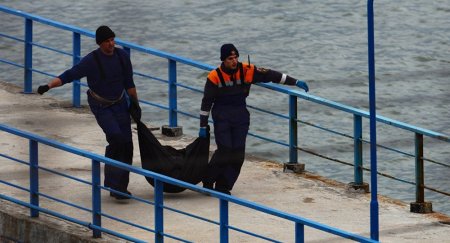
That suggestion began rising to the surface later in the day. Transport Minister Maxim Sokolov reported the finding of 11 bodies in the sea, adding ominously that “fragments of other bodies were also found.” He added: “Of course the entire spectrum and almost any possible causes…are being probed, but it is premature now to speak about this as a terrorist act.”

Maj. Gen. Igor Konashenkov, a military spokesman put in that the pilot was “first-class,” and the 33-year-old Tupelov passenger jet had been serviced recently.

But by then, investigators must have had some idea of what caused the crash just two minutes after takeoff – too suddenly for the pilot to send a distress signal.

Did they find evidence of explosives planted on the plane or, possibly, a sabotaged fuel line or tank, or a passenger carrying a bomb or wearing a bomb vest? A possibly technical fault cannot be ruled out at this stage. However, the unusual Russian response to the disaster indicated that the Kremlin was in a hurry to find answers and that its emergency infrastructure was in high gear to cope with a massive terrorist attack. Deployed to the scene of the crash was an army of 3,000 rescue personnel, including 100 divers, who were rushed in from all parts of Russia, along with 32 ships and submarines and scores of helicopters and drones – all engaged in gathering every scrap of debris and human remains for a complete picture of the disaster.

While world attention remains focused on the wave of terror overtaking Europe, Islamist terrorists including ISIS, are clearly placing Russia firmly in their sights, especially since its intensified military intervention in Syria last September.

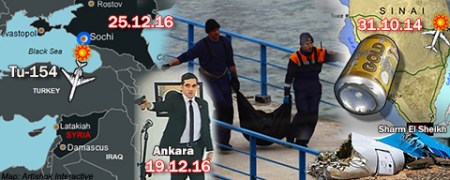
Still registered on the collective Russian consciousness is the tragic downing of the Metrojet Airbus on Oct. 31 2015 over Egyptian Sinai, after taking off from Sharm El-Sheikh, then a favorite Russian tourist resort. None of the 217 passengers and crew survived.

Still ringing in Russian ears is the voice of the Turkish assassin yelling: “Remember Syria! Remember Aleppo!” six days earlier, after he shot Andrew Karlov, 62, the Russian ambassador to Ankara. The video of the crime played out on TV screens across the world.

russainblackseaplane480

So far, President Vladimir Putin has managed to minimize the casualties of Russian military personnel involved in the Syrian war. But the number of fatalities building up from terrorism under the shadow of that war may have just jumped to an ominous level to 310 – not counting soldiers.

The Black Sea crash, if an act of terror is proven, will demonstrate that Russia has become a central target for Islamic terrorists, especially ISIS and Al Qaeda’s Syrian arm, the Nusra Front, and is paying a cruel price for its role in the Syrian conflict.

The doomed Tupolev was carrying more than one popular national symbol: 64 singers of the Red Army Choir, known as the Alexandrov Ensemble, a troupe of dancers, and Yelizaveta Glinka, known popularly as “Doctor Liza,” beloved leader of an organization for aiding victims in Russian combat zones. Nine reporters were also on the plane.  Putin declared Monday a day of national mourning.

They were all flying to the Russian Hmemim airbase in Latakia with a shipment of medicines. A concert for the troops was booked for the New Year.

Terrorists have for years had their eye on the celebrated Black Sea resort of Sochi, venue of international summits and favorite winter getaway location for Russian rulers, including Putin, who maintains a holiday residence there. An assault on Sochi is therefore a poke in the eye for the Russian president and the Russian military and security agencies battling terrorism.

The sorrow and the pity in Syria

December 21, 2016

The sorrow and the pity in Syria, Washington Times

(Please see also, Lies and Hypocrisy over Aleppo. — DM)

iraninsyriaIllustration on Iran’s future role in Syria by Linas Garsys/The Washington Times

ANALYSIS/OPINION:

Over the last five years, Syria has been descending into a hell on Earth. Over the last four months, the lowest depths of the inferno have been on display in Aleppo, an ancient city, once among the most diverse and dynamic in the Middle East. On Friday, in the final press conference of his presidency, Barack Obama addressed this still-unfolding humanitarian and strategic catastrophe.

“So with respect to Syria,” he said, “what I have consistently done is taken the best course that I can to try to end the civil war while having also to take into account the long-term national security interests of the United States.”

An estimated 500,000 dead, 11 million displaced, millions more living in fear, sorrow and pitiful poverty, Iranian forces backed by Russian forces occupying the heart of the Arab world — yet no-drama Mr. Obama remains so casual, so confident that the decisions he’s made were “the best” and, what’s more, that he made them “consistently.” Is refusing to change one’s mind as conditions worsen and policies fail really a virtue?

To bolster his case, the president emphasized that he has spent lots of time — “if you tallied it up, days and weeks” — attending meetings on Syria. “We went through every option in painful detail with maps,” he said, “and we had our military and we had our aid agencies and we had our diplomatic teams, and sometimes, we’d bring in outsiders who were critics of ours.” Imagine that: painful detail, maps, aid agencies, even critical outsiders.

Count me among those not convinced. In 2011, during that hopeful moment known as the Arab Spring, peaceful protesters took to the streets of Damascus. The dynastic dictator Bashar Assad responded brutally. Before long, a civil war was ignited.

Mr. Obama’s top advisers recommended assisting non-Islamist and nationalist rebels — not with the proverbial boots on the proverbial ground but with secure communications devices, money, weapons and training. Mr. Obama rejected that advice. He had done the math: Mr. Assad, a member of the Alawite minority, hadn’t enough loyal troops to prevail against Syria’s insurgent Sunni majority. So the fall of the Assad regime had to be both inevitable and imminent.

What that failed to take into account: Iran’s theocrats would send in foreign Shia fighters, including those of Hezbollah, their Lebanese proxy, all under the leadership of their Islamic Revolutionary Guard Corps. Vladimir Putin also would deploy forces in support of the Assad regime. We can surmise his reasons: to have a Mediterranean port for his navy; to re-establish Russia’s influence in the Middle East; to show the world that, unlike Mr. Obama, he does not abandon his friends; to diminish American credibility and prestige.

Mr. Obama’s response was, as it so often is, mainly rhetorical. He warned Mr. Putin that he was stepping into a quagmire. He proclaimed, as so he often does, that there can be “no military solution.”

The Russian president, a product of the KGB rather than the faculty lounge, knew that was nonsense. In the Middle East, the law of the jungle trumps international law every time.

Having accused President George W. Bush of overreach, Mr. Obama adopted a policy that might be called underreach. He decided not to enforce the “red line” he had declared against Mr. Assad’s use of chemical weapons. He decided not to eliminate Mr. Assad’s air power, which would have ended the barrel-bombing of civilians. He wasn’t even willing to help establish “safe zones” where innocent Syrians might stand a chance to defend themselves.

I know: Mr. Obama saw his mission as ending wars and certainly not risking additional American entanglements. And he is among those who believe that the projection of American power generally does more harm than good.

Not mutually exclusive is the theory that he had a specific goal in mind: to bring Iran’s rulers into a strategic partnership with the United States. To achieve that, he had to demonstrate that he respected what he has called their “equities” in Syria. Were he to take action against Mr. Assad, the Islamic republic’s envoys might walk away from the table where they were negotiating the nuclear weapons deal Mr. Obama envisioned as his great foreign policy legacy.

The president has been nothing if not “consistent” in his pursuit of detente with Iran’s Islamic revolutionaries. In all likelihood, that is what explains his decision, just after taking office, to turn a blind eye to the clerical regime’s ruthless repression of the Green Movement that took to the streets of Iranian cities following a rigged presidential election in 2009.

History will record that these efforts failed. Nixon went to China. Mr. Obama will not be going to Iran — or to Syria, which Iran intends to incorporate into its version of a caliphate (which Shia call an “imamate”).

Aleppo,” U.S. Ambassador Samantha Power said last week at the U.N., “will join the ranks of those events in world history that define modern evil, that stain our conscience decades later. Halabja, Rwanda, Srebrenica, and, now, Aleppo. To the Assad regime, Russia, and Iran, your forces and proxies are carrying out these crimes.”

She went on to ask: “Are you truly incapable of shame? Is there literally nothing that can shame you? Is there no act of barbarism against civilians, no execution of a child that gets under your skin?”

Would it be unfair to suggest that the answers to these questions should have been apparent to her and the president years ago? Had that been the case, perhaps they would have formulated different policies and implemented a different course of action. Or perhaps not.