Archive for the ‘Russia – Syrian war’ category

Hizballah launches Chemicals and Dirty Bombs program at secret Syrian site

March 2, 2016

Hizballah launches Chemicals & Dirty Bombs program at secret Syrian site, DEBKAfile, March 2, 2016

Nassralah_Zabadani480

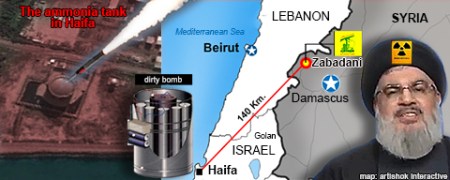
The southwestern town of Zabadani, 30 km west of Damascus, is a ghost town, depopulated by five years of Syrian war ravages, except for one sign of life – or rather death. Since December, Hizballah has enclosed this once attractive tourist resort, strategically located on the Damascus-Beirut highway, into a heavily fortified ex territoria enclave whose high walls conceal the terrorist group’s new program for the development of weapons of mass destruction. This is disclosed for the first time by DEBKAfile’s military and intelligence sources.

Most of the facilities for the research and development of chemical weapons and dirty bombs are sunk below the surface of the secret 2.5 sq. km site.

Syrian and Iranian engineers and technicians are developing the chemical weapons for Hizballah’s arsenal, and foreign experts were hired from outside the Middle East to help build radioactive weapons. They are kept out of sight in on-site accommodation at Zabadani.

A telltale sign that the Shiite terrorist organization was actively pursuing a radioactive bomb program – and which prompted our investigation – was dropped in a speech given by Hizballah leader Hassan Nasrallah on Feb. 16.

He boasted that a pair of Hizballah rockets falling on the Israeli city of Haifa would cause a catastrophe equivalent to a “nuclear bomb” attack. He elaborated on this: “An Israeli expert had said that Haifa’s residents fear a deadly attack on the ammonia storage tanks which contain more than 15,000 tons of this gas. That would lead to the deaths of tens of thousands of Israelis and affect another 800,000,” he declared.

“This would be exactly like a nuclear bomb and we can say that Lebanon today has a nuclear bomb, seeing as any rocket that might hit these tanks is capable of creating a nuclear bomb effect,” Nasrallah said.

When someone like the Hizballah terrorist chief drops four references to a nuclear bomb in as many sentences, ending with the boast that “Lebanon today has nuclear bomb,” it must be presumed that he is crowing over some sort of nuclear device in hand.

It may not be an actual atom bomb – which would call for multimillion dollar investment, expertise and time, “only” a “dirty bomb” (essentially a conventional bomb mixed with radioactive material). That too could cause massive damage to Haifa’s chemical industry, resulting in a high death toll, runaway panic and major disruption – the perfect weapon for terrorists.

Israeli officials decline to discuss Hizballah’s new WMD program, but it certainly raises hard questions for Moscow and the commanding Russian military presence in Syria. It is hard to believe that the Shiite terrorists can develop game-changing poison chemicals and dirty bombs in the heart of Syria, without Russian intelligence noticing what was going on. Does that mean that Vladimir Putin is amenable to his air force providing it with cover?

Iran uses Syrian truce to deploy hundreds of Palestinian terrorists on Golan border

February 27, 2016

Iran uses Syrian truce to deploy hundreds of Palestinian terrorists on Golan border, DEBKAfile, February 27, 2016

Al-Sabirin-logo

Under cover of the Syrian ceasefire that went into effect Saturday, Feb. 27, and the Russian air umbrella, Iran’s Revolutionary Guards Corps finally managed to secretly install hundreds of armed Palestinian terrorists on the Syrian-Israeli border face-to-face with the IDF’s Golan positions.

This is reported exclusively by DEBKAfile’s military and intelligence sources.

These Palestinians belong to Al-Sabirin, a new terrorist organization the Iranian Guards and Hizballah are building in the refugee camps of Lebanon and the Gaza Strip. Their agents clandestinely recruited the new terrorists from among young Palestinians who fled the Yarmouk refugee camp outside Damascus and sought refuge in Lebanon. Hizballah organized their return to Syria through south Lebanon – but not before training and arming them for penetration deep inside Israel to carry out mass-casualty assaults on IDF positions, highways and civilians.

So Iran and Hizballah have finally been able to achieve one of the most cherished goals of their integration in the Syria civil war, namely, to bring a loyal terrorist force right up to Israel’s border.

Israel’s military planners went to extreme lengths to prevent this happening. Last December, Samir Quntar, after being assigned by Tehran and Hizballah to establish a Palestinian-Druze terror network on the Golan, was assassinated in Damascus.

Twelve months before that, on Jan. 18, an Israeli air strike hit an Iranian-Syrian military party surveying the Golan in search of jumping-off locations for Hizballah terror squads to strike across the border against Israeli targets. The two senior officers in the party, Iranian General Allah-Dadi and Hizballah’s Jihad Mughniyeh, were killed.

The hubbub in the run-up to the Syrian truce, coupled with Russia’s protective military presence, finally gave the Islamic Republic and its Lebanese proxy the chance to outfox Israeli intelligence and secretly bring forward a terrorist force to striking range against Israel

This discovery was one of the causes of Prime Minister Binyamin Netanyahu’s urgent phone call to President Vladimir Putin Wednesday, Feb. 24, two days before the ceasefire went into effect. He reminded the Russian leader of the understandings they had reached regarding the deployment of pro-Iranian terrorists on the Syrian-Israeli border. He also sent emissaries to Moscow to intercede with Russian officials.

Putin’s answers to Israel’s demarches were vague and evasive, on the lines of a promise to look into their complaints.

He also tried to fob Netanyahu off by inviting President Reuven Rivlin for a state visit to Russia. Putin promised to use that occasion for a solemn Russian pledge of commitment to upholding Israel’s security in a tone that would leave Tehran in no doubt of Moscow support for the Jewish state.
The Rivlin visit has been scheduled for March 16.

But it is clear that the prime minister and defense minister Moshe Ya’alon were too slow to pick up on the new terrorist menace Iran had parked on Israel’s border. Now their hands are tied, say DEBKAfile’s sources. An IDF operation to evict the pro-Iranian Palestinian Al-Sabirin network from the Syrian Golan, before it digs in, would lay Israel open to the charge of jeopardizing, or even sabotaging, the inherently fragile Syrian ceasefire initiated jointly by the US and Russia.

Netanyahu phones Putin for clarifications on the South Syrian ceasefire

February 24, 2016

Netanyahu phones Putin for clarifications on the South Syrian ceasefire, DEBKAfile, February 24, 2016

PutinBibi2-480

Prime Minister Binyamin Netanyahu phoned President Vladimir Putin Wednesday Feb. 24, to find out how the partial Syrian ceasefire due to go into effect Saturday Feb. 27 will affect Israel’s northern border security. According to the Kremlin statement, “The two leaders discussed the Middle East and reached agreement to hold a number of high-level contact meetings.”

Agreement was also reached on “a range of contact [meetings] on the high and highest level, taking into consideration the 25tyh anniversary of the establishment of diplomatic relations between the two countries,” the communiqué went on to say.

The language and content of this communiqué struck DEBKAfile’s diplomatic sources as oddly off the point compared with statements that came after past conversations.

It is hard to believe that the Russian President, while deeply immersed in tense exchanges with President Barack Obama and Iran’s Hassan Rouhani for tying up the ends of the approaching Syrian ceasefire, would give his attention to the celebration of a historic event.

The words did however convey the impression that the Russian leader was making an effort to calm Israel’s apprehensions about the coming stage of the Syrian crisis.

According to our sources, Netanyahu put in the call to Putin when he learned that the Russian and American presidents had agreed to get the partial ceasefire started in southern Syria, namely on the front closest to the borders of Israel and Jordan.

Israeli and Jordanian military officials have been trying to get a picture of how these arrangements would work and affect their national security, but Washington and Moscow are similarly tightlipped on information. This is also the reaction the Israeli Foreign Ministry’s Director General Dore Gold found when he called on Russian Foreign Minister Sergei Lavrov in Moscow on Feb. 18. The minister was polite but avoided direct answers to questions.

Israel is most deeply troubled by the possibility that Syrian army, Iranian and Hizballah forces currently in offensive momentum in South Syria will exploit the cessation of hostilities to advance towards its Golan border with hostile intent.

With only three days to go before the truce goes into effect, Israel has still not received any clear answers about whether the Russian air force will continue to strike Syrian rebel elements deemed “terrorists” unabated in close proximity to its northern borders.

US officials have tried in the last 24 hours to assuage Israel’s concerns, but they are no more forthcoming with clear information than the Russians.

Netanyahu therefore picked up the phone to the Russian president, with whom he maintains a friendly dialogue, to find out what was ahead in the wake of the truce and to ask for guarantees that Syrian, Iranian and Hizballah forces would not permitted to take advantage of the lull to gain ground.

The prime minister also asked Putin about the huge $14bn arms deal in negotiation with Tehran.

He is most unlikely to have been appeased by the bone the Russian president threw him about a joint celebration of an anniversary. The record is not assuring. In early January, Putin promised Netanyahu that he would make sure that Hizballah forces would not be part of the Russian-backed Syrian army offensive in the South. But then, on Jan. 27, a large Hizballah force entered the southern town of Daraa and Russian air strikes drew ever closer to the Israeli border, until explosions could be heard in Israel from a distance of no more than a few hundred meters.

Shoigu in Tehran to rescue Putin’s plan from Assad’s Iranian-backed obstructionism

February 22, 2016

Shoigu in Tehran to rescue Putin’s plan from Assad’s Iranian-backed obstructionism, DEBKAfile, February 22, 2016

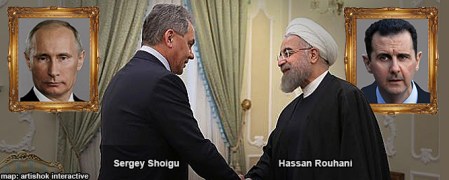
Shoigu_Ruhani

President Vladimir Putin this week mounted a rescue operation to unsnarl his blueprint for a solution of the Syrian crisis from the blockage placed in its path by none other than Bashar Assad. The Syrian ruler won’t hear of Moscow’s proposals for ending the war, or even the cessation of hostilities approved last week in Munich by the 17-member Syria Support Group.

DEBKAfile reports that the strains between Moscow and Damascus this week have blown back onto the working relations between the Russian, Syrian and Iranian military commands running the war in Syria.

US Secretary of State John Kerry, referring to the lack of progress toward a ceasefire during a visit to Amman Sunday, Feb. 21, pointed mainly at the Syrian opposition. Its High Negotiations Committee insists first on an end to the sieges, a halt on Russian bombardment and the inclusion of the jihadist Nusra Front in the ceasefire.

But, according to our sources, the main monkey wrench has been thrown into the mix by Assad.

When Putin discovered that the Syrian ruler had won the secret backing of Tehran in h is refusal, he decided to send the supreme commander of the Russian campaign in Syria, Defense Minister Gen. Sergei Shoigu, to Tehran Sunday, Feb. 21, with a personal message for President Hassan Rouhani.

Gen. Shoigu laid before Rouhani the extent to which Russian intervention had turned the tide of the Syrian war in favor of the regime, and the great advantages of a political resolution that would end the conflict in a way that enhanced Russian and Iranian influence in the region to the maximum.

The Russian general stressed that at the end of the proposed political process, Assad would be required to step down. This concurrence was incorporated in the Putin-Obama deal for working together to solve the Syrian crisis.

But Rouhani was unmoved, according to the statement he issued at the end of the interview.

“The crisis in Syria can only be solved through political negotiation and respect for the rights of the country’s government and people, who are those taking the final decision regarding its future,”  he said.

This was taken in Moscow as Iran’s rejection of at least one element of the Putin plan – imposing a solution on Assad – but not the plan in its entirety. This qualified response was meant to nudge Moscow closer to Teheran and Moscow and pull away from Washington.

The Shoigu mission therefore did not lessen the strains between Russia, Iran and Assad – at least for now, according to DEBKAfile’s sources.

Although all the parties concerned agree that the war must be ended by political means, those means are the subject of controversy between Moscow and its allies. The Russians are seeking a staged advance towards the final goal by first scaling down military operations, the while gradually refocusing their efforts on political and diplomatic arrangements.

But Syrian and Iranian leaders want to keep the focus on the military course.

Moscow wants the Assad regime to make concessions for paving the way to a cease-fire, and to accept a transitional government taking over in Damascus with representation for the opposition. The Syrian dictator would then gradually transfer his powers to the stand-ins as they assume responsibility for the various branches of government.

But both Assad and Tehran are adamantly opposed to a transitional government being installed – or any other political steps being pursued – before the rebel forces are totally defeated in non-stop military operations – first in the north and then in the south.

Neither the Syrian ruler nor Iran show any sign of relenting, or appreciating that the dramatic progress achieved in the past month by Syrian army, Iranian and Hizballah forces were down to Russian military support and especially its air campaign against their enemies. They feel safe in their intransigence because they assume that Putin can’t afford to abruptly pull his military support from under their feet to make them bow to his demands.

After five months in which Moscow and the Russian air force have provided the Iranian leadership and Assad with signal victories on the ground, President Putin has been brought up short by the same Iranian-Syrian negative obstructionism, that has defied every effort to end the brutal five-year war, which has cost 470,000 lives, left 1.9 million injured, displaced half the country’s population of 23 million and left a Syria ravaged beyond recognition.

Russia air strikes seal Jebel Druze against attack and refugees

February 21, 2016

Russia air strikes seal Jebel Druze against attack and refugees, DEBKAfile, February 22, 2016

2717545 10/10/2015 Russian Su-25 attack aircraft take off from the Khmeimim airbase in Syria. Dmitriy Vinogradov/RIA Novosti

2717545 10/10/2015 Russian Su-25 attack aircraft take off from the Khmeimim airbase in Syria. Dmitriy Vinogradov/RIA Novosti

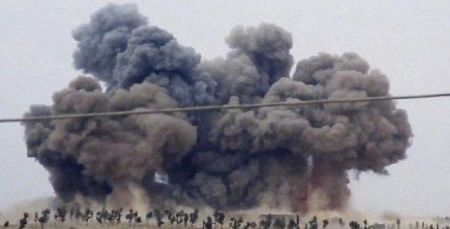
While Syrian war reporting focused over the weekend on the battles around Aleppo and along the Turkish border in the north, Russia since Saturday, Feb. 20 has ramped up its air bombardment of southern cities and towns, especially Daraa and Nawa. Thousands of fleeing rebels with their families and other civilians have meanwhile been turned away from the locked Jordanian border and are heading towards the Golan opposite the Israeli border.

The heaviest Russian air strikes seen hitherto in Syria have two strategic goals.

1. To retake the key southern town of Daraa from rebel hands and restore it to Syrian President Bashar Assad’s full control.

2. To crush rebel resistance in the South and force them to accept surrender, collapse or escape in the direction of the Jordanian or Israeli borders.

The intense Russian sorties are opening the door to Syrian, Iranian and Hizballah forces to move into the South and reach the Israeli borders. Prime Minister Binyamin Netanyahu sent Dr. Dore Gold to Moscow last week as his special emissary to explain how this affected Israel’s security. But he was unable to persuade the Russians to scale down their attacks in this sensitive border region.

Those attacks have a third goal, which is to encircle the Jebel Druze region with a “shield of fire” as protection for this ethnic minority of 750,000, most which inhabit mountain villages.

This unusual operation, the first of its kind in the Syrian war, has three objectives:

A. To shield the Druzes villages against ISIS attack from the east, namely Deir az-Zour.

B. To shut the door against fleeing rebels seeking sanctuary in the Druze enclave.

C. To show other Syrian minorities, especially the Kurds in the north, the great advantage of allying themselves with Moscow. Word of Russian protection of the Druzes has undoubtedly spread to Syria’s other minorities.

As for the rebels and refugees, Jordanian troops moved into the border crossings evacuated by Syrian rebels and closed the last crossing at Ramtha.

The exodus from southern Syria is now heading towards the Golan on Israel’s doorstep.

Israel has imposed a media blackout on this development. However, DEBKAfile’s sources warn that it will soon be impossible to keep it dark. Within a few days, many thousands of Syrian refugees will be massing at Israel’s Ein Zivan gate opposite Quneitra. Like Turkey and Jordan, Israel will have to supply large numbers of distressed Syrian refugees with tents, food, water and medicines.

Russian Magazine: Russia’s Air Force In Syria Is Winning The Battle For Assad

February 17, 2016

Russian Magazine: Russia’s Air Force In Syria Is Winning The Battle For Assad, MEMRI, February 17, 2016

(Please see also, Moscow on the Tigris: Russia Joins the Terror Nexus:

While an exhausted and burned out United States wishes international migraines like the Syrian civil war would just go away, Russia is energized by the prospect of filling the vacuum and thus once again playing a major role on the world stage. Aggressively intervening on behalf of his ally in Damascus, President Bashar al-Assad, and projecting force well beyond even the frontier states in his“near abroad,” Vladimir Putin audaciously aims to change political outcomes in a region that has been out of his country’s sphere of influence for a generation.

— DM)

Recently, the Russian campaign in Syria reached its 100th day. An article in Expert Online, the website of the influential Russian analytical magazine Expert, reviews the state of the Syria war, analyzing the activities on various fronts as well as the Russian involvement. The article, by journalist Pyetr Skorobogatyj, states that, with Russia’s help, the Syrian army is advancing slowly but surely. It stresses that the operation in Syria is not a substantial financial burden for Russia, and that it benefits Russia in many ways – including by allowing it to train pilots, test the performance of various weapons, and target Russian-speaking militants who are fighting in Syria. Most significantly, it allows Russia to establish a permanent presence in the Middle East that has an impact on all the region’s countries.

The article then reviews the military situation in Syria region by region. Focusing first on the north, it stresses that the Kurdish forces there are making headway against ISIS and are laying down the foundations for what may eventually become a Kurdish autonomy or even an independent Kurdish state. The main loser, says the article, is Turkey, who is powerless to stop these developments from unfolding.

The article states further that Russia, using its S-400 missiles, has effectively set up a no-fly-zone in the north of Syria, thus enabling the regime forces to make substantial achievements against the rebels, especially in the Latakia area. It adds that the U.S., too, is planning to establish a military base in northeast Syria, in the Malikia area.

Moving to the southern region, the article states that the stalemate between the sides there – namely the regime forces and rebel groups backed by Jordan – has ended, since Jordan has ordered these forces to stop attacking Assad’s troops. In Damascus, too, the regime is slowly flushing out the rebels, street by street and building by building. As for eastern Syria, the article concedes that ISIS still maintains a strong presence there and will be difficult to defeat.

The following are excerpts from the article.[1]

 “The Air Campaign Is Not Expensive For Moscow, And It Allows Russia To Train Pilots And Test Different Types Of Weapons”

“As the Russian campaign recently reached its 100th day,[2] [Russia’s] main goal appears to be the use of military power to force peace on the ‘rational’ [i.e., non-jihadist] rebel groups. There are a number of small [rebel] groups which have either joined Assad’s military or have stayed independent but coordinate their activities with the Syrian army. [Russia’s] largest partner [apart from the Syrian army] is the Syrian Democratic Army [SDA], a Sunni popular militia which is fighting in the north [of the country] alongside the Kurds and government troops. The Russian Ministry of Defense has confirmed that Russia supports the SDA with weapons, ammunition and airstrikes. ‘For its part, the patriotic opposition [i.e. the SDA] coordinates its military objectives with the Russian aviation group,’ noted Lt. General Sergei Rudskoy, Chief of Main Operations Management in the Russian Army General Staff…

“The joint military campaign of the Russian Air Force and Syrian troops seems to be [progressing] slowly but surely. [The slow pace] is due to the broad spectrum of military goals which must be met, including pressure on all ‘factions’ in order to separate [potential] ‘partners’ from ‘enemies,’ as well as the necessity to return as much territory as possible to the Syrian government’s control, in order to enable it to negotiate from a position of strength about the country’s future. In addition, all the battle fronts seem chaotic, with many parallel ‘seething cauldrons’… and with weather conditions are getting worse… All of these factors together make Russian air operations difficult, especially during the winter period. This week the ‘bad guys’ [i.e. ISIS] used the cover of a sandstorm [which hampered Russian air activity] to mount a major offensive on Deir Al-Zor, a Syrian enclave in the desert. This action resulted in a major defeat for the Syrian side. As prevailing weather conditions worsen, the… intensity of the military campaign will decrease…

“Notwithstanding, during the first 100 days of Russian Air Force and Navy operations, 217 villages and towns were retaken, and 1000 sq. km. of territory. The Russian-Syrian coalition has no need to hurry. The air campaign is not expensive for Moscow, and it allows Russia to train pilots and to test the battle performance of different types of weapons. These benefits are in addition to the political gains and to the main goal, which is to eliminate Russian-speaking fighters in theaters far away from Russia’s borders.

“In addition, thanks to the new Russian air force base in the [the Syrian city of] Latakia, Moscow has established a permanent presence in the region, controlling a very important logistic hub. This modern military base (equipped with Iskander[3] and S-400[4] missiles)… changes the military and political situation in Iraq, Iran, Israel, the U.S… and, of course, Turkey”…”

“Russia Has Set Up A No-Fly Zone Using Its S-400 Surface-To-Air Missile System”

“[Meanwhile] the goals of the main participants in the Syrian battle have become clear. In the north of Syria… the Kurds are winning. They are finally receiving extensive military support from the U.S. and covert support from Russia. They are carrying out offensive operations against ISIS and expanding their territory, which might become a future Kurdish state or an autonomous region within Syria, depending on the final agreement… The main loser is Turkey, who is unpredictable, irresponsible and unable to keep agreements. Currently, [Turkish President Recep Tayyip] Erdogan can only look on as the Kurdish enclave continually grows stronger. [The Turkish President] can initiate military operations only on his own territory…

“The geopolitical value of northern Syria is understood by all parties. Russia has set up a no-fly zone [there] using its S-400 surface-to-air missile system… [while] Syria is strengthening its Al-Bab air base with Russian military advisors and the S-300[5] missile system. The Americans are not napping either, and plan to set up a military base in Malikia in north-east Syria… This will allow the U.S to carry out an independent policy without having to depend on the Kurdish state which is being established…

“The Syrian army, aided by Hizbullah’s brigades, is doing very well in the Latakia governorate. The map [below] clearly shows the movement of the fighting forces over the last few months. The dotted red line represents the front on October 7, 2015. In the first half of January 2016, government troops finally showed fighting ability against the Islamist stronghold of Salma… It was the first time that Russian military experts actively took part in the campaign, probably coordinating the attack on Salma. Support from Russian planes in the northern Latakia province allows the Syrian army to continue its advance at full speed…”
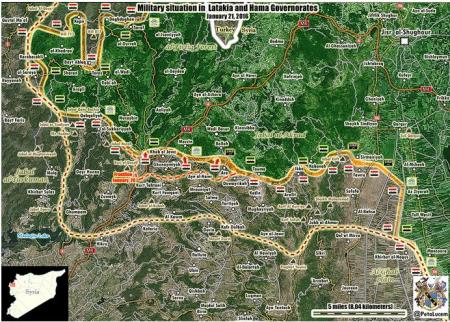
26798Military situation in Latakia and Hama areas, January 21, 2016

In The South, Jordan-Backed Rebels Have Been Ordered To Stop Attacking; In Damascus, The Government Is Flushing Out Islamists; In The East, ISIS Still Holds A Significant Area

“In the Dera province in the south, the opposing sides had [previously] agreed to maintain the status quo. Damascus was avoiding a conflict with Israel as well as with Jordan, which openly sponsored tribal forces and Islamist brigades… [Today, however,] the tactic of constant pressure [by Syrian regime troops on these forces and brigades] is producing results. The Military Operations Command [MOC] in Amman… which is coordinating rebel activities in southern Syria, has ordered [the forces it sponsors] to stop attacking [Syrian] government forces… Jordan’s logic is very simple… Syrian refugees in Jordan now total about 30% of the population, the same number as the Palestinians living in Jordan… so Jordan prefers to try to stabilize the situation in Syria rather than dream about cutting off Syria’s southern territories from the rest of the country. On the other hand, Damascus has begun to raise the issue of Israeli[-sponsored] rebels occupying the [Syrian] Golan Heights.

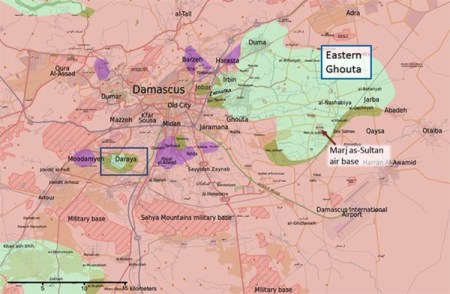
“In the Syrian capital, government troops are continuing to flush out Islamists and ‘bad guys’ from the city. The score is being kept not by counting streets retaken, but by counting buildings… The progress in the Damascus area is noticeable only when viewed over a long period of time. Below is a map showing the balance of forces in 2013, and beneath it a map showing the balance of forces in 2015.
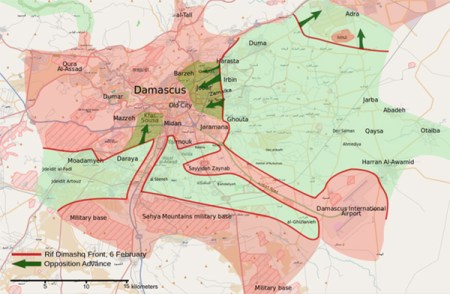
26799Damascus area in 2013
26800Damascus’ area in 2015

“In addition, peace talks between the government and some rebel groups are now underway. Just recently, an agreement was made with a rebel brigade in the Al-Qadam suburb [in Damascus]. Some militants who were disarmed were moved to Raqqa and Idlib, while almost 1,500 others agreed to switch to Assad’s side…

“In spite of the relative success of government troops, ISIS still holds a significant area in the eastern part of Syria… The [ISIS] Caliphate is well-entrenched in the area it controls, with a strong force and command structure, and is not going to withdraw easily.”


Endnotes:

[1] Expert.ru, January, 22, 2016.

[2] The Russian campaign in Syria started on September 30, 2015.

[3] A Russia-manufactured portable short-range ballistic missile system; NATO designation name: SS-26 Stone.

[4] A Russia-manufactured anti-aircraft weapons system; NATO designation name: SA-21 Growler.

[5] A Russia-manufactured long range surface-to-air missile system;  NATO designation name: SA-10 Grumble.
‘Senior Official’ of Iran-Russia-Syria Alliance Brags About Subverting U.S. Diplomacy

February 17, 2016

‘Senior Official’ of Iran-Russia-Syria Alliance Brags About Subverting U.S. Diplomacy, Washington Free Beacon, Morgan Chalfant, February 17, 2016

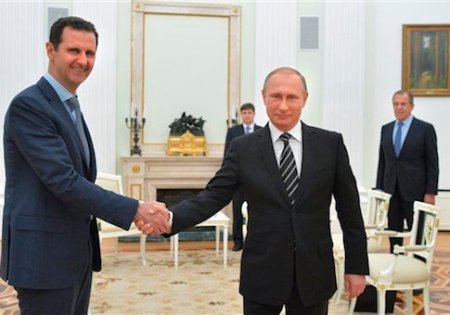
FILE - In this file photo taken on Tuesday, Oct. 20, 2015, Russian President Vladimir Putin, center, shakes hand with Syrian President Bashar Assad as Russian Foreign Minister Sergey Lavrov, right, looks on in the Kremlin in Moscow, Russia. When Russian Foreign Minister Sergey Lavrov said his country is ready to aid Syrian rebels fighting Islamic State militants on the ground, rebel commanders scoffed at the notion, pointing out that Russian aircraft were pounding rebel bases in central and northern Syria on daily basis. (Alexei Druzhinin, RIA-Novosti, Kremlin Pool Photo via AP, File)

FILE – In this file photo taken on Tuesday, Oct. 20, 2015, Russian President Vladimir Putin, center, shakes hand with Syrian President Bashar Assad as Russian Foreign Minister Sergey Lavrov, right, looks on in the Kremlin in Moscow, Russia. (Alexei Druzhinin, RIA-Novosti, Kremlin Pool Photo via AP, File)

A “senior official” of the military alliance between Iran, Russia, and Syria that is currently waging a ground offensive in Aleppo boasted about subverting U.S. diplomacy in a recent interview with an U.S. newspaper.

The official told the Wall Street Journal that military forces from Iran, Russia, and Syria would use a recent ceasefire deal brokered by world powers—including the United States—not to take steps towards a peaceful resolution of the Syrian war, but to consolidate their military gains.

The Journal reported:

“These allies are together in the same command center, working, planning and coordinating their operations in the battlefield,” said a senior official in the Iran-Russia-Syrian regime military alliance. “Retaking Aleppo will restore the regime’s strength and control over Syria; toppling the regime is now a thing of the past.” A cease-fire as proposed by world powers in Munich last week, he said, would simply be a pause for the Iran-led ground forces to consolidate recent territorial gains.

Thousands of fighters organized by Iran—including Hezbollah, the Islamic Revolutionary Guard Corps, and Shia fighters from Afghanistan, Iraq, and other countries—have launched the assault on Aleppo alongside Syrian army forces. Emboldened by Russian airstrikes, the fighters have been able to advance on Syria’s largest city.

There is some doubt regarding whether the ceasefire will be implemented at all. The deal was established by global powers on Friday, though neither Assad nor the Syrian opposition formally signed off on it. The deal was supposed to allow humanitarian aid to be sent to Syria and commence peace negotiations. The United States hoped that the ceasefire would be implemented in a week’s time.

Hours before the ceasefire was announced, Assad vowed to retake Syria in its entirety in an interview published by AFP.

Iran has put billions of dollars toward backing Assad, and Russia has launched a military intervention in Syria to back the Assad regime under the guise of fighting terrorist groups.

While the Obama administration has long said that Assad must be removed from power, the United States has softened that stance since 2011, when the Syrian civil war began. Secretary of State John Kerry said in December that the administration was not seeking a “regime change” in Syria following a meeting with Russian President Vladimir Putin.

“The United States and our partners are not seeking so-called regime change,” Kerry said then, indicating that world powers were focused on achieving a peace process in which “Syrians will be making decisions for the future of Syria.”

Both Russia and Iran have resisted any effort to oust Assad.

Special Israeli emissary to Moscow over Russian Syria air strikes near border

February 17, 2016

Special Israeli emissary to Moscow over Russian Syria air strikes near border, DEBKAfile, February 17, 2016

Israel_near_border_16.2.16

In view of the crisis building up on the southern Syrian-Israeli border, Prime Minister Binyamin Netanyahu decided immediately on his return home from Berlin early Wednesday, Feb. 17, to send a special  emissary to Moscow to ask for clarifications. Tuesday, Intensified Russian air strikes came to within 6 km of the Israeli border, sparking a growing exodus of Syrian refugees heading towards the Qoneitra border crossing to Israel.

DEBKAfile’s sources reveal that the envoy is Dr. Dore Gold, director-general of the Foreign Ministry and one of the prime minister’s few trusted confidantes.

It was still not clear whom Gold will meet in the Russian capital, but it is assumed that it will be one of Moscow’s senior decision-makers in the loop on its military operation in Syria.

The fact that Netanyahu decided to dispatch a top diplomat rather than a senior military or intelligence officer is a sign that the prime minister is not of one mind with the IDF’s intelligence assessments of the situation on the ground.

Netanyahu’s concerns grew after after the Russian air force on Tuesday widened its massive bombing of southern Syria from the city of Daraa to the Golan town of Quneitra, in order to help the Syria army’s 7th armored division push the rebels east, so they will not attempt to cross the border and seek shelter in Israel.

DEBKAfile’s military sources report that that 12 of the 15 targets bombed by the Russian air force across from the Israeli border were new rebel positions that had not been attacked before, even by the Syrian army. Military sources monitoring the war said Tuesday night that there is no doubt that the Russians are in the process of wiping out the rebel positions along the Israeli border by means of an offensive comparable to their operations in the northern Aleppo sector.

Our sources report that Israel’s concerns grew when, as the Russians bombing raids neared the Israeli border, Syrian officials threatened Jordan with serious consequences if Amman gave the Saudi air force a base for attacking eastern or southern Syria.

The threats began Tuesday, after Jordanian forces took over the Syrian-Jordanian border crossings formerly held by Syrian rebels, as a measure to stem the volume of Syrian refugees in search of sanctuary in the Hashemite Kingdom. But this step was interpreted by the Syrians and their Russian ally as clearing the way for Saudi intervention in the Syrian conflict using Jordan as a jumping-off base.

Meanwhile, Western military sources reported a sub substantial presence Tuesday of both Russian and Israeli warplanes in the skies over and around southern Syria.

Obama Managed to Make Syria a Lot Messier

February 17, 2016

Obama Managed to Make Syria a Lot Messier, Front Page Magazine, Daniel Greenfield, February 16, 2016

obama-wears-tan-suit-149481242256_6

Obama and Kerry are frantically touting a Syria ceasefire as the solution to the conflict. In reality, they’ve made the conflict much worse.

While Hillary Clinton was talking up a No Fly Zone, Russia entered Syria and enforced its own de facto No Fly Zone against the United States. Their bombing campaign has boosted the Iran-Assad-Hezbollah axis while beating back Sunni militias backed by Turkey and Saudi Arabia.

The Turks responded by shooting down a Russian jet. Obama threw in more anti-tank missiles. But a sustained bombing campaign does pay off. It’s what Obama refused to do against ISIS. But the Russians had no problem hitting Sunni opposition forces with one. They also don’t care about collateral damage. And while Obama and his proxies bleat about Russia being isolated and doomed, Putin set the terms of the proposed peace deal.

Obama’s willingness to switch to the side of the Shiite axis and accept them however only worsened the conflict for reasons ridiculously obvious to everyone outside the White House and the media.

The Saudis and Turkey are not about to lose this fight with Iran. Turkey is also worried about Kurdish gains. So they’re going to send ground troops to “fight ISIS”. Just like Iran and Russia are “fighting ISIS”.

Even in the best case scenario, this means the effective end of an independent Syria as it’s carved up under a Russian-Iranian-Turkish, etc occupation. Since Syria never really existed, that’s not too great of a loss. But in practice, it means that Syria will be divided into terrorist training camps for Shiite and Sunni terrorists, backed by friendly troops and jets from their allied states, which will sometimes also take shots at each other.

This may end up destroying ISIS by territorially squeezing it out. Or it may just escalate the already messy conflict and take it to a new level.

It’s hard to say to what extent this will represent a threat to the United States, aside from the general perception of weakness and impotence inflicted by Obama’s failed foreign policy. But if the conflict escalates, it could have all sorts of destructive implications. And obviously, Israel’s situation becomes more problematic. At the very least, we’re going to see Syria being turned into an even bigger terrorist production factory than it already was. And those terrorists won’t just stay in Syria, as we’ve already seen.

And the United States is likely to be dragged into this mess in a variety of ways from providing aid on the ground to peacekeeping to taking in refugees. And considering Turkey’s inappropriate place in NATO, we might end up even being dragged into an actual war.

That’s what Obama’s ceasefire looks like.

Report: Hizballah Has Russian Technology Capable of Downing Israeli Jets

February 16, 2016

Report: Hizballah Has Russian Technology Capable of Downing Israeli Jets, Investigative Project on Terrorism, February 16, 2016

Hizballah is using advanced radar technology to “lock on” to Israeli aircraft flying reconnaissance missions over Lebanon, according to Israel’s Walla news service and reported by i24 News.

The new technology enables Hizballah to identify Israeli jets and fire missiles at them, Israeli security sources said.

“The connection between Hizballah, Russia and Syria have greatly changed the rules of the game in the region…Hizballah is indicating to Israel that it is ready for the next stage,” said an Israeli security official, quoted in Walla.

Israeli fighter jets are capable of detecting radar that threatens them, allowing pilots to alter their course. Nevertheless, the reports signal a troubling development that could hinder Israel’s freedom of movement in airspace across the northern border and its ability to effectively monitor Hizballah.

Following the 2006 war between Israel and Hizballah, the terrorist organization began acquiring sophisticated anti-aircraft systems and other advanced weapons from Syria and Iran. A recent report suggests that Hizballah is using Iranian anti-tank missiles in Syria that could be used against Israel in a future confrontation.

In light of these developments, Israel has allegedly targeted Hizballah weapons convoys on several occasions coming into Lebanon from Syria over the past few years. Nevertheless, the terrorist organization continues to build up its weapons arsenal and consolidate a base of operations on the Syrian Golan in order to attack the Jewish state.

Last month, Hizballah field commanders with operatives fighting in Syria told the Daily Beast that Russia is providing the terrorist organization with advanced weaponry amid enhanced coordination among both actors. The report outlines that Hizballah is acquiring long-range tactical missiles, anti-tank systems, and laser guided rockets from the Russians.