Archive for the ‘Rouhani’ category

Iranian Desire to Lift Sanctions Dominates Agenda at Geneva Nuclear Talks

December 17, 2014

Iranian Desire to Lift Sanctions Dominates Agenda at Geneva Nuclear Talks, Algemeiner, Ben Cohen, December 16, 2014

Back where they startedBack where they started: Iranian and American negotiators in Geneva this week. Photo: Twitter

Rouhani’s determination to lift the sanctions has worried some analysts, who posit that the Obama Administration may back down on key verification demands in order to boost the regime’s “moderate” faction.

“[W]e are down to just discussions on how to remove sanctions in exchange for a short term enhanced inspection arrangement that cannot possibly be relied upon to discover undeclared facilities,” Ottolenghi said. “Unfortunately, the Obama Administration is trading long term security for a short term diplomatic victory.”

**************

As nuclear talks between international negotiators and Iranian representatives got underway in Geneva today following two days of direct US-Iranian bilateral negotiations, the Tehran regime again stressed the importance of lifting sanctions against it, leading some analysts to express concern that sanctions relief may be applied even in the absence of a deal that satisfies western powers.

Iranian chief negotiator and deputy foreign minister Abbas Araghchi described the atmosphere at the bilateral negotiations as having “proceeded in a good ambience.” Aragchi stressed that “there were elaborate discussions on all topics, especially sanctions” – the issue that the Iranian regime is most concerned about.

A New York Times report today portrayed the sanctions issue as the dividing line between Iranian conservatives who reject a deal and the putative moderates, led by President Hasan Rouhani, who see a nuclear deal and the lifting of sanctions as the price to pay for Iran’s full participation in international affairs.

“Mr. Rouhani came to office this year promising not just to strike a nuclear deal that would lift economic sanctions but to end Iran’s isolation from the world economy and to promote individual freedoms,” The Timesobserved.

Rouhani’s determination to lift the sanctions has worried some analysts, who posit that the Obama Administration may back down on key verification demands in order to boost the regime’s “moderate” faction.

“Iranian officials have a vested interest in presenting the talks as proceeding according to their list of desiderata,” Michael Doran, a former deputy assistant secretary of defense in the George W. Bush Administration who now works for the Hudson Institute think-tank in Washington DC,  told The Algemeiner. “That said, the Obama administration has shown a disturbing tendency to back away from previous red lines, of which forcing Iran to divulge the possible military dimensions (PMD) of its nuclear program is one of the most important – precisely because it is a prerequisite for effective monitoring.”

Any deal that offered sanctions relief before Iran has satisfied the International Atomic Energy Agency’s (IAEA) concerns about the military aspects of its nuclear program “is a very bad deal,” Doran said.

Emanuele Ottolenghi, a Senior Fellow at the Foundation for Defense of Democracies, told The Algemeinerthat Iran had persuaded the P5+1 – the five permanent members of the UN Security Council plus Germany –”that neither its missile program nor the possible military dimensions of it nuclear research should be part of a final deal.”

“Instead, we are down to just discussions on how to remove sanctions in exchange for a short term enhanced inspection arrangement that cannot possibly be relied upon to discover undeclared facilities,” Ottolenghi said. “Unfortunately, the Obama Administration is trading long term security for a short term diplomatic victory.”

Implications of Iranian Cheating at Arak

December 10, 2014

Implications of Iranian Cheating at Arak, Commentary Magazine, December 10, 2014

[T]he State Department never conducts lessons-learned exercises to determine why previous episodes of diplomacy have failed.

Kerry is like a gambler who has lost everything, but figures if only he is given one more round at the craps table, he can win big. American national security, however, is nothing with which to gamble. Especially when a gambler is desperate, the house will always win. In this case, however, the house is not Washington, but rather Tehran.

**********

As Jonathan Tobin notes, Colum Lynch’s Foreign Policy bombshell report about Iran’s covert efforts to buy equipment for its Arak plant, a facility which could produce plutonium for a nuclear bomb, raises questions about the logic of the Obama administration, and the recent comments by both Vice President Joe Biden and Secretary of State John Kerry with regard to the wisdom of extending nuclear talks with Iran.

If Lynch’s report is true—and it appears very much to be so—then there are two possibilities as to what happened vis-à-vis American diplomacy. The first is that Iranian diplomats were always insincere in pursuit of a nuclear resolution, and lied outright to Kerry, Undersecretary Wendy Sherman, Clinton, Biden-aide Jake Sullivan, and other officials who have championed the drive for nuclear talks with the current Iranian administration. That possibility is troubling enough, but the second scenario is as troubling, and that is that Iranian diplomats were perfectly sincere, but that the regime simply couldn’t care less what its diplomats said and pursued its own goals irrespective of any commitments they made.

A key theme of my recent book exploring the history of U.S. diplomacy with rogue regimes (of which Iran is the marquee example) is that the State Department never conducts lessons-learned exercises to determine why previous episodes of diplomacy have failed. One example they might consider is the pre-Iraq War negotiations with Iran: Immediately prior to the U.S.-led invasion of Iraq, National Security Council official Zalmay Khalilzad along with Ambassador Ryan Crocker met with Mohammad Javad Zarif, Iran’s UN ambassador (and its current foreign minister) in secret talks in Geneva. Almost simultaneously, British Foreign Secretary Jack Straw met with Iranian Foreign Minister Kamal Kharrazi. Both talks solicited the same Iranian pledge: Iranian officials would not interfere with coalition forces in Iraq, and Iran would not insert its own personnel or militias into Iraq.

In hindsight, the Iranians there, too, lied. Soon after Saddam’s fall, the Islamic Revolutionary Guard Corps (IRGC) infiltrated 2,000 fighters, militiamen, and Qods Force personnel into Iraq replete with radio transmitters, money, pamphlets, and supplies. The source for that statement? Iranian journalists. Those most enthusiastic for rapprochement, however, are now placing their hopes in the same Mr. Zarif, the man who a decade ago either lied shamelessly or bluffed about the power he did have to control the behavior of the IRGC and influence the supreme leader. Then again, there is a reason why, before he became vice president, Joe Biden was Tehran’s favorite senator.

Kerry is like a gambler who has lost everything, but figures if only he is given one more round at the craps table, he can win big. American national security, however, is nothing with which to gamble. Especially when a gambler is desperate, the house will always win. In this case, however, the house is not Washington, but rather Tehran.

Obama’s Parallel Universe

November 26, 2014

Obama’s Parallel Universe, Front Page Magazine, November 26, 2014

obama_iran_0117-383x350

[T]here is not a single aspect of Iran’s nuclear program that has stopped advancing. On the contrary, they are making progress by leaps and bounds.

******************

You’ve got to hand it to Obama. He is no slouch when it comes to redefining reality.

He can look at an elephant and proclaim it a donkey without a bat of the eye. Or in the case of Iran, look at spinning centrifuges and see no threat.

Over the weekend he told George Stephanapolous that the nuclear deal with Iran, which his negotiators extended for another eight months on Monday without a single concession from Iran, has “definitely stopped Iran’s nuclear program from advancing.”

Welcome to Obama’s Parallel Universe.

Iran continues to spin centrifuges and expand its stockpiles of enriched uranium. It continues to develop new generations of centrifuges that will allow Iran to race to the bomb five times faster than it can today. As we learned earlier this month, the International Atomic Energy Agency even found that Iran was feeding uranium gas into some of these new generation centrifuges in violation of the interim nuclear deal. The U.S. declined to call out the Iranians for cheating.

Iran also continues work on the plutonium bomb plant at Arak, rather than dismantling it as the U.S. initially demanded. It continues to deny full scope inspections and to refuse inquiries from the IAEA to explain its past nuclear weapons-related activities, without which the United States and its allies cannot map the full scope of the Iranian program or verify it.

In fact, there is not a single aspect of Iran’s nuclear program that has stopped advancing. On the contrary, they are making progress by leaps and bounds.

When Stephanapolous played the sceptic and asked Obama whether he could get the deal through Congress, Obama said he was “confidant that if we reach a deal that is verifiable and assures that Iran does not have breakout capacity, not only can I persuade Congress but I can persuade the American people that it’s the right thing to do.”

The problem is, no one believes that is what this deal will accomplish, including the French and German foreign ministers who took part in the months-long farce in Vienna, Austria that gave birth to yet another extension of talks.

Former CIA Director General Michael Hayden told Congress last week that without an “invasive inspections regime” attached to any deal, “I am unwilling to guarantee American intelligence can sufficiently verify the agreement on its own.”

That’s a pretty damning admission. Given the track record so far – massive U.S. and Western concessions on sanctions relief and enrichment, and no meaningful concessions on Iran’s side – it’s unlikely such an inspection regime will ever exist.

Former U.S. Ambassador Eric Edelman told a Washington, DC conference last week that the Western powers have been in “serial retreat” on their negotiating demands toward Iran since the EU-3 first started unsuccessful talks in 2003.

At the start of the current process, one year ago, Secretary of State John Kerry was still talking about “dismantling” Iran’s centrifuge enrichment program.

But in the first stage of talks, the P5+1 (US., UK, France, Russia, China + Germany) swept that demand off the table, caving into Iran’s demand that the great powers recognize a supposed “right to enrich,” which I and others argue Iran forfeited in the mid-2000s when the United Nations Security Council passed resolutions condemning Iran for violating its commitments under the Nonproliferation treaty.

Why would Iran agree to make meaningful concessions when the United States continues to back off its demands and to throw away its trump card: the complex tissue of U.S. and multilateral sanctions that had crippled Iran’s economy and brought it to the negotiating table in the first place?

The Economist published a series of revealing economic charts on the impact of the Iran sanctions in its November 1st edition, drawing on sources from the Economist Intelligence Unit, the Energy Information Administration, the Statistical Centre of Iran, and the Central Bank of Iran.

Once crippling oil and financial sanctions imposed in 2010-2011 began to kick in, Iran’s economy went into a freefall. Iran’s GDP has been gradually expanding for several years. In 2012, the economy went into full recession, retracting by 6%. Consumer prices skyrocketed by 40%, as did the youth unemployment rate. Vehicle production plunged, the currency collapsed, while both imports and exports declined dramatically.

By all accounts, the halving of Iran’s oil exports – a much greater impact than most analysts had expected – resulted in bringing Iran to the table.

But now, all of that is changing.

Mark Dubowitz, of the Foundation for Defense of Democracies, estimates that real sanctions relief over the first year of negotiations was close to $20 billion – far more than the administration has claimed.

“The Geneva process has turned around Iran’s economy,” he told a Washington, DC conference last week. As a result, “their nuclear intransigence has increased, not decreased.”

Former IAEA nuclear safeguards chief Olli Heinonen told the same conference that the negotiations were “rewarding Iran for its past bad behavior,” and set a “bad example for future proliferators.”

The Iranians “will just lie their faces off to get a bomb,” Senator Mark Kirk (R,IL) added.

On Monday, Secretary of State John Kerry declared in Vienna that a final agreement, to be negotiated in the coming months, would “close off all the pathways for Iran to get fissile material for a nuclear weapon.”

The formula was designed to meet a key criterion set down by Democrats in the House and Senate, such as Florida Rep. Ted Deutch, who agree with their Republican colleagues that Congress must set a high threshhold for what an acceptable deal must look like.

For these security-minded Democrats, an acceptable nuclear deal “must dismantle Iran’s centrifuge program to prevent Iran from becoming a threshold nuclear state, create robust verification and monitoring mechanisms to prevent undetectable breakout, force Iran to come clean on its past nuclear activities including possible military dimensions and cover a long enough duration that the regime won’t simply ‘wait it out.’”

If a deal along these lines cannot be reached, “Congress must make clear to Iran that sanctions will be ratcheted up dramatically at the end of the extension period,” he added.

The problem is, Obama has no intention of letting that happen, and has made it clear he will remove additional sanctions by the stroke of his Executive Order pen or by issuing waivers to legislative sanctions. (On pages 5-7 of his excellent testimony before Congress last week, FDD’s Dubowitz outlines “the administration’s plan to circumvent Congress” through executive branch sanctions relief).

Die-hard Obama loyalists in Congress, such as Virginia Democrat Gerry Connolly, argue that a bad nuclear agreement is better than no agreement. “Beware making the perfect the enemy of the good,” he said last week. “Without an agreement, we are condemning the world to a conflict with Iran.”

That in the end is Obama’s hammer. He will accuse anyone who opposes his massive concessions to Iran as a war-mongerer – a charge that Rep. Ted Deutch has tried to tackle head on. “Those who oppose a bad deal do not support a ‘march to war,’ but refuse an agreement that allows Iran to acquire a nuclear weapon,” he said.

Want to bet what Obama will be saying about him when he and Kerry finally reveal the terms of the bad deal they want Congress to approve? “They’ve red-teamed this. They will paint their opponents as war-mongers,” Dubowitz says.

Get ready to enter Obama’s parallel universe.

Like Hassan ibn Saba, leader of the 11th century hashish cult fictionalized by novelist Vladimir Bartol, Obama believes himself to be a master of illusion. If you can make people believe the illusion, then the illusion becomes reality. Perception is everything.

So here we go. Obama wants us to watch his hands and repeat after him: Iran is not a threat. We have stopped Iran’s nuclear weapons development. Iran is our ally against ISIS. Iran is a rational regime.

It’s up to us and to Congress to break the spell. Don’t look at his hands but at the fire burning just behind him.

[Satire] Iran’s Letter to Obama: Thanks for the Nukes!

November 15, 2014

Iran’s Letter to Obama: Thanks for the Nukes! Israel Today, Noah Beck, November 14, 2014

131015_iran

Dear President Obama,

You’ve been a great friend for the last six years and, to express our appreciation, we’d like to acknowledge some of your many helpful actions:

1) In 2009, our presidential election results were so dubious that millions of brave, pro-democracy protesters risked their lives to demonstrate throughout our country. When our Basij paramilitary force brutalized them, you kept your response irrelevantly mild for the sake of “engaging” us. That surely helped Iranians understand the risks of protesting our “free” election of 2012 (involving our eight handpicked candidates). It was indeed a very orderly rubberstamp.

2) After eight years of Mahmoud Ahmadinejad, we KNEW you’d fall for the smiles of his successor, President Hassan Rouhani! Human rights abuses have actually worsened under his rule and his polished charm only makes him better at duping the world into acquiescing to our nukes, so we LOVE how you’ve overlooked these facts.

3) You’ve been unilaterally weakening the sanctions against us by simply not enforcing them (which reassures us that you’re desperate to avoid any real confrontation).

4) You’ve threatened to thwart any Congressional attempt to limit your nuclear generosity by simply lifting sanctions without Congressional approval. Good stuff!

5) You isolated Israel on the issue of how close we are to a nuclear capability – we love how your estimates are so much laxer than theirs are!

6) The diplomatic snubs and betrayals of Israel by your administration have been EPIC. We couldn’t have asked for more – from your humiliation of Prime Minister Netanyahu in 2010, to Secretary of State John Kerry’s betrayal of Israel during Operation Protective Edge, to calling Netanyahu a “chickenshit” a few weeks ago, without even apologizing later. We found it hilariously ironic that your administration’s accusation of Israeli cowardice was made anonymously! And, FYI, Netanyahu is actually the only leader in the world with the guts to defy us, respond to Syrian border violations, enforce his own declared lines, etc., so we thought that this was particularly priceless.

7) Speaking of enforcing red lines, we LOVE how you backed off yours, after our Syrian buddy, Basher Assad, used chemical weapons on his own people. That was a very helpful signal to everyone that we need not take your threats too seriously (contrary to those scary words you issued in 2012 about how stopping our nukes militarily was still an option, unlike containment, and how you don’t bluff). But we understood back then that you were trying to get re-elected, so we didn’t take it personally.

8) It was adorably naive of you (in 2011) to request so politely that we give back your drone that went down on Iranian soil. In fact, your request was so quaint that we couldn’t resist recently showcasing our knock-off based on that drone.

9) Fortunately, you don’t take our Supreme Leader Khamenei seriously when he tweets out his plan for destroying Israel (why let our true motives get in the way of a fantastic nuclear deal, right)?

10) We LOVE how you obsess over Israel building apartments in Jerusalem because it’s the perfect distraction from our deal.

11) You’ve been pressuring Israel to retreat from more disputed territory, effectively rewarding Palestinians for launching the third missile war against Israel from Gaza in five years last summer and, more recently, the third Intifidah inside Israel in 17 years. You’re almost as awesome as the European appeasers who think Palestinian bellicosity merits statehood!

12) It’s so cute of you to write us these letters asking for help against ISIS and showing us how desperately you want a nuclear deal. All we had to do was hint at an ISIS-for-nukes exchange and you got so excited!

13) You’re smart to go behind everyone’s backs when dealing with us. That’s a bummer that your top aide, Ben Rhodes, was caught saying how a nuclear accord with us is as important to you as “healthcare.” But we’ve got the perfect slogan to sell our deal to Americans: “If you like your nukes, you can keep them.”

14) What’s really awesome about the deal that we’re “negotiating” is that it allows us to continue nuclear enrichment but makes it even harder for Israel to take any military action against our nuclear program. And our agreement will give the press even more ammunition against such an attack. We already know about the world media’s anti-Israel bias – they can’t even get a simple story about vehicular terrorism against Israelis correct. Even we were surprised at how The Guardian writes accurate headlines when Canada suffers an Islamist car attack but not when Israel does). So if you accept our nukes and Israel then attacks them, the media will be even harsher on Israel (even though the world will be silently relieved, if Israeli courage succeeds at neutralizing what scared everyone else).

But we kind of feel sorry for you, because nobody takes you seriously and you’re a lame duck now. Putin is unabashedly conquering neighboring countries while going all Cold War on you with 40 provocative security incidents involving Western nations and Russian flights into the Gulf of Mexico (despite your promise of greater flexibility after your 2012 reelection). The North Koreans are closer than ever to building nuclear missiles. China is dangerously testing disputed borders with India, growing increasingly assertive in the contested Spratly archipelago, and stealing your sensitive defense and corporate data. Oh, and ISIS has grown into a veritable jihadi lovefest thanks to your excellent strategy against them.

Indeed, your foreign policy seems like a massive FAIL, but we’re super ready to help! Your trusted Russian friends have suggested continuing our nuclear talks past the November 24th deadline, and we’re totally down with more enrichment time (that’s another reason we’ve stonewalled the IAEA’s investigations into our nukes), so count us in on this extension like the one from last July (and any future ones). Hey, it’s good for you too: an extension (or agreement) looks so much better than calling out our manipulations and issuing more empty threats to stop us, right?

And after everyone sees the killer deal that you’re giving us, the world’s bad actors will line up to talk to you, with demands of their own that you can try to satisfy in the hope that they’ll stop opposing your national interests so much.

Overall, we appreciate you even more than we did President Carter, because getting nukes is WAY COOLER than holding 52 American diplomats and citizens hostage for 444 days.

With our deepest gratitude,

Your Friends in the Iranian Regime

p.s. We’re glad you didn’t take any personal offense when one of our officials used the N-word to describe you back in 2010. He actually has nothing but respect for you, as do we.

Noah Beck is the author of The Last Israelis, an apocalyptic novel about Iranian nukes and other geopolitical issues in the Middle East.

A deadly deadline?

November 14, 2014

A deadly deadline? Israel Hayom, Ruthie Blum, November 14, 2014

For one thing, the drawn-out process has provided Iran with the opportunity to spread out and better fortify its nuclear plants. For another, U.S. President Barack Obama has exhibited a negative attitude toward the endangered Jewish state, a declared ally which he treats like an enemy. There is no doubt in anyone’s mind that he has told Israel, in no uncertain terms, not to launch a strike.

***************

Following a second day of talks between top American, European and Iranian diplomats in Oman on Monday, U.S. Secretary of State John Kerry admitted that “real gaps” remain between the sides, but stressed that the negotiation partners were “working hard” toward an agreement by the end of the month.

He was referring to the self-imposed Nov. 24 deadline for signing a deal that would curb Iran’s nuclear program to a mutually satisfactory extent.

Statements emerging on the sidelines of the talks, which continued beyond Tuesday among lower-tier negotiators, indicated a degree of optimism on the possibility of progress in time to make the deadline. But the real test will take place next week in Vienna, when a final round of meetings is held to iron out differences that have prevented reaching an accord until now — unless another extension is decided upon, in the event of a stalemate.

Whatever happens, however, the outcome cannot be good.

The signing of a deal would mean that the P5+1 (the U.S., Russia, China, the U.K., France and Germany) will have succumbed to Iran’s demand that it be able to complete its “peaceful” nuclear program, unencumbered by restrictive international sanctions.

The absence of a deal would basically amount to the same thing, since Russia and the Obama administration will not cease pushing for an easing of sanctions, no matter what Iran does.

This no-win situation for the West is precisely what has been buying Iran time to build nuclear bombs.

It is also what enabled Iranian President Hassan Rouhani to receive Supreme Leader Ayatollah Ali Khamenei’s tacit consent to engage in negotiations with the world’s “infidels” whom Iran intends to subjugate.

Khamenei has had good reason to trust Rouhani’s methods. Diplomacy has not kept centrifuges from spinning or uranium from being enriched. And all the stalling has helped reduce the odds of an Israeli military strike.

For one thing, the drawn-out process has provided Iran with the opportunity to spread out and better fortify its nuclear plants. For another, U.S. President Barack Obama has exhibited a negative attitude toward the endangered Jewish state, a declared ally which he treats like an enemy. There is no doubt in anyone’s mind that he has told Israel, in no uncertain terms, not to launch a strike.

If this, by itself, were not enough to embolden the Islamic republic, Obama’s latest act of groveling at the feet of the chief mullah did the trick. As was revealed last week in the Wall Street Journal, Obama sent a letter to Khamenei, in which he urged the Supreme Leader to agree to a deal by the Nov. 24 deadline, and offered to cooperate with him to defeat Islamic State.

Now, Iran has no interest in joining forces with the “Great Satan” to secure a victory over the Islamic State terrorists who are competing with it for control of a global caliphate. But it certainly enjoys bringing Obama to his knees, which is just how such an appeal on his part is interpreted.

Obama’s supplication, coupled with his repeated censure of Israel, is music to Khamenei’s ears and fodder for his sermons, speeches and social media posts.

On Sunday, he tweeted a link to a chart detailing nine ways to ensure Israel’s elimination. Among these was the urgency of arming the West Bank — “like Gaza” — to confront Israel militarily.

With weakness oozing from the White House and strong support being issued from Iran, the Palestinian Authority is feeling especially empowered, as is indicated by the intifada it is currently waging against innocent Israelis.

The one aspect of the bigger picture that threatens to alter the status quo is the Republican sweep of the Senate on Nov. 4. It will now be almost impossible for Obama, already a lame duck, to get on with his job of wreaking havoc on America.

But, stripped of his domestic abilities, Obama is certain to shift his focus to foreign affairs. Desperate to go down in history as a leader with a legacy, he wants to sign a deal with Iran (and force Israel to establish a Palestinian state) before the end of his term in 2016.

With the changing of the guard at the Senate taking place in January, he is in an even bigger hurry to do so. Unfortunately — and for the first time since entering into phony negotiations with the West — Iran, too, may be anxious to reach a deal.

Fearing a tougher stance from a Republican-dominated Congress, the regime in Tehran is now calculating the wisdom of continuing to postpone an agreement. Since it has no intention of honoring any commitment involving a reduction of its nuclear capabilities, or of having its facilities monitored, it just might decide that it is preferable to sign a worthless piece of paper than risk the wrath of the Republicans.

With all this in mind, the events of the coming week in Vienna should be observed with great trepidation.

To get a nuke deal with Iran Obama and the Islamist world demonize Israel

November 13, 2014

To get a nuke deal with Iran Obama and the Islamist world demonize Israel, Dan Miller’s Blog, Dan Miller, November 13, 2014

This is a guest post by Imam Mohamed allah-Dork, chairman of the Washington Islamist Coalition for Peace and Prosperity (WICPAP). Although it might appear to be satire it is not, because he articulates, far more candidly than most, the objectives of the “progressive” Obama Administration. I found him with the assistance of (another) imaginary “friend,” the Highly Honorable Ima Librul, Senator from the Great State of Confusion Utopia, where happy unicorns frolic endlessly in the service of Obama.

obama1_unicorn_fantasy

********************

Hatred of Israel is among our Dear Leader Obama’s most effective weapons against those who oppose Iran’s nuclear ambitions. He has made heroic efforts to encourage and use it, with help from the progressive media and His other friends.

Because of the wise efforts of Our Dear Leader and His brilliant Secretary of State, hatred of Israel has increased in recent years. This has been due, in large part, to Israel’s continuing and patently unreasonable refusals to commit national suicide by agreeing to all of the righteous demands of Palestinian Authority President Abbas, as Obama and Kerry  have also demanded. Peaceful Palestinians have responded to Israel’s malicious refusals through non-violent protests resulting in the death or injury of Jewish terrorists, accidentally run over, stabbed or shot.

Israeli Terrorists

Jewish Terrorists

The beautiful song embedded above was recently augmented by a new Palestinian musical offering including wholesome family-oriented lyrics.

I am so proud of the composers, singers and musicians that I cry whenever I watch the video!

According to a specious article at a right-wing propaganda site called PJ Media,

What has evoked this enthusiasm is a spate of murderous Palestinian attacks on Israelis over the past few weeks. The fatalities have been a three-month-old Israeli girl and a 22-year-old Ecuadorian woman, both killed in a car-ramming attack in Jerusalem; a 38-year-old Israeli Druze border patrol captain killed in another car-ramming attack in Jerusalem; a 20-year-old off-duty Israeli soldier stabbed to death in Tel Aviv on Monday; and a 26-year-old Israeli woman stabbed to death beside a Judea community that same day.

That is absurd. They were no more “murdered,” than are filthy dogs which are righteously slaughtered because they are dangers to society at large.

Unless Israel’s refusal to commit national suicide is condemned world-wide, undue attention will focus on the peace loving Islamic Republic of Iran and its legitimate goal of having nuclear weapons to bring Islamic peace to all who desire it. Israel opposes Iran’s quest for Islamic peace through nukes and therefore selfishly rejects it.

Hatred is irrational and bad, except that directed at genocidal, apartheid Israel and others who fail to embrace Islam. Hatred of them is rational and good. Just as hatred of Israel must be encouraged to the extent possible, so must the stupidity great credulity of the American people be fed and used for Progressive purposes, as it was fed and used to give them the blessings of superior health care.

Lies, obfuscation and secrecy for good purposes as praised by our Dear Leader’s consultant Jonathan Gruber, such as the passage of ObamaCare, are good because they are necessary. Leading the way, our Dear Leader promised to have the most transparent administration in history.

It was all diversionary symbolism, of course, because truth, clarity, transparency and accountability in pursuit of bad objectives — such as defeat of our Dear Leader’s policies — are intolerable because it is racist to oppose Him. Also, they might succeed.

That brings us to our Dear Leader’s dominant role in the P5+1 negotiations with The Islamic Republic of Peace Everlasting, Iran.

Some warmongering, racist Neanderthals blither that On Iran, No One Can Afford to Be Wilfully Blind.

It is more than simply unfortunate that Western policymakers look at Iran and appear to see only what they want to see. They heap praise on progress in the nuclear negotiations without looking at the actual content. They tune into televised smiles and reasonable-sounding public statements from the Rouhani administration and tune out the bombastic threats, insults and anti-Western rhetoric that invariably accompanies them. They push for large-scale rapprochement with Iran on the apparent assumption that its crimes will disappear if we somehow pretend they don’t exist. [Emphasis added.]

But these wishful thinkers are in the corridors of power in Washington and Westminster. Although ISIS has grown stronger thanks to the sectarian conflict that Iran has helped create, these unrealistic optimists would imply that somehow Iran is our best hope for defeating this menace. So they give in to Iranian intransigence in the nuclear talks by senselessly giving away more and more leverage. [Emphasis added.]

Make no mistake, Tehran’s theocratic rulers are very well aware of this “pie-in-the-sky” illogicality. Indeed, they are counting on it. The regime’s officials are so confident in our diplomatic vulnerability that they have been trying to use the crisis in Iraq not only to obtain unearned concessions in the nuclear domain, but also to pressure the U.S., the U.K. and their allies to modify their stance against the dictatorship of Bashar Assad in Syria. [Emphasis added.]

Nonsense! Iran needs nuclear weapons to pursue its peaceful, humanitarian goals and, with our Dear Leader’s help, will get (or keep) them! Life will then be better for everyone who matters.

No deal with Iran will be finalized unless all of Iran’s righteous demands are met. Unless ample lies and obfuscations are spoon-fed to the American public to minimize the consequences of Iran’s victory, the deal may well be opposed. Lies and obfuscation were needed to pass ObamaCare, even with solid Democrat majorities in both houses of Congress. A deal with Iran is even more important. Our Dear Leader’s wise consultant, Jonathan Gruber, knows this very well and so does our Dear Leader.

Fortunately, a Washington think tank is taking the lead to counter the silly stuff spouted by racists.

A leading liberal think tank in Washington, D.C., has begun enlisting its associates in an “all-hands-on-deck effort to support” the Obama administration as it seeks to ink a nuclear deal with Iran by the end of the month, according to emails obtained by the Washington Free Beacon.

The Truman National Security Project, a nonprofit think tank with ties to the administration, is assembling a “crack team of writers” to flood national and local media outlets with articles supporting the White House’s efforts before the details of a final nuclear deal have even emerged, according to internal emails sent by the organization to its listserv. [Emphasis added.]

“Our community absolutely must step up and not cede the public narrative to neocon hawks that would send our country to war just to screw the president,” Graham F. West, Truman’s writing and communications associate, wrote in a recent email to the organization’s listserv. [Emphasis added.]

Pay no attention to insane mumblings by the editor of this subversive blog. He has long opposed what he refers to as the Iran Scam and recently wrote this racist diatribe against our own Dear Leader and His quest for peace everlasting. If this sick cartoon isn’t racist, then I don’t know what is.

legacy

Our Dear Leader has already accomplished countless wonderful things to establish His magnificent legacy. Here are just a few:

He is the first African American President of the United States.

The award of His Nobel Peace Prize on October 9, 2009, a mere nine months after He became the President of the United States. No other President has accomplished that.

He compelled passage of the Affordable Care Act during His first term in office.

He has already issued more crucial executive decrees than any former President.

He has consistently condemned the apartheid, illegitimate state known as Israel.

Miller even contends, speciously, that Iran’s alleged human rights abuses and alleged support for world-wide terrorism should be considered by the esteemed P5+1 negotiators under our Dear Leader’s helpful guidance. That, like all of his other suggestions, would elevate facts, transparency and accountability for a bad purpose over lies, obfuscation and non-accountability for a good purpose. What great sage once wrote “the truth shall make you flee?” He was right. Truth would make many Americans flee from a deal with Iran, and we need their unthinking support to show that, despite recent election results, they reject racism and therefore still love, respect and have unbounded confidence in our Dear Leader.

********************

Editor’s comments

In an effort to help Imam Mohamed allah-Dork present his ideas most candidly and therefore effectively, I was pleased to provide the You Tube videos.

I agree with allah-Dork’s thesis that lies and obfuscation are as necessary to secure public approval of a nuke deal with Iran as they were to secure passage of ObamaCare. A nuke deal with Iran would be even worse than ObamaCare.

It will be very difficult, if not impossible, for Congress to repeal ObamaCare outright if for no reason other than that Obama would veto any bill repealing it. However, it is possible that the Supreme Court may deal ObamaCare a fatal blow if it finds that subsidies for customers of ObamaCare exchanges were clearly intended, and stated by the Congress, to be available only for customers of State, not Federal, exchanges.

Once Iran gets (or keeps) nukes, there will be no way for Congress to repeal the agreement, no way for the Supreme Court to overrule it and no way to force Iran to get rid of its nukes. That Iran may get rid of some of them voluntarily — by using them — offers no comfort at all.

Israel, the only free and democratic nation in the Middle East, has served as a useful distraction from the violation of even the most basic of human rights throughout the rest of the region. She continues to respect and implement those rights despite the Obama Administration’s increasing rejection of them and its refusal to take them into account when dealing with other nations. Iran is perhaps the worst human rights violator in the region as well as the most prolific sponsor of Islamic terrorism. As the Obama Administration ignores blatant human rights violations by other nations, it fantasizes that Israel is a gross violator and amplifies its fantasies at every opportunity.

Obama and His cohorts have learned the lessons taught by Mr. Gruber very well and have used them with success. Here is an excerpt from an article by Jonathan Turley, a liberal in the old fashioned sense of the word. He has often supported the ends which Obama has sought to achieve while opposing the methods He has used and continues to use.

In fairness to Gruber, he is again being honest about what happened in the passage of ACA and speaking as an academic. However, such machinations are rarely confirmed by high-level consultants or officials. The ACA was pushed through by a muscle vote on a handful of votes while the Administration made claims that he later had to admit were misleading at best, such as the President’s repeated assurance that citizens could keep your current insurance policy if you liked it. There was a great deal of cynicism and misleading representations made during the ACA debates — reflecting a deep-seated contempt for the intelligence of the American voter. Gruber however seems to celebrate the success in using what he viewed as the stupidity of citizens, to quote his earlier comments, to secure passage of the ACA. It is the triumph of the ends over the means — the mantra of Beltway denizens who view more principled actors as naive chumps. What is shocking for many outside of the Beltway is of course the moral relativism and cynicism reflected in such comments, but Gruber is the norm in Washington. He is the face of the consequentiality morality that has long governed this city. [Emphasis added.]

What is different is that he admits it.

Obama, et al, have consistently applied Gruber principles to the Iran Scam and will continue to do so in seeking public support for any nuke deal with Iran. They will also continue to obfuscate and lie about the Israeli situation to distract attention from what they are doing, relying on their perceptions of the “stupidity” of the American public.

Iran Nuclear Talks and North Korean Flashbacks

November 7, 2014

Iran Nuclear Talks and North Korean Flashbacks, ForbesClaudia Rosett, November 7, 2014

(During Clinton’s efforts to achieve detente with North Korea, Wendy Sherman found hope for change — for the better —  in every hostile utterance from NK leaders. Now she is Obama’s boot on the ground in the P5+1 negotiations with Iran. What can possibly go right wrong? — DM)

Now, in the Obama administration’s increasingly desperate quest for an Iran deal, comes news that President Obama is proposing to Iran’s Khamenei, ruler of the world’s leading terror-sponsoring state, that Iran and the U.S. cooperate to fight the terrorists of ISIS. This has a familiar ring. Back in 2000, the visit of North Korea’s Vice Marshal Jo to the White House was preceded, shortly beforehand, by a “Joint U.S.-D.P.R.K. Statement on International Terrorism,” in which both the U.S. and North Korea agreed that “international terrorism poses an unacceptable threat to global peace and security.” Apparently this was all part of the negotiating process of finding common ground. What could go wrong? Not that anyone should pin all this on Wendy Sherman, who is just one particularly active cog in the Washington negotiating machine. But there’s a familiar script playing out here. It does not end well.
*****************

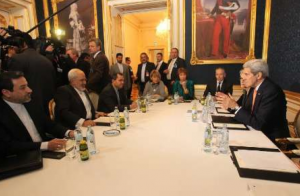
With the Iran nuclear talks nearing a Nov. 24 deadline for a deal, U.S. chief negotiator Wendy Sherman is under pressure to bring almost a year of bargaining to fruition. While U.S. policy rests ultimately with President Obama, and the most prominent American face in these talks is now that of Secretary of State John Kerry, the hands-on haggling has been the domain of Sherman. On the ground, she has been chief choreographer of the U.S. negotiating team. The President has been pleased enough with her performance to promote her last week from Under Secretary to Acting Deputy Secretary of State.

The talks themselves have been doing far less well, marked by Iranian demands and U.S. concessions. This summer the U.S. and its negotiating partners agreed to extend the original July deadline until November. Tehran’s regime, while enjoying substantial relief from sanctions, is refusing to give up its ballistic missile program and insisting on what Tehran’s officials have called their country’s “inalienable right” to enrich uranium.

The Obama administration badly wants a deal. This week The Wall Street Journal reported that last month Obama wrote a secret letter to Iran’s Supreme Leader Ali Khamenei, which “appeared aimed both at buttressing the campaign against Islamic State and nudging Iran’s religious leader closer to a nuclear deal.” Speaking to reporters in Paris this week about the Iran nuclear negotiations, Kerry said “We believe it is imperative for a lot of different reasons to get this done.”

So, now that crunch time has arrived, what might we expect? If precedent is any guide, it’s worth revisiting Sherman’s record from her previous bout as a lead negotiator, toward the end of the second term of the Clinton administration. Back then, Sherman was trying to clinch an anti-proliferation missile deal with another rogue despotism, North Korea.

That attempt failed, but only after then-Secretary of State Madeleine Albright, together with Sherman, had dignified North Korean tyrant Kim Jong Il with a visit to Pyongyang in late October, 2000. These American top diplomats brought Kim the gift of a basketball signed by one of his favorite players, Michael Jordan. Kim entertained them with a stadium display in which tens of thousands of North Koreans used flip cards to depict the launch of a long-range missile.

Less well remembered was the encounter shortly before Albright’s trip to Pyongyang, in which the State Department hosted a visit to Washington, Oct. 9-12 of 2000, by one of the highest ranking military officials in North Korea, Vice Marshal Jo Myong Rok. The centerpiece of Jo’s trip was a 45-minute face-to-face meeting at the White House, in the Oval Office, with President Clinton. It was historic, it was the first time an American president had met with an official of North Korea’s totalitarian state.

And it was a deft piece of extortion by North Korea, which had parlayed its missile program — including its missile trafficking to the Middle East, and its 1998 test-launch of a missile over Japan — into this lofty encounter in which the U.S. superpower was pulling out all the stops in hope of cutting a deal before Clinton’s second term expired in Jan., 2001. By 2000 (or, by some accounts, earlier) the Clinton administration was also seeing signs that North Korea was cheating on a 1994 denuclearization arrangement known as the Agreed Framework. Eight months before Jo arrived in Washington, Clinton had been unable to confirm to Congress that North Korea had abandoned its pursuit of a nuclear weapons program. Nonetheless, Jo’s visit rolled ahead, with Sherman enthusing in advance to the press that “Chairman Kim Jong Il has clearly made a decision — personally — to send a special Envoy to the United States to improve relations with us.”

Officially, Jo was hosted in Washington by Albright. But it was Sherman, then the Special Advisor to the President and Secretary of State for North Korea Policy, who orchestrated the events, squired Jo around Washington and briefed the press. It was Sherman who had helped prepare the way while accompanying her predecessor, the previous North Korea policy coordinator and former defense secretary, William Perry, on a trip to North Korea in 1999.

Jo arrived in Washington on Oct. 9, staying at the venerable Mayflower Hotel, where Sherman went to greet him. The next morning Jo and his delegation began their rounds with a courtesy call on Albright at the State Department. Then, before heading to the White House, Jo engaged in a symbolically freighted act. According to an account published some years later in the Washington Post by the senior State Department Korean language interpreter, Tong Kim, who was present for the occasion: “The marshal arrived in Washington in a well-tailored suit, but before going to the White House, he asked for a room at the State Department, where he changed into his mustard-colored military uniform, with lines of heavy medals hanging on the jacket, and donned an impressive military hat with a thick gold band.” Perhaps it did not occur to anyone at the State Department that North Korea was still a hostile power, a brutal rogue state fielding one of the world’s largest standing armies, and that this donning of the uniform on State premises was not just a convenience, but an implied threat. Or perhaps the zealous hospitality of the occasion just over-rode any thought at all. In any event, it was in his uniform that Jo went from the State Department to the White House.

Following those meetings, Sherman briefed the press. She made a point of mentioning that Jo had worn a business suit to the State Department. but changed into full military uniform for his meeting with the President of the United States. Sherman chose to interpret Jo’s wardrobe change as happy evidence of North Korean diversity under Dear Leader Kim: “We think this is very important for American citizens to know that all segments of North Korea society, obviously led by Chairman Kim Chong-Il in sending this Special Envoy, are working to improve the relationship between the United States and North Korea and this is obviously an important message to the citizens of North Korea as well.”

Actually, there were substantial segments of North Korean society whose chief preoccupation was finding enough food to stay alive, toward the end of a 1990s famine in which an estimated one million or so had died — forbidden by Kim’s totalitarian state to enjoy even a hint of the freedom that had by then allowed their brethren in South Korea to join the developed world. This was known at the time, but did not figure in Sherman’s public remarks.

On the second evening of Jo’s Washington visit, Albright hosted a banquet for him and his delegation at the State Department. She welcomed the “distinguished group” to the “historic meeting,” and invited everyone to relax and get better acquainted. There was laughter and applause. Jo made a toast — a disturbing toast — in which he said there could be “friendship and cooperation and goodwill, if and when the Democratic People’s Republic of Korea and our leadership is assured, is given the strong and concrete security assurances from the United States for the state sovereignty and the territorial integrity of the Democratic People’s Republic of Korea.”

If the State Department’s chief North Korea policy coordinator, Wendy Sherman, noticed a problem with that toast, and its mention of territorial integrity, it seems she did nothing to alert the assembled American dignitaries. The crowd clapped and raised a toast to North Korea’s envoy. It was left to outside observers, such as American Enterprise Institute scholar and North Korea expert Nicholas Eberstadt, to point out, as Eberstadt stressed at an AEI forum in 2008, that North Korea lays claim to the entire Korean peninsula, including South Korea. “Take a look at the maps; take a look at the preamble to the Workers’ Party charter,” said Eberstadt; the real message is, “We can be friends with North Korea if we are willing to subsidize North Korean government behavior and throw South Korea into the bargain too, but that is a pretty high opening bid.”

Jo’s visit ended with a U.S.-D.P.R.K Joint Communique, full of talk about peace, security, transparency and access. There was no missile deal. Kim Jong Il wanted Clinton, leader of the free world, to come parley over missiles in totalitarian, nuclear-cheating Pyongyang. Clinton demurred. In late October, Albright and Sherman went instead. As the clock ticked down on the final weeks of the Clinton administration, Sherman reportedly traveled to Africa with a bag of cold-weather clothes, to be ready in the event of a last-minute summons to North Korea.

In 2001, President Bush was inaugurated. Sherman left the State Department, and soon afterward she wrote an Op-ed for The New York Times, headlined “Talking to the North Koreans.” Sherman noted that “Some are understandably concerned that a summit with President Bush would only legitimize the North Korean leader” — nonetheless, she urged Bush to try it. Bush tried confrontation in 2002 over North Korea’s nuclear cheating, followed by years of Sherman-style Six-Party Talks, including two agreements, in 2005 and 2007, which North Korea punctuated in 2006 with its first nuclear test, and has followed during Obama’s presidency with two more nuclear tests, in 2009 and 2013.

Vice-Marshal Jo died in 2010. Kim Jong Il died in 2011, and was succeeded by his son, current North Korean tyrant Kim Jong Un, whose regime carried out the 2013 nuclear test, and threatened earlier this year to conduct another. Wendy Sherman rejoined the State Department under Obama, and has moved on from wooing North Korea to the bigger and potentially far deadlier project of negotiating a nuclear deal with Iran. Considerable secrecy has surrounded many specifics of these talks, while Americans have been asked to trust that this is all for their own good. In a talk last month at Washington’s Center for Strategic and International Studies, Sherman said: “As Madeleine Albright once observed — a wonderful Secretary of State, a dear friend, and a business partner to boot at one point in my life — negotiations are like mushrooms, and often they do best in the dark.”

Now, in the Obama administration’s increasingly desperate quest for an Iran deal, comes news that President Obama is proposing to Iran’s Khamenei, ruler of the world’s leading terror-sponsoring state, that Iran and the U.S. cooperate to fight the terrorists of ISIS. This has a familiar ring. Back in 2000, the visit of North Korea’s Vice Marshal Jo to the White House was preceded, shortly beforehand, by a “Joint U.S.-D.P.R.K. Statement on International Terrorism,” in which both the U.S. and North Korea agreed that “international terrorism poses an unacceptable threat to global peace and security.” Apparently this was all part of the negotiating process of finding common ground. What could go wrong? Not that anyone should pin all this on Wendy Sherman, who is just one particularly active cog in the Washington negotiating machine. But there’s a familiar script playing out here. It does not end well.

Is Ahmadinejad making a comeback?

November 7, 2014

Is Ahmadinejad making a comeback? Al-MonitorArash Azizi, November 5, 2014

(Since it now appears that a nuke deal may well be signed by the November 24th deadline — well before the new U.S. Republican Congress takes over in January — what difference does it make now? In any event, with the Supreme Leader in charge regardless of whether Iran’s President is a “moderate” or an “extremist,” what difference does it make, ever? Even a “good” deal can and will be violated with impunity. — DM)

Iran's President Mahmoud Ahmadinejad meets with Iraq's Vice President Khudair al-Khuzaie during his visit in BaghdadMahmoud Ahmadinejad (C) meets with Iraqi Vice President Khudair al-Khuzaie (not seen) during a visit in Baghdad when Ahmadinejad was still president of Iran, July 18, 2013. (photo by REUTERS/Hadi Mizban)

The media activities and meetings of former Iranian President Mahmoud Ahmadinejad signal that he is keeping his name before the public and trying to forge new alliances for his political comeback.

A three-story building in a quiet one-way alley in northern Tehran is the headquarters of an unlikely campaign that opposes both the administration of President Hassan Rouhani and many of the Islamic Republic’s establishment figures.

The Velenjak building is the base of activities for former President Mahmoud Ahmadinejad, who has his offices on its third floor.

Ahmadinejad has been relatively quiet since the ascendance of the moderate Rouhani, but the Iranian Labor News Agency (ILNA) is only one of many outlets that have reported on his desire to make a comeback.

According to Amir Mohebbian, a leading political analyst, Ahmadinejad’s attempt to return to power is obvious as he “quietly awaits favorable conditions and occasionally tests the waters.”

The provincial trips that the former hard-line president makes are one indication.

In addition to making many trips to southern and northern Iran, Ahmadinejad celebrated the end of Ramadan by visiting Taleqan with the family members of four celebrated Iran-Iraq war “martyrs” in a trip that, according to ILNA, was coordinated by the Quds Force, the formidable international arm of Iran’s Islamic Revolutionary Guards Corps.

In April, Ahmadinejad ruled out a return to politics but many of his supporters beg to differ.

They are tirelessly organizing and insist on his return. These are an unlikely bunch. Their young cadre runs many blogs and social media accounts. They draw controversy by their occasionally unconventional mixing of Islamism with an anti-wealthy and anti-establishment discourse, and many have spent time in jail for their activities. Their targets are not only the Reformists but many of the traditional conservatives.

Take Ahmad Shariat, who heads the Internet committee of an Ahmadinejad organization. In his blog, he attacked the policy of backing Syrian President Bashar al-Assad, called for a boycott of the last Majles elections in 2012 (because many Ahmadinejad forces were barred), attacked establishment religious figures such as Ayatollah Mesbah Yazdi and, finally, dared to criticize Supreme Leader Ayatollah Ali Khamenei himself (the latter, in early 2013, led to the closing of Shariat’s blog and his arrest).

These supporters leave no doubt as to their allegiance to the ex-president. One name they go by is “Homa,” a Persian acronym for “Supporters of Mahmoud Ahmadinejad.” An online newspaper with the same name (Homa Daily) opened last week on the occasion of Ahmadinejad’s 58th birthday. (“Square 72” is another outlet, named after Ahmadinejad’s neighborhood in northeastern Tehran).

Abdolreza Davari — who was a vice-president of IRNA, the national news agency for the administration under Ahmadinejad — is a leading organizer of Homa. A controversial figure who was fired from a teaching post for “political activities,” Davari was reported by ILNA as one of the top three media campaigners attempting an Ahmadinejad comeback.

“As an Iranian, I hope for the return of Mr. Ahmadinejad to politics,” Davari told Al-Monitor, before adding that he thinks the ex-president is currently focused on “scientific” activities.

To my question about the regular meetings of Homa in the Velenjak building, Davari says that such meetings are not organized but that “all kinds of people, commentators, students or ordinary people come to meet and talk to Dr. Ahmadinejad.”

Davari also denies that Homa is attempting to organize for next year’s Majles elections. Ahmadinejad’s return to power needs no less than “changes in the current relation of forces,” Davari says, seeming to imply that many of the establishment figures wouldn’t want the ex-president back. Many such figures are especially opposed to Ahmadinejad’s entourage.

Enter Esfandiar Rahim Mashaei, Ahmadinejad’s chief of staff, who was openly rebuked by Khamenei for his maverick mixing of Shiite millennialism, Persian nationalism and leftist language. Despite Khamenei’s personal rejection and the sustained attacks of many who accused Mashaei of leading a “deviationist current,” the ex-president has continued backing his close friend (whose daughter married Ahmadinejad’s eldest son) even after the Guardian Council rejected Mashaei’s candidacy in last year’s presidential elections.

Mashaei’s offices are on the second level of the Velenjak building, and he is known to take part in Homa meetings.

Homa Daily ran Mashaei’s picture in the first page of its first issue, while reprinting his most controversial interview, where he had defended the necessity of “friendship with the Israeli people” — an interview personally criticized and attacked by Khamenei.

Davari says Mashaei doesn’t want to return to politics due to his “cultural and spiritual sentiment.” Taking a note from Mashaei’s book, he says Ahmadinejad’s concept of the Islamic Revolution and his belief in the coming of the hidden Imam is not “meant for a specific geography or religion as the hidden Imam’s global message is aimed at all nations and groups.”

“Freedom-loving and justice-seeking fighters” like Fidel Castro, Che Guevara, Djamila Boupacha, Bobby Sands, Hassan Nasrallah and Hugo Chavez belong to the same global front as Ahmadinejad, Davari insists.

Acolytes of Mashaei seem to have especially targeted Iran’s nuclear negotiations. A group called the “the National Movement for Iran’s Independence” (NAMA, for its Persian acronym) was formed with the declared goal of fighting any compromise with the West. Its unusual name (not mentioning Islam) has the Mashaie imprint.

Mashaei’s presence has always driven away many of Ahmadinejad’s backers. One of them is Mohammadreza Etemadian, a trade adviser to the ex-president. Etemadian told Al-Monitor that he would like to see Ahmadinejad back, but he has always told him to keep Mashaei away since “he is not on good terms with the supreme leader and is a deviant.”

Etemadian is a leading member of the Islamic Coalition Party, the traditional organization of Bazari Islamists and an important part of the establishment. Its leaders seem to detest the populist excesses of Ahmadinejad.

Sensing this, the ever-adventurous Ahmadinejad has been trying to find new allies, even if among the Reformists. He met with Hassan Khomeini, the 40-year-old grandson of the founder of the Islamic Republic, known for his proximity to the Reformists. The ex-president boldly asked Khomeini to lead a group of young clerics to contest the next year’s election of the Assembly of Experts, the body that chooses the supreme leader.

He has also reportedly tried to meet the Reformist ex-President Mohammad Khatami and Ambassador Sadeq Kharazi, an influential diplomat from a key political family.

Meanwhile, it was reported that Gholam-Hossein Elham, the spokesman of Ahmadinejad’s government, has started campaigning for the ex-president and last week met with the governors-generals of the previous government to organize. Elham, however, spoke with the pro-Ahmadinejad “Square 72” website to deny this news.

Unceremoniously bowing out after the disqualification of the candidate he supported in the 2013 presidential elections, Ahmadinejad seems to be busy plotting a comeback.