(Rouhani and Hillary would make a good team for Iran. DM)
The portrait that emerges from Rouhani’s interview is of a man who lies and distorts to defend Iran’s illicit behavior— with its domestic nuclear program and in Syria. Simply put, Rouhani is not a “moderate,” as he is so often described, but an apologist for Iran’s revolutionary regime that operates in defiance of international law and norms.
****************************
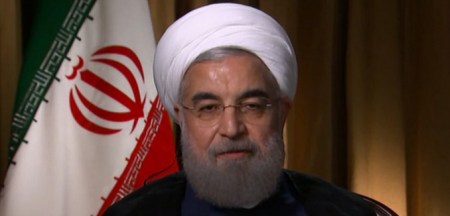
In an interview two weeks ago, Iranian President Hassan Rouhani consistently lied and evaded questions put to him by NBC News’s Chuck Todd.
Todd first asked why Iran was claiming that the United States was not living up to the nuclear deal, known as the Joint Comprehensive Plan of Action (JCPOA). Rouhani responded that the deal states “that all nations involved in this agreement must free the path, pave the way for resumption of normal activities with the Islamic Republic of Iran, such as banking transactions, insurance transactions, and the likes.” Not only is that not correct, it fits a pattern described earlier this week by analysts from the Foundation for Defense of Democracies, in which Iran hopes to gain additional concessions by threatening to walk away from the deal unless the West provides every economic concession that it believes it is owed.
The United States was only required to suspend its nuclear-related sanctions, not sanctions placed on Iran due to its history of terror financing and money laundering. (The United States has seen to it that the global watchdog against money laundering, the Financial Action Task Force, relaxed some restriction on Iran despite Iran’s continued presence at the top of the list of money launderers.)
When asked by Todd whether that was a misinterpretation of the deal’s sanctions-related clauses, Rouhani evaded the question, instead accusing the United States of blocking access to large financial institutions. Then he added that “the other breach of the agreement on the side of the United States, it has been brought into the JCPOA that airplanes intended for civil aviation only must be freely sold to Iran.”
But the airplanes that Iran wants are likely not “intended for civil aviation only.” As Emanuele Ottolenghi of the Foundation for Defense of Democracies has shown, Iran Air, Iran’s national airline, which is seeking to purchase planes from Boeing and Airbus, is using planes to transport arms and troops to Syria to support the regime of Syrian dictator Bashar al-Assad. Transporting soldiers and materiel is not “civil aviation.”
Todd later asked Rouhani if the world should be concerned about Iran’s intentions once most nuclear restrictions on Iran are lifted. Rouhani responded that Iran has adopted additional anti-weaponization safeguards as per the JCPOA, and even if these measures weren’t in place, “within the doctrine or within the laws of the Islamic Republic of Iran to include the fatwa issued by the Supreme Leader of the Islamic Republic of Iran…the building or pursuing or obtaining and using any type of weapons of mass destruction are strictly and unequivocally forbidden by Islamic law.”
The Middle East Media Research Institute has searched for a record of Khamenei’s nuclear fatwa and found no such fatwa. Mehdi Khalaji, an Iran expert at the Washington Institute for Near East Policy (WINEP), wrote in a 2011 study (.pdf) “no written texts exist for the Supreme Leader’s fatwas.” But as WINEP research director Patrick Clawson observed in the preface to Khalaji’s analysis, even if Khamanei had issued such a fatwa, “past proclamations about the matter, like all fatwas issued by Shiite clerics, can be revised under new circumstances.”
Furthermore, Rouhani himself said in a 2005 speech (.pdf) that “having [nuclear] fuel cycle capability almost means that the country that possesses this capability is able to produce nuclear weapons, should that country have the political will to do so,” suggesting that he believes the decision to develop nuclear weapons to be a political, not religious, decision.
Todd followed up by asking Rouhani why Iran has deployed a missile defense system at the Fordow nuclear site if its purpose is strictly civilian. Rouhani cited the need for Iranians to “defend ourselves,” but didn’t fully address the question. When Todd persisted, Rouhani stated that “Iran has always maintained her commitment to any agreement it has become a signatory of. You will not find any instances during the past 38 years of the history of the Islamic Republic of Iran in which a bilateral agreement or an international agreement has been signed and Iran has broken its commitment.”
This is blatantly false. Iran, a signatory to the Nuclear Nonproliferation Treaty refused to end its uranium enrichment program despite the threat of being sanctioned by the United Nations Security Council. The JCPOA allowed Iran to maintain a portion of its enrichment capacity, which it had maintained despite being repeatedly sanctioned. Being forgiven for the breach of an agreement is not the same thing as having abided by it.
Then Rouhani added, “What we were accused of for years, called ‘possible military dimensions,’ the International Atomic Energy Agency eventually reached the conclusion that that file must be closed for good and announced that the activities of Iran were solely for peaceful purposes.”
This is also false. The IAEA report (.pdf) last December did not find that Iran’s nuclear activities “were solely for peaceful purposes.” Rather, it found that Iran had a military nuclear program until at least 2009, though it found “no credible indications” that its military nuclear program continued after this point. It’s true that the IAEA closed down its investigation of Iran’s past nuclear work, but as the Institute for Science and International Security assessed, “the IAEA’s report can be viewed, at best, as a document that closes the process set forth by terms of the Roadmap” to the nuclear deal, but not as a clean bill of health.
Rouhani’s protestations of abiding by the deal also must be viewed with a certain amount of skepticism based on his own record as Iran’s lead nuclear negotiator more than a decade ago. In 2006, after he left the position, Rouhani boasted in a meeting with Islamic clergy and scholars that he had duped the West. Rouhani claimed that Iran had continued installing equipment for converting yellowcake, one of the ingredients necessary for creating nuclear fuel, even as he told his European counterparts that there was no nuclear work being performed at that time.
“When we were negotiating with the Europeans in Tehran we were still installing some of the equipment at the Isfahan site,” Rouhani told his audience. “There was plenty of work to be done to complete the site and finish the work there. In reality, by creating a tame situation, we could finish Isfahan.”
Similarly, when he was running for president in 2013, Rouhani said in an interview that he used the earlier negotiations to advance Iran’s clandestine, illicit nuclear work, boasting, “We halted the nuclear program? We were the ones to complete it! We completed the technology.”
Todd then asked Rouhani about Iran’s involvement in the Syrian Civil War, starting with a question about the recent Russian bombing of a humanitarian convoy, which killed 20 aid workers and which one United Nations official called a war crime. Instead of condemning the attack, Rouhani pointed to a mistaken American airstrike on a Syrian army position—as if an accidental bombing somehow excuses a deliberate one. Rouhani also claimed that since the Syrian soldiers were fighting ISIS (also known as Daesh), the United States was involved in “a direct defense of the Daesh terrorist group.” The charge is outrageous. Even though Syrian troops have been targeting civilians, the United States said that it was an accident and apologized.
Rouhani went on to state that Israel had also attacked some Syrian positions, though he neglected to mention that it was in response to shells being fired into Israel. He allowed that a ceasefire would be beneficial because “food stuff and medicines can get to those who are in need and have been waiting for those supplies for months.” But he didn’t mention that the party engaging in the sieges is Assad, with Iran’s backing.
In response to Secretary of State John Kerry’s recent call for a halt to all flying above Syria, Rouhani stated that “any proposal can be coordinated in order to avoid the targeting of humanitarian convoys.” But a general from his own country’s Islamic Revolutionary Guard Corps (IRGC) boasted last month that Iran provides intelligence on the ground to guide Russia’s bombing campaigns. Given this, and the ensuing possibility that Iranian troops were complicit in the bombing in question, Rouhani’s assurances that convoys can be protected are glib and meaningless.
The portrait that emerges from Rouhani’s interview is of a man who lies and distorts to defend Iran’s illicit behavior— with its domestic nuclear program and in Syria. Simply put, Rouhani is not a “moderate,” as he is so often described, but an apologist for Iran’s revolutionary regime that operates in defiance of international law and norms.
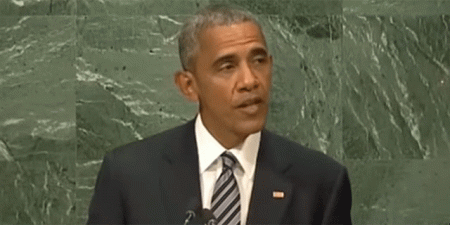
U.S. President Barack Obama addresses the UN General Assembly on Sept. 20, 2016. (Photo: video screenshot)
The Iranian leader rightfully fears a future administration that may not be willing to tolerate a total disregard for international law or human rights, given that even President Obama’s positive nod to Iran at the UN was met with the label of “continued animosity.”
****************************
In 2015, President Obama stated that Iran’s “support for terrorism” and “its use of proxies to destabilize parts of the Middle East” was problematic, despite the Joint Comprehensive Plan of Action (the nuclear deal) that had been reached by that time that allowed Iran access to millions of previously frozen funds.
Yet, bafflingly, just five minutes after mentioning terror proxies in his 2016 UN address last week, President Obama seemed to turn a blind eye to Iran’s ongoing offenses by saying, “When Iran agrees to accept constraints on its nuclear program, that enhances global security and enhances Iran’s ability to work with other nations.”
Today, Iran is poised to move funds to its global terror proxies more easily due to the infusion of cash created by the unfreezing of their assets. Even John Kerry admitted in 2015 that some of the money going back to Iran through sanctions relief would undoubtedly go to fund terrorism.
So, we all know it is happening and yet nothing is being done to stop them or to even state this obvious fact aloud before the very body that is designed to protect against such international violations.
The UN Convention that prohibits terrorism financing explicitly outlines the illegality of any government that commits such an offense when it
“directly or indirectly, unlawfully and willfully, provides or collects funds with the intention that they should be used or in the knowledge that they are to be used, in full or in part, in order to carry out . . . act(s) intended to cause death or serious bodily injury to a civilian, or to any other person not taking an active part in the hostilities in a situation of armed conflict, when the purpose of such act, by its nature or context, is to intimidate a population, or to compel a government or an international organization to do or to abstain from doing any act” (Article 2(1)).
Iran is guilty in spades of all of this.
Additionally, the Iranian government remains the U.S. State Department’s top proxy war and terror sponsor. Previous reports from the U.S. State Department note that Iran remains “unwilling to bring to justice senior al-Qaeda (AQ) members [and has] previously allowed AQ facilitators to operate a core facilitation pipeline through Iran.”
The State Department has also highlighted Iran’s provision of “hundreds of millions of dollars in support of H[e]zballah in Lebanon and has trained thousands of its fighters . . . in direct support of the Assad regime in Syria” as well as terrorist groups in Palestine (Hamas), Yemen (Houthis) and “throughout the Middle East.”
President Obama’s appeals to the oppressive government of Iran have clearly fallen on deaf ears. In a one-on-one with MSNBC’s Chuck Todd merely 24 hours after Obama’s UN speech, Iranian President Rouhani stated, “If the future administration of the United States wishes to continue animosity, it will receive the appropriate response.”
The Iranian leader rightfully fears a future administration that may not be willing to tolerate a total disregard for international law or human rights, given that even President Obama’s positive nod to Iran at the UN was met with the label of “continued animosity.”
No amount of vocal, material or financial appeasement can ease relations with the State Department’s leading state sponsor of terrorism. Despite repeated efforts by President Obama, it will not get better until the Iranian regime abandons its practice of funding terrorism, inciting proxy wars throughout the Middle East, and oppressing their own people by using their resources to build and test weapons before providing the infrastructure needed to create a stable economy and free society for their people.
While Iranian civilians and citizens were in dire economic straits with very little government reprieve or resource allocation to ease their conditions prior to the Nuclear Deal sanctions relief, the Iranian regime was spending over $6 billion per year to support the Assad regime in Syria in its efforts to ensure a Shiite majority in the region.
The Iranian regime must be held accountable for its non-adherence to international law and its desire to finance terror globally in places like Yemen, Iraq, Lebanon, and Syria.
It must be held responsible for using funds to bankroll violence and oppression instead of providing basic necessities and freedoms for its own people. As Obama said at the UN this year, Iran must “listen to voices of young people everywhere who call out for freedom, and dignity, and the opportunity to control their own lives.”
Rouhani made it clear that, despite all of the steps we’ve taken, including acknowledging them positively at the UN General Assembly, nothing the U.S. has done has thawed our relationship with Iran or helped to improve the security of people living in the areas ruled by Iran or its terror proxies.
Our leaders must continue to speak out against Iran’s human rights violations and the financing of terror if we ever hope to see change and remain a positive beacon of democracy and freedom.
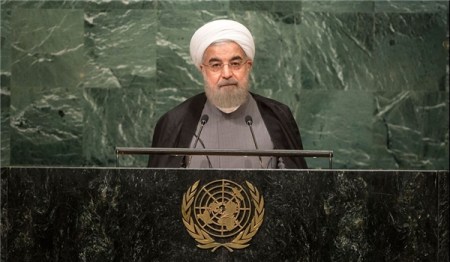
In his September 22, 2016 speech at the UN General Assembly, Iranian President Hassan Rohani accused that the U.S. is not meeting its obligations towards Iran under the JCPOA. He said: “The lack of compliance with the deal on the part of the United States in the past several months represents a flawed approach that should be rectified forthwith… Any failure on the part of the United States in implementing it (the deal) would constitute an international wrongful act and would be objected to by the international community.”[1]
Rohani at the UNGA (Image: Farsnews.com, September 22, 2016)
Rohani’s statements, which are part of an Iranian attempt in recent weeks to create a false impression that the U.S. has not met its obligations towards Iran, are in stark contradiction to statements made by senior members of the Iranian negotiation team who explicitly admitted that the U.S. has in fact met its obligations under the JCPOA (see below).
This Iranian measure is a response to the refusal of Western banks to conduct transactions with Iran in dollars, despite the lifting of the nuclear sanctions in January 2016, because the initial sanctions imposed on Iran by Congress for human rights violations and for terrorism are still in force. As will be recalled, Iran refuses to negotiate with the West on issues of terrorism, on the grounds that these issues are internal sovereign matters.
Below is a MEMRI report on this issue published on August 15, 2016.
As the first year of the JCPOA is marked, and in light of Western banks’ rejection of Iranian transactions in dollars, Iranian Supreme Leader Ali Khamenei and his supporters in the West have launched a campaign to pressure the U.S. to lift the initial sanctions imposed on Iran by Congress for human rights violations and for terrorism. Their aim is to have these sanctions lifted without negotiations and without giving anything in return.
As will be recalled, Iran from the outset restricted the framework of the negotiations to the nuclear issue, and refused to allow them to include other issues such as human rights, terrorism, or missiles, which it considers internal sovereign matters. Therefore, the initial American sanctions concerning these areas remain in force.
A demand for lifting of all the sanctions, including the initial ones, was made by Supreme Leader Ali Khamenei in the months after the JCPOA was achieved in July 2015.[2] Perhaps Tehran thought that with the lifting of the nuclear sanctions, the entire sanctions regime would collapse, including those concerning human rights, terrorism, and missiles. But this did not happen. The U.S. Treasury Department is following the letter and the spirit of U.S. law, and is warning banks worldwide that the initial sanctions remain in force.[3]
In light of this situation, Iran and the supporters of its regime in the West are now working to create a false impression that the U.S. has not met its obligations towards Iran. They claim that, in order to fulfill its commitments towards Iran in the JCPOA, the U.S. is obligated to revoke or circumvent the initial sanctions imposed on Iran by Congress, which currently prevent banks from dealing freely with Iran. For example, Tyler Cullis, member of the Iranian lobby in the U.S., the National Iranian American Council (NIAC), stated in a recent policy paper that “the United States is committed to ensuring that neither U.S. law nor policy is standing in the way of non-U.S. banks resuming correspondent banking relations with their Iranian counterparts… If U.S. laws or policies are interfering with Iran realizing the full benefit of the lifting of sanctions on Iran’s financial institutions, then the U.S. is required to take steps to ensure that those laws or policies no longer are running such interference. To do so could require additional changes to U.S. laws or policies governing the issue.”[4]
Iranian Deputy Foreign Minister and negotiating team member Majid Takhtravanchi also demanded that the U.S. take explicit steps to remove any obstacles currently preventing banks from dealing with Iran. He said on June 27, 2016,: “Two [contradictory] messages are coming out of Washington: The State Department says that there is no problem carrying out banking and financial transactions with Iran, while the OFAC says the opposite… We want the OFAC… to guarantee that there is no problem for the banks that are cooperating with Iran…”[5]
It should be mentioned that the Iranian implication that the U.S. has not met its obligations towards Iran stands in contradiction to explicit statements made recently by Iranian officials, mainly negotiation team members from Iran’s pragmatic camp, who confirmed that the U.S. had upheld its part of the JCPOA. Deputy Foreign Minister and senior negotiating team member ‘Abbas Araghchi said on a television special marking the first anniversary of the JCPOA: “Both sides have met their obligations under the JCPOA… In order to benefit from the JCPOA… we must carry out several steps because there are restrictions that are not connected to the JCPOA… The other side has implemented its obligations, and if it had not, that would have been a violation of the JCPOA, and we would have handled it in the Joint Committee…
“The JCPOA was meant to remove the obstacles of the sanctions from Iran’s economic path. [Indeed], these obstacles have been removed, but there are other obstacles, such as the initial sanctions by America, FATF [Financial Action Task Force on Money Laundering], and laws connected to money-laundering, which require time [to take care of].
“From the outset, [the other side] was not meant to lift the sanctions that are not connected to the nuclear issue; that is written even in the [2013] Geneva Joint Plan of Action [about the lifting of] ‘sanctions related to the nuclear [issue], because we were negotiating about the nuclear issue [alone]…
“The sanctions on the dollar and the use of the financial apparatus of America belong to the initial sanctions imposed long ago because of issues that are not nuclear-related… We raised the matter in the negotiations, but the Americans did not agree to lift these sanctions… and demanded additional concessions [from us] in matters that were part of our red lines…
“The Americans are serious about maintaining their initial sanctions; this is the essence of America. Iran is Iran and America is America, and as long as we do not negotiate on bilateral relations [with the U.S.], these sanctions will remain in force. The American Treasury Department tells [the banks worldwide] that these sanctions are in force, and has warned them not to get in trouble because of them. These sanctions are not related to the JCPOA.”[6]
Deputy Foreign Minister and negotiating team member Hamid Ba’idinejad said at a press conference marking the first anniversary of the JCPOA: “Up to this very moment, the members of the [Iranian] negotiating team believe that the JCPOA has not been violated [by the U.S.], and still believe that it is possible to solve the problems [concerning transactions in dollars] with discussions, recommendations, and talks… From the outset, the task set out [for the Iranian negotiating team] was to resolve the nuclear issue [alone]. So far, the Islamic Republic has made no decision to negotiate with America on [the other] issues in dispute…
“Our regime never expected us to achieve the lifting of the sanctions for human rights [in the framework] of the nuclear talks.”[7]
Expediency Council head Ali Akbar Hashemi Rafsanjani said: “America is telling [the banks worldwide] that it has not lifted the [initial] sanctions because this problem is related to human rights, terrorism, Palestine, and Lebanon. These [issues] too we could have solved.”[8]
However, after Khamenei warned, on August 1, 2016, that the U.S. had violated its commitments, the negotiating team heads fell into line with him, and began to state that the U.S. had indeed violated its obligations and to demand further changes in U.S. policies and laws.
A U.S. capitulation to these Iranian demands would be a blow to the authority of Congress, which imposed the initial sanctions, and to the separation of powers in the U.S. Moreover, it would constitute U.S. support for Iran’s ideological camp – Khamenei, Iran’s Islamic Revolutionary Guard Corps (IRGC), the Basij, and the ayatollahs connected to them – and not to the pragmatic camp, and would also stand in contradiction to President Obama’s commitment that the JCPOA deals only with the nuclear issue.
* Y. Carmon is President of MEMRI; A. Savyon is the director of MEMRI’s Iran Media Project
♦ Iran’s Supreme Leader and the senior cadre of the Islamic Revolutionary Guard Corps have been vocally critical of the nuclear deal. They fear further diplomatic and political rapprochement between the US and Iran, now that they have already achieved their objectives of the lifting of the four major rounds of the UN Security Council’s sanctions.
♦ After the nuclear deal was implemented, polls showed that 63% of Iranians expected to see improvements in the economy and living standards within a year. But currently, in a new poll, 74% of Iranians said there had been no economic improvements in the past year.
Iran’s former president, Mahmoud Ahmadinejad, saying he wants to “redefine revolutionary ideals” set up by the leader of Iran’s 1979 Islamic revolution, Ayatollah Ruhollah Khomeini, appears to be launching a campaign to run in the upcoming Iranian presidential elections, in February, 2017.
Ahmadinejad was well-known for his incendiary and provocative speeches, which included denying the Holocaust. At the end of his presidential term, from 2005 to 2013, his approval rating was extremely low, and he managed to drive away most constituents across political spectrum, including the topmost hardline leaders. He also became the first Iranian president since 1979 to be summoned by the parliament (Majlis) to answer questions regarding his activities and policies.
After all of this, the common conception among politicians, scholars and policy analysts was that Ahmadinejad would never return to politics. It seemed that his retirement plan focused on founding a university and teaching, but his plan to open a university failed.
Despite his low popularity among people, however, the “principalists” (ultra-conservatives) were still on his side, due to his fierce anti-US, anti-Western and anti-Israel policies and rhetoric, as well as the fact that he remains a major figure in the coalition of several conservative groups, the Alliance of Builders of Islamic Iran.
After Ahmadinejad’s presidency, Iran’s Supreme Leader, Ayatollah Ali Khamenei, appointed him to the Expediency Council, Iran’s highest political arbitration body, which arbitrates between the Guardian Council (the supervisory body over the parliament and elections) and the Islamic Consultative Assembly (parliament). The Expediency Council is predominantly made up of Iran’s hardline clerics, and functions as an advisory institution to the Supreme Leader.
Although it seems that Ahmadinejad did not have any intention of returning after being out of the international spotlight for two years, other factors show that he never really left. Domestically, Ahmadinejad remained politically active, trying to unify and lead the hardliners. Since he left office, he has continued holding meetings with former ministers in Tehran.
In the last few months, however, Ahmadinejad’s desire to launch his campaign more forcefully and determinedly has become clearer as, once again, he began attracting the international spotlight, such as when he wrote an open letter to US President Barack Obama, demanding the transfer of $2 billion to Iran.
To capitalize on the popular vote and the presidential elections of 2017, Ahmadinejad has been focusing on attracting constituents from around Iran by traveling to smaller cities and towns, giving lectures and speeches; supporters of Ahmadinejad have called for his return.
During his presidency, people enjoyed subsidies on items including petrol, natural gas and electricity, and his government distributed monthly cash handouts of about $17 to every person. These, as well as criticism of corruption, injustice, and capitalism, were appealing to the rural population and the less affluent.
Ahmadinejad has also been vehemently criticizing Hassan Rouhani, the current Iranian president, as incompetent, and questioning his economic and foreign policies, and pointing out that, “There will be bumps and satanic obstacles in our path… One should not forget that the US is our enemy.”
The latest poll by the Center for International and Security Studies at the University of Maryland revealed that “Ahmadinejad now represents the single largest threat to Rouhani’s re-election, and trails the once-popular incumbent by only eight points. Suddenly, the ex-president seems once again to be a real political contender.”
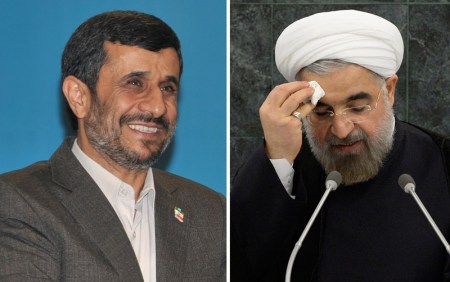
Mahmoud Ahmadinejad (left) can indeed be a viable contender against incumbent President Hassan Rouhani (right) in Iran’s 2017 presidential election, and is more likely the choice of the Supreme Leader and hardliners.
This is a ripe environment for him for several reasons.
First of all, the nuclear deal has become a popular issue among the hardliners. The Supreme Leader and senior cadre of the Islamic Revolutionary Guard Corps (IRGC) have been vocally critical of the nuclear deal. They fear further diplomatic and political rapprochement between the US and Iran, now that they have already achieved their objectives of the lifting of the four major rounds of the United Nations Security Council’s sanctions.
Ayatollah Khamenei warned against any relations with the US, and he also questioned the economic benefits of the nuclear agreement: “Weren’t the oppressive sanctions lifted so that the people would feel a change in their lives? Has there been a tangible effect on the people’s lives in the past six months?”
Second, the popularity of the nuclear deal has been on a decline among the population as well. After the nuclear deal was implemented, polls showed that 63% of Iranians expected to see improvements in the economy and living standards within a year. But currently, in a new poll, 74%of Iranians said there had been no economic improvements in the past year.
Ahmadinejad can indeed be a viable contender against Hassan Rouhani, and is more likely the choice of the Supreme Leader and the IRGC leaders, and the candidate favored by the hardliners and principalists.
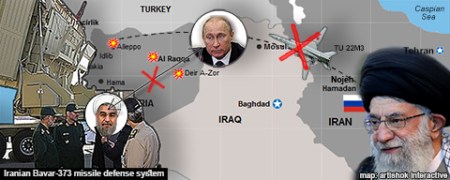
Monday, Aug. 22, just a week after the Russian defense ministry proudly released images of the first Russian bombardments in Syria to be launched from Nojeh airbase, which Tehran had granted Moscow near the Iranian town of Hamedan, the Iranian defense ministry snatched the concession back in a public rebuff for Moscow.
The Russians had presented its Iranian acquisition as the twin of the air base granted by Syria at Kmeimim near Latakia.
However, the Iranian defense ministry spokesman Bahram Ghasemi announced baldly on Monday that the Russian mission “is finished for now.” He added that the Russian air strikes in Syria were “temporary, based on a Russian request;” they were carried out with “mutual understanding and with Iran’s permission” and that the Russian mission “is finished, for now.”
Iranian sources claimed that this stinging slap to the Kremlin was prompted by mounting Iranian popular and parliamentary criticism, on the grounds that permission to a foreign power to use an Iranian base for the first time since World War II violated Article 146 of the Islamic Republic’s constitution.
Attempts by Majlis Speaker Ali Larijani and other regime officials to explain that the Russians had not been given an air base in Iran, only permission to use it to support the war Bashar Assad was waging against terrorists, an interest shared by Iran, fell on deaf ears.
A public outcry on this scale against any steps taken the ayatollahs’ regime is unusual enough to warrant exploration to uncover the hand behind it and its motives. This is all the more pressing in view of the stunning impact of the abrupt Iranian curtailment of the Russian air base venture after no more than three sorties were waged against Syrian targets: Stopped in its tracks for now – even before takeoff – is Vladimir Putin’s effort to promote his grand plan for a new and powerful Russian-Iranian-Turkish-Iraqi-Syrian pact.
The only figure in Tehran capable of raising such a public firestorm with the clout for thwarting the Russian president is supreme leader Ayatollah Ali Khamenei, DEBKAfile’s Iranian sources report.
In handling the air base issue, Putin made the same mistake as US President Barack Obama. Both assumed that getting Iranian President Hassan Rouhani’s cooperation and sensitive diplomatic prodding would eventually win the supreme leader over.
Rouhani had hoped that by extending permission to Iran’s friend Putin for the use of the Nojeh base for air strikes against Syria, he would recover some of the standing he forfeited in Tehran by signing off on the international nuclear accord in 2015.
He took a chance when, on Aug. 16, he summoned the national supreme military council and, without prior consultation with Khamenei, announced the decision to make the Nojeh air base available to the Russian air force. This was a serious miscalculation.
The supreme leader was further incensed by the exclusive report published by DEBKA file that day that Russian air freighters were on their way to the Hamedan base with advanced S-300 and S-400 air defense missiles for guarding the site and the Tupolev-22M3 bombers and Sukhoi-34 fighter bombers deployed there.
Khamenei interpreted this to mean that the Russians were already acting to commandeer the airspace over the base deep inside Iran.
Not content with the brush-off administered to Moscow by his spokesman, Iran’s Defense Minister Hossein Dehghan chided Moscow crudely for “showing off” over the air base in an “ungentlemanly manner” and a “betrayal of trust.”
He said: “We have not given any military base to the Russians and they are not here to stay.”
Realizing he was in hot water, the Iranian president tried to save face.
He arranged to be photographed for state media over the weekend, alongside the Bavar-373 missile defense system, declaring that having developed this system at home, Tehran can defend itself without recourse to the Russian high-altitude, long-range S-300s, because the Bavar-373 was just as good.
DEBKAfile’s military sources refute this claim. Indeed, the system on display which is based on Chinese technology is not operational.
However, the display did not save either Rouhani or Putin from Khamenei’s ire. Nojeh was shut down, a message the Iranian defense ministry spokesman underlined when he said Monday: Russia “has no base in Iran.”
♦ The same state-run media that shapes the Iranians’ views of the West also pushes them to favor hardline candidates.
♦ The new poll shows that Ayatollah Khamenei, his media outlets, and the Revolutionary Guards generals appear to be preparing the platform for a hardline President who will pull out of the nuclear agreement. The new poll also shows that so far their campaign has been successful.
The number of hardliners in Iran is on the rise, according to the latest poll. The Supreme Leader, Ayatollah Khamenei, appears to be preparing the social base so that a hardline president would replace President Hassan Rouhani after the sanctions are lifted by foreign powers. Khamenei seems to be achieving this by using Iranian media to slander the West and improve the image of hardline politicians. Iran’s former president, Mahmoud Ahmadinejad, appears to be getting ready to take Rouhani’s place, and is reportedly preparing his hardline platform to run in Iran’s 2017 presidential elections.
Rouhani’s popularity and standing are evidently not what they used to be. This seems to have come about largely because of changes in the economy. The overwhelming majority of Iranians believed in Rouhani’s economic promises when they elected him; after the nuclear deal was settled, 63% of Iranians believed that they would witness improvements in the economy and living standards within a year. However, a new report shows that 74% of Iranians said that there have been no economic improvements in the last year.
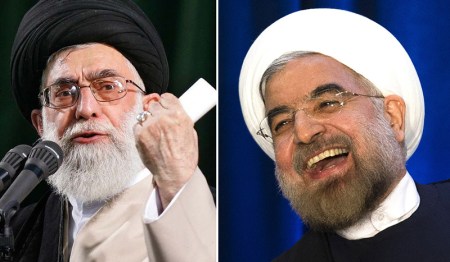
Iran’s Supreme Leader Ali Khamenei (left) appears to be preparing the social base so that a hardline president would replace President Hassan Rouhani (right).
A number of factors have slowed economic growth, including the high unemployment level, the state-owned and state-led economy, financial corruption at high levels, lack of an open market and business opportunities for the public, the increasing gap between the rich and poor, and the accumulation of wealth among the gilded circle in power and other major players — such as Supreme Leader Ayatollah Ali Khamenei, the Islamic Revolutionary Guard Corps (IRGC) and the connected elite business class — who hold control over major socio-political and economic sectors of Iran.
The Iranian government has also not done all that it could to help improve conditions. For example, after the flimsy and incomplete nuclear agreement, the Obama Administration immediately began transferring billions of dollars to Iran’s Central Bank. One of the payments included $1.7 billion transferred in January 2016. Of this sum, $1.4 billion came from American taxpayers. Iran immediately increased its military budget by $1.5 billion from $15.6 billion to $17.1 billion, rather than investing it for creating jobs.
Khamenei has already begun his campaign of blaming the West for Iranian economic problems. He fails to acknowledge the true reason that Iranians are not benefiting from the lifting of sanctions. Instead, as is his method of operation, he blames the West so that he himself is never blamed or held accountable in the eyes of the public. He stated recently “Weren’t the supposed sanctions lifted to change the life of the people? Is any tangible effect seen in people’s life after six months?” Although Iran’s oil exports have reached pre-sanctions levels, and although Iran is freely doing business on the state level, Mr. Khamenei claimed in a speech that, “the U.S. Treasury… acts in such a way that big corporations, big institutions and big banks do not dare to come and deal with Iran.”
An official from the State Department said that Iran should not blame the US for companies not doing business with Iran. Most likely, large corporations are just not yet prepared to make deals with Iran.
Khamenei’s rhetoric has a significant impact on public opinion in Iran. According to a poll, 75% of Iranians believe that the U.S. is to blame for Iran’s stagnant economy. They believe that the U.S. has been creating obstacles to Iranian business with Western companies, and to Iran’s ability to fully rejoin the global financial system.
It is true that since the nuclear deal, Iran’s unemployment rate has increased from roughly 10.8% to 12%. During the course of Rouhani’s presidency, the unemployment rate has increased by two percent. The government has also cut subsidies.
It is possible that Iran’s problems trading with American corporations and rebuilding its economy are due to other Iranian leaders’ rhetoric, the Iranian state-owned media narratives, and lack of clear understanding of the terms of the nuclear agreement among the general public. Approximately 65% of the population still watch only Iran’s domestic news channels to gain information about the latest news in comparison to the 25.4% who use internet, and 18.2% who watch satellite television. Notably, the states viewed most unfavorably by the Iranian public are the Islamic State (97.6% very unfavorable), Saudi Arabia (81.3% very unfavorable), and the United States. The overwhelming majority of Iranians, roughly 80%, believe that it is very important that their country should continue developing its nuclear program.
The same state-run media that shapes the Iranians’ views of the West also pushes them to favor hardline candidates. The new poll reveals that former president Mahmoud Ahmadinejad’s popularity is increasing. Ahmadinejad previously mentioned that he was retiring from politics, but the latest signs indicate that he is repositioning himself to lead the Islamic Republic again. During his presidency, people enjoyed subsidies on petrol, gas and electricity, and his government paid monthly cash handouts of approximately $17 to everyone. In the next presidential race, the poll shows that Ahmadinejad now trails Rouhani by only 8 percentage points compared to 27 points in May 2015.
Finally, another intriguing finding is that the person who has the highest level of respect, “very favorable,” among Iranians is General Qassem Soleimani, the head of IRGC-Qods Force (the external operations wing of the IRGC, which operates in foreign countries). His popularity has increased in the last year. This could be because he is portrayed by the Iranian media as the savior of the Shia in Iraq and Syria, a patriot, and the protector of Iranians from the Islamic State and other types of Sunni extremism. In general, the favorability of the high-profile, hardline and conservative politicians such as Muhammad Bagher Ghalibaf and Ali Larijani appears to have increased. These could threaten Rouhani’s reelection.
Khamenei, his media outlets, and the IRGC generals appear to be preparing the platform for a hardline President who will pull out of the nuclear agreement. The new poll also shows that so far, their campaign has been successful.
TEHRAN (Tasnim) – Iranian President Hassan Rouhani reaffirmed Tehran’s commitment to a nuclear deal with six countries, but warned that in case of the other side’s breach of the agreement, Iran will move to regain its previous nuclear achievements immediately.
“Should the (Group) 5+1 want to avoid honoring commitments one day, we will be fully ready, and our nuclear capabilities are in such conditions that we will be able to reach our favorable point in a short period of time,” President Rouhani said at a cabinet session on Wednesday.
The president insisted that the deal, known as the Joint Comprehensive Plan of Action (JCPOA), is good for all countries and serves international peace and security, warning that violation of the accord would be to the detriment of all parties and the first side to breach it will be a loser in the international arena.
Back in June, Leader of the Islamic Revolution Ayatollah Seyed Ali Khamenei also underlined Iran’s commitment to the nuclear deal with the Group 5+1 (Russia, China, the US, Britain, France and Germany), but made it clear that any violation of the deal by the US will trigger Tehran’s harsher response.
Imam Khamenei emphasized that Iran will never be the first side to violate the nuclear deal, but at the same time noted, “If the threats of tearing off the JCPOA made by the US presidential nominees are carried out, the Islamic Republic will set the JCPAO ablaze.”
Ahmad Jannati speaks during Tehran’s Friday prayers October 15, 2010. REUTERS/Raheb Homavandi
DUBAI (Reuters) – A powerful anti-Western cleric was chosen on Tuesday as the head of Iran’s new Assembly of Experts, in a sign that hardliners are still in firm control of the body in charge of choosing the next supreme leader.
Ahmad Jannati, 90, is a an outspoken critic of President Hassan Rouhani and his attempts to end Iran’s global isolation by normalizing ties with the West.
The 88-member assembly, consisting mostly of elderly clerics, is expected to choose the successor to supreme leader Ayatollah Ali Khamenei, who is 77 and rumored to be in frail health.
The supreme leader has the final say on all state matters, including foreign policy. He is commander-in-chief of the armed forces and appoints the heads of the judiciary, state broadcasting and major economic conglomerates. By comparison, the president has little power.
In a letter to the new assembly, carried by state media, Khamenei asked the new members to “guard the Islamic and revolutionary identity” of Iran and pay attention to the “personal and political piety of the (next) supreme leader”.
The selection of Jannati, with 51 votes according to state media, as the new head is likely to surprise voters in the February election who managed to block many hardliners from keeping their seats in the assembly. Jannati had squeezed in as the last of 16 members elected in the capital Tehran.
Jannati is also the chairman of the Guardian Council, a hardline vetting body that disqualified the majority of prominent reformist and many moderate candidates from running in the February elections.
Even by the standards of Iran’s clerical establishment, Jannati stands out for his virulently anti-Western opinions, once accusing the West of having created al Qaeda and describing U.S. forces in Iraq as “bloodthirsty wolves”.
Rouhani and his key ally, former president Akbar Hashemi Rafsanjani, are also members of the assembly.
♦ Khamenei is sending a strong signal to Washington that Iran’s reintegration in global financial system does not mean that the Iranian regime will change its hostility towards the U.S. and Israel.
♦ “The Persian Gulf is the Iranian nation’s home and the Persian Gulf and a large section of the Sea of Oman belong to this powerful nation. Therefore, we be present in the region, hold war games and display our power.” – Iranian Supreme Leader Ali Khamenei
♦ In addition, Khamenei is sending a message to the Iranian people that the current process of implementing the nuclear agreement, lifting sanctions, and partial economic liberalization does not mean that Iran is going to liberalize its politics and allow freedom of speech, freedom of the press, and more political participation.
Some politicians and policy analysts argue that Iran’s sanctions relief and the continuing implementation of its nuclear program would push Iran towards moderation in dealing with the United States and Israel, as well as scaling down Iran’s expansionist and hegemonic ambitions. The realities on the ground suggest otherwise.
As Tehran’s revenues are rising, anti-American and anti-Semitic rhetoric by Iran’s Supreme Leader, Ayatollah Ali Khamenei, are escalating.
The Iranian regime continues to view the U.S. and Israel as their top geopolitical, strategic and ideological enemies. According to Iran’s Mehr News Agency, on May 1, Khamenei welcomed the Secretary General of Palestinian Islamic Jihad, Ramadan Abdullah Shalah, and his accompanying delegation in Tehran:
“Ayatollah Khamenei reaffirmed that with this perspective in regional issues, Iran sees the United States as the main enemy with the Zionist regime standing behind it. He pointed to extensive, unprecedented sanctions of the U.S. and its followers against the Islamic establishment in recent years and dubbed the objective of them as discouraging Iran from continuing its path; ‘but they failed to achieve their goals and will fail in future as well.’ “
Khamenei is sending a strong signal to Washington that Iran’s reintegration in the global financial system does not mean that the Iranian regime will change its hostility towards the U.S. and Israel.
In addition, Khamenei is sending a message to the Iranian people that the current process of implementing the nuclear agreement, lifting sanctions, and partial economic liberalization does not mean that Iran is going to liberalize its politics and allow freedom of speech, freedom of the press, and more political participation.
Khamenei is also making it clear that Iran is not going to fundamentally change its foreign policy objectives in the region.
Regarding Iran’s role in the Gulf, Iran’s Supreme Leader pointed out on May 2 that
“The Persian Gulf is the Iranian nation’s home and the Persian Gulf and a large section of the Sea of Oman belong to this powerful nation. Therefore, we should be present in the region, hold war games and display our power.”
When it comes to Syria, Iran’s Islamic Revolutionary Guard Corps (IRGC) has become more emboldened and empowered in supporting the Syrian regime financially, militarily, and in intelligence and advisory capacities. Even during the current peace talks, Iran is ramping up its presence in Syria to increase Bashar Assad’s leverage in the negotiations.
In Iraq, Iran’s sectarian agenda and support for Shiite militias continues to cause political instability. This week, hundreds of followers of the Iraqi Shia leader, Muqtada al-Sadr, stormed into the Iraqi parliament building, demanding its speaker halt the session. Prime Minister Haider al-Abadi warned that these protests could lead to the Iraqi state’s failure. After the protests, al-Sadr — who spent several years studying in Qom (Iran’s center of Islamic studies) — travelled to Iran.
Currently, some of the powerful Iraqi Shiite militias with which Iran has close connections, and in which it is investing its resources, are: Sadr’s Promised Day Brigade, the successor to the Mahdi Army; the Badr Organization, Asa’ib Ahl al Haqq (League of the Righteous) and Kata’ib Hezbollah (Battalions of Hezbollah).
In Yemen and Bahrain, Iran’s support for the Houthi rebels and Shiite groups continues to fuel the sectarian conflicts there.
Khamenei has also unleashed a series of anti-U.S. and anti-Israel tweets, including:
“Lebanon’s Hezbollah is strong enough not to be hurt by some pressures; today, no doubt Zionist regime is scared of Hezbollah more than past.” (1 May 2016)
“Shia-Sunni clash is colonialist, US plot. Top issue is to realize 2 sides of the extensive war & one’s stance to avoid being against Islam.” (1 May 2016)
Iran’s foreign policy is anchored in three areas: ideological principles (anti-Americanism and anti-Semitism), national interests (mainly economic gains), and nationalism.
Although Khamenei needed to emphasize Iran’s national and economic interests, there is no evidence that he is giving up on the revolutionary ideological norms. Khamenei is relying on the so-called moderates — President Hassan Rouhani and his U.S.-educated foreign minister, Javad Zarif — to continue the process of implementing the nuclear deal in order to benefit Iran economically and ensure the regime’s hold on power.
Iran’s Supreme Leader, Ayatollah Khamenei (left), is not giving up on the revolutionary ideological norms. He is relying on the so-called moderates, such as President Hassan Rouhani (right), to continue the process of implementing the nuclear deal in order to benefit Iran economically and ensure the regime’s hold on power.
Nevertheless, at the end of day, the key decision makers in Iran’s political establishments are Khamenei and the senior cadre of the IRGC, who prioritize Iran’s ideological and revolutionary principles. It is from them that Khamenei draws his legitimacy.
As long as the Supreme Leader is alive, one should not expect that Iran’s reintegration into the global economy to move the country to the moderate end of the spectrum, or that its anti-American, anti-Semitic sentiments and fundamentals of Tehran’s foreign policies will change.
(The views expressed in this article are mine and do not necessarily reflect those of Warsclerotic or any of its other editors. — DM)
A recent article by David Samuels at the New York Times Magazine, based on an interview with Obama’s foreign policy guru Ben Rhodes, purported to explain how, and about what, the Obama administration lied to get public support for the Iran Scam. According to the article, the principal Obama lie involved who was the Iranian president when the negotiations with Iran began. It’s much deeper and worse than that. As Paul Harvey would say, “Here’s “the rest of the story.”
Iranian President Rouhani was elected on June 15, 2013 and assumed office on August 3d. According to Rhodes,
negotiations started when the ostensibly moderate Hassan Rouhani was elected president, providing an opening for the administration to reach out in friendship. In reality, as Samuels gets administration officials to admit, negotiations began when “hardliner” Mahmoud Ahmadinejad was still president. [Emphasis added.]
There is no necessary inconsistency — about a month and a half elapsed between Rouhani’s election and becoming the Iranian president. However, that is of little if any consequences.
Mr. Rosen, interviewed in the above video, touches, very briefly, on other problems with the Iran scam. Back in the world of reality, “we” had been negotiating with Iran during Ahmadinejad’s presidency for a couple of years, during which “we” gave Iran everything it requested. This article is intended to provide substantially more information and analysis of what happened and why during “our” secret bilateral negotiations with Iran.
The Negotiations
According to interviews with Iranian vice president and Atomic Energy Organization head Ali Akbar Salehi, translated and published by the Middle East Media Research Institute (MEMRI) on August 17, 2015, secret bilateral negotiations between the Obama and Iranian regimes had begun much earlier and included Obama’s Assistant Secretary of State, William Burns. During those negotiations, the U.S. conceded that Iran’s right to Uranium enrichment would be respected, that Iran’s missile programs would be left out of any deal and that its efforts to develop nuclear warheads and other devices would be ignored. Obama had essentially caved in to Iran’s demands even before the existence of negotiations was acknowledged.
In an interview published in the daily Iran on August 4, 2015 under the title “The Black Box of the Secret Negotiations between Iran and America,” Iranian vice president and Atomic Energy Organization head Ali Akbar Salehi, who is a senior member of Iran’s negotiation team and was foreign minister under president Ahmadinejad, revealed new details on the secret bilateral talks between Iran and the U.S. that started during Ahmadinejad’s second presidential term. According to Salehi, U.S. Secretary of Energy Dr. Ernest Moniz, whom Salehi knew from his period as a doctoral student at MIT, was appointed to the American negotiation team at Salehi’s request, a request which the Americans met within hours. [Emphasis added.]
Salehi added that Khamenei agreed to open a direct channel of negotiations between Iran and the U.S. on the condition that the talks would yield results from the start and would not deal with any other issue, especially not with U.S.-Iran relations. Following this, Salehi demanded, via the Omani mediator Sultan Qaboos, that the U.S. recognize Iran’s right to enrich uranium, and received a letter from Qaboos expressing such American recognition, which he relayed to Ahmadinejad. [Emphasis added.]
The secret bilateral Iran-US negotiations had begun with a letter for Iran delivered to an Omani official. Salehi told an Omani intermediary.
‘I am not sure how serious the Americans are, but I will give you a note. Tell them that these are our demands. Deliver it on your next visit to Oman.’ I wrote down four clear issues, one of which was official recognition of rights to [uranium] enrichment. I figured that if the Americans were sincere in their offer, then they must agree to these four demands. Mr. Suri gave this short letter to the mediator, and stressed that these were Iran’s demands. [He added that]if the Americans wished to solve this issue, they were welcome to, otherwise dealing with White House proposals would be useless and unwarranted…
“All the demands in the letter were related to the nuclear challenge. These were issues we have always come against, such as closing the nuclear dossier [in the Security Council], official recognition of [Iran’s] right to enrich [uranium], and resolving the issue of Iran’s actions under the PMD [Possible Military Dimensions]. After receiving the letter, the Americans said: ‘We are certainly willing and able to easily solve the issues Iran has brought up.’ [Emphasis added.]
The first meeting between the Iranian and American negotiating teams began following eight months of coordination. Iran
sent a team to Oman that included the deputy foreign minister for European and American affairs, Mr. [Ali Asghar] Khaji, as well as several CEOs. The Americans were surprised in the first meeting and said, ‘We cannot believe this is happening. We thought Oman was joking. We aren’t even prepared for these talks with you.’
“Q: What was the level of the team that the Americans dispatched?
“A: It included Assistant Secretary of State William Burns. They said: ‘We only came to see if Iran was truly willing to negotiate.’ Our representative gave them the required response and eventually there were talks on this issue. The initial result was achieved and the ground was prepared for further coordination. [Emphasis added.]
“Q: How were the Americans convinced that the Iranian diplomats who were dispatched had the necessary authority?
“A: [Until] that phase, Iran and America had not been allowed to sit opposite each other at the negotiating table. The fact that Iran had sent a deputy foreign minister to the talks indicated its seriousness. The Americans also noticed how seriously [Iran was taking] the issue. At that meeting, Khaji pressed the Americans to set up a roadmap for the negotiations, and eventually the talks of a roadmap were postponed to the second meeting. At the second meeting, Khaji warned the Americans: ‘We did not come here for lengthy negotiations. If you are serious, you must officially recognize enrichment, otherwise we cannot enter into bilateral talks. But if you officially recognize enrichment, then we too are serious and willing to meet your concerns on the nuclear matter as part of international regulations.‘
International regulations were later agreed upon by the P5+1 negotiators, in the form of the Iran – IAEA secret deals concerning nuke inspections and a UN resolution dealing with Iranian missiles. Neither was included in the Joint Cooperative Plan of Action.
“Of course, at that time we were [still] exchanging various information with the Americans via the [Omani] mediation, and this is documented at the Foreign Ministry. We did not do it in the form of official letters, but rather unofficially and not on paper. The Omani mediator later came to Iran, held talks with us, and then later spoke to the Americans and told them our positions, so that the ties were not severed. But there was no possibility for direct talks.
“Thus, a real opportunity was squandered because, at the time, the Americans were genuinely prepared to make real concessions to Iran. Perhaps it was God’s will that the process progressed like that and the results were [eventually] in our favor. In any case, several months passed and Obama was reelected in America [in November 2012]. I thought that, unlike the first time, we must not waste time in coordinating [within regime bodies], so with the leader’s backing and according to my personal decision, I dispatched our representatives to negotiate with the Americans in Oman. [Emphasis added.]
“Q: Didn’t you have another meeting with the leader about the process and content of the talks?
“A: No. Obviously during the process I wrote a letter to the leader detailing the problems. He said ‘try to solve them.’ He was always supportive but told me to ‘act in a manner that includes necessary coordination [within the regime]. In this situation, I dispatched Khaji to the second meeting in Oman (around March 2013) and it was a positive meeting. Both sides stayed in Oman for two or three days and the result was that the Omani ruler sent a letter to Ahmadinejad saying that the American representative had announced official recognition of Iran’s enrichment rights. Sultan Qaboos sent the same letter to the American president. When Ahmadinejad received the letter, several friends said that this move would be fruitless and that the Americans do not keep [their] commitments. [But] we had advanced to this stage. [Emphasis added.]
. . . . We [then ] prepared ourselves for the third meeting with the Americans in order to set up the roadmap and detail the mutual commitments. All this happened while Iran was nearing the presidential elections [in June 2013]. At that time, the leader’s office told me that I had to cease negotiations and let the next government handle the talks after the results of the elections were known.
. . . .
“Q: What was the Americans’ position in the first meetings between Iran and the P5+1 held during the Rohani government [era]?
“A:After the Rohani government began to operate – along with the second term of President Obama – the new negotiations between Iran and the P5+1 were started. By then, Kerry was no longer an American senator but had been appointed secretary of state. As a senator, Kerry had been appointed by Obama to be in charge of handling the nuclear dossier, and then [in December 2012] he was appointed secretary of state. [Emphasis added.]
“Before that, the Omani mediator, who had close relations with Kerry, told us that Kerry would soon be appointed [U.S.] secretary of state. During the period when the secret negotiations with the Americans were underway in Oman, there was a situation in which it was easier to obtain concessions from the Americans. After the Rohani government and the American administration [of Obama’s second term] took power, and Kerry become secretary of state, the Americans spoke from a more assertive position. They no longer showed the same degree of eagerness to advance the negotiations. Their position became harder, and the threshold of their demands rose. At the same time, on the Iranian side, the situation [also] changed, and a most professional negotiating team took responsibility for negotiating with the P5+1. [Emphasis added.]
As to the reluctance of the American side to make concessions after Kerry had replaced Clinton as the Secretary of State, it must be remembered that “we” had already made all or most of the concessions Iran sought.
Another positive point was that [President] Rohani oversaw the dossier, knew its limits, and as a result succeeded in producing a good strategy to advance the nuclear dossier. At the same time, Rohani took responsibility for everything. Many may have reservations and ask why we were putting ourselves in danger, but Rohani’s willingness to take responsibility was very high. There are those who say, from a political standpoint, that he was willing to take a very great risk, because, had the negotiations not achieved certain results, and had the best results not been achieved, he would have faced waves of criticism. But he took upon himself the risk of [such] criticism. In any event, he agreed to take this responsibility, and, God be praised, even God helped him, and he emerged [from the negotiations] with his head held high.” [Emphasis added.]
At some point, the negotiations broke down over “technical issues.” Salehi, a technical expert as well as a diplomat, found a way to resolve those issues.
A . . . condition was that American experts would come to Iran and talk to me. I said that as vice president I would not enter into a discussion with their experts, because as far as the protocol was concerned, this would create a bad situation and they would say that Iran would capitulate in any situation. This was not good for Iran, but I was willing to quit and to come to the talks not as vice president but as the foreign minister’s scientific advisor. Larijani said ‘he’s right.’ The next day, Fereydoun asked me to come to his office and asked me who my [American] counterpart was. I said, the [U.S.] Department of Energy. Fereydoun called Araghchi and said, ‘Tell [U.S. Under Secretary of State for Political Affairs] Ms. [Wendy] Sherman that Salehi is joining the negotiations provided that the American secretary of energy also joins the negotiators.‘ Araghchi and Sherman were the liaison between Iran and America. Araghchi said in this conversation with Fereydoun that on such short notice it was unlikely that they [i.e. the Americans] would send their secretary of energy. I heard [Fereydoun’s conversation with Araghchi]. In short, Fereydoun asked and Araghchi contacted Sherman and a few hours later a report that they welcomed Iran’s proposal arrived. [Emphasis added.]
“Q: How many hours did it take before they [the Americans] said yes?
“A: It didn’t take long. I went to see Fereydoun in the evening and the next day they responded. This was because of the time difference [between Tehran and Washington].
“Q: The general perception was that because Moniz was brought into the negotiating team, you were brought into the Iranian team?
“A: [On the contrary,] Moniz came because of me. In any case, in February [2015] I joined [the negotiations], and praise God, matters moved forward with Moniz.
“Q: Did you and Moniz study together?
“A: Moniz knew me more than I knew him. I saw him at the annual IAEA meeting. When I was a doctoral student at MIT, he had just been accepted as a staff member. He is five years older than me.
“Q: Did you take one of his classes?
“A: No. He knew me because my doctoral studies advisor was his close friend and right hand man in scientific fields. Even now he is an advisor on many of Moniz’s scientific programs. Many of my fellow students are now experts for Moniz. One of them was Mujid Kazimi, who is of Palestinian origin. He recently died. He was two years older than me but we were friends in college. After graduating, he became the head of the MIT Department of Nuclear Science and was a prominent figure who carried out many programs with Moniz.
“Q: How did Moniz treat you initially?
“A: In light of our prior acquaintance, he was excited. We’ve known each other for years and he treated [me] very well. Our first meeting was in public.
“Q: How did you feel when you heard Moniz was coming [to the talks]?
“A: I was very happy. I was assured. I said that the prestige of the Islamic Republic remained intact [because] an Iranian official would not speak to an American expert but rather would negotiate with a high-ranking American official. This was very important. Second, as I said before, he could make a decision [while] an expert could not. We had a very interesting group meeting. The American experts were same ones who had dealt with disarmament vis-à-vis the Soviet Union.
“I said [to Moniz]: ‘I cannot accept your offer for various reasons.’ One American expert said, ‘We do not accept the basic assumption of your calculations.’ I said, ‘Tell us what is the basic assumption of [your] calculations so we can work from there.’ He said ‘we can’t do that.’ I said to them, ‘If you don’t accept our estimation, then tell us [yours]. You say that you cannot because this [exposes] your process. If we show [our] calculation, you will know our working secrets.’ So then I said ‘ok, what do we do now?’ The meeting stagnated.
“Later I thought about it… and said ‘Mr. Moniz, I am here with full authority from my country. Anything I sign will be acceptable to my country. Do you have full authority as well, or does any result achieved here need to be asked and clarified with officials from other countries?’ He said ‘no, I have full authority.’
“Q: Did you have full authority?
“A: Yes. In the scientific discussions, I knew the level of [Iran’s] demands. I said, ‘Mr. Moniz, you made an offer to Iran, and Iran rejects it. I want to ask you a question. If you can answer it [then] I will have no problem with your offer.’ I continued and said: ‘Show me one place on earth where enrichment is taking place using the method you are demanding of us. If you can give me even a single example then I will sign on the spot and we will become the second country to enrich in this method.’ He looked [at me] and then announced that the meeting was over, and we spoke. We had the first private meeting that lasted two or three hours. He said: ‘Mr. Salehi, when I was called [out of the negotiating room, it was because] Obama wanted to speak to me. Now I am free [to continue]. What you said is acceptable [but] there are practical problems with your offer.’ I said, ‘Do you agree? Then I relinquish that proposal.’ Eventually. we reached mutual understandings on this issue. I said ‘let’s start from the top.’ This diplomatic challenge should be published in a memoir so that everyone can understand how we reached 6,000 centrifuges. It is a very nice story… [Emphasis added.]
The Aftermath
Ultimately, Iran’s right to enrich Uranium was fully recognized in the Joint Plan of Action (JPOA) and in the subsequent Joint Cooperative Plan of Action (JCPOA). As to the missile aspects of the “possible military dimensions” of Iran’s nuclear program, neither document dealt with Iranian missiles. That was left up to the United Nations Security Council to deal with in its resolution approving the nuke “deal.” In light of Russia’s warm relations with Iran, Russia would most likely veto any proposed Security Council resolution finding Iran in violation of its missile provisions.
The “verification” mechanism was included only in separate and secret “side deal(s)” solely between Iran and the IAEAwhich members of the U.S. Congress were not permitted to see during the pseudo-approval process. According to Kerry, he was not permitted to see them either, but the details were “fully explained” to him.
Here’s a video of Secretary Kerry under questioning about the side deals:
Questions might have been better directed to this Kerry clone; more candid answers might have been provided.
Any pretense that the IAEA will have “any time, anywhere” access to Iran’s military sites was mere rhetoric, as acknowledged by US Under Secretary of State Wendy Sherman on July 16th
“I think this is one of those circumstances where we have all been rhetorical from time to time,” Sherman said in a conference call with Israeli diplomatic reporters. “That phrase, anytime, anywhere, is something that became popular rhetoric, but I think people understood that if the IAEA felt it had to have access, and had a justification for that access, that it would be guaranteed, and that is what happened.” [Emphasis added.]
Ms. Sherman was right about the rhetorical nature of administration assertions, but wrong about IAEA access, of which there will apparently be little or none pursuant to the secret deals between Iran and the IAEA.
In an interview on Al Jazeera TV last week Ali Akbar Velayati, Security Adviser to Iran’s Supreme Leader, stated that
United Nations nuclear inspectors from the International Atomic Energy Agency would not be given access to Tehran’s sensitive military nuclear sites.
. . . .
“First, allow me to emphasize that the issue of the missiles and of Iran’s defensive capabilities were not part of the negotiations to begin with,” Velayati said. [Emphasis added.]
“No matter what pressure is exerted, Iran never has negotiated and never will negotiate with others – America, Europe, or any other country – about the nature and quality of missiles it should manufacture or possess, or about the defensive military equipment that it needs. This is out of the question.” [Emphasis added.]
. . . .
Reza Najafi, Iran’s ambassador and permanent envoy to the IAEA, stated over the weekend that “no country is permitted to know the details of future inspections conducted by the IAEA.” [Emphasis added.]
Najafi’s statement could mean (a) that no details about inspection methodology will be disclosed, (b) that no details about inspection results will be disclosed or (c) both. If inspection methodologies — who did the inspections as well as when, where and how, are not disclosed, what useful purpose will they serve, other than for Iran? If details of the results of inspections are not disclosed, that will also be the case. How, in either or both cases, will the members of the P5+1 negotiating teams have sufficient information to decide whether to “snap back” sanctions — if doing so is now even possible — or anything else? [Emphasis added.]
Conclusions
One can only hope that our next president will dispose of the Iranian “deal” as a treaty which Obama refused to submit to the Congress as the Constitution requires or at least ostentatiously ignore it and grant no more concessions.
Otherwise, be not afraid; Obama the Great One — the smartest person in any room and the best President ever — has made us safe. How can one possibly be safer alive than dead?






 anneinpt
 artaxes
 danmillerinpanama
 davidking1530
 Peter Hofman
 Joseph Wouk
 Peter
Peter Louisiana Steve
 WarSclerotic
Recent Comments