Archive for the ‘Reform Islam’ category

Fast-roping toward war in the Middle East

October 10, 2015

Fast-roping toward war in the Middle East, Washington Times, Ken Allard, October 8, 2015

(Oh well,


Not on our side

— DM)


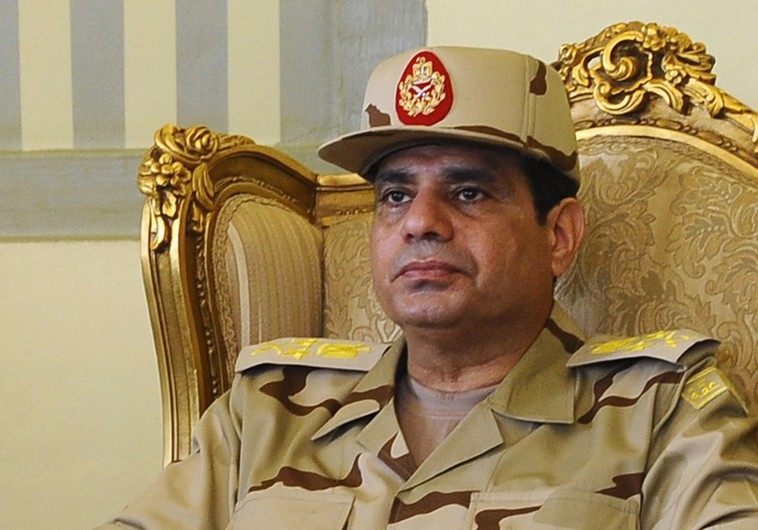
Home to the Arab world’s largest population and the region’s geopolitical crossroads, Egypt had been a key American strategic ally ever since Anwar Sadat. But Mr. Obama backed the Islamist dictatorship of Mohammed Morsi, even after 30 million Egyptians took to the streets in July, 2013 to force his overthrow. When Mr. Obama cut off military ties with the new Egyptian regime of President Abdel Fattah al-Sisi, the Russians swiftly stepped in to reverse a generation of American statecraft. Unlike the amateurs in the West Wing, Russian strategists and diplomats have no difficulty connecting dots or reading maps.

Neither do our few remaining allies in the Middle East, who can be forgiven for drawing their own conclusions, given the Egyptian reversal, those Syrian red-lines, the recent Iranian arms control deal and the steady expansion of Iranian influence throughout the region.

*****************************

The Russians are rapidly reinforcing their bridgehead in Syria, adding ground troops to their air, marine and naval forces. It is a classic air, land and sea intervention by a military establishment that understands how combined arms build synergies and broaden capabilities. As Jed Babbin pointed out in these pages on Wednesday, the broad-shouldered Russian intervention is the direct counterpoint to the “inaction, indecision and dithering” that have long characterized President Barack Obama’s foreign policy.

Russian President Vladimir Putin has called Mr. Obama’s bluff. He has also deployed a Russian expeditionary force bristling with robust anti-aircraft and ground-attack weapons, even firing cruise missiles from warships in the Caspian Sea. Such a deployment is precisely what Mr. Putin believes necessary to insure that Russian jets and helicopters dominate the skies over Syria. Fox News reports that Russian jets have already shadowed U.S. Predator drones on three occasions, a quiet but unsubtle message that the unmanned aircraft are flying only because of Russian forbearance.

Depending solely on Mr. Putin’s strategic objectives, that prevailing restraint can vanish in an instant. Union and Confederate commanders, for example, routinely practiced counter-reconnaissance throughout the Shenandoah Valley campaign of 1864. When planning a surprise attack or defending a vulnerable position, their first objective was to prevent enemy cavalry from having an unobstructed view of one’s own dispositions. What cavalry did back then, air forces and satellites do today.

Updating an ancient principle for the digital age, Norman Schwarzkopf destroyed Saddam Hussein’s radars, reconnaissance systems and intelligence assets before American airpower launched the opening salvos of Operation Desert Storm. Today’s Russian generals grew up practicing the basic principles of Soviet electronic warfare: Intercept the enemy’s communications, jam him or destroy him. Above all: Use the electromagnetic spectrum and state-of-the-art Russian air defenses to offset hi-tech American airpower. In Syria, that campaign has already begun.

Pandering to an American public that is militarily and strategically illiterate, some presidential candidates have reflexively called for “no-fly zones” to be set up in Syria. Predictably, Donald Trump has even expressed enthusiasm for Mr. Putin’s alleged intent to combat ISIS. But seriously, folks, why would Vladimir Putin go to the considerable trouble of staging the largest foreign deployment of Russian forces since the Cold War only to cater to western conceits about no-fly zones? Even if he did, who would set up and enforce them? Having made a power play to control Syria (and therefore a major chunk of the Middle East) why on earth would Mr. Putin content himself solely with attacking ISIS? (If you are having trouble following this logic, then you probably are a member of the White House staff “perplexed” by Russian objectives.

As a highly trained KGB apparatchik, Syria is not Mr. Putin’s first rodeo. While it has become obligatory in Washington policy salons to deplore Crimea and eastern Ukraine, Egypt’s recent history offers a better clue to Russia’s long-range goals.

Home to the Arab world’s largest population and the region’s geopolitical crossroads, Egypt had been a key American strategic ally ever since Anwar Sadat. But Mr. Obama backed the Islamist dictatorship of Mohammed Morsi, even after 30 million Egyptians took to the streets in July, 2013 to force his overthrow. When Mr. Obama cut off military ties with the new Egyptian regime of President Abdel Fattah al-Sisi, the Russians swiftly stepped in to reverse a generation of American statecraft. Unlike the amateurs in the West Wing, Russian strategists and diplomats have no difficulty connecting dots or reading maps.

Neither do our few remaining allies in the Middle East, who can be forgiven for drawing their own conclusions, given the Egyptian reversal, those Syrian red-lines, the recent Iranian arms control deal and the steady expansion of Iranian influence throughout the region. Because it is a tough and unforgiving neighborhood, where would you place your bets if you lived there? Do you ally yourself with the rising regional power or the one seemingly intent only on defeat and retreat? As a friend points out, “Obama only attacks oilmen, Wall Street, the police, pro-lifers, the NRA, Christians, conservative Republicans, and traditional U.S. allies. Remember when they were the good guys?”

In this confusing world, it is important to remember that things can get worse, particularly given the fog of war with lots of heavily armed aircraft moving at high speeds over surprisingly small operating areas. War is justly famed for confounding the best intentions, for proving that the only assumption which holds true is the one you were certain could never happen.

How ironic that the place where three of the world’s great religions were born might yet spark a global confrontation where no holds are barred.
Why hasn’t Sisi visited Washington yet?

October 9, 2015

Why hasn’t Sisi visited Washington yet? Al-MonitorMohamed Saied, October 8, 2014

(Obama thinks highly of the Islamist Muslim Brotherhood and rejects President Sisi because he supported the Egyptian masses who sought the overthrow of an increasingly dictatorial President Morsi. Obama’s rejection of Sisi’s Egypt pushed it into an alliance with Russia. Now Obama, et al, claim that alliance as a basis for the continuing hostility toward Sisi. Perhaps it is. Obama, et al, have also complained about Egyptian human rights violations in repressing the Muslim Brotherhood; few similar complaints have been made about far greater Saudi and Iranian human rights violations. Sisi is the only president of a Muslim nation who seeks to promote a more secular and hence moderate Islam, to which the Muslim Brotherhood is hostile. Please see also, Egypt’s secular culture minister ruffles Salafi feathers. — DM)

One of the most important issues that may hinder the return of US-Egyptian relations to their previous state is the strong relationship between Cairo and Moscow; Sisi has met his Russian counterpart Vladimir Putin four times so far, and Egypt is currently considered the most important ally of Moscow in the Middle East.

**********************

CAIRO — Ever since Egyptian President Abdel Fattah al-Sisi took office on June 8, 2014, US-Egyptian relations have been deteriorating. This has been further confirmed by the fact that Sisi has not visited Washington yet despite the shuttle visits he has made abroad.

Differences and conflicts plagued the US-Egyptian relationship during the era of President Gamal Abdel Nasser. These conflicts culminated in the 1967 Six-Day War, when diplomatic relations between the two countries were severed because of the economic and military support by the United States to Israel.

However, these relations started to take a positive turn based on the strengthening of the strategic interests shared between the two countries in the wake of the signing of the Camp David Accords with Israel — the US’ permanent ally — on Sept. 17, 1978, between Egyptian President Anwar Sadat and Israeli Prime Minister Menachem Begin, as per the State Information Service affiliated with the Presidency of the Republic.

Only one meeting was held between Presidents Sisi and Barack Obama on the sidelines of the 69th Session of the UN General Assembly in September 2014 in New York, but other than this the two presidents have been settling for phone calls to discuss the latest developments in the region.

According to The Washington Times, Obama refused to meet with Sisi on the sidelines of the 70th session of the UN General Assembly. Egyptian Foreign Minister Sameh Shoukry attributed this in a press statement on Sept. 24 to the mismatching agendas and schedules of the two presidents, which prevented them from holding individual talks.

According to the US Embassy in Egypt’s reports on the situation in the country following the revolution of June 30, 2013, Washington started a “comprehensive review” of its relations with Egypt on the background of the ouster of former Egyptian President Mohammed Morsi.

On Aug. 15, 2013, following the killing of hundreds of Muslim Brotherhood demonstrators in Al-Nahda Square and Rabia al-Adawiya Square, Obama announced the cancellation of the Bright Star maneuvers, which were launched in 1980 following the signing of the peace treaty between Egypt and Israel and consisted of a joint military exercise between the two countries.

By October 2013, the review of relations put a halt to the deal consisting of delivering arms to Egypt. Also in October 2013, the US administration suspended $260 million that was going to be directly transferred to the Egyptian government along with another $300 million in US loan guarantees.

However, in a telephone call on March 13, Obama told Sisi that the military aid amounting to $1.3 billion would continue.

Meanwhile, Dina Badawi, spokeswoman for the US State Department for the Middle East, expressed concerns in a live interview on the ONtv channel April 2 over the state of rights and freedoms in Egypt, and pointed out that aid is aimed at continuing the democratic track and the political reforms in the country.

Abdel Moneim Said, director of the Regional Centre for Strategic Studies, and Shai Feldman, the Judith and Sidney Swartz director at the Crown Center for Middle East Studies, said in a research paper titled “Resetting US-Egyptian relations,” which was published in March 2014 on the center’s website, that at the root of the downturn in the US-Egyptian relations is the huge gap between the two sides’ narratives regarding the events of June 30, 2013.

One of the most important issues that may hinder the return of US-Egyptian relations to their previous state is the strong relationship between Cairo and Moscow; Sisi has met his Russian counterpart Vladimir Putin four times so far, and Egypt is currently considered the most important ally of Moscow in the Middle East.

The dispute between Russia and the United States is in regard to several issues. Chief among these is the Syrian issue; Moscow launched airstrikes on Sept. 30, sparking criticism on the part of Obama during a press conference Oct. 2. Obama said that Moscow is acting “not out of strength, but out of weakness” in support of the losing party. The president was referring to Syrian President Bashar al-Assad, and he pointed out that Russia should help in reaching a political settlement.

Meanwhile, the Egyptian Foreign Ministry did not issue any statements condemning or supporting such strikes.

In January, spokeswoman for the US State Department Jennifer Psaki said during the daily press brief that a meeting she described as “routine” was held with a delegation of members of the former Egyptian parliament from the dissolved Muslim Brotherhood-affiliated Freedom and Justice Party, on the sidelines of their visit to Washington, which was organized and financed by Georgetown University in Washington.

This meeting raised the ire of the Egyptian political leadership, as well-informed sources told Reuters in June that the Egyptian government summoned the US ambassador in Cairo to express displeasure over visits to Washington by figures of the Muslim Brotherhood, which is banned in Egypt.

Concerning the fact that Egypt did not extend an official invitation to Obama to meet with Sisi, or vice versa, Atef el-Ghomri, former director of the office of the Egyptian Al-Ahram newspaper in Washington and a member of the Egyptian Council for Foreign Affairs, said, “There is an ongoing split within the US decision-making circles over the revolution of June 30, 2013, and the toppling of former President Mohammed Morsi, who belongs to the Muslim Brotherhood.”

Ghomri told Al-Monitor that over the past years, Egypt’s relations have been confined to its foreign relations with Washington as it only took into account its regional and international interests. This deprived Egypt of any international initiatives or insights about various issues. Also, Egypt had to give up its pivotal role in the Middle East as far as the African and Arab countries are concerned. This negatively affected Egypt over time.

“The Egyptian leadership is trying to diversify its foreign relations. It resorted to the Eastern bloc led by Russia, as well as East Asia represented by China and Singapore.” Ghomri added.

Washington is concerned about several files managed by the Egyptian leadership, mainly the human rights and political reforms issues. The United States has been expressing those concerns since the June 30 Revolution, when the Muslim Brotherhood was toppled and replaced by a military president.

Under such circumstances, Cairo had to resort to other countries, while the US-Egyptian relations are expected to witness further tension, especially with the differences in views concerning several international issues, namely Syria, Iran and Libya.


The Fiction of Political Islam

September 2, 2015

The Fiction of Political Islam, The Gatestone InstituteBassam Tawil, September 2, 2015

  • To this day, the Obama administration mourns the fall of Egypt’s Islamist President Morsi, and turns a cold shoulder to forward-looking President el-Sisi, who is (sometimes) trying to take Egypt into the 21st century and extricate Egypt from its economic and societal crisis.
  • Muslim Brotherhood terrorism against the Egyptian regime is a perfect example of how this “political movement” is in reality a terrorist movement whose objective is the violent overthrow of Egypt’s government. The White House, fully aware of the facts, continues hosting senior Muslim Brotherhood officials and shows them respect during consultations about the American Islamic community and U.S. policy in the Middle East.
  • Events in Sinai prove there is no such thing as “political Islam.” There is a radical Islamist leadership that represents itself to the gullible West as “moderate,” preaches violence from mosques, cloaks itself in ideological-religious tradition, and employs Islamist terrorists to attack civilians and Egyptian government targets.
  • It is hard not to conclude, looking at President Obama’s record (ignoring protesters of 2009 in Iran; “I’ve got a pen, and I’ve got a phone”; the dictatorial way the Iran deal is bypassing the democratic process) that in his heart-of-hearts, he is far more committed to supporting extremist Islamist regimes — whether the mullahs of Iran or the Muslim Brotherhood — than to supporting democracy, individual freedoms or human rights.
  • The Europeans are more aware of the situation but woke up too late. As hundreds of thousands of migrants from Muslim lands continue to pour over Europe’s open borders, there is little doubt that radical Islam is poised to take over the West. Islamic communities and terrorist cells continue to mushroom throughout the cities of Europe.
  • The world is beginning to understand that the catastrophes of the Middle East have nothing to do with the resolution of the Palestinian issue but are caused by the innate homicidal tendencies of the Arab rulers and the regional Islamist terrorist organizations.

Hamas is in trouble. Its relations with Egypt are going from bad to worse, and the influx of money, primarily from Qatar, Saudi Arabia and the mosques in the Western world — where charity (zakat) was collected to finance anti-Israel terrorism — has dwindled to almost nothing. So has the flow of arms and explosives from Iran, Libya, Sudan and Lebanon. The resulted is the weakening of Hamas rule in the Gaza Strip, making it ever more difficult for Hamas to continue its ongoing subversion of the Palestinian Authority (PA) in the West Bank and its non-stop attempts to overthrow President Mahmoud Abbas to take over the West Bank and establish there the sort of Islamic emirate it established in the Gaza Strip.

Hamas’s military buildup was halted when the President Mohamed Morsi’s radical Muslim Brotherhood regime in Egypt was toppled and General Abdel Fattah el-Sisi was elected President. Morsi, it will be recalled, strangely received support from President Obama until he was ousted. The Obama administration supported him despite Morsi enabling for the flow of money and arms to Hamas in Gaza to continue unhampered through the tunnels in the Sinai Peninsula. The weapons were used not only to attack Israel, but also to sabotage peace talks between Israel and the Palestinians and, indirectly, to attack the Palestinian Authority.

The Islamist terrorism festivities ended when President el-Sisi clamped down on the Islamists in Egypt, destroyed the tunnels and sealed Egypt’s border with Gaza. Since el-Sisi has been president of Egypt, Muslim Brotherhood rule has ended and the tunnels have been destroyed. It is hard to fathom why, to this day, the Obama administration mourns the fall of the Islamist Morsi administration and turns a cold shoulder to forward-looking el-Sisi, who is (sometimes) trying to take Egypt into the 21st century and extricate Egypt from its economic and societal crisis.

Since el-Sisi has been in power, money and arms no longer flow through the tunnels into the Gaza Strip; instead they began to flow in the opposite direction, from the Gaza Strip into Egypt’s Sinai Peninsula. Since the Muslim Brotherhood and its affiliated terrorist organizations, Hamas among them, have not accepted defeat, there has been an increase in terrorist attacks targeting the Egyptian regime both inside the country proper and in the Sinai Peninsula. The terrorist campaign receives ongoing support from the Izz al-Din al-Qassam Brigades, Hamas’ military-terrorist wing, and the ISIS-affiliated Ansar Bayt al-Maqdis. Both continuously attack the Egyptian police and army in the Sinai Peninsula, murder Egyptian officials and target Egyptian institutions.

The endless terrorist campaign in Egypt has proven yet again that the claim of a political Islam, separate from the terrorist organizations, is simply a lie. Muslim Brotherhood terrorism against the Egyptian regime is a perfect example of how the “political movement” tries to represent itself as dealing only with the da’wah [proselytizing], while in reality it is a terrorist movement whose objective is the violent overthrow of el-Sisi’s administration. The White House, fully aware of the facts, continues hosting senior Muslim Brotherhood officials and shows them respect during consultations about the American Islamic community and U.S. policy in the Middle East.

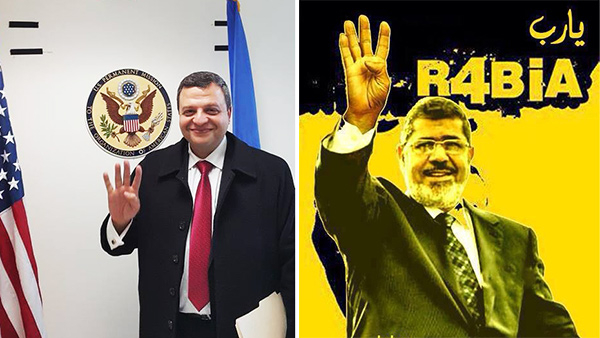
919 (1)While being hosted by the State Department on a visit to Washington in January 2015, Muslim Brotherhood judge Waleed Sharaby (left) flashed the organization’s four-finger “Rabia” sign. At right, ousted Egyptian President Mohamed Morsi (from the Muslim Brotherhood) displays the Rabia sign.

The events in the Sinai Peninsula prove there is no such thing as “political Islam.” There is a radical Islamist leadership that represents itself to the gullible West as “moderate,” preaches violence from the mosques, cloaks itself in ideological-religious tradition, and employs a hard core of Islamist terrorists to carry out attacks on civilians and Egyptian administration targets.

In the meantime, the real victims are the Egyptians. The Muslim Brotherhood’s terrorism has paralyzed Egypt’s tourist industry, as foreigners fear to visit Egypt’s antiquities. And now there are terrorist threats to the New Suez Canal, a project initiated and carried out under the leadership of General Sisi to turn both banks of the two canals into an international logistics, commercial and industrial area.

The Islamists’ plans are clear. First, they want to leverage violence, murder and countless Egyptian army casualties into establishing an autonomous terrorist enclave in the Sinai Peninsula. Then they will try to overthrow the Egyptian government and reinstate an Islamist Muslim Brotherhood regime headed by Morsi. That is exactly what their offshoot, Hamas, did in the Gaza Strip when it liquidated Palestinian Authority officials and established an Islamic emirate. The writing on the wall is still illegible as far as the U.S. government is concerned. Or else the Obama administration is still in the thrall of extremist Islam and its Muslim Brotherhood leaders. The two main ones are Turkey’s Recep Tayyip Erdogan, who has just called new elections so that he can try again to acquire enough seats in parliament to amend Turkey’s constitution to award himself a one-man Sultanate, an absolute dictatorship-for-life to go along with his new palace. The other is Mohamed Morsi, whom Obama apparently is still backing.

It is hard not to conclude, looking at the U.S. president’s record (ignoring the protesters of 2009 in Iran; “I’ve got a pen, and I’ve got a phone” and the dictatorial way the Iran deal has been short-circuited to bypass the democratic process) that in his heart-of-hearts, he is far more committed to supporting extremist Islamist regimes — whether the mullahs of Iran or the Muslim Brotherhood — than to supporting democracy, individual freedoms or human rights.

The Europeans are more aware of the situation but unfortunately woke up too late. As hundreds of thousands of migrants from Muslim lands continue to pour over Europe’s open borders, there is little doubt that radical Islam is poised to take over the West. Islamic communities and terrorist cells continue to mushroom and gather strength throughout the cities of Europe.

From the beginning of the wave of attacks in Egypt, senior Egyptian security officials threatened Hamas. Egypt warned Hamas to stop training, arming and sending its terrorists to collaborate with ISIS operatives in attacks against the Egyptian army. Hamas steadfastly denies any involvement, even as it continues collaborating with ISIS against Egypt.

As far as Hamas is concerned, destroying the Egyptian army is essential, because its continued actions along the Rafah border and in Sheikh Zuweid in the northern Sinai Peninsula prevent Hamas from acquiring money and stockpiling weapons to fight Israel, which weakens its subversion against Mahmoud Abbas and its plans to take over the West Bank.

Despite profuse denials, at the end of August 2015, four operatives from Hamas’s military-terrorist wing, the Izz al-Din al-Qassam Brigades, were taken off a bus by armed Egyptians on the way from Rafah through the Sinai Peninsula to Cairo. Hamas immediately accused Israeli intelligence of responsibility and warned the Egyptian authorities that “the abduction of its operatives will not go unpunished.”

In response, Dina Ramez, a co-host on Egypt’s official TV station, called Hamas out on its lies and denials of its terrorist activities in the Sinai Peninsula against the Egyptian regime. She asked Hamas, “If you are not involved in terrorism, what were your senior Izz al-Din al-Qassam Brigades operatives doing in Sinai?” and called them “cockroaches.”

Sources in Hamas called her a “whore,” and called Egypt a loser country defeated by Israel, using a peace treaty to sell Palestine to the enemy. Was that really the way to thank Egypt for everything it has done for the Palestinians, sacrificing its army and soldiers for us? It is a sad situation for the Palestinians and for our leadership.

What have we Palestinians gained from Hamas’s military actions against Egypt? What have we gained from our solidarity with Islamist organizations fighting against Assad in Syria, or joining organizations such as the “Palestinian Liberation Army” fighting for Assad? Why are we killing each other in the Ain al-Hilweh refugee camp? Why do we refuse everything the Israelis offer us?

Anyone who remembers history remembers the ungrateful path trodden by the Palestinians against the Kingdom of Jordan, when our leaders, headed by Arafat, tried in 1970 to overthrow King Hussein, despite the refuge Jordan offered us during the catastrophes of the Nakba in 1948 and the Naksa in 1967. Then we did the same thing in Lebanon, to where we fled from Jordan. The PLO relocated its headquarters to Beirut, and went on to turn Lebanon into a terrorist country and the lives of the Lebanese into a nightmare. If the Israelis had not invaded Lebanon in 1982, and forced the PLO to relocate to Tunisia (where its behavior was also criminal), the Palestinians definitely would have destroyed Lebanon.

The Middle East is in chaos, and Palestinian factionalism and ingratitude continue to inflame the dissolution of the Arab states and the internal Palestinian division between Hamas in Gaza and the Palestinian Authority in the West Bank.

The world is beginning to understand that the catastrophes of the Middle East have nothing to do with the resolution of the Palestinian issue, but are caused by the innate homicidal tendencies of the Arab rulers and the regional Islamist terrorist organizations.

The only person left who believes the Israeli-Palestinian nonsense is President Barack Obama, even though he is witness to the murders, rapes, beheadings and the millions of refugees, next to which the Palestinian issue is an old, irrelevant and very tired joke.

Iran Deal: A Potential Kiss Of Death For Liberalism In The Middle East’

August 28, 2015

Iran Deal: A Potential Kiss Of Death For Liberalism In The Middle East’, MEMRI, August 27, 2015

In a July 19, 2015 article on Al-Ahram’s English-language website titled “Iran Deal: A Potential Kiss of Death for Liberalism in the Middle East,”[1]Egyptian blogger and political commentator Nervana Mahmoud criticized the claim made, inter alia, by U.S. President Barack Obama and others in his administration, that the nuclear deal with Iran will strengthen moderate elements in that country.[2] Rather than promote liberals, she writes, the deal will only vindicate Iran’s current theocratic leadership by ending Iran’s isolation. It will also, she stresses, send a message to other authoritarian regimes in the region that the U.S. is likely to overlook their crackdown on dissidents, while encouraging Islamist movements to emulate Iran by embracing extremism.

Ms. Mahmoud goes on to accuse the Obama administration of promoting “illiberalism” by defining as moderate “any group, entity, or state willing to show pragmatism and cooperation with the United States, regardless of that state’s intolerant actions on the ground.”

24629Nervana Mahmoud (Image: Nervana1.org)

“For The Iranian Mullahs, The Nuclear Deal Is An Indirect Acknowledgment From The West That Their Anti-Modernity Model Is Viable And Successful”

“After 12 years of diplomatic proposals and 20 months of tough negotiations, theocratic Iran and world powers have reached a nuclear deal that, regardless of its potential advantages, is undoubtedly a victory for smart illiberalism and a potential kiss of death for the prospect of liberal, pluralistic democracies in the Middle East.

“Both illiberal Shi’a and Sunni Islamists and illiberal non-Islamist autocrats could receive an enormous boost from the deal.

“A few years ago, against all advice, I visited the Islamic Republic of Iran. To my surprise, I found a vibrant nation, with many liberal youth yearning for freedom and democracy. Those youth may now celebrate the lifting of sanctions and the end of isolation, but it is doubtful the nuclear deal will bridge the deep divide between them and their theocratic rulers.

“For the Iranian Mullahs, the nuclear deal is an indirect acknowledgment from the West that their anti-modernity model is viable and successful. U.S. President Barack Obama may be genuine in his hopes that Iran will abandon its ‘path of violence and rigid ideology’ following this ‘historic agreement,’ but his hopes may turn out to be no more than wishful thinking.

“The regime – now less isolated–has less incentive to couple its agreed abandonment of its nuclear program with an abandonment of what it sees as successful ideology than ever before.”Many commentators have pointed out that the deal could not have come at a worse time for the Arab world. With open sectarian tension in many Arab countries, a strong Islamic Iran will only inspire other political Islamic groups to try to match up to the Mullahs.

“Iran’s regional influence in Lebanon, Iraq, Syria, and Yemen will only prompt a counter-movement by forces that share an underlying belief in Islamism, but differ in its sectarian interpretation. Since 1979, Sunni Islamism has learned one important lesson from Iran: ‘Yes, we can’ -– a slogan the Islamists touted quietly, long before Obama uttered those words in 2008.

“Arab Islamists saw theocratic Iran as a perfect model for fulfilling their dream of ruling Muslim societies. The new nuclear deal will add two more lessons, and liberal democracy is not one of them– defiance and lobbying in Washington…

“Last Saturday, Ahrar Al-Sham, an Islamist Sunni insurgent group fighting in Syria, published an article in the Washington Post claiming to believe in ‘a moderate future for Syria.’ Charles Lister, a visiting fellow at Brookings, scrutinized their claim: ‘Ahrar Al-Sham has been one of the most consistent military allies of Al-Qaeda affiliate Jabhat Al-Nusra.’ The publication of the article in itself indicates how some people in the corridors of power in Washington are willing to buy Ahrar’s narrative.

“The implication for Syria could not be more serious. Syria will continue to be torn between two mutually exclusive Sunni versus Shi’a forces; many of them are radical, ruthless, and undemocratic. Somehow, the Obama administration seems to see no problem in embracing both…’However, tacitly embracing radical Shi’a militias’ fight against radical Sunni groups such as the Islamic State (ISIS), while pretending that other radicals such as Ahrar Al-Sham are moderate, does not seem to be a sound strategy.”

“It Is Dangerous For The U.S. To Empower Illiberalism In A Region That Suffers Mainly As A Consequence Of Its Illiberal Players”

“In Egypt, neither the removal of Hosni Mubarak nor the ousting of Muhammad Mursi has produced a liberal democracy. Moreover, a significant section of the Muslim Brotherhood, despite its antipathy to Shia Islamism, has started to view the Iranian model as the way forward to regain power.

“They wrongly attribute their failure to run the country during Morsi’s tenure to what they describe as their ‘reluctance to embrace revolutionary politics.’ The Mullahs’ violent ejection of their opponents in 1979 is seen as ‘a model.’ In addition, the Muslim Brotherhood and its supporters will continue to lobby in Washington, hoping that its projection of an Iranian–style defiance will convince the Obama Administration to exert pressure on the leadership in Cairo to change its posture toward the group.

“On the other hand, many among President Abdel Fattah El-Sisi’s supporters will use Iran as a pretext to justify more crackdown on opponents, and argue that world powers, which are willing to lift sanctions against the Iranian regime, despite 36 years of ruthless rule, have no moral ground on which to judge Egypt.

“In his speech in Cairo in 2009, President Obama advocated tolerance, respect for minorities, and religious freedom. He also said elections alone do not constitute a true democracy.

“Now, as Hisham Melhem, Bureau Chief of the Al Arabiya News Channel in Washington, has pointed out, ‘after almost six and a half years of trying to shape events in the Middle East, President Obama has very little to show for it except the nuclear deal with Iran.’ More alarmingly, the American president seems to have lowered the bar, and is now willing to accept a softer definition of moderation to include any group, entity, or state willing to show pragmatism and cooperation with the United States, regardless of that state’s intolerant actions on the ground.’

“There are intrinsic reasons behind the metastasizing sectarian and ethnic conflicts that followed the failed Arab awakening. It is unreasonable to expect the United States to ‘fix’ the region; however, it is dangerous for the U.S. to empower illiberalism in a region that suffers mainly as a consequence of its illiberal players. It would be a pity if President Obama went down in the history books as the man who fumbled with the West’s anti-illiberalism alarm button, and embraced the enemies of liberalism in the Middle East.”

_____________________

Endnotes:

[1] English.ahram.org.eg, July 19, 2015.

[2] See for example Obama’s interviews in Al-Sharq Al-Awsat (Aawsat.net, ,May13, 2015) and with National Public Radio (Npr.org, April 7, 2015).

The U.S. Must Help Egyptian President Sisi

July 6, 2015

The U.S. Must Help Egyptian President Sisi, American ThinkerMichael Curtis, July 6, 2015

(Not much chance of that. General al-Sisi supported the large masses of Egyptians who wanted then President Morsi deposed. He was later elected President of Egypt. Morsi and his Muslim Brotherhood — which uses terrorism to gain and keep power — is an Obama favorite. Besides, al-Sisi’s efforts to reform Islam run counter to Obama’s delusion that Islam, as it is and has long been, is a wonderful religion of peace. — DM)

The silence was truly deafening. Not a sound from Archbishop Desmond Tutu or Alice Walker or the eager boycotters of Israel or the United Nations Human Rights Council about the brutal massacre of more than 70, perhaps 100, Egyptian soldiers and civilians by Islamist terrorists in the northern Sinai peninsula.

Since Israel, after the 1979 Egyptian-Israeli peace treaty, withdrew all its forces and all settlements — including Yamit — by 1982, the Sinai peninsula has been plagued by terrorist attacks, especially against tourists, by kidnappings, and by violence. After the 2011 Egyptian revolution and consequent uprisings, a major terrorist group emerged and became even more belligerent after the coup that deposed President Mohammed Morsi on July 3, 2013. This was Ansar Bayt al-Maqdis (ABM) that has claimed responsibility for numerous attacks against both Israeli interests and Egyptian personnel.

These assaults included an attack in July 2012 against a Sinai pipeline, a rocket strike in August 2012 on Eilat in south Israel, suicide bombings in el Tor in southern Sinai in May 2014, downing an Egyptian military helicopter in a missile attack, car bombings and hand grenades in Cairo, assassinations and attempted assassinations of Egyptian officials, beheading of four individuals in October 2014, an attack on a security checkpoint, and the June 29, 2015 murder in Cairo of Hisham Barakat, the Egyptian Prosecutor General, who in only two years in office had detained hundreds of members of the Muslim Brotherhood. He was the most senior Egyptian government official murdered.

In November 2014, ABM declared its allegiance to the Islamic State of Iraq and Syria (IS) and accepted the new self-appointed Caliph. It appears to have several hundred trained operatives and collaborators. There are different opinions about the actions of the Sinai Bedouin population, especially that of the largest of the 10 major tribes, the Tarabin tribe in northern Sinai, a tribe that is notorious for drug dealing, weapons smuggling, and human trafficking in prostitutes and African labor workers. Tarabin is said to have called for unification of all the tribes against the terrorists, but rumors of clashes appear to be untrue, and some even allege collaboration with the terrorists. What is true is that local Bedouin tribesmen, alleging discrimination by the state against them, have launched attacks against government forces in Sinai.

Over the last two years ABM, now regarding itself as a dedicated affiliate of IS, has tried to undermine the rule of Egyptian President Abdel Fattah al-Sisi. It has attacked Egyptian army posts, and security centers, and also the UN Multilateral Force in northern Sinai, that oversees the terms of the peace treaty between Egypt and Israel, and tried as well to infiltrate Israeli territory.

There had already been terrorist attacks on October 2014 and January 2015 when more than 30 were killed on each occasion in northeast Sinai. The most dramatic deed of ABM, which now seems to have changed its name to Province of Sinai, (POS) was the series of simultaneous coordinated attacks on July 1, 2015 on fifteen army centers of security forces and checkpoints in northern Sinai. The attacks, including three suicide bombers, killed at least 70 soldiers and civilians.

Evidently POS, imitating its mentor IS that has taken and now rules cities in Iraq and Syria, wanted to take over the city of Sheikh Zuweid, close to Israel, and cut off Rafah from al-Arish.

The danger to all of the democratic countries is immediate for a number of reasons. The first is that the success of the terrorists in their daring ambushes, control of the roads, taking police officers hostage, and planting mines in the streets, indicates not only their disciplined activity but also the influence of IS operatives directly and indirectly through training. IS in Iraq and Syria has operated in just this aggressive and disciplined fashion. All authorities responsible for security in the United States should be conscious of and take account of this highly organized success and of the threat of future similar attacks in the U.S. itself.

The second reason is that Hamas in Gaza is providing support to POS with weapons and logistical support, and even with Hamas terrorists taking part in operations. These have come from Hamas commanders in the Izz ad-Din al-Qassam Brigades that have been prominent for anti-Israeli attacks, including suicide bombings against civilians inside Israel. One particular active commander is Wael Faraj, who has smuggled wounded fighters from Sinai into Gaza.

A third problem is the obvious attempt to undermine and aim at the overthrow of President Sisi, a voice of sanity in the Muslim world. He has courageously criticized the extremists of his religion. In his remarkable speech at al-Azhar University in Cairo on January 22, 2015, he said that fellow Muslims needed to change the religious discourse and remove from it things that have led to violence and extremism. The Muslim religion, he said to imams, is in need of religious reform.

Since he assumed power on June 8, 2014, Sisi has attempted to stem the tide of terrorism by reinforcing the Sinai, restricting traffic, imposing curfews in the area, and demolishing homes of suspected terrorists in Rafah. He sought to create a buffer zone along the border with Gaza, and to destroy the tunnels built by Hamas. But clearly Sisi needs help to survive. It is imperative for the U.S. together with Israel to provide that help to the overwhelmed Egyptian army and intelligence services.

Israel is acutely aware of the danger. POS captured armored vehicles on July 1, 2015 that it can now use to penetrate the border fence between Sinai and Israel. That fence is unlikely to deter a trained terrorist group that now has combat experience. Israel responded by closing roads and two border crossings as a precautionary measure. But all the democratic countries, especially the United States, and also the United Nations because of its Multilateral Force, are now aware that the Islamist terror is at their doors as well as at the outskirts of Israel, and should act accordingly.


A Belief System in Need of Reform

June 26, 2015

(Some may have issues with the source, but I find this video quite compelling. – LS)


Egypt Says NY Times Promoting Muslim Brotherhood Agitprop

June 3, 2015

Egypt Says NY Times Promoting Muslim Brotherhood Agitprop, The Clarion ProjectRyan Mauro, June 3, 2015

(Obama has spread and relied upon much the same meme as the NY Times and Washington Post. — DM)

New-York-Times-Building-IP_1The New York Times building in New York City

If the New York Times values objective reporting, then it must mention the Brotherhood’s calls to violence in its coverage as well as the many other instances of violence that the group has been involved in.

*********************

The Egyptian ambassador to the U.S. has written a public letter toThe New York Times protesting “its unquestioning adoption of Moslem Brotherhood’s propaganda” and false characterization of the Islamist group as non-violent.

Ambassador Mohamed Tawfik’s letter was written around the same time that the Egyptian embassy released three videos of calls to violence made on Muslim Brotherhood television networks based in Turkey.

The networks’ coverage promoted explicit calls for killing Egyptian police officers and attacking foreign companies and embassies. A threat was also made to carry out regional attacks against the interests of countries who support the Egyptian government.

Egypt is infuriated at the Times as well as the Washington Post for repeatedly asserting that the Brotherhood is non-violent. In response to the Times suggestion that the Egyptian government’s prosecution of the Brotherhood is pushing it towards terrorism, the Egyptian ambassador writes:

This statement demonstrates, at best, a complete misunderstanding of the roots of radicalism. At worst, it amounts to a justification for violent extremism. Today, terrorists in Egypt are part of a network of extremists who are bound by a singular distorted ideology, and by a shared goal of taking our region back hundreds of years. They are inspired by the radical teachings of the former Moslem Brotherhood leader Sayyid Kutb [Qutb]. Terrorists in Egypt share the same evil goals as terrorists in Iraq, Syria and Libya.

Indeed, Ambassador Tawfik is correct that the New York Times separates Islamists from terrorists and extremists. The Times editorial condemns “relentless and sweeping crackdown on Islamists, under the baseless contention that they are inherently dangerous.”

The New York Times described sentencing to death of former President Morsi and 100 other Brotherhood members as “deplorable.” It describes the Brotherhood as having renounced violence in the 1970s.

However, Morsi and the defendants were sentenced for his involvement in prison breaks in 2011 that freed 20,000 inmates, including Morsi himself. The Egyptian government says the attacks were well-orchestrated and involved participation by the Muslim Brotherhood, Hamas and Hezbollah.

Tawfik chastises the Times for failing to mention that the prison break was a violent operation that resulted in the deaths of prison guards and inmates and freed members of Hamas and Hezbollah.

The Egyptian ambassador also excoriated the Washington Post in February for “toeing the Muslim Brotherhood line” and advised it to be more balance in order to “save whatever is left of your credibility in the Arab world.”

Egyptian President El-Sisi came into power after the popularly-supported military intervention in July 2013 overthrew the Muslim Brotherhood government. The move had the support of a broad spectrum of Egyptian society with public endorsements from secular-democratic activists, the Grand Sheikh of Al-Azhar University and the leader of the Coptic Orthodox Church.

The overthrow came after Morsi (whose election itself was marred bycharges of voter fraud) seized far-sweeping powers for himself, essentially negating any semblance of a democratic government.

El-Sisi is often characterized as an anti-democratic strongman; a depiction that his government is now challenging.

He argues that these strongman tactics are necessary because a democratic transition cannot be completed without stability, economic development and a confrontation with Islamism (also known as Political Islam). He asks the West to understand that there is a “civilizational gap between us and you” and it will take time to modernize.

A study commissioned by the Egyptian government criticized its heavy-handedness but concluded that banning Islamist parties is required for the country’s stability and democratic development. It recommended a program to separate politics and religion.

The Egyptian government sees the Islamic State (ISIS) as a natural outgrowth of the Muslim Brotherhood. Its website warns that the Muslim Brotherhood has a network of fronts in America that are disguised as civil society organizations.

El-Sisi called for a reformation in Islamic interpretation in January 2014 and made a dramatic call on the Islamic religious establishment to address problematic teachings this January that received widespread media coverage. He has explicitly said that Egypt should be “a civil state, not an Islamic one” and defined the ideology of the enemy as Political Islam in an interview on FOX News Channel.

El-Sisi is also confronting Islamist terrorism internationally, in addition to its fight against Islamic State in the Sinai Peninsula. His government is an enemy of Hamas and is as minimally anti-Israel as can be expected of an Arab leader.

Egypt has conducted airstrikes on ISIS in Libya and is materially supporting the Libyan government in its civil war against Islamist forces. Egypt and Libya are complaining about a lack of American backing. A new Egyptian-backed offensive is said to be in the works.

El-Sisi is assembling an Arab rapid-reaction force of 40-50,000 troops that can quickly be deployed to fight Islamic State and other terrorists. Egypt is also taking part in the Arab military intervention against the Iranian-backed Houthi rebels in Yemen.

El-Sisi also made a historic visit to a Coptic Christian church during mass on Christmas Eve. He challenged the Egyptian honor culture when he apologized to a woman who was raped in Tahrir Square.

Major American media outlets have fallen for the falsehood that the Muslim Brotherhood is non-violent. It is true that the Egyptian government is often criticized for its human rights record, but coverage of those accusations should not automatically exempt the Brotherhood and other Islamists from blame.

If the New York Times values objective reporting, then it must mention the Brotherhood’s calls to violence in its coverage as well as the many other instances of violence that the group has been involved in.

ISIS Announces the Winners of its Death Lottery

May 6, 2015

ISIS POSTS WARNING: ‘We Have 71 Trained Soldiers in 15 States’ – NAMES 5 TARGETS
Posted by Jim Hoft on Tuesday, May 5, 2015, 8:59 PM Via Gateway Pundit


(What’s the matter ISIS? You can’t take a joke? – LS)

ISIS released a new online threat today on JustPasteIt.

The terrorist group says they will murder Pamela Geller and kill anyone who shields her.

The terrorists also say they have 71 fighters in 15 different states and they 23 have signed up already for missions like the failed Sunday attack in Garland, Texas.

Via Sooper Mexican:

Bismillah Ar Rahman Ar Raheem

“The New Era”

To our brothers and sisters fighting for the Sake of Allah, we make dua for you and ask Allah to guide your bullets, terrify your enemies, and establish you in the Land. As our noble brother in the Phillipines said in his bayah, “This is the Golden Era, everyone who believes… is running for Shaheed”.

The attack by the Islamic State in America is only the beginning of our efforts to establish a wiliyah in the heart of our enemy. Our aim was the khanzeer Pamela Geller and to show her that we don’t care what land she hides in or what sky shields her; we will send all our Lions to achieve her slaughter. This will heal the hearts of our brothers and disperse the ones behind her. To those who protect her: this will be your only warning of housing this woman and her circus show. Everyone who houses her events, gives her a platform to spill her filth are legitimate targets. We have been watching closely who was present at this event and the shooter of our brothers. We knew that the target was protected. Our intention was to show how easy we give our lives for the Sake of Allah.

We have 71 trained soldiers in 15 different states ready at our word to attack any target we desire. Out of the 71 trained soldiers 23 have signed up for missions like Sunday, We are increasing in number bithnillah. Of the 15 states, 5 we will name… Virginia, Maryland, Illinois, California, and Michigan. The disbelievers who shot our brothers think that you killed someone untrained, nay, they gave you their bodies in plain view because we were watching.

The next six months will be interesting, To our Amir Al Mu’mineen make dua for us and continue your reign, May Allah enoble your face.

May Allah send His peace and blessings upon our Prophet Muhummad and all those who follow until the last Day.

Abu Ibrahim Al Ameriki

The threat was posted by Abu Al Ameriki.


Arab world: Egypt’s dangerous stalemate

April 17, 2015

Arab world: Egypt’s dangerous stalemate, Jerusalem Post, Zvi Mazel, April 17, 2015

Egypt's Defense Minister Abdel Fattah al-Sisi is seen during a news conference in Cairo on the release of seven members of the Egyptian security forces kidnapped by Islamist militants in SinaiAbdul Fattah Sisi. (photo credit:REUTERS)

Vainly did the Egyptian president try to convince the US-led coalition against Islamic State to extend its activities to the whole Middle East. But US President Barack Obama is unwilling to acknowledge that there is a regional and international dimension to the movement.

*****************

Egyptian President Abdel Fattah al-Sisi is fighting for his country’s survival – and his own.

Islamic terrorism is not abating, hampering vital efforts to bring a better life to the people through a revitalized economy and political stability. Sisi knows he has to show results soon to prevent Egypt from slipping back into anarchy and chaos.

Despite the army’s all-out effort to defeat Islamist insurgency in Sinai, there is no end in sight. F-16 fighter planes and Apache helicopters have joined the campaign, security forces have killed or wounded hundreds of terrorists, destroying their haunts and their training groups – but more keep coming.

Ansar Bayt al-Maqdis gunmen, who have pledged allegiance to Islamic State, continue making daring raids against police stations and other security targets, leading to loss of life and heavy damage.

In one instance on April 14, the commander of the central police station of El-Arish was wounded in a raid; the assailants were able to escape.

For all intents and purposes the situation has reached a stalemate, though the army has managed to contain the terrorists in the northern part of the Sinai Peninsula, preventing them from extending their activities to the south and to the Suez Canal – where they could have inflicted untold damage to economic and security infrastructure, and severely undermined public morale.

However, there are still sporadic terrorist attacks in Cairo and other parts of the country.

Bombs explode, killing and maiming; power lines are blasted. A number of terrorist groups are involved, from Ansar Bayt al-Maqdis and the so-called Soldiers of Egypt to the ever-present Muslim Brotherhood; many of their members have been arrested, their leaders sentenced to death – though no one has been executed yet – but they keep on demonstrating against the regime (though in diminishing numbers).

In Yemen, Iranian-backed Houthi tribes are poised to take over the strategic Red Sea straits, threatening free passage to the Suez Canal – a reminder, if one was needed, of the fact that Islamic terrorism knows no border.

Vainly did the Egyptian president try to convince the US-led coalition against Islamic State to extend its activities to the whole Middle East. But US President Barack Obama is unwilling to acknowledge that there is a regional and international dimension to the movement.

The fact remains that Islamic State dispatches terrorists and weapons to Ansar Bayt al-Maqdis in the Sinai Peninsula from Libya, where there is an unlimited supply of both. No matter how many guerrillas are intercepted or killed by the Egyptian army, more are coming through the vast mountainous and desert region, along the 1,200-km border between the two countries.

Then there is Gaza, where terrorists can find refuge, regroup and train, and where new weapons can be tested.

Cairo is desperately trying to cut off the peninsula from the Strip. The Rafah crossing is closed most of the time, and when it opens it is under the strict supervision of Egyptian authorities. More than 2,000 contraband tunnels have been destroyed and a 1-km.-deep sanitized zone has been installed; thousands of families have been uprooted.

They have been compensated but resentment is high, and the move has prompted widespread condemnation by human rights associations.

Against this backdrop, the regime is weighing extending the zone to 5 km. and making the digging of contraband tunnels punishable by life imprisonment. A court in Cairo has forbidden Hamas activities in Egypt, and another has declared Hamas a terrorist organization; however, the central government is appealing that decision for the sake of its ongoing dialogue with Gaza’s leaders on the Palestinian issue.

The Iranian-Houthi threat has led Sisi to call for the creation of a rapid-response Arab unit, as Saudi Arabia has rallied neighboring states to form a coalition against the rebels in Yemen – who are threatening its border in the south, and were about to take control of the strategic port of Aden.

Though the creation of a united Arab unit was decided at a summit in Sharm e-Sheikh last month, implementation will not be easy. A number of states such as Lebanon and Iraq have warned they would not allow any infringement to their sovereignty; some Gulf states and Jordan have been more forthcoming, and meetings between army commanders are scheduled.

The problem is that these countries are not keen to risk their troops in a ground operation in neighboring states. Armies are the traditional bulwark of Arab regimes; a failed intervention outside their borders could cause their downfall. Nevertheless, since the West is largely indifferent to what is happening, Sisi and his Gulf allies have no choice but to unite against the common threat of Islamic terrorism, be it Sunni or Shi’ite.

On the home front, Sisi has launched a series of impressive projects – a new canal parallel to the old one to enable simultaneous crossing in both directions, thereby doubling receipts; an industrial, commercial and tourist zone between the two canals; 3,000 km of modern roads. Perhaps his most ambitious project is the creation of a new administrative capital city east of Cairo, at an estimated cost of $45 billion. Arab states have rallied to his side, pledging billions of dollars at a special economic summit last month; international groups have indicated their interest in some of the projects – a significant victory for the embattled president.

But Egypt’s endemic problems – population explosion, illiteracy leading to widespread unemployment and enduring poverty, as well as corruption on an epic scale – are not making Sisi’s task easier.

He is also calling to reform Islam by purging it of its extremist discourse, and has already instructed the Education Ministry to eliminate extremist content such as the call to jihad and attacks on other religions.

Meanwhile, the political situation is still unclear and elections are repeatedly postponed, allegedly because of ambiguities in the election law.

The fact is that the president has not been able to secure a large enough block to ensure his electoral victory, while the Muslim Brotherhood – though banned – and other Islamic parties can still muster a sizable vote.

Can Sisi win all his battles? How long will the Egyptian people wait for some much-needed economic results? Egypt is going it alone, still waiting for the West to understand that Cairo remains its best ally against the rising tide of terrorism now lapping at its shores.

King Abdullah II: We’re War With “Outlaws Of Islam” – Special Report

April 14, 2015

King Abdullah II: We’re War With “Outlaws Of Islam” – Special Report via You Tube, April 13, 2015

(He seems quite diplomatic, but what does he actually think? — DM)