Archive for the ‘Putin’ category

Chipping Away at Syria Despite Putin’s Threats

June 30, 2015

Turkey and Jordan said preparing buffer zones inside Syria. Israeli air support mooted. Putin issues warning

DEBKAfile Special Report June 30, 2015, 10:09 AM (IDT)


The Shrinking Country of Syria. [Photo Credit: Artishok Interactive]

(Anyone else would had jumped ship. Putin must have too much to lose to accept a fallen Assad regime. How long other Russian politicians will tolerate this is anyone’s guess. It’s interesting to note that the Jordanian buffer zone includes about 20% of the Israeli-Syrian border, assuming the map is somewhat accurate. – LS)

The Turkish and Jordanian armies were reported on June 30 to be getting ready to cross into Syria for the first time since war engulfed that country in 2011, and set up security buffer zones. Both are impelled to fight ISIS, oppose the Assad regime and anxious to stem the flow of refugees, but there are also differences in their objectives and it is not clear if they are coordinated.

Turkey has prepared 18,000 troops to carve out a buffer zone in northern Syria and use its air force to impose a no-fly zone against Syrian flights. Middle East sources report that the Jordanian army is also on the ready to cross into southern Syria. Jordan and Israel are reported to be planning joint air cover and the creation of a parallel no-fly zone in the south.

These preparations prompted Russian President Vladimir Putin to pledge his support for the Assad regime .On Monday, June 29, Putin summoned Syrian Foreign Minister Walid al-Moallem to his Kremlin office from a meeting with Russian Foreign Minister Sergey Lavrov to tell him that Russia’s “policy to support Syria, the Syrian leadership and the Syrian people remains unchanged.”

Putin has repeatedly warned Western governments against military intervention in the Syrian war or any attempt to oust Bashar Assad, warning that if foreign troops go into Syria, Moscow will respond in kind.

The Russians have not spelled out what action is contemplated, but they have options: they maintain naval and marine forces in the Mediterranean and Black Sea regions able to reach Syria at short notice. South Russian air force bases are also close enough to interfere with no-fly zones being setup over Syria.

Possible outside military intervention in Syria was the dominant topic in the phone call the Russian president put through to President Barack Obama on June 26. The communiqués in Moscow and Washington both referred to the “dangerous situation” in Syria. The two presidents also discussed the prospects of the nuclear accord shaping up with Iran, and the two issues may have been linked. The White House later stated that President Obama had stressed the need for the world powers to hold to a united stand in the negotiations with Iran.

Sources in Ankara claim that President Recep Tayyip Erdogan has already given Turkish units their orders to go into Syria, although this is not confirmed. Others use the term “Western intervention” – suggesting that US and NATO are involved in the Turkish initiative. This may refer to US Air Force squadrons based in southern Turkey possibly providing air cover.

Western and Middle East sources report that the Jordanian plan entails a joint operation with Syrian rebel forces to carve out a security zone in southern Syria running from Jabal Druze and Suwayda in the east running west through the town of Deraa and up to the intersection of the Jordanian-Syrian-Israeli borders.

Fierce fighting has been raging in this part of Syria in recent days as the rebels battle Syrian-Hizballah forces in an attempt to push them out and capture southern Syria. So far they have not made it.
The never-ending refugee problem from Syria is a major headache for the two governments. Turkey hosts some two million refugees and Jordan more than a million and a half. Stemming this flow is not the least of the goals of their buffer zone plans.

Putin’s Economic Legacy

June 29, 2015

Putin Meets Economic Collapse With Purges, Broken Promises

By Peter Sattler 6/28/15 at 10:17 AM Via Newsweek


A wink and a nod. Meanwhile, the dangerous game begins. [Photo Credit: Unknown]

(What better way to distract the Russian people facing economic woes back home than to invade another country and rally against impending threats from outside forces? – LS)

The corrupt bargain on which Russian President Vladimir Putin built his regime—provision of wealth to loyal officials and a decent standard of living to the people—is in dire straits.

As the economy shrinks and the Kremlin adjusts its expenditures, Putin must be aware that the threat of a coalition of disgruntled officials and powerbrokers—aiming to restore their prosperity—grows daily.

With no intention of being deposed in a palace coup, Putin has gone on the offensive, striking the Russian political elite off-balance through mass dismissals and early elections. This threatens to disrupt established patronage networks and political stability across Russia.

As for the Russian people, Putin failed to curb corruption or reform the economy for 15 years. He won’t do so now that he is on emergency footing, and average citizens will suffer as a consequence.

As their situation deteriorates, Russians will not tolerate Putin’s fruitless and autocratic tendencies. The coming chaos among the elite—and hardship for ordinary people—will destabilize Russia in the long term.

Economic Crisis

The collapsing ruble, Western sanctions, Putin’s own ill-designed “countersanctions” and increasing nationalist fervor have prompted dramatic capital flight. By some estimates, capital flight in April was around twice that month’s 1.6 percent drop GDP.

On June 15, the Russian statistics agency Rosstat reevaluated its estimate of GDP shrinkage from 1.9 percent to 2.2 percent. On June 11, Russian Prime Minister Dmitry Medvedev stated that government income had fallen while expenses actually rose by 3.7 percent.

OPEC’s flooding of the oil market ensures that Russian crude production will increase to maintain revenue, swamping the market and depressing prices. Putin’s December 2014 budget was based on oil at $100 per barrel. The projected 2015 Brent crude price is $61 per barrel.

In response to these shocks, Moscow slashed investment projects by a third, including development of the Far East, Kaliningrad and the North Caucasus. Many Federal Target Programs and Federal Targeted Investment Programs will undergo severe cuts and may be seriously underfunded. Should the crisis persist through 2017, the Kremlin could deepen the investment cuts by 42 percent.

Preemptive Offensive

Recognizing the danger that these cuts may breed dissatisfaction within the government, Putin launched a preemptive offensive. He kicked off his campaign in April by tearing through the security chieftains, the siloviki.

On April 6, he gutted the Ministry of Emergency Situations, firing 19 officials from leadership positions across the country without appointing successors. He moved on the powerful Ministry of Internal Affairs, dismissing its Samara office head; naming new leadership for its branches in Krasnodar, Perm and Stavropol; and replacing the chief of its technology and information department.

Putin also posted two new officials to the St. Petersburg and Transbaikal investigative committees. The next day, he struck at the top of the Kremlin itself, replacing the head of the FSB’s counterintelligence division. On April 9, Putin replaced the head of Internal Affairs in the conflict-ridden Kabardino-Balkaria Republic, and on June 10, Putin fired the Novosibirsk oblast chief of police after he permitted opposition leader Aleksei Naval’niy to organize a “Party of Progress” meeting.

Putin also ran a more nuanced campaign against provincial governors. Between April 16 and June 10, Putin fired 14 governors. Ten of these governors were named “acting governor” until September. Should these leaders fail to adequately support Putin and quell opposition within their regions, they will presumably lose these elections and more malleable people will take their places. Putin offered no such hope for the governors of Krasnodar, Tambov, Penza or North Ossetia, replacing them outright.

The threat of early elections extends beyond the federal subjects. On June 11, MP Igor Lebedev, speaker of the Duma and member of United Russia, announced a bill to move parliamentary elections forward from December to September. This political disruption will shock established patronage networks. The disoriented political elite will be more unpredictable than loyal.

Public Hardship

While acknowledging that Russia suffers severe economic conditions, Medvedev claims that the government will do more with less on social spending. However, hard numbers refute his claims.

Rosstat’s June 11 report saw a year-on-year increase in Russians receiving less than the living wage by 3.1 million people in 2015, up to 15.9 percent of the population. Food prices are up by 17.9 percent, and the cost of non-food products and services increased by 17.7 percent and 16.2 percent respectively. April saw wages fall by 4 percent.

Experts are increasingly projecting a sharp spike in the price of medicine. In March, sources from the Moscow city government and Ministry of Health leaked plans to fire around 14,000 health care professionals and close several branches of local hospitals by 2017. Many, including former Finance Minister Alexei Kudrin, claim that the real crisis is still yet to come.

These new hardships are further exacerbated by the failure to reform the Russian economy or judicial system. For instance, reiderstvo, often translated as “raiding” or “asset-grabbing,” continues unabated, allowing local power brokers to seize private assets without reproach. The role of state officials in reiderstvo operations is expanding, and some argue that instances of reiderstvo are increasing over time with tacit official support.

The Kremlin may expand such opportunities in place of providing direct pay-offs. For instance, the 2014 “foreign agents” law allows Russian officials to declare any foreign firm an “undesirable,” seizing its assets. Predatory officials and the collapsing standard of living will inhibit Russians from improving their lives in any meaningful sense.

As the drivers of the collapse persist, the economic crisis will grind on unabated. The public supports Putin’s authoritarianism because it provides order and prosperity. This crisis undermines the core tenants of Putin’s social contract, delegitimizing his regime and widening the gap between the ruling and the ruled.

And ordinary people are mobilizing. Throughout 2014, businesses banded together to form mutual defense associations in answer to aggressive and corrupt bureaucrats. In November 2014, more than a thousand people marched through Moscow, St. Petersburg and Vladivostok to protest health care cuts.

And despite the supposed support for Putin and his war in Ukraine, general discontent is spilling over into politics. In September 2014, 20,000 people marched against Russia’s aggression in Ukraine. This dissatisfaction held strong through March 2015, with 20,000 marching in memorial for Boris Nemtsov and tens of thousands protesting the war in Ukraine.

Protests are continuing throughout 2015, with thousands rallying in Novosibirsk and Petrozavodsk against government corruption and censorship. This does not signal a united and coherent opposition to the government, but rather suggests a leaderless and pervasive discontent, which government is increasingly unable to control. This may lead to a push against Putin’s regime, but it is just as likely to grow erratic and destabilizing.

Putin rose to power, and kept it, by promising wealth to his supporters and a better quality of life for the masses. Today, the economic crisis is stripping him of the ability to fulfill his obligations.

Putin can clamp down on the political elites, but destabilizing the politicians is likely to only cause more uncertainty. Furthermore, restarting growth for the people would require far too much in terms of reform and reorientation to be palatable.

If Moscow cannot uphold its end of the social contract, it can expect only social unrest and instability to result.

Putin Declares Military Spending War

June 29, 2015

Pentagon accuses Russia of ‘playing with fire’ over nuclear threats towards Nato

by Mary Chastain 28 Jun 2015 Via Breitbart


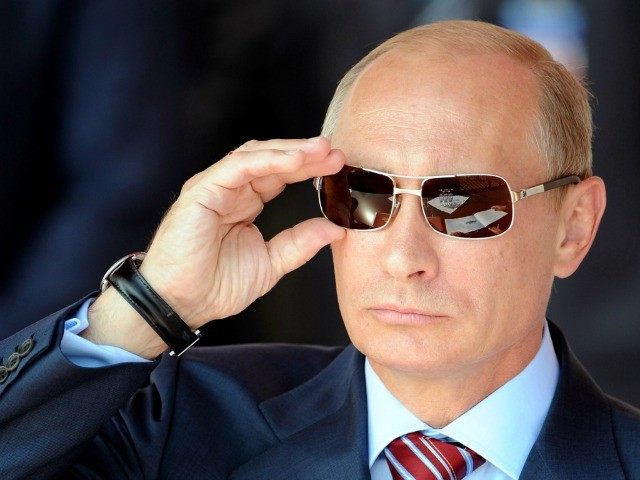
Cool sunglasses. [Photo Credit: AFP]

(Yeah, well good luck with that one Putin. Just remember the last time your predecessors tried to outspend the good old USA. – LS)

According to Russian President Vladimir Putin, the country faces intense threats on its border and must upgrade its army for protection. Ukraine disagrees, as its government reports this week that over 54,000 Russian soldiers are standing by on its borders.

“Currently, Russia continues to deploy a group of troops in close vicinity to border and in the occupied territory of Ukraine, consisting of 45 battalion tactical groups, 17 company tactical groups, with a total number of servicemen exceeding 54,000 people, with all weapons and equipment,” stated the Anti-Terrorist Organization press office.

Putin promised new military graduates plans “to spend 22 trillion rubles (over $400 billion) through 2020 to give the armed forces dozens of navy ships, hundreds of new planes and missiles and thousands of tanks and other weapons.” But his nuclear-armed intercontinental missile program has been delayed, which means the first missile will not be available for several months. There are no specific details regarding why it is taking so long.

“The plant is doing its work,” one defense industry source told The Moscow Times. “Everything now depends on whether or not contractors deliver the [remaining] components on time. The red line that cannot be crossed is the end of October.”

Tensions between the West and Russia continue to rise on an almost weekly basis. Russia’s neighbors pleaded for more protection after Moscow invaded eastern Ukraine and illegally annexed Crimea in case Putin targets them next.

America recently announced more defense for NATO allies in Eastern Europe. It is the first time America has increased its presence in Europe since the end of the Cold War. The U.S. will spread weapons and 5,000 troops in Bulgaria, Estonia, Latvia, Lithuania, Romania, and Poland. All of these countries were once Soviet states or satellite states. Russian officials warned of retaliation if America places tanks and weapons near Russian borders.

“If heavy U.S. military equipment, including tanks, artillery batteries and other equipment really does turn up in countries in eastern Europe and the Baltics, that will be the most aggressive step by the Pentagon and NATO since the Cold War,” declared General Yuri Yakubov, the Russian defense ministry official. “Russia will have no option but to build up its forces and resources on the Western strategic front.”

In mid-June, Putin sent waves through the West when he announced that Russia will own 40 new intercontinental ballistic missiles in 2015. The move forced NATO to review its nuclear weapon policy.

“There is very real concern about the way in which Russia publicly bandies around nuclear stuff,” explained a NATO diplomat. “So there are quite a lot of deliberations in the alliance about nuclear [weapons], but it is being done very slowly and deliberately. We need to do due diligence on where we are.”

Putin also caused a panic when he told the world that Moscow can plant nukes anywhere in their territory, including Crimea. Under the Non-Proliferation Treaty (NPT), five countries, including Russia, may plant “nuclear weapons anywhere in its territory.” However, the United Nations and NATO still consider Crimea a part of Ukraine. In May, NATO lashed out against Russia’s buildup in Crimea. They also repeated to Moscow that none of them recognize their annexation of Crimea.


Russian Bully Putin Threatens Europe

June 16, 2015

Russia warns of ‘new military confrontation’ in Europe

BY Holly Ellyat Via CNBC June 16, 2015


Russia prepares for a European road trip. (photo credit: Kirill Kudryavtsev | AFP | Getty Images)

(While the Russian economy continues to falter, Putin competes in the only way he’s capable…nuclear build up. I hope Europe is listening. The threat is real. Put a cap on the socialist spending and invest in a strong military now before it’s too late. – LS)

Relations between Russia and the West took another downturn this week when Russia warned that any stationing of military equipment along the border with eastern Europe could have “dangerous consequences.”

The warning came as Russian President Vladimir Putin announced on Tuesday that Russia would add more than 40 new intercontinental ballistic missiles to its nuclear arsenal this year, Reuters reported.

The Russian Foreign Ministry issued the warning on Monday after theNew York Times and other media organizations reported that the U.S. had offered to store military equipment for up to 5,000 troops – including battle tanks and heavy weapons — in allied eastern European countries.

“The emergence of such information confirms that the U.S., in cooperation with its allies, apparently has serious sights on ultimately undermining key provisions in the ‘NATO Russia Founding Act’ of 1997, in which the alliance pledged not to deploy substantial combat forces on the territory of the countries mentioned in the permanent basis,” the ministry said in a statement on its website.

“We hope, however, that reason will prevail and that the situation in Europe will be able to keep from sliding to a new military confrontation that could have dangerous consequences.”

The statement preceded a comments from Putin, who was attending a military and arms fair on Tuesday. Addressing the fair’s attendees, he announced the addition of the ballistic missiles which, he said, were able to “overcome even the most technically advanced anti-missile defence systems,” Reuters reported.

An U.S. Pentagon official told the NYT that no decision had yet been made and that the North Atlantic Treaty Organization (NATO), to which many European countries belong, would have to ratify such a move.

“The U.S. military continues to review the best location to store these materials in consultation with our allies,” said a Pentagon spokesman said, cited by the NYT. “At this time, we have made no decision about if or when to move to this equipment.”

Propaganda and Phobia

Eastern European and Baltic states sharing a border with Russia—which include Finland, Estonia, Latvia and Ukraine—have become increasingly nervous about recent, seemingly provocative military exercises by Russia. This follows Moscow’s annexation of Ukraine’s Crimea region last year, role in the pro-Russian uprising in Ukraine and subsequent sanctioning by the West.

Nonetheless, the Russian Foreign Ministry said the proposed move by the U.S. to station military equipment along the border was part of a propaganda plot to turn Europe against Moscow.

“Washington says the planned measures are needed to ‘increase the confidence’ of European allies in the face of the ‘Russian threat,'” the ministry said.

“In fact, capitals in both Washington and in Europe are aware that the ‘Russian threat’ is nothing more than a myth.”

The countries where military equipment could be stored include Bulgaria, Latvia, Lithuania, Poland, Romania, Estonia and possible Hungary. The plans could be decided upon when defence ministers from the 28 NATO member countries meet later in June.

A Russian defence official was also quoted on Monday as saying that any U.S. plan to station tanks and heavy weapons in NATO states on Russia’s border would be an “aggressive step,” news agency Interfax reported.

“If heavy U.S. military equipment, including tanks, artillery batteries and other equipment really does turn up in countries in eastern Europe and the Baltics, that will be the most aggressive step by the Pentagon and NATO since the Cold War,” Russian defence ministry official General Yuri Yakubov said.

He was also quoted as saying Moscow would retaliate by building up its own forces “on the Western strategic front.”

All about Ukraine

With the war of words between the U.S. and Russia threatening to descend into something nastier, Ian Bremmer, president of risk consultancy Eurasia Group, said the geo-political tension was very much focused on Ukraine.

“We have seen a ceasefire in Ukraine that has not held, we have seen an escalation in Russian war material in east Ukraine, we’ve seen casualties in the last few weeks and expanded Russian military exercises on the border as well as more Russian troops,” he told CNBC Europe’s “Squawk Box.”

“From the western perspective it does seem laughable that Russia would talks about the greatest escalation by the Americans potentially putting tanks in the Baltics, which still hasn’t been approved by NATO as a whole, when Russia is putting tanks in countries that don’t want those tanks there. This is very much about Ukraine.”

Moscow has also accused the U.S. of being responsible for the political uprising in Ukraine in 2014 that preceded the annexation of Crimea, in which the pro-Russian leader Viktor Yanukovych was ousted.

“It is convenient to use propaganda to cover up the responsibility of the U.S. for the anti-constitutional coup in Ukraine and in Kiev,” said the Russian Foreign Ministry in its statement.

“The U.S. has assiduously nurtured an anti-Russian among its European allies in order to take advantage of the current difficult moment for the further expansion of its military presence.”