Archive for the ‘Palestinian state’ category

Fearing UN vote on principles of Palestinian statehood, PM ‘reaching out to Trump’

December 26, 2016

Fearing UN vote on principles of Palestinian statehood, PM ‘reaching out to Trump’, Times of Israel, December 25, 2016

bibiandobamamouth(AFP/Pool/Atef Safadi)

TV reports: Netanyahu is wary that Kerry will set out parameters for permanent accord, then outgoing Obama administration will seek Security Council approval.

Amid escalating fallout from the UN Security Council vote Friday that condemned Israel’s settlement activities, a furious Prime Minister Benjamin Netanyahu was reported on Sunday night to be attempting to “recruit” the incoming Trump administration and the US Congress to block a feared bid by the outgoing Obama administration to have the Security Council approve principles for a Palestinian state.

“They are spitting at us,” Netanyahu has told colleagues behind closed doors, Channel 2 news reported. “We will respond forcefully.”

Netanyahu held a 40-minute meeting with US Ambassador Dan Shapiro on Sunday evening, having summoned the envoy to explain why the US abstained in the vote on Resolution 2334, enabling it to pass 14-0, rather than vetoing it. He had earlier summoned the envoys of the 12 nations with representatives in Israel that voted for the resolution for a dressing-down at the Foreign Ministry.

Underlining Israel’s determination to press ahead with building beyond the pre-1967 lines, the Jerusalem municipality will this week approve some new homes in Ramat Shlomo and Ramot, neighborhoods captured in 1967 and subsequently annexed by Israel as part of Jerusalem, Channel 2 news reported.

Netanyahu is now reaching out to the incoming Trump administration, which takes office on January 20, and to friends in Congress, in the hope of “deterring” what he sees as further potential Obama administration-led diplomatic action against Israel, the Channel 2 report said. His aim is for the Trump team to make plain that his administration will “economically hurt” those countries that voted against Israel in the UN and that do so in the future.
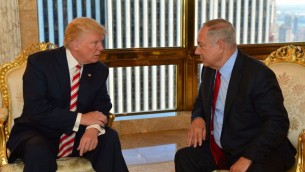
bibiandfriendSeptember 25, 2016. (Kobi Gideon/GPO)

Netanyahu’s fear is that Secretary of State John Kerry will set out principles or parameters for a Palestinian state in a speech that he has said he will deliver in the next few days on his Middle East vision. The prime minister fears that, in its final days, the Obama administration will seek to have a resolution enshrining those parameters adopted by the UN Security Council, the report said.

France is to hold a conference on the Israeli-Palestinian conflict on January 15, and Netanyahu expects that Kerry will attend, that the Middle East Quartet — the US, UN, Russia and EU — will coordinate their positions at that summit, and that they will then turn to the Security Council in the very last days of the Obama presidency, a Channel 10 report further suggested.

Such speculation was not confirmed by the Prime Minister’s Office, but Netanyahu has made public his outrage at the Obama administration several times since Resolution 2334 was passed, claiming that the president initiated and helped draft the resolution “behind Israel’s back.” He has variously called the resolution skewed, shameful and ridiculous — in part because it brands Jerusalem’s Old City, including the Temple Mount and Western Wall, “occupied Palestinian territory.”

Lighting festive Hanukkah candles at the Western Wall on Sunday night, Netanyahu stressed that Israel “cannot accept” the UN resolution, and asked: “How could they vote that [the Western Wall] is occupied territory? We were here much earlier.”

In an address on Saturday night, Netanyahu had likened President Barack Obama to the former president Jimmy Carter, who he said was “deeply hostile” to Israel. He described the vote in the Security Council as “the swan song of the old world that is anti-Israel.” Now, he said, “we are entering a new era. And as President-elect Trump said, it’s going to happen a lot faster than people think.” In this new era, it will be a lot more costly for those who seek to harm Israel, he warned.

The prime minister was also widely reported Sunday to have either canceled or opted not to schedule a meeting with Britain’s Prime Minister Theresa May at the World Economic Forum annual meeting in Davos next month; his spokesman said no such meeting had ever been arranged. He was also said to have chosen not to schedule a meeting with China’s President Xi Jinping. He has already recalled Israel’s ambassadors from Senegal and New Zealand, two of the four countries that co-sponsored the resolution. (Israel has no ties with the other two sponsors, Malaysia and Venezuela.)

Netanyahu also reportedly told his cabinet ministers at a meeting on Sunday morning to reduce to a minimum their engagement with all the countries that voted for the resolution and with which Israel has ties — China, Russia, France, the UK, Spain, Egypt, Angola, Ukraine, Uruguay, Japan, New Zealand and Senegal. They were told to minimize any visits to those countries, and that he would not receive visits from their foreign ministers.

On Saturday, Netanyahu canceled this week’s scheduled visit to Israel of Ukraine’s prime minister.
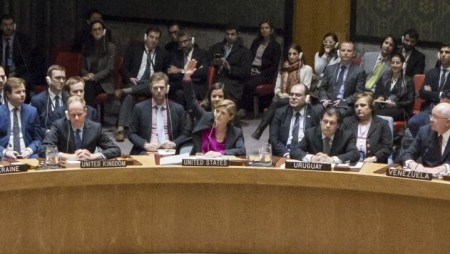
unseccounSamantha Power, center, the United States Ambassador to the United Nations, votes to abstain during a U.N. Security Council vote on condemning Israel’s settlements in the West Bank and east Jerusalem, Friday, Dec. 23, 2016 at United Nations Headquarters. (Manuel Elias/The United Nations via AP)

Addressing the weekly cabinet meeting in Jerusalem Sunday, Netanyahu reiterated his staunch opposition to Resolution 2334.

“We have no doubt that the Obama administration initiated it, stood behind it, coordinated its versions and insisted upon its passage,” he said.

Palestinians: Abbas “The Jew”

October 7, 2016

Palestinians: Abbas “The Jew”, Gatestone Institute, Khaled Abu Toameh, October 7, 2016

The unprecedented outcry over Abbas’s participation in the funeral of an Israeli leader is further proof of the degree to which Palestinians have been radicalized.

This is what happens when you unleash a tidal wave of hate against Israel and its leaders in the media, mosques and public rhetoric. In light of this brainwashing, how do you expect your people to respond when you, in any way, associate with an Israeli leader?

If attending the funeral of an Israeli leader, especially one who devoted the past two decades of his life to peace between Israel and the Palestinians, draws such condemnation, it is easy to imagine the result of a Palestinian leader making a peace overture to Israel.

Even if the current condemnation eventually dies down, it will have sent a message to future Palestinian leaders: “No peace with Israel, not in our time, and not in any time.”


Palestinian Authority (PA) President Mahmoud Abbas is facing a barrage of criticism for attending the funeral of former Israeli President Shimon Peres in Jerusalem. The fury directed towards Abbas comes as no surprise to those who are familiar with the unrelenting campaign of anti-Israel incitement that has been taking place for many years in Palestinian society.

If attending the funeral of an Israeli leader, especially one who devoted the past two decades of his life to peace between Israel and the Palestinians, draws such condemnation, it is easy to imagine the result of a Palestinian leader making a peace overture to Israel.

President Abbas is now receiving a dose of his own medicine. This is what happens when you unleash a tidal wave of hate against Israel and its leaders in the media, mosques and public rhetoric. This is what happens when you inform your people that Israeli leaders are “war criminals” who ought to be prosecuted before the International Criminal Court. This is what happens when you drive into your people that Jews are desecrating with their “filthy feet” Islamic holy sites in Jerusalem. This is what happens when you accuse Israel of “ethnic cleansing”, “extra-judicial executions” and “poisoning” Yasser Arafat.

In light of this brainwashing, how do you expect your people to respond when you, in any way, associate with an Israeli leader?

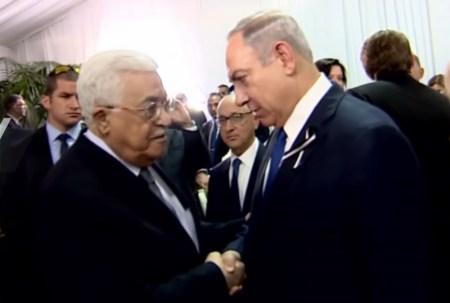
1928Palestinian Authority President Mahmoud Abbas shakes hands with Israeli Prime Minister Binyamin Netanyahu at the funeral of Shimon Peres, a former president of Israel, on September 30. Abbas is facing a barrage of criticism for attending the funeral, with members of his own party calling it “treason.” (Image source: Ruptly video screenshot)

It is hard to believe that Abbas and his cronies were surprised by the current wave of reprobation. But the degree of vitriol was perhaps not predicted.

Abbas is now getting it from all quarters. The denunciations are coming not only from his political foes in Hamas, Islamic Jihad and the Popular Front for the Liberation of Palestine (PFLP), but also from groups and figures belonging to his ruling Fatah faction.

Palestinians say that the 81-year-old Abbas, who is now in his 11th year of his four-year term in office, is facing his most serious challenge to leadership. And there are no signs that the recriminations are subsiding. On the contrary, each day brings with it yet another flood of reproof, prompting Palestinian Authority officials in Ramallah to issue a stiff warning to those who are exploiting the situation to “incite” against Abbas. However, the threats have failed to deter his critics from proceeding with their attacks on him and calling on him to step down.

One of those who have already paid a price for criticizing Abbas’s attendance of the Peres funeral is Lieutenant Colonel Osama Mansour, who holds a senior position in the PA’s Military Liaison Apparatus. In a post on Facebook, the PA officer strongly condemned Abbas’s move:

“If you alone decided to participate in the funeral of the killer of our sons, then you erred. And if you took the decision on the basis of what you were told by your advisors, then they have misled you.”

Hours after the post appeared on Facebook, Mansour was suspended from his job. Later, he was arrested by PA Military Intelligence Service officers who raided his house and conducted a search, during which they destroyed furniture, according to his family. A PA court has since ordered Mansour remanded into custody for fifteen days.

The suspension and subsequent arrest of the officer sparked a new wave of rage against Abbas and his security forces. Palestinians took to social media to protest the crackdown on the officer, hailing him as a hero and denouncing Abbas as a “dog” and Israeli “collaborator.” Some suggested that the officer was worthy of being appointed as a minister in the PA Cabinet for his courageous remarks.

But the move against the senior officer did not deter many Abbas loyalists from coming out against him for going to the funeral of Peres.

Fatah’s “Youth Movement,” known in Arabic as Al-Shabiba, issued a statement calling on Abbas to “apologize” to the Palestinians for committing a “grave mistake.” Abbas’s participation in the funeral was “humiliating and degrading” for the Palestinians and a form of “treason,” according to the statement. The group pointed out that Abbas’s move was in violation of Fatah’s regulations, which envisage the “full liberation of Palestine and eliminating Israeli occupation economically, politically, militarily and culturally.” Addressing Abbas, the group stated:

“Mr. President of the State of Palestine, Mahmoud Abbas. You have committed a crime against our people by equating the executioner with the victim. We will not allow treason to become a viewpoint.”

Several senior Fatah officials sought to distance themselves from Abbas’s decision to attend the funeral of Peres by claiming that they had not been consulted beforehand.

One of them, Tawfik Tirawi, who previously served as commander of the Palestinian Authority’s General Intelligence Service in the West Bank, announced that he was personally opposed to Abbas’s gesture. He clarified that Abbas did not seek the opinion of the Fatah leadership before he went to the funeral:

“Had I been personally consulted as a member of the Fatah Central Committee, I would have made it clear that I am against participation in principle, because this is a funeral of a Zionist who wallowed, from head to toe, in the blood of our people and other Arabs.”

Tirawi went on to describe Peres as the “engineer of the Israeli nuclear project which is designed to foil any plan to retrieve our land.”

The widespread protests against Abbas’s decision to participate in Peres’s funeral took a violent turn on October 3, when PA policemen used force to break up a peaceful demonstration in Ramallah. Organized by the PFLP, the protest was yet another sign of the strong sentiments many Palestinians harbor not only against Abbas, but also Israel.

Palestinian lawyer Muhanad Karajeh, who works for a Ramallah-based human rights organization, reported that he was asked by the organizers to be present in order to document the event. The lawyer stated he was severely beaten by PA security officers during the protest. “I was repeatedly beaten in the face and different parts of the body,” he recounted. “I know some of the officers personally. They tore my suit although I told them I am a lawyer. They humiliated me and cursed me and my profession.”

In a desperate act to counter the spreading protests, Abbas’s aides organized impromptu marches in support of the Palestinian Authority president. The PA leadership summons Fatah activist-thugs to take to the streets whenever it feels the heat. Carrying photos of Abbas and the yellow Fatah flags, scores of Fatah members marched in the streets of Ramallah in a show of force and as a message of warning to those who would censure Abbas. “We stand behind our historic leadership and President Abbas,” declared top Fatah activist Osama Qawassmeh. “Fatah is a red line and it is facing a conspiracy.”

On social media, the attacks on Abbas were quite ruthless. Palestinian activists circulated cartoons ridiculing Abbas. One of them depicted Abbas as a rabbi in Israeli military uniform and a Jewish skullcap weeping next to Peres’s grave. Another cartoon featured an Arab laying a wreath on a boot next to Peres’s photo.

On Twitter, activists launched hashtags called, “Offering Condolences On the Death of Peres is Treason” and “Normalization is Treason.”

Hamas was not silent about Abbas’s “treason.” Mahmoud Zahar, one of the leaders of the Islamist movement in the Gaza Strip, opined that according to Islamic teachings, Abbas qualifies as a Jew. “We hope that he will join Peres in Hell,” Zahar said. “Abbas is an Israeli product. The man who claims to represent all the Palestinian people has stood up against all Palestinians and Arabs.”

A large group of Palestinian and Arab academics, journalists and political activists signed a petition calling on Abbas to apologize for attending the Peres funeral, characterizing the move as an “historic and political mistake.” At least 150 Palestinians and Arabs signed the petition, which stressed that Abbas’s decision came as a “shock” to Palestinians.

The protests have, meanwhile, spread to Palestinian refugee camps in the West Bank, Gaza Strip and neighboring Arab countries. At the Balata refugee camp near the West Bank city of Nablus, thousands of Palestinians chanted slogans calling for the removal of Abbas from power. The protest came during a funeral of a Palestinian man who had been shot dead a week earlier by Palestinian Authority policemen.

The unprecedented outcry over Abbas’s participation in the funeral of an Israeli leader is further proof of the degree to which Palestinians have been radicalized. Frustration with Abbas and his policies is not new. More and more Palestinians have in recent years expressed rage over his “lenient” policies towards Israel. A particular bone in their throat is the continued security coordination between PA security forces and Israel. They perceive this cooperation with the Israelis as “treasonous”. Many Palestinians are also angry with Abbas for his refusal to share power and pave the way for the emergence of new leaders.

The blame for the radicalization of the Palestinian people lies squarely at the feet of Abbas and the rest of the PA. If you promote boycotts of Israel, expect to be attacked when you break that boycott by associating with any Israeli, alive or dead. Protests tend to subside, but even if the current condemnation eventually does die down, it will have sent a message to future Palestinian leaders. The message is: “No peace with Israel, not in our time, and not in any time.”

Another area where Congress must be ready to oppose the president.

October 2, 2016

Another area where Congress must be ready to oppose the president, American Spectator, September 30, 2016

President Obama is rumored to be considering a major reversal of decades-long U.S. policy toward Israel by supporting a UN Security Council resolution that unilaterally recognizes a Palestinian state before a peace agreement is negotiated between Israel and the Palestinians. Congress must act to counter this bold and reckless move that endangers Israel’s security and America’s strategic interests.

There is much at stake: Israel is a free and democratic ally in a hostile region that has been repeatedly attacked by its neighbors. Before it occupied the West Bank, Gaza, and Golan Heights in 1967, these territories were used as a base of war and terrorism against the Jewish state. Offers to create a Palestinian state in Gaza and most of the West Bank that would allow for a safe and secure Israel have been repaid by intifada after intifada.

Others have argued persuasively that any Palestinian state established in the absence of a peace agreement with Israel will become a virtually ungovernable hotbed of terrorism sure to threaten not just Israel, but also the region and the world. The events in Gaza in the past decade strongly support this position. Ordinary Palestinians will also suffer, forced to endure rule by the same Islamic fanatics and brutal, corrupt autocrats who have destroyed their economy.

A White House decision to support unilateral Palestinian statehood would unquestionably be contrary to the will of Congress: 88 senators recently signed a letter opposing such an action, while 388 members of the House have signed a similar letter supporting a veto of all “one-sided” UN resolutions concerning the Israel/Palestine issue.

And these numbers understate congressional opposition: several senators refused to sign the letter because they thought it was insufficiently strong. Furthermore, a White House reversal on unilateral Palestinian statehood would also be contrary to the stated policies of both the Democratic and Republican presidential nominees.

To dissuade a determined White House from this course of action, Congress will have to do more than write letters. Here are some of the legislative options that could throw significant roadblocks in its path.

First, Congress should make clear its intention to sanction any unilaterally-declared Palestinian state and its new leaders, blocking their access to U.S. banking and markets, similar tosanctions on the Iranian regime.  Loss of access to the U.S. financial system would be extremely costly to any Palestinian regime.

Second, Congress should make clear its intention to immediately and completely cut hundreds of millions of dollars in annual U.S. direct aid to the Palestinian Authority (PA) in the event that President Mahmoud Abbas succeeds in his bid to win Palestinian statehood recognition at the UN.  Congress reduced this aid by 22 percent last year in retaliation for the PA’s continuing terrorism incitement.  It would be a significant blow to a new state to cut all such aid.

Third, Congress should mandate that any newly-created Palestinian state be designated a state sponsor of terrorism. This designation would include restrictions on U.S. foreign assistance; a ban on defense exports and sales; and various other restrictions. The Palestinian Authority (PA) currently uses a shell-game topay the families of terrorists, something Congress is currently working to stop.  Other PA ties to various terrorist activities go back decades.

Finally, Congress should review and update decades-old federal laws prohibiting U.S. funding of any UN organization that “accords the Palestine Liberation Organization the same standing as member states” to ensure that they apply and cannot be skirted if Abbas wins Security Council recognition of Palestinian statehood.

Congress should use its power boldly to exert influence over this vital issue.  Large majorities in Congress opposed the Iran nuclear deal and had both the facts and public opinion on their side. But due to the peculiarities of the law and the politics of the situation, they were outmaneuvered.  Congress should work to ensure this situation is not repeated.

Though knowledgeable and trusted congressional leaders like Senators Arthur Vandenberg and Henry “Scoop” Jackson once led coalitions in Congress that held great influence in foreign affairs, there is a bipartisan belief that Congress has shirked its duty to shape foreign policy in recent decades.  Now would be a good time to start taking it back.

