Archive for the ‘Palestinian incitement’ category

Peace is light-years away

July 14, 2017

Peace is light-years away, Israel Hayom, Ruthie Blum, July 14, 2017

(Israel: give, give, give. Palestinians: take, take, take. But no peace. — DM)

So far, however, all Abbas has done is call the shots on the venue of a meeting ‎between his honchos and Trump’s team, agree to water and electricity deals that ‎benefit the PA and give the White House cause for false optimism. Undoubtedly, ‎he has already figured out how to get around the Taylor Force Act, if and when it ‎passes. A revised, bipartisan version of the bill, in particular — geared toward ‎guaranteeing that ordinary Palestinians are not robbed of humanitarian services ‎as a result of their leaders’ violations — will provide him with sufficient loopholes ‎to keep his “martyrs” in clover.‎

****************************

If the leaders of the Palestinian Authority had invested as much time, energy and ‎other people’s money in building a flourishing society as they do in the pursuit of ‎death and destruction, there would be no need for outside efforts to broker ‎peace between them and their Israeli counterparts. It takes only about 30 minutes ‎to drive from the Muqataa compound in Ramallah to the Prime Minister’s Office in ‎Jerusalem. Yet it is still easier for dignitaries from the United States and Europe to ‎spend hours on flights to Tel Aviv for the purpose of talking about a two-state ‎solution than it is for PA President Mahmoud Abbas to budge in any direction ‎other than backwards. ‎

Take this week, for instance, which began with the Palestinians’ refusal to host ‎U.S. Ambassador to Israel David Friedman — whom U.S. President Donald Trump ‎has included in his Mideast peacemaking team, along with advisers Jason ‎Greenblatt and Jared Kushner — in Ramallah. Friedman is too pro-Israel, as far as ‎Abbas is concerned. As a result, the meeting between American and Palestinian ‎officials on Tuesday took place at the King David Hotel in west Jerusalem. ‎

On Thursday, Greenblatt joined fellow envoys of the Middle East Quartet — the ‎U.S. (which he represents), the European Union, the United Nations and Russia — ‎in Jerusalem “to discuss current efforts to advance Middle East peace, as well as ‎the deteriorating situation in Gaza.”‎

Also on Thursday, Greenblatt announced that Israel had agreed to sell the PA 1.2 ‎billion cubic feet of water. This, he said, in addition to an electricity deal reached ‎between Israel and the PA on Monday, will improve the Palestinians’ standard of ‎living.‎

Meanwhile, in Washington, D.C. on Wednesday, the Senate Foreign Relations ‎Committee conducted a hearing on the proposed Taylor Force Act, named after ‎the former U.S. Army officer who — while on a trip to Israel in March 2016 — was ‎stabbed to death by a knife-wielding Palestinian on a rampage in Tel Aviv. The bill, ‎co-sponsored by Senators Lindsey Graham (R-S.C.), Dan Coats (R-‎Ind.) and Roy Blunt (R-Miss.), aims to halt American aid to the PA until it ‎stops paying salaries and stipends to imprisoned terrorists and the families of ‎those “martyred” while murdering Israelis. ‎

Testifying before the committee on behalf of the bill, Senior Fellow for Middle ‎Eastern Studies at the Council on Foreign Relations Elliott Abrams — who served as ‎deputy assistant to the president and deputy national security adviser in the ‎George W. Bush administration — railed against the “Palestinian practice of ‎making payments to individuals convicted of acts of terror, and their families or ‎survivors, in accordance with the severity of their acts and the length of their ‎sentences.” The “predictable effect of this practice,” he said, “is to reward and ‎incentivize acts of terror.”‎

Pointing to the billions of dollars that the U.S. has poured into the PA since its ‎establishment in the 1990s, Abrams said, “As long as the Palestinian government ‎is in effect rewarding terror, we need to be sure we make our objections — our ‎condemnation — known, and that cannot be merely in words. Our assistance ‎program must reflect our feeling of repugnance.” He then proposed a revision to ‎the bill that would enable the U.S. to continue funding hospitals and other ‎projects that benefit the Palestinian people, while preventing the money from ‎lining the pockets of corrupt bureaucrats.‎

Whether this carrot-and-stick approach to the PA was purposeful or inadvertent ‎is unclear. What is certain, however, is that the PA president is not turning over a ‎new leaf. Earlier this month, as Palestinian Media Watch reported, Abbas ‎was quoted on Fatah’s official Facebook page as proclaiming: “Even if I have to ‎leave my position, I will not compromise on the salary of a martyr or a prisoner, ‎as I am the president of the entire Palestinian people, including the prisoners, the ‎martyrs, the injured, the expelled and the uprooted.”‎

This sentiment was echoed recently by PA Prime Minister Rami Hamdallah. ‎Hamdallah — who launched the first-ever Palestinian-owned power substation in ‎Jenin with Israeli National Infrastructure, Energy and Water Resources Minister ‎Yuval Steinitz on Monday, and signed the electricity deal touted by Greenblatt — ‎vowed last month to continue rewarding terrorists.‎

On June 16, according to PMW, the official PA newspaper quoted Hamdallah ‎announcing: “On behalf of … Abbas and our Palestinian people, I salute all of the ‎martyrs’ families … [and] emphasize to them that their rights are protected. … We ‎remember the sacrifices and struggle of the pure martyrs, guardians of the land ‎and identity, who have turned our people’s cause into a historical epic of struggle ‎and resolve.”‎

Hamdallah’s reassurance came on the heels of U.S. Secretary of State Rex ‎Tillerson’s claim that the PA’s “intent is to cease the payments to the families of ‎those who have committed murder or violence against others.” Ironically, both ‎Israeli and Palestinian officials were incensed by the statement, and Tillerson was ‎forced to modify it. Washington and Ramallah — he said the following day — are ‎engaged in an “active discussion” on the matter.‎

So far, however, all Abbas has done is call the shots on the venue of a meeting ‎between his honchos and Trump’s team, agree to water and electricity deals that ‎benefit the PA and give the White House cause for false optimism. Undoubtedly, ‎he has already figured out how to get around the Taylor Force Act, if and when it ‎passes. A revised, bipartisan version of the bill, in particular — geared toward ‎guaranteeing that ordinary Palestinians are not robbed of humanitarian services ‎as a result of their leaders’ violations — will provide him with sufficient loopholes ‎to keep his “martyrs” in clover.‎

Ramallah may be a mere 10 miles from Jerusalem, but it — ‎like peace — is light-years away.‎

Obama’s Anti-Israel Diplomats Want to Gut Taylor Force Act

July 2, 2017

Obama’s Anti-Israel Diplomats Want to Gut Taylor Force Act, The Point (Front Page Magazine), Daniel Greenfield, July 2, 2017

It was only a matter of time.

The Taylor Force Act, which demands that the PLO stop funding terror or lose US taxpayer cash, is picking up steam. So the usual anti-Israel crowd is crawling into action.

Obama’s errand boy to Israel, Dan Shapiro and Ilan Goldenberg, who describes himself as a “former deep stater” on his Twitter profile, have a call to neuter it in Foreign Policy. The game plan is everything you would expect.

Warn about “instability” if the terrorists don’t get their cash. Cite Israeli lefties who warn against it. And then suggest a “national security waiver”. That waiver is why the embassy still isn’t in Jerusalem.

Also there are warnings that the US wouldn’t be able to provide “humanitarian aid” to Gaza the next time Hamas gets bombed. And, worst of all, the terrorists might stop accepting our money to train their terrorists.

This is an actual argument that Shapiro and Goldenberg make.

“But if security assistance is the only U.S. support that remains, and no other economic benefits for the Palestinians materialize, then it becomes politically much more difficult for the Palestinian leadership to accept these funds and continue the program.”

If we don’t give the terrorists more money to shove into their Swiss bank accounts under the guise of “improving life for Palestinians”, they won’t take our money to train their terrorists.

This isn’t an argument. This is a Monty Python skit. But what else would one expect from the author of “Why Israel’s Settlement Construction Must Be Stopped” and “How Israel Brought U.N. Resolution on Itself With Irrational Settlement Push”

Trump’s productive Middle East failure

June 30, 2017

Trump’s productive Middle East failure, Israel Hayom, Jonathan S. Tobin, June 30, 2017

What the Palestinians fail to understand is that ending PA support for terror is itself a core ‎issue that must be addressed now, and it is not a distraction from the real diplomatic ‎agenda.‎

It’s hardly surprising that the Palestinians are having trouble adjusting to the ‎administration’s mindset. Since neither the Americans nor the Europeans have ‎been much interested in the Palestinians’ terror payments and incitement, they seem to view ‎Trump’s focus on those issues as an indication that he is in Israel’s pocket. Former President Barack Obama was obsessed with the idea that pressure on Israel was ‎the key to peace and was willing to give the Palestinians a pass on anything they ‎did. But Trump rightly understands that as long as the Palestinians are funding ‎terror — and doing so with money given them by the West — they can’t be ‎considered serious about peace.‎

***************************

It didn’t take long for the bubble to burst. The chance of U.S. President Donald Trump achieving a breakthrough in Middle East peace that had eluded all his ‎predecessors was always slim. But reports about Palestinian Authority President ‎Mahmoud Abbas yelling at presidential adviser and son-in-law Jared Kushner during ‎their meeting last week may signal that the Trump initiative is over even ‎before it begins.‎

The president’s critics should acknowledge that even if the effort was ‎bound to end in failure, it nevertheless points toward the only way peace can be ‎achieved. By focusing on the Palestinians’ willingness to foment and subsidize ‎terror, the U.S. has exposed a key problem that the Obama administration ignored. ‎Rather than this obstructing peace, it is an important step without ‎which genuine progress toward ending the conflict will be impossible.‎

The meeting between Kushner and Abbas went badly. The Palestinians were ‎shocked that Kushner followed up on the key sticking point that had arisen ‎between Trump and the Palestinian leader during their two meetings in May. ‎Abbas claimed during their first encounter in the White House that the PA was not ‎engaging in incitement to hatred against Israelis and that it did not pay salaries or ‎pensions to terrorists and their families. By the time they met again, Trump had ‎learned that Abbas had lied to him about both issues and reportedly pounded the ‎table as he demanded that the Palestinian leader end these practices.‎

But when Kushner and chief U.S. peace negotiator Jason Greenblatt raised the issue ‎again with Abbas, the Palestinians were angry. As far as Abbas ‎was concerned, the Americans were merely relaying a list of demands from Israeli ‎Prime Minister Netanyahu, when Abbas had been expecting to hear about American ‎positions on “core issues of the conflict,” by which he meant strategies to stop ‎Israel from building in the West Bank and push it back to the 1967 ‎borders.‎

What the Palestinians fail to understand is that ending PA support for terror is itself a core ‎issue that must be addressed now, and it is not a distraction from the real diplomatic ‎agenda.‎

It’s hardly surprising that the Palestinians are having trouble adjusting to the ‎administration’s mindset. Since neither the Americans nor the Europeans have ‎been much interested in the Palestinians’ terror payments and incitement, they seem to view ‎Trump’s focus on those issues as an indication that he is in Israel’s pocket. Former President Barack Obama was obsessed with the idea that pressure on Israel was ‎the key to peace and was willing to give the Palestinians a pass on anything they ‎did. But Trump rightly understands that as long as the Palestinians are funding ‎terror — and doing so with money given them by the West — they can’t be ‎considered serious about peace.‎

The administration denies reports that it is considering backing away from the ‎push for negotiations. But the president may realize that his statement after his ‎first meeting with Abbas, in which he claimed that Middle East peace “is not as ‎difficult as most people thought,” was more than premature. ‎

While few thought his willingness to prioritize the peace process was likely to be ‎rewarded with success, his thinking that the time is ripe for a breakthrough was rational. With Sunni Arab states now looking at Israel as an ally against the ‎threat from Iran, it was reasonable to suppose that this confluence of ‎interests might result in an effort to pressure the Palestinians to settle their dispute ‎with Israel.

However, the theory that the Palestinians can be either pushed or ‎bribed by the Saudis into making peace is now being called into doubt.‎

As long as the Palestinians cling to the idea that their national identity is inextricably tied up with the ‎century-long war on Zionism, peace will remain a pipe dream. Neither Trump’s threats ‎nor the efforts of the Saudis are likely to persuade them to abandon a political ‎culture in which incitement and pensions for terrorists — on which they have ‎lavished more than $1.1 billion in just the last four years — are seen as laudable. ‎Trump is asking Abbas for something he cannot do and still ‎survive in power.‎

But with Congress looking to tie his hands by considering legislation that would ‎end U.S. aid unless the Palestinians stop the terror payments, Trump may not be ‎willing to let this issue drop. If so, his efforts won’t lead to the “ultimate deal” he ‎longs to broker, but it will lay the foundation for more realism about the peace ‎process. It will also put the Palestinians on ‎notice about what they must do if they genuinely want a two-state solution.‎

Jonathan S. Tobin is the opinion editor of JNS.org and a contributing writer for ‎National Review. 

The PLO’s IDF Lobbyists

June 27, 2017

The PLO’s IDF Lobbyists, Front Page MagazineCaroline Glick, June 27, 2017

(The Israeli deep state? — DM)

CIS is a consortium of 260 left-wing retired security brass. It formed just before the 2015 elections. CIS refuses to reveal its funding sources. Several of its most visible members worked with the Obama administration through the George Soros-funded Center for a New American Security.

Since its inception, CIS has effectively served as a PLO lobby. It supports Israeli land giveaways and insists that Israel can do without a defensible eastern border.

Last Wednesday CIS released a common-sense defying statement opposing the Taylor Force Act.

The generals mind-numbingly insisted the US must continue paying the terrorism-financing PA because Israel needs the help of the terrorism-incentivizing PA to fight the terrorists the PA incentivizes. If the US cuts off funding to the PA because it incentivizes terrorism, then the PA will refuse to cooperate with Israel in fighting the terrorism it incentivizes.

************************

How radicalized Israeli generals are furthering the cause of Palestinian terrorists.

Originally published by the Jerusalem Post

Should the United States pay Palestinian terrorists? For the overwhelming majority of Americans and Israelis this is a rhetorical question.

The position of the American people was made clear – yet again – last week when US President Donald Trump’s senior envoys Jared Kushner and Jason Greenblatt met with Palestinian Authority chairman and PLO chief Mahmoud Abbas and repeated Trump’s demand that the PA cut off the payments.

Not only did Abbas reject their demand, he reportedly accused the presidential envoys of working as Israeli agents.

Abbas’s treatment of Kushner and Greenblatt was in line with his refusal to even meet with US Ambassador David Friedman, reportedly because he doesn’t like Friedman’s views.

The most amazing aspect of Abbas’s contemptuous treatment of the Trump administration is that he abuses Trump and his senior advisers while demanding that Trump continue funding him in excess of half a billion dollars a year, and do so in contravention of the will of the Republican-controlled Congress.

Abbas’s meeting last week took place as the Taylor Force Act makes its way through Congress.

Named for Taylor Force, the West Point graduate and US army veteran who was murdered in March 2016 in Tel Aviv by a Palestinian terrorist, the Taylor Force Act will end US funding of the PA until it ends its payments to terrorists and their families – including the family of Force’s murderer Bashar Masalha.

The Taylor Force Act enjoys bipartisan majority support in both the House and the Senate. It is also supported by the Israeli government.

Given the stakes, what could possibly have possessed Abbas to believe he can get away with mistreating Trump and his envoys? Who does he think will save him from Congress and the White House? Enter Commanders for Israel’s Security (CIS), stage left.

CIS is a consortium of 260 left-wing retired security brass. It formed just before the 2015 elections. CIS refuses to reveal its funding sources. Several of its most visible members worked with the Obama administration through the George Soros-funded Center for a New American Security.

Since its inception, CIS has effectively served as a PLO lobby. It supports Israeli land giveaways and insists that Israel can do without a defensible eastern border.

Last Wednesday CIS released a common-sense defying statement opposing the Taylor Force Act.

The generals mind-numbingly insisted the US must continue paying the terrorism-financing PA because Israel needs the help of the terrorism-incentivizing PA to fight the terrorists the PA incentivizes. If the US cuts off funding to the PA because it incentivizes terrorism, then the PA will refuse to cooperate with Israel in fighting the terrorism it incentivizes.

If you fail to follow this logic, well, you don’t have what it takes to be an Israeli general.

Moreover, if you fail to follow this logic, and you defy the position of Israel’s retired generals, then you may well endanger Israel.

After all, they know what’s best even better than the Israeli government because they are retired Israeli generals.

The CIS group would be bad enough for Israel on its own. But unfortunately, the radical politics of its members – and their anonymous funders – are all too resonant inside of the IDF itself.

And just as CIS members use the ranks they received in the past to undermine the powers of the government today, so the current crop of serving generals use their positions to advance policies that are contrary to the expressed position of the government.

This is nowhere more evident than in the behavior of the Civil Administration in Judea and Samaria.

Until Israel formed the PLO-controlled PA in 1994, the Civil Administration was responsible for governing Judea and Samaria as the governing arm of the military government that Israel set up in the area after the Six Day War.

In 1996, Israel transferred all Palestinian population centers in Judea and Samaria to the PA. Since then, the Civil Administration has been responsible only for Area C where all Israeli communities are located and where between 100,000 and 200,000 Palestinians also live.

The question of what the ultimate disposition of Area C will be is the top issue on the national agenda today. The majority of government ministers and the majority of the public support applying Israeli law to all or parts of the area.

Yet while the government debates the issue and formulates policies to advance whatever policies it adopts on this issue, the Civil Administration has for the past several years been acting independently to undermine and constrain the government’s ability to make strategic decisions relating to Area C.

Among other things, the Civil Administration has been independently initiating Palestinian settlement projects in Area C that undermine Israel’s ability to govern the areas. By the same token, the Civil Administration has used its powers to scupper, delay and prevent Israeli construction projects in the area.

The story of the Civil Administration’s rogue policymaking was catapulted to the headlines last week when Channel 2 reported that it was advancing a plan to massively expand the Palestinian city of Kalkilya into Area C. Among other things, the plan endangers Israeli communities whose territory abuts the expanded boundaries of Kalkilya advanced by the plan.

Channel 2 reported that the Netanyahu government’s security cabinet had given the Civil Administration a green light to begin construction.

The story caused a political outcry not only from Likud voters but from the security cabinet members themselves. Led by Minister Ze’ev Elkin, the Likud ministers insisted that they had been misled by the Civil Administration which deliberately hid the nature of the plan from them when it brought it to the cabinet for approval.

The ministers’ protests ring true because the Civil Administration has a history of acting in this manner.

In 2008 for instance, the Civil Administration initiated a building scheme in the Jordan Valley that would have taken land from Moshav Tomer to build Palestinian settlements.

The head of the local council complained to the government only to discover that the ministers had no idea what he was talking about. The Civil Administration had undertaken the plan, which undermined Israel’s control over a strategically vital area, without government knowledge or approval.

In contrast, and again against the wishes of the government, the Civil Administration has repeatedly acted to block Israeli construction in Area C. For instance, the IDF insists that no land deal between Israel and Palestinians is final until the IDF approves it. The policy harms Israeli construction in two ways.

First, it gives the Civil Administration the power – which it uses – to delay Israeli construction indefinitely.

Second, by forcing parties to land deals to come forward publicly, the Civil Administration intimidates Palestinian land sellers. They know that if their land deals with Israelis become public they will face execution by the PA.

Returning to Abbas for a moment, the PLO chief may have overplayed his hand by insulting Trump and his senior envoys. All the politicized retired and currently serving Israeli generals together cannot convince Trump to send US tax dollars to a terrorism supporting leader who trashes him and his senior officials. Consequently, there is every reason to believe that the Taylor Force Act will soon be signed into law and the US will end its financing of Palestinian terrorism.

But even if Washington cuts off funding to the PA, Israel is still left to deal with its radicalized generals who exploit their rank to undermine the government.

The best way to end this situation is for the government to shut down the Civil Administration and get the IDF out of the governing business in Judea and Samaria. So long as the government continues to empower unaccountable generals to administer civilian areas instead of its accountable, civilian bureaucracy, we will continue to be confronted with the surreal spectacle of Israeli generals lobbying for Palestinian terrorists.

If the government applies Israeli law to Area C, it can still negotiate with the PLO, just as it has negotiated about the Golan Heights and Jerusalem. But in the meantime, it will remove one of the most corrupting and corrosive forces preying on our generals and our democracy for the benefit of the Israeli and Palestinian residents of Area C alike and indeed for Israel as a whole.

Report: Trump May Exit Peace Talks After ‘Tense’ Kushner/Abbas Meeting

June 24, 2017

Report: Trump May Exit Peace Talks After ‘Tense’ Kushner/Abbas Meeting, Jerusalem Post, Asser Okbi/ Maariv Haskavua, Jpost.Com Staff, June 24, 2017

(“Abbas angrily accused Kushner and Trump’s lead international negotiator, Jason Greenblatt, of taking Israel’s side. . . ” After the Obama administration, he must be shocked. — DM)

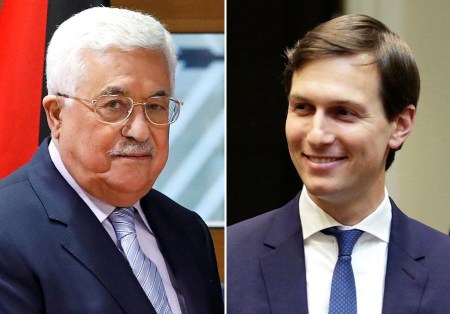
Abbas and Kushner. (photo credit:REUTERS)

US President Donald Trump is reportedly weighing whether to pull out of Israeli-Palestinian peace negotiations following a “tense” meeting with White House senior staff and officials in Ramallah, according to London-based Arabic daily al-Hayat on Saturday.

The report claimed that Trump is to determine the future of reigniting Mideast peace talks in the near future, including  the possibility of withdrawing completely from the process.

The al-Hayat report came just days after a meeting between the administration’s senior adviser Jared Kushner and Palestinian Authority President Mahmoud Abbas, which was described as “tense” by an Abbas advisor present at the talks.

Abbas was supposedly furious with the president’s son-in-law after Kushner relayed Israeli demands to the 81-year-old Palestinian leader which included the immediate halt of payments to terrorists and their families.

Abbas angrily accused Kushner and Trump’s lead international negotiator, Jason Greenblatt, of taking Israel’s side and refused to commit to the request.

The report claims that the Trump administration was equally upset with Abbas after he failed to denounce the latest stabbing attack in Jerusalem, leaving 23-year-old St.-Sgt. Maj. Hadas Malka brutally stabbed to death in a terror attack last week. Ties were further strained after Abbas reportedly refused to meet  American ambassador to Israel David Friedman.

The Palestinian official also told the paper that the Americans demanded Palestinian officials curb inflammatory statements regarding Israel.

“(Kushner) will submit his report to the president and, after it is submitted, Trump will decide if there’s a chance for negotiations or it might be preferable to pull out peace talks,” the official said.

Abbas claimed that Israel is using the issue of payments to terrorists and their families as a pretext to avoid entering peace-talks, saying that the payments are a part of the Palestinian government’s “social responsibility.”

John Bolton: Trump ‘in the Right Place’ on North Korea, but State Dept. Continues 25 Years of Failed Policy

June 23, 2017

John Bolton: Trump ‘in the Right Place’ on North Korea, but State Dept. Continues 25 Years of Failed Policy, BreitbartJohn Hayward, June 23, 2017

(Reunification of North and South Korea would be very expensive for South Korea and may not be as appealing to South Korea as it once was. China is very much opposed because it perceives — wrongly in my view — a unified Korea on its border as a threat. How about unification of North Korea and China instead? — DM)

“We’ve tried that for 25 years with respect to the nuclear program. It has had no effect. I don’t think you can change the behavior of the North Korean regime because I don’t think you can change its character,” he said.

“That, to me, is why the only real solution to eliminate the nuclear threat, to stop this treatment of both foreigners and their own citizens, to give the people of North Korea a chance for a decent life, you have to end the regime. My own view is you reunite North and South Korea. The U.S. has to persuade China it’s in their interests to do it. It’s a heavy lift. I acknowledge that. But otherwise, we just keep doing what we’ve done ever since this regime was formed shortly after World War II. It only respects force, and nobody wants to see use of force on the Korean peninsula today, with its potentially tragic consequences,” said Bolton.

“The State Department can keep doing what it’s done unsuccessfully for 25 years. Year 26 is going to be exactly the same. I think we’ve got to try something very, very different. If we don’t, we’re going to get the same result,” he cautioned.

Bolton said he thinks President Trump himself is “in the right place on this.”

********************************

On Friday’s Breitbart News Daily, former U.N. ambassador John Bolton talked about the death of American student Otto Warmbier, recently released from more than a year of captivity in North Korea, most of which he spent in a coma. He also discussed what Warmbier’s death means for America’s North Korea policy moving forward. Bolton then looked at the one-year anniversary of the Brexit vote and U.S. policy toward the Israeli-Palestinian conflict.

“It’s obviously a personal tragedy,” Bolton told SiriusXM host Alex Marlow. “Here’s a perfectly healthy young man, goes to North Korea, and comes back and dies a few days later. Obviously, we are all feeling for his family and his friends.”

“But I think for the United States as a whole, the lesson here is about the character of the North Korean regime: that they’re so barbaric, that even if you take everything they say as true, that Otto Warmbier stole a political poster – you know, that’s what college kids do. Slap him on the wrist, put him in jail for a day, kick him out of the country. That’s what civilized countries do, but not North Korea,” he said.

“Not only did they brutalize him; they lied about it consistently for a year-and-a-half,” he noted. “They’re still holding three other Americans. They have a long history of kidnapping South Korean and Japanese citizens over the past several decades. This is the way they treat foreigners. They run a 25-million-person prison camp in their own country, under just horribly primitive conditions for most citizens. And they’re pursuing deliverable nuclear weapons and appear to be pretty close to achieving that.”

“This is not a regime that you can reason with in the same sense Americans think of that term,” Bolton contended. “They may be rational in terms of the regime in North Korea, but it’s not rational in our terms. That’s why I’m somewhat distressed with the Trump administration reaction, or at least the State Department reaction of saying, ‘Well, we’re just going to apply more pressure on North Korea to get them to change their behavior.’”

“We’ve tried that for 25 years with respect to the nuclear program. It has had no effect. I don’t think you can change the behavior of the North Korean regime because I don’t think you can change its character,” he said.

“That, to me, is why the only real solution to eliminate the nuclear threat, to stop this treatment of both foreigners and their own citizens, to give the people of North Korea a chance for a decent life, you have to end the regime. My own view is you reunite North and South Korea. The U.S. has to persuade China it’s in their interests to do it. It’s a heavy lift. I acknowledge that. But otherwise, we just keep doing what we’ve done ever since this regime was formed shortly after World War II. It only respects force, and nobody wants to see use of force on the Korean peninsula today, with its potentially tragic consequences,” said Bolton.

“The State Department can keep doing what it’s done unsuccessfully for 25 years. Year 26 is going to be exactly the same. I think we’ve got to try something very, very different. If we don’t, we’re going to get the same result,” he cautioned.

Bolton said he thinks President Trump himself is “in the right place on this.”

“I think he, as much as anybody – maybe more than anybody in his administration – understands the danger of North Korea’s nuclear weapons program,” Bolton added. I think he understands and said publicly what a terrible treatment Otto Warmbier received. It should never happen to anybody and shouldn’t happen again.”

“He’s just tweeted a few days ago he doesn’t think China has delivered on the commitments Xi Jinping made when he was here in the United States at the Mar-a-Lago summit. What Trump said then, what he’s implied in the tweet, is that China’s jiving us again – as they have been on North Korea for 25 years, and the United States will have to solve this on its own,” he said.

“The question is whether the bureaucracy responds to the president. At this point, I don’t see it, unfortunately. I don’t rule it out. Obviously, things could be happening that are not public yet. But I think the president’s in one place, and the bureaucracy is in another. The bureaucracy’s in the same place on North Korea it has been for 25 years. It just doesn’t change,” he lamented.

Bolton’s policy recommendations for North Korea included restoring “all of the sanctions previously imposed on North Korea.”

“I would correct the Bush administration’s…one of Condi Rice’s worst mistakes is taking North Korea off our list of state sponsors of terrorism. I would put them right back on that list. They’re not only state sponsors, they are terrorists themselves, given this treatment of Otto Warmbier and many others, American and non-American alike,” he declared.

“I’d put the pressure on, no doubt about it, but I think we’ve got to be realistic: it’s not going to work. It’s not going to change their behavior. They’ll find ways to evade it. Sanctions have been evaded by the North Koreans successfully with the help of China and Russia for decades. We’ve got to have a very straight talk with China about reunification, and if that doesn’t work, then our options are limited and unattractive,” Bolton warned.

Marlow turned to Britain’s exit from the European Union, which reached its one-year anniversary on Friday. He noted that very little progress has been made during the past year.

“It’s disappointing, I must say,” Bolton agreed. “It’s due to several factors. It’s due to the fact that, obviously, David Cameron had to be replaced as prime minister. I think the supporters of leaving the European Union in the Conservative Party hoped to get a champion of the Leave position in as prime minister. That didn’t happen, although Theresa May seemed to be prepared to negotiate for a hard Brexit if necessary. But then she called this snap election, and it seemed like a brilliant move at the time, but it’s resulted in the Conservative Party actually losing seats in the House of Commons, so they’re in disarray.”

“I think it’s going to be hard for Theresa May to survive politically, so you’ve had this turmoil in domestic politics that’s gotten in the way of negotiations,” he said. “I think that those who advocated Leave just need to grit their teeth and continue on because the decision to leave was then, and is today, the right decision for Britain.”

“The elites, the high-minded in Europe and in Britain and in America, all think that they should reverse their decision. That’s not going to happen. People need to get used to that,” he said.

“I think President Trump said some time ago he wanted to step up and establish a bilateral trade relationship between the U.S. and a U.K. no longer in the E.U. I think we should be moving ahead on that,” Bolton advised. “There are certain constraints the Brits face, but we can lay out the big principles so that businesses and financial services institutions on both sides of the Atlantic know what’s coming. I think it’s a win-win for the U.S. and the U.K., and I hope we pay more attention to that.”

“As hard and as unproductive as the past year has been, the fundamental decision remains correct. They just need to fight through it,” he said.

Marlow observed that the hard British left has been working out an alliance with Islamists. “It seems like the encroaching Islamist philosophies of Islamism are becoming much more prevalent and more accepted, and it seems like the priorities of the folks in the Jeremy Corbyn wing of British politics seem to be getting a much more powerful voice than I was anticipating,” he said.

“I must say, within the Labor party in Britain, the only religion that seems to be favored is Islam,” Bolton replied. “Christianity, Judaism are old-fashioned. The levels of anti-Semitism in the Labor party are at historically high levels. I think it has to do with their ideology. I think that this self-segregation, this unwillingness to join the broader U.K. culture, is a huge potential problem.”

“You know, none of the European countries have the concept of the melting pot the way we do in the United States, where people come from all over the world and get into the melting pot and emerge as Americans,” he pointed out. “It’s a huge strength of the United States. It’s why we’ve been a draw for people from all over the world forever. They understand that when they come here, they’re going to do something very different in their lives. They’re going to join a nation that is unique in the world, founded on an idea, and they change.”

“When we’ve seen in recent years people coming to this country who don’t want to get into the melting pot, who don’t want to be Americanized – they don’t even like that word; I think it’s a word we should use more often – it’s a problem for us,” he added.

“The Brits are the closest of the European countries to having that ability, but it’s been failing them for a number of years. It doesn’t work at all on the continent of Europe itself. I think this split within society, this view that some can live under sharia law, everybody else will live under the regular English legal system, is the beginning of the end of the democratic society. I don’t want to be apocalyptic about it, but I think that’s the direction it’s moving in,” Bolton said.

“The Europeans are in the midst of a decision whether they understand it or not, given the hundreds of thousands – indeed, millions – of refugees and migrants that are coming from North Africa and the Middle East,” he contended. “This is a process that’s been in play for a long time. Maybe they don’t care so much about their cultural identity. That’s their choice to make, if they want to lose it. But there are demographic trends at play here that could foreshadow a very different Europe by the end of this century. If they don’t insist on integration into the broader society, then it won’t happen.”

“In the United States, people have come here historically because they want to become Americans. They want to shed some of the baggage of the countries they’re leaving from. To the extent we suffer from that same European problem, we will have the same issues here – maybe a little bit later than the Europeans, but inevitably, we will face the same problems,” he predicted.

“I think it’s emblematic of this unwillingness to deal with this issue that you’re seeing almost daily acts of terrorism across Europe. It hasn’t happened here yet, but we’re beginning to see that pattern, and I think it’s only going to get worse,” said Bolton.

Marlow asked for Bolton’s view of the visit by President Trump’s son-in-law Jared Kushner to the Middle East and the persistent issue of Palestinian payments to the families of suicide bombers, blatantly encouraging violence in a way that makes talk of a “peace process” farcical.

Bolton agreed these payments to the families of terrorists are “a very significant issue.”

“Secretary of State Tillerson testified – I think it’s about two weeks ago now – that the Palestinian Authority said it wasn’t going to make such payments anymore,” he recalled. “The next day, the government of Israel said that’s not true; it’s still going on.”

“You’ve got a fundamentally different perspective on many, many things in that region,” he said. “I think Jared Kushner, I think the president himself, are approaching this in good faith with a good heart. They want to see what they can do. I’ve believed for some time, however, that the two-state solution has run into a dead end. It’s not going to work. It’s not doable. The Palestinian Authority doesn’t have the legitimacy or the capability of making commitments and then carrying them out. I think you’ve got to look at something radically different.”

“I just have to say, as my honest diplomatic and political assessment, repeating the Middle East peace process as we’ve known it this past forty or fifty years, the idea of a two-state solution, isn’t going to go anywhere,” Bolton concluded.

The Left’s Abbas problem

June 6, 2017

The Left’s Abbas problem, Israel Hayom, Jonathan S. Tobin, June 6, 2017

Despite repeated Palestinian rejections of peace offers, advocates of a two-state solution still cling to the belief that it is Israel that is inventing conditions designed to ensure that negotiations will fail. But if their goal is to create a genuine consensus behind peace, then rather than lament Trump’s criticisms of Abbas, they ought to hope he will succeed in getting the PA leader to stop the incitement as well as the prisoner payments. If Netanyahu’s opponents continue to refuse to take this issue seriously, they will have no one but themselves — and the Palestinians — to blame if they continue to be marginalized and peace remains a remote dream.

***********************

For the Israeli Left, talk about Palestinian incitement is nothing more than an excuse invented by the Right to avoid peace. The same largely applies to their views about the Palestinian Authority’s payments of more than $1 billion in just the last four years in salaries to imprisoned terrorists and their families.

The PA’s ongoing efforts to inculcate new generations in the ideology of hate that has driven the century-long war on Zionism is itself a barrier to peace. It also ensures that any effort to end the conflict will run counter to notions of Palestinian identity that are inextricably linked to that war.

But if you believe that Israel’s chief objective must be to achieve a separation from the Palestinians and an end to its presence in the West Bank and east Jerusalem regardless of what happens or who governs a Palestinian state, you view the issue differently. If you think separation is the only way to preserve a Jewish majority in the Jewish state and to protect both Israelis and Palestinians from the burden of the occupation, statements of support or even subsidies for those who commit violence are side issues or distractions that obscure the big picture.

Yet opponents of the Netanyahu government are making a big mistake when they downplay these issues. Though they doubt the motives of those who point out what the Palestinian Authority have been doing and even agree with PA President Mahmoud Abbas’ assertion that both sides incite, they are missing the point. A failure to address these questions has been the Achilles’ heel of the Left ever since the Oslo Accords were signed. Doing so is not only political poison, it also sends the wrong message to Palestinians who they insist are, against all evidence, viable partners for peace.

The issue of incitement is at the center of the discussion now because U.S. President Donald Trump has decided it is important. Trump was sufficiently ignorant of the history of the conflict and how the PA operates that he actually seems to have believed Abbas’ assurances about not supporting incitement or payments to prisoners that the PA leader made during their initial White House meeting.

But when the Israelis pointed out to him that Abbas was seeking to pull the wool over his eyes, and backed it up with video evidence, he didn’t like it. More than that, he rightly understood that this lie was an obstacle to achieving the unlikely diplomatic triumph he craved.

That led to Trump reportedly pounding the table and accusing Abbas of being liar when they met in Bethlehem. Since it would be difficult for Abbas to suddenly alter the nature of what is published in PA newspapers or viewed on PA television to mollify Israeli or Western sensibilities, let alone cease payments to the very same terrorist prisoners who are lauded by Palestinians as heroes, Trump’s insistence on these points was no small controversy.

The Left deplores Trump’s embrace of this issue and puts it down to a clever strategy implemented by Netanyahu. But if that’s all they think there is to it, they’re repeating the same mistakes that ensured the failure of peace talks in the past. In the 1990s, both the Clinton administration and Labor-led governments saw PLO leader Yasser Arafat’s words and actions as merely fodder for domestic Palestinian political consumption. But the result of that policy was not only to convey to the PA that it could transgress with impunity; this spirit of complacency also materially contributed to the collapse of faith in the peace process once Palestinian actions moved from words to bombs in the Second Intifada.

The Left’s problem is not just that serious observers understand the implications of incitement and material support for terror and that not enough people share their belief that Israeli actions are as bad or worse than those of the Palestinians. Nor are most Israelis likely to be persuaded to view actions of self-defense undertaken by their government as morally equivalent to the PA’s support for terror. Just as important is that a Palestinian leader who felt constrained to engage in behavior that engendered such deep mistrust among Israelis would be unlikely to muster support for an end to the conflict among his own people, even if he wanted to make peace.

Despite repeated Palestinian rejections of peace offers, advocates of a two-state solution still cling to the belief that it is Israel that is inventing conditions designed to ensure that negotiations will fail. But if their goal is to create a genuine consensus behind peace, then rather than lament Trump’s criticisms of Abbas, they ought to hope he will succeed in getting the PA leader to stop the incitement as well as the prisoner payments. If Netanyahu’s opponents continue to refuse to take this issue seriously, they will have no one but themselves — and the Palestinians — to blame if they continue to be marginalized and peace remains a remote dream.

Jonathan S. Tobin is the opinion editor of JNS.org and a contributing writer for ‎National Review.

Taking sides on terrorism

June 4, 2017

Taking sides on terrorism, Israel National News, Att’y Stephen M. Flatow, June 4, 2017

Members of Congress are preparing to cast their votes on legislation that is intended take a strong and clear stand against terrorism. The Taylor Force Act would stop U.S. aid to the Palestinian Authority if the PA continues paying salaries to terrorists and their families. Named after an American murdered by Palestinians in 2016, the law is long-overdue. It would take a real stand against the PA’s outrageous sponsorship of terrorists.

So far, all 41 co-sponsors in the House of Representatives, and all 10 co-sponsors in the Senate, are Republicans. That concerns me. At a time when even the United Nations is denouncing the PA’s glorification of terrorists, there is simply no good reason for Democrats not to support the Taylor Force Act just as much as the GOP. No matter how much ill-will there is right now between Republicans and Democrats on other issues, the fight against terrorism is an issue on which the two parties should be able to unite without the slightest hesitation.

And maybe then even Europe will wake up and realize that all terrorists are colleagues.

*************************************

Stephen M. Flatow, a vice president of the Religious Zionists of America, is an attorney in New Jersey. He is the father of Alisa Flatow, who was murdered in an Iranian-sponsored Palestinian terrorist attack in 1995

We all remember President George W. Bush’s powerful declaration when he spoke at a joint session of Congress on September 21, 2001, shortly after the 9/11 attacks: “Every nation, in every region, now has a decision to make,” he said. “Either you are with us, or you are with the terrorists.”

When it comes to Palestinian terrorists and their colleagues, unfortunately, much of the world has for too long shied away from taking a clear-cut stand. But that is beginning to change. Perhaps the 6 dead on London Bridge will do the trick.

The United States finally seems to be abandoning the old tried-and-failed policy of ignoring the Palestinian Authority’s incitement and support of terrorism. According to media reports, when President Trump recently met PA leader Mahmoud Abbas in Bethlehem, he “accused Abbas of supporting incitement and terrorism with the salaries paid to prisoners” and said Abbas was “personally responsible for incitement” to violence.

This would represent a very significant change from the previous U.S. administration. President Obama and secretaries of state Clinton and Kerry looked the other way when the PA paid terrorists and incited violence by praising terrorists as “heroes” and “martyrs.”

And America is not alone. In a remarkable break from West European appeasement of the PA, the government of Norway last week demanded that Abbas return Norway’s donation to a Palestinian women’s center that the PA named in honor of mass-murderer Dalal Mughrabi. She led the terror gang that carried out the 1978 Tel Aviv Highway massacre of 37 Israelis (including 13 children) and American nature photographer Gail Rubin, the niece of U.S. Senator Abraham Ribicoff.

Norwegian Foreign Minister Borge Brende was unequivocal: “The glorification of terrorist attacks is completely unacceptable, and I deplore this decision in the strongest possible terms. Norway will not allow itself to be associated with institutions that take the names of terrorists in this way. We will not accept the use of Norwegian aid funding for such purposes.” Even the United Nations (!), under new secretary-general Antonio Guterres, has denounced the naming of the center after Mughrabi as “offensive” and removed its name from the facility.

So the United States, Norway, and even the United Nations are standing against Palestinian terrorism.

Who’s on the terrorists’ side? British opposition leader Jeremy Corbyn is. The Daily Mail revealed that Corbyn, leader of England’s Labor Party, took part in a ceremony honoring Palestinian terrorists, including one of the key planners of the 1972 Munich Olympics massacre. At the ceremony, which was held in Tunisia in 2014, Corbyn placed wreaths on the graves of terrorists, including Munich mastermind Atef Bseiso, and wrote about the “poignant” event in the British radical newspaper Morning Star.

Who else is lining up on the side of the terrorists? The city of Barcelona, Spain last week hosted and subsidized a book fair at which one of the featured speakers was the unrepentant Palestinian hijacker Leila Khaled. The mayor and city council members should be ashamed of themselves.

Meanwhile, back in Washington, Members of Congress are preparing to cast their votes on legislation that is intended take a strong and clear stand against terrorism. The Taylor Force Act would stop U.S. aid to the Palestinian Authority if the PA continues paying salaries to terrorists and their families. Named after an American murdered by Palestinians in 2016, the law is long-overdue. It would take a real stand against the PA’s outrageous sponsorship of terrorists.

So far, all 41 co-sponsors in the House of Representatives, and all 10 co-sponsors in the Senate, are Republicans. That concerns me. At a time when even the United Nations is denouncing the PA’s glorification of terrorists, there is simply no good reason for Democrats not to support the Taylor Force Act just as much as the GOP. No matter how much ill-will there is right now between Republicans and Democrats on other issues, the fight against terrorism is an issue on which the two parties should be able to unite without the slightest hesitation.

And maybe then even Europe will wake up and realize that all terrorists are colleagues.

Denmark stops funding for Palestinian NGOs for “glorifying” terror

June 3, 2017

Denmark stops funding for Palestinian NGOs for “glorifying” terror, DEBKAfile, June 3, 2017

The Danish ambassador to Israel Jesper Vahr announced Saturday that his country has stopped financial support to Palestinian non-governmental organizations for “glorifying terrorism, and demands money back.”

Copenhagen announced the decision a few days after Norway decided to stop funding for a Palestinian youth center for women, because it was named after the Palestinian female terrorist Dalal al-Maghrabi. In 1978, Maghrabi commanded a horrendous hijack-cum murder operation which left 38 Israelis dead, including 13 children, as well as an American photographer Gail Rubin. Another 72 were injured. A public square in Ramallah honors her memory as “martyr.”

Earlier this month, Israeli Prime Minister Benjamin Netanyahu urged Danish foreign minister Anders Samuelsen to cancel Denmark’s funding for Palestinian NGOs that promoted incitement against Israel.

Palestinians: Israel’s Goodwill Gestures Send Wrong Messages

June 2, 2017

Palestinians: Israel’s Goodwill Gestures Send Wrong Messages, Gatestone InstituteBassam Tawil, June 2, 2017

Here is what is being said on the Palestinian street: Today Israel runs away from the West Bank or the Gaza Strip; tomorrow Israel will run away from Ashkelon, then from Tel Aviv and from there to the sea, and we have achieved our goal of destroying Israel. Therefore, we need to continue attacking Israel.

As with the Gaza Strip, the withdrawal from Lebanon taught the Palestinians that terrorism could drive Israelis out of their country.

Never have the Palestinians given Israel credit for its goodwill steps. On the contrary, they scoff at these moves and describe them as “cosmetic changes”. The Palestinian line is that Israel’s steps are “insufficient” and “unhelpful.” Its concessions are regarded as gestures of a terrified people and as the rightful reward for terrorism. Far from satiating the appetite of the terrorists, such steps prompt them to step up their attacks against Israelis.

The West suffers under a major misconception concerning the Israeli-Palestinian conflict: that “goodwill gestures” and territorial concessions on the part of Israel boost the prospects of peace in the Middle East. The facts, however, suggest that precisely the opposite is true.

Last week, Israel’s Channel 10 television station reported that the U.S. administration was pushing Israel to transfer parts of Area C — areas under full Israeli security and civilian control in the West Bank — to the control of Mahmoud Abbas’s Palestinian Authority (PA). According to the report, the U.S. believes that the transfer of the territory to the PA would be a “goodwill step” towards the Palestinians, paving the way for the revival of the stalled peace process with Israel.

This assumption, of course, has already proven wrong. The experiences of the past few decades have shown clearly that Israeli concessions have always sent the wrong message to the Palestinians.

In fact, Palestinians read Israeli goodwill steps as signs of weakness and retreat. This misinterpretation on the part of the Palestinians then leads to more violence against Israel. It would be hard for anyone not to conclude that if pressure works, keep on pressuring.

The past 24 years are littered with examples of how the Palestinians react to Israeli concessions.

The Oslo Accords that were signed between Israel and the PLO in 1993 were seen by Palestinians as a first step by Israel towards total capitulation.

The accords, which brought the PLO from several Arab countries to the West Bank and Gaza Strip, came after five years of the first Palestinian Intifada. By allowing the PLO to assume control over large parts of the West Bank and Gaza Strip, Israel sent a message that it was caving in to the violence and terrorism of the First Intifada.

Barely a breath after Oslo, Israel was again asked to conciliate the Palestinians: this time, hundreds of prisoners, many with Jewish (and Arab) blood on their hands, were released from Israeli prison in order to create an atmosphere “conducive” to the peace process.

Instead of viewing the prisoner release for what it was, namely a generous gesture, many Palestinians considered it a “victory” for terrorism and violence. Worse, it was not long before many of the released prisoners were rearrested for their role in further terrorism against Israel. The release of prisoners also sent a message of recidivism to Palestinians: terror does indeed pay! A short stint in an Israeli prison is sure to lead to release in some Israeli “confidence-building measure” or other.

According to statistics, at least half of released Palestinian prisoners have returned to terrorism.

Despite the grim statistics, the international community regularly demands that Israel release more convicted terrorists as a “gesture” towards Mahmoud Abbas and other Palestinians.

RAMALLAH, WEST BANK – OCTOBER 30: Released Palestinian prisoners stand on a sage as they arrive to the Mukata Presidential Compound in the early morning hours on October 30, 2013 in Ramallah, West Bank. The 26 Palestinian prisoners were released by Israel as part of the terms of renewed U.S.-brokered peace talks. (Photo by Oren Ziv/Getty Images)

Since 1993, Israel has complied again and again with such international pressure, only to reinforce the message to Palestinians: terrorism is indeed worth the trouble.

Let us consider, for a moment, Gaza. In 2005, Israel unilaterally withdrew from the Gaza Strip, after destroying 21 Jewish settlements and expelling more than 8,000 Jews from their homes there.

In Palestinian eyes, however, the Israeli “disengagement” from the Gaza Strip was anything but an olive branch of peace. The withdrawal came after five years of the bloody Second Intifada, when Palestinians waged a massive campaign of suicide bombings and rocket attacks against Israelis.

Thus, for Palestinians, Israel was once again retreating in the face of unremitting bloodshed.

Here is what is being said on the Palestinian street: Today Israel runs away from the West Bank or the Gaza Strip, tomorrow Israel will run away from Ashkelon, then from Ashdod and Tel Aviv and from there to the sea, and we have achieved our goal of destroying Israel. Therefore, we need to continue attacking Israel.

Moreover, it was also precisely the Israeli pullout from Gaza that launched Hamas to its current pinnacle of popularity among Palestinians. Hamas took credit for expelling the Jews from the Gaza Strip through terrorism. A few months later, Hamas even won the Palestinian parliamentary election because Palestinians gave Hamas total credit for driving Israel out of the Gaza Strip.

The Israeli pullout told Palestinians in no uncertain terms: Why bother negotiating when terror will do the trick?

Five years earlier, the Israeli withdrawal from southern Lebanon also had the same effect: it emboldened the Iranian-backed Hezbollah terror group. As with the Gaza Strip, the withdrawal from Lebanon taught the Palestinians that terrorism could drive Israelis out of their country.

In the past few years, additional Israeli goodwill gestures, such as removing security checkpoints and the easing travel restrictions in the West Bank, led to yet more violence, claiming the lives of yet more Israelis.

Abbas and his top officials have always responded to Israeli gestures with cynicism. Never have they given Israel credit for its goodwill steps. On the contrary, they scoff at these moves, and describe them as “cosmetic changes aimed at beautifying Israel’s ugly face” or as public-relations stunts.

For the sake of clarity, let us say it clearly: handing over areas in the West Bank to the Palestinian Authority, and the release of convicted murderers, does not contribute to any sort of “peace process;” it only contributes to the death of more Israelis.

The Palestinian line is that Israel’s steps are “insufficient” and “unhelpful.” Its concessions are regarded as gestures of a terrified people and as the rightful reward for terrorism. Far from satiating the appetite of the terrorists, such steps prompt them to step up their attacks against Israelis. The next time Americans and Europeans think of asking Israel to cede yet more to the Palestinians, let them consider what Israel might be receiving in return, other than the spilling of more Jewish blood.

Bassam Tawil is a Muslim based in the Middle East.