Archive for the ‘Obama – Middle East’ category

Russia overrides Middle East cyber waves

October 26, 2015

Russia overrides Middle East cyber waves, DEBKAfile, October 26, 2015

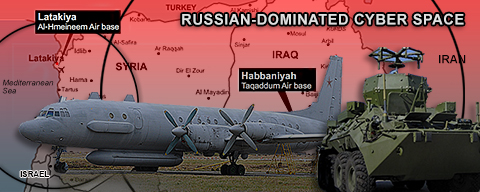
Latakia_Habaniya480

Aloft over Syria, the IL-20 can supply Russian forces and commanders with a complete, detailed picture of the situation on the ground. Its close proximity to Israel, moreover, enables this wonder plane to scoop up a wealth of data from across the border – not just on IDF military movements on the Golan, but also to eavesdrop on electronic activity and conversations in Jerusalem, Military Staff Headquarters in Tel Aviv, Air Force bases in southern Israel and even the nuclear complex in Dimona in the Negev.

******************

The distance as the crow flies between Russia’s Syrian air base Al-Hmeineem near Latakia and its Iraqi host facility at Al Taqaddum Air base is 824 km (445 nautical miles). From the Latakia base to Israel, the distance is just 288 km or 155 nautical miles, a hop and a skip in aerial terms. Syria’s ruler Bashar Assad first let Moscow in with the use of a base where 30 fighter and bombing jets are now parked. Iraqi Prime Minister Haider al-Abadi followed suit Saturday, Oct. 24 by granting the Russian Air force the use of a facility 74 km from Baghdad.

Their presence in the two bases draws a strong arc of Russian aerial control at the heart of Middle East. By boosting its two extremities with state-of-the-art electronic warfare systems, Moscow has imposed a new reality whereby it will soon be almost impossible for any air or ground force, American or Israeli, to go into military action above or inside Syria or Iraq without prior coordination with the Russians.

The bricks of Russian domination are now almost all in place.

In the last week of September, two Ilyushin-20 (IL-20 Coot) super-surveillance planes stole into Syrian airspace, to provide a major upgrade for the Russian air fleet of Sukhoi-30 fighter jets, cargo planes and attack helicopters gathering for combat in Syria.

This was first revealed by DEBKA Weekly’s military and intelligence sources on Oct. 2.

The IL-20s, the Russian Air Force’s top-line intelligence-gathering aircraft, brought over from the Baltic Sea, have exceptional features as an intelligence platform. Their four turboprop engines enable it to stay airborne for over 12 hours, using its thermal and infrared sensors, antennas, still and video cameras, and side-looking airborne (SLAR) radar to collect a wide range of data from long distances, day or night, in almost any kind of weather.

The Coot-20 collates the data gathered and transmits it to intelligence or operational command centers in Moscow or its Latakia air base by powerful jam-resistant communications systems, satellites and other methods.

Aloft over Syria, the IL-20 can supply Russian forces and commanders with a complete, detailed picture of the situation on the ground. Its close proximity to Israel, moreover, enables this wonder plane to scoop up a wealth of data from across the border – not just on IDF military movements on the Golan, but also to eavesdrop on electronic activity and conversations in Jerusalem, Military Staff Headquarters in Tel Aviv, Air Force bases in southern Israel and even the nuclear complex in Dimona in the Negev.

DEBKAfile’s military sources add that an Il-20 Coot has been sighted in the last few days at the Iraqi Al Taqaddum Air base near Baghdad.

Then, on Oct. 4, our sources reveal, another Russian super-weapon was brought to Syria by Russian cargo ships: Nine MT-LB armored personnel carriers fitted with the Borisoglebsk 2 electronic warfare systems, which are among the most sophisticated of their kind in the world.

These APCs were secretly driven aboard tank carriers to Nabi Yunis, which is the highest peak of the Alawite Mountains along the coastal plain of northwest Syria, and stands 1,562 meters (5,125 feet) above sea level. To render the highly complicated Borisoglebsk 2 device system impermeable to attack, our electronic warfare experts describe it as fitted into the interior and walls of the nine APCS, along with receivers that can pick up transmissions on a wide range of frequencies on the electromagnetic spectrum.

From their mountain aerie, its antennas and powerful transmitters are designed to intercept and jam almost any radio signal carried by the electromagnetic waves in military or civilian use.

Russian strategists posted this top-of-the-line system in Syria to enable the Russian air force to operate unhindered in Middle Eastern skies and, just as importantly, to neutralize US-led coalition special forces operating deep within Syrian territory, and block or disrupt the operations of rebel groups and Islamic State forces.

The Borisoglebsk 2 system has only just started rolling off top secret Russian assembly lines. It took five years to plan and manufacture the system, which went into service for the first time at the beginning of this year on the Ukraine battlefield.

From its vantage point in Syria, the Russian electronic warfare system could seriously impair the performance of Israeli intelligence and communication networks arrayed across the Golan and along the northern border in the upper and western Galilee. It could run interference against the IDF’s use of unmanned aerial vehicles (unless they were autonomous), the field operations of Israeli Special Operations forces and air and naval networks, which depend on communications networks in their defense of the country’s northern borders.

Madam Hillary is on the right side of herstory

October 25, 2015

Madam Hillary is on the right side of herstory, Dan Miller’s Blog, October 25, 2015

(The views expressed in this article are mine, and do not necessarily reflect those of Warsclerotic or its other editors.– DM)


Lies are good and truth is bad because truth would damage Madam Hillary’s and even Imam Obama’s sterling images. Both, bravely and proudly, try to feed us what is “good.” Their people love it, so what difference does it make? 

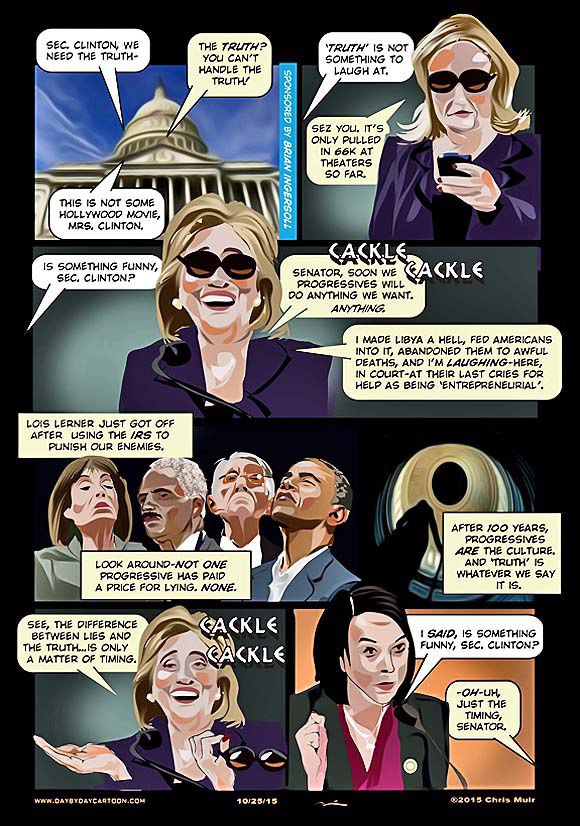
1025151 (1)

According to John Hinderaker at Power Line, Madam Hillary

lies…it’s not exactly a news flash. On the contrary, based on the liberal media’s reaction to her Benghazi testimony, her willingness to lie, brazenly, is a positive virtue.

There’s always an excuse for having “misspoke.” It need not be a credible excuse, because an incredible excuse works just fine. Anyway, whatever happened was in the past and therefore doesn’t matter now:

What has Imam Obama lied about? Plenty. Here’s an incomplete list: Islam, the nuke “deal” with Iran, Libya, His strength and Putin’s weakness in the Middle East, Israel, Immigration, Crime, Obamacare, race relations and on and on and on. As with Madam Hillary’s spewings, the “legitimate media” generally love it.

Madam Hillary blamed the video repeatedly

According to an article titled “I didn’t blame the video,” Madam Hillary did just that while also managing to lie about substantially more than that.

Hillary simply adores arguing and lawyering.

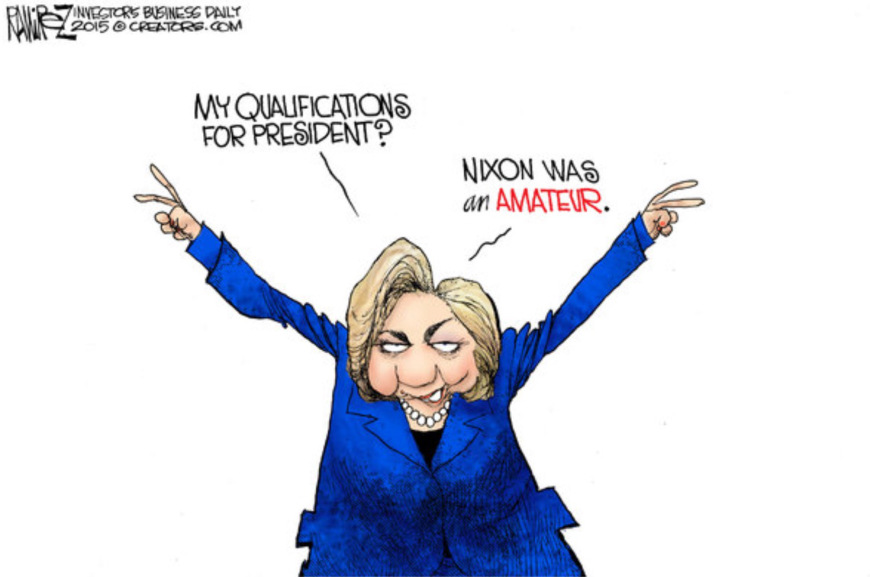
She lives for it and has at least since she was fired from the House Judiciary Committee during its investigation of the Watergate scandal that eventually brought down President Richard M. Nixon in 1974. Hillary’s then-supervisor, lifelong Democrat Jerry Zeifman, said he canned the 27-year-old attorney “because she was a liar … an unethical, dishonest lawyer. She conspired to violate the Constitution, the rules of the House, the rules of the committee and the rules of confidentiality.” [Emphasis added.]

No lie is too big or too small for Hillary, whether it’s a concocted tale of being under enemy fire at an airport in Bosnia, the existence of a “vast right-wing conspiracy” to undermine her husband’s presidency, that she was named after Mt. Everest climber Sir Edmund Hillary even though he rocketed to fame by accomplishing the feat when she was a six-year-old, or that the Clintons were “dead broke” when they exited the White House.

Meanwhile, at the Thursday hearing, Rep. Jim Jordan (R-Ohio) demolished Clinton’s apparently fresh assertion at the hearing that she didn’t actually claim an obscure anti-Islam movie trailer posted on YouTube prompted the terrorist assault in Benghazi on the eleventh anniversary of the 9/11 attacks. She now takes a more nuanced, twisted-like-a-pretzel position in which maybe some non-terrorist Muslims were suddenly stirred to violence in Libya by the video, but really at the same time it was a terrorist attack, something she testified Thursday has been her position the whole time. She talked about the video publicly not to point fingers but as a warning, she testified, to those who might attack U.S. interests in the region. In other words, like a good defense lawyer, Hillary was trying to confuse the issues and muddy the waters. [Emphasis added.]

. . . .

While she was informing the American public that the anti-Islam video was what caused the attack, at the same time she emailed her daughter Chelsea and the governments of Libya and Egypt to pin the blame on Muslim militants, Jordan explained. Around the same time the White House, in the closing weeks of a heated presidential election campaign, was pushing the line that what transpired in Benghazi was a spontaneous demonstration turned violent, but terrorism was not a factor.

“We know that the attack in Libya had nothing to do with the film,” Clinton wrote Egypt’s prime minister the night of the attack. “It was a planned attack, not a protest.” But in public Clinton continued to blame the “offensive” video. The U.S. government acquired $80,000 worth of commercial airtime in Pakistan to apologize for the YouTube clip. [Emphasis added]

Jordan pointed out that there was no video-inspired protest over in Benghazi on Sept. 11, 2012, but there was one in Cairo, Egypt. The same day State Department spokeswoman Victoria Nuland said “Benghazi has been attacked by militants. In Cairo, police have removed demonstrators.”

You want to talk about Madam Hillary’s lies? She didn’t lie, of course, but let’s change the subject to something more important. Right now.

hillary-Nixon-copy


Conclusions

“Her people” not only don’t care, they are delighted with Madam Hillary’s numerous lies. Again, “what difference does it make?” Plenty.

Please think about Madam Hillary’s and Imam Obama’s impunity — and readiness —  to lie, violate laws and do pretty much whatever they please. We have become a nation without law enforcement where we need it most and very much where enforcement of Obama’s executive decrees harms us greatly (climate change and immigration for example). Do we want a nation the governance of which is increasingly based on, and perpetuated through, lies to “We the people?” Do we want Madam Hillary or another Obama clone as the next Commander in Chief?

Here’s what “Commander in Chief” Obama has done with his our military:

Do you approve of those and the other things He has done to our military? Want more of the same? Or even worse? If not, what can we do about it? Supporting Donald Trump may or may not be what we should do, but I think the songs in the video are superb. Back in September, I wrote an article titled To bring America back we need to break some stuff. We still do, and if someone other than Trump is ready, willing and able he (or, of course, she) should also be considered, very seriously.;

The Obama Intifada

October 16, 2015

The Obama Intifada, Washington Free Beacon

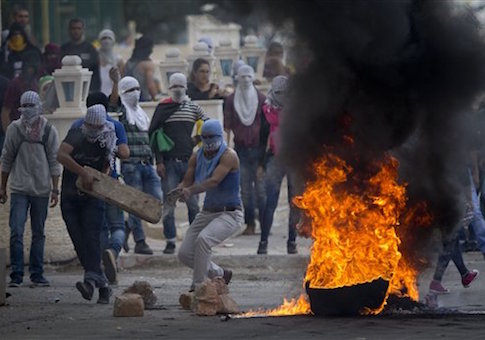
Palestinians improvise a barricade during clashes with Israeli troops near Ramallah, West Bank, Saturday, Oct. 10 / AP

Obama won’t hold the Palestinians accountable because that might jeopardize his policy of daylight between America and Israel. A policy that was intended to improve U.S. credibility in the Muslim world and thereby denuclearize Iran, disarm and remove Bashar al-Assad, and establish a peaceful Palestinian state. A policy that has instead destabilized the region, formalized the Russian-Iranian-Syrian axis, enriched and empowered the Shiite theocracy, rattled our allies, and done nothing to curtail Palestinian intransigence.

********************

More than 30 dead in Israel as Palestinians armed with knives attack innocents. What’s responsible? A campaign of incitement, which slanderously accuses Jews of intruding on the Al-Aqsa Mosque in Jerusalem and murdering Arab children in cold blood.

And who is legitimizing this campaign? None other than Mahmoud Abbas, president of the Palestinian Authority, whom President Obama and Secretary of State John Kerry have long held up as a peacemaker. “I think nobody would dispute that whatever disagreements you may have with him, he has proven himself to be somebody who has committed to nonviolence and diplomatic efforts to resolve this issue,” Obama told writer Jeffrey Goldberg in 2014.

That’s a strange view of commitment. This is the same Abbas, remember, who rejected then-Israeli Prime Minister Ehud Olmert’s absurdly generous 2008 peace offer. The same Abbas who resisted negotiations with Prime Minister Benjamin Netanyahu during the 10-month settlement freeze in 2010, which Obama demanded explicitly on the grounds that it would give Abbas the cover he needed to begin talks. Abbas finally relented to Saudi pressure, and attended a few meetings with Netanyahu that September. But under no definition of what the word “negotiation” actually means were these meetings for real: The freeze was about to expire, the get togethers were perfunctory, and nothing of significance was discussed. The farce ended soon after.

It is a lie to say that Mahmoud Abbas is committed to a diplomatic resolution. Just as it was a lie when, the other day at Harvard, Secretary Kerry attributed the bloodshed to “a frustration that is growing” because of the “massive increase in settlements over the course of the last years.” As Elliott Abrams points out, there has been an increase in the population of the settlements, but not in their size. As if the settlements have any connection to what’s happening in the first place: The terror gripping Israel is the result of a Palestinian leadership so adrift and corrupt, so aggrieved and conspiratorial, that it encourages the radicalization of its youth and promotes an atmosphere of hatred and murder.

David Horovitz of the Times of Israel recounts the history. Not only did Abbas reject Olmert and Obama. He insisted in 2013 that the Palestinian “right of return,” which would irrevocably transform Israel into a bi-national state, be part of any deal. Declared in 2014 that Israel was committing “genocide” in Gaza. Announced in 2015 that the Palestinian Authority would no longer uphold previous agreements. Charged Israel, falsely, with infiltrating and violating Muslim sites. Encouraged Palestinians to lionize the knife-wielding assailants as martyrs, victims of Israeli “execution.” Spread the myth that 13-year-old Ahmad Mansara, recovering in an Israeli hospital from wounds he incurred in a botched terrorist attack—in which he critically wounded a Jewish teen—had been killed by an Israeli vigilante.

Concludes Horovitz: “The fact is that Abbas has quite deliberately fueled the flames of this latest Al-Aqsa-centered terror wave.”

And what has the United States done to stop him? Nothing. Not during this presidency. Obama’s focus has been laser-like when it comes to Israel’s missteps, Israel’s weaknesses, Israel’s moral code, and what he sees as Israel’s true interests. Abbas, on the other hand, is someone Obama has been content to puff up, placate, excuse, humor, ignore.

“I have to commend President Abbas,” Obama said during a bilateral meeting at the White House last year. “He has been somebody who has consistently renounced violence, has consistently sought a diplomatic and peaceful solution that allows for two states, side by side, in peace and security.”

In his interview with Goldberg, conducted around the same time, Obama added, “I believe that President Abbas is sincere about his willingness to recognize Israel and its right to exist, to recognize Israel’s legitimate security needs, to shun violence, to resolve these issues in a diplomatic fashion that meets the concerns of the people of Israel.”

But at that White House meeting, according to reports, Abbas explicitly rejected three key elements of any agreement: recognition of Israel as a Jewish State; renunciation of the right of return; and commitment to “end of conflict” language that would foreclose future Palestinian demands. As he has done with so many dictators, theocrats, and goons, the president offered an open hand—and was rebuked with a closed fist.

This rebuke was not met with forceful rhetoric, countermeasures, or a shift in policy to strengthen Palestinian institutions, develop Palestinian civil society, broaden and liberalize the Palestinian leadership. It was met with silence. The White House just looked the other way.

“My concern about Obama is that he never asks anything about the Palestinians. He gives them a complete pass,”says Ambassador Dennis Ross, a former Obama official whose new book Doomed to Succeed tells the story of the beleaguered U.S.-Israel alliance. “It makes it worse for the Palestinians. For the Palestinians, you have a political culture that is driven so much by this profound sense of victimhood and grievance—the idea that they should do anything towards the Israelis, they should make any accommodation towards the Israelis, is completely illegitimate.”

Why the pass? Jeffrey Goldberg says it’s because the Palestinians “have less power.” That’s no excuse. Another possibility: The president is occupied with Cuba, ISIS, Syria, Ukraine, and Iran. He doesn’t have the bandwidth to hold Mahmoud Abbas to the same standard as Benjamin Netanyahu.

But we know that’s not the case, either. The president has been more than happy to castigate Netanyahu all along. Can’t he say a few tough things about Abbas?

Obama won’t hold the Palestinians accountable because that might jeopardize his policy of daylight between America and Israel. A policy that was intended to improve U.S. credibility in the Muslim world and thereby denuclearize Iran, disarm and remove Bashar al-Assad, and establish a peaceful Palestinian state. A policy that has instead destabilized the region, formalized the Russian-Iranian-Syrian axis, enriched and empowered the Shiite theocracy, rattled our allies, and done nothing to curtail Palestinian intransigence.

Even the carrot Obama offered Israel as part of the Iran deal—interdiction of Iranian weapons to Hezbollah—has been exposed as an illusion. Russia has a no-fly zone in Syria and is arming Syrian regulars and presumably Hezbollah, too. How else to explain Netanyahu’s sudden visit to Moscow last month? Hezbollah with a nuclear umbrella was something the Iran deal was supposed to prevent. Now Hassan Nasrallah benefits from the Russian nuclear umbrella, in addition to the Iranian one that will be unfurled a decade hence. Great job Obama.

So here we are: Palestinians no closer to statehood, Israel terrorized, Jewish and Arab lives being lost, and an atmosphere so rife with revisionism and paranoia that the New York Times is questioning the history of Jews on the Temple Mount. All because President Obama forgot that daylight ends in darkness.

Looking beyond the ‘third intifada’

October 14, 2015

Looking beyond the ‘third intifada’ Jerusalem PostLouis Rene Beres, October 13, 2015

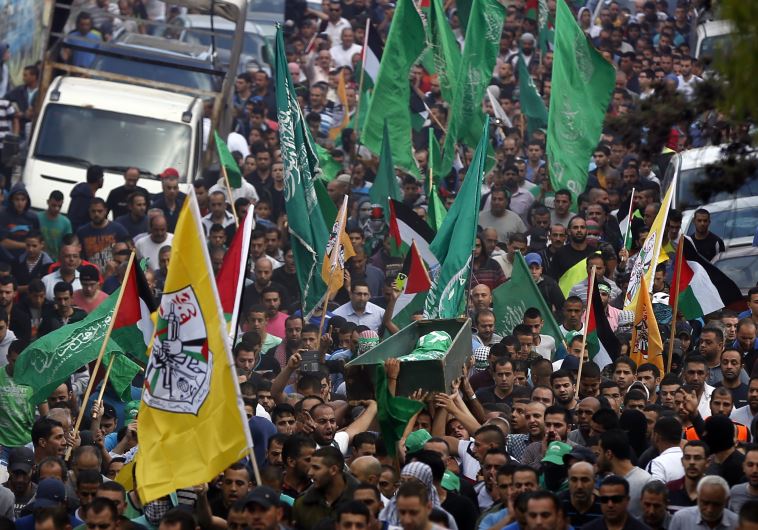
ShowImage (14)Funeral in the Shuafat refugee camp in east Jerusalem, on October 10, 2015. (photo credit: AHMAD GHARABLI / AFP)

About expected Palestinian state intentions, there is little real mystery to fathom. It should already be widely understood that any new state of Palestine could provide a ready platform for launching endlessly renewable war and terrorism against Israel. Significantly, not a single warring Palestinian faction has ever even bothered to deny such overtly criminal intent. On the contrary, aggressive intent has always been openly embraced, fervently cheered as a distinctly sacred “national” incantation.

*********************************

It’s farewell to the drawing-room’s civilized cry, The professor’s sensible where to and why, The frock-coated diplomat’s social aplomb, Now matters are settled with gas and with bomb.”

– W.H. Auden, Danse Macabre

With apparent suddenness, and a very deliberate brutality, Palestinian terrorists are launching a new wave of indiscriminate assaults they proudly hail as a “third intifada.”

But behind the protective veneer of language, where homicide is conveniently transfigured into revolution, these latest Arab attacks remain what they have always been – that is, crudely camouflaged expressions of rampant criminality.

Jurisprudentially, this is all perfectly obvious. Prima facie, under all pertinent international law, calculated assaults on mostly women and children can never be sanitized or justified. Always, rather, they represent codified crimes of war and crimes against humanity.

Always, such crimes are unpardonable.

Oddly enough, even after the painfully long history of egregious Palestinian crimes carried out against noncombatant populations, a sizable portion of the “international community” still seeks to encourage Palestinian statehood. Self-righteously, of course, and with ritualistic indignation directed against Israeli “intransigence,” the “civilized community of nations” remains willing to rip a 23rd Arab state from the still-living body of Israel. Even now, as the Palestinians remain rigorously segmented into barbarously warring factions – into opponents who enthusiastically maim and torture each other, all while cooperating in doing the same to their commonly despised Israeli victims – world public opinion calls naively for Palestinian “self-determination.”

Even now, when any new Palestinian state could quickly come to resemble an already-fractured Syria, the United Nations and its secretary – general seem much more concerned with comforting the markedly unheroic Palestinian criminals than with protecting fully innocent Israeli civilians.

Unapologetically, and whatever their unhindered and ongoing excesses, Fatah, Hamas and Islamic Jihad are easily able to incite followers to inflict and then celebrate incessant harms upon Israel.

At some point, it is likely that such harms, joyously imposed with a reassuring impunity, could involve diverse weapons of mega-terrorism, including assorted chemical, biological, or even nuclear agents.

In this last category of insidious choice, Palestine, after formalizing its sought-after condition of statehood or sovereignty, could be placed in an optimal position to assault Israel’s Dimona nuclear reactor.

This plainly sensitive facility was previously attacked, in both 1991 and again in 2014. Those earlier missile and rocket barrages, which produced no ascertainably injurious damages to the critical reactor core, had originated with Iraqi and Hamas aggressions, respectively.

About expected Palestinian state intentions, there is little real mystery to fathom. It should already be widely understood that any new state of Palestine could provide a ready platform for launching endlessly renewable war and terrorism against Israel. Significantly, not a single warring Palestinian faction has ever even bothered to deny such overtly criminal intent. On the contrary, aggressive intent has always been openly embraced, fervently cheered as a distinctly sacred “national” incantation.

A September 2015 poll by the Palestinian Center for Policy and Survey research – the leading social research organization in the Palestinian territories – found that a majority of Palestinians unhesitatingly reject a two-state solution.

When asked, as a corollary question, about any preferred or alternate ways to establish an independent Palestinian state, 42 percent called for “armed action.”

Only 29% favored “negotiation,” or some sort of peaceful resolution.

Not much mystery here.

On all currently official Hamas and Palestinian Authority (PA ) maps of “Palestine,” Israel has been removed altogether, or identified exclusively as “occupied Palestine.”

By these revealingly forthright and vengeful depictions, Israel has already been forced to suffer a “cartographic genocide.” Unambiguously, from the standpoint of any prospective Palestinian state policies toward Israel, such incendiary maps are portentous, predictive and possibly even prophetic.

What is not generally recognized is that a Palestinian state, any Palestinian state, could play a determinedly serious role in bringing some form of nuclear conflict to the Middle East. Palestine, of course, would itself be non-nuclear; but that’s not the issue. There would remain several other ways in which the new state’s predictable infringements of Israeli security could make the Jewish state more vulnerable to an eventual nuclear attack from Iran, or, in the even more distant future, from a newly-nuclear Arab state.

This second prospect would likely have its core origins in understandable reactions to the plainly impotent Vienna pact with Iran.

Following the July 14, 2015 Joint Comprehensive Plan of Action (JCPOA ), several Sunni states in the region, most plausibly Egypt and/ or Saudi Arabia, will likely feel compelled to “go nuclear.”

In essence, any such considered Sunni Arab nuclear proliferation would represent a more-or-less coherent “self-defense” reaction against expectedly escalating perils, once still-avoidable dangers now issuing from the reciprocally fearful Shi’ite world.

There is also more to expect from the Sunni side. Here, in actions that would have no apparent connection to expected Iranian nuclearization, Islamic State (IS) could begin an avowedly destructive march westward, across Jordan, and all the way to the borders of West Bank (Judea/Samaria). There, should a Palestinian state already be established and functional, dedicated Sunni terrorist cadres would likely make quick work of any deployed Palestinian army. In the event that a new Arab state had not yet been suitably declared – that is, in a fashion consistent with codifying Montevideo Convention (1934) expectations – invading IS forces (not Israel) will have become the principal impediment to Palestinian independence.

Credo quia absurdum – “I believe because it is absurd.” In either case, any such IS or IS-related conquest could create another available platform for launching relentless terrorist attacks across the region.

In time, of course, most of these murderous attacks would be aimed precisely at Israel.

IS, as everyone can see, is on the move. It has already expanded well beyond Iraq and Syria, notably into Yemen, Libya, Egypt and Somalia.

Although Hamas leaders generally deny any IS presence in Gaza, that terrorist group’s black flag is now seen more and more regularly in that expressly Palestinian space.

In principle, at least, Israel could sometime find itself forced to cooperate with Hamas against IS, but any reciprocal willingness from the Islamic Resistance Movement, whether glaringly conspicuous or beneath the radar, is implausible.

Additionally, Egypt regards Hamas as part of the much wider Muslim Brotherhood, and prospectively, just as dangerous as IS.

In any event, after Palestine, and even in the absence of any takeover of the new Arab state by IS forces, Israel’s physical survival would require increasing self-reliance in existential military matters.

Such expansions, in turn, would demand: 1) an appropriately revised nuclear strategy, involving deterrence, defense, preemption and warfighting capabilities; and 2) a corollary conventional strategy.

Significantly, however, the birth of Palestine could impact these strategies in several disruptive ways.

Most ominously, a Palestinian state could render most of Israel’s conventional capabilities substantially more problematic. It could thereby heighten certain eventual chances of a regional nuclear war.

Credo quia absurdum. A nuclear war in the Middle East is not out of the question. At some point, such a conflict could arrive in Israel not only as a “bolt-from-the-blue” surprise missile attack, but also as a result, whether intended or inadvertent, of escalation.

If, for example, certain enemy states were to begin “only” with conventional and/or biological attacks upon Israel, Jerusalem might then respond, sooner or later, with nuclear reprisals. Or if these enemy states were to begin hostilities with certain conventional attacks upon Israel, Jerusalem’s own conventional reprisals might then be met, at least in the future, with enemy nuclear counterstrikes.

For now, this second scenario could become possible only if Iran were to continue its evident advance toward an independent nuclear capability. It follows that a persuasive Israeli conventional deterrent, at least to the extent that it could prevent enemy state conventional, and/or biological attacks, would substantially reduce Israel’s risk of any escalatory exposure to a nuclear war. Israel will need to maintain its capacity for “escalation dominance,” but Palestinian statehood, on its face, could still impair this overriding strategic obligation.

A subsidiary question comes to mind. Why should Israel need a conventional deterrent at all? Israel, after all, seemingly maintains a capable nuclear arsenal and corollary doctrine, even though both still remain “deliberately ambiguous.”

And there arises a still further query. Even after “Palestine,” wouldn’t enemy states desist from launching conventional and/or biological attacks upon Israel, here, out of an entirely reasonable and prudent fear of suffering a nuclear retaliation? Not necessarily. Aware that Israel would cross the nuclear threshold only in certain extraordinary circumstances, these enemy states could be convinced – rightly or wrongly – that so long as their attacks were to remain non-nuclear, Israel would respond only in kind. Faced with such probable calculations, Israel’s ordinary security would still need to be sustained by conventional deterrent threats.

A strong conventional capability will still be needed by Israel to deter or to preempt conventional attacks – attacks that could, if undertaken, lead quickly, via escalation, to various conceivable forms of unconventional war.

Credo quia absurdum. It is still not sufficiently understood that Palestine could have serious effects on power and peace in the Middle East. As the creation of yet another enemy Arab state would need to arise from the intentional dismemberment of Israel, the Jewish state’s strategic depth would inevitably be diminished. Over time, therefore, Israel’s conventional capacity to ward off assorted enemy attacks could be correspondingly reduced.

Paradoxically, if enemy states were to perceive Israel’s own sense of expanding weakness and desperation, this could strengthen Israel’s nuclear deterrent. If, however, pertinent enemy states did not perceive such a “sense” among Israel’s decision-makers (a far more likely scenario), these states, now animated by Israel’s conventional force deterioration, could then be encouraged to attack. The cumulative result, spawned by Israel’s post-Palestine incapacity to maintain strong conventional deterrence, could become: 1) defeat of Israel in a conventional war; 2) defeat of Israel in an unconventional chemical/biological/nuclear war; 3) defeat of Israel in a combined conventional/unconventional war; or 4) defeat of Arab/Islamic state enemies by Israel in an unconventional war.

For Israel, a country less than half the size of Lake Michigan, even the “successful” fourth possibility could prove intolerable. The tangible consequences of a nuclear war, or even a “merely” chemical/ biological war, could be calamitous for the victor as well as the vanquished.

Under such exceptional conditions of belligerency, the traditional notions of “victory” and “defeat” would likely lose all serious meaning.

Although a meaningful risk of regional nuclear war in the Middle East must exist independently of any Palestinian state, this uniquely serious threat would be still greater if a new Arab terrorist state were authoritatively declared.

Palestine, it has increasingly been argued, could sometime become vulnerable to overthrow by even more militant jihadist Arab forces, a violent transfer of power that could then confront Israel with an even broader range of regional perils.

In this connection, IS, again, could find itself at the outer gates of “Palestine.” In such a scenario, it is plausible that the IS fighters would make fast work of any residual Palestinian defense force, PA and/ or Hamas, and then absorb Palestine itself into a rapidly expanding Islamic “caliphate.”

Before anything remotely decent could be born from such a determined theocracy, a very capable sort of gravedigger would have to wield the forceps.

The “third intifada” is just another legitimizing term for remorseless Palestinian terrorism. Should it transform the always fratricidal Palestinian territories into another corrupted Arab state, Palestine, either by itself, or as a newly-incorporated part of a still-growing IS “caliphate,” would become another Syria. Even more significantly, Palestine could bring specifically nuclear-based harms to the broader region.

Then, quite predictably, all pertinent “matters” would be settled “with gas and with bomb.”

Czar Putin defends the West

October 14, 2015

Czar Putin defends the West, American ThinkerJames Lewis, October 14, 2015

Vladimir Putin isn’t a nice liberal, but he is a realist, which is much more than any Western leader can say today. Without realism it is impossible to act morally. Without realism, everything turns into an Obamaesque kabuki play.

********************************

Well, Obama has systematically undercut our friends in the Middle East, and Vladimir Putin is picking up the pieces. Obama promised big change — only not the ones we see happening. As Obama promised the radical left, America is now drastically weakened; but oddly enough, peace hasn’t busted out all over.

So here comes the Czar of all Russias to rescue Christian civilization from a bloody nightmare in Syria and Iraq. While the United States is supplying major weapons to brutal Sunni gangs who keep committing horrific war crimes, jihadis are taking advantage of the chaos to make genocidal attacks on Arab Christians, Egyptian Copts, Orthodox Armenians, Kurds, Yazidis, and Druze. (And each other — of course.)

Every time another domino falls, this administration looks more shell-shocked. Their comforting delusions are crumbling. Today they’ve stopped even pretending to understand what’s going on.

Even Obama’s surrender to Iran’s nuclear obsessions is now failing. Today, none of the European “partners” in that miserable appeasement are still willing to sign Obama’s Diktat; not even the Iranians, who are getting everything they want without Obama. It’s a total capitulation, with sinister consequences to come soon.

The Germans have doubled their profitable trade with Tehran, while  Russia and China are making huge military and nuclear power plant sales. Seven thousand Iranian Revolutionary Guards are fighting against U.S.-sponsored jihadis in Syria, along with ten times as many Hizb’allah fighters. Iran’s strategic noose around Saudi Arabia is tightening, and the naval chokepoint of Aden is under direct military threat.

The CIA failed to predict Putin’s intervention in Syria, yet for months everybody from Israel to Saudi Arabia has been sending top-level negotiators to Moscow. It’s the only thing they could do, after we threw them to the sharks. For nations in mortal peril, it’s any port in a storm.

And yes, it’s a fair bet that all the players carried gifts for the Tsar, to make sure they would not be victimized by the new hegemon.

The CIA failed to predict the Russian move into Syria. But you don’t need a huge intelligence “community” to see the obvious. This White House isn’t interested in the truth anyway. Obama can’t stand being contradicted, and the CIA is responding by not telling him what he doesn’t want to hear.

Syria’s President Assad is as ruthless as any dictator in the Middle East, but he based his power on protecting minorities, like his own Alawites. Like Muammar Gadaffi in Libya, he kept a precarious peace among hostile factions.

Christian bishops in the Middle East see Putin as their sole protector in the double bind between jihad and a militantly atheist West. To persecuted minorities in the Middle East, Putin has seized the moral high ground.

We have no idea what Putin is going to do next. Russia has the potential of becoming a major stabilizing force in the Middle East. But his convictions are becoming clearer. He understands Syria along the lines of his war with Chechnya: His actions there were ruthless but effective. ISIS has thousands of Chechnyan jihadis, now with combat experience, and ready to assault Russia. Putin will not tolerate that, just as China won’t tolerate its own Muslim rebels in Syria-Iraq returning to attack its vulnerable Uighur flank.

Putin carries street cred in a world of jihadist gangs. In 2002, Chechnyan terrorists murdered school children in Beslan and bombed the Dubrovka Theater. Putin reacted with brutal efficiency. His rise to power since that time is based on knocking down the Chechnyan rebellion, by bombarding entire cities. Much of Putin’s popularity among regular Russians is based on his brutal suppression of violent Islam.  But the Islamists attacks still continue.

Obama has just spent half a billion dollars to arm and train “Syrian moderates,” who took the money and ran, to join the worst terrorist gangs in the neighborhood. This week we heard that 70% of our military equipment sent to “Syrian moderates” ended up in the hands of ISIS.

I know we’re not supposed to say words like “Christian civilization,” but Vladimir Putin believes them. He isn’t wrong. For four centuries, until Lenin murdered the last Romanovs in 1918, the Tsars prided themselves on being the defenders of Christianity. Like the Vatican, the Russian Orthodox Church claims a direct line of apostolic descent from the early Christian churches, by way of the Byzantine Empire. And yes, there were plenty of wars between Polish Catholics and Russian Orthodox.

There was cruel persecution of Jews whenever a scapegoat was wanted. But today the Ottoman Turks are still remembered with a special horror in Eastern and Southern Europe. Sometimes you have to choose between bad and worse.

(Several years ago Pope Benedict quoted the Byzantine Emperor Manuel Paleologus II, condemning the sadistic cruelties of jihadist Islam. Telling the truth horrified liberals around the world, the way it always does. That quote came from a time shortly before the Byzantine Empire was destroyed by jihad, leaving the remaining Orthodox Churches bereft of their original lands.)

Putin has his picture taken regularly with the Patriarch of Moscow, probably for political reasons, but also because he has a deep sense of history. Unlike every cowardly Western liberal politician who can’t say the words “Muslim barbarism,” Putin is very clear about jihad. He understands the history of horrific Muslim assaults on Russia. He knows that jihad war has not changed one little bit in a thousand years. Like Samuel Huntington, the first historian of the jihad war, Putin also understands in a very profound way that this is a war for civilization.

Vladimir Putin isn’t a nice liberal, but he is a realist, which is much more than any Western leader can say today. Without realism it is impossible to act morally. Without realism, everything turns into an Obamaesque kabuki play.

Putin was raised by an Orthodox mother and a Marxist father. He came to power by brutally putting down a Muslim terrorist rebellion in Chechnya, using the standard Russian method of bombarding entire cities until they surrendered.

As a rising KGB colonel, Putin saw his world falling apart under Gorbachev, who tried to liberalize the Soviet Empire, only to see it collapse. In his eyes, democratic liberalism doesn’t work, Soviet Marxism didn’t work, and he certainly doesn’t want nuclear jihad to win.

Americans are used to thinking of Soviet Russia as a militant atheist regime, which tried to destroy religious faith wherever it could, for seven or eight decades. One of the astonishing facts of the 20th century is the survival of traditional religion under decades of Marxist oppression. It sometimes seems as if faith tends crumble in rich consumer societies; but persecution and misery bring it back.

When the Soviet Union was beginning to crumble in the late 1980s, some members of the Central Committee were quoted as exclaiming “Bozhe moye!” — My God!! whenever another piece of bad news came in. Religion had survived, even at the secret heart of the heart of the Communist Party. The same is happening in China today.

So Putin has gone back to the Tsarist practice of using the Orthodox Church to build national unity. He is also religiously tolerant as long as it’s peaceful. As long as they don’t threaten the Tsar, people can practice their faith. (But not when it comes to militant gay movements).

If Putin is smart, he won’t abuse his new credibility and power in the Middle East. Russia stands to gain numerous benefits, as long as it is perceived to be preserving an acceptable balance of power. That also means finding a position between Iran and Saudi Arabia, between Israel and Iran, and between Europe and the oil it depends on. Russia can reap huge benefits just from protecting mutually hostile oil regimes from each other; by saving their cookies, Putin also gets into the oil game.

Putin now runs the biggest military near the world’s oil spigot, even as shale deposits are quickly being exploited all over the world.

This is a time of constant probing to discover the parameters of the new hegemony.

So far, Putin’s intervention has been cheap,  taking advantage of historically stupid moves by the Euro-American Left. Putin can use his new-found influence in the Middle East to rebuild Russia’s economy in a world of fast-falling oil prices.


Putin: Obama has “mush for brains”

October 13, 2015

Putin: Obama has “mush for brains,” Power LineJOHN HINDERAKER, October 13, 2015

Vladimir Putin once again showed his deep respect for Barack Obama, as he complained about the incompetence of U.S. policy in Syria:

“Now, we often hear that our pilots are striking the wrong targets, not IS,” Putin said at an investment forum in Moscow explaining that Russia had asked Washington to provide a list of targets.
But Washington declined.

“‘No, we are not ready for this’ was the answer,” Putin quoted them as saying. “Then we thought again and asked another question: then tell us where we should not strike. No answer too,” he said, adding: “That is not a joke. I did not make this up.”

“How is it possible to work together?” he asked. “I think some of our partners simply have mush for brains, they do not have a clear understanding of what really happens in the country and what goals they are seeking to achieve.”

While Putin didn’t use Obama’s name, his meaning is clear enough: just as he is personally aware of the situation in Syria and Russia’s communications with the U.S., his American counterpart is, or should be, aware as well. Barack Obama has become an international piñata, a figure of fun for whom other leaders need no longer pretend to have respect.

Obama arms Islamic terrorists who called for “slaughtering Americans like cattle”

October 12, 2015

Obama arms Islamic terrorists who called for “slaughtering Americans like cattle,” Front Page Magazine, Daniel Greenfield, October 12, 2015

(Surely Obama, with access to top military and intelligence officials, knows precisely what he’s doing. Not only that, it couldn’t be his mess. Somebody else has to be blamed. Right? — DM)

logo_of_ghuraba_al-sham_front

The Syrian Civil War is a mess. Whether or not that disclaimer appears at the top of every article and post, you should assume that it does. There are factions and splinter groups that are constantly merging and reforming.

Which is why backing anyone in the war is hazardous. But here’s the latest phase of Obama’s “I don’t know what the hell I’m doing in Syria” strategy.

The U.S. military airdropped 50 tons of small arms ammo and grenades in northern Syria on Sunday, a senior defense official told Fox News, representing the Pentagon’s shift from training rebel fighters to equipping them.

Coming just two days after the Defense Department announced it was effectively ending its current training program, the airdrop delivery was made Sunday by four C-17 transport aircraft. The 112 pallets contained ammunition for M-16s and AK-47s.

This time, the official said Syrian Kurds were not recipients of the U.S. airdrop — only Syrian Arabs fighting ISIS. There is sensitivity in Washington over arming Syrian Kurds, whom Turkey sees as an enemy but the U.S. counts as a NATO ally.

Who is actually getting the weapons? Here’s whom the weapons are meant to be going to…

The alliance calling itself the Democratic Forces of Syria includes the Kurdish YPG militia and Syrian Arab groups, some of which fought alongside it in a campaign that drove Islamic State from wide areas of northern Syria earlier this year.

The Arab groups in the new alliance are operating under the name “The Syrian Arab Coalition” – a grouping which U.S. officials have said would receive support under a new U.S. strategy aimed at fighting Islamic State in Syria.

So Turkey has forced the US to deny weapons to the Kurdish part of the alliance. The Syriac Military Council is in the alliance too, but it’s unclear if they’re getting resupplied.

So that just leaves the Syrian Arab Coalition. And who is in the Syrian Arab Coalition?

“We met the Americans and this has been approved and we have been told these new arms … are on their way,” said Abu Muazz, a spokesman for the Raqqa Revolutionaries Front, a grouping of mainly Arab tribal insurgents who are mostly drawn from the Raqqa area.

Tribal insurgents. Sounds okay, right? Except that name doesn’t appear to be in use. This may be the Raqqa Revolutionaries’ Brigade whose Arabic name is Liwa Thuwwar al-Raqqa which was formerly allied with the Al Nusra Front… which is Al Qaeda. Since then Liwa claims to have split from Nusra and is fighting ISIS. But Nusra is also fighting ISIS.

Aymenn Jawad Al-Tamimi has a summary of the relationship that runs several paragraphs. (The Syrian Civil War is a mess. See above.)

The new alliance includes the YPG, various Arab groups including Jaysh al-Thuwwar (Army of Rebels) and the Arab tribal Jaysh al-Sanadeed, and an Assyrian Christian group, according to a statement announcing its establishment.

Except we’re apparently not arming the YPG. It’s unclear if we’re arming the Assyrians. But we are arming Jaysh al-Thuwwar, which is a coalition of a bunch of other groups formerly part of the FSA. The Sanadeed appear to actually be closely linked to the YPG.

But it gets messier from here.

Another faction in the new coalition, Jaysh al-Qasas, worked with IS in 2014. FSA commanders say its leader spends most of his time in Turkey and his fighters are most interested in looting.

Of course the FSA, which used to be US backed, has every reason to trash talk the current aid recipients.

“They are fighters who have moved from one militia to another,” says Abdul Rahman, a commander with the Army of Mujahideen , which is aligned with Jaish al Fata, or the Army of Conquest, the Islamist rebel alliance.“Most of them are rejects. They are not reliable — we don’t trust them,” he told VOA.

“I generally agree with the testimony of those rebels you have spoken to,” says Aymenn Jawad al-Tamimi, a fellow at U.S.-based think tank the Middle East Forum. He says that armed groups in one of the largest of the factions, the Dawn of Freedom, have “reputations for corruption.”

“The main groups of the coalition are splinters from larger rebel militias and in the case of Dawn of Freedom it is essentially a regrouping of militias that had reputations for criminality in North Aleppo, such as Ghuraba al-Sham,” he told VOA. Some of the factions were thrown out of an Islamist rebel alliance.

Al-Tamimi added: “The other components of the rebel allies with the YPG are small groups of locals who fled their homes in Deir ez-Zor and Jarabulus” after the Islamic State overran the towns. Some are members of the Shammar tribe in eastern Syria, which has suffered repeated IS reprisals and massacres.

Opportunists is about the nicest thing we could say about them. But it also means they’re likely to resell weapons or engage in fake battles. And when a lot of fighters move from one militia to another, we could very well end up directly arming ISIS or Al Qaeda groups.

But don’t worry, when this falls apart, Obama will blame Hillary Clinton or McCain and claim that he never wanted to do it in the first place. Because Obama never takes responsibility.

Oh by the way, here’s something on Ghuraba al-Sham.

Ghuraba al-Sham comprising mainly Turks and fighters from former Soviet bloc countries…

As Syrian preacher Dr. Mahmud al-Aghasi, known as Abu al-Qaqa, left an Aleppo mosque after Friday prayers on September 28, an assassin stepped out of a car and opened fire with an automatic weapon. The controversial preacher received mortal wounds to the head and body, while three others were wounded. Little information on the case has emerged from the normally secretive and tightly controlled Syrian state. Most of what is known comes from al-Qaqa’s own followers in Ghuraba al-Sham (Strangers of Greater Syria), some of whom chased the killer for two to three kilometers before apprehending him.

It gets worse. Much, much worse.

On the CDs, Abu al-Qaqa is shown speaking to worshipers under the banner of a then-unknown group, Guraba al-Sham (Strangers of Greater Syria). This became the umbrella under which he operated, and whose name was imprinted on all of his CDs. On camera, he tells his followers, who are assembled before him at a mosque: “We will teach our enemies a lesson they will never forget.” He then asks: “Are you ready?” Thundering chants respond affirmatively from his audience, who get worked up into tears as they listen, and he carries on: “Speak louder so [US President George W Bush] can hear you!” Their tears make him weep as well, as he gets impassioned with anti-Americanism and adds: “Guests have come to our land … slaughter them like cattle. Burn them! Yes, they are the Americans!”

So that’s who we’re arming. The pet militia of a guy who played a key role in funneling terrorists to kill Americans in Iraq.

Today the Iraqi government aired the confession of Mohammed Hassan al Shemari, a Saudi al Qaeda member who claims to be the leader of the terror group’s forces in Diyala province. Sherari said Syrian intelligence, or the Mukhabarat, actively supports al Qaeda in Iraq. From Reuters:

Shemari said when he arrived in Syria from Saudi Arabia, he was met by a militant who took him to an al Qaeda training camp in Syria. The head of the camp was a Syrian intelligence agent called Abu al-Qaqaa, he said. “They taught us lessons in Islamic law and trained us to fight. The camp was well known to Syrian intelligence,” he said.

Once inside Iraq he undertook more training in its vast desert province of Anbar, bordering Syria, alongside 30 other foreign fighters. He then met a purported al Qaeda in Iraq leader, Omar al-Baghdadi, who he said appointed him head of al Qaeda in the violent Diyala province.

He launched gun attacks on police checkpoints in Diyala, kidnapping Iraqi officers and extorting money for their release or killed them with knives and set up suicide bombings, he said.

Assad at the time was collaborating with Al Qaeda in conducting attacks on Americans. Which is why all the Russian propaganda claiming that the US created ISIS and that Assad is the only bulwark against them is laughable. Assad was their former pal. Guraba al-Sham is a group of former Jihadists backed by Assad to kill Americans that turned against Assad.

And their dead leader really hated America.

“Our hearts are filled with joy when we hear about any resistance operations in Iraq against the American invaders. We ask people to keep praying to Allah to help achieve victory for Iraq against the US,” Sheikh Qaqa says.

Qaqa’s Islamic values go far beyond vocal – and popular – hostility toward US Mideast policy. For example, he openly calls for an Islamic state based on sharia law in Syria…

“Yes, I would like to see an Islamic state in Syria and that’s what we are working for,” Qaqa says. There are even indications that Qaqa’s support base is becoming organized. His followers hold meetings in a building that serves as an office and library. Several of his followers wear camouflage military trousers.

So we’re arming the Islamic State to fight the Islamic State. It’s a plan that can’t fail.

Sheikh Qaqa was also known as the godfather of Fatah al-Islam. Fatah al-Islam was officially classified as a terror group under Bush, but not under Obama. It was inspired by Al Qaeda and worked with Zarqawi, the leader of what would become ISIS.

It attempted to carry out terrorist attacks in Europe and it’s currently allied with ISIS.

Heck of a job, John Kerry. Heck of a job.

Islamic State grows in Afghanistan, encroaches on Kabul as U.S. remains ‘passive observer’

October 12, 2015

Islamic State grows in Afghanistan, encroaches on Kabul as U.S. remains ‘passive observer’ Washington TimesRowan Scarborough, October 11, 2015

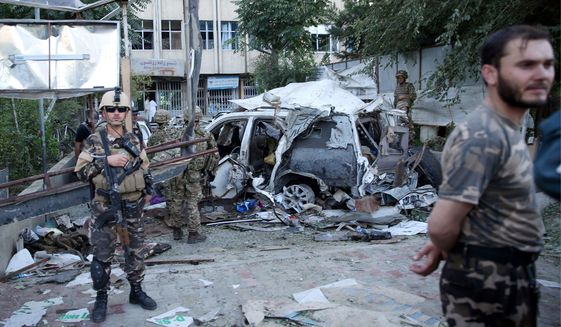
10112015_afghan8201_c0-275-5060-3224_s561x327Photo by: Massoud Hossaini  Afghan security forces and British soldiers inspect the site of a suicide attack in the heart of Kabul, Afghanistan. Loyalists of the Islamic State group are making inroads into Afghanistan, with homegrown militants claiming allegiance to the Islamic State as it controls territory in some parts of the country. (Associated Press)

Afghanistan’s 3,000-member ISIL army is about one-tenth the size of the Afghan Taliban’s forces. But NATO says the Islamic State has reached the next stage of being an emerging threat. If its growth in other regions, such as North Africa, is a gauge, its Afghan component will only expand further as young Muslims are drawn by social media to its ultraviolent ways and Sunni orthodoxy.

************************

The Islamic State is growing at an alarming rate in Afghanistan, within striking distance of the capital, and there does not seem to be a concerted U.S. effort to strike the terrorist army as there is in the Syria-Iraq war theater.

An independent think tank has concluded that the allies are “reacting disjointedly and ineffectively” to the group in Afghanistan and other places outside those two countries.

The Islamic State’s numbers now may reach as high as 3,000 in Afghanistan, mostly in Nangarhar province, less than 50 miles east of Kabul. The emergence presents the NATO-backed elected government there with a fifth deadly enemy in addition to the Taliban, al Qaeda, the Haqqani network and elements of the Pakistani intelligence service.

Globally, the Islamic State, also called ISIL and ISIS, has affiliates in nearly 20 countries.

“It’s like a metastasizing cancer spreading throughout certain parts of the Islamic world,” said James Russell, a former Pentagon official and an instructor at the Naval Postgraduate School in Monterey, California. “We have to hope that the antibodies in these societies can ward off the death, misery and destruction that will come raining down upon them if ISIS takes hold in their communities.”

ISIS_s220x241

Afghanistan’s 3,000-member ISIL army is about one-tenth the size of the Afghan Taliban’s forces. But NATO says the Islamic State has reached the next stage of being an emerging threat. If its growth in other regions, such as North Africa, is a gauge, its Afghan component will only expand further as young Muslims are drawn by social media to its ultraviolent ways and Sunni orthodoxy.

Yet unlike in Syria and Iraq, where a U.S.-led coalition conducts a series of daily airstrikes against the Islamic State, there appears to be no such strategy in Afghanistan, where Afghan government forces now have the lead in all combat operations and request NATO air power on an ad hoc basis.

“What concerns me most is the fact that the United States has become a passive observer rather than the driver of the policy,” said Larry Johnson, a former counterterrorism official at the State Department, commenting on the overall U.S. effort against the Islamic State.

U.S. military spokesmen had no immediate comment on the question of American policy toward the Afghan Islamic State. Army Gen. John Campbell, the allied commander in-country, was asked at congressional hearings last week what triggers action against Islamic State. He answered that the criterion is “force protection.”

After the Syria-Iraq war theater, Islamic State’s emergence near Kabul could be the most troublesome for the U.S., whose troop levels have dropped to less than 10,000, and only a small portion of those forces are dedicated to assist in counterterrorism. The Islamic State has shown it can execute brutal attacks and deploy vehicle bombs to take territory and hold it.

Gen. Campbell said Afghanistan’s security forces lack the leadership and troop numbers to respond to every trouble spot.

Meanwhile, the Islamic State is beginning to flex its terrorism muscle in Afghanistan.

Islamic militant competition

The Institute for the Study of War (ISW) in Washington is tracking the Islamic State’s violent ways in Afghanistan and other countries. It said the Islamic State launched attacks in mid-September against a UNICEF convoy, Afghan government forces, the Afghan Taliban and Shiite civilians. In late September the Islamic State “launched coordinated attacks on multiple Afghan security positions” in Nangarhar, the think tank said.

“The group reportedly also shut down several schools in eastern Afghanistan amid other efforts to assert social control,” the institute said. “ISIS has established robust ground campaigns in Libya, Egypt and Afghanistan.”

The ISW said in the special report “ISIS Global Strategy: A Wargame,” written by counterterrorism analyst Harleen Gambhir, that the Islamic State’s expansion stems from its ability to attract local jihadis.

“The coalition is focused on Iraq and Syria, and it is reacting disjointedly and ineffectively to ISIS’s activities in Libya, Egypt, Afghanistan, and other places,” Ms. Gambhir writes. “ISW’s war game demonstrated how this failure enables ISIS to strategically outpace the U.S. and its allies.”

U.S. intelligence agencies are still trying to digest the meaning of Islamic State setting up shop in South Asia.

Nicholas Rasmussen, director of the National Counterterrorism Center, speaks of an “increasing competition between extremist actors” in the Afghanistan-Pakistan region involving al Qaeda, the Taliban and the Islamic State.

“So that’s an additional factor that we’re still trying to understand,” Mr. Rasmussen told the Combating Terrorism Center at West Point in remarks published last month. He characterized the burgeoning competition as an “interesting feature of the South Asia landscape.”

Gen. Campbell, the U.S. commander closest to Islamic State terrorism in Afghanistan, said foreign fighters are arriving to join the Islamic State as they “try to bring in some sort of funding stream to build a place in Nangarhar.”

He said the emergence of Islamic State “has further complicated the theater landscape and potentially expanded the conflict.”

Mr. Johnson, the former counterterrorism official, said the leaders of Middle East and South Asia countries “concede that the U.S. has no appetite for being engaged, especially militarily in the region.”

The struggle between two radical Sunni groups, the Taliban and the Islamic State, may be sparked in part by the Taliban’s willingness to do business with Iran, a Shiite Islamic country.

“The Taliban have always been far more pragmatic in dealing with Iran, and the religious difference is not a critical factor,” Mr. Johnson said. “Not so with the ISIS crowd. For them, theology takes precedence, and Iran is an apostate state that must be destroyed.”

Does the PA have a strategy?‎

October 11, 2015

Does the PA have a strategy?‎ Israel Hayom, Richard Baehr, October 11, 2015

Abbas may sense that a reconciliation between Israel and the ‎Obama administration is not at hand this time around. The obvious and petty ‎boycott of Netanyahu’s speech at the U.N. certainly supports that thesis. This president ‎carries grudges. In Israel’s case, he seems to have come into office carrying one. ‎With the president in full-time legacy-building mode in his last 16 months in office ‎‎(the climate treaty and executive action on gun control are next up), it is hard to ‎believe that he will simply accept defeat and an inability to influence the Israeli-‎Palestinian conflict in the time he has left. ‎

************************

A third intifada has not yet been officially designated by Haaretz or The New York ‎Times or National Public Radio, though it may feel as if one is underway, when ‎over 60% of Israelis in the latest public opinion survey say they now fear for their ‎personal safety. So too, there is no evidence yet that the wave of Palestinian ‎attacks or — new to this current campaign — the attempted mass crossings from Gaza, ‎have peaked. ‎

Certainly, the reporting on the current events in Israel reflects old habits about ‎how most journalists cover stories of Palestinian violence and Israeli responses. ‎Two standbys always work. One if that there is “a cycle of violence” ( a pox on both ‎your houses), always leaving unclear who the original perpetrators were in an ‎individual attack or group of attacks. A second is to keep a daily scorecard of the ‎comparative body counts, especially when there are more Palestinian casualties ‎and fatalities than Israeli, courtesy of Israeli police or soldiers responding to ‎stabbing attacks, not all of which prove lethal before the attacker is neutralized. ‎This narrative leads to the inevitable charge of disproportionality, one that has ‎become the principal media assault on Israeli responses to terror emanating from ‎Gaza in recent years. As in every other instance in recent years, Haaretz is playing ‎its appointed role of feeding the many international journalists in the country with ‎the “truth in English” as it sees it, and as the international media want to receive ‎and see it, confirming all their established biases about Israel behavior.

For Israeli ‎responses to the current violence to be “fair” and proportional, the comparative ‎Jewish and Arab body counts would need to be more in balance than in prior ‎years. When the current campaign of attacks on Israelis began, The New York Times ‎relegated the story to it its interior pages. Once a few Palestinians were killed by ‎Israeli police, the story became front page news.‎

Any attack on Arabs by an Israeli is always highlighted since it removes any ‎attempt by Israel to argue it is the victim of attacks. It also buttresses the PA’s ‎charges that Israelis, whether in security roles or settlers, are willing executioners, ‎committing crimes against Palestinians. Regardless of how infrequent these individual attacks by Israelis ‎are, they serve to solidify the cycle of violence theme. The Israeli government can ‎condemn these attacks and capture the perpetrators, but it makes no difference. ‎The PA, meanwhile, will applaud the heroism of their new martyrs protecting the ‎holy places on the Temple Mount from an invasion of stinking Jewish filth.‎

The current wave of Arab attacks followed a Palestinian Authority incitement ‎campaign with language such as that above, in which President Mahmoud Abbas, ‎seemingly the president for life, though only elected to a four year term, ‎condemned Israel’s campaign to change the status of the Temple Mount, for which ‎there is no evidence whatsoever. U.S. Secretary of State John Kerry, probably in ‎seclusion and being treated with antidepressants since being denied the Nobel ‎Peace Prize for his abject surrender to the Iranians in Geneva, has acknowledged ‎to Israeli Prime Minister Benjamin Netanyahu that the Americans understand there is no ‎Israeli effort underway to reshape any policy regarding behavior on the Temple ‎Mount. Kerry can probably blame Yasser Arafat’s Nobel Peace Prize for the peace ‎prize medal he did not receive (and likely would not have tossed away). The ‎selection committee was probably not anxious to have the Iranians make them look ‎like fools in years to come once they violated the nuclear deal as Arafat tossed Oslo ‎aside when it was inconvenient. ‎

The naked demagoguery of Abbas’ continually repeated lies about Israeli plans for ‎the Temple Mount will always have the desired affect on the many young men on ‎whom the PA can depend to take to the streets and do their part to protect the ‎‎”holy places” for a fee. While there is no consensus on the degree of PA control ‎over the attacks, the Palestinians certainly know where their rhetoric leads.‎

The question, though, is why the Palestinians have chosen this point in time to ‎overheat the situation, resulting in the loss of both Israeli and Palestinian lives.‎

The answer offered by most analysts so far is that the PA wanted to draw ‎international attention back to its grievances with Israel, which most basically ‎begins with the continued existence of the State of Israel. For many months, ‎relations between Israel and the United States, never very good at any time during ‎the Obama years, have become much more fractious as a result of the ‎disagreement between the two countries over the wisdom of America’s ‎spearheading the effort to make all the concessions required as achieve the ‎nuclear deal with Iran by the ‎P5+1 group of nations. ‎

In prior administrations, when relations between the two countries hit a rough ‎patch over some policy disagreement, typically there was an effort made by both ‎parties to try to restore the historic relationship. In the Obama years, the White ‎House has had problems with Israel on pretty much everything — whether to ‎impose new sanctions on Iran, inhibiting Israeli steps targeting Iran’s nuclear ‎program, the nuclear deal itself, and of course the peace process with the ‎Palestinians, the breakdown of which was blamed on Israel by the administration. ‎In no prior administration has the public rhetoric and off-the-record commentary ‎about Israel and its elected leader been so consistently hostile. A boycott of Netanyahu’s speech to a joint meeting of Congress was supported by the ‎administration, which pulled Vice President Joe Biden from attendance. Near a quarter ‎of all Democrats in Congress chose to observe the boycott. The administration ‎doubled down on its boycott campaign when Kerry and ‎Ambassador Samantha Power were instructed not to attend ‎Netanyahu’s recent speech to the U.N. General Assembly. It makes sense that the president has never condemned the Boycott, Divestment and Sanctions campaigns targeting Israel on American ‎college campuses. He would probably be leading them if he were now a student. ‎

In any case, Abbas may sense that a reconciliation between Israel and the ‎Obama administration is not at hand this time around. The obvious and petty ‎boycott of Netanyahu’s speech at the U.N. certainly supports that thesis. This president ‎carries grudges. In Israel’s case, he seems to have come into office carrying one. ‎With the president in full-time legacy-building mode in his last 16 months in office ‎‎(the climate treaty and executive action on gun control are next up), it is hard to ‎believe that he will simply accept defeat and an inability to influence the Israeli-‎Palestinian conflict in the time he has left. ‎

Abbas has resorted to the strategy that always works to get his cause back in the ‎news — get some of his people killed by Israel, and blame it on Israeli over-reaction ‎and trigger-happy behavior. Maybe Obama will then show his disgust with Israel ‎and commit to not vetoing new measures targeting Israel at the U.N. Security ‎Council, including establishing a plan for Israeli withdrawal from the West Bank ‎and Jerusalem. ‎

It is also possible that Obama planned to lower the temperature of the American-‎Israeli relationship now that the Iran deal had not been blocked by Congress. The prime minister had been invited to the White House next month, and reportedly ‎the president planned to show up. If Abbas thought this was the new glide path, ‎then throwing a monkey wrench into the mix with new violence would certainly ‎complicate things. Obama’s press secretary, Josh Earnest, gave a particularly awful ‎response when questioned about the new wave of Palestinian violence this week, ‎suggesting he had not been advised to turn any page:‎

“The United States condemns in the strongest possible terms ‎violence against Israeli and Palestinian civilians. We call upon ‎all parties to take affirmative steps to restore calm and refrain ‎from actions and rhetoric that would further enflame tensions ‎in that region of the world. We continue to urge all sides to find ‎a way back to the full restoration of the status quo at the ‎Temple Mount in Haram al-Sharif, the location that has ‎precipitated so much of the violence that we’ve seen there.”

In other words, both sides are guilty for attacking the other’s ‎civilians, and somehow a change in the status of the Temple ‎Mount (Israel’s doing) was the root cause of the new problems. ‎

When the administration’s top spokesperson makes this kind ‎of comment, do you think Abbas will decide to ease ‎up on the violence accelerator?

Op-Ed: Chaos and 2nd Cold War, Part II: Israel’s Nuclear Strategy

October 11, 2015

Op-Ed: Chaos and 2nd Cold War, Part II: Israel’s Nuclear Strategy, Israel National News, Prof. Louis René Beres, October 11, 2015

(Part I is available here. — DM)

Israel should now be calculating the exact extent or subtlety with which it should consider communicating key portions of its nuclear posture and positions. Naturally, Israel should never reveal any too-specific information about its nuclear strategy, its nuclear hardening, or even its nuclear yield-related capabilities. Still, sometimes, the duty of finely-honed intelligence services should not be to maximize strategic secrecy, but rather, to carefully “share” certain bits of pertinent information.

**********************************

How will Russia respond to any ramped up American uses of force in the Middle East, and, more plausibly, vice-versa?  One must assume that Jerusalem is already asking these key questions, and even wondering whether, in part, greater mutualities of interest could sometime exist with Moscow than with Washington.

To wit, Prime Minister Benjamin Netanyahu met with Russia’s President Vladimir Putin in September 2015. Among other things, the Israeli leader must  be calculating: 1)Will the Obama Administration’s incoherent retreat from most of the Middle East point toward a more permanent United States detachment from the region; and 2) If it does, what other major powers are apt to fill the resultant vacuum? Just as importantly, and as an obvious corollary to (2), above, the prime minister should be inquiring: “How will the still-emerging Cold War II axis of conflict impact America’s pertinent foreign policy decisions?”

There are some additional ironies yet to be noted. Almost certainly, ISIS, unless it is first crushed by U.S. and/or Russian-assisted counter-measures, will plan to march westward across Jordan, ultimately winding up at the borders of West Bank (Judea/Samaria). There, ISIS Jihadists could likely make fast work of any still-posted Hamas and Fatah forces, in effect, taking over what might once have become “Palestine.” In this now fully imaginable scenario, the most serious impediment to Palestinian statehood is not Israel, but rather a murderous band of Sunni Arab terrorists.[16]

What about the larger picture of “Cold War II?” Israeli defense planners will need to factor into their suitably nuanced calculations the dramatically changing relationship between Washington and Moscow. During “Cold War I,” much of America’s support for the Jewish State had its most fundamental origins in a perceived need to compete successfully in the Middle East with the then Soviet Union. In the progressive development of “Cold War II,” Jerusalem will need to carefully re-calculate whether a similar “bipolar” dynamic is once again underway, and whether the Russian Federation might, this time around, identify certain strategic benefits to favoring Israel in regional geo-politics.

In all such strategic matters, once Israel had systematically sorted through the probable impact of emerging “superpower” involvements in the Middle East, Jerusalem would need to reassess its historic “bomb in the basement.” Conventional wisdom, of course, has routinely pointed in a fundamentally different policy direction. Still, this “wisdom” assumes that credible nuclear deterrence is simply an automatic result of  physically holding nuclear weapons. By the logic of this too-simplistic argument, removing Israel’s nuclear bomb from the “basement” would only elicit new waves of global condemnation, and would likely do so without returning any commensurate security benefits to Jerusalem.

Scholars know, for good reason, that the conventional wisdom is often unwise. Looking ahead, the strategic issues facing Israel are not at all uncomplicated or straightforward.  Moreover, in the immutably arcane world of Israeli nuclear deterrence, it can never really be adequate that enemy states merely acknowledge the Jewish State’s nuclear status. Rather, it is also important that these states should be able to believe that Israel holds usable nuclear weapons, and that Jerusalem/Tel-Aviv would be willing to employ these usable weapons in certain clear, and situationally recognizable, circumstances.

Current instabilities in the Middle East will underscore several good reasons to doubt that Israel could ever benefit from any stubborn continuance of deliberate nuclear ambiguity. It would seem, too, from certain apparent developments already taking place within Mr. Netanyahu’s “inner cabinet,” that portions of Israel’s delegated leadership must now more fully understand the bases of any such informed skepticism.

In essence, Israel is imperiled by compounding and inter-related existential threats that justify its fundamental nuclear posture, and that require a correspondingly purposeful strategic doctrine. This basic need exists well beyond any reasonable doubt. Without such weapons and doctrine, Israel could not expectedly survive over time, especially if certain neighboring regimes, amid expanding chaos,  should soon become more adversarial, more Jihadist, and/or less risk-averse.

Incontestably, a purposeful nuclear doctrine could prove increasingly vital to coping with various more-or-less predictable strategic scenarios for Israel, that is, those believable narratives requiring preemptive action, and/or an appropriate retaliation.

Typically, military doctrine carefully describes how national forces should fight in various combat operations. The literal definition of “doctrine” derives from Middle English, from the Latin doctrina, meaning teaching, learning, andinstruction. Though generally unrecognized, the full importance of doctrine lies not only in the several ways that it can animate and unify military forces, but also in the uniquely particular fashion that it can transmit certain desired “messages.”

In other words, doctrine can serve an increasingly imperiled  state as a critical form of communication, one directed to its friends, and also to its foes.

Israel can benefit from just such broadened understandings of doctrine. The principal security risks now facing Israel are really more specific than general or generic. This is because Israel’s extant adversaries in the region will likely be joined, at some point, by: (1) a new Arab state of “Palestine;” and/or by (2) a newly-nuclear Iran. It is also because of the evidently rekindled global spark of “bipolar” or “superpower” adversity, and the somewhat corollary insertion of additional American military forces to combat certain new configurations of Jihadi terror.

For Israel, merely having nuclear weapons, even when fully recognized in broad outline by enemy states, can never automatically ensure successful deterrence. In this connection, although starkly counter-intuitive, an appropriately selective and thoughtful end to deliberate ambiguity could improve the overall credibility of Israel’s nuclear deterrent.  With this point in mind, the potential of assorted enemy attack prospects in the future could be reduced by making available certain selected information concerning the safety of  Israel’s nuclear weapon response capabilities.

This crucial information, carefully limited, yet more helpfully explicit, would center on the distinctly major and inter-penetrating issues of Israeli nuclear capability and decisional willingness.

Skeptics, no doubt, will disagree. It is, after all, seemingly sensible to assert that nuclear ambiguity has “worked” thus farWhile Israel’s current nuclear policy has done little to deter multiple conventional terrorist attacks, it has succeeded in keeping the country’s enemies, singly or in collaboration, from mounting any authentically existential aggressions. This conclusion is not readily subject to any reasonable disagreement.

But, as the nineteenth-century Prussian strategic theorist, Karl von Clausewitz, observed, in his classic essay, On War, there may come a military tipping point when “mass counts.” Israel is already coming very close to this foreseeable point of no return. Israel is very small.  Its enemies have always had an  undeniable advantage in “mass.”

More than any other imperiled state on earth, Israel needs to steer clear of such a tipping point.

This, too, is not subject to any reasonable disagreement.

Excluding non-Arab Pakistan, which is itself increasingly coup-vulnerable, none of Israel’s extant Jihadi foes has “The Bomb.”  However, acting together, and in a determined collaboration, they could still carry out potentially lethal assaults upon the Jewish State. Until now, this capability had not been possible, largely because of insistent and  persistently overriding fragmentations within the Islamic world. Looking ahead, however, these same fragmentations could sometime become a source of special danger to Israel, rather than remain a continuing source of  national safety and reassurance.

An integral part of Israel’s multi-layered security system lies in the country’s ballistic missile defenses, primarily, the Arrow or “Hetz.” Yet, even the well-regarded and successfully-tested Arrow, now augmented by the newer and shorter-range iterations of “Iron Dome,” could never achieve a sufficiently high probability of intercept to meaningfully protect Israeli civilians.[17] No system of missile defense can ever be “leak proof,” and even a single incoming nuclear missile that somehow managed to penetrate Arrow or corollary defenses could conceivably kill tens or perhaps hundreds of thousands of Israelis.[18]

In principle, at least, this fearsome reality could be rendered less prospectively catastrophic if Israel’s traditional reliance on deliberate ambiguity were suitably altered.

Why alter? The current Israeli policy of an undeclared nuclear capacity is unlikely to work indefinitely. Leaving aside a Jihadi takeover of already-nuclear Pakistan, the most obviously unacceptable “leakage” threat would come from a nuclear Iran. To be effectively deterred, a newly-nuclear Iran would require convincing assurance that Israel’s atomic weapons were both (1) invulnerable, and (2) penetration-capable.

Any Iranian judgments about Israel’s capability and willingness to retaliate with nuclear weapons would then depend largely upon some prior Iranian knowledge of these weapons, including their expected degree of protection from surprise attack, as well as Israel’s expected capacity to “punch-through” all pertinent Iranian active and passive defenses.

Jurisprudentially, at least, following JCPOA in Vienna, a  nuclear weapons-capable Iran is a fait accompli. For whatever reasons, neither the “international community” in general, nor Israel in particular, had ever managed to create sufficient credibility concerning a once-timely preemptive action. Such a critical defensive action would have required very complex operational capabilities, and could have generated Iranian/Hezbollah counter actions that might have a  very significant impact on the entire Middle East. Nevertheless, from a purely legal standpoint, such preemptive postures could still have been justified, under the authoritative criteria of anticipatory self-defense, as permitted under customary international law.

It is likely that Israel has undertaken some very impressive and original steps in cyber-defense and cyber-war, but even the most remarkable efforts in this direction will not be enough to stop Iran altogether. Earlier, the “sanctions” sequentially leveled at Tehran – although certainly better than nothing – could have had no tangible impact on effectively halting Iranian nuclearization.

Strategic assessments can sometimes borrow from a Buddhist mantra. What is, is. Ultimately, a nuclear Iran could decide to share some of its nuclear components and materials with Hezbollah, or with another kindred terrorist group. Ultimately, amid growing regional chaos, such injurious assets could find their way to such specifically U.S- targeted groups as ISIS.

Where relevant, Israeli nuclear ambiguity could be loosened by releasing certain very general information regarding the availability and survivability of appropriately destructive  nuclear weapons.

Israel should now be calculating the exact extent or subtlety with which it should consider communicating key portions of its nuclear posture and positions. Naturally, Israel should never reveal any too-specific information about its nuclear strategy, its nuclear hardening, or even its nuclear yield-related capabilities. Still, sometimes, the duty of finely-honed intelligence services should not be to maximize strategic secrecy, but rather, to carefully “share” certain bits of pertinent information.

What about irrational enemies? An Israeli move from ambiguity to disclosure would not likely help in the case of an irrational nuclear enemy. It is even possible, in this regard, that particular elements of Iranian leadership might meaningfully subscribe to certain end-times visions of a Shiite apocalypse. By definition, any such enemy would not necessarily value its own continued national survival more highly than any other national preference, or combination of preferences. By definition, any such enemy would present a genuinely unprecedented strategic challenge.

Were its leaders to become authentically irrational, or to turn in expressly non-rational directions, Iran could then effectively become a nuclear suicide-bomber in macrocosm.  Such a profoundly destabilizing strategic prospect is improbable, but it is also not inconceivable. A similarly serious prospect exists in already-nuclear Pakistan.

To protect itself against military strikes from irrational enemies, especially those attacks that could carry existential costs, Israel will need to reconsider virtually every aspect and function of its nuclear arsenal and doctrine. This is a strategic reconsideration that must be based upon a number of bewilderingly complex intellectual calculations, and not merely on ad hoc, and more-or-less presumptively expedient political judgments.

Removing the bomb from Israel’s basement could enhance Israel’s strategic deterrence to the extent that it would heighten enemy perceptions of the severe and likely risks involved. This would also bring to mind the so-called Samson Option, which, if suitably acknowledged, could allow various enemy decision-makers to note and underscore a core assumption. This is that Israel is prepared to do whatever is needed to survive. Interestingly, such preparation could be entirely permissible under governing international law, including the 1996 Advisory Opinion of the International Court of Justice.[19]

Irrespective of  its preferred level of ambiguity, Israel’s nuclear strategy must always remain oriented toward deterrence, not to actual war-fighting.[20] The Samson Option refers to a policy that would be based in part upon a more-or-less implicit threat of massive nuclear retaliation for certain anticipated enemy aggressions.  Israel’s small size means, inter alia, that any nuclear attack would threaten Israel’s very existence, and could not be tolerated. Israel’s small size also suggests a compelling need for sea-basing (submarines) at least a recognizably critical portion of its core nuclear assets,

From a credibility standpoint, a Samson Option could make sense only in “last-resort,” or “near last-resort,” circumstances. If the Samson Option is to be part of a convincing deterrent, as it should, an incremental end to Israel’s deliberate ambiguity is essential. The really tough part of this transformational process will lie in determining the proper timing for such action vis-a-vis Israel’s security requirements, and in calculating authoritative expectations (reasonable or unreasonable) of the “international community.”

The Samson Option should never be confused with Israel’s overriding security objective: To seek stable deterrence at the lowest possible levels of military conflict. As a last resort, it basically states the following warning to all potential nuclear attackers:  “We (Israel) may have to `die,` but (this time) we won’t die alone.”

There is a related observation. In our often counter-intuitive strategic world, it can sometimes be rational to pretend irrationality. The nuclear deterrence benefits of any such pretended irrationality would depend, at least in part, upon an enemy state’s awareness of Israel’s intention to apply counter-value targeting when responding to a nuclear attack. But, once again, Israeli decision-makers would need to be aptly wary of ever releasing too-great a level of specific operational information.

In the end, there are specific and valuable critical security benefits that would likely accrue to Israel as the result of a purposefully selective and incremental end to its historic policy of deliberate nuclear ambiguity.   The right time to begin such an “end”  has not yet arrived. But, at the precise moment that Iran verifiably crosses the nuclear threshold, or arguably just before this portentous moment, Israel should  promptly remove The Bomb from its “basement.”

When this critical moment arrives, Israel should already have configured (1) its presumptively optimal allocation of nuclear assets; and (2) the extent to which this preferred configuration should now be disclosed. Such strategic preparation could then enhance the credibility of Israel’s indispensable nuclear deterrence posture.

When it is time for Israel to selectively ease its nuclear ambiguity, a second-strike nuclear force should be revealed in broad outline. This robust strategic force – hardened, multiplied, and dispersed – would need to be fashioned so as to recognizably inflict a decisive retaliatory blow against major enemy cities. Iran, it follows, so long as it is led by rational decision-makers, should be made to understand that the actual costs of  any planned aggressions against Israel would always exceed any expected gains.

In the final analysis, whether or not a shift from deliberate ambiguity to some selected level of nuclear disclosure would actually succeed in enhancing Israeli nuclear deterrence would depend upon several complex and intersecting factors. These include, inter alia, the specific types of nuclear weapons involved; reciprocal assessments and calculations of pertinent enemy leaders; effects on rational decision-making processes by these enemy leaders; and effects on both Israeli and adversarial command/control/communications operations. If  bringing Israel’s bomb out of the “basement” were to result in certain new enemy pre-delegations of nuclear launch authority, and/or in new and simultaneously less stable launch-on-warning procedures, the likelihood of unauthorized and/or accidental nuclear war could then be substantially increased.

Not all adversaries may be entirely rational. To comprehensively protect itself against potentially irrational nuclear adversaries, Israel has no logical alternative to developing an always problematic conventional preemption option, and to fashion this together with a suitable plan for subsequent “escalation dominance.” Operationally, especially at this very late date, there could be no reasonable assurances of success against many multiple hardened and dispersed targets. Regarding deterrence, however, it is noteworthy that “irrational” is not the same as “crazy,” or “mad,” and that even an expectedly irrational Iranian leadership could still maintain susceptible preference orderings that are both consistent and transitive.

Even an irrational Iranian leadership could be subject to threats of deterrence that credibly threaten certain deeply held religious as well as civic values. The relevant difficulty here for Israel is to ascertain the precise nature of these core enemy values. Should it be determined that an Iranian leadership were genuinely “crazy” or “mad,” that is, without any decipherable or predictable ordering of preferences, all deterrence bets could then have to give way to preemption, and possibly even to certain plainly unwanted forms of war fighting.

Such determinations, of course, are broadly strategic, not narrowly jurisprudential. From the discrete standpoint of international law, especially in view of Iran’s expressly genocidal threats against Israel, a preemption option could still represent a permissible expression of anticipatory self-defense. Again, however, this purely legal judgment would be entirely separate from any parallel or coincident assessments of operational success. There would be no point for Israel to champion any strategy of preemption on solely legal grounds if that same strategy were not also expected to succeed in specifically military terms.

Growing chaotic instability in the Middle East plainly heightens the potential for expansive and unpredictable conflicts.[21] While lacking any obviously direct connection to Middle East chaos, Israel’s nuclear strategy must now be purposefully adapted to this perilous potential. Moreover, in making this adaptation, Jerusalem could also have to pay special attention not only to the aforementioned revival of  major “bipolar” animosities, but also, more specifically and particularly, to Russia’s own now-expanding nuclear forces.

This cautionary warning arises not because augmented and modernized Russian nuclear forces would necessarily pose any enlarged military threat to Israel directly, but rather because these strategic forces could determine much of the way in which “Cold-War II” actually evolves and takes shape. Vladimir Putin has already warned Washington of assorted “nuclear countermeasures,” and recently test launched an intercontinental nuclear missile.[22] One such exercise involved a new submarine-launched Bulava missile, a weapon that could deliver a nuclear strike with up to 100 times the force of the 1945 Hiroshima blast.

Current adversarial Russian nuclear posturing vis-à-vis the United States remains oriented toward the Ukraine, not the Middle East.[23] Nevertheless, whatever happens to U.S.-Russian relations in any one part of the world could carry over to certain other parts, either incrementally, or as distinctly sudden interventions or escalations. For Jerusalem, this means, among other things, an unceasing obligation to fashion its own developing nuclear strategy and posture with an informed view to fully worldwide power problems and configurations.

Whether looking toward Gaza, West Bank (Judea/Samaria), Iran, Lebanon, Iraq, Jordan, Egypt, or Syria, Israel will need to systematically prioritize existential threats, and, thereafter, stay carefully focused on critically intersecting and overriding factors of global and regional security. In all such meticulously careful considerations, both chaos and Cold War II should be entitled to occupy a conspicuous pride of place.

Sources:

[16] A further irony here concerns Palestinian “demilitarization,” a pre-independence condition of statehood called for by Israeli Prime Minister Benjamin Netanyahu. Should Palestinian forces (PA plus Hamas) ever actually choose to abide by any such formal legal expectation, it could makes these forces less capable of withstanding any foreseeable ISIS attacks. Realistically, however, any such antecedent compliance would be highly improbable. See, for earlier legal assessments of Palestinian demilitarization, Louis René Beres and (Ambassador) Zalman Shoval, “Why a Demilitarized Palestinian State Would Not Remain Demilitarized: A View Under International Law,” Temple International and Comparative Law Journal, Winter 1998, pp. 347-363; and Louis René Beres and Zalman Shoval, “On Demilitarizing a Palestinian `Entity’ and the Golan Heights: An International Law Perspective,” Vanderbilt Journal of Transnational Law, Vol. 28, No. 5, November 1995, pp. 959-972.

[17] There is another notable and more generic (pre-nuclear age) risk of placing too-great a reliance on defense. This is the risk that a corollary of any such reliance will be a prospectively lethal tendency to avoid taking otherwise advantageous offensive actions. Recall, in this connection, Carol von Clausewitz On War:  “Defensive warfare…does not consist of waiting idly for things to happen. We must wait only if it brings us visible and decisive advantages. That calm before the storm, when the aggressor is gathering new forces for a great blow, is most dangerous for the defender.” See: Carl von Clausewitz, Principles of War, Hans W. Gatzke, tr., New York: Dover Publications, 2003, p. 54.

[18] For early authoritative accounts, by the author, of expected consequences of a nuclear attack, see: Louis René Beres, Apocalypse: Nuclear Catastrophe in World Politics (Chicago: University of Chicago Press, 1980); Louis René Beres, Mimicking Sisyphus: America’s Countervailing Nuclear Strategy (Lexington, Mass., Lexington Books, 1983); Louis René Beres, Reason and Realpolitik: U.S. Foreign Policy and World Order (Lexington, Mass., Lexington Books, 1984); and Louis René Beres, Security or Armageddon: Israel’s Nuclear Strategy (Lexington, Mass., Lexington Books, 1986).

[19] See: “Summary of the Legality of the Threat or Use of Nuclear Weapons,” Advisory Opinion, 1996, I.C.J., 226 (Opinion of 8 July 1996). The key conclusion of this Opinion is as follows: “…in view of the current state of international law, and of the elements of fact at its disposal, the Court cannot conclude definitively whether the threat or use of nuclear weapons would be lawful or unlawful in an extreme circumstance of self-defense, in which the very survival of a State would be at stake.”

[20] This advice was a central recommendation of the Project Daniel Group’s final report,  Israel’s Strategic Future (ACPR, Israel, May 2004: “The overriding priority of Israel’s nuclear deterrent force must always be that it preserves the country’s security without ever having to be fired against any target. The primary point of Israel’s nuclear forces must always be deterrence ex ante, not revenge ex post.” (p. 11). Conceptually, the core argument of optimizing military force by not resorting to any actual use pre-dates the nuclear age. To wit, Sun-Tzu, in his ancient classic, The Art of War, counseled: “Supreme excellence consists of breaking the enemy’s resistance without fighting.”

[21] Once again, Prussian military thinker, Carl von Clausewitz, had already highlighted the generic (pre-nuclear age) dangers of unpredictability, summarizing these core hazards as matters of “friction.”

[22] ICBM test launches are legal and permissible under the terms of New START, It does appear, however,  that Russia has already developed and tested a nuclear-capable cruise missile with a range of 500-5500 KM, which would be in express violation of the Intermediate Nuclear Forces Treaty (INF). At the same time, current research into the U.S. Conventional Prompt Global Strike Program seeks to circle around INF Treaty limitations, by employing a delivery vehicle trajectory that is technically neither ballistic nor cruise.

[23] Russia, of course, is operating much more openly and substantially in Syria, but here, in the Middle East theatre, at least, Moscow’s public tone toward Washington is somewhat less confrontational or adversarial.