Archive for the ‘Obama and Iran’ category

Iran: Attack on US Boats is Warning to Congress on Sanctions

January 13, 2016

Iran: Attack on US Boats is Warning to Congress on Sanctions, Front Page Magazine, Daniel Greenfield, January 13, 2016

(Here’s an analysis of the Iranian actions:

— Oh well. — DM)


obama_tv

The official media narrative is that Obama’s great relationship with Iran enabled the release of the American sailors captured at gunpoint by Iran’s terrorist IRGC. The media is full of praise for Obama for letting ten American sailors be taken hostage… and then released.

That’s how low the bar is set.

Meanwhile Iran is making it clear that it’s sending a very different kind of message.

Iran’s army chief said on Wednesday the seizure of two US navy boats and their 10 sailors should be a lesson to members the US Congress trying to impose new sanctions on Tehran.

“This incident in the Persian Gulf, which probably will not be the American forces’ last mistake in the region, should be a lesson to troublemakers in the US Congress,” Major General Hassan Firouzabadi, head of Iran’s armed forces, was quoted as saying by Tasnim news agency.

Iran isn’t even bothering to threaten Obama. It just slaps him around. Instead it uses his weakness to threaten Congress which it now considers stronger than Obama.

Our World: In Pakistan, they trust

January 12, 2016

Our World: In Pakistan, they trust, Jerusalem Post, Caroline Glick, January 11, 2016

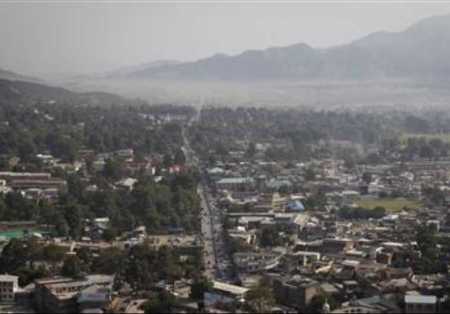
Pakistan viewA general view of houses from a hilltop in Abbottabad, Pakistan. (photo credit:REUTERS)

It is a testament to the precarious state of the world today that in a week that saw North Korea carry out a possible test of a hydrogen bomb, the most frightening statement uttered did not come from Pyongyang.

It came from Pakistan.

Speaking in the military garrison town of Rawalpindi, Pakistani Army chief Gen. Raheel Sharif said that any Iranian threat to Saudi Arabia’s territorial integrity will “wipe Iran off the map.”

Sharif made the statement following his meeting with Saudi Arabia’s defense minister and Deputy Crown Prince Mohammed bin Salman. According to media reports, Salman was the second senior Saudi official to visit Pakistan in the past week amid growing tensions between Iran and the kingdom.

Salman’s trip and Sharif’s nuclear threat make clear that following the US’s all-but-official abandonment of its role as protector of the world’s largest oil producer, the Saudis have cast their lots with nuclear-armed Pakistan.

When last October, the USS Harry Truman exited the Persian Gulf, the move marked the first time since 2007 that the US lacked an aircraft carrier in the region. Nine years ago, the US naval move was not viewed as a major statement of strategic withdrawal, given that back then the US had some one hundred thousand troops in Iraq.

While the USS Truman returned to the Gulf late last month, its return gave little solace to America’s frightened and spurned Arab allies. The Obama administration’s weak-kneed response to Iran’s live-fire exercises on December 26, during which an Iranian Revolutionary Guards vessel fired rockets a mere 1,370 meters from the aircraft carrier as it transited the Straits of Hormuz, signaled that the US is not even willing to make a show of force to deter Iranian aggression.

And so the Saudis have turned to Pakistan.

It would be foolish to view Sharif’s nuclear threat as mere bluster.

By every meaningful measure, Pakistan is little more than a failed state with nuclear weapons. Pakistan appears in every global index of failed or failing states.

To take just a few leading indicators, as spelled out by Basit Mahmood in a report last summer for The Political Domain, barely 1% of Pakistanis pay taxes of any kind. More than half the population lives in abject poverty. The government has no control over most Pakistani territory.

Between 2003 and 2015, more than 58,000 people were killed by terrorism countrywide.

Public health is a disaster. Polio, eradicated throughout much of the world, is now galloping through the country.

Last summer more than 1,300 people died in a heat wave in the supposedly advanced city of Karachi.

These data do not take into account the wholesale slaughter and persecution of minority groups – first and foremost Christians – and the systematic denial of basic human rights and widespread, violent persecution of women and girls.

As for its nuclear arsenal, a 2010 report by the Bulletin of Atomic Scientists estimated that Pakistan possesses between 70 and 90 nuclear warheads. Other credible reports estimate the size of the arsenal at 120.

Pakistan refuses to adopt a no-firststrike policy. In the US and worldwide, it is considered to be the greatest threat to global nuclear security.

Following a Pakistani jihadist assault on the Indian parliament in late 2001, India and Pakistan both deployed forces along their contested border. In the months that followed, due to Pakistani nuclear threats, the prospect of nuclear war was higher than it had ever been.

Cold War nuclear brinksmanship – which reached its high point during the 1962 Cuban missile crisis – paled in comparison.

In 2008, following the Pakistani jihadist assault on Mumbai, India threatened to retaliate against Pakistan.

India’s threats rose as evidence mounted that, as was the case in 2001, the jihadists were tied to Pakistan’s ISI spy service. Once again, rather than clean its own house, Pakistan responded by threatening to launch a nuclear attack against India.

And now, following the unraveling of US-strategic credibility, Pakistan’s aggressive nuclear umbrella is officially coming to the Persian Gulf.

Saudi Arabia’s decision to turn to Pakistan for protection indicates that the second wave of the destruction of the Arab state model is upon us. The notion of Arab states was invented nearly 100 years ago by the British and French at the tail end of World War I. The Sykes-Picot agreement, which partitioned the Arab world into states, rewarded national dominion to the most powerful tribal actors in the various land masses that became the states of the Arab world.

With the possible exception of Egypt, which predated Sykes-Picot, the Arab states formed at the end of World War I were not nation states. Their populations didn’t view themselves as distinct nations. Rather the populations of the Arab states were little more than a hodgepodge of tribes, clans and sectarian and ethnic groupings. In each case, the British and French made their determinations of leadership based on the relative power of the various groups. Those chosen to control these new states were viewed either as the strongest factions within the new borders or as the most loyal allies to the European powers.

The first wave of Arab state collapse began six years ago. It submerged the non-royal regimes, which fell one after the other, like houses of cards.

Syria, Libya, Iraq and Yemen ceased to exist.

Egypt, which in the space of two years experienced both an Islamist revolution and a military counter-revolution, still teeters on the brink of collapse.

Lebanon will likely break apart at the slightest provocation.

Today we are seeing the opening stages of the collapse of the Arab monarchies, and most importantly, of Saudi Arabia.

Most of the international attention to Saudi Arabia’s current threat environment has focused on Iran. The Iranian threat to the Saudis has grown in direct proportion to the Obama administration’s determination to realign the US away from its traditional Sunni allies and towards Iran. The conclusion of the US-led nuclear pact with Tehran has exacerbated Iran’s regional aggression as it no longer fears US retaliation for its threats to the Sunni monarchies.

But Iran is just the most visible of three existential threats now besetting the House of Saud.

The most profound threat to the world’s largest oil power is economic.

The drop in world oil prices has endangered the kingdom.

As David Goldman reported last week in the Asia Times, according to an International Monetary Fund analysis, the collapse in Saudi oil revenues “threatens to exhaust the kingdom’s $700 billion in financial reserves within five years.”

The house of Saud’s hold on power owes to its oil-subsidized economy. As Goldman noted, last month dwindling revenues forced the Saudis to cut subsidies for water, electricity and gasoline.

According to Goldman, Riyadh’s mass execution of 43 long-jailed prisoners at the start of the month was an attempt by the aging royal house to demonstrate its firm control of events. But the very fact the Saudi regime believed it was necessary to stage such a demonstration shows that it is in distress.

The third existential threat the regime now faces is Islamic State. Since 1979, the Saudis have sought to deflect domestic opposition by promoting Wahabist Islam at home and Wahabist jihad beyond its borders.

Now, with Islamic State in control over large swathes of neighboring Iraq, as well as Syria and Libya and threatening the Saudi-supported Sisi regime in Egypt, the Saudi royal family faces the rising threat of blowback. Some analysts argue that given the popular support for jihad in Saudi Arabia, were Islamic State to cross the Saudi border, its forces would be greeted with flowers, not bullets.

If the House of Saud falls, then the Gulf emirates will also be imperiled.

The Egyptian regime, which is bankrolled by the Saudis and its Gulf allies will also be endangered. The Hashemite monarchy in Jordan, which is protected by the US and by Israel, will face unprecedented threats.

The implications of expanding chaos – or worse – in Arabia are not limited to the Middle East. The global economy as well as the security of Europe and the US will be imperiled.

Obviously, the order of the day is for the US security guarantee to Saudi Arabia to be reinforced, mainly through straightforward US action against Iranian naval aggression and ballistic missile development.

Unfortunately, the Obama administration can be depended on to take just the opposite approach. And as a consequence, at least for the next year, the main thing propping up the Gulf monarchies, and with them, the global economy and what passes for global security, is a failed state with an itchy finger on the nuclear trigger.

Op-Ed: The hidden dangers in Obama’s final year

January 11, 2016

Op-Ed: The hidden dangers in Obama’s final year, Israel National News, Dr. Joe Tuzara, January 11, 2012

Barack Obama is entering a twilight of maybes, his presidency still driven by high ambitions but the power to achieve his warped radical ideology of systematically emasculating the United States is running out.  

Even as national security and the threat of terrorism have risen as the top concerns of the American public, our elected and appointed officials have developed a mindset that avoids reality.

Despite serious threats to our homeland, our increasingly feckless president gives more attention to ‘petty squabbles’ than to our nation’s security.

Obama has insidiously and deliberately caused much damage by his ‘destabilizing policies.’ His inaction and hesitation acts to embolden our enemies, endanger our allies, and undermine U.S. strategic interests anywhere in the world.

To an astonishing extent, Obama has shown that he abhors ‘American exceptionalism,’ despises traditional Judeo-Christian values and has displayed a foreign loyalty antithetical to America. He has consistently shown nothing but scorn for Israel, the U.S military, the U.S. Constitution and the Declaration of Independence.

Is it because the God affirmed in the foundational documents is none other than the God of Israel?  Perhaps.

Either way, as should by now be apparent, America’s president is a determined enabler of America’s enemies, and an equally determined betrayer of her friends.

It must be said to those people who can’t face the truth about Obama: the first anti-Americanmost anti-Israel president in history is a pseudo-Christian and Islamic sympathizer with a Marxist agenda, who will not sit idly by without a vindictive adieu in his final year in power.

The antecedents of Obama’s hatred of America are now well understood: Obama is not transforming the nation but terminating it.

The more contrarian he becomes, and the more he opposes the wishes of the vast majority of the American people, all the more Obama envisions himself speaking truth to power and becoming iconic for something, while the reality is that he is becoming proof of nothing.

Heralding hidden dangers in a tumultuous election year, government insiders say Obama is preparing to go all out against the Constitution and Bill of Rights.

Notwithstanding, Obama is doubling down to the “unfinished business” of his presidency– and maybe “planning a huge surprise for the 2016 election.”

Amidst widespread disenchantment with the Obama administration, the fear of a rigged electoral system is palpable. If history is any guide, there will be no wholesale revolution at the ballot box in 2016. But this year may well mark the beginning of the end for the era of government largesse.

Can you imagine the anarchy when Obama takes away your Medicaid, food stamps, free housing, and other federally funded benefits?

To ensure public order in a country threatened with anarchy, in addition to false flag Islamic State (ISIS) attacks on American soil, this can be a prelude to declaring martial law.

More than likely, Obama will use his final State of the Union address for another interracial melodrama, “meaningless” executive actions on ‘gun control,’ amnesty to another million illegal aliens, gay rights – and the release of thousands more felons, murderers, rapists and Al- Qaeda terrorists, as well as closing the Guantanamo Bay detention camp the top issues of his final year.

But in truth, it is possible there will be mass shootings in America in 2016 – and, Obama will use that to make a last-ditch attempt to change his nation’s controversial gun laws.

According to Claude Arnold, retired special agent in charge for Immigration and Customs Enforcement’s Los Angeles bureau of Homeland Security Investigations, the student visa program’s many vulnerabilities raise spying and terror fears.

Recent attention has been focused on refugee programs and illegal border crossings but “the Achilles heel in America’s immigration system may be the program that invites 1.2 million foreigners into the U.S. each year,” Arnold said.

Iran, in particular, has sent scientists to the U.S., ostensibly to study weapons technology at America’s top schools, but really to gain knowledge to benefit Iran’s weapons program. Whether it is potentially ISIS, Al-Qaeda or Iran, he asks “Why are we allowing dangerous enemies into the country to learn technical skills to use against us?”

Another proposed new regulation, dramatically upping the annual inflow of foreign college-grads allowed to take jobs in the United States —reflects Obama’s preference for foreigners over Americans.

Many Americans still do not realize that this is one of the many reasons Obama continues pushing a well planned invasion, advancing jihad on U.S. campuses and enabling its plan to overthrow America and the West.

By allowing terrorists ‘sleeper cells’ to flood into the countries of Europe and America, we are being set up for our ultimate takedown of borders, language and culture.

Again, the lack of U.S. leadership will define 2016  and the Middle East will never be the same again.

From Europe, Africa and the Middle East to the island-building dispute in the South China Sea – increasing tensions, conflicts and crises will be the mainstay of Obama’s dangerous final year.

For the most part, the absurd Obama doctrine of ‘leading from behind’ promotes growing anti-Semitism, genocide against Christians and a global rise of terror.

Russia’s annexation of Crimea, the intervention in Syria, expansion of ISIS and the rise of newly energized Iran as a regional power on the verge of nuclear weapons represents a clear and present danger to Israel, America and our Arab allies in the most volatile and dangerous part of the world.

Former Central Intelligence Agency (CIA) acting director Michael Morell predicts that Afghanistan will reemerge as a pivotal foreign policy issue in 2016.

For this reason, Obama’s finale is shaping up to be a deliberately violent year where the Taliban has surged in Afghanistan and ISIS is moving in on its turf.

According to the Middle East Media Research Institute (MEMRI), homegrown terrorists seeking to carry out violent jihadi attacks continue to headline the most critical threats to U.S. security. Former National Counterterrorism Center Director Matthew Olsen says, “There is every reason to expect that the threat of terrorism here in the U.S. will increase in 2016.”

While Obama lashed out at requests that more Christian refugees be brought into America, why does the world do almost nothing about ISIS persecution and genocide of Christians? Instead of stopping the slaughter of Christians, Obama, who ironically claims to be Christian, is doing nothing except blaming America while vastly expanding the influx of Muslim migrants.

Presidential wannabe Donald Trump warns Syrian refugees could be one of the biggest Trojan horse in history and the assembling of a potential 200,000 man terrorist army in America.

Now we know that Obama’s promised transparency and open government is a fraud: he has prosecuted more government whistleblowers than any other president — and the list is growing as he ramps up his war on dissent. The big revelations may still have to come – and by the end of his term we will understand that Obama’s plans, made in secret behind closed doors ,cannot be hidden forever.

It is a shame Obama has done much damage to America because the entire world believed his lies and deception about hope and change.

And last but not least, the Obama era will be remembered for its obnoxious lists of questionable accomplishments, as well as, the expanding global Islamic terrorism, chaos and confusion unprecedented in modern history.

The writer was clinical research-physician-general surgeon for Saudi Arabian, Philippine and American healthcare systems and is currently an American freelance writer as well as op-ed contributor. 


American blackmail

January 8, 2016

American blackmail, Israel Hayom, Sarah N. Stern, January 8, 2016

Yossi Melman, noted Israeli author and security analyst, who is certainly no right-winger, wrote a piece in a recent edition of The Jerusalem Report which opens with: “The U.S administration is concerned about the possibility of a new confrontation with Prime Minister Benjamin Netanyahu following the International Atomic Energy Agency’s latest nuclear shenanigans. ‘We hope it won’t happen,’ a senior U.S. official tells The Jerusalem Report, ‘but if it does, it will be a completely different ball game. The administration will not sit idly by this time, and it will be vindictive.'”

This is akin to telling parents that a known child predator wants to abduct their children and has expressed the explicit desire to murder them, but if they notify the police, it will be a completely different ball game. The local government will not sit idly by this time, and it will be vindictive — against the parents who have the responsibility of protecting their children.

In actuality, the Obama administration’s outrage is completely legitimate, but it is directed at the wrong target: Israel. However, after seven years of the Orwellian world that we now inhabit, we have become conditioned to believe that this statement is almost normal.

Under international law, however, this is clearly upside-down and backward. It is Iran, after all, that violated U.N. Security Council Resolution 1929 (by firing missiles), the understandings reached in the July nuclear agreement and the United Nations Universal Declaration of Human Rights. Therefore, Iran should legitimately be the target of American as well as international outrage.

Iran is guilty of conspiracy to commit genocide. The IAEA is complicit in this guilt by closing the file on Iran’s nuclear program despite the fact that certain fundamental questions regarding prior military dimensions remain unanswered. The IAEA admitted as much on December 2, 2015, yet still decided to close the Iran file under what can only be explained as political pressure.

In 1948, in the immediate aftermath of the Holocaust, the U.N. passed United Nations General Assembly Resolution 260, the Convention on the Punishment and the Crime of Genocide. Article 3 of this convention lists crimes that should be punished as (a) genocide; (b) conspiracy to commit genocide; (c) direct and public incitement to commit genocide; (d) attempt to commit genocide and (e) complicity in genocide.

The Jerusalem Center for Genocide Prevention has compiled an outstanding collection of remarks made by Iranian Supreme Leader Ayatollah Ali Khamenei between 2000 and 2015. The center came up with a few significant findings, including the fact that “Iranian state incitement against Israel has been explicit in its calls for destruction of the Jewish state. Pre-war Nazi propaganda used euphemisms and never explicitly called for the destruction of the Jews.” Official Iranian threats and incitement have “lasted for more than 30 years, as compared with Nazi governmental incitement, which lasted 12 years.”

They also found that the frequency and the intensity of Iran’s incitement to commit genocide has only increased the more the international community eased sanctions.

In fact, shortly after the July 14 agreement was reached, Khamenei issued a book titled “Palestine,” outlining in painstaking detail the steps that should be taken to annihilate Israel, which he described as “a cancerous tumor” whose elimination would mean that “the threats and hegemony of the United States will be replaced by Iran.”

The book sketches out how to eliminate Israel through an eternal chain of low-intensity assaults that will eventually make life so unbearable for Israelis that they will pack their bags and leave. He also wrote that the Iranian nuclear bomb would inhibit the Israelis against any sort of retaliation.

Since the Joint Comprehensive Plan of Action was reached on July 14, both Iran and U.S. President Barack Obama have behaved in predictable ways. Iran has conducted two missile tests, one on Oct. 10 and one on Nov. 21, and on Dec. 29 fired a rocket within 1,500 yards of an American aircraft carrier, the USS Harry S. Truman in the Strait of Hormuz.

While Obama was trying to sell the JCPOA to Congress and a skeptical American public last summer, we were constantly assured of “immediate, snapback sanctions.”

According to a report in The Wall Street Journal last month, the U.S. Department of Treasury notified Congress that approximately a dozen companies or individuals in Hong Kong, the UAE and Iran were to face sanctions for working on the Iranian missile program, which not only violated the JCPOA but also U.N. Security Resolution 1929.

The Iranian government was quick to denounce the threat of new sanctions, calling them, “unilateral, arbitrary and illegal.” And just as swiftly and predictably, Obama caved under Iranian pressure and decided to delay imposing new sanctions, for an unspecified period of time. And now Iran has publicly unveiled a new underground missile site.

According to a report in The Washington Free Beacon, Democratic members of Congress who backed the deal are disappointed with the White House. Rep. Steny Hoyer of Maryland said: “We are always in a sensitive moment in our dealings with Iran, and there is never a perfect time to take such actions. … But Iran must know with certainty that violating U.N. Security Council resolutions, both inside and outside the scope of the Joint Comprehensive Plan of Action, will be met with serious consequences.”

Senator Chris Coons (D-Del.) told The Wall Street Journal: “I believe in the power of vigorous enforcement that pushes back on Iran’s bad behavior. If we don’t do that, we invite Iran to cheat.”

It appears that America’s moral backbone, the IAEA and all the Democratic members of Congress who believed Obama’s reassurances of “immediate snapback sanctions” are currently being blackmailed by Obama’s quest for a foreign policy legacy.

Yes, Obama will, indeed, have a foreign policy legacy, but it will prove to be the same as Neville Chamberlain’s.

After Bomb Test, North Korea, Iran Continue Illicit Nuke Cooperation

January 8, 2016

After Bomb Test, North Korea, Iran Continue Illicit Nuke Cooperation, Washington Free Beacon, January 7, 2016

(Please see also, North Korea and Iran: The Nuclear Duo. — DM)

Iranian President Hasan Rouhani, right, shakes hands with a top North Korean leader, Kim Yong Nam, at the start of a meeting in Tehran, Iran, Saturday, Aug. 3, 2013. Iran's supreme leader formally endorsed Hasan Rouhani as president Saturday, allowing the moderate cleric to take charge of a country weakened by economic sanctions over its nuclear program. Kim Yong Nam is in Tehran to attend a ceremony when Rouhani will take the oath of office in parliament Sunday. (AP Photo/Ebrahim Noroozi)

Iranian President Hasan Rouhani, right, shakes hands with a top North Korean leader, Kim Yong Nam, at the start of a meeting in Tehran, Iran, Saturday, Aug. 3, 2013.

Iran won’t even need to make any progress on its domestic nuclear program—once it perfects its ballistic missiles it could purchase a weapon from North Korea and all of the conditions and monitoring in the [nuclear deal] would be ineffective in detecting or stopping that. . . .

****************************

One day after North Korea claimed to have successfully tested a miniaturized hydrogen bomb, lawmakers and regional experts are warning that Pyongyang and Tehran are continuing an illicit clandestine partnership enabling the rogue nations to master nuclear technology.

Loopholes in the nuclear pact recently reached between Iran and the international community have allowed the Islamic Republic and North Korea to boost their nuclear cooperation, which includes the exchange of information and technology, according to material provided to Congress over the past year.

Iran is believed to be housing some of its key nuclear weapons-related technology in North Korea in order to avoid detection by international inspectors. Iranian dissidents once tied to the regime have disclosed that both countries have consulted on a nuclear warhead.

Following the test, however, the White House publicly denied that Iran and North Korea are working together, according to multiple statements issued by the administration on Wednesday.

Still, the Iranian-North Korean nuclear axis is coming under renewed scrutiny by lawmakers in light of Pyongyang’s most recent detonation, which is the fourth of its kind in recent years.

Congressional critics now warn that the Obama administration cannot be trusted to clamp down on North Korea given its recent efforts to appease Iran by dropping a new set of sanctions that were meant to target its illicit ballistic weapons program.

Iran, on the other hand, thinks that the bomb test will give it “media breathing space” by drawing attention away from its own nuclear pursuits, according to Persian-language reports carried by state-controlled media outlets closely aligned with the country’s Revolutionary Guards Corps.

“The entire world may well consider North Korea a failed state, but from the view point of the [Iranian Revolutionary Guard Corps], North Korea is a success story and a role model: A state which remains true to its revolutionary beliefs and defies the Global Arrogance,” said Ali Alfoneh, an expert on the inner workings of the Iranian regime.

Prominent members of Congress are now warning that North Korea’s latest nuclear test is a sign of what could come from Iran, which they claim is closely following the North Korean nuclear playbook.

Rep. Ileana Ros Lehtinen (R, Fla.), chair of House’s foreign relations subcommittee on the Middle East and North Africa, described North Korea’s latest test as “a precursor to what we can expect from Iran in a few years.”

Iran, Ros-Lehtinen told the Washington Free Beacon, “is following the North Korea playbook” and “stands to be the main beneficiary of Pyongyang’s continued nuclear progress.”

“Iran and North Korea have a history of collaboration on military programs and have long been suspected of collaborating on nuclear related programs,” she said, noting that the Iran deal provides the Islamic Republic with the cash necessary to purchase advanced nuclear technology.

“Iran won’t even need to make any progress on its domestic nuclear program—once it perfects its ballistic missiles it could purchase a weapon from North Korea and all of the conditions and monitoring in the [nuclear deal] would be ineffective in detecting or stopping that,” she said.

“Let’s not forget, Iranians have reportedly been present at each of North Korea’s previous nuclear tests,” Sen. David Perdue (R., Ga.), a member of the Senate Foreign Relations Committee, said in a statement. “We cannot turn a blind eye to ongoing ties between North Korea and Iran. President Obama must act now to stop these rogue nations from supporting each other’s nuclear weapons efforts aimed at harming America and our allies.”

Rep. Patrick Meehan (R., Pa.) expressed concern that Iran is following in North Korea’s footsteps, and that the nuclear deal will collapse just as  Bill Clinton’s agreement with North Korea did in the mid-1990s.

“This test is just the latest sign that North Korea is a regime hell-bent on building and developing a sophisticated nuclear program,” Meehan said. “The passage of the 1995 nuclear deal with [North Korea] came with it promises from the Clinton administration of accountability and transparency for Kim’s regime.”

“Those same sort of assurances are echoed today by the Obama White House as it seeks to assure us that its own deal with Iran will be more successful,” Meehan said. “The Iran deal and the North Korean deal were sold with the same promises, the same assurances, to the American people, sometimes even word-for-word.”

“When you put the rhetoric of the 90’s and the North next to the rhetoric of today and Iran, it’s hard to tell the difference,” he added.

Sen. Mark Kirk (R., Ill.), a chief advocate for increased economic sanctions on Iran, highlighted what he called North Korea’s “alarming record” of “cooperating on missile development with Iran.”

With Iran set to receive billions of dollars in sanctions relief later this month, regional experts have informed Congress that the nuclear deal “creates conditions and incentives that are highly likely to result in the expansion” of Iran and North Korea’s illicit nuclear exchange, according to testimony submitted last year by Claudia Rossett, an expert at the Foundation for Defense of Democracies.

The deal fails to “cut off the pathways between Iran and nuclear-proliferating North Korea” and even has made “it safer for Iran to cheat,” according to Rossett’s testimony.

Additionally, sanctions relief gives Iran a chance to “go shopping in North Korea,” she said.

The Obama administration denied the ties between Iran and North Korea, telling reporters on Wednesday that “they’re entirely two different issues altogether.”

“We consider the Iran deal as a completely separate issue handled in a completely different manner than were the—than was the Agreed Framework with North Korea,” said John Kirby, a State Department spokesman, echoing similar remarks issued by the White House.

The administration’s hesitance to link the two nuclear issues has angered some critics of the Iran deal.

“This is exactly the kind of dishonest incoherence that the Iran nuclear deal forces its advocates to defend,” said Omri Ceren, the managing director of press and strategy at The Israel Project, a D.C.-based organization that works with journalists on Middle East issues.

“The Obama administration can’t admit that the [deal] provided the Iranians with hundreds of billions of dollars, some of which they’re going to invest in nuclear research beyond their borders, allowing them to get sanctions relief while advancing their program anyway,” Ceren said. “So instead they have to deny that there are links between Iran and North Korea’s nuclear program, even though that’s laughable.”

North Korea and Iran: The Nuclear Duo

January 8, 2016

North Korea and Iran: The Nuclear Duo, Front Page MagazineJoseph Klein, January 8, 2016

(With the Iran Scam’s sanctions relief, Iran will soon have lots more money to outsource development of nuclear weapons to North Korea. North Korea desperately needs foreign currency and will be delighted to help, as it has done in the past and, apparently, continues to do. — DM)

pl (1)

There is no reason to believe that, as a result of the deal Iran is already sidestepping, Iran will suddenly stop all dealings with North Korea with regard to both countries’ nuclear programs. The Obama administration and the United Nations upon which it relies ignore the close relationship between the two rogue nations at the world’s peril.

********************************

North Korea conducted its fourth nuclear test on January 6th, which it claimed was a hydrogen bomb. Despite some skepticism as to North Korea’s claim that it had actually tested a hydrogen bomb, the Obama administration acknowledged that North Korea had indeed tested some sort of nuclear device. The administration condemned North Korea’s latest testing as a violation of a series of past United Nations Security Council resolutions.

“We do not and will not accept North Korea as a nuclear armed state, and actions such as this latest test only strengthen our resolve,” declared Secretary of State John Kerry.

Mr. Kerry is a bit late with his declaration. North Korea has had an active nuclear arms program for nearly a decade and has conducted three of its four nuclear tests during President Obama’s time in office. None of the sanctions contained in the Security Council resolutions have stopped North Korea from thumbing its nose at the so-called “international community” and conducting as many nuclear and missile tests as it wishes. Kerry’s declaration begs the question – “resolve” to do what? Pass yet another Security Council resolution with a few more symbolic sanctions and some additional travel restrictions on senior North Korean officials?

The Obama administration’s claim of “resolve” in dealing effectively with nuclear threats rings hollow. Its idea of what “resolve” means was demonstrated by the loophole-ridden nuclear deal with Iran, which contains no safeguards against Iran’s cooperation with North Korea on nuclear technology and development. No doubt the administration would offer North Korea a similar deal if its leader Kim Jong-un were as crafty as Iranian President Hassan Rouhani in lulling President Obama and Kerry into a false sense of security.

Moreover, rather than work closely with China to maximize its leverage in defusing North Korea’s nuclear threat, the administration chose to prioritize climate change in its relationship with China above all other issues.

The administration’s solution to the North Korea problem is to double down on its failed strategy of relying principally on the UN for concerted “international” action. It joined Japan, a non-permanent member of the Security Council, in calling for the December 6th emergency session. After about two hours of closed door consultations, the Security Council issued a press statement condemning the test and vowing further unspecified measures in response:

“The members of the Security Council strongly condemned this test, which is a clear violation of Security Council resolutions1718 (2006), 1874 (2009), 2087 (2013), and 2094 (2013) and of the non-proliferation regime, and therefore a clear threat to international peace and security continues to exist. The members of the Security Council also recalled that they have previously expressed their determination to take ‘further significant measures’ in the event of another DPRK nuclear test, and in line with this commitment and the gravity of this violation, the members of the Security Council will begin to work immediately on such measures in a new Security Council resolution.”

Even if Russia and China were to come around and support another resolution under the enforcement provisions of Chapter 7 of the UN Charter, it is hard to believe that it will make any difference. Before the emergency Security Council meeting even began, Russian UN Ambassador Churkin was already lowering expectations, saying softly to reporters: “Cool heads, cool heads” and “proportionate response.”

North Korea regards the UN Security Council, and the Obama administration for that matter, with about as much contempt as Iran does. Indeed, all North Korea’s leaders have had to do is look at how Iran has been treated when it behaves badly. Iran was rewarded with a deal that merely postpones its nuclear arms program in return for the lifting of sanctions and unfreezing of many billions of dollars. Moreover, Iran suffered no consequences to speak of from its recent violations of the Security Council resolutions prohibiting it from developing or testing ballistic missiles capable of carrying nuclear weapons. The Security Council held meetings but did nothing. As U.S. ambassador to the United Nations Samantha Power told the Senate Foreign Relations Committee last December, “Beyond having Security Council discussions on the matter there’s been no follow-on action. Discussions are a form of U.N. action.”

For its part, the Obama administration put off the imposition of any separate U.S. sanctions it had been considering in response to Iran’s missile launchings as soon as the Iranians claimed that any such sanctions would violate President Obama’s “holy grail” nuclear deal.

The United Nations Security Council, as well as the Obama administration, tend to compartmentalize flashpoints erupting in different regions of the world. They refuse to acknowledge that Iran and North Korea have long been joined at the hip when it comes to the development of nuclear material for bombs and ballistic missiles capable of delivering them.

The Security Council holds separate meetings on Iran and North Korea, as if their respective nuclear activities have been completely unrelated to each other. And, as demonstrated by the following exchange between a correspondent and White House Press Secretary Josh Earnest at the January 6th daily press briefing, the Obama administration is turning a blind eye to the dangerous risk of continuing cooperation between Iran and North Korea:

“Q: You mentioned Iran earlier, and I’m wondering if there’s a bit of sleight of hand there from the Iranians’ perspective — meaning they’re trying to, on the one hand, work with the international community to have sanctions relief, but on the other hand, it’s been widely reported that they’ve been working with the North Koreans, perhaps even using them as a proxy to continue development of their own nuclear ambition. Does the White House understand that view?

MR. EARNEST:  I can’t speak to the veracity of those claims.

Iran and North Korea have been cooperating for decades on nuclear technology. As Ilan Berman, a leading expert on the Middle East and Iran, wrote last August in the National Journal, “over the past three decades, Iran and the Stalinist regime of the Kim dynasty in North Korea have erected a formidable alliance—the centerpiece of which is cooperation on nuclear and ballistic-missile capabilities.”

Secretary of Defense Ashton Carter stated during an April 2015 interview that North Korea and Iran could still be cooperating to develop a nuclear weapon. Moreover, according to an assessment of “Iran-North Korea-Syria Ballistic Missile and Nuclear Cooperation” published by the Congressional Research Service last May, “U.S. intelligence officials have expressed concern that North Korea might export its nuclear technology or fissile material.”

Iran “may still rely on Pyongyang for certain materials for producing Iranian ballistic missiles, Iran’s claims to the contrary notwithstanding,” the Congressional Research Service report added.

North Korea has also conducted several tests involving nuclear explosive devices, a technology in which Iran has reportedly shown interest and would be in a position to procure from North Korea.

In short, rebutting the claims by the Obama administration that its nuclear deal with Iran cuts off all its pathways to the achievement of a nuclear weapon capability, the title of Mr. Berman’s National Journal article says it all – “North Korea: Iran’s Pathway to a Nuclear Weapon.”

There is no reason to believe that, as a result of the deal Iran is already sidestepping, Iran will suddenly stop all dealings with North Korea with regard to both countries’ nuclear programs. The Obama administration and the United Nations upon which it relies ignore the close relationship between the two rogue nations at the world’s peril.

Iraq Offers To Mediate Fight Raging Between Saudi Arabia and Iran

January 7, 2016

Iraq Offers To Mediate Fight Raging Between Saudi Arabia & Iran, Fox News via You Tube, January 7, 2017

(How about a plague on both their houses? — DM)


A Strategy to Defeat Islamic Theo-fascism

January 7, 2016

A Strategy to Defeat Islamic Theo-fascism, American ThinkerG. Murphy Donovan, January 7, 2016

Surely, whatever passed for American foreign or military policy in the past three decades is not working. Just as clearly, in case anyone keeps score these days, the dark side of Islam is ascendant at home and abroad. What follows here is a catalogue of policy initiatives that might halt the spread of Islamic fascism and encourage religious reform in the Ummah.

Some observers believe that the Muslim problem is a matter of life and death. Be assured that the need for Islamic reform is much more important than either. The choices for Islam are the same as they are for Palestine Arabs; behave or be humbled. Europe may still have a Quisling North and a Vichy South; but Russia, China, and even America, at heart, are still grounded by national survival instincts – and Samuel Colt.

Call a spade a spade

The threat is Islam, both kinetic and passive aggressive factions. If “moderate” Islam is real, then that community needs to step up and assume responsibility for barbaric terror lunatics and immigrants/refugees alike. Neither America nor Europe has solutions to the Islamic dystopia; civic incompetence, strategic illiteracy, migrants, poverty, religious schisms, or galloping irredentism. The UN and NATO have no remedies either. Islamism is an Ummah, Arab League, OIC problem to solve. Absent moral or civic conscience, unreformed Islam deserves no better consideration than any other criminal cult.

Western Intelligence agencies must stop cooking the books too. The West is at war and the enemy is clearly the adherents of a pernicious ideology. A global war against imperial Islam might be declared, just as angry Islam has declared war on civilization.  A modus vivendi might be negotiated only after the Ummah erects a universal barrier between church and state globally. Islam, as we know it, is incompatible with democracy, civility, peace, stability, and adult beverages.

Oxymoronic “Islamic” states need to be relegated to the dustbin of history. If the Muslim world cannot or will not mend itself, Islamism, like the secular fascism of the 20th Century, must be defeated, humbled in detail. Sooner is better.

Answer the Ayatollahs

Recent allied concessions to Tehran may prove to be a bridge too far. If the Persian priests do not abide by their nuclear commitments, two red lines might be drawn around Israel. Firstly, the ayatollahs should be put on notice, publicly, that any attack against Israel would be considered an attack against America — and met with massive Yankee retaliation. Secondly, any future cooperation with NATO or America should be predicated on an immediate cessation of clerical hate speech and so-called fatwas, those arbitrary death sentences.

Clerical threats to “wipe Israel off the face of the earth” and “death to America” injunctions are designed to stimulate jihad and terror globally. The only difference between a Shia ayatollah and a Sunni imam in this regard these days seems to be the torque in their head threads.

Ostracize the Puppeteers

Strategic peril does not emanate from Sunni tacticians like Osama bin Laden, Mullah Omar, or Abu Bakr al-Baghadadi. Nor does the real threat begin with or end with al Qaeda, the Taliban, Hezb’allah, Hamas, or the Islamic State. Lethal threat comes, instead, on four winds: toxic culture, religious politics, fanatic fighters, and furtive finance, all of which originate with Muslim state sponsors. The most prominent of these are Saudi Arabia, the Emirates, Turkey, Iran, and Pakistan.

Put aside for a moment the Saudi team that brought down the Twin Towers in New York. Consider instead, the House of Saud as the most egregious exporter of Salifism (aka Wahabbism) doctrine, clerics, imams, and mosques from which ultra-irredentist ideologies are spread. The Saudis are at once the custodians of Islam’s sacredshrines and at the same time the world’s most decadent, corrupt, and duplicitous hypocrites. Imam Baghdadi is correct about two things: the venality of elites in Washington and Riyadh. The House of Saud, an absolutist tribal monarchy, does not have the moral standing to administer “holy” sites of any description — Mecca, Medina, or Disneyland.

The cozy relationship between Europe, the European Union, and Arabia can be summarized with a few words; oil, money, arms sales, and base rights. This near-sighted blend of Mideast obscenities has reached its sell-by date. The “white man’s burden” should have expired when Edward Said vacated New York for paradise.

Jettison Turkey and Pakistan

What Saudi Arabia is to toxic ideology in North Africa, Turkey and Pakistan are to perfidy in the Levant and South Asia. Turkey and Pakistan are Islam’s most obvious and persistent grifters. Turkey supports the Islamic State and other Sunni terror groups with a black market oil racket. Pakistan supports the Taliban, al Qaeda, and ISIS with sanctuary and tolerance of the world’s largest opium garden. Oil and drug monies from Arabia, Turkey, and South Asia are financing the global jihad. Turkey also facilitates the migration of Muslims west to Europe while sending Islamist fighters and weapons south to Syria and Iraq.

With the advent of Erdogan and his Islamist AKP, Turkey has morphed into NATO’s Achilles Heel, potentially a fatal flaw.  Turkey needs to be drummed out of NATO until secular comity returns to Ankara. Pakistan needs to be restrained, too, with sanctions until it ceases to provide refuge for terrorists. Pakistani troops harassing India could be more prudently redeployed to exterminate jihadists.

Sanctions against Russia and Israel are a study in moral and political fatuity whilst Arabs and Muslims are appeased midst a cultural sewer of geo-political crime and human rights abuses. If NATO’s eastern flank needs to be anchored in trust and dependability, Russia, Kurdistan, or both, would make better allies than Turkey. Ignoring Turkish perfidy to protect ephemeral base rights confuses tactical necessity with strategic sufficiency.

Recognize Kurdistan

Aside from Israel, Kurdistan might be the most enlightened culture in the Mideast. The Kurds are also the largest ethnic group in the world not recognized as a state. While largely Muslim, the Kurds, unlike most of the Ummah, appreciate the virtues of religious diversity and women’s rights. Indeed, Kurdish women fight alongside their men against Turkish chauvinism and Sunni misogyny with equal aplomb. For too long, the Kurds have been patronized by Brussels and Washington.

While Kurdish fighters engage ISIS and attempt to control the Turkish oil black market, Ankara uses American manufactured NATO F-16s to bomb Kurds in Turkey and Syria. Turkish ground forces now occupy parts of Iraq too. In eastern Turkey, Ergdogan’s NATO legions use ISIS as an excuse for bookend genocide, a cleansing of Kurds that might rival the Armenian Christian genocide (1915-1917).

195876_5_Kurdish angel of death

All the while, American strategic amateurs argue for a “no-fly” zone in contested areas south of Turkey. Creating a no-fly zone is the kind of operational vacuity we have come to expect from American politicians and generals. Such a stratagem would foil Kurdish efforts to flank ISIS and allow the Erdogan jihad, arms, and oil rackets to flourish. A no-fly zone is a dangerous ploy designed to provoke Russia, not protect Muslim “moderates.”

Putin, Lavrov, and the Russians have it right this time; Turkish and Erdogan family subterfuges are lethal liabilities, not assets.

Washington and European allies have been redrawing the map in Eastern Europe, North Africa, South Asia, and the Mideast since the end of WWII. The time has come to put Kurdistan on the map too. Kurdistan is a unique and exemplary case of reformed or enlightened Islam; indeed, a nation that could serve as a model for the Muslim world.  If base rights are a consideration, Kurdistan would be an infinitely more dependable ally than Turkey or any corrupt tribal autocracy in Arabia. America has a little in common with desert dictators — and fewer genuine friends there either. Indeed, at the moment America is allied with the worst of Islam.

Create New Alliances

NATO, like the European Union, has become a parody of itself. Absent a threat like the Soviet Union or the Warsaw Pact, Brussels has taken to justifying itself by meddling in East Europe and resuscitating a Cold War with the Kremlin. Indeed, having divided Yugoslavia, NATO now expands to the new Russian border with reckless abandon; in fact, fanning anti-Russian flames now with neo-Nazi cohorts in former Yugoslavia, Georgia, and Ukraine.

NATO support for the Muslims of one-time Yugoslavia is of a piece with support for Islamic troublemakers in Chechnya and China too. Throughout, we are led to believe that jihad Uighurs and caliphate Chechens are freedom fighters. Beslan, Boston, Paris, and now San Bernardino put the lie to any notion that Islamists are “victims” (or heroes). Indeed, the Boston Marathon bombing might have been prevented had Washington a better relationship with Moscow.

Truth is, America has more in common with Russia and China these days than we do with any number of traditional European Quislings. Indeed, it seems that Europe and America can’t take yes for an answer.

The Cold War ideological or philosophical argument has been won. Moscow and Beijing have succumbed to market capitalism. Islamism, in stark contrast, is now a menace to Russian, Chinese, and American secular polities alike. The logic of a cooperative or unified approach to a common enemy seems self-evident. America, China, and Russia, at least on issues like toxic Islam, is a match made in Mecca.

The late great contest with Marxist Russia and China was indeed a revolution without guns. Now the parties to that epic Cold War struggle may have to join forces to suppress a theo-fascist movement that, like its Nazi predecessor, will not be defeated without guns. The West is at war again, albeit in slow motion. Withal, questions of war are not rhetorical. Saying that you are not at war does not make it so. Once declared, by one party or the other, the only relevant question about war is who wins and who loses. Losers do not make the future.

If America and Europe were as committed to Judeo/Christian secular values as Islamists are committed to a sick religious culture, then the war against pernicious Islam would have been won decades ago. Or as Jack Kennedy once put it: “Domestic policy can only defeat us; foreign policy can kill us.

Trump Footnote

Donald Trump made several policy suggestions on the Islamism issue, one on immigration, the other on Mideast oil. On the former, he suggests a hiatus on Muslim immigration until America develops a plan or reliable programs to vet migrants. On Arab oil, he suggests, given the lives and treasure spent liberating Kuwait and Iraqi oil fields, America should have held those resources in trust and use oil revenues to finance the war against jihad, however long that takes. The problem with both Trump ideas is that they come perilously close to common sense, an American instinct in short supply these days.

 

Richardson: North Korea May Have Launched Nuclear Test to Get Nuclear Deal Like Iran’s

January 7, 2016

Richardson: North Korea May Have Launched Nuclear Test to Get Nuclear Deal Like Iran’s, Washington Free Beacon, January 6, 2016

(Why not? Their human rights records are comparable. — DM)

Richardson, who ran for president in 2008, endorsed Clinton for the 2016 election. Clinton, Obama’s former secretary of state, has been a vocal supporter of the Iran nuclear agreement.

**********************

Hillary Clinton supporter and former New Mexico governor Tom Richardson said North Korea’s nuclear test may have been an attempt to gain leverage for a nuclear deal similar to the one Iran struck with the Obama administration and other world powers.

North Korea claimed it successfully tested a hydrogen bomb on Tuesday, although nuclear experts doubt that was the actual device tested. CNN reported the test corresponded with a 5.1 seismic event.

CNN host Wolf Blitzer asked Richardson whether North Korean dictator Kim Jong-un was crying out for attention with this latest act of aggression.

“I think he’s trying to get attention, number one, but I think he’s also sending a message that if you want to deal with me, if you want me to curb our nuclear weapons, it’s going to be a very high price,” Richardson said. “It’s a very poor country. They need humanitarian assistance. They need energy assistance. They need all kinds of sanctions lifted. It could be that he’s preparing for a negotiation. I think he’s looking at what happened with Iran, and he says, ‘You know, maybe there’s a deal that can be struck for me,’ although we don’t know this man thinks. He’s very unpredictable.”

Richardson, who ran for president in 2008, endorsed Clinton for the 2016 election. Clinton, Obama’s former secretary of state, has been a vocal supporter of the Iran nuclear agreement.

The Iran nuclear deal made in July and championed by the Obama White House, despite numerous concessions, was met with celebration in Tehran. The world’s largest state sponsor of terrorism received billions of dollars in sanctions relief, among other sweeteners, as part of the agreement.

Thumbing nose at US, Iran unveils depot for nuclear-capable missiles

January 5, 2016

Thumbing nose at US, Iran unveils depot for nuclear-capable missiles, DEBKAfile, January 5, 2016

In clear defiance of the Obama administration, Iran revealed on Tuesday a second underground facility for storing ballistic missiles capable of carrying nuclear warheads.

In a one-minute video shown on Iranian state-run television,  Ali Larijiani, speaker of Iran’s parliament, was shown inspecting the depot of “Emad” ballistic missiles along with officers from Iran’s Revolutionary Guard Corps.

DEBKAfile military sources: The Emad, which has a 750-kilogram warhead and a range of 1,700 kilometers, is capable of striking any point in Israel. Iran carried out a successful test of the missile four months ago, in October 2015.

Washington announced that the test was a violation of the nuclear agreement between Iran and Western powers. Tehran replied that it never agreed in any stage of the negotiations to limit its missile program in the framework of the agreement.

At the end of December, the Obama administration announced that it was weighing the possibility of imposing fresh sanctions on Iran following the launch of the missile. Several days later, however, Washington withdrew the plan after Tehran threatened that it would view the imposition of new sanctions as a breach of the nuclear agreement.

On Tuesday, Iran not only said it will continue to develop the Emad, but claimed the weapon is already in operational use by the Revolutionary Guard Corps.