28 Times Obama Said He’d Prevent Iran from Getting a Nuclear Weapon | SUPERcuts! #184, via You Tube, April 9, 2015
There is no better deal with Iran, Israel Hayom, Prof. Efraim Inbar, April 9, 2015
If inspections, sanctions, sabotage and political isolation ever had a chance to stop Iran from getting the bomb (this was always a dicey proposition), that certainly is no longer the case. It is more evident than ever that only military action can stop a determined state such as the Islamic Republic of Iran from building a nuclear bomb. It remains to be seen whether Israel has elected the leader to live up to this historic challenge.
***********************
The debate over the pros and cons of the Iran nuclear framework agreement negotiated between the P5+1 and Iran at Lausanne (April 2, 2015) is simply irrelevant. The search for truth in the conflicting versions about the details of the deal coming out of Washington and Tehran is of no consequence. And the steps suggested by Israel and other critics to improve the efficacy of the deal (by more stringent inspections and so on) will not change much. The deal is basically dangerous in nature, and needs to be rejected outright.
The deal permits Iran to preserve stockpiles of enriched uranium, to continue to enrich uranium, and to maintain illegally-built facilities at Fordow and Arak. Even in the absence of a signed full agreement, the U.S. and its negotiating partners already have awarded legitimacy to Iran’s nuclear threshold status. In all likelihood, the United States, quite desperate to get a formal deal, will make additional concessions in order to have a signed formal deal — which won’t be worth the paper on which it is printed.
This outcome has been a foregone conclusion since November 2013, when the U.S. agreed to the “Joint Plan of Action” on Iran’s nuclear program. Already back then, the U.S. decided not to insist any longer on the goal of rolling back the Iranian nuclear program, ignoring several U.N. Security Council resolutions demanding no uranium enrichment, as well as discarding the security concerns of American allies in the Middle East (primarily Israel, Saudi Arabia and Egypt — who better understand the regional realities).
Middle Easterners clearly discern an Iranian diplomatic victory in this accord, which should not surprise anybody. Iranians are much more adept at negotiating than Americans. Iran is getting more or less what it wanted: the capability to produce enriched uranium and to research weapon design; agreement to keep its missile program intact; and no linkages to Iranian behavior in the region. The deal is a prelude to nuclear breakout and Iranian regional hegemony.
Indeed, with no attempt to roll back the Iranian nuclear program, as was done in Libya, we are progressing toward the North Korean model. Those two are the only options in dealing with nuclear programs of determined states such as Iran. Iran’s nuclear program benefited in many ways from assistance that originated in Pakistan and in North Korea (both are nuclear proliferators despite American opposition). Compare the recent statements by President Obama to the speeches of President Clinton justifying the agreement with North Korea (October 1994). Their similarities are amazing; an indication of the incredible capacity of great powers for self-delusion.
What counts is not the Obama’s administration expression of satisfaction with the prospective deal, but the perceptions of Middle East actors. For example, Saudi Arabia and Egypt have deplored the fact that the U.S. is bestowing international legitimacy on Iran’s status as a nuclear threshold state. They probably believe the interpretations of the deal offered by Tehran more than those professed in Washington. Therefore, they will do their best to build a similar infrastructure leading inevitably to nuclear proliferation in the region — a strategic nightmare for everybody.
Unfortunately, no better deal is in the offing. Whatever revisions are introduced cannot change its basic nature. The accord allows Iran to have fissionable material that can be enriched to weapons grade material in a short time and Tehran can always deny access to inspectors any time it chooses. This is the essence of the North Korean precedent.
Obama is right that the only alternative to this deal is an Iranian nuclear fait accompli or the bombing of the Iranian nuclear infrastructure. Obama’s penchant for engagement, his reluctance to use force, and his liberal prism on international relations (which adds rosy colors to international agreements) has led to this miserable result.
Netanyahu is wrong in demanding a better deal because no such deal exists. Yet denying its ratification by the U.S. Congress could create better international circumstances for an Israeli military strike. In fact, criticism of Obama’s deal with Iran fulfills only one main function — to legitimize future military action. Indeed, Netanyahu is the only leader concerned enough about the consequences of a bad deal with the guts and the military capability to order a strike on the Iranian key nuclear installations.
If inspections, sanctions, sabotage and political isolation ever had a chance to stop Iran from getting the bomb (this was always a dicey proposition), that certainly is no longer the case. It is more evident than ever that only military action can stop a determined state such as the Islamic Republic of Iran from building a nuclear bomb. It remains to be seen whether Israel has elected the leader to live up to this historic challenge.
Ayatollah Khamenei Outlines Requirements of Final Iran Nuclear Deal, Tasnim News Agency (Iranian), April 9, 2015
(All bold face print is from the original. — DM)

TEHRAN (Tasnim) – Supreme Leader of the Islamic Revolution Ayatollah Seyed Ali Khamenei on Thursday defined the main points that a final nuclear deal between Iran and world powers should involve, but refused to adopt a stance on the Lausanne statement that entails no binding commitment.
Addressing a gathering in Tehran on Thursday, Ayatollah Khamenei said he has not taken a position on a statement released by Iran and the Group 5+1 (Russia, China, the US, Britain, France and Germany) after the most recent round of nuclear talks in the Swiss city of Lausanne, because nothing has been still agreed upon, nor have the parties reached any binding agreement.
“What has happened so far does not guarantee either the principle of an agreement, or the negotiations that lead to an agreement or even the content of an agreement, and it does not even guarantee that these talks would result in a deal, so congratulation has no meaning,” the Leader said.
The comments came after Iran and the six powers on April 2 reached a framework nuclear agreement after more than a week of intensive negotiations in Lausanne, Switzerland, with both sides committed to push for a final, comprehensive accord until the end of June.
Ayatollah Khamenei then reaffirmed strong support for a deal that respects the Iranian nation’s dignity, and rejected as “untrue” the reports on his opposition to any agreement.
The Leader, however, underlined that “no deal is better than a bad deal.”
Imam Khamenei then explained that he has only outlined the “general issues, the main guidelines, frameworks and red lines” regarding the nuclear talks and has not specified the details.
“I am not indifferent to the negotiations, but have not interfered in the details of the talks so far, and will not interfere in future either,” the Leader stressed.
The Supreme Leader then pointed to the unreliable nature of the US, an obvious sign of which he said was a biased fact sheet that Washington issued only two hours after the Lausanne statement was declared.
“Drafting such a statement (fact sheet) within two hours is not possible, so they (Americans) had been busy preparing a flawed and wrong statement contrary to the content of the talks at the same time that they were negotiating with us.”
The Leader further called on the country’s negotiators to hold consultations with the critics of the Lausanne statement to better deal with the talks, something known as “rapport” among Iranians.
Imam Khamenei once again made it clear that the talks with the US revolve only around the nuclear issue and nothing else, but at the same time noted that such nuclear negotiations provide an experience to test the possibility of talking on other subjects if Washington puts aside objections.
But, the Leader added, if the US keeps raising objections, Iran’s experience of mistrust of the US will be corroborated.
Commenting on the main points that have to be stipulated in a possible final nuclear deal, Ayatollah Khamenei pointed to the removal of anti-Iran sanctions all at once, adding, “This issue is very important and the sanctions should be completely terminated at the very day of the agreement.”
“If the removal of sanctions is to be conditioned by a new process, the fundamental of negotiations will be nonsense, because the purpose of the talks is lifting of the sanctions,” the Leader said.
The Supreme Leader also categorically rejected foreign access to the country’s “security and defensive” sectors under the pretext of nuclear monitoring.
Imam Khamenei said Iran’s military capabilities must be upheld and strengthened day by day, stressing that Iran’s backing for its “brothers” in the resistance front in different regions should never be diminished.
Moreover, the Leader voiced opposition to any deal that subjects Iran to “unconventional” monitoring and would make it a special case in the world, underlining that monitoring of Iran’s peaceful nuclear program should be conventional, like the other countries.
Iran’s “scientific and technical developments in different dimensions” was another requirement that the Leader emphasized a deal must include.
Ayatollah Khamenei finally said the responsibility lies with the country’s negotiators to fulfill those necessary demands in the talks, calling on them to “find the correct ways of negotiations” by using the view points of the informed and reliable individuals and listening to the critics.
‘Iran to publish facts document to counter American lies’, Israel Hayom, April 8, 2015
Iran could build bomb today but isn’t doing so because of ayatollah’s religious decree, not because of sanctions, Iranian FM reportedly tells parliament • “We made significant achievements in exchange for unimportant concessions,” says Iranian lawmaker.
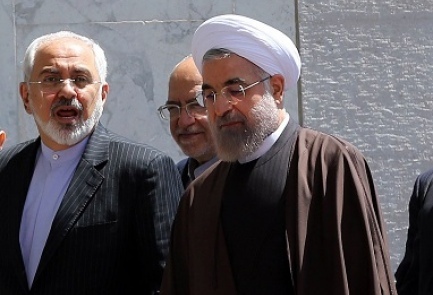 Iran’s Foreign Minister Mohammad Javad Zarif (left) with Iranian President Hassan Rouhani | Photo credit: AFP
Iran could build a nuclear bomb today if it wanted and is only refraining from doing so because of a fatwa (religious decree) issued by Ayatollah Ali Khamenei, not because of international sanctions, Iran’s Foreign Minister Mohammad Javad Zarif reportedly said on Tuesday during a closed hearing at the Iranian parliament, Majlis.
According to one of the participants, Zarif said the country’s foreign ministry would soon publish a “document of facts” about the nuclear deal with world powers.
“Zarif told us that his office hadn’t intended on releasing such a document, but reversed its decision because of the Americans’ lies,” said Iranian lawmaker Hussain Naqvi al-Hussaini.
Another Iranian parliamentarian, Gholamali Jafarzadeh Imenabadi, said Zarif told the parliament that Iran is not going to permit online cameras for inspection purposes at nuclear facilities. The reason for the decision, allegedly conveyed by Zarif, was because cameras have supposedly been used in the past to help assassinate Iranian nuclear scientists.
Also in attendance was Ali Akbar Salehi, the head of Iran’s Atomic Energy Organization, who presented the Majlis with the technical aspects of the framework deal. Salehi, who participated in the negotiations in Lausanne, reportedly told his audience that world powers consented to enter negotiations with Iran because they had no other choice.
“We made significant achievements in exchange for unimportant concessions,” said Iranian lawmaker Nozar Shafi.
Meanwhile, Zarif and Iranian President Hassan Rouhani have reportedly garnered the support of Revolutionary Guard commander Mohammad Ali Jafari, who demanded immediate sanctions relief in exchange for a deal.
Iran’s supreme leader, Khamenei, did not voice his opposition to the deal, widely interpreted as silent consent. With that, some 200 Iranian hardliners protested in Tehran against the framework deal.
Iran news report: Tehran will start using fastest centrifuges on day deal takes effect, Times of Israel, April 8, 2015
FARS agency quotes Zarif, Salehi telling MPs they’ll inject gas into IR-8 centrifuges, a breach of US-published framework terms that would make a mockery of deal.
Iran will begin using its latest generation IR-8 centrifuges as soon as its nuclear deal with the world powers goes into effect, Iran’s foreign minister and nuclear chief told members of parliament on Tuesday, according to Iran’s semi-official FARS news agency.
If accurate, the report makes a mockery of the world powers’ much-hailed framework agreement with Iran, since such a move clearly breaches the US-published terms of the deal, and would dramatically accelerate Iran’s potential progress to the bomb.
Iran has said that its IR-8 centrifuges enrich uranium 20 times faster than the IR-1 centrifuges it currently uses.
According to the FARS report, “Iran’s foreign minister and nuclear chief both told a closed-door session of the parliament on Tuesday that the country would inject UF6 gas into the latest generation of its centrifuge machines as soon as a final nuclear deal goes into effect by Tehran and the six world powers.”
It said that Foreign Minister Mohammad Javad Zarif and Atomic Energy Organization of Iran (AEOI) head Ali Akbar Salehi made the promise when they briefed legislators on the framework agreement, and claimed the move was permitted under the terms of the deal.
“The AEOI chief and the foreign minister presented hopeful remarks about nuclear technology R&D which, they said, have been agreed upon during the talks (with the six world powers), and informed that gas will be injected into IR8 (centrifuge machines) with the start of the (implementation of the) agreement,” FARS quoted Javad Karimi Qoddousi, a member of the parliament’s National Security and Foreign Policy Commission, as saying.
Qoddousi said the Iranian Foreign Ministry plans to release a fact sheet presenting Iran’s version of the framework understandings in the next few days. “Those issues that have stirred serious concern among the Iranians will be revised and released in this fact sheet,” he said.
Earlier Tuesday, Israel Radio reported that Zarif told the lawmakers that Iran was capable of producing an atomic bomb at any given moment, but will refrain from doing so due to religious Islamic injunctions against such a move.
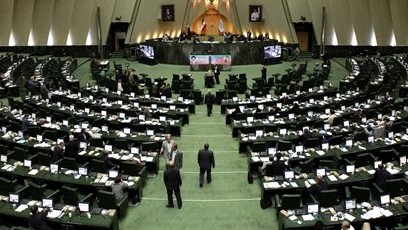 A general view of Iran’s parliament in Tehran, Aug. 28, 2013 (photo credit: AP/Ebrahim Noroozi)
Major differences have emerged between the P5+1 powers and Iran over what was agreed in the framework deal.
“Parameters” detailed by the US leave no doubt whatsoever, however, that the use of anything other than the most basic, first generation IR-1 centrifuges is barred for 10 years, and that even R&D on advanced centrifuges will be severely constrained.
“Iran will only enrich uranium at the Natanz facility, with only 5,060 IR-1 first-generation centrifuges for ten years,” the US parameters state. “Iran has agreed to only enrich uranium using its first generation (IR-1 models) centrifuges at Natanz for ten years, removing its more advanced centrifuges… Iran will not use its IR-2, IR-4, IR-5, IR-6, or IR-8 models to produce enriched uranium for at least ten years,” the US document adds. “For ten years, enrichment and enrichment research and development will be limited to ensure a breakout timeline of at least 1 year. Beyond 10 years, Iran will abide by its enrichment and enrichment R&D plan submitted to the IAEA, and pursuant to the JCPOA, under the Additional Protocol resulting in certain limitations on enrichment capacity.”
A French fact-sheet seen by The Times of Israel takes a similar position. It provides for Iran to gradually introduce the use of IR-2 and IR-4 centrifuges to enrich uranium after 12 years. It does not provide for the use of IR-8 centrifuges. The French fact sheet does specify that Iran will be allowed to continue R&D work on the advanced IR-4, IR-5, IR-6 and IR-8 centrifuges.
A document issued by the Iranian Foreign Ministry on Friday also does not assert an Iranian right to use IR-8 centrifuges. Its only reference to the IR-8 is as follows: “According to the reached solutions, Iran will continue its research and development on advanced machines and will continue the initiation and completion phases of the research and development process of IR-4, IR-5, IR-6, and IR-8 centrifuges during the 10-year period of the Comprehensive Plan for Joint Action.”
‘Messing’ with Israel, Israel Hayom, Elliott Abrams, April 7, 2015
(“If you like your country you can keep it.” Even if Obama’s phrasings were not ambiguous, and they are, he could not be trusted. Moreover, since Obama’s talking points about the “once in a lifetime deal” and those of his Iranian counterparts are very different, there is no way of knowing now whether there will be a deal, whether the U.S. Congress will block it, or what it will be. — DM)
In his lengthy interview with Thomas Friedman of The New York Times, President Obama makes many statements about Israel’s security and how the proposed deal with Iran enhances it. These words from the interview are key:
“I have to respect the fears that the Israeli people have,” he added, “and I understand that Prime Minister Netanyahu is expressing the deep-rooted concerns that a lot of the Israeli population feel about this, but what I can say to them is: Number one, this is our best bet by far to make sure Iran doesn’t get a nuclear weapon, and number two, what we will be doing even as we enter into this deal is sending a very clear message to the Iranians and to the entire region that if anybody messes with Israel, America will be there.”
What does “messes with Israel” mean? No one has the slightest idea. The president unfortunately uses this kind of diction too often, dumbing down his rhetoric for some reason and leaving listeners confused. Today, Iran is sending arms and money to Hamas in Gaza, and has done so for years. Is that “messing with Israel?” Iran has tried to blow up several Israeli embassies, repeating the successful attack it made on Israel’s embassy in Buenos Aires in 1992. Fortunately Israel has foiled the more recent plots, but is attempting to bomb Israeli embassies “messing with Israel?” Iranian Revolutionary Guards, along with Hezbollah troops, are in southern Syria now near the Golan. Is that “messing with Israel?” And what does the president mean by “America will be there?” With arms? With bandages? With the diplomatic protection his administration is now considering removing at the United Nations?
Later in the interview, the president says this:
“Now, what you might hear from Prime Minister [Benjamin] Netanyahu, which I respect, is the notion, ‘Look, Israel is more vulnerable. We don’t have the luxury of testing these propositions the way you do,’ and I completely understand that. And further, I completely understand Israel’s belief that given the tragic history of the Jewish people, they can’t be dependent solely on us for their own security. But what I would say to them is that not only am I absolutely committed to making sure that they maintain their qualitative military edge, and that they can deter any potential future attacks, but what I’m willing to do is to make the kinds of commitments that would give everybody in the neighborhood, including Iran, a clarity that if Israel were to be attacked by any state, that we would stand by them. And that, I think, should be … sufficient to take advantage of this once-in-a-lifetime opportunity to see whether or not we can at least take the nuclear issue off the table.”
This is not much help. For one thing, the president says “attacked by any state,” presumably leaving out Hamas and Hezbollah, and for that matter the Islamic State group and al-Qaida. One has to assume he means “attacked by Iran,” but what does “we would stand by them” mean? It doesn’t add much to “America will be there.” There will be no conventional war between Israel and any Arab state in the foreseeable future, so Hezbollah is the most likely problem and is presumably excluded from the president’s formulation. What Israel worries about today is a nuclear attack by Iran or a terrorist group like Hezbollah to which Iran has given the bomb. No doubt that qualifies as “messing with Israel,” but were that to occur what exactly would “America will be there” and “stand by them” mean? Take in refugees from the destroyed State of Israel after the nuclear attack on it? The president’s language about “commitment” suggests that he may envision a formal defense commitment by the United States to Israel. Israel has not wanted such a treaty because it has always said it wants to defend itself, not have Americans dying to defend it. That position has served the U.S.-Israel relationship well for 67 years. Should it really be changed now, and would that really help Israel? What would the value of such a commitment be? To ask the question another way, are not Poles and Estonians wondering right now about the value of their membership in NATO, if Mr. Putin “messes” with them?
There were other problems in the interview, such as this language:
“There has to be the ability for me to disagree with a policy on settlements, for example, without being viewed as … opposing Israel. There has to be a way for Prime Minister Netanyahu to disagree with me on policy without being viewed as anti-Democrat, and I think the right way to do it is to recognize that as many commonalities as we have, there are going to be strategic differences. And I think that it is important for each side to respect the debate that takes place in the other country and not try to work just with one side. … But this has been as hard as anything I do because of the deep affinities that I feel for the Israeli people and for the Jewish people. It’s been a hard period.”
“You take it personally?” Friedman asked.
“It has been personally difficult for me to hear … expressions that somehow … this administration has not done everything it could to look out for Israel’s interest — and the suggestion that when we have very serious policy differences, that that’s not in the context of a deep and abiding friendship and concern and understanding of the threats that the Jewish people have faced historically and continue to face.”
“Respect the debate?” “Personally difficult?” This is the White House whose high officials called the prime minister of Israel a “chickens—” and a “coward,” in interviews meant to be published — not off the record. And the officials who said those things remain in place; no effort was ever made to identify and discipline them.
But the deeper problem is that the reassurances the president is offering to Israel … are simply not reassuring. Iran is already, right now, while under sanctions that are badly hurting its economy, spending vast amounts of money and effort to “mess with Israel.” This administration’s reaction has been to seek a nuclear deal that will give Iran more economic resources to dedicate to its hatred and violence against Israel, but will in no way whatsoever limit Iran’s conventional weapons and its support for terrorism.
Several times in this interview the president went out of his way to suggest that he fully understands Israel’s security problems, but the full text suggests that he does not — because he believes that his statements that “if anybody messes with Israel, America will be there” and would “stand by them” actually solve any of those problems. Time alone undermines the value of those statements, because he will not be president in 22 months. The words he used are sufficiently vague to undermine their value as well. It is hard to believe that many Israelis will be reassured by the interview, especially if they read the Iranian press and see what, in their own interviews, Iranian officials are claiming they got out of the new nuclear agreement.
Can and should Israel destroy Iran’s nuclear facilities? Dan Miller’s Blog, April 5, 2015
(The views expressed in this article are mine and do not necessarily reflect those of Warsclerotic or any of its other editors. — DM)
It has been suggested that Israel should seriously consider destroying Iranian nuclear facilities, but Israeli officials obviously haven’t said, and won’t say, if, how or when she might.

Speaking to Arutz Sheva Friday, Professor Efraim Inbar, who heads the Begin-Sadat Center for Strategic Studies, said the deal had realized Israel’s worst fears by leaving Iran’s nuclear program essentially intact.
The Islamic Republic’s nuclear program has been granted “legitimacy” by the agreement, which still allowed it to continue enriching uranium and to maintain a reactor capable of producing enriched plutonium, he said. “And that’s what worries Israel, that they (Iran) will be able within a short time frame to reach a nuclear bomb.”
“I hold the view that the only way to stop Iran in its journey to a nuclear bomb is through military means,” Inbar maintained, suggesting that “Israel needs to seriously consider striking a number of important nuclear facilities” to head off the threat.
On March 28, former U.S. Ambassador Bolton said that it should be done.
The P5+1 nuclear “deal,” proudly announced by President Obama on April 2nd, is a sham. There is no “deal,” and public announcements by Iran and Obama cast it in very different lights. According to Iran, all sanctions will be lifted immediately when an agreement is reached on or before June 30th. According to Obama, sanctions relief will be gradual and based on Iran’s compliance with invasive inspections and other conditions. Even National Public Radio (NPR) has pointed out differences. NPR observed that, according to Iran,
all sanctions relief – U.N., EU and U.S. – would be immediate. It was unequivocal. It stated that Iran under the deal was free to pursue industrial scale enrichment to fuel its own reactors – unequivocal. It stated that Iran was unhindered in its ability to conduct centrifuge R&D.
Iran has also emphasized that its intention to destroy Israel is non-negotiable, and the Obama Administration has rejected any efforts to make Iran recognize Israel’s right to exist, on the ground that
“This is an agreement that is only about the nuclear issue,” State Department spokeswoman Marie Harf told reporters on Friday night, according to Fox News. “This is an agreement that doesn’t deal with any other issues, nor should it.” [Emphasis added.]
Israeli Prime Minister Netanyahu has said that Israel’s right to exist is non-negotiable.
Iran is very unlikely to retreat from its perception of the “deal,” Obama is very likely to retreat in Iran’s favor, and Israel is very unlikely to retreat from its perceptions about Iran, the “deal” or Israel’s right to exist.
What should Israel do?
In Martin Archer’s novel Islamic War, which I reviewed here, Israel dispatched elderly, large and substantially refurbished remove controlled aircraft, full of high explosives, from Somalia to half dozen nuclear facilities operated by hostile nations. They flew circuitous routes at varying altitudes to avoid detection until it was too late to stop them. Over a period of weeks, they crashed into and destroyed their targets, amid speculation about who had done it and why. Israel was not suspected. Would that have been possible then? Now? I don’t know.
It has been reported that Saudi Arabia has given Israel clearance to use her airspace for an attack on Iran’s nuclear facilities.
Fox News reports that US Defense sources claim the Saudis are conducting tests on their air defense systems after giving Israel permission to to enter a narrow corridor to shorten the distance to attack Iran.
The testing would make sure that Saudi jets don’t get scrambled when Israel entered Saudi airspace. Once the IAF planes complete their mission and exit Saudi airspace, Saudi defenses would go back online again. [Emphasis added.]
Might Saudi Arabia, Egypt and perhaps other Gulf States go beyond not interfering with an Israeli attack to provide air support and other help? They seem to be as displeased with the “deal” as Israel is.
Assuming that Israel is not overly concerned about being identified as the attacker and is willing to act alone, she might:
Detonate one or more high-altitude atomic bombs to emit sufficient electromagnetic pulses (EMP) to fry all above-ground Iranian electronics. That would substantially disable Iranian above-ground command and control facilities as well as other communications, hence diminishing (but not eliminating) the possibility of counter-strikes by Iran and/or its proxies. Perhaps she has other, non-nuclear, means of generating EMPs; she hasn’t said.
Immediately thereafter, drop whatever suitable bombs she may have on all Iranian military and nuclear facilities. Does Israel have bunker-buster bombs? Probably not of U.S. manufacture, but that does not mean that she has not developed her own. It would be surprising if she had not.
Obama and other “leaders of the free world” would complain and the U.N. would emit fits of angry censures. However, that happens with great frequency in any event, and would be an insufficient reason for Israel to commit national suicide through inaction against Iran.
I am no “military expert” and would appreciate any comments on the suggestions I have made as well as any other suggestions anyone might care to offer.
The Lausanne deal: Exercise in spin and counter-spin, DEBKAfile, April 4, 2015
 Iran’s counters US fact sheet on Lausanne deal
Hours after Washington published a “fact sheet” in Lausanne Thursday, April 2 – which enumerated “the parameters of the agreed framework” hammered out by the US world powers and Iran – Tehran countered with its own version the next day, after the lead Iranian negotiator Foreign Minister Mohammed Javad Zarif, dismissed the American accounting as “spin.”
The Iranian version departs substantially from President Barack Obama’s assurance of “a deal that meets our core objections,” and statement,: “There is no way Iran can get around it to build a bomb or produce plutonium at its Arak plan…verification mechanisms built into the agreed framework will ensure that if Iran cheats, the world will know it.”
Tehran’s version had two objects: 1) To refute Obama’s presentation of the outcome of the Lausanne talks, and 2) To show the Iranian people how successful its negotiating team had been in defending its national interest.
DEBKAfile reports that the battle of versions, fought just hours after both sides claimed victory in the diplomatic contest played out at Lausanne, makes it obvious that the gaps between the world powers and Iran are far wider than admitedt. They could not even find a common definition of what if anything was achieved in the talks: “a framework deal” in US terms; or “a package of solutions leading up to a future Comprehensive Plan of Joint Action” – in Iranian parlance.
The gaps on such key issues as enrichment, sanctions, research and development, means of verifying compliance (described by Obama as intrusive”) could no longer be papered over after Tehran issued its version. It was a short document and here are its main points:
Iran’s version of the Lausanne deal
The devil is in the equivocations
According to the US version, Iran’s preparatory work must include the de-tuning of Fordow and Arak, reducing the Natanz centrifuges down to 6,000, with 5,000 working, uranium stocks reduced from 10,000 kilos to 300 and the Additional Protocol activated.
Iran’s version:
A non-binding package
Arabs Blast “Obama’s Deal” With Iran, Gatestone Institute, Khaled Abu Toameh, April 4, 2015
“This is a dangerous agreement…[It ]provides Iran with what it needs most to pursue its wars and expansionism against the Arabs: funds.” —Salah al-Mukhtar, Ammon News”
“Iran has tried to intervene in Iraq, Lebanon and Syria and it is seeing that it’s not paying any price…There is also a feeling in Tehran that the U.S. is avoiding a military confrontation with the Iranians.”– Hassan al-Barari, Al-Sharq
The deal means that the international community has accepted Iran as a nuclear power.” — Hani ala-Jamal, al-Wafd
Many Arabs have expressed deep concern over the nuclear deal that was reached last week between Iran and the world powers, including the US.
Arab leaders and heads of state were polite enough not to voice public criticism of the agreement when President Barack Obama phoned them to inform them about it. But this has not stopped Arab politicians, political analysts and columnists reflecting government thinking in the Arab world from lashing out at what they describe as “Obama’s bad and dangerous deal with Iran.”
The Arabs, especially those living in the Gulf, see the framework agreement as a sign of US “weakness” and a green light to Iran for Iran to pursue its “expansionist” scheme in the Arab world.
“Some Arab countries are opposed to the nuclear deal because it poses a threat to their interests,” said the Egyptian daily Al-Wafd in an article entitled, “Politicians: (President Barack) Obama’s deal with Iran threatens Arab world.” http://www.alwafd.org/838527
The newspaper quoted Hani al-Jamal, an Egyptian political and regional researcher, as saying that the deal means that the international community has accepted Iran as a nuclear power. He predicted that the framework agreement would put Iran and some Arab countries such as Saudi Arabia and Egypt on a course of collision.
Al-Jamal advised the Arab countries to form a “Sunni NATO” that would guarantee Pakistan’s status as a nuclear power Arab ally in face of the “Iranian and Israeli threat.”
Jihad Odeh, an Egyptian professor of political science, said that Obama’s “achievements are designed to dismantle the Arab world. Obama wants to make historic achievements before the end of his term in office by destroying Al-Qaeda, seeking rapprochement with Cuba and reaching a nuclear agreement with Iran.”
Although Saudi Arabia, which is currently waging war on Iranian-backed Houthi militiamen in Yemen, “welcomed” the nuclear agreement, it has privately expressed concern over the deal.
Similarly, several Gulf countries that initially welcomed the agreement are beginning to voce concern over its repercussions on the region. For the past several months, the Arabs have been warning against Iran’s ongoing effort to take control over their countries.
“The US surely does not want to see a more powerful Iranian hegemony in the region, but at the same time, it does not appear to mind some kind of Iranian influence in the region,” said Nasser Ahmed Bin Gaith, a United Arab Emirates researcher. “Iran has been seeking to reclaim its previous role as the region’s police.”
Bin Gaith said that it was clear that a Western recognition of Iranian regional influence would come at the expense of the Gulf countries.
“The Gulf states should build strategic partnerships with the regional powers of Pakistan and Turkey, who share the Gulf nations’ fears of Iranian ambitions in the region,” he added.
Echoing widespread fear among Arabs of Iran’s territorial ambitions in the Middle East, political analyst Hassan al-Barari wrote in Qatar’s daily Al-Sharq against the policy of appeasement toward Tehran.
“Iran has tried to intervene in Iraq, Lebanon and Syria and it is seeing that it’s not paying any price; on the contrary, there are attempts by the big powers to reach understandings with Iran,” al-Barari pointed out. There is also a feeling in Tehran that the US is avoiding a military confrontation with the Iranians and their proxies. The Gulf countries have learned from the lessons of the past in various areas. The policy of appeasement has only led to wars. Any kind of appeasement with Iran will only lead it to ask for more and probably meddle in the internal affairs of the Arab countries and increase its arrogance.”
http://www.al-sharq.com/news/details/324014#.VR7KLjuUevV
Even Jordanians have joined the chorus of Arabs expressing fear over Iran’s growing threat to the Arab world, especially in wake of the nuclear deal with the US and the big powers.
Salah al-Mukhtar, a Jordanian columnist, wrote an article entitled, “Oh Arabs wake up, your enemy is Iran,” in which he accused the US of facilitating Tehran’s wars against the Arab countries.
http://www.ammonnews.net/article.aspx?articleno=225764
Describing Iran as “Eastern Israel,” al-Mukhtar said that the most dangerous aspect of the framework agreement is that allows Iran to continue with its “destructive wars” against the Arabs. “This is a dangerous agreement, particularly for Saudi Arabia and the opposition forces in Iraq and Syria,” the Jordanian columnist cautioned. This agreement provides Iran with what it needs most to pursue its wars and expansionism against the Arabs: funds. Lifting the sanctions is America’s way of backing the dangerous and direct wars against Arabs; the lifting of the sanctions also provides the Iranians with the funds needed to push with their Persian advancement. The US wants to drain Saudi Arabia and the Arab Gulf countries in preparation for dividing them.”
Lebanon’s English language The Daily Star newspaper also voiced skepticism over the nuclear deal. “For all the talk of this deal contributing to making the world safer, if Obama is truly concerned with his legacy, especially in the Middle East, he must now work with Iran to encourage it to become a regular member of the international community once again, and not a country which sponsors conflict, whether directly or via proxies, across the region,” the paper editorialized. “Otherwise, this deal could just leave Iran emboldened in its expansionist designs.”
http://www.dailystar.com.lb/Opinion/Editorial/2015/Apr-03/293201-a-deal-or-legacy.ashx
In addition to the Arabs, Iranian opposition figures have also come out against the nuclear deal.
Maryam Rajavi, an Iranian politician and President of the National Council of Resistance, commented that the a “statement of generalities, without spiritual leader Khamenie’s signature and official approval, does not block Tehran’s path to a nuclear bomb nor prevent its intrinsic deception.
“Continuing talks with religious fascism in Iran – as part of a policy of appeasement – will not secure the region and world from the threat of nuclear proliferation,” Rajavi warned. “Complying with UN Security Council resolutions is the only way to block the mullahs from obtaining nuclear weapons. Leniency and unwarranted concessions by the P5+1 to the least trustworthy regime in the world today only grants it more time and further aggravates the dangers it poses to the Iranian people, to the region and to the wider world.”




 anneinpt
 artaxes
 danmillerinpanama
 davidking1530
 Peter Hofman
 Joseph Wouk
 Peter
Peter Louisiana Steve
 WarSclerotic
Recent Comments