Leon Panetta enters the ‘No Spin Zone’, Fox News via YouTube, March 16, 2017
As the blurb beneath the video states,
Former CIA Director discusses U.S. troops in combat and American surveillance controversies on ‘The O’Reilly Factor’
Leon Panetta enters the ‘No Spin Zone’, Fox News via YouTube, March 16, 2017
As the blurb beneath the video states,
Former CIA Director discusses U.S. troops in combat and American surveillance controversies on ‘The O’Reilly Factor’
‘Strategic Patience’ Is Over: Tillerson Floats Military Action in North Korea, Breitbart, Frances Martel, March 17, 2017
(Might Secretary Tillerson also have intended to give a “hint” to The Islamic Republic of Iran? — DM)
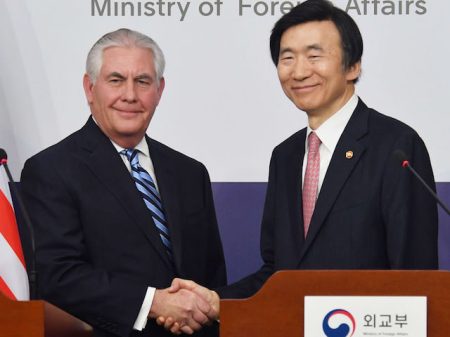
SEOUL, SOUTH KOREA – MARCH 17: (L to R) U.S. Secretary of State Rex Tillerson shakes hands with South Korean Foreign Minister Yun Byung-se during a press conference on March 17, 2017 in Seoul, South Korea. (Photo by Song Kyung-Seok-Pool/Getty Images)
U.S. Secretary of State Rex Tillerson told reporters in Seoul on Friday that the Trump administration is open to military action against North Korea as a last resort, and that the Obama-era policy of “strategic patience has ended.”
“The policy of strategic patience has ended. We are exploring a new range of diplomatic, security and economic measures. All options are on the table,” Tillerson told reporters at a press conference with South Korean Foreign Minister Yun Byung-se. “If North Korea takes actions that threaten South Korean forces or our own forces, that will be met with an appropriate response.”
“If they elevate the threats of their weapons program to the level that we believe requires action, that option is on the table,” Tillerson added. He emphasized that the United States would attempt to avoid to the extent possible any military actions against North Korea, particularly those that may put North Korean civilian lives in danger. “We hope that that will persuade North Korea to take a different course of action. That’s our desire,” Tillerson concluded.
Tillerson also took the opportunity to once again call for China to take on a larger role in containing North Korea’s escalating belligerence and objected to China cutting economic ties with South Korea over the deployment of the America Terminal High Altitude Area Defense (THAAD) missile defense system. “While we acknowledge Chinese opposition, its economic retaliation against South Korea is inappropriate and troubling. We ask China to refrain from such actions. Instead, we urge China to address the threat that makes that necessary,” Tillerson said.
Tillerson is currently in the middle of a three-nation trip to Asia, having left Japan on Thursday and scheduled to meet with leaders in China on Saturday.
The Secretary of State’s remarks regarding potential military action against North Korea follow remarks in Japan that emphasized a “different approach” to the rogue government in Pyongyang. “Part of the purpose of my visit to the region is to exchange views on a new approach,” Tillerson noted on Friday in a press conference with his Japanese counterpart, Foreign Minister Fumio Kishida.
Following Tillerson’s remarks Friday, President Trump himself issued a warning to North Korea on Twitter:
North Korea is behaving very badly. They have been “playing” the United States for years. China has done little to help!
— Donald J. Trump (@realDonaldTrump) March 17, 2017
Tillerson’s message towards China was also similar in Japan: as its largest trading partner, take a more prominent role in containing North Korea. “We look to China to fulfill its obligations and fully implement the sanctions called for,” he said. Anticipating Tillerson’s visit, Chinese Premier Li Keqiang told reporters Wednesday he was “optimistic about the future of China-US relations” and anticipated a positive outcome from Tillerson’s visit. President Donald Trump is reportedly working with Chinese officials to plan a U.S. visit by President Xi Jinping next month.
These statements represent a nearly complete shift away from what former Secretary of State and twice-failed presidential candidate Hillary Clinton described as “strategic patience“: a policy of waiting for the North Korean economy to implode and Pyongyang finding itself no longer able to afford to ignore UN sanctions and the rejection of the international community. This policy largely failed because China continued to trade with North Korea, providing the fellow communist regime a vital lifeline.
The response in Seoul to the new, robust U.S. policy is largely divided along partisan lines, according to the South Korean news agency Yonhap. Conservative leaders have expressed gratitude for Tillerson’s strong support for their country. “We highly appreciate his comments as he expressed a strong willingness to respond to North Korea’s reckless behavior,” Liberty Korea Party spokesman Rep. Choung Tae-ok told Yonhap.
One left-wing leader, in contrast, told Yonhap: “We are supporting the U.S.’s move to strengthen the effectiveness of sanctions against the North through cooperation with relevant countries, but we cannot help expressing concerns about the U.S. stance that there will be no dialogue until North Korea gives up (nuclear weapons).”
North Korea appears to have responded to Tillerson’s presence in the region with the publication of a “human rights white paper” condemning the United States as a serial violator of human rights, condemning the presidential election itself as a human rights violation against the American people and labeling the nation a “human rights desert.”
US twin sea buildup against China, NKorea, Iran, DEBKAfile, February 19, 2017
The conventional thinking until now was that, in the event of an Iranian clash with the US or Gulf states, including Saudi Arabia, Tehran would push back by blocking the strategic Strait of Hormuz. Today, American forces have been placed in position to prevent Iran from blocking the Strait of Mandeb, and so choking the main sea route used by oil and merchant shipping sailing to and from the Mediterranean via the Suez Canal, by posting missile bases on Yemen’s western Red Sea coast.
*********************
Donald Trump marked his first month as US President with two major military gambits in the Middle East, Asia and the South China Sea. Early Sunday, Feb. 19, the US Navy said that the Nimitz-class USS Carl Vinson aircraft carrier and strike group had begun patrols in the disputed waters of the South China Sea. With them are three air squadrons coming from their Naval Air Station Lemoore: the USS Lake Champlain guided missile cruiser and two guided missile destroyers, the USS Michael Murphy and the USS Wayne E. Meyer.
The deployment comes after Beijing’s warning that a US naval unit sailing near the disputed Spralys, where China has built islands and a military presence, would be seen as a violation of sovereignty, which the US and Japan refuse to recognize.
The Trump administration’s move therefore opens up a potential arena of confrontation between the US and China. It also caries a message for North Korea, which Trump has called “a big, big problem and we will deal with that very strongly.”
A week ago, on Feb. 12, North Korea launched a missile, using new “cold eject” technology which makes it possible to fire a missile from a submarine. Military experts in Washington and Jerusalem estimate that once Pyongyang has perfected the system, it will be passed to Tehran, an eventuality covered in Prime Minister Binyamin Netanyahu’s White House talks with President Trump last week, our sources reveal.
Our military sources add that while Washington has publicly announced the transfer of a naval-air force to the South China Sea, the deployment of the large 11th Marine Expeditionary Combat Unit to the Gulf of Aden and Red Sea is being kept low key.
The conventional thinking until now was that, in the event of an Iranian clash with the US or Gulf states, including Saudi Arabia, Tehran would push back by blocking the strategic Strait of Hormuz. Today, American forces have been placed in position to prevent Iran from blocking the Strait of Mandeb, and so choking the main sea route used by oil and merchant shipping sailing to and from the Mediterranean via the Suez Canal, by posting missile bases on Yemen’s western Red Sea coast.
The 4,500-strong contingent of MEC marines and sailors is supported by the fighters and attack helicopters on board the USS Makin Island amphibious assault ship, the USS Somerset amphibious transport and the USS Comstock dock landing ship. Their task is to keep the strategic waterway open and safe.
The deployment of the USS Cole destroyer around the strait was announced on Feb. 3, days after a suicide boat attack by Yemeni Houthi rebels on the Saudi frigate Al Madinah off the Yemeni port of Al Hudaydah.
DEBKAfile’s military analysts note that the deployment of these naval and air forces in two international maritime arenas offers President Trump a flexible operational scenario. He can order one of those forces to go on the offensive as a warning to hostile elements in the other one – or go into action in both simultaneously – for example the US could strike North Korean and Iranian targets synchronously.
In line with these moves, a US flotilla departed its Arabian Sea base at Duqm in Oman on Feb. 12 and is sailing towards Bab Al Mandeb.
Tehran reacted Monday, Feb. 20, by embarking on a large-scale three-day military exercise titled Grand Prophet 11. Gen. Mohammed Pakpour, commander of the Revolutionary Guards ground forces, announced that the drill would include missile launches, without specifying their types or ranges.
Iranian leaders have repeatedly stated that they would not allow American warnings to deter them from their missile program, any more than Pyongyang hesitated to fly in the face of those warnings. Those warnings are now backed up by America’s sea and air might in combat positions.
Impeached President’s attorney claims protests against her “led by N.Korea” NK News, JH Ahn, January 6, 2017
(Maybe Park’s claim that Kim Jong-un is responsible for her downfall will work as well as Clinton’s claim that Putin is responsible for hers. — DM)

South Korea’s ongoing Park Geun-hye scandal took another strange turn on Thursday, with a member of the impeached President’s legal representation claiming that followers of Juche ideology were behind the protests against her.
Comparing President Park to Socrates and Jesus, who were, like Park, “falsely driven by the people to execution,” the attorney said that the protests were “not the representation of the South Koreans’ popular will.”
“The candlelight vigils were organized by those who follow Kim Il Sung’s Juche ideology, and was a de facto (the North’s) declaration of war against the Republic of Korea,” Seo Seok-gu, President Park’s attorney said during impeachment hearings at the Constitutional Court.
“North Korea’s Rodong Sinmun has said that South Koreans are raising their torchlight following Kim Jong Un’s order,” Seo said. It’s unclear which article he was referring to, as no such report was found in a search of KCNA Watch.
“South Korean reports (about the protests)… are being highly complimented by the North Korean media…and should not be used as evidence against Park.”
On the following day of impeachment hearings, Seo repeated the claim during an interview with a local radio channel.
“(Haven’t the protesters) marched through the center of the city, walking with the giant sculpture of Lee Seok-ki, who have said to plot the armed protests should the North declare war against us?,” Seo asked the CBS anchor.
Seo’s eccentric arguments continued: he claimed that Pentagon had used its intelligence satellites to count the number of protestors in Seoul.
“On the day of the protest, when so-called ‘one million’ gathered at Gwanghwamun Plaza, Pentagon has used its satellite to take the imagery and announced that it was 113,373,” Seo said.
No article or statement by the Pentagon has mentioned this, while a defense expert said it would be “technically impossible”.
“The U.S. satellites are known to be capable of identifying objects that are only a few centimeters wide,” Kim Min-seok, a senior researcher at the Korea Defense and Security Forum, told NK News.
“But that does not mean that the intelligence satellites can identify people, track their movements and count numbers,” Kim said.
6 of 7 Nations With Worst Record of Christian Persecution Are Muslim, Creeping Sharia, December 4, 2016

The seven nations where persecution was branded so extreme that “it could scarcely get any worse” include: Afghanistan, Iraq (northern), Nigeria, North Korea, Saudi Arabia, Somalia and Syria.
************************
Source: Top 7 Nations With Worst Record of Christian Persecution: Report
Persecution watchdog group Aid to the Church in Need released its 2016 “Religious Freedom in the World” report on Thursday, highlighting the growing cases of intolerance around the world, particularly between the time period of June 2014 and June 2016 — coinciding with the rise of the Islamic State terror group.
The report included case by case studies of a number of different countries around the world, and the religious discrimination people of faith face. Some of the most extreme forms of oppression were experienced by people in Iraq and Syria, including Christians and Yazidis, who have been targeted in an ongoing genocide campaign by IS.
One Yazidi boy trained for jihad in Syria shared the chilling words his radical instructors told to him: “You have to kill kuffars [unbelievers] even if they are your fathers and brothers, because they belong to the wrong religion and they don’t worship God.”
The report revealed that 196 countries were examined, with 38 showing “unmistakable evidence” of significant religious freedom violations. Twenty-three of those countries were placed in the top level “Persecution” category, while 15 others in the “Discrimination” group.
Religious freedom conditions “clearly worsened” in 14 countries, the report added, and only three — Bhutan, Egypt and Qatar — showed signs of improvement since the last study in 2014.
The seven nations where persecution was branded so extreme that “it could scarcely get any worse” include: Afghanistan, Iraq (northern), Nigeria, North Korea, Saudi Arabia, Somalia and Syria.
“A virulent and extremist form of Islam emerged as the number one threat to religious freedom and was revealed as the primary cause of persecution in many of the worst cases,” the report noted.
It added that “religious hyper-extremism,” such as the actions of IS in their quest to build a caliphate and kill off minorities, has been on the rise, characterized by mass killings, ‘horrific’ forms of executions, rape, and extreme torture such as burning people alive, crucifixions, or throwing victims off buildings.
The atrocities committed by Islamist radical groups in nations such as Syria, Iraq and Libya were called arguably some of the “greatest setbacks for religious freedom since the Second Wold War,” with victims being subjugated to a system which “insults almost every tenet of human rights.”
Other watchdog groups, such as Open Doors USA, have called on the global Church to resist being too self-centered, and instead reach out to help its brothers and sisters in need.
Open Doors President David Curry told The Christian Post in October that the factors that led to 2015 being the worst year for Christian persecution have stayed in place for 2016 as well.
“You still have rouge nations like Eritrea, North Korea, Sudan and others, who are not concerned about international justice laws, and are persecuting Christians within their government,” Curry told CP at the time, ahead of the International Day of Prayer.
“I’m not encouraged yet by the response of the global Church, but I’m hopeful that they are going to wake up and see what is happening,” he added.
North Korean Nukes, South Korea, Japan, China and Obama, Dan Miller’s Blog, September 10, 2016
(The views expressed in this article are mine and do not necessarily reflect those of Warsclerotic or its other editors. — DM)
On September 9th, North Korea conducted its fifth nuke test, of its most powerful nuke thus far. Can Obama get China to help make North Korea stop developing and testing nukes? Nope. China sees Obama, not as the representative of the world’s greatest power, but as a joke. He has no clout internationally and is a national embarrassment.
China and North Korea – a very short history
Here’s a link to an article I posted on June 25, 2013 about the Korean conflict. To summarize, China and the Democratic People’s Republic of Korea (North Korea) have a long history of acting together. China views the Republic of Korea (South Korea), which borders North Korea to the south and is an American ally, as a threat. She does not want reunification of the Korean peninsula under a government favorable to America.
When, on June 25, 1950, North Korea invaded South Korea with Russian aircraft, weaponry, training and other substantial support, China did not assist North Korea. North Korean forces pushed the South Korean government, as well as the few American military advisers (then under the command of the Department of State), south to the Pusan perimeter. Following General MacArthur’s unexpected and successful Inchon invasion which began on September 15th, American and other United Nations forces pushed the North Korean forces back north: MacArthur sent his by then greatly augmented forces east to Wonson and eventually managed to push North Korean forces to the northern side of the Yalu River. However, Chinese forces struck back en masse and MacArthur’s forces were driven back to Seoul.
Ever since bringing to an end MacArthur’s successes in the Korean Conflict, China has supported North Korea. She has opposed, and has then declined to enforce, significant sanctions responsive to North Korean nuclear and missile development and testing. While China may acquiesce in weak UN resolutions condemning North Korean provocations, she rarely goes beyond that.
China, Japan and the two Koreas
China has a long memory and still resents, bitterly, the lengthy period prior to and during World War II when Japan occupied significant parts of China. Ditto South Korea, all of which was under Japanese occupation for a lengthy period prior to and during World War II. Although China has substantial trade with both South Korea and Japan, she is more hostile to Japan than is South Korea; the latter two have substantial mutual interests transcending trade.
Perhaps the most important current dispute between China on the one hand, and Japan-South Korea-America on the other, involves the plans of Japan and South Korea to defend against North Korean missiles by the installation of THAAD anti-missile weapons provided by America. China’s stated reason for opposition to the THAAD system is that it could be used against Chinese, as well as North Korean, missiles. Why does China assert this objection unless she hopes to fire missiles at one or both of them? If China fires missiles at Japan and/or South Korea, they have every right to destroy her missiles and to respond in kind with U.S. assistance if requested.
condemned Pyongyang’s fifth nuclear test today in the “strongest possible terms as a grave threat to regional security and to international peace and stability” as outraged lawmakers from both parties called for tougher action to stop North Korea’s nuclear program. [Emphasis added.]
That may well be all that Obama does — despite the warnings of Rep. Adam Smith (D-Wash.), the top Democrat on the House Armed Services Committee, that
we have to make it absolutely clear that if they engage in any military activity, they will be destroyed. We have to have a credible deterrent. That seems to be the only thing that will stop North Korea from engaging in military action… We have sanctioned them, and we should keep sanctioning them, but it’s not going to stop them from developing the nuclear weapons.” [Emphasis added.]
Obama won’t do that:
In a statement Friday, President Obama vowed to “take additional significant steps, including new sanctions, to demonstrate to North Korea that there are consequences to its unlawful and dangerous actions.”
Obama did not suggest what He might have in mind, beyond historically ineffective sanctions and condemnations “in the strongest possible terms,” to let North Korea know that there will be “consequences.”
A September 9th article at the New York Times provides an unpleasant analysis of the options Obama now has, and which His successor will have, in dealing with North Korea.
A hard embargo, in which Washington and its allies block all shipping into and out of North Korea and seek to paralyze its finances, risks confrontations that allies in Asia fear could quickly escalate into war. But restarting talks on the North’s terms would reward the defiance of its young leader, Kim Jong-un, with no guarantee that he will dismantle the nuclear program irrevocably.
For more than seven years, President Obama has sought to find a middle ground, adopting a policy of gradually escalating sanctions that the White House once called “strategic patience.” But the test on Friday — the North’s fifth and most powerful blast yet, perhaps with nearly twice the strength of its last one — eliminates any doubt that that approach has failed and that the North has mastered the basics of detonating a nuclear weapon.
Despite sanctions and technological backwardness, North Korea appears to have enjoyed a burst of progress in its missile program over the last decade, with experts warning that it is speeding toward a day when it will be able to threaten the West Coast of the United States and perhaps the entire country. [Emphasis added.]
. . . .
Mr. Obama has refused to negotiate with the North unless it agrees first that the ultimate objective of any talks would be a Korean Peninsula without nuclear arms. But Mr. Kim has demonstrated, at least for now, that time is on his side. And as he gets closer to an ability to threaten the United States with a nuclear attack, and stakes the credibility of his government on it, it may be even more difficult to persuade him to give up the program.
In a statement Friday, Mr. Obama condemned the North’s test and said it “follows an unprecedented campaign of ballistic missile launches, which North Korea claims are intended to serve as delivery vehicles intended to target the United States and our allies.”
“To be clear, the United States does not, and never will, accept North Korea as a nuclear state,” he said.
Many experts who have dealt with North Korea say the United States may have no choice but to do so. [Emphasis added.]
“It’s too late on the nuclear weapons program — that is not going to be reversed,” William Perry, the defense secretary under President Bill Clinton during the 1994 nuclear crisis with North Korea, said in August at a presentation in Kent, Conn. The only choice now, he argued, is to focus on limiting the missile program. [Emphasis added.]
Obama has taken no significant steps to limit Iran’s continuing missile development and testing program. How can He limit that of North Korea without Chinese cooperation?
Yet the latest effort to do that, an agreement between the United States and South Korea to deploy an advanced missile defense system in the South, has inflamed China, which argues the system is also aimed at its weapons. While American officials deny that, the issue has divided Washington and Beijing so sharply that it will be even more difficult now for them to come up with a joint strategy for dealing with the North. [Emphasis added.]
China has been so vocal with its displeasure over the deployment of the American system that Mr. Kim may have concluded he could afford to upset Beijing by conducting Friday’s test. [Emphasis added.]
Fueling that perception were reports that a North Korean envoy visited Beijing earlier this week.
“North Korea almost certainly sees this as an opportunity to take steps to enhance its nuclear and missile capabilities with little risk that China will do anything in response,” Evans J.R. Revere, a former State Department official and North Korea specialist, said in a speech in Seoul on Friday. [Emphasis added.]
The breach between China and the United States was evident during Mr. Obama’s meeting with President Xi Jinping last week. “I indicated to him that if the Thaad bothered him, particularly since it has no purpose other than defensive and does not change the strategic balance between the United States and China, that they need to work with us more effectively to change Pyongyang’s behavior,” Mr. Obama said, referring to the Terminal High Altitude Area Defense system, as the advanced missile defense project is known. [Emphasis added.]
North Korea and Iran
Iran and North Korea have a long history of cooperation in developing nukes and missiles with which to deliver them. In the past, Iranian scientists have been present at North Korean nuke tests, and vice versa. They have also assisted each other in the development of nukes and missiles.
Iran and North Korea have substantial reasons to cooperate: by virtue of the Iran scam, Iran now has lots of money but is at least minimally restricted in its nuke development. North Korea has little usable currency, needs whatever it can get, and no attempts to halt or even to limit its nuke development have worked.
A missile fired recently by North Korea bore a striking resemblance to an Iranian missile.
Photos released by North Korea of its launch of long-range ballistic missiles are the latest proof of the close military cooperation between Pyongyang and Tehran, an Israeli expert in the field told the news site IsraelDefense on Tuesday.
According to Tal Inbar — head of Space and UAV Research Centre at the Fisher Institute for Air & Space Strategic Studies — what was new in the photos was the shape of the warheads attached to the Nodong missiles, known in Iran as the Shahab-3.
Until now, such warheads — first detected by Inbar in Iran in 2010 — have not been seen in North Korea. At the time, Inbar dubbed them NRVs (or, “new entry vehicles”), which became their nickname among missile experts around the world. [Emphasis added.]
Inbar told IsraelDefense: “The configuration that we saw [on Tuesday] is identical to what we saw in Iran six years ago. In principle, its penetrating body (warhead) is identical to that of Scud missiles, but is mounted on the Shahab-3, and creates a more stable entity than other Shahab/Nodong warheads.”
Inbar said this was the third time that something of this nature had appeared in Iran before it did in North Korea. “But we must remember that the two countries engage in close cooperation where military and space-directed missiles are concerned,” he said. “It is thus possible that both plans and technology are being transferred regularly from one to the other.” [Emphasis added.]
Are North Korea and Iran rational? According to this New York Times analysis, North Korea is.
North Korea’s actions abroad and at home, while abhorrent, appear well within its rational self-interest, according to a 2003 study by David C. Kang, a political scientist now at the University of Southern California. At home and abroad, he found, North Korean leaders shrewdly determined their interests and acted on them. (In an email, he said his conclusions still applied.) [Emphasis added.]
“All the evidence points to their ability to make sophisticated decisions and to manage palace, domestic and international politics with extreme precision,” Mr. Kang wrote. “It is not possible to argue these were irrational leaders, unable to make means-ends calculations.” [Emphasis added.]
Victor Cha, a Georgetown University professor who served as the Asian affairs director on George W. Bush’s National Security Council, has repeatedly argued that North Korea’s leadership is rational.
I submit that the same analysis, applied to Iran, produces the same result. Iran’s leaders know what they want, and are sufficiently rational to achieve it; they did. Obama, not the leader of a dictatorial theocracy, is sufficiently irrational to believe that what he wants for the Islamic Republic of Iran is what America needs it to have. It is not.
Obama and Iran
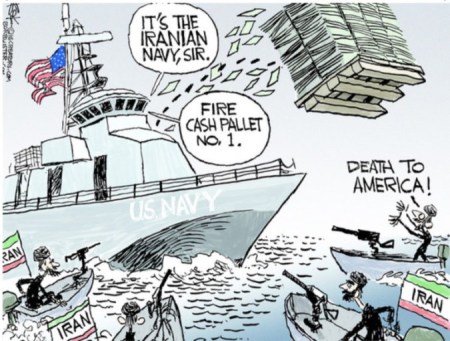
Obama’s Iran scam would be farcical were it not potentially deadly. He did not do what would have been best for America and the free world in general — increase sanctions until Iran complied fully with UN resolutions on missile testing, ceased Uranium enrichment and disposed of the means to do it, ceased all nuke research as well as all nuke cooperation with North Korea and ceased supporting all terrorist groups, including Hezbollah and Hamas. Instead, perhaps considering Himself above such trivia, Obama sought little more than what He considered His greatest achievement — His legacy:
Conclusions
If Obama were viewed internationally as the powerful leader of the world’s most powerful nation, He might be able to get China to clamp down, severely and successfully, on North Korea’s nuke and missile development. Were China to reject His overtures, He could arrange for it to wish that it had acceded. That’s not who Obama is, as demonstrated by, among His other actions, entering into the Iran Scam deal with Iran.
Perhaps Kim Jong-un needs to dress like an Iranian mullah to convince Obama to give him a “deal” similar to the one He gave to Iran. He had better hurry: that won’t work with President Trump.
North Korean Leader Kim Jong-un Dead After Apparent Suicide Attack, East Asia Tribune, June 16, 2016
(I “Googled” East Asia Tribune and one of the links was to a Wikipedia page on fake (satirical) news sites. East Asia Tribune is not mentioned there. I also searched the Wikipedia page for East Asia Tribune and was advised that it does not exist. I have seen no other reports of Kim’s death.- DM)
A report filed by North Korean state media earlier today announced that Kim Jong-un, chairman of the Worker’s Party of Korea and supreme leader of the DPRK, was killed in an explosion in Pyongyang which was believed to have been carried out by a female suicide bomber. Few details have been confirmed by North Korea’s state-owned media outlets, and the lack of foreign journalists based in Pyongyang makes corroborating the story hard. However, at this point the following facts have been revealed by KCTV (조선중앙텔레비죤):
The attack on Kim Jong-un was carried out at around 14:00 local time in the Potonggang District of Pyongyang. Mr Kim was attending the commemoration of a new state built on the banks of the Potong River when a female spectator burst past security barricades and sprinted in his direction. Mr Kim’s bodyguards drew their weapons, but before they had a chance to fire upon the female, she detonated a device which is believed to be a suicide belt. The ensuing blast seriously wounded Mr Kim, and despite being rushed to a nearby hospital he was pronounced dead on arrival. State media has been completely silent on the topic of who among the DPRK’s remaining leadership may succeed Mr Kim, who held the post of supreme leader after his father, Kim Jong-il, passed away in late 2011. There exists a power vacuum among North Korea’s elite, with the younger Kim conducting a series of purges aimed at consolidating his power in recent times. Foreign media outlets have speculated that Kim’s sister, Ms Kim Yo-jung, who currently holds the position of deputy director of the Korean Worker’s Party, is a leading candidate. “Some analysts claim that during Kim Jong-Un’s lengthy absence from the public eye in 2014, that she may have been running the country.”
The identity of the female suicide bomber remains a mystery, and few details have emerged that shed any light on her identity. Witnesses to the blast were interviewed on Korean state media but were mostly too consumed by grief to share any useful information. One exception was a younger North Korean man who was interviewed, who reported that the female bomber was ‘exceptionally beautiful’. “She had half the men in the crowd watching her,” he commented, before his interview was abruptly terminated by KCTV.
North Korean Nuke Program Built With Earnings From Slave Labor, Washington Free Beacon,

North Korean leader Kim Jong Un waves during a parade at Kim Il Sung Square in the country’s capital Pyongyang on May 10, 2016, to celebrate the end of the seventh Workers’ Party of Korea congress. Kim appeared at the parade, in which hundreds of thousands of people took part. (Kyodo)
North Korea uses “forced and slave laborers” in order to fund state priorities, including the development of nuclear weapons and missiles, according to a new report on the labor practices in the isolated dictatorship.
The report, entitled Gulag, Inc., was unveiled by the Committee for Human Rights in North Korea (HRNK) at an event at the National Press Club in Washington, D.C., last week. It offers a glimpse into the way Kim Jong Un’s regime exploits North Korean citizens in the lowest tiers of its social system for economic gain.
“Most of us cannot imagine a place where your life is pre-determined from the time you are born: what you eat, where you attend school, travel, and work—all forced onto you, regardless of your desires, dreams, talents, or merits,” the report says.
“If you are born into the lowest rung of the loyalty-based social discrimination system (songbun), you will likely live a brutish, dangerous, and often short life, shrouded in the darkness of the country’s state-run mines. This has been the reality of North Korea under three generations of the Kim regime.”
The report was written by Kim Kwang-Jin, a defector from North Korea and an expert on the regime’s secret and illegal international financial operations who is a fellow at HRNK.
Forced labor serves as the backbone of North Korea’s mining industry, which yields coal, copper, and other commodities that “earn hard foreign currency for the state,” Kwang-Jin explains in the report.
The mining industry continues to play a central role in North Korea’s exports despite reductions in the price of commodities. In 2013, for example, coal and mineral resources accounted for half of the regime’s total exports. The chief buyer of North Korean mineral exports is China.
“In 2013, China accounted for 97% of North Korea’s exports of mining products in terms of revenue. Exports of coal and iron ore to China in the same year totaled $1.68 billion, or 44% of North Korea’s overall exports to all countries for that year,” the report notes.
All facets of the mining industry are run by state entities.
The North Korean social system is comprised of three classes: the basic class, the complex class, and the hostile class. Members of the two lower rungs “are forcibly assigned to the most difficult and avoided occupations in North Korea, which include mines and farms.” The occupations of those in the hostile class, the lowest class, are pre-determined by the occupations of the individual’s parents or grandparents.
North Korea’s political prison camps are also linked to mining activities, according to evidence presented in the report.
“These individuals, systematically marginalized and discriminated against, cannot enter the institutions of power, including the Party, government, or the military. They are placed at an extreme disadvantage in all walks of life, and their labor is exploited to maintain production and export the state’s underground resources,” the report says. “The dark reality of this industry reveals a vast system of unlawful imprisonment, forced labor, and human rights violations.”
The wealth generated from the mining industry is used by Kim Jong Un’s regime to “strengthen its own power,” meaning that the state’s interests are funded by slave labor.
“The underground resources exported from North Korea are produced by forced labor and human rights violations committed by the state,” the report explains. “The wealth that is generated from these exports is spent on state priorities: the privileged lifestyle of the Kim dynasty and the elite classes, the development of nuclear weapons and missiles, songun (‘Military First’) politics, giftpolitik, and the maintenance of the songbun system of social classification.”
A resolution passed by the United Nations Security Council in March cracked down on North Korean exports by prohibiting Pyongyang from exporting coal, iron, iron ore, gold, and other minerals, with some exceptions. The new sanctions came in response the regime’s January nuclear test. Still, the resolution is not likely to be enough to curb exports to China, the report notes.
“Although the sanctions imposed by UN Security Council resolution 2270 were widely regarded to be unprecedented in strength, they do not yet appear to have had a significant impact on North Korea’s exports of underground resources to China, which continue under the guise of ‘livelihood purposes,’” the report states.
“There is an urgent need to strengthen controls on North Korea’s mining exports, not only to improve the effectiveness of sanctions aimed at altering Pyongyang’s stance on denuclearization, but also to protect the human rights of countless North Koreans who endure forced labor in mines across the country.”
Kwang-Jin headlined the launch event for Gulag, Inc. on Thursday along with David Asher, who was a State Department official during the Bush administration; William Newcomb, a former U.S. government economist; and Roberta Cohen, an expert on human rights and humanitarian issues at the Brookings Institution.
Asher, who served as a senior adviser for East Asian and Pacific Affairs and coordinator of the North Korea Working Group at the State Department, emphasized the need to crack down on North Korea’s forced labor in order to minimize threats posed by Pyongyang to the homeland.
“These workers are being used as slaves or serfs in a way that is absolutely at the center of the North Korean regime’s finances and weapons of mass destruction program,” stated Asher.
“North Korea’s ‘Gulag, inc.’ is supporting a system that at the end of the day is involved in threatening the entire stability of the world economy and civil society,” Asher later said. “North Korea’s exploitation of its human people like cattle at the end of the day results in a very sophisticated ability to build nuclear weapons and proliferate them as well as missiles.”
Security Expert: N. Korea Has Capability To Incapacitate US, Western Journalism, Randy DeSoto, April 25, 2016
A defense expert warns that North Korea now has two satellites orbiting the United States, capable of engaging in an electromagnet pulse attack that would bring the nation to a standstill.
“Peter Vincent Pry told G2 Bulletin that the satellites can be commanded either to de-orbit and hit a target on the ground or explode at a high altitude to create an EMP effect that would knock out the unprotected U.S. national electrical grid system and all life-sustaining critical infrastructures that depend on it,” World Net Daily reported.
“The threat,” Pry said, “continues to race, hare-like, at an alarming rate, compared to the tortoise pace of our preparations.”
The U.S. intelligence community does not know what, if any, payload North Korean satellites KMS-3-2 and KMS 4 contain, according to Pry, but they orbit the country at approximately 300 miles above the earth and from that altitude a detonated low yield hydrogen bomb could incapacitate America.
Additionally, the Washington Examiner reported that the communist nation launched its first submarine based missile over the weekend. “This is something that started as a joke, but has turned into something very serious,” a Pentagon official told the news outlet.
While the launch from the submarine “Gorae” was successful, the flight of the KN-11 missile was failure, with it only traveling a distance of 20 miles. According to the Pentagon official, the rogue regime’s diesel-powered submarines, like the Gorae, pose little threat to the United State because they lack the range to reach the North American coast without being detected.
Nonetheless, the Pentagon is taking the launch seriously. “North Korea’s pursuit of ballistic missile nuclear weapons capabilities continues to pose a significant threat to the United States, to our allies in the region and remains obviously a significant concern, said Pentagon spokesman Peter Cook. “It is just the latest in a series of steps they’ve taken that we think have been counterproductive.”
Cuba and Obama’s ‘Axis of Evil’ Gatestone Institute, A.J. Caschetta, March 21, 2016
♦ Just as the Soviet Union did not subsidize Castro’s tyranny for the good cigars, so too Iran and North Korea are less interested in old weapons and luxury goods than in the one thing Cuba has always offered to America’s enemies — physical proximity. The USSR used Cuba as a forward operating base in the Cold War. Why would Iran and North Korea not do the same?
♦ Iranian and North Korean scientists have been openly cooperating on so many projects that Iran, if it is not already doing so, will likely evade IAEA inspections by testing its weapons in North Korea.
♦ A medium range missile fired from Cuba could reach most of the US. Cuba would also be a good launch point for an EMP attack on the US.
♦ Obama’s diplomatic engagement with Cuba’s octogenarian dictators will ensure that the island prison stays in business. Like Iran, Cuba has been flaunting its tyranny since Obama’s outreach, with 8,616 political arrests in 2015.
When George W. Bush used the term “axis of evil” to describe Iran, Iraq and North Korea in his 2002 State of the Union speech he was derided from all sides. Post-modernists and others among whom ideas of good and evil are quaint but obsolete, sneered that Bush was a simplistic thinker. Others, who agreed that threats to their existence might be evil, seemed less troubled by the ethics than by the accuracy of the term “axis.”
Bush, by linking these three nations, was accused of misunderstanding that members of an axis work together. As Iraq and Iran were mortal enemies, so went the argument, there was no evidence of cooperation.
In 2002 it may have been impossible to prove Iranian-North Korean cooperation, but that has changed. Since at least 2012 when the two countries signed a technological cooperation pact, Iranian and North Korean scientists have been openly cooperating on so many projects that Iran, if it is not already doing so, will likely evade IAEA inspections by testing its weapons in North Korea.
Whether through prescience or luck, Bush was correct about the Iran-North Korea connection. With Saddam out of the picture the “Axis of Evil” has become the “Duo of Evil” — not nearly the same ring. There also is evidence that the Duo is seeking to recruit a new third member to complete the axis.
Putin’s Russia, for instance, could easily be taken for a new member of the axis. Its fingerprints have been showing up in many places: the murder of Russian dissidents, the downing of passenger jets, the invasion of its neighbors. Putin’s decisions to cancel the transfer of S-300 surface-to-air missiles to Iran and withdrawal of troops from Syria suggest a Russia making a strategic retreat for its own best interests at the moment, whatever they may be.
China might also part of the axis. Constructing military bases on artificial islands indicates a budding expansionism. China’s reportedly growing dismay over North Korea’s antics, however, suggest a nation too concerned with its own interests to join any axis seeking to destroy the chief marketplace for its goods.
The less obvious, but more probable, recruit to the axis is Cuba, which shares with Iran and North Korea an institutional hatred for the USA and a history of autocratic rule. Robin Wright has called Cuba and Iran “melancholy twins.”
Most bitterly of all, all three countries might today be far less threatening had U.S. aid not saved them at crucial moments when their tottering regimes might have been toppled.
 President Barack Obama shakes hands with Cuban dictator Raúl Castro during the Summit of the Americas in Panama City, on April 11, 2015. (Image source: White House/Pete Souza)
Had Jimmy Carter not pulled the regime out from under the Shah, the Iranian Revolution might never have caught on. Carter’s shameful treatment of an imperfect ally is a blight on his presidency. But when the so-called Green Revolution broke out in 2009, a newly-inaugurated President Obama did nothing to help the revolutionaries. Worse, he reached out his open hand, eventually placing billions of dollars at the mullah’s disposal just when sanctions were crippling Iran’s economy.
In 1994, North Korea was not yet a nuclear power. Its economy was almost non-existent, and an ailing Kim Il-Sung was losing the battle of world opinion after the IAEA declared it in violation of non-proliferation safeguards. Just when international opprobrium might have been leveraged against the regime, a semi-retired Jimmy Carter saved the Kims with the worst diplomatic deal the U.S. had ever made. The subsequent Clinton-Carter Agreed Framework provided Kim Jong Il (whose father died during negotiations) regular shipments of heavy fuel oil and, of all things, two light water nuclear plants. In return, Kim promised not to do what he immediately set about doing.
The now-infamous photograph of Kim Jong-Il and Madeleine Albright toasting the deal is an iconic tableau to diplomatic folly on par with Neville Chamberlain triumphantly waving a piece of paper with Hitler’s promise to behave himself, or more recently, John Kerry and Zarif shaking hands over the JCPOA.
Now Cuba is being saved just when its repressive dictatorship was finally vulnerable and fading on the vine, bereft of the welfare it enjoyed first from its Soviet patrons and then from Venezuela’s Hugo Chavez. Obama’s diplomatic engagement with Cuba’s octogenarian dictators will ensure that the island prison stays in business. Like Iran, Cuba has been flaunting its tyranny since Obama’s outreach, with 8,616 political arrests in 2015.
Historical similarities aside, Cuba has cooperated with both Iran and North Korea. Under the Shah, Iran had no diplomatic ties with Cuba; but after 1979, Castro was one of the first nations to recognize Khomeini’s regime as the legitimate government of Iran. Since then, ties between the two have been increasing steadily. In May of 2001, Fidel Castro visited Iran, where he said “Iran and Cuba, in cooperation with each other, can bring American to its knees.” Visiting Cuba at a meeting of the Non-Aligned Movement (NAM) in 2006, then Iranian President Mahmoud Ahmadinejad thanked the Castros for their support of his country’s nuclear program; he visitedCuba again in 2012; by 2014 the relationship had grown even closer.
Cuban relations with North Korea are not as old nor as easily documented as those with Iran. Aside from Castro’s visit to Pyongyang in 1986 and some weapons transfers in the 1980s, there had been little to report, until recently. The Economist offers 2008 as the year that cooperation between Cuba and North Korea began increasing. In 2013, the North Korean ship Chong Chon Gang was interdicted in Panama after leaving Cuba laden with Soviet weaponry hidden under mountains of sugar. There were MiG jets, spare MiG engines, missile parts, radar components, and other weaponry. There were reports that the ship had visited Cuba several times before being caught with the weapons. What else might have been smuggled out of Cuba is far less worrisome than what might have been smuggled into Cuba.
A Cuban role in the axis would be more than ideological. Just as the USSR did not subsidize Castro’s tyranny for the good cigars, so too Iran and North Korea are less interested in old weapons and luxury goods than in the one thing Cuba has always offered to America’s enemies — physical proximity. The USSR used Cuba as a forward operating base in the Cold War. Why would Iran and North Korea not do the same?
Most analysts are focused on North Korea’s intercontinental ballistic missiles (ICBMs), but a medium-range missile fired from Cuba could reach most of the US. Cuba would also be a good launch point for an electromagnetic pulse (EMP) attack on the US.
Just days before North Korea’s purported hydrogen bomb test, the State Department reached out to Kim Jong Un with another lifeline offer. And on March 17, the US removed Cuba from the list of countries deemed to have insufficient port security.
In spite of repeated Iranian violations of the JCPOA, there is no sign that the so-called “snapback sanctions” are even a topic of discussion at the White House. Last week, Russia used its veto at the UN Security Council to prevent any sanctions on Iran.
The biggest difference between the Bush and Obama approach to the “axis of evil” is that Bush was opposed to it; Obama appears infatuated.




 anneinpt
 artaxes
 danmillerinpanama
 davidking1530
 Peter Hofman
 Joseph Wouk
 Peter
Peter Louisiana Steve
 WarSclerotic
Recent Comments