Archive for the ‘Middle East’ category

Egypt-Qatar rapprochement rattles Hamas

December 31, 2014

Egypt-Qatar rapprochement rattles Hamas, Al-MonitorAdnan Abu Amer, December 30, 2014

(These guys could form several pretty adequate stand-up comedy teams.

— DM)

Egyptian woman gestures during a protest against what they say is Qatar's backing of ousted Egyptian president Mohamed Mursi's government, outside the Qatari Embassy in CairoAn Egyptian woman gestures during a demonstration against what protesters call Qatar’s backing of ousted Egyptian President Mohammed Morsi’s government, outside the Qatari Embassy in Cairo, Nov. 30, 2013. (photo by REUTERS)

At a time when Hamas is mending its relationship with Iran, Egypt and Qatar are also in the process of rapprochement after more than a year of tension. Resumed ties between them will likely have an impact on Hamas, but questions remain as to whether the Palestinian Islamist movement stands to gain or lose from this important regional development.

Hamas waited several days to announce its final position on the return of positive relations between Doha and Cairo on Dec. 20, when President Abdel Fattah al-Sisi met the envoy of Qatar’s emir in Cairo, Sheikh Mohammed bin Abdulrahman bin Jassim Al-Thani, the minister’s assistant for International Cooperation Affairs.

On Dec. 28, senior Hamas leader Mahmoud al-Zahar welcomed the Egyptian-Qatari convergence and denied Qatar was pressuring the Hamas leadership to leave Doha. He also denied reports that Qatar was planning to suspend its support for Hamas over the warming of ties with Egypt, reiterating that Hamas supports the unity of Arab countries to serve the Palestinian cause.

Yousef Rizqa, the former minister of information and political adviser to former Gaza Prime Minister Ismail Haniyeh, said in an interview with Al-Monitor, “The Egyptian-Qatari rapprochement serves the interest of the Palestinian national project, and Hamas has no concerns about its relations with Doha being harmed after the Doha-Cairo rapprochement because the movement is not a party to the internal Arab conflict, and it is accepted by the Arab capitals.”

However, an anonymous Egyptian official said in Dec. 26 press statement that Doha informed Hamas leaders that it would temporarily suspend its support for the movement in a bid to pressure Hamas to change its policies against Cairo.

Husam Badran, spokesman for Hamas and a resident of Doha, told Al-Monitor, “There is no suspension of the Qatari financial support for the movement, since their relationship is ongoing.” But Palestinian Minister of Labor Maamoun Abu Shahla revealed Dec. 28 that Qatar had postponed the financial grant supposed to be sent to Gaza’s state workers.

Rizqa neither confirmed nor denied this report, but he told Al-Monitor that Qatar has not cut its support and relationship with Hamas over the rapprochement with Egypt, saying, “The Hamas-Doha relationship is stable and Qatar’s support for the movement is sustained and has never ceased. Moreover, Qatar’s position on Hamas is strategic.”

It is worth noting that Hamas’ fear of Qatar halting its financial support for the movement at Egypt’s request coincides with its renewed attempt to improve ties with Iran, as well as political head Khaled Meshaal’s recent visit to Turkey. Hamas may be reaching out to possible alternatives for regional support should Doha downgrade its ties with the movement in a “secret” deal with Cairo.

The Palestinian Authority did not express a position on the Egyptian-Qatari rapprochement, but on Dec. 25 Ambassador Hazem Abu Shanab, a member of the Revolutionary Council of Fatah, ruled out the consideration that the Egyptian-Qatari convergence would contribute to the improvement of relations between Hamas and Cairo, because this depends on how Cairo decides to deal with the Muslim Brotherhood and its affiliates, such as Hamas.

This prompted the Egyptian official to reveal Dec. 26, also on condition of anonymity, that Hamas demanded Doha mediate with Cairo to calm the atmosphere with Hamas, as the movement expressed its goodwill toward overcoming the tension with Cairo.

A senior Hamas official told Al-Monitor on condition of anonymity that Hamas is analyzing the extent of Doha’s ability to influence Cairo on reconciling with the movement. Should the rupture between Hamas and Egypt continue irrespective of the Doha-Cairo rapprochement, this would be interpreted by Hamas as being made a scapegoat.

A former member of the Qatari Shura Council, asking not to be named, revealed to Al-Monitor, “There have been contacts made between the Hamas leadership, represented by Meshaal, and Emir Tamim bin Hamad al-Thani, among other Qatari officials. They discussed the rapprochement with Egypt. Meshaal told the emir that he fully supports any Qatari effort to unify Arab positions.”

The Qatari official told Al-Monitor by phone from Doha, “Meshaal received a formal Qatari pledge not to attack the Hamas leadership or tighten the noose around its neck in Doha in exchange for rapprochement with Cairo. This is because Qatar never establishes relations based on bargaining between one party or another, and our relationship with Hamas will continue to exist.”

Interestingly, coinciding with the rapprochement, Egyptian media outlets reported that Cairo threatened to cut ties with Hamas on Dec. 26 unless 13 accused members of the movement were extradited to Egypt. The 13 were accused of involvement in armed operations in Egypt, and allegedly, Egyptian authorities have insisted that extradition proceedings must conclude before they consider improving relations with Hamas.

On Dec. 28, Zahar denied Egyptian media reports that Hamas interfered in Egypt’s domestic affairs.

A senior Hamas official in Gaza who spoke to Al-Monitor on condition of anonymity also denied the reports, saying, “Egypt made no formal request to extradite any Hamas member, and these accusations were featured across all media outlets, which only creates more tensions,” he said.

Ahmed Yousef, a senior Hamas official, told Al-Monitor that he hopes “the breakthrough in the Doha-Cairo relations will positively affect Hamas’ relations with Egypt and that Qatar would do its best to alleviate the tension between Gaza and Cairo,” adding, “The Hamas and Cairo dossier is likely to be opened after the meeting of Emir Tamim with Sisi.” He denied the existence of contacts between the movement and Egypt following the Doha-Cairo rapprochement.

The timing of the Egyptian-Qatari warming may have come as a surprise to Hamas, which took nearly a week to announce that it welcomes the move, making sure that it would not come at its expense. The atmosphere prevailing within Hamas is still ambiguous over whether the Qatari position toward the movement will be affected, despite promises made by Doha to the contrary. Hamas knows that the pressure exerted on Qatar may be stronger than its ability to resist.

 

Turkey: America’s unacknowledged problem

December 31, 2014

Turkey: America’s unacknowledged problem, Israel Hayom, Prof. Efraim Inbar, December 31, 2014

(The foreign policy of the Obama administration is difficult to understand. What might be the reasoning behind its apparently continuing support for Islamic Turkey, a bitter foe of Israel? What are the administration’s interests in the Middle East?– DM)

It is not clear why Washington puts up with such Turkish behavior. The Obama ‎administration seems to be unable to call a spade a spade. It refuses to acknowledge ‎that Turkey is a Trojan horse in NATO, and that Ankara undermines American interests ‎in the Middle East and elsewhere.‎

***************

Turkey is a NATO ally, and U.S. President Barack Obama has called Turkish President Recep Tayyip Erdogan his best friend. But Erdogan-led Turkey does not ‎behave as an ally or a friend of the U.S. This is not a new development.‎

Erdogan and his Islamist party, the Justice and Development Party (AKP), have ruled Turkey since 2002. Erdogan’s ‎Turkey has gradually distanced itself from the West, adopting domestic and foreign ‎policies fueled by Ottoman and Islamist impulses. ‎

Turkey has been on the road to an authoritarian regime for several years. Infringements ‎on human rights have gradually increased. In truth, Turkey has never had a political ‎system with checks and balances able to constrain attempts to consolidate power ‎around one politician. In recent years, Erdogan has weakened further the few ‎constitutional constraints against “Putinization” of the Turkish political system. ‎

The longer Erdogan rules, the more power-hungry he seems. His authoritarian ‎personality becomes clearer every day. The press is hardly free. Erdogan arrests even ‎Islamist journalists who are critical of his policies. His party has infiltrated the judicial ‎system and the police. Foci of power, such as the bureaucracy, the banking system, ‎industrial associations and trade unions, have been mostly co-opted by the AKP. ‎Opposition political parties are largely discredited. The military, once active in politics ‎as the defender of the Kemalist secular tradition, has been successfully sidelined. ‎

From a realpolitik perspective, the domestic political developments, deplorable as they ‎may be in Turkey, could be ignored by the democratic West as long as Ankara ‎continues to be a useful ally. Unfortunately, Turkey no longer qualifies as a trusted ‎ally. ‎

The most recent examples of nefarious Turkish behavior are its support of Islamic State and ‎Hamas. Turkey is playing a double game on the issue of Islamic State. It pretends to ‎cooperate with the U.S. policy in the attempt to contain radical Islam, but actually ‎Turkey supports the radical group. It allows passage of volunteers through Turkish territory to join ‎Islamic State in Iraq. The group gets logistical support via Turkey, and sends its wounded militants for ‎treatment in Turkey. Turkish military forces stood idly by the besieged city of Kobani, ‎just across the Turkish border, while the Islamists killed Kurdish fighters. Finally, ‎Turkey denies the American air force access to Turkish bases, forcing the U.S. to use far‎away bases when attacking Islamic State targets. ‎

Turkey is also openly supporting another radical Islamist organization, Hamas. ‎Despite the fact that the West regards Hamas a terrorist organization, Ankara regularly ‎hosts Hamas representatives to meet the highest Turkish dignitaries. Hamas, an ‎offshoot of the Muslim Brotherhood, has a rabid anti-American position. Moreover, ‎Salah al-Aruri, a senior Hamas operative, operates out of Istanbul. Recently, the ‎Turkish branch of Hamas was involved in a series of attempts to carry out terrorist ‎attacks against Israel, and in orchestrating a coup against the current leadership of the ‎Palestinian Authority.‎

Such behavior should not surprise policy makers in Washington. In 2003, Ankara ‎denied the request from Washington to open its territory so that the U.S. military could ‎attack Saddam Hussein’s forces from two separate fronts.‎

AKP-ruled Ankara also defied American preferences on Syria, a country allied with ‎radical Iran and on the American list of states supporting terrorism. In January 2004, ‎Bashar Assad became the first Syrian president ever to visit Turkey. In April 2009, the ‎two states conducted their first ever joint military exercise. No other NATO member ‎had such close relations with the authoritarian regime in Damascus, which has been ‎closely allied with Iran for several decades.‎

Turkey further deviated from the Western consensus in 2008 by hosting Sudanese ‎President Omar Hassan al-Bashir twice. Bashir, who was charged with war crimes and ‎genocide in Darfur, presided over an Islamist regime. ‎

Turkey even welcomed the president of the Islamic Republic of Iran, Mahmoud ‎Ahmadinejad, for a visit in August 2008. No Western country has issued such an ‎invitation to the Iranian leader. Additionally, Erdogan congratulated Ahmadinejad ‎immediately after his re-election in June 2009. When it comes to Iran’s nuclear threat, ‎Ankara, unlike its NATO allies, has refused to adopt the U.S. stance on harsher ‎sanctions, fearing in part the economic consequences of such steps. In June 2010, ‎Turkey voted at the U.N. Security Council against a U.S.-sponsored resolution meant to ‎impose a new round of sanctions on Iran.‎

Turkey also has consistently defied advice from Washington to tone down its anti-‎Israel statements and mend relations with an important American ally. All American ‎efforts in this direction have failed.‎

There is also a clear divergence between the U.S. and Turkey on important global issues ‎such as Russia and China. For example, U.S. wanted to send ships into the Black Sea via ‎the Bosporus Strait during the Georgia war in August 2008. Turkey flatly denied ‎several such requests on the pretext that the military vessels were too large. Moreover, ‎Turkey proposed the creation of a regional security framework involving Turkey, ‎Russia, Georgia, Armenia and Azerbaijan that left out a NATO role. More blatantly, ‎Turkey has failed to participate in the Western economic sanctions imposed on Russia ‎during the recent Ukraine crisis.‎

Dissonance exists also with regards to China. While the U.S. fears the rise of China, ‎Turkey sees this country as a potential economic partner and not a problem. It held ‎military exercises with China. Ankara even considered purchasing anti-aircraft systems ‎from Beijing, an incredibly brazen position for a NATO member.

It is not clear why Washington puts up with such Turkish behavior. The Obama ‎administration seems to be unable to call a spade a spade. It refuses to acknowledge ‎that Turkey is a Trojan horse in NATO, and that Ankara undermines American interests ‎in the Middle East and elsewhere.‎

The U.S. President is Not Omnipotent

December 28, 2014

The U.S. President is Not Omnipotent, Algemeiner, December 28, 2014. This article was originally published by Israel Hayom.

full-senate-300x200The United States Senate.

Will the 114th Congress follow in his footsteps, or will it abdicate its constitutional responsibilities?

Congress has often abdicated its constitutional power in the area of foreign policy, failing to fully leverage the power of the purse: funding, defunding and “fencing.”

***************

White House and State Department officials contend that, irrespective of Congress, President Barack Obama can apply effective diplomatic, commercial and national security pressure and coerce Israel to partition Jerusalem and retreat from Judea and Samaria to the 9-15 mile-wide pre-1967 sliver, surrounded by the violently turbulent and unpredictable Arab street.

U.S. Ambassador to Israel Dan Shapiro recently voiced this inaccurate underestimation of the power of Congress — which has traditionally opposed pressure on Israel, echoing the sentiments of most constituents — saying, “What is unmistakable about our foreign policy system is that the Constitution provides the president with the largest share of power.”

The assertion that U.S. foreign policy and national security are shaped by presidential omnipotence can be refuted by the U.S. Constitution as well as recent precedents. The Constitution was created by the Founding Fathers, who were determined to limit the power of government and preclude the possibility of executive dictatorship. They were apprehensive of potential presidential excesses and encroachment, and therefore assigned the formulation of foreign policy and national security to both Congress and the president. Obviously, the coalescing of policy between 535 legislators constitutes a severe disadvantage for the legislature.

According to the Congressional Quarterly, the U.S. Constitution rectified the mistakes of its predecessor, the Articles of Confederation, upgrading the role of Congress to the primary branch of the U.S. government. “Hence, the first article of the Constitution is dedicated to Congress. The powers, structure, and procedures of the national legislature are outlined in considerable detail in the Constitution, unlike those of the presidency and the judiciary.”

Unlike all other Western democracies — where the executive branch of government dominates the legislature, especially in the area of international relations and defense — the U.S. Constitution laid the foundation for the world’s most powerful legislature, and for an inherent power struggle over the making of foreign policy between the legislature and the executive, two independent, co-equal and co-determining branches of government. Moreover, while the president is the commander in chief, presidential clout depends largely on congressional authorization and appropriation in a system of separation of powers and checks and balances, especially in the areas of sanctions, foreign aid, military assistance, trade agreements, treaty ratification, appointment confirmation and all spending.

Congressional power has been dramatically bolstered since the Vietnam War, Watergate, the Iran-Contra affair and globalization, which have enhanced the involvement of most legislators in international issues, upgraded the oversight capabilities of Congress, dramatically elevated the quality and quantity of some 15,000(!) Capitol Hill staffers and have restrained the presidency.

However, Congress has often abdicated its constitutional power in the area of foreign policy, failing to fully leverage the power of the purse: funding, defunding and “fencing.” Legislators prefer to focus on domestic issues, which represent their constituents’ primary concerns and therefore determine their re-electability. Hence, they usually allow the president to take the lead in the initiation and implementation of foreign and national security policies, unless the president abuses their trust, outrageously usurping power, violating the law, assuming an overly imperial posture, pursuing strikingly failed policies, or dramatically departing from national consensus (e.g., the deeply rooted, bipartisan commitment to the Jewish state). Then, Congress reveals impressive muscle as befits a legislature, which is the most authentic reflection of the American people, unrestrained by design, deriving its power from the constituent and not from party leadership or the president, true to the notion that “the president proposes, Congress disposes.”

For example:

  • On August 1, 2014, Democratic senators forced Obama to separate the $225 million funding of Iron Dome batteries from the highly controversial $2.7 billion immigration and border security bill.
  • Since 1982 the Senate has repeatedly refused to ratify the Convention on the Law of the Sea, and since 1999 it has rejected ratification of the Comprehensive Test Ban Treaty.
  • The January 2013 defense authorization bill tightened restrictions on the transfer of terrorists from Guantanamo to the U.S. In May 2009, Majority Leader Harry Reid foiled Obama’s attempt to close down the detention camp.
  • On February 17, 2011, Obama reluctantly vetoed a U.N. Security Council condemnation of Israel’s settlement policy, due to bipartisan congressional pressure.
  • In September 2012, a $450 million cash transfer to the Muslim Brotherhood regime in Egypt was blocked by Congress.
  • The 2012 budget cut into Obama’s foreign aid spending request by more than $8 billion.
  • In 2009, bipartisan congressional opposition prevented the appointment of Charles Freeman to chair the National Intelligence Council.
  • In 1990-1992, Congress approved a series of amendments, expanding U.S.-Israel strategic cooperation to unprecedented levels despite presidential opposition.
  • In 1990, President George H. W. Bush failed in his attempt to cut Israel’s foreign aid by 5 percent due to congressional opposition.
  • In January 1975, the Jackson-Vanik Amendment was signed into law, in defiance of the president.
  • Congress ended U.S. military involvement in Vietnam (the 1973 Eagleton, Cooper and Church Amendments), Angola (the 1976 Clark Amendment) and Nicaragua (the 1982-1984 Boland Amendments).
  • In 1991, Senator Daniel Inouye fended off administration pressure to withdraw an amendment to upgrade the port of Haifa facilities for the Sixth Fleet: “According to the U.S. Constitution, the legislature supervises the executive, not vice versa.”

Will the 114th Congress follow in his footsteps, or will it abdicate its constitutional responsibilities?

ISIS capture of Jordanian pilot puts US and Jordan in conflicting dilemmas, may be pivotal to anti-terror war

December 25, 2014

ISIS capture of Jordanian pilot puts US and Jordan in conflicting dilemmas, may be pivotal to anti-terror war, DEBKAfile, December 25, 2014

F-16_down_Syria_24.12.14A Jordanian air force F-16 downed over Syria

DEBKAfile’s military and intelligence sources add that Middle East military and aviation control centers are quite sure that the Jordanian warplane was hit by an ISIS missile, while making low passes over the terrorist organization’s Syrian headquarters at Raqqa in violation of the pilot’s orders.

*****************

The US military is going to great lengths to deny any evidence that ISIS shot down the Jordanian Air Force F-16 which came down Wednesday, Dec. 24 over the northern Syrian town of Raqaa. First Lieutenant Muath al-Kasaesbeh, aged 27, was the first Arab pilot to be taken prisoner by the Islamic State. The US Central Command statement said: “We can say with certainty that it was an aircraft crash and the plane was not downed by ISIL as was claimed by the terrorist organization.”

This contradicted an earlier statement by the Jordanian Information Minister Mohammad Momani that the plane had crashed after being hit by a ground-air missile. DEBKAfile’s military and intelligence sources add that Middle East military and aviation control centers are quite sure that the Jordanian warplane was hit by an ISIS missile, while making low passes over the terrorist organization’s Syrian headquarters at Raqqa in violation of the pilot’s orders.

The Jordanians are making intense efforts to deter the jihadis from harming 1st Lt. Kasaesbeh.The Hashemite Kingdom’s armed forces warned that “IS and its supporters would be held responsible for the pilot’s safety and his life.”

The pilot belongs to the Bedouin tribe of Bararsha near Kerak in southern Jordan, which boasts several army generals. They and the tribal chiefs are bringing all their influence to bear to obtain his release.

American military is joining the effort to save the Jordanian pilot – from different motives, which are geared more to sustaining the goals and tactics pursued by the US and the coalition in the war on the Islamic State.
Thursday, Central Command chief Gen. Lloyd J. Austin, who is in charge of US and coalition operations in Iraq and Syria, released a long communiqué praising Jordan for its military actions in the battle, adding: “We will not tolerate ISIL’s attempts to misrepresent or exploit this unfortunate aircraft crash for its own purposes.”

The US general’s message was designed to reassure Jordanian Air Force pilots and dissuade them from dropping out of the coalition air campaign for fear of being shot down by an ISIS missile. The three other Arab coalition members, Saudi Arabia, Bahrain and the United Arab Emirates, must also be kept from quitting.

The share of the four Arab air forces in the war is too weighty to forfeit.

ISIS leader Abu Bakr Al Baghdadi has not doubt calculated his stake in keeping the Jordanian pilot alive and at risk to scare fellow Arab pilots from continuing to take part in US-led bombing missions against his forces.

Furthermore, the Bararsha, like other South Jordanian Bedouin tribes, is known around the region for producing fierce fighters and their relentless pursuit of blood revenge.

Al Baghdadi may opt to avoid antagonizing them for this reason, as well as in the hope of a tangible benefit: ISIS is already using the smuggling routes of southern Jordan as channels to the groups his organization has planted in Sinai, Egypt and eastern Libya. He may decide to go one better and build an alliance with those very tribes behind the backs of the Americans and Jordan’s Abdullah II.

Such an eventuality would add a new dimension to the war on the Islamist terrorists.

Israel, the Obsession

December 22, 2014

Israel, the Obsession, American ThinkerRichard Baehr, December 22, 2014

[T]here is no clear path back to sanity, nor is there a clear path to the end of the obsession with Israel.

*****************

It has been a pretty typical week on the hate Israel front.  A European Union Court has decided that Hamas is not a terrorist organization, and their previous designation as such had not been justified by real evidence that Europeans had developed, as opposed, say, to information supplied by the United States or Israel.  An international court in Geneva is hearing evidence of Israeli human rights violations.  The United Nations Security Council has been considering a resolution developed by the Palestinian Authority, as well as one by the French that would effectively lay out the terms for Israel’s capitulation over the next few years.  Israel’s peace camp has been working with U.S. Secretary of State John Kerry, encouraging a delay in consideration of the Security Council resolutions, since any action before the upcoming Israeli parliamentary elections could benefit the right-wing parties in Israel.  In other words, there is not even an attempt to hide anymore that the United States is putting its foot down for one particular side in the Israeli election.  Various European countries are endorsing Palestinian statehood on the terms demanded by the Palestinian Authority.  Academic groups, unions, and churches in Europe and the United States are endorsing the boycott, divestment, and sanctions (BDS) movement.  Certain European communities are now “Israeli-frei” – free of Israeli goods (or at least those they can identify and care to avoid).  The U.N. Human Rights Council and the General Assembly, as well as specific agencies whose only task is to bash Israel, are set to get back to work, creating more resolutions and condemnations of the Jewish state.

As Joshua Muravchik makes clear in his outstanding new book, Making David Into Goliath, this obsession with Israel by most nations of the world and the United Nations – or as they are collectively known, “the international community” – as well as by “the global left,” could not have been imagined a half-century back, prior to the Six-Day War.  At that time, Israel was championed by Socialist political parties, and viewed sympathetically as a beleaguered democracy fighting for its existence against a collection of larger anti-Western Arab tyrannies.  There was residual sympathy for Jewish survivors of the Holocaust, many of whom had moved to Israel.  There was no movement for Palestinian nationhood, though certainly violent actions by Arabs aimed at Israel and Jews in the region had been going on for decades.

Muravchik’s book attempts to explain what has happened during this period and why.  A lot changed after the 1967 war, when, instead of little Israel facing off with 21 Arab nations, the conflict was recast with Israel as the big dog, oppressing the Palestinians and occupying their land.  Since the left tends to root for the underdog, Israel no longer fit the bill.  The description of the conflict in the post-1967 telling is of course neither factual nor historical, since there had never been a unique nation of Palestinian Arabs, denied their nationhood – say, the way the Tibetans or the Kurds have been for sixty years, or forever.  The Palestinians became refugees because their leaders refused to accept half a loaf – a state on half of the mandate territory in 1947 – and instead chose to go to war to deny the Zionists their state.  The Arabs of Palestine, even with the support of armies from their Arab neighbor states, lost the war.

When you start a war and lose, there are consequences.

Since 1967, the Palestinians and their allies have been trying to reverse not just the war of 1967, but the 1948 war as well.  Refugees from the 1948 war (and there are not many of them left) are still in refugee camps, unlike any other refugees from any other conflicts then or in the years since, and the descendants of the original refugee population, now from three generations, demands a “right of return” to homes in Israel where they never lived and in fact to a country where they have never been.

The 1948 war produced a population exchange – a larger number of Jews were driven out of Egypt, Tunisia, Morocco, Algeria, Yemen, Iraq, Libya, and other countries than Arabs who left their homes in what became Israel.  Most of the Jewish refugees moved to Israel, where in relatively short order they were out of any temporary refugee camps and absorbed as regular citizens of the state.  That the Arabs have sacrificed generations of their own people to maintain their inflexible hatred of Israel is all one needs to know about why there has been no resolution of the conflict despite serious efforts over the years to accomplish this.

Muravchik, who was once a leftist himself, spends a fair amount of time in the book documenting the impact of Edward Said , who with his disciples has mentored the current U.S. president, Barack Obama.  Said, despite his faked personal history, has had enormous impact introducing moral relativism to studies of the regions, declaring that the West cannot understand “the Orient” and has no right to judge the regimes, the religions, the people.  What the West calls a terrorist group is instead viewed as a resistance fighting for freedom.  The combination of mosque and state is what those in the region know and prefer, not Western parliamentary systems.  Israel is not a beacon with much to offer those in the region, but an imperialist creation and a predator.  Muravchik outlines how in Israel itself, a part of the population is at war with Zionism and is in fact in league with Israel’s external enemies, assisting viperish non-governmental organizations (often funded by European nations) and bigoted journalists.  An increasing number of left-wing Jews in the United States behave as if Israel is an embarrassment, claiming that Israel’s behavior is “not in its name” and calling for an end to the “racist, apartheid“ state.

At one time, the United Nations consisted primarily of democracies who had fought the Axis powers.  With the decolonization of Africa and Asia after the war, dozens of new nations, since dubbed “the Third World,” became the dominant block at the U.N., particularly in the General Assembly and other international organizations.  These new nations included many Arab and Islamic countries, and their power in numbers shifted these organizations into full-blown assault forces directed at Israel.  Three quarters of all U.N. General Assembly resolutions that are directed at a single country are rebukes of Israel.  It is fairly obvious that the international community considers Israel the worst country in the world (or at least the closest thing to a piñata for the purposes of diplomatic assault) and has ignored the human rights disasters at play in Sudan, Somalia, Nigeria, Iran, North Korea, Pakistan, Bangladesh, Libya, Saudi Arabia, and dozens of other easy targets, since there is no real interest in fairness, and Israel is always held to a different standard.

The Palestinians and their allies have also scored with the terror weapon and the oil weapon.  One nation after another demonstrated that cowardice was the preferred policy for dealing with Palestinian terror groups, rather than risking confrontation with them, and many nations thought they could buy peace and security by becoming harsh critics of Israel and allies of the Palestinians.  In countries with large populations of Arab or Muslim immigrants, taking on Israel politically, and ignoring violence directed against Israel or threats against Jews, was seen as a safety valve to prevent terrorism and violence directed against such countries’ own citizens.  After the 1973 Yom Kippur War, OPEC, dominated by Arab oil producers, began a more systematic effort to use the threat of cutting off oil deliveries to force changes in policy by oil-importing nations, particularly in Europe.

Muravchik is an honest historian of the conflict, and he documents how Israel contributed to changing the narrative of the conflict.  Some of Israel’s leaders were poor spokespersons for the country.  The invasion of Lebanon in 1982, followed by the attacks carried out by Christian Phalangists in Sabra and Shatila to avenge the assassination of their leader by Palestinians, with Israeli forces seemingly looking the other way, were particularly damaging.  Many Israelis, not all on the hard left, have opposed the settlement enterprise in Judea and Samaria.  Muravchik makes clear, however, much as Caroline Glick has done in her book The Israel Solution, that to a large extent it is irrelevant what Israel has offered in any peace process to achieve a deal.  In essence, the country has entered a bidding war against itself.

Muravchik has laid out why Israel is now in the dock, facing more critics on more fronts all the time.  But what is most depressing is that there is no clear path back to sanity, nor is there a clear path to the end of the obsession with Israel.  In fact, the momentum is all with those ganging up on the Jewish state.  In the United States, Barack Obama is a president more comfortable with the thinking of the international community than any prior president since Israeli statehood in 1948, and he seems anxious to end America’s isolation on this issue (since it alone has stood in Israel’s corner for several decades) and move American policy so we are more in line with Sweden or Spain with regard to the conflict.

Muravchik calls for vigilance (Obama will be around only another two years and one month), but with America’s rapidly shifting demography, and the takeover of so many parts of the culture by the left – most of the media, the arts, the universities, Hollywood, many churches and synagogues – the struggle for those who stand with Israel will be uphill.


EU Gives Hamas Green Light to Attack Israel

December 22, 2014

EU Gives Hamas Green Light to Attack Israel, Gatestone InstituteKhaled Abu Toameh, December 22, 2014

Although the EU court has said that its controversial decision was “technical” and was not a reassessment of Hamas’s classification as a terrorist group, leaders of the Islamist movement believe that the move will eventually earn them legitimacy in the international arena.

The EU court’s decision represents a “severe blow to the Palestinian Authority and Egypt,” according to Palestinian political analyst Raed Abu Dayer.

Any victory for Hamas, albeit a small and symbolic one, is a victory for the Islamic State, Al-Qaeda, Islamic Jihad, the Muslim Brotherhood and other fundamentalist groups, and causes tremendous damage to those Muslims who are opposed to radical Islam.

Hours before the EU court’s decision was made public, Hamas leader Mahmoud Zahar announced that his movement would never recognize Israel, and that Hamas seeks to overthrow the Palestinian Authority and seize control of the West Bank.

The EU court’s decision also coincided with a rapprochement between Hamas and Iran. Now, the Iranians and other countries, such as Turkey and Qatar, are likely to interpret the EU court’s decision as a green light to resume financial and military aid, including rockets and missiles, to Hamas — not only to Gaza but to the West Bank as well — to support those Palestinians whose aim it is to eliminate Israel.

Less than 48 hours after a top European Union court ruled that Hamas should be removed from the bloc’s list of terrorist groups, supporters of the Palestinian Islamist movement responded by firing a rocket at Israel. The attack, which did not cause any casualties or damage, did not come as a surprise.

Buoyed by the EU court’s ruling, Hamas leaders and spokesmen see it as a “political and legal achievement” and a “big victory” for the “armed struggle” against Israel.

Musa Abu Marzouk, a top Hamas leader, issued a statement thanking the EU court for its decision. He hailed the decision to remove his movement from the terrorist list as a “victory for all those who support the Palestinian right to resistance.”

When Hamas leaders talk about “resistance,” they are referring to terrorist attacks, such as the launching of rockets and suicide bombings against Israel. In other words, Hamas has interpreted the court’s decision as a green light to carry out fresh attacks as part of its ambition to destroy Israel.

The rocket that was fired from the Gaza Strip at Israel only days after the court decision is not likely to be the last.

Although the EU court has said that its controversial decision was “technical” and was not a reassessment of Hamas’s classification as a terrorist group, leaders of the Islamist movement believe that the move will eventually earn them legitimacy in the international arena.

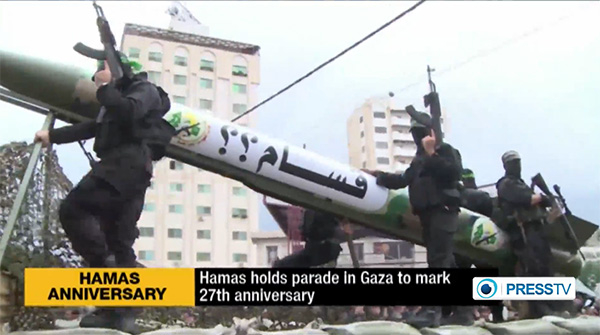
Ironically, the EU court’s decision coincided with Hamas celebrations marking the 27thanniversary of its founding. Once again, Hamas used the celebrations to remind everyone that its real goal is to destroy Israel. And, of course, Hamas used the event to display its arsenal of weapons that include various types of rockets and missiles, as well as drones.

845 (1)Thousands of armed Hamas troops showed off their military hardware at a Dec. 14, 2014 parade in Gaza, marking the organization’s 27th anniversary. (Image source: PressTV video screenshot)

Hours before the EU court decision was made public, Hamas leader Mahmoud Zahar announced that his movement would never recognize Israel. Zahar also made it clear that Hamas seeks to overthrow the Palestinian Authority [PA] regime and seize control over the West Bank.

The EU court’s decision also coincided with increased efforts to achieve rapprochement between Hamas and Iran. Recently, a senior Hamas leadership delegation visited Tehran as part of efforts to mend fences between the two sides. The main purpose of the visit was to persuade the Iranians to resume military and financial aid to Hamas. The visit, according to senior Hamas officials, appears to have been “successful.”

“There are many signs that our relations are back on the right track,” explained Hamas’s Musa Abu Marzouk. “Hamas and Iran have repaired their relations, which were strong before the Syrian crisis.” Relations between Hamas and Iran deteriorated due to the Islamist movement’s refusal to support the regime of Syrian President Bashar Assad.

Now the Iranians are likely to interpret the EU court decision to remove Hamas from the list of terrorist groups as a green light to resume financial and military aid to the movement.

Iran’s leaders recently announced that they intend to dispatch weapons not only to the Gaza Strip, but to the West Bank as well, as part of Tehran’s effort to support those Palestinians who are fighting to eliminate Israel.

Moreover, the EU court’s move will also embolden other countries that provide Hamas with political and financial aid, first and foremost Qatar and Turkey. Oil-rich Gulf countries such as Kuwait, Bahrain, Oman and Saudi Arabia will now face pressure from many Arabs and Muslims to join Qatar, Turkey and Iran in extending their support to Hamas.

The biggest losers, meanwhile, are Palestinian Authority President Mahmoud Abbas and Egypt’s President Abdel Fattah el-Sisi. Over the past few months, the two men have been doing their utmost to undermine Hamas and end its rule over the Gaza Strip.

Abbas has been fighting Hamas by blocking financial and humanitarian aid and arresting its supporters in the West Bank, while Sisi continues to tighten the blockade on the Gaza Strip and destroy dozens of smuggling tunnels along the border with Egypt.

The EU court’s decision represents a “severe blow to the Palestinian Authority and Egypt,” noted Palestinian political analyst Raed Abu Dayer. “As far is Abbas is concerned, the decision grants Hamas political legitimacy and challenges his claim to be the sole legitimate leader [of the Palestinians]. With regards to Egypt, the European court decision calls into question rulings by Egyptian courts that Hamas is a terrorist organization.”

Even if the EU court decision is reversed in the future, there’s no doubt that it has already caused tremendous damage, especially to those Muslims who are opposed to radical Islam.

Any victory for Hamas, albeit a small and symbolic one, is a victory for the Islamic State, Al-Qaeda, Islamic Jihad, the Muslim Brotherhood and other fundamentalist groups around the world.

The decision has left many Arabs and Muslims with the impression that Hamas, after all, is not a terrorist organization, especially if non-Muslims in Europe say so through one of their top courts. Even worse, the decision poses a real and immediate threat to Israel, as evident from the latest rocket attack.

If the Europeans have reached the conclusion that Hamas is not a terrorist organization, then why don’t their governments openly invite tens of thousands of Hamas members and supporters to move to London, Paris and Rome? And they should not forget to ask the Hamas members to bring along with them their arsenal of weapons.

Why is Israel blamed for evil while Islamic nations are not?

December 21, 2014

Why is Israel blamed for evil while Islamic nations are not? Dan Miller’s Blog, December 21, 2014

Blaming Israel for evil, rather than her many Islamic neighbors and enemies is, despite the views of Obama and His colleagues, contrary to American values. Doing so is based on Jew hatred, envy of success, and the multicultural absurdity that no culture or religion is better or worse than any other.

As I argued most recently here and here, Israel is fighting for her survival against regimes that want her to cease to exist because she is Jewish, not Islamic, and her government is free and democratic, not dictatorial. She is, therefore, an outsider in the Middle East.

This video identifies many of the reasons why Israel is viewed harshly by other Western civilizations while Islamic nations, which are neither free nor democratic, are viewed favorably.

I suspect that Dr. Ben Carson, who recently visited Israel and was much impressed, would agree with the points made in the video.

Although the U.S. remains Israel’s closest and most important ally, Obama and Israeli Prime Minister Benjamin Netanyahu have little personal chemistry and have frequently clashed. The U.S. has been outspoken in its criticism of Israeli settlement construction in the West Bank and east Jerusalem — captured areas claimed by the Palestinians as parts of a future state. At the same time, U.S. Secretary of State John Kerry has made numerous trips to the region and elsewhere to try to broker a peace deal.

Carson said the criticism of the settlements has been exaggerated, and he asserted that Palestinian hostility toward Israel is what is preventing peace in the region. Of Netanyahu, Carson said, “I think he’s a great leader in a difficult time.” [Emphasis added.]

The Muslim Council of Britain on the Peshawar Massacre

December 20, 2014

The Muslim Council of Britain on the Peshawar Massacre, American ThinkerPaul Austin Murphy, December 20, 2014

(Islam is taqiyya all the way down. Examples of the same sorts of Islamic distortion and public acceptance of them as true are commonplace and guide foreign policy in the United States of Obama and Europe. — DM)

The Muslim Council of Britain (MCB) seems to spend almost its entire time publishing apologies for Islamic slaughter, killing, terrorism, violence, misogyny, sexual-grooming gangs, and so on. And it usually does so with Islamic taqiyya: lies, prevarications, evasiveness, equivocations, ambiguity, deceit, dishonesty, obfuscation, deception, dissembling and dissimulation (all used to advance and/or protect Islam).

Predictably, in the aftermath of the Islamic slaughter in Peshawar, the MCB has given its own response to the event in a very short piece entitled, ‘A Massacre of Children: An Ummah in Shock’. And equally predictably, it quotes the one quote that Muslims always use in such circumstances.

Basically, you hear this passage all the time at Interfaith meetings, in the Guardian, on the BBC, etc. Try Googling the phrase and you’ll get literally dozens of links; almost all will be from Muslim or interfaith groups.

This is a passage from the Koran which even many non-Muslims will recognize. The MCB version goes:

“Whosoever kills a human being, it shall be as if he had killed all mankind, and whosoever saves the life of one, it shall be as if he had saved the life of all mankind.”

This quote is a perfect and despicable example of Islamic taqiyya and it is so for many reasons.

What surprises me, however, is that — after the deceitful nature of this passage has been demonstrated so many times and in so many different places — Muslims and Islamophiles are still using it. The MCB, for example, must think its non-Muslim supporters/readers are either stupid or even (fellow) liars.

This following is the MCB’s lead-up to its citation:

“While it is very hard to find the words to respond to the tragedy before us, I can only quote a verse from the Koran in which it says…”

And then we have the passage itself:

“Whosoever kills a human being, it shall be as if he had killed all mankind, and whosoever saves the life of one, it shall be as if he had saved the life of all mankind.”

(The passage is verse 32 of sura/chapter 5.)

Virtually no religion or ideology believes or accepts what is purported to be the meaning of that Koranic statement. In order to fully accept it, the religion or ideology concerned would have to be fully pacifist in nature (e.g., Jainism or Quakerism); which makes its use by Muslims all the more ironic or even somewhat sick.

This passage — at least within a MCB and indeed Islamic context — is at best meaningless (a mere soundbite) and at worse a piece of gross deceit.

The relevant point is that the MCB has cynically removed the middle clause knowing full well that it more or less negates the surrounding clauses. After all, the erased central clause isn’t long: it’s a mere ten words in length. This, I suggest, is classic Islamic taqiyya or deceit. And no Islamic organization does that better than the Muslim Council of Britain.

Here’s the passage in full:

“… We ordained for the Children of Israel that if anyone slew a person – unless it be for murder or spreading mischief in the land [my italics] – it would be as if he slew the whole people.”

Immediately after that, we have:

“And if anyone saved a life, it would be as he saved the life of the whole people. Then although there came to them our messengers with clear signs, yet even after that, many of them continued to commit excesses in the land.”

It can be seen that the opening clause is also always deleted by Muslims when they quote it at non-Muslims. That is, for a while I didn’t even know — because of the deliberate misquotations from Muslims (or their use of Kitman) — that the passage begins with the clause: “We [i.e., Allah] ordained for the Children of Israel…” That is followed by: “…. that if anyone slew a person…”.

So not only is this supposedly peaceful — or even pacifist — passage not aimed at Muslims in the first place (it was aimed at Jews), on only a tiny bit of analysis it can be seen not to be very peaceful or positive in the first place!

(This well-used passage is from Jewish scripture (Mishnah, Sanhedrin: 4:5) anyway. It was stolen from Jewish sources by Muhammad and his immediate followers (something they often did).

In addition, the passage doesn’t appear to have been abrogated like so many other “peaceful verses” in that book. Perhaps this is so precisely because of the surgically removed central clause.)

Here’s another equally-positive translation used by Muslim:

“That whosoever killed a human being, it shall be deemed as though he had killed all mankind.”

The actual version (again) is:

“That whosoever killed a human being, except as punishment for murder or other villainy [sometimes ‘mischief’] in the land, shall be deemed as though he had killed all mankind…”

This, of course, prompts the question: What would be deemed as “villainy” by Muslims?

What about what the Taliban has claimed about the Pakistani Army and others?

Anyway, here’s a list of what has been — and still is — classed as “villainy in the land” by millions of Muslims:

apostasy, churches, the possession of Bibles, homosexuality, preaching a religion other than Islam, all criticism of Islam, Muhammad, the Koran, not going to the mosque, sex outside marriage, atheism, Zionism, materialist philosophies and political views, secularism… basically anything non-Islamic and certainly everything anti-Islamic.

Let’s not mess about here.

Millions of Muslims today believe the very existence of people who aren’t Muslims — or lands that aren’t Islamic — are examples of “villainy in the land”.


Imperialism, Obama style

December 20, 2014

Imperialism, Obama style, Dan Miller’s Blog, December 20, 2014

Obama condemns “wicked” U.S. imperialism for supporting American values such as freedom and democracy abroad. Simultaneously, he tries to precipitate “regime change” in Israel so that she will support His values and those of Palestinians rather than American and Israeli values of freedom and democracy.

The Palestinians have placed before the United Nations Security Council a “peace proposal” intended to force Israel to agree to creation of a Palestinian state and “an Israeli withdrawal to the pre-1967 lines” by the end of 2017. Secretary Kerry has argued that the matter should not be considered until after the Israeli Knesset elections in March. According to an article in Foreign Policy,

Speaking at an annual luncheon with the 28 European Union ambassadors, Kerry cautioned that any action by the U.N. Security Council would strengthen the hands of Israeli hardliners who oppose the peace process. . . . [Emphasis added.]

“Kerry has been very, very clear that for the United States it was not an option to discuss whatever text before the end of the Israeli election,” according to a European diplomat.

The diplomat, who spoke on condition of anonymity because the luncheon was confidential, said that Kerry explained that Israel’s liberal political leaders, Shimon Peres and Tipzi Livni, had expressed concern that a Security Council move to pressure Israel on the eve of election would only strengthen the hands of Israeli hardliners, including Prime Minister Benjamin Netanyahu, and Naftali Bennett, an implacable foe of a Palestinian state and leader of the right-wing Jewish Home party. Netanyahu is also fiercely opposed to the Palestinians effort to secure Security Council backing for its statehood drive. [Emphasis added.]

Kerry said Livni had “told him that such a text imposed by the international community would reinforce Benjamin Netanyahu and the hardliners in Israel,” as well as the hardliners in Palestine, according to the European diplomat.

The message, said another European diplomat, was that U.N. action would “give more impetus to more right-wing parties, that there was a risk this could further embolden the more right-wing forces along the Israeli political spectrum.” [Emphasis added.]

Kerry’s remarks highlight the Obama administration’s delicate balancing act when it comes to its tense relationship with the Israeli government. On the one hand, senior  administration officials make little attempt to hide the personal dislike between Netanyahu and President Barack Obama or their sharp disagreements on issues ranging from the peace process to Iran. On the other hand, Kerry and other top policymakers have tried to avoid saying or doing anything that could be seen as meddling in the Israeli election in an effort to oust Netanyahu and replace him with a more centrist prime minister. [Emphasis added.]

On an open microphone in March of 2012, Obama

told Dmitry Medvedev that he would have more flexibility after November’s election to deal with contentious issues such as missile defence. . . .

Obama’s candid remark was considered a gaffe because He made it assuming that the microphone had been turned off and that no one other than Medvedev would hear Him. Kerry, however, candidly but intentionally told twenty-eight European Union ambassadors that it is U.S. policy to encourage the Israeli left, to diminish the Israeli right and to make it more difficult for Prime Minister Netanyahu to remain in office. Aside from his incredible naivete, why did Kerry do that?

For Obama and European leaders, Israel is reducible to the peace process. And the Israeli left depends on the support of foreign governments for its network of foreign funded non-profit organizations. The Israeli left can’t let go of its exploding version of ObamaCare [Palestine] because the left is becoming a foreign organization with limited domestic support. Its electorate isn’t in Israel; it’s in Brussels. [Emphasis and bracketed insert added.]

. . . .

Escalating a crisis in relations has been the traditional way for US administrations to force Israeli governments out of office. Bill Clinton did it to Netanyahu and as Israeli elections appear on the horizon Obama would love to do it all over again.

There’s only one problem.

The United States is popular in Israel, but Obama isn’t. Obama’s spats with Netanyahu ended up making the Israeli leader more popular. The plan was for Obama to gaslight Israelis by maintaining a positive image in Israel while lashing out at the Jewish State so that the blame would fall on Netanyahu. [Emphasis added.]

Kerry’s remarks — covered by Israeli media — seem, contrary to his intentions, likely to enhance the chances of Israeli “hardliners” on the “right,” to hurt the chances of those on the left and hence to increase PM Netanyahu’s chances of remaining in office. Even leaving that aside, how will Kerry’s remarks favoring regime change be viewed by other increasingly reluctant U.S. allies in the Middle East?

Israeli “hardliners” have already yielded to the Palestinians as much as, if not more than, they can without greatly endangering the security of Israel because there is no Palestinian entity with which peace can be made other than through Israel’s suicide.

The remarks of the Islamic preacher at the mosque in Jerusalem reflect a general Palestinian view.

Interestingly, the speaker doesn’t mention the longing for Palestinian statehood or independence. Instead, he talks of the establishment of the “Islamic Caliphate.” “Oh Allah’” he states, “Hasten the establishment of the State of the Islamic Caliphate,” and further rants, “Oh Allah hasten the pledge of allegiance to the Muslim Caliph.” He spews forth the latter statement three times to chants of “Amen!” from the large, approving crowd congregating around him.

These comments, which would register horror and revulsion in the West (at least in some quarters) are almost banal among Palestinians. In fact, a similar video featuring a different speaker some days earlier at the same venue, conveyed identical sentiment, expressing admiration for the Islamic State and calling for murder of Jews and annihilation of America. [Emphasis added.]

Here’s the other video referenced in the article:

Guttural anti-Semitism is ingrained and interwoven in the fabric of Palestinian society. Despite their minuscule numbers, 78% of Palestinians believe that Jews are responsible for most of the world’s wars while a whopping 88% believe that Jews control the global media and still more believe that Jews wield too much power in the business world. [Emphasis added.]

Much of the blame for this can be placed squarely on the doorstep of Mahmoud Abbas’s Palestinian Authority, which subjects the Palestinian population to a steady diet of hate-filled, Judeophobic rhetoric through state-controlled media and educational institutions. It is so well entrenched that the process of deprogramming, if it were ever attempted, would take generations to reverse. [Emphasis added.]

As noted in the Wall Street Journal article linked in the quote immediately above,

To understand why peace in Palestine is years if not decades away, consider the Palestinian celebrations after Tuesday’s murder in a Jerusalem synagogue of five Israelis, including three with joint U.S. citizenship. Two Palestinian cousins armed with meat cleavers and a gun attacked worshipers during morning prayers, and the response was jubilation in the streets.

The Popular Front for the Liberation of Palestine claimed responsibility, while Hamas praised the murders as a “response to continued Israeli crimes.” The main obstacle to peace isn’t Jewish settlements in the multireligious city of Jerusalem. The barrier is the culture of hatred against Jews that is nurtured by Palestinian leaders. [Emphasis added.]

Palestinian Prime Minister Mahmoud Abbas condemned the killings, but not without calling for Israel to halt what he called “invasions” of the holy Al Aqsa Mosque in Jerusalem. Mr. Abbas has previously said the Temple Mount was being “contaminated” by Jews, despite assurances by Prime Minister Benjamin Netanyahu that the Dome of the Rock and Al Aqsa Mosque are for Muslim worship only. The Memri news service reports that the Oct. 29 issue of the Palestinian daily Al-Hayat Al-Jadida was full of false accusations that Israel is damaging Jerusalem’s holy sites. [Emphasis added.]

Moreover,

An overwhelming majority of Palestinian Arabs support the recent spate of terrorist attacks against Israelis, an opinion poll released Tuesday finds, according to The Associated Press (AP).[Emphasis added.]

The poll also found that more than half of Palestinian Arabs support a new “intifada” (uprising) against Israel, and that Hamas would win presidential elections if they were held today. [Emphasis added.]

Palestinian Arab pollster Khalil Shikaki said the results reflected anger over Israeli statements about Jerusalem, as well as a loss of hope following the collapse of U.S.-brokered peace talks and Israel’s recent war with Hamas in Gaza.

Shikaki heads the Palestinian Center for Policy and Survey Research, which interviewed 1,270 people in the Palestinian Authority-assigned areas of Judea and Samaria and Gaza last week. The poll had an error margin of 3 percentage points.

“There is an environment in which violence is becoming a dominant issue,” Shikaki told AP. “This seems to be one of the most important driving forces.”

Hamas is, if possible, even worse than Abbas’ Palestinian Authority.

Both Hamas and Abbas’ Palestinian Authority seek the death of Israeli Jews and the destruction of Israel, the only democratic and free nation in the Middle East. Kerry’s ill-conceived efforts to assist them at the expense of Israel, most recently by actively seeking to promote Israel’s left wing, to diminish its right wing and hence to empower Palestinians intent upon the death of Israel, may well fail. Succeed or fail, those efforts are consistent with Obama’s preference for Islamic dictators over democracy coupled with freedom.

Barack Mitsvah

Off Topic: Awed by Israel, 2016 Republican hopeful Ben Carson pledges support

December 20, 2014

Awed by Israel, 2016 Republican hopeful Ben Carson pledges support, Times of IsraelJOSEF FEDERMAN, December 20, 2014

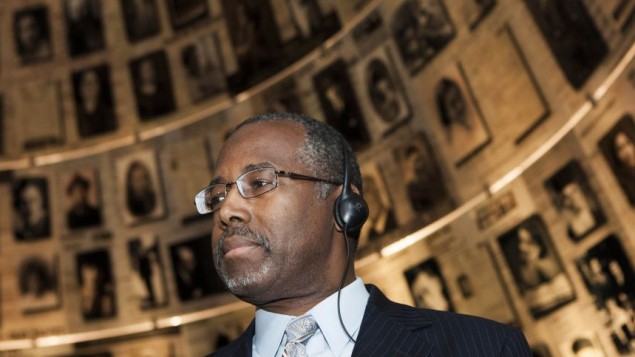
Mideast-Israel-Carson_Horo-e1419086784255-635x357Ben Carson visits Yad Vashem Holocaust memorial in Jerusalem on December 18, 2014. Carson, 63, a retired African-American neurosurgeon best known for his groundbreaking work in separating conjoined twins, has not yet declared his candidacy for the Republican Presidential nomination, saying that he is “strongly considering” a bid. (photo credit: AP Photo/Dan Balilty)

Carson said the criticism of the settlements has been exaggerated, and he asserted that Palestinian hostility toward Israel is what is preventing peace in the region. Of Netanyahu, Carson said, “I think he’s a great leader in a difficult time.”

**************

JERUSALEM (AP) — In his first visit to Israel, prospective Republican presidential candidate Ben Carson said he is in awe of the Jewish state, inspired by its ancient holy sites, impressed by the resilience of people living in a perpetual conflict zone — and deeply disappointed in President Barack Obama.

“I do not believe that Obama has been one to cultivate the relationship,” said Dr. Carson, a retired neurosurgeon who has emerged as a favorite of some conservatives in the early field of possible GOP candidates.

“I would make it very clear that Israel and the United States have a long, cordial relationship, and I don’t think we should ever leave the Israelis in a position of wondering whether we support them,” Carson said in an hour long interview with The Associated Press in Jerusalem. “And that certainly is a question now.”

Carson, 63, perhaps best known for his groundbreaking work in separating conjoined twins, is largely unknown to most Americans. But he’s earned hero status among conservative activists thanks to his outspoken criticism of Obama’s health care law.

His rags-to-riches story — he had a hardscrabble childhood in inner-city Detroit — and his deep Christian faith also appeal to potential voters. While Carson has said he is “strongly considering” a bid, supporters have already opened offices in the early voting states of Iowa and New Hampshire.

He is one of more than a dozen Republicans eyeing the presidency, and those with little international experience, such as Carson, are working to strengthen their resumes before formally announcing their 2016 plans.

Carson at Israeli hospitalBen Carson visits in Hadassah Hospital in Jerusalem, December 18, 2014. (photo credit: AP Photo/Dan Balilty)

Speaking to the AP, Carson expressed views that are common among Israel’s nationalist right wing. He showed sympathy for Israel’s much-maligned settlement movement and questioned the desire among Palestinians for peace. He even suggested that instead of Israel relinquishing captured land to make way for a Palestinian state, neighboring countries such as Egypt should provide the space for a future Palestine.

“That’s one possibility,” he said.

Carson is visiting Israel as a guest of “The Face of Israel,” a private group that sponsors trips for “influential decision makers” to promote a positive image of the country and counter “threats to Israel’s international legitimacy.” The trip has included visits to Israel’s northern front with Syria and the southern border with Gaza, and meetings with military officials and everyday people.

Although the U.S. remains Israel’s closest and most important ally, Obama and Israeli Prime Minister Benjamin Netanyahu have little personal chemistry and have frequently clashed. The U.S. has been outspoken in its criticism of Israeli settlement construction in the West Bank and east Jerusalem — captured areas claimed by the Palestinians as parts of a future state. At the same time, U.S. Secretary of State John Kerry has made numerous trips to the region and elsewhere to try to broker a peace deal.

Carson said the criticism of the settlements has been exaggerated, and he asserted that Palestinian hostility toward Israel is what is preventing peace in the region. Of Netanyahu, Carson said, “I think he’s a great leader in a difficult time.”

While he expressed sympathy for the plight of Palestinians, Carson said Israeli security concerns were more important in the short term, noting that after Israel’s withdrawal of troops and settlers from the Gaza Strip in 2005, the territory was overrun by Hamas militants. An Israeli withdrawal from the West Bank, he said, would be even riskier, given its proximity to major Israeli cities.

“Until such time as their neighbors are no longer desirous of their elimination,” he said, Israel’s continued control of the West Bank “makes perfectly good sense.”

There is little disagreement among the GOP’s top prospects on American policy toward Israel, given religious conservatives’ overwhelming support for the Jewish state and the influence of conservative donors like billionaire casino mogul Sheldon Adelson, an outspoken Israel supporter who donated more to Republicans in the last presidential contest than anyone else.

Carson said he expects to make a decision on seeking the presidency by May. If he wins the job, he promised a different approach toward Israel.

“I would make sure that Israel knew that we had their back,” he said. “Because if their neighbors know that we’re backing them up, they’re not going to be anywhere near as aggressive.”